

生物多样性 ›› 2026, Vol. 34 ›› Issue (7): 26134. DOI: 10.17520/biods.2026134 cstr: 32101.14.biods.2026134
孙秀锋1( ), 李旭2,*(
 ), 丁成龙1, 燕俊儒1, 尹杰1, 潘良倩1
收稿日期:2026-04-15
接受日期:2026-07-17
出版日期:2026-07-20
发布日期:2026-09-21
通讯作者:
李旭
基金资助:
Xiufeng Sun1(), Xu Li2,*(), Chenglong Ding1, Junru Yan1, Jie Yin1, Liangqian Pan1
Received:2026-04-15
Accepted:2026-07-17
Online:2026-07-20
Published:2026-09-21
Contact:
Xu Li
Supported by:摘要:
古树是记录自然环境演变与人类活动历史的重要载体, 对维护生物与文化多样性具有重要意义。然而, 在快速城镇化背景下, 城乡二元结构如何差异化影响古树留存机制尚缺乏系统认知。本文以处于我国种子植物特有属分布核心区的重庆市为研究范围, 基于29,104株古树数据及18个环境因子, 综合运用树种多样性指数、空间自相关分析、XGBoost-SHAP可解释性机器学习与最大熵(MaxEnt)模型等方法, 对比解析了城乡古树的空间分布格局及其驱动机制。结果表明: (1)重庆市古树隶属73科158属304种, 呈现“优势种集中与稀有种并存”特征, 38.8%的树种个体数少于3株, 区系具显著的热带-温带过渡性; 城乡树种组成分异明显, 城区观赏树种占比突出, 乡村以地带性遗存树种为主。(2)古树空间分布呈显著聚集特征, 渝东南和渝东北为古树高多样性与高珍稀度复合集聚区。(3)城乡古树留存机制存在显著差异, 乡村古树多样性受自然生境筛选主导, 并表现出复杂的非线性阈值效应, 如地表温度 < 21.79℃利于其留存; 城区古树分布则主要受社会文化因子塑造, 历史公园与文化遗产是其核心空间载体, 如距公园距离的贡献率可达43.2%, 同时不同树种对人文因子的响应存在特异性。本研究揭示了“乡村自然筛选-城区人文塑造”的古树留存二元机制, 基于此, 构建了融合“城乡梯度-珍稀度等级-树种类型”的三维保护策略体系框架, 以期为区域古树资源及生物文化多样性的协同保护提供科学参考。
孙秀锋, 李旭, 丁成龙, 燕俊儒, 尹杰, 潘良倩 (2026) 城乡二元结构下重庆市古树空间格局、留存机制与保护策略. 生物多样性, 34, 26134. DOI: 10.17520/biods.2026134.
Xiufeng Sun, Xu Li, Chenglong Ding, Junru Yan, Jie Yin, Liangqian Pan (2026) Spatial pattern, retention mechanism, and conservation strategies of ancient trees in Chongqing under the urban-rural dual structure. Biodiversity Science, 34, 26134. DOI: 10.17520/biods.2026134.
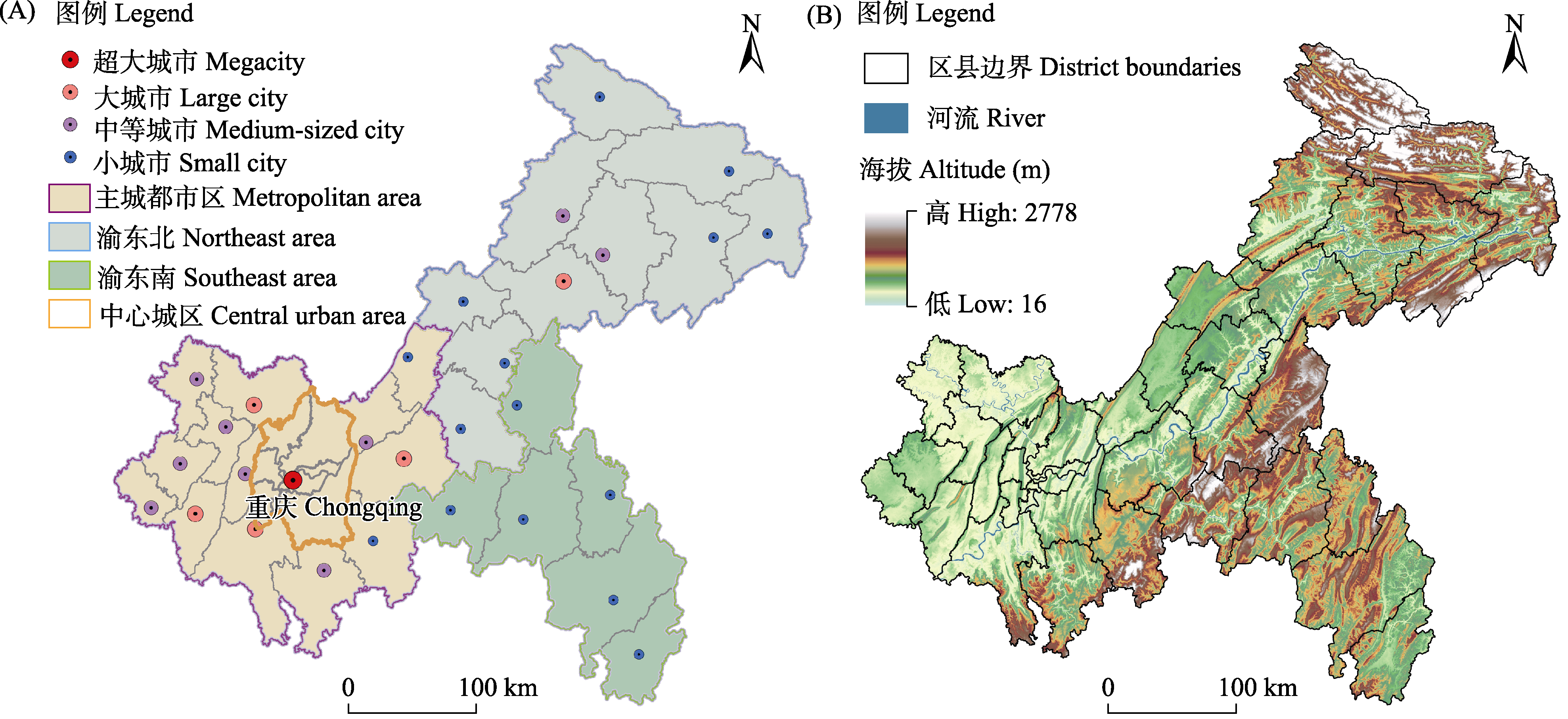
图1 重庆市发展分区图(A)和地形图(B)
Fig. 1 Development zoning map (A) and topographic map (B) of Chongqing
| 城市区域 Urban areas | 乡村区域 Rural areas | ||||||||||
|---|---|---|---|---|---|---|---|---|---|---|---|
| 排名 Rank | 科 Family | 属数 No. of genera | 种数 No. of species | 株数 No. of individuals | 株数占比 Percentage of individuals (%) | 排名 Rank | 科 Family | 属数 No. of genera | 种数 No. of species | 株数 No. of individuals | 株数占比 Percentage of individuals (%) |
| 1 | 桑科 Moraceae | 3 | 8 | 2,331 | 65.50 | 1 | 桑科 Moraceae | 6 | 12 | 9,455 | 37.01 |
| 2 | 樟科 Lauraceae | 3 | 4 | 223 | 6.27 | 2 | 柏科 Cupressaceae | 6 | 8 | 2,633 | 10.30 |
| 3 | 山茶科 Theaceae | 1 | 1 | 166 | 4.66 | 3 | 蕈树科 Altingiaceae | 1 | 1 | 1,984 | 7.78 |
| 4 | 银杏科 Ginkgoaceae | 1 | 1 | 154 | 4.33 | 4 | 壳斗科 Fagaceae | 5 | 27 | 1,835 | 7.18 |
| 5 | 木樨科 Oleaceae | 4 | 5 | 125 | 3.51 | 5 | 樟科 Lauraceae | 7 | 20 | 1,368 | 5.36 |
| 6 | 罗汉松科 Podocarpaceae | 1 | 1 | 108 | 3.03 | 6 | 银杏科 Ginkgoaceae | 1 | 1 | 1,289 | 5.05 |
| 7 | 豆科 Fabaceae | 6 | 7 | 76 | 2.14 | 7 | 漆树科 Anacardiaceae | 4 | 5 | 1,107 | 4.33 |
| 8 | 漆树科 Anacardiaceae | 2 | 2 | 40 | 1.12 | 8 | 木樨科 Oleaceae | 4 | 6 | 699 | 2.74 |
| 9 | 苏铁科 Cycadaceae | 1 | 1 | 37 | 1.04 | 9 | 豆科 Fabaceae | 11 | 15 | 675 | 2.64 |
| 10 | 大麻科 Cannabaceae | 2 | 3 | 33 | 0.93 | 10 | 松科 Pinaceae | 7 | 17 | 595 | 2.33 |
| 合计 Total | - | 24 | 33 | 3,293 | 92.53 | 合计 Total | - | 52 | 112 | 21,640 | 84.71 |
表1 重庆市城区与乡村古树株数排名前10位的科
Table 1 The top 10 families by number of individuals of ancient trees in urban and rural areas of Chongqing
| 城市区域 Urban areas | 乡村区域 Rural areas | ||||||||||
|---|---|---|---|---|---|---|---|---|---|---|---|
| 排名 Rank | 科 Family | 属数 No. of genera | 种数 No. of species | 株数 No. of individuals | 株数占比 Percentage of individuals (%) | 排名 Rank | 科 Family | 属数 No. of genera | 种数 No. of species | 株数 No. of individuals | 株数占比 Percentage of individuals (%) |
| 1 | 桑科 Moraceae | 3 | 8 | 2,331 | 65.50 | 1 | 桑科 Moraceae | 6 | 12 | 9,455 | 37.01 |
| 2 | 樟科 Lauraceae | 3 | 4 | 223 | 6.27 | 2 | 柏科 Cupressaceae | 6 | 8 | 2,633 | 10.30 |
| 3 | 山茶科 Theaceae | 1 | 1 | 166 | 4.66 | 3 | 蕈树科 Altingiaceae | 1 | 1 | 1,984 | 7.78 |
| 4 | 银杏科 Ginkgoaceae | 1 | 1 | 154 | 4.33 | 4 | 壳斗科 Fagaceae | 5 | 27 | 1,835 | 7.18 |
| 5 | 木樨科 Oleaceae | 4 | 5 | 125 | 3.51 | 5 | 樟科 Lauraceae | 7 | 20 | 1,368 | 5.36 |
| 6 | 罗汉松科 Podocarpaceae | 1 | 1 | 108 | 3.03 | 6 | 银杏科 Ginkgoaceae | 1 | 1 | 1,289 | 5.05 |
| 7 | 豆科 Fabaceae | 6 | 7 | 76 | 2.14 | 7 | 漆树科 Anacardiaceae | 4 | 5 | 1,107 | 4.33 |
| 8 | 漆树科 Anacardiaceae | 2 | 2 | 40 | 1.12 | 8 | 木樨科 Oleaceae | 4 | 6 | 699 | 2.74 |
| 9 | 苏铁科 Cycadaceae | 1 | 1 | 37 | 1.04 | 9 | 豆科 Fabaceae | 11 | 15 | 675 | 2.64 |
| 10 | 大麻科 Cannabaceae | 2 | 3 | 33 | 0.93 | 10 | 松科 Pinaceae | 7 | 17 | 595 | 2.33 |
| 合计 Total | - | 24 | 33 | 3,293 | 92.53 | 合计 Total | - | 52 | 112 | 21,640 | 84.71 |
| 树种 Tree species | IUCN濒危等级 IUCN red list category | 国家重点保护等级 National key protection level | 中国特有 Chinese endemic | 株数 No. of individuals | 珍稀度值 Rarity value |
|---|---|---|---|---|---|
| 银杏 Ginkgo biloba | EN | I | + | 1,442 | 8.56 |
| 崖柏 Thuja sutchuenensis | EN | I | + | 1 | 8.56 |
| 西藏红豆杉 Taxus wallichiana | EN | I | + | 1 | 8.56 |
| 水杉 Metasequoia glyptostroboides | EN | I | + | 11 | 8.56 |
| 南川木波罗 Artocarpus nanchuanensis | CR | II | + | 5 | 8.35 |
| 大果青杄 Picea neoveitchii | CR | II | + | 3 | 8.35 |
| 银杉 Cathaya argyrophylla | VU | I | + | 8 | 7.60 |
| 南方红豆杉 Taxus wallichiana var. mairei | VU | I | + | 37 | 7.60 |
| 润楠 Machilus nanmu | EN | II | + | 34 | 6.91 |
| 伯乐树 Bretschneidera sinensis | EN | II | + | 1 | 6.91 |
| 梓叶槭 Acer amplum subsp. catalpifolium | VU | II | + | 4 | 5.95 |
| 台湾杉 Taiwania cryptomerioides | VU | II | + | 2 | 5.95 |
| 楠木 Phoebe zhennan | VU | II | + | 5 | 5.95 |
| 大叶榉树 Zelkova schneideriana | VU | II | + | 2 | 5.95 |
| 珙桐 Davidia involucrata | - | I | + | 27 | 5.20 |
| 鹅掌楸 Liriodendron chinense | NT | II | + | 17 | 4.99 |
| 苏铁 Cycas revoluta | LC | I | - | 65 | 4.73 |
| 云杉 Picea asperata | VU | - | + | 3 | 4.63 |
| 冷杉 Abies fabri | VU | - | + | 26 | 4.63 |
| 黄杉 Pseudotsuga sinensis | VU | - | + | 18 | 4.63 |
| 杜仲 Eucommia ulmoides | VU | - | + | 1 | 4.63 |
| 大果榉 Zelkova sinica | VU | - | + | 3 | 4.63 |
| 白桂木 Artocarpus hypargyreus | VU | - | + | 1 | 4.63 |
| 罗汉松 Podocarpus macrophyllus | LC | II | + | 228 | 4.03 |
| 连香树 Cercidiphyllum japonicum | LC | II | + | 5 | 4.03 |
| 阔叶樟 Camphora platyphylla | VU | - | - | 16 | 3.68 |
| 榉树 Zelkova serrata | NT | - | + | 219 | 3.67 |
| 红豆树 Ormosia hosiei | NT | - | + | 105 | 3.67 |
| 侧柏 Platycladus orientalis | NT | - | + | 3 | 3.67 |
| 巴山松 Pinus henryi | NT | - | + | 9 | 3.67 |
| 中华猕猴桃 Actinidia chinensis | - | II | + | 1 | 3.55 |
| 油樟 Cinnamomum longepaniculatum | - | II | + | 29 | 3.55 |
| 香果树 Emmenopterys henryi | - | II | + | 21 | 3.55 |
| 桫椤 Alsophila spinulosa | - | II | + | 10 | 3.55 |
| 苏铁蕨 Brainea insignis | - | II | + | 1 | 3.55 |
| 峨眉含笑 Michelia wilsonii | - | II | + | 1 | 3.55 |
| 红椿 Toona ciliata | LC | II | - | 18 | 3.08 |
| 水青树 Tetracentron sinense | - | II | - | 17 | 2.60 |
| 龙眼 Dimocarpus longan | - | II | - | 104 | 2.60 |
表2 重庆市古树珍稀度分级表
Table 2 Rarity grading of ancient trees in Chongqing
| 树种 Tree species | IUCN濒危等级 IUCN red list category | 国家重点保护等级 National key protection level | 中国特有 Chinese endemic | 株数 No. of individuals | 珍稀度值 Rarity value |
|---|---|---|---|---|---|
| 银杏 Ginkgo biloba | EN | I | + | 1,442 | 8.56 |
| 崖柏 Thuja sutchuenensis | EN | I | + | 1 | 8.56 |
| 西藏红豆杉 Taxus wallichiana | EN | I | + | 1 | 8.56 |
| 水杉 Metasequoia glyptostroboides | EN | I | + | 11 | 8.56 |
| 南川木波罗 Artocarpus nanchuanensis | CR | II | + | 5 | 8.35 |
| 大果青杄 Picea neoveitchii | CR | II | + | 3 | 8.35 |
| 银杉 Cathaya argyrophylla | VU | I | + | 8 | 7.60 |
| 南方红豆杉 Taxus wallichiana var. mairei | VU | I | + | 37 | 7.60 |
| 润楠 Machilus nanmu | EN | II | + | 34 | 6.91 |
| 伯乐树 Bretschneidera sinensis | EN | II | + | 1 | 6.91 |
| 梓叶槭 Acer amplum subsp. catalpifolium | VU | II | + | 4 | 5.95 |
| 台湾杉 Taiwania cryptomerioides | VU | II | + | 2 | 5.95 |
| 楠木 Phoebe zhennan | VU | II | + | 5 | 5.95 |
| 大叶榉树 Zelkova schneideriana | VU | II | + | 2 | 5.95 |
| 珙桐 Davidia involucrata | - | I | + | 27 | 5.20 |
| 鹅掌楸 Liriodendron chinense | NT | II | + | 17 | 4.99 |
| 苏铁 Cycas revoluta | LC | I | - | 65 | 4.73 |
| 云杉 Picea asperata | VU | - | + | 3 | 4.63 |
| 冷杉 Abies fabri | VU | - | + | 26 | 4.63 |
| 黄杉 Pseudotsuga sinensis | VU | - | + | 18 | 4.63 |
| 杜仲 Eucommia ulmoides | VU | - | + | 1 | 4.63 |
| 大果榉 Zelkova sinica | VU | - | + | 3 | 4.63 |
| 白桂木 Artocarpus hypargyreus | VU | - | + | 1 | 4.63 |
| 罗汉松 Podocarpus macrophyllus | LC | II | + | 228 | 4.03 |
| 连香树 Cercidiphyllum japonicum | LC | II | + | 5 | 4.03 |
| 阔叶樟 Camphora platyphylla | VU | - | - | 16 | 3.68 |
| 榉树 Zelkova serrata | NT | - | + | 219 | 3.67 |
| 红豆树 Ormosia hosiei | NT | - | + | 105 | 3.67 |
| 侧柏 Platycladus orientalis | NT | - | + | 3 | 3.67 |
| 巴山松 Pinus henryi | NT | - | + | 9 | 3.67 |
| 中华猕猴桃 Actinidia chinensis | - | II | + | 1 | 3.55 |
| 油樟 Cinnamomum longepaniculatum | - | II | + | 29 | 3.55 |
| 香果树 Emmenopterys henryi | - | II | + | 21 | 3.55 |
| 桫椤 Alsophila spinulosa | - | II | + | 10 | 3.55 |
| 苏铁蕨 Brainea insignis | - | II | + | 1 | 3.55 |
| 峨眉含笑 Michelia wilsonii | - | II | + | 1 | 3.55 |
| 红椿 Toona ciliata | LC | II | - | 18 | 3.08 |
| 水青树 Tetracentron sinense | - | II | - | 17 | 2.60 |
| 龙眼 Dimocarpus longan | - | II | - | 104 | 2.60 |
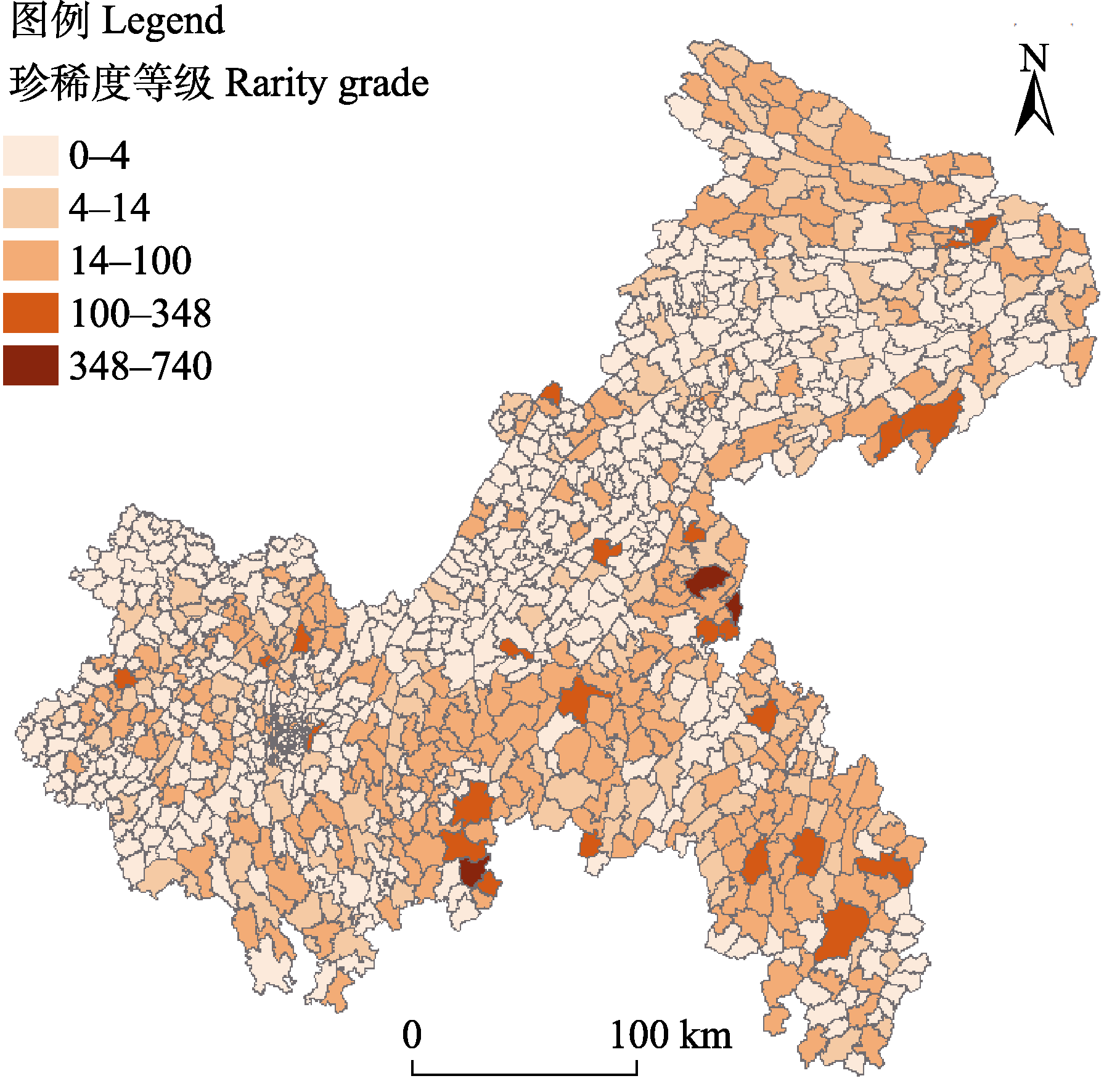
图2 重庆古树珍稀度等级空间分布图(珍稀度分值采用左闭右开原则进行等级划分, 如0 ≤ R < 4; 4 ≤ R < 14)
Fig. 2 Spatial distribution map of ancient tree rarity grades in Chongqing (The rarity scores are classified into grades based on the left-closed and right-open principle; e.g., 0 ≤ R < 4; 4 ≤ R < 14)
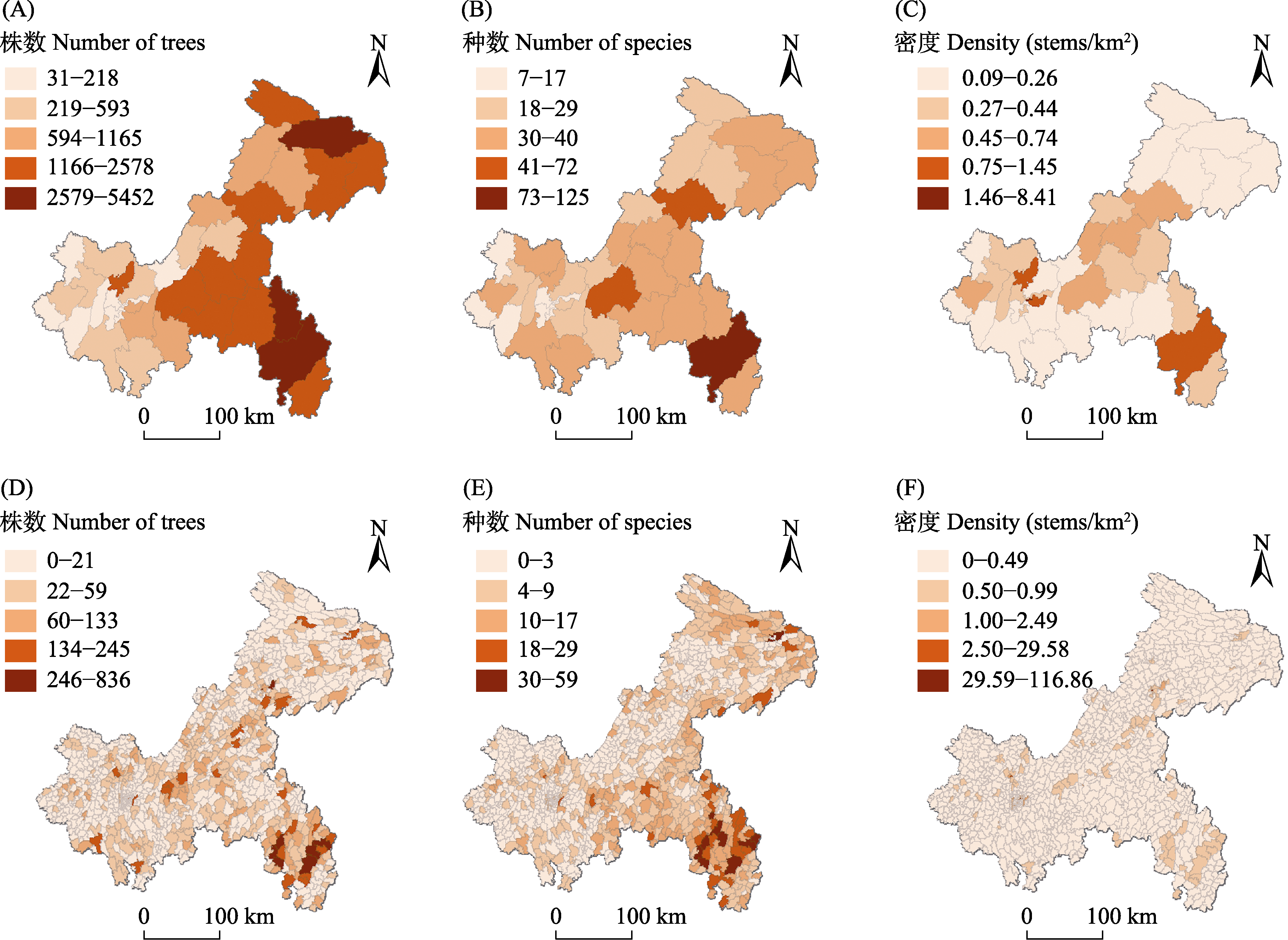
图3 重庆市区县尺度(A、B、C)和乡镇尺度(D、E、F)古树株数、种数及密度空间分布图
Fig. 3 Spatial distribution map of plant count, species count, and density at the district/county scale (A, B, C) and township scale (D, E, F) in Chongqing
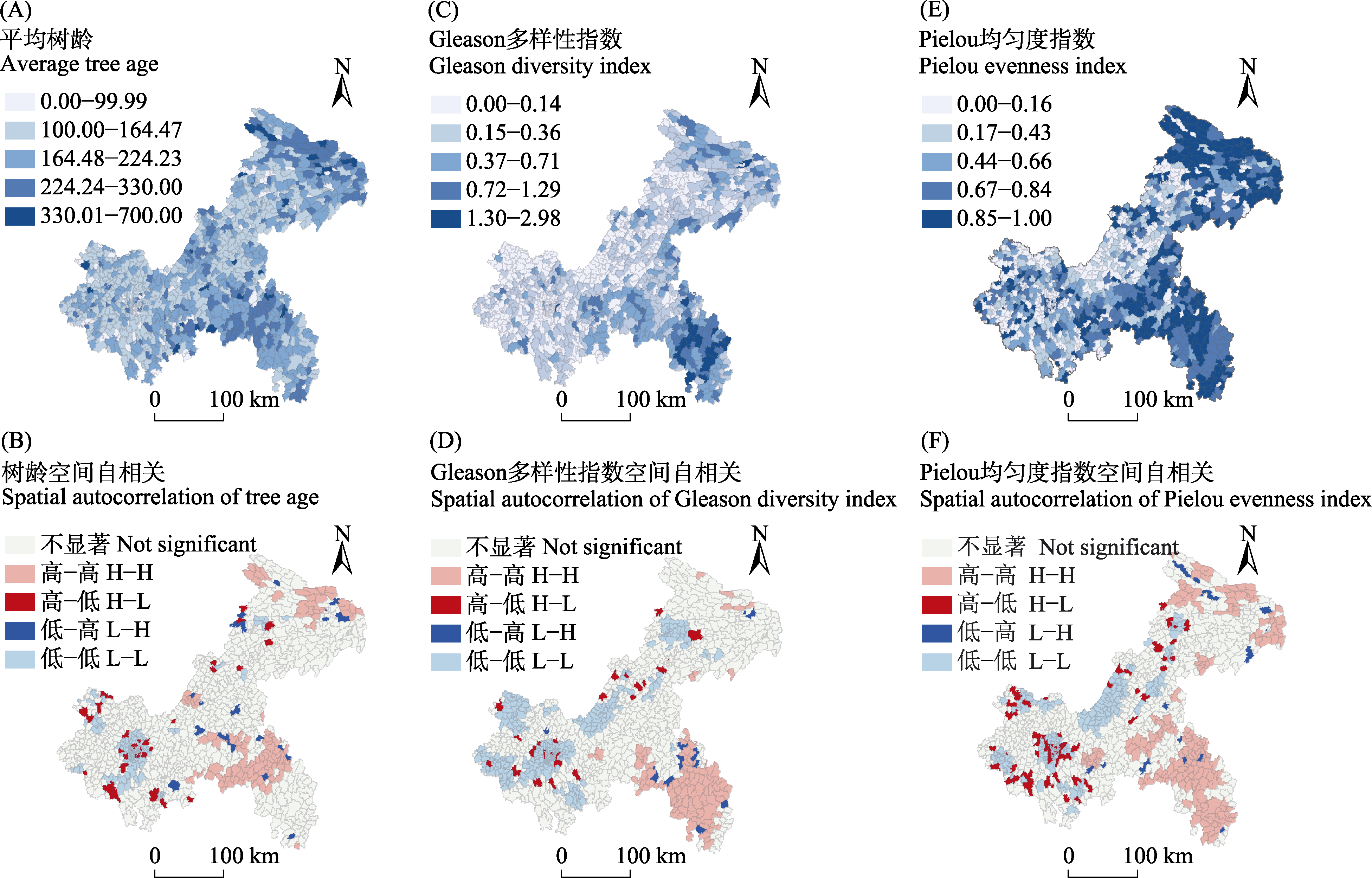
图4 重庆市乡镇尺度古树平均树龄(A、B)、Gleason多样性指数(C、D)及Pielou均匀度指数(E、F)空间分布特征及其空间自相关
Fig. 4 Spatial distribution characteristics and spatial autocorrelation of the average age of ancient trees (A, B), Gleason diversity index (C, D), and Pielou evenness index (E, F) at the township scale in Chongqing. H, High; L, Low.
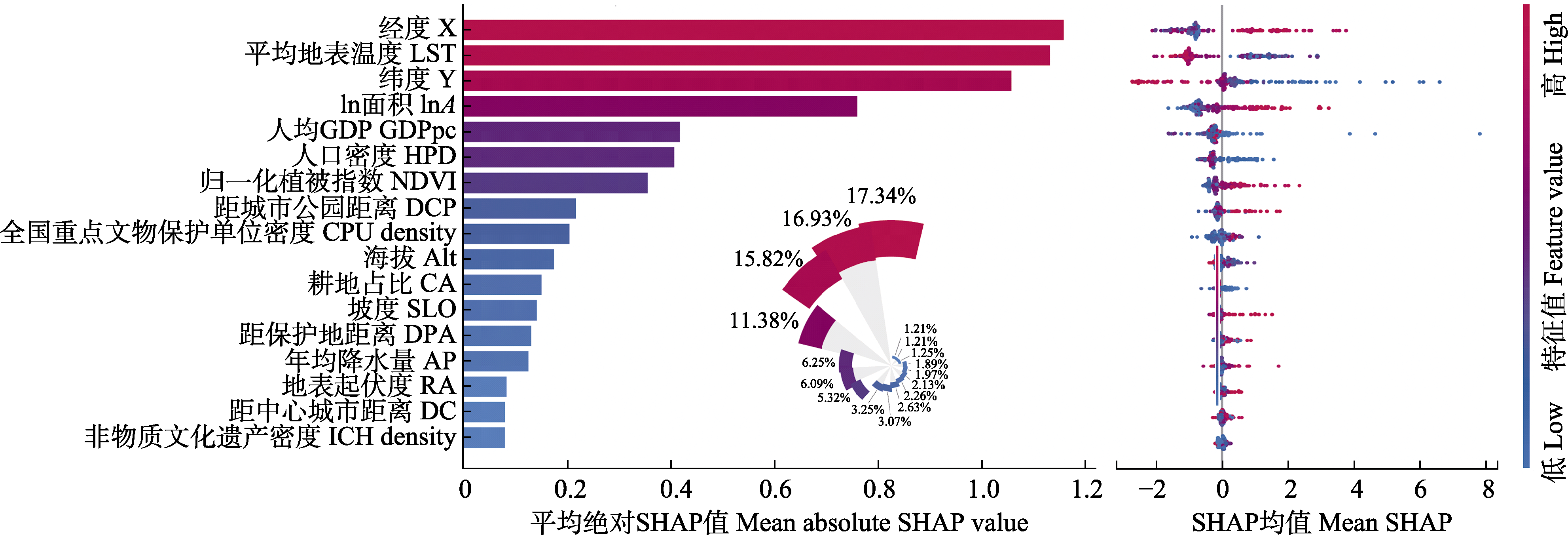
图5 乡村古树树种多样性驱动因子重要性及SHAP蜂群图
Fig. 5 Driver importance and SHAP bee swarm plot for rural ancient tree species diversity. X, Longitude; Y, Latitude; LST, Mean land surface temperature; A, Area; GDPpc, Gross domestic product (GDP) per capita; HPD, Population density; NDVI, Normalized difference vegetation index; DCP, Distance to urban parks; CPU, National key cultural relics protection units; ALT, Altitude; CA, Cropland proportion; SLO, Slope; DPA, Distance to protected areas; AP, Mean annual precipitation; RA, Topographic relief; DC, Distance to central city; ICH, Intangible cultural heritage.
| 古树树种 Ancient tree | 主导因子及贡献率 Dominant factors and contribution rates (%) | 累积贡献率 Cumulative contribution rates (%) | |||||
|---|---|---|---|---|---|---|---|
| 全部树种 All Species | 距城市公园距离 Distance to urban parks (43.2) | 归一化植被指数 NDVI (32.7) | 海拔 Altitude (6.5) | 国内生产总值 GDP (2.7) | 85.1 | ||
| 黄葛树 Ficus virens | 距城市公园距离 Distance to urban parks (34.6) | 归一化植被指数 NDVI (26.6) | 海拔 Altitude (18.9) | 年均降水量 Mean annual precipitation (3.6) | 国内生产总值 GDP (3.4) | 87.1 | |
| 山茶 Camellia japonica | 距城市公园距离 Distance to urban parks (45.5) | 非物质文化遗产密度 ICH density (15.0) | 土壤质地 Soil texture (11.4) | 全国重点文物保护单位密度 CPU density (6.7) | 人口密度 Population density (6.4) | 85.0 | |
| 银杏 Ginkgo biloba | 距城市公园距离 Distance to urban parks (50.5) | 国内生产总值GDP (15.0) | 归一化植被指数 NDVI (12.3) | 距中心城市距离 Distance to central city (6.6) | 非物质文化遗产密度 ICH density (2.8) | 87.2 | |
| 香樟 Cinnamomum camphora | 人口密度 Population density (33.5) | 植被类型Vegetation type (17.9) | 归一化植被指数 NDVI (15.9) | 距城市公园距离 Distance to urban parks (9.6) | 全国重点文物保护单位密度 CPU density (7.9) | 年均降水量 Mean annual precipitation(2.6) | 87.4 |
表3 城区主导环境因子及其对古树和优势树种分布的贡献率
Table 3 Dominant environmental factors and their contributions to the distribution of ancient and dominant tree species in urban areas
| 古树树种 Ancient tree | 主导因子及贡献率 Dominant factors and contribution rates (%) | 累积贡献率 Cumulative contribution rates (%) | |||||
|---|---|---|---|---|---|---|---|
| 全部树种 All Species | 距城市公园距离 Distance to urban parks (43.2) | 归一化植被指数 NDVI (32.7) | 海拔 Altitude (6.5) | 国内生产总值 GDP (2.7) | 85.1 | ||
| 黄葛树 Ficus virens | 距城市公园距离 Distance to urban parks (34.6) | 归一化植被指数 NDVI (26.6) | 海拔 Altitude (18.9) | 年均降水量 Mean annual precipitation (3.6) | 国内生产总值 GDP (3.4) | 87.1 | |
| 山茶 Camellia japonica | 距城市公园距离 Distance to urban parks (45.5) | 非物质文化遗产密度 ICH density (15.0) | 土壤质地 Soil texture (11.4) | 全国重点文物保护单位密度 CPU density (6.7) | 人口密度 Population density (6.4) | 85.0 | |
| 银杏 Ginkgo biloba | 距城市公园距离 Distance to urban parks (50.5) | 国内生产总值GDP (15.0) | 归一化植被指数 NDVI (12.3) | 距中心城市距离 Distance to central city (6.6) | 非物质文化遗产密度 ICH density (2.8) | 87.2 | |
| 香樟 Cinnamomum camphora | 人口密度 Population density (33.5) | 植被类型Vegetation type (17.9) | 归一化植被指数 NDVI (15.9) | 距城市公园距离 Distance to urban parks (9.6) | 全国重点文物保护单位密度 CPU density (7.9) | 年均降水量 Mean annual precipitation(2.6) | 87.4 |
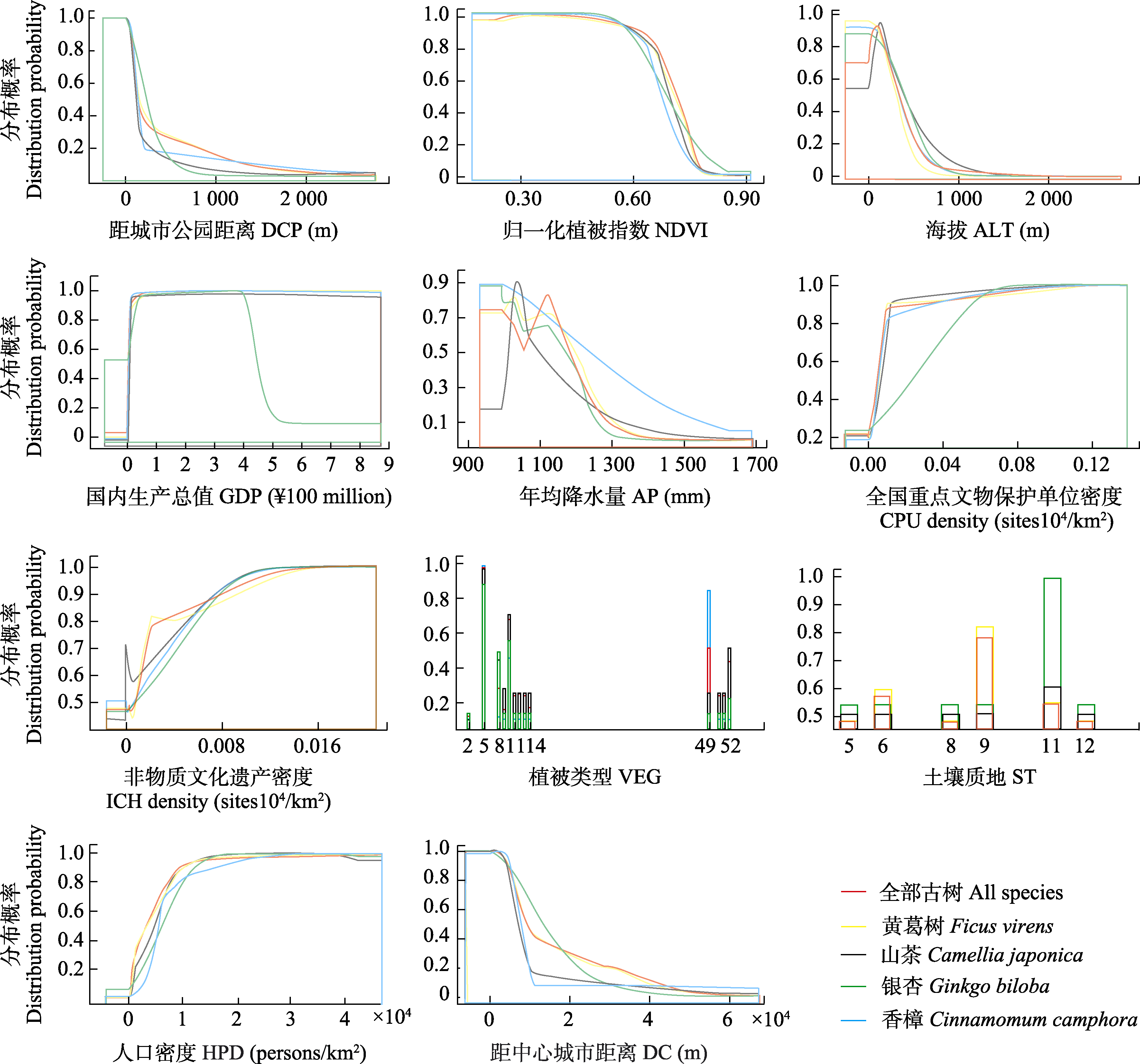
图6 重庆城区古树分布概率对各主导环境因子的响应。植被类型: 2. 温带针叶林; 5. 亚热带和热带山地针叶林; 8. 温带落叶阔叶林; 11. 亚热带常绿及落叶阔叶混交林; 14. 亚热带硬叶常绿阔叶林和矮林; 49. 耐旱作物; 52. 旱作和落叶果树园。土壤质地: 5. 粘壤土; 6. 粉土; 8. 砂质黏土; 9. 壤土; 11. 砂质壤土; 12. 壤质砂土。
Fig. 6 Response of ancient tree distribution probability to dominant environmental factors in the urban area of Chongqing. Vegetation types (VEG): 2. Temperate coniferous forest; 5. Subtropical/tropical montane coniferous forest; 8. Temperate deciduous broadleaf forest; 11. Subtropical evergreen and deciduous broadleaf mixed forest; 14. Subtropical sclerophyllous evergreen broadleaf forest and dwarf forest; 49. Drought-tolerant crops; 52. Dryland farming and deciduous fruit orchards. Soil texture (ST): 5. Clay loam; 6. Silt loam; 8. Sandy clay; 9. Loam; 11. Sandy loam; 12. Loamy sand. DCP, Distance to urban parks; ALT, Altitude; AP, Mean annual precipitation; CPU, National key cultural relics protection units; ICH, Intangible cultural heritage, HPD, Human population density; DC, Distance to central city.
| 维度 Dimension | 分类层级 Classification | 核心问题/特征 Core issues/features | 保护策略 Protection strategy | 实施重点 Implementation focus |
|---|---|---|---|---|
| 城乡梯度Urban-rural gradient | 建成区Built-up area | 高人为干预; 生境碎片化; 依赖历史公园/文化遗产High human intervention; habitat fragmentation; dependence on historic parks/cultural heritage sites | 古树公园模式: 整合古树群与城市绿地系统; 遗产价值优先: 强化文化关联性保护; 生境修复: 构建微型生态网络 Ancient tree park model: integrating tree groups into urban green space; heritage value priority: strengthening cultural association protection; habitat restoration: constructing micro-ecological networks | 历史名园示范; 社区参与管护; 古树生境保护立法 Demonstration in historic gardens; community participation in management; legislation for habitat protection |
| 城乡交错带Urban-rural fringe | 生态挤压; 城市化侵蚀原始生境 Ecological squeeze; urbanization erodes the original habitat | 生境保护: 原始生境保留; 森林系统连片保护: 衔接城市与自然林地 Habitat protection: preserving original habitat; forest connectivity protection: linking urban and natural woodlands | 保护红线划定与设置缓冲带; 土地开发避让 Delineation of protection redlines and buffer zones; avoidance in land development | |
| 乡村地区 Rural area | 自然遗存为主; 高珍稀度集中 Natural remnant; concentration of high rarity | 自然保护地协同: 联动自然保护地; 区域性保护规划: 乡镇尺度精准管理 Synergy with protected areas: linking with nature reserves; regional protection planning: precision management at township scale | 大巴山国家级自然保护区、石柱七曜山地质公园等保护区整合; 保护专项规划 Integration of protected areas such as Daba Mountain National Nature Reserve and Shizhu Qiyao Mountain National Geopark; formulation of specialized protection plans | |
| 珍稀度等级 Rarity grade | 高珍稀度 High rarity | 濒危/极危种; 单株或极小种群 Critically endangered/ Endangered species; single individuals or very small populations | 一树一策: 个性化监测与生境修复; 繁殖技术攻关; 近/迁地保护: 建立保护圃 Individual tree strategy: personalized monitoring and habitat restoration; propagation research; ex/in situ conservation: establishing conservation nurseries | 个性化保护与人工扩繁; 设立专项保护基金 Personalized conservation and artificial propagation of species; special protection fund |
| 中珍稀度 Medium rarity | 易危/近危种; 区域性分布 Vulnerable/Near Threatened species; regional distribution | 生境质量提升: 控制干扰源; 社区共管: 知识融入保护 Habitat quality improvement: controlling disturbance sources; community co-management: integrating local knowledge | 后备古树资源培育; 减少活动干扰; 生境林分改造 Cultivating future ancient tree resources; reducing human disturbance; habitat stand improvement | |
| 低珍稀度 Low rarity | 广布种; 种群稳定Widespread species; stable population | 常规监测: 病虫害防治; 可持续利用: 文化价值开发 Routine monitoring: pest and disease control; sustainable utilization: developing cultural value | 定期普查; 古树文化旅游线路融合Regular census; integration into cultural tourism routes | |
| 树种类型 Tree species | 孑遗种 Relict species | 古老起源; 生态脆弱Ancient origin; ecologically vulnerable | 气候韧性提升: 应对极端天气; 遗传多样性保护; 后备资源培育 Climate resilience enhancement: addressing extreme weather; genetic diversity conservation; cultivating future resources | 建立气候适应试验区; 后备资源培育 Establishing climate adaptation pilot zones; cultivating future resources |
| 中国特有种 Chinese endemic species | 狭域分布; 特有性高 Narrow distribution; high endemism | 栖息地保护: 核心分布区禁伐; 科学考察: 明确种群动态 Habitat protection: prohibiting logging in core distribution areas; scientific survey: clarifying population dynamics | 武陵山专项调查; 设立特有古树保护小区 Special survey in Wuling Mountains; protection plots for endemic trees | |
| 广布种Widespread species | 适用性强; 文化关联高 High adaptability; deep cultural association | 文化传承: 古树文化微保护地; 公众教育: 古树认养计划 Cultural heritage: ancient tree biocultural micro-conservation site; public education: tree adoption programs | 编撰重庆古树文化志; 科普教育基地建设 Compiling Chongqing ancient tree cultural records; building science education bases |
表4 重庆古树资源保护策略框架
Table 4 Strategic framework for the conservation of ancient tree resources in Chongqing
| 维度 Dimension | 分类层级 Classification | 核心问题/特征 Core issues/features | 保护策略 Protection strategy | 实施重点 Implementation focus |
|---|---|---|---|---|
| 城乡梯度Urban-rural gradient | 建成区Built-up area | 高人为干预; 生境碎片化; 依赖历史公园/文化遗产High human intervention; habitat fragmentation; dependence on historic parks/cultural heritage sites | 古树公园模式: 整合古树群与城市绿地系统; 遗产价值优先: 强化文化关联性保护; 生境修复: 构建微型生态网络 Ancient tree park model: integrating tree groups into urban green space; heritage value priority: strengthening cultural association protection; habitat restoration: constructing micro-ecological networks | 历史名园示范; 社区参与管护; 古树生境保护立法 Demonstration in historic gardens; community participation in management; legislation for habitat protection |
| 城乡交错带Urban-rural fringe | 生态挤压; 城市化侵蚀原始生境 Ecological squeeze; urbanization erodes the original habitat | 生境保护: 原始生境保留; 森林系统连片保护: 衔接城市与自然林地 Habitat protection: preserving original habitat; forest connectivity protection: linking urban and natural woodlands | 保护红线划定与设置缓冲带; 土地开发避让 Delineation of protection redlines and buffer zones; avoidance in land development | |
| 乡村地区 Rural area | 自然遗存为主; 高珍稀度集中 Natural remnant; concentration of high rarity | 自然保护地协同: 联动自然保护地; 区域性保护规划: 乡镇尺度精准管理 Synergy with protected areas: linking with nature reserves; regional protection planning: precision management at township scale | 大巴山国家级自然保护区、石柱七曜山地质公园等保护区整合; 保护专项规划 Integration of protected areas such as Daba Mountain National Nature Reserve and Shizhu Qiyao Mountain National Geopark; formulation of specialized protection plans | |
| 珍稀度等级 Rarity grade | 高珍稀度 High rarity | 濒危/极危种; 单株或极小种群 Critically endangered/ Endangered species; single individuals or very small populations | 一树一策: 个性化监测与生境修复; 繁殖技术攻关; 近/迁地保护: 建立保护圃 Individual tree strategy: personalized monitoring and habitat restoration; propagation research; ex/in situ conservation: establishing conservation nurseries | 个性化保护与人工扩繁; 设立专项保护基金 Personalized conservation and artificial propagation of species; special protection fund |
| 中珍稀度 Medium rarity | 易危/近危种; 区域性分布 Vulnerable/Near Threatened species; regional distribution | 生境质量提升: 控制干扰源; 社区共管: 知识融入保护 Habitat quality improvement: controlling disturbance sources; community co-management: integrating local knowledge | 后备古树资源培育; 减少活动干扰; 生境林分改造 Cultivating future ancient tree resources; reducing human disturbance; habitat stand improvement | |
| 低珍稀度 Low rarity | 广布种; 种群稳定Widespread species; stable population | 常规监测: 病虫害防治; 可持续利用: 文化价值开发 Routine monitoring: pest and disease control; sustainable utilization: developing cultural value | 定期普查; 古树文化旅游线路融合Regular census; integration into cultural tourism routes | |
| 树种类型 Tree species | 孑遗种 Relict species | 古老起源; 生态脆弱Ancient origin; ecologically vulnerable | 气候韧性提升: 应对极端天气; 遗传多样性保护; 后备资源培育 Climate resilience enhancement: addressing extreme weather; genetic diversity conservation; cultivating future resources | 建立气候适应试验区; 后备资源培育 Establishing climate adaptation pilot zones; cultivating future resources |
| 中国特有种 Chinese endemic species | 狭域分布; 特有性高 Narrow distribution; high endemism | 栖息地保护: 核心分布区禁伐; 科学考察: 明确种群动态 Habitat protection: prohibiting logging in core distribution areas; scientific survey: clarifying population dynamics | 武陵山专项调查; 设立特有古树保护小区 Special survey in Wuling Mountains; protection plots for endemic trees | |
| 广布种Widespread species | 适用性强; 文化关联高 High adaptability; deep cultural association | 文化传承: 古树文化微保护地; 公众教育: 古树认养计划 Cultural heritage: ancient tree biocultural micro-conservation site; public education: tree adoption programs | 编撰重庆古树文化志; 科普教育基地建设 Compiling Chongqing ancient tree cultural records; building science education bases |
| [1] |
Blicharska M, Mikusiński G (2014) Incorporating social and cultural significance of large old trees in conservation policy. Conservation Biology, 28, 1558-1567.
DOI PMID |
| [2] |
Chen JL, Bai YH, Huang X, Huang L, Tang ZY (2026) Improved forest protection at Chinese heritage relic sites. Nature Sustainability, 9, 1160-1170.
DOI |
| [3] | Chen SS, Zhou Y, Li ZX, Zhang MJ (2021) Distribution characteristics of famous ancient trees in different regions of Jiangsu Province. Chinese Landscape Architecture, 37(6), 117-121. (in Chinese with English abstract) |
| [陈赛赛, 周钰, 李祉宣, 张明娟 (2021) 江苏省不同区域古树名木分布特点研究. 中国园林, 37(6), 117-121.] | |
| [4] |
Chen XX, Gai ZS, Zhai JT, Xu JD, Jiao PP, Wu ZH, Li ZJ (2021) Genetic diversity and construction of core conservation units of the natural populations of Populus euphratica in Northwest China. Biodiversity Science, 29, 1638-1649. (in Chinese with English abstract)
DOI URL |
|
[陈向向, 盖中帅, 翟军团, 徐劲东, 焦培培, 吴智华, 李志军 (2021) 中国西北地区天然胡杨群体遗传多样性及核心保护单元的构建. 生物多样性, 29, 1638-1649.]
DOI |
|
| [5] | Chen TQ, Guestrin C (2016) XGBoost: A scalable tree boosting system. In: Proceedings of the 22nd ACM SIGKDD International Conference on Knowledge Discovery and Data Mining, pp. 785-794. San Francisco, USA. |
| [6] |
Fay N (2002) Environmental arboriculture, tree ecology and veteran tree management. Arboricultural Journal, 26, 213-238.
DOI URL |
| [7] | Fu QC, Qiu EF, Zhang Y, Wang HC, Huang LH (2023) Characteristics and influencing factors of heart rot of ancient Ginkgo biloba trees in Beijing. Scientia Silvae Sinicae, 59(6), 130-140. (in Chinese with English abstract) |
| [符庆成, 邱尔发, 张媛, 王慧超, 黄岚虹 (2023) 北京市银杏古树心腐特征及其影响因素. 林业科学, 59(6), 130-140.] | |
| [8] |
Getis A, Ord JK (1992) The analysis of spatial association by use of distance statistics. Geographical Analysis, 24, 189-206.
DOI URL |
| [9] |
Guisan A, Thuiller W (2005) Predicting species distribution: Offering more than simple habitat models. Ecology Letters, 8, 993-1009.
DOI PMID |
| [10] | Hartel T, Hanspach J, Moga CI, Holban L, Szapanyos Á, Tamás R, Hováth C, Réti KO (2018) Abundance of large old trees in wood-pastures of Transylvania (Romania). Science of the Total Environment, 613, 263-270. |
| [11] | Huang JH, Ma KP, Chen B (2014) Diversity and Geographic Distribution of Endemic Seed Plants in China. Higher Education Press, Beijing. (in Chinese) |
| [黄继红, 马克平, 陈彬 (2014) 中国特有种子植物的多样性及其地理分布. 高等教育出版社, 北京.] | |
| [12] | Huang L, Jin C, Zhou LH, Hu SW, Tian LJ, Li CQ, Yang YC (2021) Large old trees in human settlements: Distribution patterns, drivers and conservation practices. Guihaia, 41, 1665-1673. (in Chinese with English abstract) |
| [黄力, 靳程, 周礼华, 胡四维, 田丽娟, 李崇清, 杨永川 (2021) 人类聚居地的古树: 分布格局、驱动因素与保护实践. 广西植物, 41, 1665-1673.] | |
| [13] | Huang L, Tian LJ, Zhou LH, Jin C, Qian SH, Jim CY, Lin DM, Zhao L, Minor J, Coggins C, Yang YC (2020) Local cultural beliefs and practices promote conservation of large old trees in an ethnic minority region in southwestern China. Urban Forestry & Urban Greening, 49, 126584. |
| [14] |
Jim CY (2004) Spatial differentiation and landscape-ecological assessment of heritage trees in urban Guangzhou (China). Landscape and Urban Planning, 69, 51-68.
DOI URL |
| [15] |
Jim CY (2005) Monitoring the performance and decline of heritage trees in urban Hong Kong. Journal of Environmental Management, 74, 161-172.
PMID |
| [16] | Jim CY, Zhang H (2013) Species diversity and spatial differentiation of old-valuable trees in urban Hong Kong. Urban Forestry & Urban Greening, 12, 171-182. |
| [17] | Li X, Sun XF, Li Y, Yang DW (2025) Quantitative assessment on supply-demand space of cultural ecosystem services of mountainous high-density city: A case study in Chongqing. Journal of Wuhan University (Natural Science Edition), 71, 98-108. (in Chinese with English abstract) |
| [李旭, 孙秀锋, 李悦, 杨德伟 (2025) 山地型高密度城市生态系统文化服务供需空间关系的定量评估: 以重庆市为例. 武汉大学学报(理学版), 71, 98-108.] | |
| [18] | Li XP, Li K, Xu J, Jia FG, Lei S (2026) Eco-environment evolution and driving factors of the Loess Plateau based on the XGBoost-SHAP approach. Journal of Desert Research, 46, 175-186. (in Chinese with English abstract) |
|
[李晓鹏, 李康, 徐静, 贾富贵, 雷双 (2026) 基于XGBoost-SHAP方法的黄土高原生态质量演变及驱动因素分析. 中国沙漠, 46, 175-186.]
DOI |
|
| [19] | Li XS, Ma JZ (2025) Ancient tree biocultural micro-conservation site: An innovative conservation pathway synergizing biological and cultural elements. Biodiversity Science, 33, 25295. (in Chinese with English abstract) |
|
[李小双, 马建忠 (2025) 古树生物文化微保护地: 一种生物与文化要素协同的创新型保护路径. 生物多样性, 33, 25295.]
DOI |
|
| [20] |
Lindenmayer DB, Laurance WF (2017) The ecology, distribution, conservation and management of large old trees. Biological Reviews, 92, 1434-1458.
DOI URL |
| [21] | Liu JJ, Yang B, Lindenmayer DB (2019) The oldest trees in China and where to find them. Frontiers in Ecology and the Environment, 17, 319-322. |
| [22] | Liu SJ, Wang ZJ, Dai L, Zhou XX, Hu CY, Wu C (2025) The area effect of habitat patches on plant diversity in remnant mountains in karst mountainous cities. Acta Ecologica Sinica, 45, 8376-8388. (in Chinese with English abstract) |
| [柳书俊, 王志杰, 代磊, 周学霞, 胡嫦月, 吴超 (2025) 喀斯特山地城市遗存山体植物多样性及其生境斑块面积效应. 生态学报, 45, 8376-8388.] | |
| [23] | Liu YX, Hu C, Zhu SC, Lan SR, Ma ZY (2019) Analysis of spatial distribution characteristics of ancient tree resources in Wenzhou City based on GIS. Chinese Landscape Architecture, 35(5), 107-111. (in Chinese with English abstract) |
| [刘益曦, 胡春, 朱圣潮, 兰思仁, 马知遥 (2019) 基于GIS的温州古树资源空间分布特征分析. 中国园林, 35(5), 107-111.] | |
| [24] | Long CL (2025) The significance of traditional culture for biodiversity conservation. Biodiversity Science, 33, 25230. (in Chinese with English abstract) |
|
[龙春林 (2025) 传统文化在生物多样性保护中的特殊意义. 生物多样性, 33, 25230.]
DOI |
|
| [25] |
Ma KP (1994) Methods for measuring diversity of biological communities. I. Methods for measuring α diversity (Part I). Biodiversity Science, 2, 162-168. (in Chinese)
DOI URL |
| [马克平 (1994) 生物群落多样性的测度方法. I. α多样性的测度方法(上). 生物多样性, 2, 162-168.] | |
| [26] |
Ma KP, Liu YM (1994) Methods for measuring diversity of biological communities. I. Methods for measuring α diversity (Part II). Biodiversity Science, 2, 231-239. (in Chinese)
DOI URL |
| [马克平, 刘玉明 (1994) 生物群落多样性的测度方法. I. α多样性的测度方法(下). 生物多样性, 2, 231-239.] | |
| [27] |
Pederson N (2010) External characteristics of old trees in the eastern deciduous forest. Natural Areas Journal, 30, 396-407.
DOI URL |
| [28] |
Pickett STA, Cadenasso ML, Grove JM, Nilon CH, Pouyat RV, Zipperer WC, Costanza R (2001) Urban ecological systems: Linking terrestrial ecological, physical, and socioeconomic components of metropolitan areas. Annual Review of Ecology and Systematics, 32, 127-157.
DOI URL |
| [29] | Qiu ZZ, Hu XJ, Qian H, Wei BJ, Liao KF (2022) Analysis of spatial distribution characteristics of ancient and famous trees in Xintian County. Journal of Central South University of Forestry & Technology, 42(10), 46-56. (in Chinese with English abstract) |
| [邱族周, 胡希军, 钱惠, 韦宝婧, 廖坤富 (2022) 新田县古树名木资源组成和空间分布特征分析. 中南林业科技大学学报, 42(10), 46-56.] | |
| [30] | Ren WQ, Hou HP, Bi HT, Sun YM (2024) Analysis of characteristics of ancient tree resources in different regions of Henan Province and protection countermeasures. Journal of Henan Agricultural University, 58, 444-455. (in Chinese with English abstract) |
| [任婉倩, 侯贺平, 毕会涛, 孙煜萌 (2024) 河南省不同区域古树资源特征分析及保护对策. 河南农业大学学报, 58, 444-455.] | |
| [31] | Shi YF, Niu FR, Huang XM, Hong X, Gong XW, Wang YL, Lin D, Liu XN (2026) Interpretable machine learning and its applications in ecology. Biodiversity Science, 34, 25210. (in Chinese with English abstract) |
|
[石亚飞, 牛富荣, 黄晓敏, 洪星, 龚相文, 王艳莉, 林栋, 柳小妮 (2026) 可解释机器学习及其生态学应用. 生物多样性, 34, 25210.]
DOI |
|
| [32] | Tian LJ, Huang L, Zhou LH, Chen TY, Qian SH, Yang YC (2018) The composition and distribution of heritage trees in Guizhou ethnic minority areas: A case study of Wuchuan County. Chinese Journal of Ecology, 37, 2768-2775. (in Chinese with English abstract) |
| [田丽娟, 黄力, 周礼华, 陈廷跃, 钱深华, 杨永川 (2018) 贵州少数民族聚居地古树资源组成及分布特征--以务川县为例. 生态学杂志, 37, 2768-2775.] | |
| [33] | Wan JZ, Li QF, Wei GL, Yin GJ, Wei DX, Song ZM, Wang CJ (2020) The effects of the human footprint and soil properties on the habitat suitability of large old trees in alpine urban and periurban areas. Urban Forestry & Urban Greening, 47, 126520. |
| [34] | Wang PR, You GX, Zhuge MM, Da LJ, Hu YD (2024) Study on the composition and spatial distribution of ancient tree resources in Badong County, Hubei Province. Chinese Landscape Architecture, 40(5), 138-144. (in Chinese with English abstract) |
| [王沛然, 游桂璇, 诸葛名名, 达良俊, 胡远东 (2024) 湖北省巴东县古树资源组成及其空间分布特征研究. 中国园林, 40(5), 138-144.] | |
| [35] | Wang XF, Duan YX, Jin LL, Wang CY, Peng MC, Li Y, Wang XH, Ma YF (2023) Prediction of historical, present and future distribution of Quercus sect. Heterobalanus based on the optimized MaxEnt model in China. Acta Ecologica Sinica, 43, 6590-6604. (in Chinese with English abstract) |
| [王晓帆, 段雨萱, 金露露, 王崇云, 彭明春, 李云, 王旭红, 马云飞 (2023) 基于优化的最大熵模型预测中国高山栎组植物的历史、现状与未来分布变化. 生态学报, 43, 6590-6604.] | |
| [36] | Wu ZY (1991) The areal-types of Chinese genera of seed plants. Acta Botanica Yunnanica, 13(Suppl. IV), 1-139. (in Chinese with English abstract) |
| [吴征镒 (1991) 中国种子植物属的分布区类型. 云南植物研究, 13(增刊IV), 1-139.] | |
| [37] | Wu ZY, Zhou ZK, Li DZ, Peng H, Sun H (2003) The areal-types of the world families of seed plants. Acta Botanica Yunnanica, 25, 245-257. (in Chinese with English abstract) |
| [吴征镒, 周浙昆, 李德铢, 彭华, 孙航 (2003) 世界种子植物科的分布区类型系统. 云南植物研究, 25, 245-257.] | |
| [38] |
Xie CP, Li M, Jim CY, Liu DW (2022) Environmental factors driving the spatial distribution pattern of venerable trees in Sichuan Province, China. Plants, 11, 3581.
DOI URL |
| [39] |
Yang YB, Bao GD, Zhang D, Zhai C (2022) Spatial distribution and driving factors of old and notable trees in a fast-developing city, Northeast China. Sustainability, 14, 7937.
DOI URL |
| [40] | Ying JS, Zhang YL (1994) Endemic Genus of Seed Plants in China. Science Press, Beijing. (in Chinese) |
| [应俊生, 张玉龙 (1994) 中国种子植物特有属. 科学出版社, 北京.] | |
| [41] |
Zhang H, Lai PY, Jim CY (2017) Species diversity and spatial pattern of old and precious trees in Macau. Landscape and Urban Planning, 162, 56-67.
DOI URL |
| [42] | Zhang H, Wu J, Lü XY, Wang YY, Zuo YW, Xia CY, Li WQ, Deng HP (2024) Diversity characteristics of key protected wild plants distributed in Chongqing City. Journal of Plant Resources and Environment, 33(4), 81-91. (in Chinese with English abstract) |
| [张欢, 吴婧, 吕信运, 王仪云, 左有为, 夏常英, 李文巧, 邓洪平 (2024) 重庆市分布的重点保护野生植物多样性特征. 植物资源与环境学报, 33(4), 81-91.] | |
| [43] | Zhao Z (2025) Problems and challenges faced by the health management of old trees. Scientia Silvae Sinicae, 61(7), 94-99. (in Chinese with English abstract) |
| [赵忠 (2025) 古树健康管理面临的问题和挑战. 林业科学, 61(7), 94-99.] | |
| [44] | Zheng MF, Deng ZJ, Liu ZZ, Gu X (2024) Characteristics of ancient trees in different urbanization rates areas of Yi nationality in Yunnan Province. Guihaia, 44, 600-610. (in Chinese with English abstract) |
| [郑梦菲, 邓忠坚, 刘倬志, 古旭 (2024) 云南彝族地区不同城镇化水平区域的古树遗留特征. 广西植物, 44, 600-610.] | |
| [45] |
Zhu GP, Liu GQ, Bu WJ, Gao YB (2013) Ecological niche modeling and its applications in biodiversity conservation. Biodiversity Science, 21, 90-98. (in Chinese with English abstract)
DOI |
|
[朱耿平, 刘国卿, 卜文俊, 高玉葆 (2013) 生态位模型的基本原理及其在生物多样性保护中的应用. 生物多样性, 21, 90-98.]
DOI |
| [1] | 倪庆永, 番玉买, 张琦, 解萌. 中国懒猴科灵长类研究与保护进展[J]. 生物多样性, 2026, 34(3): 25451-. |
| [2] | 王儒晓, 史博洋, 潘达, 孙红英. 中国特有华溪蟹属淡水蟹多样性格局及其保护空缺[J]. 生物多样性, 2025, 33(8): 25123-. |
| [3] | 田书荣, 魏营, 肖芬, 周芸芸, 解宜兴, 王丞, 宋芬, 梁志强, 桂小杰. 湖南张家界大鲵国家级自然保护区中国大鲵种群动态及保护策略[J]. 生物多样性, 2025, 33(7): 24581-. |
| [4] | 李艳朋, 陈洁, 卢春洋, 许涵. 海南尖峰岭热带山地雨林64 ha次生林动态监测样地群落结构特征[J]. 生物多样性, 2025, 33(2): 24445-. |
| [5] | 王春晓, 张正旺, 夏少霞, 段后浪, 王稳, 贾亦飞, 张立勋, 冯刚, 杨亚桥, 李桐, 丁长青, 王春平, 原宝东, 雷进宇, 刘宇, 石建斌, 兰科其, 石青青, 肖晴, 于秀波. 黄河流域水鸟多样性季节和区域特征及保护策略[J]. 生物多样性, 2024, 32(11): 23490-. |
| [6] | 杨俊毅, 关潇, 李俊生, 刘晶晶, 郝颢晶, 王槐睿. 乌江流域生物多样性与生态系统服务的空间格局及相互关系[J]. 生物多样性, 2023, 31(7): 23061-. |
| [7] | 李仕裕, 张奕奇, 邹璞, 宁祖林, 廖景平. 广东省植物园植物多样性迁地保护现状及发展建议[J]. 生物多样性, 2023, 31(6): 22647-. |
| [8] | 祖奎玲, 王志恒. 山地物种海拔分布对气候变化响应的研究进展[J]. 生物多样性, 2022, 30(5): 21451-. |
| [9] | 王雅婷, 张定海, 张志山. 古尔班通古特沙漠固定沙丘上白梭梭和梭梭的空间分布及种间关联性[J]. 生物多样性, 2022, 30(3): 21280-. |
| [10] | 王重阳, 赵联军, 孟世勇. 王朗国家级自然保护区滑坡体兰科植物分布格局及其保护策略[J]. 生物多样性, 2022, 30(2): 21313-. |
| [11] | 郝希阳, 贺姹, 楚克林, 申志新, 赵强, 高伟, 潘达, 孙红英. 海南岛淡水蟹类分布格局与多样性保护[J]. 生物多样性, 2021, 29(5): 605-616. |
| [12] | 梁栋栋, 彭杰, 高改利, 洪欣, 周守标, 储俊, 王智. 鹞落坪落叶阔叶林蔷薇科主要树种的空间分布格局及种间关联性[J]. 生物多样性, 2020, 28(8): 1008-1017. |
| [13] | 苏金源, 燕语, 李冲, 李丹, 杜芳. 通过遗传多样性探讨极小种群野生植物的致濒机理及保护策略: 以裸子植物为例[J]. 生物多样性, 2020, 28(3): 376-384. |
| [14] | 孙远, 胡维刚, 姚树冉, 孙颖, 邓建明. 黄河流域被子植物和陆栖脊椎动物丰富度格局及其影响因子[J]. 生物多样性, 2020, 28(12): 1523-1532. |
| [15] | 颜文博,吉晟男,帅凌鹰,赵雷刚,朱大鹏,曾治高. 秦岭南坡陕西洋县辖区哺乳动物物种多样性的空间分布格局[J]. 生物多样性, 2019, 27(2): 177-185. |
| 阅读次数 | ||||||
|
全文 |
|
|||||
|
摘要 |
|
|||||
备案号:京ICP备16067583号-7
Copyright © 2026 版权所有 《生物多样性》编辑部
地址: 北京香山南辛村20号, 邮编:100093
电话: 010-62836137, 62836665 E-mail: biodiversity@ibcas.ac.cn
