

生物多样性 ›› 2026, Vol. 34 ›› Issue (3): 25451. DOI: 10.17520/biods.2025451 cstr: 32101.14.biods.2025451
• 中国灵长类研究历史与进展——纪念Jane Goodall专题 • 上一篇 下一篇
倪庆永1,*( )(
)( ), 番玉买2, 张琦3, 解萌1()
收稿日期:2025-11-11
接受日期:2026-01-02
出版日期:2026-03-20
发布日期:2026-04-09
通讯作者:
*E-mail: 基金资助:
Qingyong Ni1,*()(), Yumai Fan2, Qi Zhang3, Meng Xie1()
Received:2025-11-11
Accepted:2026-01-02
Online:2026-03-20
Published:2026-04-09
Contact:
*E-mail: Supported by:摘要:
懒猴是懒猴科灵长类的统称, 为小型树栖夜行性动物, 具有超声通讯、低温休眠、分泌毒素等一系列独特的生理和行为特征, 在我国分布有蜂猴(Nycticebus bengalensis)和倭蜂猴(Xanthonycticebus intermedius)两种。本文通过文献检索与梳理, 分析了国内外懒猴研究现状与趋势, 总结概括了目前保护工作中存在的问题, 并提出了针对性建议。国内懒猴研究从20世纪80年代起步至今, 经历了基础探索、发展深化与综合保护3个阶段, 在系统发育与基因组学、生理生态与行为学、种群分布与现状、圈养种群管理、技术创新应用和野化放归探索等方面取得了重要进展, 尤其是近十年呈现出明显的增长态势。然而, 相对于全球懒猴研究规模, 国内研究机构及方向仍十分有限。同时, 国内懒猴保护仍面临诸多挑战, 比如基础种群数据缺乏、保护方式单一、救护圈养条件不足及科研进度缓慢等问题。未来工作需要整合政策、执法、栖息地保护、社区共管、公众意识教育、科学研究和跨境协作等多种方式, 以实现懒猴种群的长期有效保护。
倪庆永, 番玉买, 张琦, 解萌 (2026) 中国懒猴科灵长类研究与保护进展. 生物多样性, 34, 25451. DOI: 10.17520/biods.2025451.
Qingyong Ni, Yumai Fan, Qi Zhang, Meng Xie (2026) Conservation and research progress of Lorisidae primates in China. Biodiversity Science, 34, 25451. DOI: 10.17520/biods.2025451.
| 物种 Species | 分布 Distribution | 体重 Body weight (g) | IUCN濒危等级 IUCN category |
|---|---|---|---|
| 树熊猴亚科 Perodicticinae | |||
| 树熊猴属 Perodicticus | |||
| 西部树熊猴 P. potto | 几内亚, 几内亚比绍, 尼日利亚 Guinea, Guinea Bissau, Nigeria | 600 | NT |
| 中部树熊猴 P. edwardsi | 中非共和国, 刚果, 尼日利亚 Central African Republic, Congo, Nigeria | 850-1,600 | LC |
| 南部树熊猴 P. juju | 尼日利亚 Nigeria | 无数据 No data | |
| 东部树熊猴 P. ibeanus | 布隆迪, 刚果, 肯尼亚, 卢旺达 Burundi, Congo, Kenya, Rwanda | 850-920 | LC |
| 金熊猴属 Arctocebus | |||
| 金熊猴 A. aureus | 加蓬 Gabon | 150-270 | LC |
| 卡拉巴尔金熊猴 A. calabarensis | 喀麦隆, 刚果, 加蓬 Cameroon, Congo, Gabon | 270-325 | NT |
| 懒猴亚科 Lorisinae | |||
| 懒猴属 Loris | |||
| 灰懒猴 L. lydekkerianus | 印度南部, 斯里兰卡 South India, Sri Lanka | 225-320 | NT |
| 红懒猴 L. tardigradus | 斯里兰卡 Sri Lanka | 105-170 | EN |
| 蜂猴属 Nycticebus | |||
| 蜂猴 N. bengalensis | 孟加拉, 不丹, 柬埔寨, 中国, 印度, 老挝, 缅甸, 泰国, 越南 Bangladesh, Bhutan, Cambodia, China, India, Laos, Myanmar, Thailand, Vietnam | 1,140-2,100 | EN |
| 巽他(大)蜂猴 N. coucang | 苏门答腊岛, 马来半岛, 泰国 Sumatra Island, Malay Peninsula, Thailand | 630-850 | EN |
| 爪哇蜂猴 N. javanicus | 爪哇岛 Java Island | 750-1,150 | CR |
| 菲律宾蜂猴 N. menagensis | 文莱, 印度尼西亚, 马来西亚, 菲律宾 Brunei, Indonesia, Malaysia, Philippines | 265-850 | VU |
| 婆罗洲蜂猴 N. borneanus | 婆罗洲 Borneo | 360-580 | VU |
| 卡扬蜂猴 N. kayan | 婆罗洲 Borneo | 500-700 | VU |
| 索式蜂猴 N. bancanus | 婆罗洲, 邦加岛, 贝林顿岛 Borneo, Banka Island, Belitung Island | 无数据 No data | CR |
| 苏门答腊蜂猴 N. hilleri | 北苏门答腊 North Sumatra | 650-790 | EN |
| 倭蜂猴属 Xanthonycticebus | |||
| 倭蜂猴 X. intermedius | 老挝, 中国南部, 越南 Laos, South China, Vietnam | 360-580 | EN |
| 南倭蜂猴 X. pygmaeus | 柬埔寨, 越南 Cambodia, Vietnam | 360-580 | EN |
表1 懒猴科灵长类分类与分布(根据Nekaris & Burrows, 2020)
Table 1 Taxonomy and distribution of Lorisidae primates (Based on Nekaris & Burrows, 2020)
| 物种 Species | 分布 Distribution | 体重 Body weight (g) | IUCN濒危等级 IUCN category |
|---|---|---|---|
| 树熊猴亚科 Perodicticinae | |||
| 树熊猴属 Perodicticus | |||
| 西部树熊猴 P. potto | 几内亚, 几内亚比绍, 尼日利亚 Guinea, Guinea Bissau, Nigeria | 600 | NT |
| 中部树熊猴 P. edwardsi | 中非共和国, 刚果, 尼日利亚 Central African Republic, Congo, Nigeria | 850-1,600 | LC |
| 南部树熊猴 P. juju | 尼日利亚 Nigeria | 无数据 No data | |
| 东部树熊猴 P. ibeanus | 布隆迪, 刚果, 肯尼亚, 卢旺达 Burundi, Congo, Kenya, Rwanda | 850-920 | LC |
| 金熊猴属 Arctocebus | |||
| 金熊猴 A. aureus | 加蓬 Gabon | 150-270 | LC |
| 卡拉巴尔金熊猴 A. calabarensis | 喀麦隆, 刚果, 加蓬 Cameroon, Congo, Gabon | 270-325 | NT |
| 懒猴亚科 Lorisinae | |||
| 懒猴属 Loris | |||
| 灰懒猴 L. lydekkerianus | 印度南部, 斯里兰卡 South India, Sri Lanka | 225-320 | NT |
| 红懒猴 L. tardigradus | 斯里兰卡 Sri Lanka | 105-170 | EN |
| 蜂猴属 Nycticebus | |||
| 蜂猴 N. bengalensis | 孟加拉, 不丹, 柬埔寨, 中国, 印度, 老挝, 缅甸, 泰国, 越南 Bangladesh, Bhutan, Cambodia, China, India, Laos, Myanmar, Thailand, Vietnam | 1,140-2,100 | EN |
| 巽他(大)蜂猴 N. coucang | 苏门答腊岛, 马来半岛, 泰国 Sumatra Island, Malay Peninsula, Thailand | 630-850 | EN |
| 爪哇蜂猴 N. javanicus | 爪哇岛 Java Island | 750-1,150 | CR |
| 菲律宾蜂猴 N. menagensis | 文莱, 印度尼西亚, 马来西亚, 菲律宾 Brunei, Indonesia, Malaysia, Philippines | 265-850 | VU |
| 婆罗洲蜂猴 N. borneanus | 婆罗洲 Borneo | 360-580 | VU |
| 卡扬蜂猴 N. kayan | 婆罗洲 Borneo | 500-700 | VU |
| 索式蜂猴 N. bancanus | 婆罗洲, 邦加岛, 贝林顿岛 Borneo, Banka Island, Belitung Island | 无数据 No data | CR |
| 苏门答腊蜂猴 N. hilleri | 北苏门答腊 North Sumatra | 650-790 | EN |
| 倭蜂猴属 Xanthonycticebus | |||
| 倭蜂猴 X. intermedius | 老挝, 中国南部, 越南 Laos, South China, Vietnam | 360-580 | EN |
| 南倭蜂猴 X. pygmaeus | 柬埔寨, 越南 Cambodia, Vietnam | 360-580 | EN |
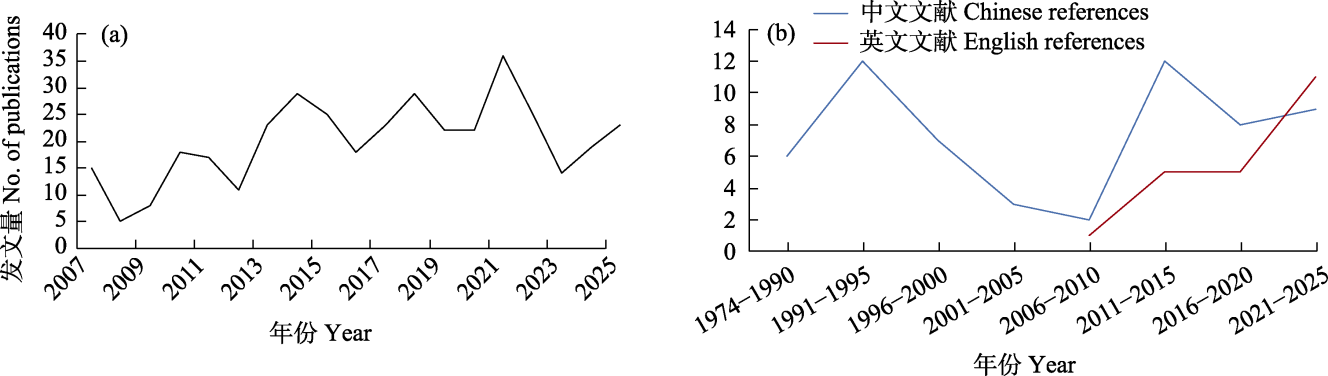
图1 全球(a)及国内(b)懒猴相关研究发文量变化趋势
Fig. 1 The trends of global (a) and national (b) research regarding Lorisidae primates
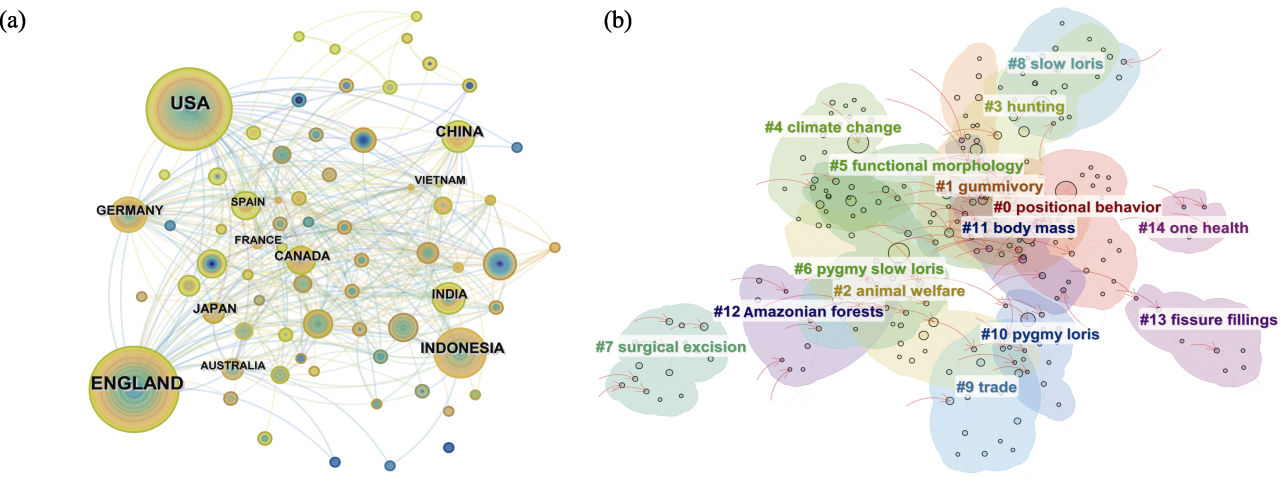
图2 基于Web of Science数据库的懒猴科灵长类研究国家合作共现图(a)及关键词聚类图(b)。节点大小代表发文量, 颜色由蓝色到黄色代表成果发表年份由远及近。
Fig. 2 Country co-occurrence map (a) and clustering map of keywords (b) in Lorisidae primates research based on the Web of Science database. The node size indicates the number of publications, and the color gradient from blue to yellow indicates the publication year from earlier to more recent.
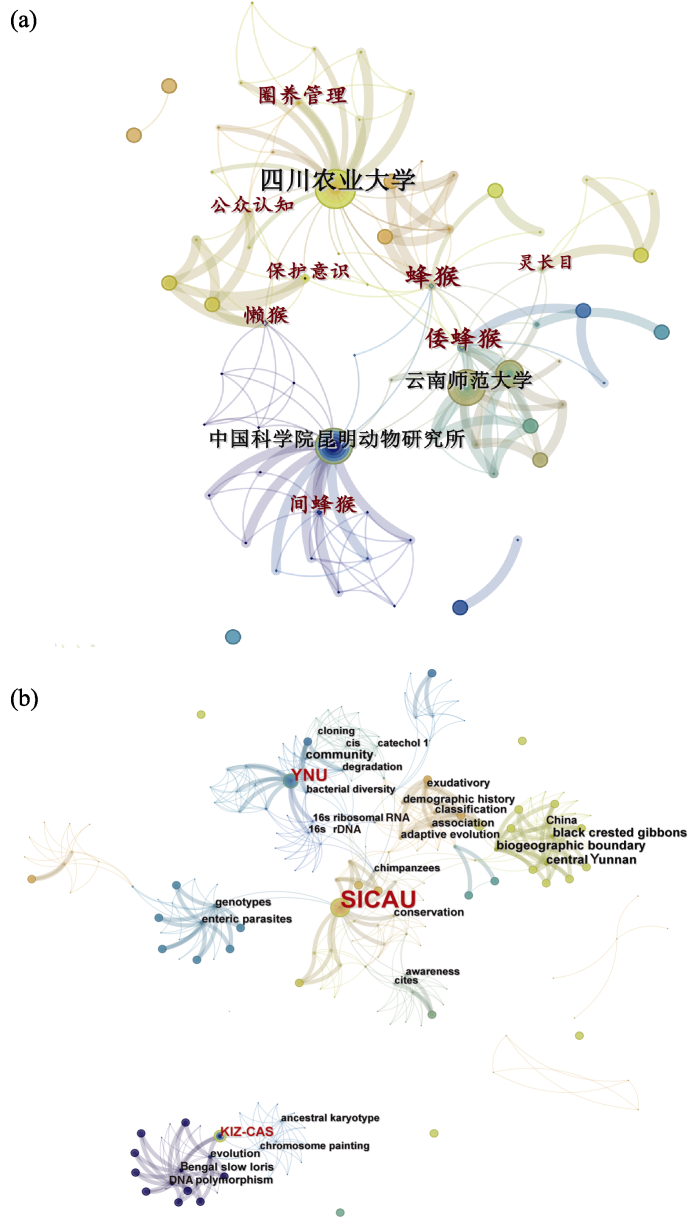
图3 基于CNKI (a)和Web of Science数据库(b)的中国懒猴科灵长类研究机构-关键词共现图。KIZ-CAS: 中国科学院昆明动物研究所; SICAU: 四川农业大学; YNU: 云南师范大学。节点颜色由蓝色到黄色代表成果发表年份由远及近。
Fig. 3 Institute-keywords co-occurrence map of Lorisidae primates research in China based on the CNKI (a) and Web of Science database (b). KIZ-CAS, Kunming Institute of Zoology, Chinese Academy of Sciences; SICAU, Sichuan Agricultural University; YNU, Yunnan Normal University. The node color gradient from blue to yellow indicates the publication year from earlier to more recent
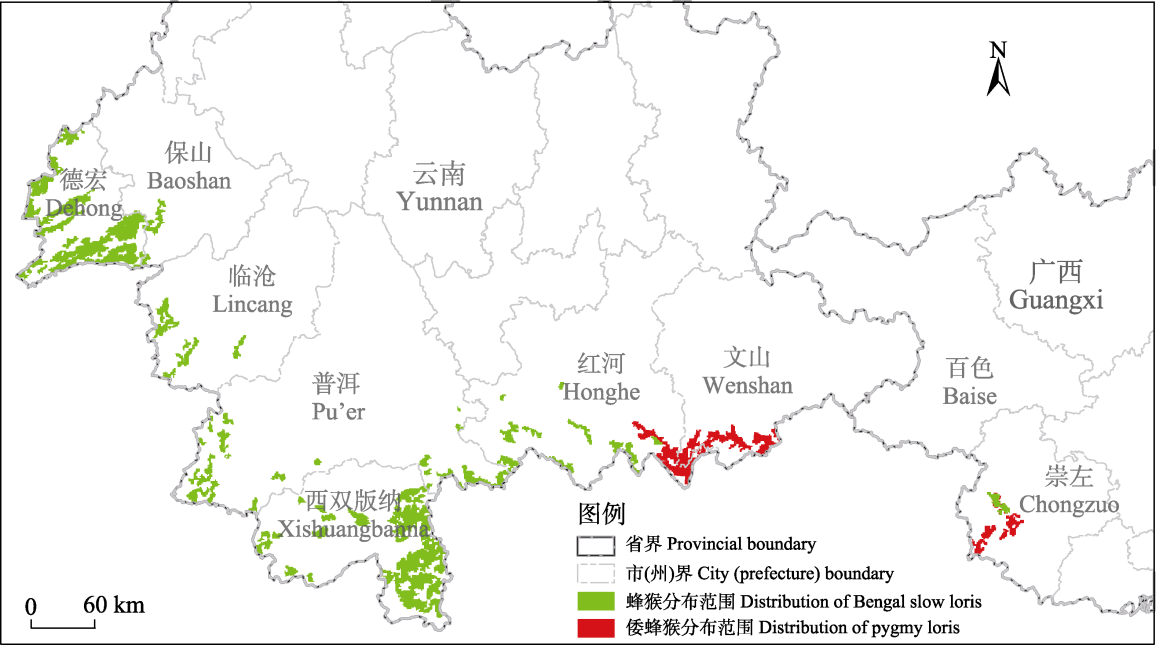
图4 中国懒猴科灵长类分布现状
Fig. 4 Distribution status of Lorisidae primates in China
| [1] | Al-Razi H, Maria M, Bin Muzaffar S (2019) Mortality of primates due to roads and power lines in two forest patches in Bangladesh. Zoologia, 36, e33540. |
| [2] |
Barrett M, Campera M, Morcatty TQ, Weldon AV, Hedger K, Maynard KQ, Ali Imron M, Nekaris KAI (2021) Risky business: The function of play in a venomous mammal—The Javan slow loris (Nycticebus javanicus). Toxins, 13, 318.
DOI URL |
| [3] |
Bearder SK, Nekaris KAI, Curtis DJ (2006) A re-evaluation of the role of vision in the activity and communication of nocturnal primates. Folia Primatologica, 77, 50-71.
PMID |
| [4] |
Blair M, Cao G, López-Nandam E, Veronese-Paniagua D, Birchette M, Kenyon M, Md-Zain B, Munds R, Nekaris K, Nijman V, Roos C, Thach H, Sterling E, Le M (2023) Molecular phylogenetic relationships and unveiling novel genetic diversity among slow and pygmy lorises, including resurrection of Xanthonycticebus intermedius. Genes, 14, 643.
DOI URL |
| [5] |
Chen CY, Shao Y, Wang S, Li ML, Qiao HF (2025) The role of primate-specific genes in the phenotypic evolution of lorises. Current Zoology, 71, 267-272.
DOI URL |
| [6] |
Chen JH, Pan D, Groves C, Wang YX, Narushima E, Fitch-Snyder H, Crow P, Thanh VN, Ryder O, Zhang HW, Fu YX, Zhang YP (2006) Molecular phylogeny of Nycticebus inferred from mitochondrial genes. International Journal of Primatology, 27, 1187-1200.
DOI URL |
| [7] | Chen MJ, Bi CX, Yu LG, Yang SJ (2014) Biological characteristics, survival status and protection strategies of the pygmy lorises. Bulletin of Biology, 49(10), 7-10, 64. (in Chinese) |
| [陈敏杰, 毕超贤, 余梁哥, 杨士剑 (2014) 倭蜂猴生物学特性、生存现状及保护对策. 生物学通报, 49(10), 7-10, 64.] | |
| [8] | Chen MJ, Yu LG, Yang SJ, Bi CX (2015) Advances on the ecological study of pygmy slow loris (Nycticebus pygmaeus). Chinese Journal of Nature, 37, 197-204. (in Chinese with English abstract) |
|
[陈敏杰, 余梁哥, 杨士剑, 毕超贤 (2015) 倭蜂猴生态学研究现状. 自然杂志, 37, 197-204.]
DOI |
|
| [9] |
Curtis DJ (1995) Functional anatomy of the trunk musculature in the slow loris (Nycticebus coucang). American Journal of Physical Anthropology, 97, 367-379.
DOI PMID |
| [10] | Deng DJ (2017) Some observations on the anatomy of lung of pygmy slow loris Nycticebus pygmaeus. Journal of Henan Forestry Science and Technology, 37(4), 19-22, 42. (in Chinese with English abstract) |
| [邓大军 (2017) 倭蜂猴肺组织的解剖与观察. 河南林业科技, 37(4), 19-22, 42.] | |
| [11] | Ding G, Chen ZK (1994) Observations and analysis on the electrocardiogram of Nycticebus coucang. Journal of Yunnan Agricultural University, 9, 148-151. (in Chinese with English abstract) |
| [丁光, 陈振昆 (1994) 蜂猴(Nycticebus coucang)心电图分析. 云南农业大学学报, 9, 148-151.] | |
| [12] | Duan YF, Xie ZH, Hu JY, Li WB, Gan P (2012) Present situation and protection strategy of Bengal and pygmy slow lorises. Bulletin of Biology, 47(7), 4-7. (in Chinese) |
| [段艳芳, 谢朝晖, 胡建业, 李文博, 干萍 (2012) 蜂猴、倭蜂猴的现状与保护策略. 生物学通报, 47(7), 4-7.] | |
| [13] | Feng Q, Wang YX, Li CY (1992) Mother-infants interactions in captive middle slow loris (Nycticebus intermedicus). Acta Theriologica Sinica, 12, 167-174. (in Chinese with English abstract) |
| [冯庆, 王应祥, 李崇云 (1992) 笼养条件下间蜂猴(Nycticebus intermedius)的母婴关系. 兽类学报, 12, 167-174.] | |
| [14] | Feng Q, Wang YX, Li CY (1993) Reproduction of slow lorises in cage-reared environments. Zoological Research, 14, 21-26. (in Chinese with English abstract) |
| [冯庆, 王应祥, 李崇云 (1993) 笼养间蜂猴的繁殖. 动物学研究, 14, 21-26.] | |
| [15] | Feng Q, Wang YX, Li CY (1996) Growth and development of slow lorises in cages. Zoological Research, 17, 443-449. (in Chinese with English abstract) |
| [冯庆, 王应祥, 李崇云 (1996) 笼养间蜂猴的生长发育. 动物学研究, 17, 443-449.] | |
| [16] |
Fitzpatrick LLJ, Ligabue-Braun R, Nekaris KAI (2023) Slowly making sense: A review of the two-step venom system within slow (Nycticebus spp.) and pygmy lorises (Xanthonycticebus spp.). Toxins, 15, 514.
DOI URL |
| [17] |
Fuller G, Eggen WF, Wirdateti W, Nekaris KAI (2018) Welfare impacts of the illegal wildlife trade in a cohort of confiscated greater slow lorises, Nycticebus coucang. Journal of Applied Animal Welfare Science, 21, 224-238.
DOI PMID |
| [18] |
Fuller G, Lukas KE, Kuhar C, Dennis PM (2014) A retrospective review of mortality in lorises and pottos in North American zoos, 1980-2010. Endangered Species Research, 23, 205-217.
DOI URL |
| [19] |
Fuller G, Wirdateti W, Nekaris KAI (2024) Evaluating the use of chemical weapons for capturing prey by a venomous mammal, the greater slow loris (Nycticebus coucang). Animals, 14, 1438.
DOI URL |
| [20] |
Geerah DR, O’Hagan RP, Wirdateti W, Nekaris KAI (2019) The use of ultrasonic communication to maintain social cohesion in the Javan slow loris (Nycticebus javanicus). Folia Primatologica, 90, 392-403.
DOI PMID |
| [21] |
Gnanaolivu SD, Campera M, Nekaris KAI, Nijman V, Satish R, Babu S, Singh M (2022) Medicine, black magic and supernatural beings: Cultural rituals as a significant threat to slender lorises in India. People and Nature, 4, 1007-1019.
DOI URL |
| [22] |
Goodman M, Porter CA, Czelusniak J, Page SL, Schneider H, Shoshani J, Gunnell G, Groves CP (1998) Toward a phylogenetic classification of primates based on DNA evidence complemented by fossil evidence. Molecular Phylogenetics and Evolution, 9, 585-598.
PMID |
| [23] |
Grow NB, Wirdateti W, Nekaris KAI (2015) Does toxic defence in Nycticebus spp. relate to ectoparasites? The lethal effects of slow loris venom on arthropods. Toxicon, 95, 1-5.
DOI URL |
| [24] |
Guan Y, Lei YJ, Zhu YH, Li TX, Xiang Y, Dong PM, Jiang R, Luo JW, Huang AQ, Fan YM, Teng P, Zhang Y, Zeng CJ, Xie M, Mu J, Ni QY (2023) Face recognition of a Lorisidae species based on computer vision. Global Ecology and Conservation, 45, e02511.
DOI URL |
| [25] | Jiang BQ, Yang MJ (1992) Studies on lactate dehydrogenase isozymes of Nycticebus coucang bengalensis and Tupaia belangeri chinensis. Journal of Yunnan University (Natural Sciences), 14, 69-73. (in Chinese with English abstract) |
| [姜伯倩, 杨明江 (1992) 懒猴和树鼩的乳酸脱氢酶同工酶的研究. 云南大学学报(自然科学版), 14, 69-73.] | |
| [26] |
Jiang R, Zhang XJ, Xie L, Zhang Y, Zeng CJ, Yao YF, Xu HL, Yang CY, Wang X, Ni QY, Xie M, Li CR (2025) The role of MHC-II diversity over enclosure design in gut microbiota structuring of captive Bengal slow lorises. Biology, 14, 1094.
DOI URL |
| [27] | Lan DY (1999) Diversity and conservation of slow loris in Yunnan, China. Tigerpaper (FAO), 26, 12-15. |
| [28] |
Lei YJ, Dong PM, Guan Y, Xiang Y, Xie M, Mu J, Wang YZ, Ni QY (2022a) Postural behavior recognition of captive nocturnal animals based on deep learning: A case study of Bengal slow loris. Scientific Reports, 12, 7738.
DOI |
| [29] |
Lei YJ, Xiang Y, Zhu YH, Guan Y, Zhang Y, Yang X, Yao XL, Li TX, Xie M, Mu J, Ni QY (2022b) Development of a slow loris computer vision detection model. Animals, 12, 1553.
DOI URL |
| [30] | Li ML, Wang S, Xu PH, Tian HY, Bai MX, Zhang YP, Shao Y, Xiong ZJ, Qi XG, Cooper DN, Zhang GJ, Zhu HH, Wu DD (2022) Functional genomics analysis reveals the evolutionary adaptation and demographic history of pygmy lorises. Proceedings of the National Academy of Sciences, USA, 119, e2123030119. |
| [31] | Lü XM, Wang YX, Zhang YP (2001) Divergence and phylogeny of mitochondrial cytochrome b gene from species in Nycticebus. Zoological Research, 22, 93-98. (in Chinese with English abstract) |
| [吕雪梅, 王应祥, 张亚平 (2001) 蜂猴线粒体细胞色素b基因变异特点及系统发育分析. 动物学研究, 22, 93-98.] | |
| [32] | Ma SL, Wang YX (1988) Distribution, current status and conservation of modern primates in China. Acta Theriologica Sinica, 8, 250-260. (in Chinese with English abstract) |
| [马世来, 王应祥 (1988) 中国现代灵长类的分布、现状与保护. 兽类学报, 8, 250-260.] | |
| [33] | McKenna MC, Bell SK (1997) Classification of Mammals:Above the Species Level. Columbia University Press, New York. |
| [34] |
Müller EF (1979) Energy metabolism, thermoregulation and water budget in the slow loris (Nycticebus coucang, Boddaert 1785). Comparative Biochemistry and Physiology Part A: Physiology, 64, 109-119.
DOI URL |
| [35] |
Nekaris KAI (2014) Extreme primates: Ecology and evolution of Asian lorises. Evolutionary Anthropology: Issues, News, and Reviews, 23, 177-187.
DOI URL |
| [36] |
Nekaris KAI, Blackham GV, Nijman V (2008) Conservation implications of low encounter rates of five nocturnal primate species (Nycticebus spp.) in Asia. Biodiversity and Conservation, 17, 733-747.
DOI URL |
| [37] | Nekaris KAI, Burrows AM (2020) Evolution, Ecology and Conservation of Lorises and Pottos. Cambridge University Press, Cambridge, UK. |
| [38] | Nekaris KAI, Campera M, Nijman V, Birot H, Rode-Margono EJ, Fry BG, Weldon A, Wirdateti W, Ali Imron M (2020) Slow lorises use venom as a weapon in intraspecific competition. Current Biology, 30, R1252-R1253. |
| [39] |
Nekaris KAI, Moore RS, Rode EJ, Fry BG (2013) Mad, bad and dangerous to know: The biochemistry, ecology and evolution of slow loris venom. Journal of Venomous Animals and Toxins Including Tropical Diseases, 19, 21.
DOI URL |
| [40] |
Nekaris KAI, Musing L, Vazquez AG, Donati G (2016) Is tickling torture? Assessing welfare towards slow lorises (Nycticebus spp.) within Web 2.0 videos. Folia Primatologica, 86, 534-551.
DOI URL |
| [41] |
Nekaris KAI, Nijman V (2022) A new genus name for pygmy lorises, Xanthonycticebus gen. nov. (Mammalia, Primates). Zoosystematics and Evolution, 98, 87-92.
DOI URL |
| [42] |
Nekaris KAI, Stevens NJ (2007) Not all lorises are slow: Apid arboreal locomotion in Loris tardigradus of Southwestern Sri Lanka. American Journal of Primatology, 69, 113-121.
DOI URL |
| [43] |
Ni QY, Dong SS, Fan YM, Wan W, Teng P, Zhu SB, Liang XB, Xu HL, Yao YF, Zhang MW, Xie M (2022a) Molecular epidemiology of Blastocystis in confined slow lorises, macaques, and gibbons. Animals, 12, 2992.
DOI URL |
| [44] |
Ni QY, Dong SS, Xing BL, Zeng B, Kong FL, Xu HL, Yao YF, Li DY, Zhang MW, Fan XL, Yang DY, Yang MY, Xie M (2022b) Oral and fecal microbiome of confiscated Bengal slow lorises in response to confinement duration. Frontiers in Microbiology, 13, 941261.
DOI URL |
| [45] | Ni QY, He X, Wang Y, Meng XY (2020a) Distribution and conservation status of slow lorises in Indo-China. In: Evolution, Ecology and Conservation of Lorises and Pottos (eds Nekaris KAI, Burrows AM), pp. 326-338. Cambridge University Press, Cambridge, UK. |
| [46] |
Ni QY, He X, Zeng B, Meng XY, Xu HL, Li Y, Yang MY, Li DY, Yao YF, Zhang MW, Li Y, Fan XL, Yang DY, Xie M (2020b) Variation in gut microbiota of captive Bengal slow lorises. Current Microbiology, 77, 2623-2632.
DOI |
| [47] | Ni QY, Wang Y, Weldon A, Xie M, Xu HL, Yao YF, Zhang MW, Li Y, Li Y, Zeng B, Nekaris KAI (2018) Conservation implications of primate trade in China over 18 years based on web news reports of confiscations. PeerJ, 6, e6069. |
| [48] |
Ni QY, Zhang C, Li DY, Xu HL, Yao YF, Zhang MW, Fan XL, Zeng B, Yang DY, Xie M (2021) Effects of dietary alteration on the gut microbiome and metabolome of the rescued Bengal slow loris. Frontiers in Microbiology, 12, 650991.
DOI URL |
| [49] |
Nijman V, Shepherd CR, Nekaris KAI (2014) Trade in Bengal slow lorises in Mong La, Myanmar, on the China border. Primate Conservation, 28, 139-142.
DOI URL |
| [50] |
Pan D, Chen JH, Groves C, Wang YX, Narushima E, Fitch-Snyder H, Crow P, Jinggong XY, Thanh VN, Ryder O, Chemnick L, Zhang HW, Fu YX, Zhang YP (2007) Mitochondrial control region and population genetic patterns of Nycticebus bengalensis and N. pygmaeus. International Journal of Primatology, 28, 791-799.
DOI URL |
| [51] | Peng YP, Xie YH, Zou RJ (1992) Study on energy demand of slow lorises. Chinese Journal of Zoology, 27(1), 33-35, 7. (in Chinese) |
| [彭沿平, 谢云华, 邹如金 (1992) 懒猴能量需求的研究. 动物学杂志, 27(1), 33-35, 7.] | |
| [52] | Quan GQ, Jin JY, Huang JS, Zhou YF (1987) A new record of primates in China. Acta Theriologica Sinica, 7, 158. (in Chinese) |
| [全国强, 靳景玉, 黄金声, 周玉富 (1987) 我国灵长目一种的新记录. 兽类学报, 7, 158.] | |
| [53] |
Reinhardt KD, Vyazovskiy VV, Hernandez-Aguilar RA, Ali Imron M, Nekaris KAI (2019) Environment shapes sleep patterns in a wild nocturnal primate. Scientific Reports, 9, 9939.
DOI PMID |
| [54] |
Ruf T, Streicher U, Stalder GL, Nadler T, Walzer C (2015) Hibernation in the pygmy slow loris (Nycticebus pygmaeus): Multiday torpor in primates is not restricted to Madagascar. Scientific Reports, 5, 17392.
DOI PMID |
| [55] |
Starr C, Nekaris KAI (2013) Obligate exudativory characterizes the diet of the pygmy slow loris Nycticebus pygmaeus. American Journal of Primatology, 75, 1054-1061.
DOI URL |
| [56] | Tao YJ (1995) Five cases of death due to streptomycin allergy in slow loris. Chinese Journal of Veterinary Science and Technology, 25(11), 22. (in Chinese) |
| [陶玉静 (1995) 懒猴链霉素过敏死亡5例. 中国兽医科技, 25(11), 22.] | |
| [57] | Thompson CL, Hermann EA (2024) Behavioral thermoregulation in primates: A review of literature and future avenues. American Journal of Primatology, 86, e23614. |
| [58] | Wang W, Su B, Lan H, Liu RQ, Zhu CL, Nai WH, Chen YZ, Zhang YP (1996) Ribosomal DNA variation and interspecific differentiation in the genus Loris. Zoological Research, 17, 89-93. (in Chinese with English abstract) |
| [王文, 宿兵, 兰宏, 刘瑞清, 朱春玲, 佴文惠, 陈玉泽, 张亚平 (1996) 懒猴属的核糖体DNA变异及其种间分化关系. 动物学研究, 17, 89-93.] | |
| [59] | Wang WM, Liu J, Zheng T, Huang W, Cui DY (2010) Influence of food enrichment on behaviors of slow lorises in captivity. Chinese Journal of Wildlife, 31, 175-177. (in Chinese with English abstract) |
| [王万民, 刘佳, 郑彤, 黄维, 崔多英 (2010) 食物丰容对圈养蜂猴行为的影响. 野生动物, 31, 175-177.] | |
| [60] | Wang ZK, Liu L, Li QF, Sun RY (2000) The characteristics of nonshivering thermogenesis and cellular respiration in lesser slow loris (Nycticebus pygmaeus). Acta Theriologica Sinica, 20, 13-20. (in Chinese with English abstract) |
| [王政昆, 刘璐, 李庆芬, 孙儒泳 (2000) 倭蜂猴的产热及细胞呼吸特征. 兽类学报, 20, 13-20.] | |
| [61] | Wang ZK, Sun RY, Li QF (1995) A study on the basal metabolic rate and thermoregulation of the pygmy slow loris. Acta Zoologica Sinica, 41, 149-157. (in Chinese with English abstract) |
| [王政昆, 孙儒泳, 李庆芬 (1995) 倭蜂猴静止代谢率和体温调节的研究. 动物学报, 41, 149-157.] | |
| [62] | Wu JY (1990) Observation on tooth morphology of slow loris. Chinese Journal of Zoology, 25(1), 25-27. (in Chinese) |
| [吴介云 (1990) 懒猴的牙齿形态观察. 动物学杂志, 25(1), 25-27.] | |
| [63] | Wu JY, Wang ZK (1991) Comparative study on skull morphology of slow lorises. Chinese Journal of Zoology, 26(4), 29-33. (in Chinese) |
| [吴介云, 王政昆 (1991) 懒猴的头骨形态及其比较研究. 动物学杂志, 26(4), 29-33.] | |
| [64] | Wu MC (1983) Species distribution and quantitative estimation of primates in Guangxi. Acta Theriologica Sinica, 3, 16. (in Chinese) |
| [吴名川 (1983) 广西灵长类动物的种类分布及数量估计. 兽类学报, 3, 16.] | |
| [65] |
Xing BL, Liao LH, Han DC, Liu JY, Zhao KR, Fan YM, Teng P, Zhang Y, Huang AQ, Zeng CJ, Xie M, Ni QY (2024) Effect of rehabilitation exercise on locomotion performance of captive Bengal slow loris. Applied Animal Behaviour Science, 276, 106304.
DOI URL |
| [66] |
Xu B, Huang ZX, Wang XY, Gao RC, Tang XH, Mu YL, Yang YJ, Shi H, Zhu LD (2010) Phylogenetic analysis of the fecal flora of the wild pygmy loris. American Journal of Primatology, 72, 699-706.
DOI PMID |
| [67] |
Xu B, Xiong CY, Deng M, Li JJ, Tang XH, Wu Q, Zhou JP, Yang YJ, Ding JM, Han NY, Huang ZX (2017) Genetic diversity of catechol 1,2-dioxygenase in the fecal microbial metagenome. Journal of Basic Microbiology, 57, 883-895.
DOI PMID |
| [68] |
Xu B, Xu WJ, Yang FY, Li JJ, Yang YJ, Tang XH, Mu YL, Zhou JP, Huang ZX (2013) Metagenomic analysis of the pygmy loris fecal microbiome reveals unique functional capacity related to metabolism of aromatic compounds. PLoS ONE, 8, e56565.
DOI URL |
| [69] |
Xu B, Yang FY, Xiong CY, Li JJ, Tang XH, Zhou JP, Xie ZR, Ding JM, Yang YJ, Huang ZX (2014) Cloning and characterization of a novel α-amylase from a fecal microbial metagenome. Journal of Microbiology and Biotechnology, 24, 447-452.
PMID |
| [70] | Xu JJ, Tang CK, Tang SZ (1991) Study on hemoglobin aerum albumin and isozyme in Nycticebus. Zoological Research, 12, 406, 412, 418. (in Chinese with English abstract) |
| [许金菊, 唐承奎, 唐绍宗 (1991) 懒猴血红蛋白血清蛋白及同功酶的研究. 动物学研究, 12, 406, 412, 418.] | |
| [71] | Yang Q, Chen J, Bai ZL, Deng XB, Liu ZQ (2000) Trade of wild animals and plants in China-Laos border areas: Status and suggestion for effective management. Chinese Biodiversity, 8, 284-296. (in Chinese with English abstract) |
| [杨清, 陈进, 白志林, 邓晓保, 刘志秋 (2000) 中国、老挝野生动植物边境贸易现状及加强管理的建议. 生物多样性, 8, 284-296.] | |
| [72] |
Yang ZQ, Du YT, Li PF, Leng TT, Ding SY, Zhang YX, Lin ZZ, Yang YL, Fan YM, Zhang Y, Zeng CJ, Xie M, Ni QY (2025) Identifying small-displacement stereotypical behavior of captive slow lorises based on Animal YOLO-Bytetrack network. Ecology and Evolution, 15, e72304.
DOI URL |
| [73] | Yin HL, Xuan QF, Cheng HC, Jin YY, Wang EF, Tao SC, Pang HW (1987) A preliminary study on the anatomical structure of slow lorises. Journal of Zhengzhou College of Animal Husbandry Engineering, (1), 10-17. (in Chinese) |
| [阴化龙, 轩庆丰, 程会昌, 金玉叶, 王恩福, 陶书长, 庞宏伟 (1987) 懒猴体解剖构造的初步研究. 郑州牧业工程高等专科学校学报, (1), 10-17.] | |
| [74] | Yu LG, Chen MJ, Yang SJ, Li XY, Shi L (2013) Camera trapping survey of Nycticebus pygmaeus, Nycticebus coucang and other sympatric mammals at Dawei Mountain, Yunnan. Sichuan Journal of Zoology, 32, 814-818. (in Chinese with English abstract) |
| [余梁哥, 陈敏杰, 杨士剑, 李学友, 师蕾 (2013) 利用红外相机调查屏边县大围山倭蜂猴、蜂猴及同域兽类. 四川动物, 32, 814-818.] | |
| [75] | Zhang FY, Liu C, Lü LB (2024) Analysis of microbial diversity in feces of adult Nycticebus bengalensis by high-throughput sequencing. Laboratory Animal and Comparative Medicine, 44, 297-304. (in Chinese with English abstract) |
| [张飞燕, 刘超, 吕龙宝 (2024) 基于高通量测序技术分析人工圈养成年蜂猴的粪便微生物多样性. 实验动物与比较医学, 44, 297-304.] | |
| [76] | Zhang YP, Zhang B, Shi LM (1989) Restriction maps of mitochondrial DNA of slow loris and tree shrew. Zoological Research, 10(Suppl.), 79-89. (in Chinese with English abstract) |
| [张亚平, 张冰, 施立明 (1989) 蜂猴(Nycticebus coucang)和树鼩(Tupaia belangeri chinensis) mtDNA 10种限制酶物理图谱. 动物学研究, 10(增刊), 79-89.] | |
| [77] |
Zhao KR, Liao LH, Xie L, Du YT, Dong PM, Xie M, Ni QY (2024) Distribution and conservation status of Lorisinae primates in the middle and lower reaches of Nanxi River in southeastern Yunnan. Acta Theriologica Sinica, 44, 85-93. (in Chinese with English abstract)
DOI |
|
[赵凯瑞, 廖琳鸿, 谢磊, 杜雅婷, 董鹏妹, 解萌, 倪庆永 (2024) 滇东南南溪河中下游懒猴种群分布与保护现状. 兽类学报, 44, 85-93.]
DOI |
|
| [78] | Zhou F, Pan GP, Cao ZN, Huang CL (1995) Primates in the Karst mountains of Guangxi. Journal of Guangxi Academy of Sciences, 11(1), 8-11. (in Chinese with English abstract) |
| [周放, 潘国平, 曹指南, 黄成亮 (1995) 广西岩溶山区的灵长类动物. 广西科学院学报, 11(1), 8-11.] | |
| [79] | Zhu H (2023) Biodiversity changes of the fragmented tropical rain forest in Yunnan. Journal of Southwest Forestry University (Natural Sciences), 43(4), 1-7. (in Chinese with English abstract) |
| [朱华 (2023) 云南片断化热带雨林生物多样性变化研究. 西南林业大学学报(自然科学), 43(4), 1-7.] | |
| [80] | Zhu WL, Zhang D, Gao WR, Wang ZK (2014) Molecular genetics of Nycticebus inferred from D-loop control region and cytochrome b gene. Journal of Biology, 31(5), 1-5. (in Chinese with English abstract) |
| [朱万龙, 章迪, 高文荣, 王政昆 (2014) 蜂猴属(Nycticebus) D-loop控制区和Cyt b基因遗传学研究. 生物学杂志, 31(5), 1-5.] |
| [1] | 田书荣, 魏营, 肖芬, 周芸芸, 解宜兴, 王丞, 宋芬, 梁志强, 桂小杰. 湖南张家界大鲵国家级自然保护区中国大鲵种群动态及保护策略[J]. 生物多样性, 2025, 33(7): 24581-. |
| [2] | 王春晓, 张正旺, 夏少霞, 段后浪, 王稳, 贾亦飞, 张立勋, 冯刚, 杨亚桥, 李桐, 丁长青, 王春平, 原宝东, 雷进宇, 刘宇, 石建斌, 兰科其, 石青青, 肖晴, 于秀波. 黄河流域水鸟多样性季节和区域特征及保护策略[J]. 生物多样性, 2024, 32(11): 23490-. |
| [3] | 何德奎, 陈晋南, 丁刘勇, 徐一扬, 黄俊豪, 隋晓云. 雅鲁藏布江鱼类多样性现状与分布格局[J]. 生物多样性, 2024, 32(11): 24143-. |
| [4] | 李仕裕, 张奕奇, 邹璞, 宁祖林, 廖景平. 广东省植物园植物多样性迁地保护现状及发展建议[J]. 生物多样性, 2023, 31(6): 22647-. |
| [5] | 朱逸晓, 王大伟, 李治霖, 冯佳伟, 王天明. 亚洲虎种群恢复的机遇与挑战[J]. 生物多样性, 2022, 30(9): 22421-. |
| [6] | 祖奎玲, 王志恒. 山地物种海拔分布对气候变化响应的研究进展[J]. 生物多样性, 2022, 30(5): 21451-. |
| [7] | 苏金源, 燕语, 李冲, 李丹, 杜芳. 通过遗传多样性探讨极小种群野生植物的致濒机理及保护策略: 以裸子植物为例[J]. 生物多样性, 2020, 28(3): 376-384. |
| [8] | 杨培, 彭艳琼, 赵荣华, 杨大荣. 大蜜蜂的生物学特性、面临威胁与保护策略[J]. 生物多样性, 2018, 26(5): 476-485. |
| [9] | 王玉国, 杨洁, 陈家宽. 长江流域野生猕猴桃遗传资源的潜在价值、现状分析与保护策略[J]. 生物多样性, 2018, 26(4): 373-383. |
| [10] | 张中华, 周华坤, 赵新全, 姚步青, 马真, 董全民, 张振华, 王文颖, 杨元武. 青藏高原高寒草地生物多样性与生态系统功能的关系[J]. 生物多样性, 2018, 26(2): 111-129. |
| [11] | 蔡波, 李家堂, 陈跃英, 王跃招. 通过红色名录评估探讨中国爬行动物受威胁现状及原因[J]. 生物多样性, 2016, 24(5): 578-587. |
| [12] | 周翔, 高江云. 珍稀濒危植物的回归: 理论和实践[J]. 生物多样性, 2011, 19(1): 97-105. |
| [13] | 田瑜, 邬建国, 寇晓军, 李钟汶, 王天明, 牟溥, 葛剑平. 东北虎种群的时空动态及其原因分析[J]. 生物多样性, 2009, 17(3): 211-225. |
| [14] | 姚小洪, 叶其刚, 康明, 黄宏文. 秤锤树属与长果安息香属植物的地理分布及其濒危现状[J]. 生物多样性, 2005, 13(4): 339-346. |
| [15] | 李鹏, 唐思远, 董立, 罗毅波, 寇勇, 杨小琴, Holger Perner. 四川黄龙沟兰科植物的多样性及其保护[J]. 生物多样性, 2005, 13(3): 255-261. |
| 阅读次数 | ||||||
|
全文 |
|
|||||
|
摘要 |
|
|||||
备案号:京ICP备16067583号-7
Copyright © 2026 版权所有 《生物多样性》编辑部
地址: 北京香山南辛村20号, 邮编:100093
电话: 010-62836137, 62836665 E-mail: biodiversity@ibcas.ac.cn
