

生物多样性 ›› 2026, Vol. 34 ›› Issue (7): 26124. DOI: 10.17520/biods.2026124 cstr: 32101.14.biods.2026124
陈建平( ), 钟鑫, 陈彬, 葛斌杰(), 杜诚, 高燕萍, 郭莉, 金冬梅(), 马其侠, 胡永红*()(
 )
收稿日期:2026-04-10
接受日期:2026-05-24
出版日期:2026-07-20
发布日期:2026-09-21
通讯作者:
胡永红
基金资助:
Jianping Chen(), Xin Zhong, Bin Chen, Binjie Ge(), Cheng Du, Yanping Gao, Li Guo, Dongmei Jin(), Qixia Ma, Yonghong Hu*()()
Received:2026-04-10
Accepted:2026-05-24
Online:2026-07-20
Published:2026-09-21
Contact:
Yonghong Hu
Supported by:摘要:
随着国家植物园体系建设的推进, 数字化与智能化已成为提升植物多样性迁地保护效能的关键。针对当前植物园AI应用缺乏顶层设计与量化评估工具的现状, 本文结合上海辰山植物园实践, 提出了面向国家植物园体系的AI能力建设参考模型(national botanical gardens-AI capability reference model, NBG-AICRM)。该模型按照“基础支撑-数据获取-数据治理-智能分析-场景应用”的逻辑, 构建了基础设施层、数据感知层、数据管理层、智能分析层和应用场景层5个逻辑层级, 涵盖25个关键能力项与若干扩展能力项, 并制定了Level 0-5级的成熟度评价量表。在此基础上, 提出了应用场景驱动的逆向架构设计方法与“智能保育九宫格”体系。为验证模型的架构设计指导作用, 开发了基于大语言模型(LLM)的“智能植物保育管家” (smart plant attendant, SPA)系统, 通过Text-to-SQL技术实现了自然语言驱动的业务分析。初步应用表明, NBG-AICRM能有效弥补植物园智慧化规划缺口, 为国家植物园“数据-智能-业务”的深度融合提供理论范式与实践路径。
陈建平, 钟鑫, 陈彬, 葛斌杰, 杜诚, 高燕萍, 郭莉, 金冬梅, 马其侠, 胡永红 (2026) 国家植物园体系AI能力建设: 参考模型、成熟度评价框架与应用架构. 生物多样性, 34, 26124. DOI: 10.17520/biods.2026124.
Jianping Chen, Xin Zhong, Bin Chen, Binjie Ge, Cheng Du, Yanping Gao, Li Guo, Dongmei Jin, Qixia Ma, Yonghong Hu (2026) AI capability development for China’s national botanical garden system: A reference model, maturity assessment framework, and application architecture. Biodiversity Science, 34, 26124. DOI: 10.17520/biods.2026124.
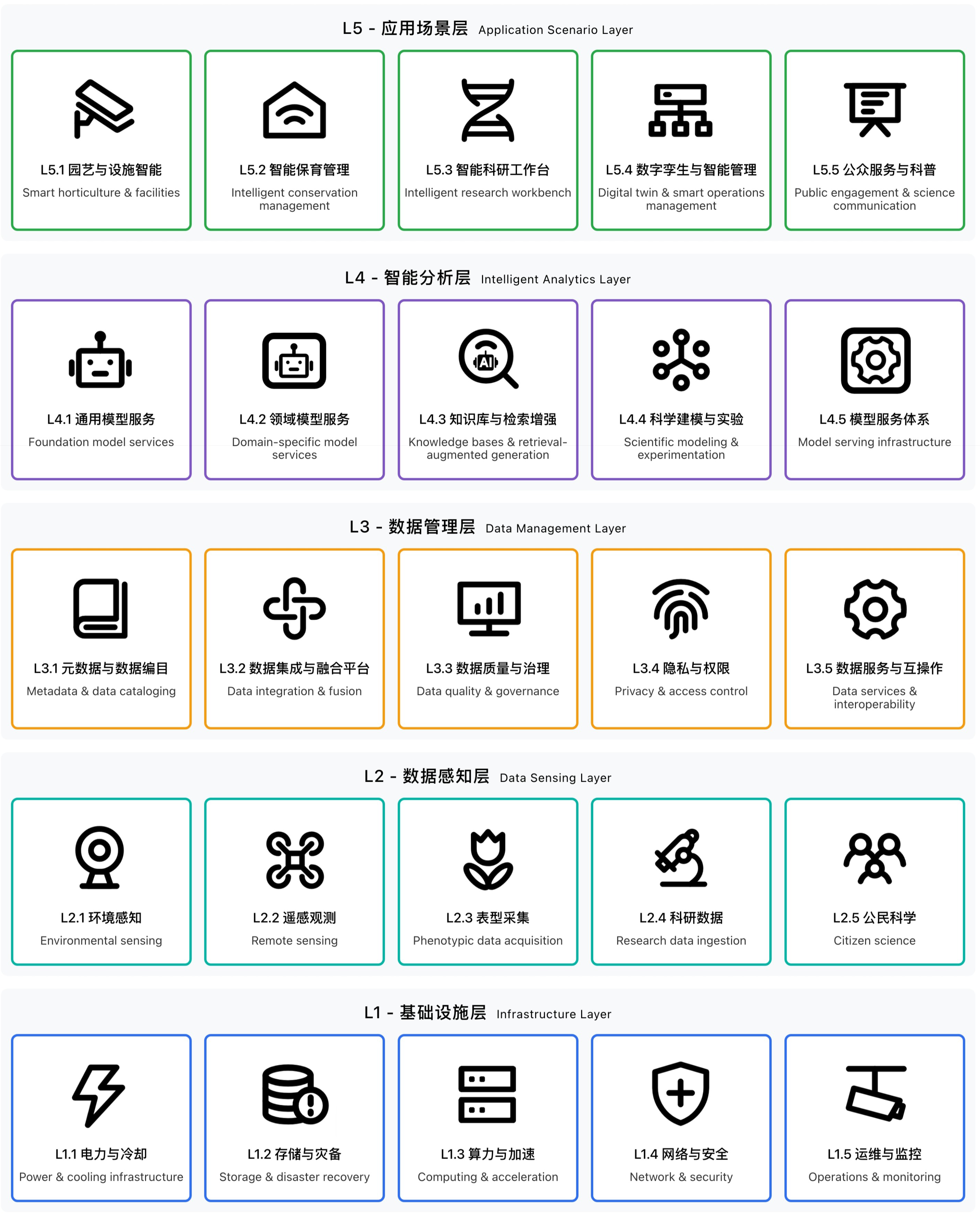
图1 国家植物园AI能力参考模型总体架构
Fig. 1 Overall architecture of the AI capability reference model for national botanical gardens
| 成熟度级别 Maturity level | 能力描述 Capability description | 评估标准 Assessment criteria | 分值 Score |
|---|---|---|---|
| Level 0 | 能力缺失 Capability absence | 能力完全缺失, 且无法通过自建或外部渠道获得/不可用 The capability completely absent, and cannot be acquired or is unavailable | 0 |
| Level 1 | 外部依赖 External dependency | 边缘业务, 委托第三方的业务/主要依赖外部合作; 主要通过租用、外部合作等方式获得/没有自主能力 Peripheral business, entrusted to third parties/primarily dependent on external partners; mainly obtained through leasing or external collaboration/lacking autonomous capability | 1 |
| Level 2 | 部分自主 Partial autonomy | 属于主营业务; 有能力实现自研; 资源部分自主; 能满足单位主要需求, 但不充分 Part of the core business; capable of in-house development; resources partially autonomous; able to meet the organization’s primary needs, but not fully | 2 |
| Level 3 | 自主可控 Autonomous & controllable | 主营业务; 有能力自研; 资源自主可控; 能满足单位全部需求 Core business; capable of independent in-house development; resources autonomous and controllable; able to meet all organizational needs | 3 |
| Level 4 | 国内领先 Domestic leading | 主营业务; 有原创能力; 国内领先水平; 资源充足, 能满足自己需求且能提供公共服务 Core business; original innovation capability; domestically leading level; resources sufficient to meet internal needs and to provide public services | 4 |
| Level 5 | 国际领先 International leading | 主营业务; 有行业领先的研发能力; 有国际影响力; 资源充足且能引领国际合作 Core business; possessing industry-leading research and development capability; having international influence; resources sufficient and able to lead international cooperation | 5 |
表1 国家植物园AI能力成熟度评价
Table 1 Evaluation of AI capability maturity levels for national botanical gardens
| 成熟度级别 Maturity level | 能力描述 Capability description | 评估标准 Assessment criteria | 分值 Score |
|---|---|---|---|
| Level 0 | 能力缺失 Capability absence | 能力完全缺失, 且无法通过自建或外部渠道获得/不可用 The capability completely absent, and cannot be acquired or is unavailable | 0 |
| Level 1 | 外部依赖 External dependency | 边缘业务, 委托第三方的业务/主要依赖外部合作; 主要通过租用、外部合作等方式获得/没有自主能力 Peripheral business, entrusted to third parties/primarily dependent on external partners; mainly obtained through leasing or external collaboration/lacking autonomous capability | 1 |
| Level 2 | 部分自主 Partial autonomy | 属于主营业务; 有能力实现自研; 资源部分自主; 能满足单位主要需求, 但不充分 Part of the core business; capable of in-house development; resources partially autonomous; able to meet the organization’s primary needs, but not fully | 2 |
| Level 3 | 自主可控 Autonomous & controllable | 主营业务; 有能力自研; 资源自主可控; 能满足单位全部需求 Core business; capable of independent in-house development; resources autonomous and controllable; able to meet all organizational needs | 3 |
| Level 4 | 国内领先 Domestic leading | 主营业务; 有原创能力; 国内领先水平; 资源充足, 能满足自己需求且能提供公共服务 Core business; original innovation capability; domestically leading level; resources sufficient to meet internal needs and to provide public services | 4 |
| Level 5 | 国际领先 International leading | 主营业务; 有行业领先的研发能力; 有国际影响力; 资源充足且能引领国际合作 Core business; possessing industry-leading research and development capability; having international influence; resources sufficient and able to lead international cooperation | 5 |
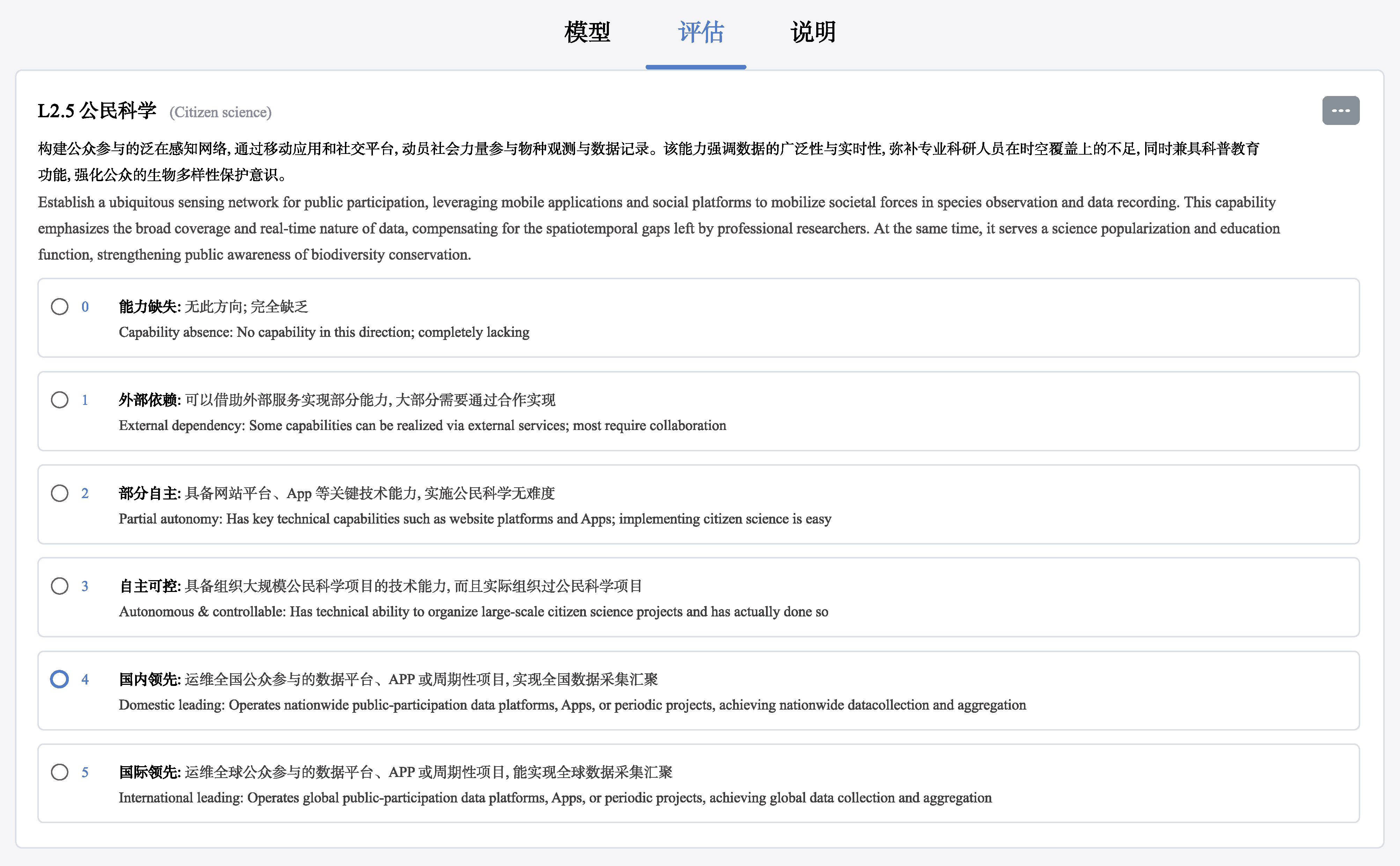
图2 国家植物园AI能力成熟度评价系统界面
Fig. 2 Interface of the AI capability maturity assessment system for national botanical gardens
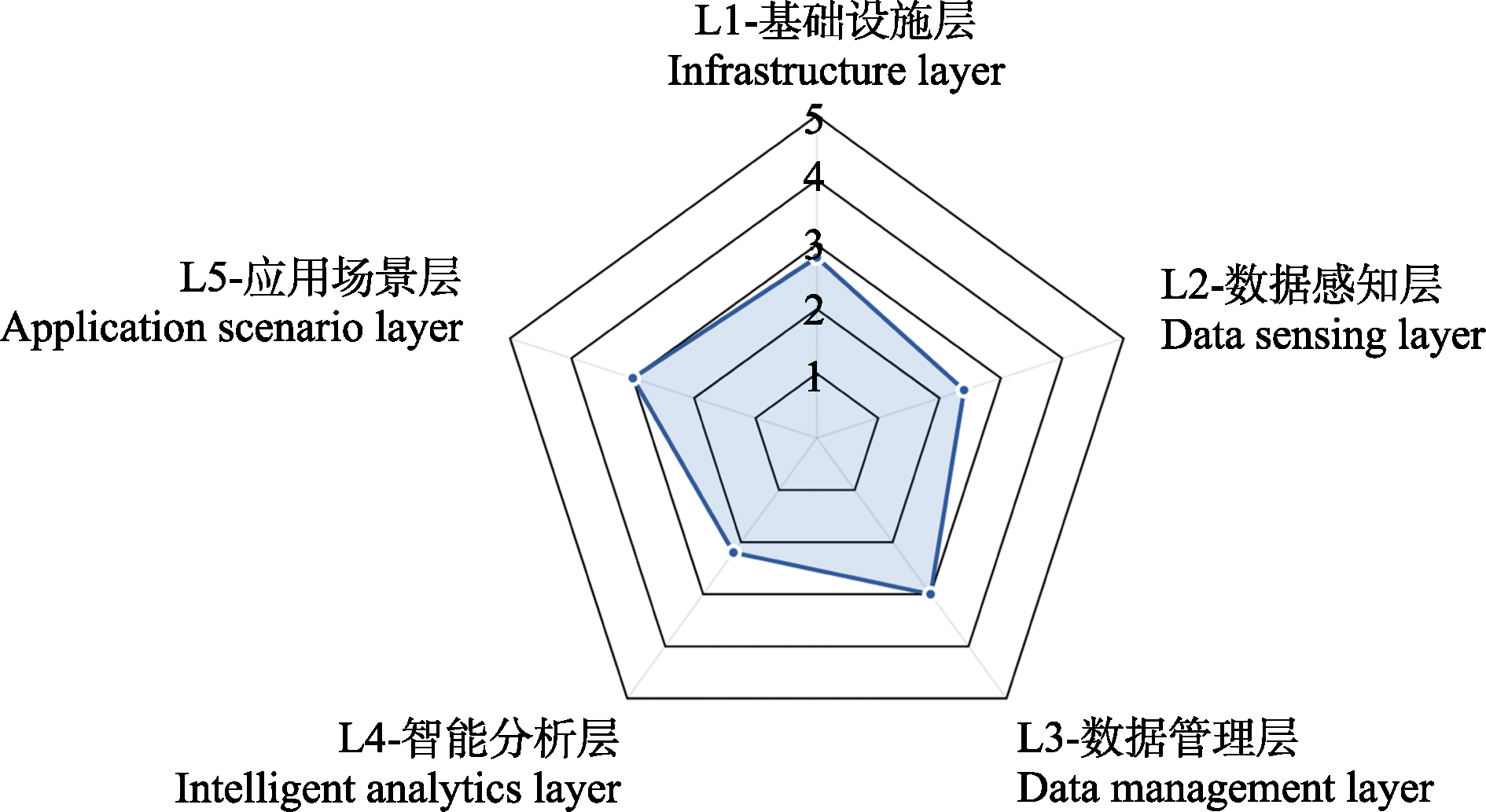
图3 国家植物园AI能力成熟度评价的雷达图
Fig. 3 Radar chart of AI capability maturity assessment for national botanical gardens
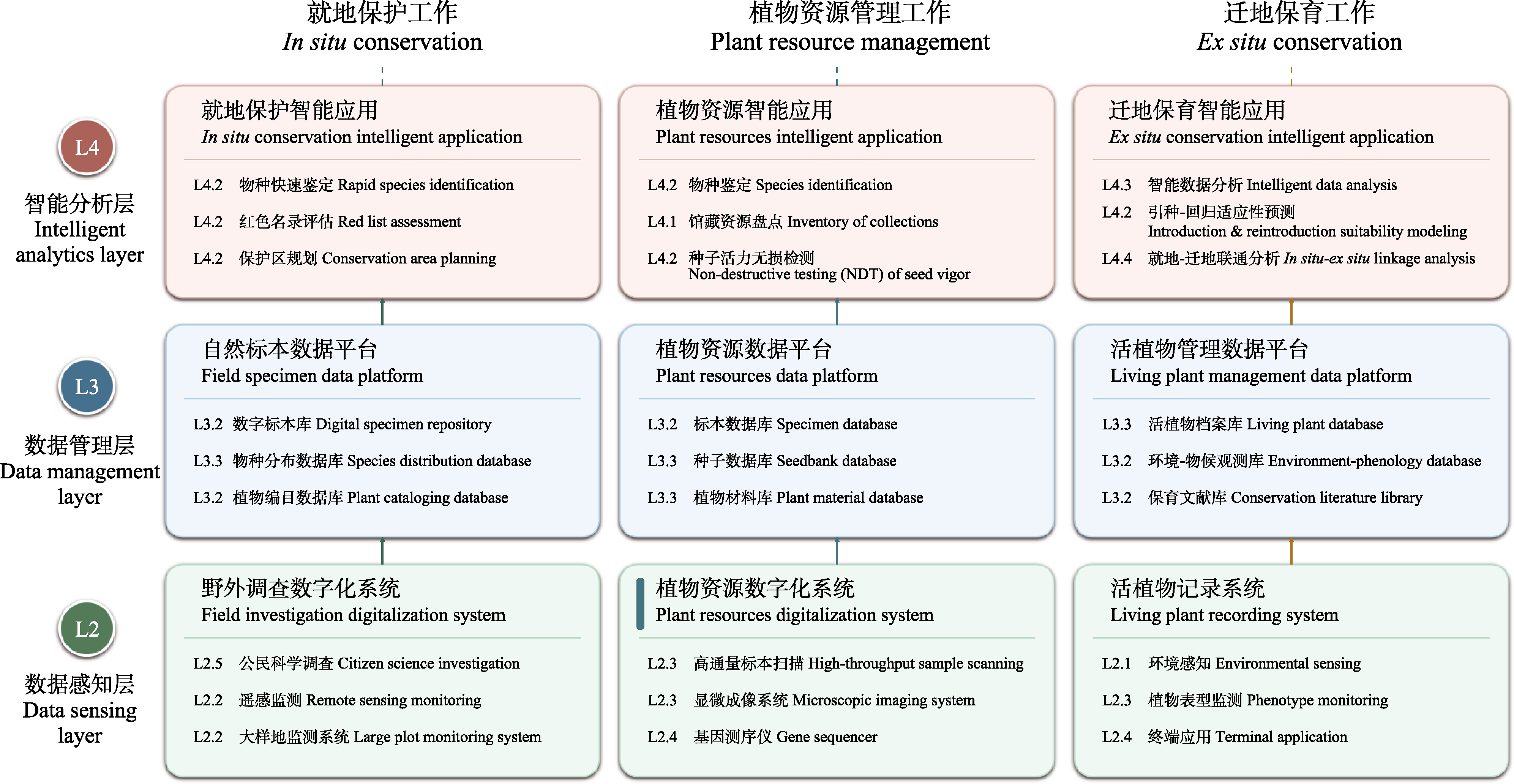
图4 上海辰山植物园智能保育九宫格体系架构图
Fig. 4 System architecture of the smart conservation matrix at Shanghai Chenshan Botanical Garden
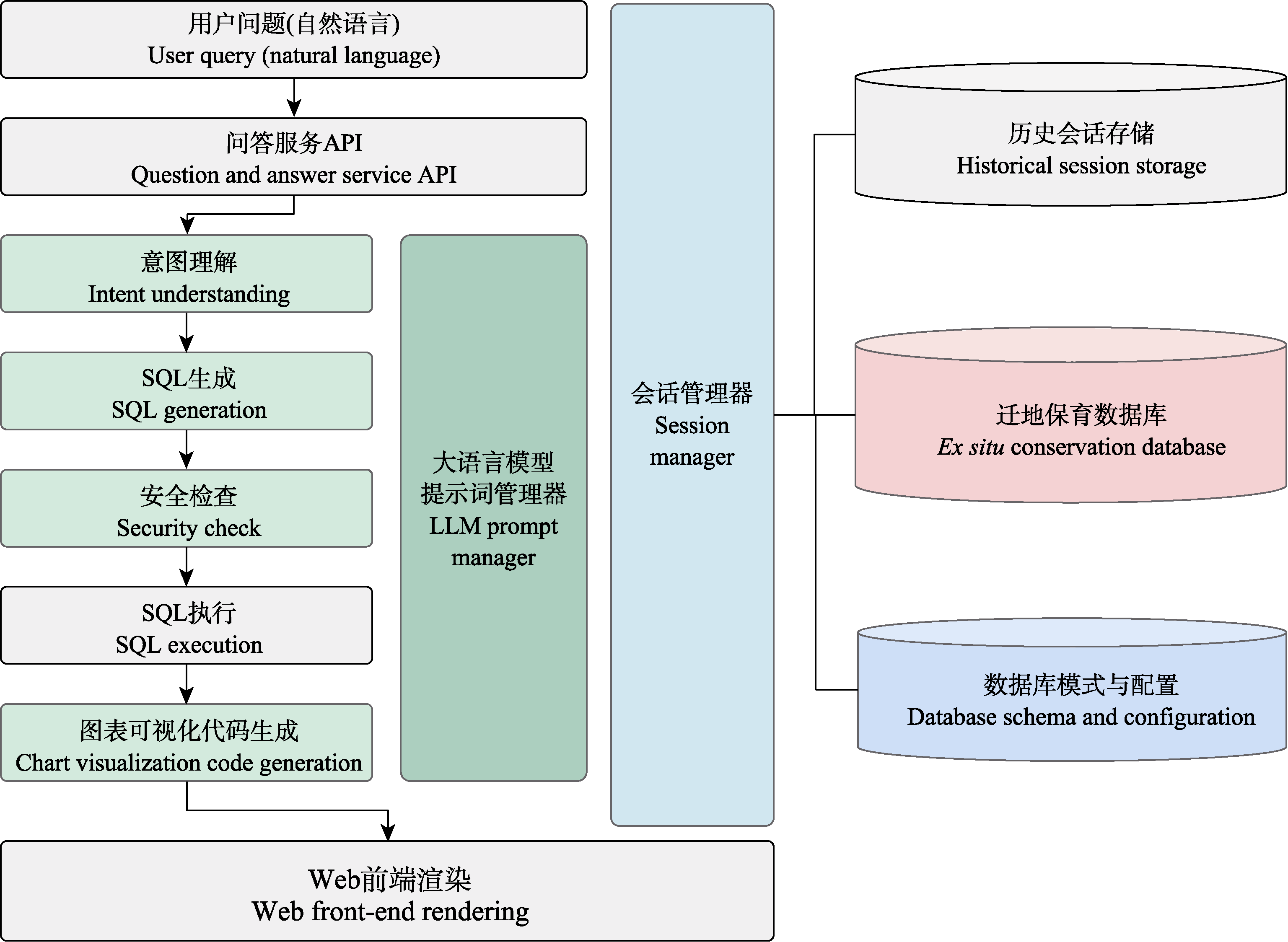
图5 智能植物保育管家(SPA)的核心架构
Fig. 5 Core architecture of the smart plant attendant (SPA). LLM, Large language model.
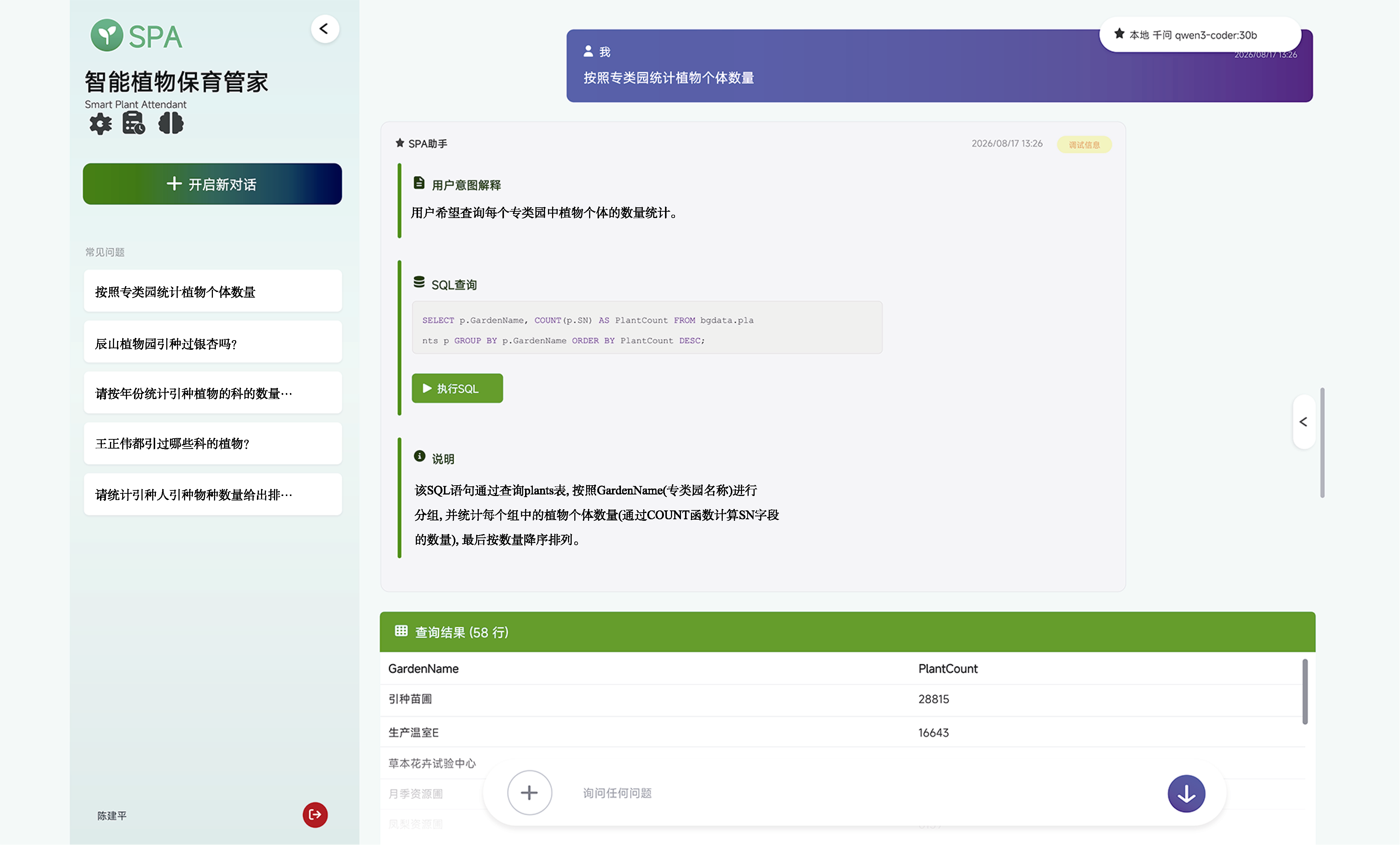
图6 智能植物保育管家(SPA)系统中基于大语言模型(LLM)的自然语言生成结构化查询语言(SQL)查询
Fig. 6 Large language model (LLM)-based natural language to structured query language (SQL) query generation in the smart plant attendant (SPA) system
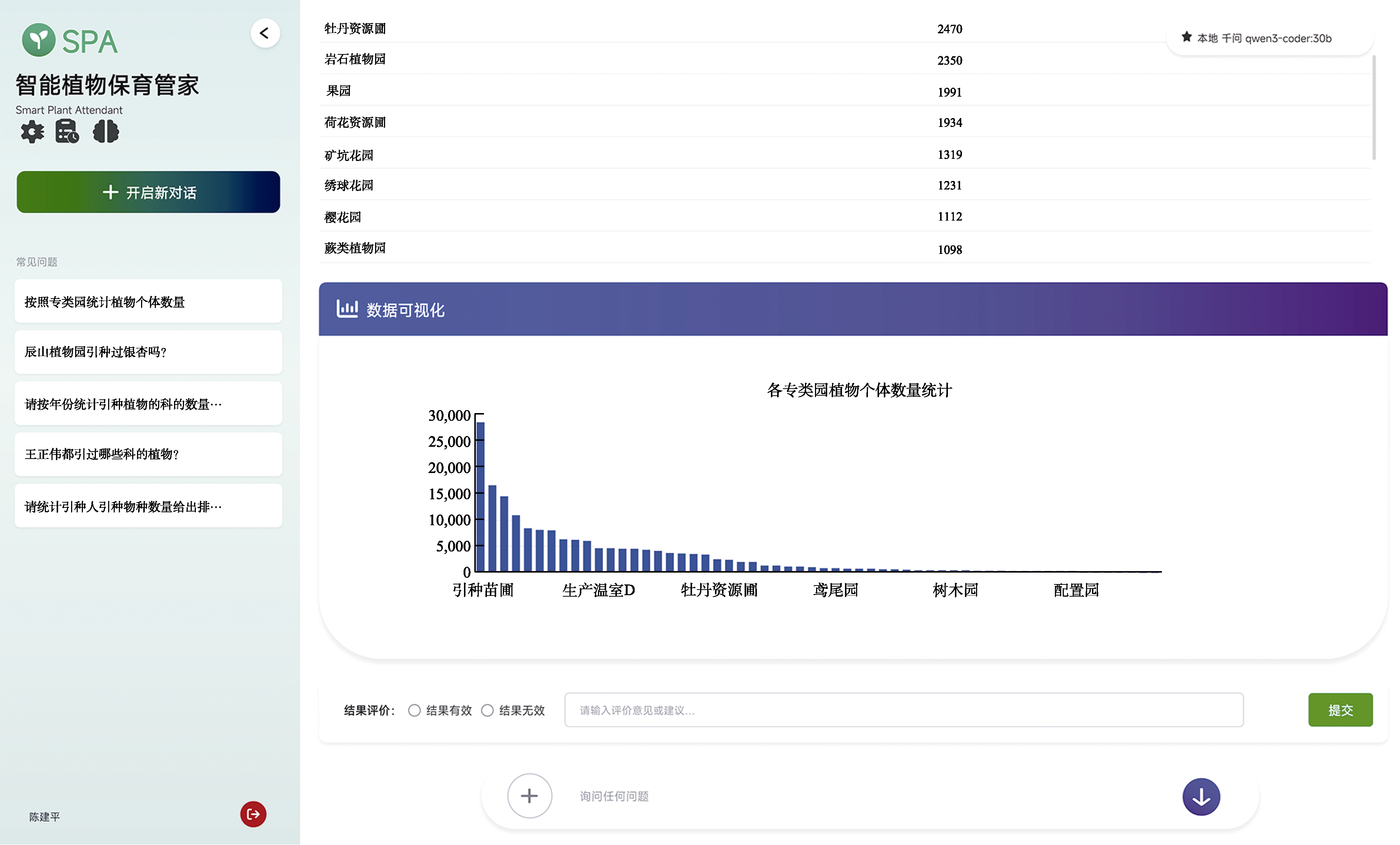
图7 智能植物保育管家(SPA)系统中的数据可视化
Fig. 7 Data visualization in the smart plant attendant (SPA) system
| [1] |
Abramson J, Adler J, Dunger J, Evans R, Green T, Pritzel A, Ronneberger O, Willmore L, Ballard AJ, Bambrick J, Bodenstein SW, Evans DA, Hung CC, O’Neill M, Reiman D, Tunyasuvunakool K, Wu Z, Žemgulytė A, Arvaniti E, Beattie C, Bertolli O, Bridgland A, Cherepanov A, Congreve M, Cowen-Rivers AI, Cowie A, Figurnov M, Fuchs FB, Gladman H, Jain R, Khan YA, Low CMR, Perlin K, Potapenko A, Savy P, Singh S, Stecula A, Thillaisundaram A, Tong C, Yakneen S, Zhong ED, Zielinski M, Žídek A, Bapst V, Kohli P, Jaderberg M, Hassabis D, Jumper JM (2024) Accurate structure prediction of biomolecular interactions with AlphaFold 3. Nature, 630, 493-500.
DOI |
| [2] |
Brun P, Karger DN, Zurell D, Descombes P, de Witte LC, de Lutio R, Wegner JD, Zimmermann NE (2024) Multispecies deep learning using citizen science data produces more informative plant community models. Nature Communications, 15, 4421.
DOI PMID |
| [3] | Buschmann F, Meunier R, Rohnert H, Sommerlad P, Stal M (1996) Pattern-Oriented Software Architecture: A System of Patterns. John Wiley & Sons, Chichester. |
| [4] | Dijkstra EW (1982) On the role of scientific thought. In: Selected Writings on Computing: A Personal Perspective (ed. Dijkstra EW), pp. 60-66. Springer, New York. |
| [5] | E WN (2024) AI helps to establish a new paradigm for scientific research. Bulletin of Chinese Academy of Sciences, 39, 10-16. (in Chinese with English abstract) |
| [鄂维南 (2024) AI助力打造科学研究新范式. 中国科学院院刊, 39, 10-16.] | |
| [6] | Gillespie LE, Ruffley M, Exposito-Alonso M (2024) Deep learning models map rapid plant species changes from citizen science and remote sensing data. Proceedings of the National Academy of Sciences, USA, 121, e2318296121. |
| [7] | Gu JQ, Chen JP, Lai JS (2024) Application of large language models in biodiversity research. Biodiversity Science, 32, 24258. (in Chinese with English abstract) |
|
[谷际岐, 陈建平, 赖江山 (2024) 大语言模型在生物多样性研究中的应用. 生物多样性, 32, 24258.]
DOI |
|
| [8] | Hey T, Tansley S, Tolle KM (2009) The Fourth Paradigm: Data-Intensive Scientific Discovery. Microsoft Research, Redmond. |
| [9] | Huang YF, Lu CY, Jia MM, Wang ZL, Su Y, Su YL (2023) Plant species classification of coastal wetlands based on UAV images and object-oriented deep learning. Biodiversity Science, 31, 22411. (in Chinese with English abstract) |
|
[黄雨菲, 路春燕, 贾明明, 王自立, 苏越, 苏艳琳 (2023) 基于无人机影像与面向对象-深度学习的滨海湿地植物物种分类. 生物多样性, 31, 22411.]
DOI |
|
| [10] | Li GJ (2024) AI4R: The fifth scientific research paradigm. Bulletin of Chinese Academy of Sciences, 39, 1-9. (in Chinese with English abstract) |
| [李国杰 (2024) 智能化科研(AI4R): 第五科研范式. 中国科学院院刊, 39, 1-9.] | |
| [11] | Li X, Yu HC (2024) A new paradigm of life science research driven by artificial intelligence. Bulletin of Chinese Academy of Sciences, 39, 50-58. (in Chinese with English abstract) |
| [李鑫, 于汉超 (2024) 人工智能驱动的生命科学研究新范式. 中国科学院院刊, 39, 50-58.] | |
| [12] | Liao JP, Ni DJ, He T, Huang HW (2023) Historical review, current status and future prospects of global botanical gardens. Biodiversity Science, 31, 23256. (in Chinese with English abstract) |
|
[廖景平, 倪杜娟, 何拓, 黄宏文 (2023) 全球植物园发展历史、现状与展望. 生物多样性, 31, 23256.]
DOI |
|
| [13] |
Liu XY, Shen SY, Li BY, Ma PX, Jiang RZ, Zhang YX, Fan J, Li GL, Tang N, Luo YY (2025) A survey of Text-to-SQL in the era of LLMs: Where are we, and where are we going? IEEE Transactions on Knowledge and Data Engineering, 37, 5735-5754.
DOI URL |
| [14] | Lu XQ, Dong SS, Ma Y, Xu X, Qiu F, Zang MY, Wan YQ, Li LX, Yu CG, Liu Y (2025) Current status, challenges, and prospects of frontier technologies in biodiversity conservation applications. Biodiversity Science, 33, 24440. (in Chinese with English abstract) |
|
[卢晓强, 董姗姗, 马月, 徐徐, 邱凤, 臧明月, 万雅琼, 李孪鑫, 于赐刚, 刘燕 (2025) 前沿技术在生物多样性研究中的应用现状、挑战与展望. 生物多样性, 33, 24440.]
DOI |
|
| [15] |
Paulk MC, Curtis B, Chrissis MB, Weber CV (1993) Capability maturity model, version 1.1. IEEE Software, 10, 18-27.
DOI URL |
| [16] | Ren H, He T, Wen SF, Dong H (2023) The main features of the world-class national botanical garden with Chinese characteristics. Biodiversity Science, 31, 23192. (in Chinese with English abstract) |
|
[任海, 何拓, 文世峰, 董晖 (2023) 中国特色、世界一流国家植物园的主要特征. 生物多样性, 31, 23192.]
DOI |
|
| [17] | Wan FM, Wan HW, Zhang ZR, Gao JX, Sun CX, Wang YC (2024) The application potential of unmanned aerial vehicle surveys in grassland plant diversity. Biodiversity Science, 32, 23381. (in Chinese with English abstract) |
|
[万凤鸣, 万华伟, 张志如, 高吉喜, 孙晨曦, 王永财 (2024) 草地植物多样性无人机调查的应用潜力. 生物多样性, 32, 23381.]
DOI |
|
| [18] | Xie G, Xuan J, Fu QD, Wei Z, Xue K, Luo HR, Gao JX, Li M (2025) Establishing an intelligent identification model for unmanned aerial vehicle surveys of grassland plant diversity. Biodiversity Science, 33, 24236. (in Chinese with English abstract) |
|
[谢淦, 宣晶, 付其迪, 魏泽, 薛凯, 雒海瑞, 高吉喜, 李敏 (2025) 草地植物多样性无人机调查的物种智能识别模型构建. 生物多样性, 33, 24236.]
DOI |
|
| [19] |
Xie G, Xuan J, Liu B, Luo YB, Wang YF, Zou XH, Li M (2024) FlowerMate 2.0: Identifying plants in China with artificial intelligence. The Innovation, 5, 100636.
DOI URL |
| [20] | Xu XH, Wang WW, Mi XC, Chen L, Ma KP (2023) The Chinese Forest Biodiversity Monitoring Network: 20-year achievements and outlook. Biodiversity Science, 31, 23354. (in Chinese with English abstract) |
|
[徐学红, 王巍伟, 米湘成, 陈磊, 马克平 (2023) 中国森林生物多样性监测网络(CForBio): 二十年进展与展望. 生物多样性, 31, 23354.]
DOI |
|
| [21] | Xu ZH, Liu SY, Zhao Y, Tu WQ, Chang ZF, Zhang ET, Guo J, Zheng D, Geng J, Gu GY, Guo CP, Guo LL, Wang J, Xu CY, Peng C, Yang T, Cui MQ, Sun WC, Zhang JT, Liu HT, Ba CQ, Wang HQ, Jia JC, Wu JZ, Xiao C, Ma KP (2020) Evaluation of the identification ability of eight commonly used plant identification application softwares in China. Biodiversity Science, 28, 524-533. (in Chinese with English abstract) |
|
[许展慧, 刘诗尧, 赵莹, 涂文琴, 常诏峰, 张恩涛, 郭靖, 郑迪, 耿鋆, 顾高营, 郭淳鹏, 郭璐璐, 王静, 徐春阳, 彭钏, 杨腾, 崔梦琪, 孙伟成, 张剑坛, 刘皓天, 巴超群, 王鹤琪, 贾竞超, 武金洲, 肖翠, 马克平 (2020) 国内8款常用植物识别软件的识别能力评价. 生物多样性, 28, 524-533.]
DOI |
|
| [22] | Zha DC, Bhat ZP, Lai KH, Yang F, Jiang ZM, Zhong SC, Hu X (2025) Data-centric artificial intelligence: A survey. ACM Computing Surveys, 57, Article 129. |
| [23] | Zhou XH, Yang J (2025) Applications and challenges of AI and LLMs in biodiversity conservation research and practices. Biodiversity Science, 33, 25179. (in Chinese with English abstract) |
|
[周宣宏, 杨军 (2025) AI和LLMs在生物多样性保护研究和实践中的应用与挑战. 生物多样性, 33, 25179.]
DOI |
|
| [24] |
Zizka A, Andermann T, Silvestro D (2022) IUCNN-Deep learning approaches to approximate species’ extinction risk. Diversity and Distributions, 28, 227-241.
DOI URL |
| [1] | 李保平, 张展豪, 魏雅丹. 人工智能背景下中国履行《生物多样性公约》获取与惠益分享制度的挑战与优化路径[J]. 生物多样性, 2026, 34(6): 26073-. |
| [2] | 金冬梅, 何拓, 董晖, 马其侠, 胡永红. 我国植物园体系如何更好地践行植物多样性保护?[J]. 生物多样性, 2025, 33(6): 24441-. |
| [3] | 谢淦, 宣晶, 付其迪, 魏泽, 薛凯, 雒海瑞, 高吉喜, 李敏. 草地植物多样性无人机调查的物种智能识别模型构建[J]. 生物多样性, 2025, 33(4): 24236-. |
| [4] | 卢晓强, 董姗姗, 马月, 徐徐, 邱凤, 臧明月, 万雅琼, 李孪鑫, 于赐刚, 刘燕. 前沿技术在生物多样性研究中的应用现状、挑战与展望[J]. 生物多样性, 2025, 33(4): 24440-. |
| [5] | 武慧, 俞乐, 杜贞容, 赵强, 戚文超, 曹越, 王金洲, 申小莉, 孙尧, 马克平. 基于遥感监测的《昆蒙框架》执行进展快速评估: 路径与展望[J]. 生物多样性, 2025, 33(3): 24526-. |
| [6] | 孔祥飞, 丁强, 王国全, 黄国华, 田哲豪, 王新谱, 佟一杰, 宋志顺, 张晓宁, 李卫海, 韩辉林, 李文亮, 聂瑞娥, 杨海东, 杨星科, 刘梅柯, 孙永明, 崔亚琴, 杨美霞, 刘宁, 路园园, 李盼盼, 白明. “SITE-100”中国样地昆虫多样性监测研究进展[J]. 生物多样性, 2025, 33(12): 24323-. |
| [7] | 何拓, 周志华, 董晖, 郭立新, 郑苗淼, 王泳腾, 秦亚龙, 顾钰峰, 袁良琛, 廖景平. 全球国家植物园发展现状与启示: 兼论中国国家植物园体系建设路径[J]. 生物多样性, 2025, 33(11): 25310-. |
| [8] | 周宣宏, 杨军. AI和LLMs在生物多样性保护研究和实践中的应用与挑战[J]. 生物多样性, 2025, 33(10): 25179-. |
| [9] | 谷际岐, 陈建平, 赖江山. 大语言模型在生物多样性研究中的应用[J]. 生物多样性, 2024, 32(9): 24258-. |
| [10] | 刘夙, 杜诚, 胡永红. 迁地保护应当具有明确的灵活性[J]. 生物多样性, 2024, 32(2): 24037-. |
| [11] | 陈进, 杨玺. 关于植物迁地保护若干问题的讨论[J]. 生物多样性, 2024, 32(2): 24064-. |
| [12] | 文世峰, 周志华, 何拓, 董晖, 袁良琛, 卢泽洋, 王泳腾, 郭琳, 舒江平, 李开凡. 《国家植物园体系布局方案》编制背景、程序、思路和重点考虑[J]. 生物多样性, 2023, 31(9): 23193-. |
| [13] | 陈进. 《昆明-蒙特利尔全球生物多样性框架》与国家植物园体系建设[J]. 生物多样性, 2023, 31(9): 23257-. |
| [14] | 许再富. 对国家植物园体系建设“统筹原则”的一些见解[J]. 生物多样性, 2023, 31(1): 22470-. |
| [15] | 任海, 文香英, 廖景平, 郑祥慈, 杨明, 周桔. 试论植物园功能变迁与中国国家植物园体系建设[J]. 生物多样性, 2022, 30(4): 22113-. |
| 阅读次数 | ||||||
|
全文 |
|
|||||
|
摘要 |
|
|||||
备案号:京ICP备16067583号-7
Copyright © 2026 版权所有 《生物多样性》编辑部
地址: 北京香山南辛村20号, 邮编:100093
电话: 010-62836137, 62836665 E-mail: biodiversity@ibcas.ac.cn
