

生物多样性 ›› 2026, Vol. 34 ›› Issue (4): 25435. DOI: 10.17520/biods.2025435 cstr: 32101.14.biods.2025435
张同1,#( ), 梁力文2,#, 王长剑3,4, 舒服1, 王璐5, 郭泽光2, 卓玛曲珍6, 钱芊2, 蒋安莉2, 敖俊杰1, 彭兴文1, 伍小刚2,7, 向左甫3, 郭克疾1,3,*(
 ), 廖梓延2,7,*()()
收稿日期:2025-11-03
接受日期:2026-02-19
出版日期:2026-04-20
发布日期:2026-05-28
通讯作者:
*E-mail: guokeji@126.com; liaozy@cib.ac.cn
作者简介:#共同第一作者
基金资助:
Tong Zhang1,#(), Liwen Liang2,#, Changjian Wang3,4, Fu Shu1, Lu Wang5, Zeguang Guo2, quzhen Zhuoma6, Qian Qian2, Anli Jiang2, Junjie Ao1, Xingwen Peng1, Xiaogang Wu2,7, Zuofu Xiang3, Keji Guo1,3,*(), Ziyan Liao2,7,*()()
Received:2025-11-03
Accepted:2026-02-19
Online:2026-04-20
Published:2026-05-28
Contact:
*E-mail: guokeji@126.com; liaozy@cib.ac.cn
About author:#Co-first authors
Supported by:摘要:
摸清生物多样性本底是落实以国家公园为主体的自然保护地体系建设的重要基础。为明确西藏芒康滇金丝猴国家级自然保护区鸟类和兽类多样性现状及其季节性分布特征, 我们于2021年12月至2025年7月在保护区及周边地区布设122台红外相机开展连续监测。野外监测共记录到兽类4目12科26种, 鸟类8目18科51种, 其中包含6种国家一级重点保护野生动物和20种国家二级重点保护野生动物。6种国家一级重点保护野生动物为豹(Panthera pardus)、林麝(Moschus berezovskii)、马麝(M. chrysogaster)、滇金丝猴(Rhinopithecus bieti) 、斑尾榛鸡(Tetrastes sewerzowi)和黄喉雉鹑(Tetraophasis szechenyii)。相对多度较高的兽类为毛冠鹿(Elaphodus cephalophus)、灰尾兔(Lepus oiostolus)、中华鬣羚(Capricornis milneedwardsii)、猕猴(Macaca mulatta)和赤狐(Vulpes vulpes); 鸟类为血雉(Ithaginis cruentus)、白马鸡(Crossoptilon crossoptilon)和黄喉雉鹑。在此基础上, 基于监测数据的完整性与代表性, 我们选取了赤狐、中华鬣羚、滇金丝猴、白马鸡和血雉5种代表性物种, 采用单季节占域模型分析了其季节性空间分布差异。结果表明, 不同物种在不同季节的占域率存在明显差异, 四季平均占域率最高的是赤狐(ψ=0.64), 其次为中华鬣羚(ψ=0.44)、滇金丝猴(ψ=0.43)和白马鸡(ψ=0.43), 血雉的占域率相对较低(ψ=0.41)。总体来看, 各物种的季节性空间利用模式具有明显的物种特异性, 其变化与植被条件、地形特征及水源可达性等多种环境因子相关。本研究揭示了西藏芒康滇金丝猴国家级自然保护区鸟兽多样性现状, 并阐明了部分代表性大中型兽类和地栖性鸟类的季节性空间利用格局, 可为保护区的生物多样性保护与管理提供科学依据。
张同, 梁力文, 王长剑, 舒服, 王璐, 郭泽光, 卓玛曲珍, 钱芊, 蒋安莉, 敖俊杰, 彭兴文, 伍小刚, 向左甫, 郭克疾, 廖梓延 (2026) 基于红外相机的西藏芒康滇金丝猴国家级自然保护区鸟兽多样性及代表性物种的季节性空间利用特征. 生物多样性, 34, 25435. DOI: 10.17520/biods.2025435.
Tong Zhang, Liwen Liang, Changjian Wang, Fu Shu, Lu Wang, Zeguang Guo, quzhen Zhuoma, Qian Qian, Anli Jiang, Junjie Ao, Xingwen Peng, Xiaogang Wu, Zuofu Xiang, Keji Guo, Ziyan Liao (2026) Camera-trap-based assessment of bird and mammal diversity and seasonal occupancy patterns of representative species in the Mangkang Yunnan Snub-nosed Monkey National Nature Reserve, Xizang, China. Biodiversity Science, 34, 25435. DOI: 10.17520/biods.2025435.
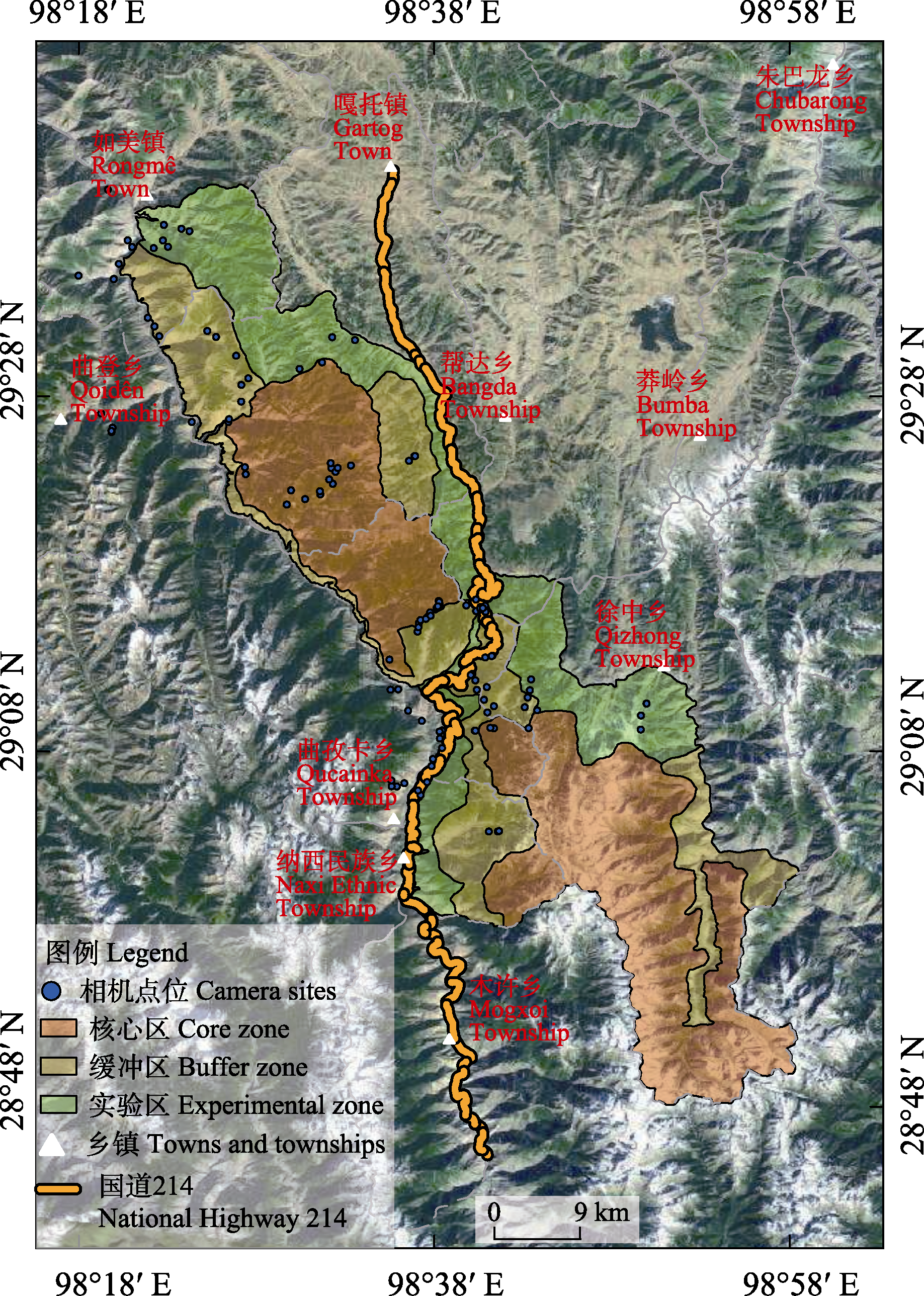
图1 西藏芒康滇金丝猴国家级自然保护区红外相机布设位点
Fig. 1 Camera trap sites in the Mangkang Yunnan Snub-nosed Monkey National Nature Reserve, Xizang
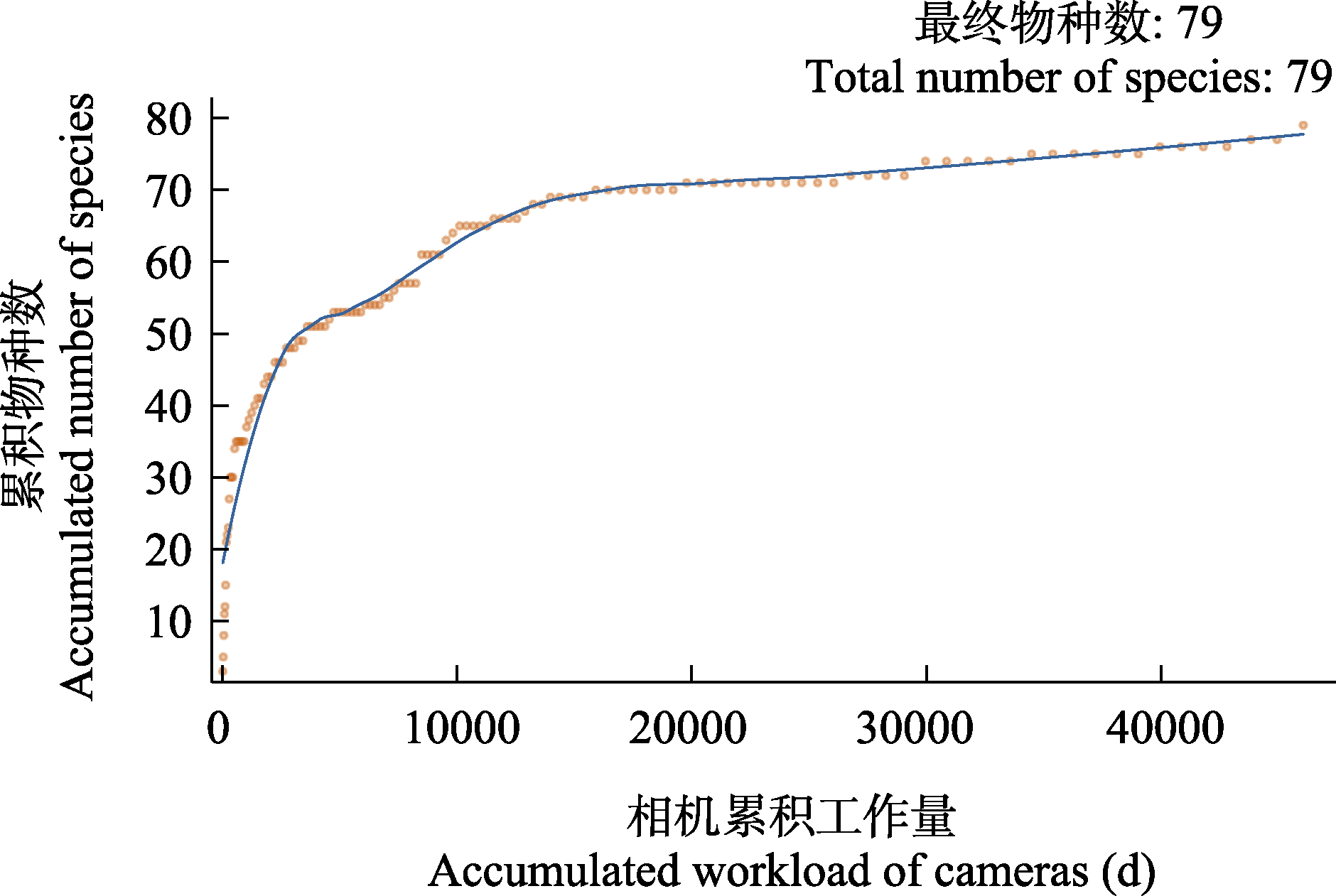
图2 物种累积曲线。随着相机累计工作量的增加, 识别到的物种数逐渐增加; 每个点代表一台相机, 曲线为平滑拟合结果。
Fig. 2 Species accumulation curves. As cumulative camera effort increased, the number of detected species gradually increased; each point represents one camera, and the curve indicates result of the smoothed fitted.
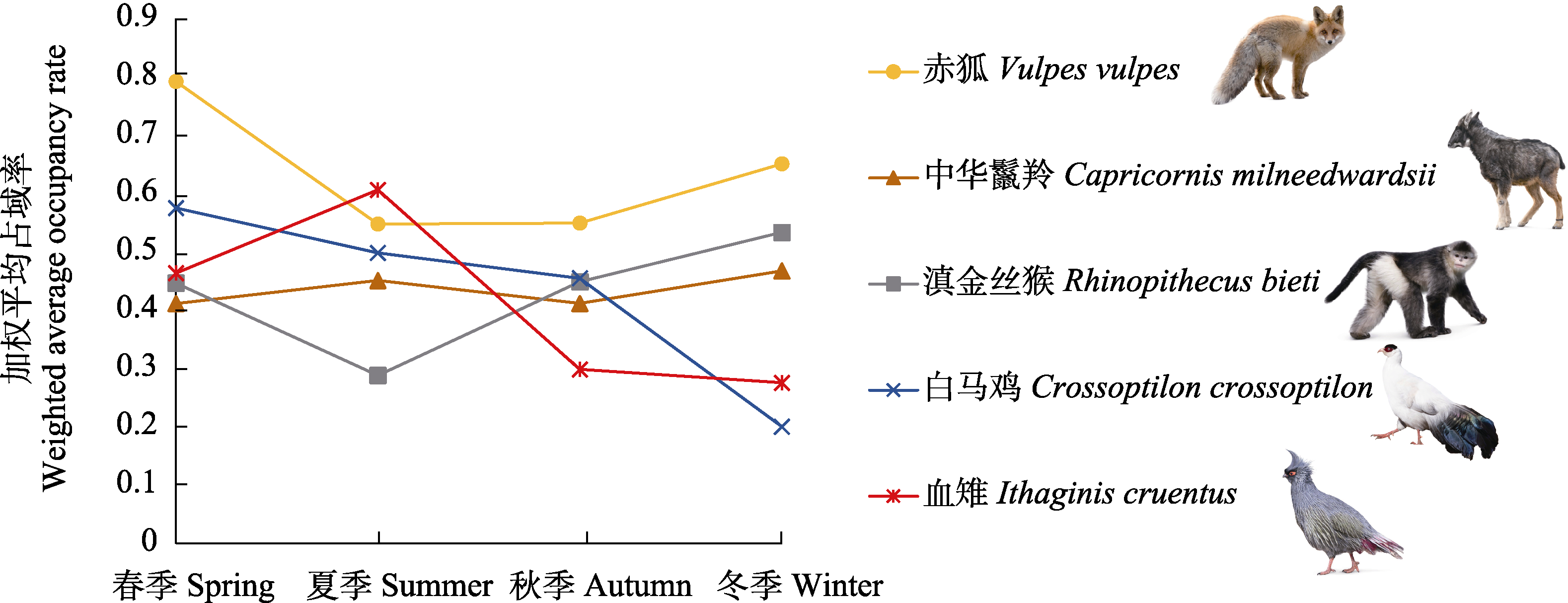
图3 各物种占域率的季节性变化。占域率为等效模型的加权平均值, 春季、夏季、秋季、冬季分别为3-5月、6-8月、9-11月、12月至次年2月。
Fig. 3 Seasonal variation in species occupancy rates (presented as model-averaged weighted estimates across quarters defined as spring (Mar.-May), summer (Jun.-Aug.), autumn (Sept.-Nov.), and winter (Dec.-Feb.))
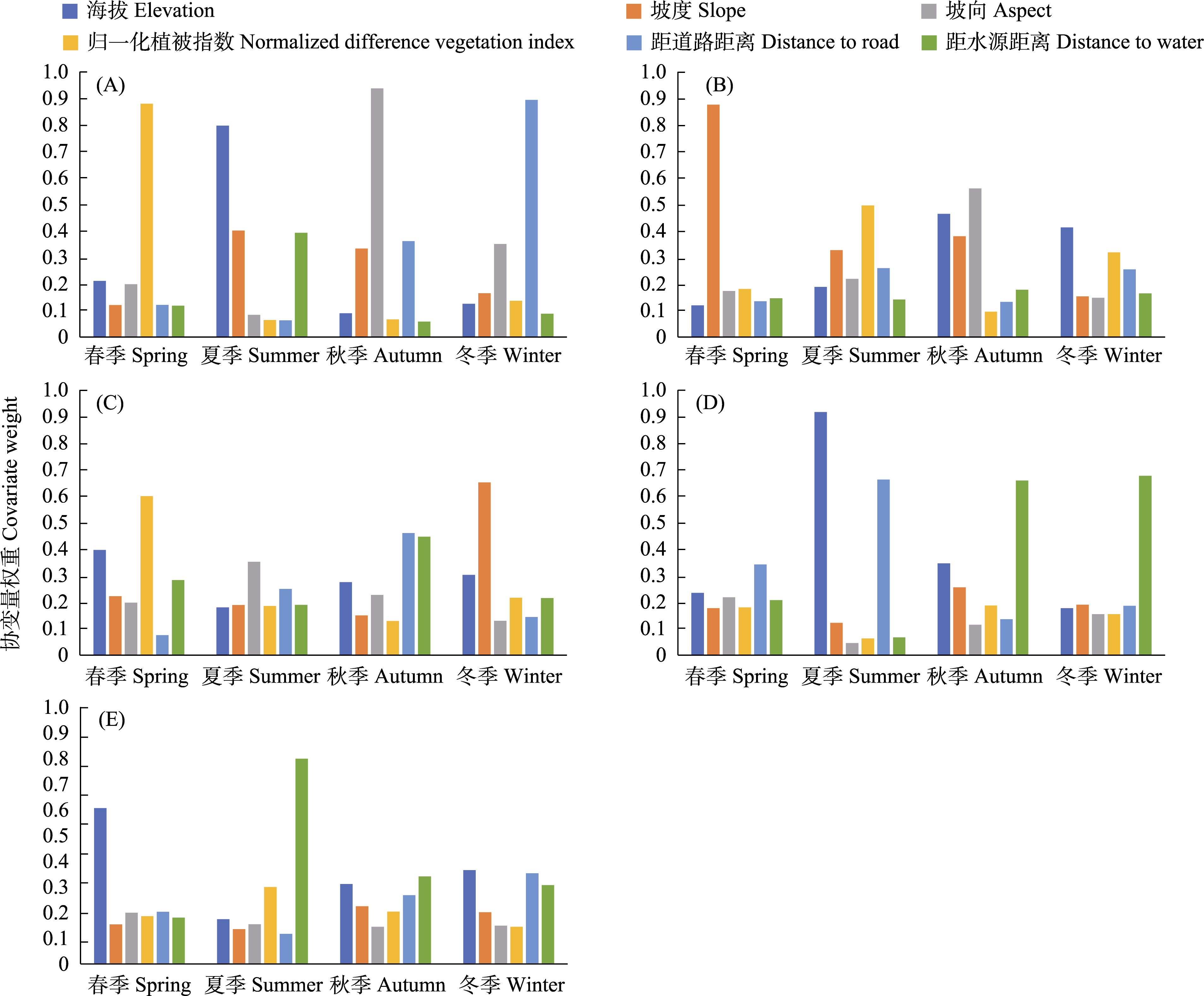
图4 5个代表性物种基于占域模型的各协变量权重的季节性变化。(A)赤狐; (B)中华鬣羚; (C)滇金丝猴; (D)白马鸡; (E)血雉。
Fig. 4 Seasonal variation in the weights of covariates derived from occupancy models for five representative species. (A) Vulpes vulpes; (B) Capricornis milneedwardsii; (C) Rhinopithecus bieti; (D) Crossoptilon crossoptilon; (E) Ithaginis cruentus.
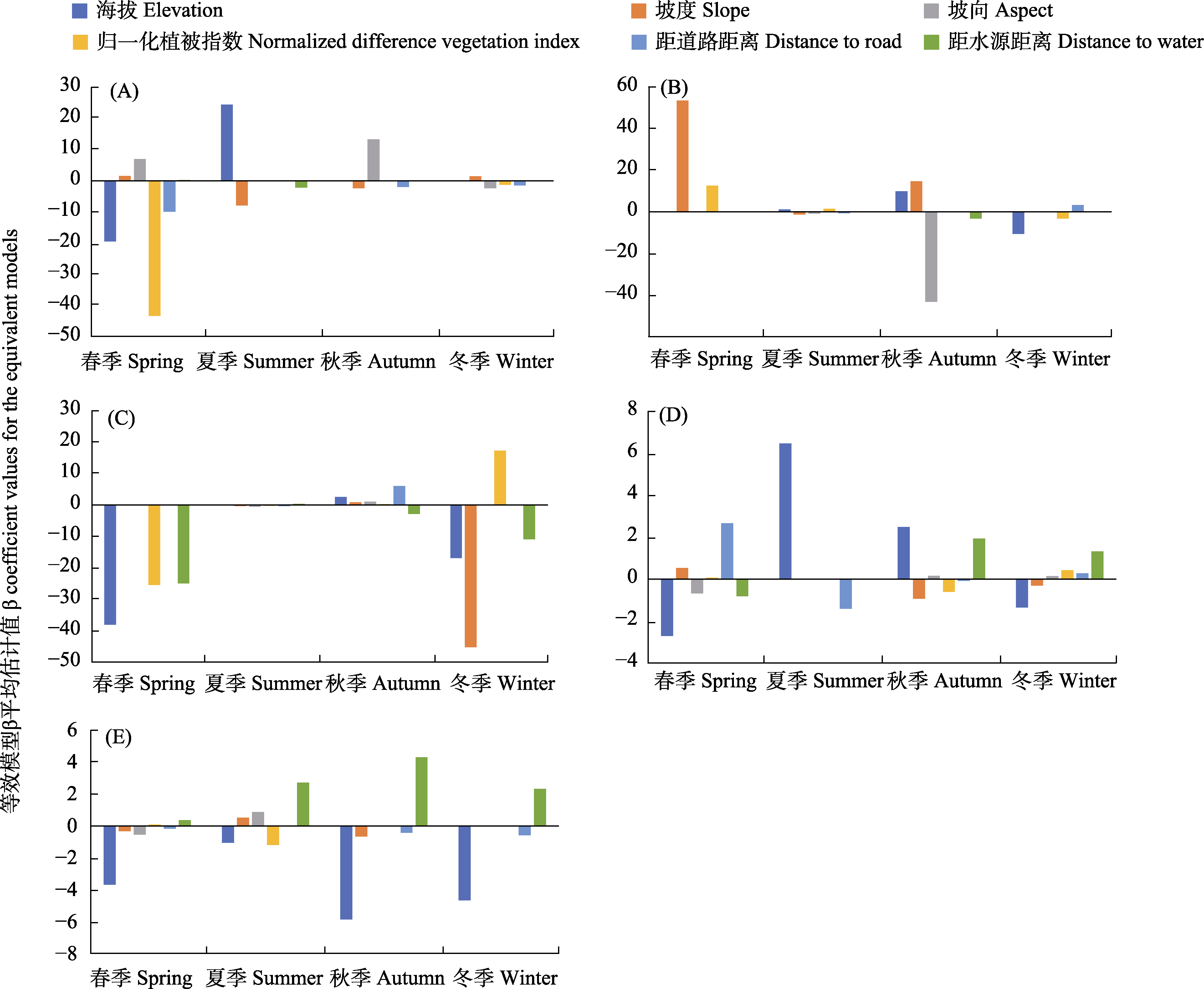
图5 5个代表性物种协变量对占域率的β平均估计值。(A)赤狐; (B)中华鬣羚; (C)滇金丝猴; (D)白马鸡; (E)血雉。
Fig. 5 Average estimated β coefficients of covariates on occupancy rates for five representative species. (A) Vulpes vulpes; (B) Capricornis milneedwardsii; (C) Rhinopithecus bieti; (D) Crossoptilon crossoptilon; (E) Ithaginis cruentus.
| [1] | Bartoń K (2025) MuMIn: Multi-Model Inference. R package version 1.48.11. https://CRAN.R-project.org/package=MuMIn. (accessed on 2025-03-15) |
| [2] | Cavallini P (1996) Variation in the social system of the red fox. Ethology Ecology & Evolution, 8, 323-342. |
| [3] | Cagnacci F, Meriggi A, Lovari S (2004) Habitat selection by the red fox Vulpes vulpes (L. 1758) in an alpine area. Ethology Ecology & Evolution, 16, 103-116. |
| [4] | Cui MH, Yang GB, Han LX (2012) Birds diversity of Lanping Yunling Provincial Nature Reserve and the surrounding area. Journal of Dali University, 11(10), 33-43. (in Chinese with English abstract) |
| [崔茂欢, 杨国斌, 韩联宪 (2012) 兰坪云岭省级自然保护区及周边地区鸟类多样性. 大理学院学报, 11(10), 33-43.] | |
| [5] | Cui MH, Yang GB, Yang SJ (2014) Mammals survey of Lanping Yunling Provincial Nature Reserve. Journal of Dali University, 13(6), 48-53. (in Chinese with English abstract) |
| [崔茂欢, 杨国斌, 杨士剑 (2014) 兰坪云岭省级自然保护区兽类资源调查. 大理学院学报, 13(6), 48-53.] | |
| [6] |
Dixon P (2003) VEGAN, a package of R functions for community ecology. Journal of Vegetation Science, 14, 927-930.
DOI URL |
| [7] | Duan LJ, Zhang YB, Kang DW, Wang XR, Li JQ (2014) Daily activity pattern and group behavior of Ithaginis cruentus in initial breeding period and brooding period. Journal of Biology, 31(6), 42-45. (in Chinese with English abstract) |
| [段利娟, 张玉波, 康东伟, 王小蓉, 李俊清 (2014) 血雉繁殖初期和育雏期的日活动模式及集群行为研究. 生物学杂志, 31(6), 42-45.] | |
| [8] |
Elsen PR, Monahan WB, Merenlender AM (2020) Topography and human pressure in mountain ranges alter expected species responses to climate change. Nature Communications, 11, 1974.
DOI PMID |
| [9] | Fiske I, Chandler R (2011) Unmarked: An R package for fitting hierarchical models of wildlife occurrence and abundance. Journal of Statistical Software, 43(10), 1-23. |
| [10] |
Fournier CS, McPhee S, Amboko JD, Detwiler KM (2023) Camera traps uncover the behavioral ecology of an endemic, cryptic monkey species in the Congo Basin. Animals, 13, 1819.
DOI URL |
| [11] | Fox J, Weisberg S (2019) An R Companion to Applied Regression, 3rd edn. Sage, CA. https://www.john-fox.ca/Companion/. (accessed on 2025-03-15) |
| [12] |
Gong CF, Wei W, Luo G, Han YM, Wu PC, He MN, Min QY, Fu Q, Chen P (2025) Spatial distribution and coexistence of ungulates in Chongzhou Area of Giant Panda National Park. Biodiversity Science, 33, 24260. (in Chinese with English abstract)
DOI |
|
[龚翠凤, 韦伟, 罗概, 韩一敏, 吴鹏程, 何梦楠, 闵清悦, 付强, 陈鹏 (2025) 大熊猫国家公园崇州片区有蹄类动物空间分布及共存关系. 生物多样性, 33, 24260.]
DOI |
|
| [13] |
Gu JQ, Lai JS, Wang Y, Wu HR, Zhang X, Song XT, Shao XM, Lou AR (2026) Theoretical foundations, methodological advances, and applications of joint species distribution models with a focus on the HMSC framework in ecology. Biodiversity Science, 34, 25364. (in Chinese with English abstract)
DOI |
|
[谷际岐, 赖江山, 王瑛, 吴浩然, 张雪, 宋晓彤, 邵小明, 娄安如 (2026) 联合物种分布模型与生物群落层次建模框架: 生态学理论、方法及应用. 生物多样性, 34, 25364.]
DOI |
|
| [14] | Guo L, Liu FQ, Shi L, Wen LY (2020) Physiological and ecological adaptability of blood pheasant (Ithaginis cruentus) and its favorite bryophyte. Chinese Journal of Applied and Environmental Biology, 26, 1400-1405. (in Chinese with English abstract) |
| [郭玲, 刘方庆, 时磊, 文陇英 (2020) 血雉喜食苔藓的生理生态及环境适应性. 应用与环境生物学报, 26, 1400-1405.] | |
| [15] |
Han YM, Xiao M, He MN, Li MF, Hou R, Wu PC, He F, Chen LM, Hu J, Chen P (2024) The activity rhythm and space utilization among six species of ungulates in Tangjiahe National Nature Reserve, Sichuan, China. Acta Theriologica Sinica, 44, 598-610. (in Chinese with English abstract)
DOI |
|
[韩一敏, 肖梅, 何梦楠, 李明富, 侯蓉, 吴鹏程, 何芳, 谌利民, 胡杰, 陈鹏 (2024) 唐家河国家级自然保护区同域分布六种偶蹄类动物的活动节律与空间利用. 兽类学报, 44, 598-610.]
DOI |
|
| [16] | Hu J (2008) Survey on bird diversity of Tianchi Nature Reserve in Yunlong of Yunnan. Forest Inventory and Planning, 33(3), 40-44. (in Chinese) |
| [胡箭 (2008) 云龙天池自然保护区鸟类多样性调查. 林业调查规划, 33(3), 40-44.] | |
| [17] | Huang XL, Meng BS, Li HB, Ran W, Yang W, Wang C, Xie B, Zhang X, Ran JC, Zhang MM (2024) Interspecific associations between Rhinopithecus brelichi and its sympatric species using infrared cameras. Biodiversity Science, 32, 23402. (in Chinese with English abstract) |
|
[黄小龙, 蒙秉顺, 李海波, 冉伟, 杨伟, 王丞, 谢波, 张旭, 冉景丞, 张明明 (2024) 基于红外相机的黔金丝猴及其同域分布物种种间关联. 生物多样性, 32, 23402.]
DOI |
|
| [18] | Kely MR, Kouakou CY, Béné JK, Tiedoué MR, Diarrasouba A, Tondossama A, Kuehl HS, Waltert M (2021) Research and tourism affect positively the occupancy pattern of Loxodonta Cyclotis (Elephantidae) in Taï National Park, Côte d’Ivoire. Nature Conservation Research, 6, 68-77. |
| [19] | Li AN, Deng SY, Zan LS (2024) Advance in conservation biological research of Chinese serow (Capricornis milneedwardsii). Acta Agriculturae Boreali-Occidentalis Sinica, 33, 981-988. (in Chinese with English abstract) |
| [李安宁, 邓帅豫, 昝林森 (2024) 中华鬣羚的保护生物学研究进展. 西北农业学报, 33, 981-988.] | |
| [20] | Li BG, Zhang H, Li M, Jiang XL, Fan PF, Zhou J, Guo ST, Qi XG, Li JH, Lu JQ, Xia DP, Cui LW, Xiang ZF, Zhou QH, Huang ZP, Huang CM, Xiao W, Hu HJ, Zhou ZX, Chen MY, Li DY, Fan PL, Yang Y, Pan RL (2024) Achievements and challenges in primate conservation in China. Journal of Northwest University (Natural Science Edition), 54, 755-766. (in Chinese with English abstract) |
| [李保国, 张河, 李明, 蒋学龙, 范朋飞, 周江, 郭松涛, 齐晓光, 李进华, 路纪琪, 夏东坡, 崔亮伟, 向左甫, 周岐海, 黄志旁, 黄乘明, 肖文, 胡慧建, 周智鑫, 陈明勇, 黎大勇, 范朋来, 杨寅, 潘汝亮 (2024) 中国灵长类动物保护的成就与挑战. 西北大学学报(自然科学版), 54, 755-766.] | |
| [21] | Li DY, Ren BP, He XM, Hu G, Li BG, Li M (2011) Diet of Rhinopithecus bieti at Xiangguqing in Baimaxueshan National Nature Reserve. Acta Theriologica Sinica, 31, 338-346. (in Chinese with English abstract) |
| [黎大勇, 任宝平, 和鑫明, 胡刚, 李保国, 李明 (2011) 白马雪山自然保护区响古箐滇金丝猴的食性. 兽类学报, 31, 338-346.] | |
| [22] | Li H, Li L, Wu GS, Zhou Y, Li WW, Mei ZW (2018) Analysis of the landscape-level connectivity of the Yunnan snub-nosed monkey habitat based on circuit theory. Acta Ecologica Sinica, 38, 2221-2228. (in Chinese with English abstract) |
| [李慧, 李丽, 吴巩胜, 周跃, 李雯雯, 梅泽文 (2018) 基于电路理论的滇金丝猴生境景观连通性分析. 生态学报, 38, 2221-2228.] | |
| [23] | Li JJ, Fang YH, Wang HH, Zhang SX, Zhan JC, Li YP, Xu HM, Tan K, Xiao W (2023) Camera trap survey of bird and mammal diversity in the Yunlong Tianchi National Nature Reserve, Yunnan. Sichuan Journal of Zoology, 42, 222-233. (in Chinese with English abstract) |
| [李军杰, 房以好, 王浩瀚, 张淑霞, 詹继聪, 李延鹏, 徐会明, 谭坤, 肖文 (2023) 基于红外相机技术的云龙天池国家级自然保护区鸟兽多样性调查. 四川动物, 42, 222-233.] | |
| [24] | Li M, Xiang ZF (2016) China’s flagship protected species: Golden monkey. World Environment, (S1), 12-15. (in Chinese) |
| [李明, 向左甫 (2016) 中国旗舰保护物种: 金丝猴. 世界环境, (S1), 12-15.] | |
| [25] |
Li S, Wang DJ, Xiao ZS, Li XH, Wang TM, Feng LM, Wang Y (2014) Camera-trapping in wildlife research and conservation in China: Review and outlook. Biodiversity Science, 22, 685-695. (in Chinese with English abstract)
DOI |
|
[李晟, 王大军, 肖治术, 李欣海, 王天明, 冯利民, 王云 (2014) 红外相机技术在我国野生动物研究与保护中的应用与前景. 生物多样性, 22, 685-695.]
DOI |
|
| [26] | Li XY, Yang SJ (2009) Winter food habits of the Yunnan snub-nosed monkey (Rhinopithecus bieti) found at Mt. Longma, Yunnan. Acta Anthropologica Sinica, 28, 391-400. (in Chinese with English abstract) |
| [李学友, 杨士剑 (2009) 云南龙马山滇金丝猴(Rhinopithecus bieti)冬季食性分析. 人类学学报, 28, 391-400.] | |
| [27] |
Linkie M, Guillera-Arroita G, Smith J, Ario A, Bertagnolio G, Cheong F, Clements GR, Dinata Y, Duangchantrasiri S, Fredriksson G, Gumal MT, Horng LS, Kawanishi K, Khakim FR, Kinnaird MF, Kiswayadi D, Lubis AH, Lynam AJ, Maryati, Maung M, Ngoprasert D, Novarino W, O’Brien TG, Parakkasi K, Peters H, Priatna D, Rayan DM, Seuaturien N, Shwe NM, Steinmetz R, Sugesti AM, Sunarto, Sunquist ME, Umponjan M, Wibisono HT, Wong CCT, Zulfahmi(2013) Cryptic mammals caught on camera: Assessing the utility of range-wide camera trap data for conserving the endangered Asian tapir. Biological Conservation, 162, 107-115.
DOI URL |
| [28] |
Liu GH, Fu BJ (2001) Effects of global climate change on forest ecosystems. Journal of Natural Resources, 16, 71-78.
DOI |
| [刘国华, 傅伯杰 (2001) 全球气候变化对森林生态系统的影响. 自然资源学报, 16, 71-78.] | |
| [29] |
Long H, Li QT, Chen YC, Lu J, Zhang YS (2017) Investigation on mammal resources in Baima Snow Mountain based on infrared camera monitoring. Bulletin of Biology, 52(4), 6-8. (in Chinese)
DOI |
| [龙华, 李庆涛, 陈永春, 陆斤, 张永生 (2017) 基于红外相机监测的白马雪山哺乳动物资源调查. 生物学通报, 52(4), 6-8.] | |
| [30] | MacKenzie DI, Nichols JD, Lachman GB, Droege S, Andrew Royle J, Langtimm CA (2002) Estimating site occupancy rates when detection probabilities are less than one. Ecology, 83, 2248-2255. |
| [31] |
MacKenzie DI, Royle JA (2005) Designing occupancy studies: General advice and allocating survey effort. Journal of Applied Ecology, 42, 1105-1114.
DOI URL |
| [32] | Mazerolle MJ (2023) AICcmodavg: Model Selection and Multimodel Inference Based on (Q)AIC(c). R package version 2.3.3. https://cran.r-project.org/package=AICcmodavg. (accessed on 2025-03-15) |
| [33] | McShea WJ, Stewart C, Peterson L, Erb P, Stuebing R, Giman B (2009) The importance of secondary forest blocks for terrestrial mammals within an Acacia/secondary forest matrix in Sarawak, Malaysia. Biological Conservation, 142, 3108-3119. |
| [34] | Mi XC, Feng G, Hu YB, Zhang J, Chen L, Corlett RT, Hughes AC, Pimm S, Schmid B, Shi SH, Svenning JC, Ma KP (2021) The global significance of biodiversity science in China: An overview. National Science Review, 8, nwab032. |
| [35] |
Niedballa J, Sollmann R, Courtiol A, Wilting A (2016) camtrapR: An R package for efficient camera trap data management. Methods in Ecology and Evolution, 7, 1457-1462.
DOI URL |
| [36] |
Qian TL, Qin SJ, Wu ZN, Xi CB, Wang JC (2022) Impacts of human interference on the potential distribution of Yunnan snub-nosed monkeys by MaxEnt model. Acta Theriologica Sinica, 42, 349-361. (in Chinese with English abstract)
DOI |
|
[钱天陆, 秦淑洁, 吴朝宁, 席唱白, 王结臣 (2022) 基于MaxEnt模型的人类干扰对滇金丝猴潜在分布的影响. 兽类学报, 42, 349-361.]
DOI |
|
| [37] | Shi SC, Shi XD, Yao ZY, Qi Y, Jiang JP (2022) Amphibian and reptile diversity in Basu, Zuogong, and Mangkang County, Tibet, China. Chinese Journal of Zoology, 57, 236-246. (in Chinese with English abstract) |
| [石胜超, 石秀东, 姚忠祎, 齐银, 江建平 (2022) 西藏八宿、左贡和芒康两栖爬行动物多样性调查报告. 动物学杂志, 57, 236-246.] | |
| [38] | Shi XQ, Shen JX, He CL, Huang ZP (2025) Analysis of habitat suitability and conservation gap of the Yunnan snub-nosed monkey based on MaxEnt model. Chinese Journal of Wildlife, 46, 14-23. (in Chinese with English abstract) |
| [石小倩, 沈金祥, 和春兰, 黄志旁 (2025) 基于MaxEnt模型的滇金丝猴生境适宜性及保护空缺分析. 野生动物学报, 46, 14-23.] | |
| [39] | Shu XH, N MCL, Chen J, Wang XYD, Li TH, Chen J, S NYZ, Li WY, Ge RQZ, Li YR (2023) Preliminary study of infrared cameras for bird and animal diversity in the northern section of Baima Snow Mountain Reserve. Journal of Green Science and Technology, 25(4), 57-62. (in Chinese with English abstract) |
| [树雪花, 尼玛此里, 陈捷, 汪学云登, 李田浩, 陈机, 斯那永宗, 李文艳, 格茸取扎, 李嫣然 (2023) 基于红外相机监测的白马雪山保护区北段鸟兽多样性初探. 绿色科技, 25(4), 57-62.] | |
| [40] | Tang HM (2021) Analysis of biodiversity monitoring data in Xiaruo District of Yunnan Baima Snow Mountain National Nature Reserve. Rural Practical Technology, (9), 113-115. (in Chinese) |
| [唐辉美 (2021) 云南白马雪山国家级自然保护区霞若辖区生物多样性监测数据分析. 农村实用技术, (9), 113-115.] | |
| [41] | Ti B, Mu YC, Ma YJ, Jiang CNB, Zhang PW, Shi Y, Yang JQ, Xi DS (2021) Investigation on bird and mammal diversity in Quzonggong region of Baimaxueshan National Nature Reserve. Forest Inventory and Planning, 46(4), 22-26. (in Chinese with English abstract) |
| [提布, 木艳春, 马运军, 江次农布, 张鹏万, 史岩, 杨建强, 习东生 (2021) 白马雪山国家级自然保护区曲宗贡区域鸟兽多样性调查. 林业调查规划, 46(4), 22-26.] | |
| [42] |
Villanueva RAM, Chen ZJ (2019) ggplot2: Elegant graphics for data analysis, 2nd edn. Measurement-Interdisciplinary Research and Perspectives, 17, 160-167.
DOI URL |
| [43] | Wan YQ, Guo WB, Wu J, Li L, Xu HG (2017) Site occupancy model: Principles and research progress. Journal of Ecology and Rural Environment, 33, 673-679. (in Chinese with English abstract) |
| [万雅琼, 郭伟波, 吴军, 李莉, 徐海根 (2017) 物种占域模型的基本原理及其研究进展. 生态与农村环境学报, 33, 673-679.] | |
| [44] |
Wang W, Feng CT, Liu FZ, Li JS (2020) Biodiversity conservation in China: A review of recent studies and practices. Environmental Science and Ecotechnology, 2, 100025.
DOI URL |
| [45] | Wei FW, Yang QS, Wu Y, Jiang XL, Liu SY, Hu YB, Ge DY, Li BG, Yang G, Li M, Zhou J, Li S, Li S, Yu WH, Chen BY, Zhang ZJ, Zhou CQ, Wu SB, Zhang L, Chen ZZ, Chen SD, Deng HQ, Jiang TL, Zhang LB, Shi HY, Lu XL, Li Q, Liu Z, Cui YQ, Li YC, He K (2025) Catalogue of mammals in China (2024). Acta Theriologica Sinica, 45, 1-16. (in Chinese with English abstract) |
| [魏辅文, 杨奇森, 吴毅, 蒋学龙, 刘少英, 胡义波, 葛德燕, 李保国, 杨光, 李明, 周江, 李松, 李晟, 余文华, 陈炳耀, 张泽钧, 周材权, 吴诗宝, 张立, 陈中正, 陈顺德, 邓怀庆, 江廷磊, 张礼标, 石红艳, 卢学理, 李权, 刘铸, 崔雅倩, 李玉春, 何锴 (2025) 中国兽类名录(2024版). 兽类学报, 45, 1-16.] | |
| [46] |
Weng Y, McShea W, Diao YX, Yang HB, Zhang XF, Gu BJ, Bu HL, Wang F (2022) The incursion of free-ranging dogs into protected areas: A spatio-temporal analysis in a network of giant panda reserves. Biological Conservation, 265, 109423.
DOI URL |
| [47] | Xiang ZF, Xiao W, Huo S (2011) Selection of sleeping sites and sleeping trees by black-and-white snub-nosed monkeys (Rhinopithecus bieti) in Honglaxueshan National Nature Reserve, Tibet. Acta Theriologica Sinica, 31, 330-337. (in Chinese with English abstract) |
| [向左甫, 肖文, 霍晟 (2011) 西藏红拉雪山滇金丝猴的夜宿地与夜宿树选择. 兽类学报, 31, 330-337.] | |
| [48] | Xiang ZF, Xiao W, Huo S, Li M (2013) Conservation implications from the ranging behavior and population structure of Yunnan snub-nosed monkeys in Xiaochangdu, Xizang. Chinese Science Bulletin, 58, 1505-1512. (in Chinese) |
| [向左甫, 肖文, 霍晟, 李明 (2013) 西藏小昌都滇金丝猴游走行为和种群结构对保护的启示. 科学通报, 58, 1505-1512.] | |
| [49] | Xiao W, Huo S, Xiang ZF, Cui LW (2005) A preliminary analysis on population viability for black-and-white snub-nosed monkeys (Rhinopithecus bieti). Zoological Research, 26, 9-16. (in Chinese with English abstract) |
| [肖文, 霍晟, 向左甫, 崔亮伟 (2005) 黑白仰鼻猴种群生存力初步分析. 动物学研究, 26, 9-16.] | |
| [50] |
Xiao WH, Shu ZF, Chen LJ, Yao WT, Ma Y, Zhang YM, Xiao ZS (2019) Using occupancy models in wildlife camera-trapping monitoring and the study case. Biodiversity Science, 27, 249-256. (in Chinese with English abstract)
DOI |
|
[肖文宏, 束祖飞, 陈立军, 姚武韬, 马勇, 张应明, 肖治术 (2019) 占域模型的原理及在野生动物红外相机研究中的应用案例. 生物多样性, 27, 249-256.]
DOI |
|
| [51] |
Xiao ZS, Li XH, Wang XZ, Zhou QH, Quan RC, Shen XL, Li S (2014) Developing camera-trapping protocols for wildlife monitoring in Chinese forests. Biodiversity Science, 22, 704-711. (in Chinese with English abstract)
DOI |
|
[肖治术, 李欣海, 王学志, 周岐海, 权锐昌, 申小莉, 李晟 (2014) 探讨我国森林野生动物红外相机监测规范. 生物多样性, 22, 704-711.]
DOI |
|
| [52] |
Xiao ZS, Xiao WH, Wang TM, Li S, Lian XM, Song DZ, Deng XQ, Zhou QH (2022) Wildlife monitoring and research using camera-trapping technology across China: The current status and future issues. Biodiversity Science, 30, 22451. (in Chinese with English abstract)
DOI |
|
[肖治术, 肖文宏, 王天明, 李晟, 连新明, 宋大昭, 邓雪琴, 周岐海 (2022) 中国野生动物红外相机监测与研究: 现状及未来. 生物多样性, 30, 22451.]
DOI |
|
| [53] | Xu XL (2018) China Quarterly NDVI and EVI 250 m Dataset. Resource and Environmental Science Data Registration and Publishing System. (in Chinese) |
| [徐新良 (2018) 中国季度NDVI、EVI 250 m数据集. 资源环境科学数据注册与出版系统.] https://www.resdc.cn/DOI/DOI.aspx?DOIID=51. (accessed on 2025-03-15) | |
| [54] | Xu ZG (2012) Adjustment on the scope and functional zone of Rhinopithecus bieti National Natural Reserve of Mangkang in Tibet. Central South Forest Inventory and Planning. 31(4), 39-41, 45. (in Chinese with English abstract) |
| [徐志高 (2012) 西藏芒康滇金丝猴国家级自然保护区范围与功能区调整初探. 中南林业调查规划, 31(4), 39-41, 45.] | |
| [55] | Yang SJ, Ding W, Nian B, Zhang J (2005) Status and ecological study on Rhinopithecus bieti population in Mangkang, Tibet. Journal of Northeast Forestry University, 32(2), 62-64. (in Chinese with English abstract) |
| [杨士剑, 丁伟, 年波, 张峻 (2005) 西藏芒康县滇金丝猴种群现状和生态学研究. 东北林业大学学报, 32(2), 62-64.] | |
| [56] | Yu Q, Quan H, Zheng WL, Liao ZH, Lan XZ (2015) Study on medicinal plant resources and diversity in Rhinopithecus bieti National Natural Reserve of Markam in Tibet. China Journal of Chinese Materia Medica, 40, 367-372. (in Chinese with English abstract) |
| [余奇, 权红, 郑维列, 廖志华, 兰小中 (2015) 西藏芒康滇金丝猴国家级自然保护区药用植物资源及其多样性研究. 中国中药杂志, 40, 367-372.] | |
| [57] | Zhaba DJ, Ma FF, Chen SL, Yao Y, Ba S, Ma JL, Ma YJ, Zhashi PC (2023) Bird and animal diversity in the southern part of Baimaxueshan National Nature Reserve in Yunnan Province based on infrared camera survey. Shaanxi Forest Science and Technology, 51(5), 28-33, 40. (in Chinese with English abstract) |
| [扎巴都吉, 马芳芳, 陈绍林, 姚颖, 巴桑, 马金林, 马运军, 扎史品初 (2023) 云南白马雪山国家级自然保护区南部区域鸟兽多样性研究. 陕西林业科技, 51(5), 28-33, 40.] | |
| [58] | Zhao WD, Sun QL, Chen YC, Ti B, Zhang YS, Li QT, Lu J, Shu XH, Li XM, He XM (2016) Wild animal monitoring based on infrared camera technology in Baima Snow Mountain Nature Reserve. Forest Inventory and Planning, 41(3), 42-44. (in Chinese with English abstract) |
| [赵卫东, 孙庆蕾, 陈永春, 提布, 张永生, 李庆涛, 陆斤, 树雪花, 李新明, 和鑫明 (2016) 基于红外相机技术的白马雪山自然保护区野生动物监测研究. 林业调查规划, 41(3), 42-44.] | |
| [59] | Zheng GM (2023) Classification and Distribution List of Birds in China, 4th edn. Science Press, Beijing. (in Chinese) |
| [郑光美 (2023) 中国鸟类分类与分布名录(第四版). 科学出版社, 北京.] | |
| [60] | Zhou W, Liu GH, Duan XW, Su XK (2022) Spatio-temporal characteristics of forest area change and its determinants in the distribution area of Yunnan snub-nosed monkey (Rhinopithecus bieti). Acta Ecologica Sinica, 42, 791-803. (in Chinese with English abstract) |
| [周维, 刘国华, 段兴武, 苏旭坤 (2022) 滇金丝猴分布区森林面积变化的时空特征及其影响因素. 生态学报, 42, 791-803.] | |
| [61] |
Zu KL, Wang ZH, Zhu XY, Lenoir J, Shrestha N, Lyu T, Luo A, Li YQ, Ji CJ, Peng SJ, Meng JH, Zhou J (2021) Upward shift and elevational range contractions of subtropical mountain plants in response to climate change. Science of the Total Environment, 783, 146896.
DOI URL |
| [1] | 郭画, 罗雨甜, 董译莉, 周铝, 姚世贸, 朱旭飞, 田成. 放牧干扰对王朗国家级自然保护区红腹角雉时空分布的影响[J]. 生物多样性, 2026, 34(6): 25501-. |
| [2] | 张梦, 曹荣军, 王功芳, 邹琼玖, 吴林庭, 付伟昌, 周友兵, 彭刚志. 道路干扰对偶蹄类动物的影响: 以湖北大老岭国家级自然保护区为例[J]. 生物多样性, 2026, 34(6): 26050-. |
| [3] | 王倩倩, 陈孝国, 朱锐丰, 张明春, 王新, 李世林, 仁增江措, 彭武, 杨彪. 藏东南黑麝及其同域有蹄类物种的生态适应性差异[J]. 生物多样性, 2026, 34(5): 25433-. |
| [4] | 冯杰, 李彦知, 王书理, 李岚曦, 丁鹏飞, 吕冰薇, 孟吉, 史湘莹, 李雪阳. 西南山地有蹄类栖息地利用率变化及环境影响: 以关坝村红外相机监测为例[J]. 生物多样性, 2026, 34(5): 25261-. |
| [5] | 孔孜亦, 王德港, 王建涛, 裴志永, 孙晶, 张长春, 张军国. 基于SCD-HRNet模型的野生动物姿态估计及其在生物多样性监测中的应用: 以内蒙古赛罕乌拉地区为例[J]. 生物多样性, 2026, 34(4): 25287-. |
| [6] | 周铝, 郭画, 姚世贸, 田成. 王朗国家级自然保护区红腹角雉时空分布模式[J]. 生物多样性, 2025, 33(7): 24537-. |
| [7] | 李基才, 邵长亮, 高帅帅, 李佳. 新疆卡拉麦里国家公园候选区蒙古野驴夏季水源利用规律、活动范围和适宜生境分布[J]. 生物多样性, 2025, 33(7): 24509-. |
| [8] | 毛静, 王婧, 黄杰, 熊姝红, 张自亮, 张佑祥, 吴涛. 湖南高望界国家级自然保护区2021-2023年鸟兽多样性监测数据集[J]. 生物多样性, 2025, 33(6): 24489-. |
| [9] | 黄定旭, 肖文宏, 白小节, 刘邦友, 黎源君, 梁盛, 肖治术, 刘伟. 赤水桫椤国家级自然保护区中小型食肉目动物昼夜活动节律的比较[J]. 生物多样性, 2025, 33(6): 24376-. |
| [10] | 罗敏, 杨永川, 靳程, 周礼华, 龙宇潇. 重庆中心城区城市森林兽类组成特征及其对人类活动的响应[J]. 生物多样性, 2025, 33(5): 24402-. |
| [11] | 龚翠凤, 韦伟, 罗概, 韩一敏, 吴鹏程, 何梦楠, 闵清悦, 付强, 陈鹏. 大熊猫国家公园崇州片区有蹄类动物空间分布及共存关系[J]. 生物多样性, 2025, 33(3): 24260-. |
| [12] | 王大伟, 程帅, 冯佳伟, 王天明. 东北地区张广才岭2015-2020年野生动物红外相机监测数据集[J]. 生物多样性, 2025, 33(2): 24384-. |
| [13] | 汪锦辉, 刘宝权, 周晓, 梁子安, 孔令伟, 方卫军, 孙晗靖, 金挺浩, 厉亮, 何珂, 朱振贤. 基于红外相机监测的杭州市鸟兽多样性分析与优先保护关键区域评估[J]. 生物多样性, 2025, 33(12): 25265-. |
| [14] | 李菡, 董伟, 陆江涛, 吴永杰, 何兴成, 刘林, 木留里哈, 张学林. 四川省甘洛县马鞍山省级自然保护区及周边地区红外相机鸟兽监测数据集[J]. 生物多样性, 2025, 33(10): 25165-. |
| [15] | 高翔, 潘淑芳, 孙争争, 李霁筱, 高天雨, 董路, 王宁. 广东珠海凤凰山和淇澳岛小灵猫的分布与活动节律[J]. 生物多样性, 2024, 32(8): 24045-. |
| 阅读次数 | ||||||
|
全文 |
|
|||||
|
摘要 |
|
|||||
备案号:京ICP备16067583号-7
Copyright © 2026 版权所有 《生物多样性》编辑部
地址: 北京香山南辛村20号, 邮编:100093
电话: 010-62836137, 62836665 E-mail: biodiversity@ibcas.ac.cn
