

生物多样性 ›› 2025, Vol. 33 ›› Issue (12): 25265. DOI: 10.17520/biods.2025265 cstr: 32101.14.biods.2025265
汪锦辉1, 刘宝权1, 周晓2, 梁子安2, 孔令伟3, 方卫军4, 孙晗靖5, 金挺浩1( ), 厉亮6, 何珂7,*()(
 ), 朱振贤1,*()
收稿日期:2025-07-10
接受日期:2025-10-11
出版日期:2025-12-20
发布日期:2026-01-09
通讯作者:
* 共同通讯作者:E-mail: heke@zafu.edu.cn;
sinpig@163.com
基金资助:
Jinhui Wang1, Baoquan Liu1, Xiao Zhou2, Zi’an Liang2, Lingwei Kong3, Weijun Fang4, Hanjing Sun5, Tinghao Jin1(), Liang Li6, Ke He7,*()(), Zhenxian Zhu1,*()
Received:2025-07-10
Accepted:2025-10-11
Online:2025-12-20
Published:2026-01-09
Supported by:摘要:
了解区域内物种的空间分布格局和种群数量, 是制定科学有效保护策略的关键依据, 城市生物多样性更是城市自然生产力和生态系统稳定的重要基础。本研究基于杭州市全域红外相机监测数据, 系统分析区域内物种的空间分布格局, 利用随机相遇模型估算种群密度, 占域模型评价栖息地利用影响生态因素, Zonation评估杭州市珍稀濒危物种保护优先区。结果显示: (1)共记录到147个物种, 包括兽类7目18科30种, 鸟类11目36科117种, 其中兽类以小麂(Muntiacus reevesi)、花面狸(Paguma larvata)、鼬獾(Melogale moschata)和猪獾(Arctonyx collaris)数量较高, 鸟类则以白鹇(Lophura nycthemera)数量最高。(2)物种多样性空间分布呈现明显异质性, 临安和淳安是重点保护物种的主要分布区, 黑麂(Muntiacus crinifrons)、中华鬣羚(Capricornis milneedwardsii)等珍稀物种集中分布于此, 而梅花鹿(Cervus nippon)仅见于临安的自然保护区内; 淳安发现了具有重要生态意义的豹猫(Prionailurus bengalensis)种群, 余杭区则分布有貉(Nyctereutes procyonoides)和亚洲狗獾(Meles leucurus)等适应城市周边生态系统的食肉目物种。(3)对于广泛分布的物种, 海拔是影响其在杭州市分布的重要因素。(4)基于红外相机监测到的小型兽类和地栖性鸟类数据, 系统评估识别出优先区总面积5,068.85 km2; 现有自然保护地有54.3%位于该30%优先区内, 覆盖了目标优先区的20.74%, 主要为国家级保护体系(天目山国家级自然保护区、清凉峰国家级自然保护区和富春江-新安江国家级风景名胜区)。在淳安西部和西北部的山区、萧山湘湖、临安岛石镇和清凉峰镇及桐庐百江镇山区存在保护空缺。这些发现为优化杭州市生物多样性保护网络、完善保护地体系建设提供了科学依据, 特别是对临安和淳安等关键区域的保护管理具有重要指导意义。
汪锦辉, 刘宝权, 周晓, 梁子安, 孔令伟, 方卫军, 孙晗靖, 金挺浩, 厉亮, 何珂, 朱振贤 (2025) 基于红外相机监测的杭州市鸟兽多样性分析与优先保护关键区域评估. 生物多样性, 33, 25265. DOI: 10.17520/biods.2025265.
Jinhui Wang, Baoquan Liu, Xiao Zhou, Zi’an Liang, Lingwei Kong, Weijun Fang, Hanjing Sun, Tinghao Jin, Liang Li, Ke He, Zhenxian Zhu (2025) Analyzing bird and mammal diversity and identifying key protection zones in Hangzhou based on infrared camera traps. Biodiversity Science, 33, 25265. DOI: 10.17520/biods.2025265.
| 调查区域 Region | 实施时间 Monitoring period (year) | 样区网格划分 Grid-based sampling (km × km) | 红外相机数 Number of infrared camera | 有效相机日 Effective camera-day (day) | 抽样 Sampling | 采样饱和度 Sampling saturation (%) |
|---|---|---|---|---|---|---|
| 临安区 Lin’an District | 2021-2023 | 2 × 2 | 204 | 63,940 | 按25%网格抽样调查 Sampling 25% of the grid | 89.3 |
| 桐庐县 Tonglu County | 2023-2024 | 3 × 3 | 197 | 65,207 | 全查 All | 97.1 |
| 萧山区 Xiaoshan District | 2023-2024 | 3 × 3 | 49 | 16,225 | 全查 All | 89.5 |
| 主城区 Urban area | 2023-2025 | 3 × 3 | 25 | 9,250 | 全查 All | 100 |
| 淳安县 Chun’an County | 2023-2025 | 3 × 3 | 426 | 148,758 | 全查 All | 98.0 |
| 余杭区 Yuhang District | 2022-2023 | 2 × 2 | 100 | 41,250 | 按25%网格抽样调查 Sampling 25% of the grid | 97.3 |
| 富阳区 Fuyang District | 2023-2024 | 3 × 3 | 120 | 47,400 | 全查 All | 93.8 |
| 建德市 Jiande City | 2021-2023 | 未划网格 Undefined | 103 | 36,720 | 无固定方法 Undefined | |
表1 杭州市红外相机布设和调查情况
Table 1 Camera-trapping deployment and survey parameters in Hangzhou City
| 调查区域 Region | 实施时间 Monitoring period (year) | 样区网格划分 Grid-based sampling (km × km) | 红外相机数 Number of infrared camera | 有效相机日 Effective camera-day (day) | 抽样 Sampling | 采样饱和度 Sampling saturation (%) |
|---|---|---|---|---|---|---|
| 临安区 Lin’an District | 2021-2023 | 2 × 2 | 204 | 63,940 | 按25%网格抽样调查 Sampling 25% of the grid | 89.3 |
| 桐庐县 Tonglu County | 2023-2024 | 3 × 3 | 197 | 65,207 | 全查 All | 97.1 |
| 萧山区 Xiaoshan District | 2023-2024 | 3 × 3 | 49 | 16,225 | 全查 All | 89.5 |
| 主城区 Urban area | 2023-2025 | 3 × 3 | 25 | 9,250 | 全查 All | 100 |
| 淳安县 Chun’an County | 2023-2025 | 3 × 3 | 426 | 148,758 | 全查 All | 98.0 |
| 余杭区 Yuhang District | 2022-2023 | 2 × 2 | 100 | 41,250 | 按25%网格抽样调查 Sampling 25% of the grid | 97.3 |
| 富阳区 Fuyang District | 2023-2024 | 3 × 3 | 120 | 47,400 | 全查 All | 93.8 |
| 建德市 Jiande City | 2021-2023 | 未划网格 Undefined | 103 | 36,720 | 无固定方法 Undefined | |
| 序号 No. | 物种 Species | 保护等级 Protect level | 独立照片数 Independent detections | 网格占有率 Grid occupancy (%) | 点位数量 Number of record sites | 全域RAI Region-wide relative abundance index | 调查区域种群密度和95%置信 区间 Population density with 95% confidence interval (ind./km2) | 变异系数 Coefficient of variation (%) |
|---|---|---|---|---|---|---|---|---|
| 1 | 猕猴 Macaca mulatta | II | 80 | 2.43 | 27 | 7.01 | 0.20 (0.17-0.25) | 38.93 |
| 2 | 马来豪猪 Hystrix brachyura | ZJ | 136 | 2.43 | 27 | 7.01 | 0.54 (0.42-0.70) | 52.59 |
| 3 | 毛冠鹿 Elaphodus cephalophus | II | 9 | 0.36 | 4 | 1.04 | 点位过少未计算 Insufficient number of points for calculation | |
| 4 | 黑麂 Muntiacus crinifrons | I | 206 | 2.96 | 33 | 8.57 | 0.76 (0.70-0.83) | 16.27 |
| 5 | 梅花鹿 Cervus nippon | I | 4 | 0.36 | 4 | 1.04 | 点位过少未计算 Insufficient number of points for calculation | |
| 6 | 中华鬣羚 Capricornis milneedwardsii | II | 55 | 2.79 | 31 | 8.05 | 0.22 (0.20-0.24) | 16.27 |
| 7 | 中华穿山甲 Manis pentadactyla | I | 3 | 0.27 | 3 | 0.78 | 点位过少未计算 Insufficient number of points for calculation | |
| 8 | 豹猫 Prionailurus bengalensis | II | 380 | 10.33 | 115 | 29.87 | 0.32 (0.25-0.41) | 48.98 |
| 9 | 花面狸 Paguma larvata | ZJ | 2,868 | 56.51 | 629 | 163.38 | 0.53 (0.49-0.57) | 15.22 |
| 10 | 食蟹獴 Herpestes urva | ZJ | 49 | 1.98 | 22 | 5.71 | 0.26 (0.24-0.28) | 15.22 |
| 11 | 貉 Nyctereutes procyonoides | II | 94 | 1.26 | 14 | 3.64 | 0.78 (0.72-0.84) | 15.22 |
| 12 | 黄腹鼬 Mustela kathiah | ZJ | 192 | 11.23 | 125 | 32.47 | 0.18 (0.17-0.19) | 15.22 |
| 13 | 黄鼬 Mustela sibirica | ZJ | 197 | 8.54 | 95 | 24.68 | 0.24 (0.22-0.26) | 15.22 |
| 14 | 鼬獾 Melogale moschata | ZJ | 3,175 | 48.97 | 545 | 141.56 | 0.68 (0.63-0.73) | 15.22 |
| 15 | 亚洲狗獾 Meles leucurus | ZJ | 130 | 1.53 | 17 | 4.42 | 0.89 (0.83-0.96) | 15.22 |
| 16 | 猪獾 Arctonyx collaris | ZJ | 2,717 | 61.01 | 679 | 176.36 | 0.47 (0.43-0.50) | 15.22 |
| 17 | 勺鸡 Pucrasia macrolopha | II | 421 | 17.43 | 194 | 50.39 | 1.51 (1.27-1.82) | 36.73 |
| 18 | 白颈长尾雉 Syrmaticus ellioti | I | 321 | 16.26 | 181 | 47.01 | 1.24 (1.04-1.49) | 36.73 |
| 19 | 白鹇 Lophura nycthemera | II | 15,327 | 81.31 | 905 | 235.06 | 11.81 (9.88-14.22) | 36.73 |
表2 重点监测物种相关数据
Table 2 Data summary of focal monitoring species
| 序号 No. | 物种 Species | 保护等级 Protect level | 独立照片数 Independent detections | 网格占有率 Grid occupancy (%) | 点位数量 Number of record sites | 全域RAI Region-wide relative abundance index | 调查区域种群密度和95%置信 区间 Population density with 95% confidence interval (ind./km2) | 变异系数 Coefficient of variation (%) |
|---|---|---|---|---|---|---|---|---|
| 1 | 猕猴 Macaca mulatta | II | 80 | 2.43 | 27 | 7.01 | 0.20 (0.17-0.25) | 38.93 |
| 2 | 马来豪猪 Hystrix brachyura | ZJ | 136 | 2.43 | 27 | 7.01 | 0.54 (0.42-0.70) | 52.59 |
| 3 | 毛冠鹿 Elaphodus cephalophus | II | 9 | 0.36 | 4 | 1.04 | 点位过少未计算 Insufficient number of points for calculation | |
| 4 | 黑麂 Muntiacus crinifrons | I | 206 | 2.96 | 33 | 8.57 | 0.76 (0.70-0.83) | 16.27 |
| 5 | 梅花鹿 Cervus nippon | I | 4 | 0.36 | 4 | 1.04 | 点位过少未计算 Insufficient number of points for calculation | |
| 6 | 中华鬣羚 Capricornis milneedwardsii | II | 55 | 2.79 | 31 | 8.05 | 0.22 (0.20-0.24) | 16.27 |
| 7 | 中华穿山甲 Manis pentadactyla | I | 3 | 0.27 | 3 | 0.78 | 点位过少未计算 Insufficient number of points for calculation | |
| 8 | 豹猫 Prionailurus bengalensis | II | 380 | 10.33 | 115 | 29.87 | 0.32 (0.25-0.41) | 48.98 |
| 9 | 花面狸 Paguma larvata | ZJ | 2,868 | 56.51 | 629 | 163.38 | 0.53 (0.49-0.57) | 15.22 |
| 10 | 食蟹獴 Herpestes urva | ZJ | 49 | 1.98 | 22 | 5.71 | 0.26 (0.24-0.28) | 15.22 |
| 11 | 貉 Nyctereutes procyonoides | II | 94 | 1.26 | 14 | 3.64 | 0.78 (0.72-0.84) | 15.22 |
| 12 | 黄腹鼬 Mustela kathiah | ZJ | 192 | 11.23 | 125 | 32.47 | 0.18 (0.17-0.19) | 15.22 |
| 13 | 黄鼬 Mustela sibirica | ZJ | 197 | 8.54 | 95 | 24.68 | 0.24 (0.22-0.26) | 15.22 |
| 14 | 鼬獾 Melogale moschata | ZJ | 3,175 | 48.97 | 545 | 141.56 | 0.68 (0.63-0.73) | 15.22 |
| 15 | 亚洲狗獾 Meles leucurus | ZJ | 130 | 1.53 | 17 | 4.42 | 0.89 (0.83-0.96) | 15.22 |
| 16 | 猪獾 Arctonyx collaris | ZJ | 2,717 | 61.01 | 679 | 176.36 | 0.47 (0.43-0.50) | 15.22 |
| 17 | 勺鸡 Pucrasia macrolopha | II | 421 | 17.43 | 194 | 50.39 | 1.51 (1.27-1.82) | 36.73 |
| 18 | 白颈长尾雉 Syrmaticus ellioti | I | 321 | 16.26 | 181 | 47.01 | 1.24 (1.04-1.49) | 36.73 |
| 19 | 白鹇 Lophura nycthemera | II | 15,327 | 81.31 | 905 | 235.06 | 11.81 (9.88-14.22) | 36.73 |
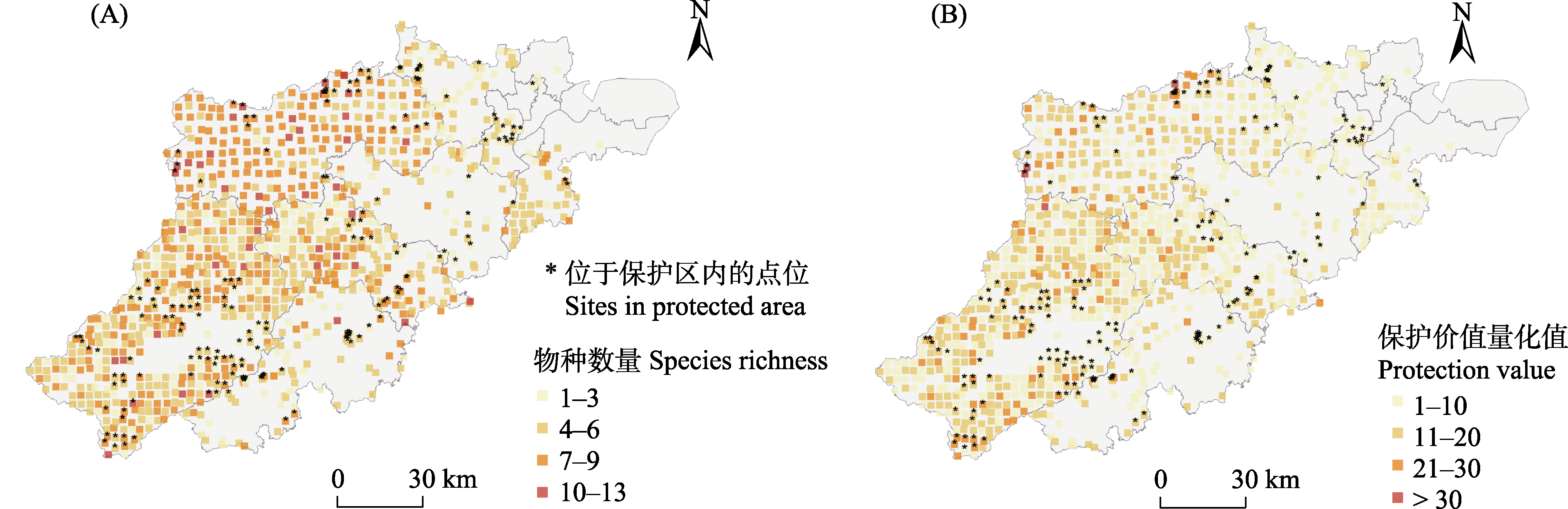
图1 杭州市红外相机点位监测动物物种数量(A)和保护价值量化值(B)。为减少不同区域调查的差异, 仅采用部分兽类(排除鼠类和松鼠类)和鸟类中的地栖性鸟类(鸡形目)。
Fig. 1 Species richness (A) and quantified conservation value (B) based on infrared camera monitoring in Hangzhou City. Only species of certain mammals (excluding rodents and squirrels) and Galliformes were included (B).
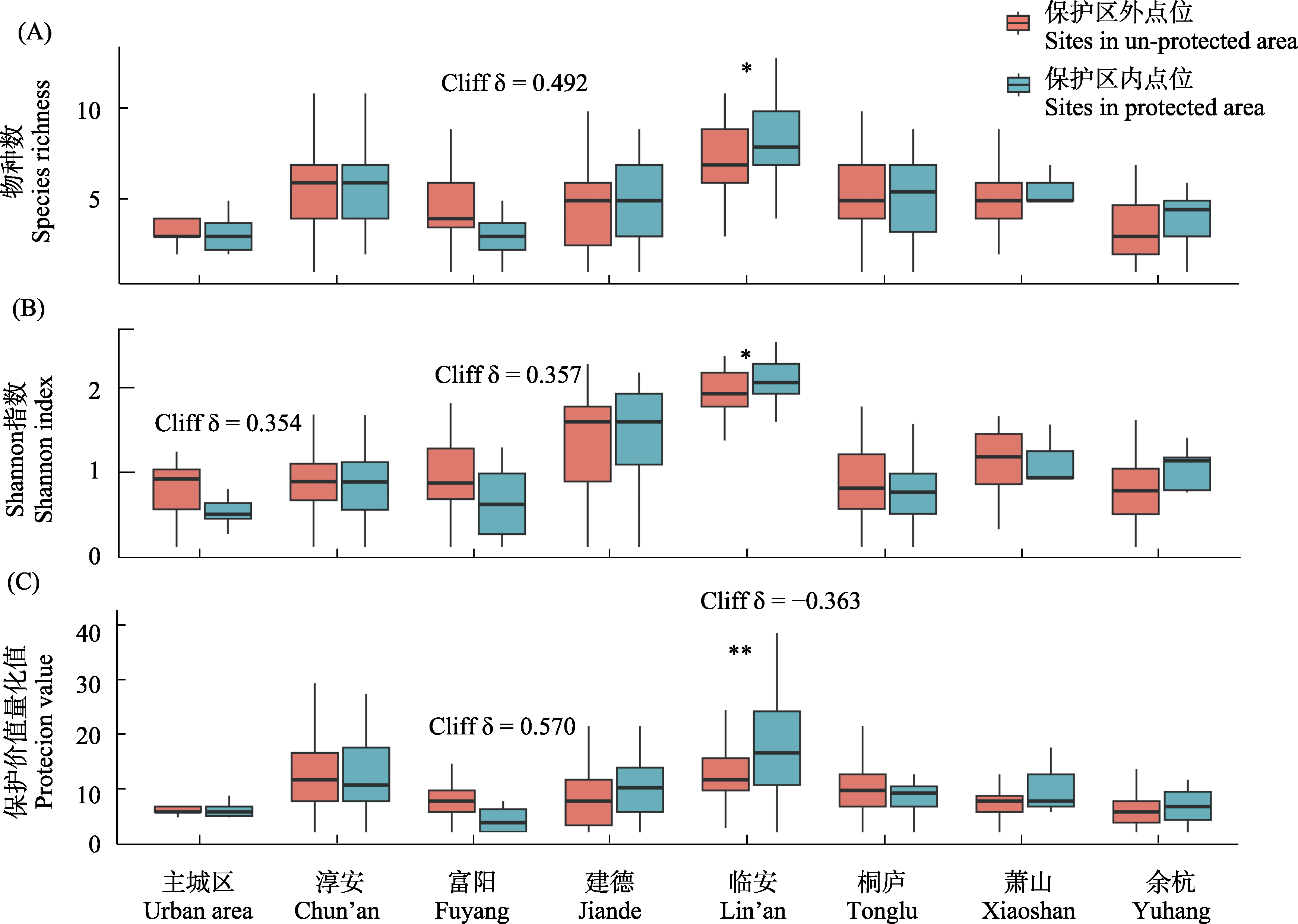
图2 杭州市不同行政区划的物种数量(A)、Shannon指数(B)和保护价值量化值(C)在保护区内外的比较。P为FDR校正后数值, * P < 0.05, ** P < 0.01。Cliff δ值为可忽略(|δ| < 0.147)和小效应(|δ| < 0.330)的未列出。
Fig. 2 Comparisons between protected and unprotected areas in Hangzhou for species richness (A), Shannon index (B), and protection value (C) across different regions. P-values were adjusted using FDR correction. * P < 0.05, ** P < 0.01. Cliff δ values indicating negligible effect (|δ| < 0.147) or small effect (|δ| < 0.330) are not shown.
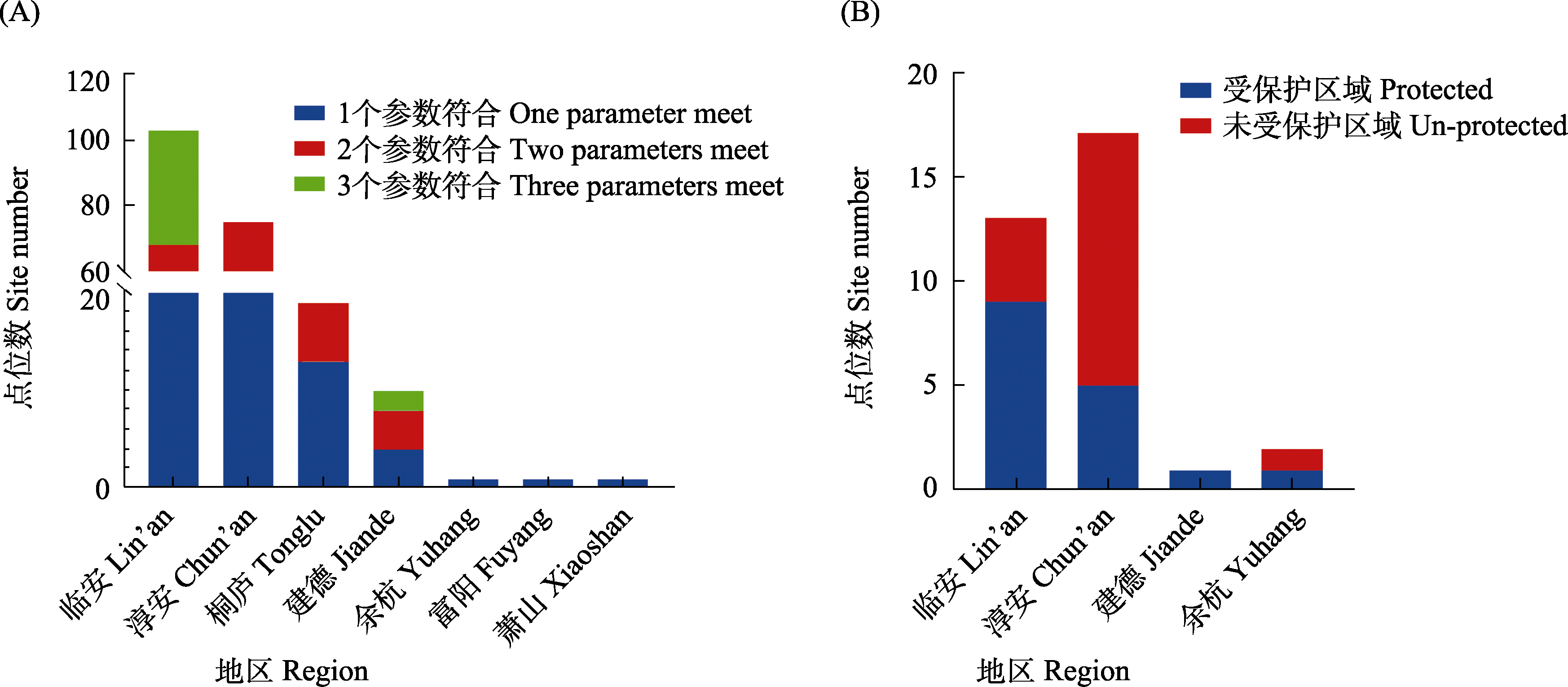
图3 杭州市不同区域的物种丰富度(物种数量)、生物多样性指数(Shannon指数)、保护价值量化值3个参数前10%的点位分布情况(A)和重点保护物种分布点位受保护情况(B)
Fig. 3 Spatial distribution of top 10% sampling sites for three parameters: species richness (number of species), biodiversity index (Shannon index), and protection value in Hangzhou (A) and protection status of key species occurrence sites across different regions (B)
| 序号 No. | 物种 Species | 估计占域率ψ及范围 Estimated occupancy rate (ψ) and range | 探测率 Detection probability (p) | 模型选择 Model | 影响是否显著 Significance |
|---|---|---|---|---|---|
| 1 | 猕猴 Macaca mulatta | 0.034 (0.026-0.052) | 0.079 | 海拔 Elevation | |
| 2 | 马来豪猪 Hystrix brachyura | 0.035 (0.020-0.081) | 0.272 | 海拔 Elevation | ** |
| 4 | 黑麂 Muntiacus crinifrons | 0.033 (0.021-0.040) | 0.109 | 海拔 Elevation | |
| 6 | 中华鬣羚 Capricornis milneedwardsii | 0.051 (0.037-0.088) | 0.031 | 海拔 Elevation | |
| 8 | 豹猫 Prionailurus bengalensis | 0.122 (0.090-0.211) | 0.065 | 海拔 + NDVI Elevation + NDVI | 海拔 Elevation* |
| 9 | 花面狸 Paguma larvata | 0.633 (0.595-0.657) | 0.050 | 道路 Road | |
| 10 | 食蟹獴 Herpestes urva | 0.025 (0.017-0.057) | 0.102 | NDVI | * |
| 11 | 貉 Nyctereutes procyonoides | 0.015 (0.000-0.052) | 0.125 | 海拔 + 道路 Elevation + Road | 海拔 Elevation**, 道路 Road*** |
| 12 | 黄腹鼬 Mustela kathiah | 0.256 (0.142-0.373) | 0.020 | 海拔 + NDVI Elevation + NDVI | |
| 13 | 黄鼬 Mustela sibirica | 0.157 (0.123-0.169) | 0.026 | 三者单因子无差异 No difference between three factors | |
| 14 | 鼬獾 Melogale moschata | 0.550 (0.512-0.622) | 0.046 | 海拔 Elevation | |
| 15 | 亚洲狗獾 Meles leucurus | 0.023 (0.017-0.042) | 0.057 | NDVI | |
| 16 | 猪獾 Arctonyx collaris | 0.742 (0.717-0.813) | 0.040 | 道路 Road | |
| 17 | 勺鸡 Pucrasia macrolopha | 0.263 (0.189-0.292) | 0.029 | NDVI | |
| 18 | 白颈长尾雉 Syrmaticus ellioti | 0.345 (0.265-0.516) | 0.021 | 海拔 Elevation | * |
| 19 | 白鹇 Lophura nycthemera | 1.000 | 0.068 | ΔAICc > 2 | |
表3 占域模型分析结果
Table 3 Results of occupancy model analysis
| 序号 No. | 物种 Species | 估计占域率ψ及范围 Estimated occupancy rate (ψ) and range | 探测率 Detection probability (p) | 模型选择 Model | 影响是否显著 Significance |
|---|---|---|---|---|---|
| 1 | 猕猴 Macaca mulatta | 0.034 (0.026-0.052) | 0.079 | 海拔 Elevation | |
| 2 | 马来豪猪 Hystrix brachyura | 0.035 (0.020-0.081) | 0.272 | 海拔 Elevation | ** |
| 4 | 黑麂 Muntiacus crinifrons | 0.033 (0.021-0.040) | 0.109 | 海拔 Elevation | |
| 6 | 中华鬣羚 Capricornis milneedwardsii | 0.051 (0.037-0.088) | 0.031 | 海拔 Elevation | |
| 8 | 豹猫 Prionailurus bengalensis | 0.122 (0.090-0.211) | 0.065 | 海拔 + NDVI Elevation + NDVI | 海拔 Elevation* |
| 9 | 花面狸 Paguma larvata | 0.633 (0.595-0.657) | 0.050 | 道路 Road | |
| 10 | 食蟹獴 Herpestes urva | 0.025 (0.017-0.057) | 0.102 | NDVI | * |
| 11 | 貉 Nyctereutes procyonoides | 0.015 (0.000-0.052) | 0.125 | 海拔 + 道路 Elevation + Road | 海拔 Elevation**, 道路 Road*** |
| 12 | 黄腹鼬 Mustela kathiah | 0.256 (0.142-0.373) | 0.020 | 海拔 + NDVI Elevation + NDVI | |
| 13 | 黄鼬 Mustela sibirica | 0.157 (0.123-0.169) | 0.026 | 三者单因子无差异 No difference between three factors | |
| 14 | 鼬獾 Melogale moschata | 0.550 (0.512-0.622) | 0.046 | 海拔 Elevation | |
| 15 | 亚洲狗獾 Meles leucurus | 0.023 (0.017-0.042) | 0.057 | NDVI | |
| 16 | 猪獾 Arctonyx collaris | 0.742 (0.717-0.813) | 0.040 | 道路 Road | |
| 17 | 勺鸡 Pucrasia macrolopha | 0.263 (0.189-0.292) | 0.029 | NDVI | |
| 18 | 白颈长尾雉 Syrmaticus ellioti | 0.345 (0.265-0.516) | 0.021 | 海拔 Elevation | * |
| 19 | 白鹇 Lophura nycthemera | 1.000 | 0.068 | ΔAICc > 2 | |
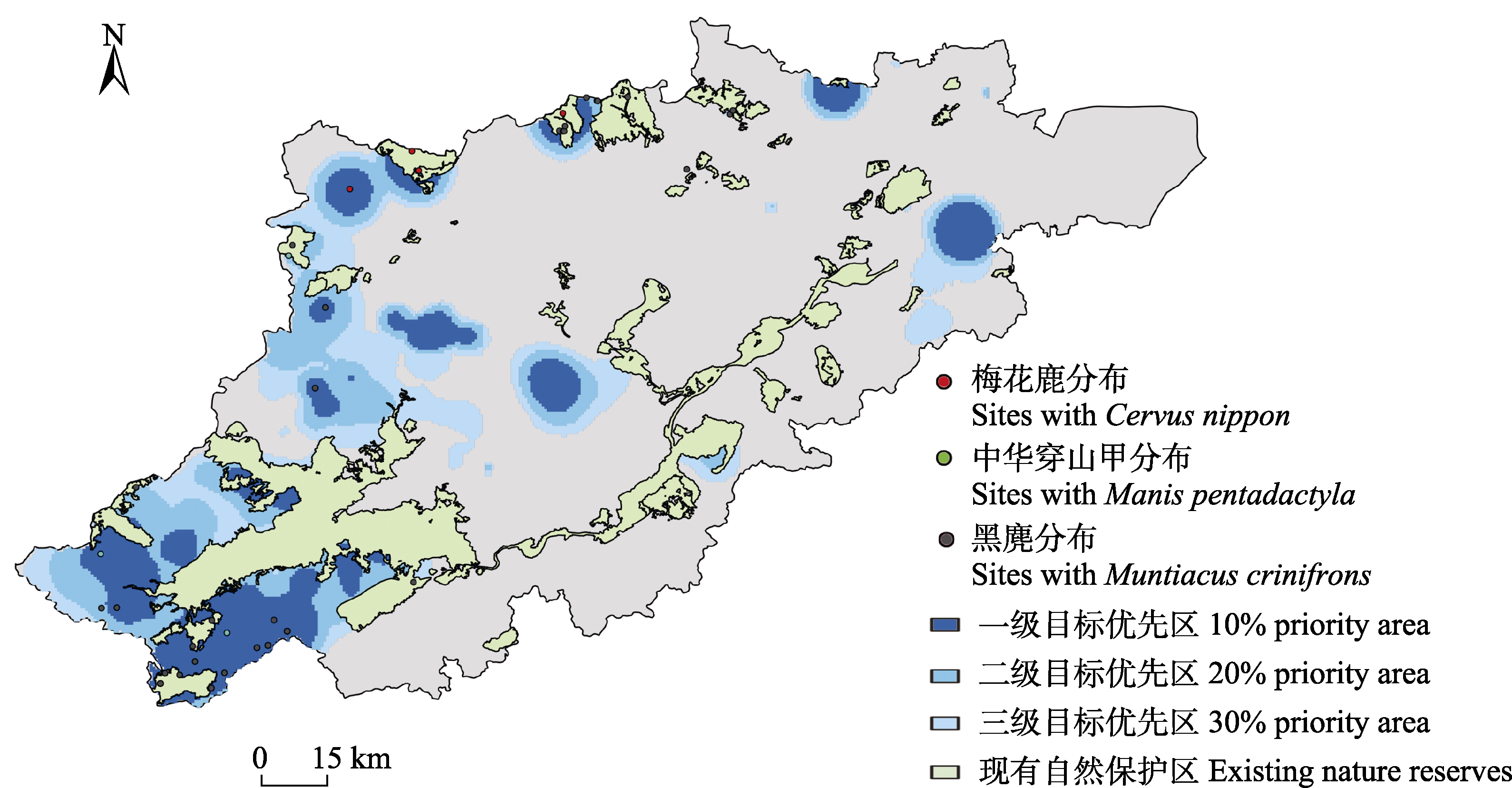
图4 杭州市基于红外相机监测的目标优先区与现有自然保护地空间布局
Fig. 4 Spatial layout of target priority areas based on infrared camera monitoring and natural protected areas in Hangzhou City
| 已建保护体系 Established protection system | 总面积 Area (km2) | 30%目标区域 30% of the target area | 20%目标区域 20% of the target area | 10%目标区域 10% of the target area | |||
|---|---|---|---|---|---|---|---|
| 面积 Area | 占比 Proportion (%) | 面积 Area | 占比 Proportion (%) | 面积 Area | 占比 Proportion (%) | ||
| 天目山国家级自然保护区 Tianmu Mountain National Nature Reserve | 42.8 | 39.7 | 92.8 | 39.4 | 92.2 | 38.6 | 90.1 |
| 清凉峰国家级自然保护区 Qingliangfeng National Nature Reserve | 112.5 | 92.6 | 82.3 | 87.4 | 77.7 | 42.1 | 37.4 |
| 富春江-新安江国家级风景名胜区* Fuchun River-Xin’an River National Scenic Area | 1,339.6 | 853.5 | 63.7 | 525.8 | 39.3 | 359.1 | 26.8 |
| 大明山省级地质公园 Daming Mountain Provincial Geological Park | 30.3 | 26.3 | 86.9 | 11.0 | 36.2 | - | - |
| 昌化省级森林公园 Changhua Provincial Forest Park | 22.9 | 18.5 | 80.4 | 18.2 | 79.3 | 14.4 | 62.5 |
| 太湖源风景区 Taihuyuan Scenic Area | 115.2 | 15.3 | 13.3 | 4.8 | 4.1 | 6.3 | 5.4 |
| 全部保护地体系* Entire protected area system | 1,925.2 | 1,045.9 | 54.3 | 686.6 | 35.7 | 460.4 | 23.9 |
表4 杭州市已建保护体系在目标区域的占比情况。在30%目标区域中占比未超过5%的保护地体系未列出。
Table 4 Proportion of the established protection system in the target area of Hangzhou City. Regions covering less than 5% of any 30% target region are excluded from the list.
| 已建保护体系 Established protection system | 总面积 Area (km2) | 30%目标区域 30% of the target area | 20%目标区域 20% of the target area | 10%目标区域 10% of the target area | |||
|---|---|---|---|---|---|---|---|
| 面积 Area | 占比 Proportion (%) | 面积 Area | 占比 Proportion (%) | 面积 Area | 占比 Proportion (%) | ||
| 天目山国家级自然保护区 Tianmu Mountain National Nature Reserve | 42.8 | 39.7 | 92.8 | 39.4 | 92.2 | 38.6 | 90.1 |
| 清凉峰国家级自然保护区 Qingliangfeng National Nature Reserve | 112.5 | 92.6 | 82.3 | 87.4 | 77.7 | 42.1 | 37.4 |
| 富春江-新安江国家级风景名胜区* Fuchun River-Xin’an River National Scenic Area | 1,339.6 | 853.5 | 63.7 | 525.8 | 39.3 | 359.1 | 26.8 |
| 大明山省级地质公园 Daming Mountain Provincial Geological Park | 30.3 | 26.3 | 86.9 | 11.0 | 36.2 | - | - |
| 昌化省级森林公园 Changhua Provincial Forest Park | 22.9 | 18.5 | 80.4 | 18.2 | 79.3 | 14.4 | 62.5 |
| 太湖源风景区 Taihuyuan Scenic Area | 115.2 | 15.3 | 13.3 | 4.8 | 4.1 | 6.3 | 5.4 |
| 全部保护地体系* Entire protected area system | 1,925.2 | 1,045.9 | 54.3 | 686.6 | 35.7 | 460.4 | 23.9 |
| [1] |
Bai QQ, Chen JZ, Chen ZH, Dong GT, Dong JT, Dong WX, Fu VWK, Han YX, Lu G, Li J, Liu Y, Lin Z, Meng DR, Martinez J, Ni GH, Shan K, Sun RJ, Tian SX, Wang FQ, Xu ZW, Yu YT, Yang J, Yang ZD, Zhang L, Zhang M, Zeng XW (2015) Identification of coastal wetlands of international importance for waterbirds: A review of China coastal waterbird surveys 2005-2013. Avian Research, 6, 12.
DOI URL |
| [2] | Bengsen AJ, Leung LKP, Lapidge SJ, Gordon IJ (2011) Using a general index approach to analyze camera-trap abundance indices. Journal of Wildlife Management, 75, 1222-1227. |
| [3] | Cai LY, Xu YP, Jiang PP, Ding P, Yao XH, Xu XR, Wang GB (2007) Home range and daily moving distance of Elliot’s pheasant. Journal of Zhejiang University (Science Edition), 34, 679-683. (in Chinese with English abstract) |
| [蔡路昀, 徐言朋, 蒋萍萍, 丁平, 姚小华, 徐向荣, 王国兵 (2007) 白颈长尾雉的活动区和日活动距离. 浙江大学学报(理学版), 34, 679-683.] | |
| [4] | CBD (Convention on Biological Diversity) (2022) CBD/COP/ DEC/15/4: Kunming-Montreal Global Biodiversity Framework. https://www.cbd.int/doc/decisions/cop-15/cop-15-dec-04-en.pdf. (accessed on 2024-07-08) |
| [5] | Chen L, Liu CL, Ma MR, Qiao Q, Pei S, Liu XN (2019) Spatial distribution, hot spots identification and protection effectiveness evaluation of urgently protected species in priority area of Taihang Mountains Biodiversity Conservation (Beijing region). Journal of Ecology and Rural Environment, 35, 451-458. (in Chinese with English abstract) |
| [陈龙, 刘春兰, 马明睿, 乔青, 裴厦, 刘晓娜 (2019) 太行山生物多样性保护优先区(北京区域)急需保护物种的空间分布、热点识别及保护成效评价. 生态与农村环境学报, 35, 451-458.] | |
| [6] |
Chen YX, Xiao ZS, Zhang L, Wang XW, Li M, Xiang ZF (2019) Activity rhythms of coexisting red serow and Chinese serow at Mt. Gaoligong as identified by camera traps. Animals, 9, 1071.
DOI URL |
| [7] | Ding P, Chen SH, Bao YX, Wang YJ (2008) Terrestrial wildlife resources in Hangzhou. Journal of Chinese Urban Forestry, 6(4), 62-65, 71. (in Chinese) |
| [丁平, 陈水华, 鲍毅新, 王玉军 (2008) 杭州市陆生野生动物资源. 中国城市林业, 6(4), 62-65, 71.] | |
| [8] | Fang YF, Song WZ, Wu XL, Huang Q, Fan ZY (2017) Breeding record of tawny fish owl (Ketupa flavipes) in Thousand Island Lake, Zhejiang Province, China. Chinese Journal of Zoology, 52, 1078-1079. (in Chinese) |
| [方一锋, 宋唯真, 吴晓丽, 黄秦, 范忠勇 (2017) 浙江千岛湖黄腿渔鸮的繁殖记录. 动物学杂志, 52, 1078-1079.] | |
| [9] |
Gong CF, Wei W, Luo G, Han YM, Wu PC, He MN, Min QY, Fu Q, Chen P (2025) Spatial distribution and coexistence of ungulates in Chongzhou area of Giant Panda National Park. Biodiversity Science, 33, 24260. (in Chinese with English abstract)
DOI |
|
[龚翠凤, 韦伟, 罗概, 韩一敏, 吴鹏程, 何梦楠, 闵清悦, 付强, 陈鹏 (2025) 大熊猫国家公园崇州片区有蹄类动物空间分布及共存关系. 生物多样性, 33, 24260.]
DOI |
|
| [10] |
Guo ZL, Xing SH, Cui GF (2017) A method for assessing species diversity conservation value of nature reserves. Biodiversity Science, 25, 312-324. (in Chinese with English abstract)
DOI |
|
[郭子良, 邢韶华, 崔国发 (2017) 自然保护区物种多样性保护价值评价方法. 生物多样性, 25, 312-324.]
DOI |
|
| [11] |
Han SC, Lu DW, Han YC, Li RH, Yang J, Sun G, Yang L, Qian JW, Fang X, Luo SJ (2024) Distribution of leopard cats in the nearest mountains to urban Beijing and its affecting environmental factors. Biodiversity Science, 32, 24138. (in Chinese with English abstract)
DOI |
|
[韩思成, 陆道炜, 韩宇辰, 栗若寒, 杨晶, 孙戈, 杨陆, 钱俊伟, 方翔, 罗述金 (2024) 北京近郊浅山地区的野生豹猫分布及环境影响因素. 生物多样性, 32, 24138.]
DOI |
|
| [12] | Hu G, Wilson M, Zhou BB, Shang CW, Yu MJ, Wu JG (2021) Spatiotemporal patterns and ecological consequences of a fragmented landscape created by damming. PeerJ, 9, e11416. |
| [13] | Hu J, Xie PG, Mei YY, Guo R, Song X, Li TT, Xu AC (2023) Potential suitable habitats prediction and overlap analysis of black muntjac (Muntiacus crinifrons) and small muntjac (M. reevesi) in Qingliangfeng National Nature Reserve, Zhejiang Province. Acta Ecologica Sinica, 43, 2210-2219. (in Chinese with English abstract) |
| [胡娟, 谢培根, 梅祎芸, 郭瑞, 宋虓, 李婷婷, 徐爱春 (2023) 浙江清凉峰国家级自然保护区黑麂和小麂潜在适宜栖息地预测及重叠性分析. 生态学报, 43, 2210-2219.] | |
| [14] |
Huang ZD, Bai Y, Alatalo JM, Yang ZQ (2020) Mapping biodiversity conservation priorities for protected areas: A case study in Xishuangbanna tropical area, China. Biological Conservation, 249, 108741.
DOI URL |
| [15] | IPBES (Intergovernmental Science-Policy Platform on Biodiversity and Ecosystem Services) Secretariat (2019) Global Assessment Report on Biodiversity and Ecosystem Services of the Intergovernmental Science-Policy Platform on Biodiversity and Ecosystem Services. IPBES Secretariat, Bonn. |
| [16] |
Li S (2020) Development progress and outlook of the wildlife camera-trapping networks in China. Biodiversity Science, 28, 1045-1048. (in Chinese)
DOI |
|
[李晟 (2020) 中国野生动物红外相机监测网络建设进展与展望. 生物多样性, 28, 1045-1048.]
DOI |
|
| [17] |
Li ZZ, Du MT, Zhu YX, Wang DW, Li ZL, Wang TM (2023) A practical guide for estimating the density of unmarked populations using camera traps. Biodiversity Science, 31, 22422. (in Chinese with English abstract)
DOI |
|
[李珍珍, 杜梦甜, 朱原辛, 王大伟, 李治霖, 王天明 (2023) 基于红外相机的不可个体识别动物种群密度估算方法. 生物多样性, 31, 22422.]
DOI |
|
| [18] | Liu YZ, Wang JC, Wu ZN, Li SQ, Dai WY (2024) Identification of biodiversity priority conservation areas in China by integrating genetic, species and ecosystem diversity. Biological Conservation, 300, 110854. |
| [19] |
Lu JY, Shi XY, Duo LA, Wang TM, Li ZL (2024) Circadian rhythms of urban terrestrial mammals in Tianjin based on camera trapping method. Biodiversity Science, 32, 23369. (in Chinese with English abstract)
DOI |
|
[卢佳玉, 石小亿, 多立安, 王天明, 李治霖 (2024) 基于红外相机技术的天津城市地栖哺乳动物昼夜活动节律评价. 生物多样性, 32, 23369.]
DOI |
|
| [20] |
Luo M, Yang YC, Jin C, Zhou LH, Long YX (2025) Composition characteristics of mammals and their responses to human activities in urban forests of Chongqing central urban area. Biodiversity Science, 33, 24402. (in Chinese with English abstract)
DOI |
|
[罗敏, 杨永川, 靳程, 周礼华, 龙宇潇 (2025) 重庆中心城区城市森林兽类组成特征及其对人类活动的响应. 生物多样性, 33, 24402.]
DOI |
|
| [21] | Ma KP, Qian YQ (1998) Biodiversity conservation and its research progress. Chinese Journal of Applied and Environmental Biology, 4, 95-99. (in Chinese with English abstract) |
| [马克平, 钱迎倩 (1998) 生物多样性保护及其研究进展. 应用与环境生物学报, 4, 95-99.] | |
| [22] | Ma L (2023) Study on the density and size of Macaca mulatta population in Huangshan City based on infrared camera technology. Anhui Forestry Science and Technology, 49(4), 19-23. (in Chinese with English abstract) |
| [马莉 (2023) 基于红外相机技术的黄山市猕猴种群密度和数量的调查研究. 安徽林业科技, 49(4), 19-23.] | |
| [23] |
Mohamed A, Sollmann R, Bernard H, Ambu LN, Lagan P, Mannan S, Hofer H, Wilting A (2013) Density and habitat use of the leopard cat (Prionailurus bengalensis) in three commercial forest reserves in Sabah, Malaysian Borneo . Journal of Mammalogy, 94, 82-89.
DOI URL |
| [24] | Moilanen A, Arponen A, Leppänen J, Meller L, Kujala H (2011) Zonation: Spatial Conservation Planning Framework and Software version 3.0 User Manual. http://www.helsinki.fi/bioscience/consplan/software/Zonation/ZONATION_v3_Manual_111124_v2.pdf. (accessed on 2024-07-08) |
| [25] |
Pépin D, Morellet N, Goulard M (2009) Seasonal and daily walking activity patterns of free-ranging adult red deer (Cervus elaphus) at the individual level. European Journal of Wildlife Research, 55, 479-486.
DOI URL |
| [26] |
Ripple WJ, Estes JA, Beschta RL, Wilmers CC, Ritchie EG, Hebblewhite M, Berger J, Elmhagen B, Letnic M, Nelson MP, Schmitz OJ, Smith DW, Wallach AD, Wirsing AJ (2014) Status and ecological effects of the world’s largest carnivores. Science, 343, 1241484.
DOI URL |
| [27] | Shen Y, Cheng H, Liu GH, Deng HB, Su XK (2024) Conservation gaps and priorities on the Qinghai-Tibetan Plateau based on biodiversity and ecosystem services. Acta Ecologica Sinica, 44, 4507-4516. (in Chinese with English abstract) |
| [申宇, 程浩, 刘国华, 邓红兵, 苏旭坤 (2024) 基于生物多样性和生态系统服务的青藏高原保护优先区和保护空缺识别. 生态学报, 44, 4507-4516.] | |
| [28] | Sheng HL (1987) Black muntjac (Muntiacus crinifrons)—An endemic species of China. Chinese Journal of Zoology, 2(19), 45-48. (in Chinese) |
| [盛和林 (1987) 中国特产动物——黑麂. 动物学杂志, 2(19), 45-48.] | |
| [29] |
Si XF, Jin TH, Li WD, Ren P, Wu Q, Zeng D, Zhang X, Zhao YH, Zhu C, Ding P (2024) TIL20: A review of island biogeography and habitat fragmentation studies on subtropical reservoir islands of Thousand Island Lake, China. Zoological Research: Diversity and Conservation, 1, 89-105.
DOI URL |
| [30] |
Tian J, Zhu SY, Zhang XF, He LW, Gu XD, Guan TP, Li S (2021) The diversity of large- and medium-sized terrestrial mammals and birds in the Giant Panda National Park: A meta-analysis based on camera-trapping data. Biodiversity Science, 29, 1490-1504. (in Chinese with English abstract)
DOI |
|
[田佳, 朱淑怡, 张晓峰, 何礼文, 古晓东, 官天培, 李晟 (2021) 大熊猫国家公园的地栖大中型鸟兽多样性现状: 基于红外相机数据的分析. 生物多样性, 29, 1490-1504.]
DOI |
|
| [31] |
Tilson R, Hu DF, Muntifering J, Nyhus PJ (2004) Dramatic decline of wild South China tigers Panthera tigris amoyensis: Field survey of priority tiger reserves. Oryx, 38, 40-47.
DOI URL |
| [32] | Wei FW, Yang QS, Wu Y, Jiang XL, Liu SY, Hu YB, Ge DY, Li BG, Yang G, Li M, Zhou J, Li S, Li S, Yu WH, Chen BY, Zhang ZJ, Zhou CQ, Wu SB, Zhang L, Chen ZZ, Chen SD, Deng HQ, Jiang TL, Zhang LB, Shi HY, Lu XL, Li Q, Liu Z, Cui YQ, Li YC, He K (2025) Catalogue of mammals in China (2024). Acta Theriologica Sinica, 45, 1-16. (in Chinese with English abstract) |
| [魏辅文, 杨奇森, 吴毅, 蒋学龙, 刘少英, 胡义波, 葛德燕, 李保国, 杨光, 李明, 周江, 李松, 李晟, 余文华, 陈炳耀, 张泽钧, 周材权, 吴诗宝, 张立, 陈中正, 陈顺德, 邓怀庆, 江廷磊, 张礼标, 石红艳, 卢学理, 李权, 刘铸, 崔雅倩, 李玉春, 何锴 (2025) 中国兽类名录(2024版). 兽类学报, 45, 1-16.] | |
| [33] |
Wei Y, Jiang GS (2022) Overview of monitoring methods for tigers, leopards and ungulate prey. Biodiversity Science, 30, 21551. (in Chinese with English abstract)
DOI |
|
[韦怡, 姜广顺 (2022) 虎豹及有蹄类猎物种群数量监测方法概述. 生物多样性, 30, 21551.]
DOI |
|
| [34] |
Wolf C, Ripple WJ (2017) Range contractions of the world’s large carnivores. Royal Society Open Science, 4, 170052.
DOI URL |
| [35] | Xia SX, Yu XB, Millington S, Liu Y, Jia YF, Wang LZ, Hou XY, Jiang LG (2017) Identifying priority sites and gaps for the conservation of migratory waterbirds in China’s coastal wetlands. Biological Conservation, 210, 72-82. |
| [36] |
Xiao WH, Li XY, Quan RC, Lian XM, Li M, Nie YG, Xiang ZF, Yang WK, Xu F, Wang J, Zhou QH, Fan PF, Yang XF, Liu W, Sun YH, Zhang LB, Huang ZP, Huang H, Fan ZJ, Xiao ZS (2023) Construction of Sino BON Mammal Diversity Monitoring Network (Sino BON-Mammal): A 10-year review and future outlook. Biodiversity Science, 31, 23326. (in Chinese with English abstract)
DOI URL |
|
[肖文宏, 李学友, 权锐昌, 连新明, 李明, 聂永刚, 向左甫, 杨维康, 徐峰, 王杰, 周岐海, 范朋飞, 杨锡福, 刘伟, 孙悦华, 张礼标, 黄志旁, 黄华, 范宗骥, 肖治术 (2023) 中国兽类多样性监测与研究网络建设: 十年回顾与展望. 生物多样性, 31, 23326.]
DOI |
|
| [37] |
Xiao WH, Shu ZF, Chen LJ, Yao WT, Ma Y, Zhang YM, Xiao ZS (2019) Using occupancy models in wildlife camera-trapping monitoring and the study case. Biodiversity Science, 27, 249-256. (in Chinese with English abstract)
DOI |
|
[肖文宏, 束祖飞, 陈立军, 姚武韬, 马勇, 张应明, 肖治术 (2019) 占域模型的原理及在野生动物红外相机研究中的应用案例. 生物多样性, 27, 249-256.]
DOI |
|
| [38] |
Xiao ZS, Chen LJ, Song XJ, Shu ZF, Xiao RG, Huang XQ (2019) Species inventory and assessment of large- and medium-size mammals and pheasants using camera trapping in the Chebaling National Nature Reserve, Guangdong Province. Biodiversity Science, 27, 237-242. (in Chinese with English abstract)
DOI |
| [肖治术, 陈立军, 宋相金, 束祖飞, 肖荣高, 黄小群 (2019) 基于红外相机技术对广东车八岭国家级自然保护区大中型兽类与雉类的编目清查与评估. 生物多样性, 27, 237-242.] | |
| [39] |
Xiao ZS, Li XY, Xiang ZF, Li M, Jiang XL, Zhang LB (2017) Overview of the Mammal Diversity Observation Network of Sino BON. Biodiversity Science, 25, 237-245. (in Chinese with English abstract)
DOI |
|
[肖治术, 李学友, 向左甫, 李明, 蒋学龙, 张礼标 (2017) 中国兽类多样性监测网的建设规划与进展. 生物多样性, 25, 237-245.]
DOI |
|
| [40] | Xing SH, Zhou X, Liu YQ, Yuan X (2021) Priority areas identification for species diversity protection in Beijing-Tianjin-Hebei Region. Acta Ecologica Sinica, 41, 3144-3152. (in Chinese with English abstract) |
| [邢韶华, 周鑫, 刘云强, 袁秀 (2021) 京津冀地区物种多样性保护优先区识别研究. 生态学报, 41, 3144-3152.] | |
| [41] | Xu WH, Yue XL, Gao P, Xia SJ (2013) Potential ecological habitat of Muntiacus crinifrons within National Nature Reserve of Mount Tianmu, Zhejiang Province. Journal of Zhejiang A&F University, 30, 896-903. (in Chinese with English abstract) |
| [徐文辉, 岳晓雷, 高鹏, 夏淑娟 (2013) 天目山国家级自然保护区黑麂潜在栖息地的生态适宜性. 浙江农林大学学报, 30, 896-903.] | |
| [42] |
Yang JH, Li KW, Yeung HY, Au TK, Zheng X, Giordano AJ, Chan BPL (2022) Population density and activity patterns of the leopard cat (Prionailurus bengalensis) in southern China: Estimates based on camera-trapping data. Biodiversity Science, 30, 21357. (in Chinese with English abstract)
DOI URL |
|
[杨剑焕, 李敬华, 杨浩炫, 欧梓键, 郑玺, Anthony J. Giordano, 陈辈乐 (2022) 基于红外相机数据评估华南地区豹猫的种群密度和活动节律. 生物多样性, 30, 21357.]
DOI |
|
| [43] | Yuan ZW, Xu AC, Yu PX, Guo R, Li CL (2020) Habitat suitability assessment for Sika deer in Qingliangfeng National Nature Reserve, Zhejiang Province. Acta Ecologica Sinica, 40, 6672-6677. (in Chinese with English abstract) |
| [袁智文, 徐爱春, 俞平新, 郭瑞, 李春林 (2020) 浙江清凉峰国家级自然保护区华南梅花鹿栖息地适宜性评价. 生态学报, 40, 6672-6677.] | |
| [44] | Zhang L (2008) A Preliminary Study on the Field Spatial Behavioral Ecology of Badger Species in Houhe National Nature Reserve, Hubei Province. PhD dissertation, Zhejiang University, Hangzhou. (in Chinese with English abstract) |
| [张亮 (2008) 湖北后河自然保护区獾类物种野外空间行为生态学初步研究. 博士学位论文, 浙江大学, 杭州.] | |
| [45] | Zhang SN, Wu R (2022) Knowledge mapping analysis of urban biodiversity research based on Citespace. Ecological Science, 41(6), 211-221. (in Chinese with English abstract) |
| [张思凝, 吴然 (2022) 基于Citespace知识图谱分析国际城市生物多样性研究. 生态科学, 41(6), 211-221.] | |
| [46] | Zhang SS, Li JQ, Zheng EZ, Wu YG, Liu JL, Chen XN, Xu AC (2017) Prionailurus bengalensis captured by infrared camera in some national natural reserves and park of Zhejiang. Journal of Zhejiang Forestry Science and Technology, 37(4), 12-17. (in Chinese with English abstract) |
| [章书声, 李佳琦, 郑而重, 吴友贵, 刘菊莲, 陈小南, 徐爱春 (2017) 基于红外相机技术监测浙江省自然保护区豹猫生存状况. 浙江林业科技, 37(4), 12-17.] | |
| [47] | Zheng GM (2023) A Checklist on the Classification and Distribution of the Birds of China, 4th edn. Science Press, Beijing. (in Chinese) |
| [郑光美 (2023) 中国鸟类分类与分布名录(第四版). 科学出版社, 北京.] | |
| [48] | Zheng XJ, Wang SL, Song WZ, Liu M, Wu CQ, Fan ZY (2023) Population investigation and dynamic monitoring of Gorsachius magnificus in Qiandao Lake in Zhejiang. Journal of Anhui Agricultural Sciences, 51(8), 72-74. (in Chinese with English abstract) |
| [郑新建, 汪圣礼, 宋唯真, 刘敏, 吴迟庆, 范忠勇 (2023) 浙江千岛湖海南鳽种群调查与动态监测. 安徽农业科学, 51(8), 72-74.] | |
| [49] |
Zhou H, Liu Z, Pang CM, Chen KM, Zhang SS, Yang SZ, Xu AC (2021) Comparative on the salt-licking behavior of three species of deer in the Tianmushan National Nature Reserve. Acta Theriologica Sinica, 41, 99-107. (in Chinese with English abstract)
DOI |
|
[周虎, 刘周, 庞春梅, 陈康民, 章书声, 杨淑贞, 徐爱春 (2021) 浙江天目山国家级自然保护区三种鹿科动物舔盐行为比较. 兽类学报, 41, 99-107.]
DOI |
| [1] | 王倩倩, 陈孝国, 朱锐丰, 张明春, 王新, 李世林, 仁增江措, 彭武, 杨彪. 藏东南黑麝及其同域有蹄类物种的生态适应性差异[J]. 生物多样性, 2026, 34(5): 25433-. |
| [2] | 冯杰, 李彦知, 王书理, 李岚曦, 丁鹏飞, 吕冰薇, 孟吉, 史湘莹, 李雪阳. 西南山地有蹄类栖息地利用率多年变化及环境影响: 以关坝村红外相机监测为例[J]. 生物多样性, 2026, 34(5): 25261-. |
| [3] | 孔孜亦, 王德港, 王建涛, 裴志永, 孙晶, 张长春, 张军国. 基于SCD-HRNet模型的野生动物姿态估计及其在生物多样性监测中的应用: 以内蒙古赛罕乌拉地区为例[J]. 生物多样性, 2026, 34(4): 25287-. |
| [4] | 张同, 梁力文, 王长剑, 舒服, 王璐, 郭泽光, 卓玛曲珍, 钱芊, 蒋安莉, 敖俊杰, 彭兴文, 伍小刚, 向左甫, 郭克疾, 廖梓延. 基于红外相机的西藏芒康滇金丝猴国家级自然保护区鸟兽多样性及代表性物种的季节性空间利用特征[J]. 生物多样性, 2026, 34(4): 25435-. |
| [5] | 周铝, 郭画, 姚世贸, 田成. 王朗国家级自然保护区红腹角雉时空分布模式[J]. 生物多样性, 2025, 33(7): 24537-. |
| [6] | 李基才, 邵长亮, 高帅帅, 李佳. 新疆卡拉麦里国家公园候选区蒙古野驴夏季水源利用规律、活动范围和适宜生境分布[J]. 生物多样性, 2025, 33(7): 24509-. |
| [7] | 毛静, 王婧, 黄杰, 熊姝红, 张自亮, 张佑祥, 吴涛. 湖南高望界国家级自然保护区2021-2023年鸟兽多样性监测数据集[J]. 生物多样性, 2025, 33(6): 24489-. |
| [8] | 黄定旭, 肖文宏, 白小节, 刘邦友, 黎源君, 梁盛, 肖治术, 刘伟. 赤水桫椤国家级自然保护区中小型食肉目动物昼夜活动节律的比较[J]. 生物多样性, 2025, 33(6): 24376-. |
| [9] | 罗敏, 杨永川, 靳程, 周礼华, 龙宇潇. 重庆中心城区城市森林兽类组成特征及其对人类活动的响应[J]. 生物多样性, 2025, 33(5): 24402-. |
| [10] | 龚翠凤, 韦伟, 罗概, 韩一敏, 吴鹏程, 何梦楠, 闵清悦, 付强, 陈鹏. 大熊猫国家公园崇州片区有蹄类动物空间分布及共存关系[J]. 生物多样性, 2025, 33(3): 24260-. |
| [11] | 王大伟, 程帅, 冯佳伟, 王天明. 东北地区张广才岭2015-2020年野生动物红外相机监测数据集[J]. 生物多样性, 2025, 33(2): 24384-. |
| [12] | 李菡, 董伟, 陆江涛, 吴永杰, 何兴成, 刘林, 木留里哈, 张学林. 四川省甘洛县马鞍山省级自然保护区及周边地区红外相机鸟兽监测数据集[J]. 生物多样性, 2025, 33(10): 25165-. |
| [13] | 高翔, 潘淑芳, 孙争争, 李霁筱, 高天雨, 董路, 王宁. 广东珠海凤凰山和淇澳岛小灵猫的分布与活动节律[J]. 生物多样性, 2024, 32(8): 24045-. |
| [14] | 苏荣菲, 陈睿山, 俞霖琳, 吴婧彬, 康燕. 基于红外相机调查的上海市长宁区社区生境花园生物多样性[J]. 生物多样性, 2024, 32(8): 24068-. |
| [15] | 卢佳玉, 石小亿, 多立安, 王天明, 李治霖. 基于红外相机技术的天津城市地栖哺乳动物昼夜活动节律评价[J]. 生物多样性, 2024, 32(8): 23369-. |
| 阅读次数 | ||||||
|
全文 |
|
|||||
|
摘要 |
|
|||||
备案号:京ICP备16067583号-7
Copyright © 2026 版权所有 《生物多样性》编辑部
地址: 北京香山南辛村20号, 邮编:100093
电话: 010-62836137, 62836665 E-mail: biodiversity@ibcas.ac.cn
