

生物多样性 ›› 2026, Vol. 34 ›› Issue (5): 25433. DOI: 10.17520/biods.2025433 cstr: 32101.14.biods.2025433
王倩倩1, 陈孝国3, 朱锐丰7, 张明春1, 王新5, 李世林5, 仁增江措6, 彭武8, 杨彪2,4,*( )
)
收稿日期:2025-10-31
接受日期:2026-02-10
出版日期:2026-05-20
发布日期:2026-07-01
通讯作者:
杨彪
基金资助:
Qianqian Wang1, Xiaoguo Chen3, Ruifeng Zhu7, Mingchun Zhang1, Xin Wang5, Shilin Li5, Jiangcuo Renzeng6, Wu Peng8, Biao Yang2,4,*()
Received:2025-10-31
Accepted:2026-02-10
Online:2026-05-20
Published:2026-07-01
Contact:
Biao Yang
Supported by:摘要:
黑麝(Moschus fuscus)被列为IUCN红色名录濒危等级和中国国家一级重点保护野生动物。然而, 当前研究多限于对其分类学、形态学以及部分地区的分布调查。掌握同域有蹄类的分布情况及其活动节律, 有助于理解它们的生态位关系和共存机制。本研究基于2023年4月至2025年6月在藏东南墨脱县格当区域布设的169台红外相机所收集的数据, 对黑麝及其同域有蹄类物种进行了系统研究。结果显示, 6种有蹄类物种的独立有效探测次数为3,255次, 其中黑麝的独立探测次数为202次, 相对多度指数较低(RAI = 3.38)。黑麝在> 3,500 m的高海拔区域的独立探测次数最高, 占其总独立探测次数的70.30%; 相比之下, 喜马拉雅鬣羚(Capricornis thar)与喜马拉雅扭角羚(Budorcas taxicolor)对高海拔和低海拔生境具有广幅利用, 而赤斑羚(Naemorhedus baileyi)、贡山麂(Muntiacus gongshanensis)与野猪(Sus scrofa)则偏好中低海拔生境, 这些物种的海拔利用模式体现出“垂直分层”的生境生态位分化机制。季节性活动模式显示, 黑麝冬季的活动频率较高, 并在1月达到峰值。同时, 该物种在春、秋、冬3季的活动最低环境温度阈值、各季节活动的最高环境温度和全年平均环境温度均为同域有蹄类中最低, 体现了其对高寒生境的生态适应性。此外, 黑麝表现出显著的夜行性特征, 其夜行性指数高达0.98。日活动节律分析显示, 黑麝从傍晚17:00开始活动, 且活动频次呈上升趋势, 至凌晨3:00达到最高峰; 而在白天10:00-16:00几乎无黑麝活动记录。黑麝与其同域有蹄类物种之间的日活动节律均存在显著分化, 尤其是与昼行性的野猪, 其活动重叠指数仅0.140。本研究基于大量野外实地调查, 首次系统揭示了黑麝种群“高海拔 + 极夜行”的生境选择和活动节律等生态特征, 为该物种野生种群与藏东南珍稀濒危野生动物的保护管理以及后续研究提供了重要的科学依据。
王倩倩, 陈孝国, 朱锐丰, 张明春, 王新, 李世林, 仁增江措, 彭武, 杨彪 (2026) 藏东南黑麝及其同域有蹄类物种的生态适应性差异. 生物多样性, 34, 25433. DOI: 10.17520/biods.2025433.
Qianqian Wang, Xiaoguo Chen, Ruifeng Zhu, Mingchun Zhang, Xin Wang, Shilin Li, Jiangcuo Renzeng, Wu Peng, Biao Yang (2026) Ecological adaptation differences of the black musk deer and sympatric ungulates in southeastern Xizang. Biodiversity Science, 34, 25433. DOI: 10.17520/biods.2025433.
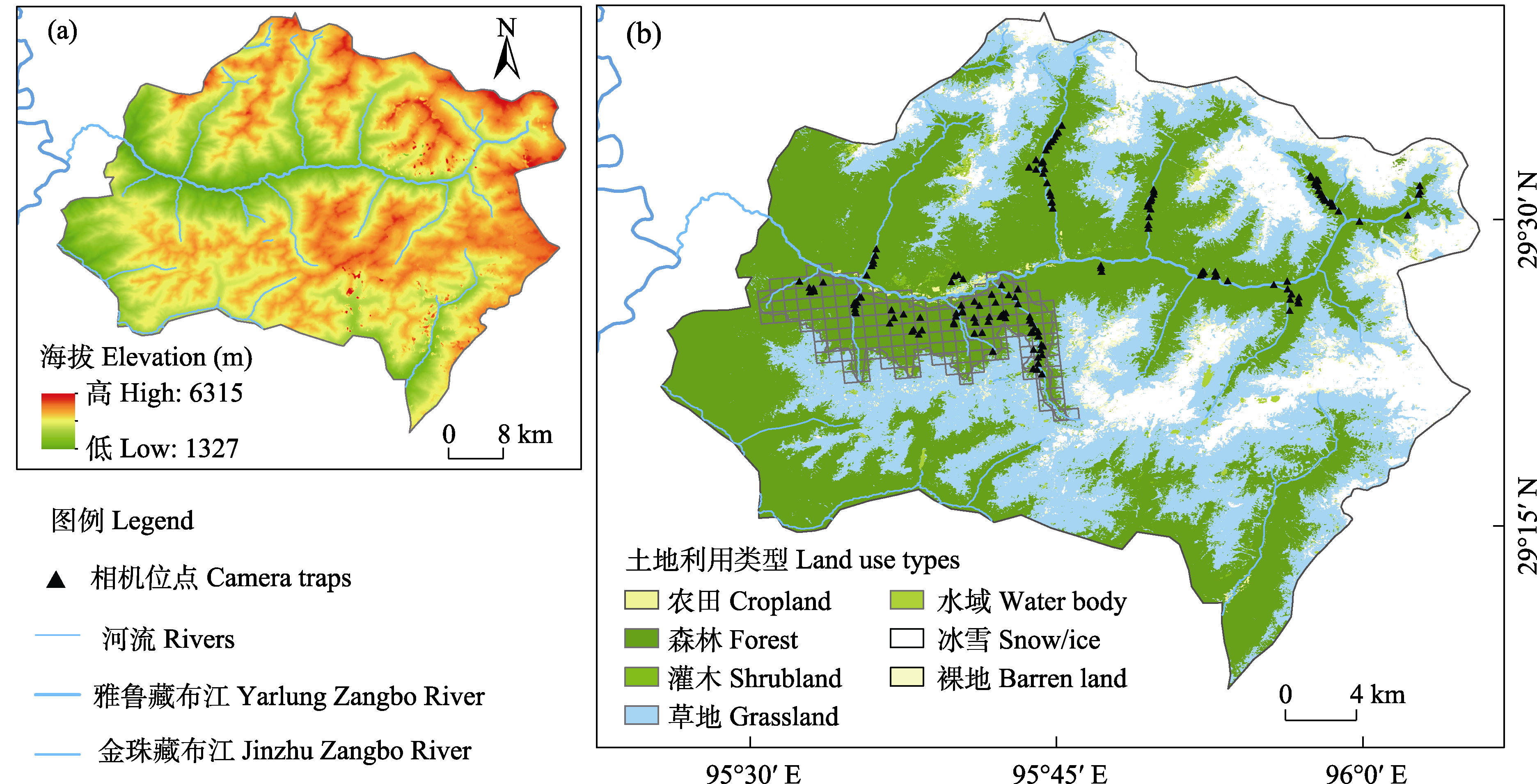
图1 藏东南墨脱县的研究区域位置和红外相机布设位点。(a)海拔范围; (b)土地利用类型。
Fig. 1 Study area and camera trap sites in Medog, southeastern Xizang. (a) Elevation range; (b) Land use types.
| 物种 Species | IUCN红色名录等级 IUCN Red List categories | 相机位点数 No. of camera trap sites | 有效影像数 No. of valid imagery | 独立探测次数 No. of independent detections | 相对多度指数 Relative abundance index (RAI) |
|---|---|---|---|---|---|
| 黑麝 Moschus fuscus | 濒危 Endangered (EN) | 13 | 840 | 202 | 3.38 |
| 喜马拉雅鬣羚 Capricornis thar | 易危 Vulnerable (VU) | 120 | 6,278 | 987 | 16.50 |
| 喜马拉雅扭角羚 Budorcas taxicolor | 易危 Vulnerable (VU) | 49 | 3,852 | 275 | 4.60 |
| 赤斑羚 Naemorhedus baileyi | 易危 Vulnerable (VU) | 51 | 2,983 | 538 | 8.99 |
| 贡山麂 Muntiacus gongshanensis | 数据缺乏 Data Deficient (DD) | 59 | 7,445 | 1,170 | 19.56 |
| 野猪 Sus scrofa | 无危 Least Concern (LC) | 22 | 617 | 83 | 1.39 |
表1 藏东南格当区域红外相机拍摄的黑麝与同域有蹄类物种情况
Table 1 The black musk deer and sympatric ungulates captured by camera traps in Gedang, southeastern Xizang
| 物种 Species | IUCN红色名录等级 IUCN Red List categories | 相机位点数 No. of camera trap sites | 有效影像数 No. of valid imagery | 独立探测次数 No. of independent detections | 相对多度指数 Relative abundance index (RAI) |
|---|---|---|---|---|---|
| 黑麝 Moschus fuscus | 濒危 Endangered (EN) | 13 | 840 | 202 | 3.38 |
| 喜马拉雅鬣羚 Capricornis thar | 易危 Vulnerable (VU) | 120 | 6,278 | 987 | 16.50 |
| 喜马拉雅扭角羚 Budorcas taxicolor | 易危 Vulnerable (VU) | 49 | 3,852 | 275 | 4.60 |
| 赤斑羚 Naemorhedus baileyi | 易危 Vulnerable (VU) | 51 | 2,983 | 538 | 8.99 |
| 贡山麂 Muntiacus gongshanensis | 数据缺乏 Data Deficient (DD) | 59 | 7,445 | 1,170 | 19.56 |
| 野猪 Sus scrofa | 无危 Least Concern (LC) | 22 | 617 | 83 | 1.39 |
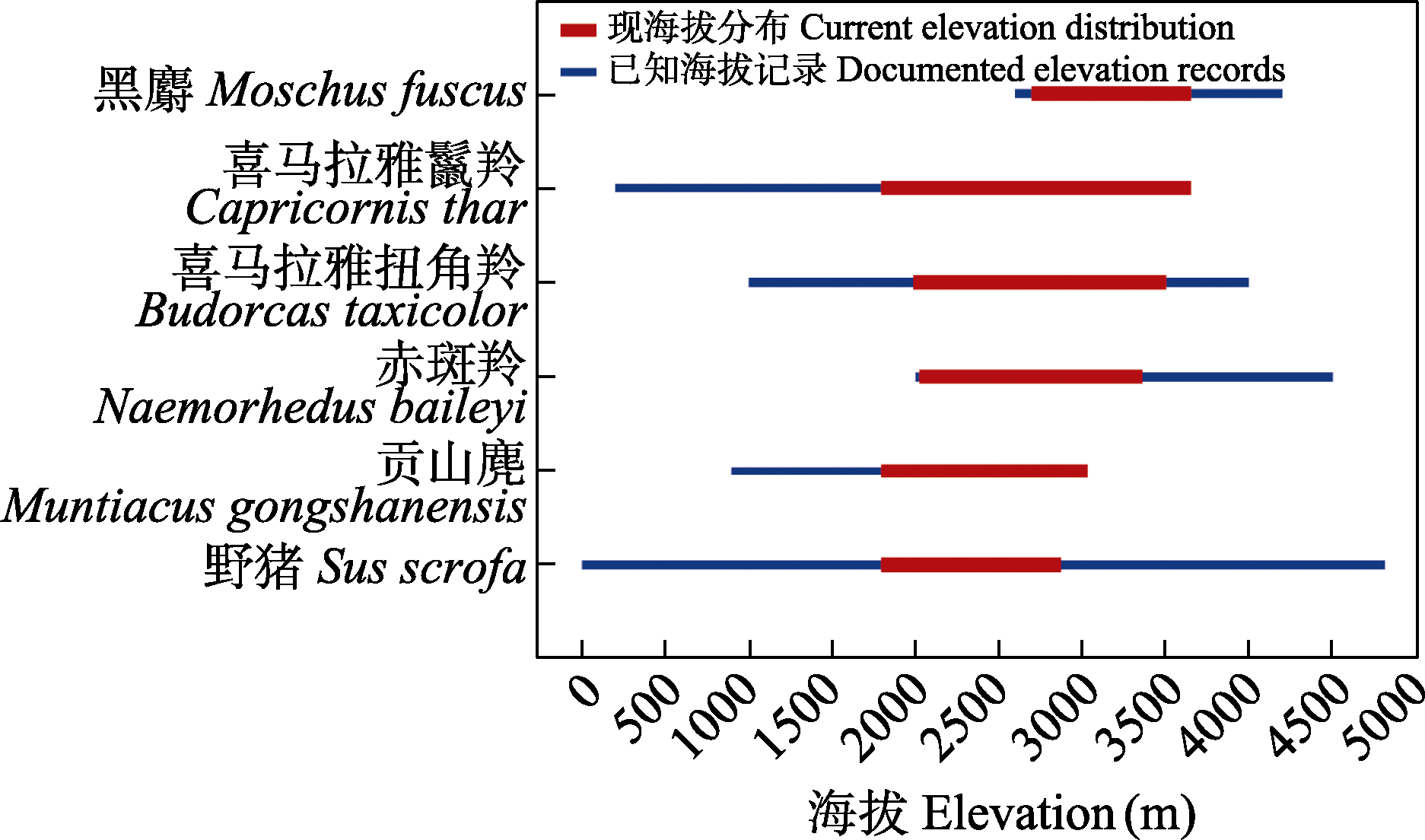
图2 藏东南格当区域黑麝及其同域有蹄类物种的分布海拔。已知海拔记录来源于IUCN濒危物种红色名录(2025-1版)。
Fig. 2 Elevational distribution of black musk deer and sympatric ungulates in Gedang, southeastern Xizang. Documented elevational records were derived from the IUCN Red List of Threatened Species (Version 2025-1).
| 物种 Species | < 2,000 m | 2,000-2,300 m | 2,300-2,600 m | 2,600-2,900 m | 2,900-3,200 m | 3,200-3,500 m | > 3,500 m | 总计 Total |
|---|---|---|---|---|---|---|---|---|
| 黑麝 Moschus fuscus | 0 (0%) | 0 (0%) | 0 (0%) | 13 (6.44%) | 11 (5.45%) | 36 (17.82%) | 142 (70.30%) | 202 (100%) |
| 喜马拉雅鬣羚 Capricornis thar | 29 (2.94%) | 48 (4.86%) | 115 (11.65%) | 596 (60.39%) | 76 (7.70%) | 114 (11.55%) | 9 (0.91%) | 987 (100%) |
| 喜马拉雅扭角羚 Budorcas taxicolor | 1 (0.36%) | 18 (6.55%) | 12 (4.36%) | 96 (34.91%) | 25 (9.09%) | 110 (40.00%) | 13 (4.73%) | 275 (100%) |
| 赤斑羚 Naemorhedus baileyi | 3 (0.56%) | 34 (6.32%) | 77 (14.31%) | 397 (73.79%) | 26 (4.83%) | 1 (0.19%) | 0 (0%) | 538 (100%) |
| 贡山麂 Muntiacus gongshanensis | 349 (29.83%) | 330 (28.21%) | 228 (19.49%) | 262 (22.39%) | 1 (0.09%) | 0 (0%) | 0 (0%) | 1,170 (100%) |
| 野猪 Sus scrofa | 3 (3.61%) | 19 (22.89%) | 20 (24.10%) | 41 (49.40%) | 0 (0%) | 0 (0%) | 0 (0%) | 83 (100%) |
表2 藏东南格当区域黑麝与同域有蹄类物种在不同海拔的独立探测次数及其占该物种总独立探测次数的比例
Table 2 Independent detection and their proportion of the total independent detections for black musk deer and sympatric ungulates across different elevations in Gedang, southeastern Xizang
| 物种 Species | < 2,000 m | 2,000-2,300 m | 2,300-2,600 m | 2,600-2,900 m | 2,900-3,200 m | 3,200-3,500 m | > 3,500 m | 总计 Total |
|---|---|---|---|---|---|---|---|---|
| 黑麝 Moschus fuscus | 0 (0%) | 0 (0%) | 0 (0%) | 13 (6.44%) | 11 (5.45%) | 36 (17.82%) | 142 (70.30%) | 202 (100%) |
| 喜马拉雅鬣羚 Capricornis thar | 29 (2.94%) | 48 (4.86%) | 115 (11.65%) | 596 (60.39%) | 76 (7.70%) | 114 (11.55%) | 9 (0.91%) | 987 (100%) |
| 喜马拉雅扭角羚 Budorcas taxicolor | 1 (0.36%) | 18 (6.55%) | 12 (4.36%) | 96 (34.91%) | 25 (9.09%) | 110 (40.00%) | 13 (4.73%) | 275 (100%) |
| 赤斑羚 Naemorhedus baileyi | 3 (0.56%) | 34 (6.32%) | 77 (14.31%) | 397 (73.79%) | 26 (4.83%) | 1 (0.19%) | 0 (0%) | 538 (100%) |
| 贡山麂 Muntiacus gongshanensis | 349 (29.83%) | 330 (28.21%) | 228 (19.49%) | 262 (22.39%) | 1 (0.09%) | 0 (0%) | 0 (0%) | 1,170 (100%) |
| 野猪 Sus scrofa | 3 (3.61%) | 19 (22.89%) | 20 (24.10%) | 41 (49.40%) | 0 (0%) | 0 (0%) | 0 (0%) | 83 (100%) |
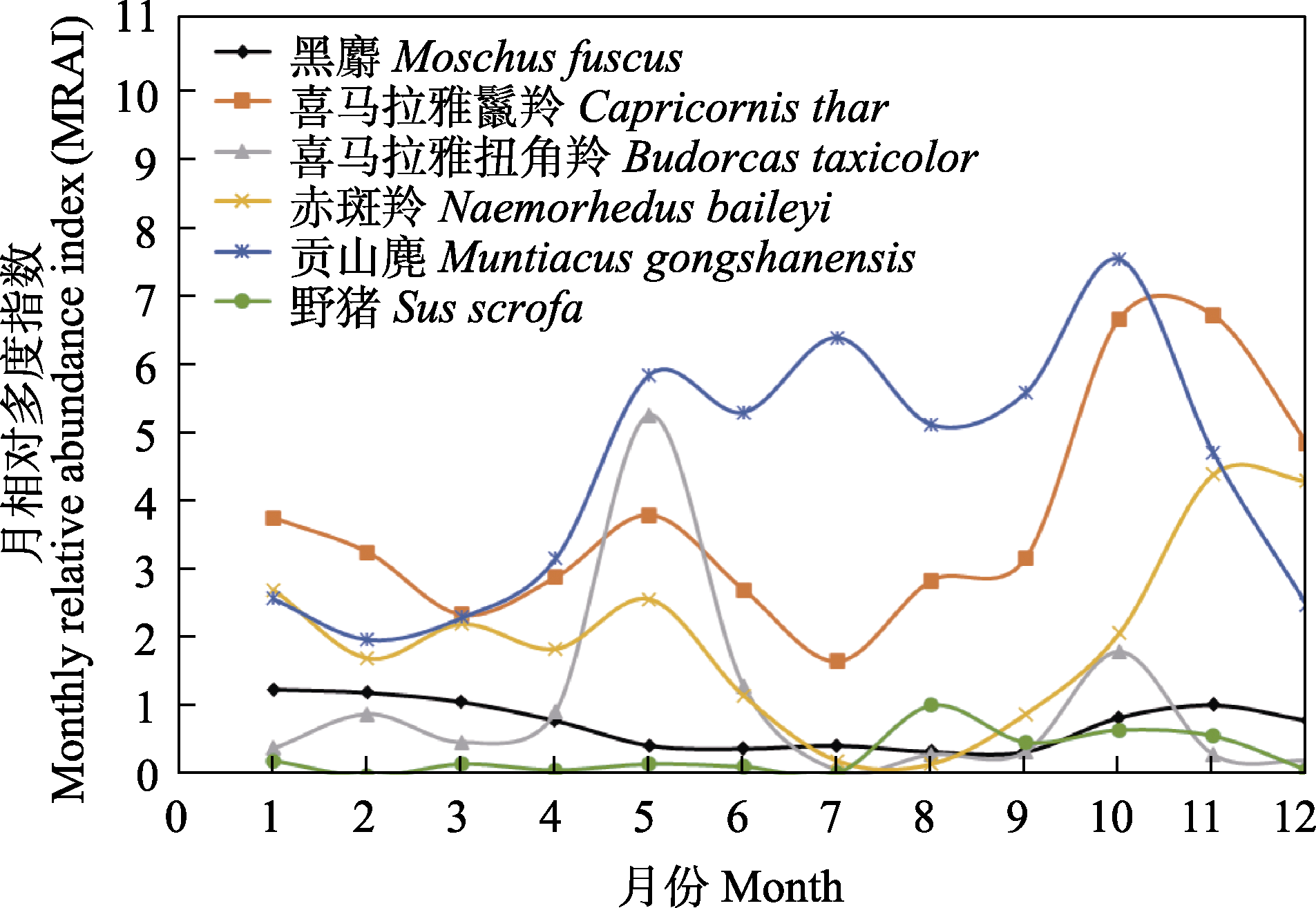
图3 藏东南格当区域黑麝及其同域有蹄类物种的月活动节律
Fig. 3 Monthly activity rhythms of black musk deer and sympatric ungulates in Gedang, southeastern Xizang
| 物种 Species | 春季 Spring | 夏季 Summer | 秋季 Autumn | 冬季 Winter | 总计 Total | ||||||||||
|---|---|---|---|---|---|---|---|---|---|---|---|---|---|---|---|
| ID | SRAI | T (℃) | ID | SRAI | T (℃) | ID | SRAI | T (℃) | ID | SRAI | T (℃) | ID | RAI | Avg (℃) | |
| 黑麝 Moschus fuscus | 51 | 0.85 | -6 - 9 | 28 | 0.47 | 7-14 | 50 | 0.84 | -4 - 11 | 73 | 1.22 | -11 - 3 | 202 | 3.38 | 1.58 |
| 喜马拉雅鬣羚 Capricornis thar | 200 | 3.34 | -1 - 21 | 160 | 2.67 | 8-32 | 365 | 6.10 | -3 - 30 | 262 | 4.38 | -6 - 13 | 987 | 16.50 | 6.28 |
| 喜马拉雅扭角羚 Budorcas taxicolor | 148 | 2.47 | -2 - 31 | 38 | 0.64 | 5-19 | 55 | 0.92 | 0-18 | 34 | 0.57 | -1 - 13 | 275 | 4.60 | 7.87 |
| 赤斑羚 Naemorhedus baileyi | 147 | 2.46 | -1 - 32 | 35 | 0.59 | 8-19 | 163 | 2.72 | -1 - 34 | 193 | 3.23 | -3 - 37 | 538 | 8.99 | 6.35 |
| 贡山麂 Muntiacus gongshanensis | 250 | 4.18 | 2-19 | 371 | 6.20 | 9-21 | 393 | 6.57 | 2-21 | 156 | 2.61 | -2 - 16 | 1,170 | 19.56 | 11.91 |
| 野猪 Sus scrofa | 10 | 0.17 | 6-39 | 27 | 0.45 | 12-33 | 39 | 0.65 | 7-24 | 7 | 0.12 | 1-15 | 83 | 1.39 | 13.96 |
表3 藏东南格当区域黑麝及其同域有蹄类物种在不同季节的拍摄情况和记录温度
Table 3 Independent detection and recorded temperatures of black musk deer and sympatric ungulates across different seasons in Gedang, southeastern Xizang
| 物种 Species | 春季 Spring | 夏季 Summer | 秋季 Autumn | 冬季 Winter | 总计 Total | ||||||||||
|---|---|---|---|---|---|---|---|---|---|---|---|---|---|---|---|
| ID | SRAI | T (℃) | ID | SRAI | T (℃) | ID | SRAI | T (℃) | ID | SRAI | T (℃) | ID | RAI | Avg (℃) | |
| 黑麝 Moschus fuscus | 51 | 0.85 | -6 - 9 | 28 | 0.47 | 7-14 | 50 | 0.84 | -4 - 11 | 73 | 1.22 | -11 - 3 | 202 | 3.38 | 1.58 |
| 喜马拉雅鬣羚 Capricornis thar | 200 | 3.34 | -1 - 21 | 160 | 2.67 | 8-32 | 365 | 6.10 | -3 - 30 | 262 | 4.38 | -6 - 13 | 987 | 16.50 | 6.28 |
| 喜马拉雅扭角羚 Budorcas taxicolor | 148 | 2.47 | -2 - 31 | 38 | 0.64 | 5-19 | 55 | 0.92 | 0-18 | 34 | 0.57 | -1 - 13 | 275 | 4.60 | 7.87 |
| 赤斑羚 Naemorhedus baileyi | 147 | 2.46 | -1 - 32 | 35 | 0.59 | 8-19 | 163 | 2.72 | -1 - 34 | 193 | 3.23 | -3 - 37 | 538 | 8.99 | 6.35 |
| 贡山麂 Muntiacus gongshanensis | 250 | 4.18 | 2-19 | 371 | 6.20 | 9-21 | 393 | 6.57 | 2-21 | 156 | 2.61 | -2 - 16 | 1,170 | 19.56 | 11.91 |
| 野猪 Sus scrofa | 10 | 0.17 | 6-39 | 27 | 0.45 | 12-33 | 39 | 0.65 | 7-24 | 7 | 0.12 | 1-15 | 83 | 1.39 | 13.96 |
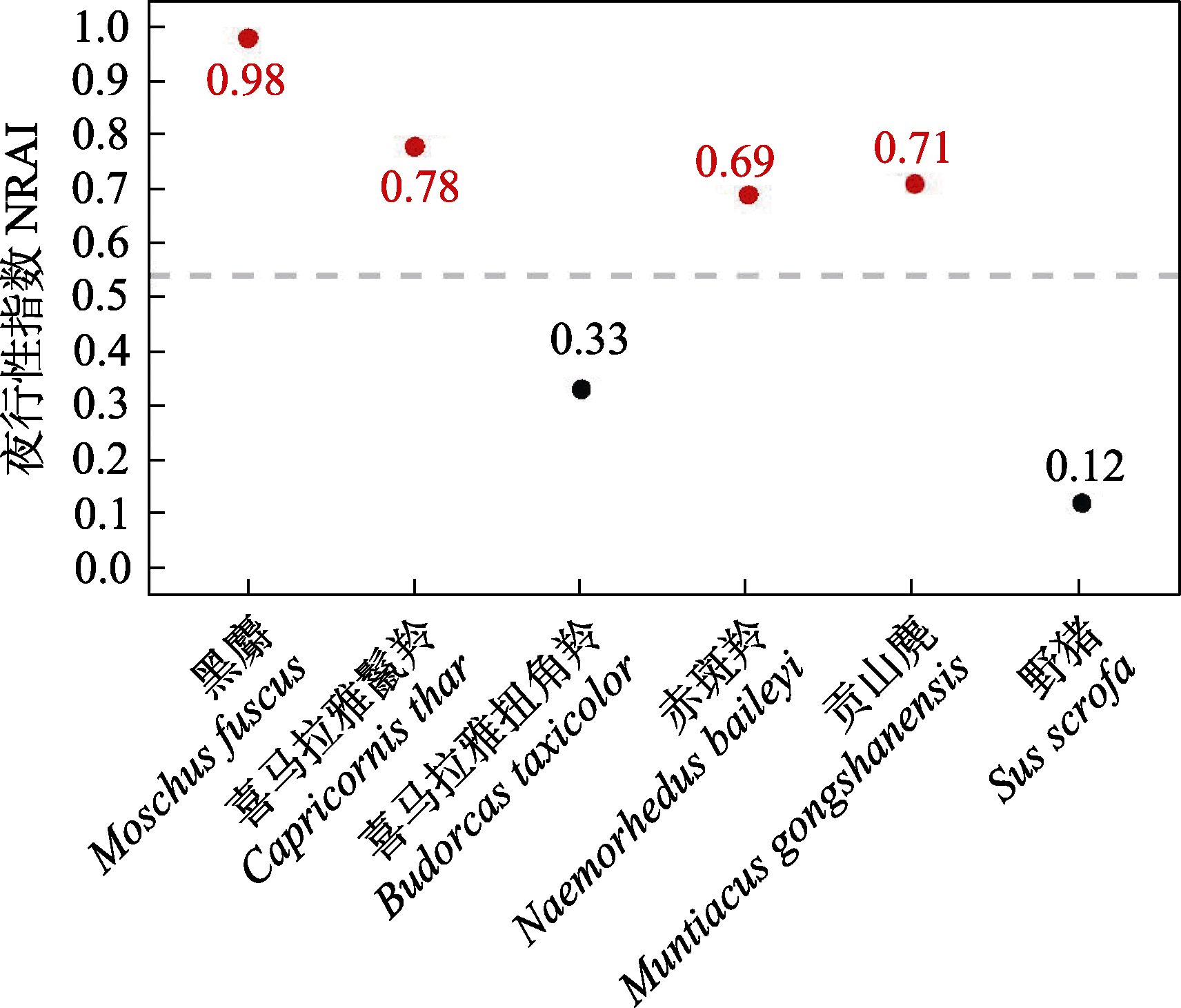
图4 藏东南格当区域黑麝及其同域有蹄类物种的夜行性指数
Fig. 4 Night-time relative abundance index (NRAI) of black musk deer and sympatric ungulates in Gedang, southeastern Xizang
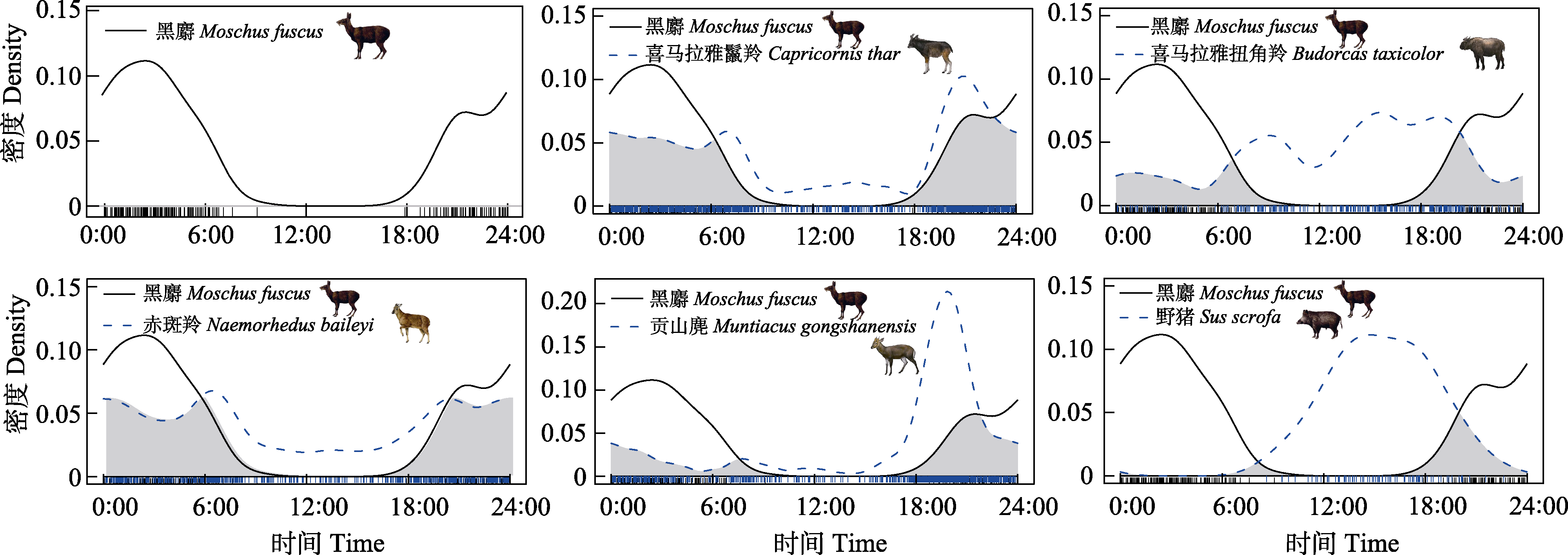
图5 藏东南格当区域黑麝及其同域有蹄类物种的日活动节律曲线与时间重叠比较
Fig. 5 Comparison of daily activity rhythms and temporal overlap of black musk deer and sympatric ungulates in Gedang, southeastern Xizang
| [1] |
Azlan JM, Sharma DSK (2006) The diversity and activity patterns of wild felids in a secondary forest in Peninsular Malaysia. Oryx, 40, 36-41.
DOI URL |
| [2] | Chen EJ, Guan TP, Li S (2022) The sex ratio, social structure and activity pattern of Reeves’ muntjac (Muntiacus reevesi) in Minshan Mountains, Sichuan Province. Acta Theriologica Sinica, 42, 1-11. (in Chinese with English abstract) |
|
[陈尔骏, 官天培, 李晟 (2022) 四川岷山小麂的种群性比、社会结构和活动节律. 兽类学报, 42, 1-11.]
DOI |
|
| [3] |
Chen GT, Li XN, Miao YX, Pang DP, Wang H, Fan HZ, Zhang BW (2025) Population genomic analysis provides insights into the evolution and conservation of two critically endangered musk deer species. Evolutionary Applications, 18, e70134.
DOI URL |
| [4] |
Chen LJ, Shu ZF, Xiao ZS (2019) Application of camera- trapping data to study daily activity patterns of Galliformes in Guangdong Chebaling National Nature Reserve. Biodiversity Science, 27, 266-272. (in Chinese with English abstract)
DOI URL |
|
[陈立军, 束祖飞, 肖治术 (2019) 应用红外相机数据研究动物活动节律——以广东车八岭保护区鸡形目鸟类为例. 生物多样性, 27, 266-272.]
DOI |
|
| [5] | Chen X, Jin YY, Jiang Y, Jiang WH, Yang ZS, Hu DF, Yang B (2025) A new record of mammals in Sichuan Province— Black musk deer. Sichuan Journal of Zoology, 44, 373. (in Chinese) |
| [陈星, 晋雨漪, 蒋勇, 蒋维宏, 杨志松, 胡德夫, 杨彪 (2025) 四川省兽类新记录——黑麝. 四川动物, 44, 373.] | |
| [6] | Ding YK, Yao ZC, Zhao C, Zhang ZR, Chen JD, Teng LW, Liu ZS (2023) Habitat suitability assessment of Moschus chrysogaster in Helan Mountain. Acta Ecologica Sinica, 43, 3150-3156. (in Chinese with English abstract) |
| [丁彦珂, 姚志诚, 赵唱, 张致荣, 陈俊达, 滕丽微, 刘振生 (2023) 贺兰山马麝(Moschus chrysogaster)生境适宜性评价. 生态学报, 43, 3150-3156.] | |
| [7] |
Feng H, Feng TY, Mo YD, Sun SL, Wang L, Lu CB, Feng CL, Xing K, Su ZJ (2023) Integrated multi-omics analysis reveals insights into Chinese forest musk deer (Moschus berezovskii) genome evolution and musk synthesis. Frontiers in Cell and Developmental Biology, 11, 1156138.
DOI URL |
| [8] | Feng ZJ, Cai GQ, Zheng CL (1984) A checklist of the mammals of Xizang (Tibet). Acta Theriologica Sinica, 4, 341-358. (in Chinese with English abstract) |
| [冯祚建, 蔡桂全, 郑昌琳 (1984) 西藏哺乳类名录. 兽类学报, 4, 341-358.] | |
| [9] | Gao YT (1963) Taxonomic notes on the Chinese musk-deer. Acta Zoologica Sinica, 15, 479-488. (in Chinese with English abstract) |
| [高耀亭 (1963) 中国麝的分类. 动物学报, 15, 479-488.] | |
| [10] | IUCN (2025) The IUCN Red List of Threatened Species, Version 2025- 1. (accessed on 2025-08-16) |
| [11] |
Jiang F, Zhang JJ, Gao HM, Cai ZY, Zhou XW, Li SQ, Zhang TZ (2020) Musk deer (Moschus spp.) face redistribution to higher elevations and latitudes under climate change in China. Science of the Total Environment, 704, 135335.
DOI URL |
| [12] | Jiang XW, Huang JZ, Zhang L, Li TA, Yang YG, Li D, Liu H (2025) Habitat research of forest musk deer in Mianyang area based on MaxEnt model. Journal of Mianyang Teachers’ College (Science), 44(5), 37-45. (in Chinese with English abstract) |
| [蒋夏威, 黄俊忠, 张炼, 李同澳, 杨元罡, 李冬, 刘昊 (2025) 基于MaxEnt模型的林麝在绵阳地区的栖息地研究. 绵阳师范学院学报, 44(5), 37-45.] | |
| [13] | Jiao HF (2025) Resource investigation and suitable habitat assessment of Moschus moschiferus in Shanxi Yangcheng Manghe Rhesus Monkey National Nature Reserve. Shanxi Forestry Science and Technology, 54(2), 7-9, 64. (in Chinese with English abstract) |
| [焦慧芳 (2025) 山西阳城蟒河猕猴国家级自然保护区原麝资源调查及适宜栖息地评估. 山西林业科技, 54(2), 7-9, 64.] | |
| [14] |
Lan XN, Li YX, Hai LY, Luo ZW, Jin XL, Qin XH, Hu DF, Liu G (2025) Identification and geographical distribution of wild musk deer species in North China. Biodiversity Science, 33, 24505. (in Chinese with English abstract)
DOI |
|
[蓝贤娜, 李亦欣, 海路瑶, 骆正伟, 金学林, 秦兴虎, 胡德夫, 刘刚 (2025) 华北区野生麝类的分子鉴定及分布现状. 生物多样性, 33, 24505.]
DOI |
|
| [15] | Li HJ (2021) Investigation and analysis of wild animals in Jilin Baishan Original Musk Deer National Nature Reserve. Forest Investigation Design, 50(6), 52-55. (in Chinese with English abstract) |
| [李华杰 (2021) 吉林白山原麝国家级自然保护区野生动物调查分析. 林业勘查设计, 50(6), 52-55.] | |
| [16] |
Li HP, Zan L, Zhou X, Zhang RH, Wang G, Qi J, Meng XX (2024) Impacts of anthropogenic activities on the habitat of musk deer in the Xinglongshan National Nature Reserve on the eastern edge of the Qinghai-Tibet Plateau. Chinese Journal of Ecology, 43, 1920-1927. (in Chinese with English abstract)
DOI |
| [李海萍, 昝僚, 周鑫, 张荣红, 王功, 祁军, 孟秀祥 (2024) 人类活动对青藏高原东缘兴隆山国家级自然保护区马麝(Moschus chrysogaster)生境的影响. 生态学杂志, 43, 1920-1927.] | |
| [17] | Li JJ, Zhang JH, Fang YH, Xiong Y, Huang ZP, Li YP (2025) First camera trap images of the black musk deer recorded in Yunnan Province. Sichuan Journal of Zoology, 44, 120. (in Chinese) |
| [李军杰, 张甲辉, 房以好, 熊云, 黄志旁, 李延鹏 (2025) 首次在云南省拍摄到黑麝的野外影像. 四川动物, 44, 120.] | |
| [18] | Li P, Zhang ZJ, Yang H, Wei W, Zhou H, Hong MS, Fu MX, Song XQ, Yu J (2021) Study on the activity rhythms of ungulates in Daxiangling Nature Reserve based on infrared camera trapping. Journal of Sichuan Forestry Science and Technology, 42(3), 18-23. (in Chinese with English abstract) |
| [李平, 张泽钧, 杨洪, 韦伟, 周宏, 洪明生, 付明霞, 宋心强, 余吉 (2021) 基于红外相机技术对大相岭保护区有蹄类动物活动节律的初步研究. 四川林业科技, 42(3), 18-23.] | |
| [19] |
Li S, McShea WJ, Wang DJ, Shen XL, Bu HL, Guan TP, Wang F, Gu XD, Zhang XF, Liao HH (2020) Construction progress of the Camera-trapping Network for the Mountains of Southwest China. Biodiversity Science, 28, 1049-1058. (in Chinese with English abstract)
DOI URL |
| [李晟, McShea WJ, 王大军, 申小莉, 卜红亮, 官天培, 王放, 古晓东, 张晓峰, 廖灏泓 (2020) 西南山地红外相机监测网络建设进展. 生物多样性, 28, 1049-1058.] | |
| [20] | Li ZX (1981) On a new species of musk-deer from China. Zoological Research, 2, 157-161, 204. (in Chinese with English abstract) |
| [李致祥 (1981) 中国麝一新种的记述. 动物学研究, 2, 157-161, 204.] | |
| [21] | Lin SW, Shen LQ, Gao HX, Wu JY, LüQX, Zhou X, Li JS, Meng XX (2023) The autumn activity patterns and time budgets of forest musk deer (Moschus berezovskii) in captivity. Veterinary Research Forum, 14, 589-594. |
| [22] | Liu CS (2022) Discussion on musk deer resources conservation and ecological development strategy in the east edge of Qinghai-Tibetan Plateau. Chinese Traditional and Herbal Drugs, 53, 7955-7959. (in Chinese with English abstract) |
| [刘丛盛 (2022) 青藏高原东缘麝类资源保护及生态型发展战略的探讨. 中草药, 53, 7955-7959.] | |
| [23] |
Liu K, Xie L, Deng M, Zhang XM, Luo J, Li XF (2021) Zoology, chemical composition, pharmacology, quality control and future perspective of musk (Moschus): A review. Chinese Medicine, 16, 46.
DOI PMID |
| [24] | Liu SY, Wu Y, Li S (2022) Handbook of the Mammals of China. Haixia Publishing House, Beijing. (in Chinese) |
| [刘少英, 吴毅, 李晟 (2022) 中国兽类图鉴. 海峡书局, 北京.] | |
| [25] | Liu WH, Tong JM (2005) Analysis on protection and utilization of musk deer resources in China. Review of China Agricultural Science and Technology, 7(4), 28-32. (in Chinese with English abstract) |
| [刘文华, 佟建明 (2005) 中国的麝资源及其保护与利用现状分析. 中国农业科技导报, 7(4), 28-32.] | |
| [26] |
Mainali KP, Singh PB, Evans M, Adhikari A, Hu YM, Hu HJ (2023) A brighter shade of future climate on Himalayan musk deer Moschus leucogaster. Scientific Reports, 13, 12771.
DOI PMID |
| [27] | Meredith M, Ridout M (2014) Overlap: Estimates of Coefficient of Overlapping for Animal Activity Patterns. (accessed on 2025-09-08) |
| [28] |
O’Brien TG, Kinnaird MF, Wibisono HT (2003) Crouching tigers, hidden prey: Sumatran tiger and prey populations in a tropical forest landscape. Animal Conservation, 6, 131-139.
DOI URL |
| [29] | Pang DP, Wang LR, Lu YT, Huang JW, Xu P, Jiang QY, Ding ZW, Chen YF, Ding J, Zhang BW (2025) Temporal niche patterns of Anhui musk deer (Moschus anhuiensis) and sympatric ungulates. Acta Theriologica Sinica, 45, 302-311. (in Chinese with English abstract) |
| [庞大鹏, 王兰荣, 卢雨婷, 黄嘉伟, 许鹏, 江清悦, 丁仲文, 陈云峰, 丁俊, 张保卫 (2025) 安徽麝及其同域分布有蹄类动物时间生态位格局初步研究. 兽类学报, 45, 302-311.] | |
| [30] | Peng HY, Chen WC, Zhang XY (2010) A review on the classification of musk deer. Journal of Yulin Normal University, 31(2), 66-72. (in Chinese with English abstract) |
| [彭红元, 陈伟才, 张修月 (2010) 麝的分类研究概述. 玉林师范学院学报, 31(2), 66-72.] | |
| [31] | Ridout MS, Linkie M (2009) Estimating overlap of daily activity patterns from camera trap data. Journal of Agricultural, Biological, and Environmental Statistics, 14, 322-337. |
| [32] | Rowcliffe M (2016) Activity: Animal Activity Statistics. (accessed on 2025-09-08) |
| [33] | Shao JB, Guo DL, Ma YT, Zhao WC, Xie ZF, Yu YP, Ma XL, Zhang YH (2024) Impact of human activities on habitat of forest musk deer in Shaanxi Niubeiliang Nature Reserve of Qinling Mountains. Shaanxi Forest Science and Technology, 52(6), 28-35. (in Chinese with English abstract) |
| [邵建斌, 郭东玲, 麻应太, 赵文超, 解振锋, 于艳萍, 马雪亮, 张耀红 (2024) 人类活动对陕西牛背梁国家级自然保护区林麝栖息地的影响. 陕西林业科技, 52(6), 28-35.] | |
| [34] | Shen LQ, Gao HX, Wang G, Liu R, Qi J, Zhang XY, Wang CL, Wu JY, Meng XX (2023) Summer bed-site habitat utilization of wild alpine musk deer (Moschus chrysogaster) in Xinglongshan National Nature Reserve, Gansu Province of China. Chinese Journal of Ecology, 42, 1699-1704. (in Chinese with English abstract) |
| [申立泉, 高浩翔, 王功, 刘瑞, 祁军, 张学炎, 王春玲, 吴佳忆, 孟秀祥 (2023) 甘肃兴隆山野生马麝夏季卧息生境选择. 生态学杂志, 42, 1699-1704.] | |
| [35] |
Shi XY, Li XY, Wei CY, Sun G, Liu Z, Zhao X, Zhou JD, Fan J, Li C, Lü Z (2023) Avian and mammal diversities and their altitudinal and seasonal distribution patterns in Yarlung Zangbo Grand Canyon, China. Biodiversity Science, 31, 22491. (in Chinese with English abstract)
DOI |
|
[史湘莹, 李雪阳, 魏春玥, 孙戈, 刘震, 赵翔, 周嘉鼎, 樊简, 李成, 吕植 (2023) 雅鲁藏布大峡谷鸟兽多样性及其海拔和季节分布. 生物多样性, 31, 22491.]
DOI |
|
| [36] | Sun H, Zhou ZK (1996) The characters and origin of the flora from the big bend gorge of Yalutsangpu (Brahmabutra) River, Eastern Himalayas. Acta Botanica Yunnanica, 18, 185-204. (in Chinese with English abstract) |
| [孙航, 周浙昆 (1996) 喜马拉雅东部雅鲁藏布江大峡弯河谷地区植物区系的特点及来源. 云南植物研究, 18, 185-204.] | |
| [37] | Sun JX, Li JQ, Wan YQ, Li S, Guan TP, Wang J, Xia WC, Xu HG (2018) Study on the activity rhythms of nine ungulates in summer and autumn in Sichuan. Journal of Ecology and Rural Environment, 34, 1003-1009. (in Chinese with English abstract) |
| [孙佳欣, 李佳琦, 万雅琼, 李晟, 官天培, 王杰, 夏万才, 徐海根 (2018) 四川9种有蹄类动物夏秋季活动节律研究. 生态与农村环境学报, 34, 1003-1009.] | |
| [38] | Veldhuis MP, Hofmeester TR, Balme G, Druce DJ, Pitman RT,Cromsigt JPGM (2020) Predation risk constrains herbivores’ adaptive capacity to warming. Nature Ecology & Evolution, 4, 1069-1074. |
| [39] | Wang A, Wen DX, Zhou YY, Yu GQ, Chen J, Peng DY, Huang TF, Tian SR, Xiao F (2024) Assessment of habitat suitability for Moschus berezovskii in Hunan Province based on MaxEnt model and ArcGIS. Hunan Forestry Science & Technology, 51(1), 43-49. (in Chinese with English abstract) |
| [王安, 文东新, 周芸芸, 于桂清, 陈军, 彭德永, 黄太福, 田书荣, 肖芬 (2024) 基于MaxEnt模型和ArcGIS软件的湖南省林麝生境适宜性评价. 湖南林业科技, 51(1), 43-49.] | |
| [40] | Wang P, Li YJ, Yuan JG, Geng P, Li R (2023) Habitat suitability assessment for Moschus moschiferus based on optimized MaxEnt model. Chinese Journal of Wildlife, 44, 38-45. (in Chinese with English abstract) |
| [王佩, 李英杰, 袁家根, 耿盼, 李蕊 (2023) 基于优化MaxEnt模型的原麝生境适宜性评价. 野生动物学报, 44, 38-45.] | |
| [41] | Wang QQ, Yang B, Chang J, Wang X, Chen XG, Li SL, Renzeng JC, Gongqiu DZ, Zhang L (2025) The population ecological characteristics of Gongshan muntjac (Muntiacus gongshanensis) in Southeastern Tibet based on camera-trap technology. Ecology and Evolution, 15, e71646. |
| [42] |
Wang QQ, Yang B, Zhu RF, Wang X, Li SL, Zhang L (2024) Unveiling the biodiversity and conservation significance of Medog: A camera-trapping survey on mammals in the Southeastern Tibetan mountains. Animals, 14, 2188.
DOI URL |
| [43] | Wang QS, Hu XL, Yan YH (1982) On a new subspecies of Siberian musk-deer (Moschus moschiferus anhuiensis subsp. nov.) from Anhui, China. Acta Theriologica Sinica, 2, 133-138. (in Chinese with English abstract) |
| [王歧山, 胡小龙, 颜于宏 (1982) 我国原麝一新亚种——安徽亚种. 兽类学报, 2, 133-138.] | |
| [44] | Wang ZX, Wang XY, Huang K, Zhu YH, Xia WC, Fei HL, Li DY (2024) Preliminary study on the activity rhythm of Himalayan Iguana in Jiacha Gorge of Yarlung Zangbo River. Journal of Guizhou Normal University (Natural Sciences), 42(3), 76-83. (in Chinese with English abstract) |
| [王志祥, 王雪宇, 黄凯, 朱宇航, 夏万才, 费汉榄, 黎大勇 (2024) 雅鲁藏布江加查峡谷喜马拉雅鬣羚活动节律研究. 贵州师范大学学报(自然科学版), 42(3), 76-83.] | |
| [45] | Wei FW, Yang QS, Wu Y, Jiang XL, Liu SY, Hu YB, Ge DY, Li BG, Yang G, Li M, Zhou J, Li S, Li S, Yu WH, Chen BY, Zhang ZJ, Zhou CQ, Wu SB, Zhang L, Chen ZZ, Chen SD, Deng HQ, Jiang TL, Zhang LB, Shi HY, Lu XL, Li Q, Liu Z, Cui YQ, Li YC, He K (2025) Catalogue of mammals in China (2024). Acta Theriologica Sinica, 45, 1-16. (in Chinese with English abstract) |
| [魏辅文, 杨奇森, 吴毅, 蒋学龙, 刘少英, 胡义波, 葛德燕, 李保国, 杨光, 李明, 周江, 李松, 李晟, 余文华, 陈炳耀, 张泽钧, 周材权, 吴诗宝, 张立, 陈中正, 陈顺德, 邓怀庆, 江廷磊, 张礼标, 石红艳, 卢学理, 李权, 刘铸, 崔雅倩, 李玉春, 何锴 (2025) 中国兽类名录(2024版). 兽类学报, 45, 1-16.] | |
| [46] | Wen LJ, Shi K, Huang J, Song Y, Guo YM (2014) Preliminary analysis of mammal and bird diversity monitored with camera traps in Medog, Tibet. Biodiversity Science, 22, 798-799. (in Chinese with English abstract) |
|
[温立嘉, 时坤, 黄建, 宋阳, 郭玉民 (2014) 西藏墨脱鸟兽红外相机监测初报. 生物多样性, 22, 798-799.]
DOI |
|
| [47] | Wen P, Peng K, Chen X, Wei Y, Yang ZS, Dai Q (2021) Habitat suitability evaluation of four ungulate species in Baishuihe National Nature Reserve based on MaxEnt model. Journal of Sichuan Forestry Science and Technology, 42(1), 70-75. (in Chinese with English abstract) |
| [温平, 彭科, 陈旭, 韦怡, 杨志松, 戴强 (2021) 基于MaxEnt模型的白水河国家级保护区有蹄类保护动物生境适宜性评价. 四川林业科技, 42(1), 70-75.] | |
| [48] | Weng SY, Liu SS, Yang L (2022) A preliminary report on breeding bird diversity in Gawalong Mountain of northern Medog County, Tibet. Plateau Science Research, 6(4), 20-32. (in Chinese with English abstract) |
| [翁仕洋, 刘善思, 杨乐 (2022) 西藏墨脱县北部嘎瓦龙山繁殖鸟类多样性初报. 高原科学研究, 6(4), 20-32.] | |
| [49] | Wu H, Hu JC (2001) A comparison in spring and winter habitat selection of takin, serow and goral in Tangjiahe, Sichuan. Acta Ecologica Sinica, 21, 1627-1633. (in Chinese with English abstract) |
| [吴华, 胡锦矗 (2001) 四川唐家河羚牛、鬣羚、斑羚春冬季生境选择比较研究. 生态学报, 21, 1627-1633.] | |
| [50] | Wu JP, Luo H, Zhu XL, Li BZ, Liu WL, Ci P (2016) Monitoring mammals and birds with camera traps at different altitudes of Medog, Tibet. Biodiversity Science, 24, 351-354. (in Chinese with English abstract) |
|
[吴建普, 罗红, 朱雪林, 李炳章, 刘务林, 次平 (2016) 西藏墨脱不同海拔区鸟兽红外相机监测. 生物多样性, 24, 351-354.]
DOI |
|
| [51] | Wu KJ, Wu SL, Su Y, Cai YH, Yang Y, Gong H, Jiang GM (2022) An overview and progress of the population distribution and food source research of Moschus berezovskii. South China Agriculture, 16(8), 166-169. (in Chinese) |
| [吴科君, 吴世磊, 苏宇, 蔡永华, 杨营, 龚杭, 蒋桂枚 (2022) 林麝的种群分布及食源研究概况和进展. 南方农业, 16(8), 166-169.] | |
| [52] | Xi J, Zhu YD, He K, Yang ZS, Li DY (2023) Habitat selection of wild training Moschus berezovskii individuals in Liziping National Nature Reserve, Sichuan Province. Journal of Sichuan Forestry Science and Technology, 44(2), 51-57. (in Chinese with English abstract) |
| [席健, 朱玉东, 何可, 杨志松, 黎大勇 (2023) 四川栗子坪国家级自然保护区林麝野化培训个体的生境选择. 四川林业科技, 44(2), 51-57.] | |
| [53] |
Xiao ZS, Li XH, Wang XZ, Zhou QH, Quan RC, Shen XL, Li S (2014) Developing camera-trapping protocols for wildlife monitoring in Chinese forests. Biodiversity Science, 22, 704-711. (in Chinese with English abstract)
DOI |
|
[肖治术, 李欣海, 王学志, 周岐海, 权锐昌, 申小莉, 李晟 (2014) 探讨我国森林野生动物红外相机监测规范. 生物多样性, 22, 704-711.]
DOI |
|
| [54] | Xue C, Meng XX, Xu HF, Xiao Y (2008) Activity rhythm and behavioral time budgets of the captive forest musk deer (Moschus berezovskii) in spring. Acta Theriologica Sinica, 28, 194-200. (in Chinese with English abstract) |
| [薛程, 孟秀祥, 徐宏发, 肖宇 (2008) 圈养林麝春季活动节律及时间分配. 兽类学报, 28, 194-200.] | |
| [55] | Yuan XJ, Liu B, Huang TF, Tian SR (2023) The historical change and protecting strategy in population and distribution of forest musk deer (Moschus berezovskii) in Hunan Province. Journal of Hunan Ecological Science, 10(3), 121-125. (in Chinese with English abstract) |
| [袁雪瑾, 刘搏, 黄太福, 田书荣 (2023) 湖南省林麝种群数量和分布的历史变迁与保护对策. 湖南生态科学学报, 10(3), 121-125.] | |
| [56] | Zhang C, Fan YW, Chen MH, Xia WC, Wang JD, Zhan ZJ, Wang WL, Khan TU, Wu SH, Luan XF (2022) Identification of conservation priority areas and a protection network for the Siberian musk deer (Moschus moschiferus L.) in Northeast China. Animals. 12, 260. |
| [57] | Zhang JQ, Zhou YB, Xu WX, Hu JC, Liao WB (2004) Discussion about musk-deer’s classification. Journal of China West Normal University (Natural Sciences), 25, 251-255. (in Chinese with English abstract) |
| [章敬旗, 周友兵, 徐伟霞, 胡锦矗, 廖文波 (2004) 几种麝分类地位的探讨. 西华师范大学学报(自然科学版), 25, 251-255.] | |
| [58] |
Zhang LX, Sun ZY, An B, Zhang DX, Chen LY (2022) Alpine musk deer (Moschus chrysogaster) adjusts to a human- dominated semi-arid mountain ecosystem. Animals, 12, 3061.
DOI URL |
| [59] | Zhou X, Lü QX, Sangzhu ZX, Zha X, Zhou M, Li Y, Meng XX (2024) Reproduction success and the relationships to sociality and social networks in ex-situ conserved alpine musk deer in the east-northern edging area of the Qinghai-Tibet Plateau. Acta Ecologica Sinica, 44, 6417-6423. (in Chinese with English abstract) |
| [周鑫, 吕青昕, 桑珠扎西, 扎西, 周密, 黎勇, 孟秀祥 (2024) 青藏高原东北缘濒危马麝迁地保育种群繁殖成效与社会性和社会网络的关系. 生态学报, 44, 6417-6423.] | |
| [60] | Zou QX, Peng CC, Yang XW, Li GR, Mu L, Su HJ (2021) Spatiotemporal pattern of co-existence of two sympatric cervid species in Mayanghe National Nature Reserve, Guizhou, China. Chinese Journal of Wildlife, 42, 5-13. (in Chinese with English abstract) |
| [邹启先, 彭彩淳, 杨雄威, 李光容, 穆浪, 粟海军 (2021) 两种同域分布鹿科动物的共存时空格局. 野生动物学报, 42, 5-13.] |
| [1] | 郭画, 罗雨甜, 董译莉, 周铝, 姚世贸, 朱旭飞, 田成. 放牧干扰对王朗国家级自然保护区红腹角雉时空分布的影响[J]. 生物多样性, 2026, 34(6): 25501-. |
| [2] | 张梦, 曹荣军, 王功芳, 邹琼玖, 吴林庭, 付伟昌, 周友兵, 彭刚志. 道路干扰对偶蹄类动物的影响: 以湖北大老岭国家级自然保护区为例[J]. 生物多样性, 2026, 34(6): 26050-. |
| [3] | 冯杰, 李彦知, 王书理, 李岚曦, 丁鹏飞, 吕冰薇, 孟吉, 史湘莹, 李雪阳. 西南山地有蹄类栖息地利用率变化及环境影响: 以关坝村红外相机监测为例[J]. 生物多样性, 2026, 34(5): 25261-. |
| [4] | 孔孜亦, 王德港, 王建涛, 裴志永, 孙晶, 张长春, 张军国. 基于SCD-HRNet模型的野生动物姿态估计及其在生物多样性监测中的应用: 以内蒙古赛罕乌拉地区为例[J]. 生物多样性, 2026, 34(4): 25287-. |
| [5] | 张同, 梁力文, 王长剑, 舒服, 王璐, 郭泽光, 卓玛曲珍, 钱芊, 蒋安莉, 敖俊杰, 彭兴文, 伍小刚, 向左甫, 郭克疾, 廖梓延. 基于红外相机的西藏芒康滇金丝猴国家级自然保护区鸟兽多样性及代表性物种的季节性空间利用特征[J]. 生物多样性, 2026, 34(4): 25435-. |
| [6] | 周铝, 姚世贸, 赵战合, 郭画, 田成. 庞泉沟国家级自然保护区狍和野猪时空共存格局[J]. 生物多样性, 2026, 34(2): 25327-. |
| [7] | 岳可欣, 牛钟辉, 刘念, 徐琳, 吕韦韦, 徐茂宏, 崔绍朋. 山西历山三种同域分布食肉动物昼夜活动节律及与月光周期的关系[J]. 生物多样性, 2025, 33(9): 25084-. |
| [8] | 周铝, 郭画, 姚世贸, 田成. 王朗国家级自然保护区红腹角雉时空分布模式[J]. 生物多样性, 2025, 33(7): 24537-. |
| [9] | 李基才, 邵长亮, 高帅帅, 李佳. 新疆卡拉麦里国家公园候选区蒙古野驴夏季水源利用规律、活动范围和适宜生境分布[J]. 生物多样性, 2025, 33(7): 24509-. |
| [10] | 毛静, 王婧, 黄杰, 熊姝红, 张自亮, 张佑祥, 吴涛. 湖南高望界国家级自然保护区2021-2023年鸟兽多样性监测数据集[J]. 生物多样性, 2025, 33(6): 24489-. |
| [11] | 黄定旭, 肖文宏, 白小节, 刘邦友, 黎源君, 梁盛, 肖治术, 刘伟. 赤水桫椤国家级自然保护区中小型食肉目动物昼夜活动节律的比较[J]. 生物多样性, 2025, 33(6): 24376-. |
| [12] | 罗敏, 杨永川, 靳程, 周礼华, 龙宇潇. 重庆中心城区城市森林兽类组成特征及其对人类活动的响应[J]. 生物多样性, 2025, 33(5): 24402-. |
| [13] | 龚翠凤, 韦伟, 罗概, 韩一敏, 吴鹏程, 何梦楠, 闵清悦, 付强, 陈鹏. 大熊猫国家公园崇州片区有蹄类动物空间分布及共存关系[J]. 生物多样性, 2025, 33(3): 24260-. |
| [14] | 王大伟, 程帅, 冯佳伟, 王天明. 东北地区张广才岭2015-2020年野生动物红外相机监测数据集[J]. 生物多样性, 2025, 33(2): 24384-. |
| [15] | 汪锦辉, 刘宝权, 周晓, 梁子安, 孔令伟, 方卫军, 孙晗靖, 金挺浩, 厉亮, 何珂, 朱振贤. 基于红外相机监测的杭州市鸟兽多样性分析与优先保护关键区域评估[J]. 生物多样性, 2025, 33(12): 25265-. |
| 阅读次数 | ||||||
|
全文 |
|
|||||
|
摘要 |
|
|||||
备案号:京ICP备16067583号-7
Copyright © 2026 版权所有 《生物多样性》编辑部
地址: 北京香山南辛村20号, 邮编:100093
电话: 010-62836137, 62836665 E-mail: biodiversity@ibcas.ac.cn
