

生物多样性 ›› 2009, Vol. 17 ›› Issue (6): 605-612. DOI: 10.3724/SP.J.1003.2009.09141 cstr: 32101.14.SP.J.1003.2009.09141
所属专题: 群落中的物种多样性:格局与机制; 物种形成与系统进化
方精云*( ), 王襄平, 唐志尧
收稿日期:2009-06-03
接受日期:2009-11-30
出版日期:2009-11-20
发布日期:2009-11-20
通讯作者:
方精云
作者简介:*E-mail: jyfang@urban.pku.edu.cn基金资助:
Jingyun Fang*(), Xiangping Wang, Zhiyao Tang
Received:2009-06-03
Accepted:2009-11-30
Online:2009-11-20
Published:2009-11-20
Contact:
Jingyun Fang
摘要:
解释群落的物种多样性大小是生态学研究的一个重要的理论和实践问题。人们提出了群落物种多样性的多种假说, Zobel等人提出的种库假说(species pool hypothesis)是生物多样性理论研究的重要发展。该假说认为, 一个群落的物种多样性不仅与环境条件和生态过程(ecological process)(如竞争、捕食)有关, 也受区域种库(regional species pool)的限制。区域种库是指一个地区可进入某一群落的潜在物种数量, 它由地史过程(如冰期、地质年代)和区域过程(物种形成、迁移扩散以及消亡)所决定。按照种库假说, 某一生境类型的面积越大, 地质年代越古老, 物种形成的机会也就越多, 因而能适应和分布于该生境的物种也就越多, 实际群落中的物种丰富度也就越高。种库在空间上主要有两个层次: 区域种库和实际种库, 前者指某一生境所拥有的潜在物种数量, 主要由生物地理过程(biogeographic processes)所决定; 后者则为调查的群落中实际出现的物种数量, 主要由竞争等生态过程和区域种库共同决定。本文对种库假说的基本概念、主要内容、种库确定方法等作了介绍, 并阐述了作者对这些问题的理解和认识。
方精云, 王襄平, 唐志尧 (2009) 局域和区域过程共同控制着群落的物种多样性: 种库假说. 生物多样性, 17, 605-612. DOI: 10.3724/SP.J.1003.2009.09141.
Jingyun Fang, Xiangping Wang, Zhiyao Tang (2009) Local and regional processes control species richness of plant communities: the species pool hypothesis. Biodiversity Science, 17, 605-612. DOI: 10.3724/SP.J.1003.2009.09141.
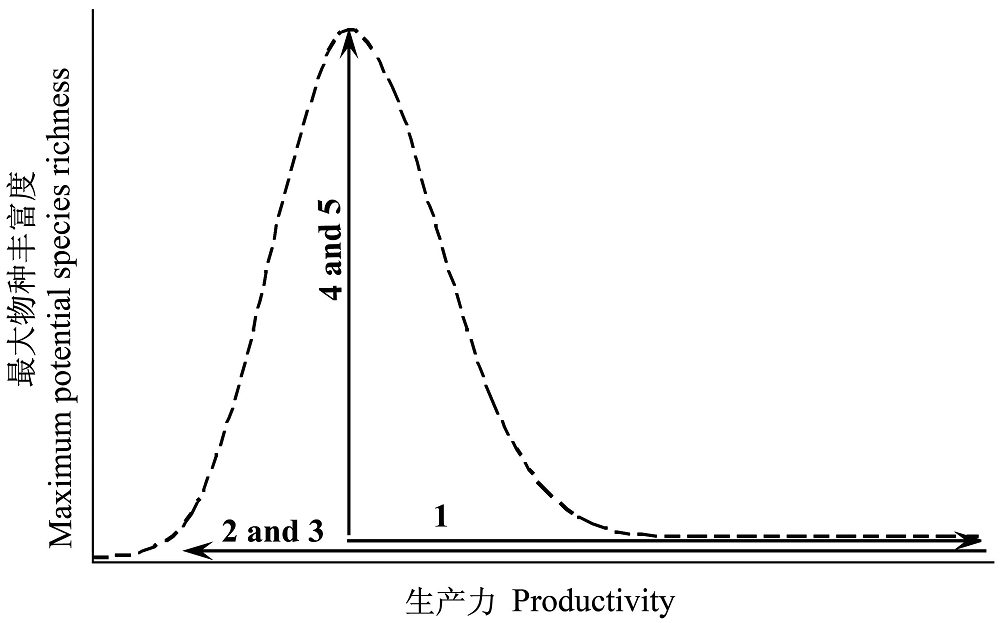
图1 Grime (1979)的驼峰模型。该模型反映了5种过程对多样性的影响: (1)优势性, (2)环境压力, (3)干扰, (4)生态位分化, (5)侵入。
Fig. 1 The “hump-backed” model of Grime (1979). The model incorporates five processes that affect community species richness: (1) dominance; (2) stress; (3) disturbance; (4) niche differentiation; and (5) colonization.
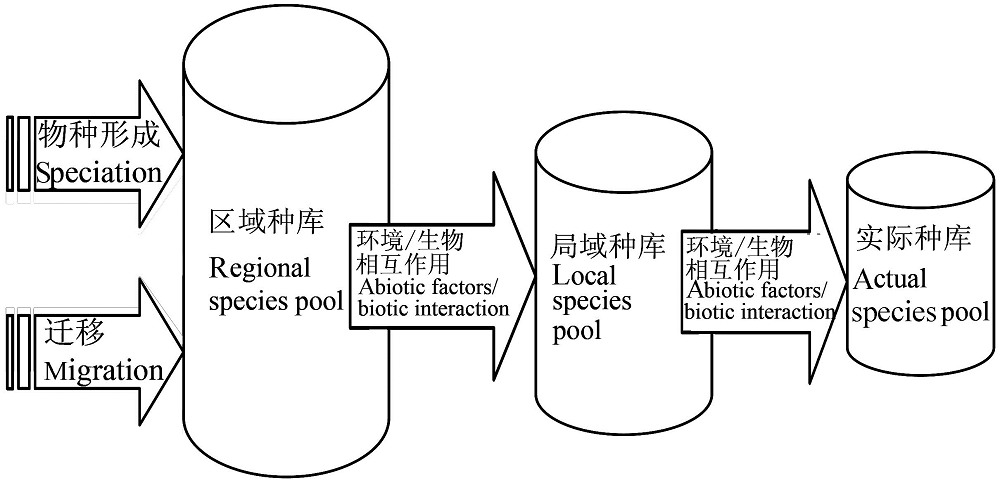
图2 不同尺度种库的关系。根据Zobel (1997)制作。
Fig. 2 Relationship between species pools at regional, local and community scales, adapted from Zobel (1997).
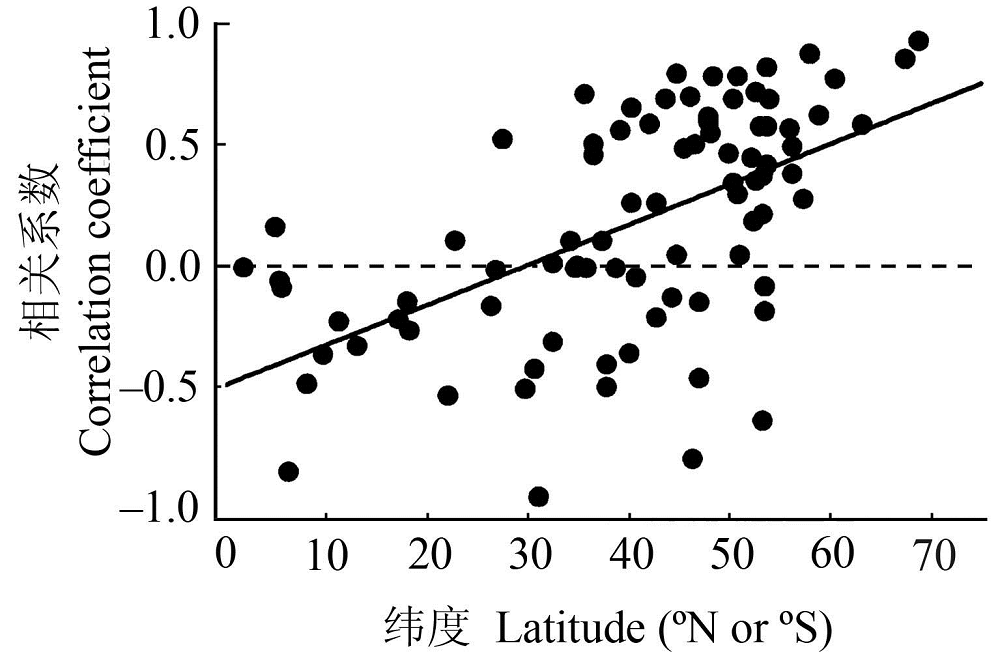
图3 维管植物丰富度与土壤pH值的相关系数与纬度的关系。在低纬度, 丰富度与土壤pH值之间多为负相关关系(虚线以下部分), 而在高纬度多为正相关关系(虚线以上部分)。修改自P?rtel(2002)。
Fig. 3 Changes in the correlation coefficient of the relationship between vascular plant species richness and soil pH with latitude. The relationship between species richness and soil pH shows a negative correlation at low latitudes (below the dashed line), while a positive relationship at high latitudes(P?rtel, 2002).
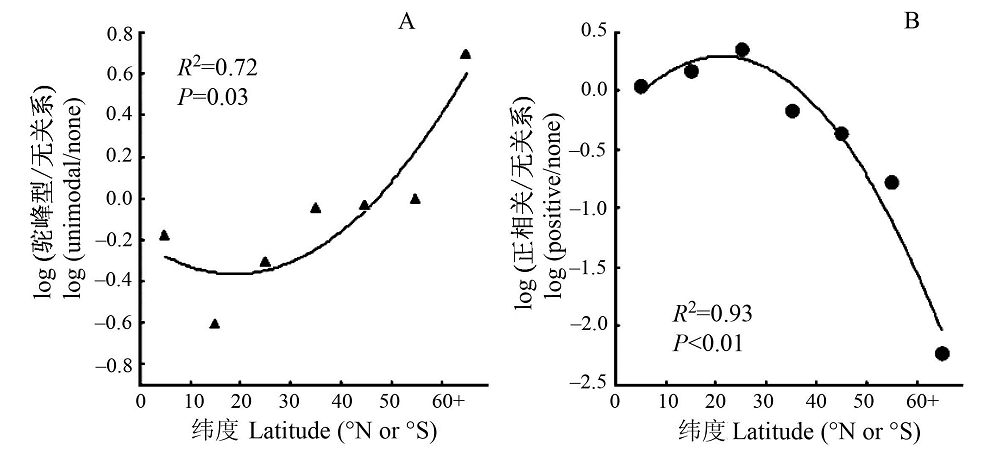
图4 多样性–生产力关系随纬度的变化。图中, 纵坐标为每个纬度段(10°)内, 多样性-生产力关系呈驼峰型(A)或正相关型(B)的案例数与二者间无关系的案例数的比例。随着纬度的增加, 驼峰型关系的比例显著增加(R2 = 0.72, P = 0.034), 正相关型关系的比例显著下降(R2 = 0.93, P = 0.002) (引自P?rtel et al., 2007)。
Fig. 4 Changes in productivity-plant diversity relationships with latitude. Y axis is the proportion of unimodal (A) and positive (B) relationships to cases in which no significant relations are found between productivity and diversity. With increasing latitude, the proportion of unimodal relationships increased remarkably (R2 = 0.72, P = 0.034) while that of positive relationships decreased (R2 = 0.93, P = 0.002) (P?rtel et al., 2007).
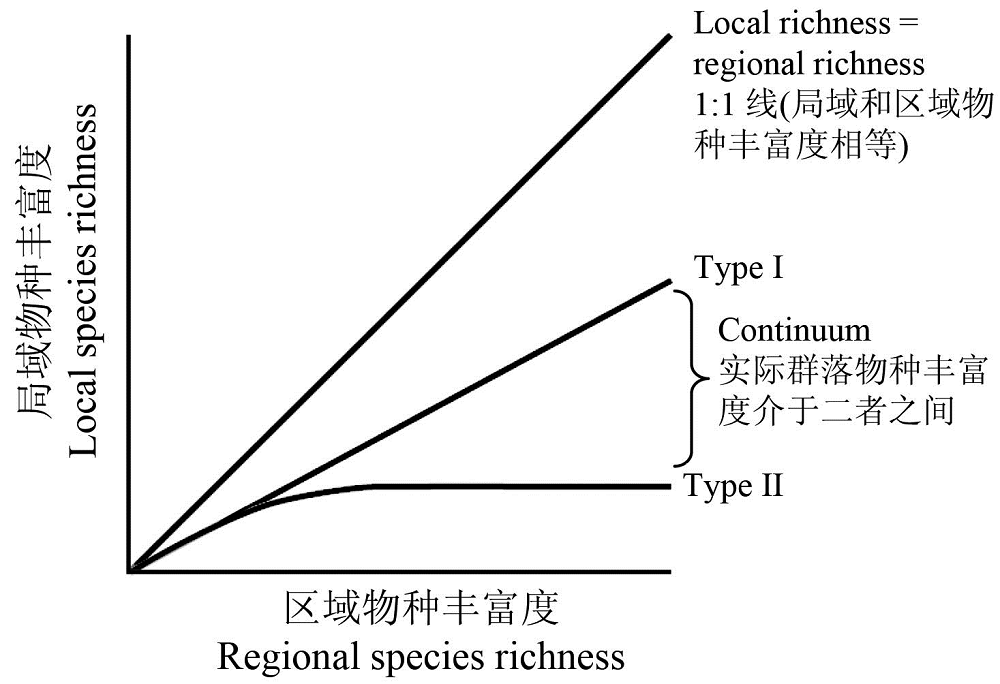
图5 局域和区域多样性之间的理论关系。在非饱和关系中(Type I), 群落的多样性不受竞争的影响, 而主要决定于区域种库; 在饱和关系(Type II)中, 由于竞争激烈导致的生态位限制, 群落的多样性在上升到一定水平后达到饱和。自然界中实际群落常介于二者之间(引自Gaston, 2000)。
Fig. 5 Two theoretical relationships between local and regional species richness. For the unsaturated relationship (Type I), community richness is not limited by biotic interactions in the local habitat and increases proportionately with regional richness. In the saturated relationship (Type II), however, biotic interactions limit community richness which saturates and becomes independent of regional species pool. Communities in the real world probably fall on a continuum between the two extremes (Gaston, 2000).
| [1] | Begon M, Townsend CA, Harper JL (2006) Ecology: From Individuals to Ecosystems. Blackwell Publishing, Oxford: |
| [2] | Brudvig LA, Mabry CM (2008) Trait-based filtering of the regional species pool to guide understory plant reintroductions in midwestern oak savannas, U.S.A. Restoration Ecology, 16, 290-304. |
| [3] | Chytry M, Danihelka J, Ermakov N, Hajek M, Hajkova P, Koci M, Kubesova S, Lustyk P, Otypkova Z, Popov D, Roleeek J, Reznickova M, Smarda P, Valachovic M (2007) Plant species richness in continental southern Siberia: effects of pH and climate in the context of the species pool hypothesis. Global Ecology and Biogeography, 16, 668-678. |
| [4] | Cornell HV, Lawton JH (1992) Species interactions, local and regional processes, and limits to the richness of ecological communities: a theoretical perspective. Journal of Animal Ecology, 61, 1-12. |
| [5] | Cornwell WK, Grubb PJ (2003) Regional and local patterns in plant species richness with respect to resource availability. Oikos, 100, 417-428. |
| [6] | Dupré C (2000) How to determine a regional species pool: a study in two Swedish regions. Oikos, 89, 128-136. |
| [7] | Dupré C, Wessberg C, Diekmann M (2002) Species richness in deciduous forests: effects of species pools and environmental variables. Journal of Vegetation Science, 13, 505-516. |
| [8] | Ellenberg H, Weber HE, Duell R, Wirth V, Werner W, Paulissen D (1991) Indicator Values of Plants in Central Europe. Goltze, Goettingen. |
| [9] | Eriksson O (1993) The species-pool hypothesis and plant community diversity. Oikos, 68, 371-374. |
| [10] | Ewald J (2003) The calcareous riddle: why are there so many calciphilous species in the central European flora? Folia Geobotanica, 38, 357-366. |
| [11] |
Gaston KJ (2000) Global patterns in biodiversity. Nature, 405, 220-227.
DOI URL PMID |
| [12] | Goldberg DE, Rajaniemi T, Gurevitch J, Stewart-Oaten A (1999) Empirical approaches to quantifying interaction intensity: competition and facilitation along productivity gradient. Ecology, 80, 1118-1131. |
| [13] | Grace JB (1999) The factors controlling species density in herbaceous plant communities: an assessment. Perspectives in Plant Ecology, Evolution and Systematics, 2, 1-28. |
| [14] | Grace JB (2001) Difficulties with estimating and interpreting species pools and the implications for understanding patterns of diversity. Folia Geobotanica, 36, 71-83. |
| [15] | Grime JP (1973a) Competitive exclusion in herbaceous vegetation. Nature, 242, 344-347. |
| [16] | Grime JP (1973b) Control of species diversity in herbaceous vegetation. Journal of Environmental Management, 1, 151-167. |
| [17] | Grime JP (1979) Plant Strategies and Vegetation Processes. John Wiley & Sons, London. |
| [18] | Grubb PJ (1987) Global trends in species-richness in terrestrial vegetation: a view from the northern hemisphere, In: Organization of Communities: Past and Present (eds Gee JHR, Giller PS), pp. 99-118. Blackwell Scientific Publications, Oxford, UK. |
| [19] | Houseman GR, Gross KL (2006) Does ecological filtering across a productivity gradient explain variation in species pool-richness relationships? Oikos, 115, 148-154. |
| [20] | Huston MA (1979) A general hypothesis of species diversity. The American Naturalist, 113, 81-101. |
| [21] | Huston MA (1999) Local processes and regional patterns: appropriate scales for understanding variation in the diversity of plants and animals. Oikos, 86, 393-401. |
| [22] |
Jetz W, Rahbek C (2002) Geographic range size and determinants of avian species richness. Science, 297, 1548-1551.
DOI URL PMID |
| [23] |
Karlson RH, Cornell HV, Hughes TP (2004) Coral communities are regionally enriched along an oceanic biodiversity gradient. Nature, 429, 867-870.
DOI URL PMID |
| [24] | Laanisto L, Urbas P, Partel M (2008) Why does the unimodal species richness-productivity relationship not apply to woody species: a lack of clonality or a legacy of tropical evolutionary history? Global Ecology and Biogeography, 17, 320-326. |
| [25] | Latham RE, Ricklefs RE (1993) Global patterns of tree species richness in moist forests: energy diversity theory does not account for variation in species richness. Oikos, 67, 325-333. |
| [26] | Oksanen J (1996) Is the humped relationship between species richness and biomass an artefact due to plot size? Journal of Ecology, 84, 293-295. |
| [27] | Parmentier I, Malhi Y, Senterre B, Whittaker RJ, A. T. D N, Alonso A, Balinga MPB, Bakayoko A, Bongers F, Chatelain C, Comiskey JA, Cortay R, Kamdem M-ND, Doucet J-L, Gautier L, Hawthorne WD, Issembe YA, Kouame FN, Kouka LA, Leal ME, Lejoly J, Lewis SL, Nusbaumer L, Parren MPE, Peh KSH, Phillips OL, Sheil D, Sonke B, Sosef MSM, Sunderland TCH, Stropp J, Ter Steege H, Swaine MD, Tchouto MGP (2007) The odd man out? Might climate explain the lower tree α-diversity of African rain forests relative to Amazonian rain forests? Journal of Ecology, 95, 1058-1071. |
| [28] | Pärtel M (2002) Local plant diversity patterns and evolutionary history at the regional scale. Ecology, 83, 2361-2366. |
| [29] | Pärtel M, Helm A, Ingerpuu N, Reier Ü, Tuvi E-L (2004) Conservation of Northern European plant diversity: the correspondence with soil pH. Biological Conservation, 120, 525-531. |
| [30] |
Pärtel M, Laanisto L, Zobel M (2007) Contrasting plant productivity-diversity relationships across latitude: the role of evolutionary history. Ecology, 88, 1091-1097.
URL PMID |
| [31] | Pärtel M, Zobel M, Liira J, Zobel K (2000) Species richness limitations in productive and oligotrophic plant communities. Oikos, 90, 191-193. |
| [32] | Pärtel M, Zobel M, Zobel K, van der Maarel E (1996) The species pool and its relation to species richness: evidence from Estonian plant communities. Oikos, 75, 111-117. |
| [33] | Peet RK, Fridley JD, Gramling JM (2003) Variation in species richness and species pool size across a pH gradient in forests of the southern Blue Ridge Mountains. Folio Geobotanica, 38, 391-401. |
| [34] |
Rajaniemi TK, Goldberg DE, Turkington R, Dyer AR (2006) Quantitative partitioning of regional and local processes shaping regional diversity patterns. Ecology Letters, 9, 121-128.
DOI URL PMID |
| [35] |
Ricklefs RE (1987) Community diversity: relative roles of local and regional processes. Science, 235, 167-171.
URL PMID |
| [36] | Ricklefs RE (2004) A comprehensive framework for global patterns in biodiversity. Ecology Letters, 7, 1-15. |
| [37] |
Ricklefs RE (2006) Evolutionary diversification and the origin of the diversity-environment relationship. Ecology, 87, S3-S13.
DOI URL PMID |
| [38] | Schuster B, Diekmann M (2003) Changes in species density along the soil pH gradient: evidence from German plant communities. Folia Geobotanica, 38, 367-379. |
| [39] | Taylor DR, Aarssen LW, Loehle C (1990) On the relationship between r/K selection and environmental carrying capacity: a new habitat templet for plant life history strategies. Oikos, 58, 239-250. |
| [40] | Tilman D (1982) Resource Competition and Community Structure. Princeton University Press, Princeton. |
| [41] | Tilman D (1994) Competition and biodiversity in spatially structured habitats. Ecology, 75, 2-16. |
| [42] | Wamelink GWW, Joosten V, van Dobben HF, Berendse F (2002) Validity of Ellenberg indicator values judged from physico-chemical field measurements. Journal of Vegetation Science, 13, 269-278. |
| [43] | Weiher E, Forbes S, Schauwecker T, Grace JB (2004) Multivariate control of plant species richness and community biomass in blackland prairie. Oikos, 106, 151-157. |
| [44] | Wilson JB, Anderson BJ (2001) Species-pool relations: like a wooden light bulb? Folia Geobotanica, 36, 35-44. |
| [45] | Zinko U, Dynesius M, Nilsson C, Seibert J (2006) The role of soil pH in linking groundwater flow and plant species density in boreal forest landscapes. Ecography, 29, 515-524. |
| [46] | Zobel K (2001) On the species-pool hypothesis and on the quasi-neutral concept of plant community diversity. Folia Geobotanica, 36, 3-8. |
| [47] |
Zobel M (1992) Plant species coexistence: the role of historical, evolutionary and ecological factors. Oikos, 65, 314-320.
DOI URL |
| [48] |
Zobel M (1997) The relative role of species pools in determining plant species richness: an alternative explanation of species coexistence? Trends in Ecology and Evolution, 12, 266-269.
DOI URL PMID |
| [49] | Zobel M, van der Maarel E, Dupré C (1998) Species pool: the concept, its determination and significance for community restoration. Applied Vegetation Science, 1, 55-66. |
| [1] | 蒋翠憶, 谢致敬, 田中平, 李玥莹, 郑明心, 房帅, 米尔卡米力∙麦麦提, 依里帆∙艾克拜尔江, 高梅香, 张健. 微地形生境异质性对新疆西天山森林土壤跳虫群落分异的塑造作用[J]. 生物多样性, 2026, 34(4): 25300-. |
| [2] | 罗钰, 郑旭艳, 曹力, 王波, 彭艳琼, 罗银玲, 周会平, 杨小芳, 苗白鸽, 王朝雅, 高洁. 生境简化重塑榕树-榕小蜂互作网络: 挥发物组成与群落结构的适应性响应[J]. 生物多样性, 2026, 34(2): 25328-. |
| [3] | 袁林溪, 王美震, 张利祥, 李彭, 张永生, 蒋学龙, 管振华. 人类活动对高黎贡白眉长臂猿栖息地乔木多样性及潜在食物资源的影响[J]. 生物多样性, 2026, 34(2): 25271-. |
| [4] | 邹怡. α多样性指数选择: 不等量采样下的模拟比较[J]. 生物多样性, 2026, 34(1): 25278-. |
| [5] | 樊广泰, 陈奕宁, 何既白, 窦海龙, 陈纪元, 杨海涛, 沈秋, 关宏灿. 基于红外相机揭示浙江省金塘岛欧亚水獭对同域物种及人类干扰的时空响应[J]. 生物多样性, 2025, 33(9): 25148-. |
| [6] | 柴恩平, 葛苏婷, 王锡茂, 杨州, 向昭宜, 张美惠, 李漫淑, 沈瑶, 斯幸峰. 基于高频监测研究人为干扰对城市夜鹭巢址分布动态及繁殖成功的影响[J]. 生物多样性, 2025, 33(9): 25025-. |
| [7] | 李玉, 周立志. 淮河干流越冬水鸟多样性的时空格局及其影响因素[J]. 生物多样性, 2025, 33(8): 24590-. |
| [8] | 于琦胧, 郝珉辉, 何怀江, 张春雨, 赵秀海. 长白山森林不同演替阶段生物多样性与生产力的关系: 基于物种、性状和系统发育的视角[J]. 生物多样性, 2025, 33(8): 25060-. |
| [9] | 田璐瑶, 尹豪. 基于生物多样性保护的我国生态铁路现状和对策研究[J]. 生物多样性, 2025, 33(8): 24495-. |
| [10] | 黄定旭, 肖文宏, 白小节, 刘邦友, 黎源君, 梁盛, 肖治术, 刘伟. 赤水桫椤国家级自然保护区中小型食肉目动物昼夜活动节律的比较[J]. 生物多样性, 2025, 33(6): 24376-. |
| [11] | 齐月, 李俊生, 侯亚男. 城市植物多样性的人为影响因素及保护管理策略[J]. 生物多样性, 2025, 33(5): 24484-. |
| [12] | 徐欢, 辛凤飞, 施宏亮, 袁琳, 薄顺奇, 赵欣怡, 邓帅涛, 潘婷婷, 余婧, 孙赛赛, 薛程. 生态修复技术集成应用对长江口北支生境与鸟类多样性提升效果评估[J]. 生物多样性, 2025, 33(5): 24478-. |
| [13] | 康燕, 干靓, 俞霖琳, 何晨静, 张理卿, 吴婧彬. 基于NbS的城市小微栖息地营造与网络构建模式: 以上海市长宁区生境花园为例[J]. 生物多样性, 2025, 33(5): 24528-. |
| [14] | 刘咏华, 童光蓉, 余航远, 王宁宁, 任海保, 陈磊, 马克平, 米湘成. 钱江源-百山祖国家公园候选区钱江源园区冠层三维结构及光谱特征对人为干扰的响应[J]. 生物多样性, 2025, 33(4): 24174-. |
| [15] | 贾贞妮, 张意岑, 杜彦君, 任海保. 干扰对中亚热带森林群落物种多样性演替动态的影响[J]. 生物多样性, 2025, 33(2): 24078-. |
| 阅读次数 | ||||||
|
全文 |
|
|||||
|
摘要 |
|
|||||
备案号:京ICP备16067583号-7
Copyright © 2026 版权所有 《生物多样性》编辑部
地址: 北京香山南辛村20号, 邮编:100093
电话: 010-62836137, 62836665 E-mail: biodiversity@ibcas.ac.cn
