

生物多样性 ›› 2026, Vol. 34 ›› Issue (6): 26050. DOI: 10.17520/biods.2026050 cstr: 32101.14.biods.2026050
张梦1( ), 曹荣军2, 王功芳2, 邹琼玖2, 吴林庭2, 付伟昌1, 周友兵1, 彭刚志2,*(
 )
)
收稿日期:2026-02-12
接受日期:2026-04-21
出版日期:2026-06-20
发布日期:2026-07-30
通讯作者:
*E-mail: 349625645@qq.com
基金资助:
Meng Zhang1(), Rongjun Cao2, Gongfang Wang2, Qiongjiu Zou2, Linting Wu2, Weichang Fu1, Youbing Zhou1, Gangzhi Peng2,*()
Received:2026-02-12
Accepted:2026-04-21
Online:2026-06-20
Published:2026-07-30
Contact:
*E-mail: 349625645@qq.com
Supported by:摘要: 道路网络日益密集, 在便利人们出行的同时, 也给野生动物的活动带来了影响, 但道路干扰对野生动物的道路影响域及其与物种特征的相关性尚不明确。湖北大老岭国家级自然保护区被省道S287贯穿, 其核心区被分割成两部分, 而道路作为线性基础设施, 对野生动物尤其是偶蹄类动物可能造成潜在的干扰。本研究于2020年1月至2025年7月在湖北大老岭国家级自然保护区省道S287两侧各3 km范围内布设红外相机。基于388台红外相机数据, 通过广义线性模型分析6种偶蹄类动物的道路影响域。结果表明, 6种偶蹄类动物的道路影响域均有2个, 且阈值呈现种间差异。毛冠鹿(Elaphodus cephalophus)的近端影响域阈值为600 m, 远端影响域阈值为1,700 m; 小麂(Muntiacus reevesi)的近端影响域阈值为1,300 m, 远端影响域阈值为1,700 m; 中华鬣羚(Capricornis milneedwardsii)、中华斑羚(Naemorhedus griseus)、林麝(Moschus berezovskii)的近端影响域阈值均为1,400 m, 远端影响域阈值均为1,800 m; 野猪(Sus scrofa)的近端影响域阈值为900 m, 远端影响域阈值为1,300 m。采用相关分析探讨道路影响域与体重、昼行性指数的关联发现, 昼行性指数与两阈值均呈显著负相关(rs = –0.893, P < 0.05; rs = –0.939, P < 0.05), 即昼行性物种表现出更强的道路耐受性; 体重与道路影响域无显著相关。研究表明偶蹄类对道路的耐受能力不相同, 昼行性指数是反映物种道路耐受性的关键指标。研究结果可为保护区内既有道路的管理优化以及野生动物保护提供科学依据。
张梦, 曹荣军, 王功芳, 邹琼玖, 吴林庭, 付伟昌, 周友兵, 彭刚志 (2026) 道路干扰对偶蹄类动物的影响: 以湖北大老岭国家级自然保护区为例. 生物多样性, 34, 26050. DOI: 10.17520/biods.2026050.
Meng Zhang, Rongjun Cao, Gongfang Wang, Qiongjiu Zou, Linting Wu, Weichang Fu, Youbing Zhou, Gangzhi Peng (2026) Impacts of road disturbance on Artiodactyla: A case study from Hubei Dalaoling National Nature Reserve, China. Biodiversity Science, 34, 26050. DOI: 10.17520/biods.2026050.
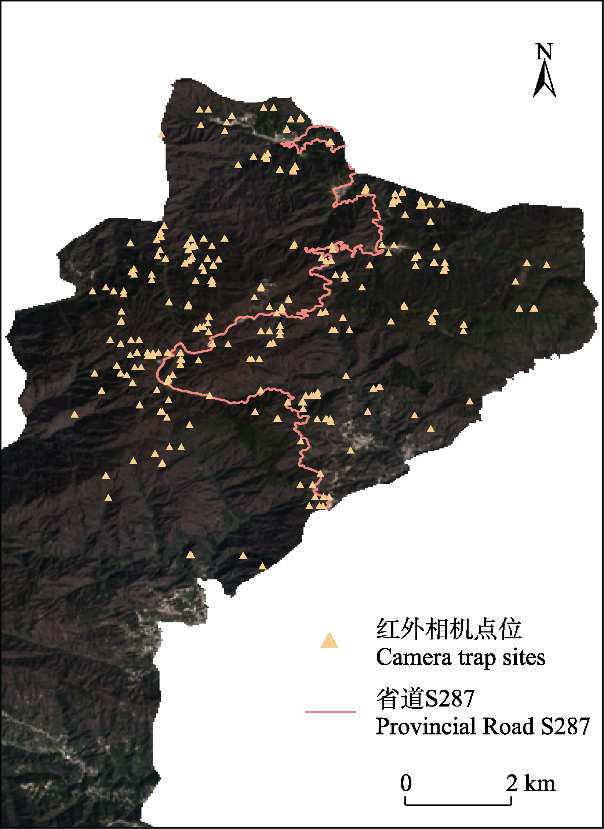
图1 湖北大老岭国家级自然保护区研究区域内相机监测布设点位
Fig. 1 Location of camera trap sites in the study area of Hubei Dalaoling National Nature Reserve
| 物种 Species | 独立有效事件总数 Total no. of valid independent events | 拍摄到的位点数 No. of detected sites | 位点比例 Site proportion (%) | 相对多度指数 Relative abundance index (RAI) |
|---|---|---|---|---|
| 野猪 Sus scrofa | 3,201 | 262 | 81.619 | 5.648 |
| 毛冠鹿 Elaphodus cephalophus | 2,140 | 191 | 59.501 | 5.396 |
| 小麂 Muntiacus reevesi | 12,015 | 249 | 77.570 | 22.500 |
| 中华鬣羚 Capricornis milneedwardsii | 1,322 | 194 | 60.436 | 3.129 |
| 中华斑羚 Naemorhedus griseus | 927 | 152 | 47.352 | 2.727 |
| 林麝 Moschus berezovskii | 829 | 161 | 50.155 | 2.379 |
表1 湖北大老岭国家级自然保护区6种偶蹄类动物红外相机记录(2020年1月至2025年7月)
Table 1 Camera trap detection records of six artiodactyl species in Hubei Dalaoling National Nature Reserve (2020.01-2025.07)
| 物种 Species | 独立有效事件总数 Total no. of valid independent events | 拍摄到的位点数 No. of detected sites | 位点比例 Site proportion (%) | 相对多度指数 Relative abundance index (RAI) |
|---|---|---|---|---|
| 野猪 Sus scrofa | 3,201 | 262 | 81.619 | 5.648 |
| 毛冠鹿 Elaphodus cephalophus | 2,140 | 191 | 59.501 | 5.396 |
| 小麂 Muntiacus reevesi | 12,015 | 249 | 77.570 | 22.500 |
| 中华鬣羚 Capricornis milneedwardsii | 1,322 | 194 | 60.436 | 3.129 |
| 中华斑羚 Naemorhedus griseus | 927 | 152 | 47.352 | 2.727 |
| 林麝 Moschus berezovskii | 829 | 161 | 50.155 | 2.379 |
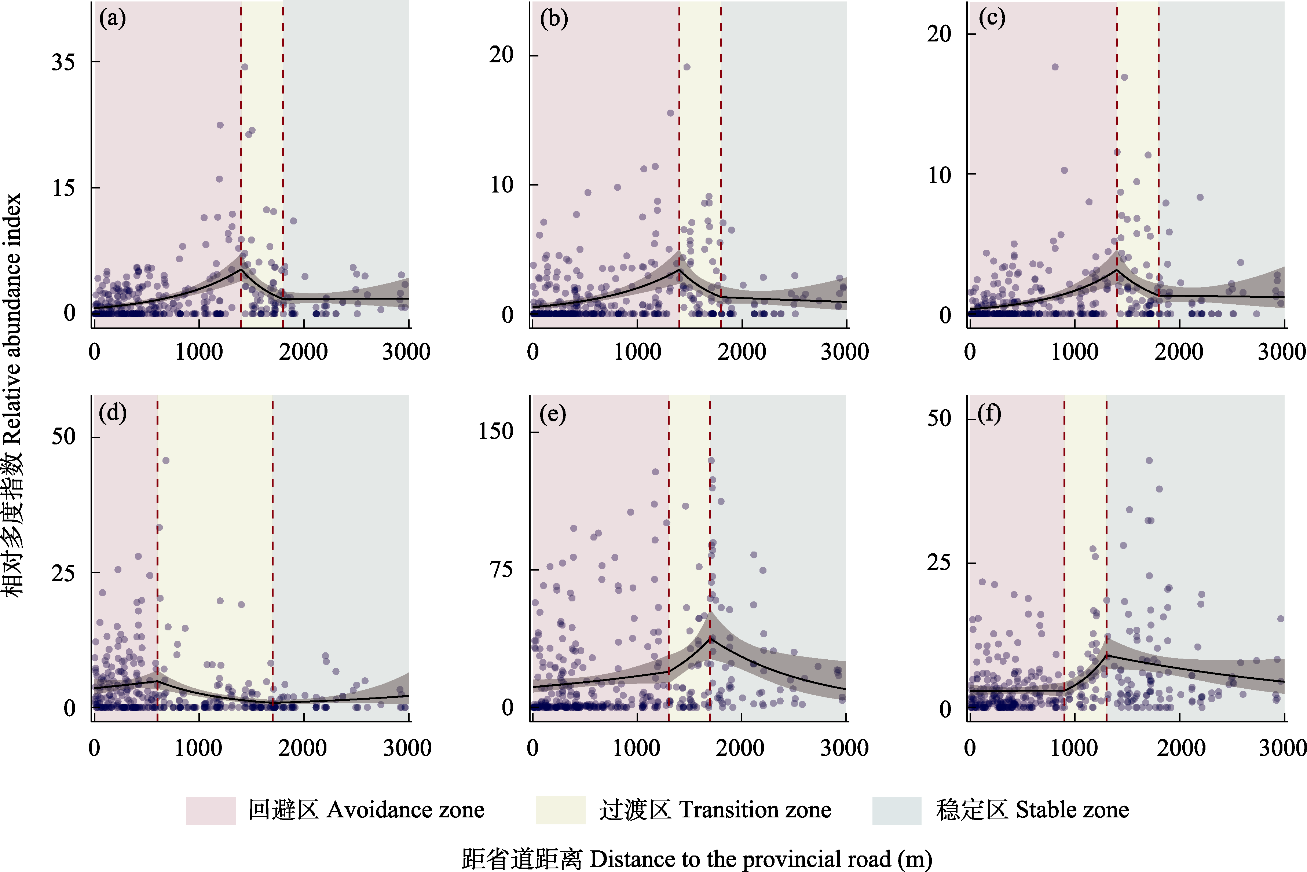
图2 基于双拐点分段广义线性模型(GLM)的湖北大老岭国家级自然保护区6种偶蹄类动物相对多度(RAI)随道路距离的变化。图中阴影表示95%置信区间, 红色虚线为拐点位置。(a)中华鬣羚; (b)中华斑羚; (c)林麝; (d)毛冠鹿; (e)小麂; (f)野猪。
Fig. 2 Changes in the relative abundance index (RAI) of six artiodactyl species with distance from roads in Hubei Dalaoling National Nature Reserve, based on two-breakpoint generalized linear model (GML). The shaded areas represent the 95% confidence intervals, and the red dashed lines indicate the locations of the breakpoints. (a) Capricornis milneedwardsii; (b) Naemorhedus griseus; (c) Moschus berezovskii; (d) Elaphodus cephalophus; (e) Muntiacus reevesi; (f) Sus scrofa.
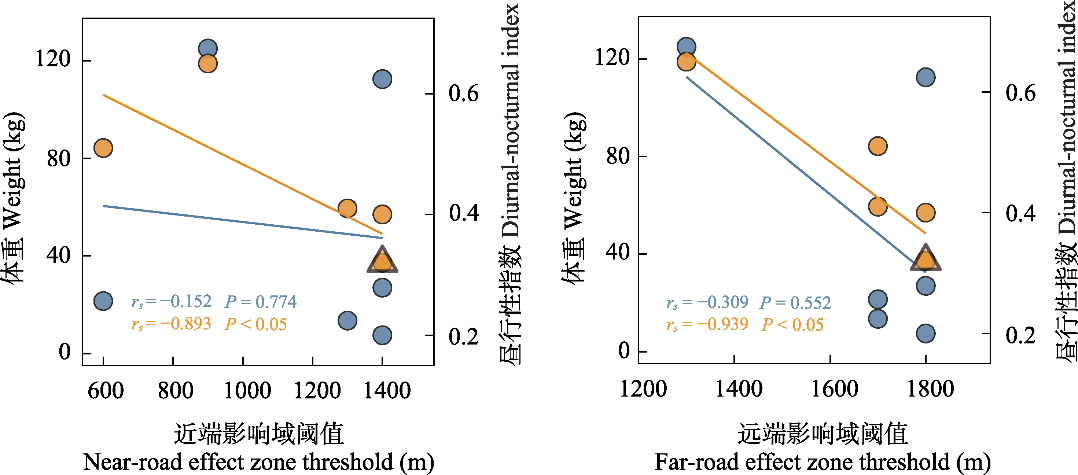
图3 物种特征与道路影响域的Spearman相关性分析。其中, 蓝色圆点为体重数据, 黄色圆点为昼行性指数数据; 蓝色线条为体重与道路影响域的相关性分析, 黄色线条为昼行性指数与道路影响域的相关性分析; 中华鬣羚的昼行性指数用三角形表示(与林麝的昼行性指数相同, 均为0.32)。
Fig. 3 Spearman correlation analysis between species traits and road effect zones. Blue circles represent body weight data, and yellow circles represent diurnal-nocturnal index data. The blue line represents the correlation analysis between body weight and the road effect zone, while the yellow line represents the correlation analysis between the diurnal-nocturnal index and the road effect zone. The diurnal-nocturnal index of Capricornis milneedwardsii is represented by a triangle (identical to that of Moschus berezovskii, both being 0.32).
| [1] | Barthelmess EL, Brooks MS (2010) The influence of body-size and diet on road-kill trends in mammals. Biodiversity and Conservation, 19, 1611-1629. |
| [2] | Bartonička T, Andrášik R, Duľa M, Sedoník J, Bíl M (2018) Identification of local factors causing clustering of animal-vehicle collisions. The Journal of Wildlife Management, 82, 940-947. |
| [3] | Brett CK, Mehner AR, Young JH Jr, Lehnen SE, Kline RJ (2025) Spatiotemporal responses to a rural highway by four mammal species. Frontiers in Ecology and Evolution, 13, 1566882. |
| [4] | Carr LW, Fahrig L (2001) Effect of road traffic on two amphibian species of differing vagility. Conservation Biology, 15, 1071-1078. |
| [5] | Chanchani P, Rawat GS, Goyal SP (2010) Unveiling a wildlife haven: Status and distribution of four Trans-Himalayan ungulates in Sikkim, India. Oryx, 44, 366-375. |
| [6] | Chen LJ, Xiao WH, Xiao ZS (2019) Limitations of relative abundance indices calculated from camera-trapping data. Biodiversity Science, 27, 243-248. (in Chinese with English abstract) |
| [陈立军, 肖文宏, 肖治术 (2019) 物种相对多度指数在红外相机数据分析中的应用及局限. 生物多样性, 27, 243-248.] | |
| [7] | Colino-Rabanal VJ, Bosch J, Muñoz MJ, Peris SJ (2012) Influence of new irrigated croplands on wild boar (Sus scrofa) road kills in NW Spain. Animal Biodiversity and Conservation, 35, 247-252. |
| [8] | Dickie M, McNay SR, Sutherland GD, Cody M, Avgar T (2021) Corridors or risk? Movement along, and use of, linear features varies predictably among large mammal predator and prey species. Journal of Animal Ecology, 89, 623-634. |
| [9] | Forman RTT (2000) Estimate of the area affected ecologically by the road system in the United States. Conservation Biology, 14, 31-35. |
| [10] | Frid A, Dill L (2002) Human-caused disturbance stimuli as a form of predation risk. Conservation Ecology, 6(1),11. |
| [11] | Gibbs JP, Shriver WG (2002) Estimating the effects of road mortality on turtle populations. Conservation Biology, 16, 1647-1652. |
| [12] | Grilo C, Sousa J, Ascensão F, Matos H, Leitão I, Pinheiro P, Costa M, Bernardo J, Reto D, Lourenço R, Santos-Reis M, Revilla E (2012) Individual spatial responses towards roads: Implications for mortality risk. PLoS ONE, 7, e43811. |
| [13] | Hill JE, DeVault TL, Belant JL (2021) A review of ecological factors promoting road use by mammals. Mammal Review, 51, 214-227. |
| [14] | Kautz TM, Fowler NL, Petroelje TR, Beyer DE, Svoboda NJ, Belant JL (2021) Large carnivore response to human road use suggests a landscape of coexistence. Global Ecology and Conservation, 30, e01772. |
| [15] | Laurance WF, Clements GR, Sloan S, O’Connell CS, Mueller ND, Goosem M, Venter O, Edwards DP, Phalan B, Balmford A, Van Der Ree R, Arrea IB (2014) A global strategy for road building. Nature, 513, 229-232. |
| [16] | Li JH, Zhang YL, Hu YL, Zhu CH, Song S, Bao XK (2026) Alysis of suitable habitat for forest musk deer (Moschus berezovskii) in the Liupan Mountain region. Chinese Journal of Ecology, 45, 1300-1307. (in Chinese with English abstract) |
| [李佳华, 张亚莉, 胡玉龙, 朱朝晖, 宋森, 包新康 (2026) 六盘山地区林麝适宜栖息地分析. 动物学杂志, 45, 1300-1307.] | |
| [17] | Lian XM, Li XX, Xu T (2012) Avoidance distances of four ungulates from roads in Kekexili and related protection suggestions. Chinese Journal of Ecology, 31, 81-86. (in Chinese with English abstract) |
| [连新明, 李晓晓, 徐图 (2012) 可可西里四种有蹄类动物对道路的回避距离及保护建议. 生态学杂志, 31, 81-86.] | |
| [18] | Longcore T, Rich C (2004) Ecological light pollution. Frontiers in Ecology and the Environment, 2, 191-198. |
| [19] | O’Brien TG, Kinnaird MF, Wibisono HT (2003) Crouching tigers, hidden prey: Sumatran tiger and prey populations in a tropical forest landscape. Animal Conservation, 6, 131-139. |
| [20] | Onu B (2025) Impact of artificial night lights on nocturnal animals. Greener Journal of Ecology and Ecosolution, 6, 8-14. |
| [21] | Planillo A, Mata C, Manica A, Malo JE (2018) Carnivore abundance near motorways related to prey and roadkills. The Journal of Wildlife Management, 82, 319-327. |
| [22] | Qiao SC, Zhai PH, Qi JZ, Liu BZ, Liang XK, Hao J, Jing HY, Li RP, Jiang GS (2026) Effects of roads on spatiotemporal distribution of red foxes (Vulpes vulpes) and leopard cats (Prionailurus bengalensis) in Shanxi Tieqiaoshan Nature Reserve. Acta Ecologica Sinica, 46, 1114-1125. (in Chinese with English abstract) |
| [乔尚纯, 翟鹏辉, 齐进哲, 刘保庄, 梁轩恺, 郝珏, 景慧玉, 李瑞平, 姜广顺 (2026) 道路对山西铁桥山保护区赤狐和豹猫时空分布的影响. 生态学报, 46, 1114-1125.] | |
| [23] | Ramesh T, Kalle R, Sankar K, Qureshi Q (2015) Role of body size in activity budgets of mammals in the Western Ghats of India. Journal of Tropical Ecology, 31, 315-323. |
| [24] | Ramirez JI, Jansen PA, den Ouden J, Moktan L, Herdoiza N, Poorter L (2021) Above- and below-ground cascading effects of wild ungulates in temperate forests. Ecosystems, 24, 153-167. |
| [25] | Ripple WJ, Beschta RL (2012) Trophic cascades in Yellowstone: The first 15 years after wolf reintroduction. Biological Conservation, 145, 205-213. |
| [26] | Rytwinski T, Fahrig L (2011) Reproductive rate and body size predict road impacts on mammal abundance. Ecological Applications, 21, 589-600. |
| [27] | Shen ZH, Zhang XS, Jin YX (2000) Spatial pattern analysis and topographical interpretation of species diversity in the forests of Dalaoling in the region of the Three Gorges. Acta Botanica Sinica, 42, 620-627. (in Chinese with English abstract) |
| [沈泽昊, 张新时, 金义兴 (2000) 三峡大老岭森林物种多样性的空间格局分析及其地形解释. 植物学报, 42, 620-627.] | |
| [28] | Smith AT, Xie Y (2009) A Guide to the Mammals of China. Hunan Education Press, Changsha. (in Chinese) |
| [Smith AT, 解焱 (2009) 中国兽类野外手册. 湖南教育出版社, 长沙.] | |
| [29] | Thurber JM, Peterson RO, Drummer TD, Thomasma SA (1994) Gray wolf response to refuge boundaries and roads in Alaska. Wildlife Society Bulletin (1973-2006), 22, 61-68. |
| [30] | Trombulak SC, Frissell CA (2000) Review of ecological effects of roads on terrestrial and aquatic communities. Conservation Biology, 14, 18-30. |
| [31] | Wang Y, Guan L, Du LX, Qu JP, Wang MY, Han YS, Yang YG, Zhou HP, Kong YP (2021) Overlapping barrier and avoidance effects of the Qinghai-Tibet highway and railway on four typical ungulates on the Tibetan Plateau. Chinese Journal of Ecology, 40, 1091-1097. (in Chinese with English abstract) |
| [王云, 关磊, 杜丽侠, 曲家鹏, 王明月, 韩用顺, 杨艳刚, 周红萍, 孔亚平 (2021) 青藏公路和铁路对青藏高原四种典型有蹄类动物的叠加阻隔和回避影响. 生态学杂志, 40, 1091-1097.] | |
| [32] | Xiao ZS (2014) An introduction to wildlife camera trapping monitoring from Chinese Forest Biodiversity Monitoring Network (CForBio). Biodiversity Science, 22, 808-809. (in Chinese) |
| [肖治术 (2014) 我国森林动态监测样地的野生动物红外相机监测. 生物多样性, 22, 808-809.] | |
| [33] | Yeaton RI, Cody ML (1974) Competitive release in island song sparrow populations. Theoretical Population Biology, 5, 42-58. |
| [34] | Zhang DH, Li J, Zhang X, Zhao JX, Yi DY, Yu SY, Wu RH (2025) Temporal niche partitioning of sympatric ungulate species in the Yunmengshan Nature Reserve, Beijing. Environmental Ecology, 7, 90-94. (in Chinese with English abstract) |
| [张德怀, 李建, 张鑫, 赵建喜, 伊德英, 于思玉, 乌日涵 (2025) 北京市云蒙山自然保护区有蹄类动物时间生态位分化. 环境生态学, 7, 90-94.] | |
| [35] | Zhang Y, Zhang Y, Xue YD, Cheng MH, Li J, Yu HL, Jiang J, Nie XQ, Li DQ (2024) Study on spatiotemporal dynamics of wildlife adaptation to roads in Shennongjia National Park. Research of Environmental Sciences, 37, 2237-2246. (in Chinese with English abstract) |
| [张溢, 张宇, 薛亚东, 程铭昊, 李劲, 余辉亮, 蒋军, 聂秀青, 李迪强 (2024) 神农架国家公园野生动物对道路的时空适应动态研究. 环境科学研究, 37, 2237-2246.] | |
| [36] | Zhou L, Yao SM, Zhao ZH, Guo H, Tian C (2026) Spatiotemporal coexistence patterns of Capreolus pygargus and Sus scrofa in Pangquangou National Nature Reserve. Biodiversity Science, 34, 25327. (in Chinese with English abstract) |
| [周铝, 姚世贸, 赵战合, 郭画, 田成 (2026) 庞泉沟国家级自然保护区狍和野猪时空共存格局. 生物多样性, 34, 25327.] | |
| [37] | Zou MJ, Qian Q, Tian YY, Deng CH, Gao BW, Zhu K, Liu YP, Zhou YB, Peng GZ (2026) Temporal niche differentiation of sympatric mesocarnivores in Hubei Dalaoling National Nature Reserve. Acta Theriologica Sinica, 46, 483-495. (in Chinese with English abstract) |
| [邹明江, 钱前, 田瑶瑶, 邓春韩, 高本旺, 朱凯, 刘益平, 周友兵, 彭刚志 (2026) 湖北大老岭同域中型食肉类动物的时间生态位分化. 兽类学报, 46, 483-495.] |
| [1] | 郭画, 罗雨甜, 董译莉, 周铝, 姚世贸, 朱旭飞, 田成. 放牧干扰对王朗国家级自然保护区红腹角雉时空分布的影响[J]. 生物多样性, 2026, 34(6): 25501-. |
| [2] | 王倩倩, 陈孝国, 朱锐丰, 张明春, 王新, 李世林, 仁增江措, 彭武, 杨彪. 藏东南黑麝及其同域有蹄类物种的生态适应性差异[J]. 生物多样性, 2026, 34(5): 25433-. |
| [3] | 冯杰, 李彦知, 王书理, 李岚曦, 丁鹏飞, 吕冰薇, 孟吉, 史湘莹, 李雪阳. 西南山地有蹄类栖息地利用率变化及环境影响: 以关坝村红外相机监测为例[J]. 生物多样性, 2026, 34(5): 25261-. |
| [4] | 孔孜亦, 王德港, 王建涛, 裴志永, 孙晶, 张长春, 张军国. 基于SCD-HRNet模型的野生动物姿态估计及其在生物多样性监测中的应用: 以内蒙古赛罕乌拉地区为例[J]. 生物多样性, 2026, 34(4): 25287-. |
| [5] | 张同, 梁力文, 王长剑, 舒服, 王璐, 郭泽光, 卓玛曲珍, 钱芊, 蒋安莉, 敖俊杰, 彭兴文, 伍小刚, 向左甫, 郭克疾, 廖梓延. 基于红外相机的西藏芒康滇金丝猴国家级自然保护区鸟兽多样性及代表性物种的季节性空间利用特征[J]. 生物多样性, 2026, 34(4): 25435-. |
| [6] | 周铝, 郭画, 姚世贸, 田成. 王朗国家级自然保护区红腹角雉时空分布模式[J]. 生物多样性, 2025, 33(7): 24537-. |
| [7] | 李基才, 邵长亮, 高帅帅, 李佳. 新疆卡拉麦里国家公园候选区蒙古野驴夏季水源利用规律、活动范围和适宜生境分布[J]. 生物多样性, 2025, 33(7): 24509-. |
| [8] | 毛静, 王婧, 黄杰, 熊姝红, 张自亮, 张佑祥, 吴涛. 湖南高望界国家级自然保护区2021-2023年鸟兽多样性监测数据集[J]. 生物多样性, 2025, 33(6): 24489-. |
| [9] | 黄定旭, 肖文宏, 白小节, 刘邦友, 黎源君, 梁盛, 肖治术, 刘伟. 赤水桫椤国家级自然保护区中小型食肉目动物昼夜活动节律的比较[J]. 生物多样性, 2025, 33(6): 24376-. |
| [10] | 罗敏, 杨永川, 靳程, 周礼华, 龙宇潇. 重庆中心城区城市森林兽类组成特征及其对人类活动的响应[J]. 生物多样性, 2025, 33(5): 24402-. |
| [11] | 龚翠凤, 韦伟, 罗概, 韩一敏, 吴鹏程, 何梦楠, 闵清悦, 付强, 陈鹏. 大熊猫国家公园崇州片区有蹄类动物空间分布及共存关系[J]. 生物多样性, 2025, 33(3): 24260-. |
| [12] | 王大伟, 程帅, 冯佳伟, 王天明. 东北地区张广才岭2015-2020年野生动物红外相机监测数据集[J]. 生物多样性, 2025, 33(2): 24384-. |
| [13] | 汪锦辉, 刘宝权, 周晓, 梁子安, 孔令伟, 方卫军, 孙晗靖, 金挺浩, 厉亮, 何珂, 朱振贤. 基于红外相机监测的杭州市鸟兽多样性分析与优先保护关键区域评估[J]. 生物多样性, 2025, 33(12): 25265-. |
| [14] | 李菡, 董伟, 陆江涛, 吴永杰, 何兴成, 刘林, 木留里哈, 张学林. 四川省甘洛县马鞍山省级自然保护区及周边地区红外相机鸟兽监测数据集[J]. 生物多样性, 2025, 33(10): 25165-. |
| [15] | 高翔, 潘淑芳, 孙争争, 李霁筱, 高天雨, 董路, 王宁. 广东珠海凤凰山和淇澳岛小灵猫的分布与活动节律[J]. 生物多样性, 2024, 32(8): 24045-. |
| 阅读次数 | ||||||
|
全文 |
|
|||||
|
摘要 |
|
|||||
备案号:京ICP备16067583号-7
Copyright © 2026 版权所有 《生物多样性》编辑部
地址: 北京香山南辛村20号, 邮编:100093
电话: 010-62836137, 62836665 E-mail: biodiversity@ibcas.ac.cn
