

生物多样性 ›› 2026, Vol. 34 ›› Issue (6): 26073. DOI: 10.17520/biods.2026073 cstr: 32101.14.biods.2026073
李保平*( ), 张展豪, 魏雅丹*()
收稿日期:2026-03-06
接受日期:2026-05-20
出版日期:2026-06-20
发布日期:2026-07-30
通讯作者:
*共同通讯作者 E-mail: ping@guet.edu.cn; wyd@guet.edu.cn
基金资助:
Baoping Li*(), Zhanhao Zhang, Yadan Wei*()
Received:2026-03-06
Accepted:2026-05-20
Online:2026-06-20
Published:2026-07-30
Contact:
*Co-authors for correspondence. E-mail: ping@guet.edu.cn; wyd@guet.edu.cn
Supported by:摘要: 《生物多样性公约》及其项下《名古屋议定书》构建了全球生物多样性获取与惠益分享的核心国际法框架, 旨在通过公平公正的利益分配推动生物多样性保护与可持续利用。中国作为首批缔约方, 已将该制度纳入国家战略, 并通过《知识产权强国建设纲要》等政策文件及《昆明-蒙特利尔全球生物多样性框架》等成果践行着大国担当。然而, 在人工智能技术重塑生态治理模式、全球生物多样性保护进入数智化新阶段的背景下, 获取与惠益分享制度仍面临核心术语界定适配性不足、权属分置与操作程序滞后、国际公约之间的协同不畅等挑战, 尚未形成与数智化发展相适应的成熟制度体系。本文立足当前人工智能与生态环境前沿发展态势, 结合跨境遗传资源数据采集、算法育种、传统知识数字化开发等典型实践案例, 提出应精准界定核心术语适配标准、构建人工智能赋能的权属分置与流程优化机制, 以及建立智能协同的国际公约协调体系等对策, 为中国高质量履行《生物多样性公约》, 实现遗传资源与传统知识的可持续利用及公平惠益分享提供技术支撑与制度参考。
李保平, 张展豪, 魏雅丹 (2026) 人工智能背景下中国履行《生物多样性公约》获取与惠益分享制度的挑战与优化路径. 生物多样性, 34, 26073. DOI: 10.17520/biods.2026073.
Baoping Li, Zhanhao Zhang, Yadan Wei (2026) Challenges and optimization paths for China in implementing the access and benefit-sharing system of the Convention on Biological Diversity in the context of artificial intelligence. Biodiversity Science, 34, 26073. DOI: 10.17520/biods.2026073.
| 项目 Item | 公约要旨 Core objective | 与CBD关系 Relationship with CBD | 遗传资源获取与惠益分享核心规则 Core rules on access and benefit-sharing of genetic resources | 传统知识获取与惠益分享规则 Rules on access and benefit- sharing for traditional knowledge | 数智化适配性主要缺口 Main gaps in Digital & AI adaptability |
|---|---|---|---|---|---|
| 《生物多样性公约》 Convention on Biological Diversity (CBD) | 基础国际条约, 统筹生物多样性保护与可持续利用 A foundational international treaty governing the conservation and sustainable use of biological diversity | - | 国家主权原则; 事先知情同意与共同商定条件规则 Principle of national sovereignty; prior informed consent and mutually agreed terms regimes | 承认传统知识重要性 Recognizes the significance of traditional knowledge | 缺乏人工智能场景“获取” “惠益”的界定标准 Lacks defined criteria for “access” and “benefits” under artificial intelligence scenarios |
| 《名古屋议定书》 Nagoya Protocol | CBD补充法律文件, 细化获取与惠益分享规则 Supplementary legal instrument to the CBD that elaborates access and benefit-sharing rules | 补充并细化CBD中获取与惠益分享规定 Supplements and elaborates the access and benefit-sharing provisions of the CBD | 提供获取与惠益分享法律框架; 明确经济与非经济惠益形式 Establishes a legal framework for access and benefit-sharing; defines monetary and non-monetary benefits | 确保土著和地方社区的PIC与惠益分享 Guarantees PIC and benefit-sharing for indigenous and local communities | 未覆盖数字化传统 知识的获取与惠益 分享规则 Fails to cover access and benefit-sharing rules for digitized traditional knowledge |
| 《粮食和农业植物遗传资源国际条约》 International Treaty on Plant Genetic Resources for Food and Agriculture (ITPGRFA) | 专注于粮农植物遗传资源的国际法律框架 International legal framework focusing on plant genetic resources for food and agriculture | 与CBD相辅相成, 侧重粮农植物遗传资源 Complementary to the CBD, with a special focus on agricultural plant genetic resources | 多边获取与惠益分享系统; 设立多边惠益分享基金 Multilateral access and benefit-sharing system set up a multilateral benefit-sharing fund | 涉及与粮农相关的传统知识保护利用 Covers the conservation and utilization of food and agriculture related traditional knowledge | 多边系统未对接人工智能数据追溯平台 The multilateral system is not linked to AI data traceability platforms |
| 《与贸易相关的知识产权协定》 Agreement on Trade-Related Aspects of Intellectual Property Rights (TRIPS) | 世贸组织管辖的多边贸易协定, 聚焦知识产权保护 Multilateral trade agreement under WTO focusing on intellectual property protection | 知识产权保护与生物多样性保护目标一致 Aligns with the objectives of biodiversity conservation through intellectual property protection | 知识产权商业化惠益, 不专门针对遗传资源 Regulates commercial benefits from intellectual property, with no special provisions for genetic resources | 无专门规定 No dedicated provisions | 未明确人工智能育种成果的知识产权归属 Does not clarify intellectual property ownership of AI-bred crop varieties |
| 《国际植物新品种保护公约》 International Convention for the Protection of New Varieties of Plants (UPOV Convention) | 植物新品种保护及产权相关国际公约 International convention on the protection of new plant varieties and related proprietary rights | CBD在植物新品种保护方面的补充 CBD as complement to the new plant variety protection system | 植物新品种商业利用相关惠益分享 Benefit-sharing related to the commercial utilization of new plant varieties | 涉及与植物新品种相关的传统知识保护问题 Addresses issues on protecting traditional knowledge associated with new plant varieties | 缺乏算法育种与传统品种权益的协调规则 Lacks coordination rules for algorithmic breeding and rights to traditional varieties |
表1 获取与惠益分享相关国际条约的核心规则及数智化适配性比较
Table 1 Core rules relevant international treaties on access and benefit-sharing and comparison of their digital adaptability
| 项目 Item | 公约要旨 Core objective | 与CBD关系 Relationship with CBD | 遗传资源获取与惠益分享核心规则 Core rules on access and benefit-sharing of genetic resources | 传统知识获取与惠益分享规则 Rules on access and benefit- sharing for traditional knowledge | 数智化适配性主要缺口 Main gaps in Digital & AI adaptability |
|---|---|---|---|---|---|
| 《生物多样性公约》 Convention on Biological Diversity (CBD) | 基础国际条约, 统筹生物多样性保护与可持续利用 A foundational international treaty governing the conservation and sustainable use of biological diversity | - | 国家主权原则; 事先知情同意与共同商定条件规则 Principle of national sovereignty; prior informed consent and mutually agreed terms regimes | 承认传统知识重要性 Recognizes the significance of traditional knowledge | 缺乏人工智能场景“获取” “惠益”的界定标准 Lacks defined criteria for “access” and “benefits” under artificial intelligence scenarios |
| 《名古屋议定书》 Nagoya Protocol | CBD补充法律文件, 细化获取与惠益分享规则 Supplementary legal instrument to the CBD that elaborates access and benefit-sharing rules | 补充并细化CBD中获取与惠益分享规定 Supplements and elaborates the access and benefit-sharing provisions of the CBD | 提供获取与惠益分享法律框架; 明确经济与非经济惠益形式 Establishes a legal framework for access and benefit-sharing; defines monetary and non-monetary benefits | 确保土著和地方社区的PIC与惠益分享 Guarantees PIC and benefit-sharing for indigenous and local communities | 未覆盖数字化传统 知识的获取与惠益 分享规则 Fails to cover access and benefit-sharing rules for digitized traditional knowledge |
| 《粮食和农业植物遗传资源国际条约》 International Treaty on Plant Genetic Resources for Food and Agriculture (ITPGRFA) | 专注于粮农植物遗传资源的国际法律框架 International legal framework focusing on plant genetic resources for food and agriculture | 与CBD相辅相成, 侧重粮农植物遗传资源 Complementary to the CBD, with a special focus on agricultural plant genetic resources | 多边获取与惠益分享系统; 设立多边惠益分享基金 Multilateral access and benefit-sharing system set up a multilateral benefit-sharing fund | 涉及与粮农相关的传统知识保护利用 Covers the conservation and utilization of food and agriculture related traditional knowledge | 多边系统未对接人工智能数据追溯平台 The multilateral system is not linked to AI data traceability platforms |
| 《与贸易相关的知识产权协定》 Agreement on Trade-Related Aspects of Intellectual Property Rights (TRIPS) | 世贸组织管辖的多边贸易协定, 聚焦知识产权保护 Multilateral trade agreement under WTO focusing on intellectual property protection | 知识产权保护与生物多样性保护目标一致 Aligns with the objectives of biodiversity conservation through intellectual property protection | 知识产权商业化惠益, 不专门针对遗传资源 Regulates commercial benefits from intellectual property, with no special provisions for genetic resources | 无专门规定 No dedicated provisions | 未明确人工智能育种成果的知识产权归属 Does not clarify intellectual property ownership of AI-bred crop varieties |
| 《国际植物新品种保护公约》 International Convention for the Protection of New Varieties of Plants (UPOV Convention) | 植物新品种保护及产权相关国际公约 International convention on the protection of new plant varieties and related proprietary rights | CBD在植物新品种保护方面的补充 CBD as complement to the new plant variety protection system | 植物新品种商业利用相关惠益分享 Benefit-sharing related to the commercial utilization of new plant varieties | 涉及与植物新品种相关的传统知识保护问题 Addresses issues on protecting traditional knowledge associated with new plant varieties | 缺乏算法育种与传统品种权益的协调规则 Lacks coordination rules for algorithmic breeding and rights to traditional varieties |
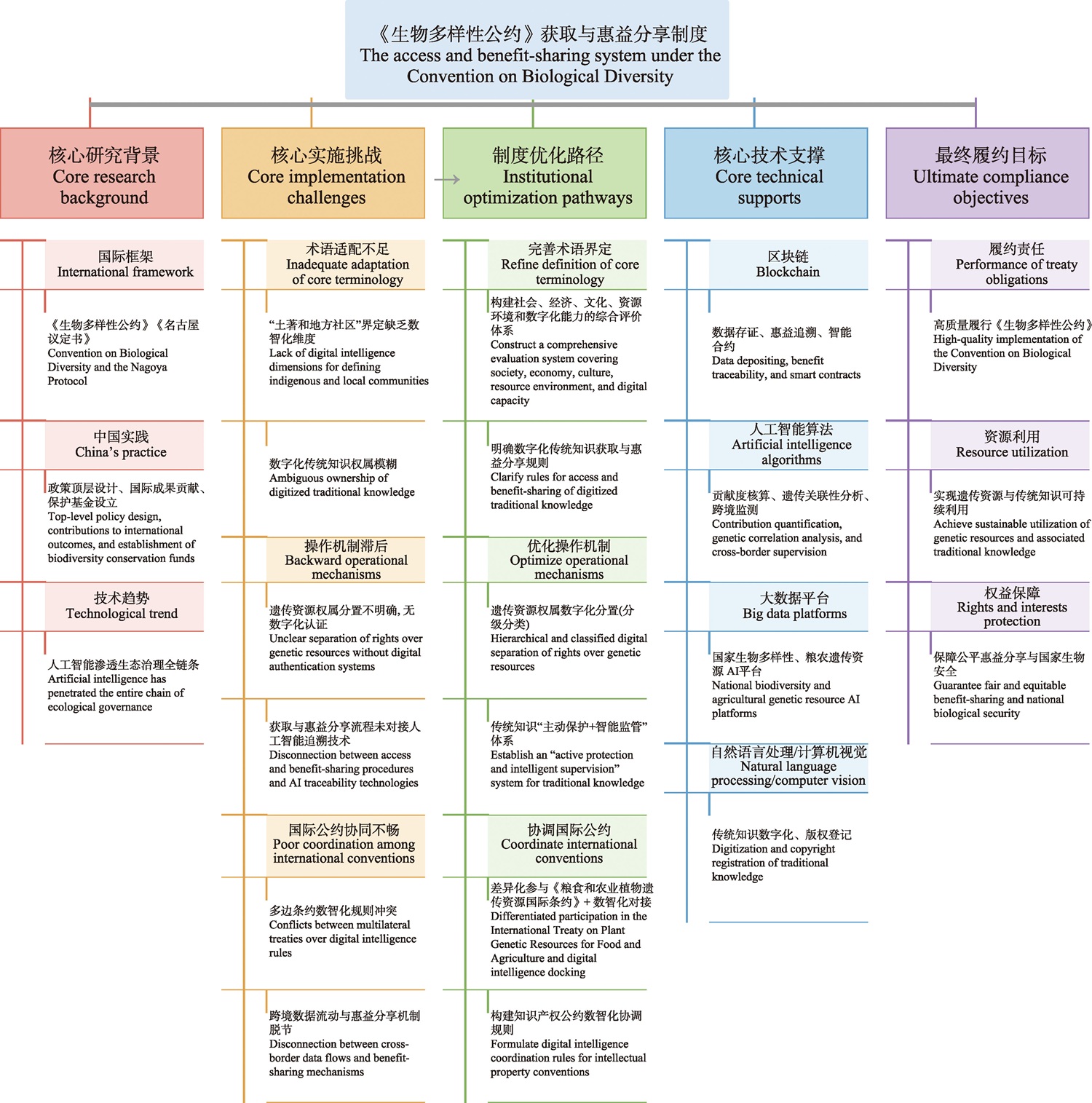
图1 人工智能背景下中国实施《生物多样性公约》获取与惠益分享制度的背景、挑战及优化路径
Fig. 1 Background, challenges and optimization pathways for China’s implementation of the access and benefit-sharing system under the Convention on Biological Diversity in the context of artificial intelligence
| [1] | CBD (Convention on Biological Diversity) (2025) Guide for Databases: The Multilateral Mechanism for the Fair and Equitable Sharing of Benefits from the Use of Digital Sequence Information on Genetic Resources, and the Cali Fund. https://www.cbd.int/califund/guides/guide-for-databas es.pdf. (accessed on 2025-10-16) |
| [2] | INSDC (International Nucleotide Sequence Database Collaboration) (2023) INSDC Spatiotemporal Metadata Minimum Standards Update. https://www.insdc.org/news/ins dc-spatiotemporal-metadata-minimum-standards-update-03-03-2023/. (accessed on 2025-10-16) |
| [3] | Lawson C, Humphries F, Rourke M (2024) Challenging the existing order of knowledge sharing governance with digital sequence information on genetic resources. Journal of Intellectual Property Law and Practice, 19, 337-357. |
| [4] | Li BP, Xue DY (2021) Applicability and evaluation index system of the term “indigenous and local communities” of the Convention on Biological Diversity in China. Biodiversity Science, 29, 193-199. (in Chinese with English abstract) |
| [李保平, 薛达元 (2021) 《生物多样性公约》中“土著和地方社区”术语在中国的适用性和评价指标体系. 生物多样性, 29, 193-199.] | |
| [5] | Liu LJ, Song M (2011) Conflicts and harmonization in the international regime for proprietorship of biological and genetic resources and policy options in China. Resources Science, 33, 1750-1756. (in Chinese with English abstract) |
| [刘丽军, 宋敏 (2011) 生物遗传资源权属国际制度安排的冲突、协调及中国的应对策略. 资源科学, 33, 1750-1756.] | |
| [6] | Ma Y, Yang JB, Wen Q, Xue DY (2019) A study on the changes of traditional knowledge related to biodiversity of ecological immigrants—Based on the investigation of immigrant villages in Hongsipu District, Ningxia. Social Sciences in Ningxia, (1), 145-150. (in Chinese with English abstract) |
| [马瑛, 杨京彪, 文琦, 薛达元 (2019) 生态移民的生物多样性相关传统知识变迁研究——基于宁夏红寺堡区移民村落的调查. 宁夏社会科学, (1), 145-150.] | |
| [7] | Wu JY, Xue DY, Zhao FW (2013) Plant genetic resources collection of some botanic gardens in the USA and UK from China. Resources Science, 35, 1499-1509. (in Chinese with English abstract) |
| [武建勇, 薛达元, 赵富伟 (2013) 欧美植物园引种中国植物遗传资源案例研究. 资源科学, 35, 1499-1509.] | |
| [8] | Xu J, Wang JZ (2023) Analysis of the main elements and implications of the Kunming-Montreal Global Biodiversity Framework. Biodiversity Science, 31, 23020. (in Chinese with English abstract) |
| [徐靖, 王金洲 (2023) 《昆明-蒙特利尔全球生物多样性框架》主要内容及其影响. 生物多样性, 31, 23020.] | |
| [9] | Xue DY (2017) The latest development for implementation of the Convention on Biological Diversity. Biodiversity Science, 25, 1145-1146. (in Chinese) |
| [薛达元 (2017) 《生物多样性公约》履约新进展. 生物多样性, 25, 1145-1146.] | |
| [10] | Yu WX (2013) Study on Biodiversity Policy and Legislation. Intellectual Property Press, Beijing. (in Chinese) |
| [于文轩 (2013) 生物多样性政策与立法研究. 知识产权出版社, 北京.] | |
| [11] | Zhang XY (2018) Research on International Legal Issues of Genetic Resources. Intellectual Property Press, Beijing. (in Chinese) |
| [张小勇 (2018) 遗传资源国际法问题研究. 知识产权出版社, 北京.] | |
| [12] | Zhao FW (2025) The negotiation process of the multilateral mechanism of digital sequence information on genetic resources and China’s response to it. Biodiversity Science, 33, 24599. (in Chinese with English abstract) |
| [赵富伟 (2025) 遗传资源数字序列信息多边机制的谈判进程及我国的对策. 生物多样性, 33, 24599.] |
| [1] | 陈建平, 钟鑫, 陈彬, 葛斌杰, 杜诚, 高燕萍, 郭莉, 金冬梅, 马其侠, 胡永红. 国家植物园体系AI能力建设: 参考模型、成熟度评价框架与应用架构[J]. 生物多样性, 2026, 34(7): 26124-. |
| [2] | 王也, 王茜璐, 关婧, 王迎. 《生物多样性公约》现行资金机制及其替代方案[J]. 生物多样性, 2026, 34(1): 25353-. |
| [3] | 赵富伟. 遗传资源数字序列信息多边机制的谈判进程及我国的对策[J]. 生物多样性, 2025, 33(6): 24559-. |
| [4] | 祝晓雨, 王晨灏, 王忠君, 张玉钧. 城市绿地生物多样性研究进展与展望[J]. 生物多样性, 2025, 33(5): 25027-. |
| [5] | 臧明月, 刘立, 马月, 徐徐, 胡飞龙, 卢晓强, 李佳琦, 于赐刚, 刘燕. 《昆明-蒙特利尔全球生物多样性框架》下的中国城市生物多样性保护[J]. 生物多样性, 2025, 33(5): 24482-. |
| [6] | 卢晓强, 董姗姗, 马月, 徐徐, 邱凤, 臧明月, 万雅琼, 李孪鑫, 于赐刚, 刘燕. 前沿技术在生物多样性研究中的应用现状、挑战与展望[J]. 生物多样性, 2025, 33(4): 24440-. |
| [7] | 谢淦, 宣晶, 付其迪, 魏泽, 薛凯, 雒海瑞, 高吉喜, 李敏. 草地植物多样性无人机调查的物种智能识别模型构建[J]. 生物多样性, 2025, 33(4): 24236-. |
| [8] | 顾婧婧, 刘宜卓, 苏杨. 基层地方政府在完成《昆蒙框架》中的作用和难点: 基于《联合国气候变化框架公约》任务的比较[J]. 生物多样性, 2025, 33(3): 24585-. |
| [9] | 武慧, 俞乐, 杜贞容, 赵强, 戚文超, 曹越, 王金洲, 申小莉, 孙尧, 马克平. 基于遥感监测的《昆蒙框架》执行进展快速评估: 路径与展望[J]. 生物多样性, 2025, 33(3): 24526-. |
| [10] | 孔祥飞, 丁强, 王国全, 黄国华, 田哲豪, 王新谱, 佟一杰, 宋志顺, 张晓宁, 李卫海, 韩辉林, 李文亮, 聂瑞娥, 杨海东, 杨星科, 刘梅柯, 孙永明, 崔亚琴, 杨美霞, 刘宁, 路园园, 李盼盼, 白明. “SITE-100”中国样地昆虫多样性监测研究进展[J]. 生物多样性, 2025, 33(12): 24323-. |
| [11] | 李希, 平晓鸽, 徐学红, 操瑜, 高博轩, 鲍一明, 徐基良. 《生物多样性公约》第十六次缔约方大会重要议题进展与展望[J]. 生物多样性, 2025, 33(12): 25121-. |
| [12] | 周宣宏, 杨军. AI和LLMs在生物多样性保护研究和实践中的应用与挑战[J]. 生物多样性, 2025, 33(10): 25179-. |
| [13] | 刘蕾, 郝志明, 杜乐山, 刘海鸥. 《昆明-蒙特利尔全球生物多样性框架》视角下将性别考虑纳入中国生物多样性治理[J]. 生物多样性, 2025, 33(1): 24235-. |
| [14] | 刘海鸥, 杜乐山, 刘文慧, 李子圆, 潘丽波, 刘蕾. 全球生物多样性框架基金管理政策分析与启示[J]. 生物多样性, 2024, 32(3): 23334-. |
| [15] | 贾韶琦, 张巨保. 生物遗传资源获取与惠益分享专门立法的重启必要与现实回应[J]. 生物多样性, 2024, 32(11): 24383-. |
| 阅读次数 | ||||||
|
全文 |
|
|||||
|
摘要 |
|
|||||
备案号:京ICP备16067583号-7
Copyright © 2026 版权所有 《生物多样性》编辑部
地址: 北京香山南辛村20号, 邮编:100093
电话: 010-62836137, 62836665 E-mail: biodiversity@ibcas.ac.cn
