

生物多样性 ›› 2025, Vol. 33 ›› Issue (12): 25400. DOI: 10.17520/biods.2025400 cstr: 32101.14.biods.2025400
张一帆1,2,3( ), 张文远3(), 王迪3(), 王志恒1,2,*()(
 ), 王戎疆1,3,*()()
收稿日期:2025-10-10
接受日期:2025-12-11
出版日期:2025-12-20
发布日期:2026-01-09
通讯作者:
*共同通讯作者:E-mail: zhiheng.wang@pku.edu.cn;
rjwang@pku.edu.cn
基金资助:
Yifan Zhang1,2,3(), Wenyuan Zhang3(), Di Wang3(), Zhiheng Wang1,2,*()(), Rongjiang Wang1,3,*()()
Received:2025-10-10
Accepted:2025-12-11
Online:2025-12-20
Published:2026-01-09
Supported by:摘要:
人类活动导致的环境变化正严重威胁全球生物多样性。在保护生物学中, IUCN红色名录常被作为衡量物种灭绝风险的重要依据, 但目前在昆虫等类群中, 物种灭绝风险评估仍存在明显不足。中国蝴蝶多样性丰富, 但现有红色名录评估主要依赖历史数据, 尚未纳入对未来生存风险的预测。本研究整合了中国1,920种蝴蝶的247,248条分布记录, 其中598个物种当前的分布数据不足以建模, 将其评估为数据缺乏; 对1,322种数据充足的物种, 结合未来气候与土地利用数据, 运用集成物种分布模型模拟了从当前至2070年的潜在分布变化。通过量化分布区面积变动, 并依据IUCN标准A3c阈值, 系统评估了物种的受威胁等级。研究结果显示, 不同未来情景下蝴蝶物种所受威胁存在显著差异, 其中在高强迫路径SSP5-8.5下受威胁物种数量最高(277种), 且分布区平均缩减幅度高达55.0%。与此前的IUCN红色名录相比, 本研究新识别出多个易受未来气候变化影响的物种。本研究提供了首份基于未来情景的中国蝴蝶IUCN红色名录评估, 揭示了高强度排放路径对生物多样性的严重威胁, 识别出需优先保护的关键类群, 为制定前瞻性保护策略提供了科学依据。
数据库(集)基本信息简介
| 数据库(集)名称 | 全球变化情景下的中国蝴蝶受威胁物种名录 | |
| 作者 | 张一帆, 张文远, 王迪, 王志恒, 王戎疆 | |
| 通讯作者 | 王志恒(zhiheng.wang@pku.edu.cn), 王戎疆(rjwang@pku.edu.cn) | |
| 时间范围 | 现在至2070年 | |
| 地理区域 | 中国 | |
| 文件大小 | 11.33 MB | |
| 数据格式 | *.xlsx, *.tif | |
| 数据链接 | https://doi.org/10.57760/sciencedb.j00152.00054 https://www.biodiversity-science.net/fileup/1005-0094/DATA/2025400.zip | |
| 数据库(集)组成 | 本数据集核心为1个excel文件(*.xlsx), 其中整理了4种未来情景(SSP1-2.6、SSP2-4.5、SSP3-7.0与SSP5-8.5)下的中国蝴蝶受威胁物种名录, 每种情景数据分别存储于独立的工作表中; 除名录外, 数据集还提供了中国蝴蝶在当前及各未来情景下的分布区预测图层, 以栅格(GeoTIFF格式, *.tif)存储。 |
张一帆, 张文远, 王迪, 王志恒, 王戎疆 (2025) 全球变化情景下的中国蝴蝶受威胁物种名录. 生物多样性, 33, 25400. DOI: 10.17520/biods.2025400.
Yifan Zhang, Wenyuan Zhang, Di Wang, Zhiheng Wang, Rongjiang Wang (2025) A list of threatened butterfly species in China under future global change scenarios. Biodiversity Science, 33, 25400. DOI: 10.17520/biods.2025400.
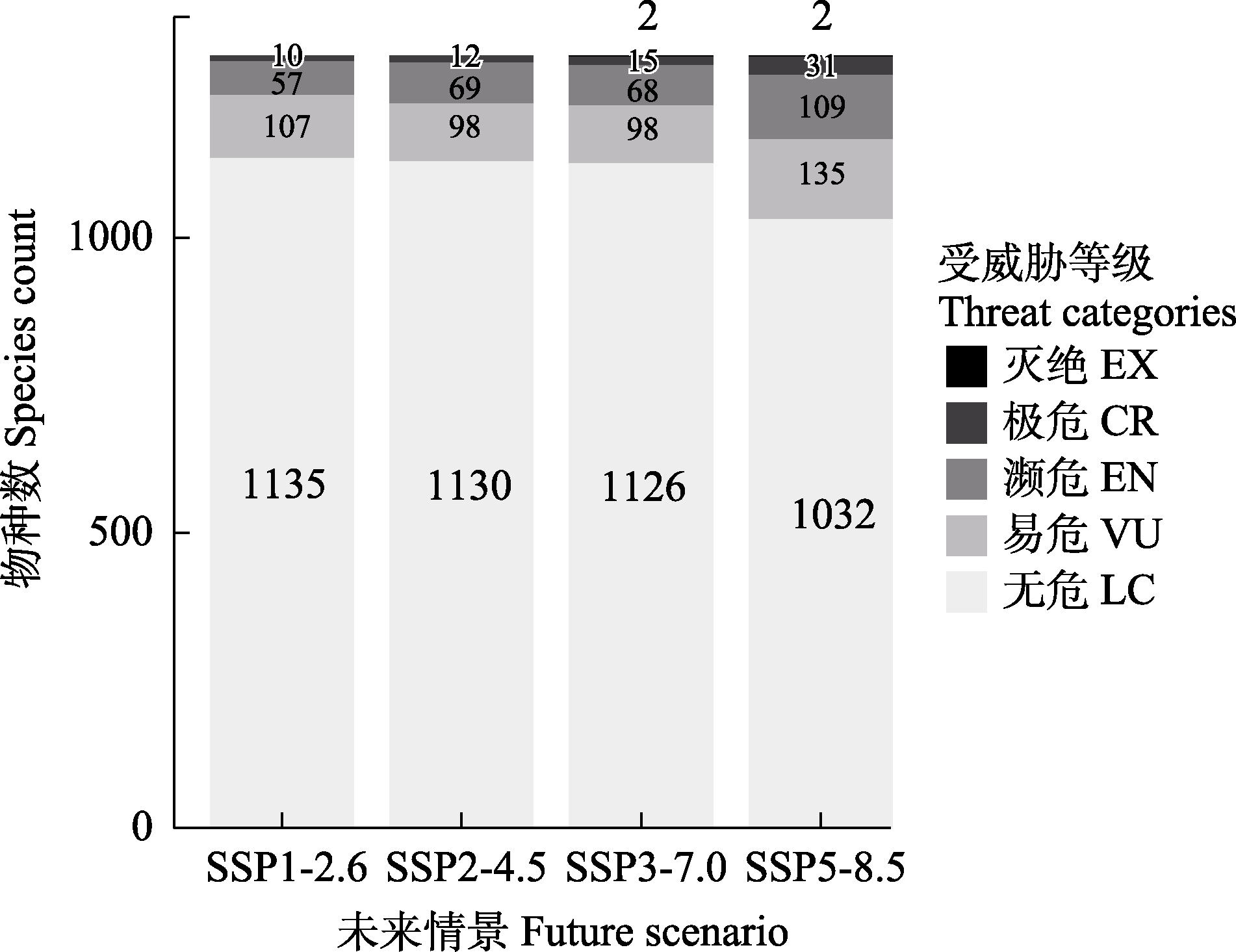
图1 不同未来气候和土地利用情景下中国蝴蝶的受威胁等级分布
Fig. 1 Distribution of threat categories for butterflies in China under different future climate and land-use scenarios. EX, Extinct; CR, Critically Endangered; EN, Endangered; VU, Vulnerable; LC, Least Concern.
| [1] |
Araújo MB, Peterson AT (2012) Uses and misuses of bioclimatic envelope modeling. Ecology, 93, 1527-1539.
DOI PMID |
| [2] |
Bellard C, Bertelsmeier C, Leadley P, Thuiller W, Courchamp F (2012) Impacts of climate change on the future of biodiversity. Ecology Letters, 15, 365-377.
DOI PMID |
| [3] |
Beyer RM, Manica A (2020) Historical and projected future range sizes of the world’s mammals, birds, and amphibians. Nature Communications, 11, 5633.
DOI |
| [4] | Ceballos G, Ehrlich PR, Barnosky AD, García A, Pringle RM, Palmer TM (2015) Accelerated modern human-induced species losses: Entering the sixth mass extinction. Science Advances, 1, e1400253. |
| [5] |
Fick SE, Hijmans RJ (2017) WorldClim 2: New 1-km spatial resolution climate surfaces for global land areas. International Journal of Climatology, 37, 4302-4315.
DOI URL |
| [6] |
Fitzpatrick MC, Sanders NJ, Ferrier S, Longino JT, Weiser MD, Dunn R (2011) Forecasting the future of biodiversity: A test of single- and multi-species models for ants in North America. Ecography, 34, 836-847.
DOI URL |
| [7] | Guéguen M, Blancheteau H, Lemaire-Patin R, Thuiller W (2025) biomod2: Ensemble Platform for Species Distribution Modeling. https://biomodhub.github.io/biomod2/. (accessed on 2024-05-03) |
| [8] | Hill GM, Kawahara AY, Daniels JC, Bateman CC, Scheffers BR (2021) Climate change effects on animal ecology: Butterflies and moths as a case study.Biological Reviews, 96, 2113-2126. |
| [9] | IUCN (2012a) IUCN Red List Categories and Criteria: Version 3.1, Second edition. IUCN, Gland, Switzerland and Cambridge, UK. |
| [10] | IUCN (2012b) Guidelines for Application of IUCN Red List Criteria at Regional and National Levels, Version 4.0. IUCN, Gland, Switzerland and Cambridge, UK. |
| [11] | Ma FZ, Xu HG, Chen MM, Tong WJ, Wang CB, Cai L (2018) Progress in construction of China Butterfly Diversity Observation Network (China BON-Butterflies). Journal of Ecology and Rural Environment, 34, 27-36. (in Chinese with English abstract) |
| [马方舟, 徐海根, 陈萌萌, 童文君, 王晨彬, 蔡蕾 (2018) 全国蝴蝶多样性观测网络(China BON-Butterflies)建设进展. 生态与农村环境学报, 34, 27-36.] | |
| [12] |
Peng SJ, Luo Y, Cai HY, Zhang XL, Wang ZH (2022) A new list of threatened woody species in China under future global change scenarios. Biodiversity Science, 30, 21459. (in Chinese with English abstract)
DOI |
|
[彭莳嘉, 罗源, 蔡宏宇, 张晓玲, 王志恒 (2022) 全球变化情景下的中国木本植物受威胁物种名录. 生物多样性, 30, 21459.]
DOI |
|
| [13] | Pinkert S, Barve V, Guralnick R, Jetz W (2022) Global geographical and latitudinal variation in butterfly species richness captured through a comprehensive country-level occurrence database. Global Ecology and Biogeography, 31, 830-839. |
| [14] | Pinkert S, Farwig N, Kawahara AY, Jetz W (2025) Global hotspots of butterfly diversity are threatened in a warming world. Nature Ecology & Evolution, 9, 789-800. |
| [15] |
van Klink R, Bowler DE, Gongalsky KB, Swengel AB, Gentile A, Chase JM (2020) Meta-analysis reveals declines in terrestrial but increases in freshwater insect abundances. Science, 368, 417-420.
DOI PMID |
| [16] | Wang D, Zhang YF, Lu LZ, Li S, Wang RJ (2025) Butterfly diversity patterns provide new insights into biodiversity conservation in China. Global Ecology and Biogeography, 34, e13946. |
| [17] | Wang S, Xie Y (2005) China Species Red List (Vol. 3): Invertebrate. Higher Education Press, Beijing. (in Chinese) |
| [汪松, 解焱 (2005) 中国物种红色名录(第三卷): 无脊椎动物. 高等教育出版社, 北京.] | |
| [18] |
Wisz MS, Hijmans RJ, Li J, Peterson AT, Graham CH, Guisan A, NCEAS Predicting Species Distributions Working Group 2008) Effects of sample size on the performance of species distribution models. Diversity and Distributions, 14, 763-773.
DOI URL |
| [19] | Wu CS, Hsu YF (2017) Illustrated Handbook of Chinese Butterflies. Straits Publishing House, Fuzhou. (in Chinese) |
| [武春生, 徐堉峰 (2017) 中国蝴蝶图鉴. 海峡书局, 福州.] | |
| [20] |
Xie Y (2022) Progress and application of IUCN Red List of Threatened Species. Biodiversity Science, 30, 22445. (in Chinese with English abstract)
DOI |
|
[解焱 (2022) IUCN受威胁物种红色名录进展及应用. 生物多样性, 30, 22445.]
DOI |
|
| [21] |
Yu XT, Yang FL, Da W, Li YC, Xi HM, Cotton AM, Zhang HH, Duan K, Xu ZB, Gong ZX, Wang WL, Hu SJ (2023) Species richness of Papilionidae butterflies (Lepidoptera: Papilionoidea) in the Hengduan Mountains and its future shifts under climate change. Insects, 14, 259.
DOI URL |
| [22] |
Zhang TY, Cheng CX, Wu XD (2023) Mapping the spatial heterogeneity of global land use and land cover from 2020 to 2100 at a 1 km resolution. Scientific Data, 10, 748.
DOI PMID |
| [23] |
Zizka A, Silvestro D, Andermann T, Azevedo J, Duarte Ritter C, Edler D, Farooq H, Herdean A, Ariza M, Scharn R, Svantesson S, Wengström N, Zizka V, Antonelli A (2019) CoordinateCleaner: Standardized cleaning of occurrence records from biological collection databases. Methods in Ecology and Evolution, 10, 744-751.
DOI URL |
| [1] | 郭蓉, 吴旭东, 张雨, 康瑞红, 王一凡, 王占军, 蒋齐, 俞鸿千, 马琨. 荒漠草原土壤丛枝菌根真菌群落对降水变化的响应[J]. 生物多样性, 2026, 34(5): 26028-. |
| [2] | 徐进博, 崔雅倩, 王渊, 王伟波, 刘锋, 王广龙, 扈晶晶, 普布顿珠, 边巴多吉, 旦增, 胡开, 王小川, 宋刚, 吕永磊, 温知新. 西藏雅鲁藏布大峡谷国家级自然保护区内白颊猕猴的栖息地适宜性评价[J]. 生物多样性, 2025, 33(7): 24493-. |
| [3] | 张彤云, 胡自民. 二裂墨角藻谱系多样性模式显示纽芬兰大浅滩存在一个海洋冰期避难所[J]. 生物多样性, 2025, 33(6): 24416-. |
| [4] | 顾婧婧, 刘宜卓, 苏杨. 基层地方政府在完成《昆蒙框架》中的作用和难点: 基于《联合国气候变化框架公约》任务的比较[J]. 生物多样性, 2025, 33(3): 24585-. |
| [5] | 吴琪, 张晓青, 杨雨婷, 周艺博, 马毅, 许大明, 斯幸峰, 王健. 浙江钱江源-百山祖国家公园庆元片区叶附生苔多样性及其时空变化[J]. 生物多样性, 2024, 32(4): 24010-. |
| [6] | 曹可欣, 王敬雯, 郑国, 武鹏峰, 李英滨, 崔淑艳. 降水格局改变及氮沉降对北方典型草原土壤线虫多样性的影响[J]. 生物多样性, 2024, 32(3): 23491-. |
| [7] | 冯莉. 国际法视野下生物多样性和气候变化的协同治理[J]. 生物多样性, 2023, 31(7): 23110-. |
| [8] | 姚雪, 陈星, 戴尊, 宋坤, 邢诗晨, 曹宏彧, 邹璐, 王健. 采集策略对叶附生苔类植物发现概率及物种多样性的重要性[J]. 生物多样性, 2023, 31(4): 22685-. |
| [9] | 桑佳文, 宋创业, 贾宁霞, 贾元, 刘长成, 乔鲜果, 张琳, 袁伟影, 吴冬秀, 李凌浩, 郭柯. 青藏高原植被调查与制图评估[J]. 生物多样性, 2023, 31(3): 22430-. |
| [10] | 张琼悦, 邓卓迪, 胡学斌, 丁志锋, 肖荣波, 修晨, 吴政浩, 汪光, 韩东晖, 张语克, 梁健超, 胡慧建. 粤港澳大湾区城市化进程对区域内鸟类分布及栖息地连通性的影响[J]. 生物多样性, 2023, 31(3): 22161-. |
| [11] | 邵雯雯, 范国祯, 何知舟, 宋志平. 多地同质园实验揭示普通野生稻的表型可塑性与本地适应性[J]. 生物多样性, 2023, 31(3): 22311-. |
| [12] | 王金洲, 徐靖. “基于自然的解决方案”应对生物多样性丧失和气候变化: 进展、挑战和建议[J]. 生物多样性, 2023, 31(2): 22496-. |
| [13] | 朱瑞良, 马晓英, 曹畅, 曹子寅. 中国苔藓植物多样性研究进展[J]. 生物多样性, 2022, 30(7): 22378-. |
| [14] | 李季蔓, 靳楠, 胥毛刚, 霍举颂, 陈小云, 胡锋, 刘满强. 不同干旱水平下蚯蚓对番茄抗旱能力的影响[J]. 生物多样性, 2022, 30(7): 21488-. |
| [15] | 彭莳嘉, 罗源, 蔡宏宇, 张晓玲, 王志恒. 全球变化情景下的中国木本植物受威胁物种名录[J]. 生物多样性, 2022, 30(5): 21459-. |
| 阅读次数 | ||||||
|
全文 |
|
|||||
|
摘要 |
|
|||||
备案号:京ICP备16067583号-7
Copyright © 2026 版权所有 《生物多样性》编辑部
地址: 北京香山南辛村20号, 邮编:100093
电话: 010-62836137, 62836665 E-mail: biodiversity@ibcas.ac.cn
