

生物多样性 ›› 2025, Vol. 33 ›› Issue (12): 25365. DOI: 10.17520/biods.2025365 cstr: 32101.14.biods.2025365
吴杨1( ), 杨梦婵1, 孙芳芳1,*(
 ), 田瑜2,*()
收稿日期:2025-09-09
接受日期:2025-10-29
出版日期:2025-12-20
发布日期:2026-01-09
通讯作者:
* 共同通讯作者:E-mail: 29393026@qq.com;
30453917@qq.com
基金资助:
Yang Wu1(), Mengchan Yang1, Fangfang Sun1,*(), Yu Tian2,*()
Received:2025-09-09
Accepted:2025-10-29
Online:2025-12-20
Published:2026-01-09
Supported by:摘要:
《中国生物多样性保护战略与行动计划(2023‒2030年)》(简称中国NBSAP)的发布带动了新一轮地方生物多样性保护战略与行动计划(LBSAPs)的编制与更新。本文通过收集整理中国NBSAP出台后发布的省级LBSAPs, 从保护目标、优先行动和保障机制3个方面比较分析省级LBSAPs对中国NBSAP的响应情况, 以及地方生物多样性治理与国家行动的衔接性, 探讨我国不同地区、省际间目标设定差异与影响因素, 揭示多层级治理中的瓶颈并提出优化路径。研究发现, 省级LBSAPs在目标设定、行动方向和保障机制等方面与中国NBSAP密切衔接, 省级LBSAPs在中国NBSAP框架的基础上因地制宜地提出了具有地方特色的目标、行动和保障举措, 不同区域的LBSAPs呈现出不同特征, 以反映当地独特的生物多样性状况、社会经济条件和保护需求。然而, 多数地方的LBSAPs战略和行动仍面临目标路径不清晰、部门协调不畅、资金不足、科技力量薄弱、公众参与不足的困境。为此, 我们建议各地可通过科学编制和实施LBSAPs, 从目标设定、跨部门跨地区合作、资金、科技、人才和社会参与等方面统筹协调, 优化资源配置, 助力中国NBSAP目标实现。
吴杨, 杨梦婵, 孙芳芳, 田瑜 (2025) 地方战略与行动助力中国生物多样性保护目标路径研究. 生物多样性, 33, 25365. DOI: 10.17520/biods.2025365.
Yang Wu, Mengchan Yang, Fangfang Sun, Yu Tian (2025) Local biodiversity strategies and action plans and their contributions to the realization of China’s biodiversity conservation goals. Biodiversity Science, 33, 25365. DOI: 10.17520/biods.2025365.
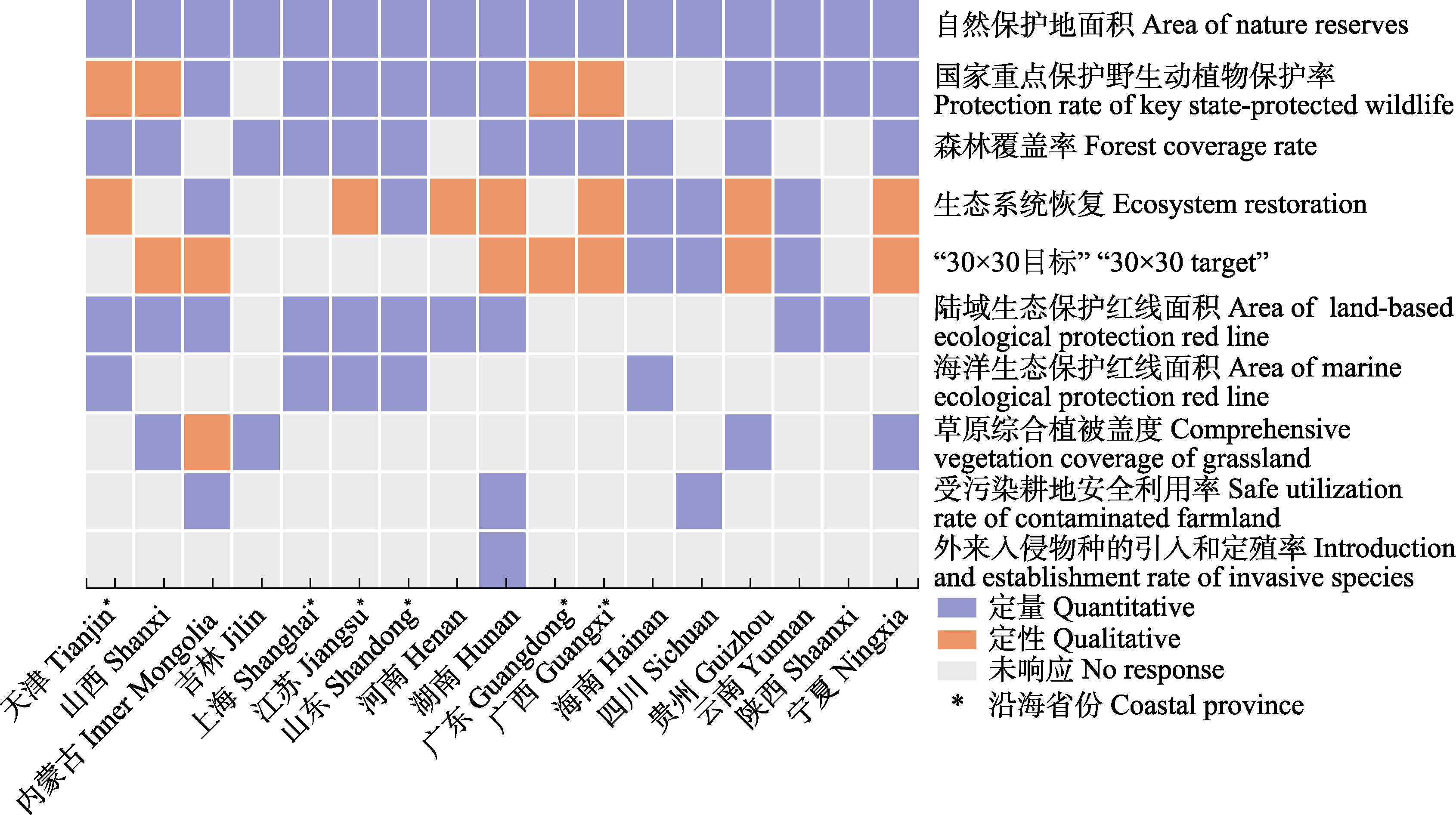
图1 新一轮17个省级LBSAP对中国NBSAP定量目标的响应情况。因吉林、河南和陕西的LBSAP信息获取有限, 本研究仅涵盖部分目标。
Fig. 1 The response of the new round of 17 provincial LBSAPs (local biodiversity strategies and action plans) to the quantitative targets of China’s NBSAP. Due to the limited availability of LBSAP targets in Jilin, Henan and Shaanxi, this study only covers a portion of the targets.
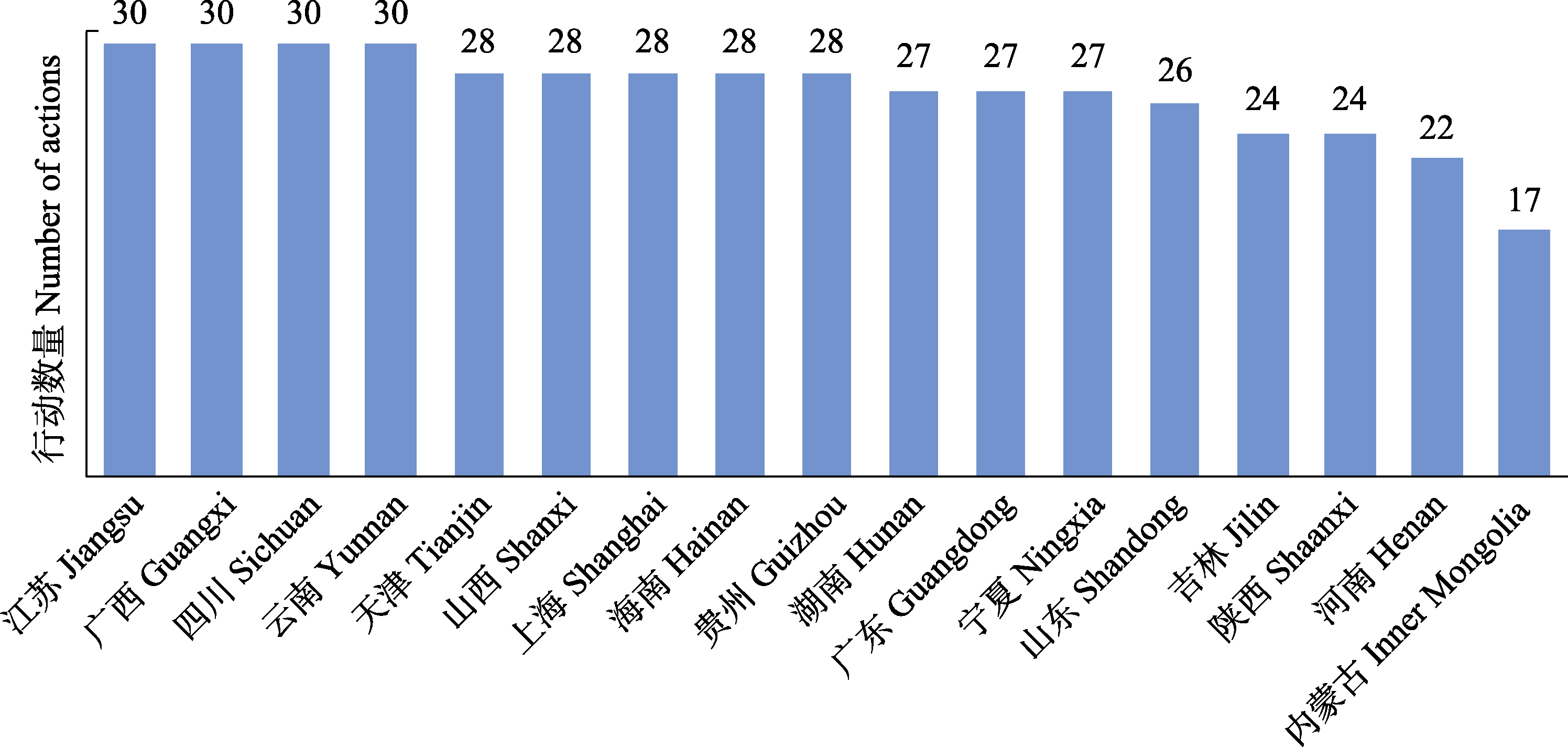
图2 新一轮17个省级LBSAP的行动数量
Fig. 2 Number of actions in the new round of 17 provincial LBSAPs (local biodiversity strategies and action plans)
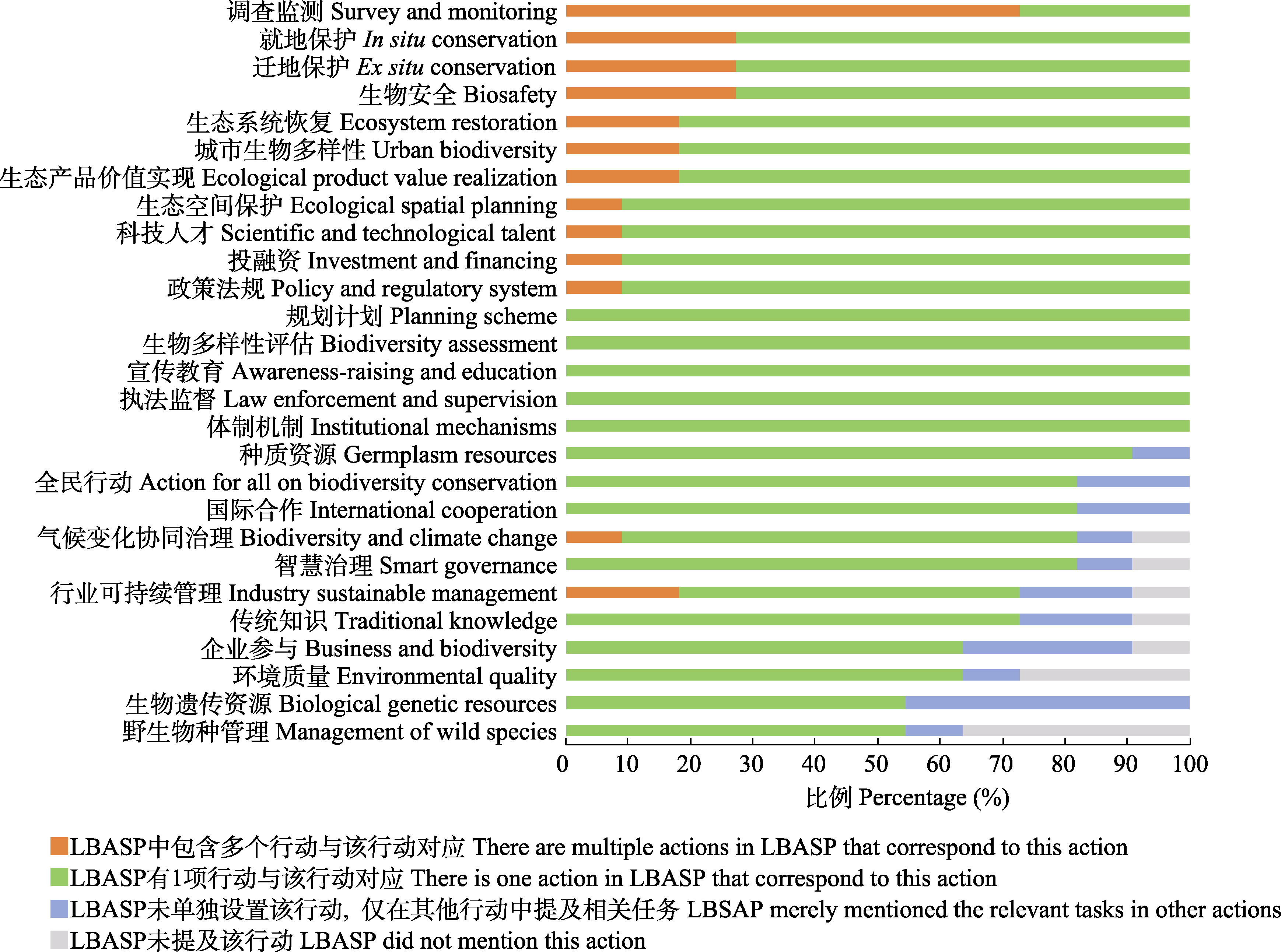
图3 省级LBSAP对中国NBSAP优先行动的响应情况
Fig. 3 Responses of local biodiversity strategies and action plans (LBSAPs) to priority actions of the China’s NBSAP
| [1] | CBD (Convention on Biological Diversity) (2008) CBD/COP/DEC/IX/28: Promoting Engagement of Cities and Local Authorities. https://www.cbd.int/doc/decisions/cop-09/cop-09-dec-28-en.pdf. (accessed on 2024-11-20) |
| [2] | CBD (Convention on Biological Diversity) (2010) CBD/COP/DEC/X/22: Plan of Action on Subnational Governments, Cities and Other Local Authorities for Biodiversity. https://www.cbd.int/doc/decisions/cop-10/cop-10-dec-22-en.pdf. (accessed on 2024-11-20) |
| [3] | CBD (Convention on Biological Diversity) (2022a) CBD/COP/ DEC/15/6: Mechanisms for Planning, Monitoring, Reporting and Review. https://www.cbd.int/doc/decisions/co p-15/cop-15-dec-06-en.pdf. (accessed on 2024-11-20) |
| [4] | CBD (Convention on Biological Diversity) (2022b) CBD/COP/ DEC/15/12: Engagement with Subnational Governments, Cities and Other Local Authorities to Enhance Implementation of the Kunming-Montreal Global Biodiversity Framework. https://www.cbd.int/doc/decisions/cop-15/cop-15-dec-12-en.pdf. (accessed on 2024-11-20) |
| [5] | European Commission (2020) EU Biodiversity Strategy for 2030. https://eur-lex.europa.eu/legal-content/EN/TXT/HTML/?uri=CELEX:52020DC0380. (accessed on 2025-10-10) |
| [6] |
Gu JJ, Liu YZ, Su Y (2025) The functions and challenges of grass-roots local governments in fulfilling the Kunming-Montreal Global Biodiversity Framework—A comparative analysis with the objectives of the United Nations Framework Convention on Climate Change. Biodiversity Science, 33, 24585. (in Chinese with English abstract)
DOI |
|
[顾婧婧, 刘宜卓, 苏杨 (2025) 基层地方政府在完成《昆蒙框架》中的作用和难点: 基于《联合国气候变化框架公约》任务的比较. 生物多样性, 33, 24585.]
DOI |
|
| [7] |
Huang JL, Wang QL, Wang AH (2025) Challenges and countermeasures for local governments in the implementation of the China National Biodiversity Conservation Strategy and Action Plan (2023-2030). Biodiversity Science, 33, 24573. (in Chinese with English abstract)
DOI |
| [黄金丽, 王茜璐, 王爱华 (2025) 地方政府执行《中国生物多样性保护战略与行动计划(2023-2030年)》的难点及对策建议. 生物多样性, 33, 24573.] | |
| [8] |
Jiang XY, Xu JY, Sheng XM, Zhu Y (2025) Synergies and differences between the China National Biodiversity Conservation Strategy and Action Plan (2023-2030) and the Kunming-Montreal Global Biodiversity Framework. Biodiversity Science, 33, 24575. (in Chinese with English abstract)
DOI URL |
|
[姜雪原, 徐嘉忆, 盛学敏, 朱源 (2025) 《中国生物多样性保护战略与行动计划(2023-2030年)》与《昆蒙框架》的协同与差异. 生物多样性, 33, 24575.]
DOI |
|
| [9] | Li XQ, Dong ZF, Ge CZ, Li XL (2022) Study on innovative policy for financing biodiversity. Environmental Protection, 50(8), 28-31. (in Chinese) |
| [李晓琼, 董战峰, 葛察忠, 李晓亮 (2022) 生物多样性保护的金融政策创新研究. 环境保护, 50(8), 28-31.] | |
| [10] |
Liu L, Zang MY, Ma Y, Wan YQ, Hu FL, Lu XQ, Liu Y (2025) Measures, progress and prospects of central-local cooperation in the implementation of the National Biodiversity Strategy and Action Plan. Biodiversity Science, 33, 24532. (in Chinese with English abstract)
DOI |
|
[刘立, 臧明月, 马月, 万雅琼, 胡飞龙, 卢晓强, 刘燕 (2025) 央地协同推动国家生物多样性战略和行动计划执行的措施、进展与展望. 生物多样性, 33, 24532.]
DOI |
|
| [11] | Liu WH, Duan HX, Zhang FC, Liu HO, Li ZY, Zhang WG, Du LS (2025) The analysis of the implementation pathways for achieving biodiversity governance goals through a whole-of-government and whole-of-society approach. Research of Environmental Sciences, 38, 9-17. (in Chinese with English abstract) |
| [刘文慧, 段禾祥, 张风春, 刘海鸥, 李子圆, 张文国, 杜乐山 (2025) 以全政府和全社会方法推动生物多样性治理目标实现路径分析. 环境科学研究, 38, 9-17.] | |
| [12] |
Ma KP (2023) Kunming-Montreal Global Biodiversity Framework: An important global agenda for biodiversity conservation. Biodiversity Science, 31, 23133. (in Chinese)
DOI |
|
[马克平 (2023) 《昆明-蒙特利尔全球生物多样性框架》是重要的全球生物多样性保护议程. 生物多样性, 31, 23133.]
DOI |
|
| [13] |
Mace GM, Barrett M, Burgess ND, Cornell SE, Freeman R, Grooten M, Purvis A (2018) Aiming higher to bend the curve of biodiversity loss. Nature Sustainability, 1, 448-451.
DOI |
| [14] | Ministry of Ecology and Environment of the People’s Republic of China (2024) China National Biodiversity Conservation Strategy and Action Plan (2023-2030). (in Chinese) |
| [生态环境部 (2024) 中国生物多样性保护战略与行动计划(2023-2030年).]https://www.mee.gov.cn/ywdt/hjywnews/202401/W020240123333807288143.pdf. (accessed on 2025-05-02) | |
| [15] | Ministry of the Environment of Japan (2023) National Biodiversity Strategy 2023-2030. https://www.env.go.jp/content/000293532.pdf. (accessed on 2025-10-10) |
| [16] | Tian Y, Li JS (2024) Analysis of the connotation and implementation path for the 30 by 30 target in the Kunming-Montreal Global Biodiversity Framework. Biodiversity Science, 32, 24086. (in Chinese with English abstract) |
|
[田瑜, 李俊生 (2024) 《昆明-蒙特利尔全球生物多样性框架》“3030”目标的内涵及实现路径分析. 生物多样性, 32, 24086.]
DOI |
|
| [17] |
Wang Y, Zhang FC, Nan X, Li HT, Liu HO (2022) Financial issues of the Convention on Biological Diversity and its reference for China’s CBD implementation. Biodiversity Science, 30, 22401. (in Chinese with English abstract)
DOI |
|
[王也, 张风春, 南希, 李宏涛, 刘海鸥 (2022) 《生物多样性公约》资金问题分析及对我国履约的启示. 生物多样性, 30, 22401.]
DOI |
|
| [18] | Wu JY, Yu ZD, Liu Hou, Liu JX, Zhao FW, Xue DY (2015) Progresses and promotion strategy of provincial biodiversity strategy and action plans. China Population, Resources and Environment, 25(S1), 555-557. (in Chinese with English abstract) |
| [武建勇, 于之的, 刘海鸥, 刘纪新, 赵富伟, 薛达元 (2015) 省级生物多样性保护战略与行动计划(BSAP)编制进展和实施策略. 中国人口·资源与环境, 25(S1), 555-557.] | |
| [19] | Xu HG, Gregory RD, Cao Y, Zhang RQ, Zhang LR, Gill M, Yu DD, Yi JF, Liu W, Lin HM (2025) Embracing global biodiversity toward a better planet. Eco-Environment & Health, 4, 100147. |
| [20] |
Xu J, Wang JZ (2023) Analysis of the main elements and implications of the Kunming-Montreal Global Biodiversity Framework. Biodiversity Science, 31, 23020. (in Chinese with English abstract)
DOI |
|
[徐靖, 王金洲 (2023) 《昆明-蒙特利尔全球生物多样性框架》主要内容及其影响. 生物多样性, 31, 23020.]
DOI |
|
| [21] | Yang J, Yang XD, Liu XY, Zhou J (2025) Perspectives of urban biodiversity studies in China serving Target 12 of the Kunming-Montreal Global Biodiversity Framework. Biodiversity Science, 33, 25104. (in Chinese with English abstract) |
|
[杨军, 杨旭东, 刘心怡, 周景 (2025) 面向《昆蒙框架》目标12的中国城市生物多样性研究展望. 生物多样性, 33, 25104.]
DOI |
|
| [22] |
Yang MC, Fang QN, Rong CZ, Hu SF, Zhao JJ, Liang ZJ, Lee TM (2025) Review of the application and outlook of citizen science as an approach for monitoring urban biodiversity. Biodiversity Science, 33, 24464. (in Chinese with English abstract)
DOI |
|
[杨梦婵, 方启年, 戎灿中, 胡思帆, 赵晶晶, 梁智健, 李添明 (2025) 公民科学在城市生物多样性调查监测上的应用现状与前景. 生物多样性, 33, 24464.]
DOI |
|
| [23] | Zang MY, Liu L, Liu Y (2025) Main elements and implications of China’s National Biodiversity Strategy and Action Plan (2023-2030). Science & Technology Review, 43(13), 22-31. (in Chinese with English abstract) |
|
[臧明月, 刘立, 刘燕 (2025) 《中国生物多样性保护战略与行动计划(2023-2030年)》的主要内容及其影响. 科技导报, 43(13), 22-31.]
DOI |
|
| [24] |
Zang MY, Liu L, Ma Y, Xu X, Hu FL, Lu XQ, Li JQ, Yu CG, Liu Y (2025) China’s urban biodiversity conservation under the Kunming-Montreal Global Biodiversity Framework. Biodiversity Science, 33, 24482. (in Chinese with English abstract)
DOI |
|
[臧明月, 刘立, 马月, 徐徐, 胡飞龙, 卢晓强, 李佳琦, 于赐刚, 刘燕 (2025) 《昆明-蒙特利尔全球生物多样性框架》下的中国城市生物多样性保护. 生物多样性, 33, 24482.]
DOI |
| [1] | 梁竣策, 李开枝, 谭烨辉. 南海翼足类物种多样性与分布[J]. 生物多样性, 2026, 34(5): 25487-. |
| [2] | 周丽洁, 郝珉辉, 何怀江, 程艳霞, 张春雨, 赵秀海. 小兴安岭森林β多样性格局、组分及其影响因素[J]. 生物多样性, 2026, 34(4): 25443-. |
| [3] | 彭昀月, 彭奎, 刘昕然, 孙天怡, 张小全. 生物多样性信用的企业参与途径、市场发展障碍与建议[J]. 生物多样性, 2026, 34(4): 26031-. |
| [4] | 李伯尧, 盛天成, 幸小云. 生物多样性风险对企业财务绩效的影响: 来自中国上市公司的证据[J]. 生物多样性, 2026, 34(4): 25330-. |
| [5] | 刘昊, 张玉霄, 刘冰, 李飞飞, 马洪峥, 覃海宁, 李德铢, 陈文俐. 中国禾本科植物多样性及其物种名录[J]. 生物多样性, 2026, 34(4): 25438-. |
| [6] | 孔孜亦, 王德港, 王建涛, 裴志永, 孙晶, 张长春, 张军国. 基于SCD-HRNet模型的野生动物姿态估计及其在生物多样性监测中的应用: 以内蒙古赛罕乌拉地区为例[J]. 生物多样性, 2026, 34(4): 25287-. |
| [7] | 朱浩友, 周友兵, 罗怡, 周昭敏. 南充市城区繁殖鸟类群落20年前后的变化[J]. 生物多样性, 2026, 34(3): 24560-. |
| [8] | 侯姝彧, 刘盈盈, 杨锐. 《昆蒙框架》背景下国际OECMs体系构建实践进展及中国化思路[J]. 生物多样性, 2026, 34(3): 25264-. |
| [9] | 程晓帆, 李青媛, 李媛辉, 张明祥. 外来入侵物种治理政策体系的困境与出路[J]. 生物多样性, 2026, 34(2): 25332-. |
| [10] | 陈璐露, 汤皓婷, 冷红, 袁青, 杨昕悦. 城市街区建成环境对生物多样性的影响[J]. 生物多样性, 2026, 34(2): 25286-. |
| [11] | 高雯琪, 向景荣, 赵耀, 范灵霜, 谷圆, 邵韦涵, 李高俊, 赵光军, 陈明斌, 蔡杏伟, 陈凯. 海南热带雨林国家公园黎母山和尖峰岭溪流鱼类群落特征及其对土地利用的响应[J]. 生物多样性, 2026, 34(2): 25374-. |
| [12] | 卢晓强, 芮丹, 张江峰, 尹冰鑫, 王雨露, 岑雨婷, 崔怡晨, 杨万霞. 氮输入驱动的关键生态过程对生物多样性的影响及其管理启示[J]. 生物多样性, 2026, 34(2): 25368-. |
| [13] | 谭廷鸿, 高帆, 杨雨, 肖群英, 吴春芳, 邱娜, 赵宁宁, 周敏, 康公平, 卢志宏, 高健强, 杨红, 杨传东, 邓春英. 中国西南喀斯特地区大型真菌物种编目[J]. 生物多样性, 2026, 34(2): 25281-. |
| [14] | 章旭日, 罗标, 赵彤, 黄丹, 艾为明. 浙江鱼类多样性: 编目、分布与保护[J]. 生物多样性, 2026, 34(2): 25225-. |
| [15] | 刘海鸥, 郝志明, 杜乐山, 刘文慧, 李子圆, 刘蕾. 全球生物多样性框架基金运行进展、挑战与启示[J]. 生物多样性, 2026, 34(2): 25463-. |
| 阅读次数 | ||||||
|
全文 |
|
|||||
|
摘要 |
|
|||||
备案号:京ICP备16067583号-7
Copyright © 2026 版权所有 《生物多样性》编辑部
地址: 北京香山南辛村20号, 邮编:100093
电话: 010-62836137, 62836665 E-mail: biodiversity@ibcas.ac.cn
