

生物多样性 ›› 2026, Vol. 34 ›› Issue (2): 25328. DOI: 10.17520/biods.2025328 cstr: 32101.14.biods.2025328
罗钰1,2,3,4,#, 郑旭艳3,#, 曹力1,2, 王波1,2, 彭艳琼1,2, 罗银玲3, 周会平3, 杨小芳1,2, 苗白鸽1,2, 王朝雅1,2,5( ), 高洁1,2,*()
收稿日期:2025-08-17
接受日期:2025-11-03
出版日期:2026-02-20
发布日期:2026-03-23
通讯作者:
高洁
作者简介:第一联系人:# 并列第一作者
基金资助:
Yu Luo1,2,3,4,#, Xuyan Zheng3,#, Li Cao1,2, Bo Wang1,2, Yanqiong Peng1,2, Yinling Luo3, Huiping Zhou3, Xiaofang Yang1,2, Baige Miao1,2, Chaoya Wang1,2,5(), Jie Gao1,2,*()
Received:2025-08-17
Accepted:2025-11-03
Online:2026-02-20
Published:2026-03-23
Contact:
Jie Gao
About author:First author contact:# Co-first authors
Supported by:摘要:
植物园(botanical garden)作为相对均质化的人工环境, 为研究植物-传粉者互作的环境适应机制提供了理想模型。榕树(Ficus spp.)与榕小蜂构成的专性互惠系统高度依赖雌花期榕果挥发物的化学通讯。榕树作为重要的观赏和生态树种, 常被引种至植物园、公园等人工环境进行异地保存。然而, 引种后榕树挥发物组成及榕小蜂群落结构是否会发生适应性变化尚不明确, 这种生境转换是否影响其互作稳定性仍待探究。本研究以自然生境和植物园中的大果榕(Ficus auriculata)为研究对象, 采用动态顶空采样结合气相色谱-质谱联用仪(GC-MS)分析雌花期榕果挥发物, 并通过雄果榕小蜂群落调查, 比较两种生境下榕蜂互作的适应性差异。研究结果表明: (1)挥发物组成显著分化, 自然生境以防御相关的脂肪酸衍生物为主, 而植物园中以吸引传粉蜂的萜烯类化合物为主; (2)榕小蜂群落结构差异显著, 自然生境多样性更高, 非传粉蜂数量显著高于植物园; 而植物园中传粉蜂占比99.07%, 远高于自然生境(76.55%); (3)自然生境榕-蜂互作网络具有更高的连接度、模块性和稳健性, 表明自然生境榕蜂关系更复杂紧密, 同时模块间具有高独立性, 使自然生境榕小蜂群落更加适应外界干扰, 对环境变化有较强的抵抗力。而植物园则表现出更强的专化性和嵌套性, 由于环境条件均一化使榕小蜂群落对环境变化敏感性增加。本研究首次系统揭示了榕树迁地保护至植物园后挥发物-榕小蜂互作网络的适应性调整机制, 证实生境简化会通过改变化学信号和生态位分配重塑共生关系。成果不仅为理解专性共生系统的环境适应性提供了理论基础, 也为榕树迁地保护及生物多样性维持策略提供科学依据。
罗钰, 郑旭艳, 曹力, 王波, 彭艳琼, 罗银玲, 周会平, 杨小芳, 苗白鸽, 王朝雅, 高洁 (2026) 生境简化重塑榕树-榕小蜂互作网络: 挥发物组成与群落结构的适应性响应. 生物多样性, 34, 25328. DOI: 10.17520/biods.2025328.
Yu Luo, Xuyan Zheng, Li Cao, Bo Wang, Yanqiong Peng, Yinling Luo, Huiping Zhou, Xiaofang Yang, Baige Miao, Chaoya Wang, Jie Gao (2026) Habitat simplification reshapes the fig-fig wasp interaction network: Adaptive responses of volatile composition and community structure. Biodiversity Science, 34, 25328. DOI: 10.17520/biods.2025328.
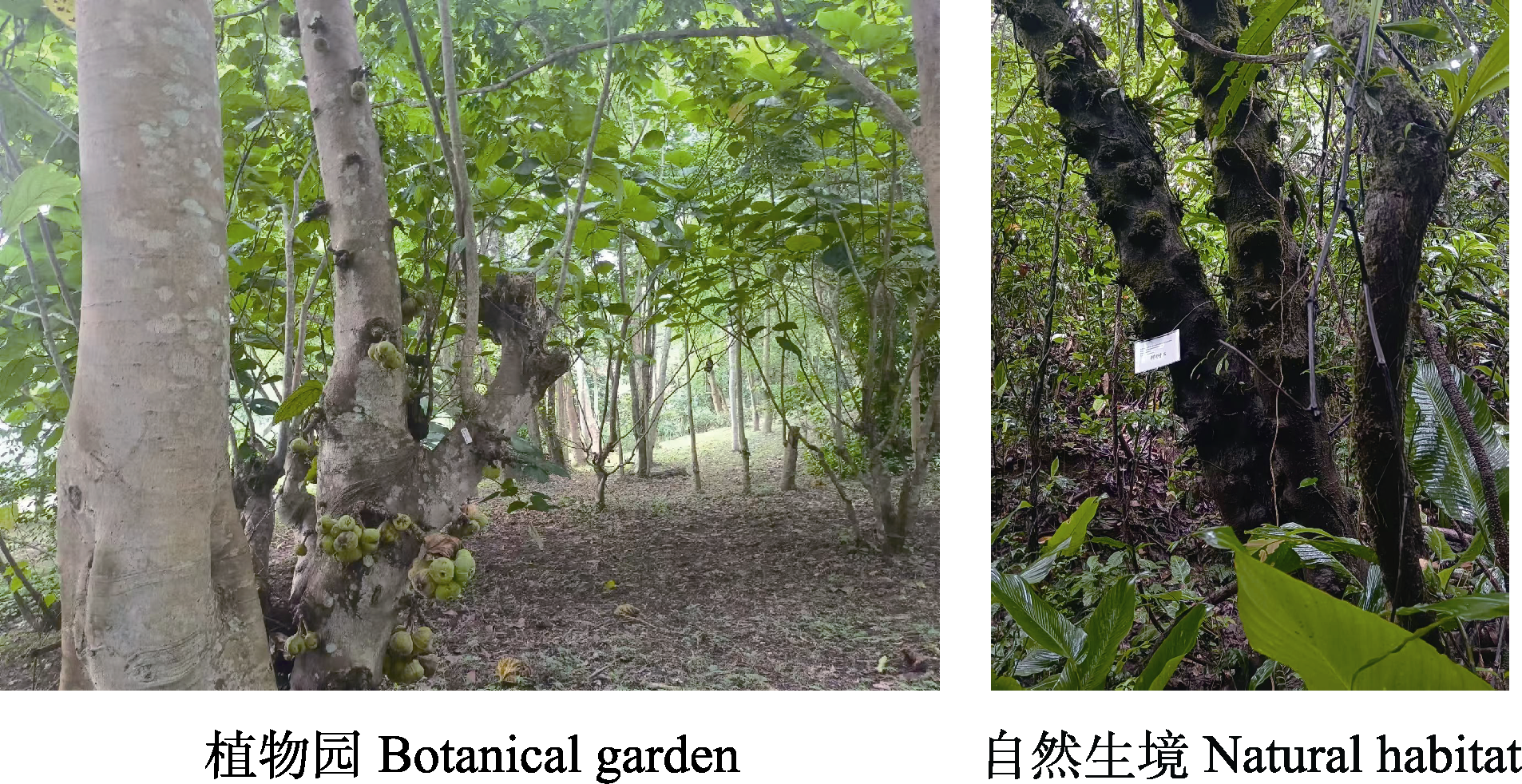
图1 研究地点(自然生境和植物园)分布图
Fig. 1 Geographical distribution of the study sites (natural habitat and botanical garden)
| 科 Family | 物种 Species | 分类特征 Taxonomic characteristics | 生物学功能 Biological function |
|---|---|---|---|
| 榕小蜂科Agaonidae | Ceratosolen emarginatus | 体棕黑色, 足黄色, 翅棕色, 单复眼黑红色, 翅棕色, 无腹柄 Body brownish-black; legs flavous; wings brown; ocelli and compound eyes nigro-rufous; petiole absent | 传粉者 Pollinator |
| 金小蜂亚科Pteromalinae | Sycoscapter roxburghi | 体呈金属黄绿, 单、复眼红色, 触角梗节和鞭节棕色, 足黄色, 腹部背板背面铁锈色, 翅透明, 不具腹柄, 产卵器的长度约是身体5.7倍, 是腹部的10.5倍, 产卵器尾部膨大 Body metallic yellowish-green; ocelli and compound eyes rufous; pedicel and funicle fuscous; legs flavous; dorsal terga ferruginous; wings hyaline; petiole absent; ovipositor 5.7 × body length, 10.5 × abdomen length, apex swollen | 非传粉 Non-pollinator 寄生蜂-寄居蜂 Parasite-inquiline |
| Philotrypesis longicaudata | 体黄黑色, 触角柄节黄色, 梗节棕色, 鞭节黑色; 前胸背板整体黄色, 足黄色, 不具腹柄, 产卵器的长度近似身体的4倍 Body yellow and black; scape flavous, pedicel fuscous, funicle niger; pronotum entirely flavous; legs flavous; petiole absent; ovipositor ca. 4 × body length | 非传粉 Non-pollinator 寄居蜂 Inquiline | |
| 长鞘榕小蜂亚科Sycophaginae | Sycophaga sp. 1 | 体呈黑色, 复眼和单眼红色, 前胸背板和足黄色, 翅透明; 不具腹柄, 产卵器散开, 其长度约为身体的3.7倍, 是腹部的8.2倍 Body niger; compound eyes and ocelli rufous; pronotum and legs flavous; wings hyaline; petiole absent; ovipositor exserted, ca. 3.7 × body length, 8.2 × abdomen length | 非传粉 Non-pollinator 造瘿蜂 Gall maker |
| Sycophaga sp. 2 | 体呈黑色, 复眼和单眼红色, 足黄色, 翅透明; 不具腹柄, 产卵器散开, 其长度约为身体的5.7倍, 是腹部的14.3倍 Body niger; compound eyes and ocelli rufous; legs flavous; wings hyaline; petiole absent; ovipositor exserted, ca. 5.7 × body length, 14.3× abdomen length | 未知 Unkown | |
| Sycophaga sp. 3 | 体呈黑色, 复眼和单眼红色, 足黄色, 翅透明; 不具腹柄, 产卵器散开, 产卵器短 Body niger; compound eyes and ocelli rufous; legs flavous; wings hyaline; petiole absent; ovipositor exserted, short | 未知 Unkown |
表1 大果榕小蜂群落组成及其生物学特性
Table 1 Wasp community composition and biological characteristics of Ficus auriculata
| 科 Family | 物种 Species | 分类特征 Taxonomic characteristics | 生物学功能 Biological function |
|---|---|---|---|
| 榕小蜂科Agaonidae | Ceratosolen emarginatus | 体棕黑色, 足黄色, 翅棕色, 单复眼黑红色, 翅棕色, 无腹柄 Body brownish-black; legs flavous; wings brown; ocelli and compound eyes nigro-rufous; petiole absent | 传粉者 Pollinator |
| 金小蜂亚科Pteromalinae | Sycoscapter roxburghi | 体呈金属黄绿, 单、复眼红色, 触角梗节和鞭节棕色, 足黄色, 腹部背板背面铁锈色, 翅透明, 不具腹柄, 产卵器的长度约是身体5.7倍, 是腹部的10.5倍, 产卵器尾部膨大 Body metallic yellowish-green; ocelli and compound eyes rufous; pedicel and funicle fuscous; legs flavous; dorsal terga ferruginous; wings hyaline; petiole absent; ovipositor 5.7 × body length, 10.5 × abdomen length, apex swollen | 非传粉 Non-pollinator 寄生蜂-寄居蜂 Parasite-inquiline |
| Philotrypesis longicaudata | 体黄黑色, 触角柄节黄色, 梗节棕色, 鞭节黑色; 前胸背板整体黄色, 足黄色, 不具腹柄, 产卵器的长度近似身体的4倍 Body yellow and black; scape flavous, pedicel fuscous, funicle niger; pronotum entirely flavous; legs flavous; petiole absent; ovipositor ca. 4 × body length | 非传粉 Non-pollinator 寄居蜂 Inquiline | |
| 长鞘榕小蜂亚科Sycophaginae | Sycophaga sp. 1 | 体呈黑色, 复眼和单眼红色, 前胸背板和足黄色, 翅透明; 不具腹柄, 产卵器散开, 其长度约为身体的3.7倍, 是腹部的8.2倍 Body niger; compound eyes and ocelli rufous; pronotum and legs flavous; wings hyaline; petiole absent; ovipositor exserted, ca. 3.7 × body length, 8.2 × abdomen length | 非传粉 Non-pollinator 造瘿蜂 Gall maker |
| Sycophaga sp. 2 | 体呈黑色, 复眼和单眼红色, 足黄色, 翅透明; 不具腹柄, 产卵器散开, 其长度约为身体的5.7倍, 是腹部的14.3倍 Body niger; compound eyes and ocelli rufous; legs flavous; wings hyaline; petiole absent; ovipositor exserted, ca. 5.7 × body length, 14.3× abdomen length | 未知 Unkown | |
| Sycophaga sp. 3 | 体呈黑色, 复眼和单眼红色, 足黄色, 翅透明; 不具腹柄, 产卵器散开, 产卵器短 Body niger; compound eyes and ocelli rufous; legs flavous; wings hyaline; petiole absent; ovipositor exserted, short | 未知 Unkown |
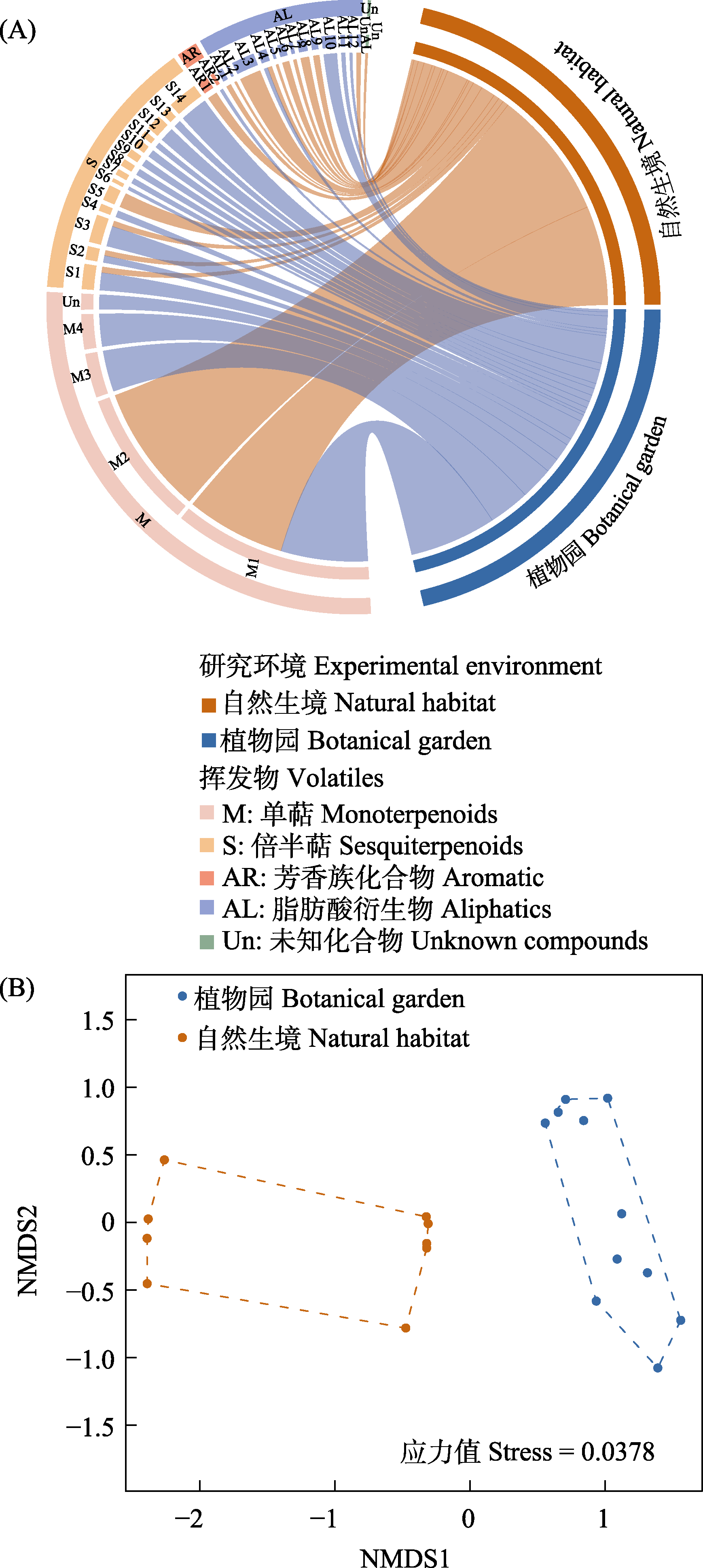
图2 自然生境和植物园雌花期榕果挥发物的弦图(A)和非度量多维尺度(NMDS)分析(B)。两种颜色代表两个生境, 和弦图中柱子宽度代表化合物的含量百分比。化合物距离矩阵基于Bray-Curtis距离。
Fig. 2 Chord diagram and non-metric multidimensional scaling (NMDS) of volatiles of fig at the female flowering stage in natural habitat and botanical garden. The two colors represent two different habitats. In the chord diagram on the left, the width of the columns indicates the percentage content of the compounds. The compound distance matrix on the right is based on Bray-Curtis distance.
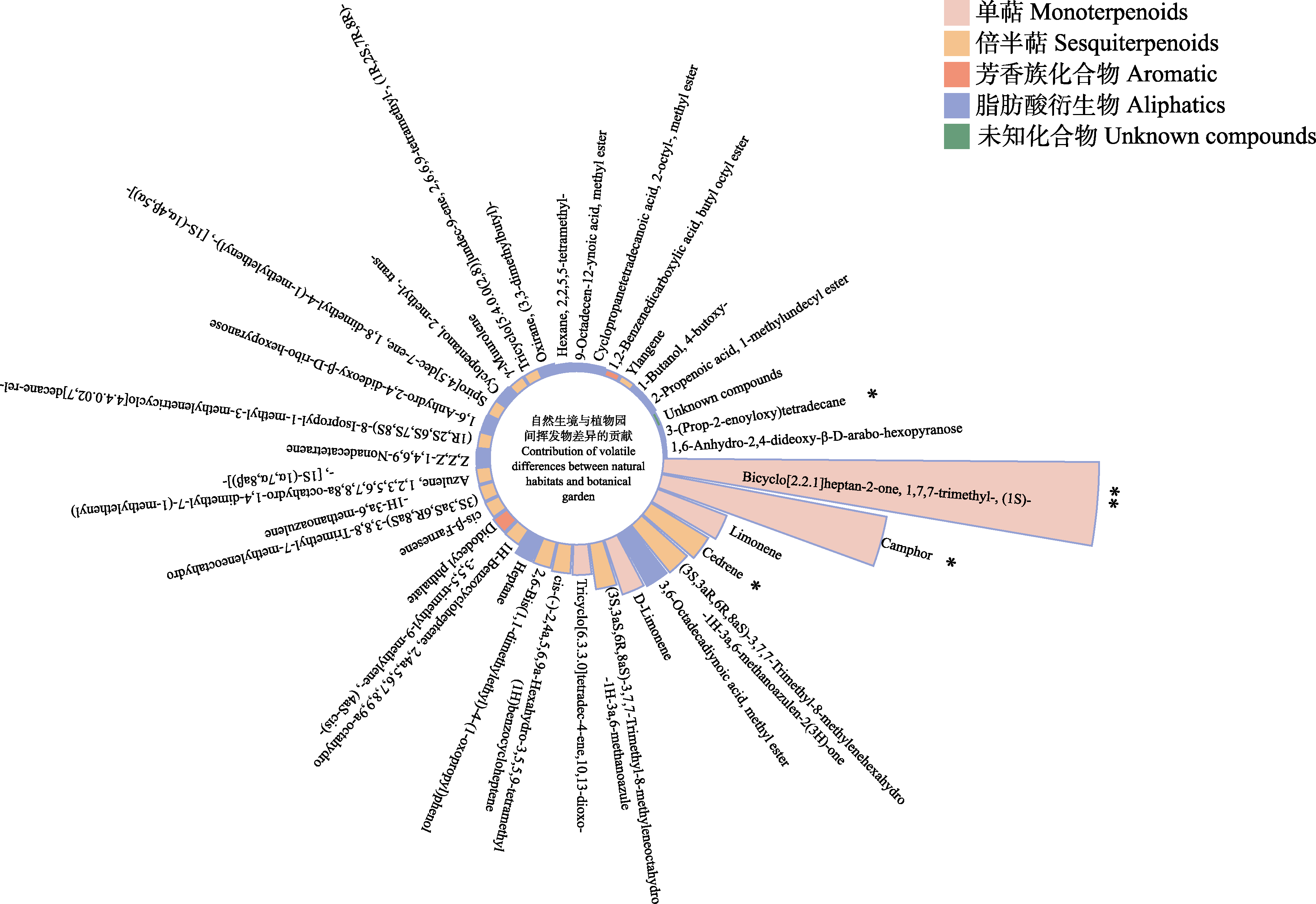
图3 自然生境和植物园大果榕榕果雌花期挥发物贡献度环图。5个颜色代表5个挥发物种类, 各个柱形的面积表示挥发物的贡献度, *代表贡献度显著的程度(* P < 0.05, ** P < 0.01)。
Fig. 3 Contribution of volatiles to natural habitats and botanical garden at the female flowering stage of figs. The 3 colors represent 5 types of volatile compounds, and the area of each bar indicates the contribution of the volatile compounds. * indicates significant contribution levels (* P < 0.05, ** P < 0.01).
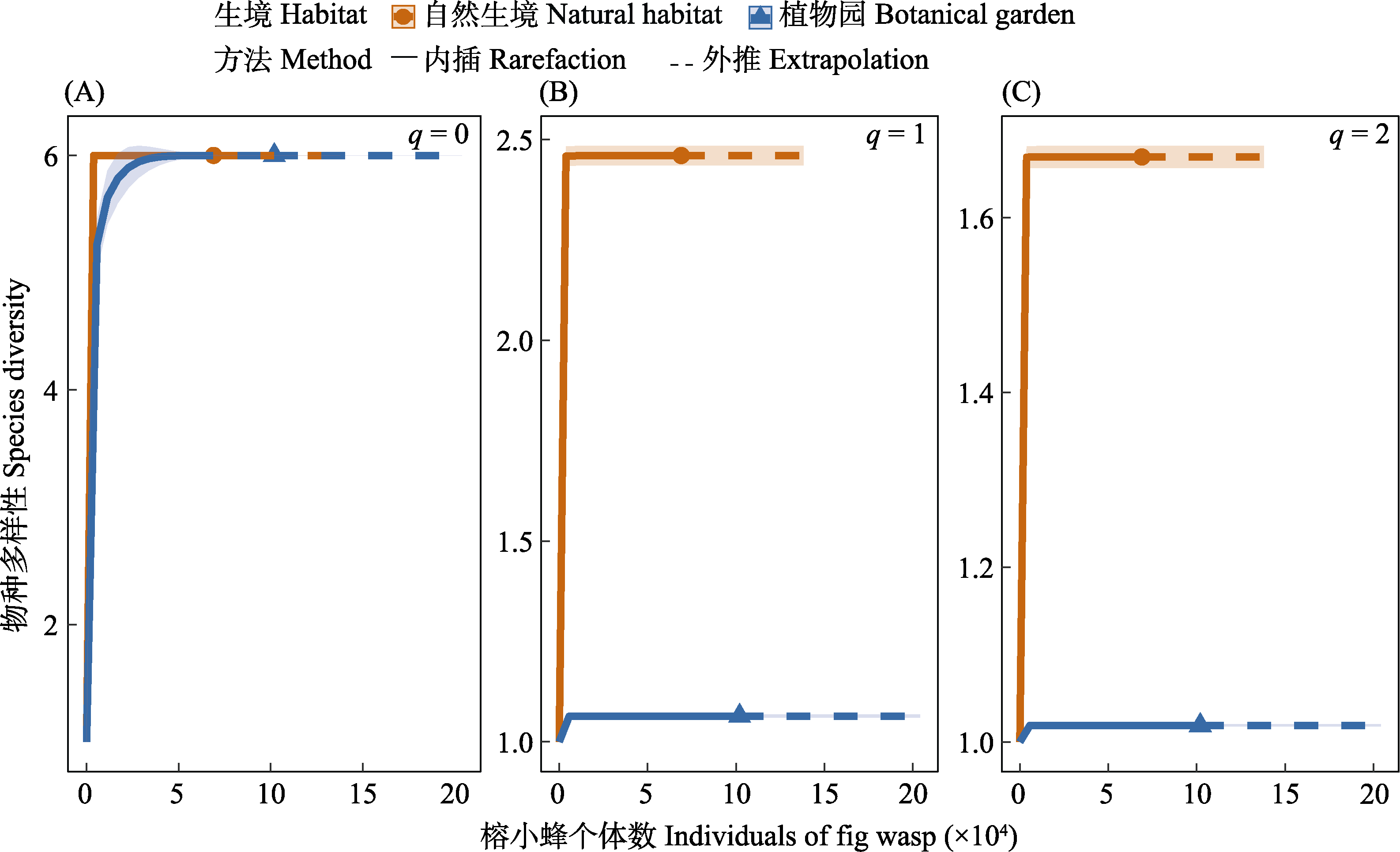
图4 自然生境和植物园大果榕榕小蜂群落采样完整性与物种多样性。希尔数: q = 0, 1, 2分别表示物种丰富度。Shannon多样性指数和Simpson多样性指数。
Fig. 4 Sampling integrity and species diversity of fig wasp communities in natural habitat and botanical garden. Hill numbers with (q = 0, 1, 2) represent species richness, Shannon diversity index and Simpson diversity index, respectively.
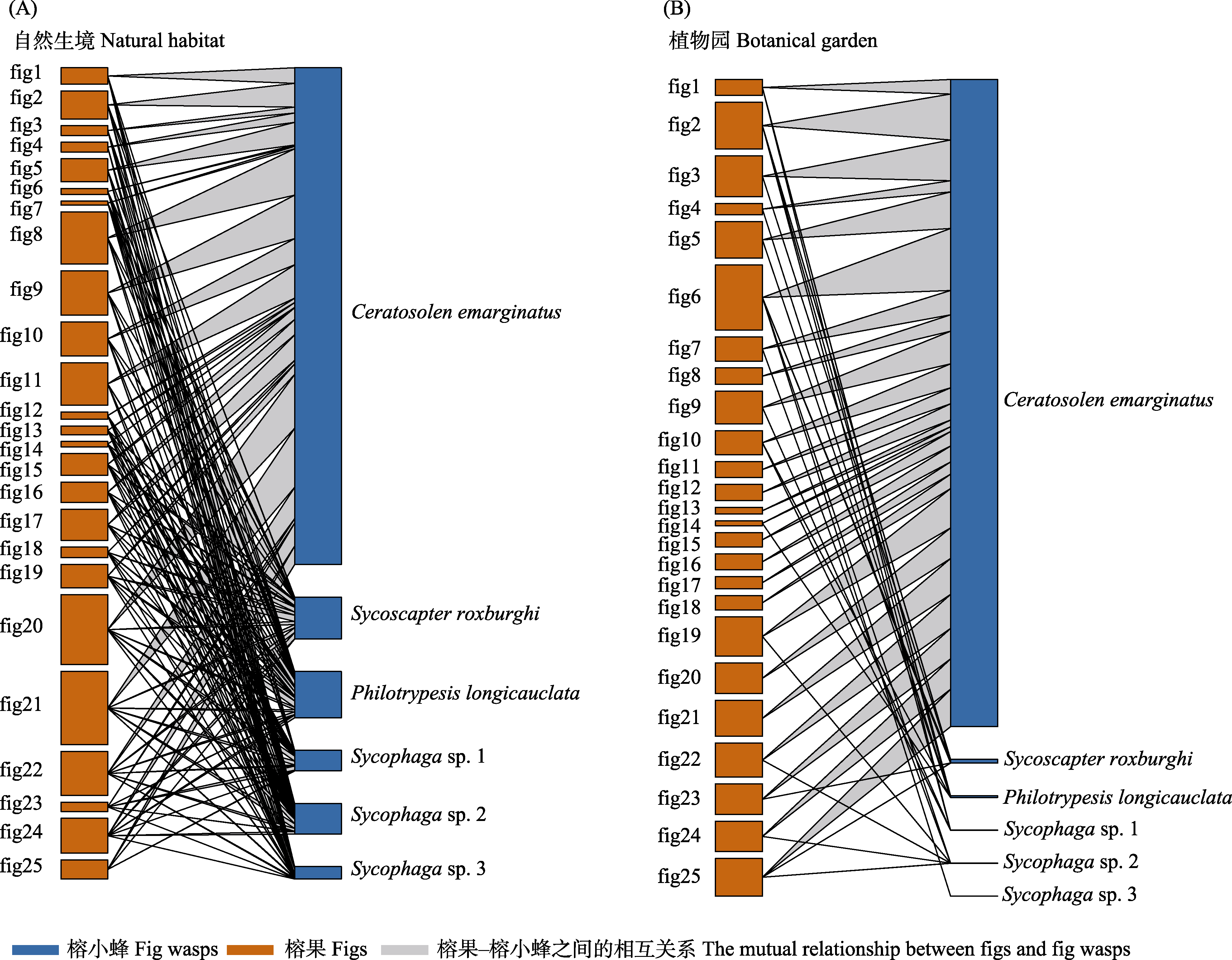
图5 榕果-榕小蜂的互作网络: 自然生境(A)和植物园(B)
Fig. 5 Fig-fig wasp interaction networks: natural habitat (A) and botanical garden (B)
| 互作网络 Interaction networks | 连接度 Connectance | 互作专化度 Specialization | 加权嵌套性 WNODF | 模块性 Modularity | 稳健性 Robustness |
|---|---|---|---|---|---|
| 自然生境 Natural habitat | 0.87 (0.85 ± 0.03) | 0.21 (0.29 ± 0.05) | 35.92 (37.37 ± 4.13) | 0.14 (0.29 ± 0.04) | 0.75 (0.68 ± 0.01) |
| 植物园 Botanical garden | 0.31 (0.33 ± 0.03) | 0.36 (0.78 ± 0.09) | 46.81 (16.37 ± 3.87) | 0.01 (0.04 ± 0.13) | 0.49 (0.40 ± 0.04) |
| 置换检验 Permutation t-test | Z = 6.21, P < 0.05 | Z = -5.99, P < 0.05 | Z = 5.84, P < 0.05 | Z = -3.02, P < 0.05 | Z = 6.14, P < 0.05 |
表2 自然生境和植物园榕果-榕小蜂互作网络的网络参数观测值(重抽样均值 ± 标准差)
Table 2 Parameters of the interaction networks between fig and fig wasp in the natural habitat and the botanical garden. Observed values are shown outside the parentheses, while values in parentheses represent the mean ± standard deviation obtained through resampling. WNODF, Weighted nestedness metric based on overlap and decreasing fill.
| 互作网络 Interaction networks | 连接度 Connectance | 互作专化度 Specialization | 加权嵌套性 WNODF | 模块性 Modularity | 稳健性 Robustness |
|---|---|---|---|---|---|
| 自然生境 Natural habitat | 0.87 (0.85 ± 0.03) | 0.21 (0.29 ± 0.05) | 35.92 (37.37 ± 4.13) | 0.14 (0.29 ± 0.04) | 0.75 (0.68 ± 0.01) |
| 植物园 Botanical garden | 0.31 (0.33 ± 0.03) | 0.36 (0.78 ± 0.09) | 46.81 (16.37 ± 3.87) | 0.01 (0.04 ± 0.13) | 0.49 (0.40 ± 0.04) |
| 置换检验 Permutation t-test | Z = 6.21, P < 0.05 | Z = -5.99, P < 0.05 | Z = 5.84, P < 0.05 | Z = -3.02, P < 0.05 | Z = 6.14, P < 0.05 |
| [1] | Adams RP (2007) Identification of Essential Oil Components by Gas Chromatography/Mass Spectrometry. Allured Publishing Corporation, Carol Stream, Illinois, USA. |
| [2] |
Ameye M, Allmann S, Verwaeren J, Smagghe G, Haesaert G, Schuurink RC, Audenaert K (2018) Green leaf volatile production by plants: A meta-analysis. New Phytologist, 220, 666-683.
DOI PMID |
| [3] | Aung KMM, Dong YY, Wang B, Peng YQ (2020) Geographic variation of fig wasp communities in Ficus racemosa between Xishuangbanna (China) and Mandalay (Myanmar). Wuyi Science Journal, 36, 16-28. (in Chinese with English abstract) |
| [Khin Me Me Aung, 董乙乂, 王波, 彭艳琼 (2020) 聚果榕小蜂群落在中国西双版纳和缅甸曼德勒之间的地理变异. 武夷科学, 36, 16-28.] | |
| [4] |
Bai LF, Yang DR, Shi ZH, Peng YQ, Zhai SW (2006) Community structure of fig wasp in Ficus benjamina in different habitats. Biodiversity Science, 14, 340-344. (in Chinese)
DOI URL |
|
[白莉芬, 杨大荣, 石章红, 彭艳琼, 翟树伟 (2006) 垂叶榕隐头果内小蜂群落结构与生境关系的初步研究. 生物多样性, 14, 340-344.]
DOI |
|
| [5] |
Chao A, Gotelli NJ, Hsieh TC, Sander EL, Ma KH, Colwell RK, Ellison AM (2014) Rarefaction and extrapolation with Hill numbers: A framework for sampling and estimation in species diversity studies. Ecological Monographs, 84, 45-67.
DOI URL |
| [6] | Chen C (2021) Identification of Active Components of Semiochemicals and Functional Analysis of Key Odorant-binding Proteins in Pagiophloeus tsushimanus. PhD dissertation, Nanjing Forestry University, Nanjing. (in Chinese with English abstract) |
| [陈聪 (2021) 香樟齿喙象信息化学物质的活性组分鉴定及其关键气味结合蛋白的功能分析. 博士学位论文, 南京林业大学, 南京.] | |
| [7] | Chen C, Song QS, Zhang GM, Peng YQ, Wang QY, Yang DR (2004) Chemical attraction of fig volatiles to their pollinating fig wasps. Acta Ecologica Sinica, 2794-2798. (in Chinese with English abstract) |
| [陈春, 宋启示, 张光明, 彭艳琼, 王秋艳, 杨大荣 (2004) 榕果挥发物对传粉榕小蜂的吸引作用. 生态学报, 2794-2798.] | |
| [8] | Chen MB, Wang G, Peng YQ, Wang B (2023) Floral volatile diversity and correlation to the phylogeny among six sympatric dioecious Ficus. Journal of Environmental Entomology, 45, 595-602. (in Chinese with English abstract) |
| [陈明波, 王刚, 彭艳琼, 王波 (2023) 六种同域分布雌雄异株榕树挥发物多样性与系统发育一致性. 环境昆虫学报, 45, 595-602.] | |
| [9] | Chen YF (2019) Comparative Study of the Key Ecological Characters in Fig-fig Wasps. PhD dissertation, South China Botanical Garden, Chinese Academy of Sciences, Guangzhou. (in Chinese with English abstract) |
| [程玉芬 (2019) 榕树-榕小蜂关键生态适应性状的比较研究. 博士学位论文, 中国科学院华南植物园, 广州.] | |
| [10] | Dong YY, Peng YQ, Wang B (2020) Seasonal dynamics of fig wasp community and interaction networks in Ficus benjamina. Biodiversity Science, 28, 496-503. (in Chinese with English abstract) |
|
[董乙乂, 彭艳琼, 王波 (2020) 垂叶榕榕小蜂群落及种间互作网络季节动态. 生物多样性, 28, 496-503.]
DOI |
|
| [11] | Duan ZB, Peng YQ, Yang DR, Xu L (2005) Fig wasp community in the syconia of Ficus altissima. Acta Ecologica Sinica, 25, 2589-2594. (in Chinese with English abstract) |
| [段柱标, 彭艳琼, 杨大荣, 徐磊 (2005) 高榕隐头果内小蜂群落的动态变化. 生态学报, 25, 2589-2594.] | |
| [12] |
Farache FHA, Cruaud A, Rasplus JY, Cerezini MT, Rattis L, Kjellberg F, Pereira RAS (2018) Insights into the structure of plant-insect communities: Specialism and generalism in a regional set of non-pollinating fig wasp communities. Acta Oecologica, 90, 49-59.
DOI URL |
| [13] | Feng ZR, Chen YC, Peng YQ, Li L, Wang B (2023) Ecological network analysis: From metacommunity to metanetwork. Biodiversity Science, 31, 135-146. (in Chinese with English abstract) |
| [冯志荣, 陈有城, 彭艳琼, 李莉, 王波 (2023) 生态网络分析: 从集合群落到集合网络. 生物多样性, 31, 135-146.] | |
| [14] |
Firn RD, Jones CG (2003) Natural products—A simple model to explain chemical diversity. Natural Product Reports, 20, 382-391.
DOI URL |
| [15] |
Fox JF (1979) Intermediate-Disturbance Hypothesis. Science, 204, 1344-1345.
PMID |
| [16] |
Gu D, Peng YQ, Yang DR (2012) Convergence in host recognition behavior between obligate pollinating fig wasps and non-pollinating fig wasps. Biodiversity Science, 20, 324-329 (in Chinese with English abstract)
DOI |
|
[顾丁, 彭艳琼, 杨大荣 (2012) 传粉榕小蜂与非传粉小蜂间寄主识别行为的趋同进化. 生物多样性, 20, 324-329.]
DOI |
|
| [17] | Herre EA (2000) Laws governing species interactions? Encouragement and caution from figs and their associates. In: Levels of Selection in Evolution (ed. Keller L), pp.209-237. Princeton University Press. Princeton, New Jersey. |
| [18] |
Hsieh TC, Ma KH, Chao A (2016) iNEXT: An R package for rarefaction and extrapolation of species diversity (Hill numbers). Methods in Ecology and Evolution, 7, 1451-1456.
DOI URL |
| [19] | Hutchinson GE (1957) Concluding remarks. Cold Spring Harbor Symposia on Quantitative Biology, 22, 239. |
| [20] |
Jevanandam N, Goh AGR, Corlett RT (2013) Climate warming and the potential extinction of fig wasps, the obligate pollinators of figs. Biology Letters, 9, 20130041.
DOI URL |
| [21] | Jia S, Wen P, Peng YQ (2024) Characteristics of volatile organic compounds emitted during different floral phases of Ficus auriculata. Wuyi Science Journal, 40, 12-20. (in Chinese with English abstract) |
| [贾珊, 文平, 彭艳琼 (2024) 大果榕不同花期释放挥发性有机化合物的特点. 武夷科学, 40, 12-20.] | |
| [22] |
Kachroo A, Kachroo P (2009) Fatty acid-derived signals in plant defense. Annual Review of Phytopathology, 47, 153-176.
DOI PMID |
| [23] |
Kerdelhue C, Rossi JP, Rasplus JY (2000) Comparative community ecology studies on old world figs and fig wasps. Ecology, 81, 2832.
DOI URL |
| [24] | Li ZB, Yang P, Peng YQ, Yang DR (2012) Components and spatial variations in the emission of volatiles by figs of Ficus auriculata before and after pollination. Journal of Yunnan University (Natural Sciences Edition), 34, 90-98. (in Chinese with English abstract) |
| [李宗波, 杨培, 彭艳琼, 杨大荣 (2012) 木瓜榕隐头果传粉前后挥发性化合物构成及其变化规律. 云南大学学报(自然科学版), 34, 90-98.] | |
| [25] | Liu CR, Ma KP, Chen LZ (2002) Nestedness: Methods, mechanisms and implications for biological conservation. Acta Phytoecologica Sinica, 26, 68-72. (in Chinese with English abstract) |
| [刘灿然, 马克平, 陈灵芝 (2002) 嵌套性: 研究方法、形成机制及其对生物保护的意义. 植物生态学报, 26, 68-72.] | |
| [26] | Liu FJ, Yu S, Liu G (2023) Mechanism and research progress of plant lipid regulation under biotic and abiotic stresses. Chinese Journal of Oil Crop Sciences, 45, 1062-1072. (in Chinese with English abstract) |
|
[刘凤娇, 于耸, 刘冠 (2023) 生物与非生物逆境胁迫下植物脂质调控机制及其研究进展. 中国油料作物学报, 45, 1062-1072.]
DOI |
|
| [27] | Liu SJ, Jin YJ, Zhong SX, Luo YQ, Yao GL (2011) Comparison and determination of volatile compounds from Hippophae rhamnoides in natural forests and plantations. Journal of Beijing Forestry University, 33, 139-142. (in Chinese with English abstract) |
| [刘书景, 金幼菊, 宗世祥, 骆有庆, 姚国龙 (2011) 沙棘天然林与人工林挥发物的比较分析. 北京林业大学学报, 33, 139-142.] | |
| [28] | Liu WX, Liu ZP, Xie WG, Wang YR (2014) Responses of fatty acid and its derivatives to stress in plants. Pratacultural Science, 31, 1556-1565. (in Chinese with English abstract) |
| [刘文献, 刘志鹏, 谢文刚, 王彦荣 (2014) 脂肪酸及其衍生物对植物逆境胁迫的响应. 草业科学, 31, 1556-1565.] | |
| [29] |
Matsui K (2006) Green leaf volatiles: Hydroperoxide lyase pathway of oxylipin metabolism. Current Opinion in Plant Biology, 9, 274-280.
DOI PMID |
| [30] | Mckey D (1979) The distribution of secondary compounds within plants. In: Herbivores: Their Interaction with Secondary Plant Metabolites (eds Rosenthal GA, Berenbaum MR). Academic Press, New York. |
| [31] | Niu YQ, Wang MX, Cui L, Ye HX, Pan C, Han BY (2015) Control of the tea green leafhopper via volatile compounds of rosemary: The potential for further development of a Push-Pull strategy. Acta Ecologica Sinica, 35, 2380-2387. (in Chinese with English abstract) |
| [钮羽群, 王梦馨, 崔林, 叶火香, 潘铖, 韩宝瑜 (2015) 迷迭香挥发物不同组合对假眼小绿叶蝉行为的调控. 生态学报, 35, 2380-2387.] | |
| [32] |
Ollerton J, Winfree R, Tarrant S (2011) How many flowering plants are pollinated by animals? Oikos, 120, 321-326.
DOI URL |
| [33] | Peng YQ, Yang DR, Wang QY, Zhou F, Luo JR (2002) On the structure and distribution of the insect communities of Ficus auriculata. Acta Entomologica Sinica, 45, 629-635 (in Chinese with English abstract) |
| [彭艳琼, 杨大荣, 王秋艳, 周芳, 罗进荣 (2002) 木瓜榕上昆虫群落结构及分布特征. 昆虫学报, 45, 629-635.] | |
| [34] |
Proffit M, Schatz B, Borges RM, Hossaert-Mckey M (2007) Chemical mediation and niche partitioning in non-pollinating fig-wasp communities. Journal of Animal Ecology, 76, 296-303.
DOI PMID |
| [35] |
Segar ST, Pereira RAS, Compton SG, Cook JM (2013) Convergent structure of multitrophic communities over three continents. Ecology Letters, 16, 1436-1445.
DOI PMID |
| [36] | Song CF (2022) Bioactivities of Volatiles from Non-host Plant Pelargonium × hortorum in Plutella xylostella Larvae and Effects on Olfactory Behavior in Adults. PhD dissertation, Shanxi Agricultural University, Taigu, Shanxi. (in Chinese with English abstract) |
| [宋程飞 (2022) 非寄主植物天竺葵挥发物对小菜蛾幼虫的生物活性及对成虫的嗅觉行为研究. 博士学位论文, 山西农业大学, 山西太谷.] | |
| [37] |
Stephens RE, Gallagher RV, Dun L, Cornwell W, Sauquet H (2023) Insect pollination for most of angiosperm evolutionary history. New Phytologist, 240, 880-891.
DOI PMID |
| [38] |
Sun BF, Wang RW, Hu Z (2008) Diet segregation of fig wasps and the stability of fig-fig wasp mutualism. Biodiversity Science, 16, 525-532. (in Chinese with English abstract)
DOI URL |
|
[孙宝发, 王瑞武, 胡忠 (2008) 榕小蜂食性分化与榕树-榕小蜂系统稳定性. 生物多样性, 16, 525-532.]
DOI |
|
| [39] | Tang LC, Zhao YL, Mao L, Li AL (2012) Progress on fatty acids and their derivatives-mediated signaling pathways in plant disease resistance. Journal of Henan Normal University (Natural Science Edition), 40, 127-131. (in Chinese with English abstract) |
| [汤丽川, 赵永亮, 毛龙, 李爱丽 (2012) 植物脂肪酸及其衍生物防御信号研究进展. 河南师范大学学报(自然科学版), 40, 127-131.] | |
| [40] | Tong ZY, Wu LY, Feng HH, Zhang M, Armbruster WS, Renner SS, Huang SQ (2023) New calculations indicate that 90% of flowering plant species are animal-pollinated. National Science Review, 10, nwad219. |
| [41] | Wang B (2022) Mechanisms underlying Multitrophic Fig Wasp Community Assembly. Xishuangbanna Tropical Botanical Garden, Chinese Academy of Sciences, Xishuangbanna, China, Menglun, Yunnan. |
| [王波 (2022) 多营养级榕小蜂群落构建机制. 中国科学院西双版纳热带植物园, 云南勐仑.] | |
| [42] |
Wang B, Ma LB, Pan B, Dong YY, Huang JF, Peng YQ (2022) Spatial variation in ant-tree bipartite networks is driven by a bottom-up process. Ecological Entomology, 47, 1011-1021.
DOI URL |
| [43] | Wang JB, San LS, Xie TT, Yang BS, Shi YT, He C (2024) Variations in leaf functional traits of Nitraria species introduced from the wild to a common garden. Chinese Journal of Grassland, 46, 47-55. (in Chinese with English abstract) |
| [王剑博, 单立山, 解婷婷, 杨彪生, 师亚婷, 何彩 (2024) 野外白刺引种至同质园叶片功能性状变异研究. 中国草地学报, 46, 47-55.] | |
| [44] | Wang WX, Li SG, Bai XF, Du YG (2004) Functions of unsaturated fatty acid and derivate in plant defense reactions. Plant Physiology Communications, 741-748. (in Chinese with English abstract) |
| [王文霞, 李曙光, 白雪芳, 杜昱光 (2004) 不饱和脂肪酸及其衍生物在植物抗逆反应中的作用. 植物生理学通讯, 741-748.] | |
| [45] | Wei ZD, Peng YQ, Xu L, Yang DR (2005) Impact of Oecophylla smaragina on the percentage number of offspring of pollinator and non-pollinating wasps on Ficus racemosa. Zoological Research, 26, 386-390. (in Chinese with English abstract) |
| [魏作东, 彭艳琼, 徐磊, 杨大荣 (2005) 聚果榕上黄猄蚁对传粉小蜂和非传粉小蜂后代数量的影响. 动物学研究, 26, 386-390.] | |
| [46] | Xu L, Yang DR (2008) A brief review of phylogenetic reconstruction and co-evolution of fig-wasp mutualism. Biodiversity Science, 446-453. (in Chinese with English abstract) |
| [徐磊, 杨大荣 (2008) 榕树及其传粉榕小蜂的系统发育和协同进化研究现状及展望. 生物多样性, 446-453.] | |
| [47] | Xu ZF (1994) Ficus microcarpa—A key plant in the tropical rain forest ecosystem of southern Yunnan. Chinese Biodiversity, 2, 21-23. (in Chinese) |
| [许再富 (1994) 榕树——滇南热带雨林生态系统中的一类关键植物. 生物多样性, 2, 21-23.] | |
| [48] | Zhang Q, Chen Y, Huang QM (2018) Research advances in the defense signaling pathway and transcription factors mediated by plant unsaturated fatty acid derivatives under abiotic stress. Molecular Plant Breeding, 16, 1494-1502. (in Chinese with English abstract) |
| [张琦, 陈瑶, 黄乾明 (2018) 逆境胁迫下植物不饱和脂肪酸衍生物介导的防卫信号途径及转录因子研究进展. 分子植物育种, 16, 1494-1502.] | |
| [49] |
Zhang XT, Wang G, Zhang SC, Chen S, Wang YB, Wen P, Ma XK, Shi Y, Qi R, Yang Y, Liao ZY, Lin J, Lin JS, Xu XM, Chen XQ, Xu XD, Deng F, Zhao LH, Lee YL, Wang R, Chen XY, Lin YR, Zhang JS, Tang HB, Chen J, Ming R (2020) Genomes of the banyan tree and pollinator wasp provide insights into fig-wasp coevolution. Cell, 183, 875-889.
DOI PMID |
| [50] | Zhao XN, Liu LH, Gao SY, Sheng CY, Tang JW (1995) A study of the zonation pattern and stratification pattern of Shorea chinensis population in Xishuangbanna. Yunnan. Acta Botanica Yunnanica, 17, 33-40. (in Chinese) |
| [赵学农, 刘伦辉, 高圣义, 盛才余, 唐继武 (1995) 西双版纳望天树种群带状与分层格局. 云南植物研究, 17, 33-40.] | |
| [51] | Zhou YXQ, Guo P, Liu LN, Wang XY, Ma LP, Han LL, Han XY, Luo ZW (2024) Resources of Flower Visiting Insects in Different Habitats of Fujin National Wetland Park and Its Diversity. Modern Agricultural Science and Technology, (2), 156-159, 168. (in Chinese with English abstract) |
| [周亚星乔, 郭鹏, 刘丽娜, 王雪盈, 马立苹, 韩丽丽, 韩晓云, 罗志文 (2024) 富锦国家湿地公园不同生境访花昆虫资源及其多样性. 现代农业科技, (2), 156-159, 168.] |
| [1] | 陈小勇. 珍稀濒危植物有效迁地保护: 概念、标准和建议[J]. 生物多样性, 2026, 34(4): 25448-. |
| [2] | 金冬梅, 何拓, 董晖, 马其侠, 胡永红. 我国植物园体系如何更好地践行植物多样性保护?[J]. 生物多样性, 2025, 33(6): 24441-. |
| [3] | 何拓, 周志华, 董晖, 郭立新, 郑苗淼, 王泳腾, 秦亚龙, 顾钰峰, 袁良琛, 廖景平. 全球国家植物园发展现状与启示: 兼论中国国家植物园体系建设路径[J]. 生物多样性, 2025, 33(11): 25310-. |
| [4] | 胡志清, 董路. 城市化对鸟类参与的种间互作的影响[J]. 生物多样性, 2024, 32(8): 24048-. |
| [5] | 冯志荣, 陈明波, 杨小芳, 王刚, 董乙乂, 彭艳琼, 陈华燕, 王波. 榕树繁育系统及榕小蜂资源利用塑造了榕小蜂群落[J]. 生物多样性, 2024, 32(3): 23307-. |
| [6] | 刘夙, 杜诚, 胡永红. 迁地保护应当具有明确的灵活性[J]. 生物多样性, 2024, 32(2): 24037-. |
| [7] | 陈进, 杨玺. 关于植物迁地保护若干问题的讨论[J]. 生物多样性, 2024, 32(2): 24064-. |
| [8] | 冯晨, 张洁, 黄宏文. 统筹植物就地保护与迁地保护的解决方案: 植物并地保护(parallel situ conservation)[J]. 生物多样性, 2023, 31(9): 23184-. |
| [9] | 文世峰, 周志华, 何拓, 董晖, 袁良琛, 卢泽洋, 王泳腾, 郭琳, 舒江平, 李开凡. 《国家植物园体系布局方案》编制背景、程序、思路和重点考虑[J]. 生物多样性, 2023, 31(9): 23193-. |
| [10] | 任海, 何拓, 文世峰, 董晖. 中国特色、世界一流国家植物园的主要特征[J]. 生物多样性, 2023, 31(9): 23192-. |
| [11] | 李仕裕, 张奕奇, 邹璞, 宁祖林, 廖景平. 广东省植物园植物多样性迁地保护现状及发展建议[J]. 生物多样性, 2023, 31(6): 22647-. |
| [12] | 王利松, 湛青青, 廖景平, 黄宏文. 我国迁地保护的国家重点保护、受威胁和特有维管植物多样性[J]. 生物多样性, 2023, 31(2): 22495-. |
| [13] | 王朝雅, 李金涛, 刘畅, 王波, 苗白鸽, 彭艳琼. 西双版纳热带植物园蝴蝶多样性稳定的年际变化及幼虫与植物的互作网络结构[J]. 生物多样性, 2023, 31(12): 23305-. |
| [14] | 许再富. 对国家植物园体系建设“统筹原则”的一些见解[J]. 生物多样性, 2023, 31(1): 22470-. |
| [15] | 任海, 文香英, 廖景平, 郑祥慈, 杨明, 周桔. 试论植物园功能变迁与中国国家植物园体系建设[J]. 生物多样性, 2022, 30(4): 22113-. |
| 阅读次数 | ||||||
|
全文 |
|
|||||
|
摘要 |
|
|||||
备案号:京ICP备16067583号-7
Copyright © 2026 版权所有 《生物多样性》编辑部
地址: 北京香山南辛村20号, 邮编:100093
电话: 010-62836137, 62836665 E-mail: biodiversity@ibcas.ac.cn
