

生物多样性 ›› 2026, Vol. 34 ›› Issue (2): 25327. DOI: 10.17520/biods.2025327 cstr: 32101.14.biods.2025327
周铝1( ), 姚世贸1, 赵战合2, 郭画1(), 田成1,*()(
 )
)
收稿日期:2025-08-17
接受日期:2026-01-08
出版日期:2026-02-20
发布日期:2026-03-23
通讯作者:
田成
基金资助:
Lü Zhou1(), Shimao Yao1, Zhanhe Zhao2, Hua Guo1(), Cheng Tian1,*()()
Received:2025-08-17
Accepted:2026-01-08
Online:2026-02-20
Published:2026-03-23
Contact:
Cheng Tian
Supported by:摘要:
探究狍(Capreolus pygargus)与野猪(Sus scrofa)的生态位分化与共存机制, 对于理解我国华北地区物种种间作用机制及指导保护区生态系统管理具有重要的理论与实践意义。本研究基于2023年8月至2024年11月的40台红外相机监测数据, 运用集合模型、核密度估计法、日活动差异指数(α)和昼行性指数(β)等多种方法系统解析了山西庞泉沟国家级自然保护区同域分布狍和野猪的时空分布及共存格局。结果显示: (1) 40台红外相机累计工作15,880个工作日, 获取可识别独立有效照片7,116张, 其中狍2,344张、野猪192张。(2)两物种均呈现昼行性双峰活动模式(狍β = 0.63, 野猪β = 0.71), 每月日活动差异不显著(P > 0.05), 日活动节律重叠存在显著差异(Δ4 = 0.85; 95% CI: 0.81-0.87; P < 0.05), 狍晨间活动高峰较野猪延迟1-2 h, 下午活动高峰期近乎相同, 表明二者通过时间生态位的分化而减少竞争。(3)集合模型对二者分布预测效果良好。狍与野猪的适宜栖息地主要集中于保护区中部, 狍适宜栖息地面积为71.64 km2, 占保护区总面积的67.06%; 野猪适宜栖息地面积为59.08 km2, 占比56.91%, 二者生态位重叠程度较高(Schoener’s D = 0.70)。(4)人为干扰、归一化植被指数和等温性是影响二者分布的关键因素。其中狍和野猪的出现概率随等温性升高显著下降, 与归一化植被指数呈正相关, 与人类干扰呈先下降后上升的非线性关系。本研究揭示了狍与野猪日活动节律、空间分布、环境响应及共存格局, 为保护区内狍和野猪的保护与管理提供了理论依据, 同时填补了庞泉沟国家级自然保护区有蹄类物种间时空分布和共存格局的研究空白。
周铝, 姚世贸, 赵战合, 郭画, 田成 (2026) 庞泉沟国家级自然保护区狍和野猪时空共存格局. 生物多样性, 34, 25327. DOI: 10.17520/biods.2025327.
Lü Zhou, Shimao Yao, Zhanhe Zhao, Hua Guo, Cheng Tian (2026) Spatiotemporal coexistence patterns of Capreolus pygargus and Sus scrofa in Pangquangou National Nature Reserve. Biodiversity Science, 34, 25327. DOI: 10.17520/biods.2025327.
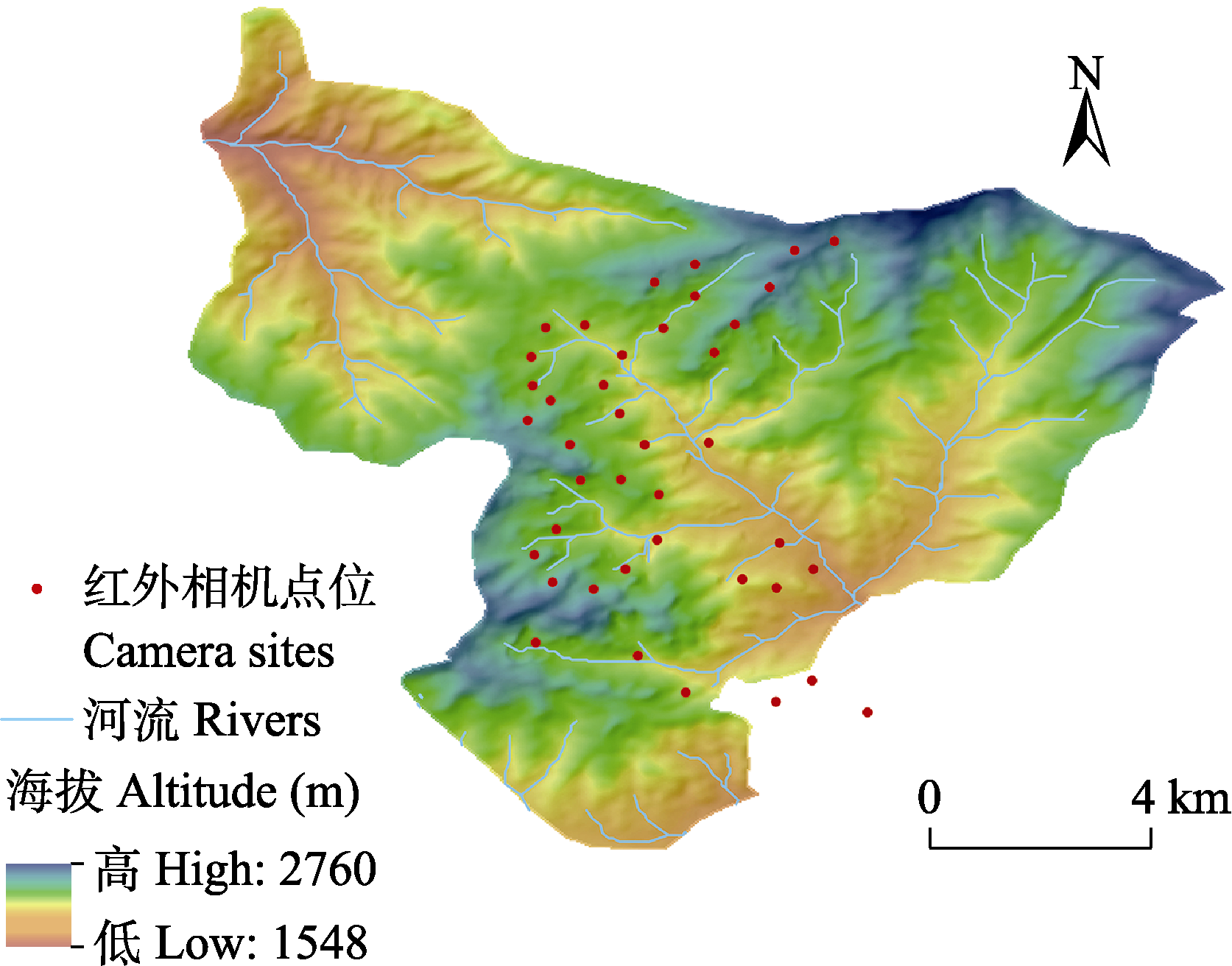
图1 庞泉沟国家级自然保护区40台红外相机分布图
Fig. 1 Distribution map of 40 infrared cameras in Pangquangou National Nature Reserve
| 变量类型 Variable type | 变量名称 Variable |
|---|---|
| 气候变量 Climatic variables | 等温性 Isothermality (BIO3) |
| 最湿月降水量 Precipitation of wettest month (BIO13) | |
| 最干月降水量 Precipitation of driest month (BIO14) | |
| 降水季节性 Precipitation seasonality (BIO15) | |
| 最干季降水量 Precipitation of driest quarter (BIO17) | |
| 地形变量 Topographic variables | 坡度 Slope (Slope) |
| 坡向 Aspect (Aspect) | |
| 人为活动变量 Human activity variables | 人类干扰指数 Human influence index (HII) |
| 生物变量 Biotic variables | 归一化植被指数 Normalized difference vegetation index (NDVI) |
表1 用于模型构建的环境因子
Table 1 Environmental factors used for model construction
| 变量类型 Variable type | 变量名称 Variable |
|---|---|
| 气候变量 Climatic variables | 等温性 Isothermality (BIO3) |
| 最湿月降水量 Precipitation of wettest month (BIO13) | |
| 最干月降水量 Precipitation of driest month (BIO14) | |
| 降水季节性 Precipitation seasonality (BIO15) | |
| 最干季降水量 Precipitation of driest quarter (BIO17) | |
| 地形变量 Topographic variables | 坡度 Slope (Slope) |
| 坡向 Aspect (Aspect) | |
| 人为活动变量 Human activity variables | 人类干扰指数 Human influence index (HII) |
| 生物变量 Biotic variables | 归一化植被指数 Normalized difference vegetation index (NDVI) |
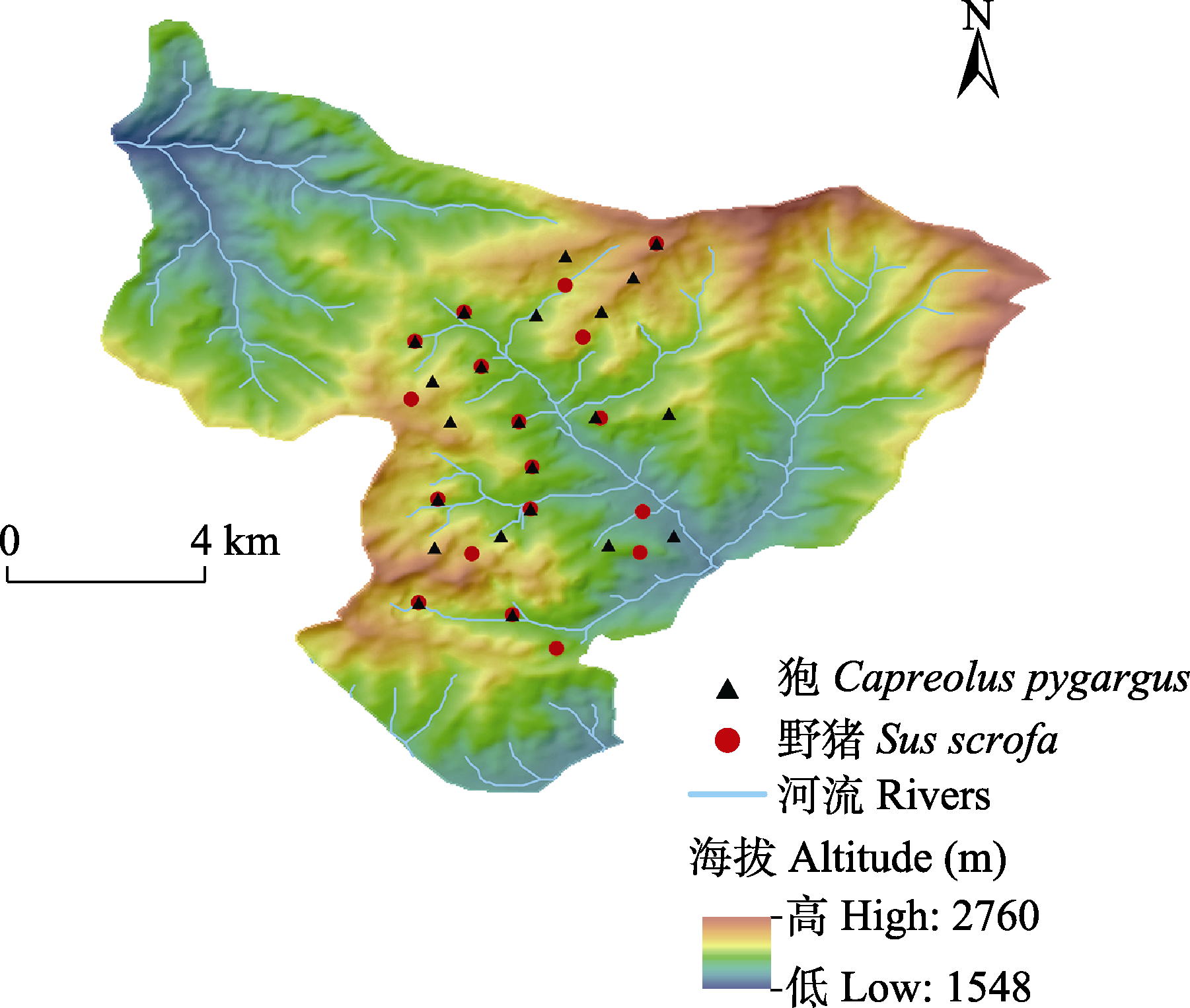
图2 狍和野猪有效分布点位
Fig. 2 Valid occurrence locations of Capreolus pygargus and Sus scrofa
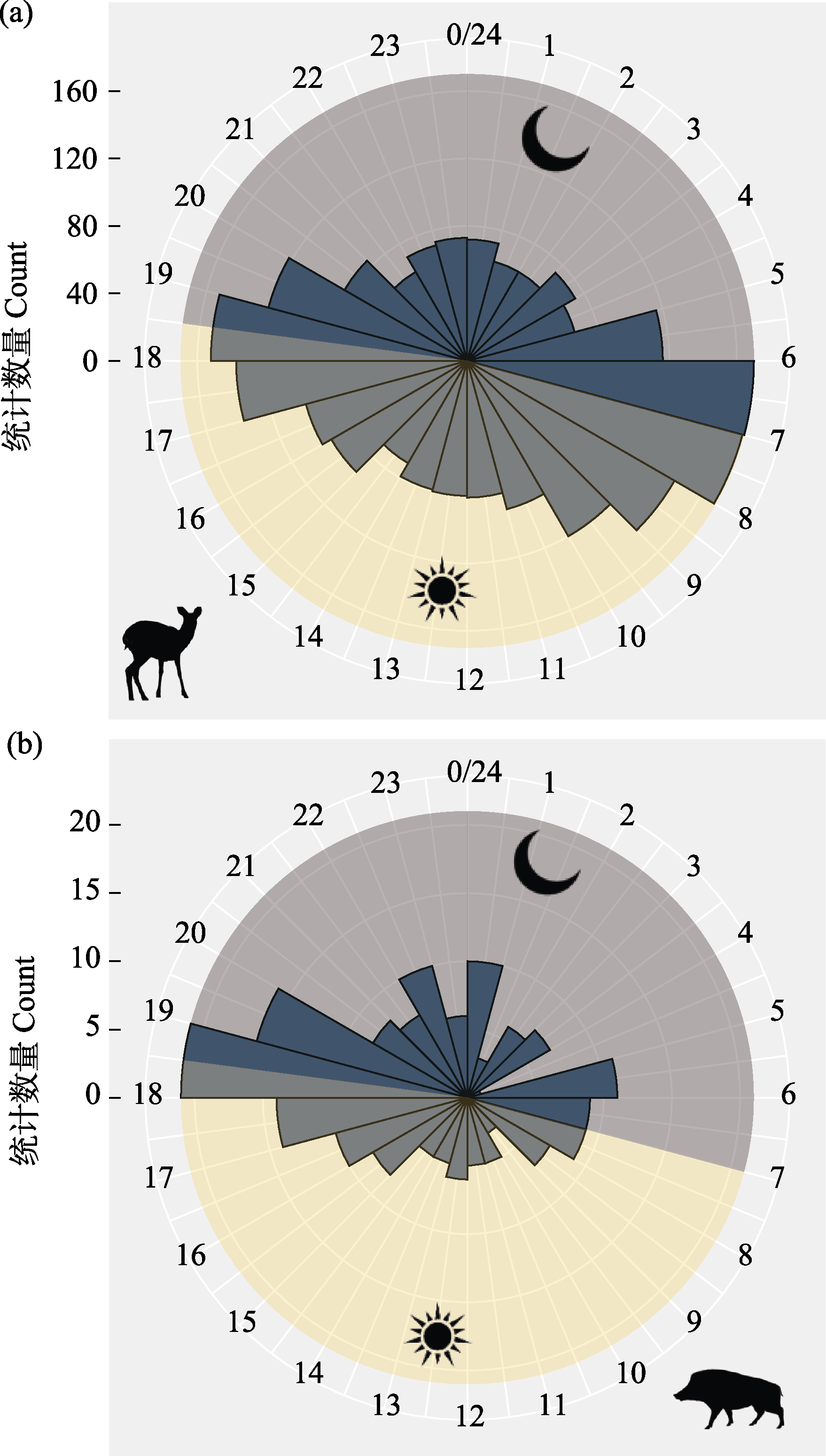
图3 狍(a)与野猪(b)的日活动节律。根据实地调查, 庞泉沟国家级自然保护区每日日出时间为7:00, 日落时间为18:30, 故图中白天与黑夜时间设置分割线为7:00和18:30。
Fig. 3 The daily activity rhythms of Capreolus pygargus (a) and Sus scrofa (b). According to the field investigation, the daily sunrise time at Pangquangou National Nature Reserve is 7:00 and the sunset time is 18:30. Therefore, the dividing line for daytime and nighttime in the figure is set at 7:00 and 18:30.
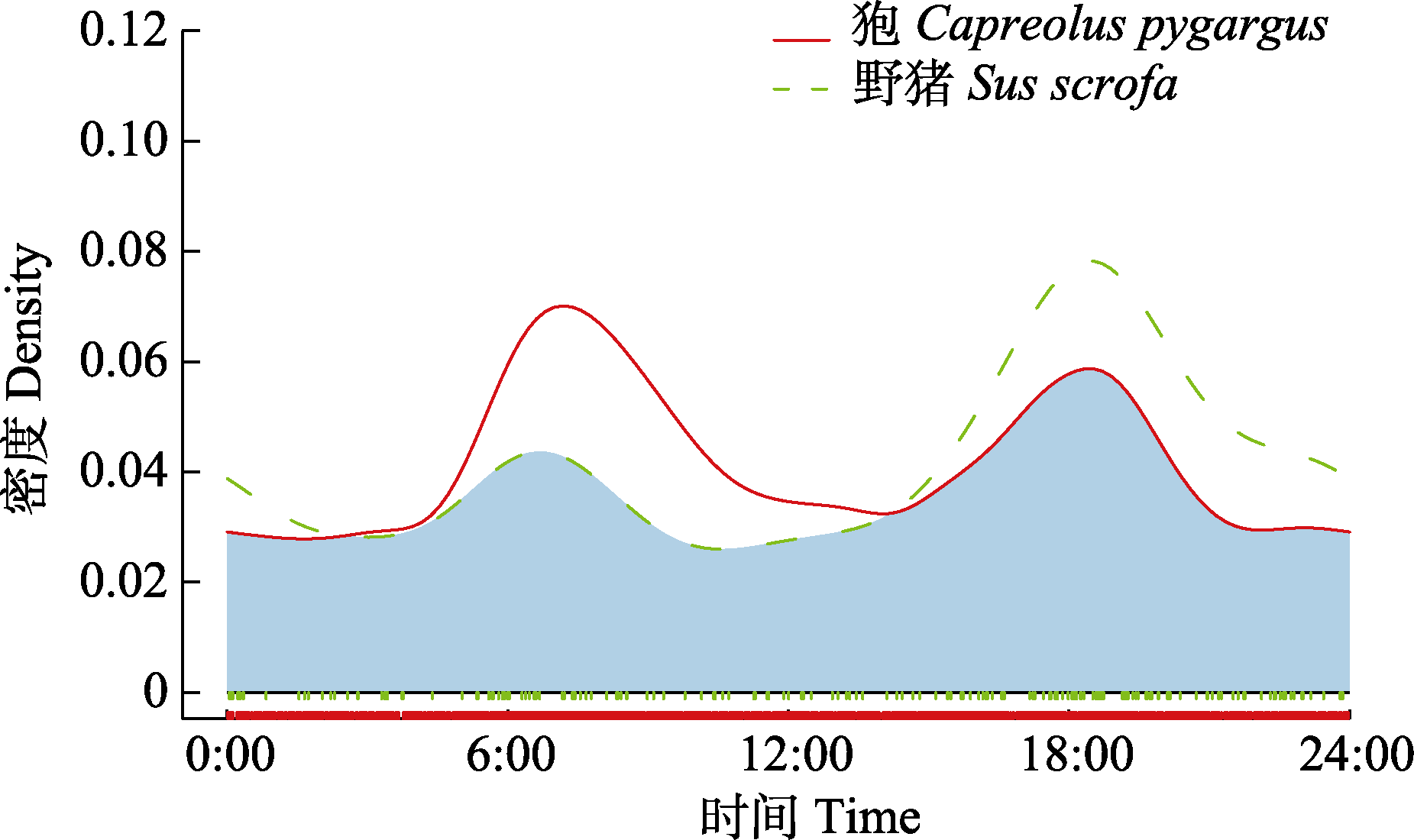
图4 狍和野猪日活动节律重叠图
Fig. 4 Overlap plot of the daily activity rhythms of Capreolus pygargus and Sus scrofa
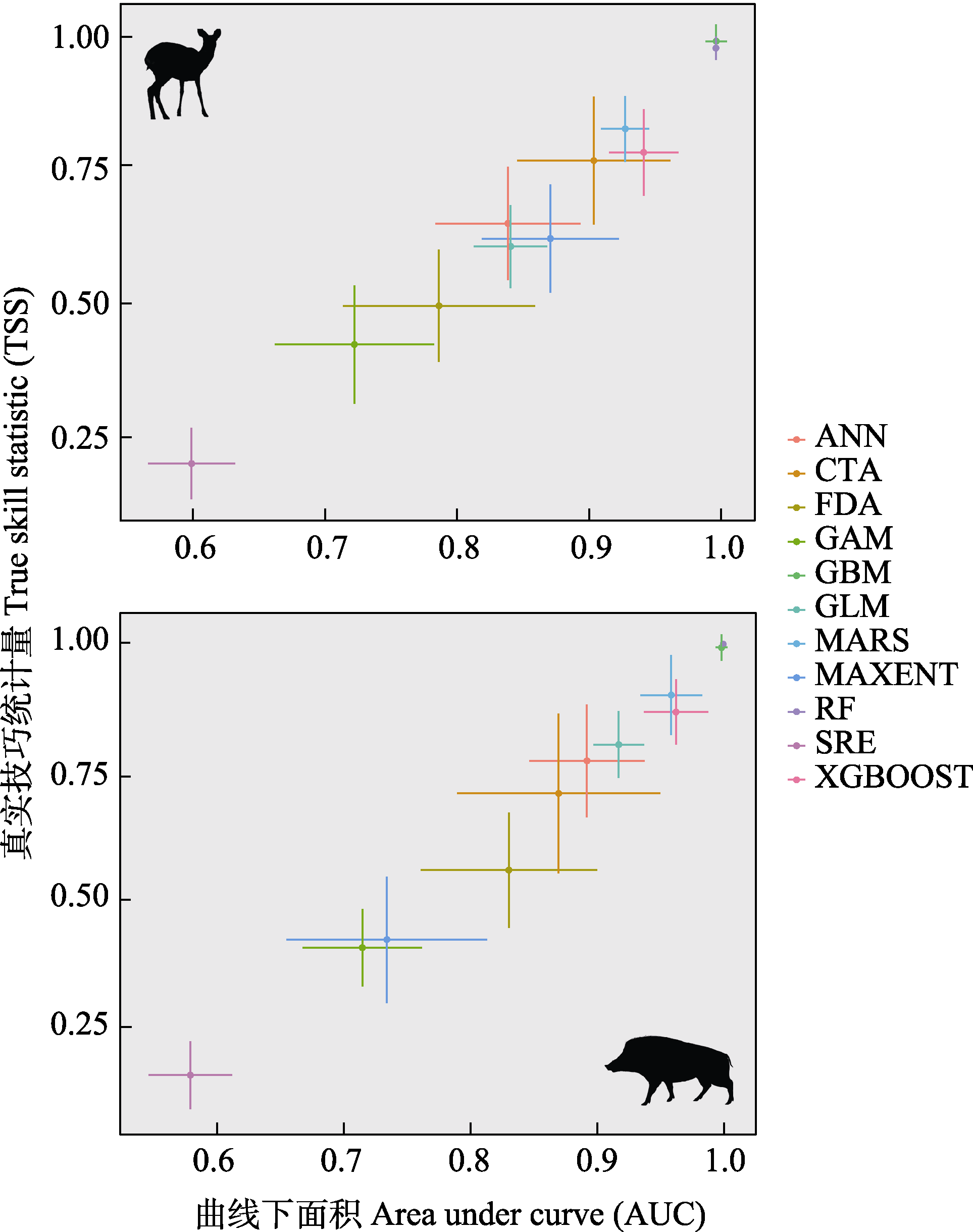
图5 狍和野猪的11种单一模型评价。ANN: 人工神经网络; CTA: 分类树分析; FDA: 灵活判别分析; GAM: 广义加性模型; GBM: 梯度提升机; GLM: 广义线性模型; MARS: 多元自适应回归样条; MAXENT: 最大熵模型; RF: 随机森林; SRE: 表面范围包络法; XGBOOST: 极端梯度提升。
Fig. 5 Evaluation of 11 single models for Capreolus pygargus and Sus scrofa. ANN, Artificial neural network; CTA, Classification tree analysis; FDA, Flexible discriminant analysis; GAM, Generalized additive model; GBM, Gradient boosting machine; GLM, Generalized linear model; MARS, Multivariate adaptive regression splines; MAXENT, Maximum entropy model; RF, Random forest; XGBOOST, Extreme gradient boosting.
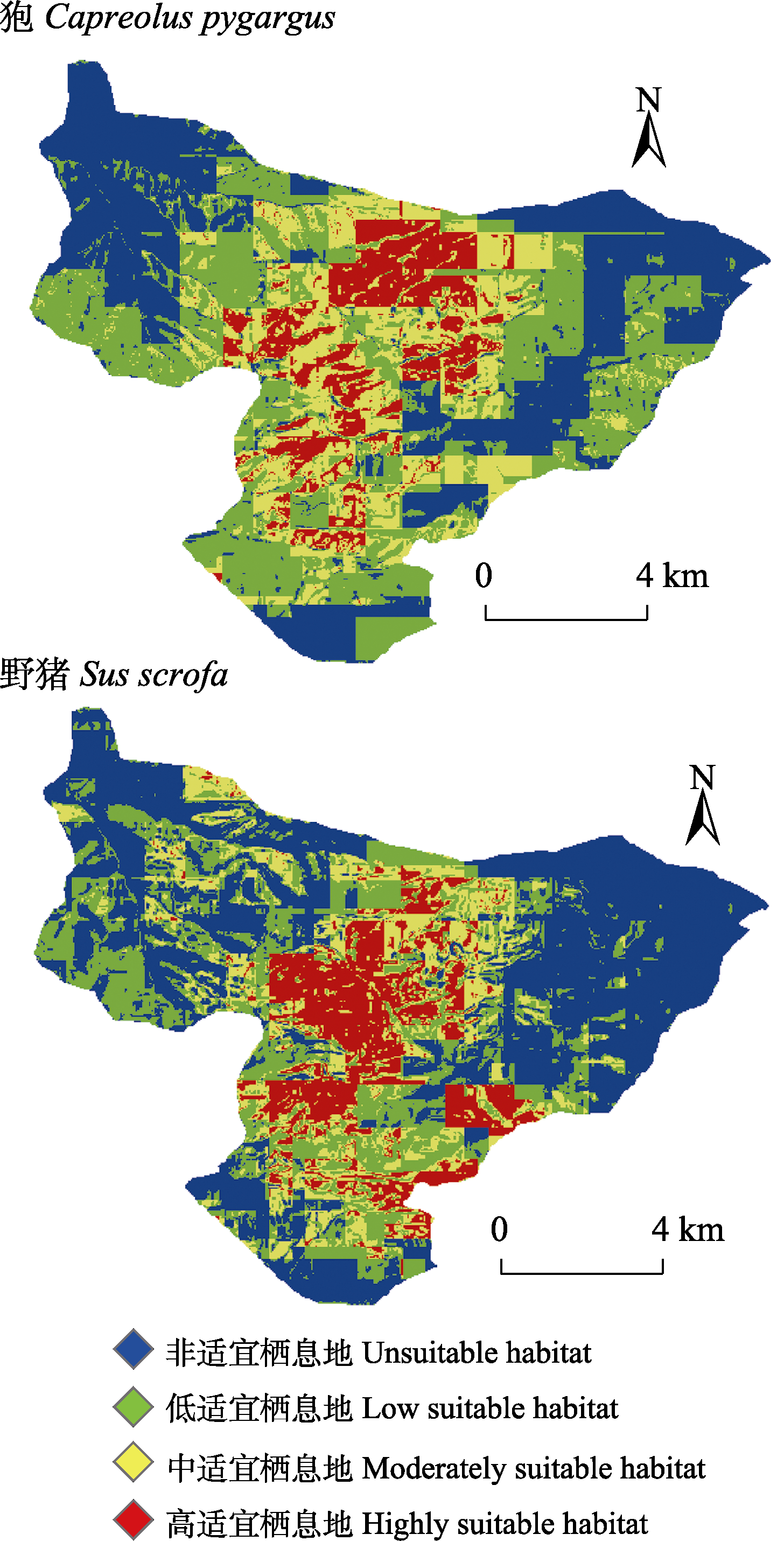
图6 狍和野猪适宜栖息地分布图
Fig. 6 Distribution map of suitable habitats for Capreolus pygargus and Sus scrofa
| 适宜性 Suitability | 狍 Capreolus pygargus | 野猪 Sus scrofa | ||
|---|---|---|---|---|
| 面积 Area (km2) | % | 面积 Area (km2) | % | |
| 非适宜栖息地 Unsuitable habitat | 35.19 | 32.94 | 44.74 | 43.09 |
| 低适宜栖息地 Low suitable habitat | 38.33 | 35.88 | 28.33 | 27.29 |
| 中适宜栖息地 Moderately suitable habitat | 21.40 | 20.03 | 16.25 | 15.65 |
| 高适宜栖息地 Highly suitable habitat | 11.91 | 11.15 | 14.50 | 13.97 |
表2 狍与野猪适宜栖息地面积及占比
Table 2 Area and proportion of suitable habitats for Capreolus pygargus and Sus scrofa
| 适宜性 Suitability | 狍 Capreolus pygargus | 野猪 Sus scrofa | ||
|---|---|---|---|---|
| 面积 Area (km2) | % | 面积 Area (km2) | % | |
| 非适宜栖息地 Unsuitable habitat | 35.19 | 32.94 | 44.74 | 43.09 |
| 低适宜栖息地 Low suitable habitat | 38.33 | 35.88 | 28.33 | 27.29 |
| 中适宜栖息地 Moderately suitable habitat | 21.40 | 20.03 | 16.25 | 15.65 |
| 高适宜栖息地 Highly suitable habitat | 11.91 | 11.15 | 14.50 | 13.97 |
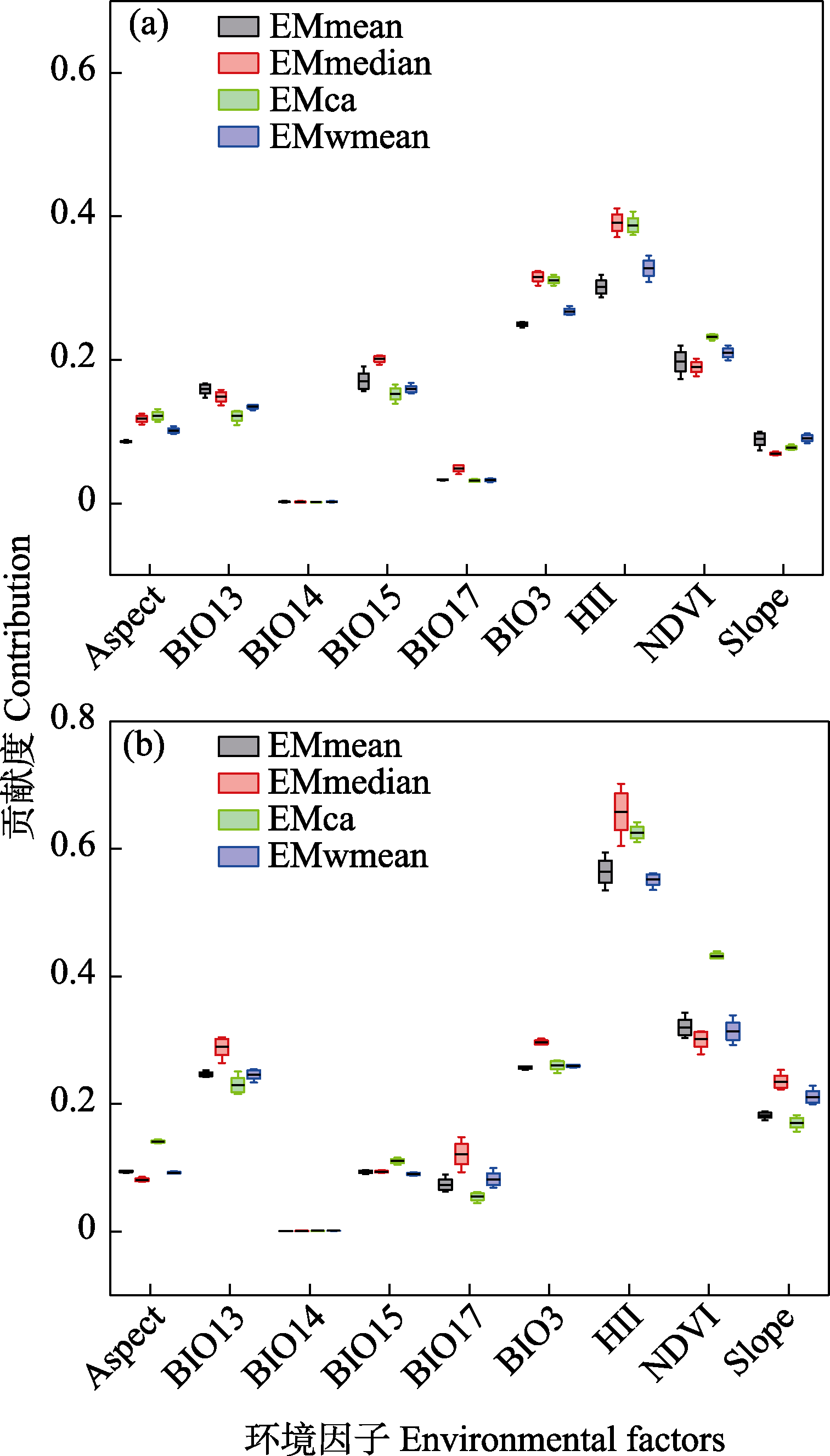
图7 狍(a)和野猪(b)的模型贡献度。EMmean: 平均值集成法; EMmedian: 中位数集成法; EMca: 二元投票; EMwmean: 加权平均值集成法。环境因子缩写含义见表1。
Fig. 7 Contribution of the model for Capreolus pygargus (a) and Sus scrofa (b). EMmean, Ensemble model of mean; EMmedian, Ensemble model of median; EMca, Ensemble model of consensus averaging; EMwmean, Ensemble model of weighted mean. Abbreviations for environmental factors are defined in Table 1.
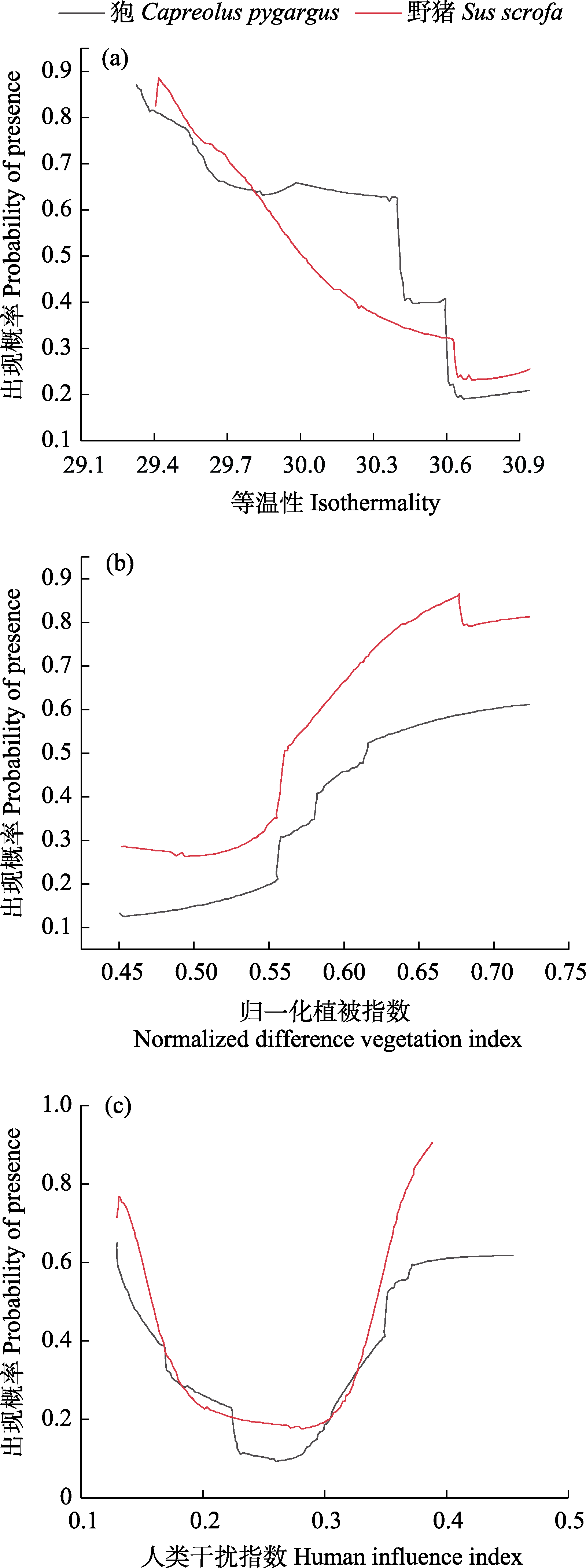
图8 狍和野猪响应曲线
Fig. 8 Response curves of Capreolus pygargus and Sus scrofa
| [1] | Albaba I (2016) The impact of wild boar (Sus scrofa) on different agricultural crops in the northern governorates of Palestine. International Journal of Fauna and Biological Studies, 3, 25-27. |
| [2] |
Barrios-Garcia MN, Ballari SA (2012) Impact of wild boar (Sus scrofa) in its introduced and native range: A review. Biological Invasions, 14, 2283-2300.
DOI URL |
| [3] |
Cai HW, Zhang GF (2024) Predicting the potential distribution of rare and endangered Emmenopterys henryi in China under climate change. Ecology and Evolution, 14, e70403.
DOI URL |
| [4] |
Cao HQ, Yang XW, Peng CC, Wang YY, Guo QY, Su HJ (2023) Winter dietary analysis reveals the foraging differences of wild boar (Sus scrofa) in different regions of a karst mountainous area. Animals, 13, 727.
DOI URL |
| [5] |
Chave J (2004) Neutral theory and community ecology. Ecology Letters, 7, 241-253.
DOI URL |
| [6] |
Chen LJ, Shu ZF, Xiao ZS (2019) Application of camera-trapping data to study daily activity patterns of Galliformes in Guangdong Chebaling National Nature Reserve. Biodiversity Science, 27, 266-272. (in Chinese with English abstract)
DOI |
|
[陈立军, 束祖飞, 肖治术 (2019) 应用红外相机数据研究动物活动节律——以广东车八岭保护区鸡形目鸟类为例. 生物多样性, 27, 266-272.]
DOI |
|
| [7] | Chen QT, Zhao TJ, Feng XM, Sun GM, Zhu JB, Wang YS, Zhao DP (2021) Cluster patterns and spatiotemporal activity patterns of wild roe deer in the Tianjin Baxianshan National Nature Reserve. Sichuan Journal of Zoology, 40, 8-14. (in Chinese with English abstract) |
| [陈秋婷, 赵铁建, 冯小梅, 孙国明, 朱金保, 王玉申, 赵大鹏 (2021) 天津八仙山国家级自然保护区野生狍集群模式和时空活动规律. 四川动物, 40, 8-14.] | |
| [8] | Chen XN, Tian J, Liu MZ, Shen YY, Yu JP, Liu F, Shen XL, Li S (2023) Estimating the population size of wild boar (Sus scrofa) in Kaihua County, Zhejiang Province using camera-trapping data. Acta Theriologica Sinica, 43, 523-532. (in Chinese with English abstract) |
|
[陈小南, 田佳, 刘鸣章, 申云逸, 余建平, 刘锋, 申小莉, 李晟 (2023) 基于红外相机数据估算浙江省开化县野猪种群数量. 兽类学报, 43, 523-532.]
DOI |
|
| [9] | Chen ZM, Peng B, He F, He XC, Wang WL, Liu TJ, Li YX, Ran JH (2024) A study on the temporal and spatial patterns of ungulates in the Xiaozhaizigou National Nature Reserve, Sichuan. Sichuan Journal of Zoology, 43, 373-384. (in Chinese with English abstract) |
| [陈章敏, 彭波, 贺飞, 何兴成, 王文玲, 刘天骄, 李雨芯, 冉江洪 (2024) 四川小寨子沟国家级自然保护区有蹄类的时空格局研究. 四川动物, 43, 373-384.] | |
| [10] |
Chesson P (2000) Mechanisms of maintenance of species diversity. Annual Review of Ecology and Systematics, 31, 343-366.
DOI URL |
| [11] |
Cuevas MF, Mastrantonio L, Ojeda RA, Jaksic FM (2012) Effects of wild boar disturbance on vegetation and soil properties in the Monte Desert, Argentina. Mammalian Biology, 77, 299-306.
DOI URL |
| [12] |
Davies TJ, Shai MR, Barraclough TG, Gittleman JL (2007) Species co-existence and character divergence across carnivores. Ecology Letters, 10, 146-152.
PMID |
| [13] | Drimaj J, Kamler J, Mikulka O, Homolka M, Plhal R (2021) Effects of human activities on distribution and behaviour of roe deer and wild boar in a suburban forest. Zprávy lesnického výzkumu, 66, 302-310. |
| [14] |
Epperly HK, Clinchy M, Zanette LY, McCleery RA (2021) Fear of large carnivores is tied to ungulate habitat use: Evidence from a bifactorial experiment. Scientific Reports, 11, 12979.
DOI PMID |
| [15] |
Evcin Ö (2023) Can highway tunnel construction change the habitat selection of roe deer (Capreolus capreolus Linnaeus, 1758)?. Environmental Monitoring and Assessment, 195, 1410.
DOI |
| [16] |
Feng B, Bai WK, Fan XY, Fu MX, Song XQ, Liu JY, Qin WR, Zhang JD, Qi DW, Hou R (2023) Species coexistence and niche interaction between sympatric giant panda and Chinese red panda: A spatiotemporal approach. Ecology and Evolution, 13, e9937.
DOI PMID |
| [17] | Feng B, Hu L, Zhao SS, Dong X, Feng WJ, Zhang DY, Zhang JD, Zhou CQ, Bai WK (2022) Spatio-temporal niche characteristics of sympatric Chinese serow and Chinese goral. Acta Ecologica Sinica, 42, 5275-5284. (in Chinese with English abstract) |
| [冯彬, 胡露, 赵姗姗, 董鑫, 冯万举, 张栋耀, 张晋东, 周材权, 白文科 (2022) 同域分布中华鬣羚与中华斑羚时空生态位特征. 生态学报, 42, 5275-5284.] | |
| [18] |
Foster CN, Barton PS, Lindenmayer DB (2014) Effects of large native herbivores on other animals. Journal of Applied Ecology, 51, 929-938.
DOI URL |
| [19] | Frid A, Dill LM (2002) Human-caused disturbance stimuli as a form of predation risk. Conservation Ecology, 6, art11. |
| [20] | Ge ZY, Zhu HQ, Mao ZX, Zhang DD, Jiang CY, Li C, Zhang XD, Wang HJ (2012) Wintering habitat selection by roe deer (Capreolus capreolus) in Huangnihe Nature Reserve, Jilin Province of Northeast China. Chinese Journal of Ecology, 31, 943-948. (in Chinese with English abstract) |
| [葛志勇, 朱洪强, 毛之夏, 张冬冬, 姜春艳, 李成, 张晓东, 王海军 (2012) 黄泥河自然保护区狍冬季栖息地选择. 生态学杂志, 31, 943-948.] | |
| [21] |
Gray TNE, Phan C, Pin C, Prum S (2012) Establishing a monitoring baseline for threatened large ungulates in eastern Cambodia. Wildlife Biology, 18, 406-413.
DOI URL |
| [22] |
Gu R, Wei SP, Li JR, Zheng SH, Li ZT, Liu GL, Fan SH (2024) Predicting the impacts of climate change on the geographic distribution of moso bamboo in China based on biomod2 model. European Journal of Forest Research, 143, 1499-1512.
DOI |
| [23] | Guo R, Tong GP, Zheng NZ, Ma TW, Xu LJ, Wang XC, Xu AC (2024) Temporal niche relationships among Cervus nippon kopschi and sympatric ungulates in Zhejiang Qingliangfeng National Nature Reserve. Acta Theriologica Sinica, 44, 456-465. (in Chinese with English abstract) |
|
[郭瑞, 童跟平, 郑南忠, 马天午, 许丽娟, 王旭池, 徐爱春 (2024) 浙江清凉峰华南梅花鹿与同域分布有蹄类动物时间生态位关系. 兽类学报, 44, 456-465.]
DOI |
|
| [24] |
Guo W, Cao GH, Quan RC (2017) Population dynamics and space use of wild boar in a tropical forest, Southwest China. Global Ecology and Conservation, 11, 115-124.
DOI URL |
| [25] | He YJ, Yang XL, Ming XQ (2023) Hazards of living habits and prevention and control countermeasures of wild boar. Agricultural Technology & Equipment, (3), 142-143, 146. (in Chinese with English abstract) |
| [何仪军, 杨新龙, 明小强 (2023) 野猪的生活习性、危害及防控对策. 农业技术与装备, (3), 142-143, 146.] | |
| [26] |
Hewison AJM, Vincent JP, Joachim J, Angibault JM, Cargnelutti B, Cibien C (2001) The effects of woodland fragmentation and human activity on roe deer distribution in agricultural landscapes. Canadian Journal of Zoology, 79, 679-689.
DOI URL |
| [27] |
Ji HC, Yang G, Lv XM, Jia BR, Xu ZZ, Wang YH (2023) Climate extremes drive the phenology of a dominant species in meadow steppe under gradual warming. Science of the Total Environment, 869, 161687.
DOI URL |
| [28] |
Jiang GS, Ma JZ, Zhang MH, Stott P (2009) Effects of human activities on the spatial distribution of eastern roe deer Capreolus pygargus bedfordi in the Lesser Khingan Mountains, northeastern China. Mammal Research, 54, 61-76.
DOI URL |
| [29] | Jiang HL, Zhou SC, Zhang MH, Xu WP, Li W (2023) Activity rhythm of wild boar and roe deer and its relationship with moonlight cycle in sympatric distribution. Acta Ecologica Sinica, 43, 3128-3136. (in Chinese with English abstract) |
| [江辉龙, 周绍春, 张明海, 徐万鹏, 李薇 (2023) 同域分布的野猪与狍活动节律及与月光周期的关系. 生态学报, 43, 3128-3136.] | |
| [30] | Li C, Zhang WW, Wang Y (2023) Investigation on the current situation of wild boar population resources. Animal Industry and Environment, (3), 11-13. (in Chinese) |
| [李冲, 张伟伟, 王原 (2023) 野猪种群资源现状调查. 畜牧业环境, (3), 11-13.] | |
| [31] | Li MH, Huang XJ, Chang J, Mo ZM, Wan DM, Jiang YT (2025) Relative abundance, cluster type, and daily activity rhythm of Siberian roe deer Capreolus pygargus in Western Liaoning Province. Acta Theriologica Sinica, 45, 356-367. (in Chinese with English abstract) |
| [李明慧, 黄莘钧, 常劲, 莫志民, 万冬梅, 蒋一婷 (2025) 辽西地区狍的相对多度、集群模式及日活动节律. 兽类学报, 45, 356-367.] | |
| [32] | Li S, Zhang XF, Chen P, Wang J, Xiang DQ, Dong W, Zhang XM, He BS, Sun RQ (2014) The community structure and elevational patterns of forest ungulates at the southern slope of the Qinling Mountains, China. Chinese Journal of Zoology, 49, 633-643. (in Chinese with English abstract) |
| [李晟, 张晓峰, 陈鹏, 王军, 向定乾, 董伟, 张希明, 何百锁, 孙瑞谦 (2014) 秦岭南坡森林有蹄类群落组成与垂直分布特征. 动物学杂志, 49, 633-643.] | |
| [33] |
Li XM, Yan JX, Du ZQ, Wang Y (2022) Detection of influencing factors of spatial variability of soil respiration in Pangquangou Nature Reserve. Environmental Science, 43, 4858-4866. (in Chinese with English abstract)
DOI URL |
| [李晓敏, 严俊霞, 杜自强, 王琰 (2022) 庞泉沟自然保护区土壤呼吸空间分异性影响因素探测. 环境科学, 43, 4858-4866.] | |
| [34] |
Li ZC, Zhou YT, Cao RX, Jia KN, Mai XT, Feng JW, Wang TM (2024) Amur tiger and leopard and their ungulate prey show differentiated spatiotemporal responses to human disturbances in the Northeast China Tiger and Leopard National Park. Acta Theriologica Sinica, 44, 665-680. (in Chinese with English abstract)
DOI |
|
[李梓琛, 周雨瞳, 曹冉星, 贾康宁, 麦晓烔, 冯佳伟, 王天明 (2024) 东北虎豹国家公园虎豹及其有蹄类猎物对人类干扰的时空响应. 兽类学报, 44, 665-680.]
DOI |
|
| [35] | Liu F, Gong CQ, Li S, Chen YF, Zhou HW (2023) Predicted future range of the fall webworm in China based on different climate scenarios. Chinese Journal of Applied Entomology, 60, 76-86. (in Chinese with English abstract) |
| [刘枫, 公超群, 李硕, 陈怡帆, 周宏威 (2023) 基于不同气候情景的美国白蛾适生区预测. 应用昆虫学报, 60, 76-86.] | |
| [36] |
Lovell C, Pettorelli N, Dawson TP (2024) Land cover preferences and spatiotemporal associations of ungulates within a Scottish mammal community. Ecology and Evolution, 14, e11015.
DOI URL |
| [37] | Ma S, Miao RZ, Liu G, Li WD, Zhou Y, Zhu HQ, Cheng L, Zhang XD (2024) Spatial-temporal niche characteristics of three ungulates in the forest area of Huangnihe. Journal of Northeast Normal University (Natural Science Edition), 56, 117-124. (in Chinese with English abstract) |
| [马帅, 苗润泽, 刘庚, 李伟东, 周勇, 朱洪强, 程龙, 张晓东 (2024) 黄泥河林区3种有蹄类动物时空生态位特征. 东北师大学报(自然科学版), 56, 117-124.] | |
| [38] |
McShea WJ, Sukmasuang R, Erickson DL, Herrmann V, Ngoprasert D, Bhumpakphan N, Davies SJ (2019) Metabarcoding reveals diet diversity in an ungulate community in Thailand. Biotropica, 51, 923-937.
DOI URL |
| [39] |
Middleton AD, Sawyer H, Merkle JA, Kauffman MJ, Cole EK, Dewey SR, Gude JA, Gustine DD, McWhirter DE, Proffitt KM, White PJ (2020) Conserving transboundary wildlife migrations: Recent insights from the Greater Yellowstone Ecosystem. Frontiers in Ecology and the Environment, 18, 83-91.
DOI |
| [40] |
Mori E, Bagnato S, Serroni P, Sangiuliano A, Rotondaro F, Marchianò V, Cascini V, Poerio L, Ferretti F (2020) Spatiotemporal mechanisms of coexistence in an European mammal community in a protected area of southern Italy. Journal of Zoology, 310, 232-245.
DOI |
| [41] |
O’Brien TG, Kinnaird MF, Wibisono HT (2003) Crouching tigers, hidden prey: Sumatran tiger and prey populations in a tropical forest landscape. Animal Conservation, 6, 131-139.
DOI URL |
| [42] | Pan QH, Wang YX, Yan K (2007) A Field Guide to the Mammals of China. China Forestry Publishing House, Beijing. (in Chinese) |
| [潘清华, 王应祥, 岩崑 (2007) 中国哺乳动物彩色图鉴. 中国林业出版社, 北京.] | |
| [43] | Pei C, Li YX, Luo ZW, Hai LY, Lan XN, Hu DF (2025) Diets and niche separation of forest musk deer (Moschus berezovskii) and roe deer (Capreolus pygargus) in spring in the Lyuliang Mountains, China. Chinese Journal of Ecology, 44, 930-938. (in Chinese with English abstract) |
| [裴超, 李亦欣, 骆正伟, 海路瑶, 蓝贤娜, 胡德夫 (2025) 吕梁山系林麝与狍春季食性及生态分离. 生态学杂志, 44, 930-938.] | |
| [44] |
Pitta-Osses N, Centeri C, Fehér Á, Katona K (2022) Effect of wild boar (Sus scrofa) rooting on soil characteristics in a deciduous forest affected by sedimentation. Forests, 13, 1234.
DOI URL |
| [45] |
Ramirez JI, Jansen PA, Poorter L (2018) Effects of wild ungulates on the regeneration, structure and functioning of temperate forests: A semi-quantitative review. Forest Ecology and Management, 424, 406-419.
DOI URL |
| [46] | Ridout MS, Linkie M (2009) Estimating overlap of daily activity patterns from camera trap data. Journal of Agricultural, Biological, and Environmental Statistics, 14, 322-337. |
| [47] |
Rocha DG, Sollmann R (2023) Habitat use patterns suggest that climate-driven vegetation changes will negatively impact mammal communities in the Amazon. Animal Conservation, 26, 663-674.
DOI URL |
| [48] |
Ruiz-Navarro A, Gillingham PK, Britton JR (2016) Predicting shifts in the climate space of freshwater fishes in Great Britain due to climate change. Biological Conservation, 203, 33-42.
DOI URL |
| [49] |
Schoener TW (1968) The Anolis lizards of Bimini: Resource partitioning in a complex fauna. Ecology, 49, 704-726.
DOI URL |
| [50] |
Strani F, DeMiguel D, Sardella R, Bellucci L (2018) Resource and niche differentiation mechanisms by sympatric Early Pleistocene ungulates: The case study of Coste San Giacomo. Quaternary International, 481, 157-163.
DOI URL |
| [51] | Teng LW, Liu ZS, Zhang ED, Ma JZ (2007) Winter bed-site selection of Capreolus capreolus in low mountain areas of southern Xiaoxing’anling Mountains. Chinese Journal of Ecology, 26, 213-218. (in Chinese with English abstract) |
| [滕丽微, 刘振生, 张恩迪, 马建章 (2007) 小兴安岭南部低山丘陵地区狍冬季卧息地选择. 生态学杂志, 26, 213-218.] | |
| [52] | Tian C (2020) Study on Spatial-Temporal Distribution and Driving Factors of Wildlife in Habitat of Giant Pandas. PhD dissertation, Beijing Forestry University, Beijing. (in Chinese with English abstract) |
| [田成 (2020) 大熊猫栖息地野生动物时空分布及驱动因素研究. 博士学位论文, 北京林业大学, 北京.] | |
| [53] | Tian XM, Ji XY, Wang XX, Zhang ZD, Chen H, Liu XH, Liu L, Wang QF, Ma YH, Qian XY, Zhou SC, Ju D (2024) Habitat suitability and activity patterns of roe deer in Beijicun National Nature Reserve, Heilongjiang Province, China. Acta Ecologica Sinica, 44, 8175-8184. (in Chinese with English abstract) |
| [田新民, 汲旭阳, 王鑫雪, 张子栋, 陈红, 刘小慧, 刘磊, 王启蕃, 马雨含, 钱昕玥, 周绍春, 鞠丹 (2024) 北极村国家级自然保护区狍栖息地适宜性及活动节律. 生态学报, 44, 8175-8184.] | |
| [54] |
Tripathi HG, Woollen ES, Carvalho M, Parr CL, Ryan CM (2021) Agricultural expansion in African savannas: Effects on diversity and composition of trees and mammals. Biodiversity and Conservation, 30, 3279-3297.
DOI |
| [55] |
Ursell T (2021) Structured environments foster competitor coexistence by manipulating interspecies interfaces. PLoS Computational Biology, 17, e1007762.
DOI URL |
| [56] |
van den Bosch M, Beyer DE, Erb JD, Gantchoff MG, Kellner KF, MacFarland DM, Norton DC, Patterson BR, Price Tack JL, Roell BJ, Belant JL (2022) Identifying potential gray wolf habitat and connectivity in the eastern USA. Biological Conservation, 273, 109708.
DOI URL |
| [57] |
Vild O, Hédl R, Kopecký M, Szabó P, Suchánková S, Zouhar V (2017) The paradox of long-term ungulate impact: Increase of plant species richness in a temperate forest. Applied Vegetation Science, 20, 282-292.
DOI PMID |
| [58] | Wan XR, Wang MJ, Liu W, Wang GH, Zhong WQ (2002) Numerical indices for evaluating the activity patterns of rodent species. Acta Theriologica Sinica, 22, 211-217. (in Chinese with English abstract) |
| [宛新荣, 王梦军, 刘伟, 王广和, 钟文勤 (2002) 啮齿动物活动模式的几种数值指标. 兽类学报, 22, 211-217.] | |
| [59] |
Wang JF, Xu K, Yao S, Liu T, Yu B, Huang XQ, Xiao ZS, Xia DP (2024) Temporal niche partitioning among sympatric wild and domestic ungulates between warm and cold seasons. Scientific Reports, 14, 10570.
DOI |
| [60] | Wang JP, Hao YH, Wang JT, Zhang J (1995) An initial investigation into winter ecology. Chinese Journal of Zoology, 30, 41-44. (in Chinese with English abstract) |
| [王建平, 郝映红, 王俊田, 张军 (1995) 豹冬季生态的初步研究. 动物学杂志, 30, 41-44.] | |
| [61] | Wang X, Li F, Li CQ, Li TF, Yang LY, Yang R (2022) Analysis on the activity rhythm and damage of wild boar (Sus scrofa) in Xishui National Nature Reserve. Chinese Journal of Wildlife, 43, 323-330. (in Chinese with English abstract) |
| [王逍, 李飞, 李崇清, 李腾飞, 杨伶熠, 杨瑞 (2022) 习水国家级自然保护区野猪活动特征和危害分析. 野生动物学报, 43, 323-330.] | |
| [62] |
Wang YD, Liu MZ, Xia F, Li S (2024) Human activities reshape the spatial overlap between North Chinese leopard and its wild ungulate prey. Frontiers in Zoology, 21, 24.
DOI PMID |
| [63] |
Warren DL, Glor RE, Turelli M (2010) ENMTools: A toolbox for comparative studies of environmental niche models. Ecography, 33, 607-611.
DOI URL |
| [64] | Wei FW, Yang QS, Wu Y, Jiang XL, Liu SY, Hu YB, Ge DY, Li BG, Yang G, Li M, Zhou J, Li S, Li S, Yu WH, Chen BY, Zhang ZJ, Zhou CQ, Wu SB, Zhang L, Chen ZZ, Chen SD, Deng HQ, Jiang TL, Zhang LB, Shi HY, Lu XL, Li Q, Liu Z, Cui YQ, Li YC, He K (2025) Catalogue of mammals in China (2024). Acta Theriologica Sinica, 45, 1-16. (in Chinese with English abstract) |
| [魏辅文, 杨奇森, 吴毅, 蒋学龙, 刘少英, 胡义波, 葛德燕, 李保国, 杨光, 李明, 周江, 李松, 李晟, 余文华, 陈炳耀, 张泽钧, 周材权, 吴诗宝, 张立, 陈中正, 陈顺德, 邓怀庆, 江廷磊, 张礼标, 石红艳, 卢学理, 李权, 刘铸, 崔雅倩, 李玉春, 何锴 (2025) 中国兽类名录(2024版). 兽类学报, 45, 1-16.] | |
| [65] | Xu F, Cai TJ, Ju CY, Zhao YL (2011) Autumn habitat selection of wild boar in the Fenghuangshan Nature Reserve, Heilongjiang Province. Journal of Beijing Forestry University, 33(3), 86-91. (in Chinese with English abstract) |
| [徐飞, 蔡体久, 琚存勇, 赵玉龙 (2011) 黑龙江凤凰山自然保护区野猪秋季生境选择. 北京林业大学学报, 33(3), 86-91.] | |
| [66] | Xu PP, Xiang J, Liu JM, Xie ZW, Wang QP (2024) Population survey and habitat selection of Sus scrofa in Hunan Gaowangjie National Nature Reserve by infrared camera. Hunan Forestry Science & Technology, 51(2), 49-56. (in Chinese with English abstract) |
| [徐培培, 向杰, 刘菊敏, 谢增文, 王秋盼 (2024) 基于红外相机对湖南高望界国家级自然保护区野猪种群现状及生境选择研究. 湖南林业科技, 51(2), 49-56.] | |
| [67] |
Yasuda M (2004) Monitoring diversity and abundance of mammals with camera traps: A case study on Mount Tsukuba, central Japan. Mammal Study, 29, 37-46.
DOI URL |
| [68] |
Ye YX, Hu CS, Jiang YT, Davison GWH, Ding CQ (2021) Three-dimensional niche partitioning between two colonially nesting Ardeid species in Central China. Avian Research, 12, 33.
DOI |
| [69] |
Zhang C, Lu ZW, Zhuang HF, Zhou JJ, Zhang Y, Lv XY, Chen MH, Krzton A, Xia WC (2024) Identification of potential suitable areas and conservation priority areas for representative wild animals in the Greater and Lesser Khingan Mountains. Ecology and Evolution, 14, e11600.
DOI URL |
| [70] |
Zhao GH, Cui XY, Sun JJ, Li TT, Wang Q, Ye XZ, Fan BG (2021) Analysis of the distribution pattern of Chinese Ziziphus jujuba under climate change based on optimized biomod2 and MaxEnt models. Ecological Indicators, 132, 108256.
DOI URL |
| [71] | Zhou XY, Liu WB (2022) Monitoring and protection of wild roe deer in Taizishan Nature Reserve. Forestry of Gansu, (6), 41-43. (in Chinese) |
| [周晓燕, 柳文斌 (2022) 太子山保护区野生狍子监测与保护初探. 甘肃林业, (6), 41-43.] |
| [1] | 王倩倩, 陈孝国, 朱锐丰, 张明春, 王新, 李世林, 仁增江措, 彭武, 杨彪. 藏东南黑麝及其同域有蹄类物种的生态适应性差异[J]. 生物多样性, 2026, 34(5): 25433-. |
| [2] | 岳可欣, 牛钟辉, 刘念, 徐琳, 吕韦韦, 徐茂宏, 崔绍朋. 山西历山三种同域分布食肉动物昼夜活动节律及与月光周期的关系[J]. 生物多样性, 2025, 33(9): 25084-. |
| [3] | 彭欣, 刘传, 黄晓磊. 基于GenBank数据库的真核生物遗传数据时空格局分析[J]. 生物多样性, 2025, 33(8): 25184-. |
| [4] | 余德菊, 何云雲, 曹敏, 王刚, 杨洁. 基于代谢组学与转录组学技术的热带森林树种共存机制研究——以榕属植物为例[J]. 生物多样性, 2025, 33(7): 24475-. |
| [5] | 周铝, 郭画, 姚世贸, 田成. 王朗国家级自然保护区红腹角雉时空分布模式[J]. 生物多样性, 2025, 33(7): 24537-. |
| [6] | 黄定旭, 肖文宏, 白小节, 刘邦友, 黎源君, 梁盛, 肖治术, 刘伟. 赤水桫椤国家级自然保护区中小型食肉目动物昼夜活动节律的比较[J]. 生物多样性, 2025, 33(6): 24376-. |
| [7] | 罗敏, 杨永川, 靳程, 周礼华, 龙宇潇. 重庆中心城区城市森林兽类组成特征及其对人类活动的响应[J]. 生物多样性, 2025, 33(5): 24402-. |
| [8] | 罗怀英, 张超, 钱长江, 李剑峰, 程搏幸, 何勇, 孙悦. 圈养川金丝猴行为谱、PAE编码系统及行为节律[J]. 生物多样性, 2025, 33(10): 25133-. |
| [9] | 高翔, 潘淑芳, 孙争争, 李霁筱, 高天雨, 董路, 王宁. 广东珠海凤凰山和淇澳岛小灵猫的分布与活动节律[J]. 生物多样性, 2024, 32(8): 24045-. |
| [10] | 卢佳玉, 石小亿, 多立安, 王天明, 李治霖. 基于红外相机技术的天津城市地栖哺乳动物昼夜活动节律评价[J]. 生物多样性, 2024, 32(8): 23369-. |
| [11] | 张明军, 王合升, 颜文博, 符运南, 王琦, 曾治高. 海南大田国家级自然保护区小灵猫的活动节律与栖息地选择[J]. 生物多样性, 2024, 32(6): 23420-. |
| [12] | 曲锐, 左振君, 王有鑫, 张良键, 吴志刚, 乔秀娟, 王忠. 基于元素组的生物地球化学生态位及其在不同生态系统中的应用[J]. 生物多样性, 2024, 32(4): 23378-. |
| [13] | 吕晓波, 李东海, 杨小波, 张孟文. 红树林群落通过淹水时间及海水盐度的生态位分化实现物种共存[J]. 生物多样性, 2024, 32(3): 23302-. |
| [14] | 任嘉隆, 王永珍, 冯怡琳, 赵文智, 严祺涵, 秦畅, 方静, 辛未冬, 刘继亮. 基于陷阱法采集的河西走廊戈壁荒漠甲虫数据集[J]. 生物多样性, 2024, 32(2): 23375-. |
| [15] | 麦晓烔, 康佳, 李梓琛, 王天明. 东北虎豹国家公园梅花鹿活动节律及其对道路的响应[J]. 生物多样性, 2024, 32(11): 24178-. |
| 阅读次数 | ||||||
|
全文 |
|
|||||
|
摘要 |
|
|||||
备案号:京ICP备16067583号-7
Copyright © 2026 版权所有 《生物多样性》编辑部
地址: 北京香山南辛村20号, 邮编:100093
电话: 010-62836137, 62836665 E-mail: biodiversity@ibcas.ac.cn
