

生物多样性 ›› 2026, Vol. 34 ›› Issue (4): 25448. DOI: 10.17520/biods.2025448 cstr: 32101.14.biods.2025448
陈小勇*( )(
)( )
)
收稿日期:2025-11-09
接受日期:2026-03-19
出版日期:2026-04-20
发布日期:2026-04-30
通讯作者:
陈小勇
基金资助:
Xiao-Yong Chen*()()
Received:2025-11-09
Accepted:2026-03-19
Online:2026-04-20
Published:2026-04-30
Contact:
Xiao-Yong Chen
Supported by:摘要:
迁地保护是保护珍稀濒危植物的重要途径之一, 《国家植物园体系布局方案》提出到2035年我国70%以上的珍稀濒危野生植物得到有效迁地保护, 然而有效迁地保护的定义及其衡量标准并不明确。本文就相关问题进行探讨。在迁地保护实践中, 存活并生长正常、繁殖成功、自我维持以及保持物种原真性可作为不同程度成功的依据, 本文将这些成功程度不同的迁地保护归为迁地保存和有效迁地保护两类, 并提出采用自我维持、遗传独特性和遗传完整性作为判断有效迁地保护的标准, 最后提出了开展有效迁地保护的4个建议。
陈小勇 (2026) 珍稀濒危植物有效迁地保护: 概念、标准和建议. 生物多样性, 34, 25448. DOI: 10.17520/biods.2025448.
Xiao-Yong Chen (2026) On the effective ex situ conservation of rare or endangered plants: Definition, standards and recommendations. Biodiversity Science, 34, 25448. DOI: 10.17520/biods.2025448.
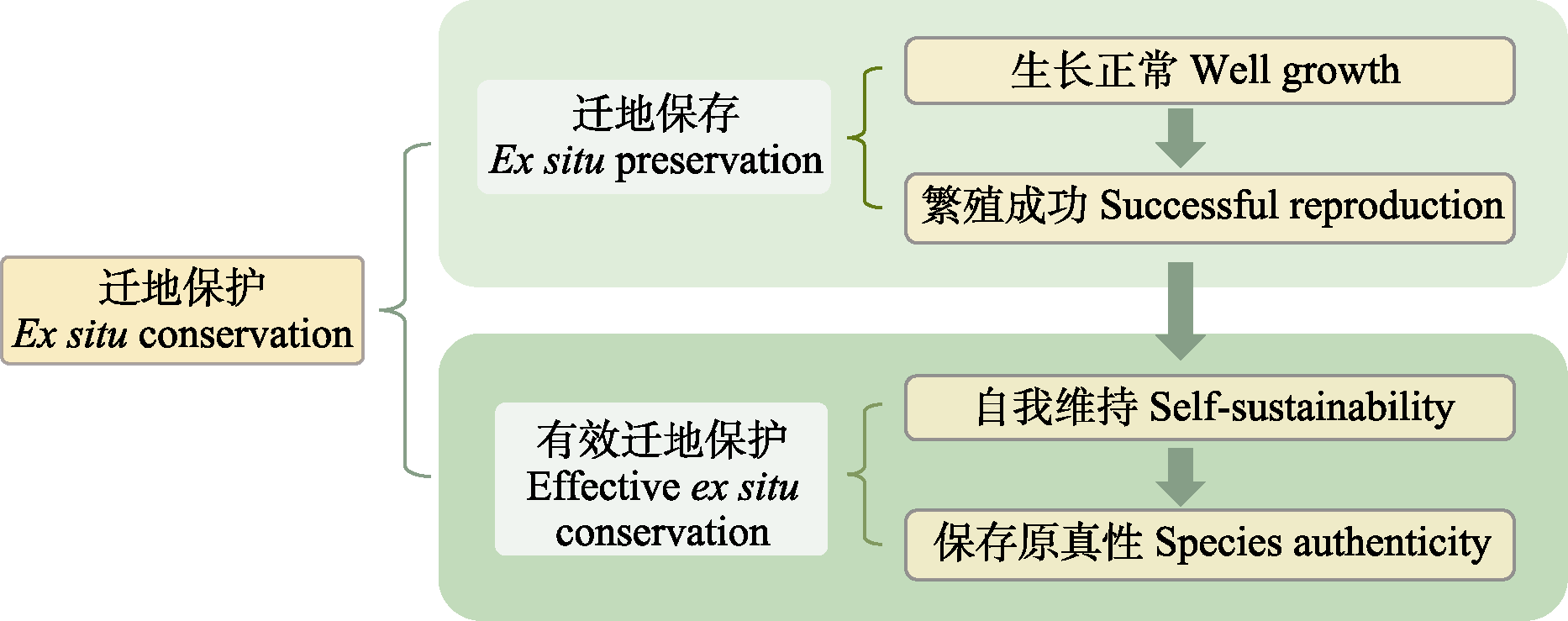
图1 迁地保护类型及其成功的评判依据
Fig. 1 Types of ex situ conservation and criteria for assessing success at varying extents
| [1] |
Bradbury D, Binks RM, Webb A, Byrne M (2023) Defining conservation units in a species complex with genomic-taxonomic discordance: A case study of Conospermum caeruleum (Proteaceae). Biodiversity and Conservation, 32, 1949-1975.
DOI |
| [2] |
Chen J, Yang X (2024) Discussion on the plant ex situ conservation. Biodiversity Science, 32, 24064.(in Chinese with English abstract)
DOI |
|
[陈进, 杨玺 (2024) 关于植物迁地保护若干问题的讨论. 生物多样性, 32, 24064.]
DOI |
|
| [3] |
Coates DJ, Byrne M, Moritz C (2018) Genetic diversity and conservation units: Dealing with the species-population continuum in the age of genomics. Frontiers in Ecology and Evolution, 6, 165.
DOI URL |
| [4] |
Feng C, Zhang J, Huang HW (2023) Parallel situ conservation: A new plant conservation strategy to integrate in situ and ex situ conservation of plants. Biodiversity Science, 31, 23184.(in Chinese with English abstract)
DOI URL |
|
[冯晨, 张洁, 黄宏文 (2023) 统筹植物就地保护与迁地保护的解决方案: 植物并地保护(parallel situ conservation). 生物多样性, 31, 23184.]
DOI |
|
| [5] | IUCN/SSC (2014) Guidelines on the Use of ex situ Management for Species Conservation. Version 2.0. IUCN Species Survival Commission, Gland, Switzerland. |
| [6] | Li J, Chen JK, Zhou J, He GQ (1999) Dynamics and evaluation of Oryza rufipogon and Ranalisma rostratum population in ex situ conservation of communities. Acta Phytoecologica Sinica, 23, 275-282.(in Chinese with English abstract) |
| [李今, 陈家宽, 周进, 何国庆 (1999) 迁地保护中普通野生稻和长喙毛茛泽泻种群动态及评价. 植物生态学报, 23, 275-282.] | |
| [7] | Liu CN, Li YY, Wang R, Chen XY (2020) Genetic factors are less considered than demographic characters in delisting species. Biological Conservation, 251, 108791. |
| [8] |
Liu HJ (2024) Questioning the goal of ex-situ conservation about more than 85% native wild plants of China. Biodiversity Science, 32, 24009.(in Chinese with English abstract)
DOI URL |
|
[刘华杰 (2024) 质疑关于野生本土植物85%的迁地保护目标. 生物多样性, 32, 24009.]
DOI |
|
| [9] |
Liu S, Du C, Hu YH (2024) Ex situ conservation should have clear flexibility. Biodiversity Science, 32, 24037.(in Chinese with English abstract)
DOI |
|
[刘夙, 杜诚, 胡永红 (2024) 迁地保护应当具有明确的灵活性. 生物多样性, 32, 24037.]
DOI |
|
| [10] |
Ren H (2024) Reflections on the ex situ conservation target of botanical gardens. Biodiversity Science, 32, 24015.(in Chinese with English abstract)
DOI |
|
[任海 (2024) 关于植物园迁地保护目标的思考. 生物多样性, 32, 24015.]
DOI |
|
| [11] | Sun WB (2025) Thinking about the ex situ conservation of plants in China. Guihaia, 45, 406-412.(in Chinese with English abstract) |
| [孙卫邦 (2025) 关于我国植物迁地保护的思考. 广西植物, 45, 406-412.] | |
| [12] |
Volis S, Blecher M (2010) Quasi in situ: A bridge between ex situ and in situ conservation of plants. Biodiversity and Conservation, 19, 2441-2454.
DOI URL |
| [13] | Wang ZF, Zhao Z, Liu JQ (2025) Homoploid hybrid speciation: Advancements and challenges. Plant Ecology & Diversity, 18, 141-158. |
| [14] |
Waser NM (1978) Interspecific pollen transfer and competition between co-occurring plant species. Oecologia, 36, 223-236.
DOI PMID |
| [15] |
Wen SF, Zhou ZH, He T, Dong H, Yuan LC, Lu ZY, Wang YT, Guo L, Shu JP, Li KF (2023) Formulating the National Botanical Garden System Layout Plan of China: Background, procedures, ideas and key considerations. Biodiversity Science, 31, 23193.(in Chinese with English abstract)
DOI |
| [文世峰, 周志华, 何拓, 董晖, 袁良琛, 卢泽洋, 王泳腾, 郭琳, 舒江平, 李开凡 (2023) 《国家植物园体系布局方案》编制背景、程序、思路和重点考虑. 生物多样性, 31, 23193.] | |
| [16] | Xiao ZQ, Liu H, Huang GY, Wu D, Qiu LW, Wu JH, Wei XZ, Jiang MX (2026) Spatially biased collections and the failure to cover all wild genetic clusters in plant populations under ex situ conservation. Plant Diversity, 48, 75-83. |
| [17] | Xu ZF, Guo HJ (2014) Near situ conservation for wild plant species with extremely small populations. Plant Diversity and Resources, 36, 533-536.(in Chinese with English abstract) |
| [许再富, 郭辉军 (2014) 极小种群野生植物的近地保护. 植物分类与资源学报, 36, 533-536.] | |
| [18] |
Zhang JJ, Ye QG, Yao XH, Huang HW (2010) Spontaneous interspecific hybridization and patterns of pollen dispersal in ex situ populations of a tree species (Sinojackia xylocarpa) that is extinct in the wild. Conservation Biology, 24, 246-255.
DOI URL |
| [1] | 刘忠成, 张忠, 兰勇, 赵万义, 刘佳, 陈春泉, 廖文波, 王蕾. 罗霄山脉珍稀濒危重点保护野生植物的生存状况及保护策略[J]. 生物多样性, 2020, 28(7): 867-875. |
| [2] | 张玲玲, 刘子玥, 王瑞江. 广东兰科植物多样性保育现状[J]. 生物多样性, 2020, 28(7): 787-795. |
| [3] | 任海. 植物园与植物回归[J]. 生物多样性, 2017, 25(9): 945-950. |
| [4] | 陈玉凯, 杨小波, 李东海, 龙文兴. 海南岛维管植物物种多样性的现状[J]. 生物多样性, 2016, 24(8): 948-956. |
| [5] | 杨文忠, 向振勇, 张珊珊, 康洪梅, 史富强. 极小种群野生植物的概念及其对我国野生植物保护的影响[J]. 生物多样性, 2015, 23(3): 419-425. |
| [6] | 张荣京, 赵哲, 苏文拔, 邢福武. 海南甘什岭保护区珍稀濒危植物的分布与评估[J]. 生物多样性, 2015, 23(1): 11-17. |
| [7] | 李长昊, 程涛, 董文攀, 周世良. “中国珍稀濒危植物DNA条形码鉴定平台”简介[J]. 生物多样性, 2014, 22(1): 110-110. |
| [8] | 王蕾, 施诗, 廖文波, 陈春泉, 李贞. 井冈山地区珍稀濒危植物及其生存状况[J]. 生物多样性, 2013, 21(2): 163-169. |
| [9] | 周翔, 高江云. 珍稀濒危植物的回归: 理论和实践[J]. 生物多样性, 2011, 19(1): 97-105. |
| [10] | 万开元, 陈防, 陈树森, 钟志祥, 李作洲, 苏嫚丽. 珍稀濒危植物迁地保护策略中植物营养问题的探讨[J]. 生物多样性, 2006, 14(2): 172-180. |
| [11] | 胡绍庆, 丁炳扬, 陈征海. 浙江省珍稀濒危植物物种多样性保护的关键区域[J]. 生物多样性, 2002, 10(1): 15-23. |
| [12] | 郝日明, 黄致远, 刘兴剑, 王中磊, 徐惠强, 姚志刚. 中国珍稀濒危保护植物在江苏省的自然分布及其特点[J]. 生物多样性, 2000, 08(2): 153-162. |
| [13] | 刘占林, 赵桂仿. 居群遗传学原理及其在珍稀濒危植物保护中的应用[J]. 生物多样性, 1999, 07(4): 340-346. |
| [14] | 葛继稳, 吴金清, 朱兆泉, 杨敬元, 雷耘. 湖北省珍稀濒危植物现状及其就地保护[J]. 生物多样性, 1998, 06(3): 220-228. |
| [15] | 向成华, 牟克华. 宽坝林区珍稀濒危植物资源的初步研究[J]. 生物多样性, 1997, 05(3): 202-205. |
| 阅读次数 | ||||||
|
全文 |
|
|||||
|
摘要 |
|
|||||
备案号:京ICP备16067583号-7
Copyright © 2026 版权所有 《生物多样性》编辑部
地址: 北京香山南辛村20号, 邮编:100093
电话: 010-62836137, 62836665 E-mail: biodiversity@ibcas.ac.cn
