

生物多样性 ›› 2026, Vol. 34 ›› Issue (2): 25271. DOI: 10.17520/biods.2025271 cstr: 32101.14.biods.2025271
袁林溪1,2( ), 王美震1,2, 张利祥3, 李彭3, 张永生3, 蒋学龙4,*()(
 ), 管振华1,2,*()()
收稿日期:2025-07-14
接受日期:2025-10-13
出版日期:2026-02-20
发布日期:2026-03-23
通讯作者:
蒋学龙,管振华
基金资助:
Linxi Yuan1,2(), Meizhen Wang1,2, Lixiang Zhang3, Peng Li3, Yongsheng Zhang3, Xuelong Jiang4,*()(), Zhenhua Guan1,2,*()()
Received:2025-07-14
Accepted:2025-10-13
Online:2026-02-20
Published:2026-03-23
Contact:
Xuelong Jiang, Zhenhua Guan
Supported by:摘要:
高黎贡白眉长臂猿(Hoolock tianxing)是典型的树栖灵长类物种, 其栖息地因长期遭受人为干扰而高度破碎化。为探究其栖息地乔木多样性和食物资源状况以及人为干扰的影响, 我们于2023年7-8月在云南省盈江县苏典傈僳族乡选择6个高黎贡白眉长臂猿群体的核心活动区域布设了26个20 m × 20 m的乔木样方进行调查; 基于土地利用数据构建了一个新的人为干扰强度量化评估指数——栖息地干扰指数(habitat disturbance index, HDI), 利用线性混合模型分析了HDI及海拔对乔木群落α和β多样性的影响, 利用广义线性混合模型分析了HDI及海拔对食物树种丰富度的影响; 计算了各物种的重要值(importance value, IV)及累积IV占比, 将累积IV占比达到50%的前若干种界定为群落优势树种, 并对高黎贡白眉长臂猿食物树种的保有状况进行了评估。样方调查共记录乔木21目34科58属146种; HDI和海拔对乔木群落的α多样性无显著影响, 但均显著负向影响β多样性梯度。在研究区域的26个优势树种中, 有10种(38.46%)为高黎贡白眉长臂猿的食物树种, 且所有食物树种的总IV占乔木群落总IV的24.84%, 表明当前的食物资源得以有效保留并维持一定丰度。另外, 海拔对高黎贡白眉长臂猿食物树种数量具有显著正向影响, 而HDI未显著影响食物树种丰富度, 这提示高海拔可能在维持高黎贡白眉长臂猿食物资源方面发挥着重要作用, 体现了食物树种对适度干扰的生态韧性。本研究揭示了受干扰森林斑块在支持高黎贡白眉长臂猿生存中的潜在价值以及人为干扰和海拔对其栖息地乔木群落组成结构的影响。在评估濒危物种的适宜栖息地时, 不能简单地将受干扰区域视为低价值栖息地, 需对森林质量和干扰程度进行综合评估, 将保有重要食物资源的区域纳入保护规划。
袁林溪, 王美震, 张利祥, 李彭, 张永生, 蒋学龙, 管振华 (2026) 人类活动对高黎贡白眉长臂猿栖息地乔木多样性及潜在食物资源的影响. 生物多样性, 34, 25271. DOI: 10.17520/biods.2025271.
Linxi Yuan, Meizhen Wang, Lixiang Zhang, Peng Li, Yongsheng Zhang, Xuelong Jiang, Zhenhua Guan (2026) Impact of human activities on the diversity of trees and potential food resources in the habitat of Hoolock tianxing. Biodiversity Science, 34, 25271. DOI: 10.17520/biods.2025271.
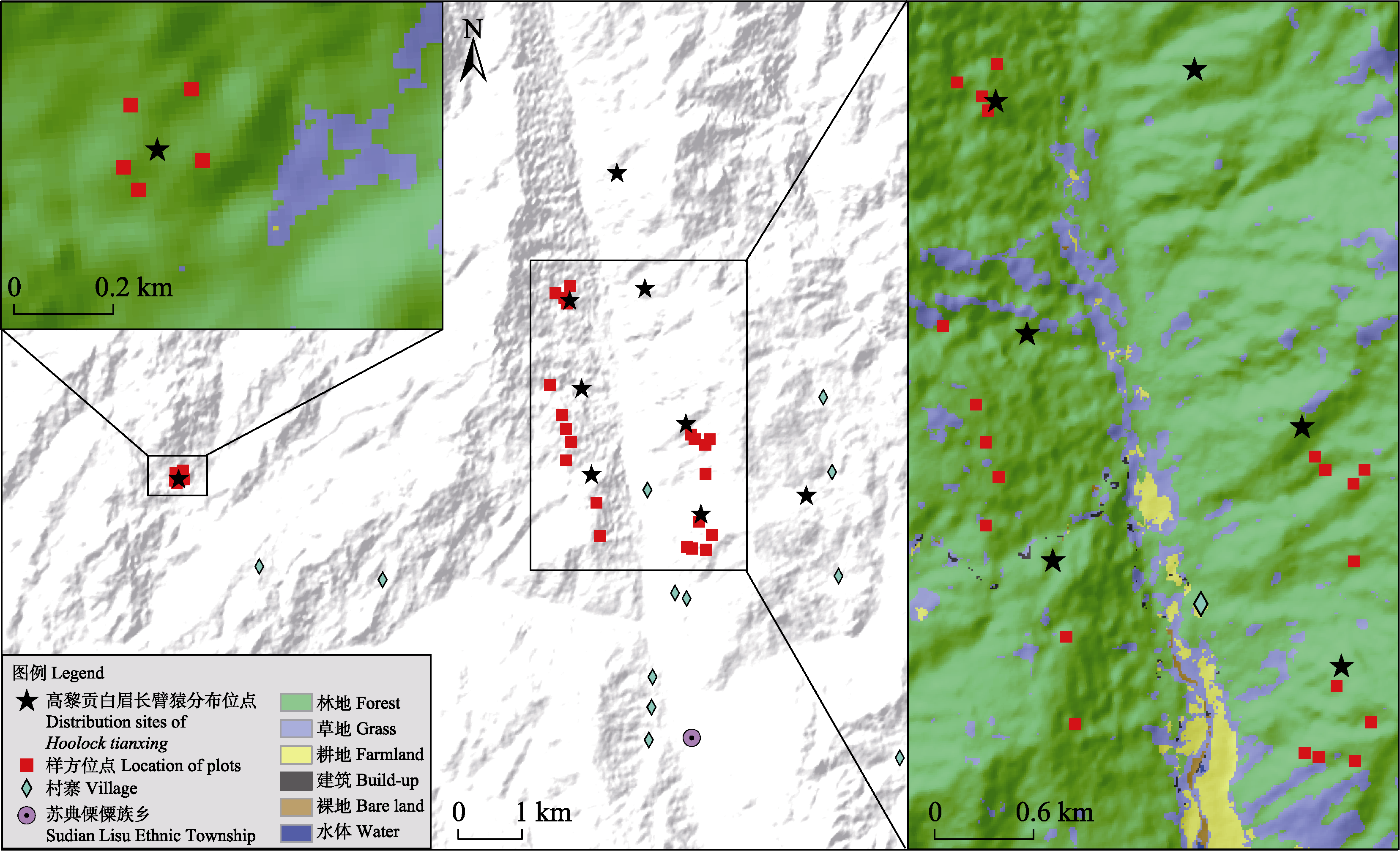
图1 研究区域土地利用类型、高黎贡白眉长臂猿群体分布及样方布设图
Fig. 1 Land use types, distribution of Hoolock tianxing populations and plots layout in the study area
| 效应类型 Effect type | 变量 Variable | 估计值 Estimate | 标准误 SE | z值 z-value | P | 方差 Variance |
|---|---|---|---|---|---|---|
| 固定效应 Fixed effects | 截距 Intercept | 1.396 | 1.427 | 0.979 | 0.361 | - |
| 栖息地干扰指数 HDI | 0.003 | 0.003 | 0.817 | 0.423 | - | |
| 海拔 Altitude | 0.001 | 0.001 | 0.802 | 0.449 | - | |
| 随机效应 Random effects | 组间方差 Group variance | - | - | - | - | 0.021 |
| 残差方差 Residual variance | - | - | - | - | 0.095 |
表1 乔木群落α多样性与栖息地干扰指数(HDI)和海拔的线性混合模型分析结果
Table 1 Results of linear mixed models of tree community α-diversity in relation to the habitat disturbance index (HDI) and altitude
| 效应类型 Effect type | 变量 Variable | 估计值 Estimate | 标准误 SE | z值 z-value | P | 方差 Variance |
|---|---|---|---|---|---|---|
| 固定效应 Fixed effects | 截距 Intercept | 1.396 | 1.427 | 0.979 | 0.361 | - |
| 栖息地干扰指数 HDI | 0.003 | 0.003 | 0.817 | 0.423 | - | |
| 海拔 Altitude | 0.001 | 0.001 | 0.802 | 0.449 | - | |
| 随机效应 Random effects | 组间方差 Group variance | - | - | - | - | 0.021 |
| 残差方差 Residual variance | - | - | - | - | 0.095 |
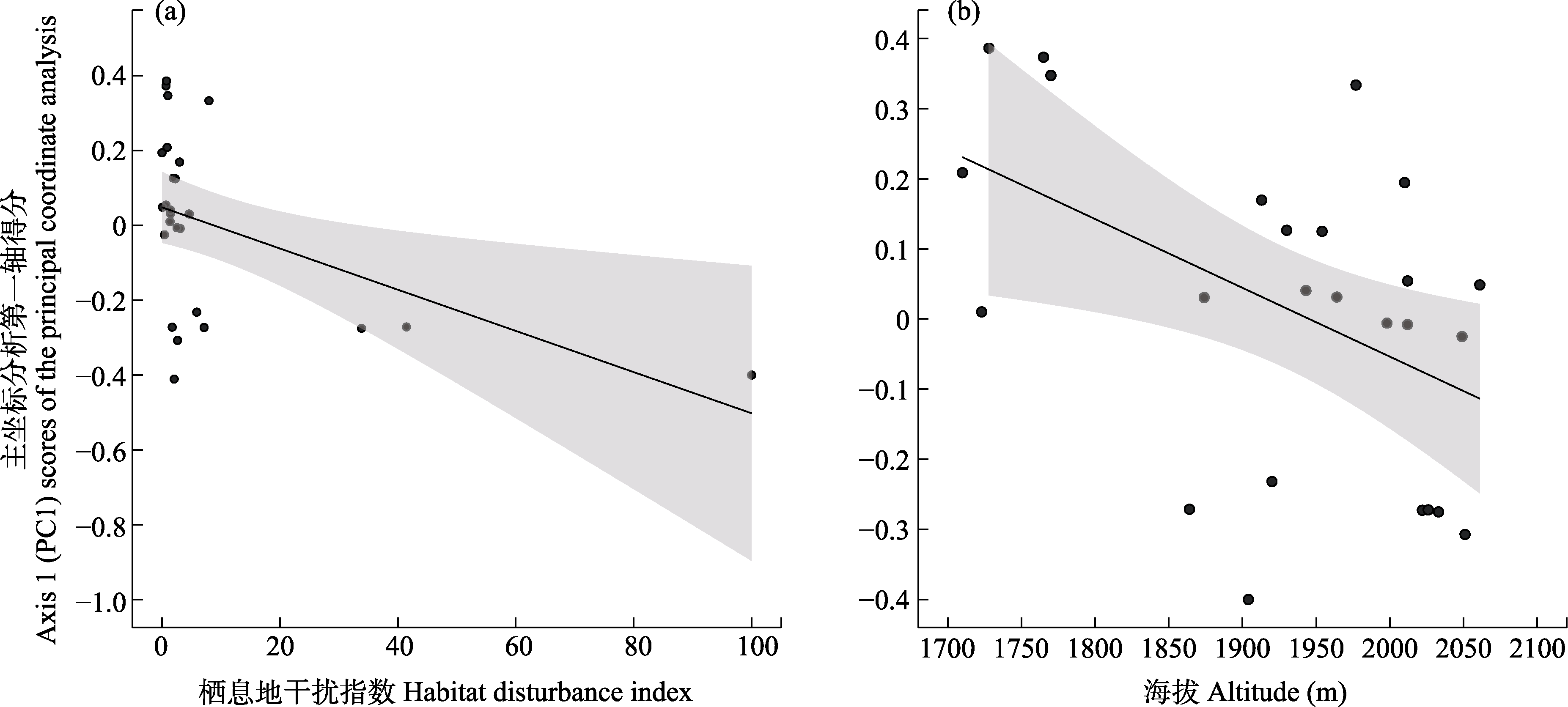
图2 栖息地干扰指数(a)与海拔(b)对主坐标分析第一轴(PC1)得分的影响
Fig. 2 Effects of the habitat disturbance index (a) and altitude (b) on the axis 1 (PC1) scores of the principal coordinate analysis
| 主坐标轴 Principal coordinate axis | 效应类型 Effect type | 变量 Variable | 估计值 Estimate | 标准误 SE | z值 z-value | P | 方差 Variance |
|---|---|---|---|---|---|---|---|
| 主坐标分析第一轴 Axis 1 of PCoA (PC1) | 固定效应 Fixed effects | 截距 Intercept | 2.285 | 0.771 | 2.965 | 0.011* | - |
| 栖息地干扰指数 HDI | -0.004 | 0.002 | -2.314 | 0.029* | - | ||
| 海拔 Altitude | -0.001 | 0.000 | -2.930 | 0.012* | - | ||
| 随机效应 Random effects | 组间方差 Group variance | - | - | - | - | 0.011 | |
| 残差方差 Residual variance | - | - | - | - | 0.017 | ||
| 主坐标分析第二轴 Axis 2 of PCoA (PC2) | 固定效应 Fixed effects | 截距 Intercept | 0.457 | 0.950 | 0.482 | 0.637 | - |
| 栖息地干扰指数 HDI | 0.003 | 0.002 | 1.449 | 0.160 | - | ||
| 海拔 Altitude | -0.000 | 0.000 | -0.515 | 0.614 | - | ||
| 随机效应 Random effects | 组间方差 Group variance | - | - | - | - | 0.022 | |
| 残差方差 Residual variance | - | - | - | - | 0.021 | ||
| 主坐标分析第三轴 Axis 3 of PCoA (PC3) | 固定效应 Fixed effects | 截距 Intercept | 1.340 | 0.727 | 1.844 | 0.104 | - |
| 栖息地干扰指数 HDI | 0.002 | 0.002 | 1.415 | 0.169 | - | ||
| 海拔 Altitude | -0.001 | 0.000 | -1.898 | 0.096 | - | ||
| 随机效应 Random effects | 组间方差 Group variance | - | - | - | - | 0.009 | |
| 残差方差 Residual variance | - | - | - | - | 0.017 |
表2 主坐标分析主轴得分与栖息地干扰指数(HDI)和海拔的线性混合模型分析结果
Table 2 Results of linear mixed models of principal axis scores of principal coordinates analysis (PCoA) in relation to the habitat disturbance index (HDI) and altitude
| 主坐标轴 Principal coordinate axis | 效应类型 Effect type | 变量 Variable | 估计值 Estimate | 标准误 SE | z值 z-value | P | 方差 Variance |
|---|---|---|---|---|---|---|---|
| 主坐标分析第一轴 Axis 1 of PCoA (PC1) | 固定效应 Fixed effects | 截距 Intercept | 2.285 | 0.771 | 2.965 | 0.011* | - |
| 栖息地干扰指数 HDI | -0.004 | 0.002 | -2.314 | 0.029* | - | ||
| 海拔 Altitude | -0.001 | 0.000 | -2.930 | 0.012* | - | ||
| 随机效应 Random effects | 组间方差 Group variance | - | - | - | - | 0.011 | |
| 残差方差 Residual variance | - | - | - | - | 0.017 | ||
| 主坐标分析第二轴 Axis 2 of PCoA (PC2) | 固定效应 Fixed effects | 截距 Intercept | 0.457 | 0.950 | 0.482 | 0.637 | - |
| 栖息地干扰指数 HDI | 0.003 | 0.002 | 1.449 | 0.160 | - | ||
| 海拔 Altitude | -0.000 | 0.000 | -0.515 | 0.614 | - | ||
| 随机效应 Random effects | 组间方差 Group variance | - | - | - | - | 0.022 | |
| 残差方差 Residual variance | - | - | - | - | 0.021 | ||
| 主坐标分析第三轴 Axis 3 of PCoA (PC3) | 固定效应 Fixed effects | 截距 Intercept | 1.340 | 0.727 | 1.844 | 0.104 | - |
| 栖息地干扰指数 HDI | 0.002 | 0.002 | 1.415 | 0.169 | - | ||
| 海拔 Altitude | -0.001 | 0.000 | -1.898 | 0.096 | - | ||
| 随机效应 Random effects | 组间方差 Group variance | - | - | - | - | 0.009 | |
| 残差方差 Residual variance | - | - | - | - | 0.017 |
| 编号 No. | 优势树种 Dominant tree species | 重要值 Importance value (IV) | 重要值占比 Percentage of IV (%) | 累积重要值占比 Percentage of cumulative IV (%) | 是否为食物树 Food tree (yes/no) |
|---|---|---|---|---|---|
| 1 | 森林榕 Ficus neriifolia | 83.70 | 4.08 | 4.08 | 是 Yes |
| 2 | 柯属一种 Lithocarpus sp.1 | 79.10 | 3.85 | 7.93 | 否 No |
| 3 | 锥属一种 Castanopsis sp.1 | 70.01 | 3.41 | 11.34 | 否 No |
| 4 | 元江锥 Castanopsis orthacantha | 63.19 | 3.08 | 14.41 | 否 No |
| 5 | 中缅木莲 Manglietia hookeri | 49.61 | 2.42 | 16.83 | 是 Yes |
| 6 | 肖樱叶柃 Eurya pseudocerasifera | 47.69 | 2.32 | 19.15 | 是 Yes |
| 7 | 勐海柯 Lithocarpus fohaiensis | 46.81 | 2.28 | 21.43 | 否 No |
| 8 | 尼泊尔桤木 Alnus nepalensis | 45.83 | 2.23 | 23.66 | 是 Yes |
| 9 | 三股筋香 Lindera thomsonii | 41.91 | 2.04 | 25.70 | 否 No |
| 10 | 麻子壳柯 Lithocarpus variolosus | 36.98 | 1.80 | 27.50 | 是 Yes |
| 11 | 尖叶桂樱 Prunus undulata | 36.31 | 1.77 | 29.27 | 否 No |
| 12 | 云南金叶子 Craibiodendron yunnanense | 34.34 | 1.67 | 30.94 | 否 No |
| 13 | 马蹄荷 Exbucklandia populnea | 34.27 | 1.67 | 32.61 | 否 No |
| 14 | 白穗柯 Lithocarpus craibianus | 33.74 | 1.64 | 34.25 | 否 No |
| 15 | 栎属一种 Quercus sp.1 | 30.93 | 1.51 | 35.76 | 否 No |
| 16 | 白柯 Lithocarpus dealbatus | 30.40 | 1.48 | 37.24 | 否 No |
| 17 | 泥柯 Lithocarpus fenestratus | 30.27 | 1.47 | 38.71 | 否 No |
| 18 | 硬壳柯 Lithocarpus hancei | 29.87 | 1.45 | 40.17 | 否 No |
| 19 | 毛樱桃 Prunus tomentosa | 29.79 | 1.45 | 41.62 | 是 Yes |
| 20 | 金平木姜子 Litsea chinpingensis | 29.05 | 1.41 | 43.03 | 是 Yes |
| 21 | 青冈属一种 Cyclobalanopsis sp.1 | 28.50 | 1.39 | 44.42 | 否 No |
| 22 | 中华鹅掌柴 Heptapleurum chinense | 28.27 | 1.38 | 45.80 | 是 Yes |
| 23 | 尼泊尔水东哥 Saurauia napaulensis | 24.64 | 1.20 | 46.99 | 是 Yes |
| 24 | 穗序鹅掌柴 Heptapleurum delavayi | 21.63 | 1.05 | 48.05 | 否 No |
| 25 | 浆果楝 Cipadessa baccifera | 21.55 | 1.05 | 49.10 | 否 No |
| 26 | 云南黄杞 Engelhardia spicata | 21.29 | 1.04 | 50.13 | 是 Yes |
表3 乔木群落优势树种组成及高黎贡白眉长臂猿食物树种评估结果
Table 3 Dominant tree species composition and assessment results of food trees for Hoolock tianxing of the tree community
| 编号 No. | 优势树种 Dominant tree species | 重要值 Importance value (IV) | 重要值占比 Percentage of IV (%) | 累积重要值占比 Percentage of cumulative IV (%) | 是否为食物树 Food tree (yes/no) |
|---|---|---|---|---|---|
| 1 | 森林榕 Ficus neriifolia | 83.70 | 4.08 | 4.08 | 是 Yes |
| 2 | 柯属一种 Lithocarpus sp.1 | 79.10 | 3.85 | 7.93 | 否 No |
| 3 | 锥属一种 Castanopsis sp.1 | 70.01 | 3.41 | 11.34 | 否 No |
| 4 | 元江锥 Castanopsis orthacantha | 63.19 | 3.08 | 14.41 | 否 No |
| 5 | 中缅木莲 Manglietia hookeri | 49.61 | 2.42 | 16.83 | 是 Yes |
| 6 | 肖樱叶柃 Eurya pseudocerasifera | 47.69 | 2.32 | 19.15 | 是 Yes |
| 7 | 勐海柯 Lithocarpus fohaiensis | 46.81 | 2.28 | 21.43 | 否 No |
| 8 | 尼泊尔桤木 Alnus nepalensis | 45.83 | 2.23 | 23.66 | 是 Yes |
| 9 | 三股筋香 Lindera thomsonii | 41.91 | 2.04 | 25.70 | 否 No |
| 10 | 麻子壳柯 Lithocarpus variolosus | 36.98 | 1.80 | 27.50 | 是 Yes |
| 11 | 尖叶桂樱 Prunus undulata | 36.31 | 1.77 | 29.27 | 否 No |
| 12 | 云南金叶子 Craibiodendron yunnanense | 34.34 | 1.67 | 30.94 | 否 No |
| 13 | 马蹄荷 Exbucklandia populnea | 34.27 | 1.67 | 32.61 | 否 No |
| 14 | 白穗柯 Lithocarpus craibianus | 33.74 | 1.64 | 34.25 | 否 No |
| 15 | 栎属一种 Quercus sp.1 | 30.93 | 1.51 | 35.76 | 否 No |
| 16 | 白柯 Lithocarpus dealbatus | 30.40 | 1.48 | 37.24 | 否 No |
| 17 | 泥柯 Lithocarpus fenestratus | 30.27 | 1.47 | 38.71 | 否 No |
| 18 | 硬壳柯 Lithocarpus hancei | 29.87 | 1.45 | 40.17 | 否 No |
| 19 | 毛樱桃 Prunus tomentosa | 29.79 | 1.45 | 41.62 | 是 Yes |
| 20 | 金平木姜子 Litsea chinpingensis | 29.05 | 1.41 | 43.03 | 是 Yes |
| 21 | 青冈属一种 Cyclobalanopsis sp.1 | 28.50 | 1.39 | 44.42 | 否 No |
| 22 | 中华鹅掌柴 Heptapleurum chinense | 28.27 | 1.38 | 45.80 | 是 Yes |
| 23 | 尼泊尔水东哥 Saurauia napaulensis | 24.64 | 1.20 | 46.99 | 是 Yes |
| 24 | 穗序鹅掌柴 Heptapleurum delavayi | 21.63 | 1.05 | 48.05 | 否 No |
| 25 | 浆果楝 Cipadessa baccifera | 21.55 | 1.05 | 49.10 | 否 No |
| 26 | 云南黄杞 Engelhardia spicata | 21.29 | 1.04 | 50.13 | 是 Yes |
| 效应类型 Effect type | 变量 Variable | 估计值 Estimate | 标准误 SE | z值 z-value | P | 方差 Variance |
|---|---|---|---|---|---|---|
| 固定效应 Fixed effects | 截距 Intercept | -4.811 | 1.984 | -2.425 | 0.015* | - |
| 栖息地干扰指数 HDI | 0.004 | 0.004 | 0.918 | 0.359 | - | |
| 海拔 Altitude | 0.003 | 0.001 | 3.208 | 0.001** | - | |
| 随机效应 Random effects | 组间方差 Group variance | - | - | - | - | 0.000 |
| 残差方差 Residual variance | - | - | - | - | 0.000 |
表4 食物树种丰富度与栖息地干扰指数(HDI)和海拔的广义线性混合模型分析结果
Table 4 Results of generalized linear mixed models of food tree species richness in relation to the habitat disturbance index (HDI) and altitude
| 效应类型 Effect type | 变量 Variable | 估计值 Estimate | 标准误 SE | z值 z-value | P | 方差 Variance |
|---|---|---|---|---|---|---|
| 固定效应 Fixed effects | 截距 Intercept | -4.811 | 1.984 | -2.425 | 0.015* | - |
| 栖息地干扰指数 HDI | 0.004 | 0.004 | 0.918 | 0.359 | - | |
| 海拔 Altitude | 0.003 | 0.001 | 3.208 | 0.001** | - | |
| 随机效应 Random effects | 组间方差 Group variance | - | - | - | - | 0.000 |
| 残差方差 Residual variance | - | - | - | - | 0.000 |
| [1] |
Alfonso-Corrado C, Gorgonio-Ramírez M, Aguirre-Hidalgo V, Fuente ME, Jorrín-Novo JV, Campos JE, Aquino-Vázquez C, Clark-Tapia R (2024) Historical changes in abundance and structure of oak populations under management in Sierra Juárez, Oaxaca, Mexico. Forest Ecology and Management, 561, 121876.
DOI URL |
| [2] |
Aung PP, Lwin N, Aung TH, Htike TSM, Thompson C, Roos C, Zaw SM, Lum LZ, Oo WN, Sau Z, Turvey ST, Thein WZ, Maw MT, Win YT, Oo ZM, Van Rompay KKA, Gilardi KV, Tremeu-Bravard A, Momberg F, Fan PF, Cheyne SM, Smiley Evans T (2024) Confirmation of skywalker hoolock gibbon (Hoolock tianxing) in Myanmar extends known geographic range of an endangered primate. International Journal of Primatology, 45, 810-833.
DOI |
| [3] | Bai B, Zhou W, Ai HS, Li ZB, Zhang XY, Hu CG (2007) Habitat use of the hoolock gibbon (Hoolock hoolock) at Nankang, Mt. Gaoligong in spring. Zoological Research, 28, 179-185. (in Chinese with English abstract) |
| [白冰, 周伟, 艾怀森, 李正波, 张兴勇, 胡成贵 (2007) 高黎贡山赧亢白眉长臂猿春季栖息地利用. 动物学研究, 28, 179-185.] | |
| [4] |
Baskerville EB, Dobson AP, Bedford T, Allesina S, Anderson TM, Pascual M (2011) Spatial guilds in the Serengeti food web revealed by a Bayesian group model. PLoS Computational Biology, 7, e1002321.
DOI URL |
| [5] | Bates D, Mächler M, Bolker B, Walker S (2015) Fitting linear mixed-effects models using lme4. Journal of Statistical Software, 67, 1-48. |
| [6] |
Bevilacqua S, Guarnieri G, Farella G, Terlizzi A, Fraschetti S (2018) A regional assessment of cumulative impact mapping on Mediterranean coralligenous outcrops. Scientific Reports, 8, 1757.
DOI PMID |
| [7] |
Bisht M, Sekar KC, Mukherjee S, Thapliyal N, Bahukhandi A, Singh D, Bhojak P, Mehta P, Upadhyay S, Dey D (2022) Influence of anthropogenic pressure on the plant species richness and diversity along the elevation gradients of Indian Himalayan high-altitude protected areas. Frontiers in Ecology and Evolution, 10, 751989.
DOI URL |
| [8] |
Bolker BM, Brooks ME, Clark CJ, Geange SW, Poulsen JR, Stevens MHH, White JS (2009) Generalized linear mixed models: A practical guide for ecology and evolution. Trends in Ecology & Evolution, 24, 127-135.
DOI URL |
| [9] |
Bowd E, Blanchard W, McBurney L, Lindenmayer D (2021) Direct and indirect disturbance impacts on forest biodiversity. Ecosphere, 12, e03823.
DOI URL |
| [10] |
Bray JR, Curtis JT (1957) An ordination of the upland forest communities of southern Wisconsin. Ecological Monographs, 27, 325-349.
DOI URL |
| [11] | Bredemeier M, Lamersdorf N, Schulte-Bisping H, Von Lüpke B (2001) Risk appraisal for forest management with respect to site quality and environmental changes. In: Risk Analysis in Forest Management (ed. Von Gadow K), pp. 21-48. Springer Netherlands, Dordrecht. |
| [12] | Carcaillet C, Fulé PZ (2024) Temperate and boreal mountain forests. In: Routledge Handbook of Forest Ecology (eds Peh KSH, Corlett RT, Bergeron Y), pp. 74-92. Routledge, London. |
| [13] |
Chaudhry S, Singh SP, Singh JS (1996) Performance of seedlings of various life forms on landslide-damaged forest sites in central Himalaya. Journal of Applied Ecology, 33, 109-117.
DOI URL |
| [14] |
Chen SS, Ma MH, Wu SJ, Tang QQ, Wen ZF (2023) Topography intensifies variations in the effect of human activities on forest NPP across altitude and slope gradients. Environmental Development, 45, 100826.
DOI URL |
| [15] | Cheyne SM, Thompson C, Fan PF, Chatterjee HJ (2023) Gibbon Conservation in the Anthropocene. Cambridge University Press, Cambridge. |
| [16] |
Cottee-Jones HEW, Bajpai O, Chaudhary LB, Whittaker RJ (2016) The importance of Ficus (Moraceae) trees for tropical forest restoration. Biotropica, 48, 413-419.
DOI URL |
| [17] |
Curtis JT, McIntosh RP (1951) An upland forest continuum in the prairie-forest border region of Wisconsin. Ecology, 32, 476-496.
DOI URL |
| [18] |
Dornelas M, Gotelli NJ, McGill B, Shimadzu H, Moyes F, Sievers C, Magurran AE (2014) Assemblage time series reveal biodiversity change but not systematic loss. Science, 344, 296-299.
DOI PMID |
| [19] |
Esselman PC, Infante DM, Wang L, Wu D, Cooper AR, Taylor WW (2011) An index of cumulative disturbance to river fish habitats of the conterminous United States from landscape anthropogenic activities. Ecological Restoration, 29, 133-151.
DOI URL |
| [20] |
Estrada A, Garber PA, Rylands AB, Roos C, Fernandez-Duque E, Di Fiore A, Nekaris KA, Nijman V, Heymann EW, Lambert JE, Rovero F, Barelli C, Setchell JM, Gillespie TR, Mittermeier RA, Arregoitia LV, de Guinea M, Gouveia S, Dobrovolski R, Shanee S, Shanee N, Boyle SA, Fuentes A, MacKinnon KC, Amato KR, Meyer ALS, Wich S, Sussman RW, Pan RL, Kone I, Li BG (2017) Impending extinction crisis of the world’s primates: Why primates matter. Science Advances, 3, e1600946.
DOI URL |
| [21] |
Fan PF, Ai HS, Fei HL, Zhang D, Yuan SD (2013a) Seasonal variation of diet and time budget of eastern hoolock gibbons (Hoolock leuconedys) living in a northern montane forest. Primates, 54, 137-146.
DOI URL |
| [22] |
Fan PF, Fei HL, Scott MB, Zhang W, Ma CY (2011a) Habitat and food choice of the critically endangered cao vit gibbon (Nomascus nasutus) in China: Implications for conservation. Biological Conservation, 144, 2247-2254.
DOI URL |
| [23] |
Fan PF, He K, Chen X, Ortiz A, Zhang B, Zhao C, Li YQ, Zhang HB, Kimock C, Wang WZ, Groves C, Turvey ST, Roos C, Helgen KM, Jiang XL (2017) Description of a new species of Hoolock gibbon (Primates: Hylobatidae) based on integrative taxonomy. American Journal of Primatology, 79, e22631.
DOI URL |
| [24] |
Fan PF, Ren GP, Wang W, Scott MB, Ma CY, Fei HL, Wang L, Xiao W, Zhu JG (2013b) Habitat evaluation and population viability analysis of the last population of cao vit gibbon (Nomascus nasutus): Implications for conservation. Biological Conservation, 161, 39-47.
DOI URL |
| [25] | Fan PF, Turvey ST, Bryant JV (2020) Hoolock tianxing (amended version of 2019 assessment). The IUCN Red List of Threatened Species, IUCN 2020. https://dx.doi.org/10.2305/IUCN.UK.2020-1.RLTS.T118355648A166597159.en. (accessed on 2025-06-15) |
| [26] |
Fan PF, Xiao W, Huo S, Ai HS, Wang TC, Lin RT (2011b) Distribution and conservation status of the Vulnerable eastern hoolock gibbon Hoolock leuconedys in China. Oryx, 45, 129-134.
DOI URL |
| [27] | Fei HL, de Guinea M, Yang L, Garber PA, Zhang L, Chapman CA, Fan PF (2023) Wild gibbons plan their travel pattern according to food types of breakfast. Proceedings of the Royal Society B: Biological Sciences, 290, 20230430. |
| [28] |
Fei HL, Thompson C, Fan PF (2019) Effects of cold weather on the sleeping behavior of skywalker hoolock gibbons (Hoolock tianxing) in seasonal montane forest. American Journal of Primatology, 81, e23049.
DOI URL |
| [29] | Foley JA, Defries R, Asner GP, Barford C, Bonan G, Carpenter SR, Chapin FS, Coe MT, Daily GC, Gibbs HK, Helkowski JH, Holloway T, Howard EA, Kucharik CJ, Monfreda C, Patz JA, Prentice IC, Ramankutty N, Snyder PK (2005) Global consequences of land use. Science, 309, 570-574. |
| [30] | Frans VF, Liu JG (2024) Gaps and opportunities in modelling human influence on species distributions in the Anthropocene. Nature Ecology & Evolution, 8, 1365-1377. |
| [31] |
Gardner TA, Barlow J, Chazdon R, Ewers RM, Harvey CA, Peres CA, Sodhi NS (2009) Prospects for tropical forest biodiversity in a human-modified world. Ecology Letters, 12, 561-582.
DOI PMID |
| [32] |
Gower JC (1966) Some distance properties of latent root and vector methods used in multivariate analysis. Biometrika, 53, 325-338.
DOI URL |
| [33] |
Griffiths LL, Williams J, Buelow CA, Tulloch VJ, Turschwell MP, Campbell MD, Harasti D, Connolly RM, Brown CJ (2024) A data-driven approach to multiple-stressor impact assessment for a marine protected area. Conservation Biology, 38, e14177.
DOI URL |
| [34] | Guan ZH, Cui CY, Zhu YL, Li ZQ, Li XY, Zhang FY, Zhang LX, Jiang XL (2026) Population status and conservation needs of the Endangered Hoolock tianxing in China. Oryx, accepted. |
| [35] | Guan ZH, Ma CY, Fei HL, Huang B, Ning WH, Ni QY, Jiang XL, Fan PF (2018) Ecology and social system of northern gibbons living in cold seasonal forests. Zoological Research, 39, 255-265. |
| [36] |
Guariguata MR, Ostertag R (2001) Neotropical secondary forest succession: Changes in structural and functional characteristics. Forest Ecology and Management, 148, 185-206.
DOI URL |
| [37] | Halpern BS, Fujita R (2013) Assumptions, challenges, and future directions in cumulative impact analysis. Ecosphere, 4, art131. |
| [38] | Hao MH, von Gadow K, Alavi SJ, Álvarez-González JG, Baluarte-Vásquez JR, Corral-Rivas J, Hui GY, Korol M, Kumar R, Liang JJ, Meyer P, Remadevi OK, Kakkar R, Liu WZ, Zhao XH, Zhang CY (2021) A classification of woody communities based on biological dissimilarity. Applied Vegetation Science, 24, e12565. |
| [39] | Haq A, Ullah H, Ullah I, Badshah L, Ahmad S (2024) Vegetation dynamics along the altitudinal gradient. In: Scrub Vegetation as Dynamic States of Forests-Methodologies for Learning and Research (eds Carmona EC, Cano-Ortiz A). Intech Open, Cham, Switzerland. |
| [40] |
Holling CS (1973) Resilience and stability of ecological systems. Annual Review of Ecology, Evolution, and Systematics, 4, 1-23.
DOI URL |
| [41] | Huston MA (1994) Biological Diversity: The Coexistence of Species. Cambridge University Press, Cambridge, UK. |
| [42] | IUCN (2024) IUCN Red List of Threatened Species, Version 2024-1. https://www.iucnredlist.org/. (accessed on 2025-09-12) |
| [43] | Lan DY, Ma SL, Han SL (1995) Distribution, population size and conservation of hoolock gibbons in west Yunnan. Study on the Mammal Biology in China, 1, 11-19. |
| [44] |
Laurance WF, Nascimento HEM, Laurance SG, Andrade A, Ewers RM, Harms KE, Luizão RCC, Ribeiro JE (2007) Habitat fragmentation, variable edge effects, and the landscape-divergence hypothesis. PLoS ONE, 2, e1017.
DOI PMID |
| [45] | Legendre P, Legendre L (2012) Numerical Ecology. Elsevier, Oxford, UK. |
| [46] |
Lieberman D, Lieberman M, Peralta R, Hartshorn GS (1996) Tropical forest structure and composition on a large-scale altitudinal gradient in Costa Rica. Journal of Ecology, 84, 137-152.
DOI URL |
| [47] |
McKinney ML, Lockwood JL (1999) Biotic homogenization: A few winners replacing many losers in the next mass extinction. Trends in Ecology & Evolution, 14, 450-453.
DOI URL |
| [48] |
Moran PAP (1950) Notes on continuous stochastic phenomena. Biometrika, 37, 17-23.
PMID |
| [49] | Mueller-Dombois D, Ellenberg H (1974) Aims and Methods of Vegetation Ecology. John Wiley & Sons, New York. |
| [50] | Oksanen J, Simpson GL, Blanchet FG, Kindt R, Legendre P, Minchin PR, O’Hara RB, Solymos P, Stevens MHH, Szoecs E, Wagner H, Barbour M, Bedward M, Bolker B, Borcard D, Borman T, Carvalho G, Chirico M, Caceres MD, Durand S, Evangelista HBA, FitzJohn R, Friendly M, Furneaux B, Hannigan G, Hill MO, Lahti L, Martino C, McGlinn D, Ouellette M-H, Cunha ER, Smith T, Stier A, Braak CJFT, Weedon J (2025) vegan: Community Ecology Package. Version 2.7-1. https://cran.r-project.org/web/packages/vegan/index.html. (accessed on 2025-06-30) |
| [51] |
Paradis E, Schliep K (2019) ape 5.0: An environment for modern phylogenetics and evolutionary analyses in R. Bioinformatics, 35, 526-528.
DOI PMID |
| [52] | Pinheiro JC, Bates DM (2000) Mixed-Effects Models in Sand and S-PLUS. Springer Science & Business Media, New York. |
| [53] |
Potts JR, Bastille-Rousseau G, Murray DL, Schaefer JA, Lewis MA (2014) Predicting local and non-local effects of resources on animal space use using a mechanistic step selection model. Methods in Ecology and Evolution, 5, 253-262.
PMID |
| [54] | R Core Team (2025) R: A Language and Environment for Statistical Computing. R Foundation for Statistical Computing, Vienna, Austria. |
| [55] |
Saavedra S, Rohr RP, Fortuna MA, Selva N, Bascompte J (2016) Seasonal species interactions minimize the impact of species turnover on the likelihood of community persistence. Ecology, 97, 865-873.
PMID |
| [56] |
Sabatini FM, Jiménez-Alfaro B, Burrascano S, Lora A, Chytrý M (2018) Beta-diversity of central European forests decreases along an elevational gradient due to the variation in local community assembly processes. Ecography, 41, 1038-1048.
DOI URL |
| [57] |
Sanderson EW, Jaiteh M, Levy MA, Redford KH, Wannebo AV, Woolmer G (2002) The human footprint and the last of the wild. BioScience, 52, 891-904.
DOI URL |
| [58] |
Shannon CE (1948) A mathematical theory of communication. The Bell System Technical Journal, 27, 379-423.
DOI URL |
| [59] |
Tang LP, Ke XL, Chen YY, Wang LY, Zhou QS, Zheng WW, Xiao BY (2021) Which impacts more seriously on natural habitat loss and degradation? Cropland expansion or urban expansion? Land Degradation & Development, 32, 946-964.
DOI URL |
| [60] |
Taylor PD, Fahrig L, Henein K, Merriam G (1993) Connectivity is a vital element of landscape structure. Oikos, 68, 571-573.
DOI URL |
| [61] |
Tischendorf L, Fahrig L (2000) On the usage and measurement of landscape connectivity. Oikos, 90, 7-19.
DOI URL |
| [62] |
Torres-Romero EJ, Nijman V, Fernández D, Eppley TM (2023) Human-modified landscapes driving the global primate extinction crisis. Global Change Biology, 29, 5775-5787.
DOI PMID |
| [63] |
Venter O, Sanderson EW, Magrach A, Allan JR, Beher J, Jones KR, Possingham HP, Laurance WF, Wood P, Fekete BM, Levy MA, Watson JEM (2016) Sixteen years of change in the global terrestrial human footprint and implications for biodiversity conservation. Nature Communications, 7, 12558.
DOI PMID |
| [64] |
Wu JP, Zhou W, Zhou JL, Ai HS, Huang XX, Li JH (2009) Diet and daily feeding amount of hoolock gibbon (Hoolock hoolock) at Nankang, Mt. Gaoligong. Zoological Research, 30, 539-544. (in Chinese with English abstract)
DOI URL |
| [吴建普, 周伟, 周杰珑, 艾怀森, 黄晓祥, 李家鸿 (2009) 高黎贡山赧亢白眉长臂猿食性及日取食量. 动物学研究, 30, 539-544.] | |
| [65] |
Xu ML, Zhu YL, Zhang LX, Li P, Gong QB, Zuo AR, Hu KR, Jiang XL, Lu N, Guan ZH (2025) sUAS-based high- resolution mapping for the habitat quality assessment of the endangered Hoolock tianxing gibbon. Forests, 16, 285.
DOI URL |
| [66] |
Yang JH, Huang XY, Jin SH, Chan BPL (2020) Filling a longstanding knowledge gap: Population size and conservation status of the Endangered Gaoligong hoolock gibbon (Hoolock tianxing) in Houqiao Town, Yunnan. Global Ecology and Conservation, 24, e01347.
DOI URL |
| [67] | Yang Q (2021) Analysis on the “14th Five-Year Plan” of forestry protection and development in Dehong Prefecture. Journal of Green Science and Technology, 23(19), 108-111. (in Chinese) |
| [杨强 (2021) 德宏州林业保护发展“十四五”规划思路分析. 绿色科技, 23(19), 108-111.] | |
| [68] | Zanaga D, Van De Kerchove R, Daems D, De Keersmaecker W, Brockmann C, Kirches G, Wevers J, Cartus O, Santoro M, Fritz S, Lesiv M, Herold M, Tsendbazar NE, Xu P, Ramoino F, Arino O (2022) ESA WorldCover 10 m 2021 v200. Zenodo. https://zenodo.org/records/7254221. (accessed on 2025-03-10) |
| [69] |
Zhang D, Fei HL, Yuan SD, Sun WM, Ni QY, Cui LW, Fan PF (2014) Ranging behavior of eastern hoolock gibbon (Hoolock leuconedys) in a northern montane forest in Gaoligongshan, Yunnan, China. Primates, 55, 239-247.
DOI PMID |
| [70] |
Zhang DX, Qi XM, Liu S, Lu KN, Chen Y, Long WX (2024) Seasonal home range utilization of Hainan gibbons (Nomascus hainanus) in a secondary tropical forest of Hainan Island, south China. Global Ecology and Conservation, 54, e03063.
DOI URL |
| [71] |
Zhang L, Guan ZH, Fei HL, Yan L, Turvey ST, Fan PF (2020) Influence of traditional ecological knowledge on conservation of the skywalker hoolock gibbon (Hoolock tianxing) outside nature reserves. Biological Conservation, 241, 108267.
DOI URL |
| [72] |
Zhang XY, Zhou W, Wu JP, Bai B, Li ZB, Li JH (2008) Food selection of hoolock gibbon (Hoolock hoolock) at Nankang, Mt. Gaoligong in spring. Zoological Research, 29, 174-180. (in Chinese with English abstract)
DOI URL |
| [张兴勇, 周伟, 吴建普, 白冰, 李正波, 李家鸿 (2008) 高黎贡山赧亢白眉长臂猿春季食物选择. 动物学研究, 29, 174-180.] | |
| [73] |
Zheng J, Arif M, He XR, Ding DD, Zhang SL, Ni XL, Li CX (2022) Plant community assembly is jointly shaped by environmental and dispersal filtering along elevation gradients in a semiarid area, China. Frontiers in Plant Science, 13, 1041742.
DOI URL |
| [74] |
Zhong J, Jiang C, Liu SR, Long WX, Sun OJ (2023) Spatial distribution patterns in potential species richness of foraging plants for Hainan gibbons. Chinese Journal of Plant Ecology, 47, 491-505. (in Chinese with English abstract)
DOI |
|
[钟姣, 姜超, 刘世荣, 龙文兴, 孙建新 (2023) 海南长臂猿食源植物的潜在物种丰富度分布格局. 植物生态学报, 47, 491-505.]
DOI |
|
| [75] | Zhong XK, Huang X, Zhu CY, Wang YX, Chapman CA, Garber PA, Chen Y, Fan PF (2025) Science-based suggestions to save the world’s rarest primate species Nomascus hainanus. Science Advances, 11, eadv4828. |
| [76] |
Zhu YL, Xu ML, Zhang LX, Li P, Jin B, Zuo AR, Jiang XL, Guan ZH (2025) Prediction of the potential dispersal corridors for Gaoligong hoolock gibbon in northern Yingjiang, Yunnan, China. Journal for Nature Conservation, 83, 126771.
DOI URL |
| [77] | Zhu YL, Zhou J, Li JF, Yang GT, Zhang LX, Li P, Cui LW, Guan ZH (2023) Impact of low temperature on the singing behavior of Hoolock tianxing in northern Yingjiang County, Yunnan Province. Sichuan Journal of Zoology, 42, 400-406. (in Chinese with English abstract) |
| [朱永亮, 周佳, 李金发, 杨国韬, 张利祥, 李彭, 崔亮伟, 管振华 (2023) 低温对云南盈江北部高黎贡白眉长臂猿鸣叫行为的影响. 四川动物, 42, 400-406.] |
| [1] | 柴恩平, 葛苏婷, 王锡茂, 杨州, 向昭宜, 张美惠, 李漫淑, 沈瑶, 斯幸峰. 基于高频监测研究人为干扰对城市夜鹭巢址分布动态及繁殖成功的影响[J]. 生物多样性, 2025, 33(9): 25025-. |
| [2] | 刘咏华, 童光蓉, 余航远, 王宁宁, 任海保, 陈磊, 马克平, 米湘成. 钱江源-百山祖国家公园候选区钱江源园区冠层三维结构及光谱特征对人为干扰的响应[J]. 生物多样性, 2025, 33(4): 24174-. |
| [3] | 薛玉洁, 程安鹏, 李珊, 刘晓娟, 李景文. 亚热带森林中环境和物种多样性对灌木存活的影响[J]. 生物多样性, 2023, 31(3): 22443-. |
| [4] | 唐楚飞, 葛成, 曹烨, 曹弘毅, 宋晓晓, 廖怀建. 城市森林不同林分类型的昆虫多样性: 以南京紫金山南麓为例[J]. 生物多样性, 2023, 31(2): 22357-. |
| [5] | 杨瑾谕, 朱万龙. 生境差异和人类活动对云南剑川甸南镇小型哺乳动物群落结构和多样性的影响[J]. 生物多样性, 2023, 31(11): 23246-. |
| [6] | 胡远芳, 李斌强, 梁丹, 李兴权, 刘兰香, 杨家伟, 罗旭. 人为干扰对白腹锦鸡活动节律的影响[J]. 生物多样性, 2022, 30(8): 21484-. |
| [7] | 高洁, 李德浩, 姜海波, 邓光怡, 张超凡, 何春光, 孙鹏. 白鹤利用农田作为中转取食生境的原因[J]. 生物多样性, 2022, 30(11): 22093-. |
| [8] | 王博驰, 裴雯, 杨巨才, 色拥军, 李雪竹, 娜尔力玛, 杨海蓉. 甘肃盐池湾黑颈鹤筑巢栖息地偏好及人为干扰的影响[J]. 生物多样性, 2022, 30(1): 21241-. |
| [9] | 贺佳云, 张东, 储玲, 严云志. 人为干扰对溪流鱼类功能多样性及其纵向梯度格局的影响[J]. 生物多样性, 2021, 29(7): 927-937. |
| [10] | 姚志, 郭军, 金晨钟, 刘勇波. 中国纳入一级保护的极小种群野生植物濒危机制[J]. 生物多样性, 2021, 29(3): 394-408. |
| [11] | 陈思淇, 张玉钧. 乡村景观生物多样性研究进展[J]. 生物多样性, 2021, 29(10): 1411-1424. |
| [12] | 向颖, 刘素群, 黄兴龙, 刘志霄, 张佑祥, 马方舟. 湖南高望界国家级自然保护区及其周边蝶类多样性与影响因素[J]. 生物多样性, 2020, 28(8): 940-949. |
| [13] | 邓敏, 廖明玮, 王晨彬, 廖承清, 康祖杰, 马方舟, 黄国华. 人为干扰对壶瓶山国家级自然保护区蝴蝶物种多样性的影响[J]. 生物多样性, 2020, 28(8): 931-939. |
| [14] | 石江艳, 杨海, 华俊钦, 赵玉泽, 李建强, 徐基良. 利用红外相机研究白冠长尾雉日活动节律与人为干扰的关系[J]. 生物多样性, 2020, 28(7): 796-805. |
| [15] | 李杰, 李巍岳, 付晶, 高峻, 杨蕾, 何苇航. 基于近低空遥感技术的国家公园功能分区边界识别: 以钱江源国家公园体制试点区为例[J]. 生物多样性, 2019, 27(1): 42-50. |
| 阅读次数 | ||||||
|
全文 |
|
|||||
|
摘要 |
|
|||||
备案号:京ICP备16067583号-7
Copyright © 2026 版权所有 《生物多样性》编辑部
地址: 北京香山南辛村20号, 邮编:100093
电话: 010-62836137, 62836665 E-mail: biodiversity@ibcas.ac.cn
