Please wait a minute...
Table of Content
    Volume 34 Issue 2
    20 February 2026
      
    Species boundaries of Juniperus recurva complex
    Jiajing Cheng, Renyi Ma, Kangshan Mao
    Biodiv Sci. 2026, 34 (2):  25373.  doi: 10.17520/biods.2025373   cstr: 32101.14.biods.2025373
    Abstract ( 142 )   PDF (3143KB) ( 21 )   Save
    Related Articles | Metrics

    Background & Aim: Species represent fundamental entities in biological research. In recent years, the Integrative Species Concept has gained increasing popularity. It emphasizes that the delimitation of closely related species should be based on multiple lines of evidence. J. coxii, initially described as a variety of J. recurva, was subsequently elevated to species rank by Adams et al. Nevertheless, population-level evidence supporting this taxonomic classification remains scarce. 

    Methods: To clarify the boundaries between two taxa within the J. recurva complex from the eastern Hengduan-Himalayan region, chloroplast DNA sequences were obtained from 197 individuals across 26 populations for lineage delimitation. While the molecular data delineated the phylogenetic framework, statistical morphological analyses and niche differentiation assessments were further conducted on representative populations. Additionally, ecological niche modeling was performed by integrating environmental climatic factors from both our sampling sites and previously published occurrence records. 

    Results: Chloroplast haplotype network analysis has divided the J. recurva complex into two lineages: eastern and western. Geographically, these lineages have been roughly separated by Cona County. No significant statistical discontinuity has been observed in their morphology, although morphological variation has been found among individuals. The ecological niches of the eastern and western lineages have shown significant differentiation, but some overlap has remained. 

    Conclusion: The above evidence supports classifying populations west of Cona County as J. recurva, while eastern populations represent J. coxii. However, as this study relies exclusively on chloroplast DNA data, further research employing nuclear genome-derived molecular markers is warranted.

    Stream fish community characteristics and their response to land use in Limushan and Jianfengling of Hainan Tropical Rainforest National Park
    Wenqi Gao, Jingrong Xiang, Yao Zhao, Lingshuang Fan, Yuan Gu, Weihan Shao, Gaojun Li, Guangjun Zhao, Mingbin Chen, Xingwei Cai, Kai Chen
    Biodiv Sci. 2026, 34 (2):  25374.  doi: 10.17520/biods.2025374   cstr: 32101.14.biods.2025374
    Abstract ( 496 )   PDF (4424KB) ( 43 )   Supplementary Material   Save
    Related Articles | Metrics

    Aims: Hainan Tropical Rainforest National Park is a key biodiversity hotspot in China, yet it has experienced increasing pressure in recent decades from land-use changes including deforestation, agricultural expansion, and urbanization. However, a systematic understanding of the structural characteristics of stream fish communities in this region and their specific responses to these changes remains limited. 

    Methods: From 2024 to 2025, we collected data of fish assemblages and environmental variables across 40 stream sites in and around the Limushan and Jianfengling. We compared spatial patterns in fish community composition and diversity between the two regions using multiple statistical approaches. Similarity percentage (SIMPER) analysis was applied to identify key species contributing most to community dissimilarities. We used random forest models to identify the key environmental factors of stream fish diversity under land-use change and to reveal their nonlinear response patterns. Results: Fish community composition differed significantly between Limushan and Jianfengling, with Onychostoma lepturum, Aphyocypris normalis, Opsariichthys hainanensis, and Microphysogobio kachekensis identified as the key species driving these distinctions. Species richness was significantly higher in Limushan than in Jianfengling, while fish diversity in Jianfengling also exhibited lower inter-site variability, indicating a more homogeneous spatial distribution. The major environmental drivers of fish diversity and their response patterns showed clear regional specificity and pronounced significant nonlinear relationships with land use and associated environmental variables. In Limushan, elevation and the percentage of rainfed cropland were the dominant factors, whereas in Jianfengling, the percentage of herbaceous cover cropland and impervious surfaces, pH, and conductivity played more prominent roles. 

    Conclusion: This study demonstrates significant spatial variation in stream fish community composition and diversity within Hainan Tropical Rainforest National Park, with diversity indices exhibiting nonlinear responses to land-use changes and environmental variables. These findings advance our understanding of how tropical rainforest stream fish communities are influenced by land-use change and provide a scientific basis for biodiversity conservation and sustainable landscape planning in tropical rainforest regions.

    Habitat simplification reshapes the fig–fig wasp interaction network: Adaptive responses of volatile composition and community structure
    Yu Luo, Xuyan Zheng, Li Cao, Bo Wang, Yanqiong Peng, Yinling Luo, Huiping Zhou, Xiaofang Yang, Baige Miao, Chaoya Wang, Jie Gao
    Biodiv Sci. 2026, 34 (2):  25328.  doi: 10.17520/biods.2025328
    Abstract ( 358 )   PDF (982KB) ( 39 )   Save
    Related Articles | Metrics

    Aim: The ex situ conservation botanical garden, as a relatively homogenized artificial environment, offers an ideal model for exploring environmental adaptation mechanisms in plant–pollinator interactions. This study aims to investigate how the translocation of fig trees (Ficus auriculata Lour.) to ex situ conservation botanical gardens influences the composition of fig volatiles, the structure of fig wasp communities, and the stability of their obligate mutualistic interactions relative to natural habitats. 

    Method: We analyzed volatile compounds emitted during the female flowering phase of male fig trees using dynamic headspace sampling combined with gas chromatography–mass spectrometry (GC–MS). Concurrently, we collected fig wasp communities from male flowering phase figs in male trees to compare community structure and interaction networks between natural habitats and ex situ conservation botanical garden. 

    Results: (1) Volatile compositions differed significantly between the two habitats. Natural habitat figs emitted more defense–related fatty acid derivatives, while ex situ conservation botanical garden figs predominantly released terpene compounds that attract pollinating wasps. (2) Fig wasp communities also exhibited marked differences. Natural habitats had higher wasp diversity and a greater proportion of non–pollinating wasps, whereas pollinators accounted for 99.07% of individuals in ex situ conservation botanical garden, compared to 76.55% in natural habitats. (3) The fig–fig wasp interaction network in natural habitats showed higher connectivity, modularity, and robustness, suggesting greater complexity and adaptability. In contrast, ex situ conservation botanical garden network exhibited stronger specialization and nestedness, with the homogenized environment increasing the sensitivity of fig wasp communities to environmental change. 

    Conclusion: This study is the first to systematically demonstrate how the fig–fig wasp interaction network adapts to artificial environments through changes in chemical signaling and community structure. The results confirm that habitat simplification can reshape obligate mutualisms by altering volatile profiles and niche partitioning. These findings enhance our understanding of the environmental adaptability of specialized mutualistic systems and offer important insights for the ex situ conservation of fig trees and biodiversity management strategies.

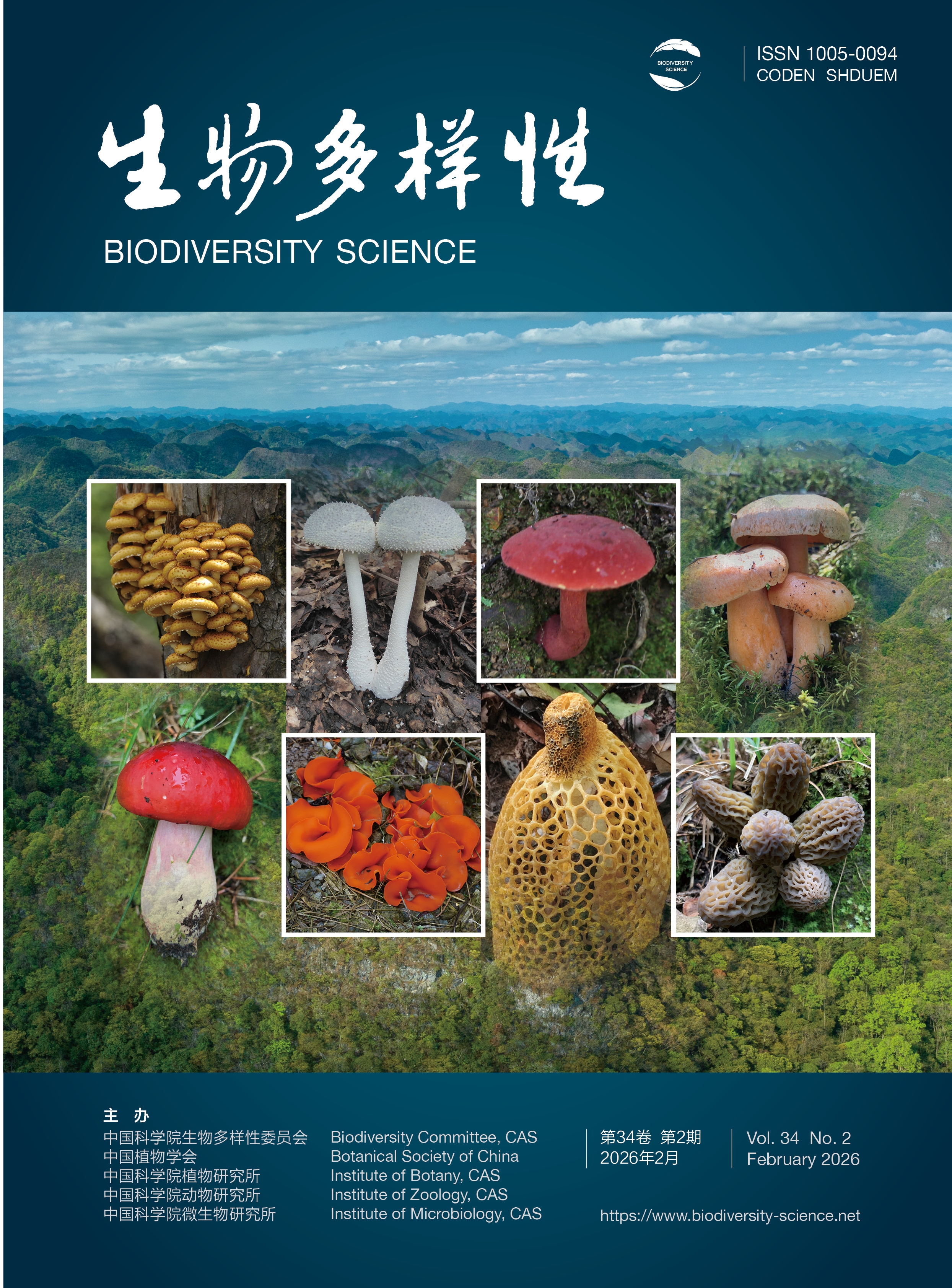
    Macrofungal flora and species diversity in karst areas of southwestern China
    Tinghong Tan, Fan Gao, Yu Yang, Qunying Gao, Chunfang Wu, Na Qiu, Ningning Zhao, Min Zhou, Gongping Kang, Zhihong Lu, Jianqiang Gao, Hong Yang, Chuandong Yang, Chunying Deng
    Biodiv Sci. 2026, 34 (2):  25281.  doi: 10.17520/biods.2025281
    Abstract ( 243 )   PDF (1648KB) ( 42 )   Save
    Related Articles | Metrics

    Aims: Macrofungi hold significant ecological and socioeconomic value. To analyze the floristic composition and species diversity of macrofungi in the karst areas of southwestern China and clarify the influence of distinctive geomorphological features on their distribution, a comprehensive survey was conducted. The results are expected to provide a scientific basis for biodiversity conservation and sustainable utilization of macrofungal resources in the areas. 

    Methods: Over a seven-year period, 12,451 macrofungal specimens were collected from Guizhou Province, Guangxi Zhuang Autonomous Region, and Yunnan Province using line transect and random survey methods. Species identification integrated morphological characterization and molecular phylogenetic analysis using ITS sequences. Taxonomic data were cross-referenced with literature to analyze floristic components and resource values. 

    Results: A total of 1,505 macrofungal species (2 phyla, 10 classes, 27 orders, 118 families, 418 genera) were identified in the karst areas of southwestern China. Among these, 19 new species, 1 newly recorded species in China, and 1 new record for Guizhou have been published. Dominant families constituted 34.75% of total families (41/118), with Russulaceae, Polyporaceae, and Boletaceae exhibiting the highest species richness. At generic level, 17.46% of genera (73/418) demonstrated dominance, particularly Russula, Amanita, and Lactarius

    Conclusions: The evaluation of macrofungal resource values identified 263 edible species, 176 medicinal species, and 237 toxic species, indicating considerable fungal diversity in this region. Floristic analysis revealed cosmopolitan distributions predominate at the family level (54.24%), while higher biogeographic diversity was observed at the genus level.

    A wildlife recognition method for skewed distributions in the Ulanba Nature Reserve
    Lin Ji, Chenxun Deng, Lifeng Wang, Degang Wang, Jiantao Wang, Yongyong Yu, Junguo Zhang
    Biodiv Sci. 2026, 34 (2):  25256.  doi: 10.17520/biods.2025256
    Abstract ( 24 )   PDF (2328KB) ( 5 )   Save
    Related Articles | Metrics

    Aim: The protection of wildlife in the Ulanba National Nature Reserve of Inner Mongolia plays a vital role in maintaining regional biodiversity. With the rapid development of artificial intelligence, deep learning has become a key tool for automating wildlife image recognition and advancing intelligent ecological monitoring. However, real-world wildlife image datasets typically exhibit a skewed distribution, where a few common species have abundant samples, while most species are underrepresented, thereby limiting the overall recognition performance of the model. 

    Methods: To address this issue, this study proposes a novel method for wildlife recognition named Diff-SCC, which integrates diffusion-based data generation and feature reconstruction. Specifically, rich semantic descriptions of low-frequency categories are first generated using a large language model to guide the diffusion model in synthesizing additional samples. A multi-scale negative sample filtering strategy is then introduced to assess image quality from pixel, feature, and semantic levels, enhancing the diversity and balance of low-frequency categories’ features. Furthermore, an SCConv module is incorporated into the backbone network to improve spatial and channel modeling, focusing more effectively on foreground regions while reducing redundant computation. 

    Results: This paper conducted comparative experiments on a self-built wildlife dataset from Ulanba Nature Reserve, which includes 12 wildlife categories, and on the public NACTI dataset. Experimental results show that the proposed Diff-SCC model achieves overall recognition accuracies of 78.71% and 80.84% on the two datasets, respectively. Notably, the recognition accuracy of low-ferquency classes improves by 9.96% and 9.99% over the baseline model, demonstrating the effectiveness of the proposed method in handling skewed data and recognizing rare species. 

    Conclusion: The Diff-SCC model proposed in this study demonstrates strong capability in mitigating the challenges of skewed distributions in wildlife image classification. It offers a reliable and practical solution for intelligent wildlife monitoring and contributes to the advancement of biodiversity conservation.

    The Future of Listening to Biodiversity: Limitations and Development Directions of Soundscape-Based Automatic Assessment Methods
    Jiangjian Xie, Mengkun Zhu, Aiwu Jiang, Zhishu Xiao
    Biodiv Sci. 2026, 34 (2):  25296.  doi: 10.17520/biods.2025296   cstr: 32101.14.biods.2025296
    Abstract ( 135 )   PDF (443KB) ( 31 )   Save
    Related Articles | Metrics

    Background:Biodiversity loss driven by human activities and climate change has intensified the demand for efficient, scalable, and non-invasive monitoring approaches. Passive acoustic monitoring (PAM), based on the soundscape concept, captures biological, geophysical, and anthropogenic sounds over large spatial and temporal scales, providing a promising framework for biodiversity assessment. Because changes in species composition and habitat conditions are often reflected in soundscape structure, soundscape-based analysis has become a key component of ecoacoustics. 

    Progress:Current soundscape-based biodiversity assessments mainly rely on two automated approaches: automatic recognition methods and acoustic index methods. Automatic recognition enables species- or sound-source-level identification using machine learning, but its performance is limited by the scarcity of annotated data, sensitivity to noise and sound overlap, and weak cross-regional generalization. Acoustic index methods offer computational efficiency by summarizing soundscape characteristics into numerical metrics, yet their ecological interpretability and robustness vary across habitats and environmental conditions, often leading to inconsistent or contradictory results. 

    Prospects:Future progress requires standardized data acquisition and processing protocols, the development of open soundscape feature databases, and methodological integration of automatic recognition and acoustic index approaches. Combining these methods with multi-source environmental data is expected to enhance robustness, ecological interpretability, and comparability, supporting more reliable soundscape-based biodiversity monitoring and conservation decision-making.

    Impacts of nitrogen inputs-driven key ecological processes on biodiversity and their management implications
    Xiaoqiang Lu, Dan Rui, Jiangfeng Zhang, Bingxin Yin, Yulu Wang, Yuting Cen, Yichen Cui, Wanxia Yang
    Biodiv Sci. 2026, 34 (2):  25368.  doi: 10.17520/biods.2025368   cstr: 32101.14.biods.2025368
    Abstract ( 334 )   PDF (1191KB) ( 20 )   Save
    Related Articles | Metrics

    Background & Aim:Human activities have substantially altered natural nitrogen (N) regimes, resulting in a marked increase in reactive nitrogen entering terrestrial and aquatic ecosystems. Nitrogen inputs, together with the key ecological processes they drive—such as atmospheric deposition, nitrogen transformation, and changes in nitrogen availability—play a central role in shaping ecosystem structure and functioning. Excess nitrogen inputs disrupt ecological balance through soil acidification, aquatic eutrophication, habitat degradation, and the spread of invasive species, thereby exerting persistent pressure on biodiversity. As biodiversity loss has become a global environmental concern, increasing attention has been directed toward understanding how externally driven nitrogen inputs influence ecological processes most closely linked to species coexistence, community assembly, and ecosystem stability. Rather than treating N inputs driven processes as a closed biogeochemical system, recent studies have emphasized nitrogen inputs as a dominant external driver with direct ecological relevance. At the same time, advances in molecular techniques, remote sensing, and large-scale ecological monitoring have provided new opportunities to examine nitrogen–biodiversity relationships across spatial and organizational scales. 

    Progresses:A growing body of evidence demonstrates that the ecological consequences of nitrogen inputs are strongly context dependent. In ecosystems characterized by low background nitrogen availability, moderate nitrogen enrichment may temporarily enhance primary productivity and, in some cases, support short-term increases in local biodiversity. In contrast, sustained or excessive nitrogen inputs are consistently associated with negative biodiversity outcomes, including species loss, community homogenization, and functional simplification. These effects are mediated by multiple interacting processes, such as shifts in soil physicochemical conditions, altered nitrogen availability and stoichiometric balance, and changes in microbially regulated nitrogen transformation pathways. Nitrogen enrichment often favors fast-growing, resource-acquisitive species, intensifying competitive exclusion and reducing niche differentiation, while simultaneously restructuring microbial communities and their functional capacities. Importantly, biodiversity itself can influence nitrogen dynamics. Functional diversity among plants, microorganisms, and soil fauna contributes to more efficient nitrogen use, reduced nitrogen losses, and greater ecosystem resistance to external nitrogen stress. Building on these insights, research on nitrogen inputs and associated ecological processes has increasingly informed biodiversity monitoring, ecological risk assessment, and ecosystem restoration, highlighting the practical relevance of process-oriented nitrogen research. 

    Perspectives:Despite substantial progress, significant challenges remain in translating scientific understanding of nitrogen–biodiversity interactions into effective management and policy actions. Data relevant to nitrogen inputs and biodiversity responses are often fragmented across ecosystems, spatial scales, and disciplinary domains, limiting integrative analysis. In addition, monitoring approaches and indicators remain insufficiently standardized, constraining comparisons among regions and long-term assessments. Nitrogen management policies are frequently developed in isolation from biodiversity objectives, reducing the potential for synergistic outcomes. Future research should therefore focus on integrating multi-source datasets, including field observations, molecular information, and remote sensing products, to better capture the dynamics of nitrogen-driven biodiversity change. Developing standardized, process-based monitoring frameworks will be essential for linking nitrogen inputs to biodiversity responses in a policy-relevant manner. Strengthening coordination across sectors—particularly agriculture, environmental management, and biodiversity conservation—will further support the incorporation of nitrogen considerations into governance and decision-making. By adopting a process-informed perspective that explicitly connects nitrogen inputs, key ecological processes, and biodiversity outcomes, research in this field can provide more robust support for ecosystem restoration, adaptive management, and the implementation of the Kunming–Montreal Global Biodiversity Framework.

    The Impacts of Urban Block Built Environments on Biodiversity ——A Review and Outlook
    Lulu Chen, Haoting Tang, Hong Leng, Qing Yuan, Xinyue Yang
    Biodiv Sci. 2026, 34 (2):  25286.  doi: 10.17520/biods.2025286
    Abstract ( 339 )   PDF (1480KB) ( 29 )   Save
    Related Articles | Metrics

    Background: With the accelerating pace of global urbanization, urban biodiversity is facing increasingly severe challenges, including habitat loss, ecological fragmentation, and the decline of native species. As the fundamental spatial and functional unit of urban spatial structure and ecological system, urban blocks not only support residential, commercial, and social functions, but also serve as critical interfaces where the built environment interacts with ecological systems. They play a vital role in maintaining ecosystem services, supporting habitat provision, and shaping local biodiversity patterns. In recent years, as urban regeneration progresses, how to effectively embed biodiversity enhancement goals into spatial planning at the scale of urban block has become a pressing and central issue in the field of urban ecological planning and sustainable design. 

    Aims & Methods: While studies examining the impacts of urban block built environment on urban biodiversity have increased in recent years, systematic reviews and integrative theoretical frameworks remain insufficient, constraining theoretical development. To address this gap, this study conducts a bibliometric and content-based review of relevant domestic and international research, and categorizes built environment factors affecting urban biodiversity at the block scale into five categories: block greening, vegetation characteristics, land use, three-dimensional morphology, and mediating factors (human activity and climate factors). Based on this framework, the study comprehensively summarizes various impact factors and their relationships identified in existing research. 

    Results: Findings reveal three key discoveries: (1) the urban block scale is critically important for biodiversity research, exhibiting distinct characteristics that differentiate it from other spatial scales; (2) the urban block built environment influences biodiversity through both direct and indirect pathways, creating complex impact mechanisms; (3) human activity in urban blocks demonstrate significant mediating effects, while climate factors play important moderating roles in shaping biodiversity patterns, suggesting these interactive effects warrant in-depth future investigation. 

    Conclusion: Based on this, the study proposes four major directions for future research: (1) deepening research on the impacts of block three-dimensional morphology on urban biodiversity; (2) revealing mediating effects of human activities at block scale; (3) exploring regulatory mechanisms of climate factors on biodiversity patterns; (4) developing differentiated guidelines and standards for refined urban block regeneration. 

    Perspectives: This review aims to provide a systematic theoretical foundation for urban block spatial planning oriented toward biodiversity enhancement, and to promote the construction of urban spatial systems characterized by ecological resilience and integration with nature.

    The Dilemmas and Solutions for Invasive Alien Species Governance Policy Systems
    Xiaofan Cheng, Qingyuan Li, Yuanhui Li, Mingxiang Zhang
    Biodiv Sci. 2026, 34 (2):  25332.  doi: 10.17520/biods.2025332
    Abstract ( 380 )   PDF (781KB) ( 46 )   Save
    Related Articles | Metrics

    Background & Aim: As the threat posed by invasive alien species to China's ecosystems becomes increasingly severe, improving the governance system has emerged as a crucial issue at present. Although existing studies have explored legal and administrative management issues in the governance of invasive alien species, most of these studies focus on governance discussions within a single field and fail to conduct systematic analysis from the perspective of the overall policy system. Therefore, in-depth research on the structural dilemmas existing in the policy system for invasive alien species governance—especially the exploration of its holistic construction—still holds significant academic value and practical significance. 

    Method: Employing literature review and case analysis methods, this paper compiles public interest litigation cases related to invasive alien species in recent years, introduces judicial cases as practical illustrations, and further demonstrates their actual harms to the ecological environment, public interests, and biological security. 

    Results: This paper sorts out the laws and policies regarding invasive alien species in China, and reveals the problems existing in current practice, such as the imperfection of the legal system, the lack of top-level design, the inadequacy of the name list system, the insufficient coordination of the implementation mechanism, and the weakness of basic guarantees and technical support. 

    Conclusion: This paper proposes a holistic improvement pathway, which includes the following aspects: at the legislative level, it suggests improving legislation through the “code-specialized law” model, strengthening accountability, and optimizing government assessment mechanisms; at the implementation level, it is necessary to establish regulatory authorities, set up a regional joint meeting mechanism, and optimize name-list management; and at the support and guarantee level, efforts should be made to promote the marketization of ecological compensation, enhance interdisciplinary collaboration, and implement the “project bidding for talent recruitment” mechanism. The purpose of this paper is to provide theoretical and practical references for the governance of invasive alien species.

    Progress, Challenges, and Insights on the Operation of the Global Biodiversity Framework Fund
    Haiou Liu, Zhiming Hao, Leshan Du, Wenhui Liu, Ziyuan Li, Lei Liu
    Biodiv Sci. 2026, 34 (2):  25463.  doi: 10.17520/biods.2025463
    Abstract ( 37 )   PDF (486KB) ( 10 )   Save
    Related Articles | Metrics

    Background & Aim: Following the decision made during the fifteenth meeting of the Conference of the Parties to the Convention on Biological Diversity (CBD COP15), the Global Environment Facility (GEF) officially established the Global Biodiversity Framework Fund (GBFF) in August 2023. The fund aims to provide additional support to developing countries in implementing the Kunming-Montreal Global Biodiversity Framework (KMGBF). This study evaluates the operational advancements of the GBFF, with particular attention to its financing mechanisms, project portfolio, allocation strategies, and alignment with the KMGBF objectives. Additionally, the research seeks to analyze the challenges faced during the initial programming phase and explore their implications for improving biodiversity financing and global biodiversity governance. 

    Review Results: The inaugural programming tranche, initiated in February 2024, allocated USD 201.6 million to 40 projects spanning 41 countries through three competitive selection rounds. The distribution of approved projects reveals that Latin America and the Caribbean received the largest portion of funding, accounting for 43% of the total allocation. In terms of project scale, the median grant under the GBFF is USD 3.9 million, significantly lower than the median of USD 9.3 million for GEF-8 biodiversity focal area projects. This indicates that GBFF-supported projects remain relatively modest in scale at this early stage. Regarding resource allocation, approximately 78% of the projects and 48% of the total funding were directed toward Action Area 1 of the GBFF (Biodiversity conservation, restoration, land/sea-use, and spatial planning). Among the 15 megadiverse countries eligible for GBFF support, 11 received funding, while China remains among the few without an approved project. 

    Recommendations: From the perspective of CBD Parties, the study recommends promoting diversified resource-mobilization strategies, strengthening the GBFF’s capacity to support systemic transformation, and enhancing synergies among financing mechanisms such as the GEF and the Kunming Biodiversity Fund. For China, as both a developing megadiverse country and a key actor in global biodiversity governance, it is crucial to design integrated, large-scale demonstrative proposals, streamline domestic application processes, and improve the preparation of essential methodological and safeguard documents to enhance approval success rates in the second programming tranche. As the initiator of the Kunming Biodiversity Fund, China should also clarify its differentiated strategic positioning, reinforce its role in capacity building, and advance more transparent and robust governance frameworks to maximize complementarity with the GBFF. Collectively, these measures can support China’s deeper engagement in global biodiversity governance and contribute to the effective implementation of the KMGBF.


  • wechat:swdyx_wx