

Biodiv Sci ›› 2026, Vol. 34 ›› Issue (2): 25256. DOI: 10.17520/biods.2025256 cstr: 32101.14.biods.2025256
• Technology and Methodology • Previous Articles Next Articles
Lin Ji1,2,3, Chenxun Deng1,2,3, Lifeng Wang1,2,3( ), Degang Wang1,2,3, Jiantao Wang4(), Yongyong Yu4, Junguo Zhang1,2,3,*(
 )
)
Received:2025-07-02
Accepted:2026-01-14
Online:2026-02-20
Published:2026-03-23
Contact:
Junguo Zhang
Supported by:Lin Ji, Chenxun Deng, Lifeng Wang, Degang Wang, Jiantao Wang, Yongyong Yu, Junguo Zhang. A wildlife recognition method for skewed distributions based on the Diff-SCC model[J]. Biodiv Sci, 2026, 34(2): 25256.
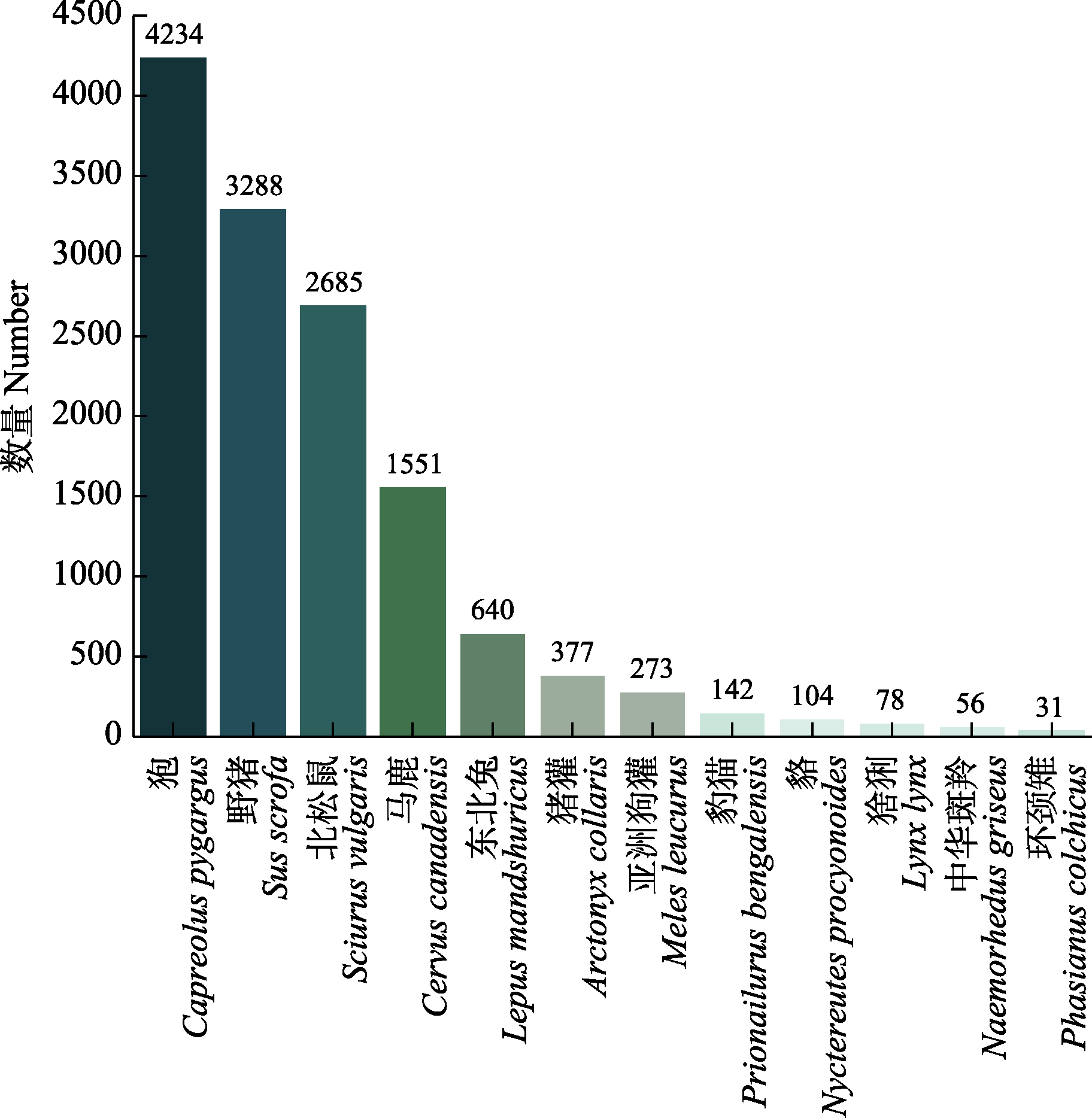
Fig. 1 Distribution of training data in the wildlife dataset from the Inner Mongolia Ulanba National Nature Reserve
| 物种 Species | 数量 Number | 物种 Species | 数量 Number |
|---|---|---|---|
| 美洲黑熊 Ursus americanus | 2,765 | 条纹臭鼬 Mephitis mephitis | 1,123 |
| 美洲狮 Puma concolor | 2,707 | 驼鹿 Alces alces | 994 |
| 短尾猫 Lynx rufus | 2,310 | 灰松鼠 Sciurus carolinensis | 798 |
| 骡鹿 Odocoileus hemionus | 1,958 | 火鸡 Meleagris gallopavo | 615 |
| 马鹿 Cervus canadensis | 1,956 | 黑尾长耳大野兔 Lepus californicus | 592 |
| 欧洲马鹿 Cervus elaphus | 1,928 | 九带犰狳 Dasypus novemcinctus | 434 |
| 野猪 Sus scrofa | 1,693 | 北美红松鼠 Tamiasciurus hudsonicus | 188 |
| 郊狼 Canis latrans | 1,614 | 加州翎鹑 Callipepla californica | 137 |
| 灰狐 Urocyon cinereoargenteus | 1,339 | 赤狐 Vulpes vulpes | 127 |
| 白靴兔 Lepus americanus | 1,246 | 弗吉尼亚负鼠 Didelphis virginiana | 110 |
| 浣熊 Procyon lotor | 1,176 | 美洲貂 Martes americana | 88 |
Table 1 Composition of the training set of the NACTI wildlife dataset
| 物种 Species | 数量 Number | 物种 Species | 数量 Number |
|---|---|---|---|
| 美洲黑熊 Ursus americanus | 2,765 | 条纹臭鼬 Mephitis mephitis | 1,123 |
| 美洲狮 Puma concolor | 2,707 | 驼鹿 Alces alces | 994 |
| 短尾猫 Lynx rufus | 2,310 | 灰松鼠 Sciurus carolinensis | 798 |
| 骡鹿 Odocoileus hemionus | 1,958 | 火鸡 Meleagris gallopavo | 615 |
| 马鹿 Cervus canadensis | 1,956 | 黑尾长耳大野兔 Lepus californicus | 592 |
| 欧洲马鹿 Cervus elaphus | 1,928 | 九带犰狳 Dasypus novemcinctus | 434 |
| 野猪 Sus scrofa | 1,693 | 北美红松鼠 Tamiasciurus hudsonicus | 188 |
| 郊狼 Canis latrans | 1,614 | 加州翎鹑 Callipepla californica | 137 |
| 灰狐 Urocyon cinereoargenteus | 1,339 | 赤狐 Vulpes vulpes | 127 |
| 白靴兔 Lepus americanus | 1,246 | 弗吉尼亚负鼠 Didelphis virginiana | 110 |
| 浣熊 Procyon lotor | 1,176 | 美洲貂 Martes americana | 88 |
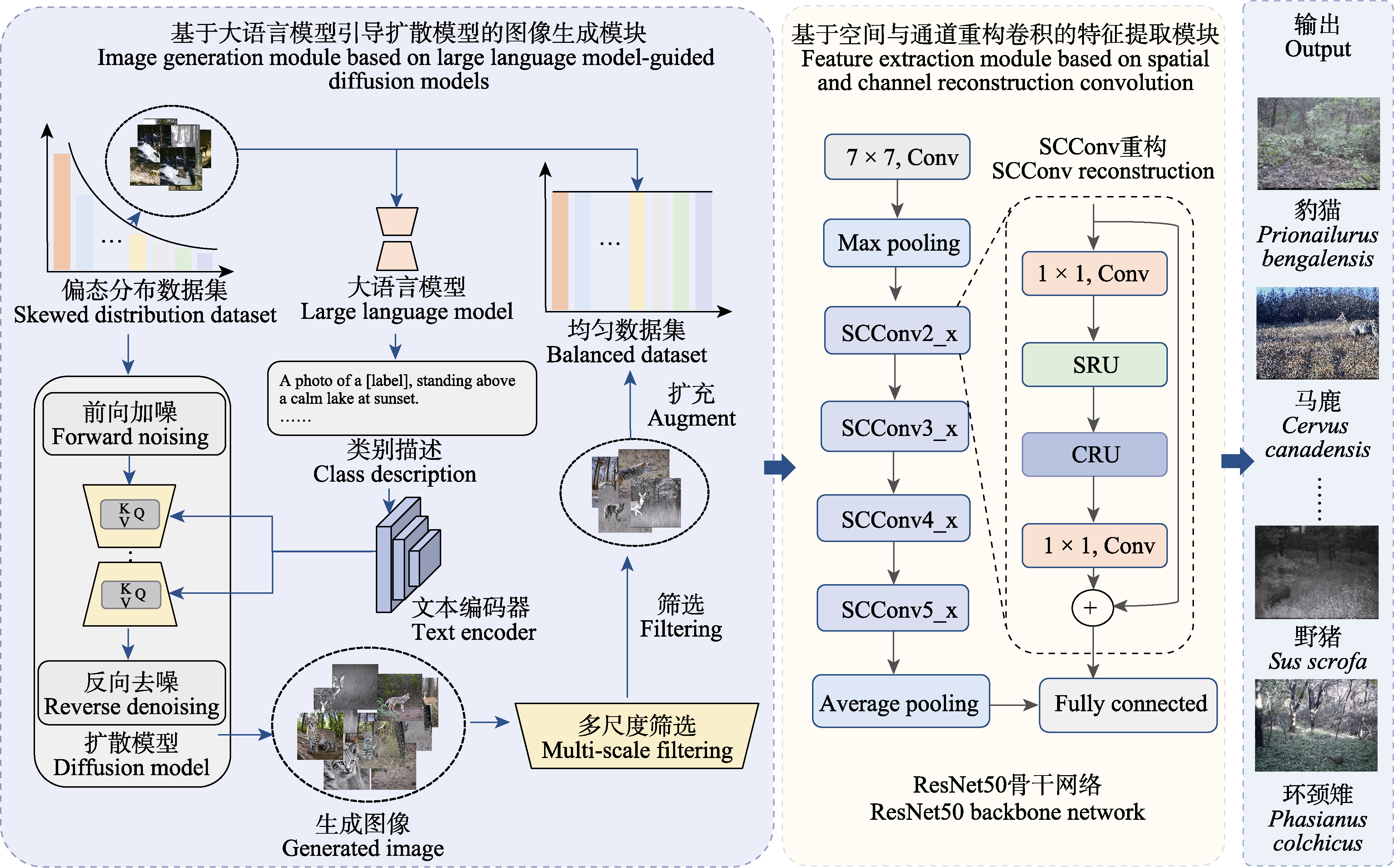
Fig. 2 The architecture of Diff-SCC model. Conv, Convolution; SCConv2_x-SCConv5_x, Residual stages of SCConv; SRU, Spatial reconstruction unit; CRU, Channel reconstruction unit.
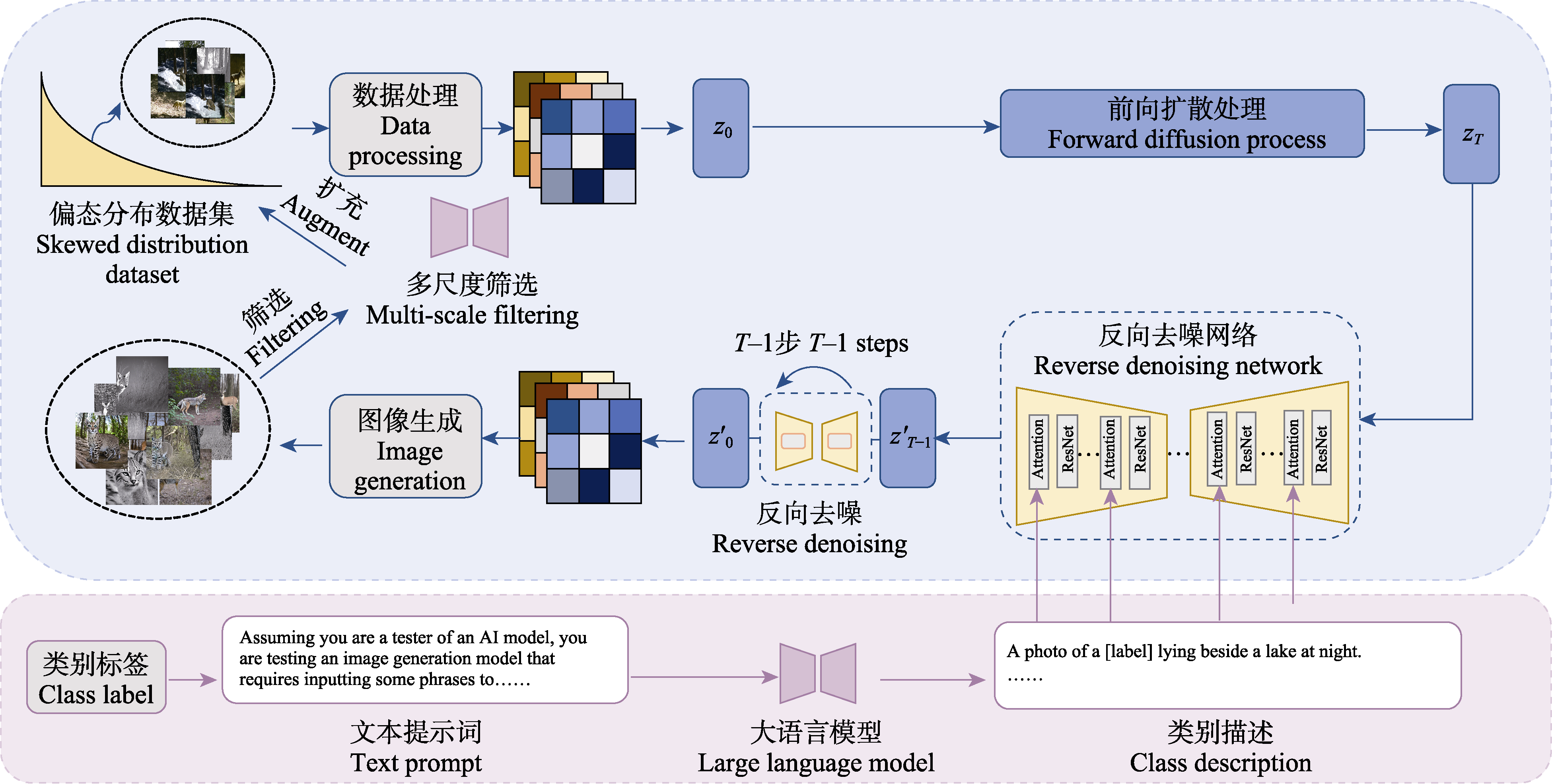
Fig. 3 Expansion of skewed dataset based on diffusion model. z0, Initial latent representation of the original image; zT, Latent representation after T steps of Gaussian noise addition; ${{{z}'}_{T1}}$, Intermediate latent representation in the reverse diffusion process;${{{z}'}_{0}}$, Latent representation of the image generated by the diffusion model.
| 编号 Number | 提示模板 Prompt template | 备注 Remarks |
|---|---|---|
| 1 | A photo of a [label] | 基础模板 Basic template |
| 2 | A photo of a [label] at sunset | 添加时间描述 Adding temporal description |
| 3 | A photo of a [label] in winter | 添加时间描述 Adding temporal description |
| 4 | A photo of a [label] at the edge of a canyon | 添加地点描述 Adding location description |
| 5 | A photo of a [label] in a misty forest clearing | 添加地点描述 Adding location description |
| 6 | A photo of a [label] nesting | 添加动作描述 Adding action description |
| 7 | A photo of a [label] landing gracefully | 添加动作描述 Adding action description |
| 8 | A photo of a [label] lying beside a lake at night | 添加3个描述 Adding three descriptions |
Table 2 Text prompt template
| 编号 Number | 提示模板 Prompt template | 备注 Remarks |
|---|---|---|
| 1 | A photo of a [label] | 基础模板 Basic template |
| 2 | A photo of a [label] at sunset | 添加时间描述 Adding temporal description |
| 3 | A photo of a [label] in winter | 添加时间描述 Adding temporal description |
| 4 | A photo of a [label] at the edge of a canyon | 添加地点描述 Adding location description |
| 5 | A photo of a [label] in a misty forest clearing | 添加地点描述 Adding location description |
| 6 | A photo of a [label] nesting | 添加动作描述 Adding action description |
| 7 | A photo of a [label] landing gracefully | 添加动作描述 Adding action description |
| 8 | A photo of a [label] lying beside a lake at night | 添加3个描述 Adding three descriptions |
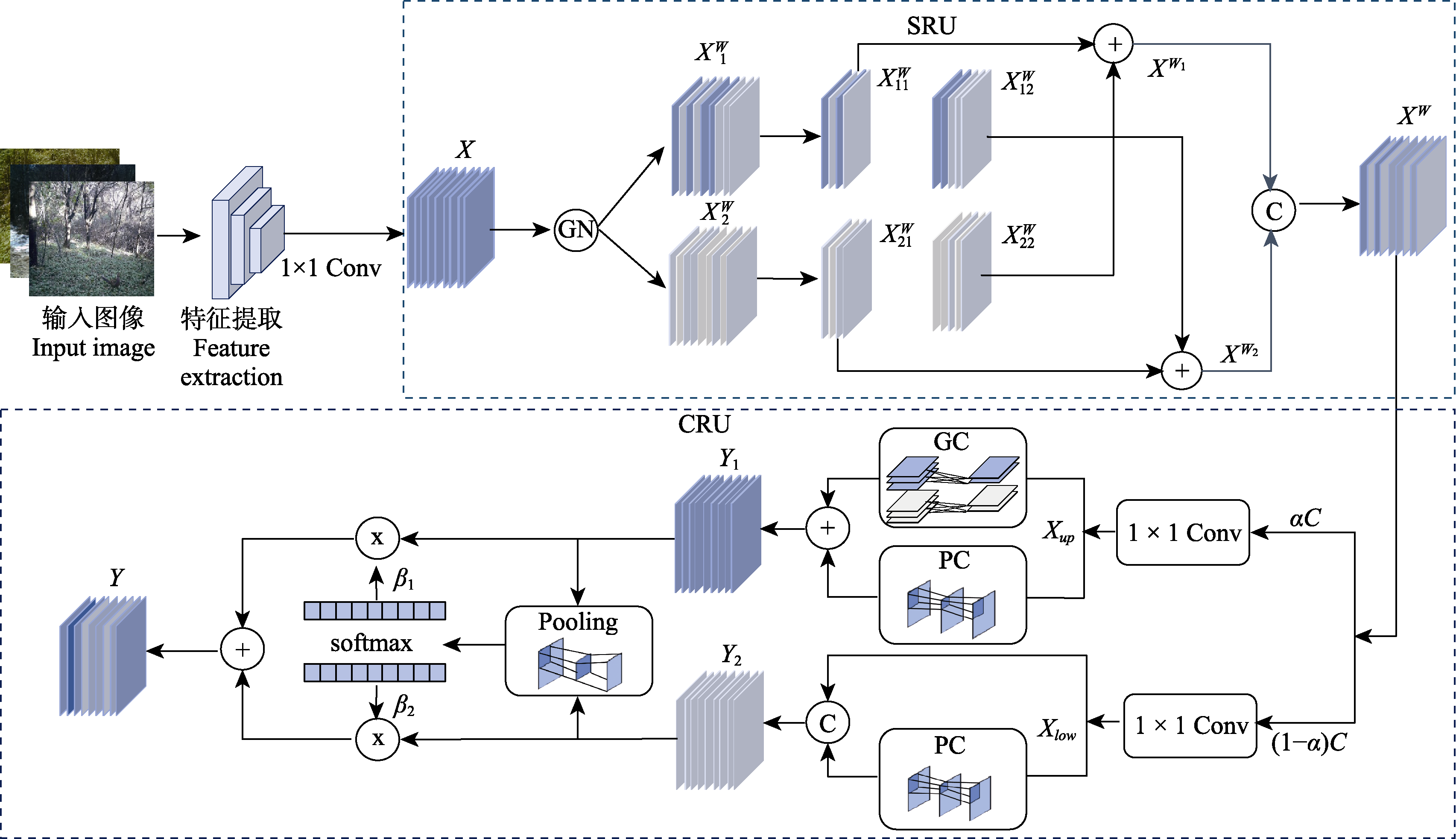
Fig. 4 The workflow of SCConv convolution reconstruction. SRU, Spatial reconstruction unit; CRU, Channel reconstruction unit; Conv, Convolution unit; X, Input feature map; GN, Group normalization; XW 1, Feature map with high information content; XW 2, Feature map with low information content; XW 11, Self-reconstructed part of the high-information feature; XW 12, Cross features injected into the low-information regions; XW 22, Self-reconstructed part of the low-information feature; XW 21, Auxiliary supplement to the high-information regions; XW1, XW2, Enhanced feature maps after reconstruction; XW, Feature map after spatial convolutional reconstruction; αC, (1-α)C, Main and auxiliary channel splits; Xup, Feature map from the main channel group; Xlow, Feature map from the auxiliary channel group; GC, Group convolution; PC, Point convolution; Y1, Main features output by the upper branch; Y2, Auxiliary features output by the lower branch; Pooling, Pooling layer; β1, β2, Channel attention weights; Y, Final channel-reconstructed feature map.
| 方法 Method | 高频类别准确率 High-frequency accuracy (%) | 中频类别准确率 Middle-frequency accuracy (%) | 低频类别准确率 Low-frequency accuracy (%) | 总体准确率 Overall accuracy (%) | Macro F1 |
|---|---|---|---|---|---|
| ResNet50 | 91.37 | 80.38 | 53.82 | 70.76 | 0.29 |
| LDAM | 92.71 | 79.34 | 53.79 | 71.02 | 0.31 |
| Balanced Softmax | 90.38 | 81.49 | 55.37 | 71.39 | 0.32 |
| AREA | 91.09 | 80.25 | 55.65 | 71.69 | 0.32 |
| PaCo | 89.16 | 84.34 | 56.79 | 72.17 | 0.33 |
| ResLT | 93.22 | 85.62 | 61.88 | 76.28 | 0.38 |
| SADE | 92.53 | 87.43 | 62.34 | 76.58 | 0.38 |
| BalPoE | 92.74 | 88.15 | 62.86 | 77.64 | 0.39 |
| Mixup | 92.75 | 85.11 | 57.28 | 73.74 | 0.35 |
| CycleGAN | 92.48 | 86.49 | 58.59 | 74.53 | 0.36 |
| Diff-SCC | 95.32 | 89.75 | 63.78 | 78.71 | 0.40 |
Table 3 Comparison of experimental results on the ULB-12 dataset among different models
| 方法 Method | 高频类别准确率 High-frequency accuracy (%) | 中频类别准确率 Middle-frequency accuracy (%) | 低频类别准确率 Low-frequency accuracy (%) | 总体准确率 Overall accuracy (%) | Macro F1 |
|---|---|---|---|---|---|
| ResNet50 | 91.37 | 80.38 | 53.82 | 70.76 | 0.29 |
| LDAM | 92.71 | 79.34 | 53.79 | 71.02 | 0.31 |
| Balanced Softmax | 90.38 | 81.49 | 55.37 | 71.39 | 0.32 |
| AREA | 91.09 | 80.25 | 55.65 | 71.69 | 0.32 |
| PaCo | 89.16 | 84.34 | 56.79 | 72.17 | 0.33 |
| ResLT | 93.22 | 85.62 | 61.88 | 76.28 | 0.38 |
| SADE | 92.53 | 87.43 | 62.34 | 76.58 | 0.38 |
| BalPoE | 92.74 | 88.15 | 62.86 | 77.64 | 0.39 |
| Mixup | 92.75 | 85.11 | 57.28 | 73.74 | 0.35 |
| CycleGAN | 92.48 | 86.49 | 58.59 | 74.53 | 0.36 |
| Diff-SCC | 95.32 | 89.75 | 63.78 | 78.71 | 0.40 |
| 方法 Method | 高频类别准确率 High-frequency accuracy (%) | 中频类别准确率 Middle-frequency accuracy (%) | 低频类别准确率 Low-frequency accuracy (%) | 总体准确率 Overall accuracy (%) | Macro F1 | |
|---|---|---|---|---|---|---|
| ResNet50 | 89.66 | 87.11 | 56.56 | 73.57 | 0.29 | |
| LDAM | 87.24 | 87.25 | 59.59 | 74.67 | 0.31 | |
| Balanced Softmax | 87.24 | 87.39 | 60.04 | 74.93 | 0.30 | |
| AREA | 88.34 | 88.68 | 57.70 | 74.18 | 0.31 | |
| PaCo | 90.16 | 88.54 | 62.15 | 76.76 | 0.32 | |
| ResLT | 92.76 | 88.57 | 64.36 | 78.13 | 0.34 | |
| SADE | 91.35 | 90.17 | 64.63 | 78.72 | 0.34 | |
| BalPoE | 92.39 | 89.55 | 64.84 | 78.67 | 0.34 | |
| Mixup | 90.88 | 89.32 | 60.96 | 76.64 | 0.32 | |
| CycleGAN | 92.16 | 89.16 | 62.21 | 77.31 | 0.35 | |
| Diff-SCC | 94.75 | 90.84 | 66.55 | 80.84 | 0.36 | |
Table 4 Comparison of experimental results on the NACTI dataset among different models
| 方法 Method | 高频类别准确率 High-frequency accuracy (%) | 中频类别准确率 Middle-frequency accuracy (%) | 低频类别准确率 Low-frequency accuracy (%) | 总体准确率 Overall accuracy (%) | Macro F1 | |
|---|---|---|---|---|---|---|
| ResNet50 | 89.66 | 87.11 | 56.56 | 73.57 | 0.29 | |
| LDAM | 87.24 | 87.25 | 59.59 | 74.67 | 0.31 | |
| Balanced Softmax | 87.24 | 87.39 | 60.04 | 74.93 | 0.30 | |
| AREA | 88.34 | 88.68 | 57.70 | 74.18 | 0.31 | |
| PaCo | 90.16 | 88.54 | 62.15 | 76.76 | 0.32 | |
| ResLT | 92.76 | 88.57 | 64.36 | 78.13 | 0.34 | |
| SADE | 91.35 | 90.17 | 64.63 | 78.72 | 0.34 | |
| BalPoE | 92.39 | 89.55 | 64.84 | 78.67 | 0.34 | |
| Mixup | 90.88 | 89.32 | 60.96 | 76.64 | 0.32 | |
| CycleGAN | 92.16 | 89.16 | 62.21 | 77.31 | 0.35 | |
| Diff-SCC | 94.75 | 90.84 | 66.55 | 80.84 | 0.36 | |
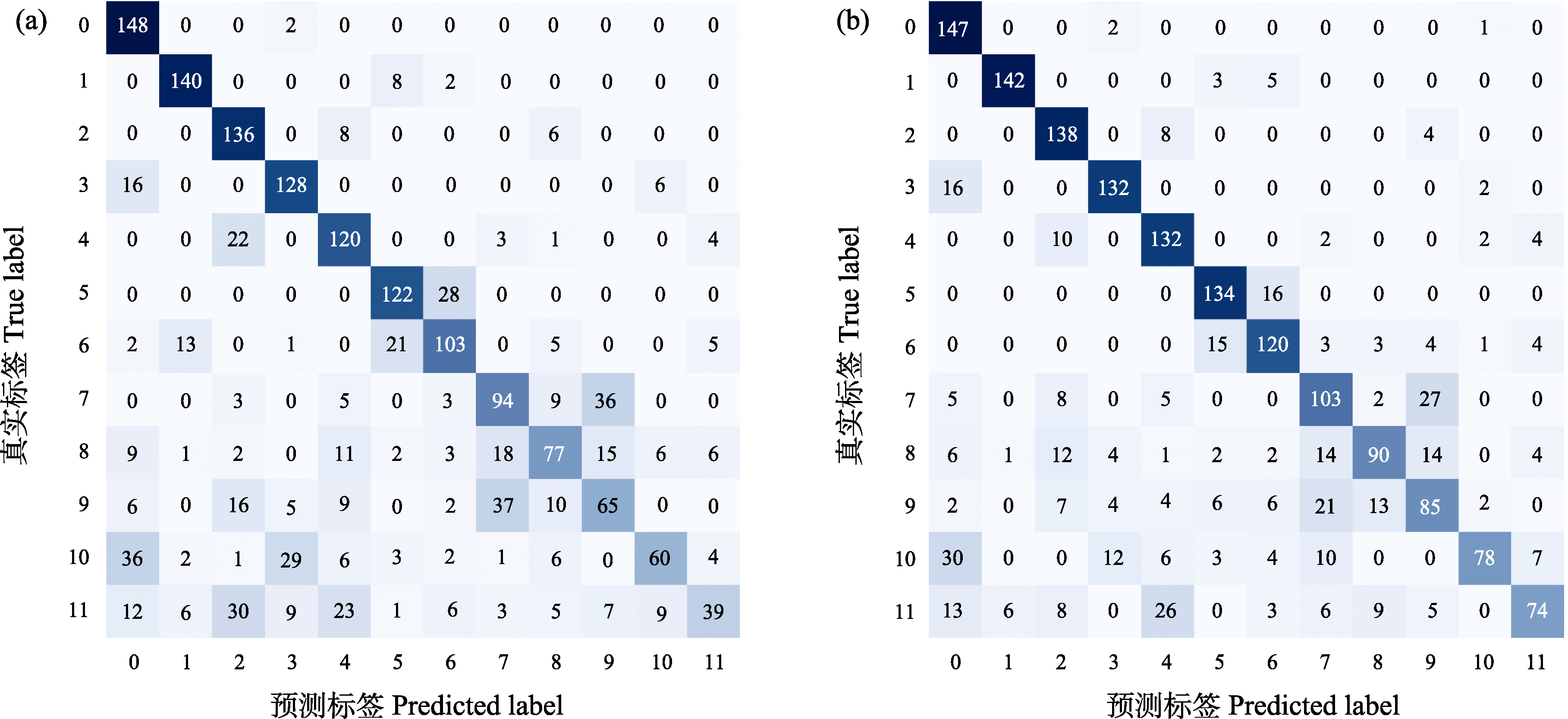
Fig. 5 Comparison of predicted vs. actual classification for ResNet50 (a) and Diff-SCC (b) models on the ULB-12 Dataset. The color intensity in the confusion matrix reflects the number of samples at each position: Darker shades indicate a larger number of samples, whereas lighter shades indicate fewer samples. Therefore, a darker and more concentrated diagonal region suggests stronger recognition performance for the corresponding class, while more pronounced off-diagonal regions indicate more severe inter-class confusion.
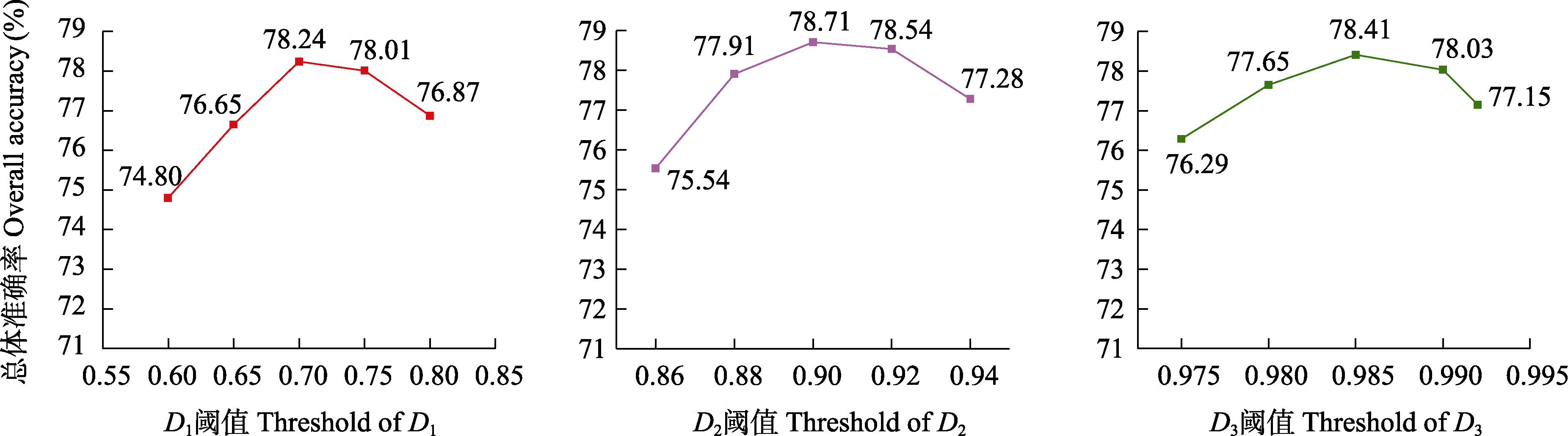
Fig. 6 Threshold sensitivity curve analysis of D1, D2, and D3
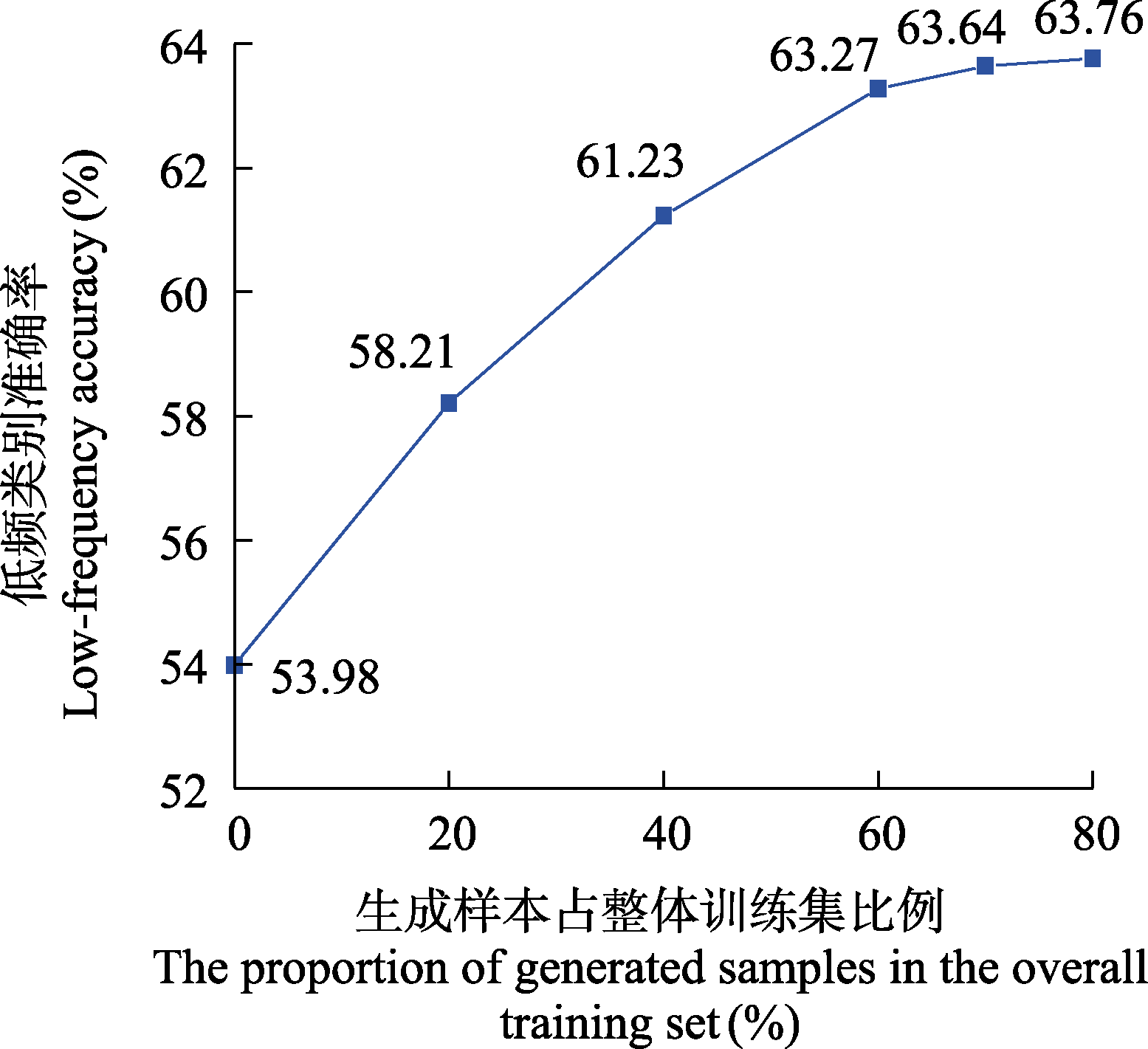
Fig. 7 Effect of the mixing ratio of real and generated samples on low-frequency accuracy
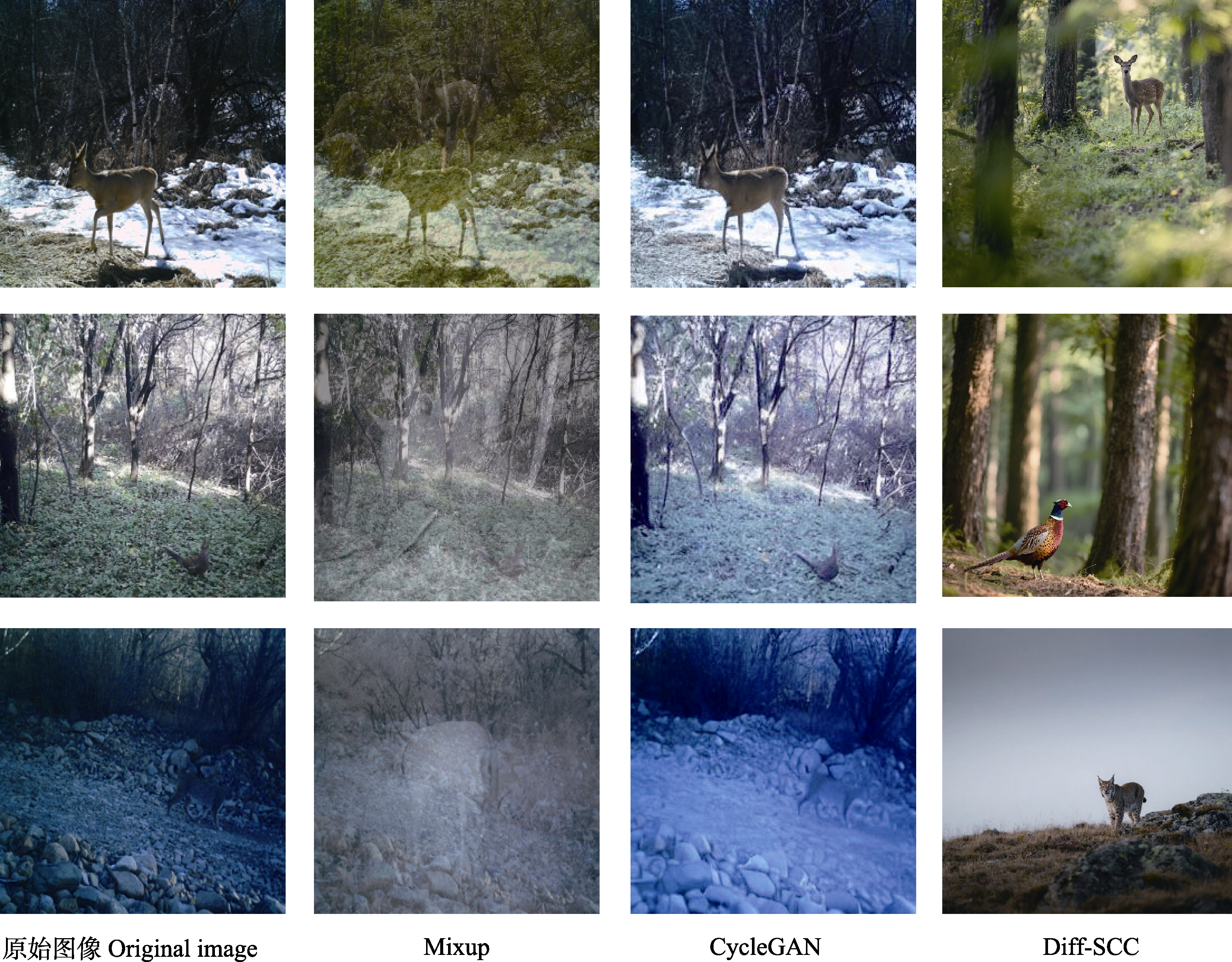
Fig. 8 Comparison of different model methods
| 方法 Method | 弗雷歇距离 FID | 方法学习感知图像 块相似度 LPIPS | 准确率 Accuracy (%) |
|---|---|---|---|
| Mixup | 39.5 | 0.42 | 73.74 |
| CycleGAN | 17.6 | 0.28 | 74.53 |
| Diff-SCC | 12.4 | 0.21 | 78.71 |
Table 5 Comparison of image quality generated by different data augmentation methods
| 方法 Method | 弗雷歇距离 FID | 方法学习感知图像 块相似度 LPIPS | 准确率 Accuracy (%) |
|---|---|---|---|
| Mixup | 39.5 | 0.42 | 73.74 |
| CycleGAN | 17.6 | 0.28 | 74.53 |
| Diff-SCC | 12.4 | 0.21 | 78.71 |
| 低频类别图像扩充策略 Low-frequency class image expansion strategy | 空间和通道卷积重构单元 Spatial and channel convolution reconstruction unit | 准确率 Accuracy (%) | 模型规模 Model size (MB) | 浮点运算次数 FLOPs (× 109) | 单张图像推理时间 Inference time per image (ms) |
|---|---|---|---|---|---|
| - | - | 70.76 | 90.14 | 4.13 | 3.8 |
| - | + | 73.86 | 56.44 | 2.66 | 2.5 |
| + | - | 77.65 | 90.14 | 4.13 | 3.8 |
| + | + | 78.71 | 56.44 | 3.13 | 2.6 |
Table 6 Ablation experiment results
| 低频类别图像扩充策略 Low-frequency class image expansion strategy | 空间和通道卷积重构单元 Spatial and channel convolution reconstruction unit | 准确率 Accuracy (%) | 模型规模 Model size (MB) | 浮点运算次数 FLOPs (× 109) | 单张图像推理时间 Inference time per image (ms) |
|---|---|---|---|---|---|
| - | - | 70.76 | 90.14 | 4.13 | 3.8 |
| - | + | 73.86 | 56.44 | 2.66 | 2.5 |
| + | - | 77.65 | 90.14 | 4.13 | 3.8 |
| + | + | 78.71 | 56.44 | 3.13 | 2.6 |
| [1] | Aimar ES, Jonnarth A, Felsberg M, Kuhlmann M (2023) Balanced product of calibrated experts for long-tailed recognition. In: 2023 IEEE/CVF Conference on Computer Vision and Pattern Recognition (CVPR), pp. 19967-19977. Vancouver, Canada. |
| [2] | Cao KD, Wei C, Gaidon A, Arechiga N, Ma TY (2019) Learning imbalanced datasets with label-distribution-aware margin loss. In:2019 Annual Conference on Neural Information Processing Systems (NeurIPS), pp. 1565-1576. Vancouver, Canada. |
| [3] | Chen JH, Su B (2023) Transfer knowledge from head to tail: Uncertainty calibration under long-tailed distribution. In: 2023 IEEE/CVF Conference on Computer Vision and Pattern Recognition (CVPR), pp. 19978-19987. Vancouver, Canada. |
| [4] | Chen XH, Zhou YC, Wu DY, Yang CL, Li B, Hu QH, Wang WP (2023) AREA: Adaptive reweighting via effective area for long-tailed classification. In: 2023 IEEE/CVF Conference on Computer Vision and Pattern Recognition (CVPR), pp. 19277-19287. Vancouver, Canada. |
| [5] | Cui JQ, Liu S, Tian ZT, Zhong ZS, Jia JY (2023) ResLT: Residual learning for long-tailed recognition. IEEE Transactions on Pattern Analysis and Machine Intelligence, 45, 3695-3706. |
| [6] | Cui JQ, Zhong ZS, Liu S, Yu B, Jia JY (2021) Parametric contrastive learning. In: 2021 IEEE/CVF International Conference on Computer Vision (ICCV), pp. 695-704. Montreal, Canada. |
| [7] | Cunha F, dos Santos EM, Colonna JG (2023) Bag of tricks for long-tail visual recognition of animal species in camera-trap images. Ecological Informatics, 76, 102060. |
| [8] | Deng CX, Li DF, Ji L, Zhang CY, Li BC, Yan HY, Zheng JY, Wang LF, Zhang JG (2025) ChatDiff: A ChatGPT-based diffusion model for long-tailed classification. Neural Networks, 181, 106794. |
| [9] | Fabian Z, Miao ZQ, Li CY, Zhang YH, Liu ZW, Hernández A, Montes-Rojas A, Escucha R, Siabatto L, Link A, Arbeláez P, Dodhia R, Ferres LF (2023) Multimodal foundation models for zero-shot animal species recognition in camera trap images. arXiv, doi:10.48550/arXiv.2311.01064. |
| [10] | Gu JQ, Chen JP, Lai JS (2024) Application of large language models in biodiversity research. Biodiversity Science, 32, 24258.(in Chinese with English abstract) |
| [谷际岐, 陈建平, 赖江山 (2024) 大语言模型在生物多样性研究中的应用. 生物多样性, 32, 24258.] | |
| [11] | Guo YT, Li SC, Wang Z, Xie Y, Yang X, Zhou GJ, You CH, Zhu SN, Gao JX (2025) Coverage and distribution of national key protected wild species in China’s nature reserves. Biodiversity Science, 33, 24423.(in Chinese with English abstract) |
| [郭雨桐, 李素萃, 王智, 解焱, 杨雪, 周广金, 尤春赫, 朱萨宁, 高吉喜 (2025) 全国自然保护地对国家重点保护野生物种的覆盖度及其分布状况. 生物多样性, 33, 24423.] | |
| [12] | He KM, Zhang XY, Ren SQ, Sun J (2016) Deep residual learning for image recognition. In: 2016 IEEE/CVF Conference on Computer Vision and Pattern Recognition (CVPR), pp. 770-778. Las Vegas, USA. |
| [13] | Hernandez A, Miao ZQ, Vargas L, Beery S, Dodhia R, Arbelaez P (2024) Pytorch-Wildlife: A collaborative deep learning framework for conservation. arXiv, doi:10.48550/arXiv.2405.12930. |
| [14] | Ho J, Jain A, Abbeel P (2020) Denoising diffusion probabilistic models. Advances in Neural Information Processing Systems, 33, 6840-6851. |
| [15] | Jin Y, Li MK, Lu Y, Cheung YM, Wang HZ (2023) Long-tailed visual recognition via self-heterogeneous integration with knowledge excavation. In: 2023 IEEE/CVF Conference on Computer Vision and Pattern Recognition (CVPR), pp. 23695-23704. Vancouver, Canada. |
| [16] | Kim J, Woo S, Park B, Kim C (2022) Temporal flow mask attention for open-set long-tailed recognition of wild animals in camera-trap images. In: 2022 IEEE International Conference on Image Processing (ICIP), pp. 2152-2156. Bordeaux, France. |
| [17] | Li JF, Wen Y, He LH (2023) SCConv: Spatial and channel reconstruction convolution for feature redundancy. In: 2023 IEEE/CVF Conference on Computer Vision and Pattern Recognition (CVPR), pp. 6153-6162. Vancouver, Canada. |
| [18] | Li MK, Cheung YM, Lu Y (2022) Long-tailed visual recognition via Gaussian clouded logit adjustment. In: 2022 IEEE/CVF Conference on Computer Vision and Pattern Recognition (CVPR), pp. 6929-6938. New Orleans, USA. |
| [19] | Li X, Wang WH, Hu XL, Yang J (2019) Selective kernel networks. In: 2019 IEEE/CVF Conference on Computer Vision and Pattern Recognition (CVPR), pp. 510-519. Long Beach, USA. |
| [20] | Mangla P, Singh M, Sinha A, Kumari N, Balasubramanian VN, Krishnamurthy B (2020) Charting the right manifold: Manifold Mixup for few-shot learning. In: 2020 IEEE/CVF Winter Conference on Applications of Computer Vision (WACV), pp. 2207-2216. Snowmass Village, USA. |
| [21] | Miao ZQ, Gaynor KM, Wang JY, Liu ZW, Muellerklein O, Norouzzadeh MS, McInturff A, Bowie RCK, Nathan R, Yu SX, Getz WM (2019) Insights and approaches using deep learning to classify wildlife. Scientific Reports, 9, 8137. |
| [22] | Miao ZQ, Liu ZW, Gaynor KM, Palmer MS, Yu SX, Getz WM (2021) Iterative human and automated identification of wildlife images. Nature Machine Intelligence, 3, 885-895. |
| [23] | Mugerwa B, Niedballa J, Planillo A, Sheil D, Kramer-Schadt S, Wilting A (2024) Global disparity of camera trap research allocation and defaunation risk of terrestrial mammals. Remote Sensing in Ecology and Conservation, 10, 121-136. |
| [24] | Norman DL, Bischoff PH, Wearn OR, Ewers RM, Rowcliffe JM, Evans B, Sethi S, Chapman PM, Freeman R (2023) Can CNN-based species classification generalise across variation in habitat within a camera trap survey? Methods in Ecology and Evolution, 14, 242-251. |
| [25] | Qi JD, Zheng SZ, Chen ZY, Ma ZT (2024) Wildlife image recognition of infrared cameras in Beijing area based on an improvement ConvNeXt model. Scientia Silvae Sinicae, 60(8), 33-45.(in Chinese with English abstract) |
| [齐建东, 郑尚姿, 陈子仪, 马鐘添 (2024) 基于ConvNeXt的北京地区红外相机野生动物图像识别改进模型构建. 林业科学, 60(8), 33-45.] | |
| [26] | Radford A, Kim JW, Hallacy C, Ramesh A, Goh G, Agarwal S, Sastry G, Askell A, Mishkin P, Clark J, Krueger G, Sutskever I (2021) Learning transferable visual models from natural language supervision. In:2021 Proceedings of Machine Learning Research (PMLR), pp. 8748-8763. Virtual meeting. |
| [27] | Rangwani H, Jaswani N, Karmali T, Jampani V, Babu RV (2022) Improving GANs for long-tailed data through group spectral regularization. In:2022 European Conference on Computer Vision (ECCV), pp. 426-442. Tel Aviv, Israel. |
| [28] | Ren JW, Yu CJ, Sheng SN, Ma X (2020) Balanced meta-softmax for long-tailed visual recognition. In:2020 Annual Conference on Neural Information Processing Systems (NeurIPS), pp. 4175-4186. Virtual meeting. |
| [29] | Rombach R, Blattmann A, Lorenz D, Esser P, Ommer B (2022) High-resolution image synthesis with latent diffusion models. In: 2022 IEEE/CVF Conference on Computer Vision and Pattern Recognition (CVPR), pp. 10684-10695. New Orleans, USA. |
| [30] | Senior RA, Oliveira BF, Dale J, Scheffers BR (2022) Wildlife trade targets colorful birds and threatens the aesthetic value of nature. Current Biology, 32, 4299-4305. |
| [31] | Shi JX, Wei T, Xiang Y, Li YF (2023) How re-sampling helps for long-tail learning? Advances in Neural Information Processing Systems, 36, 75669-75687. |
| [32] | Tabak MA, Norouzzadeh MS, Wolfson DW, Sweeney SJ, Vercauteren KC, Snow NP, Halseth JM, Di Salvo PA, Lewis JS, White MD, Teton B, Beasley JC, Schlichting PE, Bougthon RK, Wight B, Newkirk ES, Ivan JS, Odell EA, Brook RK, Lukcas PM, Moeller AK, Mandeville EG, Clune J, Miller RS (2019) Machine learning to classify animal species in camera trap images: Applications in ecology.Methods in Ecology and Evolution, 10, 585-590. |
| [33] | Tuia D, Kellenberger B, Beery S, Costelloe BR, Zuffi S, Risse B, Mathis A, Mathis MW, van Langevelde F, Burghardt T, Kays R, Klinck H, Wikelski M, Couzin ID, van Horn G, Crofoot MC, Stewart CV, Berger-Wolf T (2022) Perspectives in machine learning for wildlife conservation. Nature Communications, 13, 792. |
| [34] | Wang LF, Wang S, Deng CX, Zhu HW, Tian Y, Zhang JG (2025) DeLoCo: Decoupled location context-guided framework for wildlife species classification using camera trap images. Ecological Informatics, 85, 102949. |
| [35] | Wang XD, Yu SX (2021) Tied Block convolution: Leaner and better CNNs with shared thinner filters. In:2021 Proceedings of the AAAI Conference on Artificial Intelligence (AAAI), pp. 10227-10235. Virtual meeting. |
| [36] | Wu YX, He KM (2018) Group normalization. In:2018 European Conference on Computer Vision (ECCV), pp. 3-19. Munich, Germany. |
| [37] | Xiao ZS, Xiao WH, Wang TM, Li S, Lian XM, Song DZ, Deng XQ, Zhou QH (2022) Wildlife monitoring and research using camera-trapping technology across China: The current status and future issues. Biodiversity Science, 30, 22451.(in Chinese with English abstract) |
| [肖治术, 肖文宏, 王天明, 李晟, 连新明, 宋大昭, 邓雪琴, 周岐海 (2022) 中国野生动物红外相机监测与研究: 现状及未来. 生物多样性, 30, 22451.] | |
| [38] | Xu Q, Xie YH (2024) Automatic individual tracking method of Amur tiger based on attention mechanism fusion of multiple features. Biodiversity Science, 32, 23409.(in Chinese with English abstract) |
| [许群, 谢永华 (2024) 基于注意力机制融合多特征的东北虎个体自动跟踪方法. 生物多样性, 32, 23409.] | |
| [39] | Yang L, Jiang H, Song Q, Guo J (2022) A survey on long-tailed visual recognition. International Journal of Computer Vision, 130, 1837-1872. |
| [40] | Zhang CC, Li DF, Zhang JG (2024) Wildlife images recognition method based on Wasserstein distance and correlation alignment transfer learning. Scientia Silvae Sinicae, 60(8), 25-32.(in Chinese with English abstract) |
| [张长春, 李大方, 张军国 (2024) 基于Wasserstein距离和相关对齐迁移学习的野生动物图像识别方法. 林业科学, 60(8), 25-32.] | |
| [41] | Zhang CS, Almpanidis G, Fan GJ, Deng BQ, Zhang YB, Liu J, Kamel A, Soda P, Gama J (2025) A systematic review on long-tailed learning. IEEE Transactions on Neural Networks and Learning Systems, 36, 13670-13690. |
| [42] | Zhang QY, Yi XL, Guo JL, Tang YD, Feng T, Liu R (2023) A few-shot rare wildlife image classification method based on style migration data augmentation. Ecological Informatics, 77, 102237. |
| [43] | Zhang XY, Zhang HL, Han YY, Weng Q, Yuan ZR, Yao Y (2022) Research progress of the wildlife monitoring and identification based on deep learning. Journal of Wildlife, 43, 251-258.(in Chinese with English abstract) |
| [张雪莹, 张浩林, 韩莹莹, 翁强, 袁峥嵘, 姚远 (2022) 基于深度学习的野生动物监测与识别研究进展. 野生动物学报, 43, 251-258.] | |
| [44] | Zhang YF, Hooi B, Hong LQ, Feng JS (2022) Self-supervised aggregation of diverse experts for test-agnostic long-tailed recognition. In: 2022 Annual Conference on Neural Information Processing Systems (NeurIPS), pp. 34077-34090. New Orleans, USA. |
| [45] | Zhang YF, Kang BY, Hooi B, Yan SC, Feng JS (2023) Deep long-tailed learning: A survey. IEEE Transactions on Pattern Analysis and Machine Intelligence, 45, 10795-10816. |
| [46] | Zhao QH, Dai YL, Li H, Hu W, Zhang F, Liu J (2024) LTGC: Long-tail recognition via leveraging LLMs-driven generated content. In: 2024 IEEE/CVF Conference on Computer Vision and Pattern Recognition (CVPR), pp. 19510-19520. Seattle, USA. |
| [47] | Zhu HW, Tian Y, Zhang JG (2022) Class incremental learning for wildlife biodiversity monitoring in camera trap images. Ecological Informatics, 71, 101760. |
| [48] | Zhu JY, Park T, Isola P, Efros AA (2017) Unpaired image-to-image translation using cycle-consistent adversarial networks. In:2017 Proceedings of the IEEE International Conference on Computer Vision (ICCV), pp. 2242-2251. Venice, Italy. |
| [1] | Qianqian Wang, Xiaoguo Chen, Ruifeng Zhu, Mingchun Zhang, Xin Wang, Shilin Li, Jiangcuo Renzeng, Wu Peng, Biao Yang. Ecological adaptation differences of the black musk deer and sympatric ungulates in Southeastern Xizang [J]. Biodiv Sci, 2026, 34(5): 25433-. |
| [2] | Xiaoyu Sun. Legal approaches to resolving human-wildlife conflicts in national parks of China [J]. Biodiv Sci, 2026, 34(1): 25040-. |
| [3] | Junni Zheng, Yuanlingbo Shang, Yao Luo, Ying Wei, Zhiwei Gao, Zongze Zhou, Lingjuan Liao, Daode Yang. Refining the adjustment method for local key protected wildlife lists: A case study of terrestrial vertebrates in Hunan Province, China [J]. Biodiv Sci, 2025, 33(8): 25055-. |
| [4] | Luyao Tian, Hao Yin. Research status and strategies for China’s ecological railway development based on biodiversity conservation [J]. Biodiv Sci, 2025, 33(8): 24495-. |
| [5] | Jing Mao, Jing Wang, Jie Huang, Shuhong Xiong, Ziliang Zhang, Youxiang Zhang, Tao Wu. Bird and mammal diversity monitoring dataset in Gaowangjie National Nature Reserve (2021-2023) [J]. Biodiv Sci, 2025, 33(6): 24489-. |
| [6] | Fu Mengdi, Zhu Yanpeng, Ren Yueheng, Li Shuang, Qin Le, Xie Zhengjun, Wang Qingchun, Zhang Libo. Research on the optimization of wildlife passage spatial layout in Xinjiang [J]. Biodiv Sci, 2025, 33(3): 24346-. |
| [7] | Wang Dawei, Cheng Shuai, Feng Jiawei, Wang Tianming. The wildlife camera-trapping dataset of Zhangguangcai Mountains in Northeast China (2015-2020) [J]. Biodiv Sci, 2025, 33(2): 24384-. |
| [8] | Jianing An, Changchun Zhang, Jiantao Wang, Zhiyong Pei, Dandan Bai, Junguo Zhang. An open-set domain adaptation method for wildlife image recognition via adversarial disentanglement and feature alignment [J]. Biodiv Sci, 2025, 33(12): 25283-. |
| [9] | Sicheng Han, Daowei Lu, Yuchen Han, Ruohan Li, Jing Yang, Ge Sun, Lu Yang, Junwei Qian, Xiang Fang, Shu-Jin Luo. Distribution of leopard cats in the nearest mountains to urban Beijing and its affecting environmental factors [J]. Biodiv Sci, 2024, 32(8): 24138-. |
| [10] | Binyue Lu, Kun Li, Chenxi Wang, Sheng Li. The application and outlook of wildlife tracking using sensor-based tags in China [J]. Biodiv Sci, 2024, 32(5): 23497-. |
| [11] | Jinfeng Chen, Xinjing Wu, Hai Lin, Guofa Cui. A comparative analysis of the List of State Key Protected Wild Animals and other wildlife protection lists [J]. Biodiv Sci, 2023, 31(6): 22639-. |
| [12] | Haigang Ma, Penglai Fan. Application, progress, and future perspective of passive acoustic monitoring in terrestrial mammal research [J]. Biodiv Sci, 2023, 31(1): 22374-. |
| [13] | Yiqing Wang, Ziyu Ma, Gang Wang, Yanlin Liu, Dazhao Song, Beibei Liu, Lu Li, Xinguo Fan, Qiaowen Huang, Sheng Li. Spatiotemporal patterns of cattle depredation by the North Chinese leopard in Taihang Mountains and its management strategy: A case study in Heshun, Shanxi Province [J]. Biodiv Sci, 2022, 30(9): 21510-. |
| [14] | Rui Song, Jing Deng, Tao Qin. Development dilemma and optimization path of public liability insurance for wildlife accidents [J]. Biodiv Sci, 2022, 30(7): 22291-. |
| [15] | Zhiyong Yuan, Jinmin Chen, Yunhe Wu, Xianqi Li, Jing Che. Revision of the list of amphibian species in Yunnan Province [J]. Biodiv Sci, 2022, 30(4): 21470-. |
| Viewed | ||||||
|
Full text |
|
|||||
|
Abstract |
|
|||||
Copyright © 2026 Biodiversity Science
Editorial Office of Biodiversity Science, 20 Nanxincun, Xiangshan, Beijing 100093, China
Tel: 010-62836137, 62836665 E-mail: biodiversity@ibcas.ac.cn

