

Biodiv Sci ›› 2026, Vol. 34 ›› Issue (2): 25286. DOI: 10.17520/biods.2025286 cstr: 32101.14.biods.2025286
• Reviews • Previous Articles Next Articles
Lulu Chen1,2( ), Haoting Tang1,2(), Hong Leng1,2,*()(
 ), Qing Yuan1,2(), Xinyue Yang1,2()
Received:2025-07-20
Accepted:2025-11-03
Online:2026-02-20
Published:2026-03-23
Contact:
Hong Leng
Supported by:Lulu Chen, Haoting Tang, Hong Leng, Qing Yuan, Xinyue Yang. Impacts of urban block built environments on biodiversity—A review and outlook[J]. Biodiv Sci, 2026, 34(2): 25286.
| 指示类群 Indicator species | 适宜扩散距离 Suitable dispersal distance | 注释 Description | 参考文献 Reference |
|---|---|---|---|
| 城市留鸟 Urban resident birds | ≈ 400-900 m | 生境斑块间适宜扩散距离, 多用于连通性阈值 Characteristic inter-patch dispersal distance; commonly adopted as a threshold in connectivity analyses | Korsten et al., |
| 小型哺乳动物 Small mammals | ≈ 200 m | 作为步石、廊道间距的重要参考 Key design parameter for determining the spacing of ecological stepping-stones and corridors | Van Rossum et al., |
| 节肢动物 Arthropods | 50-150 m | 传粉服务半径与步石间距设计依据 Empirical basis for delineating pollination service radius and the spacing of habitat stepping-stones | Van Rossum & Triest, |
| 植物繁殖体 Plant propagules | 通常数百米 Typically several hundred meters | 风力或动物携带扩散的一般尺度 Typical dispersal scale via anemochory or zoochory | 刘明宇和唐毅, |
Table 1 Dispersal distances of common urban biodiversity indicator species
| 指示类群 Indicator species | 适宜扩散距离 Suitable dispersal distance | 注释 Description | 参考文献 Reference |
|---|---|---|---|
| 城市留鸟 Urban resident birds | ≈ 400-900 m | 生境斑块间适宜扩散距离, 多用于连通性阈值 Characteristic inter-patch dispersal distance; commonly adopted as a threshold in connectivity analyses | Korsten et al., |
| 小型哺乳动物 Small mammals | ≈ 200 m | 作为步石、廊道间距的重要参考 Key design parameter for determining the spacing of ecological stepping-stones and corridors | Van Rossum et al., |
| 节肢动物 Arthropods | 50-150 m | 传粉服务半径与步石间距设计依据 Empirical basis for delineating pollination service radius and the spacing of habitat stepping-stones | Van Rossum & Triest, |
| 植物繁殖体 Plant propagules | 通常数百米 Typically several hundred meters | 风力或动物携带扩散的一般尺度 Typical dispersal scale via anemochory or zoochory | 刘明宇和唐毅, |
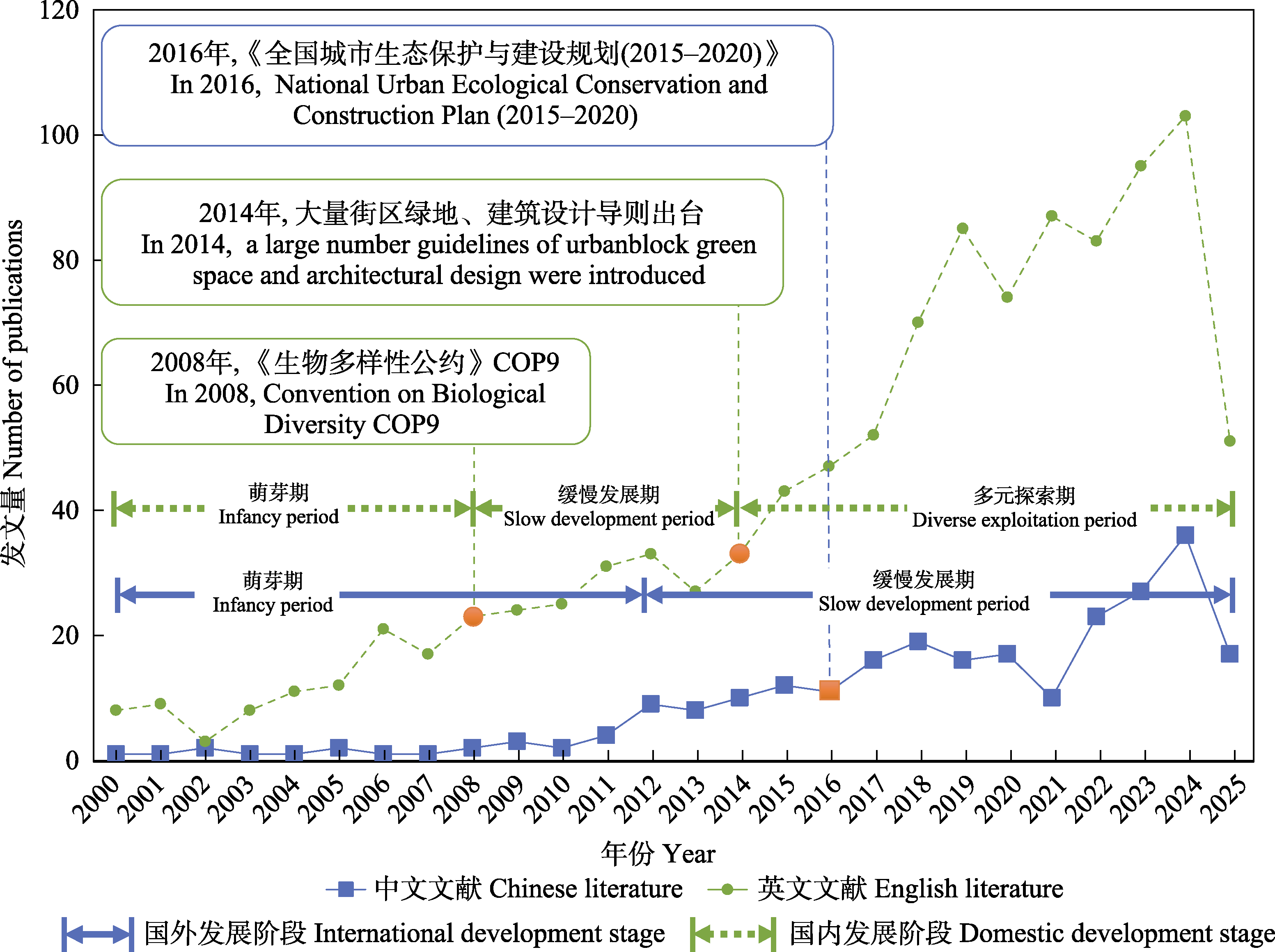
Fig. 1 Temporal distribution of relevant literature and development phases of research on the impacts of urban block built environment on biodiversity①② ① 2016年12月6日《全国城市生态保护与建设规划(2015-2020年)》. http://www.caep.org.cn/yclm/sewhbgh/sywwrjp_22031/201812/W020181227588849790425.pdf. ② 2023年7月5日《住房城乡建设部关于扎实有序推进城市更新工作的通知》. https://www.mohurd.gov.cn/gongkai/zc/wjk/art/2023/art_17339_772985.html.
| 影响要素 Impact factors | 影响指标 Indicators | 影响关系 Impact relationships | 代表文献 Representative literature |
|---|---|---|---|
| 街区绿地 Block green space | 绿地规模 Green space area | 正向 Positive | Strohbach et al., |
| 形状指数 Shape index | 正向 Positive | Wong et al., | |
| 连通性 Connectivity | 正向 Positive | Beninde et al., | |
| 屋顶绿化面积 Green roof area | 正向 Positive | Lee & Lin, | |
| 垂直绿化面积 Vertical greening area | 正向 Positive | 卢晓强等, | |
| 破碎度 Fragmentation | 负向/非线性 Negative/nonlinear | Saeki et al., | |
| 植被特征 Vegetation characteristics | 种植密度 Planting density | 正向 Positive | da Silva et al., da Silva et al., |
| 植物物种丰富度 Plant species richness | 正向 Positive | ||
| 冠层覆盖度 Canopy coverage | 双向/非线性 Bidirectional/nonlinear | Scherber et al., | |
| 层次结构复杂度 Hierarchical complexity | 复杂影响, 因物种而异 Complex effects, varying by species | 干靓等, | |
| 土地利用 Land use | 建筑密度 Building density | 负向/非线性 Negative/nonlinear | Liu et al., |
| 道路密度 Road density | 负向 Negative | Norton et al., | |
| 容积率 Plot ratio | 负向 Negative | Curzel et al., | |
| 土地利用类型多样性 Land-use diversity | 正向/非线性 Positive/nonlinear | Chang et al., | |
| 三维形态 3D morphology | 街道宽度 Street width | 负向 Negative | Tian et al., |
| 街区高宽比 Block height-to-width ratio | 负向 Negative | 林定等, | |
| 玻璃幕墙面积 Glass curtain wall area | 负向 Negative | Marzluff & Ewing, | |
| 平均建筑高度 Average building height | 负向 Negative | Curzel et al., | |
| 屋顶面积 Roof area | 正向 Positive | Williams et al., Williams et al., | |
| 阳台面积 Balcony area | 正向 Positive | ||
| 立面凹凸度 Facade protrusion | 正向 Positive | 毕凌岚等, 毕凌岚等, | |
| 材质粗糙度 Material roughness | 正向 Positive |
Table 2 Impact factors of urban block built environment on biodiversity and their relationships
| 影响要素 Impact factors | 影响指标 Indicators | 影响关系 Impact relationships | 代表文献 Representative literature |
|---|---|---|---|
| 街区绿地 Block green space | 绿地规模 Green space area | 正向 Positive | Strohbach et al., |
| 形状指数 Shape index | 正向 Positive | Wong et al., | |
| 连通性 Connectivity | 正向 Positive | Beninde et al., | |
| 屋顶绿化面积 Green roof area | 正向 Positive | Lee & Lin, | |
| 垂直绿化面积 Vertical greening area | 正向 Positive | 卢晓强等, | |
| 破碎度 Fragmentation | 负向/非线性 Negative/nonlinear | Saeki et al., | |
| 植被特征 Vegetation characteristics | 种植密度 Planting density | 正向 Positive | da Silva et al., da Silva et al., |
| 植物物种丰富度 Plant species richness | 正向 Positive | ||
| 冠层覆盖度 Canopy coverage | 双向/非线性 Bidirectional/nonlinear | Scherber et al., | |
| 层次结构复杂度 Hierarchical complexity | 复杂影响, 因物种而异 Complex effects, varying by species | 干靓等, | |
| 土地利用 Land use | 建筑密度 Building density | 负向/非线性 Negative/nonlinear | Liu et al., |
| 道路密度 Road density | 负向 Negative | Norton et al., | |
| 容积率 Plot ratio | 负向 Negative | Curzel et al., | |
| 土地利用类型多样性 Land-use diversity | 正向/非线性 Positive/nonlinear | Chang et al., | |
| 三维形态 3D morphology | 街道宽度 Street width | 负向 Negative | Tian et al., |
| 街区高宽比 Block height-to-width ratio | 负向 Negative | 林定等, | |
| 玻璃幕墙面积 Glass curtain wall area | 负向 Negative | Marzluff & Ewing, | |
| 平均建筑高度 Average building height | 负向 Negative | Curzel et al., | |
| 屋顶面积 Roof area | 正向 Positive | Williams et al., Williams et al., | |
| 阳台面积 Balcony area | 正向 Positive | ||
| 立面凹凸度 Facade protrusion | 正向 Positive | 毕凌岚等, 毕凌岚等, | |
| 材质粗糙度 Material roughness | 正向 Positive |
| 人类活动要素 Human activity factors | 影响关系 Impact relationships | 代表文献 Representative literature |
|---|---|---|
| 绿地管理强度 Green space management intensity | 非线性 Nonlinear | Li et al., |
| 绿化施药行为 Landscape maintenance spraying | 负向 Negative 负向 Negative 负向 Negative 负向 Negative | Guo et al., Guo et al., |
| 绿化修剪频率 Landscape pruning frequency | ||
| 养宠行为 Pet owning | Kristancic et al., | |
| 弃养宠物行为 Pet abandoning | Trouwborst et al., | |
| 行人流量 Pedestrian traffic | 复杂影响, 因物种而异 Complex effects, varying by species | Villegas & Garitano-Zavala, |
| 噪音水平 Noise level | 负向/非线性 Negative/nonlinear | Francis, |
| 夜间照明强度 Night illumination intensity | 负向 Negative | 张梦等, |
Table 3 Human activity factors of urban block built environment on biodiversity and their relationships
| 人类活动要素 Human activity factors | 影响关系 Impact relationships | 代表文献 Representative literature |
|---|---|---|
| 绿地管理强度 Green space management intensity | 非线性 Nonlinear | Li et al., |
| 绿化施药行为 Landscape maintenance spraying | 负向 Negative 负向 Negative 负向 Negative 负向 Negative | Guo et al., Guo et al., |
| 绿化修剪频率 Landscape pruning frequency | ||
| 养宠行为 Pet owning | Kristancic et al., | |
| 弃养宠物行为 Pet abandoning | Trouwborst et al., | |
| 行人流量 Pedestrian traffic | 复杂影响, 因物种而异 Complex effects, varying by species | Villegas & Garitano-Zavala, |
| 噪音水平 Noise level | 负向/非线性 Negative/nonlinear | Francis, |
| 夜间照明强度 Night illumination intensity | 负向 Negative | 张梦等, |
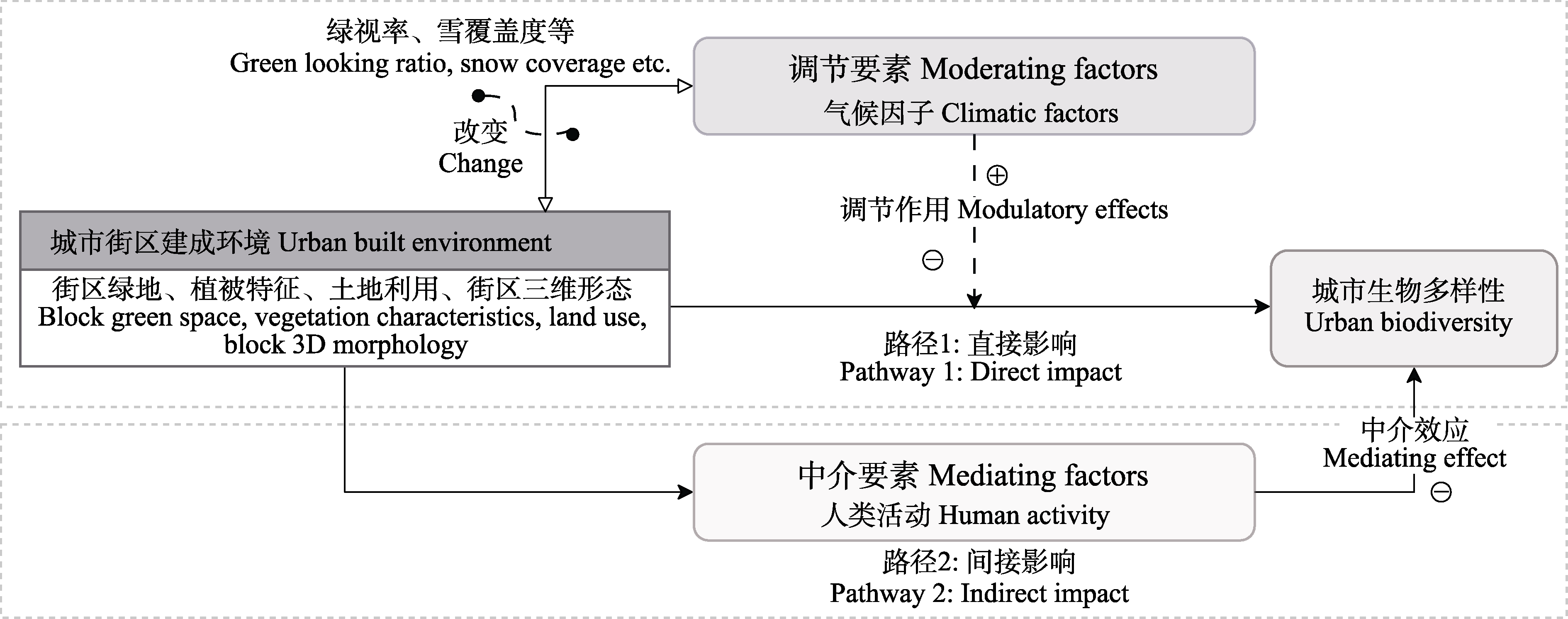
Fig. 2 Conceptual framework of the impact of urban block built environment on biodiversity. ⊕ indicates a positive impact; ㊀indicates a negative impact
| [1] |
Afrifa JK, Monney KA, Deikumah JP (2023) Effects of urban land-use types on avifauna assemblage in a rapidly developing urban settlement in Ghana. Urban Ecosystems, 26, 67-79.
DOI |
| [2] |
Amaya-Espinel JD, Hostetler ME (2019) The value of small forest fragments and urban tree canopy for Neotropical migrant birds during winter and migration seasons in Latin American countries: A systematic review. Landscape and Urban Planning, 190, 103592.
DOI URL |
| [3] |
Amaya-Espinel JD, Hostetler ME, Henríquez C, Bonacic C (2019) The influence of building density on Neotropical bird communities found in small urban parks. Landscape and Urban Planning, 190, 103578.
DOI URL |
| [4] |
Barbosa KVC, Rodewald AD, Ribeiro MC, Jahn AE (2020) Noise level and water distance drive resident and migratory bird species richness within a Neotropical megacity. Landscape and Urban Planning, 197, 103769.
DOI URL |
| [5] |
Beninde J, Veith M, Hochkirch A (2015) Biodiversity in cities needs space: A meta-analysis of factors determining intra-urban biodiversity variation. Ecology Letters, 18, 581-592.
DOI PMID |
| [6] | Bi LL, Wu YJ, Zhou HN (2023) Guided research on bio-friendly planning and construction based on symbiotic city theory—Taking Chengdu as an example. Urban Environment Design, (1), 334-340. (in Chinese with English abstract) |
| [毕凌岚, 吴莹婕, 周和宁 (2023) 基于共生城市理论的生物友好规划建设导引研究——以成都为例. 城市环境设计, (1), 334-340.] | |
| [7] |
Bouyer Y, Gervasi V, Poncin P, Beudels-Jamar RC, Odden J, Linnell JDC (2015) Tolerance to anthropogenic disturbance by a large carnivore: The case of Eurasian Lynx in south-eastern Norway. Animal Conservation, 18, 271-278.
DOI URL |
| [8] |
Burley H, Beaumont LJ, Ossola A, Baumgartner JB, Gallagher R, Laffan S, Esperon-Rodriguez M, Manea A, Leishman MR (2019) Substantial declines in urban tree habitat predicted under climate change. Science of the Total Environment, 685, 451-462.
DOI |
| [9] |
Buron R, Hostetler ME, Andreu M (2022) Urban forest fragments vs residential neighborhoods: Urban habitat preference of migratory birds. Landscape and Urban Planning, 227, 104538.
DOI URL |
| [10] | Cao S, Chen Y, Xu BW, Qiu XW, Liu H (2024) Case and corollaries on the construction of block-scale habitat network in Xi’an. Chinese Landscape Architecture, 40(5), 104-110. (in Chinese with English abstract) |
| [曹朔, 陈宇, 许博文, 邱雪玮, 刘晖 (2024) 西安市街区尺度生境网络构建的案例与思考. 中国园林, 40(5), 104-110.] | |
| [11] | Cao S, Liu H, Chen Y, Xu BW (2023) The gradient analysis of distance threshold of green space landscape connectivity at block scale in Xi’an. Chinese Landscape Architecture, 39(9), 61-66. (in Chinese) |
| [曹朔, 刘晖, 陈宇, 许博文 (2023) 西安市街区尺度绿色空间景观连接度距离阈值的梯度分析. 中国园林, 39(9), 61-66.] | |
| [12] | Carley JR, Klem D Jr, Lapp A, Bradshaw B, Rosario HD, Hong J (2016) Bird-Friendly Best Practices Glass. https://www.toronto.ca/wp-content/uploads/2017/08/8d1c-Bird-Friendly-Best-Practices-Glass.pdf. (accessed on 2025-05-20) |
| [13] |
Chang CR, Chien HF, Shiu HJ, Ko CJ, Lee PF (2017) Multiscale heterogeneity within and beyond Taipei city greenspaces and their relationship with avian biodiversity. Landscape and Urban Planning, 157, 138-150.
DOI URL |
| [14] |
Chang MY, Luo XY, Zhang YR, Pang YL, Li MH, Liu JJ, Da LJ, Song K (2022) Land-use diversity can better predict urban spontaneous plant richness than impervious surface coverage at finer spatial scales. Journal of Environmental Management, 323, 116205.
DOI URL |
| [15] | Chen XF (2015) Based on biological diversity to explore the design method of sponge urban landscape. Ecological Economy, 31(10), 194-199. (in Chinese with English abstract) |
| [陈晓菲 (2015) 基于生物多样性的海绵城市景观途径探讨. 生态经济, 31(10), 194-199.] | |
| [16] | CPDH (City Planning Department of Helsinki) (2010) Viikk—A University District and Science Park for the 2010’s. https://www.hel.fi/hel2/ksv/julkaisut/esitteet/esite_2010-8_en.pdf. (accessed on 2025-05-22) |
| [17] | Curzel FE, Bellocq MI, Leveau LM (2021) Local and landscape features of wooded streets influenced bird taxonomic and functional diversity. Urban Forestry & Urban Greening, 66, 127369. |
| [18] | da Silva BF, Pena JC, Viana-Junior AB, Vergne M, Pizo MA (2021) Noise and tree species richness modulate the bird community inhabiting small public urban green spaces of a Neotropical city. Urban Ecosystems, 24, 71-81. |
| [19] | Deng JY, Zheng X (2017) Relationship between the urban canyon geometry and microclimate. Architecture & Culture, (5), 212-213. (in Chinese with English abstract) |
| [邓寄豫, 郑炘 (2017) 街区层峡几何形态与微气候的关联性研究. 建筑与文化, (5), 212-213.] | |
| [20] | Dong J, Guo F, Lu X, Zhang H (2024) A decade review of the green roof and green wall policies (2008) in London. International Urban Planning, 39(2), 32-39, 46. (in Chinese with English abstract) |
| [董菁, 郭飞, 路晓东, 张弘驰 (2024) 伦敦屋顶绿化和墙体绿化政策 (2008) 的十年回顾. 国际城市规划, 39(2), 32-39, 46.] | |
| [21] | Emilsson T, Persson J, Mattsson JE (2013) A critical analysis of the biotope-focused planning tools: Green Space Factor. Department of Landscape Management, Design and Construction, Swedish University of Agricultural Sciences, Department series, 28, 36-38. |
| [22] |
Fidino M, Gallo T, Lehrer EW, Murray MH, Kay CAM, Sander HA, MacDougall B, Salsbury CM, Ryan TJ, Angstmann JL, Amy Belaire J, Dugelby B, Schell CJ, Stankowich T, Amaya M, Drake D, Hursh SH, Ahlers AA, Williamson J, Hartley LM, Zellmer AJ, Simon K, Magle SB (2021) Landscape-scale differences among cities alter common species’ responses to urbanization. Ecological Applications, 31, e02253.
DOI URL |
| [23] |
Francis CD (2015) Vocal traits and diet explain avian sensitivities to anthropogenic noise. Global Change Biology, 21, 1809-1820.
DOI PMID |
| [24] | Fritze H, Peltoniemi K, Pennanen T, Velmala S, Hultman J, Tarvainen O, Karhu J, Laurila M, Korpela L, Kangas K (2025) The boreal soil microbiome of different urban green spaces—Do city residents meet different microbes? Urban Forestry & Urban Greening, 111, 128870. |
| [25] |
Gan J (2018) Built environment factors affecting urban biodiversity and planning optimization approaches. Urban Planning International, 33(4), 67-73. (in Chinese with English abstract)
DOI URL |
| [干靓 (2018) 城市建成环境对生物多样性的影响要素与优化路径. 国际城市规划, 33(4), 67-73.] | |
| [26] | Gan J, Guo GP, Yao XY (2019) Biodiversity supporting services of urban roadside green spaces and the built environment influences: A case study of birds along Shanghai Century Avenue. Landscape Architecture, 26(1), 47-52. (in Chinese with English abstract) |
| [干靓, 郭光普, 姚雪艳 (2019) 城市街旁绿地的生物多样性支持功能及其环境影响——以上海世纪大道街旁绿地鸟类研究为例. 风景园林, 26(1), 47-52.] | |
| [27] |
Gan J, Liu XX, Lu XM, Yue X (2025) China’s large cities in global biodiversity hotspots: Conservation policies and optimization directions. Biodiversity Science, 33, 24529. (in Chinese with English abstract)
DOI |
|
[干靓, 刘巷序, 鲁雪茗, 岳星 (2025) 全球生物多样性热点地区中国大城市的保护政策与优化方向. 生物多样性, 33, 24529.]
DOI |
|
| [28] | Gan J, Wu ZQ, Guo GP (2018) The influence of built environment on urban biodiversity in high-density urban areas: Case study in blocks along Century Avenue, Pudong New District, Shanghai. Urban Development Studies, 25(4), 97-106. (in Chinese with English abstract) |
| [干靓, 吴志强, 郭光普 (2018) 高密度城区建成环境与城市生物多样性的关系研究——以上海浦东新区世纪大道地区为例. 城市发展研究, 25(4), 97-106.] | |
| [29] | Gan WQ, Pan LY, Duan R, Chen B (2025) Ecologically-oriented urban renewal methodological framework from a sustainable development perspective: A case study of Wujiang District, Suzhou. China Ancient City, 39(9), 28-40. (in Chinese with English abstract) |
| [甘文泉, 潘丽宇, 段然, 陈冰 (2025) 可持续发展视角下以生态空间需求为导向的城市更新方法研究——以苏州市吴江区为例. 中国名城, 39(9), 28-40.] | |
| [30] |
Gong X, Sun X, Thakur MP, Qiao ZH, Yao HF, Liu MQ, Scheu S, Zhu YG (2023) Climate and edaphic factors drive soil nematode diversity and community composition in urban ecosystems. Soil Biology and Biochemistry, 180, 109010.
DOI URL |
| [31] | Guo LY, Nizamani MM, Harris A, Padullés CJ, Johnson JB, Cui JP, Zhang HL, Zhou JJ, Zhu ZX, Wang HF (2024) Anthropogenic factors explain urban plant diversity across three tropical cities in China. Urban Forestry & Urban Greening, 95, 128323. |
| [32] | Hu CS (2016) The Home Range and Dispersal Ecology of Crested Ibis (Nipponia nippon). PhD dissertation, Beijing Forestry University, Beijing. (in Chinese with English abstract) |
| [胡灿实 (2016) 朱鹮(Nipponia nippon)活动性及其扩散模式研究. 博士学位论文,北京林业大学, 北京.] | |
| [33] | Hu FN, Zhou L (2023) Cooling effect of urban green infrastructure and its impacting factors: A review. Acta Ecologica Sinica, 43, 4445-4460. (in Chinese with English abstract) |
| [胡凤宁, 周亮 (2023) 城市绿色基础设施降温作用及其影响因素研究进展. 生态学报, 43, 4445-4460.] | |
| [34] | Jiang XY, Xu JY, Shen XM, Zhu Y (2025) Synergies and differences between the China National Biodiversity Conservation Strategy and Action Plan (2023-2030) and the Kunming-Montreal Global Biodiversity Framework. Biodiversity Science, 33, 24575. (in Chinese with English abstract) |
|
[姜雪原, 徐嘉忆, 盛学敏, 朱源 (2025) 《中国生物多样性保护战略与行动计划(2023-2030年)》与《昆蒙框架》的协同与差异. 生物多样性, 33, 24575.]
DOI |
|
| [35] |
Keck F, Peller T, Alther R, Barouillet C, Blackman R, Capo E, Chonova T, Couton M, Fehlinger L, Kirschner D, Knüsel M, Muneret L, Oester R, Tapolczai K, Zhang H, Altermatt F (2025) The global human impact on biodiversity. Nature, 641, 395-400.
DOI |
| [36] |
Korsten P, van Overveld T, Adriaensen F, Matthysen E (2013) Genetic integration of local dispersal and exploratory behaviour in a wild bird. Nature Communications, 4, 2362.
DOI PMID |
| [37] |
Kristancic AR, Kuehs J, Beal Richardson B, Baudains C, StJ Hardy GE, Fleming PA (2022) Biodiversity conservation in urban gardens—Pets and garden design influence activity of a vulnerable digging mammal. Landscape and Urban Planning, 225, 104464.
DOI URL |
| [38] |
Kroeger SB, Hanslin HM, Lennartsson T, D’Amico M, Kollmann J, Fischer C, Albertsen E, Speed JDM (2022) Impacts of roads on bird species richness: A meta-analysis considering road types, habitats and feeding guilds. Science of the Total Environment, 812, 151478.
DOI URL |
| [39] | Lee LH, Lin JC (2015) Green roof performance towards good habitat for butterflies in the compact city. International Journal of Biology, 7, 103-112. |
| [40] | Leveau LM, Leveau CM (2020) Street design in suburban areas and its impact on bird communities: Considering different diversity facets over the year. Urban Forestry & Urban Greening, 48, 126578. |
| [41] | Li MY (2025) Study on the main impacts of territorial spatial planning on urban biodiversity and planning enhancement strategies. Shanghai Urban Planning Review, (2), 82-89. (in Chinese with English abstract) |
| [李梦芸 (2025) 国土空间规划对城市生物多样性的主要影响及规划提升策略研究. 上海城市规划, (2), 82-89.] | |
| [42] | Li XP, Fan SX, Hao PY, Dong L (2019) Temporal variations of spontaneous plants colonizing in different type of planted vegetation—A case of Beijing Olympic Forest Park. Urban Forestry & Urban Greening, 46, 126459. |
| [43] | Lin D, Wu J, Liu YM, Zhu M (2023) Effects of canopy space occupation on the thermal environment of pedestrians in the street with various aspect ratios. Journal of Fuzhou University (Natural Science Edition), 51, 355-362. (in Chinese with English abstract) |
| [林定, 吴俊, 刘亚敏, 朱牧 (2023) 树冠空间占用对不同高宽比街道行人热环境的影响. 福州大学学报(自然科学版), 51, 355-362.] | |
| [44] |
Lin LH, Zhao WW, Zhu SY, Zhao BJ, Zou CJ (2025) Effects of land use on interspecific associations between plants and reptiles. Chinese Journal of Ecology, 44, 3491-3497. (in Chinese with English abstract)
DOI |
| [林龙晖, 赵薇薇, 朱思雨, 赵兵举, 邹春静 (2025) 土地利用对植物与爬行动物种间关联的影响. 生态学杂志, 44, 3491-3497.] | |
| [45] | Liu C, Xing SH, Yao Y, Zhang HX, Wang XK (2024) Spatial distribution pattern and influencing factors of spontaneous plants within the built-up areas of Beijing, China. Acta Ecologica Sinica, 44, 544-558. (in Chinese with English abstract) |
| [刘昌, 邢韶华, 姚扬, 张红星, 王效科 (2024) 北京城区自生植物分布格局及其影响因素. 生态学报, 44, 544-558.] | |
| [46] | Liu H, Cao S, Chen Y (2021) Composition and morphological elements of habitat quadrat in urban green space: A case study of Xi’an. Landscape Architecture, 28(6), 70-75. (in Chinese with English abstract) |
| [刘晖, 曹朔, 陈宇 (2021) 城市绿色空间生境样方构成与形态要素: 以西安为例. 风景园林, 28(6), 70-75.] | |
| [47] | Liu MY, Tang Y (2018) The simulation in wind-driven seed dispersal of Ulmus pumila in sparse woodland steppe. Chinese Journal of Ecology, 37, 2524-2531. (in Chinese with English abstract) |
| [刘明宇, 唐毅 (2018) 风力驱动的榆树疏林种子扩散模拟. 生态学杂志, 37, 2524-2531.] | |
| [48] |
Liu RX, Yan X, Lin XL, Sun YC, Zhang T, Xiao J (2023) Urban spontaneous plant richness in response to the 2D/3D building and green space patterns in a highly urbanized area. Ecological Indicators, 154, 110852.
DOI URL |
| [49] | Lu XQ, Zang MY, Xu X, Ma Y, Hu ZF, Li YH, Liu L, Liu Y (2025) Urbanization and biodiversity: Practical pathways to creating friendly cities. Acta Ecologica Sinica, 45, 9141-9149. (in Chinese with English abstract) |
| [卢晓强, 臧明月, 徐徐, 马月, 胡志锋, 李宇航, 刘立, 刘燕 (2025) 城市化与生物多样性: 打造友好型城市的实践路径. 生态学报, 45, 9141-9149.] | |
| [50] | Luo PJ, Li YJ, Song YH (2024) Research progress and prospect of urban biodiversity distribution pattern. Contemporary Horticulture, (9), 56-59. (in Chinese with English abstract) |
| [罗聘杰, 李一姣, 宋钰红 (2024) 城市生物多样性分布格局研究进展与展望. 现代园艺, (9), 56-59.] | |
| [51] |
Ma SF, Gong X, Shangguan HY, Yao HF, Wang B, Li ZP, Sun X (2025) Effects of urbanization and different land use types on soil eukaryotic biodiversity. Biodiversity Science, 33, 24540. (in Chinese with English abstract)
DOI |
|
[马尚飞, 龚鑫, 上官华媛, 姚海凤, 王滨, 李志鹏, 孙新 (2025) 城市化过程中不同用地类型对土壤真核生物多样性的影响. 生物多样性, 33, 24540.]
DOI |
|
| [52] | Marzluff JM, Ewing K (2008) Restoration of fragmented landscapes for the conservation of birds:A general framework and specific recommendations for urbanizing landscapes. In: Urban Ecology (eds Marzluff JM, Shulenberger E, Endlicher W, Alberti M, Bradley G, Ryan C, Simon U, ZumBrunnen C), pp. 739-755. Springer, Boston, MA. |
| [53] | McNair DB (2023) Winter bird population study (WBPS) in downtown Rockingham, North Carolina: High species richness, dominance by resident generalists, and low compositional change. Southeastern Naturalist, 22, 272-291. |
| [54] |
Mi CR, Ma L, Yang MY, Li XH, Shai MR, Roll U, Oskyrko O, Pincheira-Donoso D, Harvey LP, Jablonski D, Safaei- Mahroo B, Ghaffari H, Smid J, Jarvie S, Kimani RM, Masroor R, Kazemi SM, Nneji LM, Fokoua AMT, Tasse Taboue GC, Bauer A, Nogueira C, Meirte D, Chapple DG, Das I, Grismer L, Avila LJ, Ribeiro Júnior MA, Tallowin OJS, Torres-Carvajal O, Wagner P, Ron SR, Wang YZ, Itescu Y, Nagy ZT, Wilcove DS, Liu X, Du WG (2023) Global protected areas as refuges for amphibians and reptiles under climate change. Nature Communications, 14, 1389.
DOI PMID |
| [55] |
Muniz-Gäal LP, Pezzuto CC, de Carvalho MFH, Mota LTM (2020) Urban geometry and the microclimate of street canyons in tropical climate. Building and Environment, 169, 106547.
DOI URL |
| [56] |
Muvengwi J, Fritz H, Mbiba M, Ndagurwa HGT (2022) Land use effects on phylogenetic and functional diversity of birds: Significance of urban green spaces. Landscape and Urban Planning, 225, 104462.
DOI URL |
| [57] | Norton BA, Mears M, Warren PH, Siriwardena GM, Plummer KE, Turner T, Hancock S, Grafius DR, Evans KL (2023) Biodiversity and environmental stressors along urban walking routes. Urban Forestry & Urban Greening, 85, 127951. |
| [58] | NPBS (National Parks Board of Singapore) (2022) Biophilic Design Guildlines: Bird-Safe Building Guidelines.https://www.nparks.gov.sg/docs/default-source/resources/2024/bird-safety-guidelines-jun2024.pdf. (accessed on 2025-05-23) |
| [59] |
Ortega-Álvarez R, MacGregor-Fors I (2009) Living in the big city: Effects of urban land-use on bird community structure, diversity, and composition. Landscape and Urban Planning, 90, 189-195.
DOI URL |
| [60] |
Panlasigui S, Spotswood E, Beller E, Grossinger R (2021) Biophilia beyond the building: Applying the tools of urban biodiversity planning to create biophilic cities. Sustainability, 13, 2450.
DOI URL |
| [61] |
Saeki I, Niwa S, Osada N, Azuma W, Hiura T (2020) Contrasting effects of urbanization on arboreal and ground-dwelling land snails: Role of trophic interactions and habitat fragmentation. Urban Ecosystems, 23, 603-614.
DOI |
| [62] |
Scherber C, Vockenhuber EA, Stark A, Meyer H, Tscharntke T (2014) Effects of tree and herb biodiversity on Diptera, a hyperdiverse insect order. Oecologia, 174, 1387-1400.
DOI PMID |
| [63] |
Shen XW, Chen MZ, Li XW, Gao S, Yang QY, Wen YH, Sun QQ (2024) Advancing climate resilience through a geo-design framework: Strengthening urban and community forestry for sustainable environmental design. Journal of Forestry Research, 35, 117.
DOI |
| [64] | Strohbach MW, Lerman SB, Warren PS (2013) Are small greening areas enhancing bird diversity? Insights from community-driven greening projects in Boston. Landscape and Urban Planning, 114, 69-79. |
| [65] |
Su RF, Chen RS, Guo XN (2023) Conservation strategies for biodiversity in urban community renewal: A case study of habitat garden in Changning District, Shanghai. Biodiversity Science, 31, 23118. (in Chinese with English abstract)
DOI |
|
[苏荣菲, 陈睿山, 郭晓娜 (2023) 城市社区更新中生物多样性的保护策略: 以上海市长宁区生境花园为例. 生物多样性, 31, 23118.]
DOI |
|
| [66] | TCPA (Town and Country Planning Association)(2004) Biodiversity by Design: A Guide for Sustainable Communities. https://www.thenbs.com/PublicationIndex/Documents/Details?Pub=TCPA&DocId=290565. (accessed on 2025-05-23) |
| [67] |
Thompson KL, Pauli JN, Erker T, Kucharik CJ, Schatz J, Townsend PA, Zuckerberg B (2022) Urban greenspaces promote warmer soil surface temperatures in a snow- covered city. Landscape and Urban Planning, 227, 104537.
DOI URL |
| [68] |
Tian PL, Liang CT, Zhang JH, Xiao L, Wang K, Yang Y, Wang HM, Wang WJ (2024) Geo-climates and street developments shape urban tree characteristics: A street-view inventory analysis of over 200,000 trees of 11 metropolises in China. Science of the Total Environment, 912, 169503.
DOI URL |
| [69] |
Trouwborst A, McCormack PC, Martínez Camacho E (2020) Domestic cats and their impacts on biodiversity: A blind spot in the application of nature conservation law. People and Nature, 2, 235-250.
DOI |
| [70] | UNI (Ente Italiano di Normazione) (2015) Instructions for the Design, Execution, Inspection, and Maintenance of Green Roofs. Milano. |
| [71] | United Nations (1992) Convention on Biological Diversity. https://apps1.unep.org/resolutions/uploads/1992-convention_on_biological_diversity-en.pdf. (accessed on 2025-05-23) |
| [72] |
Van Rossum F, Stiers I, Van Geert A, Triest L, Hardy OJ (2011) Fluorescent dye particles as pollen analogues for measuring pollen dispersal in an insect-pollinated forest herb. Oecologia, 165, 663-674.
DOI PMID |
| [73] |
Van Rossum F, Triest L (2010) Pollen dispersal in an insect-pollinated wet meadow herb along an urban river. Landscape and Urban Planning, 95, 201-208.
DOI URL |
| [74] | Villaseñor NR, Truffello R, Reyes-Paecke S (2021) Greening at multiple scales promote biodiverse cities: A multi-scale assessment of drivers of Neotropical birds. Urban Forestry & Urban Greening, 66, 127394. |
| [75] |
Villegas M, Garitano-Zavala Á (2010) Bird community responses to different urban conditions in La Paz, Bolivia. Urban Ecosystems, 13, 375-391.
DOI URL |
| [76] | Wang HY, Wang HQ, Chen XY, Han BL, Shu CJ, Zhang T, Ding SY (2023) Review on evaluation and enhancement of urban biodiversity. Acta Ecologica Sinica, 43, 2995-3006. (in Chinese with English abstract) |
| [王海洋, 王浩琪, 陈禧悦, 韩宝龙, 束承继, 张童, 丁仕宇 (2023) 国内外城市生物多样性评价与提升研究综述. 生态学报, 43, 2995-3006.] | |
| [77] | Wang J, Zeng J, Su Y (2009) Application of sustainable fibre greenway in compact urban planning: A case study on Ohno Hidetoshi’s concept planning for Tokyo 2050. Urban Planning Forum, (4), 68-73. (in Chinese with English abstract) |
| [王晶, 曾坚, 苏毅 (2009) 可持续性“纤维”绿廊在紧凑城区规划中的应用——以大野秀敏2050年东京概念规划方案为例. 城市规划学刊, (4), 68-73.] | |
| [78] | Wang XJ, Wang JG (2025) An eco-environmental approach to urban morphological research. City Planning Review, 49(2), 13-22. (in Chinese with English abstract) |
| [王晓俊, 王建国 (2025) 城市形态研究的生态环境学途径. 城市规划, 49(2), 13-22.] | |
| [79] |
Williams NSG, Lundholm J, Scott MacIvor J (2014) FORUM: Do green roofs help urban biodiversity conservation? Journal of Applied Ecology, 51, 1643-1649.
DOI URL |
| [80] |
Wong JSY, Soh MCK, Low BW, Er KBH (2023) Tropical bird communities benefit from regular-shaped and naturalised urban green spaces with water bodies. Landscape and Urban Planning, 231, 104644.
DOI URL |
| [81] |
Yang FP, Ignatieva M, Wissman J, Ahrné K, Zhang SX, Zhu SY (2019) Relationships between multi-scale factors, plant and pollinator diversity, and composition of park lawns and other herbaceous vegetation in a fast growing megacity of China. Landscape and Urban Planning, 185, 117-126.
DOI URL |
| [82] |
Yang TX, Zhang WQ, Fan ZQ, Wang XR, Wang SB (2013) Exploring the space syntax under negative planning: A case study of landscape connectivity based on the behaviors of avian edge species. Acta Ecologica Sinica, 33, 5035-5046. (in Chinese with English abstract)
DOI URL |
| [杨天翔, 张韦倩, 樊正球, 王祥荣, 王寿兵 (2013) 基于鸟类边缘种行为的景观连接度研究——空间句法的反规划应用. 生态学报, 33, 5035-5046.] | |
| [83] |
Yasin G, Yousaf MTB, Javaid MM, Zulfiqar U, Djonibekova N, Matkarimova A, Almoallim HS, Javed M, Rahman SU (2025) Adaptive responses of trees to industrial pollution: Modulation of leaf anatomical, physio-biochemical, and heavy metal accumulation traits in urban biotopes. Environmental Monitoring and Assessment, 197, 882.
DOI PMID |
| [84] | Yin J, Xie YT, Wang L (2023) Impacts of human-animal interrelationships on spatial planning and implications for applications thereof from the “One Health” perspective. Landscape Architecture, 30(12), 27-32. (in Chinese with English abstract) |
| [尹杰, 谢依庭, 王兰 (2023) “同一健康” 视角下人与动物相互关系对空间规划的影响与应用启示. 风景园林, 30(12), 27-32.] | |
| [85] | Yin LQ, Wang C, Liu RZ (2025) Characteristics and influencing factors of bird communities in residential areas of Beijing. Journal of Beijing Forestry University, 47(6), 80-89. (in Chinese with English abstract) |
| [殷鲁秦, 王成, 刘锐之 (2025) 北京居住区鸟类群落特征及其影响因素. 北京林业大学学报, 47(6), 80-89.] | |
| [86] | You WB, Cai XY, Wang YZ, Wang R, Zhang JL, Chen Y, Qiu XY, Fang B, Tang SS, Jian WQ (2023) Relationship between bird diversity and landscape characteristics in the core area of Fuzhou city at two scales based on citizen science data. Acta Ecologica Sinica, 43, 7670-7681. (in Chinese with English abstract) |
| [游巍斌, 蔡新瑜, 王英姿, 王瑞, 张锦琳, 陈莹, 邱晓月, 方冰, 汤绍圣, 坚文倩 (2023) 基于不同网格尺度福州主城区鸟类多样性与景观特征的关系研究. 生态学报, 43, 7670-7681.] | |
| [87] |
Zhang M, Zhou YB, Zou DH (2025) The impact of road noise and light pollution on the behavior of Chiroptera. Biodiversity Science, 33, 24503. (in Chinese with English abstract)
DOI |
|
[张梦, 周友兵, 邹大虎 (2025) 道路噪音和光污染对翼手目动物行为的影响. 生物多样性, 33, 24503.]
DOI |
|
| [88] |
Zheng XY, Zhu MH, Shi Y, Pei H, Nie WB, Nan XG, Zhu XY, Yang GF, Bao ZY (2023) Equity analysis of the green space allocation in China’s eight urban agglomerations based on the Theil index and GeoDetector. Land, 12, 795.
DOI URL |
| [89] |
Zúñiga-Vega JJ, Solano-Zavaleta I, Sáenz-Escobar MF, Ramírez-Cruz GA (2019) Habitat traits that increase the probability of occupancy of migratory birds in an urban ecological reserve. Acta Oecologica, 101, 103480.
DOI URL |
| Viewed | ||||||
|
Full text |
|
|||||
|
Abstract |
|
|||||
Copyright © 2026 Biodiversity Science
Editorial Office of Biodiversity Science, 20 Nanxincun, Xiangshan, Beijing 100093, China
Tel: 010-62836137, 62836665 E-mail: biodiversity@ibcas.ac.cn

