

Biodiv Sci ›› 2026, Vol. 34 ›› Issue (2): 25374. DOI: 10.17520/biods.2025374 cstr: 32101.14.biods.2025374
• Original Papers: Animal Diversity • Previous Articles Next Articles
Wenqi Gao1,2( ), Jingrong Xiang1,3, Yao Zhao1, Lingshuang Fan1, Yuan Gu3,4, Weihan Shao3,4, Gaojun Li3,4, Guangjun Zhao3,4, Mingbin Chen5, Xingwei Cai3,4,*(
 ), Kai Chen6,*()()
Received:2025-09-23
Accepted:2026-01-05
Online:2026-02-20
Published:2026-03-23
Contact:
Xingwei Cai, Kai Chen
Supported by:Wenqi Gao, Jingrong Xiang, Yao Zhao, Lingshuang Fan, Yuan Gu, Weihan Shao, Gaojun Li, Guangjun Zhao, Mingbin Chen, Xingwei Cai, Kai Chen. Stream fish community characteristics and their response to land use in Limushan and Jianfengling of Hainan Tropical Rainforest National Park[J]. Biodiv Sci, 2026, 34(2): 25374.
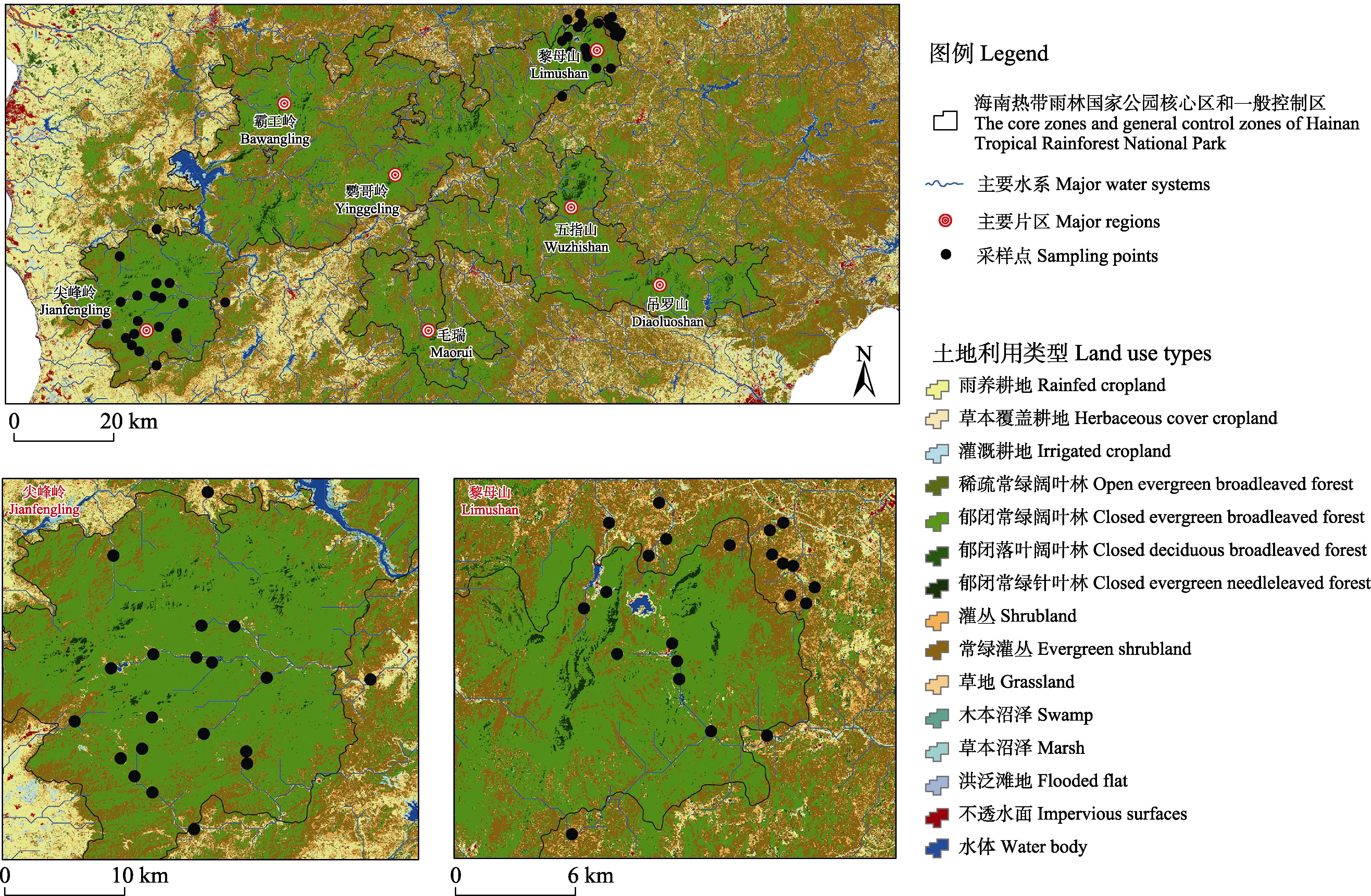
Fig. 1 Distribution of stream fish sampling sites in the core zones, general control zones, and surrounding areas of Limushan and Jianfengling in Hainan Tropical Rainforest National Park
| 环境指标 Environmental variables | 黎母山 Limushan | 尖峰岭 Jianfengling | P值 P value |
|---|---|---|---|
| 总氮 Total nitrogen content (mg/L) | 1.60 ± 0.75 | 0.72 ± 0.98 | < 0.001 |
| 总磷 Total phosphorus content (mg/L) | 0.04 ± 0.02 | 0.01 ± 0.01 | < 0.001 |
| 高锰酸盐指数 Permanganate index (mg/L) | 1.75 ± 0.54 | 2.18 ± 0.72 | < 0.05 |
| 硝态氮 Nitrate nitrogen (mg/L) | 0.52 ± 0.30 | 0.45 ± 0.56 | 0.3 |
| 水温 Water temperature (℃) | 19.92 ± 2.23 | 23.86 ± 3.72 | < 0.001 |
| pH值 pH value | 7.45 ± 0.33 | 7.78 ± 0.33 | < 0.01 |
| 溶解氧 Dissolved oxygen (mg/L) | 7.87 ± 0.66 | 6.98 ± 0.46 | < 0.001 |
| 溶解性总固体 Total dissolved solids (mg/L) | 36.10 ± 12.79 | 100.76 ± 30.87 | < 0.001 |
| 电导率 Electrical conductivity (μS/cm) | 50.58 ± 18.60 | 156.58 ± 58.01 | < 0.001 |
| 河宽 River width (m) | 4.91 ± 2.81 | 5.28 ± 4.33 | 0.82 |
| 水深 Water depth (cm) | 28.37 ± 11.56 | 22.13 ± 9.31 | 0.09 |
| 平均流速 Mean velocity (m/s) | 0.59 ± 0.15 | 0.42 ± 0.23 | < 0.01 |
| 淤泥和细沙百分比 Percentage of clay and sands (%) | 11.34 ± 16.67 | 6.86 ± 4.58 | < 0.05 |
| 碎石百分比 Percentage of gravels (%) | 37.25 ± 16.85 | 38.02 ± 17.86 | 0.96 |
| 鹅卵石百分比 Percentage of cobbles (%) | 43.15 ± 19.73 | 40.92 ± 16.59 | 0.78 |
| 巨石百分比 Percentage of boulders (%) | 8.27 ± 7.24 | 14.19 ± 10.27 | < 0.05 |
| 海拔 Elevation (m) | 294.48 ± 176.50 | 459.79 ± 226.49 | < 0.05 |
| 雨养耕地百分比 Percentage of rainfed cropland (%) | 1.34 ± 1.71 | 1.32 ± 1.29 | 0.68 |
| 草本覆盖耕地百分比 Percentage of herbaceous cover cropland (%) | 0.05 ± 0.10 | 0.04 ± 0.05 | 0.75 |
| 灌溉耕地百分比 Percentage of irrigated cropland (%) | 0.32 ± 0.57 | 0.07 ± 0.11 | 0.08 |
| 疏常绿阔叶林百分比 Percentage of open evergreen broadleaved forest (%) | 0.00 ± 0.00 | 0.00 ± 0.00 | 0.35 |
| 郁闭常绿阔叶林百分比 Percentage of closed evergreen broadleaved forest (%) | 55.16 ± 26.27 | 84.85 ± 7.50 | < 0.05 |
| 郁闭落叶阔叶林百分比 Percentage of closed deciduous broadleaved forest (%) | 1.16 ± 2.09 | 0.50 ± 0.43 | 0.2 |
| 郁闭常绿针叶林百分比 Percentage of closed evergreen needleleaved forest (%) | 2.17 ± 3.65 | 0.97 ± 1.38 | 0.36 |
| 灌丛百分比 Percentage of shrubland (%) | 4.42 ± 4.39 | 1.10 ± 1.09 | < 0.01 |
| 常绿灌丛百分比 Percentage of evergreen shrubland (%) | 34.48 ± 24.70 | 11.01 ± 6.05 | < 0.01 |
| 草地百分比 Percentage of grassland (%) | 0.00 ± 0.00 | 0.00 ± 0.00 | 0.3 |
| 木本沼泽百分比 Percentage of swamp (%) | 0.01 ± 0.02 | 0.00 ± 0.02 | 0.55 |
| 草本沼泽百分比 Percentage of marsh (%) | 0.00 ± 0.01 | 0.01 ± 0.02 | 0.48 |
| 洪泛滩地百分比 Percentage of flooded flat (%) | 0.00 ± 0.00 | 0.00 ± 0.00 | 0.26 |
| 不透水面百分比 Percentage of impervious surfaces (%) | 0.16 ± 0.23 | 0.04 ± 0.05 | < 0.05 |
| 水体百分比 Percentage of water body (%) | 0.73 ± 1.84 | 0.09 ± 0.35 | 0.26 |
Table 1 Distribution of environmental variables (mean ± SD) in Limushan and Jianfengling
| 环境指标 Environmental variables | 黎母山 Limushan | 尖峰岭 Jianfengling | P值 P value |
|---|---|---|---|
| 总氮 Total nitrogen content (mg/L) | 1.60 ± 0.75 | 0.72 ± 0.98 | < 0.001 |
| 总磷 Total phosphorus content (mg/L) | 0.04 ± 0.02 | 0.01 ± 0.01 | < 0.001 |
| 高锰酸盐指数 Permanganate index (mg/L) | 1.75 ± 0.54 | 2.18 ± 0.72 | < 0.05 |
| 硝态氮 Nitrate nitrogen (mg/L) | 0.52 ± 0.30 | 0.45 ± 0.56 | 0.3 |
| 水温 Water temperature (℃) | 19.92 ± 2.23 | 23.86 ± 3.72 | < 0.001 |
| pH值 pH value | 7.45 ± 0.33 | 7.78 ± 0.33 | < 0.01 |
| 溶解氧 Dissolved oxygen (mg/L) | 7.87 ± 0.66 | 6.98 ± 0.46 | < 0.001 |
| 溶解性总固体 Total dissolved solids (mg/L) | 36.10 ± 12.79 | 100.76 ± 30.87 | < 0.001 |
| 电导率 Electrical conductivity (μS/cm) | 50.58 ± 18.60 | 156.58 ± 58.01 | < 0.001 |
| 河宽 River width (m) | 4.91 ± 2.81 | 5.28 ± 4.33 | 0.82 |
| 水深 Water depth (cm) | 28.37 ± 11.56 | 22.13 ± 9.31 | 0.09 |
| 平均流速 Mean velocity (m/s) | 0.59 ± 0.15 | 0.42 ± 0.23 | < 0.01 |
| 淤泥和细沙百分比 Percentage of clay and sands (%) | 11.34 ± 16.67 | 6.86 ± 4.58 | < 0.05 |
| 碎石百分比 Percentage of gravels (%) | 37.25 ± 16.85 | 38.02 ± 17.86 | 0.96 |
| 鹅卵石百分比 Percentage of cobbles (%) | 43.15 ± 19.73 | 40.92 ± 16.59 | 0.78 |
| 巨石百分比 Percentage of boulders (%) | 8.27 ± 7.24 | 14.19 ± 10.27 | < 0.05 |
| 海拔 Elevation (m) | 294.48 ± 176.50 | 459.79 ± 226.49 | < 0.05 |
| 雨养耕地百分比 Percentage of rainfed cropland (%) | 1.34 ± 1.71 | 1.32 ± 1.29 | 0.68 |
| 草本覆盖耕地百分比 Percentage of herbaceous cover cropland (%) | 0.05 ± 0.10 | 0.04 ± 0.05 | 0.75 |
| 灌溉耕地百分比 Percentage of irrigated cropland (%) | 0.32 ± 0.57 | 0.07 ± 0.11 | 0.08 |
| 疏常绿阔叶林百分比 Percentage of open evergreen broadleaved forest (%) | 0.00 ± 0.00 | 0.00 ± 0.00 | 0.35 |
| 郁闭常绿阔叶林百分比 Percentage of closed evergreen broadleaved forest (%) | 55.16 ± 26.27 | 84.85 ± 7.50 | < 0.05 |
| 郁闭落叶阔叶林百分比 Percentage of closed deciduous broadleaved forest (%) | 1.16 ± 2.09 | 0.50 ± 0.43 | 0.2 |
| 郁闭常绿针叶林百分比 Percentage of closed evergreen needleleaved forest (%) | 2.17 ± 3.65 | 0.97 ± 1.38 | 0.36 |
| 灌丛百分比 Percentage of shrubland (%) | 4.42 ± 4.39 | 1.10 ± 1.09 | < 0.01 |
| 常绿灌丛百分比 Percentage of evergreen shrubland (%) | 34.48 ± 24.70 | 11.01 ± 6.05 | < 0.01 |
| 草地百分比 Percentage of grassland (%) | 0.00 ± 0.00 | 0.00 ± 0.00 | 0.3 |
| 木本沼泽百分比 Percentage of swamp (%) | 0.01 ± 0.02 | 0.00 ± 0.02 | 0.55 |
| 草本沼泽百分比 Percentage of marsh (%) | 0.00 ± 0.01 | 0.01 ± 0.02 | 0.48 |
| 洪泛滩地百分比 Percentage of flooded flat (%) | 0.00 ± 0.00 | 0.00 ± 0.00 | 0.26 |
| 不透水面百分比 Percentage of impervious surfaces (%) | 0.16 ± 0.23 | 0.04 ± 0.05 | < 0.05 |
| 水体百分比 Percentage of water body (%) | 0.73 ± 1.84 | 0.09 ± 0.35 | 0.26 |
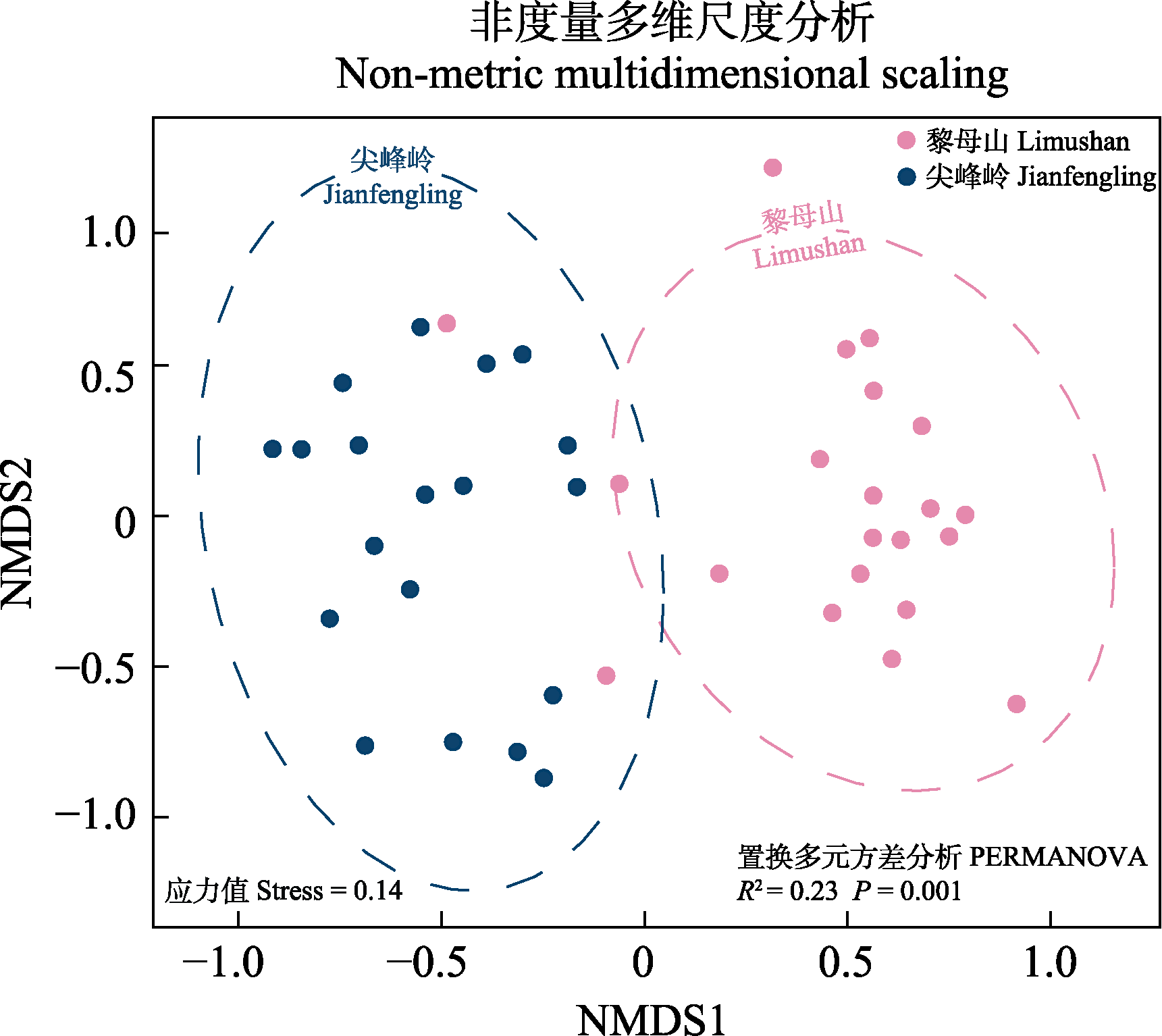
Fig. 2 Non-metric multidimensional scaling of stream fish assemblage composition in Limushan and Jianfengling
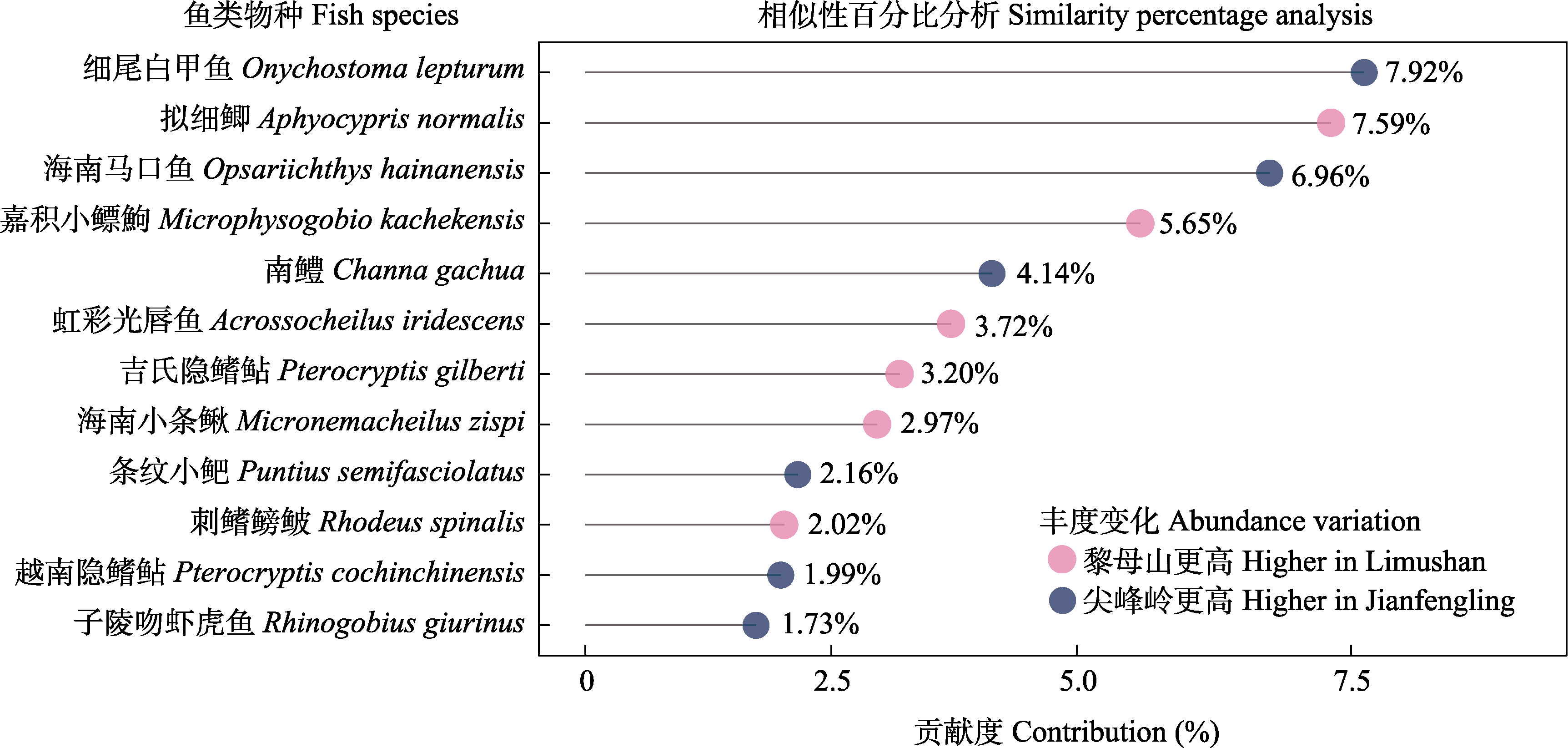
Fig. 3 Similarity percentage analysis of stream fish assemblage composition in Limushan and Jianfengling
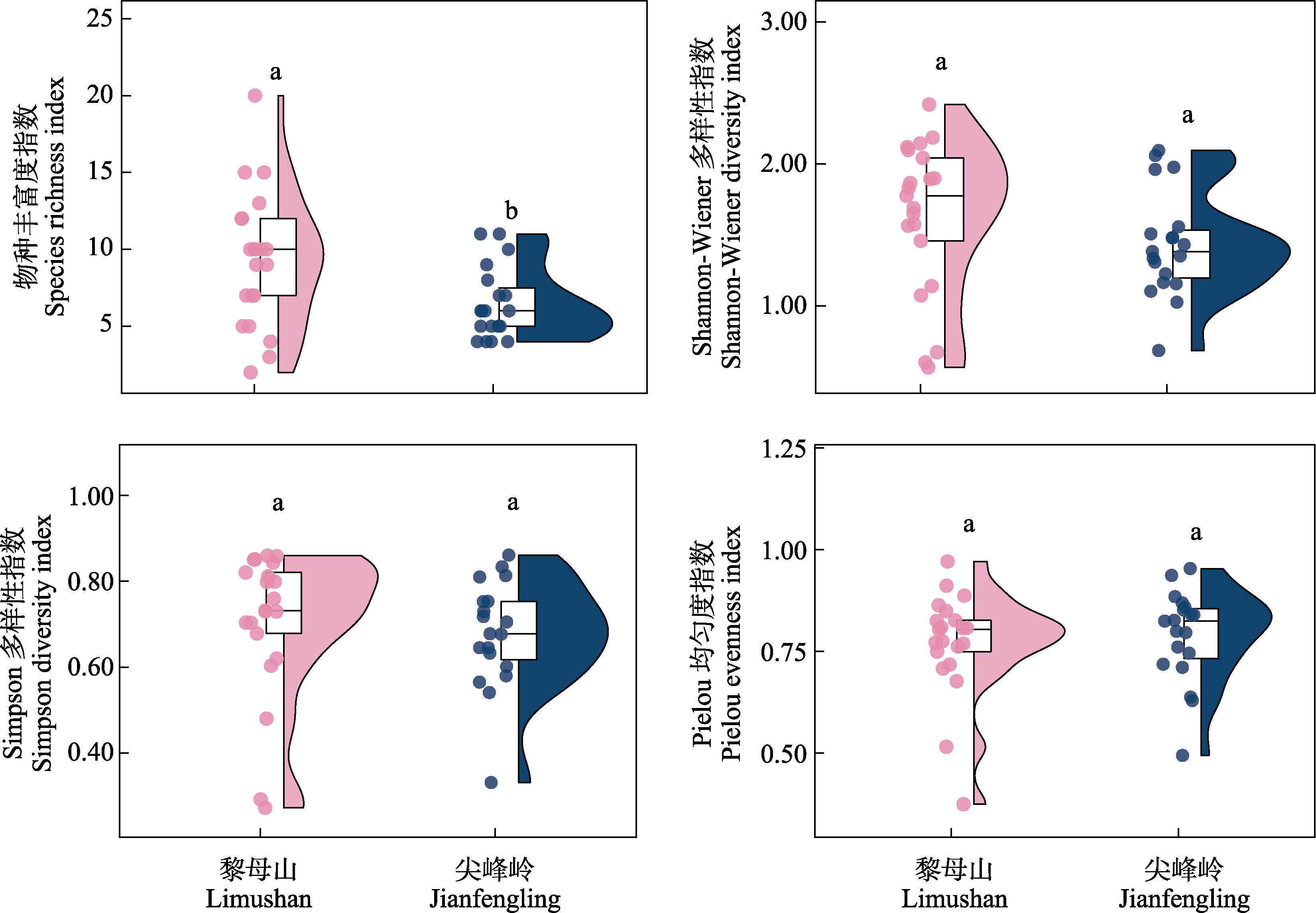
Fig. 4 Raincloud plots of stream fish species diversity indices in Limushan and Jianfengling. Different letters indicate a significant difference between Limushan and Jianfengling (P < 0.05).
| 区域 Regions | 多样性指数 Diversity indices | 模型解释量 VarExplained | 解释变量(解释量) Predictor importance |
|---|---|---|---|
| 黎母山 Limushan | 物种丰富度指数 Species richness index | 55.6% | 海拔(16.2%) + 雨养耕地百分比(13.7%) + 常绿灌丛百分比(12.7%) + 灌溉耕地百分比(12.6%) + 郁闭常绿阔叶林百分比(10.4%) + 灌丛百分比(9.8%) + 草本沼泽百分比(5.2%) + 碎石百分比(1.7%) Elevation (16.2%) + Percentage of rainfed cropland (13.7%) + Percentage of evergreen shrubland (12.7%) + Percentage of irrigated cropland (12.6%) + Percentage of closed evergreen broadleaved forest (10.4%) + Percentage of shrubland (9.8%) + Percentage of marsh (5.2%) + Percentage of gravels (1.7%) |
| Shannon-Wiener多样性指数 Shannon-Wiener diversity index | 69.5% | 雨养耕地百分比(21.7%) + 海拔(21.6%) + 总氮(19.8%) Percentage of rainfed cropland (21.7%) + Elevation (21.6%) + Total nitrogen content (19.8%) | |
| Simpson多样性指数 Simpson diversity index | 66.0% | 雨养耕地百分比(27.8%) + 海拔(26.2%) Percentage of rainfed cropland (27.8%) + Elevation (26.2%) | |
| Pielou均匀度指数 Pielou evenness index | 16.2% | 水深(11.7%) + pH值(8.3%)+河宽(5.7%) + 水体百分比(4.7%) + 草本沼泽百分比(4.1%) + 鹅卵石百分比(3.4%) + 溶解氧(2.0%) Water depth (11.7%) + pH value (8.3%) + River width (5.7%) + Percentage of water body (4.7%) + Percentage of marsh (4.1%) + Percentage of cobbles (3.4%) + Dissolved oxygen (2.0%) | |
| 尖峰岭 Jianfengling | 物种丰富度指数 Species richness index | 36.5% | 草本覆盖耕地百分比(14.0%) + 不透水面百分比(10.3%) + 灌丛百分比(9.5%) + 高锰酸盐指数(8.0%) + 灌溉耕地百分比(7.1%) + 溶解氧(5.9%) + 电导率(5.8%) + 水温(5.5%) + 雨养耕地百分比(4.3%) + 常绿灌丛百分比(3.3%) Percentage of herbaceous cover cropland (14.0%) + Percentage of impervious surfaces (10.3%) + Percentage of shrubland (9.5%) + Permanganate index (8.0%) + Percentage of irrigated cropland (7.1%) + Dissolved oxygen (5.9%) + Electrical conductivity (5.8%) + Water temperature (5.5%) + Percentage of rainfed cropland (4.3%) + Percentage of evergreen shrubland (3.3%) |
| Shannon-Wiener多样性指数 Shannon-Wiener diversity index | 51.5% | 草本覆盖耕地百分比(19.5%) + 不透水面百分比(17.7%) + pH值(9.2%) + 电导率(7.8%) Percentage of herbaceous cover cropland (19.5%) + Percentage of impervious surfaces (17.7%) + pH value (9.2%) + Electrical conductivity (7.8%) | |
| Simpson多样性指数 Simpson diversity index | 43.0% | 草本覆盖耕地百分比(17.4%) + 不透水面百分比(15.6%) + pH值(12.5%) + 电导率(6.9%) Percentage of herbaceous cover cropland (17.4%) + Percentage of impervious surfaces (15.6%) + pH value (12.5%) + Electrical conductivity (6.9%) | |
| Pielou均匀度指数 Pielou evenness index | 34.2% | pH值(21.5%) + 灌丛百分比(8.6%) pH value (21.5%) + Percentage of shrubland (8.6%) |
Table 2 Random forest models for fish diversity and environmental variables in streams of Limushan and Jianfengling
| 区域 Regions | 多样性指数 Diversity indices | 模型解释量 VarExplained | 解释变量(解释量) Predictor importance |
|---|---|---|---|
| 黎母山 Limushan | 物种丰富度指数 Species richness index | 55.6% | 海拔(16.2%) + 雨养耕地百分比(13.7%) + 常绿灌丛百分比(12.7%) + 灌溉耕地百分比(12.6%) + 郁闭常绿阔叶林百分比(10.4%) + 灌丛百分比(9.8%) + 草本沼泽百分比(5.2%) + 碎石百分比(1.7%) Elevation (16.2%) + Percentage of rainfed cropland (13.7%) + Percentage of evergreen shrubland (12.7%) + Percentage of irrigated cropland (12.6%) + Percentage of closed evergreen broadleaved forest (10.4%) + Percentage of shrubland (9.8%) + Percentage of marsh (5.2%) + Percentage of gravels (1.7%) |
| Shannon-Wiener多样性指数 Shannon-Wiener diversity index | 69.5% | 雨养耕地百分比(21.7%) + 海拔(21.6%) + 总氮(19.8%) Percentage of rainfed cropland (21.7%) + Elevation (21.6%) + Total nitrogen content (19.8%) | |
| Simpson多样性指数 Simpson diversity index | 66.0% | 雨养耕地百分比(27.8%) + 海拔(26.2%) Percentage of rainfed cropland (27.8%) + Elevation (26.2%) | |
| Pielou均匀度指数 Pielou evenness index | 16.2% | 水深(11.7%) + pH值(8.3%)+河宽(5.7%) + 水体百分比(4.7%) + 草本沼泽百分比(4.1%) + 鹅卵石百分比(3.4%) + 溶解氧(2.0%) Water depth (11.7%) + pH value (8.3%) + River width (5.7%) + Percentage of water body (4.7%) + Percentage of marsh (4.1%) + Percentage of cobbles (3.4%) + Dissolved oxygen (2.0%) | |
| 尖峰岭 Jianfengling | 物种丰富度指数 Species richness index | 36.5% | 草本覆盖耕地百分比(14.0%) + 不透水面百分比(10.3%) + 灌丛百分比(9.5%) + 高锰酸盐指数(8.0%) + 灌溉耕地百分比(7.1%) + 溶解氧(5.9%) + 电导率(5.8%) + 水温(5.5%) + 雨养耕地百分比(4.3%) + 常绿灌丛百分比(3.3%) Percentage of herbaceous cover cropland (14.0%) + Percentage of impervious surfaces (10.3%) + Percentage of shrubland (9.5%) + Permanganate index (8.0%) + Percentage of irrigated cropland (7.1%) + Dissolved oxygen (5.9%) + Electrical conductivity (5.8%) + Water temperature (5.5%) + Percentage of rainfed cropland (4.3%) + Percentage of evergreen shrubland (3.3%) |
| Shannon-Wiener多样性指数 Shannon-Wiener diversity index | 51.5% | 草本覆盖耕地百分比(19.5%) + 不透水面百分比(17.7%) + pH值(9.2%) + 电导率(7.8%) Percentage of herbaceous cover cropland (19.5%) + Percentage of impervious surfaces (17.7%) + pH value (9.2%) + Electrical conductivity (7.8%) | |
| Simpson多样性指数 Simpson diversity index | 43.0% | 草本覆盖耕地百分比(17.4%) + 不透水面百分比(15.6%) + pH值(12.5%) + 电导率(6.9%) Percentage of herbaceous cover cropland (17.4%) + Percentage of impervious surfaces (15.6%) + pH value (12.5%) + Electrical conductivity (6.9%) | |
| Pielou均匀度指数 Pielou evenness index | 34.2% | pH值(21.5%) + 灌丛百分比(8.6%) pH value (21.5%) + Percentage of shrubland (8.6%) |
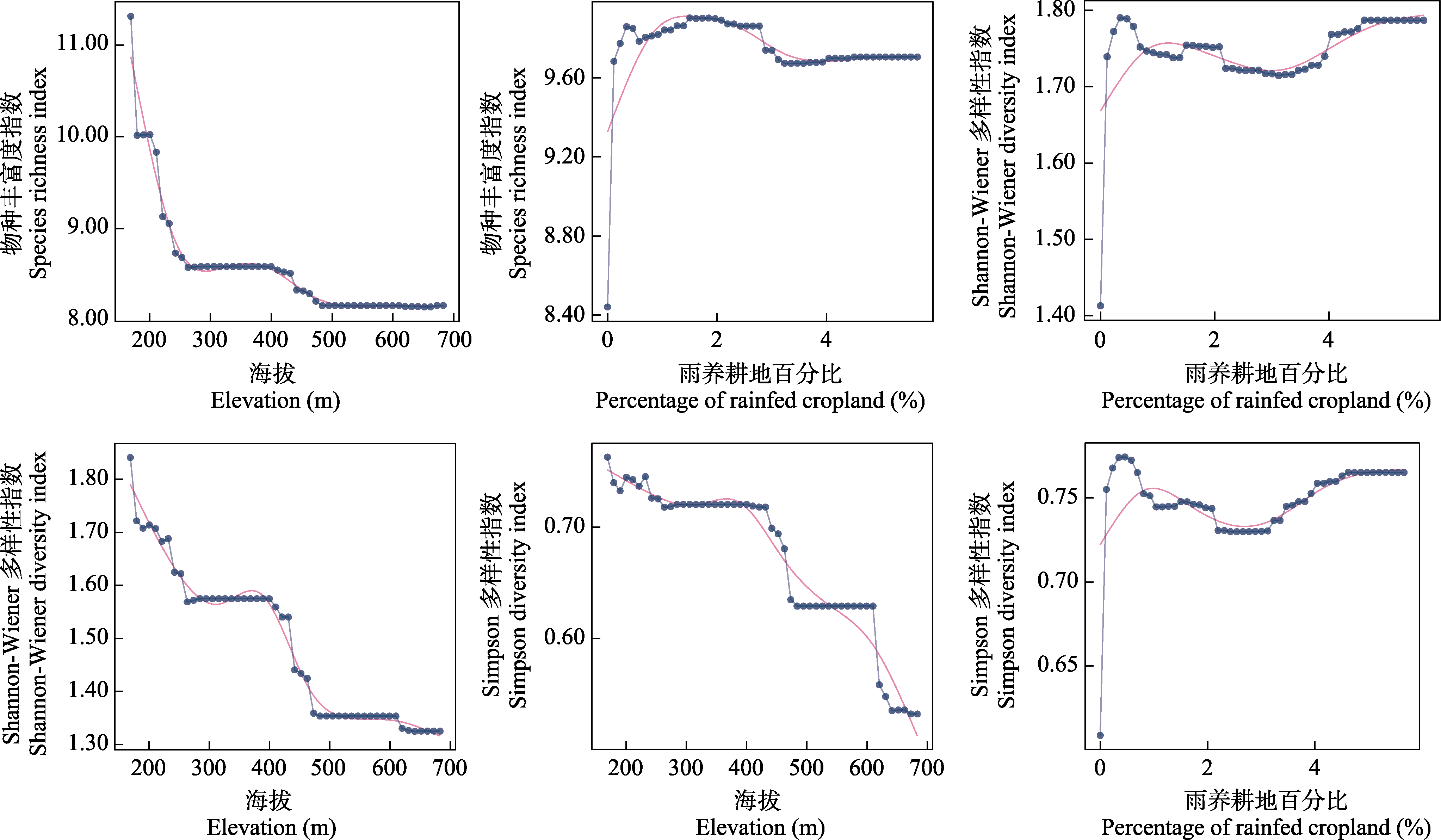
Fig. 5 Partial dependence plots of Limushan stream fish diversity indices and important explanatory variables in random forest model. The dots represent the average predicted values of the fish diversity index calculated by the random forest model under the original value gradient of the key influencing factor (50 gradient points evenly generated based on the variable’s actual range); The polyline is a trend line connecting all the dots, intuitively illustrating the variation trajectory of the fish diversity index along the original gradient of the key influencing factor; The curve is a trend line obtained by smoothing the dots using a generalized additive model, reflecting the response pattern of the diversity index to the key environmental factor.
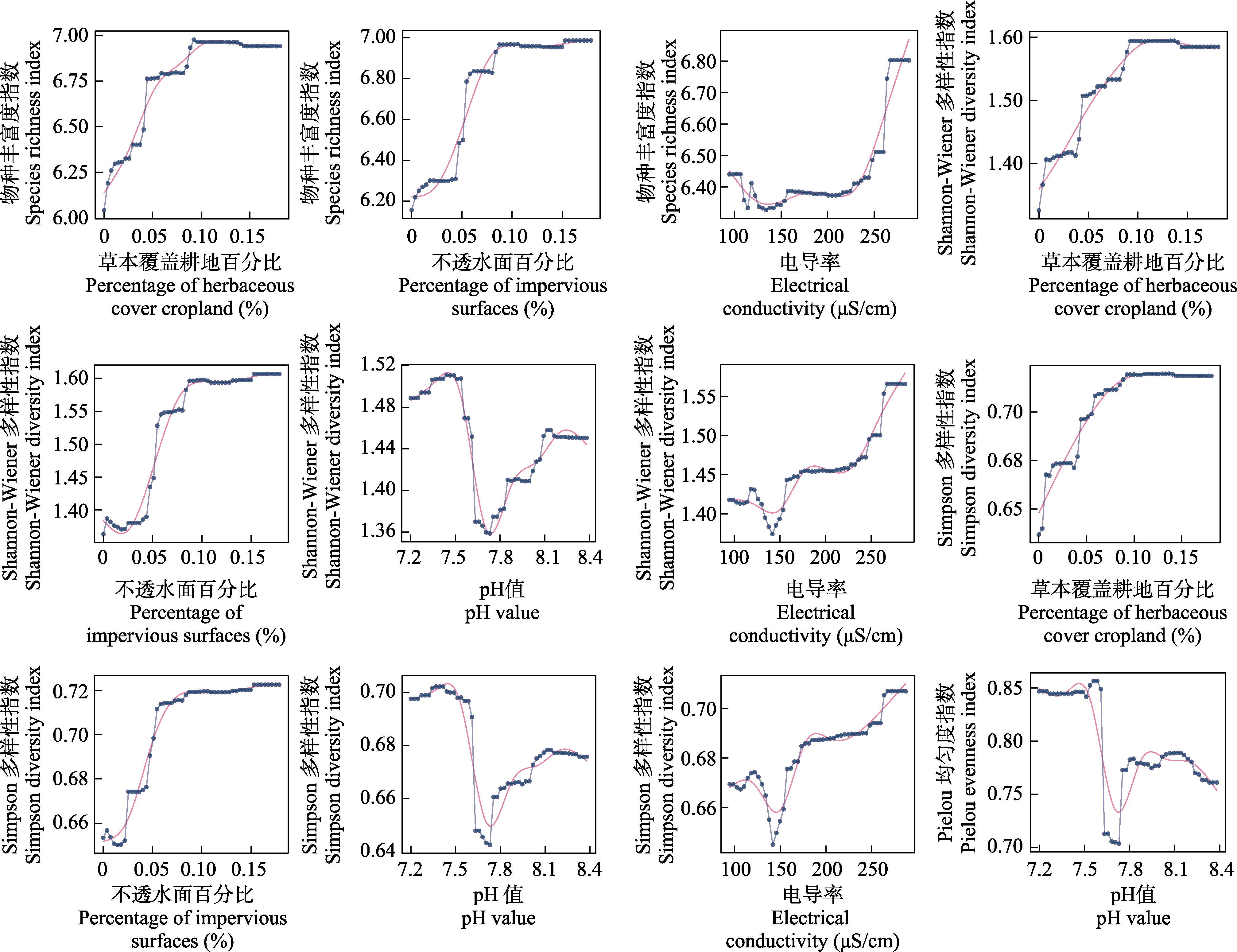
Fig. 6 Partial dependence plots of Jianfengling stream fish diversity indices and important explanatory variables in random forest model. For the meaning of the legend, see Fig. 5.
| [1] | Aitkenhead-Peterson JA, McDowell WH, Neff JC (2003) Sources, production, and regulation of allochthonous dissolved organic matter inputs to surface waters. In: AquaticEcosystems (eds Findlay SEG, Sinsabaugh RL), pp. 25-70. Academic Press, Burlington. |
| [2] | Allan JD, Castillo MM, Capps KA (2021) Stream Ecology:Structure and Function of Running Waters. Springer Nature Switzerland AG, Switzerland. |
| [3] | Arranz I, Grenouillet G, Cucherousset J (2023) Human pressures modulate climate-warming-induced changes in size spectra of stream fish communities. Nature Ecology & Evolution, 7, 1072-1078. |
| [4] | Bai XF, Zhang P, Xiong LH, Yang Z, Wang SY, Dong XH, Sun HY, Li WB, Chang JB (2025) River network connectivity reductions dominate declines in the richness of plateau fish species under climate change in the Upper Yangtze River Basin. Water Resources Research, 61, e2024WR037557. |
| [5] |
Bailey SW, McGuire KJ, Ross DS, Green MB, Fraser OL (2019) Mineral weathering and podzolization control acid neutralization and streamwater chemistry gradients in upland glaciated catchments, northeastern United States. Frontiers in Earth Science, 7, 63.
DOI URL |
| [6] |
Bojsen BH, Barriga R (2002) Effects of deforestation on fish community structure in Ecuadorian Amazon streams. Freshwater Biology, 47, 2246-2260.
DOI URL |
| [7] |
Breiman L (2001) Random forests. Machine Learning, 45, 5-32.
DOI |
| [8] |
Brejão GL, Gerhard P, Zuanon J (2013) Functional trophic composition of the ichthyofauna of forest streams in eastern Brazilian Amazon. Neotropical Ichthyology, 11, 361-373.
DOI URL |
| [9] | Bu HM, Dang HS, Zhang QF (2010) Impacts of forest vegetation on water environment of the Jinshui River Basin in the Upper Han River. Acta Ecologica Sinica, 30, 1341-1348. (in Chinese with English abstract) |
| [卜红梅, 党海山, 张全发 (2010) 汉江上游金水河流域森林植被对水环境的影响. 生态学报, 30, 1341-1348.] | |
| [10] |
Bunn SE, Arthington AH (2002) Basic principles and ecological consequences of altered flow regimes for aquatic biodiversity. Environmental Management, 30, 492-507.
PMID |
| [11] | Cai XW, Liang ZC, Li GJ, Wang ZJ, Zhang QF, Sui XR, Shen ZX (2020) Structure characteristics of fish community of Hainan Jianfengling National Nature Reserve in rainy season. Biotic Resources, 42, 287-293. (in Chinese with English abstract) |
| [蔡杏伟, 梁智策, 李高俊, 王镇江, 张清凤, 隋昕融, 申志新 (2020) 海南尖峰岭国家级自然保护区雨季鱼类群落结构特征研究. 生物资源, 42, 287-293.] | |
| [12] | Cai XW, Sui XR, Li GJ, Liang ZC, Li FY, Gu Y, Wang ZJ, Wang HG, Shen ZX (2021) Community structure and historical changes of freshwater fish in Lingshui River basin, Hainan Island. Biotic Resources, 43, 552-559. (in Chinese with English abstract) |
| [蔡杏伟, 隋昕融, 李高俊, 梁智策, 李芳远, 谷圆, 王镇江, 王海桂, 申志新 (2021) 海南岛陵水河流域淡水鱼类群落结构及历史变化研究. 生物资源, 43, 552-559.] | |
| [13] |
Carvajal-Quintero JD, Escobar F, Alvarado F, Villa-Navarro FA, Jaramillo-Villa Ú, Maldonado-Ocampo JA (2015) Variation in freshwater fish assemblages along a regional elevation gradient in the northern Andes, Colombia. Ecology and Evolution, 5, 2608-2620.
DOI PMID |
| [14] |
Chen BL, Chen XL (2008) Species diversity and distribution of freshwater fishes at Mt. Yinggeling, Hainan Island, China. Biodiversity Science, 16, 44-52. (in Chinese with English abstract)
DOI URL |
|
[陈辈乐, 陈湘粦 (2008) 海南鹦哥岭地区的鱼类物种多样性与分布特点. 生物多样性, 16, 44-52.]
DOI |
|
| [15] |
Chen J, Xu H, He D, Li YD, Luo TS, Yang HG, Lin MX (2019) Historical logging alters soil fungal community composition and network in a tropical rainforest. Forest Ecology and Management, 433, 228-239.
DOI |
| [16] |
Chen K, Midway SR, Peoples BK, Wang BX, Olden JD (2023) Shifting taxonomic and functional community composition of rivers under land use change. Ecology, 104, e4155.
DOI URL |
| [17] |
Chen K, Olden JD (2020) Threshold responses of riverine fish communities to land use conversion across regions of the world. Global Change Biology, 26, 4952-4965.
DOI URL |
| [18] |
Cilleros K, Allard L, Grenouillet G, Brosse S (2016) Taxonomic and functional diversity patterns reveal different processes shaping European and Amazonian stream fish assemblages. Journal of Biogeography, 43, 1832-1843.
DOI URL |
| [19] |
Connell JH (1978) Diversity in tropical rain forests and coral reefs. Science, 199, 1302-1310.
DOI PMID |
| [20] | Cui YY, Li HJ, Chu ZJ (2011) A preliminary study on fish communities in forest streams in Hainan, China. Journal of Jilin Agricultural University, 33, 677-681, 686. (in Chinese with English abstract) |
| [崔友勇, 李红敬, 储张杰 (2011) 海南山地森林溪流鱼类群落的初步研究. 吉林农业大学学报, 33, 677-681, 686.] | |
| [21] |
Cutler DR, Edwards TC Jr, Beard KH, Cutler A, Hess KT, Gibson J, Lawler JJ (2007) Random forests for classification in ecology. Ecology, 88, 2783-2792.
DOI PMID |
| [22] |
da Costa ID, Petry AC, Mazzoni R (2018) Responses of fish assemblages to subtle elevations in headwater streams in southwestern Amazonia. Hydrobiologia, 809, 175-184.
DOI URL |
| [23] |
Davison CW, Rahbek C, Morueta-Holme N (2021) Land-use change and biodiversity: Challenges for assembling evidence on the greatest threat to nature. Global Change Biology, 27, 5414-5429.
DOI PMID |
| [24] |
Effert-Fanta EL, Fischer RU, Wahl DH (2019) Effects of riparian forest buffers and agricultural land use on macroinvertebrate and fish community structure. Hydrobiologia, 841, 45-64.
DOI |
| [25] |
Fu F, Wei HY, Chang YT, Wang BX, Chen K (2022) Elevational patterns of life history and ecological trait diversity of aquatic insects in the middle of the Lancang River: The effects of climate and land use variables. Biodiversity Science, 30, 21332. (in Chinese with English abstract)
DOI |
|
[付飞, 魏慧玉, 常育腾, 王备新, 陈凯 (2022) 澜沧江中游水生昆虫生活史和生态学性状多样性的海拔格局: 气候和土地利用的影响. 生物多样性, 30, 21332.]
DOI |
|
| [26] |
Gao WQ, Xiong FY, Lu Y, Xin W, Wang HH, Feng GP, Kong CP, Fang L, Gao XP, Chen YS (2024) Water quality and habitat drive phytoplankton taxonomic and functional group patterns in the Yangtze River. Ecological Processes, 13, 11.
DOI |
| [27] |
Green NS, Li SB, Maul JD, Overmyer JP (2022) Natural and anthropogenic factors and their interactions drive stream community integrity in a North American river basin at a large spatial scale. Science of the Total Environment, 835, 155344.
DOI URL |
| [28] |
Hayashi M (2004) Temperature-electrical conductivity relation of water for environmental monitoring and geophysical data inversion. Environmental Monitoring and Assessment, 96, 119-128.
PMID |
| [29] |
He JY, Zhang D, Chu L, Yan YZ (2021) Anthropogenic disturbances affect the functional diversity of stream fishes and its longitudinal patterns in China. Biodiversity Science, 29, 927-937. (in Chinese with English abstract)
DOI URL |
| [贺佳云, 张东, 储玲, 严云志 (2021) 人为干扰对溪流鱼类功能多样性及其纵向梯度格局的影响. 生物多样性, 29, 927-937.] | |
| [30] | Jiang W, Zhou C, Ji DB, Liu DF, Ren YS, Haffner D, Xie DT, Zhang L (2017) Comparison of relationship between conduction and algal bloom in Pengxi River and Modao River in Three Gorges Reservoir. Environmental Science, 38, 2326-2335. (in Chinese with English abstract) |
| [姜伟, 周川, 纪道斌, 刘德富, 任豫霜, Douglas Haffner, 谢德体, 张磊 (2017) 三峡库区澎溪河与磨刀溪电导率等水质特征与水华的关系比较. 环境科学, 38, 2326-2335.] | |
| [31] |
Kirk MA, Rahel FJ, Laughlin DC (2022) Environmental filters of freshwater fish community assembly along elevation and latitudinal gradients. Global Ecology and Biogeography, 31, 470-485.
DOI URL |
| [32] |
Leitão RP, Zuanon J, Mouillot D, Leal CG, Hughes RM, Kaufmann PR, Villéger S, Pompeu PS, Kasper D, de Paula FR, Ferraz SFB, Gardner TA (2018) Disentangling the pathways of land use impacts on the functional structure of fish assemblages in Amazon streams. Ecography, 41, 219-232.
DOI PMID |
| [33] |
Liu H, Qu X, Xia WT, Chen YS (2023) Taxonomic, functional, and phylogenetic diversity patterns reveal different processes shaping river fish assemblages in the Eastern Huai River Basin, China. Water Biology and Security, 2, 100078.
DOI URL |
| [34] |
Lomolino MV (2001) Elevation gradients of species-density: Historical and prospective views. Global Ecology and Biogeography, 10, 3-13.
DOI URL |
| [35] |
Lorion CM, Kennedy BP (2009) Riparian forest buffers mitigate the effects of deforestation on fish assemblages in tropical headwater streams. Ecological Applications, 19, 468-479.
PMID |
| [36] |
Lujan NK, Roach KA, Jacobsen D, Winemiller KO, Vargas VM, Ching VR, Maestre JA (2013) Aquatic community structure across an Andes-to-Amazon fluvial gradient. Journal of Biogeography, 40, 1715-1728.
DOI URL |
| [37] | Martínez-Ramos M, Ortiz-Rodríguez IA, Piñero D, Dirzo R, Sarukhán J (2016) Anthropogenic disturbances jeopardize biodiversity conservation within tropical rainforest reserves. Proceedings of the National Academy of Sciences, USA, 113, 5323-5328. |
| [38] |
Martins RT, Brito J, Dias-Silva K, Leal CG, Leitão RP, Oliveira VC, Oliveira-Júnior JMB, Ferraz SFB, de Paula FR, Roque FO, Hamada N, Juen L, Nessimian JL, Pompeu PS, Hughes RM (2021) Low forest-loss thresholds threaten Amazonian fish and macroinvertebrate assemblage integrity. Ecological Indicators, 127, 107773.
DOI URL |
| [39] |
Moi DA, Barrios M, Tesitore G, Burwood M, Romero GQ, Mormul RP, Kratina P, Juen L, Michelan TS, Montag LFA, Cruz GM, García-Girón J, Heino J, Hughes RM, Figueiredo BRS, Teixeira de Mello F (2023) Human land-uses homogenize stream assemblages and reduce animal biomass production. Journal of Animal Ecology, 92, 1176-1189.
DOI URL |
| [40] |
Moi DA, Kaufmann PR, Riato L, Romero GQ, Kratina P, Teixeira de Mello F, Hughes RM (2024) Habitat diversity mitigates the impacts of human pressure on stream biodiversity. Global Change Biology, 30, e17534.
DOI URL |
| [41] | Moi DA, Saito VS, Quirino BA, Alves DC, Agostinho AA, Schmitz MH, Bonecker CC, Barrios M, Kratina P, Perkins DM, Teixeira de Mello F, Figueiredo BRS, Mormul RP, Okada EK, Romero GQ (2025) Human land use and non-native fish species erode ecosystem services by changing community size structure. Nature Ecology & Evolution, 9, 801-809. |
| [42] |
Montag LFA, Winemiller KO, Keppeler FW, Leão H, Benone NL, Torres NR, Prudente BS, Begot TO, Bower LM, Saenz DE, Lopez-Delgado EO, Quintana Y, Hoeinghaus DJ, Juen L (2019) Land cover, riparian zones and instream habitat influence stream fish assemblages in the eastern Amazon. Ecology of Freshwater Fish, 28, 317-329.
DOI URL |
| [43] |
Pagotto JPA, Pessoa LA, Goulart E, Mise FT, Ortega JCG, Landgraf GO (2022) Environmental degradation of streams leads to the loss of ecomorphologically similar fish species. Hydrobiologia, 849, 2299-2316.
DOI |
| [44] | Pearl River Fisheries Research Institute (1986) The Freshwater and Estuaries Fishes of Hainan Island. Guangdong Science and Technology Press, Guangzhou. (in Chinese) |
| [中国水产科学研究院珠江水产研究所 (1986) 海南岛淡水及河口鱼类志. 广东科技出版社, 广州.] | |
| [45] | Pielou EC, Levandowsky M (1975) Ecological diversity. Quarterly Review of Biology, 51, 336-340. |
| [46] | Qu X, Liu H, Yang M, Xin W, Wang WM, Chen YS (2022) Characteristics of fish communities and driving factors under urbanization in typical river basins in Shenzhen City, China. Acta Ecologica Sinica, 42, 10029-10040. (in Chinese with English abstract) |
| [屈霄, 刘晗, 阳敏, 辛未, 王伟民, 陈宇顺 (2022) 城镇化背景下深圳典型流域鱼类群落特征及驱动因子. 生态学报, 42, 10029-10040.] | |
| [47] | Riis T, Kelly-Quinn M, Aguiar FC, Manolaki P, Bruno D, Bejarano MD, Clerici N, Fernandes MR, Franco JC, Pettit N, Portela AP, Tammeorg O, Tammeorg P, Rodríguez- González PM, Dufour S (2020) Global overview of ecosystem services provided by riparian vegetation. BioScience, 70, 501-514. |
| [48] |
Rumschlag SL, Gallagher B, Hill R, Schäfer RB, Schmidt TS, Woods T, Kopp D, Dumelle M, Rohr JR, De Laender F, Hoffman J, Behrens J, Lepak R, Jones DK, Mahon MB (2025) Diverging fish biodiversity trends in cold and warm rivers and streams. Nature, 647, 656-662.
DOI |
| [49] | Sayer CA, Fernando E, Jimenez RR, MacFarlane NBW, Rapacciuolo G, Böhm M, Brooks TM, Contreras-MacBeath T, Cox NA, Harrison I, Hoffmann M, Jenkins R, Smith KG, Vié JC, Abbott JC, Allen DJ, Allen GR, Barrios V, Boudot JP, Carrizo SF, Charvet P, Clausnitzer V, Congiu L, Crandall KA, Cumberlidge N, Cuttelod A, Dalton J, Daniels AG, De Grave S, De Knijf G, Dijkstra KB, Dow RA, Freyhof J, García N, Gessner J, Getahun A, Gibson C, Gollock MJ, Grant MI, Groom AER, Hammer MP, Hammerson GA, Hilton-Taylor C, Hodgkinson L, Holland RA, Jabado RW, Juffe Bignoli D, Kalkman VJ, Karimov BK, Kipping J, Kottelat M, Lalèyè PA, Larson HK, Lintermans M, Lozano F, Ludwig A, Lyons TJ, Máiz-Tomé L, Molur S, Ng HH, Numa C, Palmer-Newton AF, Pike C, Pippard HE, Polaz CNM, Pollock CM, Raghavan R, Rand PS, Ravelomanana T, Reis RE, Rigby CL, Scott JA, Skelton PH, Sloat MR, Snoeks J, Stiassny MLJ, Tan HH, Taniguchi Y, Thorstad EB, Tognelli MF, Torres AG, Torres Y, Tweddle D, Watanabe K, Westrip JRS, Wright EGE, Zhang E, Darwall WRT (2025) One-quarter of freshwater fauna threatened with extinction. Nature, 638, 138-145. |
| [50] |
Shannon CE (1948) A mathematical theory of communication. Bell System Technical Journal, 27, 379-423.
DOI URL |
| [51] |
Simpson EH (1949) Measurement of diversity. Nature, 163, 688.
DOI |
| [52] | State Environmental Protection Administration (2002) Monitoring and Analysis Methods for Water and Wastewater, 4th edn. China Environmental Science Press, Beijing. (in Chinese) |
| [国家环境保护总局 (2002) 水和废水监测分析方法(第四版). 中国环境科学出版社, 北京.] | |
| [53] |
Tian S, Yin XW (2022) Intermediate disturbance hypothesis explains eutrophication and biodiversity pattern in a boreal river basin, China. Hydrobiologia, 849, 3389-3399.
DOI |
| [54] |
Wang YX, Zhang L (2025) From primary forests to rubber plantations: A huge ecological loss. The Innovation, 6, 100836.
DOI URL |
| [55] |
Wei HY, Chen K, Wang BX (2020) The spatial scale dependency of elevational patterns of taxonomic and functional diversity in aquatic insects in the Lancang River, Yunnan, China. Biodiversity Science, 28, 504-514. (in Chinese with English abstract)
DOI |
|
[魏慧玉, 陈凯, 王备新 (2020) 澜沧江流域水生昆虫群落分类多样性和功能多样性海拔格局的空间尺度依赖性. 生物多样性, 28, 504-514.]
DOI |
|
| [56] |
Xia ZJ, Yu FD, Xu CS, Lin PC, He YF, Liu F, Wang JW (2024) Elevational patterns of fish functional and phylogenetic community structure in a monsoon climate river basin. Diversity and Distributions, 30, e13815.
DOI URL |
| [57] |
Yang B, Qu X, Liu H, Yang M, Xin W, Wang WM, Chen YS (2024) Urbanization reduces fish taxonomic and functional diversity while increases phylogenetic diversity in subtropical rivers. Science of the Total Environment, 908, 168178.
DOI URL |
| [58] |
Yang YG, Chen HH, Abdullah Al M, Ndayishimiye JC, Yang JR, Isabwe A, Luo AQ, Yang J (2022) Urbanization reduces resource use efficiency of phytoplankton community by altering the environment and decreasing biodiversity. Journal of Environmental Sciences, 112, 140-151.
DOI PMID |
| [59] |
Zhai J, Hou P, Cao W, Yang M, Cai MY, Li J (2018) Ecosystem assessment and protection effectiveness of a tropical rainforest region in Hainan Island, China. Journal of Geographical Sciences, 28, 415-428.
DOI |
| [60] |
Zhang SB, Xia XH, Xin Y, Li XK, Wang JF, Yu LL, Li CB, McDowell WH, Tan Q, Yang ZF (2023) Electrical conductivity as a reliable indicator for assessing land use effects on stream N2O concentration. Journal of Hydrology, 626, 130253.
DOI URL |
| [61] | Zhang X, Zhao TT, Xu H, Liu WD, Wang JQ, Chen XD, Liu LY (2024) GLC_FCS30D: The first global 30 m land-cover dynamics monitoring product with a fine classification system for the period from 1985 to 2022 generated using dense-time-series Landsat imagery and the continuous change-detection method. Earth System Science Data, 16, 1353-1381. |
| [62] |
Zhang XK, Wang HL, Wan A, Fang YX, Liu ZG, Zheng AF, Chen MM, Yu DP (2017) Fishes in headwater streams of the Pihe River Basin: Spatial distribution pattern and its main influencing factors. Journal of Lake Sciences, 29, 176-185. (in Chinese with English abstract)
DOI URL |
| [张晓可, 王慧丽, 万安, 方云祥, 刘志刚, 郑爱芳, 陈敏敏, 于道平 (2017) 淠河流域河源溪流鱼类空间分布格局及主要影响因素. 湖泊科学, 29, 176-185.] | |
| [63] | Zhou JL, Cai XW, Gu KX, Gu Y, Zhao GJ, Li GJ, Xie SG, Chen K (2025) Spatial scale effects of land use on the organisms in the streams of Yinggeling Tropical Rainforest. Natural Science of Hainan University, 43, 398-404. (in Chinese with English abstract) |
| [周俊龙, 蔡杏伟, 顾恺曦, 谷圆, 赵光军, 李高俊, 谢松光, 陈凯 (2025) 土地利用影响热带雨林鹦哥岭溪流生物的空间尺度效应. 海南大学学报(自然科学版中英文), 43, 398-404.] |
| [1] | Lijie Zhou, Minhui Huang, Huaijiang He, Yanxia Cheng, Chunyu Zhang, Xiuhai Zhao. Disentangling the patterns, components, and influencing factors of forest β diversity in the Xiaoxing’an Mountains, Northeast China [J]. Biodiv Sci, 2026, 34(4): 25443-. |
| [2] | Yunyue Peng, Kui Peng, Xinran Liu, Tianyi Sun, Xiaoquan Zhang. Corporate engagement pathways, market development barriers and recommendations for biodiversity credits [J]. Biodiv Sci, 2026, 34(4): 26031-. |
| [3] | Boyao Li, Tiancheng Sheng, Xiaoyun Xing. Impact of biodiversity risk on corporate financial performance: Evidence from listed companies in China [J]. Biodiv Sci, 2026, 34(4): 25330-. |
| [4] | Hao Liu, Yuxiao Zhang, Bing Liu, Feifei Li, Hongzheng Ma, Haining Qin, Dezhu Li, Wenli Chen. Diversity and checklist of grasses (Poaceae) in China [J]. Biodiv Sci, 2026, 34(4): 25438-. |
| [5] | Ziyi Kong, Degang Wang, Jiantao Wang, Zhiyong Pei, Jing Sun, Changchun Zhang, Junguo Zhang. Wildlife pose estimation based on the SCD-HRNet model and its application in biodiversity monitoring: A case study of the Saihanwula Region, Inner Mongolia [J]. Biodiv Sci, 2026, 34(4): 25287-. |
| [6] | Haoyou Zhu, Youbing Zhou, Yi Luo, Zhaomin Zhou. Changes in breeding bird community in an urban area of Nanchong over two decades [J]. Biodiv Sci, 2026, 34(3): 24560-. |
| [7] | Shuyu Hou, Yingying Liu, Rui Yang. Progress of international OECMs practices under the Kunming-Montreal Global Biodiversity Framework and pathways for localization in China [J]. Biodiv Sci, 2026, 34(3): 25264-. |
| [8] | Xiaofan Cheng, Qingyuan Li, Yuanhui Li, Mingxiang Zhang. The dilemmas and solutions for invasive alien species governance policy systems [J]. Biodiv Sci, 2026, 34(2): 25332-. |
| [9] | Lulu Chen, Haoting Tang, Hong Leng, Qing Yuan, Xinyue Yang. Impacts of urban block built environments on biodiversity—A review and outlook [J]. Biodiv Sci, 2026, 34(2): 25286-. |
| [10] | Xiaoqiang Lu, Dan Rui, Jiangfeng Zhang, Bingxin Yin, Yulu Wang, Yuting Cen, Yichen Cui, Wanxia Yang. Impacts of nitrogen inputs-driven key ecological processes on biodiversity and their management implications [J]. Biodiv Sci, 2026, 34(2): 25368-. |
| [11] | Tinghong Tan, Fan Gao, Yu Yang, Qunying Xiao, Chunfang Wu, Na Qiu, Ningning Zhao, Min Zhou, Gongping Kang, Zhihong Lu, Jianqiang Gao, Hong Yang, Chuandong Yang, Chunying Deng. Macrofungal species cataloging in karst areas of southwestern China [J]. Biodiv Sci, 2026, 34(2): 25281-. |
| [12] | Xuri Zhang, Biao Luo, Tong Zhao, Dan Huang, Weiming Ai. Fish diversity of Zhejiang Province: Inventory, distribution and conservation [J]. Biodiv Sci, 2026, 34(2): 25225-. |
| [13] | Haiou Liu, Zhiming Hao, Leshan Du, Wenhui Liu, Ziyuan Li, Lei Liu. Progress, challenges, and insights on the operation of the Global Biodiversity Framework Fund [J]. Biodiv Sci, 2026, 34(2): 25463-. |
| [14] | Xi Luo, Qifang Wang, Jianjia Wang, Qianxi Yang, Hongfei Fang, Miao Hong, Qi Zhang, Ling Cai, Xijie Zhou, Dingyong Huang, Xinqing Zheng. Newly recorded coral species near the region of Dongshan, Fujian Province expands the biodiversity of the northernmost scleractinian communities of China [J]. Biodiv Sci, 2026, 34(2): 25335-. |
| [15] | Jiangjian Xie, Mengkun Zhu, Aiwu Jiang, Zhishu Xiao. Future of listening to biodiversity: Limitations and development directions of soundscape-based automatic assessment methods [J]. Biodiv Sci, 2026, 34(2): 25296-. |
| Viewed | ||||||
|
Full text |
|
|||||
|
Abstract |
|
|||||
Copyright © 2026 Biodiversity Science
Editorial Office of Biodiversity Science, 20 Nanxincun, Xiangshan, Beijing 100093, China
Tel: 010-62836137, 62836665 E-mail: biodiversity@ibcas.ac.cn

