

Biodiv Sci ›› 2026, Vol. 34 ›› Issue (2): 25335. DOI: 10.17520/biods.2025335 cstr: 32101.14.biods.2025335
• Bioinventories • Previous Articles Next Articles
Xi Luo1,2,3( ), Qifang Wang1,2,3,*()(
 ), Jianjia Wang1,2,3(), Qianxi Yang1,2,3, Hongfei Fang1,2,3, Miao Hong1,2,3(), Qi Zhang1,2,3, Ling Cai1,2,3, Xijie Zhou1,2,3, Dingyong Huang1,2,3, Xinqing Zheng1,2,3()
Received:2025-08-21
Accepted:2025-11-25
Online:2026-02-20
Published:2026-03-23
Contact:
Qifang Wang
Supported by:Xi Luo, Qifang Wang, Jianjia Wang, Qianxi Yang, Hongfei Fang, Miao Hong, Qi Zhang, Ling Cai, Xijie Zhou, Dingyong Huang, Xinqing Zheng. Newly recorded coral species near the region of Dongshan, Fujian Province expands the biodiversity of the northernmost scleractinian communities of China[J]. Biodiv Sci, 2026, 34(2): 25335.
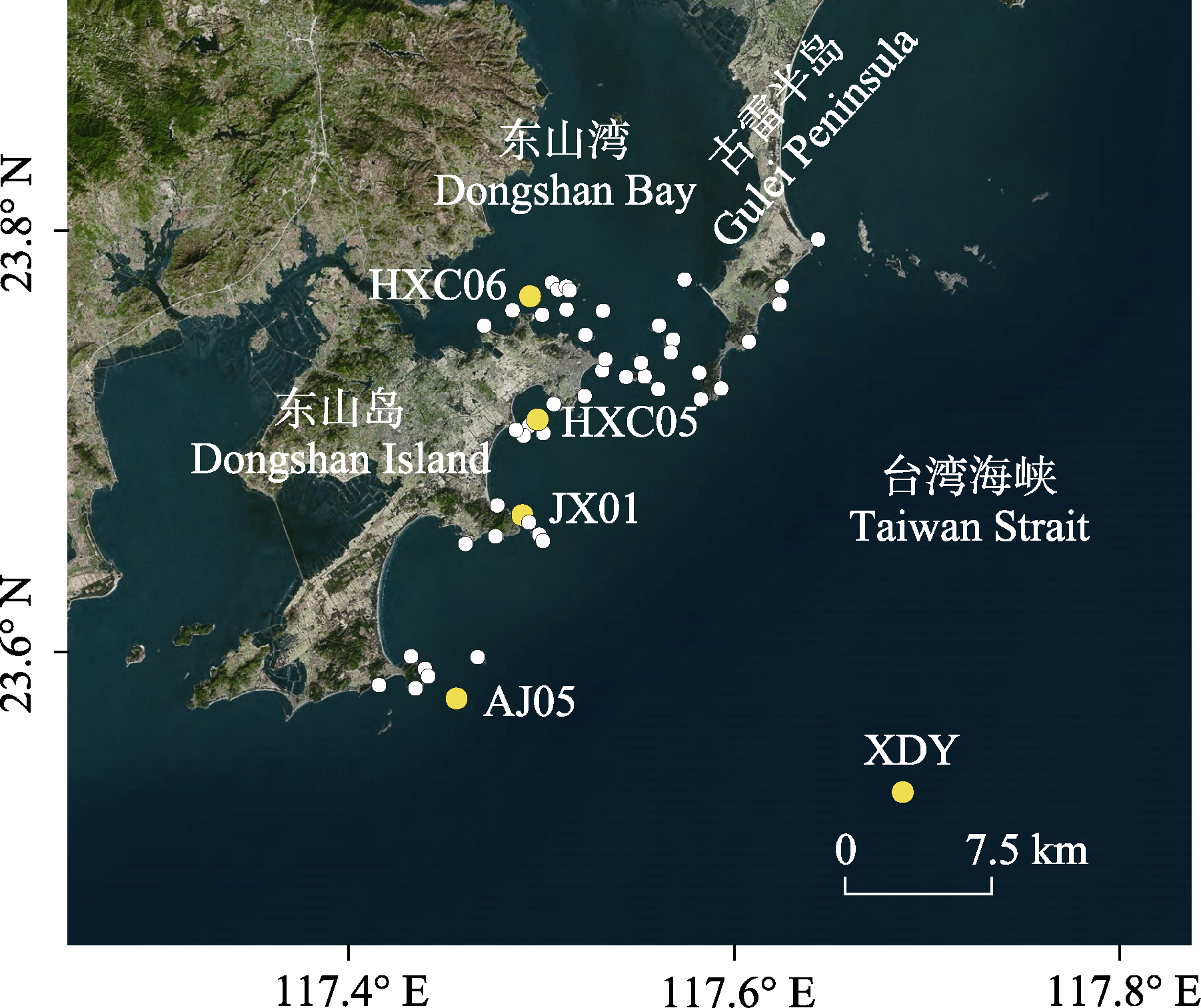
Fig. 1 The research area map of Dongshan waters, Fujian Province. White dots indicate long-term monitoring stations for scleractinian corals, while yellow dots denote sampling sites in this study.
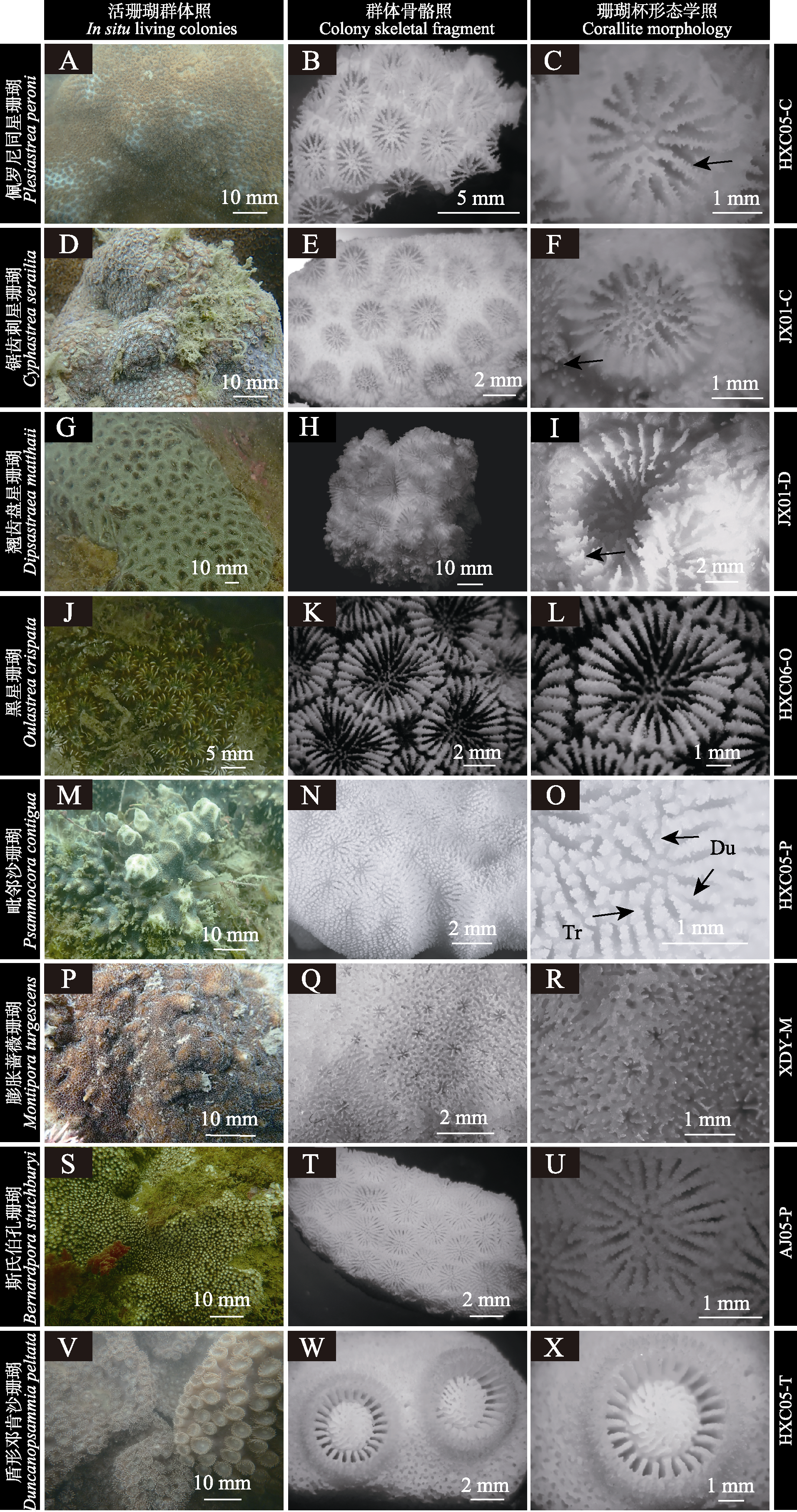
Fig. 2 Morphological structures of coral sample images. From left to right, the images sequentially show: in situ living colonies, colony skeletal fragment, and corallite morphology. A-C, D-F, G-I, J-L, M-O, P-R, S-U, and V-X are the pictures of samples HXC05-C, JX01-C, JX01-D, HXC06-O, HXC05-P, XDY-M, AJ05-P, and HXC05-T, respectively. In image C, the arrow indicates the granular septal surface. In image F, the arrow indicates granular, irregular protrusions around the corallite. In image I, the arrow points to the upward-projecting septal teeth along the margin of the corallite. Image O is the corallite morphology of HXC05-P: Du, two septa fusing to reach the columella, Tr, three septa fusing to reach the columella.
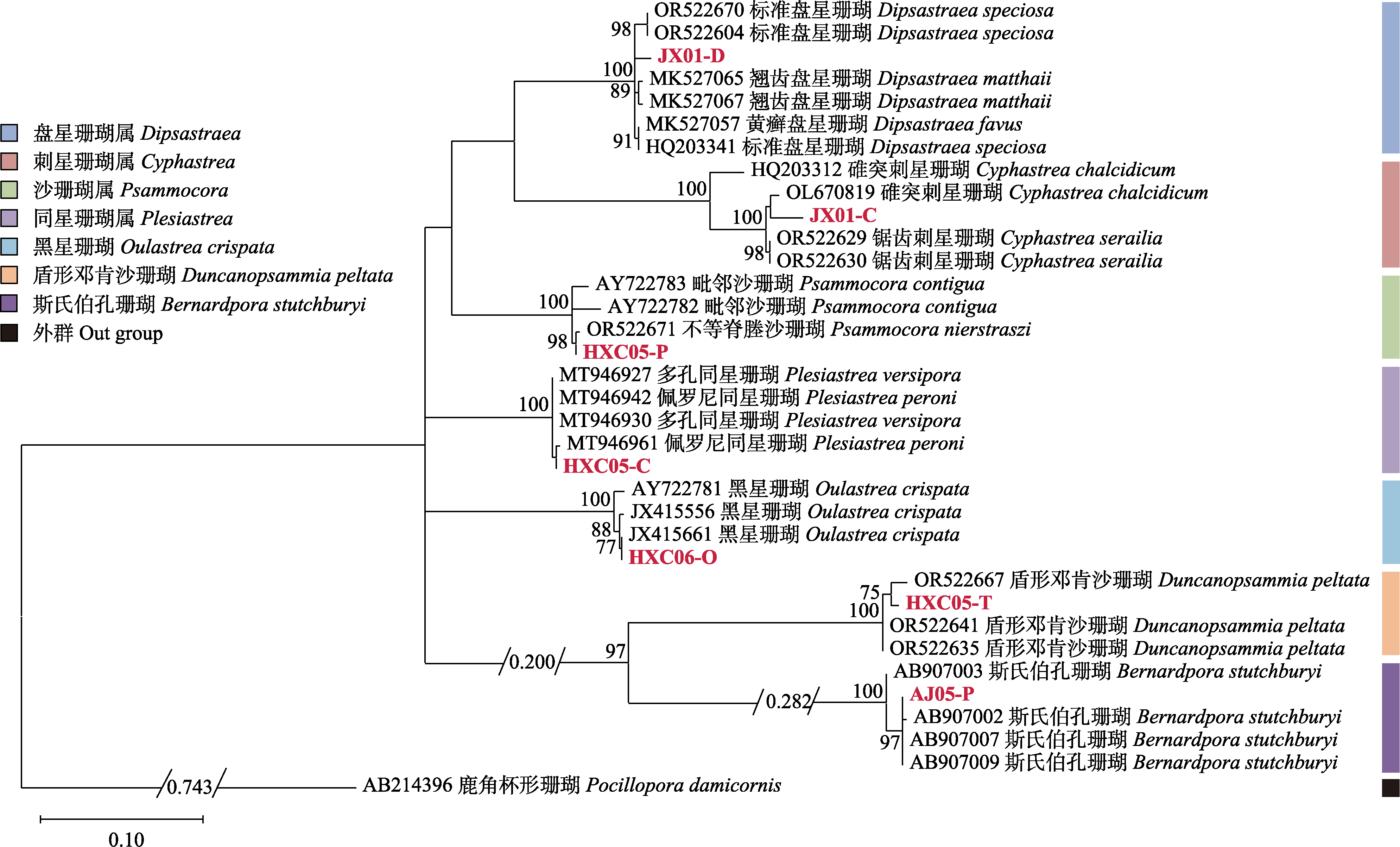
Fig. 3 Maximum likelihood phylogenetic analysis based on ITS sequences, partial branch lengths have been simplified and are represented numerically. Newly identified species in this study are marked in bold red. Branches at nodes only display values with bootstrap values > 75%.
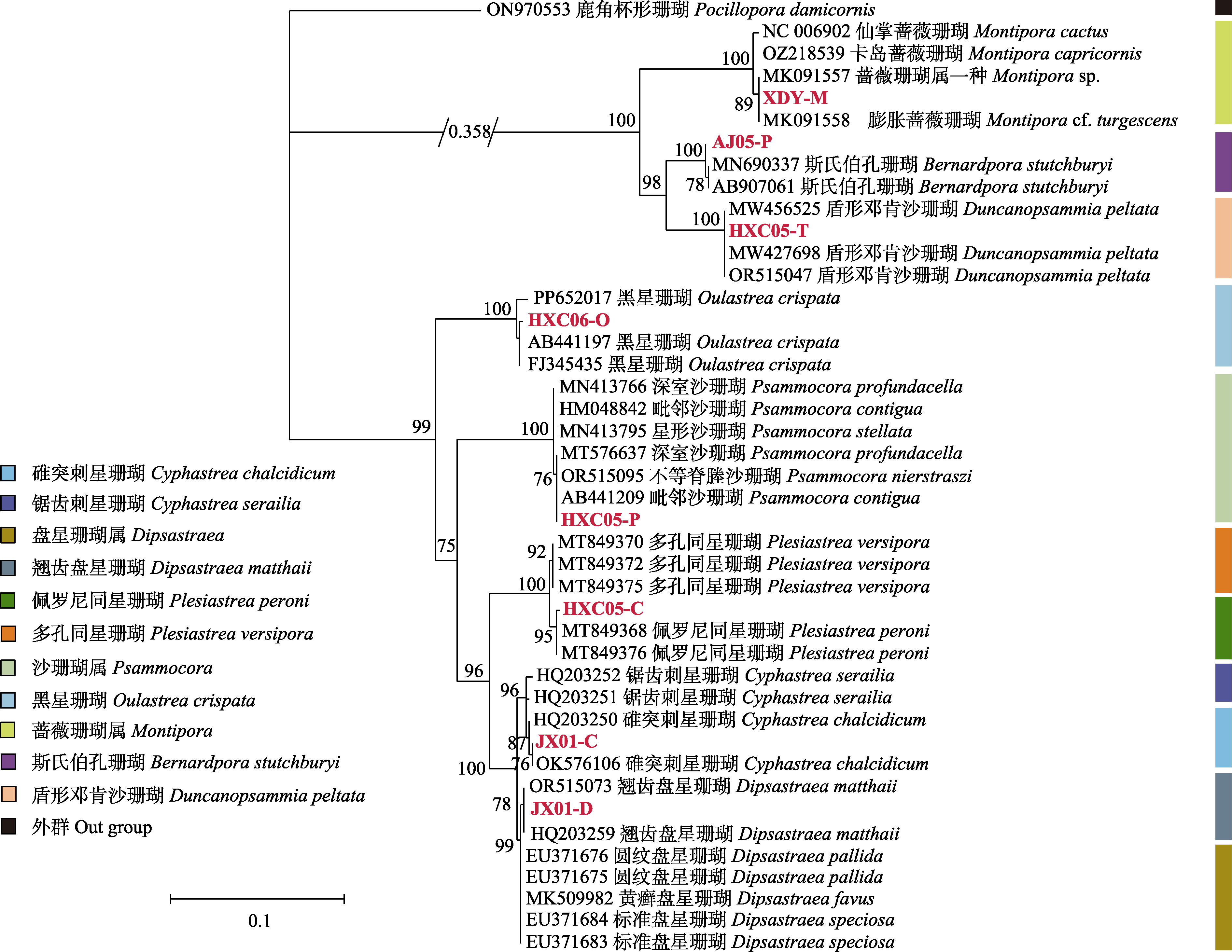
Fig. 4 Maximum likelihood phylogenetic analysis based on MCOI sequences, partial branch lengths have been simplified and are represented numerically. Newly identified species in this study are marked in bold red. Branches at nodes only display values with bootstrap values > 75%.
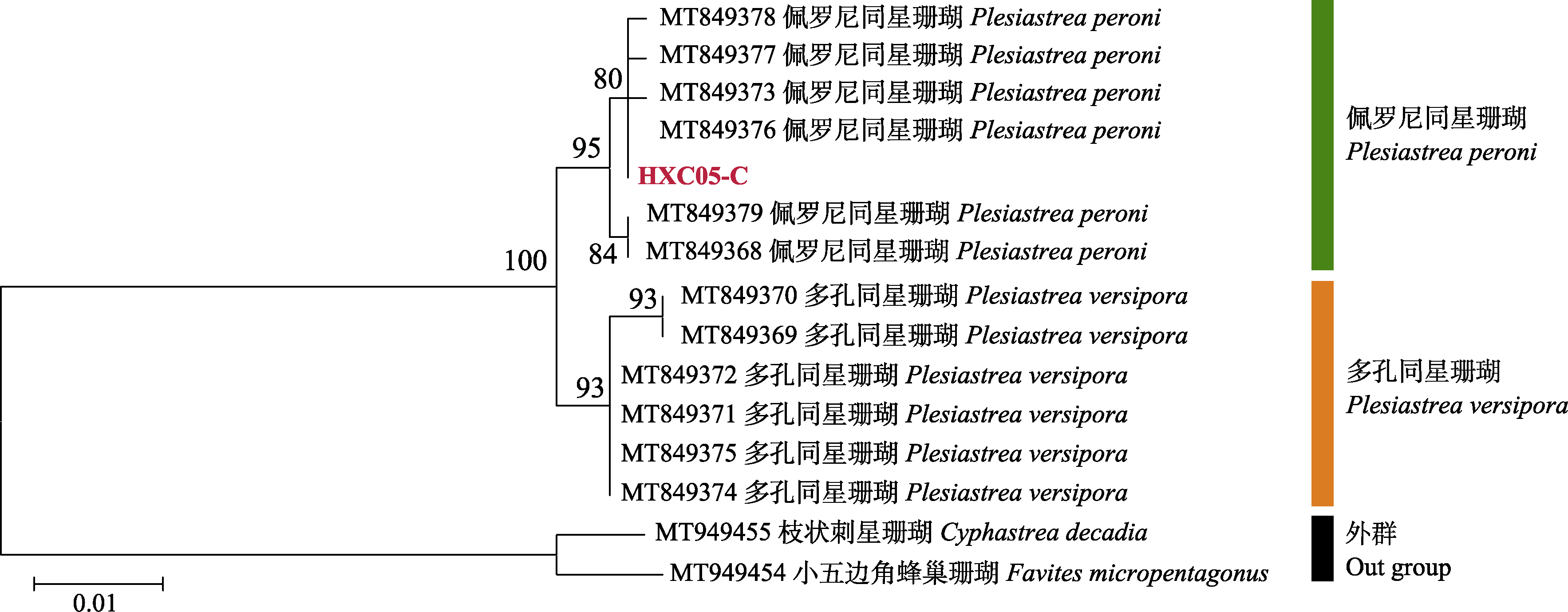
Fig. 5 Maximum likelihood phylogenetic analysis of the genus Plesiastrea based on Pv-COI sequences. Newly identified species in this study is marked in bold red. Branches at nodes only display values with bootstrap values > 75%.
| 科 Family | 属 Genus | 种 Species | 鉴定方法 Identification method | 文献 Reference |
|---|---|---|---|---|
| 鹿角珊瑚科 Acroporidae | 鹿角珊瑚属 Acropora | 霜鹿角珊瑚 A. pruinosa | 形态学 Morphological | 黄宗国等, |
| 蔷薇珊瑚属 Montipora | 膨胀蔷薇珊瑚 M. turgescens | 综合分类方法 Integrative taxonomic | 本研究 This study | |
| 滨珊瑚科 Poritidae | 伯孔珊瑚属 Bernardpora | 斯氏伯孔珊瑚 B. stutchburyi | 综合分类方法 Integrative taxonomic | 本研究 This study |
| 角孔珊瑚属 Goniopora | 角孔珊瑚属一种 Goniopora sp. | 形态学 Morphological | Zheng et al., | |
| 滨珊瑚属 Porites | 澄黄滨珊瑚 P. lutea | 形态学 Morphological | 黄宗国等, | |
| 裸肋珊瑚科 Merulinidae | 刺星珊瑚属 Cyphastrea | 锯齿刺星珊瑚 C. serailia | 综合分类方法 Integrative taxonomic | 黄宗国等, |
| 盘星珊瑚属 Dipsastraea | 标准盘星珊瑚 D. speciosa | 综合分类方法 Integrative taxonomic | 黄宗国等, | |
| 翘齿盘星珊瑚 D. matthaii | 综合分类方法 Integrative taxonomic | 本研究 This study | ||
| 木珊瑚科 Dendrophylliidae | 邓肯沙珊瑚属 Duncanopsammia | 盾形邓肯沙珊瑚 D. peltata | 综合分类方法 Integrative taxonomic | 黄宗国等, |
| 沙珊瑚科 Psammocoridae | 沙珊瑚属 Psammocora | 毗邻沙珊瑚 P. contigua | 综合分类方法 Integrative taxonomic | 本研究 This study |
| 同星珊瑚科 Plesiastreidae | 同星珊瑚属 Plesiastrea | (多孔同星珊瑚) (P. versipora)* | 形态学 Morphological | 黄林韬等, |
| 佩罗尼同星珊瑚 P. peroni | 综合分类方法 Integrative taxonomic | 本研究 This study | ||
| 黑星珊瑚科 Oulastreidae | 黑星珊瑚属 Oulastrea | 黑星珊瑚 O. crispata | 综合分类方法 Integrative taxonomic | 本研究 This study |
| 小星珊瑚科 Leptastreidae | 小星珊瑚属 Leptastrea | 紫小星珊瑚 L. purpurea | 形态学 Morphological | 黄宗国等, |
Table 1 Checklist of scleractinian coral in Dongshan, Fujian Province
| 科 Family | 属 Genus | 种 Species | 鉴定方法 Identification method | 文献 Reference |
|---|---|---|---|---|
| 鹿角珊瑚科 Acroporidae | 鹿角珊瑚属 Acropora | 霜鹿角珊瑚 A. pruinosa | 形态学 Morphological | 黄宗国等, |
| 蔷薇珊瑚属 Montipora | 膨胀蔷薇珊瑚 M. turgescens | 综合分类方法 Integrative taxonomic | 本研究 This study | |
| 滨珊瑚科 Poritidae | 伯孔珊瑚属 Bernardpora | 斯氏伯孔珊瑚 B. stutchburyi | 综合分类方法 Integrative taxonomic | 本研究 This study |
| 角孔珊瑚属 Goniopora | 角孔珊瑚属一种 Goniopora sp. | 形态学 Morphological | Zheng et al., | |
| 滨珊瑚属 Porites | 澄黄滨珊瑚 P. lutea | 形态学 Morphological | 黄宗国等, | |
| 裸肋珊瑚科 Merulinidae | 刺星珊瑚属 Cyphastrea | 锯齿刺星珊瑚 C. serailia | 综合分类方法 Integrative taxonomic | 黄宗国等, |
| 盘星珊瑚属 Dipsastraea | 标准盘星珊瑚 D. speciosa | 综合分类方法 Integrative taxonomic | 黄宗国等, | |
| 翘齿盘星珊瑚 D. matthaii | 综合分类方法 Integrative taxonomic | 本研究 This study | ||
| 木珊瑚科 Dendrophylliidae | 邓肯沙珊瑚属 Duncanopsammia | 盾形邓肯沙珊瑚 D. peltata | 综合分类方法 Integrative taxonomic | 黄宗国等, |
| 沙珊瑚科 Psammocoridae | 沙珊瑚属 Psammocora | 毗邻沙珊瑚 P. contigua | 综合分类方法 Integrative taxonomic | 本研究 This study |
| 同星珊瑚科 Plesiastreidae | 同星珊瑚属 Plesiastrea | (多孔同星珊瑚) (P. versipora)* | 形态学 Morphological | 黄林韬等, |
| 佩罗尼同星珊瑚 P. peroni | 综合分类方法 Integrative taxonomic | 本研究 This study | ||
| 黑星珊瑚科 Oulastreidae | 黑星珊瑚属 Oulastrea | 黑星珊瑚 O. crispata | 综合分类方法 Integrative taxonomic | 本研究 This study |
| 小星珊瑚科 Leptastreidae | 小星珊瑚属 Leptastrea | 紫小星珊瑚 L. purpurea | 形态学 Morphological | 黄宗国等, |
| [1] | Altieri AH, Harrison SB, Seemann J, Collin R, Diaz RJ, Knowlton N (2017) Tropical dead zones and mass mortalities on coral reefs. Proceedings of the National Academy of Sciences, USA, 114, 3660-3665. |
| [2] |
Arrigoni R, Kitano YF, Stolarski J, Hoeksema BW, Fukami H, Stefani F, Galli P, Montano S, Castoldi E, Benzoni F (2014) A phylogeny reconstruction of the Dendrophylliidae (Cnidaria, Scleractinia) based on molecular and micromorphological criteria, and its ecological implications. Zoologica Scripta, 43, 661-688.
DOI URL |
| [3] |
Beger M, Sommer B, Harrison PL, Smith SDA, Pandolfi JM (2014) Conserving potential coral reef refuges at high latitudes. Diversity and Distributions, 20, 245-257.
DOI URL |
| [4] |
Benzoni F, Stefani F, Stolarski J, Pichon M, Mitta G, Galli P (2007) Debating phylogenetic relationships of the scleractinian Psammocora: Molecular and morphological evidences. Contributions to Zoology, 76, 35-54.
DOI URL |
| [5] |
Chandran R, Kumaran RS, Vasavada DT, Joshi NN, Husen OG (2021) New distribution record of a true coral species, Psammocora contigua (Esper, 1794) from Gulf of Kachchh Marine National Park & Sanctuary, India. Journal of Threatened Taxa, 13, 20266-20271.
DOI URL |
| [6] | Chen CA, Chang CC, Wei NV, Chen CH, Lin HE, Dai CF, Wallace CC (2004) Secondary structure and phylogenetic utility of the ribosomal internal transcribed spacer 2 (ITS2) in scleractinian corals. Zoological Studies, 43, 759-771. |
| [7] | Chukaew T, Isomura N, Mezaki T, Matsumoto H, Kitano YF, Nozawa Y, Tachikawa H, Fukami H (2023) Molecular phylogeny and taxonomy of the coral genus Cyphastrea (Cnidaria, Scleractinia, Merulinidae) in Japan, with the first records of two species. Zoological Science, 40, 326-340. |
| [8] | Conti-Jerpe IE, Thompson PD, Wong CWM, Oliveira NL, Duprey NN, Moynihan MA, Baker DM (2020) Trophic strategy and bleaching resistance in reef-building corals. Science Advances, 6, eaaz5443. |
| [9] | Dai CF, Horng S (2009a) Scleractinia Tauna of Taiwan. I. The Complex Group. Taiwan University, Taipei. |
| [10] | Dai CF, Horng S (2009b) Scleractinia fauna of Taiwan. II. The Robust Group. Taiwan University, Taipei. |
| [11] | Dai CF, Zheng YR (2020) Corals of Taiwan, Vol. 1. Scleractinian Fauna. Owl Publishing House Co., LTD., Taipei. (in Chinese) |
| [戴昌凤, 郑有容 (2020) 台湾珊瑚全图鉴(上): 石珊瑚. 猫头鹰出版社, 台北.] | |
| [12] | Dong ZJ, Huang H, Huang LM, Li YC, Zhou GW (2008) Molecular taxonomy and diversity of symbiotic algae in reef-building corals in the sea near Dongshan Island in Fujian Province. Journal of Oceanography in Taiwan Strait, 27, 135-140. (in Chinese with English abstract) |
| [董志军, 黄晖, 黄良民, 李元超, 周国伟 (2008) 福建东山岛附近海域造礁石珊瑚共生藻的分子系统分类和遗传多样性研究. 台湾海峡, 27, 135-140.] | |
| [13] |
Ellegren H, Galtier N (2016) Determinants of genetic diversity. Nature Reviews Genetics, 17, 422-433.
DOI PMID |
| [14] |
Erftemeijer PLA, Riegl B, Hoeksema BW, Todd PA (2012) Environmental impacts of dredging and other sediment disturbances on corals: A review. Marine Pollution Bulletin, 64, 1737-1765.
DOI PMID |
| [15] |
Fabricius KE (2005) Effects of terrestrial runoff on the ecology of corals and coral reefs: Review and synthesis. Marine Pollution Bulletin, 50, 125-146.
DOI PMID |
| [16] |
Fiesinger A, Held C, Schmidt AL, Putchim L, Melzner F, Wall M (2023) Dominance of the coral Pocillopora acuta around Phuket Island in the Andaman Sea, Thailand. Ecology and Evolution, 13, e10724.
DOI URL |
| [17] |
Fukami H, Budd AF, Paulay G, Solé-Cava A, Allen Chen C, Iwao K, Knowlton N (2004) Conventional taxonomy obscures deep divergence between Pacific and Atlantic corals. Nature, 427, 832-835.
DOI |
| [18] |
Gösser F, Schweinsberg M, Mittelbach P, Schoenig E, Tollrian R (2023) An environmental DNA metabarcoding approach versus a visual survey for reefs of Koh Phangan in Thailand. Environmental DNA, 5, 297-311.
DOI URL |
| [19] |
Goyen S, Camp EF, Fujise L, Lloyd A, Nitschke MR, LaJeunensse T, Kahlke T, Ralph PJ, Suggett D (2019) Mass coral bleaching of P. versipora in Sydney Harbour driven by the 2015-2016 heatwave. Coral Reefs, 38, 815-830.
DOI |
| [20] | Huang DW, Benzoni F, Arrigoni R, Baird AH, Berumen ML, Bouwmeester J, Chou LM, Fukami H, Licuanan WY, Lovell ER, Meier R, Todd PA, Budd AF (2014) Towards a phylogenetic classification of reef corals: The Indo-Pacific genera Merulina, Goniastrea and Scapophyllia (Scleractinia, Merulinidae). Zoologica Scripta, 43, 531-548. |
| [21] |
Huang DW, Meier R, Todd PA, Chou LM (2008) Slow mitochondrial COI sequence evolution at the base of the metazoan tree and its implications for DNA barcoding. Journal of Molecular Evolution, 66, 167-174.
DOI URL |
| [22] |
Huang LT, Huang H, Jiang L (2020) A revised taxonomy for Chinese hermatypic corals. Biodiversity Science, 28, 515-523. (in Chinese with English abstract)
DOI |
|
[黄林韬, 黄晖, 江雷 (2020) 中国造礁石珊瑚分类厘定. 生物多样性, 28, 515-523.]
DOI |
|
| [23] |
Huang W, Huang ZH, Yang EG, Meng LQ, Chen JL, Tan RH, Xiao ZY, Zhou YP, Xu MP, Yu KF (2025) High- and low-temperature stress responses of Porites lutea from the relatively high- latitude region of the South China Sea. Marine Environmental Research, 204, 106858.
DOI URL |
| [24] |
Huang ZG, Zheng CX, Li CY, Wang JJ, Zou RL (1999) The diversity of scleractinian coral associated species in Dongshan, Fujian Province. Biodiversity Science, 7, 181-188. (in Chinese with English abstract)
DOI URL |
| [黄宗国, 郑成兴, 李传燕, 王建军, 邹仁林 (1999) 福建东山石珊瑚伴生物种多样性. 生物多样性, 7, 181-188.] | |
| [25] |
Humblet M, Hongo C, Sugihara K (2015) An identification guide to some major Quaternary fossil reef-building coral genera (Acropora, Isopora, Montipora, and Porites). Island Arc, 24, 16-30.
DOI URL |
| [26] | Ji YL, Chen LL, Li Q, Qu FY, Gong YZ, Cao XY, Wang Z (2025) Diversity of macrobenthos in the waters of the Miaodao Archipelago based on environmental DNA metabarcoding technology. Advances in Marine Science, 43, 840-855. (in Chinese with English abstract) |
| [纪莹璐, 陈琳琳, 李奇, 曲方圆, 宫英哲, 曹湘悦, 王智 (2025) 基于环境DNA宏条形码技术的庙岛群岛海域大型底栖动物多样性研究. 海洋科学进展, 43, 840-855.] | |
| [27] | Jiang F, Chen MR, Yang SY (2011) Investigating the status quo of hermatypic corals resources and its protection in Dongshan water areas, Fujian Province. Resources Science 33, 364-371. (in Chinese with English abstract) |
| [姜峰, 陈明茹, 杨圣云 (2011) 福建东山造礁石珊瑚资源现状及其保护. 资源科学, 33, 364-371.] | |
| [28] |
Juszkiewicz DJ, White NE, Stolarski J, Benzoni F, Arrigoni R, Hoeksema BW, Wilson NG, Bunce M, Richards ZT (2022) Phylogeography of recent Plesiastrea (Scleractinia: Plesiastreidae) based on an integrated taxonomic approach. Molecular Phylogenetics and Evolution, 172, 107469.
DOI URL |
| [29] |
Kawamura K, Shoguchi E, Nishitsuji K, Sekida S, Narisoko H, Zhao HW, Shu Y, Fu PC, Yamashita H, Fujiwara S, Satoh N (2023) In vitro phagocytosis of different dinoflagellate species by coral cells. Zoological Science, 40, 444-454.
DOI PMID |
| [30] |
Keshavmurthy S, Tang KH, Hsu CM, Gan CH, Kuo CY, Soong K, Chou HN, Chen CA (2017) Symbiodinium spp. associated with scleractinian corals from Dongsha Atoll (Pratas), Taiwan, in the South China Sea. PeerJ, 5, e2871.
DOI URL |
| [31] |
LaJeunesse TC, Bhagooli R, Hidaka M, de Vantier L, Done T, Schmidt GW, Fitt WK, Hoegh-Guldberg O (2004) Closely related Symbiodinium spp. differ in relative dominance in coral reef host communities across environmental, latitudinal and biogeographic gradients. Marine Ecology Progress Series, 284, 147-161.
DOI URL |
| [32] |
LaJeunesse TC, Parkinson JE, Gabrielson PW, Jeong HJ, Reimer JD, Voolstra CR, Santos SR (2018) Systematic revision of Symbiodiniaceae highlights the antiquity and diversity of coral endosymbionts. Current Biology, 28, 2570-2580.e6.
DOI PMID |
| [33] |
Leal MC, Hoadley K, Pettay DT, Grajales A, Calado R, Warner ME (2015) Symbiont type influences trophic plasticity of a model cnidarian-dinoflagellate symbiosis. Journal of Experimental Biology, 218, 858-863.
DOI URL |
| [34] | Li XB, Lian JS, Huang H, Yang JH, Zhang CL, Zhou GW, You F (2010) Diversity and spatial distribution of scleractinia corals in Dongshan, Fujian. Journal of Oceanography in Taiwan Strait, 29, 5-11. (in Chinese with English abstract) |
| [李秀保, 练健生, 黄晖, 杨剑辉, 张成龙, 周国伟, 尤丰 (2010) 福建东山海域石珊瑚种类多样性及其空间分布. 台湾海峡, 29, 5-11.] | |
| [35] | Liang SS, Wang JJ, Huang JS, Chen B, Liu WH, Zheng XQ, Hu WJ (2021) Ecological vulnerability assessment of coral community under the impact of multiple environmental factors. Ecology and Environmental Sciences, 30, 2360-2369. (in Chinese with English abstract) |
|
[梁姗姗, 王建佳, 黄锦树, 陈彬, 刘文华, 郑新庆, 胡文佳 (2021) 近岸多源环境因素影响下珊瑚群落的生态脆弱性评价研究. 生态环境学报, 30, 2360-2369.]
DOI |
|
| [36] | Márquez LM, Miller DJ, MacKenzie JB, van Oppen MJH (2003) Pseudogenes contribute to the extreme diversity of nuclear ribosomal DNA in the hard coral Acropora. Molecular Biology and Evolution, 20, 1077-1086. |
| [37] |
O’Cain ED, Frischer ME, Harrison JS, Walters TL, Thompson ME, Fogarty ND, Ruzicka R, Gleason DF (2019) Identification of newly settled Caribbean coral recruits by ITS-targeted single-step nested multiplex PCR. Coral Reefs, 38, 79-92.
DOI |
| [38] |
Pernice M, Dunn SR, Tonk L, Dove S, Domart-Coulon I, Hoppe P, Schintlmeister A, Wagner M, Meibom A (2015) A nanoscale secondary ion mass spectrometry study of dinoflagellate functional diversity in reef-building corals. Environmental Microbiology, 17, 3570-3580.
DOI PMID |
| [39] | Rodriguez-Lanetty M, Loh W, Carter D, Hoegh-Guldberg O (2001) Latitudinal variability in symbiont specificity within the widespread scleractinian coral Plesiastrea versipora. Marine Biology, 138, 1175-1181. |
| [40] |
Schoepf V, Baumann JH, Barshis DJ, Browne NK, Camp EF, Comeau S, Cornwall CE, Guzmán HM, Riegl B, Rodolfo-Metalpa R, Sommer B (2023) Corals at the edge of environmental limits: A new conceptual framework to re-define marginal and extreme coral communities. Science of the Total Environment, 884, 163688.
DOI URL |
| [41] | Stefani F, Benzoni F, Pichon M, Cancelliere C, Galli P (2008a) A multidisciplinary approach to the definition of species boundaries in branching species of the coral genus Psammocora (Cnidaria, Scleractinia). Zoologica Scripta, 37, 71-91. |
| [42] |
Stefani F, Benzoni F, Pichon M, Mitta G, Galli P (2008b) Genetic and morphometric evidence for unresolved species boundaries in the coral genus Psammocora (Cnidaria; Scleractinia). Hydrobiologia, 596, 153-172.
DOI URL |
| [43] |
Suggett DJ, Goyen S, Evenhuis C, Szabó M, Pettay DT, Warner ME, Ralph PJ (2015) Functional diversity of photobiological traits within the genus Symbiodinium appears to be governed by the interaction of cell size with cladal designation. New Phytologist, 208, 370-381.
DOI PMID |
| [44] | Todd PA, Ladle RJ, Lewin-Koh NJI, Chou LM (2004) Genotype × environment interactions in transplanted clones of the massive corals Favia speciosa and Diploastrea heliopora. Marine Ecology Progress Series, 271, 167-182. |
| [45] | Veron JEN (1995) Corals in Space and Time:The Biogeography and Evolution of the Scleractinia. Cornell University Press, New York. |
| [46] | Veron JEN (2000) Corals of the World. Australian Institute of Marine Science, Townsville. |
| [47] | Wang M, Jin XW, Lin XL, Du LN, Cui YD, Wu XP, Sun HY, Xie ZC, Wang XH, Wang BX (2021) Advances in the macrozoobenthos biodiversity monitoring and ecosystem assessment using environmental DNA metabarcoding. Acta Ecologica Sinica, 41, 7440-7453. (in Chinese with English abstract) |
| [王萌, 金小伟, 林晓龙, 杜丽娜, 崔永德, 吴小平, 孙红英, 谢志才, 王新华, 王备新 (2021) 基于环境DNA-宏条形码技术的底栖动物监测及水质评价研究进展. 生态学报, 41, 7440-7453.] | |
| [48] |
Wang QF, Zhou XJ, Wang JJ, Zhang H, Fang HF, Cai F, Huang LF, Zheng XQ (2024) Heterotrophy confers corals with resistance but limits their range expansion: A case of marginal coral communities. Ecosystem Health and Sustainability, 10, 0246.
DOI URL |
| [49] | Wells JW (1956) Scleractinia. In: Treatise on Invertebrate Paleontology, Part F: Coelenterata (ed. Moore RC), pp. F328-F444. Geological Society of America and University of Kansas Press, Lawrence. |
| [50] |
Xia JQ, Zhu WT, Liu XB, Ren YX, Huang JZ, Zhu M, Wu ZQY, Wang AM, Li XB (2022) The effect of two types of grid transplantation on coral growth and the in-situ ecological restoration in a fragmented reef of the South China Sea. Ecological Engineering, 177, 106558.
DOI URL |
| [51] | Yang SL, Yang L, Zhao DB, Ren YS (2015) Species composition and distribution of neritic scleractinian and gorgonian corals in coastal waters of Fujian. Journal of Applied Oceanography, 34, 209-218. (in Chinese with English abstract) |
| [杨顺良, 杨璐, 赵东波, 任岳森 (2015) 福建沿海浅水石珊瑚和柳珊瑚的种类及其分布. 应用海洋学学报, 34, 209-218.] | |
| [52] | Yu KF (2018) Introduction to the Science of Coral Reefs. Science Press, Beijing. (in Chinese) |
| [余克服 (2018) 珊瑚礁科学概论. 科学出版社, 北京.] | |
| [53] |
Yu WJ, Wang WH, Yu KF, Wang YH, Huang XY, Huang RY, Liao ZH, Xu SD, Chen XY (2019) Rapid decline of a relatively high latitude coral assemblage at Weizhou Island, northern South China Sea. Biodiversity and Conservation, 28, 3925-3949.
DOI |
| [54] |
Zhang JJ, Huang WB, Chen YT, Yang ZP, Ke WY, Peng ZJ, Wei SC, Zhang ZW, Hu YS, Yu WH, Zhou WL (2025) Reef-building coral diversity and distribution characteristics in the National Nature Reserve for Marine Ecology of Guangdong Nanpeng Islands. Biodiversity Science, 33, 24424. (in Chinese with English abstract)
DOI |
|
[张晶晶, 黄文彬, 陈奕廷, 杨泽鹏, 柯伟业, 彭昭杰, 魏世超, 张志伟, 胡怡思, 余文华, 周文良 (2025) 广东南澎列岛海洋生态国家级自然保护区造礁石珊瑚多样性及分布特征. 生物多样性, 33, 24424.]
DOI |
|
| [55] |
Zheng XQ, Wang QF, Dong X, Wang AJ, Wang JJ, Chen B (2021) A new perspective of nutrient management of subtropical coastal stress-tolerant scleractinian coral communities. Continental Shelf Research, 220, 104405.
DOI URL |
| [56] | Zou RL (2001) Fauna Sinica·Coelenterata·Anthozoa·Scleractinia·Hermatypic Coral. Science Press, Beijing. (in Chinese) |
| [邹仁林 (2001) 中国动物志·腔肠动物门·珊瑚虫纲·石珊瑚目·造礁石珊瑚. 科学出版社, 北京.] |
| [1] | Lijie Zhou, Minhui Huang, Huaijiang He, Yanxia Cheng, Chunyu Zhang, Xiuhai Zhao. Disentangling the patterns, components, and influencing factors of forest β diversity in the Xiaoxing’an Mountains, Northeast China [J]. Biodiv Sci, 2026, 34(4): 25443-. |
| [2] | Yunyue Peng, Kui Peng, Xinran Liu, Tianyi Sun, Xiaoquan Zhang. Corporate engagement pathways, market development barriers and recommendations for biodiversity credits [J]. Biodiv Sci, 2026, 34(4): 26031-. |
| [3] | Boyao Li, Tiancheng Sheng, Xiaoyun Xing. Impact of biodiversity risk on corporate financial performance: Evidence from listed companies in China [J]. Biodiv Sci, 2026, 34(4): 25330-. |
| [4] | Hao Liu, Yuxiao Zhang, Bing Liu, Feifei Li, Hongzheng Ma, Haining Qin, Dezhu Li, Wenli Chen. Diversity and checklist of grasses (Poaceae) in China [J]. Biodiv Sci, 2026, 34(4): 25438-. |
| [5] | Ziyi Kong, Degang Wang, Jiantao Wang, Zhiyong Pei, Jing Sun, Changchun Zhang, Junguo Zhang. Wildlife pose estimation based on the SCD-HRNet model and its application in biodiversity monitoring: A case study of the Saihanwula Region, Inner Mongolia [J]. Biodiv Sci, 2026, 34(4): 25287-. |
| [6] | Haoyou Zhu, Youbing Zhou, Yi Luo, Zhaomin Zhou. Changes in breeding bird community in an urban area of Nanchong over two decades [J]. Biodiv Sci, 2026, 34(3): 24560-. |
| [7] | Shuyu Hou, Yingying Liu, Rui Yang. Progress of international OECMs practices under the Kunming-Montreal Global Biodiversity Framework and pathways for localization in China [J]. Biodiv Sci, 2026, 34(3): 25264-. |
| [8] | Xiaofan Cheng, Qingyuan Li, Yuanhui Li, Mingxiang Zhang. The dilemmas and solutions for invasive alien species governance policy systems [J]. Biodiv Sci, 2026, 34(2): 25332-. |
| [9] | Lulu Chen, Haoting Tang, Hong Leng, Qing Yuan, Xinyue Yang. Impacts of urban block built environments on biodiversity—A review and outlook [J]. Biodiv Sci, 2026, 34(2): 25286-. |
| [10] | Wenqi Gao, Jingrong Xiang, Yao Zhao, Lingshuang Fan, Yuan Gu, Weihan Shao, Gaojun Li, Guangjun Zhao, Mingbin Chen, Xingwei Cai, Kai Chen. Stream fish community characteristics and their response to land use in Limushan and Jianfengling of Hainan Tropical Rainforest National Park [J]. Biodiv Sci, 2026, 34(2): 25374-. |
| [11] | Xiaoqiang Lu, Dan Rui, Jiangfeng Zhang, Bingxin Yin, Yulu Wang, Yuting Cen, Yichen Cui, Wanxia Yang. Impacts of nitrogen inputs-driven key ecological processes on biodiversity and their management implications [J]. Biodiv Sci, 2026, 34(2): 25368-. |
| [12] | Tinghong Tan, Fan Gao, Yu Yang, Qunying Xiao, Chunfang Wu, Na Qiu, Ningning Zhao, Min Zhou, Gongping Kang, Zhihong Lu, Jianqiang Gao, Hong Yang, Chuandong Yang, Chunying Deng. Macrofungal species cataloging in karst areas of southwestern China [J]. Biodiv Sci, 2026, 34(2): 25281-. |
| [13] | Xuri Zhang, Biao Luo, Tong Zhao, Dan Huang, Weiming Ai. Fish diversity of Zhejiang Province: Inventory, distribution and conservation [J]. Biodiv Sci, 2026, 34(2): 25225-. |
| [14] | Haiou Liu, Zhiming Hao, Leshan Du, Wenhui Liu, Ziyuan Li, Lei Liu. Progress, challenges, and insights on the operation of the Global Biodiversity Framework Fund [J]. Biodiv Sci, 2026, 34(2): 25463-. |
| [15] | Jiangjian Xie, Mengkun Zhu, Aiwu Jiang, Zhishu Xiao. Future of listening to biodiversity: Limitations and development directions of soundscape-based automatic assessment methods [J]. Biodiv Sci, 2026, 34(2): 25296-. |
| Viewed | ||||||
|
Full text |
|
|||||
|
Abstract |
|
|||||
Copyright © 2026 Biodiversity Science
Editorial Office of Biodiversity Science, 20 Nanxincun, Xiangshan, Beijing 100093, China
Tel: 010-62836137, 62836665 E-mail: biodiversity@ibcas.ac.cn

