

生物多样性 ›› 2025, Vol. 33 ›› Issue (12): 25233. DOI: 10.17520/biods.2025233 cstr: 32101.14.biods.2025233
伍金山1, 杨长乐2, 马玉凤3, 李亚旋1, 高文家2, 叶·库斯力2, 叶樑洪2, 杨宇骄1, 徐梦琦1, 廖廷琼1, 钟林强1,*( ), 单文娟1,*()
收稿日期:2025-06-18
接受日期:2025-11-18
出版日期:2025-12-20
发布日期:2026-01-09
通讯作者:
* 共同通讯作者 E-mail: zhonglinqiang@xju.edu.cn;
swj@xju.edu.cn
基金资助:
Jinshan Wu1, Changle Yang2, Yufeng Ma3, Yaxuan Li1, Wenjia Gao2, Ye Kusili2, Lianghong Ye2, Yujiao Yang1, Mengqi Xu1, Tingqiong Liao1, Linqiang Zhong1,*(), Wenjuan Shan1,*()
Received:2025-06-18
Accepted:2025-11-18
Online:2025-12-20
Published:2026-01-09
Supported by:摘要:
在全球生物多样性面临威胁的背景下, 保护野生动物的遗传多样性对于维护生态平衡和提升生态系统适应能力具有至关重要的作用。本研究以艾比湖湿地国家级自然保护区(以下简称艾比湖保护区)马鹿(Cervus elaphus)为研究对象, 采用非损伤性取样法获取粪便样本, 并基于微卫星和线粒体标记(Cytb、D-loop)分析其遗传多样性和遗传结构。结果显示, 微卫星的整体观测杂合度(Ho)为0.662, 期望杂合度(He)为0.777, 多态信息含量(PIC)为0.712, 近交系数(Fis)为0.165, 整体偏离哈迪-温伯格平衡; 线粒体标记Cytb及D-loop单倍型多样性(Hd)分别为0.447和0.605, 核苷酸多样性(Pi)分别为0.00463和0.00334, 与其他马鹿亚种相比艾比湖保护区马鹿的遗传多样性处于中等偏高水平, 未发生瓶颈效应但存在一定程度的近交现象。微卫星Structure分析和主坐标分析表明, 艾比湖保护区马鹿可分为两个聚类群体, 推测其发生了遗传分化。系统发育及遗传距离分析表明, 艾比湖保护区马鹿与天山马鹿及阿勒泰马鹿亲缘关系较近。作为保护区内的大型有蹄类物种之一, 其遗传多样性对维持生态系统功能具有重要意义。因此, 为保护艾比湖保护区马鹿遗传多样性, 建议加强马鹿栖息地的保护, 构建生态廊道以促进基因交流, 避免近交现象的发生。
伍金山, 杨长乐, 马玉凤, 李亚旋, 高文家, 叶·库斯力, 叶樑洪, 杨宇骄, 徐梦琦, 廖廷琼, 钟林强, 单文娟 (2025) 艾比湖湿地国家级自然保护区马鹿遗传多样性及遗传结构. 生物多样性, 33, 25233. DOI: 10.17520/biods.2025233.
Jinshan Wu, Changle Yang, Yufeng Ma, Yaxuan Li, Wenjia Gao, Ye Kusili, Lianghong Ye, Yujiao Yang, Mengqi Xu, Tingqiong Liao, Linqiang Zhong, Wenjuan Shan (2025) Genetic diversity and genetic structure of red deer in the Ebinur Lake Wetland National Nature Reserve. Biodiversity Science, 33, 25233. DOI: 10.17520/biods.2025233.
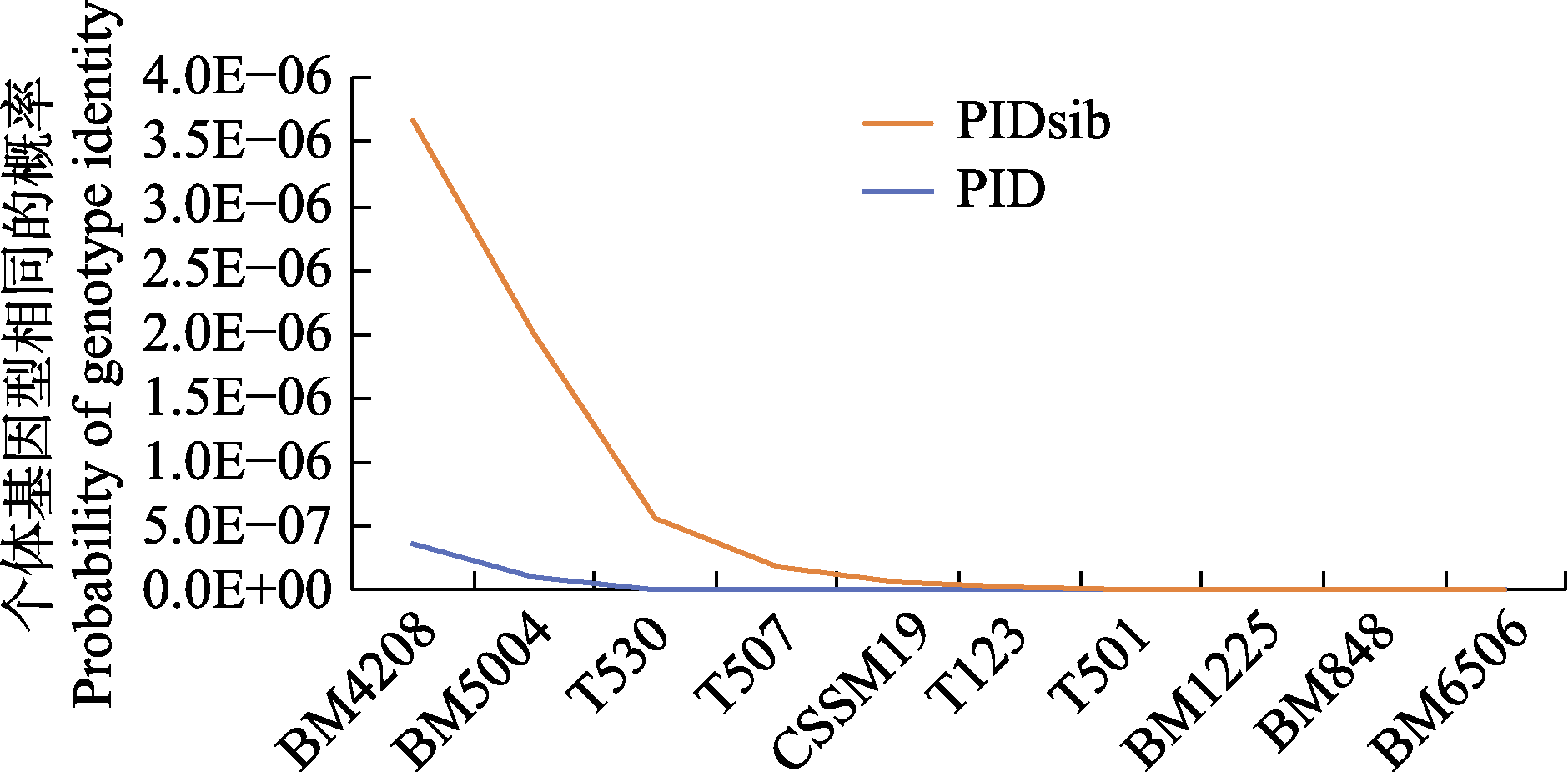
图1 艾比湖湿地国家级自然保护区马鹿累积基因座身份一致性分辨率检测结果。PIDsib: 同胞一致的概率; PID: 个体一致的概率。
Fig. 1 Results of cumulative gene locus identity consistency resolution testing for the protection of red deer in Ebinur Lake Wetland National Nature Reserve. PIDsib, Probability of identity for siblings; PID, Probability of identity for individuals.
| Locus | N | Na | Ne | I | Ho | He | PIC | Fis | P |
|---|---|---|---|---|---|---|---|---|---|
| BM4208 | 73 | 16 | 6.952 | 2.154 | 0.589 | 0.856 | 0.799 | 0.312 | 0.000*** |
| BM5004 | 73 | 7 | 2.100 | 0.972 | 0.110 | 0.524 | 0.416 | 0.791 | 0.000*** |
| T530 | 73 | 16 | 9.716 | 2.439 | 0.767 | 0.897 | 0.871 | 0.145 | 0.000*** |
| T507 | 73 | 11 | 6.741 | 2.048 | 0.822 | 0.852 | 0.823 | 0.035 | 0.013* |
| CSSM19 | 73 | 12 | 7.506 | 2.166 | 0.890 | 0.867 | 0.855 | -0.027 | 0.000*** |
| T123 | 73 | 14 | 4.320 | 1.872 | 0.808 | 0.769 | 0.685 | -0.052 | 0.000*** |
| T501 | 73 | 23 | 4.860 | 2.192 | 0.589 | 0.794 | 0.662 | 0.258 | 0.000*** |
| BM1225 | 73 | 19 | 7.706 | 2.342 | 0.671 | 0.870 | 0.849 | 0.229 | 0.000*** |
| BM848 | 73 | 13 | 2.771 | 1.339 | 0.603 | 0.639 | 0.536 | 0.057 | 0.000*** |
| BM6506 | 73 | 10 | 3.332 | 1.554 | 0.767 | 0.700 | 0.619 | -0.096 | 0.000*** |
| 平均值 Mean | 73 | 14.1 | 5.600 | 1.908 | 0.662 | 0.777 | 0.712 | 0.165 |
表1 10对微卫星位点的遗传多样性参数
Table 1 Genetic diversity parameters of 10 pairs of microsatellite loci
| Locus | N | Na | Ne | I | Ho | He | PIC | Fis | P |
|---|---|---|---|---|---|---|---|---|---|
| BM4208 | 73 | 16 | 6.952 | 2.154 | 0.589 | 0.856 | 0.799 | 0.312 | 0.000*** |
| BM5004 | 73 | 7 | 2.100 | 0.972 | 0.110 | 0.524 | 0.416 | 0.791 | 0.000*** |
| T530 | 73 | 16 | 9.716 | 2.439 | 0.767 | 0.897 | 0.871 | 0.145 | 0.000*** |
| T507 | 73 | 11 | 6.741 | 2.048 | 0.822 | 0.852 | 0.823 | 0.035 | 0.013* |
| CSSM19 | 73 | 12 | 7.506 | 2.166 | 0.890 | 0.867 | 0.855 | -0.027 | 0.000*** |
| T123 | 73 | 14 | 4.320 | 1.872 | 0.808 | 0.769 | 0.685 | -0.052 | 0.000*** |
| T501 | 73 | 23 | 4.860 | 2.192 | 0.589 | 0.794 | 0.662 | 0.258 | 0.000*** |
| BM1225 | 73 | 19 | 7.706 | 2.342 | 0.671 | 0.870 | 0.849 | 0.229 | 0.000*** |
| BM848 | 73 | 13 | 2.771 | 1.339 | 0.603 | 0.639 | 0.536 | 0.057 | 0.000*** |
| BM6506 | 73 | 10 | 3.332 | 1.554 | 0.767 | 0.700 | 0.619 | -0.096 | 0.000*** |
| 平均值 Mean | 73 | 14.1 | 5.600 | 1.908 | 0.662 | 0.777 | 0.712 | 0.165 |
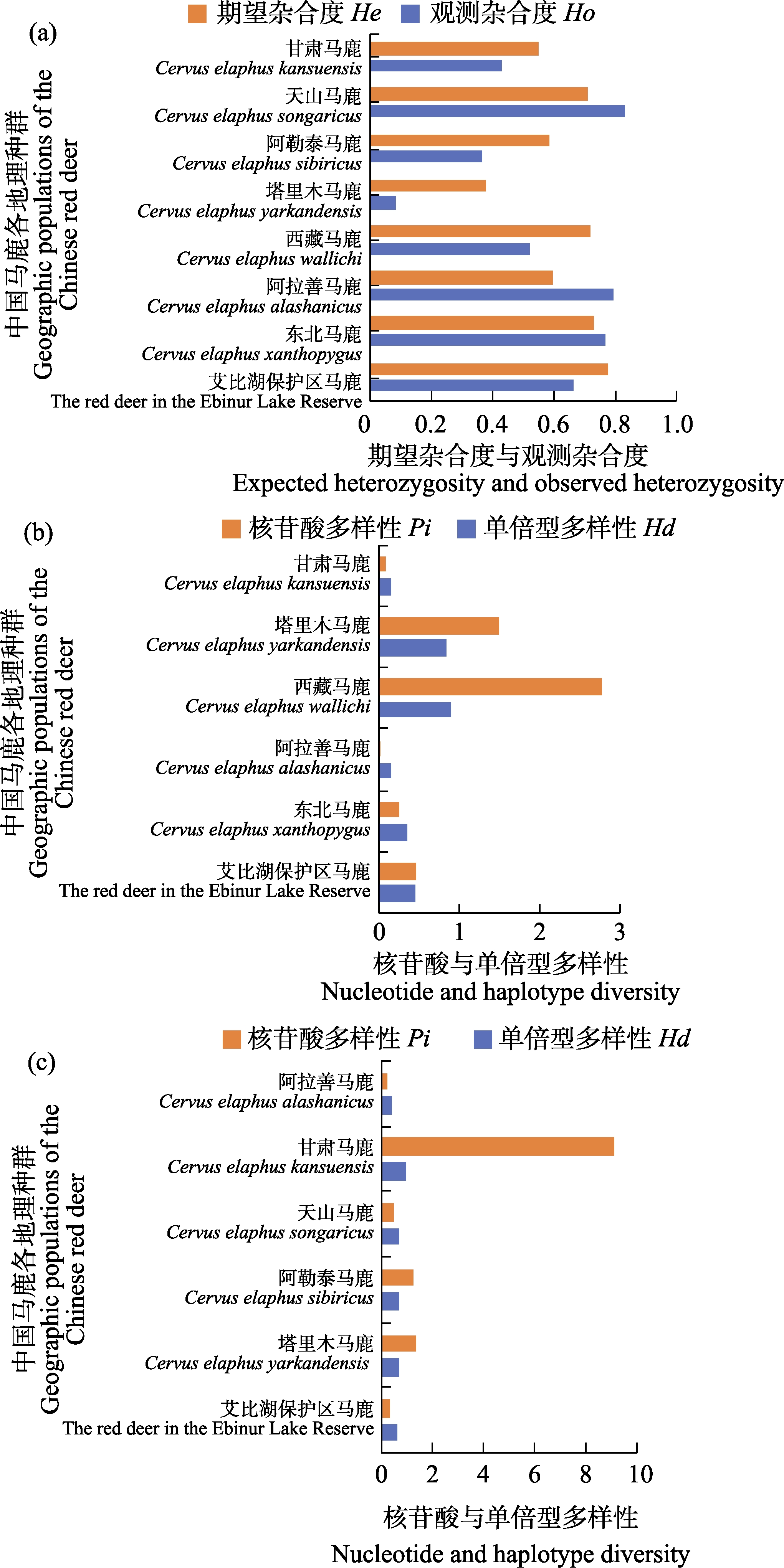
图2 艾比湖湿地国家级自然保护区(艾比湖保护区)马鹿与其他马鹿的遗传多样性比较。(a)微卫星遗传多样性比较; (b) Cytb遗传多样性比较; (c) D-loop遗传多样性比较。
Fig. 2 Comparative analysis of genetic diversity in red deer from in the Ebinur Lake Wetland National Nature Reserve (Ebinur Lake Reserve) and other red deer populations. (a) Microsatellite genetic diversity; (b) Cytb genetic diversity (c) D-loop genetic diversity. Ho, Observed heterozygosity; He, Expected heterozygosity; Pi, Nucleotide diversity; Hd, Haplotype diversity.
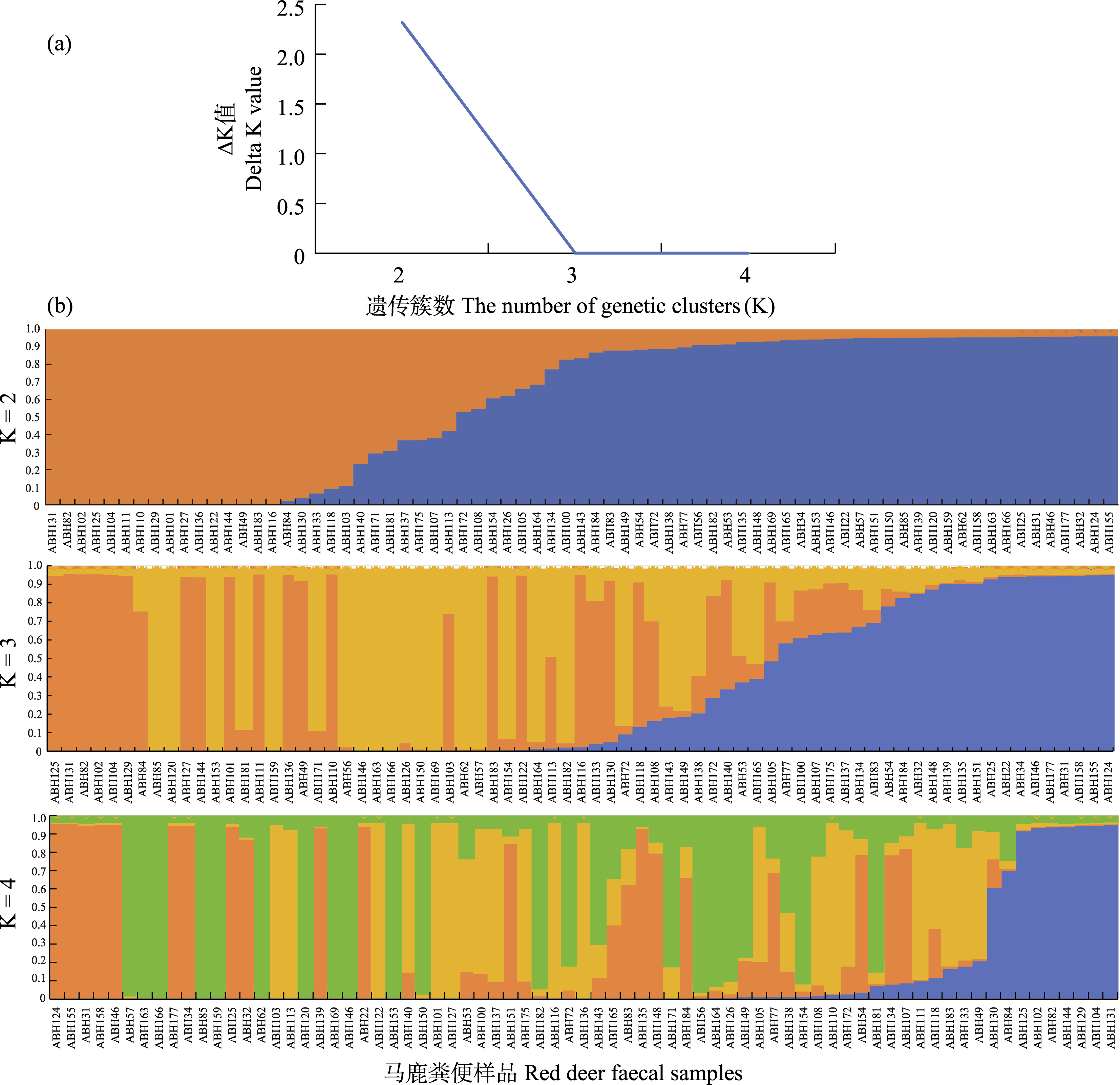
图3 艾比湖湿地国家级自然保护区马鹿种群在不同K值下的ΔK结果(a)及其对应的内部遗传结构(b)
Fig. 3 The ΔK results (a) and the corresponding internal genetic structure (b) of the red deer population in Ebinur Lake Wetland National Nature Reserve under different K values
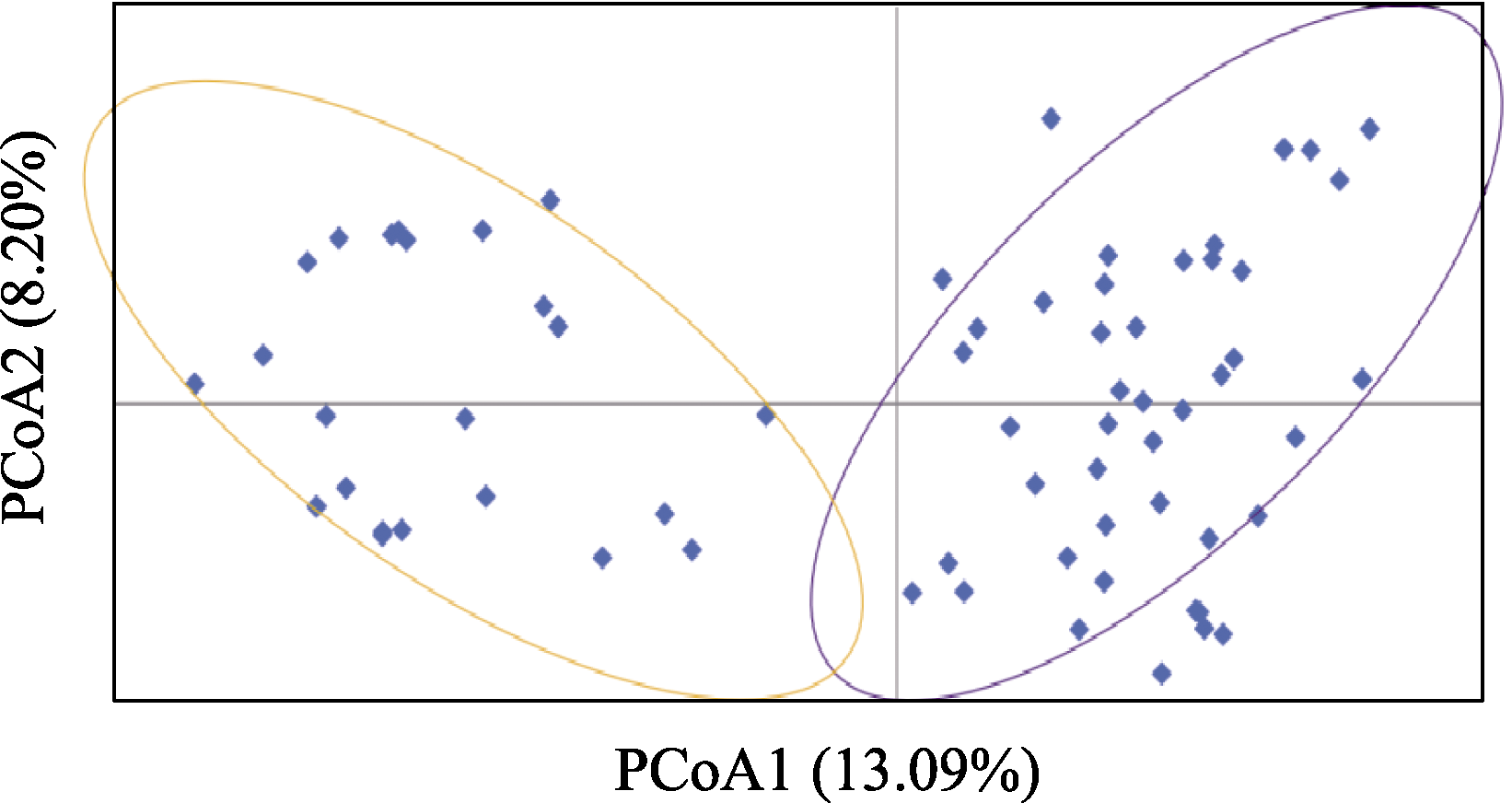
图4 基于微卫星的艾比湖湿地国家级自然保护区马鹿遗传结构的主坐标分析(PCoA)
Fig. 4 Principal coordinates analysis (PCoA) genetic structure analysis of red deer in Ebinur Lake Wetland National Nature Reserve based on microsatellites
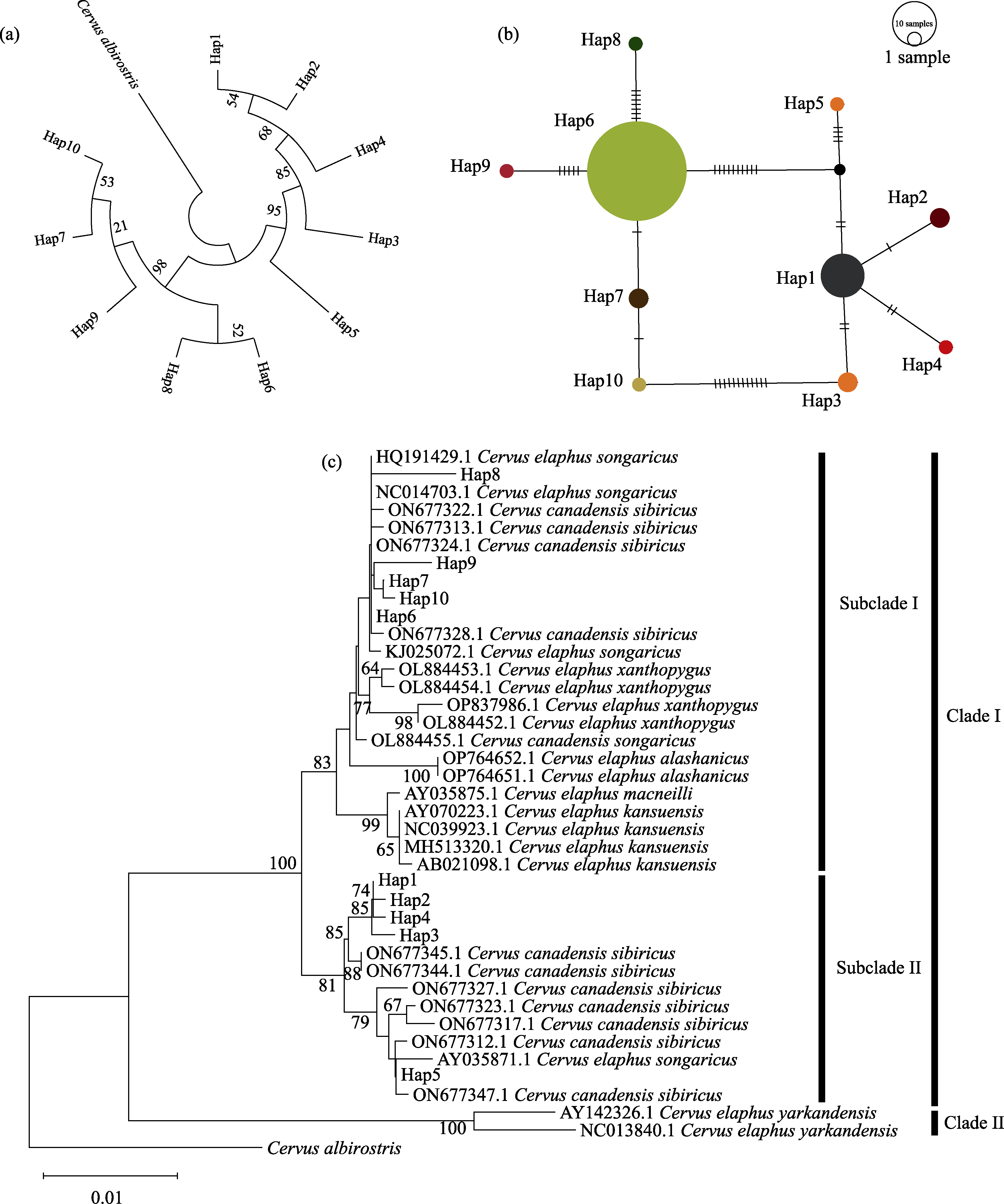
图5 艾比湖湿地国家级自然保护区马鹿种群遗传结构与系统发育关系。(a) Cytb单倍型系统发育树; (b) Cytb单倍型网络图; (c)艾比湖保护区马鹿Cytb单倍型与中国马鹿亚种系统发育树; 图c中Clade I、Clade II、Subclade I、Subclade II依次对应天山-阿勒泰-东北-阿拉善-四川-甘肃及艾比湖保护区马鹿群、塔里木马鹿群、天山-阿勒泰-东北-阿拉善-四川-甘肃及艾比湖保护区马鹿群、天山-阿勒泰及艾比湖保护区马鹿群。
Fig. 5 Genetic structure and phylogenetic relationship of red deer populations in Ebinur Lake Wetland National Nature Reserve. (a) Phylogenetic tree of Cytb haplotypes; (b) Haplotype network diagram of Cytb haplotypes; (c) Phylogenetic tree of Cytb haplotypes in red deer from Ebinur Lake Wetland National Nature Reserve and Chinese red deer subspecies; In Figure c, Clade I, Clade II, Subclade I, and Subclade II correspond sequentially to the red deer populations of the Tianshan-Altai-Northeast-Alashan- Sichuan-Gansu region and the Ebinur Lake Wetland National Nature Reserve, the Tarim red deer population, the Tianshan-Altai-Northeast-Alashan-Sichuan-Gansu region and the Ebinur Lake Wetland National Nature Reserve red deer population, and the Tianshan-Altai and Ebinur Lake Wetland National Nature Reserve red deer populations.
| ABH | ALT | TS | DB | ALS | GS | SC | |
|---|---|---|---|---|---|---|---|
| ALT | 0.010 | ||||||
| TS | 0.009 | 0.009 | |||||
| DB | 0.010 | 0.011 | 0.008 | ||||
| ALS | 0.014 | 0.014 | 0.010 | 0.011 | |||
| GS | 0.012 | 0.013 | 0.009 | 0.011 | 0.014 | ||
| SC | 0.012 | 0.012 | 0.009 | 0.010 | 0.014 | 0.002 | |
| TLM | 0.054 | 0.051 | 0.052 | 0.053 | 0.053 | 0.052 | 0.052 |
表2 艾比湖湿地国家级自然保护区马鹿与中国马鹿亚种间Cytb遗传距离
Table 2 Cytb genetic distance between red deer and Chinese red deer subspecies in Ebinur Lake Wetland National Nature Reserve
| ABH | ALT | TS | DB | ALS | GS | SC | |
|---|---|---|---|---|---|---|---|
| ALT | 0.010 | ||||||
| TS | 0.009 | 0.009 | |||||
| DB | 0.010 | 0.011 | 0.008 | ||||
| ALS | 0.014 | 0.014 | 0.010 | 0.011 | |||
| GS | 0.012 | 0.013 | 0.009 | 0.011 | 0.014 | ||
| SC | 0.012 | 0.012 | 0.009 | 0.010 | 0.014 | 0.002 | |
| TLM | 0.054 | 0.051 | 0.052 | 0.053 | 0.053 | 0.052 | 0.052 |
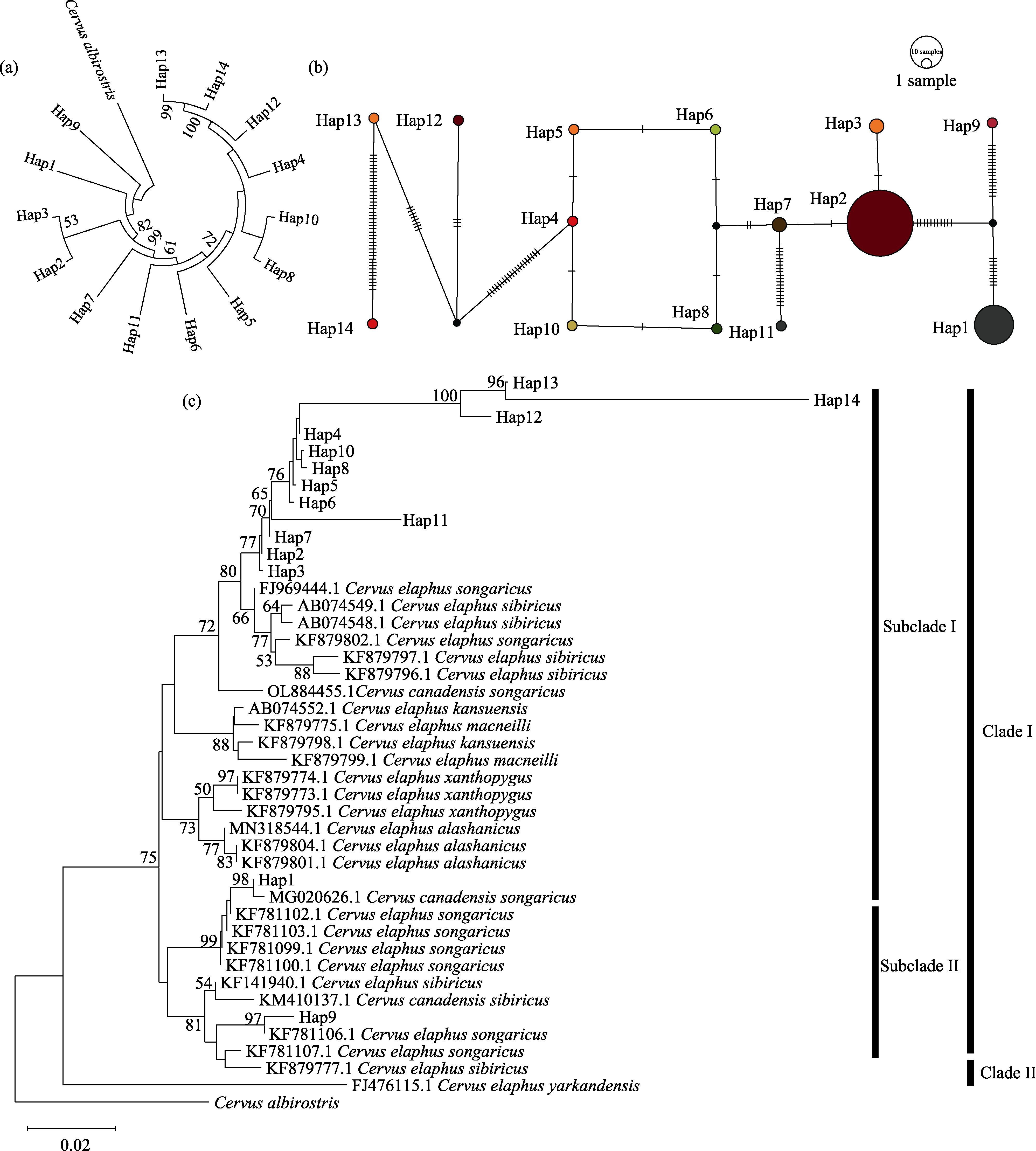
图6 艾比湖湿地国家级自然保护区马鹿种群遗传结构与系统发育关系。(a) D-loop单倍型系统发育树; (b) D-loop单倍型网络图; (c) D-loop单倍型与中国马鹿亚种系统发育树; 图c中Clade I、Clade II、Subclade I、Subclade II依次对应天山-阿勒泰-甘肃-四川-东北-阿拉善及艾比湖保护区马鹿群、塔里木马鹿、天山-阿勒泰-甘肃-四川-东北-阿拉善及艾比湖保护区马鹿群、天山-阿勒泰及艾比湖保护区马鹿群。
Fig. 6 Genetic structure and phylogenetic relationships of the red deer population in the Ebinur Lake Wetland National Nature Reserve. (a) Phylogenetic tree of the D-loop haplotype system; (b) Network diagram of the D-loop haplotype system; (c) Phylogenetic tree of D-loop haplotype in red deer from Ebinur Lake Wetland National Nature Reserve and Chinese red deer subspecies; In Figure c, Clade I, Clade II, Subclade I, and Subclade II correspond sequentially to the red deer populations of the Tianshan-Altai-Gansu-Sichuan-Northeast-Alashan and Ebinur Lake Wetland National Nature Reserve, the Tarim red deer, the red deer populations of the Tianshan-Altai-Gansu-Sichuan-Northeast-Alashan and Ebinur Lake Wetland National Nature Reserve, and the red deer populations of the Tianshan-Altai and Ebinur Lake Wetland National Nature Reserve.
| ABH | ALT | TS | DB | ALS | GS | SC | |
|---|---|---|---|---|---|---|---|
| ALT | 0.013 | ||||||
| TS | 0.015 | 0.005 | |||||
| DB | 0.032 | 0.018 | 0.014 | ||||
| ALS | 0.046 | 0.018 | 0.022 | 0.007 | |||
| GS | 0.036 | 0.018 | 0.023 | 0.033 | 0.025 | ||
| SC | 0.039 | 0.019 | 0.025 | 0.031 | 0.022 | -0.001 | |
| TLM | 0.120 | 0.091 | 0.093 | 0.080 | 0.087 | 0.087 | 0.082 |
表3 艾比湖保护区马鹿与中国马鹿亚种间D-loop遗传距离
Table 3 D-loop genetic distance between red deer and Chinese red deer subspecies in Ebinur Lake Wetland National Nature Reserve
| ABH | ALT | TS | DB | ALS | GS | SC | |
|---|---|---|---|---|---|---|---|
| ALT | 0.013 | ||||||
| TS | 0.015 | 0.005 | |||||
| DB | 0.032 | 0.018 | 0.014 | ||||
| ALS | 0.046 | 0.018 | 0.022 | 0.007 | |||
| GS | 0.036 | 0.018 | 0.023 | 0.033 | 0.025 | ||
| SC | 0.039 | 0.019 | 0.025 | 0.031 | 0.022 | -0.001 | |
| TLM | 0.120 | 0.091 | 0.093 | 0.080 | 0.087 | 0.087 | 0.082 |
| 位点 Locus | 基因数 N | 等位基因数 Na | 期望杂合度 He | 无限等位基因突变模型 I.A.M. | 两阶段突变模型 T.P.M. | 逐步突变模型 S.M.M. | |||
|---|---|---|---|---|---|---|---|---|---|
| 平均期望杂合度 Heq | P | 平均期望杂合度 Heq | P | 平均期望杂合度 Heq | P | ||||
| BM4208 | 146 | 16 | 0.862 | 0.817 | 0.250 | 0.871 | 0.315 | 0.904 | 0.033* |
| BM5004 | 146 | 7 | 0.527 | 0.600 | 0.259 | 0.687 | 0.066 | 0.762 | 0.007* |
| T530 | 146 | 16 | 0.903 | 0.822 | 0.014* | 0.871 | 0.122 | 0.903 | 0.449 |
| T507 | 146 | 11 | 0.858 | 0.735 | 0.039* | 0.803 | 0.142 | 0.854 | 0.465 |
| CSSM19 | 146 | 12 | 0.873 | 0.749 | 0.020* | 0.821 | 0.090 | 0.868 | 0.494 |
| T123 | 146 | 14 | 0.774 | 0.797 | 0.284 | 0.851 | 0.039* | 0.888 | 0.000** |
| T501 | 146 | 23 | 0.800 | 0.885 | 0.035* | 0.919 | 0.002* | 0.936 | 0.002* |
| BM1225 | 146 | 19 | 0.876 | 0.855 | 0.400 | 0.896 | 0.166 | 0.920 | 0.008* |
| BM848 | 146 | 13 | 0.644 | 0.776 | 0.072 | 0.839 | 0.000** | 0.878 | 0.000** |
| BM6506 | 146 | 10 | 0.705 | 0.715 | 0.368 | 0.783 | 0.097 | 0.839 | 0.003* |
表4 艾比湖湿地国家级自然保护区马鹿种群瓶颈检测
Table 4 Detection of population bottlenecks of red deer in the Ebinur Lake Wetland National Nature Reserve
| 位点 Locus | 基因数 N | 等位基因数 Na | 期望杂合度 He | 无限等位基因突变模型 I.A.M. | 两阶段突变模型 T.P.M. | 逐步突变模型 S.M.M. | |||
|---|---|---|---|---|---|---|---|---|---|
| 平均期望杂合度 Heq | P | 平均期望杂合度 Heq | P | 平均期望杂合度 Heq | P | ||||
| BM4208 | 146 | 16 | 0.862 | 0.817 | 0.250 | 0.871 | 0.315 | 0.904 | 0.033* |
| BM5004 | 146 | 7 | 0.527 | 0.600 | 0.259 | 0.687 | 0.066 | 0.762 | 0.007* |
| T530 | 146 | 16 | 0.903 | 0.822 | 0.014* | 0.871 | 0.122 | 0.903 | 0.449 |
| T507 | 146 | 11 | 0.858 | 0.735 | 0.039* | 0.803 | 0.142 | 0.854 | 0.465 |
| CSSM19 | 146 | 12 | 0.873 | 0.749 | 0.020* | 0.821 | 0.090 | 0.868 | 0.494 |
| T123 | 146 | 14 | 0.774 | 0.797 | 0.284 | 0.851 | 0.039* | 0.888 | 0.000** |
| T501 | 146 | 23 | 0.800 | 0.885 | 0.035* | 0.919 | 0.002* | 0.936 | 0.002* |
| BM1225 | 146 | 19 | 0.876 | 0.855 | 0.400 | 0.896 | 0.166 | 0.920 | 0.008* |
| BM848 | 146 | 13 | 0.644 | 0.776 | 0.072 | 0.839 | 0.000** | 0.878 | 0.000** |
| BM6506 | 146 | 10 | 0.705 | 0.715 | 0.368 | 0.783 | 0.097 | 0.839 | 0.003* |
| [1] | Avise JC, Arnold J, Ball RM, Bermingham E, Lamb T, Neigel JE, Reeb CA, Saunders NC (1987) Intraspecific phylogeography: The mitochondrial DNA bridge between population genetics and systematics.Annual Review of Ecology and Systematics, 18, 489-522. |
| [2] |
Bellemain E, Swenson JE, Tallmon D, Brunberg S, Taberlet P (2005) Estimating population size of elusive animals with DNA from hunter-collected feces: Four methods for brown bears. Conservation Biology, 19, 150-161.
DOI URL |
| [3] |
Bishop MD, Kappes SM, Keele JW, Stone RT, Sunden SL, Hawkins G A, Toldo SS, Fries R, Grosz MD, Yoo J (1994) A genetic linkage map for cattle. Genetics, 136, 619-639.
DOI PMID |
| [4] |
Botstein D, White RL, Skolnick M, Davis RW (1980) Construction of a genetic linkage map in man using restriction fragment length polymorphisms. American Journal of Human Genetics, 32, 314-331.
PMID |
| [5] |
Brehm A, Harris DJ, Hernández M, Cabrera VM, Larruga JM, Pinto FM, González AM (2001) Structure and evolution of the mitochondrial DNA complete control region in the Drosophila subobscura subgroup. Insect Molecular Biology, 10, 573-578.
PMID |
| [6] | Chen SJ, Hou P, Li WH, Li H (2006) Comprehensive Scientific Survey of the Ebinur Lake Wetland Nature Reserve in Xinjiang. Xinjiang Science and Technology Press, Urumqi. (in Chinese) |
| [陈蜀江, 侯平, 李文华, 李虎 (2006) 新疆艾比湖湿地自然保护区综合科学考察. 新疆科学技术出版社, 乌鲁木齐.] | |
| [7] | Cheng L, Mahmut H, Shi QD, Chen LH, Wang DH, Rahmutulla A, Ezizian N, Peng JB (2016) Habitat suitability assessment for gazellasubgutturosa in Ebinur Lake Wetland Nature Reserve. Acta Ecologica Sinica, 36, 6583-6590. (in Chinese with English abstract) |
| [程亮, 马合木提·哈力克, 师庆东, 陈丽华, 王德虎, 热木图拉·阿卜杜克热木, 艾孜孜江·乃比, 彭佳宾 (2016) 艾比湖湿地自然保护区鹅喉羚生境适宜性评价. 生态学报, 36, 6583-6590.] | |
| [8] |
Ellegren H (2004) Microsatellites: Simple sequences with complex evolution. Nature Reviews Genetics, 5, 435-445.
DOI PMID |
| [9] |
Evanno G, Regnaut S, Goudet J (2005) Detecting the number of clusters of individuals using the software structure: A simulation study. Molecular Ecology, 14, 2611-2620.
DOI PMID |
| [10] |
Galtier N, Nabholz B, Glémin S, Hurst GDD (2009) Mitochondrial DNA as a marker of molecular diversity: A reappraisal. Molecular Ecology, 18, 4541-4550.
DOI PMID |
| [11] | Gao H, Qiao FJ, Teng LW, Li JL, Yu MQ, Liu ZS (2020) Genetic diversity and structure of the Alashan red deer (Cervus elaphus alashanicus) in Helan Mountains, China. Acta Theriologica Sinica, 40, 458-466. (in Chinese with English abstract) |
| [高惠, 乔付杰, 滕丽微, 李俊乐, 余梦琦, 刘振生 (2020) 马鹿阿拉善亚种遗传多样性和群体结构. 兽类学报, 40, 458-466.] | |
| [12] | Hu HJ (2016) Studies on Molecular Ecology and Nutritional Ecology of Tibetan Red Deer (Cervus wallichii) in China. PhD dissertation, Northeast Forestry University, Harbin. (in Chinese with English abstract) |
| [胡贺娇 (2016) 西藏马鹿(Cervus wallichii)分子生态学与营养生态学研究. 博士学位论文, 东北林业大学, 哈尔滨.] | |
| [13] |
Hu HJ, Xing B, Yang M, Mpemba H, Lv ZH, Zhang MH (2018) Population and genetic diversity of Tibetan red deer based on fecal DNA. Journal of Forestry Research, 29, 227-232.
DOI URL |
| [14] |
Jakobsson M, Rosenberg NA (2007) CLUMPP: A cluster matching and permutation program for dealing with label switching and multimodality in analysis of population structure. Bioinformatics, 23, 1801-1806.
DOI PMID |
| [15] | Johns GC, Avise JC (1998) A comparative summary of genetic distances in the vertebrates from the mitochondrial cytochrome b gene. Molecular Biology and Evolution, 15, 1481-1490. |
| [16] |
Kalinowski ST, Taper ML, Marshall TC (2007) Revising how the computer program Cervus accommodates genotyping error increases success in paternity assignment. Molecular Ecology, 16, 1099-1106.
DOI PMID |
| [17] |
Kim KI, Lee JH, Li K, Zhang YP, Lee SS, Gongora J, Moran C (2002) Phylogenetic relationships of Asian and European pig breeds determined by mitochondrial DNA D-loop sequence polymorphism. Animal Genetics, 33, 19-25.
DOI PMID |
| [18] |
Kuehn R, Schroeder W, Pirchner F, Rottmann O (2003) Genetic diversity, gene flow and drift in Bavarian red deer populations (Cervus elaphus). Conservation Genetics, 4, 157-166.
DOI |
| [19] | Larkin MA, Blackshields G, Brown NP, Chenna R, McGettigan PA, McWilliam H, Valentin F, Wallace IM, Wilm A, Lopez R, Thompson JD, Gibson TJ, Higgins DG (2007) Clustal W and Custal X version 2.0. Bioinformatics, 23, 2947-2948. |
| [20] |
Leigh JW, Bryant D (2015) POPART: Full-feature software for haplotype network construction. Methods in Ecology and Evolution, 6, 1110-1116.
DOI URL |
| [21] |
Lenney WC, Serfass TL, Cogan R, Rhodes OE Jr (2002) Microsatellite variation in the reintroduced Pennsylvania elk herd. Molecular Ecology, 11, 1299-1310.
PMID |
| [22] | Li YH, Chu XZ, Jin HL (2006) Study on changes of hydrological characteristics of Ebinur Lake basin in Xinjiang. Journal of China Hydrology, 26(5), 68-71. (in Chinese with English abstract) |
| [李艳红, 楚新正, 金海龙 (2006) 新疆艾比湖流域水文特征分析. 水文, 26(5), 68-71.] | |
| [23] | Li Z, Guo JH, Liu XX, Zhang MH (2023) Population genetic diversity of red deer in the southern of the Greater Khingan Mountains. Chinese Journal of Wildlife, 44, 548-555. (in Chinese with English abstract) |
| [李峥, 郭金昊, 刘鑫鑫, 张明海 (2023) 大兴安岭南麓东北马鹿种群遗传多样性分析. 野生动物学报, 44, 548-555.] | |
| [24] | Liu YH, Zhang MH (2011) Population genetic diversity in Tibet red deer (Cervus elaphus wallichi) revealed by mitochondrial Cytb gene analysis. Acta Ecologica Sinica, 31, 1976-1981. (in Chinese with English abstract) |
| [刘艳华, 张明海 (2011) 基于线粒体Cytb基因的西藏马鹿种群遗传多样性研究. 生态学报, 31, 1976-1981.] | |
| [25] |
Luikart G, Allendorf FW, Cornuet JM, Sherwin WB (1998) Distortion of allele frequency distributions provides a test for recent population bottlenecks. The Journal of Heredity, 89, 238-247.
DOI URL |
| [26] | Mahmut H (2012) Xinjiang Tarim Red Deer. Xinjiang University Press, Urumqi. (in Chinese) |
| [ 马合木提·哈力克 (2012) 新疆塔里木马鹿. 新疆大学出版社, 乌鲁木齐.] | |
| [27] | Mahmut H, Ganzorig S, Onuma M, Masuda R, Suzuki M, Ohtaishi N (2001) A preliminary study of the genetic diversity of Xinjiang Tarim red deer (Cervus elaphus yarkandensis) using the microsatellite DNA method. The Japanese Journal of Veterinary Research, 49, 231-237. |
| [28] |
Miller WL, Edson J, Pietrandrea P, Miller-Butterworth C, Walter WD (2019) Identification and evaluation of a core microsatellite panel for use in white-tailed deer (Odocoileus virginianus). BMC Genetics, 20, 49.
DOI PMID |
| [29] | Park SDE (2001) Trypanotolerance in West African Cattle and the Population Genetic Effects of Selection. PhD dissertation, University of Dublin, Dublin. |
| [30] |
Peakall R, Smouse PE (2012) GenAlEx 6.5: Genetic analysis in Excel. Population genetic software for teaching and research—An update. Bioinformatics, 28, 2537-2539.
PMID |
| [31] |
Pritchard JK, Stephens M, Donnelly P (2000) Inference of population structure using multilocus genotype data. Genetics, 155, 945-959.
DOI PMID |
| [32] |
Putman AI, Carbone I (2014) Challenges in analysis and interpretation of microsatellite data for population genetic studies. Ecology and Evolution, 4, 4399-4428.
DOI PMID |
| [33] |
Raymond M, Rousset F (1995) GENEPOP (version 1.2): Population genetics software for exact tests and ecumenicism. Journal of Heredity, 86, 248-249.
DOI URL |
| [34] |
Rosenberg NA (2004) Distruct: A program for the graphical display of population structure. Molecular Ecology Notes, 4, 137-138.
DOI URL |
| [35] | Rozas J, Ferrer-Mata A, Sánchez-DelBarrio JC, Guirao-Rico S, Librado P, Ramos-Onsins SE, Sánchez-Gracia A (2017) DnaSP 6:DNA sequence polymorphism analysis of large data sets. Molecular Biology and Evolution, 34, 3299-3302. |
| [36] |
Selkoe KA, Toonen RJ (2006) Microsatellites for ecologists: A practical guide to using and evaluating microsatellite markers. Ecology Letters, 9, 615-629.
DOI PMID |
| [37] | Shamshinur M, Shamshidin A, Tajigvl T, Ning LQ, Mahmut H (2016) Population estimate of red deer in Ebinur Lake National Wetland Nature Reserve, Xinjiang. Journal of Wildlife Biology, 37, 287-292. (in Chinese with English abstract) |
| [先木西努·莫合德, 夏米西丁·阿不都热依木, 塔吉古丽·吐热甫, 宁礼群, 马合木提·哈力克(2016) 艾比湖湿地国家级自然保护区马鹿种群资源调查. 野生动物学报, 37, 287-292.] | |
| [38] |
Taberlet P, Griffin S, Goossens B, Questiau S, Manceau V, Escaravage N, Waits LP, Bouvet J (1996) Reliable genotyping of samples with very low DNA quantities using PCR. Nucleic Acids Research, 24, 3189-3194.
DOI PMID |
| [39] | Tayerjan M, Tajigul T, Buweihailigiemu A, Subinur E, Mahmut H (2018) Influence of environmental factors on genetic diversity of Tarim red deer. Chinese Journal of Wildlife, 39, 754-760. (in Chinese with English abstract) |
| [塔依尔江·麦麦提, 塔吉古丽·吐热甫, 布威海丽且姆·阿巴拜科日, 苏比奴尔·艾力, 马合木提·哈力克(2018) 环境因子对塔里木马鹿种群遗传多样性的影响. 野生动物学报, 39, 754-760.] | |
| [40] |
Tian XM, Zhang MH (2023) Genetic diversity of wapiti in Northeast China based on fecal DNA. Acta Theriologica Sinica, 43, 41-49. (in Chinese with English abstract)
DOI |
|
[田新民, 张明海 (2023) 基于粪便DNA的东北马鹿遗传多样性. 兽类学报, 43, 41-49.]
DOI |
|
| [41] |
Tu JF, Xu JP, Wang HL, Li YQ, Xing XM (2018) Genetic differentiation of five subspecies wapiti in China based on mitochondrial DNA control region sequences. Acta Agriculturae Boreali-Sinica, 33(S1), 79-83. (in Chinese)
DOI |
|
[涂剑锋, 徐佳萍, 王洪亮, 李一清, 邢秀梅 (2018) 基于线粒体DNA控制区序列分析我国马鹿5个亚种的遗传分化. 华北农学报, 33(S1), 79-83.]
DOI |
|
| [42] |
Van Oosterhout C, Hutchinson WF, Wills DPM, Shipley P (2004) Micro-checker: Software for identifying and correcting genotyping errors in microsatellite data. Molecular Ecology Notes, 4, 535-538.
DOI URL |
| [43] | Wu JL, Liu JJ, Wang SM (2004) Climatic change record from stable isotopes in Lake Aibi, Xinjiang during the past 1500 years. Quaternary Sciences, 24, 585-590. (in Chinese with English abstract) |
| [吴敬禄, 刘建军, 王苏民 (2004) 近1,500年来新疆艾比湖同位素记录的气候环境演化特征. 第四纪研究, 24, 585-590.] | |
| [44] | Yang XD, Lü GH, Tian YH, Yang J, Zhang XM (2009) Ecological groups of plants in Ebinur Lake Wetland Nature Reserve of Xinjiang. Chinese Journal of Ecology, 28, 2489-2494. (in Chinese with English abstract) |
| [杨晓东, 吕光辉, 田幼华, 杨军, 张雪梅 (2009) 新疆艾比湖湿地自然保护区植物的生态分组. 生态学杂志, 28, 2489-2494.] | |
| [45] | Zhang L, Gun SB, Lei TY, Liu LX, Qin DW, Zhao SF (2010) Analysis of genetic diversity and phylogeny of five Chinese subspecies of wapiti using mitochondrial Cytb complete sequence. Acta Agriculturae Boreali-Sinica, 25(4), 12-16. (in Chinese with English abstract) |
|
[张丽, 滚双宝, 雷天云, 刘丽霞, 秦大伟, 赵世峰 (2010) 应用mtDNA Cytb基因全序列分析中国5个马鹿群体的遗传多样性和系统发育. 华北农学报, 25(4), 12-16.]
DOI |
|
| [46] | Zhang ZX, Chen YX, Xi XY, Xiao RR, Zhang Q (2022) Genetic diversity analysis of Gansu red deer using microsatellite markers. Plateau Science Research, 6(1), 63-75. (in Chinese) |
| [张振祥, 陈艳霞, 习向玉, 肖荣荣, 张琪 (2022) 应用微卫星标记分析山丹军马场甘肃马鹿遗传多样性. 高原科学研究, 6(1), 63-75.] | |
| [47] | Zheng SW (2003) Morphological variation and taxonomic status of red deer in the Tianshan Mountains. Chinese Journal of Zoology, 38(2), 58-63. (in Chinese with English abstract) |
| [郑生武 (2003) 天山马鹿的形态变异及其分类地位探讨. 动物学杂志, 38(2), 58-63.] | |
| [48] | Zhou CL (2015) The Study on Population Size, Genetic Structure, Home Range and Phylogeny of Tianshan Red Deer (Cervus elaphus songaricus). PhD dissertation, Xinjiang University, Urumqi. (in Chinese with English abstract) |
| [周璨林 (2015) 天山马鹿种群数量、遗传结构、家域及系统发育关系研究. 博士学位论文, 新疆大学, 乌鲁木齐.] |
| [1] | 贾晓旭, 陈皖强, 唐修君, 樊艳凤, 张静, 王海威, 高玉时. 西南地区家鸡线粒体DNA控制区遗传多样性和基因渗入[J]. 生物多样性, 2026, 34(5): 26003-. |
| [2] | 姜媛, 黄贝希, 贾学圆, 梁思, 谢雨彤, 范平, 宋刚. 一种基于不等长DNA序列的单倍型丰富度估算方法[J]. 生物多样性, 2026, 34(1): 25263-. |
| [3] | 王儒晓, 史博洋, 潘达, 孙红英. 中国特有华溪蟹属淡水蟹多样性格局及其保护空缺[J]. 生物多样性, 2025, 33(8): 25123-. |
| [4] | 周智成, 曹天玲, 刘如垚, 丁琪琪, 马轲, 杨丽萍, 周传江, 聂国兴, 汤永涛. 基于线粒体COI基因的黄河流域麦穗鱼种群遗传多样性与遗传结构[J]. 生物多样性, 2025, 33(8): 24501-. |
| [5] | 范平, 王欢, 温知新, 宋刚, 雷富民. 气候因子对鸟类遗传多样性与物种分布面积关系的影响[J]. 生物多样性, 2025, 33(8): 25072-. |
| [6] | 薛瑞翔, 马雪蓉, 吴炯文, 刘爱君, 张细权, 季从亮, 殷颖珊, 朱炜健, 罗庆斌. 中山麻鸭群体遗传多样性与遗传结构[J]. 生物多样性, 2025, 33(8): 24592-. |
| [7] | 范平, 温知新, 宋刚. 气候因子和人类活动对两栖及哺乳动物不同遗传多样性指标的影响[J]. 生物多样性, 2025, 33(8): 25022-. |
| [8] | 王嘉陈, 徐汤俊, 许唯, 张高季, 尤艺瑾, 阮宏华, 刘宏毅. 城市景观格局对大蚰蜒种群遗传结构的影响[J]. 生物多样性, 2025, 33(1): 24251-. |
| [9] | 冯晨, 张洁, 黄宏文. 统筹植物就地保护与迁地保护的解决方案: 植物并地保护(parallel situ conservation)[J]. 生物多样性, 2023, 31(9): 23184-. |
| [10] | 李庆多, 栗冬梅. 全球蝙蝠巴尔通体流行状况分析[J]. 生物多样性, 2023, 31(9): 23166-. |
| [11] | 齐海玲, 樊鹏振, 王跃华, 刘杰. 中国北方六省区胡桃的遗传多样性和群体结构[J]. 生物多样性, 2023, 31(8): 23120-. |
| [12] | 熊飞, 刘红艳, 翟东东, 段辛斌, 田辉伍, 陈大庆. 基于基因组重测序的长江上游瓦氏黄颡鱼群体遗传结构[J]. 生物多样性, 2023, 31(4): 22391-. |
| [13] | 蒲佳佳, 杨平俊, 戴洋, 陶可欣, 高磊, 杜予州, 曹俊, 俞晓平, 杨倩倩. 长江下游外来生物福寿螺的种类及其种群遗传结构[J]. 生物多样性, 2023, 31(3): 22346-. |
| [14] | 何艺玥, 刘玉莹, 张富斌, 秦强, 曾燏, 吕振宇, 杨坤. 梯级水利工程背景下的嘉陵江干流蛇鮈群体遗传多样性和遗传结构[J]. 生物多样性, 2023, 31(11): 23160-. |
| [15] | 孙维悦, 舒江平, 顾钰峰, 莫日根高娃, 杜夏瑾, 刘保东, 严岳鸿. 基于保护基因组学揭示荷叶铁线蕨的濒危机制[J]. 生物多样性, 2022, 30(7): 21508-. |
| 阅读次数 | ||||||
|
全文 |
|
|||||
|
摘要 |
|
|||||
备案号:京ICP备16067583号-7
Copyright © 2026 版权所有 《生物多样性》编辑部
地址: 北京香山南辛村20号, 邮编:100093
电话: 010-62836137, 62836665 E-mail: biodiversity@ibcas.ac.cn
