

生物多样性 ›› 2025, Vol. 33 ›› Issue (12): 25251. DOI: 10.17520/biods.2025251 cstr: 32101.14.biods.2025251
卢炜煜1,2,3, 陈旭1,3, 张日谦1,3, 张云海1,3, 李昭4,*( )
)
收稿日期:2025-07-02
接受日期:2025-11-20
出版日期:2025-12-20
发布日期:2026-01-09
通讯作者:
*E-mail: 48612673@qq.com
基金资助:
Weiyu Lu1,2,3, Xu Chen1,3, Riqian Zhang1,3, Yunhai Zhang1,3, Zhao Li4,*()
Received:2025-07-02
Accepted:2025-11-20
Online:2025-12-20
Published:2026-01-09
Supported by:摘要:
氮富集通常会降低样方尺度的植物多样性, 而牛粪输入被认为能维持天然草原植物多样性。但氮沉降增加和牛粪周转时间延长等复合情景如何影响草原植物多样性及种-面积关系尚不明确。本研究依托中国科学院内蒙古草原生态系统定位研究站, 于2022年在附近典型草原建立了氮和牛粪添加实验, 并于实验第3年即2024年8月测定了每个实验小区1-8 m2植物物种数及表层土壤理化特性指标。结果表明: 围封显著降低了18.9%的空间尺度平均植物物种数; 显著降低了种-面积关系截距(单位面积植物多样性), 但并未改变物种共存最小面积和种-面积关系斜率(群落组成空间异质性)。氮和牛粪添加均未显著改变植物种-面积关系的截距、斜率和物种共存最小面积。结构方程模型结果显示, 围封通过降低土壤pH值使种-面积关系斜率增加, 但通过增加植物地上生产力降低了种-面积关系截距; 牛粪添加通过增加土壤铵态氮含量同时降低种-面积关系斜率和物种共存最小面积。本文结果表明, 典型草原生态系统牛粪输入会带来适量的养分输入, 有利于物种共存。因此, 应在保障草畜平衡的基础上评估牛粪输入对草原生态系统功能和畜牧生产的协同效益。
卢炜煜, 陈旭, 张日谦, 张云海, 李昭 (2025) 氮和牛粪输入对典型草原植物种-面积关系的影响. 生物多样性, 33, 25251. DOI: 10.17520/biods.2025251.
Weiyu Lu, Xu Chen, Riqian Zhang, Yunhai Zhang, Zhao Li (2025) Effects of nitrogen and cow dung input on plant species-area relationship in a typical grassland. Biodiversity Science, 33, 25251. DOI: 10.17520/biods.2025251.
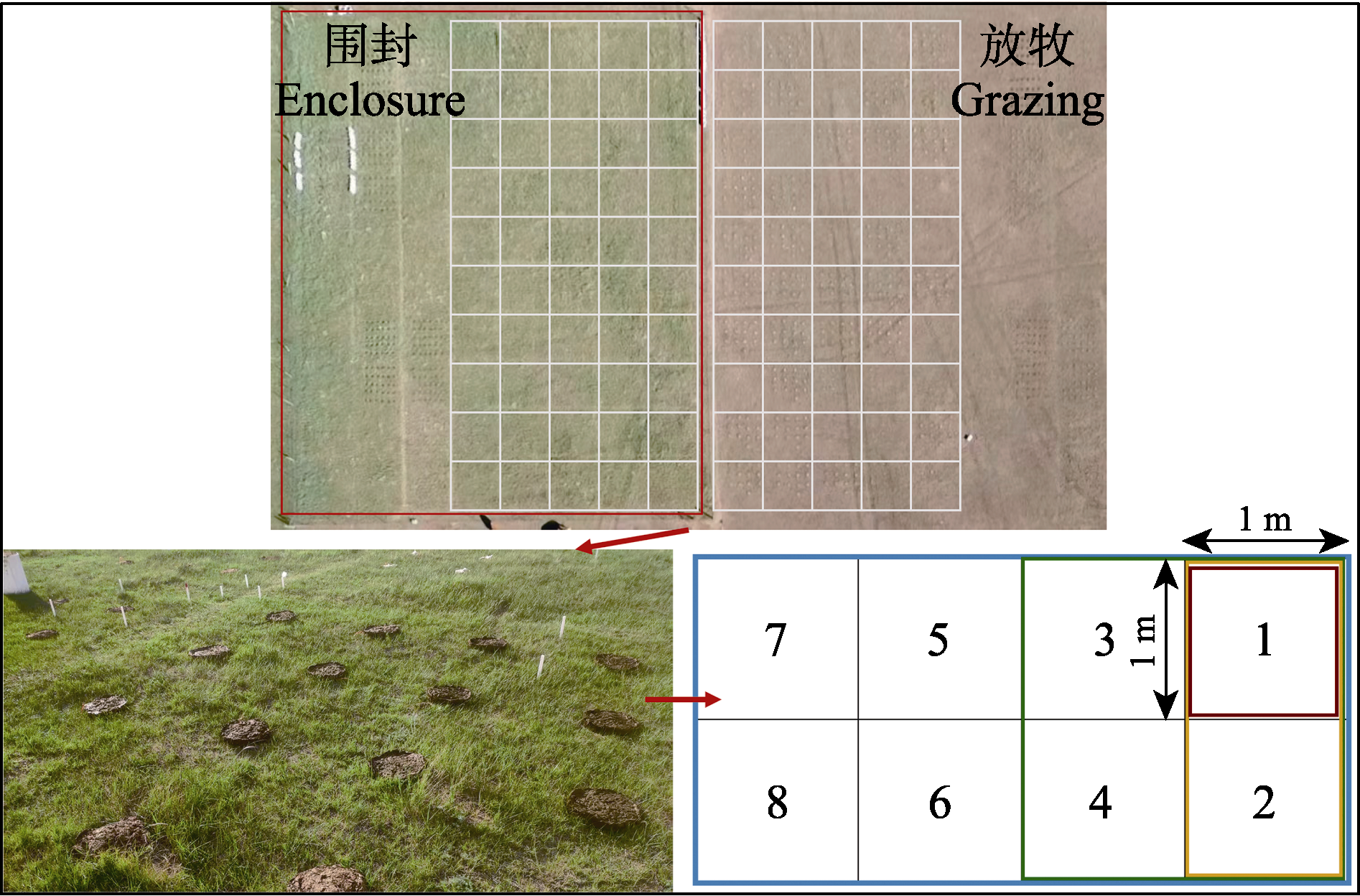
图1 实验样地及嵌套取样概览图。本实验以放牧和围封为主效应, 氮和牛粪添加为副效应。图中编号1-8为进行植物物种调查的8个1 m × 1 m小样方。种-面积关系包括4个调查面积: 1 m2 (红色)、2 m2 (黄色)、4 m2 (绿色)和8 m2 (蓝色)。
Fig. 1 Overview of experimental plots and nested sampling. This experiment primarily focuses on grazing and enclosure as the main effects, with N and cow dung addition as the secondary effects. The numbers 1-8 in the figure refer to eight 1 m × 1 m small plots for plant species sampling. The species- area relationship includes four sampling areas: 1 m2 (red), 2 m2 (yellow), 4 m2 (green), and 8 m2 (blue).
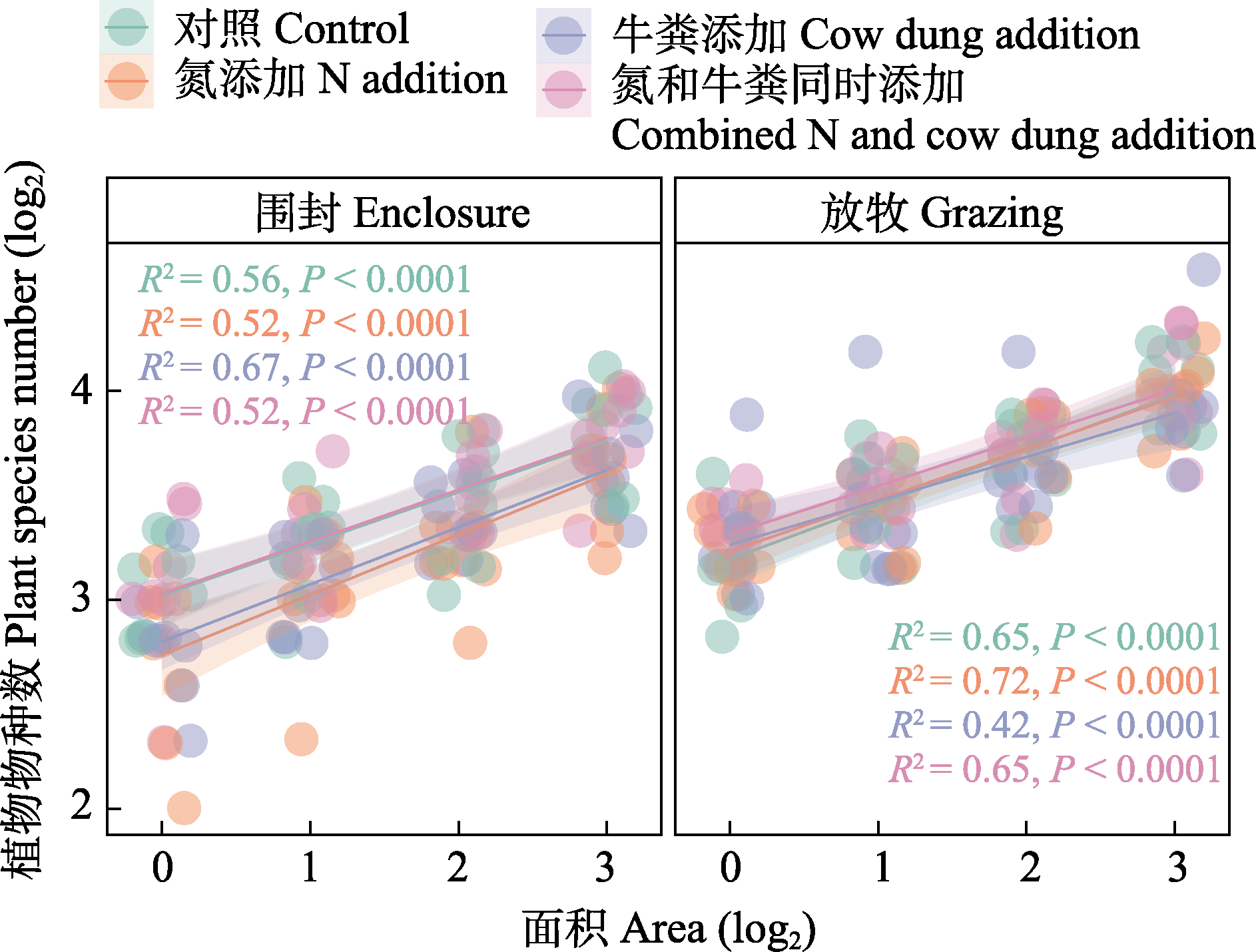
图2 氮和牛粪添加对植物种-面积关系的影响。线性拟合为围封和放牧条件下物种数与调查面积的相关性。共有1 m2、2 m2、4 m2和8 m2 4个调查面积。4种颜色对应4种处理: 对照、氮添加、牛粪添加及氮和牛粪同时添加。拟合为实线, 代表两者具有显著相关关系(P < 0.05)。阴影部分表示95%置信区间。
Fig. 2 Effects of N and cow dung addition on the plant species-area relationship. Linear regressions illustrate the relationship between species number and sampling area under both enclosure and grazing conditions. Four spatial scales were examined: 1 m2, 2 m2, 4 m2, and 8 m2. Four colors represent four treatments: control, N addition, cow dung addition, and combined N and cow dung addition. Solid lines indicate significant relationships (P < 0.05), and shaded areas represent 95% confidence intervals of the fitted lines.
| df | 物种数 Species number | 斜率 Slope | 截距 Intercept | 物种共存 最小面积 Amin | 地上净初级生产力 Aboveground net primary production | pH | 土壤含水量 SWC | 铵态氮含量 NH+ 4-N | 硝态氮含量 NO- 3-N | 土壤无机氮含量 SIN | |
|---|---|---|---|---|---|---|---|---|---|---|---|
| 面积 Area | 1, 191 | 954.7*** | - | - | - | - | - | - | - | - | - |
| 围封 Enclosure (E) | 1, 56 | 30.9*** | 1.7 | 28.3*** | 2.0 | 102.7*** | 33.4*** | 31.5*** | 3.1 | 0.0 | 0.0 |
| 氮添加 N addition (N) | 1, 56 | 0.1 | 0.1 | 0.0 | 0.0 | 0.0 | 0.2 | 0.4 | 0.7 | 0.8 | 0.5 |
| 牛粪添加 Cow dung addition (D) | 1, 56 | 0.2 | 0.9 | 0.7 | 2.8 | 2.3 | 0.6 | 0.2 | 5.5* | 20.7*** | 24.0*** |
| 围封 × 氮添加 E × N | 1, 56 | 0.2 | 0.0 | 0.3 | 0.3 | 4.4*** | 0.1 | 1.3 | 1.4 | 0.1 | 0.2 |
| 围封 × 牛粪添加 E × D | 1, 56 | 0.0 | 0.4 | 0.1 | 0.2 | 0.1 | 1.7 | 0.2 | 2.5 | 0.1 | 0.4 |
| 氮添加 × 牛粪添加 N × D | 1, 56 | 3.9 | 0.1 | 3.9 | 0.8 | 1.7 | 1.2 | 0.4 | 1.7 | 0.5 | 0.9 |
| E × N × D | 1, 56 | 1.7 | 1.6 | 3.6 | 2.9 | 8.0** | 0.2 | 1.3 | 1.6 | 1.5 | 0.9 |
表1 围封和放牧条件下氮和牛粪添加对植物群落和土壤理化性质影响的方差分析结果(F值)
Table 1 Variance analysis results of the effects of N and cow dung addition on plant communities and soil physicochemical properties under enclosure and grazing conditions (F-value). Amin, Minimum area for species coexistence; SWC, Soil water content. SIN, Soil inorganic nitrogen.
| df | 物种数 Species number | 斜率 Slope | 截距 Intercept | 物种共存 最小面积 Amin | 地上净初级生产力 Aboveground net primary production | pH | 土壤含水量 SWC | 铵态氮含量 NH+ 4-N | 硝态氮含量 NO- 3-N | 土壤无机氮含量 SIN | |
|---|---|---|---|---|---|---|---|---|---|---|---|
| 面积 Area | 1, 191 | 954.7*** | - | - | - | - | - | - | - | - | - |
| 围封 Enclosure (E) | 1, 56 | 30.9*** | 1.7 | 28.3*** | 2.0 | 102.7*** | 33.4*** | 31.5*** | 3.1 | 0.0 | 0.0 |
| 氮添加 N addition (N) | 1, 56 | 0.1 | 0.1 | 0.0 | 0.0 | 0.0 | 0.2 | 0.4 | 0.7 | 0.8 | 0.5 |
| 牛粪添加 Cow dung addition (D) | 1, 56 | 0.2 | 0.9 | 0.7 | 2.8 | 2.3 | 0.6 | 0.2 | 5.5* | 20.7*** | 24.0*** |
| 围封 × 氮添加 E × N | 1, 56 | 0.2 | 0.0 | 0.3 | 0.3 | 4.4*** | 0.1 | 1.3 | 1.4 | 0.1 | 0.2 |
| 围封 × 牛粪添加 E × D | 1, 56 | 0.0 | 0.4 | 0.1 | 0.2 | 0.1 | 1.7 | 0.2 | 2.5 | 0.1 | 0.4 |
| 氮添加 × 牛粪添加 N × D | 1, 56 | 3.9 | 0.1 | 3.9 | 0.8 | 1.7 | 1.2 | 0.4 | 1.7 | 0.5 | 0.9 |
| E × N × D | 1, 56 | 1.7 | 1.6 | 3.6 | 2.9 | 8.0** | 0.2 | 1.3 | 1.6 | 1.5 | 0.9 |
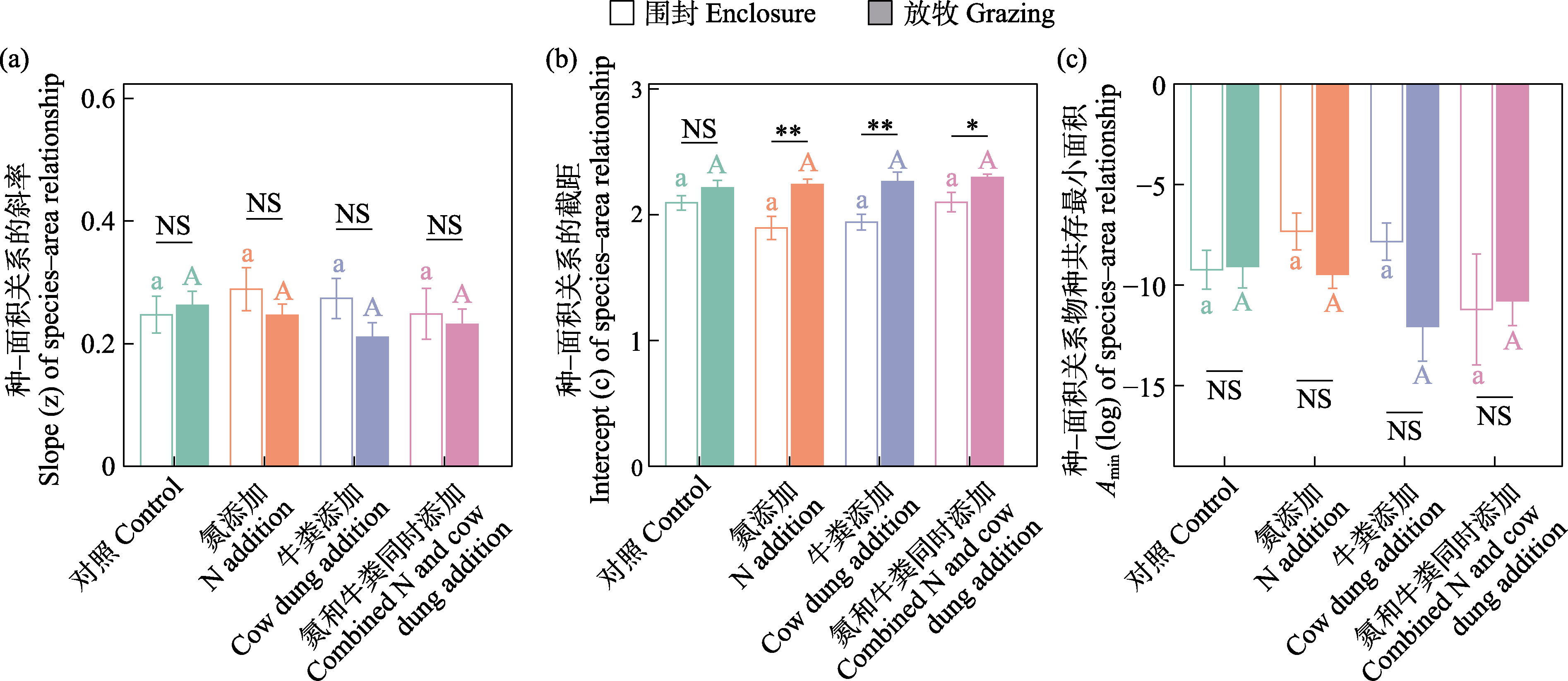
图3 氮和牛粪添加对植物种-面积关系的斜率(a)、截距(b)和物种共存最小面积(c)的影响(平均值 ± 标准误差)。不同小写字母表示围封处理间差异显著(P < 0.05), 不同大写字母表示放牧处理间差异显著(P < 0.05)。星号表示围封和放牧条件下同一处理间差异显著: * P < 0.05; ** P < 0.01; NS, 不显著。
Fig. 3 Effects of N and cow dung addition on the slope (a), intercept (b), and minimum area for species coexistence (Amin) (c) of the plant species-area relationship (mean ± SE). Different lowercase letters indicate significant differences between treatments during enclosure (P < 0.05), while different uppercase letters indicate significant differences between treatments during grazing (P < 0.05). Asterisks denote significant differences between enclosure and grazing within the same treatment: * P < 0.05; ** P < 0.01; NS, not significant.
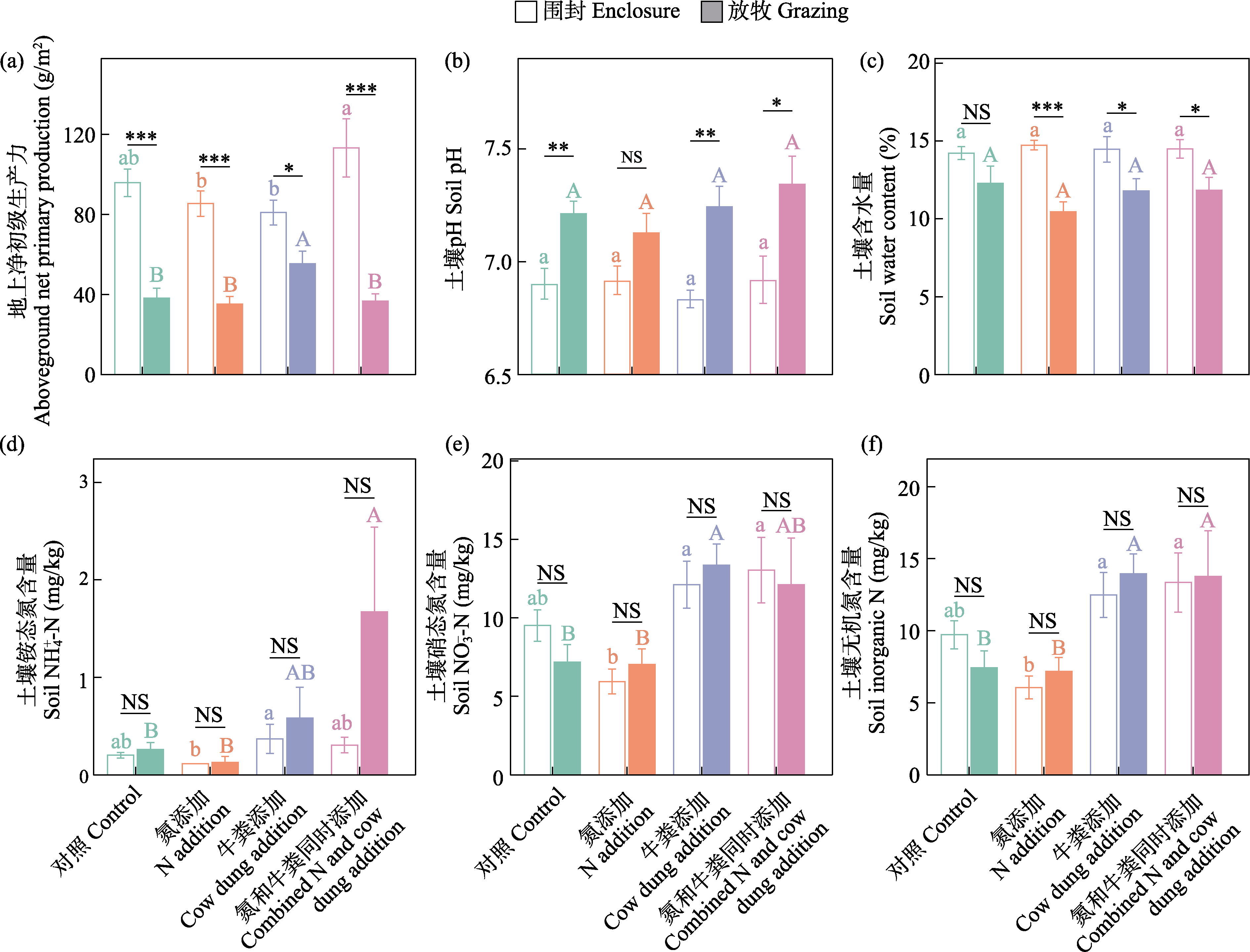
图4 氮和牛粪添加对植物地上净初级生产力(a)、土壤pH (b)、土壤含水量(c)、土壤铵态氮含量(d)、土壤硝态氮含量(e)和土壤无机氮含量(f)的影响(平均值 ± 标准误差)。不同小写字母表示围封处理间差异显著(P < 0.05), 不同大写字母表示放牧处理间差异显著(P < 0.05)。星号表示围封和放牧条件下同一处理间差异显著: * P < 0.05; ** P < 0.01; *** P < 0.001; NS, 不显著。
Fig. 4 Effects of cow dung and nitrogen addition on aboveground net primary productivity (a), soil pH (b), soil water content (c), soil ammonium nitrogen (NH4+-N) content (d), soil nitrate nitrogen (NO3--N) content (e), and soil inorganic nitrogen (f) (mean ± SE). Different lowercase letters indicate significant differences between treatments during enclosure (P < 0.05), while different uppercase letters indicate significant differences between treatments during grazing (P < 0.05). Asterisks denote significant differences between enclosure and grazing within the same treatment: * P < 0.05; ** P < 0.01; *** P < 0.001; NS, not significant.
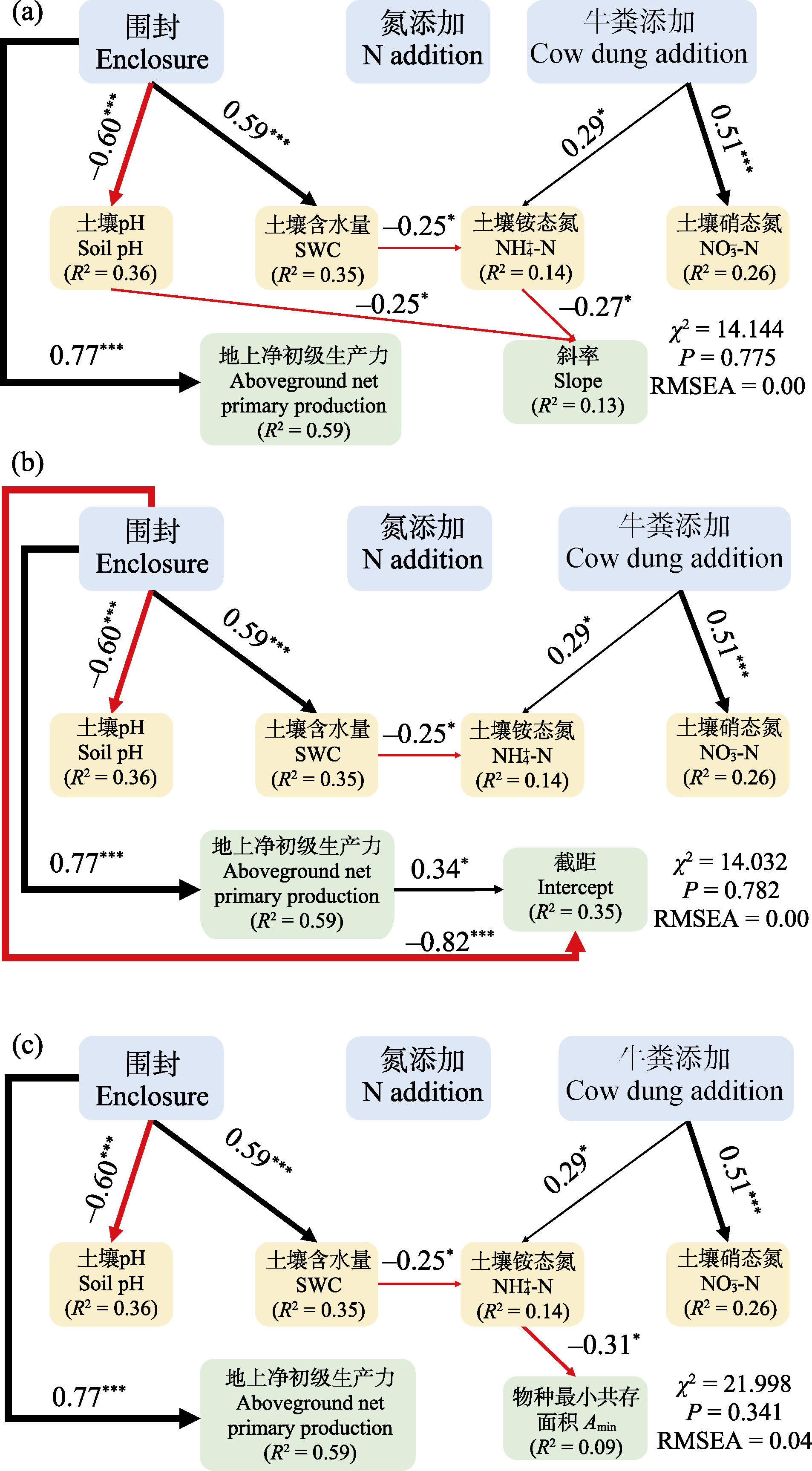
图5 影响种-面积关系的斜率(a)、截距(b)和物种共存最小面积(Amin) (c)的结构方程模型。黑线表示正相关, 红线表示负相关。* P < 0.05; ** P < 0.01; *** P < 0.001。RMSEA (近似误差均方根)用于评价模型拟合度。
Fig. 5 Structural equation models illustrating the factors influencing the slope (a), intercept (b), and minimum area for species coexistence (Amin) (c) of the species-area relationship. SWC, Soil water content. Black arrows represent positive effects, while red arrows represent negative effects. * P < 0.05; ** P < 0.01; *** P < 0.001. RMSEA (root mean square error of approximation) is used to evaluate the model fit.
| [1] | Allbee SA, Rogers HS, Sullivan LL (2023) The effects of dispersal, herbivory, and competition on plant community assembly. Ecology, 104, e3859. |
| [2] |
Arrhenius O (1921) Species and area. Journal of Ecology, 9, 95-99.
DOI URL |
| [3] |
Bai YF, Wu JG, Clark CM, Naeem S, Pan QM, Huang JH, Zhang LX, Han XG (2010) Tradeoffs and thresholds in the effects of nitrogen addition on biodiversity and ecosystem functioning: Evidence from Inner Mongolia grasslands. Global Change Biology, 16, 358-372.
DOI URL |
| [4] |
Borer ET, Seabloom EW, Gruner DS, Harpole WS, Hillebrand H, Lind EM, Adler PB, Alberti J, Anderson TM, Bakker JD, Biederman L, Blumenthal D, Brown CS, Brudvig LA, Buckley YM, Cadotte M, Chu CJ, Cleland EE, Crawley MJ, Daleo P, Damschen EI, Davies KF, DeCrappeo NM, Du GZ, Firn J, Hautier Y, Heckman RW, Hector A, HilleRisLambers J, Iribarne O, Klein JA, Knops JMH, La Pierre KJ, Leakey ADB, Li W, MacDougall AS, McCulley RL, Melbourne BA, Mitchell CE, Moore JL, Mortensen B, O’Halloran LR, Orrock JL, Pascual J, Prober SM, Pyke DA, Risch AC, Schuetz M, Smith MD, Stevens CJ, Sullivan LL, Williams RJ, Wragg PD, Wright JP, Yang LH (2014) Herbivores and nutrients control grassland plant diversity via light limitation. Nature, 508, 517-520.
DOI |
| [5] |
Chase JM, McGill BJ, McGlinn DJ, May F, Blowes SA, Xiao X, Knight TM, Purschke O, Gotelli NJ (2018) Embracing scale-dependence to achieve a deeper understanding of biodiversity and its change across communities. Ecology Letters, 21, 1737-1751.
DOI PMID |
| [6] |
Chase JM, McGill BJ, Thompson PL, Antão LH, Bates AE, Blowes SA, Dornelas M, Gonzalez A, Magurran AE, Supp SR, Winter M, Bjorkman AD, Bruelheide H, Byrnes JEK, Cabral JS, Elahi R, Gomez C, Guzman HM, Isbell F, Myers-Smith IH, Jones HP, Hines J, Vellend M, Waldock C, O’Connor M (2019) Species richness change across spatial scales. Oikos, 128, 1079-1091.
DOI |
| [7] |
Chen X, Lu HN, Ren ZR, Zhang YQ, Liu RX, Zhang YH, Han XG (2024) Reproductive height determines the loss of clonal grasses with nitrogen enrichment in a temperate grassland. Plant Diversity, 46, 256-264.
DOI |
| [8] |
Cheng JW, Li FY, Wang YD, Wang YN, Liu XM, Zhang JZ, Wang ZY, Li YL, Wang H, Yang ZP, Potter MA (2022) Dweller and tunneler dung beetles synergistically accelerate decomposition of cattle and horse dung in a semi-arid steppe. Agriculture, Ecosystems & Environment, 329, 107873.
DOI URL |
| [9] |
Dengler J, Matthews TJ, Steinbauer MJ, Wolfrum S, Boch S, Chiarucci A, Conradi T, Dembicz I, Marcenò C, García-Mijangos I, Nowak A, Storch D, Ulrich W, Campos JA, Cancellieri L, Carboni M, Ciaschetti G, De Frenne P, Dolezal J, Dolnik C, Essl F, Fantinato E, Filibeck G, Grytnes JA, Guarino R, Güler B, Janišová M, Klichowska E, Kozub Ł, Kuzemko A, Manthey M, Mimet A, Naqinezhad A, Pedersen C, Peet RK, Pellissier V, Pielech R, Potenza G, Rosati L, Terzi M, Valkó O, Vynokurov D, White H, Winkler M, Biurrun I (2020) Species-area relationships in continuous vegetation: Evidence from Palaearctic grasslands. Journal of Biogeography, 47, 72-86.
DOI URL |
| [10] |
Devault M, Woolf D, Lehmann J (2025) Nutrient recycling potential of excreta for global crop and grassland production. Nature Sustainability, 8, 99-111.
DOI |
| [11] |
Dong SK, Tang L, Wang XX, Liu YH, Liu SL, Liu QR, Wu Y, Li YY, Su XK, Zhao C (2013) Minimum plot size for estimating plant biodiversity of the alpine grasslands on the Qinghai-Tibetan Plateau. Biodiversity Science, 21, 651-657. (in Chinese with English abstract)
DOI |
|
[董世魁, 汤琳, 王学霞, 刘颖慧, 刘世梁, 刘全儒, 吴娱, 李媛媛, 苏旭坤, 赵晨 (2013) 青藏高原高寒草地植物多样性测定的最小样地面积. 生物多样性, 21, 651-657.]
DOI |
|
| [12] |
Du EZ, Terrer C, Pellegrini AFA, Ahlström A, van Lissa CJ, Zhao X, Xia N, Wu XH, Jackson RB (2020) Global patterns of terrestrial nitrogen and phosphorus limitation. Nature Geoscience, 13, 221-226.
DOI |
| [13] | Du ZY, Cai YJ, Wang XD, Zhang B, Du Z (2019) Research progress on grazing livestock dung decomposition and its influence on the dynamics of grassland soil nutrients. Acta Ecologica Sinica, 39, 4627-4637. (in Chinese with English abstract) |
| [杜子银, 蔡延江, 王小丹, 张斌, 杜忠 (2019) 放牧牲畜粪便降解及其对草地土壤养分动态的影响研究进展. 生态学报, 39, 4627-4637.] | |
| [14] |
Elser JJ, Bracken MES, Cleland EE, Gruner DS, Harpole WS, Hillebrand H, Ngai JT, Seabloom EW, Shurin JB, Smith JE (2007) Global analysis of nitrogen and phosphorus limitation of primary producers in freshwater, marine and terrestrial ecosystems. Ecology Letters, 10, 1135-1142.
DOI PMID |
| [15] |
Eskelinen A, Harpole WS, Jessen MT, Virtanen R, Hautier Y (2022) Light competition drives herbivore and nutrient effects on plant diversity. Nature, 611, 301-305.
DOI |
| [16] |
Gao D, Wang YP (2023) A review of the small-island effect detection methods and method advancement. Biodiversity Science, 31, 23299. (in Chinese with English abstract)
DOI |
|
[高德, 王彦平 (2023) 小岛屿效应检测方法研究进展. 生物多样性, 31, 23299.]
DOI |
|
| [17] |
Harpole WS, Ngai JT, Cleland EE, Seabloom EW, Borer ET, Bracken MES, Elser JJ, Gruner DS, Hillebrand H, Shurin JB, Smith JE (2011) Nutrient co-limitation of primary producer communities. Ecology Letters, 14, 852-862.
DOI PMID |
| [18] |
Harpole WS, Sullivan LL, Lind EM, Firn J, Adler PB, Borer ET, Chase J, Fay PA, Hautier Y, Hillebrand H, MacDougall AS, Seabloom EW, Williams R, Bakker JD, Cadotte MW, Chaneton EJ, Chu CJ, Cleland EE, D’Antonio C, Davies KF, Gruner DS, Hagenah N, Kirkman K, Knops JMH, La Pierre KJ, McCulley RL, Moore JL, Morgan JW, Prober SM, Risch AC, Schuetz M, Stevens CJ, Wragg PD (2016) Addition of multiple limiting resources reduces grassland diversity. Nature, 537, 93-96.
DOI |
| [19] | Jiang SC, Zhou DW (2006) The impact of cattle dung deposition on grasslands in the Songnen Grassland. Acta Prataculturae Sinica, 15(4), 30-35. (in Chinese with English abstract) |
| [姜世成, 周道玮 (2006) 牛粪堆积对草地影响的研究. 草业学报, 15(4), 30-35.] | |
| [20] | Keller AB, Walter CA, Blumenthal DM, Borer ET, Collins SL, DeLancey LC, Fay PA, Hofmockel KS, Knops JMH, Leakey ADB, Mayes MA, Seabloom EW, Hobbie SE (2023) Stronger fertilization effects on aboveground versus belowground plant properties across nine U.S. grasslands. Ecology, 104, e3891. |
| [21] |
Kimmel K, Furey GN, Hobbie SE, Isbell F, Tilman D, Reich PB (2020) Diversity-dependent soil acidification under nitrogen enrichment constrains biomass productivity. Global Change Biology, 26, 6594-6603.
DOI URL |
| [22] |
Lan ZC, Jenerette GD, Zhan SX, Li WH, Zheng SX, Bai YF (2015) Testing the scaling effects and mechanisms of N-induced biodiversity loss: Evidence from a decade-long grassland experiment. Journal of Ecology, 103, 750-760.
DOI URL |
| [23] |
Lefcheck JS (2016) piecewiseSEM: Piecewise structural equation modelling in R for ecology, evolution, and systematics. Methods in Ecology and Evolution, 7, 573-579.
DOI URL |
| [24] |
Liu D, Wang ZL, Liu KF, Zhang S, Yang FL, Li J, Liu F, Bao D, Che RX (2024) Dung-soil microbial community coalescence can exert dual effects on alpine grasslands through changing soil microbiomes. Journal of Soils and Sediments, 24, 874-887.
DOI |
| [25] |
Liu XM, Chen HY, Zheng R, Wuyun, Arengaowa, Wang RR (2011) Decomposition of sheep and cattle dung in a steppe in Inner Mongolia, China. Chinese Journal of Applied and Environmental Biology, 17, 791-796. (in Chinese with English abstract)
DOI URL |
| [刘新民, 陈海燕, 峥嵘, 乌云, 阿仁高娃, 王润润 (2011) 内蒙古典型草原羊粪和牛粪的分解特征. 应用与环境生物学报, 17, 791-796.] | |
| [26] | Liu Y, Men MX, Peng ZP, Houx JH III, Peng YF (2022) Nitrogen availability determines ecosystem productivity in response to climate warming. Ecology, 103, e3823. |
| [27] |
Lu WY, Zhang YQ, Chen X, Ren ZR, Lu HN, Liu RX, Zhang YH (2024) Similar effects of seasonal nitrogen enrichment on plant species-area relationship in a temperate grassland. Ecological Indicators, 158, 111430.
DOI URL |
| [28] |
Midolo G, Alkemade R, Schipper AM, Benítez-López A, Perring MP, De Vries W (2019) Impacts of nitrogen addition on plant species richness and abundance: A global meta-analysis. Global Ecology and Biogeography, 28, 398-413.
DOI URL |
| [29] |
Namuhan, Wang J, Yang JG, Song YT, Yu YG, Wang JD, Wang XG, Shi YP, Shen Y, Han XG, Wuyunna , Zhang HY (2024) Mechanisms of biodiversity loss under nitrogen enrichment: Unveiling a shift from light competition to cation toxicity. New Phytologist, 243, 1966-1979.
DOI PMID |
| [30] | Pinheiro JC, Bates DM, R Core Team(2020) Linear and Nonlinear Mixed Effects Models. R Package nlme Version, 3.1-151. |
| [31] |
Preston FW (1960) Time and space and the variation of species. Ecology, 41, 611-627.
DOI URL |
| [32] | R Core Team (2014) R: A Language and Environment for Statistical Computing. R Foundation for Statistical Computing, Vienna, Austria. |
| [33] |
Seabloom EW, Batzer E, Chase JM, Stanley Harpole W, Adler PB, Bagchi S, Bakker JD, Barrio IC, Biederman L, Boughton EH, Bugalho MN, Caldeira MC, Catford JA, Daleo P, Eisenhauer N, Eskelinen A, Haider S, Hallett LM, Svala Jónsdóttir I, Kimmel K, Kuhlman M, MacDougall A, Molina CD, Moore JL, Morgan JW, Muthukrishnan R, Ohlert T, Risch AC, Roscher C, Schütz M, Sonnier G, Tognetti PM, Virtanen R, Wilfahrt PA, Borer ET (2021) Species loss due to nutrient addition increases with spatial scale in global grasslands. Ecology Letters, 24, 2100-2112.
DOI PMID |
| [34] |
Stevens CJ, Dise NB, Mountford JO, Gowing DJ (2004) Impact of nitrogen deposition on the species richness of grasslands. Science, 303, 1876-1879.
PMID |
| [35] | Sun H, Yu YW, Ma XL, Mu XM, Zhang HM, Liao JF, Hou FJ (2014) Effects of animal dung deposition on grassland nutrients and botanical composition in mixed Lolium perenne and Trifolium repens pasture in Guizhou Plateau. Pratacultural Science, 31, 488-498. (in Chinese with English abstract) |
| [孙红, 于应文, 马向丽, 牟晓明, 张红梅, 廖加法, 侯扶江 (2014) 畜粪沉积对贵州高原黑麦草 + 白三叶草地养分和植被构成的影响. 草业科学, 31, 488-498.] | |
| [36] | Suttie JM, Reynolds SG, Batello C (2005) Grasslands of the World. Plant Production and Protection Series No. 34. Food and Agriculture Organization of the United Nations, Rome. |
| [37] |
Taddesse G, Peden D, Abiye A, Wagnew A (2003) Effect of manure on grazing lands in Ethiopia, East African highlands. Mountain Research and Development, 23, 156-160.
DOI URL |
| [38] |
Tian DS, Niu SL (2015) A global analysis of soil acidification caused by nitrogen addition. Environmental Research Letters, 10, 024019.
DOI URL |
| [39] |
Tjørve E (2003) Shapes and functions of species-area curves: A review of possible models. Journal of Biogeography, 30, 827-835.
DOI URL |
| [40] |
Valdés-Correcher E, Sitters J, Wassen M, Brion N, Olde Venterink H (2019) Herbivore dung quality affects plant community diversity. Scientific Reports, 9, 5675.
DOI PMID |
| [41] | Valliere JM, Irvine IC, Allen EB (2024) Nitrogen deposition suppresses ephemeral post-fire plant diversity. Global Change Biology, 30, e17117. |
| [42] | van der Plas F, Hautier Y, Ceulemans T, Alard D, Bobbink R, Diekmann M, Dise NB, Dorland E, Dupré C, Gowing D, Stevens C (2024) Atmospheric nitrogen deposition is related to plant biodiversity loss at multiple spatial scales. Global Change Biology, 30, e17445. |
| [43] |
Verma P, Sagar R, Giri N, Patel R, Verma H, Singh DK, Kumar K (2015) Variations in soil properties, species composition, diversity and biomass of herbaceous species due to ruminant dung residue in a seasonally dry tropical environment of India. Tropical Grasslands-Forrajes Tropicales, 3, 112-128.
DOI URL |
| [44] |
Wang SL, Hou FJ (2021) Seed bank of livestock dung in the Qilian Mountain grassland: A potential resource for vegetation recovery. Rangeland Ecology & Management, 78, 90-99.
DOI URL |
| [45] |
Xie YQ, Huang H, Wang CX, He YQ, Jiang YX, Liu ZL, Deng CY, Zheng YS (2023) Determinants of species-area relationship and species richness of coastal endemic plants in the Fujian islands. Biodiversity Science, 31, 22345. (in Chinese with English abstract)
DOI |
|
[谢艳秋, 黄晖, 王春晓, 何雅琴, 江怡萱, 刘子琳, 邓传远, 郑郁善 (2023) 福建海岛滨海特有植物种-面积关系及物种丰富度决定因素. 生物多样性, 31, 22345.]
DOI |
|
| [46] |
Yu GR, Jia YL, He NP, Zhu JX, Chen Z, Wang QF, Piao SL, Liu XJ, He HL, Guo XB, Wen Z, Li P, Ding G, Goulding K (2019) Stabilization of atmospheric nitrogen deposition in China over the past decade. Nature Geoscience, 12, 424-429.
DOI |
| [47] |
Zhang YH, Loreau M, Lü XT, He NP, Zhang GM, Han XG (2016) Nitrogen enrichment weakens ecosystem stability through decreased species asynchrony and population stability in a temperate grassland. Global Change Biology, 22, 1445-1455.
DOI PMID |
| [48] |
Zhang YH, Lü XT, Isbell F, Stevens C, Han X, He NP, Zhang GM, Yu Q, Huang JH, Han XG (2014) Rapid plant species loss at high rates and at low frequency of N addition in temperate steppe. Global Change Biology, 20, 3520-3529.
DOI PMID |
| [49] |
Zhang YJ, Zhu JT, Shen RN, Wang L (2020) Research progress on the effects of grazing on grassland ecosystem. Chinese Journal of Plant Ecology, 44, 553-564. (in Chinese with English abstract)
DOI URL |
|
[张扬建, 朱军涛, 沈若楠, 王荔 (2020) 放牧对草地生态系统影响的研究进展. 植物生态学报, 44, 553-564.]
DOI |
|
| [50] |
Zhou XL, Liu XD, Zhang PF, Guo Z, Du GZ (2019) Increased community compositional dissimilarity alleviates species loss following nutrient enrichment at large spatial scales. Journal of Plant Ecology, 12, 376-386.
DOI |
| [51] |
Zhu JX, Jia YL, Yu GR, Wang QF, He NP, Chen Z, He HL, Zhu XJ, Li P, Zhang FS, Liu XJ, Goulding K, Fowler D, Vitousek P (2025) Changing patterns of global nitrogen deposition driven by socio-economic development. Nature Communications, 16, 46.
DOI |
| [1] | 石亚飞, 牛富荣, 黄晓敏, 洪星, 龚相文, 王艳莉, 林栋, 柳小妮. 可解释机器学习及其生态学应用[J]. 生物多样性, 2026, 34(1): 25210-. |
| [2] | 李帅, 刘卫华, 许驭丹, 田晓波, 宋厚娟, 岳晓婷, 武玲玲, 张青, 上官铁梁. 山西省野生维管植物编目和分布数据集[J]. 生物多样性, 2025, 33(7): 24317-. |
| [3] | 林秦文, 张娜, 王强. 中国盐生植物编目和分布数据集[J]. 生物多样性, 2025, 33(7): 25030-. |
| [4] | 杨泉峰, 唐艳杰, 肖海军, 王颖, 张蓉, 欧阳芳, 魏淑花. 宁夏不同草原类型植物多样性-蝗虫-步甲的级联效应及对初级生产力的影响[J]. 生物多样性, 2025, 33(6): 25021-. |
| [5] | 宋威, 程才, 王嘉伟, 吴纪华. 土壤微生物对植物多样性-生态系统功能关系的调控作用[J]. 生物多样性, 2025, 33(4): 24579-. |
| [6] | 张浩斌, 肖路, 刘艳杰. 夜间灯光对外来入侵植物和本地植物群落多样性和生长的影响[J]. 生物多样性, 2025, 33(4): 24553-. |
| [7] | 谢淦, 宣晶, 付其迪, 魏泽, 薛凯, 雒海瑞, 高吉喜, 李敏. 草地植物多样性无人机调查的物种智能识别模型构建[J]. 生物多样性, 2025, 33(4): 24236-. |
| [8] | 吴昱萱, 王平, 胡晓生, 丁一, 彭甜恬, 植秋滢, 巴德木其其格, 李文杰, 关潇, 李俊生. 呼伦贝尔草地退化现状评估与植被特征变化[J]. 生物多样性, 2025, 33(2): 24118-. |
| [9] | 李东红, 郝媛媛, 甘辉林, 张航, 刘耀猛, 他富源, 胡桂馨. 祁连山北麓中段不同类型草地蝗虫种类及分布[J]. 生物多样性, 2024, 32(9): 24119-. |
| [10] | 连佳丽, 陈婧, 杨雪琴, 赵莹, 罗叙, 韩翠, 赵雅欣, 李建平. 荒漠草原植物多样性和微生物多样性对降水变化的响应[J]. 生物多样性, 2024, 32(6): 24044-. |
| [11] | 王永财, 万华伟, 高吉喜, 胡卓玮, 孙晨曦, 吕娜, 张志如. 基于深度学习的我国北方常见天然草地植物识别[J]. 生物多样性, 2024, 32(4): 23435-. |
| [12] | 万凤鸣, 万华伟, 张志如, 高吉喜, 孙晨曦, 王永财. 草地植物多样性无人机调查的应用潜力[J]. 生物多样性, 2024, 32(3): 23381-. |
| [13] | 曹可欣, 王敬雯, 郑国, 武鹏峰, 李英滨, 崔淑艳. 降水格局改变及氮沉降对北方典型草原土壤线虫多样性的影响[J]. 生物多样性, 2024, 32(3): 23491-. |
| [14] | 张乃鹏, 梁洪儒, 张焱, 孙超, 陈勇, 王路路, 夏江宝, 高芳磊. 土壤类型和地下水埋深对黄河三角洲典型盐沼植物群落空间分异的影响[J]. 生物多样性, 2024, 32(2): 23370-. |
| [15] | 蒋陈焜, 郁文彬, 饶广远, 黎怀成, Julien B. Bachelier, Hartmut H. Hilger, Theodor C. H. Cole. 植物系统发生海报——以演化视角介绍植物多样性的科教资料项目[J]. 生物多样性, 2024, 32(11): 24210-. |
| 阅读次数 | ||||||
|
全文 |
|
|||||
|
摘要 |
|
|||||
备案号:京ICP备16067583号-7
Copyright © 2026 版权所有 《生物多样性》编辑部
地址: 北京香山南辛村20号, 邮编:100093
电话: 010-62836137, 62836665 E-mail: biodiversity@ibcas.ac.cn
