

生物多样性 ›› 2025, Vol. 33 ›› Issue (8): 25123. DOI: 10.17520/biods.2025123 cstr: 32101.14.biods.2025123
王儒晓( ), 史博洋(), 潘达*()(
 ), 孙红英()
收稿日期:2025-04-02
接受日期:2025-05-30
出版日期:2025-08-20
发布日期:2025-09-17
通讯作者:
*E-mail: dapan@njnu.edu.cn
基金资助:
Ruxiao Wang(), Boyang Shi(), Da Pan*()(), Hongying Sun()
Received:2025-04-02
Accepted:2025-05-30
Online:2025-08-20
Published:2025-09-17
Contact:
*E-mail: dapan@njnu.edu.cn
Supported by:摘要:
淡水蟹类是底栖大型无脊椎动物代表类群之一, 也是判断生态系统健康与否的关键指示生物, 但其物种多样性和遗传多样性并未得到有效保护。据此, 本研究以中国特有的华溪蟹属(Sinopotamon)淡水蟹类为例, 基于详尽的野外调查与文献资料汇总, 构建了该类群的物种分布数据库, 利用空间广义线性混合模型来评估影响其物种多样性与遗传多样性的关键环境因素; 通过将物种多样性和遗传多样性格局与现有保护地进行叠加分析, 以识别其多样性热点和保护空缺区域。研究结果表明, 华溪蟹属物种多样性分布中心位于云贵高原东北缘至浙闽丘陵之间的地区, 其物种多样性整体上呈现出由长江流域向南北边缘逐渐稀少的特点; 遗传多样性呈现出空间不均匀分布的特征, 山地区域的遗传多样性相对较高。物种多样性和遗传多样性之间存在显著的正相关关系, 海拔和年平均降水量等环境因子对两者具有显著的正向影响。华溪蟹属物种多样性和遗传多样性格局呈现显著的空间聚集性, 其热点主要分布于中国中南部的山地丘陵地带, 在该地区识别出4个保护空缺区域; 南岭山脉东段被识别为遗传多样性特有的热点区域。本文研究结果显示, 山地生态系统及暖湿气候在华溪蟹属淡水蟹物种多样性和遗传多样性的形成过程中发挥了关键作用。本研究强调了结合物种多样性和遗传多样性来规划自然保护区的必要性, 为中国淡水生态系统的未来生物多样性保护管理与决策提供了数据支撑和科学依据。
王儒晓, 史博洋, 潘达, 孙红英 (2025) 中国特有华溪蟹属淡水蟹多样性格局及其保护空缺. 生物多样性, 33, 25123. DOI: 10.17520/biods.2025123.
Ruxiao Wang, Boyang Shi, Da Pan, Hongying Sun (2025) Biodiversity patterns and conservation gaps of the endemic freshwater crab genus Sinopotamon in China. Biodiversity Science, 33, 25123. DOI: 10.17520/biods.2025123.
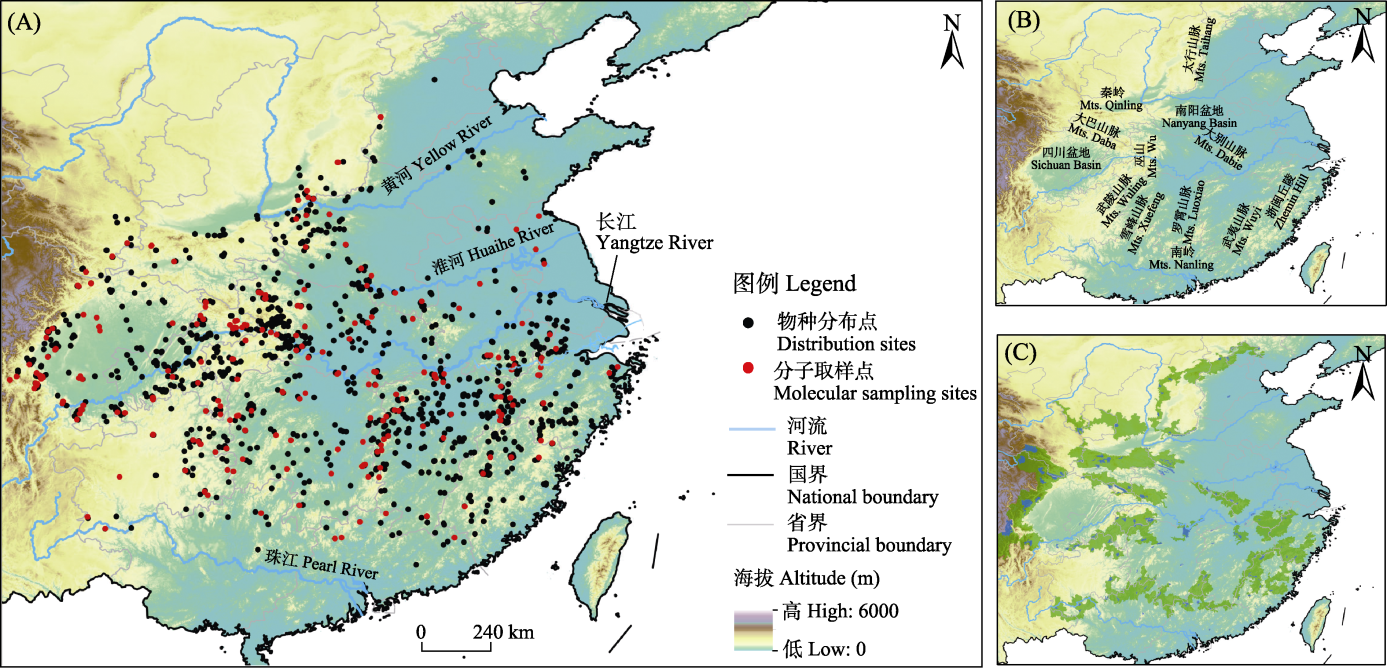
图1 华溪蟹属物种分布点位及地理分布区。(A)华溪蟹属物种分布点(黑色圆点)及分子取样点(红色圆点); (B)华溪蟹属物种分布区内分布的主要山脉(修改自刘明光, 2010); (C)华溪蟹属物种分布区内的生物多样性优先保护区域(绿色斑块; 引自生态环境部, https://www.mee.gov.cn/gkml/hbb/bgg/201601/t20160105_321061.htm)与国家级自然保护区(蓝色斑块; 引自生态环境部, https://www.mee.gov.cn/ywgz/zrstbh/zrbhdjg/201905/P020190514616282907461.pdf)。
Fig. 1 Distribution sites and geographical range of Sinopotamon species. (A) Distribution sites of Sinopotamon species (black dots) and molecular sampling localities (red dots); (B) Major mountain ranges within the distribution area of Sinopotamon (modified from Liu, 2010); (C) Biodiversity priority conservation areas (green patches; modified from Ministry of Ecology and Environment, https://www.mee.gov.cn/gkml/hbb/bgg/201601/t20160105_321061.htm) and national nature reserves (blue patches; data from Ministry of Ecology and Environment, https://www.mee.gov.cn/ywgz/zrstbh/zrbhdjg/201905/P020190514616282907461.pdf) within the distribution range of Sinopotamon species.
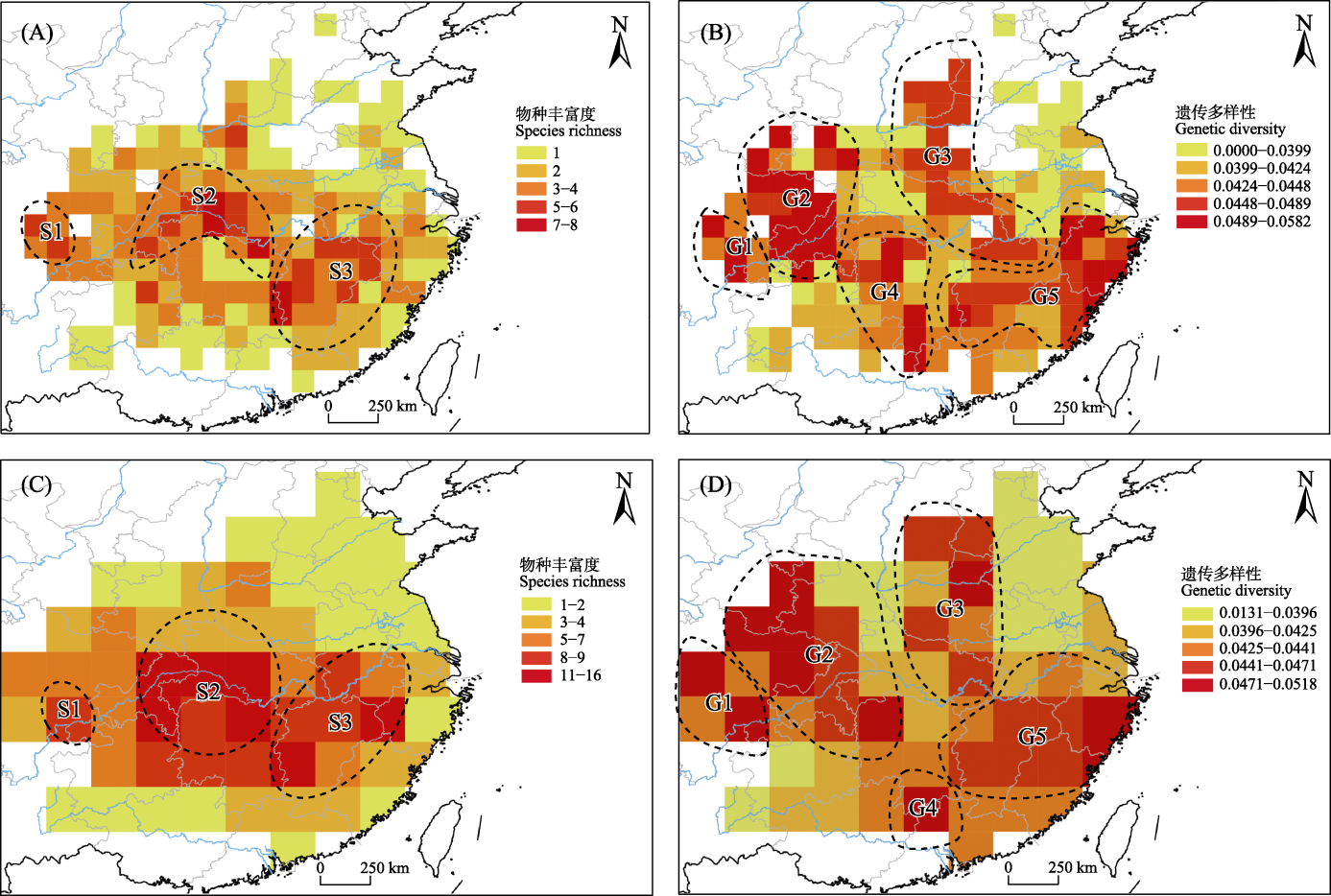
图2 华溪蟹属淡水蟹物种丰富度和遗传多样性空间分布格局。(A)以1° × 1°网格为操作单元的物种丰富度格局; (B)以1° × 1°网格为操作单元的遗传多样性格局; (C)以2° × 2°网格为操作单元的物种丰富度格局; (D)以2° × 2°网格为操作单元的遗传多样性格局。S1-S3: 物种多样性分布中心; G1-G5: 遗传多样性分布中心。
Fig. 2 Spatial patterns of species richness and genetic diversity for freshwater crabs of the genus Sinopotamon. (A) Species richness patterns based on 1° × 1° grid; (B) Genetic diversity patterns based on 1° × 1° grid; (C) Species richness patterns based on 2° × 2° grid; (D) Genetic diversity patterns based on 2° × 2° grid. S1-S3, Centers of species diversity; G1-G5, Centers of genetic diversity.
| 物种 Species | 分布点位数量 No. of distribution points | 序列数量 No. of sequences | 核苷酸多样性 Nucleotide diversity (π) | 物种 Species | 分布点位数量 No. of distribution points | 序列数量 No. of sequences | 核苷酸多样性 Nucleotide diversity (π) |
|---|---|---|---|---|---|---|---|
| 尖叶华溪蟹 S. acutum | 132 | 10 | 0.05163 | 浏阳华溪蟹 S. liuyangense | 5 | 5 | 0.03215 |
| 安徽华溪蟹 S. anhuiense | 4 | 6 | 0.05184 | 隆林华溪蟹 S. longlinense | 1 | 4 | 0.02150 |
| 安远华溪蟹 S. anyuanense | 19 | 16 | 0.04329 | 娄底华溪蟹 S. loudiense | 9 | 9 | 0.04019 |
| 白岩华溪蟹 S. baiyanense | 3 | 6 | 0.03639 | 麻阳华溪蟹 S. mayangense | 2 | 5 | 0.05047 |
| 保康华溪蟹 S. baokangense | 1 | 3 | 0.02617 | 闽东华溪蟹 S. mindongense | 4 | 6 | 0.05184 |
| 双叶华溪蟹 S. bilobatum | 12 | 6 | 0.03988 | 南岭华溪蟹 S. nanlingense | 10 | 6 | 0.05097 |
| 茶陵华溪蟹 S. chalingense | 5 | 5 | 0.05271 | 矮小华溪蟹 S. nanum | 20 | 12 | 0.03767 |
| 长安华溪蟹 S. changanense | 7 | 2 | 0.00100 | 宁岗华溪蟹 S. ninggangense | 4 | 4 | 0.05452 |
| 浙江华溪蟹 S. chekiangense | 40 | 12 | 0.04959 | 斜缘华溪蟹 S. obliquum | 16 | 10 | 0.04623 |
| 城口华溪蟹 S. chengkuense | 3 | 14 | 0.04780 | 小华溪蟹 S. parvum | 2 | 4 | 0.01121 |
| 赤水华溪蟹 S. chishuiense | 8 | 3 | 0.00125 | 屏山华溪蟹 S. pingshanense | 7 | 8 | 0.05367 |
| 叉肢华溪蟹 S. cladopodum | 48 | 10 | 0.04341 | 平原华溪蟹 S. planum | 29 | 4 | 0.02056 |
| 隆突华溪蟹 S. convexum | 7 | 8 | 0.04840 | 融水华溪蟹 S. rongshuiense | 21 | 6 | 0.04112 |
| 光泽华溪蟹 S. davidi | 50 | 18 | 0.05677 | 陕西华溪蟹 S. shensiense | 57 | 14 | 0.04377 |
| 窄小华溪蟹 S. decrescentum | 5 | 7 | 0.04361 | 四股桥华溪蟹 S. siguqiaoense | 7 | 4 | 0.04860 |
| 锯齿华溪蟹 S. denticulatum | 23 | 8 | 0.04493 | 直立华溪蟹 S. styxum | 24 | 7 | 0.03151 |
| 凹肢华溪蟹指名亚种 S. depressum depressum | 33 | 5 | 0.05059 | 圆顶华溪蟹 S. teritisum | 29 | 10 | 0.03007 |
| 凹肢华溪蟹商城亚种 S. depressum shangchengense | 5 | 3 | 0.03975 | 肿胀华溪蟹 S. turgidum | 4 | 10 | 0.03626 |
| 峨边华溪蟹 S. ebianense | 12 | 2 | 0.03738 | 不等叶华溪蟹 S. unaequum | 10 | 3 | 0.04523 |
| 峨眉华溪蟹 S. emeiense | 4 | 7 | 0.04700 | 万载华溪蟹 S. wanzaiense | 27 | 6 | 0.04586 |
| 瘦肢华溪蟹 S. exiguum | 26 | 8 | 0.04433 | 巫山华溪蟹 S. wushanense | 5 | 9 | 0.04460 |
| 福建华溪蟹 S. fukienense | 108 | 13 | 0.04671 | 湘西华溪蟹 S. xiangxiense | 30 | 17 | 0.04935 |
| 复兴华溪蟹 S. fuxingense | 10 | 6 | 0.04810 | 新宁华溪蟹 S. xingningense | 3 | 6 | 0.04735 |
| 汉阳华溪蟹 S. hanyangense | 11 | 7 | 0.03818 | 兴山华溪蟹 S. xingshanense | 21 | 5 | 0.03551 |
| 河南华溪蟹 S. honanense | 64 | 9 | 0.04720 | 休宁华溪蟹 S. xiuningense | 1 | 3 | 0.03863 |
| 会同华溪蟹 S. huitongense | 10 | 6 | 0.04125 | 修水华溪蟹 S. xiushuiense | 4 | 5 | 0.03925 |
| 江口华溪蟹 S. jiangkuoense | 16 | 7 | 0.03810 | 雅安华溪蟹 S. yaanense | 9 | 12 | 0.05248 |
| 将乐华溪蟹 S. jianglenense | 18 | 3 | 0.03701 | 长江华溪蟹陕县亚种 S. yangtsekiense shanxianense | 7 | 2 | 0 |
| 绛县华溪蟹 S. jiangxianense | 6 | 12 | 0.04486 | 长江华溪蟹桐柏亚种 S. yangtsekiense tongbaiense | 25 | 2 | 0.04486 |
| 九江华溪蟹 S. jiujiangense | 10 | 7 | 0.05714 | 长江华溪蟹指名亚种 S. yangtsekiense yangtsekiense | 85 | 13 | 0.04007 |
| 绩溪华溪蟹 S. jixiense | 6 | 2 | 0.10093 | 黟县华溪蟹 S. yixianense | 6 | 5 | 0.00112 |
| 凯里华溪蟹 S. kenliense | 6 | 4 | 0.04268 | 岳阳华溪蟹 S. yueyangense | 6 | 7 | 0.03792 |
| 灌县华溪蟹 S. kwanhsienense | 12 | 4 | 0.03240 | 玉山华溪蟹 S. yushanense | 3 | 6 | 0.04922 |
| 兰氏华溪蟹 S. lansi | 96 | 11 | 0.04330 | 遵义华溪蟹 S. zunyiense | 5 | 5 | 0.03178 |
| 莲花华溪蟹 S. linhuaense | 3 | 6 | 0.05670 | 总计 Total | 291 | 490 | - |
表1 华溪蟹属69个物种的分布点位数量和16S rDNA序列数量及其核苷酸多样性
Table 1 Distribution localities, number of 16S rDNA sequences, and nucleotide diversity of 69 species of the genus Sinopotamon
| 物种 Species | 分布点位数量 No. of distribution points | 序列数量 No. of sequences | 核苷酸多样性 Nucleotide diversity (π) | 物种 Species | 分布点位数量 No. of distribution points | 序列数量 No. of sequences | 核苷酸多样性 Nucleotide diversity (π) |
|---|---|---|---|---|---|---|---|
| 尖叶华溪蟹 S. acutum | 132 | 10 | 0.05163 | 浏阳华溪蟹 S. liuyangense | 5 | 5 | 0.03215 |
| 安徽华溪蟹 S. anhuiense | 4 | 6 | 0.05184 | 隆林华溪蟹 S. longlinense | 1 | 4 | 0.02150 |
| 安远华溪蟹 S. anyuanense | 19 | 16 | 0.04329 | 娄底华溪蟹 S. loudiense | 9 | 9 | 0.04019 |
| 白岩华溪蟹 S. baiyanense | 3 | 6 | 0.03639 | 麻阳华溪蟹 S. mayangense | 2 | 5 | 0.05047 |
| 保康华溪蟹 S. baokangense | 1 | 3 | 0.02617 | 闽东华溪蟹 S. mindongense | 4 | 6 | 0.05184 |
| 双叶华溪蟹 S. bilobatum | 12 | 6 | 0.03988 | 南岭华溪蟹 S. nanlingense | 10 | 6 | 0.05097 |
| 茶陵华溪蟹 S. chalingense | 5 | 5 | 0.05271 | 矮小华溪蟹 S. nanum | 20 | 12 | 0.03767 |
| 长安华溪蟹 S. changanense | 7 | 2 | 0.00100 | 宁岗华溪蟹 S. ninggangense | 4 | 4 | 0.05452 |
| 浙江华溪蟹 S. chekiangense | 40 | 12 | 0.04959 | 斜缘华溪蟹 S. obliquum | 16 | 10 | 0.04623 |
| 城口华溪蟹 S. chengkuense | 3 | 14 | 0.04780 | 小华溪蟹 S. parvum | 2 | 4 | 0.01121 |
| 赤水华溪蟹 S. chishuiense | 8 | 3 | 0.00125 | 屏山华溪蟹 S. pingshanense | 7 | 8 | 0.05367 |
| 叉肢华溪蟹 S. cladopodum | 48 | 10 | 0.04341 | 平原华溪蟹 S. planum | 29 | 4 | 0.02056 |
| 隆突华溪蟹 S. convexum | 7 | 8 | 0.04840 | 融水华溪蟹 S. rongshuiense | 21 | 6 | 0.04112 |
| 光泽华溪蟹 S. davidi | 50 | 18 | 0.05677 | 陕西华溪蟹 S. shensiense | 57 | 14 | 0.04377 |
| 窄小华溪蟹 S. decrescentum | 5 | 7 | 0.04361 | 四股桥华溪蟹 S. siguqiaoense | 7 | 4 | 0.04860 |
| 锯齿华溪蟹 S. denticulatum | 23 | 8 | 0.04493 | 直立华溪蟹 S. styxum | 24 | 7 | 0.03151 |
| 凹肢华溪蟹指名亚种 S. depressum depressum | 33 | 5 | 0.05059 | 圆顶华溪蟹 S. teritisum | 29 | 10 | 0.03007 |
| 凹肢华溪蟹商城亚种 S. depressum shangchengense | 5 | 3 | 0.03975 | 肿胀华溪蟹 S. turgidum | 4 | 10 | 0.03626 |
| 峨边华溪蟹 S. ebianense | 12 | 2 | 0.03738 | 不等叶华溪蟹 S. unaequum | 10 | 3 | 0.04523 |
| 峨眉华溪蟹 S. emeiense | 4 | 7 | 0.04700 | 万载华溪蟹 S. wanzaiense | 27 | 6 | 0.04586 |
| 瘦肢华溪蟹 S. exiguum | 26 | 8 | 0.04433 | 巫山华溪蟹 S. wushanense | 5 | 9 | 0.04460 |
| 福建华溪蟹 S. fukienense | 108 | 13 | 0.04671 | 湘西华溪蟹 S. xiangxiense | 30 | 17 | 0.04935 |
| 复兴华溪蟹 S. fuxingense | 10 | 6 | 0.04810 | 新宁华溪蟹 S. xingningense | 3 | 6 | 0.04735 |
| 汉阳华溪蟹 S. hanyangense | 11 | 7 | 0.03818 | 兴山华溪蟹 S. xingshanense | 21 | 5 | 0.03551 |
| 河南华溪蟹 S. honanense | 64 | 9 | 0.04720 | 休宁华溪蟹 S. xiuningense | 1 | 3 | 0.03863 |
| 会同华溪蟹 S. huitongense | 10 | 6 | 0.04125 | 修水华溪蟹 S. xiushuiense | 4 | 5 | 0.03925 |
| 江口华溪蟹 S. jiangkuoense | 16 | 7 | 0.03810 | 雅安华溪蟹 S. yaanense | 9 | 12 | 0.05248 |
| 将乐华溪蟹 S. jianglenense | 18 | 3 | 0.03701 | 长江华溪蟹陕县亚种 S. yangtsekiense shanxianense | 7 | 2 | 0 |
| 绛县华溪蟹 S. jiangxianense | 6 | 12 | 0.04486 | 长江华溪蟹桐柏亚种 S. yangtsekiense tongbaiense | 25 | 2 | 0.04486 |
| 九江华溪蟹 S. jiujiangense | 10 | 7 | 0.05714 | 长江华溪蟹指名亚种 S. yangtsekiense yangtsekiense | 85 | 13 | 0.04007 |
| 绩溪华溪蟹 S. jixiense | 6 | 2 | 0.10093 | 黟县华溪蟹 S. yixianense | 6 | 5 | 0.00112 |
| 凯里华溪蟹 S. kenliense | 6 | 4 | 0.04268 | 岳阳华溪蟹 S. yueyangense | 6 | 7 | 0.03792 |
| 灌县华溪蟹 S. kwanhsienense | 12 | 4 | 0.03240 | 玉山华溪蟹 S. yushanense | 3 | 6 | 0.04922 |
| 兰氏华溪蟹 S. lansi | 96 | 11 | 0.04330 | 遵义华溪蟹 S. zunyiense | 5 | 5 | 0.03178 |
| 莲花华溪蟹 S. linhuaense | 3 | 6 | 0.05670 | 总计 Total | 291 | 490 | - |
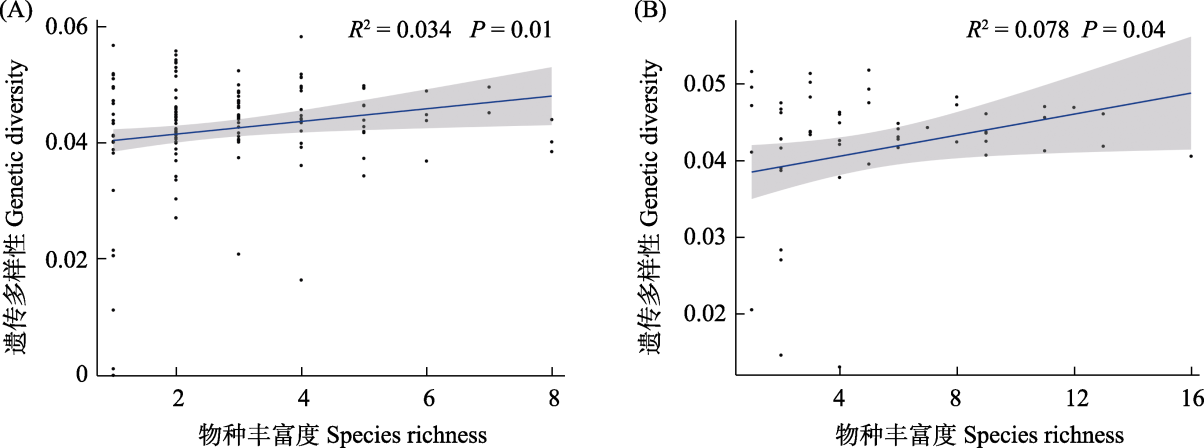
图3 以1° × 1° (A)和2° × 2° (B)网格为操作单元的物种丰富度与遗传多样性之间的单变量线性回归
Fig. 3 Univariate linear regressions between species richness and genetic diversity for freshwater crabs of the genus Sinopotamon based on 1° × 1° (A) and 2° × 2° (B) grids
| 环境变量 Environmental variables | 物种丰富度 Species richness | 遗传多样性 Genetic diversity | ||||
|---|---|---|---|---|---|---|
| 估计值 Estimate | 标准误 SE | t | 估计值 Estimate | 标准误 SE | t | |
| 截距 Intercept | -2.27E-16 | 0.06564 | -3.45E-15 | -3.61E-19 | 0.07223 | 4.99E-18 |
| 海拔 Altitude (ALT) | 0.681 | 0.144 | 4.730 | 0.179 | 0.082 | 1.960 |
| 年平均降水量 Mean annual precipitation (MAP) | 0.590 | 0.156 | 3.790 | 0.203 | 0.079 | 2.590 |
| 年温差 Temperature annual range (TAR) | 0.355 | 0.124 | 2.880 | -0.149 | 0.136 | -1.090 |
| 最湿季度均温 Mean temperature of wettest quarter (MTWQ) | 0.251 | 0.115 | 2.180 | -0.072 | 0.127 | -0.571 |
| 坡向 Aspect (ASP) | -0.048 | 0.079 | -0.607 | -0.105 | 0.087 | -1.210 |
| 降水量变异系数 Precipitation seasonality (PS) | -0.101 | 0.102 | -0.987 | -0.019 | 0.112 | -0.173 |
| 等温性 Isothermality (ISO) | -0.367 | 0.083 | -4.420 | -0.180 | 0.091 | -1.970 |
表2 1° × 1°网格分辨率下环境变量对华溪蟹属物种丰富度和遗传多样性影响的空间广义线性混合模型结果。粗体表示估计系数的95%置信区间明显偏离零。
Table 2 Results of spaGLMMs analyses evaluating the effects of environmental variables on species richness and genetic diversity of the genus Sinopotamon based on 1° × 1° grid. Bold font indicates that 95% confidence intervals of the estimated coefficients significantly deviated from zero.
| 环境变量 Environmental variables | 物种丰富度 Species richness | 遗传多样性 Genetic diversity | ||||
|---|---|---|---|---|---|---|
| 估计值 Estimate | 标准误 SE | t | 估计值 Estimate | 标准误 SE | t | |
| 截距 Intercept | -2.27E-16 | 0.06564 | -3.45E-15 | -3.61E-19 | 0.07223 | 4.99E-18 |
| 海拔 Altitude (ALT) | 0.681 | 0.144 | 4.730 | 0.179 | 0.082 | 1.960 |
| 年平均降水量 Mean annual precipitation (MAP) | 0.590 | 0.156 | 3.790 | 0.203 | 0.079 | 2.590 |
| 年温差 Temperature annual range (TAR) | 0.355 | 0.124 | 2.880 | -0.149 | 0.136 | -1.090 |
| 最湿季度均温 Mean temperature of wettest quarter (MTWQ) | 0.251 | 0.115 | 2.180 | -0.072 | 0.127 | -0.571 |
| 坡向 Aspect (ASP) | -0.048 | 0.079 | -0.607 | -0.105 | 0.087 | -1.210 |
| 降水量变异系数 Precipitation seasonality (PS) | -0.101 | 0.102 | -0.987 | -0.019 | 0.112 | -0.173 |
| 等温性 Isothermality (ISO) | -0.367 | 0.083 | -4.420 | -0.180 | 0.091 | -1.970 |
| 莫兰指数 Moran’s I | 预期指数 Expected index | 方差 Variance | Z | P | |
|---|---|---|---|---|---|
| 物种丰富度 Species richness | 0.3784651 | -0.005813953 | 0.0018715 | 205.4628 | 3.26E-19 |
| 遗传多样性 Genetic diversity | 0.4036666 | -0.005813953 | 0.0018401 | 222.6705 | 6.75E-22 |
表3 1° × 1°网格分辨率下华溪蟹属物种丰富度和遗传多样性分布格局的空间自相关分析结果
Table 3 Results of spatial autocorrelation analyses of species richness and genetic diversity distribution patterns in the genus Sinopotamon based on 1° × 1° grid
| 莫兰指数 Moran’s I | 预期指数 Expected index | 方差 Variance | Z | P | |
|---|---|---|---|---|---|
| 物种丰富度 Species richness | 0.3784651 | -0.005813953 | 0.0018715 | 205.4628 | 3.26E-19 |
| 遗传多样性 Genetic diversity | 0.4036666 | -0.005813953 | 0.0018401 | 222.6705 | 6.75E-22 |
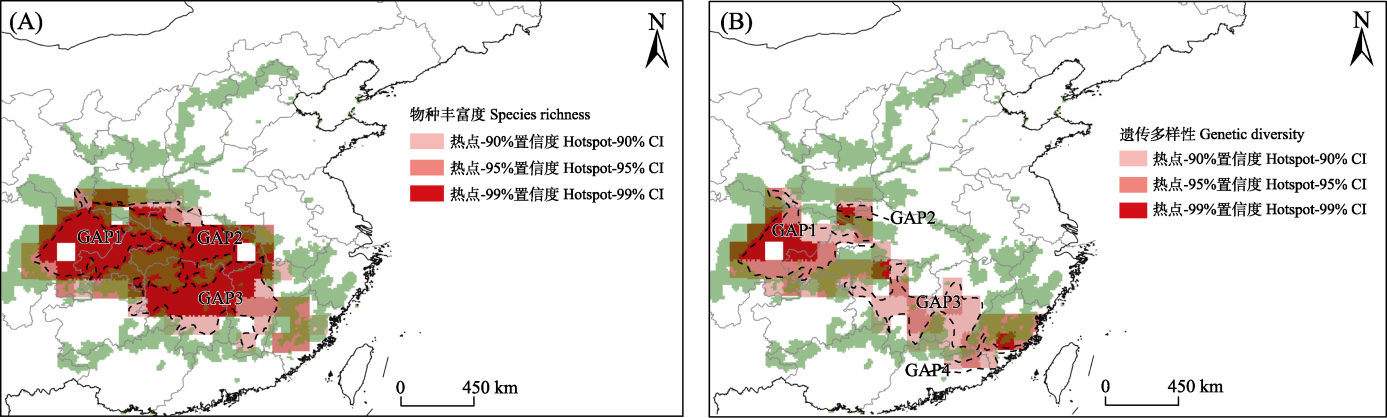
图4 华溪蟹属淡水蟹类热点地区与保护空缺区域的空间分布格局。(A)以1° × 1°网格为操作单元的物种丰富度格局; (B)以1° × 1°网格为操作单元的遗传多样性格局。红色网格代表热点区域, 绿色网格代表保护地区域。黑色虚线代表主要的保护空缺区域。CI表示置信区间。
Fig. 4 Spatial distribution patterns of biodiversity hotspots and conservation gaps for freshwater crabs of Sinopotamon. (A) Species richness patterns based on 1° × 1° grid; (B) Genetic diversity patterns based on 1° × 1° grid. Red grids represent biodiversity hotspots, green grids represent protected areas, and black dashed lines indicate major conservation gap areas. CI represents confidence interval.
| [1] | Afzali YA, Naderloo R, Keikhosravi A, Klaus S (2024) Geographic differentiation in the freshwater crab Potamon persicum Pretzmann, 1962 (Decapoda, Potamidae) in the Zagros Mountains: Evidence from morphometry. Zoosystema, 46, 77-93. |
| [2] |
Alves DFR, Martinez PA, Magalhães C, de Paiva Barros-Alves S, de Almeida AC, Amado TF (2024) Global patterns and predictors of primary freshwater crab richness across taxa and realms. Hydrobiologia, 851, 4149-4165.
DOI |
| [3] |
Bivand RS, Wong DWS (2018) Comparing implementations of global and local indicators of spatial association. TEST, 27, 716-748.
DOI |
| [4] | Chi XL, Zhang ZJ, Xu XT, Zhang XB, Zhao ZP, Liu YN, Wang QG, Wang H, Li Y, Yang G, Guo LP, Tang ZY, Huang LQ (2017) Threatened medicinal plants in China: Distributions and conservation priorities. Biological Conservation, 210, 89-95. |
| [5] |
Chu KL, Ma XP, Zhang ZW, Wang PF, Lü LN, Zhao Q, Sun HY (2018) A checklist for the classification and distribution of China’s freshwater crabs. Biodiversity Science, 26, 274-282. (in Chinese with English abstract)
DOI |
|
[楚克林, 马晓萍, 张泽伟, 王鹏飞, 吕琳娜, 赵强, 孙红英 (2018) 中国淡水蟹分类与分布名录(十足目: 拟地蟹科, 溪蟹科). 生物多样性, 26, 274-282.]
DOI |
|
| [6] | Costa L, Kiffer W Jr, Casotti C, Rangel J, Moretti M (2016) Influence of Trichodactylus fluviatilis on leaf breakdown in streams: Understanding the role of freshwater crabs in detritus-based food webs. Zoological Studies, 55, e54. |
| [7] |
Cumberlidge N, Ng PKL, Yeo DCJ, Magalhães C, Campos MR, Alvarez F, Naruse T, Daniels SR, Esser LJ, Attipoe FYK, Clotilde-Ba FL, Darwall W, McIvor A, Baillie JEM, Collen B, Ram M (2009) Freshwater crabs and the biodiversity crisis: Importance, threats, status, and conservation challenges. Biological Conservation, 142, 1665-1673.
DOI URL |
| [8] |
Cumberlidge N, Ng PKL, Yeo DCJ, Naruse T, Meyer KS, Esser LJ (2011) Diversity, endemism and conservation of the freshwater crabs of China (Brachyura: Potamidae and Gecarcinucidae). Integrative Zoology, 6, 45-55.
DOI PMID |
| [9] | Dai AY (1999) Fauna Sinica·Arthropoda·Crustacea·Malacostraca· Decapoda·Parathelphusidae, Potamidae. Science Press, Beijing. (in Chinese) |
| [戴爱云 (1999) 中国动物志∙节肢动物门∙甲壳动物亚门∙软甲纲∙十足目∙束腹蟹科, 溪蟹科. 科学出版社, 北京.] | |
| [10] |
Dijkstra KDB, Monaghan MT, Pauls SU (2014) Freshwater biodiversity and aquatic insect diversification. Annual Review of Entomology, 59, 143-163.
DOI URL |
| [11] |
Dudgeon D, Strayer DL (2025) Bending the curve of global freshwater biodiversity loss: What are the prospects? Biological Reviews, 100, 205-226.
DOI URL |
| [12] |
Edgar RC (2004) MUSCLE: A multiple sequence alignment method with reduced time and space complexity. BMC Bioinformatics, 5, 113.
PMID |
| [13] |
Exposito-Alonso M, Booker TR, Czech L, Gillespie L, Hateley S, Kyriazis CC, Lang PLM, Leventhal L, Nogues-Bravo D, Pagowski V, Ruffley M, Spence JP, Toro Arana SE, Weiß CL, Zess E (2022) Genetic diversity loss in the Anthropocene. Science, 377, 1431-1435.
DOI PMID |
| [14] |
Fang F, Ji YK, Zhao Q, Wang YJ, Gao W, Chu KL, Sun HY (2015) Phylogeography of the Chinese endemic freshwater crab Sinopotamon acutum (Brachyura, Potamidae). Zoologica Scripta, 44, 653-666.
DOI URL |
| [15] | Fang F, Sun HY, Zhao Q, Lin CT, Sun YF, Gao W, Xu JJ, Zhou JY, Ge F, Liu NF (2013) Patterns of diversity, areas of endemism, and multiple glacial refuges for freshwater crabs of the genus Sinopotamon in China (Decapoda: Brachyura: Potamidae). PLoS ONE, 8, e53143. |
| [16] |
Favre A, Päckert M, Pauls SU, Jähnig SC, Uhl D, Michalak I, Muellner-Riehl AN (2015) The role of the uplift of the Qinghai-Tibetan Plateau for the evolution of Tibetan biotas. Biological Reviews, 90, 236-253.
DOI URL |
| [17] |
Fick SE, Hijmans RJ (2017) WorldClim 2: New 1-km spatial resolution climate surfaces for global land areas. International Journal of Climatology, 37, 4302-4315.
DOI URL |
| [18] |
Geist J (2011) Integrative freshwater ecology and biodiversity conservation. Ecological Indicators, 11, 1507-1516.
DOI URL |
| [19] |
Getis A, Ord JK (1992) The analysis of spatial association by use of distance statistics. Geographical Analysis, 24(3), 189-206.
DOI URL |
| [20] |
Grenyer R, Orme CDL, Jackson SF, Thomas GH, Davies RG, Davies TJ, Jones KE, Olson VA, Ridgely RS, Rasmussen PC, Ding TS, Bennett PM, Blackburn TM, Gaston KJ, Gittleman JL, Owens IPF (2006) Global distribution and conservation of rare and threatened vertebrates. Nature, 444, 93-96.
DOI |
| [21] | Guénard B, Hughes AC, Lainé C, Cannicci S, Russell BD, Williams GA (2025) Limited and biased global conservation funding means most threatened species remain unsupported. Proceedings of the National Academy of Sciences, USA, 122, e2412479122. |
| [22] |
He K, Jiang XL (2014) Sky islands of southwest China. I. An overview of phylogeographic patterns. Chinese Science Bulletin, 59, 585-597.
DOI URL |
| [23] |
He XY, Ziegler AD, Elsen PR, Feng Y, Baker JCA, Liang SJ, Holden J, Spracklen DV, Zeng ZZ (2023) Accelerating global mountain forest loss threatens biodiversity hotspots. One Earth, 6, 303-315.
DOI URL |
| [24] | Hill MJ, Ryves DB, White JC, Wood PJ (2016) Macroinvertebrate diversity in urban and rural ponds: Implications for freshwater biodiversity conservation. Biological Conservation, 201, 50-59. |
| [25] |
Jackson JK, Füreder L (2006) Long-term studies of freshwater macroinvertebrates: A review of the frequency, duration and ecological significance. Freshwater Biology, 51, 591-603.
DOI URL |
| [26] |
Jesse R, Grudinski M, Klaus S, Streit B, Pfenninger M (2011) Evolution of freshwater crab diversity in the Aegean region (Crustacea: Brachyura: Potamidae). Molecular Phylogenetics and Evolution, 59, 23-33.
DOI PMID |
| [27] |
Ji YK, Sun YF, Gao W, Chu KL, Wang RC, Zhao Q, Sun HY (2016) Out of the Sichuan Basin: Rapid species diversification of the freshwater crabs in Sinopotamon (Decapoda: Brachyura: Potamidae) endemic to China. Molecular Phylogenetics and Evolution, 100, 80-94.
DOI URL |
| [28] | Kawai T, Cumberlidge N (2016) A Global Overview of the Conservation of Freshwater Decapod Crustaceans. Springer International Publishing, New York. |
| [29] |
Kong HH, Condamine FL, Harris AJ, Chen JL, Pan B, Möller M, Hoang VS, Kang M (2017) Both temperature fluctuations and East Asian monsoons have driven plant diversification in the karst ecosystems from southern China. Molecular Ecology, 26, 6414-6429.
DOI PMID |
| [30] |
Li C, Xiong KN, Wu GM (2013) Process of biodiversity research of Karst areas in China. Acta Ecologica Sinica, 33, 192-200.
DOI URL |
| [31] |
Li JJ, Li Q, Wu YX, Ye LQ, Liu HH, Wei JF, Huang XL (2021) Mountains act as museums and cradles for Hemipteran insects in China: Evidence from patterns of richness and phylogenetic structure. Global Ecology and Biogeography, 30, 1070-1085.
DOI URL |
| [32] | Liu MG (2010) Atlas of Physical Geography of China. SinoMaps Press, Beijing. (in Chinese) |
| [刘明光 (2010) 中国自然地理图集. 中国地图出版社, 北京.] | |
| [33] |
Luo WJ, Lapuz RS, Wee AKS (2024) Large-scale changes in the distribution of suitable habitat of the endangered subtropical canopy tree species Vatica guangxiensis under climate change. Biodiversity and Conservation, 33, 3187-3205.
DOI |
| [34] |
Manel S, Guerin PE, Mouillot D, Blanchet S, Velez L, Albouy C, Pellissier L (2020) Global determinants of freshwater and marine fish genetic diversity. Nature Communications, 11, 692.
DOI PMID |
| [35] | Mengel K, Daniels SR (2024) Hiding in the hills: Evidence for two novel mountain-dwelling freshwater crabs of Potamonautes (Decapoda: Brachyura: Potamonautidae) from South Africa. Journal of Crustacean Biology, 44, ruae026. |
| [36] |
Miraldo A, Li S, Borregaard MK, Flórez-Rodríguez A, Gopalakrishnan S, Rizvanovic M, Wang ZH, Rahbek C, Marske KA, Nogués-Bravo D (2016) An Anthropocene map of genetic diversity. Science, 353, 1532-1535.
PMID |
| [37] |
Molnar P, Boos WR, Battisti DS (2010) Orographic controls on climate and paleoclimate of Asia: Thermal and mechanical roles for the Tibetan Plateau. Annual Review of Earth and Planetary Sciences, 38, 77-102.
DOI URL |
| [38] |
Nipperess DA, Matsen FA IV (2013) The mean and variance of phylogenetic diversity under rarefaction. Methods in Ecology and Evolution, 4, 566-572.
DOI PMID |
| [39] |
Ord JK, Getis A (1995) Local spatial autocorrelation statistics: Distributional issues and an application. Geographical Analysis, 27, 286-306.
DOI URL |
| [40] | Ouyang ZY, Tang XP, Du A, Zang ZH, Xu WH (2023) Building China’s national park systems scientifically: Challenges and opportunities. National Park, 1, 67-74. (in Chinese with English abstract) |
| [欧阳志云, 唐小平, 杜傲, 臧振华, 徐卫华 (2023) 科学建设国家公园: 进展、挑战与机遇. 国家公园(中英文), 1, 67-74.] | |
| [41] |
Pan D, Shi BY, Du SY, Gu TY, Wang RX, Xing YH, Zhang Z, Chen JJ, Cumberlidge N, Sun HY (2022) Mitogenome phylogeny reveals Indochina Peninsula origin and spatiotemporal diversification of freshwater crabs (Potamidae: Potamiscinae) in China. Cladistics, 38, 1-12.
DOI PMID |
| [42] |
Pan T, Wu SH, He DM, Dai EF, Liu YJ (2012) Effects of longitudinal range-gorge terrain on the eco-geographical pattern in Southwest China. Journal of Geographical Sciences, 22, 825-842.
DOI |
| [43] |
Pebesma E (2018) Simple features for R: Standardized support for spatial vector data. The R Journal, 10, 439.
DOI URL |
| [44] | Primack RB (2006) Essentials of Conservation Biology, 6th edn. Oxford University Press, New York. |
| [45] |
Rahbek C, Borregaard MK, Antonelli A, Colwell RK, Holt BG, Nogues-Bravo D, Rasmussen CM, Richardson K, Rosing MT, Whittaker RJ, Fjeldså J (2019) Building mountain biodiversity: Geological and evolutionary processes. Science, 365, 1114-1119.
DOI PMID |
| [46] |
Reid AJ, Carlson AK, Creed IF, Eliason EJ, Gell PA, Johnson PTJ, Kidd KA, MacCormack TJ, Olden JD, Ormerod SJ, Smol JP, Taylor WW, Tockner K, Vermaire JC, Dudgeon D, Cooke SJ (2019) Emerging threats and persistent conservation challenges for freshwater biodiversity. Biological Reviews, 94, 849-873.
DOI URL |
| [47] | Sayer CA, Fernando E, Jimenez RR, Macfarlane NBW, Rapacciuolo G, Böhm M, Brook TM, Contreras-MacBeath T, Cox NA, Harrison I, Hoffmann M, Jenkins R, Smith KG, Vié JC, Abbott JC, Allen DJ, Allen GR, Barrios V, Boudot JP, Carrizo SF, Charvet P, Clausnitzer V, Congiu L, Crandall KA, Cumberlidge N, Cuttelod A, Dalton J, Daniels AG, Grave SD, Knijf GD, Dijkstra KDB, Dow RA, Freyhof J, García N, Gessner J, Getahun A, Gibson C, Gollock MJ, Grant MI, Groom AER, Hammer MP, Hammerson GA, Hilton-Taylor C, Hodgkinson L, Holland RA, Jabado RW, Bignoli DJ, Kalkman VJ, Karimov BK, Kipping J, Kottelat M, Lalèyè PA, Larson HK, Lintermans M, Lozano F, Ludwig A, Lyons TJ, Máiz-Tomé L, Molur S, Ng HH, Numa C, Palmer-Newton AF, Pike C, Pippard HE, Polaz CNM, Pollock CM, Raghavan R, Rand PS, Ravelomanana T, Reis RE, Rigby CL, Scott JA, Skelton PH, Sloat MR, Snoeks J, Stiassny MLJ, Tan HH, Taniguchi Y, Thorstad EB, Tognelli MF, Torres AG, Torres Y, Tweddle D, Watanabe K, Westrip JRS, Wright EGE, Zhang E, Darwall WR (2025) One-quarter of freshwater fauna threatened with extinction. Nature, 638, 138-145. |
| [48] | Scott JM, Davis F, Csuti B, Noss R, Butterfield B, Groves C, Anderson H, Caicco S, D’Erchia F, Edwards TC Jr, Ulliman J, Wright RG (1993) Gap analysis: A geographic approach to protection of biological diversity. Wildlife Monographs, 57, 1-41. |
| [49] |
Shi BY, Pan D, Sun YF, Liu XR, Lv XL, Cumberlidge N, Sun HY (2021) Regional climates shape the biogeographic history of a broadly distributed freshwater crab species complex. Journal of Biogeography, 48, 1432-1447.
DOI URL |
| [50] |
Shi BY, Pan D, Zhang KQ, Gu TY, Yeo DCJ, Ng PKL, Cumberlidge N, Sun HY (2024) Diversification of freshwater crabs on the sky islands in the Hengduan Mountains Region, China. Molecular Phylogenetics and Evolution, 190, 107955.
DOI URL |
| [51] |
Shi BY, Wang RX, Song DH, Xu JJ, Zhu L, Sun YF, Hu R, Cumberlidge N, Pan D, Sun HY (2025) Paleoclimate fluctuations facilitate the biogeographical history of endemic species of freshwater crabs in China via cycles of introgressive hybridisation and habitat isolation. Journal of Biogeography, 52, 750-766.
DOI URL |
| [52] |
Stendera S, Adrian R, Bonada N, Cañedo-Argüelles M, Hugueny B, Januschke K, Pletterbauer F, Hering D (2012) Drivers and stressors of freshwater biodiversity patterns across different ecosystems and scales: A review. Hydrobiologia, 696, 1-28.
DOI URL |
| [53] |
Sundar S, Heino J, de Oliveira Roque F, Simaika JP, Melo AS, Tonkin JD, Gomes Nogueira D, Silva DP (2020) Conservation of freshwater macroinvertebrate biodiversity in tropical regions. Aquatic Conservation: Marine and Freshwater Ecosystems, 30, 1238-1250.
DOI URL |
| [54] |
Vilela B, Villalobos F (2015) letsR: A new R package for data handling and analysis in macroecology. Methods in Ecology and Evolution, 6, 1229-1234.
DOI URL |
| [55] |
Wang B, Zhong X, Xu Y, Cheng YH, Ran JH, Zhang JD, Yang N, Yang B, Zhou CQ (2023) Optimizing the Giant Panda National Park’s zoning designations as an example for extending conservation from flagship species to regional biodiversity. Biological Conservation, 281, 109996.
DOI URL |
| [56] |
Wang RX, Pan D, Chen H, Zhu BQ, Sun HY (2022) Revision of two species of Sinopotamon Bott, 1967 (Crustacea, Brachyura, Potamidae) endemic to China: A new combination and a new synonym. ZooKeys, 1112, 179.
DOI URL |
| [57] | Wickham H (2011) ggplot2. WIREs Computational Statistics, 3, 180-185. |
| [58] | Xu W, Wu YH, Zhou WW, Chen HM, Zhang BL, Chen JM, Xu WH, Rao DQ, Zhao HP, Yan F, Yuan ZY, Jiang K, Jin J-Q, Hou M, Zou DH, Wang LJ, Zheng YC, Li JT, Jiang JP, Zeng XM, Chen YH, Liao Z-Y, Li C, Li XY, Gao W, Wang K, Zhang D-R, Lu CQ, Yin TT, Ding ZL, Zhao GG, Chai J, Zhao WG, Zhang YP, Wiens JJ, Che J (2024) Hidden hotspots of amphibian biodiversity in China. Proceedings of the National Academy of Sciences, USA, 121, e2320674121. |
| [59] | Xu WH, Zhao L, Han M, Ouyang ZY (2023) Assessment of species conservation status by National Park planning. National Park, 1, 11-16. (in Chinese with English abstract) |
| [徐卫华, 赵磊, 韩梅, 欧阳志云 (2023) 国家公园空间布局物种保护状况评估. 国家公园(中英文), 1, 11-16.] | |
| [60] |
Xu Y, Shen ZH, Ying LX, Wang ZH, Huang JH, Zang RG, Jiang YX (2017) Hotspot analyses indicate significant conservation gaps for evergreen broadleaved woody plants in China. Scientific Reports, 7, 1859.
DOI PMID |
| [61] |
Yang C, Wenger SJ, Rugenski AT, Wehrtmann IS, Connelly S, Freeman MC (2020) Freshwater crabs (Decapoda: Pseudothelphusidae) increase rates of leaf breakdown in a neotropical headwater stream. Freshwater Biology, 65, 1673-1684.
DOI URL |
| [62] |
Yao FX, Shi BY, Wang XQ, Pan D, Bai M, Yan J, Cumberlidge N, Sun HY (2020) Rapid divergent coevolution of Sinopotamon freshwater crab genitalia facilitates a burst of species diversification. Integrative Zoology, 15, 174-186.
DOI URL |
| [63] | Ye PC, Zhang GF, Wu JY (2020) Hotspots and conservation gaps: A case study of key higher plant species from Northwest Yunnan, China. Global Ecology and Conservation, 23, e1005. |
| [64] |
Yeo DCJ, Ng PKL, Cumberlidge N, Magalhães C, Daniels SR, Campos MR (2008) Global diversity of crabs (Crustacea: Decapoda: Brachyura) in freshwater. Hydrobiologia, 595, 275-286.
DOI URL |
| [65] |
Zeng YW, Yeo DCJ (2018) Assessing the aggregated risk of invasive crayfish and climate change to freshwater crabs: A Southeast Asian case study. Biological Conservation, 223, 58-67.
DOI URL |
| [66] | Zhang LB, Luo ZH, Mallon D, Li CW, Jiang ZG (2017) Biodiversity conservation status in China’s growing protected areas. Biological Conservation, 210, 89-100. |
| [67] | Zhang LS (2012) Paleogeography of China:The Formation of China’s Natural Environment. Science Press, Beijing. (in Chinese) |
| [张兰生 (2012) 中国古地理: 中国自然环境的形成. 科学出版社, 北京.] | |
| [68] |
Zhang XY, Ci XQ, Zhu RB, Conran JG, Li J (2022) Spatial phylogenetic patterns and conservation of threatened woody species in a transition zone of southwest China. Biodiversity and Conservation, 31, 2205-2225.
DOI |
| [1] | 贾晓旭, 陈皖强, 唐修君, 樊艳凤, 张静, 王海威, 高玉时. 西南地区家鸡线粒体DNA控制区遗传多样性和基因渗入[J]. 生物多样性, 2026, 34(5): 26003-. |
| [2] | 鲁夕霞, 周冯祥, 雍李明, 曾千慧, 赵丽媛, 张语克, 王先艳. 1990-2020年围填海对我国中华白海豚栖息地的影响[J]. 生物多样性, 2026, 34(3): 25249-. |
| [3] | 姜媛, 黄贝希, 贾学圆, 梁思, 谢雨彤, 范平, 宋刚. 一种基于不等长DNA序列的单倍型丰富度估算方法[J]. 生物多样性, 2026, 34(1): 25263-. |
| [4] | 周智成, 曹天玲, 刘如垚, 丁琪琪, 马轲, 杨丽萍, 周传江, 聂国兴, 汤永涛. 基于线粒体COI基因的黄河流域麦穗鱼种群遗传多样性与遗传结构[J]. 生物多样性, 2025, 33(8): 24501-. |
| [5] | 范平, 王欢, 温知新, 宋刚, 雷富民. 气候因子对鸟类遗传多样性与物种分布面积关系的影响[J]. 生物多样性, 2025, 33(8): 25072-. |
| [6] | 薛瑞翔, 马雪蓉, 吴炯文, 刘爱君, 张细权, 季从亮, 殷颖珊, 朱炜健, 罗庆斌. 中山麻鸭群体遗传多样性与遗传结构[J]. 生物多样性, 2025, 33(8): 24592-. |
| [7] | 范平, 温知新, 宋刚. 气候因子和人类活动对两栖及哺乳动物不同遗传多样性指标的影响[J]. 生物多样性, 2025, 33(8): 25022-. |
| [8] | 李基才, 邵长亮, 高帅帅, 李佳. 新疆卡拉麦里国家公园候选区蒙古野驴夏季水源利用规律、活动范围和适宜生境分布[J]. 生物多样性, 2025, 33(7): 24509-. |
| [9] | 李艳朋, 陈洁, 卢春洋, 许涵. 海南尖峰岭热带山地雨林64 ha次生林动态监测样地群落结构特征[J]. 生物多样性, 2025, 33(2): 24445-. |
| [10] | 伍金山, 杨长乐, 马玉凤, 李亚旋, 高文家, 叶·库斯力, 叶樑洪, 杨宇骄, 徐梦琦, 廖廷琼, 钟林强, 单文娟. 艾比湖湿地国家级自然保护区马鹿遗传多样性及遗传结构[J]. 生物多样性, 2025, 33(12): 25233-. |
| [11] | 王嘉陈, 徐汤俊, 许唯, 张高季, 尤艺瑾, 阮宏华, 刘宏毅. 城市景观格局对大蚰蜒种群遗传结构的影响[J]. 生物多样性, 2025, 33(1): 24251-. |
| [12] | 王艳丽, 张英, 戚春林, 张昌达, 史佑海, 杜彦君, 丁琼. 海南热带雨林国家公园生物多样性热点与保护空缺区域识别: 基于大型真菌与植物视角[J]. 生物多样性, 2024, 32(7): 24081-. |
| [13] | 冯晨, 张洁, 黄宏文. 统筹植物就地保护与迁地保护的解决方案: 植物并地保护(parallel situ conservation)[J]. 生物多样性, 2023, 31(9): 23184-. |
| [14] | 李庆多, 栗冬梅. 全球蝙蝠巴尔通体流行状况分析[J]. 生物多样性, 2023, 31(9): 23166-. |
| [15] | 齐海玲, 樊鹏振, 王跃华, 刘杰. 中国北方六省区胡桃的遗传多样性和群体结构[J]. 生物多样性, 2023, 31(8): 23120-. |
| 阅读次数 | ||||||
|
全文 |
|
|||||
|
摘要 |
|
|||||
备案号:京ICP备16067583号-7
Copyright © 2026 版权所有 《生物多样性》编辑部
地址: 北京香山南辛村20号, 邮编:100093
电话: 010-62836137, 62836665 E-mail: biodiversity@ibcas.ac.cn
