

生物多样性 ›› 2024, Vol. 32 ›› Issue (10): 24262. DOI: 10.17520/biods.2024262 cstr: 32101.14.biods.2024262
谭娟1,2, 朱丹丹3, 王卿1, 王敏1,*( )
)
收稿日期:2024-06-25
接受日期:2024-09-12
出版日期:2024-10-20
发布日期:2024-12-09
通讯作者:
*E-mail: wangm@saes.sh.cn
基金资助:
Juan Tan1,2, Dandan Zhu3, Qing Wang1, Min Wang1,*()
Received:2024-06-25
Accepted:2024-09-12
Online:2024-10-20
Published:2024-12-09
Contact:
*E-mail: wangm@saes.sh.cn
Supported by:摘要:
公园绿地是维持城市生物多样性的关键生境。鸟类作为城市生物多样性的指示类群, 其生物多样性格局和保护已成为城市生态学研究的热点, 近年来被动声学技术的应用逐渐成为鸟类多样性监测的发展趋势。为了探讨被动声学技术与传统样线调查方法在城市公园绿地鸟类监测中的有效性差异, 本研究于2023年7月至2024年4月选择上海外环林带典型公园绿地, 采用声纹设备和样线调查法监测鸟类多样性, 在3种生境类型中各布设1套声纹设备, 每天24 h每小时采集前15 min的动物声音数据, 基于无监督音节聚类分析对数据进行处理, 将监测结果与样线调查进行深入比较分析, 评估了两种监测方法的有效性。结果表明: 声纹设备共记录鸟类11目28科49种, 样线调查共记录鸟类5目19科32种, 二者均记录到雀形目种类最多。两种方法监测到的共有种为24种, 监测到的鸟类居留型组成特征一致, 均以留鸟为主。声纹设备记录到的优势种种类多于样线调查, 白头鹎(Pycnonotus sinensis)、珠颈斑鸠(Spilopelia chinensis)、乌鸫(Turdus mandarinus)和灰喜鹊(Cyanopica cyanus)为二者均记录到的优势种。就不同生境而言, 两种方法均以林湿复合混交林监测到种类数最多, 而林湿复合纯林和混交林种类水平相当, 各生境类型均以春秋季鸟类种类和数量相对较多, 但两种方法监测到的鸟类优势度指数、多样性和均匀度指数等群落特征及其季节变化存在较大差异。基于被动声学的鸟类智慧化监测为城市生物多样性保护研究提供了新的技术路径, 可与传统调查技术方法相结合, 提升监测数据的准确性和全面性。
谭娟, 朱丹丹, 王卿, 王敏 (2024) 被动声学技术在城市公园绿地鸟类多样性监测中的应用: 以上海闵行区春申公园为例. 生物多样性, 32, 24262. DOI: 10.17520/biods.2024262.
Juan Tan, Dandan Zhu, Qing Wang, Min Wang (2024) Application of passive acoustic technology in monitoring bird diversity in urban park green space: A case study of Chunshen Park in Minhang District, Shanghai. Biodiversity Science, 32, 24262. DOI: 10.17520/biods.2024262.
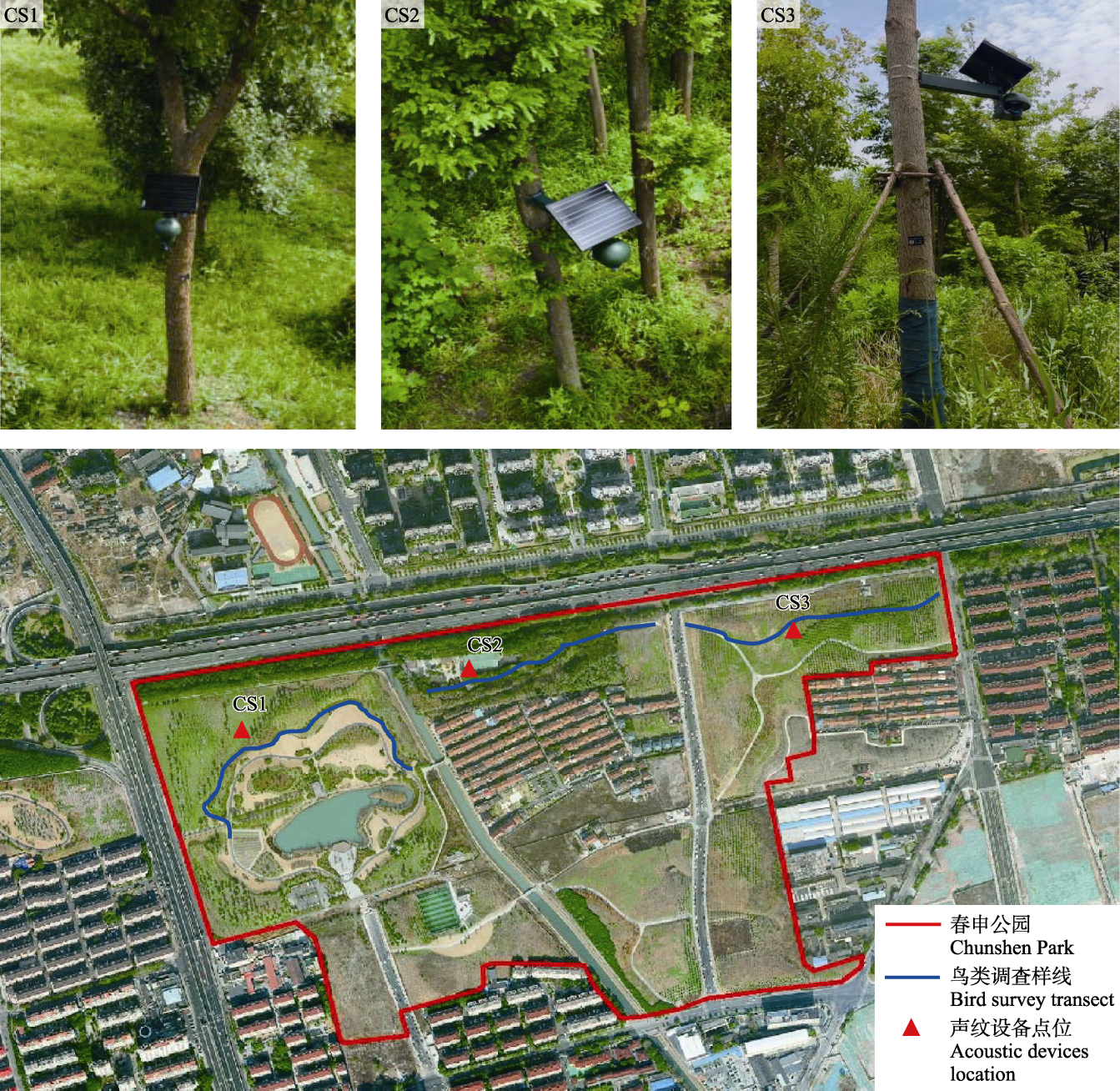
图1 春申公园鸟类多样性监测声纹设备及调查样线布设图。CS1: 林湿复合混交林; CS2: 林湿复合纯林; CS3: 混交林。
Fig. 1 Distribution of voicing equipments and survey transects for bird biodiversity monitoring in Chunshen Park. CS1, Mixed forest in forest-wetland complex; CS2, Monotypic forest in forest-wetland complex; CS3, Mixed forest.
| 处理流程 Process flow | 数据状态 Data status | 数据量 Data volume | ||
|---|---|---|---|---|
| 林湿复合混交林 Mixed forest in forest-wetland complex (CS1) | 林湿复合纯林 Monotypic forest in forest-wetland complex (CS2) | 混交林 Mixed forest (CS3) | ||
| 1. 筛选置信度 ≥ 60%的独立事件数据 Filter independent event data with a confidence level of at least 60% | 有效数据 Valid data | 6,368 | 3,335 | 1,650 |
| 2. 专家初步确认 Preliminary confirmation by experts | 确认 Confirm | 6,289 | 3,298 | 1,624 |
| 待确认 To be confirmed | 79 | 37 | 26 | |
| 3. 二次识别确认 Secondary identification confirmation | 无效数据 Invalid data | 14 | 2 | 4 |
| 确认 Confirm | 26 | 10 | 8 | |
| 修改 Modify | 39 | 25 | 14 | |
| 4. 最终确认 Final confirmation | 准确数据 Accurate data | 6,354 | 3,333 | 1,646 |
表1 春申公园鸟类多样性监测声纹设备监测数据处理信息表
Table 1 Data processing information of acoustic equipment for bird biodiversity monitoring in Chunshen Park
| 处理流程 Process flow | 数据状态 Data status | 数据量 Data volume | ||
|---|---|---|---|---|
| 林湿复合混交林 Mixed forest in forest-wetland complex (CS1) | 林湿复合纯林 Monotypic forest in forest-wetland complex (CS2) | 混交林 Mixed forest (CS3) | ||
| 1. 筛选置信度 ≥ 60%的独立事件数据 Filter independent event data with a confidence level of at least 60% | 有效数据 Valid data | 6,368 | 3,335 | 1,650 |
| 2. 专家初步确认 Preliminary confirmation by experts | 确认 Confirm | 6,289 | 3,298 | 1,624 |
| 待确认 To be confirmed | 79 | 37 | 26 | |
| 3. 二次识别确认 Secondary identification confirmation | 无效数据 Invalid data | 14 | 2 | 4 |
| 确认 Confirm | 26 | 10 | 8 | |
| 修改 Modify | 39 | 25 | 14 | |
| 4. 最终确认 Final confirmation | 准确数据 Accurate data | 6,354 | 3,333 | 1,646 |
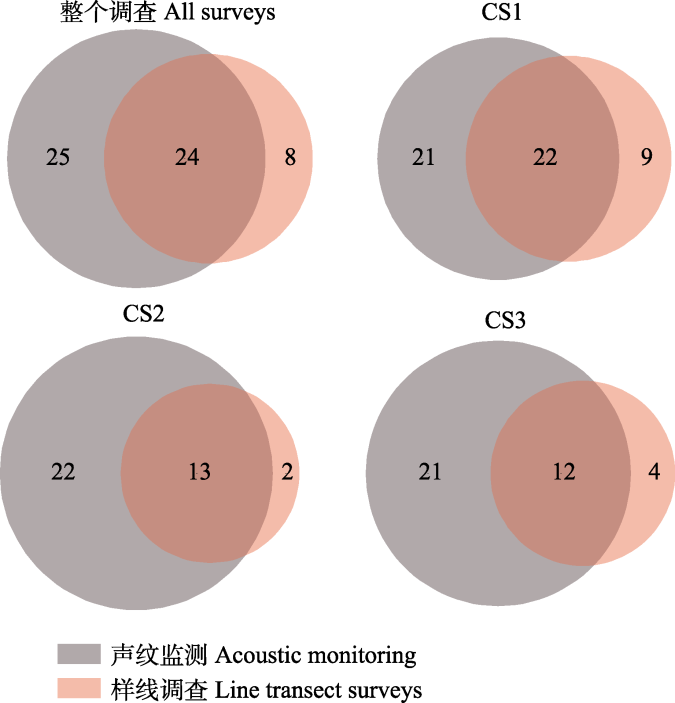
图2 声纹监测与样线调查的春申公园鸟类群落组成对比。CS1: 林湿复合混交林; CS2: 林湿复合纯林; CS3: 混交林。
Fig. 2 Comparison of bird community composition between acoustic monitoring and line transect surveys in Chunshen Park. CS1, Mixed forest in forest-wetland complex; CS2, Monotypic forest in forest-wetland complex; CS3, Mixed forest.
| 监测方法 Monitoring method | 多样性指数 Diversity index | 林湿复合混交林 Mixed forest in forest-wetland complex (CS1) | 林湿复合纯林 Monotypic forest in forest-wetland complex (CS2) | 混交林 Mixed forest (CS3) |
|---|---|---|---|---|
| 声纹监测 Acoustic monitoring | Simpson优势度指数 Simpson dominance index | 0.269 | 0.210 | 0.172 |
| Shannon-Wiener多样性指数 Shannon-Wiener diversity index | 1.408 | 1.336 | 1.600 | |
| Pielou均匀度指数 Pielou evenness index | 0.374 | 0.376 | 0.458 | |
| 样线调查 Line transect surveys | Simpson优势度指数 Simpson dominance index | 0.106 | 0.159 | 0.486 |
| Shannon-Wiener多样性指数 Shannon-Wiener diversity index | 2.646 | 2.135 | 1.316 | |
| Pielou均匀度指数 Pielou evenness index | 0.771 | 0.788 | 0.475 |
表2 声纹监测和样线调查的春申公园鸟类群落特征
Table 2 Characteristics of bird communities investigated by acoustic monitoring and line transect surveys in Chunshen Park
| 监测方法 Monitoring method | 多样性指数 Diversity index | 林湿复合混交林 Mixed forest in forest-wetland complex (CS1) | 林湿复合纯林 Monotypic forest in forest-wetland complex (CS2) | 混交林 Mixed forest (CS3) |
|---|---|---|---|---|
| 声纹监测 Acoustic monitoring | Simpson优势度指数 Simpson dominance index | 0.269 | 0.210 | 0.172 |
| Shannon-Wiener多样性指数 Shannon-Wiener diversity index | 1.408 | 1.336 | 1.600 | |
| Pielou均匀度指数 Pielou evenness index | 0.374 | 0.376 | 0.458 | |
| 样线调查 Line transect surveys | Simpson优势度指数 Simpson dominance index | 0.106 | 0.159 | 0.486 |
| Shannon-Wiener多样性指数 Shannon-Wiener diversity index | 2.646 | 2.135 | 1.316 | |
| Pielou均匀度指数 Pielou evenness index | 0.771 | 0.788 | 0.475 |
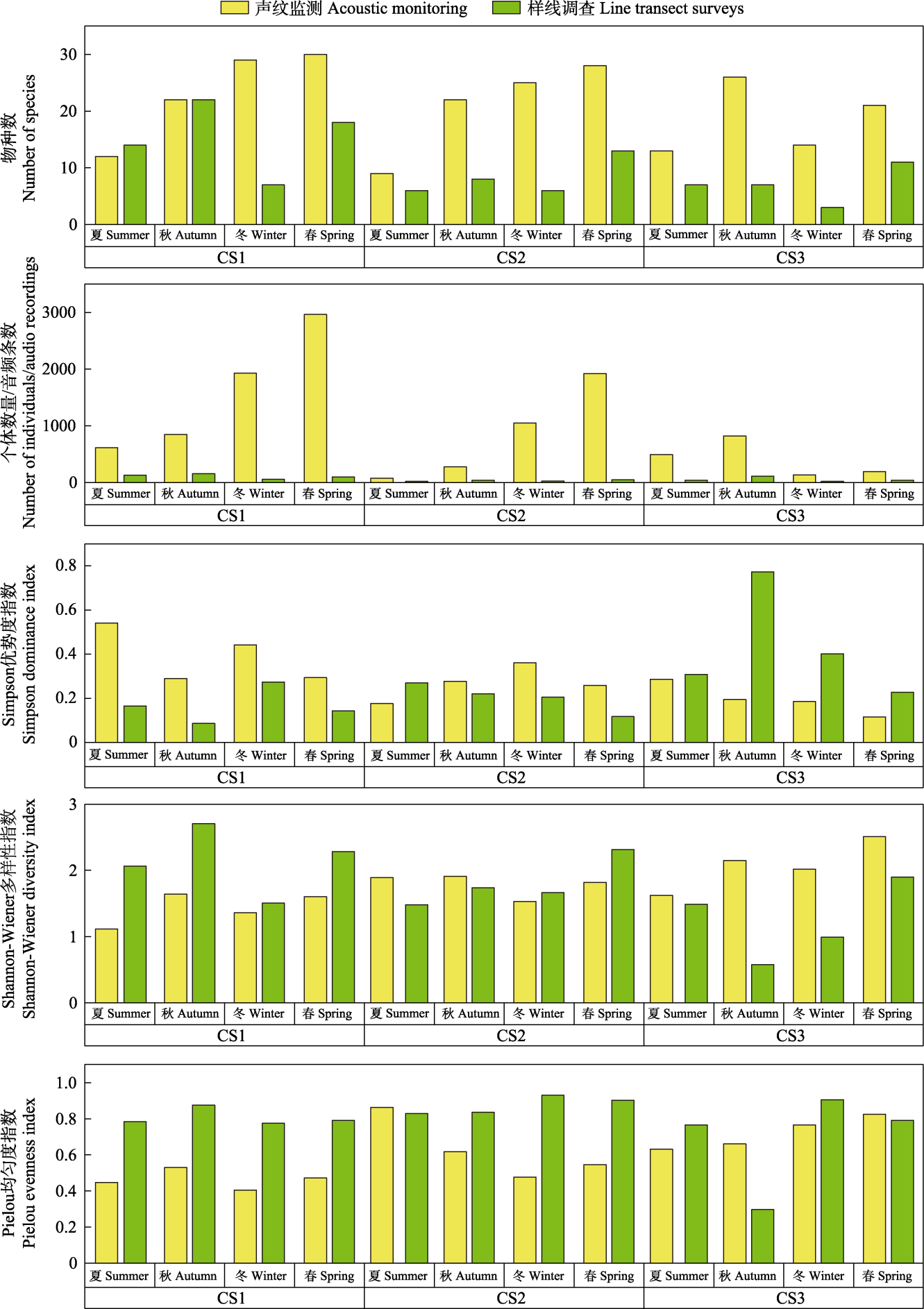
图3 声纹监测和样线调查鸟类群落结构季节变化特征。CS1: 林湿复合混交林; CS2: 林湿复合纯林; CS3: 混交林。
Fig. 3 Seasonal variation characteristics of bird community structure surveyed by acoustic monitoring and line transect surveys. CS1, Mixed forest in forest-wetland complex; CS2, Monotypic forest in forest-wetland complex; CS3, Mixed forest.
| [1] |
Alcocer I, Lima H, Sugai LSM, Llusia D (2022) Acoustic indices as proxies for biodiversity: A meta-analysis. Biological Reviews of the Cambridge Philosophical Society, 97, 2209-2236.
DOI PMID |
| [2] | Budka M, Jobda M, Szałański P, Piórkowski H (2022) Acoustic approach as an alternative to human-based survey in bird biodiversity monitoring in agricultural meadows. PLoS ONE, 17, e0266557. |
| [3] | Campos IB, Landers TJ, Lee KD, Lee WG, Friesen MR, Gaskett AC, Ranjard L (2019) Assemblage of focal species recognizers-AFSR: A technique for decreasing false indications of presence from acoustic automatic identification in a multiple species context. PLoS ONE, 14, e0212727. |
| [4] |
Cen YH, Wang P, Chen QC, Zhang CY, Yu S, Hu K, Liu Y, Xiao RB (2023) Spatiotemporal characteristics and influencing factors of animal soundscape in urban green spaces. Biodiversity Science, 31, 22359. (in Chinese with English abstract)
DOI |
|
[岑渝华, 王鹏, 陈庆春, 张承云, 余上, 胡珂, 刘阳, 肖荣波 (2023) 城市绿地动物声景的时空特征及其驱动因素. 生物多样性, 31, 22359.]
DOI |
|
| [5] | Da Silva A, Samplonius JM, Schlicht E, Valcu M, Kempenaers B (2014) Artificial night lighting rather than traffic noise affects the daily timing of dawn and dusk singing in common European songbirds. Behavioral Ecology, 25, 1037-1047. |
| [6] | Kahl S (2020) Bird NET: A deep learning solution for avian diversity monitoring. Ecological Informatics, 55, 101019. |
| [7] |
Keitt TH, Abelson ES (2021) Ecology in the age of automation. Science, 373, 858-859.
DOI PMID |
| [8] | Knight EC, Hannah KC, Foley GJ, Scott CD, Brigham RM, Bayne E (2017) Recommendations for acoustic recognizer performance assessment with application to five common automated signal recognition programs. Avian Conservation and Ecology, 12, 14. |
| [9] | Kumar P, Singh R (2023) Artificial intelligence and machine learning for automatic wildlife identification: Recent trends and future directions. Computer Applications in Engineering Education, 31, 220-237. |
| [10] |
Li G, Fang C, Li Y, Wang Z, Sun S, He S, Qi W, Bao C, Ma H, Fan Y, Feng Y, Liu X (2022) Global impacts of future urban expansion on terrestrial vertebrate diversity. Nature Communications, 13, 1628.
DOI PMID |
| [11] | Lu Y, Yang Y, Sun B, Yuan J, Yu M, Stenseth NC, Bullock JM, Obersteiner M (2020) Spatial variation in biodiversity loss across China under multiple environmental stressors. Science Advances, 6, eabd0952. |
| [12] | Lun KH, Zhang YY, Xia CW (2017) Bird diversity monitoring based on sound index. Bulletin of Biology, 52(11), 1-5. (in Chinese) |
| [伦可环, 张雁云, 夏灿玮 (2017) 基于声音指数的鸟类多样性监测. 生物学通报, 52(11), 1-5.] | |
| [13] | McDonald RI, Mansur AV, Ascensão F, Colbert M, Crossman K, Elmqvist T, Gonzalez A, Güneralp B, Haase D, Hamann M, Hillel O, Huang K, Kahnt B, Maddox D, Pacheco A, Pereira HM, Seto KC, Simkin R, Walsh B, Werner AS, Ziter C (2020) Research gaps in knowledge of the impact of urban growth on biodiversity. Nature Sustainability, 3, 16-24. |
| [14] | Mendes R, Nunes VL, Marabuto E, Costa GJ, Silva SE, Paulo OS, Simões PC (2023) Testing drivers of acoustic divergence in cicadas (Cicadidae: Tettigettalna). Journal of Evolutionary Biology, 36, 461-479. |
| [15] | Oestreich WK, Oliver RY, Chapman MS, Go M, McKenna MF (2024) Listening to animal behavior to understand changing ecosystems. Trends in Ecology & Evolution, 39, 961-973. |
| [16] | Ortega-Álvarez R, MacGregor-Fors I (2009) Living in the big city: Effects of urban land-use on bird community structure, diversity, and composition. Landscape and Urban Planning, 90, 189-195. |
| [17] | Peet RK (1975) Relative diversity indices. Ecology, 56, 496-498. |
| [18] | Pellissier V, Cohen M, Boulay A, Clergeau P (2012) Birds are also sensitive to landscape composition and configuration within the city centre. Landscape and Urban Planning, 104, 181-188. |
| [19] | Pielou EC (1966) The measurement of diversity in different types of biological collections. Journal of Theoretical Biology, 13, 131-144. |
| [20] |
Rajan SC, Athira K, Jaishanker R, Sooraj NP, Sarojkumar V (2019) Rapid assessment of biodiversity using acoustic indices. Biodiversity and Conservation, 28, 2371-2383.
DOI |
| [21] | Sharma S, Sato K, Gautam BP (2023) A methodological literature review of acoustic wildlife monitoring using artificial intelligence tools and techniques. Sustainability, 15, 7128. |
| [22] | Scott JM, Csuti B, Jacobi JD, Estes JE (1987) Species richness. BioScience, 37, 782-788. |
| [23] | Simkin RD, Seto KC, McDonald RI, Jetz W (2022) Biodiversity impacts and conservation implications of urban land expansion projected to 2050. Proceedings of the National Academy of Sciences, USA, 119, e2117297119. |
| [24] |
Stowell D, Wood MD, Pamuła H, Stylianou Y, Glotin H (2019) Automatic acoustic detection of birds through deep learning: The first Bird Audio Detection challenge. Methods in Ecology and Evolution, 10, 368-380.
DOI |
| [25] |
Sugai LSM, Silva TSF, Ribeiro JW Jr, Llusia D (2019) Terrestrial passive acoustic monitoring: Review and perspectives. BioScience, 69, 15-25.
DOI |
| [26] | Tian YL, Sun XF, Lü XY, Li X (2022) Characteristics and influencing factors of urban bird diversity in China. Journal of Southwest University (Natural Science Edition), 44(12), 39-49. (in Chinese with English abstract) |
| [田永莲, 孙秀锋, 吕鲜艳, 李旭 (2022) 我国城市鸟类多样性特征及其影响因素研究. 西南大学学报(自然科学版), 44(12), 39-49.] | |
| [27] |
Tuia D, Kellenberger B, Beery S, Costelloe BR, Zuffi S, Risse B, Mathis A, Mathis MW, van Langevelde F, Burghardt T, Kays R, Klinck H, Wikelski M, Couzin ID, van Horn G, Crofoot MC, Stewart CV, Berger-Wolf T (2022) Perspectives in machine learning for wildlife conservation. Nature Communications, 13, 792.
DOI PMID |
| [28] | Wang X, Chen X, Zhang Z (2023) A review of low-power wildlife monitoring devices and their applications in ecological research. Ecological Informatics, 78, 10163. |
| [29] | Wang YP, Ding P, Chen SH, Zheng GM (2013) Nestedness of bird assemblages on urban woodlots: Implications for conservation. Landscape and Urban Planning, 111, 59-67. |
| [30] | Wei C, Luo CQ (2014) Review of studies on acoustic behavior of cicadas and its systematic and ecological significances. Acta Agriculturae Boreali-Occidentalis Sinica, 23(6), 1-10. (in Chinese with English abstract) |
| [魏琮, 罗昌庆 (2014) 蝉总科昆虫的发声行为及相关系统学与生态学研究进展. 西北农业学报, 23(6), 1-10.] | |
| [31] |
Whelan CJ, Şekercioğlu ÇH, Wenny DG (2015) Why birds matter: From economic ornithology to ecosystem services. Journal of Ornithology, 156, 227-238.
DOI |
| [32] |
Wu KY, Ruan WD, Zhou DF, Chen QC, Zhang CY, Pan XY, Yu S, Liu Y, Xiao RB (2023) Syllable clustering analysis-based passive acoustic monitoring technology and its application in bird monitoring. Biodiversity Science, 31, 22370. (in Chinese with English abstract)
DOI |
|
[吴科毅, 阮文达, 周棣锋, 陈庆春, 张承云, 潘新园, 余上, 刘阳, 肖荣波 (2023) 基于音节聚类分析的被动声学监测技术及其在鸟类监测中的应用. 生物多样性, 31, 22370.]
DOI |
|
| [33] | Yang G, Wang Y, Xu J, Ding YZ, Wu SY, Tang HM, Li HQ, Wang XM, Ma B, Wang ZH (2015) The influence of habitat types on bird community in urban parks. Acta Ecologica Sinica, 35, 4186-4195. (in Chinese with English abstract) |
| [杨刚, 王勇, 许洁, 丁由中, 吴时英, 唐海明, 李宏庆, 王小明, 马波, 王正寰 (2015) 城市公园生境类型对鸟类群落的影响. 生态学报, 35, 4186-4195.] | |
| [34] | Zhang WW (2024) Community structure and diversity analysis of forest land birds on urban-rural gradients in Shanghai. Forest Inventory and Planning, 49, 164-169. (in Chinese with English abstract) |
| [张文文 (2024) 上海市城乡梯度上林地鸟类群落结构及多样性研究. 林业调查规划, 49, 164-169.] | |
| [35] | Zhao K, Chen G, Zhang YY (2023) Monitoring bird diversity in Xiao Longmen Forest Area of Beijing based on acoustic index. Journal of Beijing Normal University (Natural Sciences), 59, 607-613. (in Chinese with English abstract) |
| [赵凯, 陈功, 张雁云 (2023) 基于声学指数监测北京小龙门林区鸟类多样性. 北京师范大学学报(自然科学版), 59, 607-613.] |
| [1] | 郝泽周, 申小莉, 斯幸峰, 赵岩岩, 魏晨韬, 吴飞, 许晓青, 阙品甲, 董路, 华方圆, 张立勋, 张承云, 刘阳. 中国鸟类被动声学监测规范与建议[J]. 生物多样性, 2026, 34(5): 25474-. |
| [2] | 贾晓旭, 陈皖强, 唐修君, 樊艳凤, 张静, 王海威, 高玉时. 西南地区家鸡线粒体DNA控制区遗传多样性和基因渗入[J]. 生物多样性, 2026, 34(5): 26003-. |
| [3] | 梁健超, 陈淑甜, 何文祥, 熊春妮, 许镇洲, 黄源欣, 刘源志弘, 张浪, 胡慧建. 广州市陆生野生脊椎动物资源——编目、分布与保护[J]. 生物多样性, 2026, 34(5): 25422-. |
| [4] | 张海龙, 聂海燕, 刘萌萌, 魏美才, 李泽建. 浙江乌岩岭叶蜂多样性分布及影响因素[J]. 生物多样性, 2026, 34(5): 25459-. |
| [5] | 谢冰, 杨海涛, 曹吉鑫, 李进宇, 王茂良, 张微, 李建强, 徐基良. 应用激光雷达技术探究北京地区乌鸦夜栖地选择机制[J]. 生物多样性, 2026, 34(5): 26004-. |
| [6] | 梁竣策, 李开枝, 谭烨辉. 南海翼足类物种多样性与分布[J]. 生物多样性, 2026, 34(5): 25487-. |
| [7] | 白梓彤, 王成, 齐志勇. 北京中心城区公园中生物声对植被三维结构的响应[J]. 生物多样性, 2026, 34(4): 25218-. |
| [8] | 姚可侃, 余卉, 张巧玲, 陈琳. AI声纹监测与人工样线调查在鸟类多样性监测中的差异比较: 以西溪国家湿地公园为例[J]. 生物多样性, 2026, 34(4): 25239-. |
| [9] | 周丽洁, 郝珉辉, 何怀江, 程艳霞, 张春雨, 赵秀海. 小兴安岭森林β多样性格局、组分及其影响因素[J]. 生物多样性, 2026, 34(4): 25443-. |
| [10] | 蒋翠憶, 谢致敬, 田中平, 李玥莹, 郑明心, 房帅, 米尔卡米力∙麦麦提, 依里帆∙艾克拜尔江, 高梅香, 张健. 微地形生境异质性对新疆西天山森林土壤跳虫群落分异的塑造作用[J]. 生物多样性, 2026, 34(4): 25300-. |
| [11] | 王露红, 李波, 杨攀艳, 黄嘉琴, 谢予婷, 杜鑫, 文毅, 王彬. 四川省繁殖鸟类群落的多维度多样性及其影响因子[J]. 生物多样性, 2026, 34(4): 25464-. |
| [12] | 彭昀月, 彭奎, 刘昕然, 孙天怡, 张小全. 生物多样性信用的企业参与途径、市场发展障碍与建议[J]. 生物多样性, 2026, 34(4): 26031-. |
| [13] | 李伯尧, 盛天成, 幸小云. 生物多样性风险对企业财务绩效的影响: 来自中国上市公司的证据[J]. 生物多样性, 2026, 34(4): 25330-. |
| [14] | 张同, 梁力文, 王长剑, 舒服, 王璐, 郭泽光, 卓玛曲珍, 钱芊, 蒋安莉, 敖俊杰, 彭兴文, 伍小刚, 向左甫, 郭克疾, 廖梓延. 基于红外相机的西藏芒康滇金丝猴国家级自然保护区鸟兽多样性及代表性物种的季节性空间利用特征[J]. 生物多样性, 2026, 34(4): 25435-. |
| [15] | 刘昊, 张玉霄, 刘冰, 李飞飞, 马洪峥, 覃海宁, 李德铢, 陈文俐. 中国禾本科植物多样性及其物种名录[J]. 生物多样性, 2026, 34(4): 25438-. |
| 阅读次数 | ||||||
|
全文 |
|
|||||
|
摘要 |
|
|||||
备案号:京ICP备16067583号-7
Copyright © 2026 版权所有 《生物多样性》编辑部
地址: 北京香山南辛村20号, 邮编:100093
电话: 010-62836137, 62836665 E-mail: biodiversity@ibcas.ac.cn
