

生物多样性 ›› 2026, Vol. 34 ›› Issue (4): 25239. DOI: 10.17520/biods.2025239 cstr: 32101.14.biods.2025239
姚可侃1,2, 余卉1,2, 张巧玲1,2, 陈琳1,2,*( )
)
收稿日期:2025-06-22
接受日期:2025-10-09
出版日期:2026-04-20
发布日期:2026-05-27
通讯作者:
*E-mail: 542819075@qq.com
基金资助:
Kekan Yao1,2, Hui Yu1,2, Qiaoling Zhang1,2, Lin Chen1,2,*()
Received:2025-06-22
Accepted:2025-10-09
Online:2026-04-20
Published:2026-05-27
Contact:
*E-mail: 542819075@qq.com
Supported by:摘要:
鸟类多样性特征是评价湿地生态系统质量的重要指标。传统鸟类多样性调查多限于人工观测, 而近年来声纹监测技术逐步应用, 为鸟类多样性研究提供了新途径。为对比AI声纹监测与人工样线调查差异, 本研究于2024年1月(冬季)、4月(春季)、8月(夏季)和10月(秋季), 在杭州西溪国家湿地公园选取5处人工样线调查与声纹监测设备重合的样区开展同步监测。声纹监测选取77.5%作为置信阈值输出数据, 基于Simpson优势度指数(C)、Shannon-Wiener多样性指数(H′)、Pielou均匀度指数(J)和Margalef丰富度指数(M)等指标, 评估两种方法的适用性与局限性。结果表明: (1)四季累计, 声纹监测设备检测到鸟类105种, 人工样线记录鸟类89种; 声纹监测在物种丰富度(S)上表现更优。(2)按居留型看, 声纹监测对候鸟的检出更优, 人工样线则在留鸟的检出上更优; 声纹监测也能贡献区域新记录。(3)两种方法各指数的季节变化不完全一致, 声纹监测在C及M上多数季节较高, 更易捕捉优势物种信号且S表现更佳; 人工样线调查在H′及J上多数季节较高, 更能反映群落的综合多样性及物种分布的均衡程度。(4)按区域看, 声纹监测下绿堤/水下长廊的H′、J、M最高, 人工样线调查则以莲花滩最高。总体来看, 声纹监测适合长期、广时段的动态监测, 具有广阔前景, 可与人工样线调查互补, 建议建立识别置信度与质量控制阈值的评估体系, 提升方法准确性与可比性。
姚可侃, 余卉, 张巧玲, 陈琳 (2026) AI声纹监测与人工样线调查在鸟类多样性监测中的差异比较: 以西溪国家湿地公园为例. 生物多样性, 34, 25239. DOI: 10.17520/biods.2025239.
Kekan Yao, Hui Yu, Qiaoling Zhang, Lin Chen (2026) Comparing AI voiceprint monitoring and line transect surveys for avian diversity: A case study of Xixi National Wetland Park. Biodiversity Science, 34, 25239. DOI: 10.17520/biods.2025239.
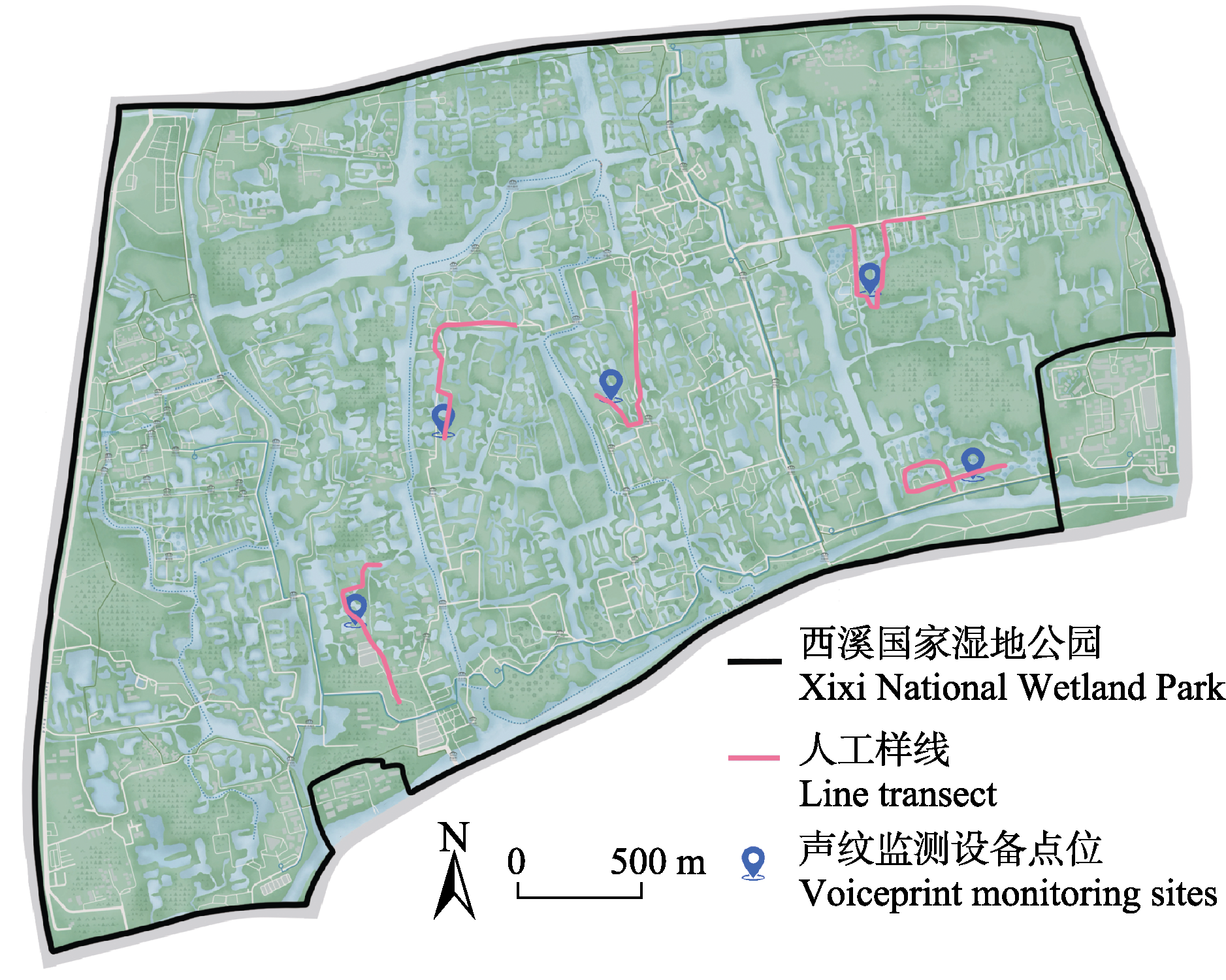
图1 西溪国家湿地公园人工样线调查路线及声纹监测设备点位
Fig. 1 Line transect survey routes and voiceprint monitoring sites in Xixi National Wetland Park
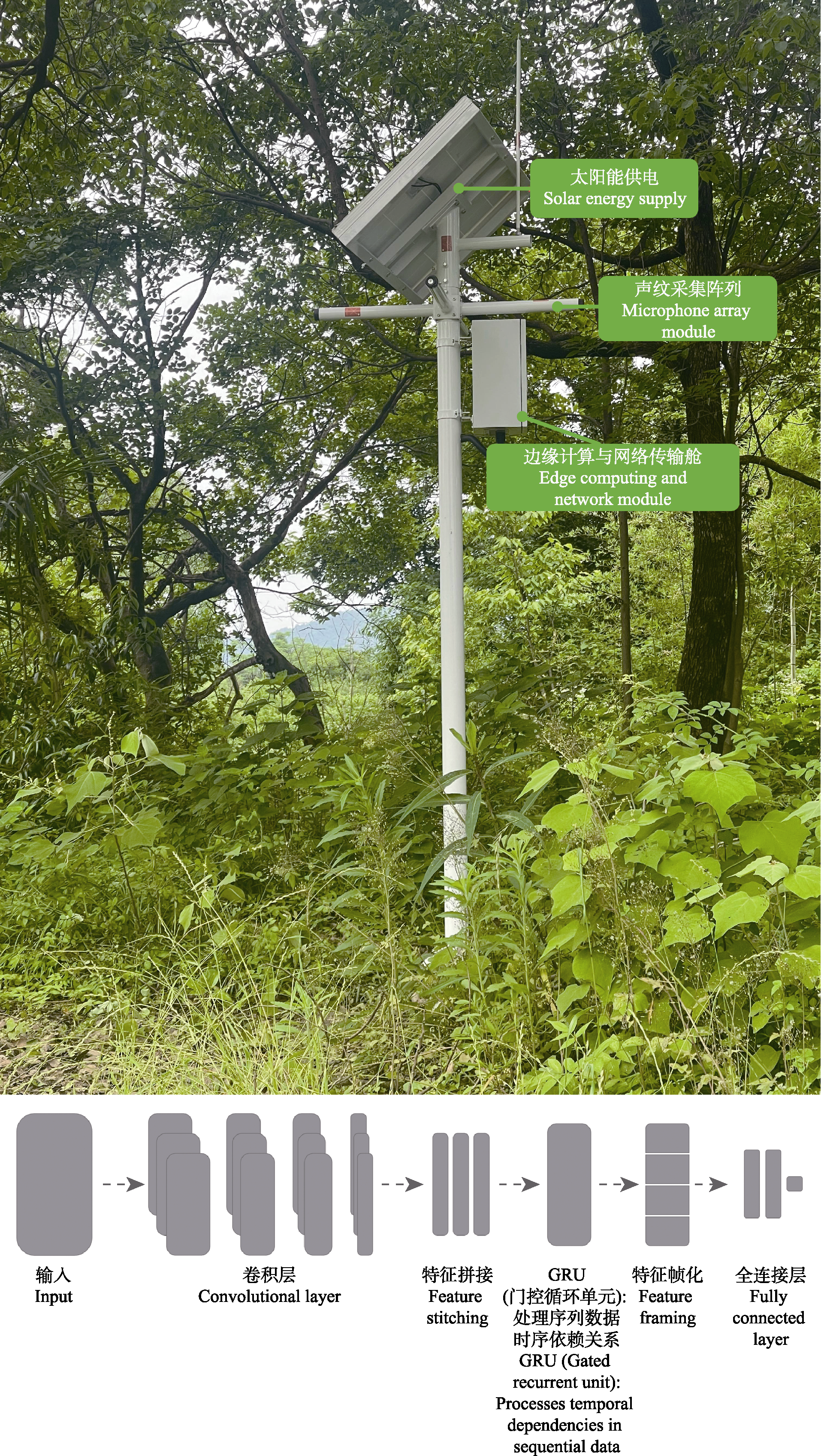
图2 声纹监测设备现场布设及声学识别流程图
Fig. 2 On-site deployment of voiceprint monitoring devices and acoustic recognition process
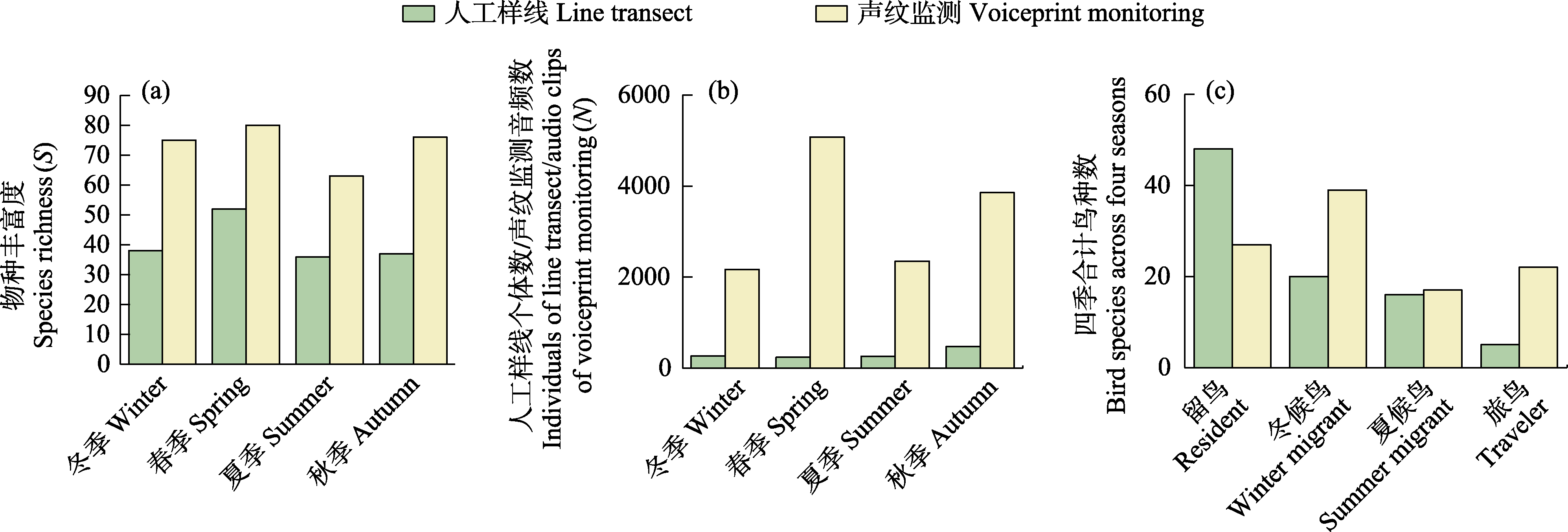
图3 各季节人工样线和声纹监测记录的鸟类数量
Fig. 3 Seasonal bird numbers recorded by line transect and voiceprint monitoring
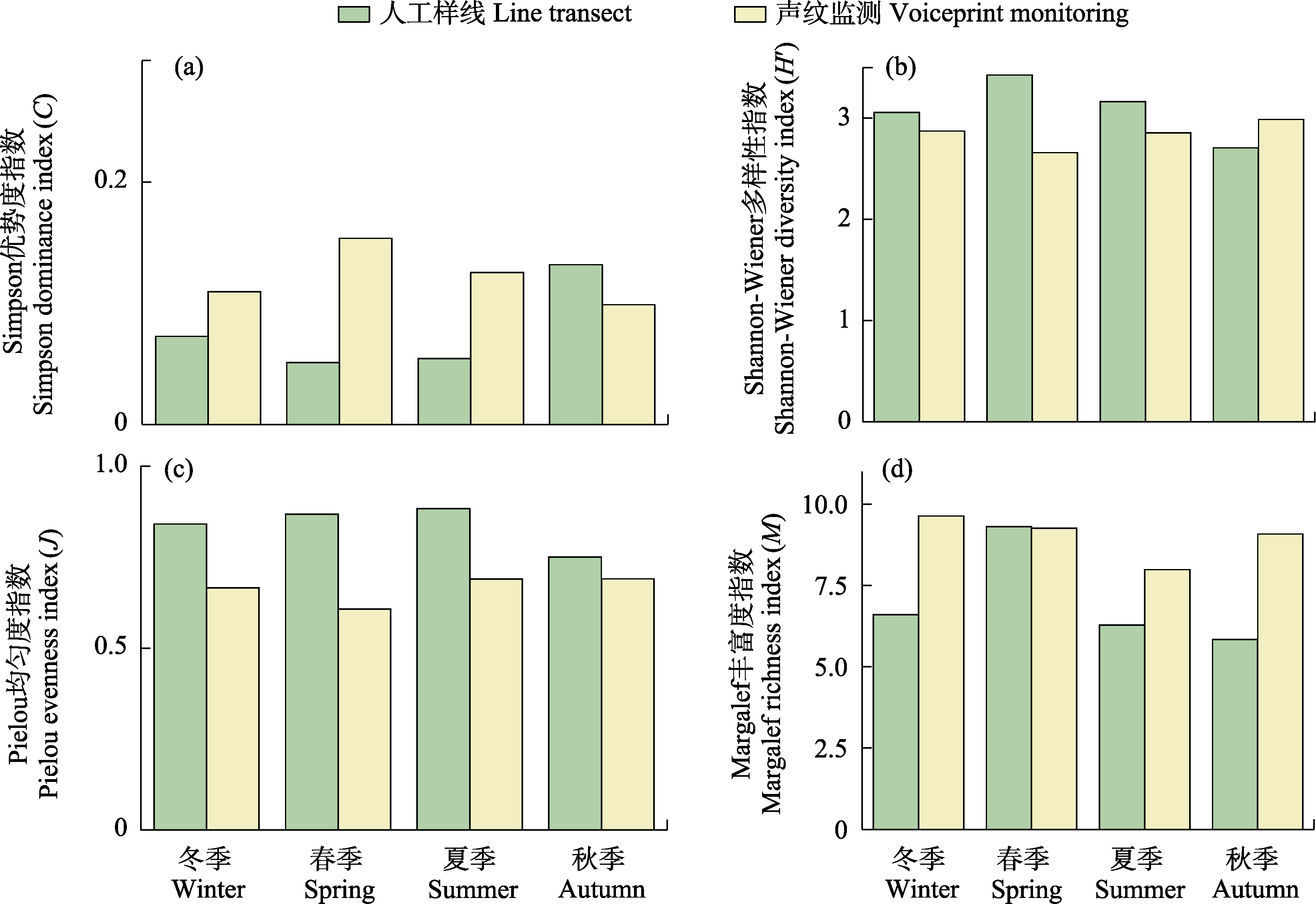
图4 各季节基于人工样线和声纹监测计算的鸟类多样性指数
Fig. 4 Avian diversity indices calculated by line transect and voiceprint monitoring in each season
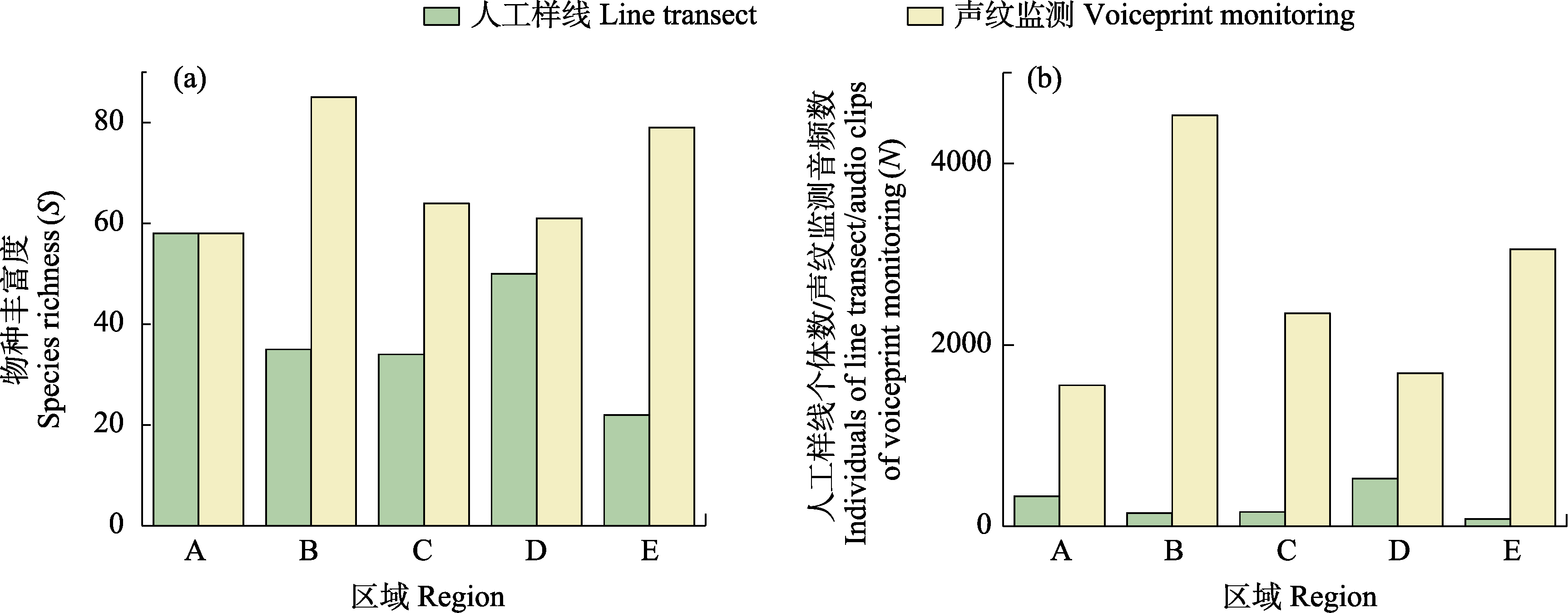
图5 各区域人工样线和声纹监测记录的鸟类数量。A: 莲花滩; B: 绿堤/水下长廊; C: 虾龙滩; D: 烟水渔庄/百家溇; E: 费家塘。
Fig. 5 Regional bird numbers recorded by line transect and voiceprint monitoring. A, Lianhuatan; B, Lüdi/Shuixiachanglang; C, Xialongtan; D, Yanshuiyuzhuang/Baijialou; E, Feijiatang.
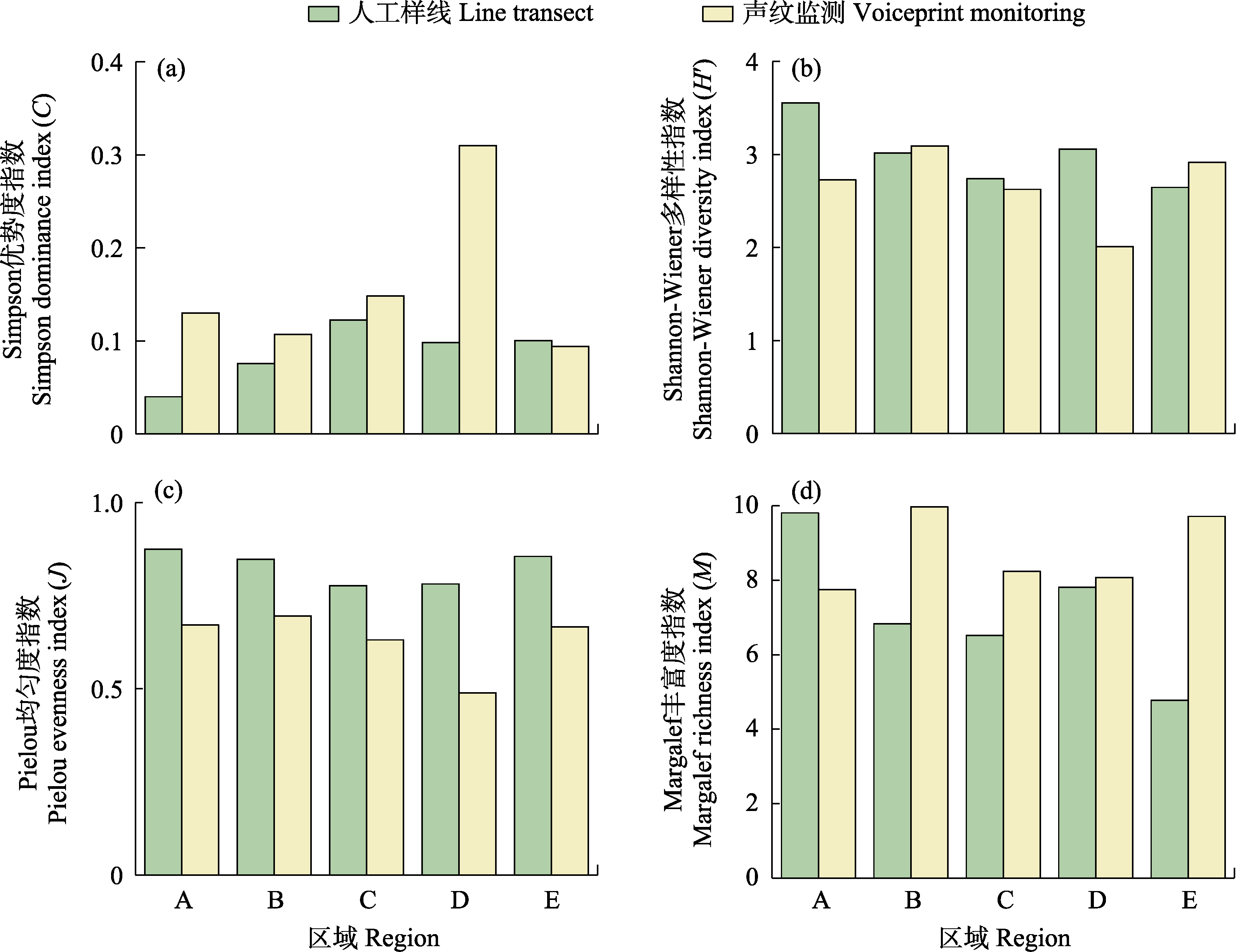
图6 各区域人工样线和声纹监测计算的鸟类群落多样性指数。A: 莲花滩; B: 绿堤/水下长廊; C: 虾龙滩; D: 烟水渔庄/百家溇; E: 费家塘。
Fig. 6 Regional avian community diversity indices calculated by line transect and voiceprint monitoring. A, Lianhuatan; B, Lüdi/Shuixiachanglang; C, Xialongtan; D, Yanshuiyuzhuang/Baijialou; E, Feijiatang.
| [1] | Alldredge MW, Simons TR, Pollock KH (2007) A field evaluation of distance measurement error in auditory avian point count surveys. Journal of Wildlife Management, 71, 2759-2766. |
| [2] |
Azar JF, Bell BD (2016) Acoustic features within a forest bird community of native and introduced species in New Zealand. Emu-Austral Ornithology, 116, 22-31.
DOI URL |
| [3] |
Bian Q, Wang C, Cheng H, Han D, Zhao YL, Yin LQ (2023) Exploring the application of acoustic indices in the assessment of bird diversity in urban forests. Biodiversity Science, 31, 22080.(in Chinese with English abstract)
DOI |
|
[边琦, 王成, 程贺, 韩丹, 赵伊琳, 殷鲁秦 (2023) 声学指数在城市森林鸟类多样性评估中的应用. 生物多样性, 31, 22080.]
DOI |
|
| [4] | Bibby CJ, Burgess ND, Hill DA, Mustoe S (2000) Bird Census Techniques, 2nd edn. Academic Press, London. |
| [5] |
Brandes TS (2008) Automated sound recording and analysis techniques for bird surveys and conservation. Bird Conservation International, 18, S163-S173.
DOI URL |
| [6] |
Cai YT, Gan XJ, Ma ZJ (2010) A comparison of line transect and point count surveys: A case study of spring saltmarsh birds at Chongming Dongtan. Biodiversity Science, 18, 44-49.(in Chinese with English abstract)
DOI |
|
[蔡音亭, 干晓静, 马志军 (2010) 鸟类调查的样线法和样点法比较: 以崇明东滩春季盐沼鸟类调查为例. 生物多样性, 18, 44-49.]
DOI |
|
| [7] | Chen HL, Sun HX, Qi J, Gao CX, Yan JQ (2015) Research of birds call recognition method based on multi-feature fusion. Journal of Nanjing University (Natural Sciences), 51, 1234-1239.(in Chinese with English abstract) |
| [陈海兰, 孙海信, 齐洁, 高春仙, 颜佳泉 (2015) 基于多维特征联合的鸟类鸣声识别方法研究. 南京大学学报(自然科学版), 51, 1234-1239.] | |
| [8] |
Darras K, Batáry P, Furnas BJ, Grass I, Mulyani YA, Tscharntke T (2019) Autonomous sound recording outperforms human observation for sampling birds: A systematic map and user guide. Ecological Applications, 29, e01954.
DOI URL |
| [9] |
Derksen DA, Thomas AG, Lafond GP, Loeppky HA, Swanton CJ (1995) Impact of post-emergence herbicides on weed community diversity within conservation-tillage systems. Weed Research, 35, 311-320.
DOI URL |
| [10] |
Hao ZZ, Zhang CY, Li L, Gao BT, Zeng W, Wang C, Wang ZX, Huang WT, Zhang Y, Pei NC, Xiao ZS (2024) Applications of passive acoustic monitoring and evaluation in urban bird research. Biodiversity Science, 32, 24123.(in Chinese with English abstract)
DOI |
|
[郝泽周, 张承云, 李乐, 高丙涛, 曾伟, 王淳, 王梓炫, 黄万涛, 张悦, 裴男才, 肖治术 (2024) 城市鸟类多样性被动声学监测与评价技术应用. 生物多样性, 32, 24123.]
DOI |
|
| [11] | He Y, Xu MY (2024) Study on construction of wetland bird habitat in Guangdong Province. Forestry Construction, 42(4), 1-9.(in Chinese with English abstract) |
| [何颖, 许铭宇 (2024) 广东省湿地鸟类栖息地营建研究. 林业建设, 42(4), 1-9.] | |
| [12] |
Jetz W, Thomas GH, Joy JB, Hartmann K, Mooers AO (2012) The global diversity of birds in space and time. Nature, 491, 444-448.
DOI |
| [13] | Johnson DH, Shaffer TL, Newton WE (2002) Statistics and the scientific method: A response to Anderson et al. (2000). Wildlife Society Bulletin, 30, 931-934. |
| [14] | Kahl S, Denton T, Klinck H, Glotin H, Goëau H, Vellinga WP, Planqué R, Joly A (2021a) Overview of BirdCLEF 2021:Bird call identification in soundscape recordings. In: CLEF 2021 Working Notes, CEUR Workshop Proceedings, pp. 1437-1450. Conference and Labs of the Evaluation Forum, Bucharest. |
| [15] |
Kahl S, Wood CM, Eibl M, Klinck H (2021b) BirdNET: A deep learning solution for avian diversity monitoring. Ecological Informatics, 61, 101236.
DOI URL |
| [16] |
Klingbeil BT, Willig MR (2015) Bird biodiversity assessments in temperate forest: The value of point count versus acoustic monitoring protocols. PeerJ, 3, e973.
DOI URL |
| [17] | Knight EC, Hannah KC, Foley GJ, Scott CD, Brigham RM, Bayne EM (2017) Recommendations for acoustic recognizer performance assessment with application to five common automated signal recognition programs. Avian Conservation and Ecology, 12, 7. |
| [18] |
Kobayashi S (1980) A model of the species rank-abundance relation for a community in an open habitat. Population Ecology, 22, 51-68.
DOI URL |
| [19] |
Lei Q, Li JY, Ma KM (2018) Applications of remote sensing technology in avian ecology. Biodiversity Science, 26, 862-877.(in Chinese with English abstract)
DOI |
|
[雷倩, 李金亚, 马克明 (2018) 遥感技术在鸟类生态学研究中的应用. 生物多样性, 26, 862-877.]
DOI |
|
| [20] | Li XM, Cheng RM, Xiao WF, Pan KY, Qian FW (2020) Waterbird monitoring: History, status and future perspectives in China. Wetland Science, 18, 633-645.(in Chinese with English abstract) |
| [李秀明, 程瑞梅, 肖文发, 盘凯筠, 钱法文 (2020) 水鸟监测: 历史与现状及其在中国未来发展的建议. 湿地科学, 18, 633-645.] | |
| [21] | Liu Y, Chen SH (2021) The CNG Field Guide to the Birds of China. Hunan Science and Technology Press, Changsha.(in Chinese) |
| [刘阳, 陈水华 (2021) 中国鸟类观察手册. 湖南科技出版社, 长沙.] | |
| [22] |
Lostanlen V, Salamon J, Farnsworth A, Kelling S, Bello JP (2019) Robust sound event detection in bioacoustic sensor networks. PLoS ONE, 14, e0214168.
DOI URL |
| [23] |
Peet RK (1975) Relative diversity indices. Ecology, 56, 496-498.
DOI URL |
| [24] |
Pielou EC (1966) The measurement of diversity in different types of biological collections. Journal of Theoretical Biology, 13, 131-144.
DOI URL |
| [25] |
Priyadarshani N, Marsland S, Castro I (2022) Application of unsupervised representation learning for bird song detection. Ecological Informatics, 68, 101540.
DOI URL |
| [26] | Ren SC, Ma SS, Zhang Y, Ji XY (2024) Research on bird diversity in spring and application of intelligent voiceprint monitoring in Suqian Santaishan National Forest Park. Environmental Monitoring and Forewarning, 16(5), 76-82.(in Chinese with English abstract) |
| [任诗超, 马士胜, 张悦, 纪轩禹 (2024) 宿迁三台山国家森林公园春季鸟类多样性研究及智能声纹监测方法应用. 环境监控与预警, 16(5), 76-82.] | |
| [27] |
Scott JM, Csuti B, Jacobi JD, Estes JE (1987) Species richness. BioScience, 37, 782-788.
DOI URL |
| [28] | Shonfield J, Bayne EM (2017) Autonomous recording units in avian ecological research: Current use and future applications. Avian Conservation and Ecology, 12, 14. |
| [29] |
Sugai LSM, Silva TSF, Ribeiro JW Jr, Llusia D (2019) Terrestrial passive acoustic monitoring: Review and perspectives. BioScience, 69, 15-25.
DOI |
| [30] | Sutherland WJ, Newton I, Green RE (2004) Bird Ecology and Conservation:A Handbook of Techniques. Oxford University Press, Oxford. |
| [31] | Tan J, Zhu DD, Wang Q, Wang M (2024) Application of passive acoustic technology in monitoring bird diversity in urban park green space: A case study of Chunshen Park in Minhang District, Shanghai. Biodiversity Science, 32, 24262.(in Chinese with English abstract) |
|
[谭娟, 朱丹丹, 王卿, 王敏 (2024) 被动声学技术在城市公园绿地鸟类多样性监测中的应用: 以上海闵行区春申公园为例. 生物多样性, 32, 24262.]
DOI |
|
| [32] |
Van Doren BM, Lostanlen V, Cramer A, Salamon J, Dokter A, Kelling S, Bello JP, Farnsworth A (2023) Automated acoustic monitoring captures timing and intensity of bird migration. Journal of Applied Ecology, 60, 433-444.
DOI URL |
| [33] | Wang HC, Wei Q, Du W, Wang F, Ge BJ, Ju RR (2023) Application of passive acoustic monitoring technology in avian monitoring at Jiuli Lake Wetland Park. Journal of Jiangsu Forestry Science & Technology, 50(3), 30-36.(in Chinese) |
| [王虎诚, 魏齐, 杜伟, 王菲, 葛秉珏, 鞠然然 (2023) 被动声学监测技术在九里湖湿地公园鸟类监测中的应用研究. 江苏林业科技, 50(3), 30-36.] | |
| [34] | Wang L, Chen W, Zhao Y, Li J (2019) Ecosystem service evaluation and management zoning of Xixi National Wetland Park. Wetlands Ecology and Management, 27, 543-555. |
| [35] | Wang YY, Xia F, Liu S, Peng T, Guo HM, Jian HF (2024) Research on bird sound recognition technology based on deep learning: Taking Beijing Cuihu National Urban Wetland Park as an example. Landscape Architecture Academic Journal, 41(4), 19-26.(in Chinese with English abstract) |
| [王一宇, 夏舫, 刘松, 彭涛, 郭慧敏, 鉴海防 (2024) 基于深度学习的鸟声识别技术研究——以北京翠湖国家城市湿地公园为例. 园林, 41(4), 19-26.] | |
| [36] | Wearn OR, Freeman R, Newell N, Harrison ME, Cheyne SM (2017) Rethinking camera traps: Improving accuracy of wildlife presence and abundance estimates. Ecological Indicators, 75, 151-157. |
| [37] |
Wrege PH, Bambi FBD, Malonga PJF, Samba OJ, Brncic T (2024) Early detection of human impacts using acoustic monitoring: An example with forest elephants. PLoS ONE, 19, e0306932.
DOI URL |
| [38] | Wu K, Li L, Wang JP, Zhang DR, Zhao AB, Li JQ, Xia Q (2024) Method for waterfowl detection based on improved YOLO v5. Journal of Hangzhou Normal University (Natural Science Edition), 23, 351-358.(in Chinese with English abstract) |
| [吴恺, 李黎, 王嘉芃, 张登荣, 赵安邦, 李俊青, 夏青 (2024) 基于改进YOLO v5的野外实景视频水鸟检测方法. 杭州师范大学学报(自然科学版), 23, 351-358.] | |
| [39] |
Wu KY, Ruan WD, Zhou DF, Chen QC, Zhang CY, Pan XY, Yu S, Liu Y, Xiao RB (2023) Syllable clustering analysis-based passive acoustic monitoring technology and its application in bird monitoring. Biodiversity Science, 31, 22370.(in Chinese with English abstract)
DOI |
|
[吴科毅, 阮文达, 周棣锋, 陈庆春, 张承云, 潘新园, 余上, 刘阳, 肖荣波 (2023) 基于音节聚类分析的被动声学监测技术及其在鸟类监测中的应用. 生物多样性, 31, 22370.]
DOI |
|
| [40] | Yang S, Frier R, Shi Q (2021) Acoustic classification of bird species using wavelets and learning algorithms. In: 13th International Conference on Machine Learning and Computing, pp. 67-71. Association for Computing Machinery, New York. |
| [41] | Yao ZY, Li CM, Wang JY, Li DF, Jiao YR, Weng C (2024) Research progress on biodiversity assessment methods based on soundscape: A bibliometric analysis. Acta Ecologica Sinica, 44, 2187-2197.(in Chinese) |
| [姚紫嫣, 李春明, 王静怡, 李大锋, 焦亚冉, 翁辰 (2024) 基于声景的生物多样性评估方法研究进展——基于文献计量分析. 生态学报, 44, 2187-2197.] | |
| [42] | Yi XM, Hua L, He H, You AJ, Yin H, Chen L, Hu JW (2023) Evaluation of water system connectivity in the Xixi Wetland based on graph theory. Wetland Science, 21, 951-960.(in Chinese with English abstract) |
| [易小梅, 滑磊, 何海, 尤爱菊, 殷浩, 陈琳, 胡静雯 (2023) 基于图论理论的西溪湿地水系连通性评价. 湿地科学, 21, 951-960.] | |
| [43] | You HL, Wu YM, Xu LG, Cheng JX, Liu LZ, Yao Z, Xin ZJ (2021) Application of soundscape monitoring technology in bird diversity monitoring at the typical wetland of Poyang Lake. Chinese Journal of Ecology, 40, 3025-3032.(in Chinese with English abstract) |
| [游海林, 吴永明, 徐力刚, 程俊翔, 刘丽贞, 姚忠, 辛在军 (2021) 声音监测技术在鄱阳湖典型湿地鸟类多样性监测中的应用. 生态学杂志, 40, 3025-3032.] | |
| [44] | Zhang CW, Hu JY, Liu WB, Feng QF, Zhang HY, Wang Y, Deng DJ, Hong J (2024) Spatiotemporal diversity of waterbirds in Jiaozuo section of Yellow River wetland. Biotic Resources, 46, 246-254.(in Chinese with English abstract) |
| [张春旺, 胡建业, 刘卫宾, 冯千凤, 张红嫄, 王颖, 邓大军, 洪军 (2024) 黄河湿地焦作段水鸟的时空多样性. 生物资源, 46, 246-254.] | |
| [45] |
Zhang CY, Jin NT, Xie J, Hao ZZ (2024) CicadaNet: Deep learning based automatic cicada chorus filtering for improved long-term bird monitoring. Ecological Indicators, 158, 111423.
DOI URL |
| [46] | Zhang Y, Shi Y, Dong X, Xu YM, Cai CY, Dang YF (2022) Study on bird diversity in Hanshiqiao Wetland Nature Reserve. Natural Protected Areas, 2(3), 43-49.(in Chinese with English abstract) |
| [张勇, 史洋, 董雪, 许亚明, 蔡春轶, 党永峰 (2022) 汉石桥湿地自然保护区鸟类多样性研究. 自然保护地, 2(3), 43-49.] | |
| [47] | Zhao K, Chen G, Zhang YY (2023) Bird diversity monitoring at Beijing Xiaolongmen Forest with acoustic indices. Journal of Beijing Normal University (Natural Science), 59, 607-613.(in Chinese with English abstract) |
| [赵凯, 陈功, 张雁云 (2023) 基于声学指数监测北京小龙门林区鸟类多样性. 北京师范大学学报(自然科学版), 59, 607-613.] | |
| [48] | Zheng GM (2023) A Checklist on the Classification and Distribution of the Birds of China, 4th edn. Science Press, Beijing.(in Chinese) |
| [郑光美 (2023) 中国鸟类分类与分布名录(第四版). 科学出版社, 北京.] |
| [1] | 郝泽周, 申小莉, 斯幸峰, 赵岩岩, 魏晨韬, 吴飞, 许晓青, 阙品甲, 董路, 华方圆, 张立勋, 张承云, 刘阳. 中国鸟类被动声学监测规范与建议[J]. 生物多样性, 2026, 34(5): 25474-. |
| [2] | 徐欢, 辛凤飞, 施宏亮, 袁琳, 薄顺奇, 赵欣怡, 邓帅涛, 潘婷婷, 余婧, 孙赛赛, 薛程. 生态修复技术集成应用对长江口北支生境与鸟类多样性提升效果评估[J]. 生物多样性, 2025, 33(5): 24478-. |
| [3] | 廖之锴, 白皓天, 张修瀚, 余上, 凌嘉乐, 刘阳. 海南热带雨林国家公园常见鸟类鸣声数据集[J]. 生物多样性, 2025, 33(11): 25194-. |
| [4] | 白皓天, 余上, 潘新园, 凌嘉乐, 吴娟, 谢恺琪, 刘阳, 陈学业. AI辅助识别的鸟类被动声学监测在城市湿地公园中的应用[J]. 生物多样性, 2024, 32(8): 24188-. |
| [5] | 王秦韵, 张玉泉, 刘浩, 李明, 刘菲, 赵宁, 陈鹏, 齐敦武, 阙品甲. 成都大熊猫繁育研究基地鸟类多样性[J]. 生物多样性, 2024, 32(8): 24066-. |
| [6] | 段菲, 刘鸣章, 卜红亮, 俞乐, 李晟. 城市化对鸟类群落组成及功能特征的影响——以京津冀地区为例[J]. 生物多样性, 2024, 32(8): 23473-. |
| [7] | 李乐, 张承云, 裴男才, 高丙涛, 王娜, 李嘉睿, 武瑞琛, 郝泽周. 基于被动声学监测技术的城市绿地景观格局与鸟类多样性关联分析[J]. 生物多样性, 2024, 32(10): 24296-. |
| [8] | 郝泽周, 张承云, 李乐, 高丙涛, 曾伟, 王淳, 王梓炫, 黄万涛, 张悦, 裴男才, 肖治术. 城市鸟类多样性被动声学监测与评价技术应用[J]. 生物多样性, 2024, 32(10): 24123-. |
| [9] | 殷鲁秦, 王成, 韩文静. 基于取食行为探究北京居民区鸟类的食源特征及多样性[J]. 生物多样性, 2023, 31(5): 22473-. |
| [10] | 申小虎, 朱翔宇, 史洪飞, 王传之. 基于机器学习鸟声识别算法研究进展[J]. 生物多样性, 2023, 31(11): 23272-. |
| [11] | 边琦, 王成, 程贺, 韩丹, 赵伊琳, 殷鲁秦. 声学指数在城市森林鸟类多样性评估中的应用[J]. 生物多样性, 2023, 31(1): 22080-. |
| [12] | 李家兴, 周丽萍, 孙家杰, 谭筱彩, 蒋爱伍. 广西山地农业化背景下鸟类多样性比较[J]. 生物多样性, 2022, 30(5): 21515-. |
| [13] | 马星, 王浩, 余蔚, 杜勇, 梁健超, 胡慧建, 邱胜荣, 刘璐. 基于MaxEnt模型分析广东省鸟类多样性热点分布及保护空缺[J]. 生物多样性, 2021, 29(8): 1097-1107. |
| [14] | 段菲, 李晟. 黄河流域鸟类多样性现状、分布格局及保护空缺[J]. 生物多样性, 2020, 28(12): 1459-1468. |
| [15] | 张倩雯, 龚粤宁, 宋相金, 王新财, 杨昌腾, 束祖飞, 邹发生. 红外相机技术与其他几种森林鸟类多样性调查方法的比较[J]. 生物多样性, 2018, 26(3): 229-237. |
| 阅读次数 | ||||||
|
全文 |
|
|||||
|
摘要 |
|
|||||
备案号:京ICP备16067583号-7
Copyright © 2026 版权所有 《生物多样性》编辑部
地址: 北京香山南辛村20号, 邮编:100093
电话: 010-62836137, 62836665 E-mail: biodiversity@ibcas.ac.cn
