

生物多样性 ›› 2025, Vol. 33 ›› Issue (11): 25275. DOI: 10.17520/biods.2025275 cstr: 32101.14.biods.2025275
黄继红1( ), 依里帆·艾克拜尔江2,3, 程瑞明1, 王文栋4, 许玥1(), 姚杰1(), 丁易1,*()(
 )
)
收稿日期:2025-07-17
接受日期:2025-10-21
出版日期:2025-11-20
发布日期:2025-12-26
通讯作者:
丁易
基金资助:
Jihong Huang1(), Erfan Akberjan2,3, Ruiming Cheng1, Wendong Wang4, Yue Xu1(), Jie Yao1(), Yi Ding1,*()()
Received:2025-07-17
Accepted:2025-10-21
Online:2025-11-20
Published:2025-12-26
Contact:
Yi Ding
Supported by:摘要:
新疆天山的雪岭云杉(Picea schrenkiana)群落是我国重要的山地森林类型, 是维持新疆绿洲生态安全的重要屏障。研究天山雪岭云杉群落结构的长期动态变化, 对于理解干旱区山地温带针叶林生态系统功能的维持和开展适应性管理具有重要意义。本研究基于2008-2024年(分别在2008、2014、2019和2024年进行了4次调查)针对新疆西天山国家级自然保护区6 ha雪岭云杉群落动态监测样地中所有胸径 ≥ 1 cm的木本植物调查数据, 研究了雪岭云杉群落的动态变化规律。结果表明: (1)在过去的16年间, 雪岭云杉群落内的木本植物个体多度逐渐降低, 其中雪岭云杉的个体多度由1,310减少到1,123, 减少了14.27%, 2014-2019年间减少的比例最高。(2)木本植物的死亡率在2008-2014、2014-2019和2019-2024年3个不同时间段分别为0.06%、2.88%和1.99%, 呈现先增加后降低的变化趋势; 补充率分别为0.60%、0.60%和0.10%, 呈现后期下降的变化趋势; 物种周转率分别为0.62%、3.39%和2.08%, 呈现先急剧增加再下降的变化趋势; 群落地上生物量的生长量和损失量均在2014-2019年间最高, 但净变化在2008-2014年间最大。(3)物种丰富度显著提高了群落树木个体的补充率、死亡率和周转率; 较高的土壤有效氮含量显著降低了地上生物量的净变化, 而高的土壤pH值显著提高了地上生物量的净变化。本研究表明新疆西天山雪岭云杉群落正在经历显著的群落结构转变, 与此同时也面临着高死亡率与低补充率并存的衰退风险。
黄继红, 依里帆·艾克拜尔江, 程瑞明, 王文栋, 许玥, 姚杰, 丁易 (2025) 新疆西天山雪岭云杉群落动态变化及其影响因素. 生物多样性, 33, 25275. DOI: 10.17520/biods.2025275.
Jihong Huang, Erfan Akberjan, Ruiming Cheng, Wendong Wang, Yue Xu, Jie Yao, Yi Ding (2025) Dynamics of the Picea schrenkiana community in the west Tianshan Mountains of Xinjiang and their influencing factors. Biodiversity Science, 33, 25275. DOI: 10.17520/biods.2025275.
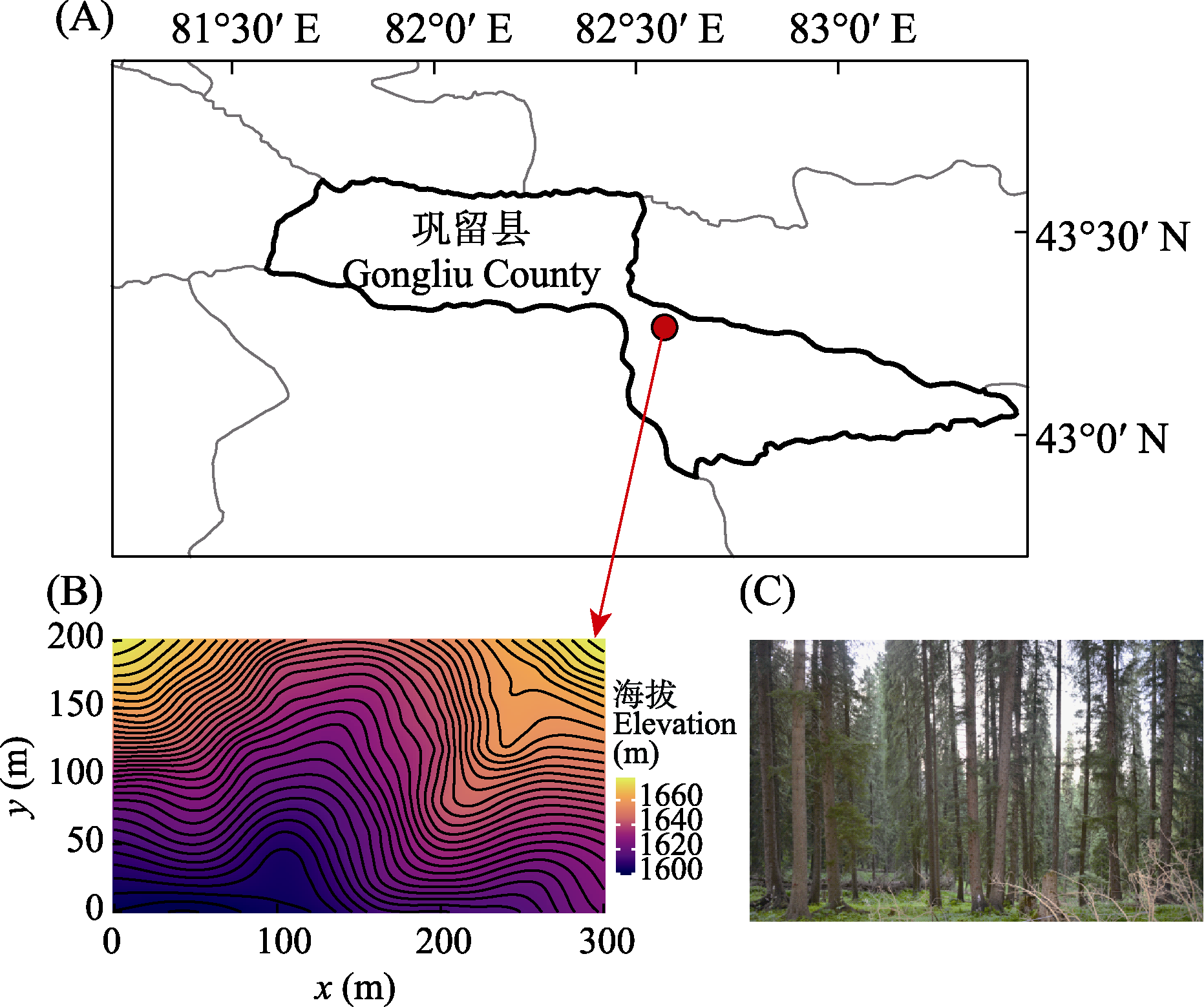
图1 新疆西天山6 ha森林动态监测样地地理位置(A)、等高线图(B)及典型雪岭云林照片(C)
Fig. 1 Location (A), contour map (B), and photographs of a typical Picea schrenkiana forest (C) in the 6-ha forest dynamics plot in the west Tianshan Mountains, Xinjiang
| 变量 Variables | 平均值 ± 标准差 Mean ± SD |
|---|---|
| 地形因子 Topographic factor | |
| 凹凸度 Convexity (Convex) | -0.11 ± 2.21 |
| 坡度 Slope | 21.56° ± 7.79° |
| 坡向 Aspect | 189.77° ± 50.18° |
| 土壤因子 Soil factor | |
| pH | 6.19 ± 0.37 |
| 土壤有机质含量 Soil organic matter content (g/kg) | 173.39 ± 64.08 |
| 有效氮含量 Available nitrogen content (mg/kg) | 191.47 ± 122.10 |
| 全氮含量 Total nitrogen content (g/kg) | 8.67 ± 2.66 |
| 有效磷含量 Available phosphorus content (mg/kg) | 37.56 ± 21.35 |
| 全磷含量 Total phosphorus content (g/kg) | 0.21 ± 0.04 |
表1 新疆西天山6 ha森林动态监测样地的地形和土壤因子基本信息
Table 1 Basic information of topographic and soil factors of the 6-ha forest dynamics plot in the west Tianshan Mountains, Xinjiang
| 变量 Variables | 平均值 ± 标准差 Mean ± SD |
|---|---|
| 地形因子 Topographic factor | |
| 凹凸度 Convexity (Convex) | -0.11 ± 2.21 |
| 坡度 Slope | 21.56° ± 7.79° |
| 坡向 Aspect | 189.77° ± 50.18° |
| 土壤因子 Soil factor | |
| pH | 6.19 ± 0.37 |
| 土壤有机质含量 Soil organic matter content (g/kg) | 173.39 ± 64.08 |
| 有效氮含量 Available nitrogen content (mg/kg) | 191.47 ± 122.10 |
| 全氮含量 Total nitrogen content (g/kg) | 8.67 ± 2.66 |
| 有效磷含量 Available phosphorus content (mg/kg) | 37.56 ± 21.35 |
| 全磷含量 Total phosphorus content (g/kg) | 0.21 ± 0.04 |
| 物种 Species | 2008 | 2014 | 2019 | 2024 |
|---|---|---|---|---|
| 雪岭云杉 Picea schrenkiana | 1,310 (91.54%) | 1,341 (90.73%) | 1,210 (91.74%) | 1,123 (93.58%) |
| 天山桦 Betula tianschanica | 91 (6.36%) | 92 (6.22%) | 62 (4.70%) | 50 (4.17%) |
| 天山花楸 Sorbus tianschanica | 11 (0.77%) | 11 (0.74 %) | 7 (0.53%) | 3 (0.25%) |
| 新疆忍冬 Lonicera tatarica | 10 (0.70%) | 13 (0.88%) | 17 (1.29%) | 10 (0.83%) |
| 山楂 Crataegus pinnatifida | 3 (0.21%) | 3 (0.20%) | 3 (0.23%) | 3 (0.25%) |
| 黄花柳 Salix caprea | 3 (0.21%) | 3 (0.20%) | 4 (0.30%) | 4 (0.33%) |
| 伊犁小檗 Berberis iliensis | 2 (0.14%) | 14 (0.95%) | 16 (1.21%) | 7 (0.58%) |
| 新疆野苹果 Malus sieversii | 1 (0.07%) | 1 (0.07%) | 0 (0.00%) | 0 (0.00%) |
| 合计 Total | 1,431 (100.00%) | 1,478 (100.00%) | 1,319 (100.00%) | 1,200 (100.00%) |
表2 新疆西天山雪岭云杉群落不同年际(2008-2024年)活立木个体数量(%)的变化
Table 2 Changes in the number of living trees across different years (2008-2024) in the Picea schrenkiana community in the west Tianshan Mountains, Xinjiang
| 物种 Species | 2008 | 2014 | 2019 | 2024 |
|---|---|---|---|---|
| 雪岭云杉 Picea schrenkiana | 1,310 (91.54%) | 1,341 (90.73%) | 1,210 (91.74%) | 1,123 (93.58%) |
| 天山桦 Betula tianschanica | 91 (6.36%) | 92 (6.22%) | 62 (4.70%) | 50 (4.17%) |
| 天山花楸 Sorbus tianschanica | 11 (0.77%) | 11 (0.74 %) | 7 (0.53%) | 3 (0.25%) |
| 新疆忍冬 Lonicera tatarica | 10 (0.70%) | 13 (0.88%) | 17 (1.29%) | 10 (0.83%) |
| 山楂 Crataegus pinnatifida | 3 (0.21%) | 3 (0.20%) | 3 (0.23%) | 3 (0.25%) |
| 黄花柳 Salix caprea | 3 (0.21%) | 3 (0.20%) | 4 (0.30%) | 4 (0.33%) |
| 伊犁小檗 Berberis iliensis | 2 (0.14%) | 14 (0.95%) | 16 (1.21%) | 7 (0.58%) |
| 新疆野苹果 Malus sieversii | 1 (0.07%) | 1 (0.07%) | 0 (0.00%) | 0 (0.00%) |
| 合计 Total | 1,431 (100.00%) | 1,478 (100.00%) | 1,319 (100.00%) | 1,200 (100.00%) |
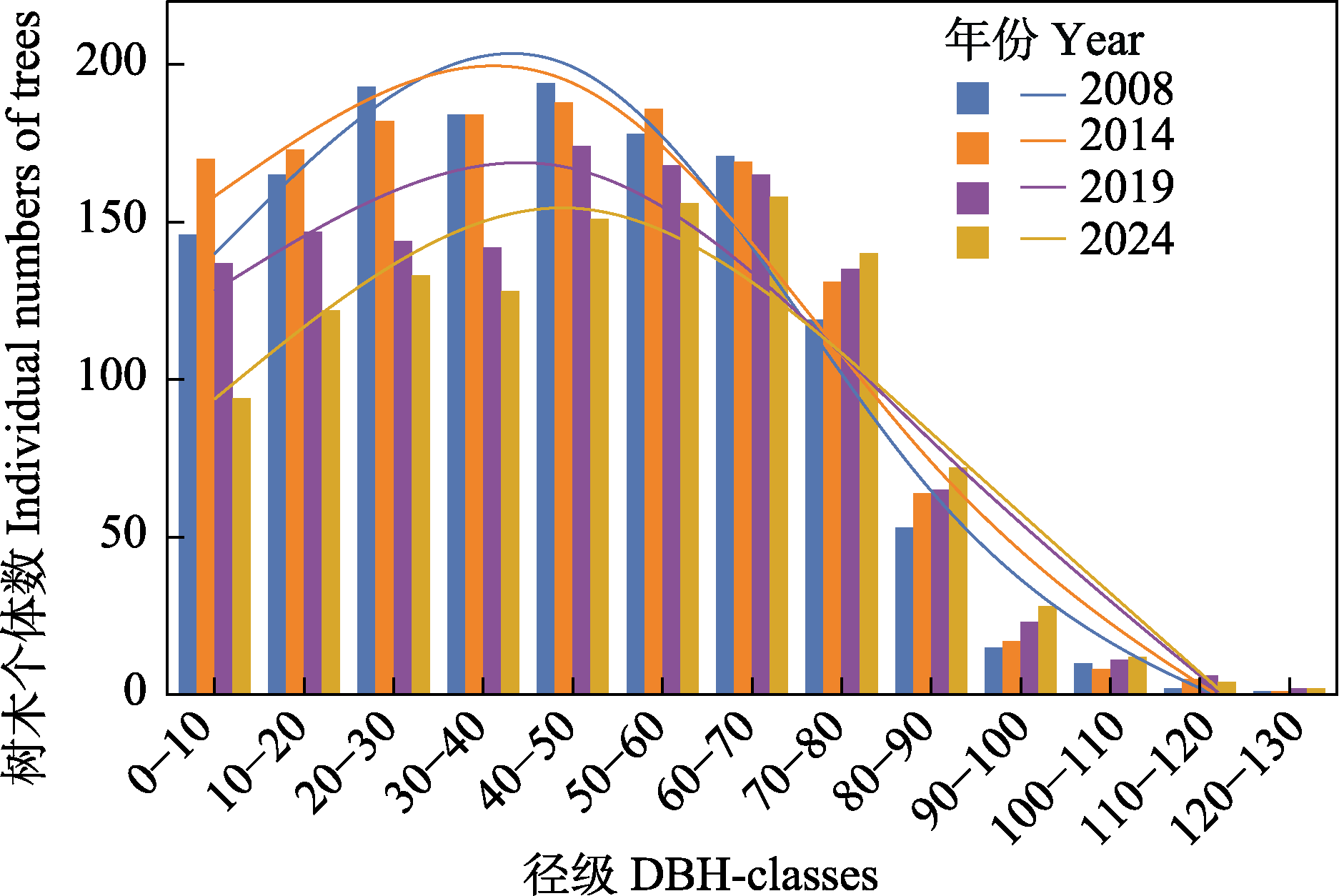
图2 新疆西天山雪岭云杉群落不同年际(2008-2024年)活立木不同径级个体数分布。柱状图代表不同调查年份不同径级个体数, 曲线图代表不同调查年份随径级变化个体数的拟合曲线。
Fig. 2 Interannual variation (2008-2024) in DBH-classes distribution of living stems in the Picea schrenkiana community in the west Tianshan Mountains, Xinjiang. The bar shows the number of individuals corresponding to different DBH-classes across survey years. The line represents the fitted curves of individual numbers varying with DBH-classes in different survey years.
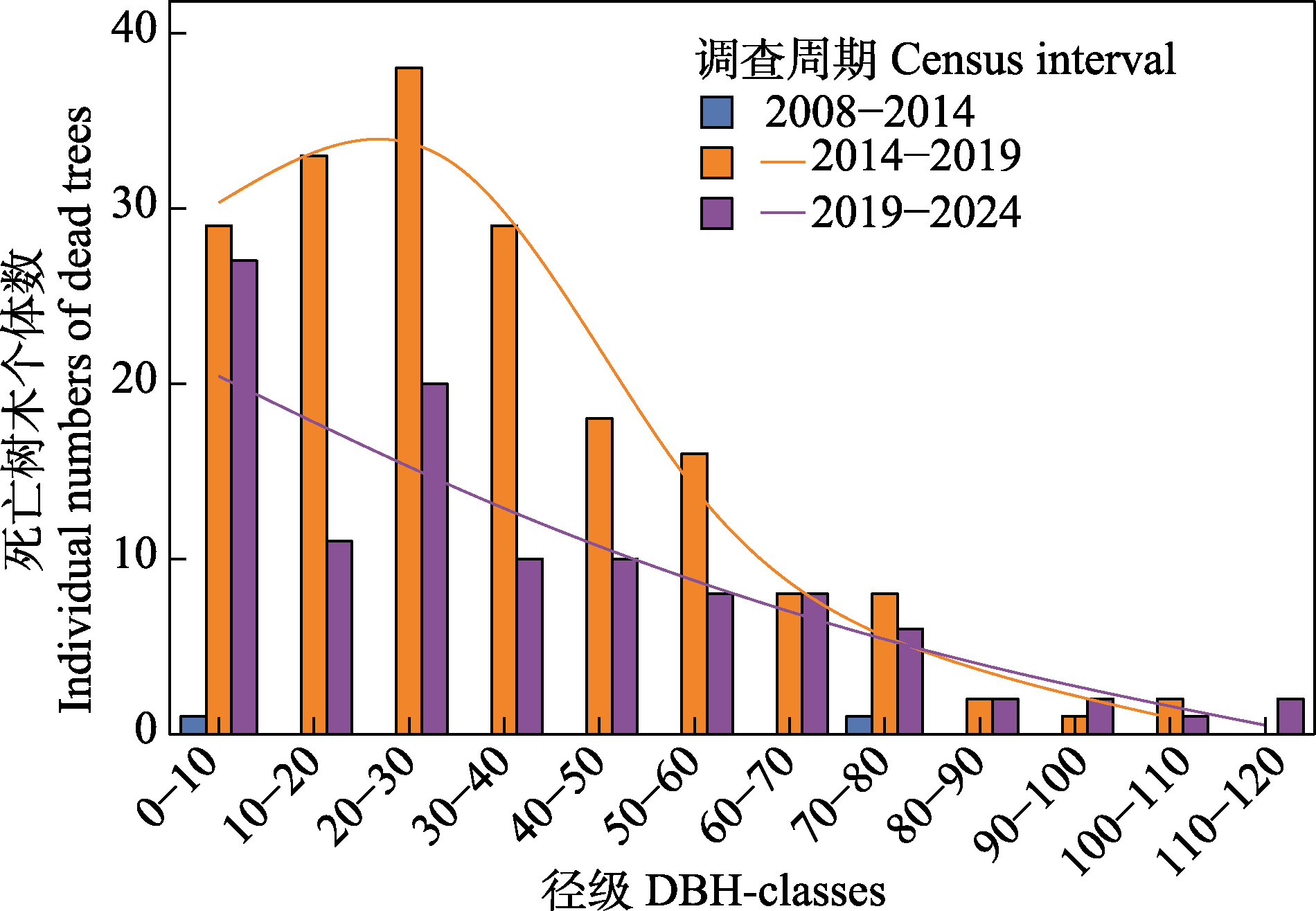
图3 新疆西天山雪岭云杉群落不同年际(2008-2024年)不同径级死亡个体数分布。柱状图体现代表不同时间段不同径级死亡个体数, 曲线图代表不同时间段随径级变化死亡个体数的拟合曲线。
Fig. 3 Interannual (2008-2024) mortality distribution across DBH-classes in the Picea schrenkiana community in the west Tianshan Mountains, Xinjiang. The bar displays the number of dead individuals across different DBH-classes in various time periods. The line graph represents the fitted curve of dead individual numbers varying by DBH-classes over different time periods.
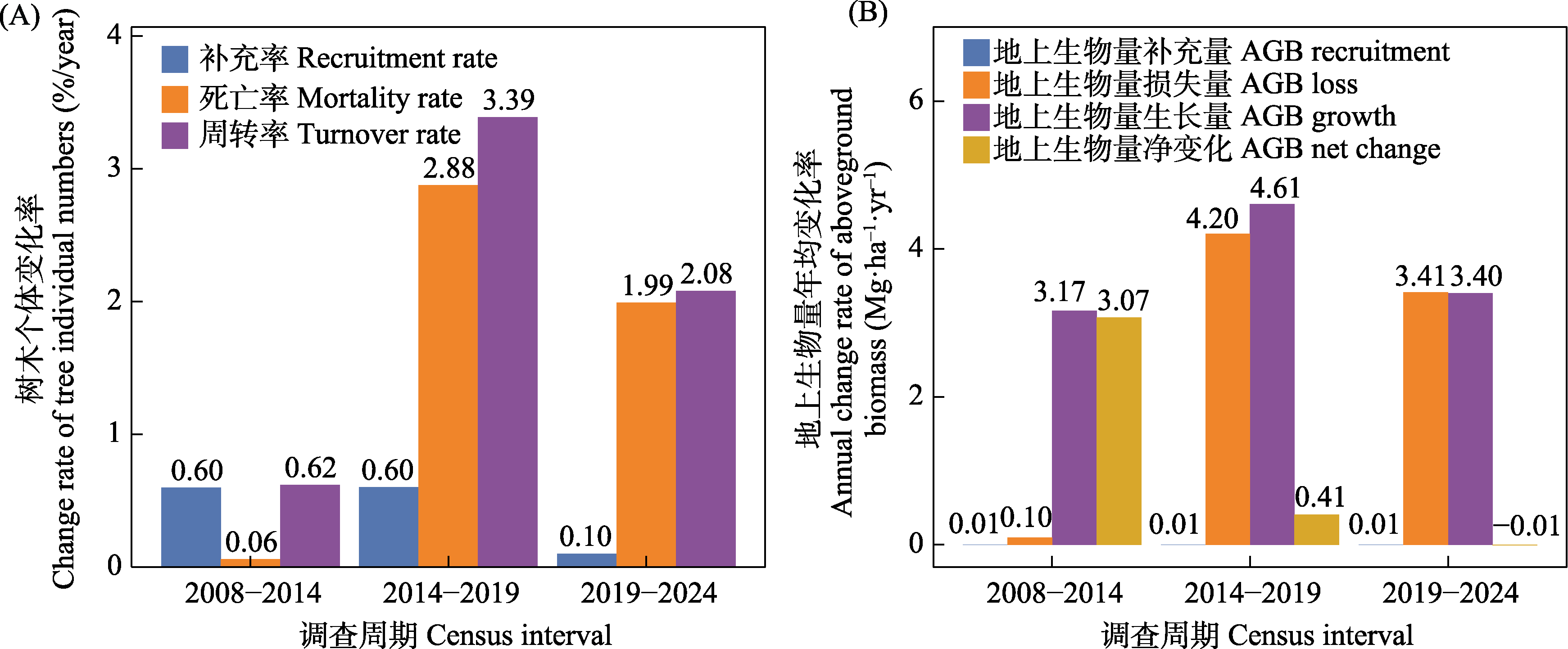
图4 新疆西天山雪岭云杉群落不同年际(2008-2024年)树木个体数变化率(A)和地上生物量年均变化率(B)
Fig. 4 Interannual (2008-2024) change rates of tree individual number (A) and aboveground biomass (AGB) (B) in the Picea schrenkiana community in the west Tianshan Mountains, Xinjiang
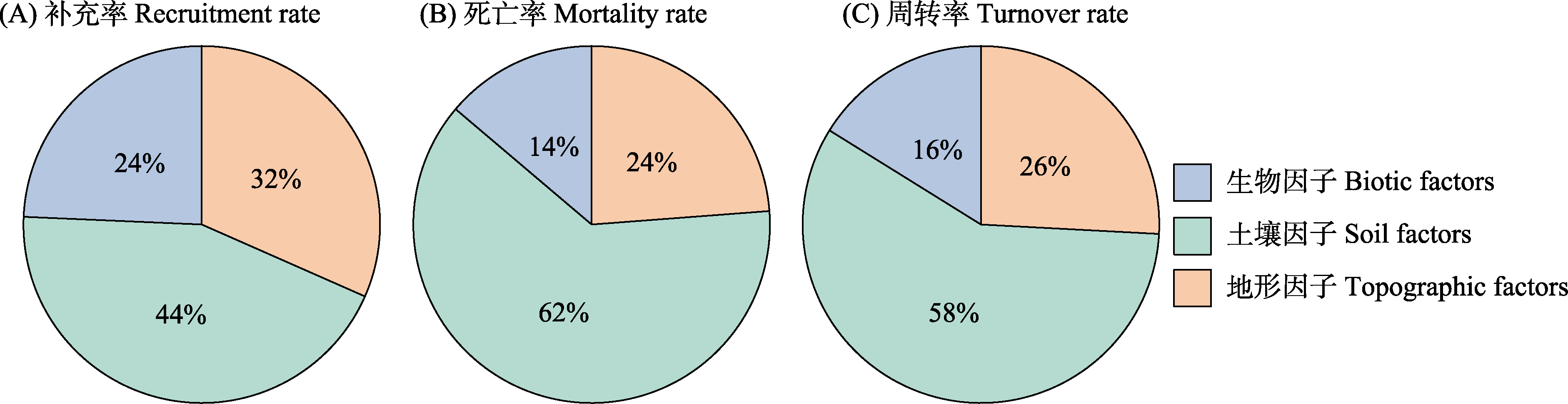
图5 生物、土壤和地形3类因子对新疆西天山雪岭云杉群落个体的补充率(A)、死亡率(B)和周转率(C)的贡献比例
Fig. 5 Proportional contributions of biological, soil, and topographic factors to the recruitment rate (A), mortality rate (B), and turnover rate (C) in the Picea schrenkiana community in the west Tianshan Mountains, Xinjiang
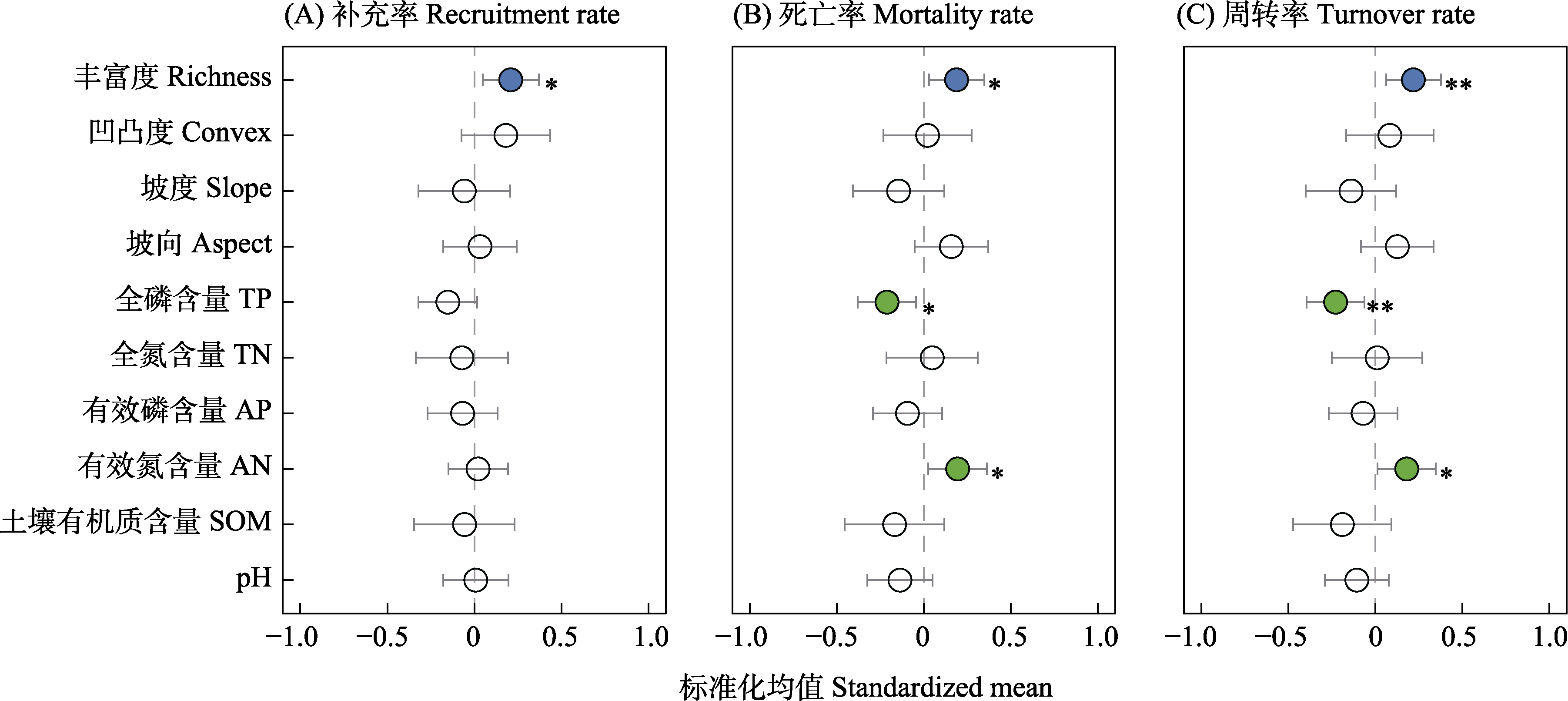
图6 新疆西天山雪岭云杉群落个体的补充率(A)、死亡率(B)和周转率(C)的影响因素。* P < 0.05; ** P < 0.01。
Fig. 6 Factors influencing recruitment rate (A), mortality rate (B), and turnover rate (C) in the Picea schrenkiana community in the west Tianshan Mountains, Xinjiang. Convex, Convexity; SOM, Soil organic matter content; AN, Available nitrogen content; TN, Total nitrogen content; AP, Available phosphorus content; TP, Total phosphorus content. * P < 0.05; ** P < 0.01.
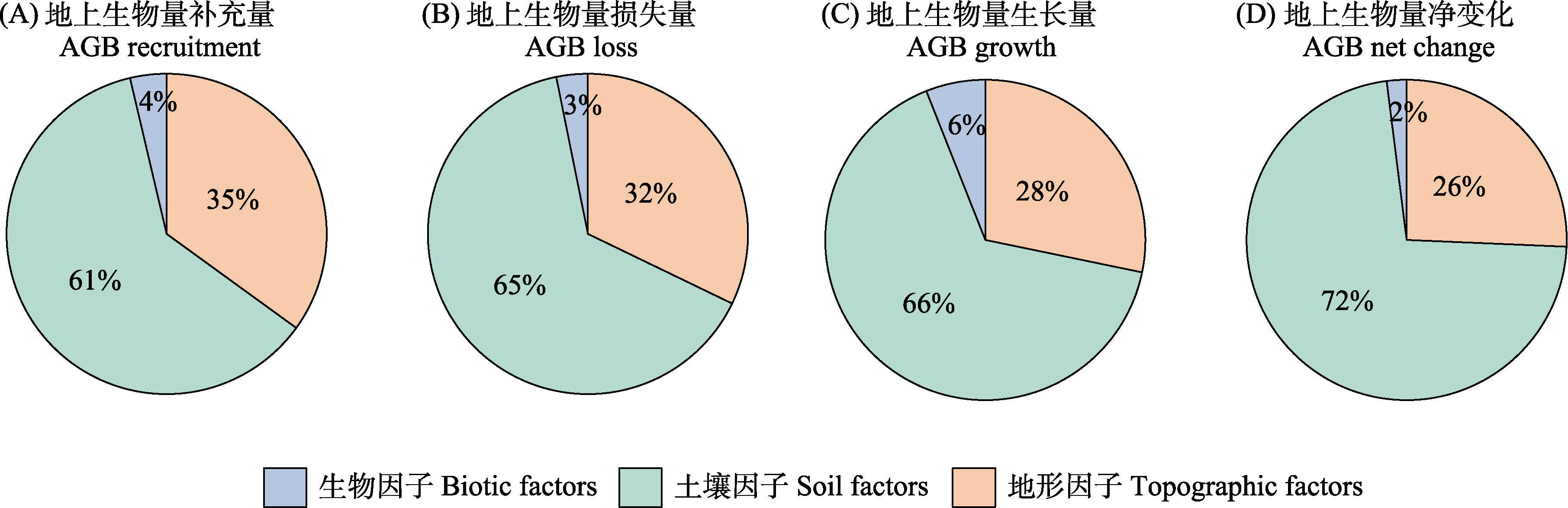
图7 生物、土壤和地形3类因子对新疆西天山雪岭云杉群落地上生物量补充量(A)、损失量(B)、生长量(C)和净变化(D)的贡献比例
Fig. 7 The proportional contributions of biological, soil, and topographic factors to the aboveground biomass (AGB) recruitment (A), loss (B), growth (C), and net change (D) in the Picea schrenkiana community in the west Tianshan Mountains, Xinjiang
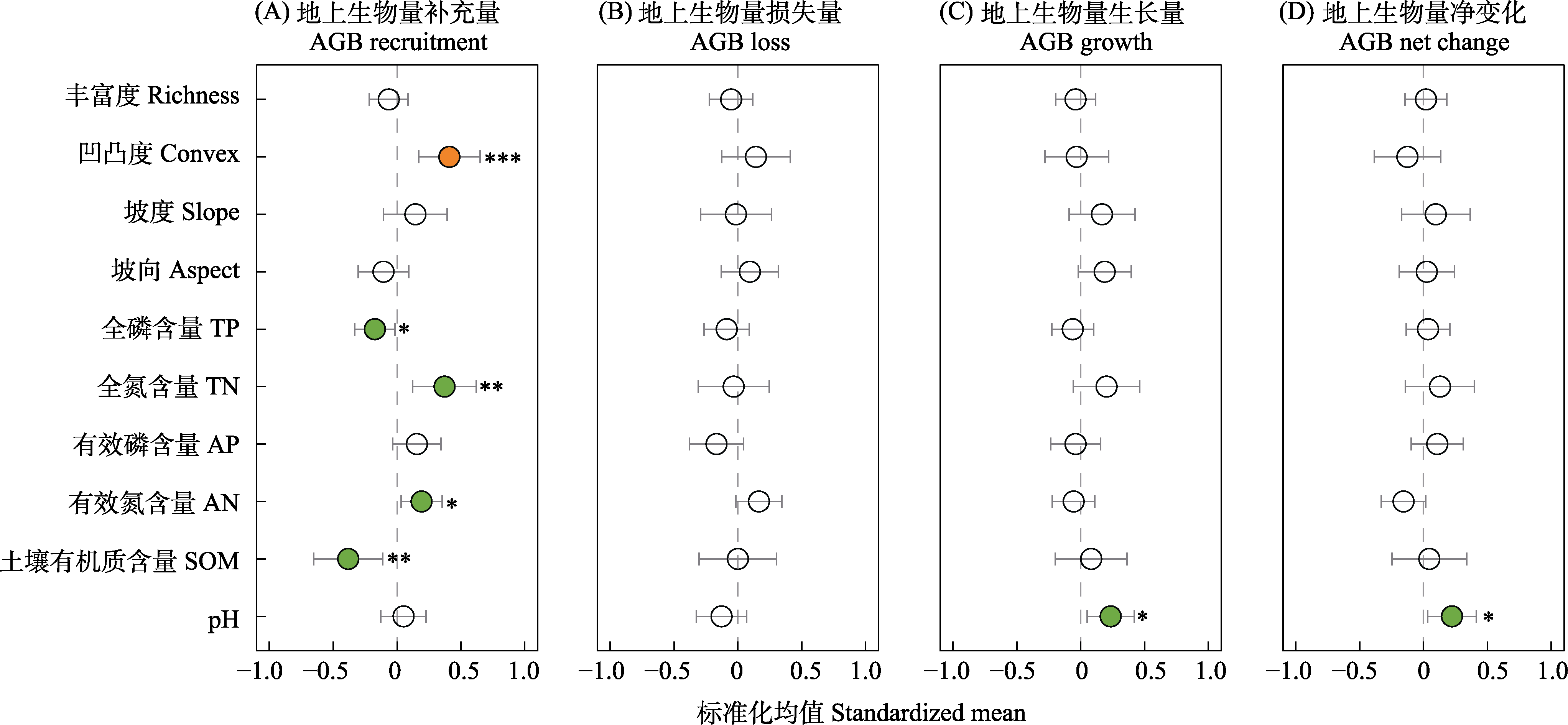
图8 新疆西天山雪岭云杉群落地上生物量补充量(A)、损失量(B)、生长量(C)和净变化(D)的影响因素。* P < 0.05; ** P < 0.01; *** P < 0.001。
Fig. 8 Factors influencing to the aboveground biomass (AGB) recruitment (A), loss (B), growth (C), and net change (D) in the Picea schrenkiana community in the west Tianshan Mountains, Xinjiang. Convex, Convexity; SOM, Soil organic matter content; AN, Available nitrogen content; TN, Total nitrogen content; AP, Available phosphorus content; TP, Total phosphorus content. * P < 0.05; ** P < 0.01; *** P < 0.001.
| [1] |
Allen CD, Macalady AK, Chenchouni H, Bachelet D, McDowell N, Vennetier M, Kitzberger T, Rigling A, Breshears DD, Hogg EH, Gonzalez P, Fensham R, Zhang Z, Castro J, Demidova N, Lim JM, Allard G, Running SW, Semerci A, Cobb N (2010) A global overview of drought and heat-induced tree mortality reveals emerging climate change risks for forests. Forest Ecology and Management, 259, 660-684.
DOI URL |
| [2] |
Bennett AC, McDowell NG, Allen CD, Anderson-Teixeira KJ (2015) Larger trees suffer most during drought in forests worldwide. Nature Plants, 1, 15139.
DOI PMID |
| [3] |
Callaway RM, Brooker RW, Choler P, Kikvidze Z, Lortie CJ, Michalet R, Paolini L, Pugnaire FI, Newingham B, Aschehoug ET, Armas C, Kikodze D, Cook BJ (2002) Positive interactions among alpine plants increase with stress. Nature, 417, 844-848.
DOI |
| [4] |
Chesson P (2000) Mechanisms of maintenance of species diversity. Annual Review of Ecology and Systematics, 31, 343-366.
DOI URL |
| [5] |
Choat B, Brodribb TJ, Brodersen CR, Duursma RA, López R, Medlyn BE (2018) Triggers of tree mortality under drought. Nature, 558, 531-539.
DOI |
| [6] | Chojnacky DC, Heath LS, Jenkins JC (2014) Updated generalized biomass equations for North American tree species. Forestry, 87, 129-151. |
| [7] |
Clark JS, Bell DM, Hersh MH, Nichols L (2011) Climate change vulnerability of forest biodiversity: Climate and competition tracking of demographic rates. Global Change Biology, 17, 1834-1849.
DOI URL |
| [8] | Condit R (1998) Tropical Forest Census Plots: Methods and Results from Barro Colorado Island, Panama and a Comparison with Other Plots. Springer, Berlin. |
| [9] |
Coomes DA, Allen RB (2009) Testing the metabolic scaling theory of tree growth. Journal of Ecology, 97, 1369-1373.
DOI URL |
| [10] |
Das A, Battles J, Stephenson NL, van Mantgem PJ (2011) The contribution of competition to tree mortality in old-growth coniferous forests. Forest Ecology and Management, 261, 1203-1213.
DOI URL |
| [11] |
Ding Y, Zang RG, Huang JH, Xu Y, Lu XH, Guo ZJ, Ren W (2019) Intraspecific trait variation and neighborhood competition drive community dynamics in an old-growth spruce forest in Northwest China. Science of the Total Environment, 678, 525-532.
DOI |
| [12] |
Eisenhauer N, Mueller K, Ebeling A, Gleixner G, Huang Y, Madaj A, Roscher C, Weigelt A, Bahn M, Bonkowski M, Brose U, Cesarz S, Feilhauer H, Guimaraes-Steinicke C, Heintz-Buschart A, Hines J, Lange M, Meyer ST, Mohanbabu N, Mommer L, Neuhauser S, Oelmann Y, Rahmanian S, Sasaki T, Scheu S, Schielzeth H, Schmid B, Schloter M, Schulz S, Unsicker SB, Vogel C, Weisser WW, Isbell F (2024) The multiple-mechanisms hypothesis of biodiversity-stability relationships. Basic and Applied Ecology, 79, 153-166.
DOI URL |
| [13] |
Elser JJ, Bracken MES, Cleland EE, Gruner DS, Harpole WS, Hillebrand H, Ngai JT, Seabloom EW, Shurin JB, Smith JE (2007) Global analysis of nitrogen and phosphorus limitation of primary producers in freshwater, marine and terrestrial ecosystems. Ecology Letters, 10, 1135-1142.
DOI PMID |
| [14] |
Feng YH, Schmid B, Loreau M, Forrester DI, Fei SL, Zhu JX, Tang ZY, Zhu J, Hong PB, Ji CJ, Shi Y, Su HJ, Xiong XY, Xiao J, Wang SP, Fang JY (2022) Multispecies forest plantations outyield monocultures across a broad range of conditions. Science, 376, 865-868.
DOI PMID |
| [15] |
Fortunel C, Lasky JR, Uriarte M, Valencia R, Wright SJ, Garwood NC, Kraft NJB (2018) Topography and neighborhood crowding can interact to shape species growth and distribution in a diverse Amazonian forest. Ecology, 99, 2272-2283.
DOI PMID |
| [16] |
García Criado M, Myers-Smith IH, Bjorkman AD, Elmendorf SC, Normand S, Aastrup P, Aerts R, Alatalo JM, Baeten L, Björk RG, Björkman MP, Boulanger-Lapointe N, Butler EE, Cooper EJ, Cornelissen JHC, Daskalova GN, Fadrique B, Forbes BC, Henry GHR, Hollister RD, Høye TT, Jacobsen IBD, Jägerbrand AK, Jónsdóttir IS, Kaarlejärvi E, Khitun O, Klanderud K, Kolari THM, Lang SI, Lecomte N, Lenoir J, Macek P, Messier J, Michelsen A, Molau U, Muscarella R, Nielsen ML, Petit Bon M, Post E, Raundrup K, Rinnan R, Rixen C, Ryde I, Serra-Diaz JM, Schaepman-Strub G, Schmidt NM, Schrodt F, Sjögersten S, Steinbauer MJ, Stewart L, Strandberg B, Tolvanen A, Tweedie CE, Vellend M (2025) Plant diversity dynamics over space and time in a warming Arctic. Nature, 642, 653-661.
DOI |
| [17] |
Grubb PJ (1977) The maintenance of species-richness in plant communities: The importance of the regeneration niche. Biological Reviews, 52, 107-145.
DOI URL |
| [18] |
Hammond WM, Williams AP, Abatzoglou JT, Adams HD, Klein T, López R, Sáenz-Romero C, Hartmann H, Breshears DD, Allen CD (2022) Global field observations of tree die-off reveal hotter-drought fingerprint for Earth’s forests. Nature Communications, 13, 1761.
DOI PMID |
| [19] |
Harpole WS, Ngai JT, Cleland EE, Seabloom EW, Borer ET, Bracken MES, Elser JJ, Gruner DS, Hillebrand H, Shurin JB, Smith JE (2011) Nutrient co-limitation of primary producer communities. Ecology Letters, 14, 852-862.
DOI PMID |
| [20] | Hisano M, Chen HYH, Searle EB, Reich PB (2019) Species-rich boreal forests grew more and suffered less mortality than species-poor forests under the environmental change of the past half-century. Ecology Letters, 22, 999-1008. |
| [21] |
Hou EQ, Luo YQ, Kuang YW, Chen CR, Lu XK, Jiang LF, Luo XZ, Wen DZ (2020) Global meta-analysis shows pervasive phosphorus limitation of aboveground plant production in natural terrestrial ecosystems. Nature Communications, 11, 637.
DOI PMID |
| [22] |
Hutchinson GE (1957) Concluding remarks. Cold Spring Harbor Symposia on Quantitative Biology, 22, 415-427.
DOI URL |
| [23] | IUSS Working Group WRB (2015) World reference base for soil resources 2014, update 2015 international soil classification system for naming soils and creating legends for soil maps. In: World Soil Resources Reports, No. 106. (ed. FAO), Rome, Italy. |
| [24] |
Laurance WF, Oliveira AA, Laurance SG, Condit R, Nascimento HEM, Sanchez-Thorin AC, Lovejoy TE, Andrade A, D’Angelo S, Ribeiro JE, Dick CW (2004) Pervasive alteration of tree communities in undisturbed Amazonian forests. Nature, 428, 171-175.
DOI |
| [25] |
Legendre P, Mi XC, Ren HB, Ma KP, Yu MJ, Sun IF, He FL (2009) Partitioning beta diversity in a subtropical broad-leaved forest of China. Ecology, 90, 663-674.
DOI PMID |
| [26] | Lenoir J, Graae BJ, Aarrestad PA, Alsos IG, Armbruster WS, Austrheim G, Bergendorff C, Birks HJB, Bråthen KA, Brunet J, Bruun HH, Dahlberg CJ, Decocq G, Diekmann M, Dynesius M, Ejrnæs R, Grytnes JA, Hylander K, Klanderud K, Luoto M, Milbau A, Moora M, Nygaard B, Odland A, Ravolainen VT, Reinhardt S, Sandvik SM, Schei FH, Speed JDM, Tveraabak LU, Vandvik V, Velle LG, Virtanen R, Zobel M, Svenning JC (2013) Local temperatures inferred from plant communities suggest strong spatial buffering of climate warming across Northern Europe. Global Change Biology, 19, 1470-1481. |
| [27] | Linger E, Long WX (2025) Phosphorus limitation constrains global forest productivity directly and indirectly via forest community structural attributes: Meta-analysis. Global Ecology and Biogeography, 34, e70048. |
| [28] |
Loreau M, Naeem S, Inchausti P, Bengtsson J, Grime JP, Hector A, Hooper DU, Huston MA, Raffaelli D, Schmid B, Tilman D, Wardle DA (2001) Biodiversity and ecosystem functioning: Current knowledge and future challenges. Science, 294, 804-808.
DOI PMID |
| [29] | McDowell NG, Sapes G, Pivovaroff A, Adams HD, Allen CD, Anderegg WRL, Arend M, Breshears DD, Brodribb T, Choat B, Cochard H, De Cáceres M, De Kauwe MG, Grossiord C, Hammond WM, Hartmann H, Hoch G, Kahmen A, Klein T, MacKay DS, Mantova M, Martínez-Vilalta J, Medlyn BE, Mencuccini M, Nardini A, Oliveira RS, Sala AN, Tissue DT, Torres-Ruiz JM, Trowbridge AM, Trugman AT, Wiley E, Xu CG (2022) Mechanisms of woody-plant mortality under rising drought, CO2 and vapour pressure deficit. Nature Reviews Earth & Environment, 3, 294-308. |
| [30] | Pan CD, Wang Q, Ruan X, Li ZH (2009) Biological activity and quantification of potential autotoxins from the leaves of Picea schrenkiana. Chinese Journal of Plant Ecology, 33, 186-196. (in Chinese with English abstract) |
|
[ 潘存德, 王强, 阮晓, 李兆慧 (2009) 天山云杉针叶水提取物自毒效应及自毒物质的分离鉴定. 植物生态学报, 33, 186-196.]
DOI |
|
| [31] |
Phillips OL, Baker TR, Arroyo L, Higuchi N, Killeen TJ, Laurance WF, Lewis SL, Lloyd J, Malhi Y, Monteagudo A, Neill DA, Núñez Vargas P, Silva JNM, Terborgh J, Vásquez Martínez R, Alexiades M, Almeida S, Brown S, Chave J, Comiskey JA, Czimczik CI, Di Fiore A, Erwin T, Kuebler C, Laurance SG, Nascimento HEM, Olivier J, Palacios W, Patiño S, Pitman NCA, Quesada CA, Saldias M, Torres Lezama A, Vinceti B (2004) Pattern and process in Amazon tree turnover, 1976-2001. Philosophical Transactions of the Royal Society B: Biological Sciences, 359, 381-407.
DOI URL |
| [32] | Poorter L, Wright SJ, Paz H, Ackerly DD, Condit R, Ibarra-Manríquez G, Harms KE, Licona JC, Martínez-Ramos M, Mazer SJ, Muller-Landau HC, Peña-Claros M, Webb CO, Wright IJ (2008) Are functional traits good predictors of demographic rates? Evidence from five neotropical forests. Ecology, 89, 1908-1920. |
| [33] | R Core Team (2024) R: A Language and Environment for Statistical Computing. R Foundation for Statistical Computing, Vienna. |
| [34] |
Reich PB, Hobbie SE, Lee TL, Ellsworth DS, West JB, Tilman D, Knops JMH, Naeem S, Trost J (2006) Nitrogen limitation constrains sustainability of ecosystem response to CO2. Nature, 440, 922-925.
DOI |
| [35] |
Sang Y, Tian F, Jin H, Cai Z, Feng L, Dou Y, Eklundh L (2024) Assessing topographic effects on forest responses to drought with multiple seasonal metrics from Sentinel-2. International Journal of Applied Earth Observation and Geoinformation, 128, 103789.
DOI URL |
| [36] |
Scherrer D, Körner C (2011) Topographically controlled thermal-habitat differentiation buffers alpine plant diversity against climate warming. Journal of Biogeography, 38, 406-416.
DOI URL |
| [37] | Schulte-Uebbing L, de Vries W (2018) Global-scale impacts of nitrogen deposition on tree carbon sequestration in tropical, temperate, and boreal forests: A meta-analysis. Global Change Biology, 24, e416-e431. |
| [38] |
Stevens CJ, Lind EM, Hautier Y, Harpole WS, Borer ET, Hobbie S, Seabloom EW, Ladwig L, Bakker JD, Chu CJ, Collins S, Davies KF, Firn J, Hillebrand H, Pierre KJL, MacDougall A, Melbourne B, McCulley RL, Morgan J, Orrock JL, Prober SM, Risch AC, Schuetz M, Wragg PD (2015) Anthropogenic nitrogen deposition predicts local grassland primary production worldwide. Ecology, 96, 1459-1465.
DOI URL |
| [39] |
Thammanu S, Marod D, Han H, Bhusal N, Asanok L, Ketdee P, Gaewsingha N, Lee S, Chung J (2021) The influence of environmental factors on species composition and distribution in a community forest in Northern Thailand. Journal of Forestry Research, 32, 649-662.
DOI |
| [40] |
Tilman D (1997) Distinguishing between the effects of species diversity and species composition. Oikos, 80, 185.
DOI URL |
| [41] |
van der Sande MT, Peña-Claros M, Ascarrunz N, Arets EJMM, Licona JC, Toledo M, Poorter L (2017) Abiotic and biotic drivers of biomass change in a Neotropical forest. Journal of Ecology, 105, 1223-1234.
DOI URL |
| [42] | van Mantgem PJ, Stephenson NL, Byrne JC, Daniels LD, Franklin JF, Fulé PZ, Harmon ME, Larson AJ, Smith JM, Taylor AH, Veblen TT (2009) Widespread increase of tree mortality rates in the western United States. Science, 323, 521-524. |
| [43] |
Vitousek PM, Porder S, Houlton BZ, Chadwick OA (2010) Terrestrial phosphorus limitation: Mechanisms, implications, and nitrogen-phosphorus interactions. Ecological Applications, 20, 5-15.
PMID |
| [44] | Wang GH (2017) Spruce Forest of China. Science Press, Beijing. (in Chinese) |
| [ 王国宏 (2017) 中国云杉林. 科学出版社, 北京.] | |
| [45] |
Wang HJ, Chang SL, Zhang YT, Xie J, He P, Song CC, Sun XJ (2016) Density-dependent effects in Picea schrenkiana forests in Tianshan Mountains. Biodiversity Science, 24, 252-261. (in Chinese with English abstract)
DOI URL |
|
[ 王慧杰, 常顺利, 张毓涛, 谢锦, 何平, 宋成程, 孙雪娇 (2016) 天山雪岭云杉森林群落的密度制约效应. 生物多样性, 24, 252-261.]
DOI |
|
| [46] |
Weintraub SR, Taylor PG, Porder S, Cleveland CC, Asner GP, Townsend AR (2015) Topographic controls on soil nitrogen availability in a lowland tropical forest. Ecology, 96, 1561-1574.
DOI URL |
| [47] | Xiao WF, Alimujiang Y, Qian FW, Xu HX, Cheng KW, Liu WC (2015) Biodiversity and Conservation Management in Xinjiang West Tianshan National Nature Reserve. Forestry Science Press, Beijing. (in Chinese) |
| [ 肖文发, 阿力木江·牙生, 钱法文, 徐洪星, 成克武, 刘文成 (2015) 新疆西天山国家级自然保护区生物多样性与自然保护管理. 林业科学出版社, 北京.] | |
| [48] | Xinjiang Comprehensive Expedition Team, Chinese Academy of Sciences, Institute of Botany, Chinese Academy of Sciences (1978) Xinjiang Vegetation and Its Utilization. Science Press, Beijing. (in Chinese) |
| [ 中国科学院新疆综合考察队, 中国科学院植物研究所 (1978) 新疆植被及其利用. 科学出版社, 北京.] | |
| [49] | Xinjiang Forest Editorial Committee (1989) Xinjiang Forest. Xinjiang People’s Publishing House, Urumqi & China Forestry Publishing House, Beijing. (in Chinese) |
| [ 新疆森林编辑委员会 (1989) 新疆森林. 新疆人民出版社, 乌鲁木齐&中国林业出版社, 北京.] | |
| [50] | Yachi S, Loreau M (1999) Biodiversity and ecosystem productivity in a fluctuating environment: The insurance hypothesis. Proceedings of the National Academy of Sciences, USA, 96, 1463-1468. |
| [51] |
Yang C, Shi Y, Sun WJ, Zhu JL, Ji CJ, Feng YH, Ma SH, Guo ZD, Fang JY (2022) Updated estimation of forest biomass carbon pools in China, 1977-2018. Biogeosciences, 19, 2989-2999.
DOI URL |
| [52] | Zang RG, Jing XH, Liu H, Liu GF, Ding Y, Cheng KW, Zhang J, Wu XC, Zhang XP, Liu P, Zhang ZD, Wang JP (2011) Ecological Characteristics of Forest Vegetation in Northern Xinjiang. China Publishing Group Modern Education Press, Beijing. (in Chinese) |
| [ 臧润国, 井学辉, 刘华, 刘贵峰, 丁易, 成克武, 张军, 吴晓成, 张新平, 刘萍, 张志东, 王计平 (2011) 北疆森林植被生态特征. 中国出版集团现代教育出版社, 北京.] | |
| [53] | Zhang J, Huang S, He FL (2015) Half-century evidence from western Canada shows forest dynamics are primarily driven by competition followed by climate. Proceedings of the National Academy of Sciences, USA, 112, 4009-4014. |
| [1] | 黄莉, 刘志发, 龚粤宁, 李步杭, 张健. 广东南岭16个1 ha森林动态监测样地植物群落组成与结构[J]. 生物多样性, 2026, 34(3): 25357-. |
| [2] | 侯馨博, 赵秀海, 何怀江, 张春雨, 王娟, 任雪莹, 张新娜. 蒙古栎纯林根际与非根际微生物群落结构对土壤碳氮的响应[J]. 生物多样性, 2025, 33(7): 25119-. |
| [3] | 潘正东, 林熙戎, 薛华, 胡治颖, 郭弘艺, 张亚, 吴阿娜, 唐文乔. 上海主要内陆水体鱼类物种多样性本底及群落结构[J]. 生物多样性, 2025, 33(6): 24290-. |
| [4] | 张明燡, 王晓梅, 郑言鑫, 吴楠, 李东浩, 樊恩源, 李娜, 单秀娟, 于涛, 赵春暖, 李波, 徐帅, 吴玉萍, 任利群. 黄河口典型牡蛎礁分布区资源状况和栖息地功能[J]. 生物多样性, 2025, 33(4): 24208-. |
| [5] | 仝淼, 王欢, 张文双, 王超, 宋建潇. 重金属污染土壤中细菌抗生素抗性基因分布特征[J]. 生物多样性, 2025, 33(3): 24101-. |
| [6] | 李艳朋, 陈洁, 卢春洋, 许涵. 海南尖峰岭热带山地雨林64 ha次生林动态监测样地群落结构特征[J]. 生物多样性, 2025, 33(2): 24445-. |
| [7] | 王文琪, 杨永川, 昌维, 胡四维, 牟文博, 曾岩. 不同生境下甘松群落结构、生长特征及潜在资源量估算[J]. 生物多样性, 2025, 33(11): 25382-. |
| [8] | 洪子辰, 杨源广, 黄鑫豪, 王孜, 郑笑, 周旭, 周艳, 陈世品, 林文俊. 武夷山国家公园常绿阔叶林生物量变化及其影响因素[J]. 生物多样性, 2025, 33(11): 25181-. |
| [9] | 魏诗雨, 宋天骄, 罗佳宜, 张燕, 赵子萱, 茹靖雯, 易华, 林雁冰. 秦岭火地塘针叶林土壤细菌群落的海拔分布格局[J]. 生物多样性, 2024, 32(9): 24180-. |
| [10] | 时永强, 栾青杉, 单秀娟, 韦超, 赵永松, 孙策策, 金显仕. 长岛南部海域浮游动物多样性周年变化[J]. 生物多样性, 2024, 32(7): 23428-. |
| [11] | 魏嘉欣, 姜治国, 杨林森, 熊欢欢, 金胶胶, 罗方林, 李杰华, 吴浩, 徐耀粘, 乔秀娟, 魏新增, 姚辉, 余辉亮, 杨敬元, 江明喜. 湖北神农架中亚热带山地落叶阔叶林25 ha动态监测样地群落物种组成与结构特征[J]. 生物多样性, 2024, 32(3): 23338-. |
| [12] | 倪艳梅, 陈莉, 董志远, 孙德斌, 李宝泉, 王绪敏, 陈琳琳. 黄河三角洲湿地生态修复区大型底栖动物群落结构与生态健康评价[J]. 生物多样性, 2024, 32(3): 23303-. |
| [13] | 刘啸林, 吴友贵, 张敏华, 陈小荣, 朱志成, 陈定云, 董舒, 李步杭, 丁炳扬, 刘宇. 浙江百山祖25 ha亚热带森林动态监测样地群落组成与结构特征[J]. 生物多样性, 2024, 32(2): 23294-. |
| [14] | 杜晴晴, 任思远, Nicole Tsz Shun Yuan, 祝燕. 北京东灵山暖温带落叶阔叶林幼树及成树生产力的影响因素[J]. 生物多样性, 2024, 32(12): 24284-. |
| [15] | 王兴煜, 孟京辉, 任思远, 祝燕. 北京东灵山暖温带落叶阔叶林群落生物多样性与地上生物量的关系[J]. 生物多样性, 2024, 32(12): 24230-. |
| 阅读次数 | ||||||
|
全文 |
|
|||||
|
摘要 |
|
|||||
备案号:京ICP备16067583号-7
Copyright © 2026 版权所有 《生物多样性》编辑部
地址: 北京香山南辛村20号, 邮编:100093
电话: 010-62836137, 62836665 E-mail: biodiversity@ibcas.ac.cn
