

生物多样性 ›› 2013, Vol. 21 ›› Issue (6): 658-665. DOI: 10.3724/SP.J.1003.2013.08048 cstr: 32101.14.SP.J.1003.2013.08048
所属专题: 青藏高原生物多样性与生态安全
赵广华1,2, 田瑜3, 唐志尧1,*( ), 李俊生3, 曾辉1,2
收稿日期:2013-02-24
接受日期:2013-06-13
出版日期:2013-11-20
发布日期:2013-12-02
通讯作者:
唐志尧
基金资助:
Guanghua Zhao1,2, Yu Tian3, Zhiyao Tang1,*(), Junsheng Li3, Hui Zeng1,2
Received:2013-02-24
Accepted:2013-06-13
Online:2013-11-20
Published:2013-12-02
Contact:
Tang Zhiyao
摘要:
截至2011年底, 中国共建立了2,640个自然保护区, 覆盖了约15%的国土面积, 其中包括318个国家级陆地自然保护区, 但目前缺乏对中国陆地自然保护区分布与自然环境及社会经济状况关系的研究。作者利用地理信息系统手段分析了中国现有国家级陆地自然保护区的分布格局及其与人类活动强度和自然环境的关系。结果表明: 中国国家级陆地自然保护区在县级水平上覆盖不平衡, 共有2,150个县级行政区(占总数的91%)的覆盖率小于10%, 其中150个(6%)覆盖率<1%, 1,726个(73%)无保护区。自然保护区覆盖率在高海拔、低温干燥以及植被生产力较低的区域较大, 而在低海拔、高温潮湿以及植被生产力较高的区域较低; 在人为活动较弱的地区较大, 而在人为活动较强的地区较低。中国现有陆地自然保护区大部分设置在人类活动较少的高寒山区或干旱区, 而在人类活动强度大的低海拔、高生产力地区保护区覆盖率过低; 自然保护区的这种设置模式有利于增加中国自然保护区的覆盖率, 然而在人为活动并不强烈的地区设立保护区的紧迫性也不如自然条件优越的地区。因此, 在目前中国自然保护区覆盖面积已经接近15%的背景下, 新增自然保护区的设置方案需要进一步优化。
赵广华, 田瑜, 唐志尧, 李俊生, 曾辉 (2013) 中国国家级陆地自然保护区分布及其与人类活动和自然环境的关系. 生物多样性, 21, 658-665. DOI: 10.3724/SP.J.1003.2013.08048.
Guanghua Zhao,Yu Tian,Zhiyao Tang,Junsheng Li,Hui Zeng (2013) Distribution of terrestrial national nature reserves in relation to human activities and natural environments in China. Biodiversity Science, 21, 658-665. DOI: 10.3724/SP.J.1003.2013.08048.
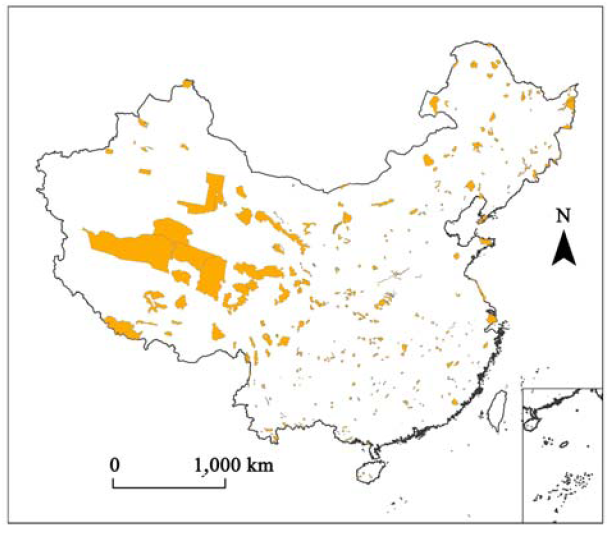
图1 中国国家级陆地自然保护区的分布
Fig. 1 Spatial distribution of terrestrial national nature reserves in China
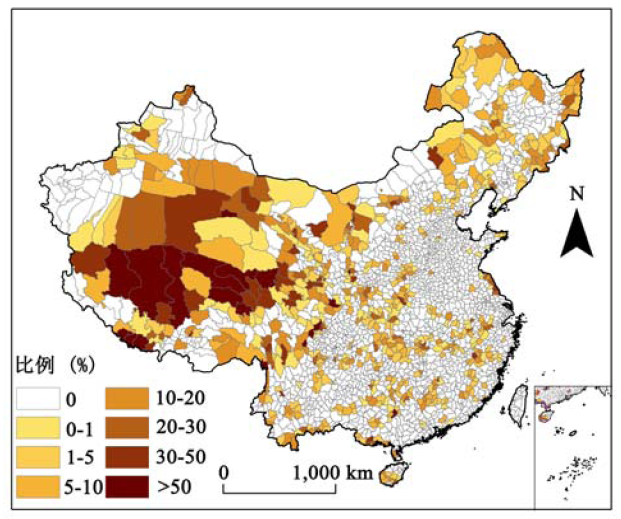
图2 中国各县域国家级自然保护区覆盖率分布
Fig. 2 County-level distribution of coverage of national nature reserves in China
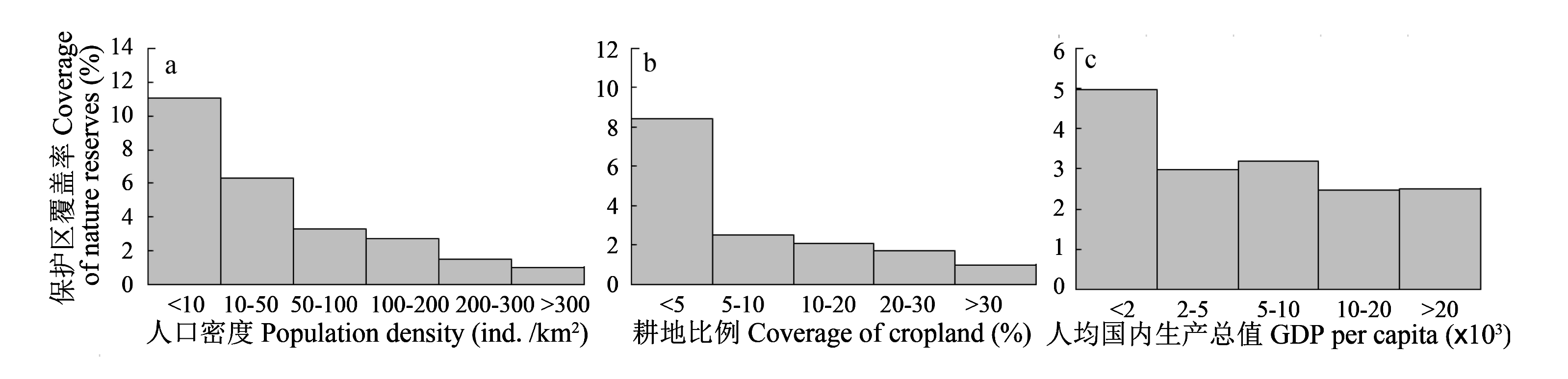
图3 中国不同人口密度(a), 耕地比例(b)以及人均GDP(c)县域平均国家级自然保护区覆盖率
Fig. 3 Average coverage of national nature reserves in counties at different levels of population density (a), coverage of cropland (b), and GDP per capita (c).
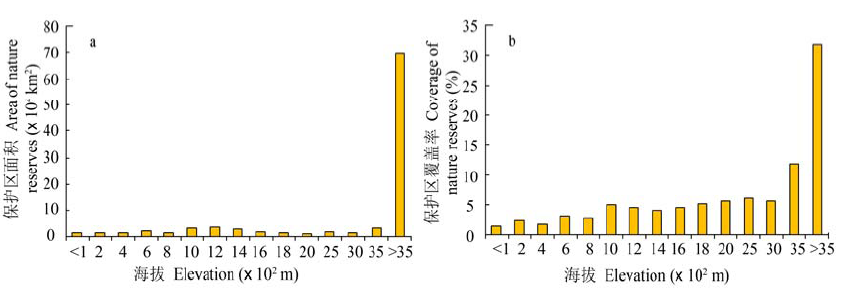
图4 中国国家级自然保护区面积(a)及覆盖率(b)沿海拔的变化趋势
Fig. 4 Area (a) and coverage (b) of nature reserves along elevation in China
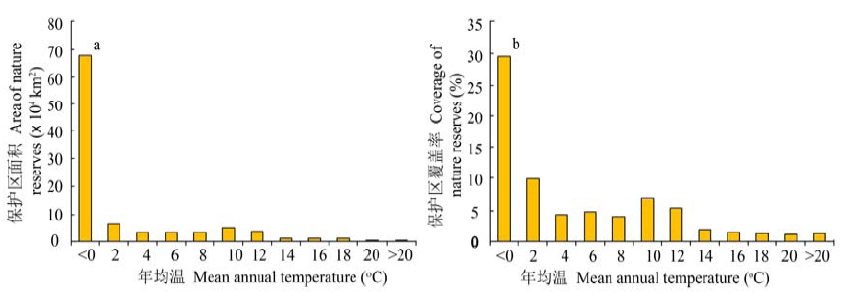
图5 中国国家级自然保护区面积(a)及覆盖率(b)沿年均温的变化趋势
Fig. 5 Area (a) and coverage (b) of nature reserves along mean annual temperature in China
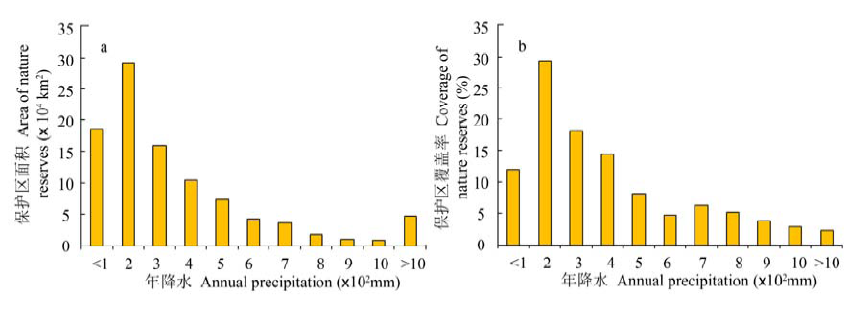
图6 中国国家级自然保护区分布面积(a)及覆盖率(b)沿年降水的变化趋势
Fig. 6 Area (a) and coverage (b) of nature reserves along annual precipitation in China
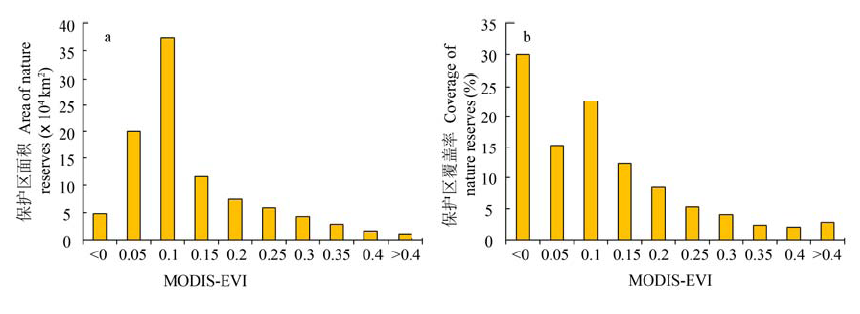
图7 中国国家级自然保护区面积(a)及覆盖率(b)沿植被指数(MODIS-EVI)的变化趋势
Fig. 7 Area (a) and coverage (b) of nature reserves along vegetation index (MODIS-EVI) in China
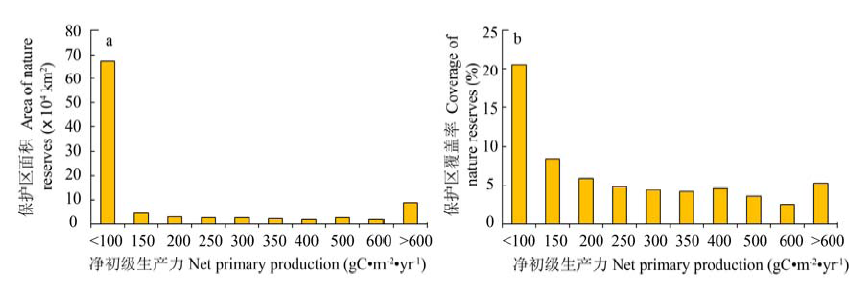
图8 中国国家级自然保护区面积(a)及覆盖率(b)沿植被净初级生产力(MODIS-NPP)的变化趋势
Fig. 8 Area (a) and coverage (b) of nature reserves along vegetation productivity (MODIS-NPP) in China
| 1 | Araujo MB (2003) The coincidence of people and biodiversity in Europe. Global Ecology and Biogeography, 12, 5-12. |
| 2 | Cantu-Salazar L, Gaston KJ (2010) Very large protected areas and their contribution to terrestrial biological conservation.BioScience, 60, 808-818. |
| 3 | Chapin FS, Zavaleta ES, Eviner VT, Naylor RL, Vitousek PM, Reynolds HL, Hooper DU, Lavorel S, Sala OE, Hobbie SE, Mack MC, Diaz S (2000) Consequences of changing biodiversity.Nature, 405, 234-242. |
| 4 | Chen YH (陈雅涵), Tang ZY (唐志尧), Fang JY (方精云) (2009) Distribution of nature reserves and status of biodiversity protection in China.Biodiversity Science(生物多样性), 17, 664-674. (in Chinese with English abstract) |
| 5 | China’s National Bureau of Statistics (国家统计局) (2012) China Statistical Yearbook for Regional Economy 2011 (中国区域经济统计年鉴2011). China Statistics Press, Beijing. (in Chinese) |
| 6 | Evans KL, Greenwood JJD, Gaston KJ (2007) The positive correlation between avian species richness and human population density in Britain is not attributable to sampling bias.Global Ecology and Biogeography, 16, 300-304. |
| 7 | Hansen AJ, DeFries R (2007) Ecological mechanisms linking protected areas to surrounding lands.Ecological Applications, 17, 974-988. |
| 8 | Hijmans RJ, Cameron SE, Parra JL, Jones PG, Jarvis A (2005) Very high resolution interpolated climate surfaces for global land areas.International Journal of Climatology, 25, 1965-1978. |
| 9 | Hockings M (2003) Systems for assessing the effectiveness of management in protected areas.BioScience, 53, 823-832. |
| 10 | Hoekstra JM, Boucher TM, Ricketts TH, Roberts C (2005) Confronting a biome crisis: global disparities of habitat loss and protection.Ecology Letters, 8, 23-29. |
| 11 | Huang JH, Chen B, Liu CR, Lai JS, Zhang JL, Ma KP (2012) Identifying hotspots of endemic woody seed plant diversity in China.Diversity and Distributions, 18, 673-688. |
| 12 | International Union for Conservation of Nature (IUCN), United Nations Environment Programme (UNEP), World Wildlife Fund (WWF) (1991) Caring for the Earth: A Strategy for Sustainable Living. Gland, Switzerland. |
| 13 | Jenkins CN, Joppa L (2009) Expansion of the global terrestrial protected area system.Biological Conservation, 142, 2166-2174. |
| 14 | Jiang ZG (蒋志刚) (2005) On the upper limit of the area of the strictly protected nature reserves in China.Acta Ecologica Sinica(生态学报), 25, 1205-1212. (in Chinese with English abstract) |
| 15 | Joppa LN, Pfaff A (2009) High and far: biases in the location of protected areas.PLoS ONE, 4, e8273. |
| 16 | Joppa LN, Pfaff A (2011) Global protected area impacts.Proceedings of the Royal Society B: Biological Sciences, 278, 1633-1638. |
| 17 | Lopez-Pujo J, Zhang FM, Sun HQ, Ying TS, Ge S (2011) Mountains of Southern China as “plant museums” and “plant cradles”: evolutionary and conservation insights. Mountain Research and Development, 31, 261-269. |
| 18 | Ma JZ (马建章), Rong K (戎可), Cheng K (程鲲) (2012) Research and practice on biodiversity in situ conservation in China: progress and prospect.Biodiversity Science(生物多样性), 20, 551-558. (in Chinese with English abstract) |
| 19 | Ma KP (马克平) (2011) Strategic targets for biodiversity conservation in 2011-2020.Biodiversity Science(生物多样性), 19, 1-2. (in Chinese) |
| 20 | Margules CR, Pressey RL (2000) Systematic conservation planning.Nature, 405, 243-253. |
| 21 | Ministry of Environmental Protection of P. R. China (中华人民共和国环境保护部) (2012) List of Nature Reserves of China (全国自然保护区名录).. (accessed April 2012) (in Chinese) |
| 22 | Naughton-Treves L, Holland MB, Brondon K (2005) The role of protected areas in conserving biodiversity and sustaining local livelihoods.Annual Review of Environment and Resources, 30, 219-252. |
| 23 | Parrish JD, Braun DP, Unnasch RS (2003) Are we conserving what we say we are? Measuring ecological integrity within protected areas.BioScience, 53, 851-860. |
| 24 | Quan J (权佳), Ouyang ZY (欧阳志云), Xu WH (徐卫华), Miao H (苗鸿) (2009) Management effectiveness of China nature reserves: status quo assessment and countermeasures.Chinese Journal of Applied Ecology(应用生态学报), 20, 1739-1746. (in Chinese with English abstract) |
| 25 | Ren H (任慧), Hao MX (郝孟曦), Zhang M (张萌), Li ZQ (李中强), Yang GX (杨国祥) (2012) Study on quantitative characteristics of the national nature reserves in China.Ecological Sciences(生态科学), 31, 225-232. (in Chinese with English abstract) |
| 26 | Rodrigues ASL, Andelman SJ, Bakarr MI, Boitani L, Brooks TM, Cowling RM, Fishpool LDC, da Fonseca GAB, Gaston KJ, Hoffmann M, Long JS, Marquet PA, Pilgrim JD, Pressey RL, Schipper J, Sechrest W, Stuart SN, Underhill LG, Waller RW, Watts MEJ, Xie Y (2004) Effectiveness of the global protected area network in representing species diversity.Nature, 428, 640-643. |
| 27 | Sang WG, Ma KP, Axmacher JC (2011) Securing a future for China’s wild plant resources.BioScience, 61, 720-725. |
| 28 | Soutullo A (2010) Extent of the global network of terrestrial protected areas.Conservation Biology, 24, 362-365. |
| 29 | Tang XP (唐小平) (2005) Analysis of the current situation of China’s nature reserve network and a draft plan for its optimization.Biodiversity Science(生物多样性), 13, 81-88. (in Chinese with English abstract) |
| 30 | Tang ZY, Fang JY, Sun JY, Gaston KJ (2011) Effectiveness of protected areas in maintaining plant production.PLoS ONE, 6, e191164. |
| 31 | Tang ZY, Wang ZH, Zheng CY, Fang JY (2006) Biodiversity in China’s mountains.Frontiers in Ecology and the Environment, 4, 347-352. |
| 32 | Wang G, Innes J, Wu S, Krzyzanowski J, Yin Y, Dai S, Zhang X, Liu S (2012) National park development in China: conservation or commercialization? AMBIO: A Journal of the Human Environment, 41, 247-261. |
| 33 | Wu RD, Zhang S, Yu DW, Zhao P, Li XH, Wang LZ, Yu Q, Ma J, Chen A, Long YC (2011) Effectiveness of China’s nature reserves in representing ecological diversity.Frontiers in Ecology and the Environment, 9, 383-389. |
| 34 | Xu HG, Tang XP, Liu JY, Ding H, Wu J, Zhang M, Yang QW, Cai L, Zhao HJ, Liu Y (2009) China’s progress toward the significant reduction of the rate of biodiversity loss.BioScience, 59, 843-852. |
| 35 | Yan Y (闫颜), Wang Z (王智), Gao J (高军), Xu WG (徐网谷), Jiang MK (蒋明康) (2010) Regional distribution characteristics of nature reserves and the influencing factors in China.Acta Ecologica Sinica(生态学报), 30, 5091-5097. (in Chinese with English abstract) |
| 36 | Yuan H (苑虎), Zhang YB (张殷波), Qin HN (覃海宁), Liu Y (刘燕), Yu M (喻梅) (2009) The in situ conservation of state key protected wild plants in national nature reserves in China.Biodiversity Science(生物多样性), 17, 280-287. (in Chinese with English abstract) |
| 37 | Zheng YM, Zhang HY, Niu ZG, Gong P (2012) Protection efficacy of national wetland reserves in China.Chinese Science Bulletin, 57, 1116-1134. |
| [1] | 周丽洁, 郝珉辉, 何怀江, 程艳霞, 张春雨, 赵秀海. 小兴安岭森林β多样性格局、组分及其影响因素[J]. 生物多样性, 2026, 34(4): 25443-. |
| [2] | 张同, 梁力文, 王长剑, 舒服, 王璐, 郭泽光, 卓玛曲珍, 钱芊, 蒋安莉, 敖俊杰, 彭兴文, 伍小刚, 向左甫, 郭克疾, 廖梓延. 基于红外相机的西藏芒康滇金丝猴国家级自然保护区鸟兽多样性及代表性物种的季节性空间利用特征[J]. 生物多样性, 2026, 34(4): 25435-. |
| [3] | 孔孜亦, 王德港, 王建涛, 裴志永, 孙晶, 张长春, 张军国. 基于SCD-HRNet模型的野生动物姿态估计及其在生物多样性监测中的应用: 以内蒙古赛罕乌拉地区为例[J]. 生物多样性, 2026, 34(4): 25287-. |
| [4] | 卢晓强, 芮丹, 张江峰, 尹冰鑫, 王雨露, 岑雨婷, 崔怡晨, 杨万霞. 氮输入驱动的关键生态过程对生物多样性的影响及其管理启示[J]. 生物多样性, 2026, 34(2): 25368-. |
| [5] | 周铝, 姚世贸, 赵战合, 郭画, 田成. 庞泉沟国家级自然保护区狍和野猪时空共存格局[J]. 生物多样性, 2026, 34(2): 25327-. |
| [6] | 杨方义, 靳彤, 申小莉, 张立, 杨彪. 生物多样性公益捐赠对《中国生物多样性保护战略与行动计划(2023‒2030年)》的贡献[J]. 生物多样性, 2026, 34(1): 25269-. |
| [7] | 田璐瑶, 尹豪. 国外生物多样性抵消研究现状和对策[J]. 生物多样性, 2026, 34(1): 25187-. |
| [8] | 黎明, 秦响玲, 朱玉茹, 熊文. 自然保护区生物多样性抵消价值实现的理论框架与运行机制[J]. 生物多样性, 2026, 34(1): 25241-. |
| [9] | 岳可欣, 牛钟辉, 刘念, 徐琳, 吕韦韦, 徐茂宏, 崔绍朋. 山西历山三种同域分布食肉动物昼夜活动节律及与月光周期的关系[J]. 生物多样性, 2025, 33(9): 25084-. |
| [10] | 徐进博, 崔雅倩, 王渊, 王伟波, 刘锋, 王广龙, 扈晶晶, 普布顿珠, 边巴多吉, 旦增, 胡开, 王小川, 宋刚, 吕永磊, 温知新. 西藏雅鲁藏布大峡谷国家级自然保护区内白颊猕猴的栖息地适宜性评价[J]. 生物多样性, 2025, 33(7): 24493-. |
| [11] | 田书荣, 魏营, 肖芬, 周芸芸, 解宜兴, 王丞, 宋芬, 梁志强, 桂小杰. 湖南张家界大鲵国家级自然保护区中国大鲵种群动态及保护策略[J]. 生物多样性, 2025, 33(7): 24581-. |
| [12] | 彭文, 邓泽帅, 郑文宝, 龚凌轩, 曾玉枫, 孟昊, 陈军, 杨道德. eDNA技术在两栖动物调查中的应用: 以湖南莽山国家级自然保护区为例[J]. 生物多样性, 2025, 33(6): 24552-. |
| [13] | 王轶哲, 冯雨晨, 黄晓磊. 福建省蚜虫及其寄主植物多样性[J]. 生物多样性, 2025, 33(6): 25159-. |
| [14] | 毛静, 王婧, 黄杰, 熊姝红, 张自亮, 张佑祥, 吴涛. 湖南高望界国家级自然保护区2021-2023年鸟兽多样性监测数据集[J]. 生物多样性, 2025, 33(6): 24489-. |
| [15] | 王艺璇, 李浩, 孙蔷, 李紫晶, 李明乐, 史亚博, 郑颖, 李星, 莫宇, 范磊, 郭肖, 苗百岭, 韩瀛, 莎娜, 董雷, 张景慧, 李智勇, 王立新, 赵利清, 梁存柱. 绵刺群落地理分布及分类数据集[J]. 生物多样性, 2025, 33(6): 25095-. |
| 阅读次数 | ||||||
|
全文 |
|
|||||
|
摘要 |
|
|||||
备案号:京ICP备16067583号-7
Copyright © 2026 版权所有 《生物多样性》编辑部
地址: 北京香山南辛村20号, 邮编:100093
电话: 010-62836137, 62836665 E-mail: biodiversity@ibcas.ac.cn
