

生物多样性 ›› 2018, Vol. 26 ›› Issue (5): 476-485. DOI: 10.17520/biods.2018036 cstr: 32101.14.biods.2018036
所属专题: 传粉生物学; 昆虫多样性与生态功能
杨培1, 彭艳琼1,*( ), 赵荣华2, 杨大荣1
收稿日期:2018-02-05
接受日期:2018-03-28
出版日期:2018-05-20
发布日期:2018-09-11
通讯作者:
彭艳琼
作者简介:# 共同第一作者
基金资助:
Pei Yang1, Yanqiong Peng1,*(), Ronghua Zhao2, Darong Yang1
Received:2018-02-05
Accepted:2018-03-28
Online:2018-05-20
Published:2018-09-11
Contact:
Peng Yanqiong
About author:# Co-first authors
摘要:
昆虫传粉在维持植物的有性繁殖、物种形成及生态系统稳定中扮演着重要角色, 而野生传粉昆虫为生态系统提供了巨大的传粉服务功能。大蜜蜂(Apis dorsata)为亚洲特有的一种野生传粉昆虫, 是热带地区多种植物和农作物的有效传粉者, 在保障热带生物多样性及作物产量中有不可或缺的作用。但受全球气候变化、人类活动和生境恶化等因素的影响, 其种群数量日益减少, 开展大蜜蜂种质资源保护势在必行。本文综述了大蜜蜂筑巢、迁飞和传粉服务功能, 分析了人为猎取蜂巢, 栖息生境遭受破坏, 杀虫剂和除草剂滥用, 昆虫、螨类和病原物侵染, 气候变化等威胁种群的因素, 以期从强化大蜜蜂基础研究和保护、推动生态农业发展、建立适合大蜜蜂迁飞生态廊道、加强检验检疫及科学合理利用大蜜蜂种质资源等方面制定相应的保护措施。
杨培, 彭艳琼, 赵荣华, 杨大荣 (2018) 大蜜蜂的生物学特性、面临威胁与保护策略. 生物多样性, 26, 476-485. DOI: 10.17520/biods.2018036.
Pei Yang,Yanqiong Peng,Ronghua Zhao,Darong Yang (2018) Biological characteristics, threat factors and conservation strategies for the giant honey bee Apis dorsata. Biodiversity Science, 26, 476-485. DOI: 10.17520/biods.2018036.
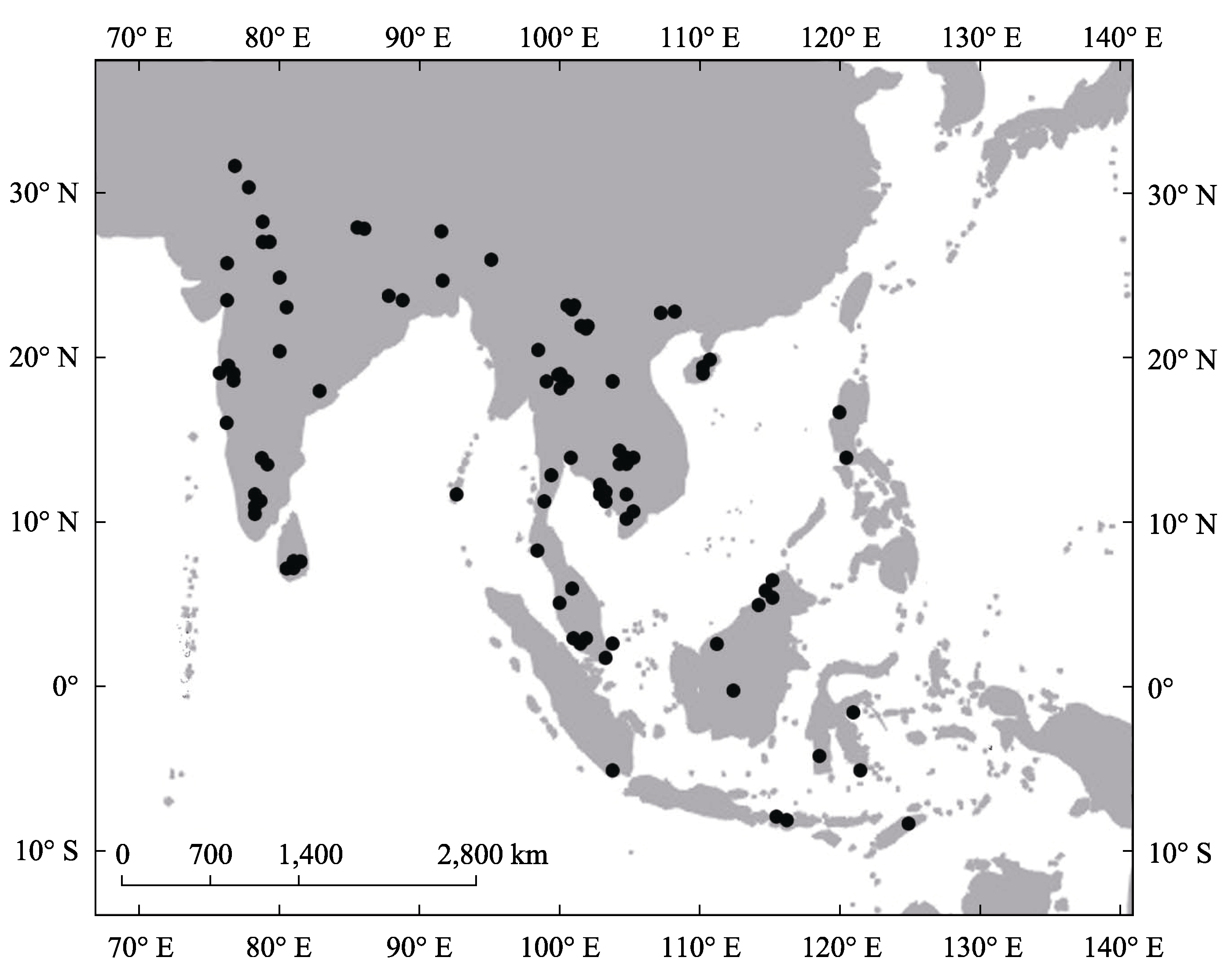
图1 大蜜蜂的地理分布图(黑点表示文献记录的大蜜蜂的分布区)
Fig. 1 The geographical distribution of Apis dorsata. The black dots show the distribution sites in references.

图2 大蜜蜂筑巢地。A: 木棉枝干的蜂巢; B: 悬崖上的蜂巢; C: 屋檐下的蜂巢; D: 工蜂聚集状
Fig. 2 Colony sites of Apis dorsata. A-B, Separate colonies aggregated on the branches of Bombax ceiba (A) and cliff (B); C, The colony under the eave; D, Multiple-layer curtain formed by A. dorsata workers.
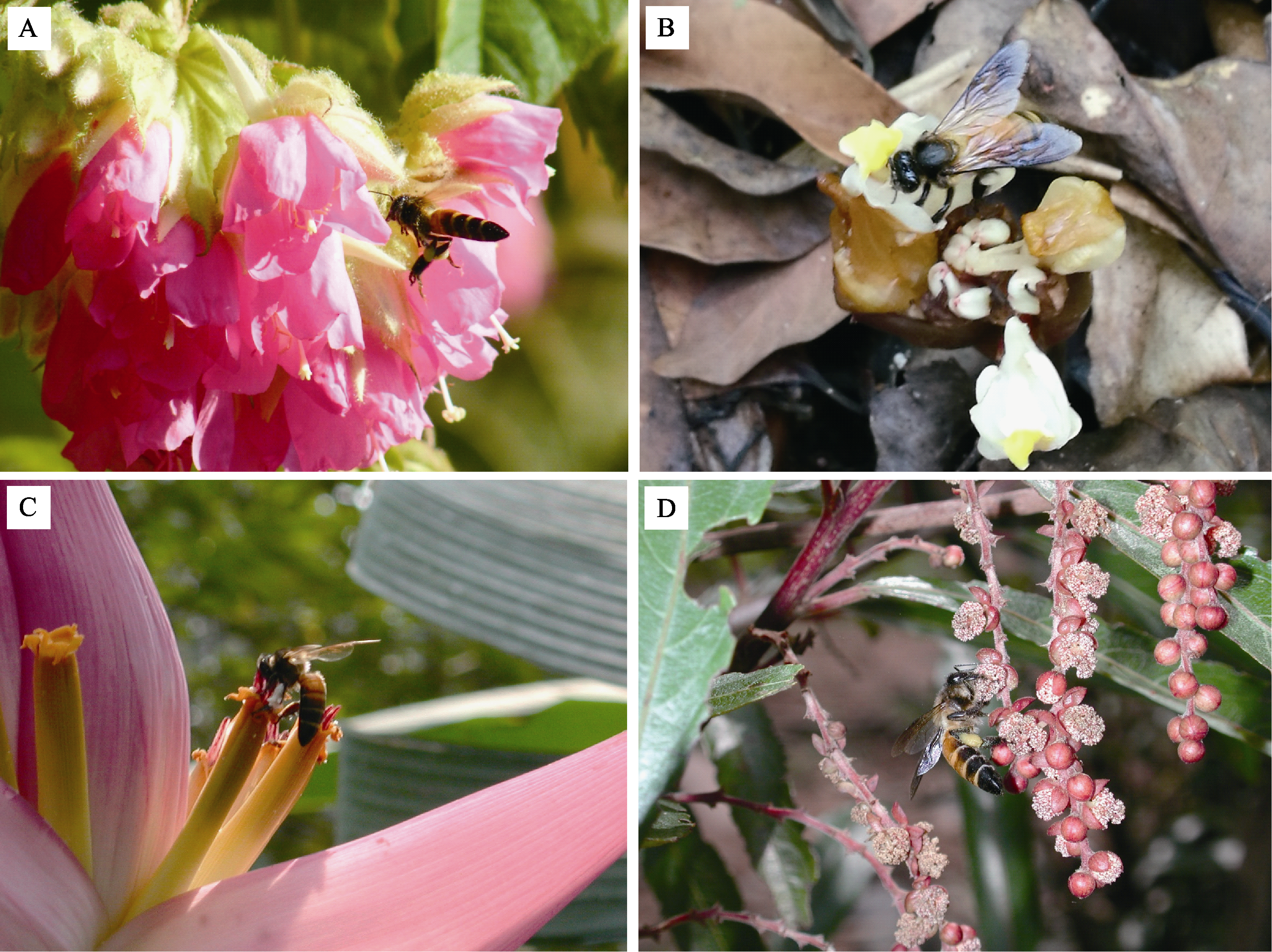
图3 大蜜蜂传粉的4种热带植物。A: 非洲芙蓉; B: 阳春砂仁; C: 紫苞芭蕉; D: 水柳。
Fig. 3 Apis dorsata visiting flowers of four tropical plants. A, Dombeya acutangula; B, Amomum villosum; C, Musa ornata; D, Homonoia riparia.
| 1 | Alexandra-Maria K, Bernard EV, James HC, Ingolf S-D, Saul AC, Claire K, Teja T (2007) Importance of pollinators in changing landscapes for world crops. Proceedings of the Royal Society B, 274, 303-313. |
| 2 | Ali M, Saeed S, Sajjad A, Bashir MA (2014) Exploring the best native pollinators for pumpkin (Cucurbita pepo) production in Punjab, Pakistan. Pakistan Journal of Zoology, 46, 531-539. |
| 3 | Boreux V, Krishnan S, Cheppudira KG, Ghazoul J (2013) Impact of forest fragments on bee visits and fruit set in rain-fed and irrigated coffee agro-forests. Agriculture, Ecosystems & Environment, 172, 42-48. |
| 4 | Breeze TD, Vaissière BE, Bommarco R, Petanidou T, Seraphides N, Kozák L, Scheper J, Biesmeijer JC, Kleijn D, Gyldenkærne S (2014) Agricultural policies exacerbate honeybee pollination service supply-demand mismatches across Europe. PLoS ONE, 9, e82996. |
| 5 | Burkle LA, Marlin JC, Knight TM (2013) Plant-pollinator interactions over 120 years: Loss of species, co-occurrence, and function. Science, 339, 1611-1615. |
| 6 | Cameron SA, Lozier JD, Strange JP, Koch JB, Cordes N, Solter LF, Griswold TL (2011) Patterns of widespread decline in North American bumble bees. Proceedings of the National Academy of Sciences, USA, 108, 662-667. |
| 7 | Cao LF, Hu FL (2012) Biological characters of Apis dorsata from China. Journal of Bee, (4), 1-2. (in Chinese) |
| [曹联飞, 胡福良 (2012) 中国大蜜蜂生物学特性研究初报. 蜜蜂杂志, (4), 1-2.] | |
| 8 | Chantawannakul P, de Guzman LI, Li J, Williams GR (2016) Parasites, pathogens, and pests of honeybees in Asia. Apidologie, 47, 301-324. |
| 9 | Colla SR (2016) Status, threats and conservation recommendations for wild bumble bees (Bombus spp.) in Ontario, Canada: A review for policymakers and practitioners. Natural Areas Journal, 36, 412-426. |
| 10 | Crane E, van Luyen V, Mulder V, Ta TC (1993) Traditional management system for Apis dorsata in submerged forests in southern Vietnam and central Kalimantan. Bee World, 74, 27-40. |
| 11 | Deutsch CA, Tewksbury JJ, Huey RB, Sheldon KS, Ghalambor CK, Haak DC, Martin PR (2008) Impacts of climate warming on terrestrial ectotherms across latitude. Proceedings of the National Academy of Sciences, USA, 105, 6668-6672. |
| 12 | Dorjay N, Abrol DP, Shankar U (2017) Insect visitors on cucumber and bittergourd flowers and impact on quantity of crop production by different pollination treatment. Journal of Apiculture, 32, 77-88. |
| 13 | Dyer FC, Seeley T (1994) Colony migration in the tropical honey bee Apis dorsata F. (Hymenoptera: Apidae). Insectes Sociaux, 41, 129-140. |
| 14 | Dyer FC (1985) Nocturnal orientation by the Asian honey bee, Apis dorsata. Animal Behaviour, 33, 769-774. |
| 15 | Ellis J, Hepburn H (2006) An ecological digest of the small hive beetle (Aethina tumida), a symbiont in honey bee colonies (Apis mellifera). Insectes Sociaux, 53, 8-19. |
| 16 | Gallai N, Salles J-M, Settele J, Vaissière BE (2009) Economic valuation of the vulnerability of world agriculture confronted with pollinator decline. Ecological Economics, 86, 810-821. |
| 17 | Ghazoul J (2015) Qualifying pollinator decline evidence. Science, 348, 981-982. |
| 18 | Hepburn H, Radloff SE (2011) Biogeography. In: Honeybees of Asia (eds Hepburn R, Radloff S), pp. 51-67. Springer, Heidelberg. |
| 19 | Itioka T, Inoue T, Kaliang H, Kato M, Nagamitsu T, Momose K, Sakai S, Yumoto T, Mohamad SU, Hamid AA (2001) Six-year population fluctuation of the giant honey bee Apis dorsata (Hymenoptera: Apidae) in a tropical lowland dipterocarp forest in Sarawak. Annals of the Entomological Society of America, 94, 545-549. |
| 20 | Kerr JT, Pindar A, Galpern P, Packer L, Potts SG, Roberts SM, Rasmont P, Schweiger O, Colla SR, Richardson LL (2015) Climate change impacts on bumblebees converge across continents. Science, 349, 177-180. |
| 21 | Kevan PG, Viana BF (2003) The global decline of pollination services. Biodiversity, 4, 3-8. |
| 22 | Kremen C, Williams NM, Aizen MA, Gemmill-Herren B, LeBuhn G, Minckley R, Packer L, Potts SG, Steffan-Dewenter I, Vazquez DP (2007) Pollination and other ecosystem services produced by mobile organisms: A conceptual framework for the effects of land-use change. Ecology Letters, 10, 299-314. |
| 23 | Lahjie AM, Seibert B (1990) Honey gathering by people in the interior of East Kalimantan. Bee World, 71, 153-157. |
| 24 | Laigo FM, Morse RA (1968) The mite Tropilaelaps clareae in Apis dorsata colonies in the Philippines. Bee World, 49, 116-118. |
| 25 | Lebuhn G, Droege S, Connor EF, Gemmill-Herren B, Potts SG, Minckley RL, Griswold T, Jean R, Kula E, Roubik DW (2013) Detecting insect pollinator declines on regional and global scales. Conservation Biology, 27, 113-120. |
| 26 | Makinson JC, Schaerf TM, Rattanawannee A, Oldroyd BP, Beekman M (2014) Consensus building in giant Asian honeybee, Apis dorsata, swarms on the move. Animal Behaviour, 93, 191-199. |
| 27 | Momose K, Yumoto T, Nagamitsu T, Kato M, Nagamasu H, Sakai S, Harrison RD, Itioka T, Hamid AA, Inoue T (1998) Pollination biology in a lowland dipterocarp forest in Sarawak, Malaysia. I. Characteristics of the plant-pollinator community in a lowland dipterocarp forest. American Journal of Botany, 85, 1477-1501. |
| 28 | Moreyra S, D’Adamo P, Lozada M (2017) Long-term spatial memory in Vespula germanica social wasps: The influence of past experience on foraging behavior. Insect Science, 24, 853-858. |
| 29 | Nagir MT, Atmowidi T, Kahono S (2016) The distribution and nest-site preference of Apis dorsata Binghami at Maros forest, South Sulawesi, Indonesia. Journal of Insect Biodiversity, 4, 1-14. |
| 30 | Nath S, Roy P, Leo R, John M (1994) Honeyhunters and Beekeepers of Tamil Nadu, A Survey Document. Coonoor Printing Press, Tamil Nadu. |
| 31 | Neokosmidis L, Tscheulin T, Devalez J, Petanidou T (2018) Landscape spatial configuration is a key driver of wild bee demographics. Insect Science, 25, 172-182. |
| 32 | Neumann P, Koeniger N, Koeniger G, Tingek S, Kryger P, Moritz RF (2000) Home-site fidelity in migratory honeybees. Nature, 406, 474-475. |
| 33 | Noreen A, Niissalo M, Lum S, Webb E (2016) Persistence of long-distance, insect-mediated pollen movement for a tropical canopy tree species in remnant forest patches in an urban landscape. Heredity, 117, 472-480. |
| 34 | Oldroyd B, Osborne K, Mardan M (2000) Colony relatedness in aggregations of Apis dorsata Fabricius (Hymenoptera, Apidae). Insectes Sociaux, 47, 94-95. |
| 35 | Oldroyd BP, Nanork P (2009) Conservation of Asian honey bees. Apidologie, 40, 296-312. |
| 36 | Ollerton J (2017) Pollinator diversity: Distribution, ecological function, and conservation. Annual Review of Ecology, Evolution, and Systematics, 48, 353-376. |
| 37 | Ollerton J, Erenler H, Edwards M, Crockett R (2014) Extinctions of aculeate pollinators in Britain and the role of large-scale agricultural changes. Science, 346, 1360-1362. |
| 38 | Paar J, Oldroyd B, Huettinger E, Kastberger G (2004) Genetic structure of an Apis dorsata population: The significance of migration and colony aggregation. Journal of Heredity, 95, 119-126. |
| 39 | Paar J, Oldroyd B, Kastberger G (2000) Giant honeybees return to their nest sites. Nature, 406, 475. |
| 40 | Pauw A (2007) Collapse of a pollination web in small conservation areas. Ecology, 88, 1759-1769. |
| 41 | Pauw A, Stanway R (2015) Unrivalled specialization in a pollination network from South Africa reveals that specialization increases with latitude only in the Southern Hemisphere. Journal of Biogeography, 42, 652-661. |
| 42 | Potts SG, Biesmeijer JC, Kremen C, Neumann P, Schweiger O, Kunin WE (2010) Global pollinator declines: Trends, impacts and drivers. Trends in Ecology & Evolution, 25, 345-353. |
| 43 | Potts SG, Vulliamy B, Dafni A, Ne’eman G, Willmer P (2003) Linking bees and flowers: How do floral communities structure pollinator communities? Ecology, 84, 2628-2642. |
| 44 | Potts SG, Imperatriz-Fonseca VL, Ngo HT, Biesmeijer JC, Breeze TD, Dicks LV, Garibaldi LA, Hill R, Settele J, Vanbergen AJ, Aizen MA, Cunningham SA, Eardley C, Freitas BM, Gallai N, Kevan PF, Kovács-Hostyánszki A, Kwapong PK, Li J, Li X, Martins DJ, Nates-Parra G, Pettis JS, Rader R, Viana BF (2016) IPBES: Summary for Policymakers of the Assessment Report of the Intergovernmental Science-Policy Platform on Biodiversity and Ecosystem Services on Pollinators, Pollination and Food Production. Secretariat of the Intergovernmental Science-Policy Platform on Biodiversity and Ecosystem Services, Bonn. |
| 45 | Qian ZN, Meng QW, Ren MX (2016) Pollination ecotypes and herkogamy variation of Hiptage benghalensis (Malpighiaceae) with mirror-image flowers. Biodiversity Science, 24, 1364-1372. (in Chinese with English abstract) |
| [钱贞娜, 孟千万, 任明迅 (2016) 风筝果镜像花的雌雄异位变化及传粉生态型的形成. 生物多样性, 24, 1364-1372.] | |
| 46 | Raghunandan K, Basavarajappa S (2014) Floral hosts and pollen calendar of Asian giant honeybee, Apis dorsata Fabricius at Southern Karnataka, India. Journal of Ecology and the Natural Environment, 6, 321-330. |
| 47 | Rattanawannee A, Chanchao C (2011) Bee diversity in Thailand and the applications of bee products. In: Changing Diversity in Changing Environment (eds Grillo O, Venora G), pp. 152-154. InTech, Rijeka. |
| 48 | Rattanawannee A, Chanchao C, Lim J, Wongsiri S, Oldroyd BP (2013) Genetic structure of a giant honey bee (Apis dorsata) population in northern Thailand: Implications for conservation. Insect Conservation and Diversity, 6, 38-44. |
| 49 | Ren MX, Zhang DY (2004) Herkogamy. In: Plant Life-History Evolution and Reproductive Ecology (ed. Zhang DY), pp. 302-321. Science Press, Beijing. (in Chinese) |
| [任明迅, 张大勇 (2004) 雌雄异位. 见: 植物生活史进化与繁殖生态学 (张大勇主编), 302-321页. 科学出版社, 北京.] | |
| 50 | Ren MX, Zhong YF, Song XQ (2013) Mirror-image flowers without buzz pollination in the Asian endemic Hiptage benghalensis (Malpighiaceae). Botanical Journal of the Linnean Society, 173, 764-774. |
| 51 | Robinson WS (2012) Migrating giant honey bees (Apis dorsata) congregate annually at stopover site in Thailand. PLoS ONE, 7, e44976. |
| 52 | Sammataro D, Gerson U, Needham G (2000) Parasitic mites of honey bees: Life history, implications, and impact. Annual Review of Entomology, 45, 519-548. |
| 53 | Shankar U, Abrol D, Chatterjee D, Rizvi S (2017) Diversity of native bees on Parkinsonia aculeata L. in Jammu region of North-West Himalaya. Tropical Ecology, 58, 211-215. |
| 54 | Sihag RC (2014) Phenology of migration and decline in colony numbers and crop hosts of giant honeybee (Apis dorsata F.) in semiarid environment of Northwest India. Journal of Insects, 2014, 1-9. |
| 55 | Sihag RC (2017) Nesting behavior and nest site preferences of the giant honey bee (Apis dorsata F.) in the semi-arid environment of north west India. Journal of Apicultural Research, 56, 452-466. |
| 56 | Sodhi NS, Koh LP, Brook BW, Ng PK (2004) Southeast Asian biodiversity: An impending disaster. Trends in Ecology & Evolution, 19, 654-660. |
| 57 | Soman A, Kshirsagar K (1991) Preliminary survey on the rockbee (Apis dorsata F.) and some observations on the traditional methods of honey hunting. Indian Bee Journal, 53, 17-22. |
| 58 | Somanathan H, Warrant EJ, Borges RM, Wallén R, Kelber A (2009) Resolution and sensitivity of the eyes of the Asian honeybees Apis florea, Apis cerana and Apis dorsata. Journal of Experimental Biology, 212, 2448-2453. |
| 59 | Srivastava K, Sharma D, Pandey S, Anal A, Nath V (2017) Dynamics of climate and pollinator species influencing litchi (Litchi chinensis) in India. Indian Journal of Agricultural Sciences, 87, 266-269. |
| 60 | Starr CK, Schmidt PJ, Schmidt JO (1987) Nest-site preferences of the giant honey bee, Apis dorsata (Hymenoptera: Apidae), in Borneo. Pan-Pacific Entomologist, 63, 37-42. |
| 61 | Tan NQ, Chinh PH, Thai PH, Mulder V (1997) Rafter beekeeping with Apis dorsata: Some factors affecting the occupation of rafters by bees. Journal of Apicultural Research, 36, 49-54. |
| 62 | Tan NQ, Ha DT (2002) Socio-economic factors in traditional rafter beekeeping with Apis dorsata in Vietnam. Bee World, 83, 165-170. |
| 63 | Wardhaugh CW (2015) How many species of arthropods visit flowers? Arthropod-Plant Interactions, 9, 547-565. |
| 64 | Warrit N, Lekprayoon C (2011) Asian honeybee mites. In: Honeybees of Asia (eds Hepburn R, Radloff S), pp. 347-368. Springer, Heidelberg. |
| 65 | Woyke J (1984) Survival and prophylactic control of Tropilaelaps clareae infesting Apis mellifera colonies in Afghanistan. Apidologie, 15, 421-434. |
| 66 | Woyke J, Wilde J, Wilde M (2012) Swarming and migration of Apis dorsata and Apis laboriosa honey bees in India, Nepal and Bhutan. Journal of Apicultural Science, 56, 81-91. |
| 67 | Wu YR (2000) Fauna Sinica (Tomus 20), Insecta, Melittidae, Apidae. Science Press, Beijing. (in Chinese) |
| [吴燕如 (2000) 中国动物志 (第20卷) 昆虫纲•准蜂科•蜜蜂科. 科学出版社, 北京.] | |
| 68 | Zhang ZS (1974) Primary research on Apis dorsata Fabricius in Yunnan. Entomological Knowledge, (3), 42-44. (in Chinese) |
| [张正松 (1974) 云南排蜂的初步研究. 昆虫知识, (3), 42-44.] |
| [1] | 王倩倩, 陈孝国, 朱锐丰, 张明春, 王新, 李世林, 仁增江措, 彭武, 杨彪. 藏东南黑麝及其同域有蹄类物种的生态适应性差异[J]. 生物多样性, 2026, 34(5): 25433-. |
| [2] | 周丽洁, 郝珉辉, 何怀江, 程艳霞, 张春雨, 赵秀海. 小兴安岭森林β多样性格局、组分及其影响因素[J]. 生物多样性, 2026, 34(4): 25443-. |
| [3] | 陈小勇. 珍稀濒危植物有效迁地保护: 概念、标准和建议[J]. 生物多样性, 2026, 34(4): 25448-. |
| [4] | 张同, 梁力文, 王长剑, 舒服, 王璐, 郭泽光, 卓玛曲珍, 钱芊, 蒋安莉, 敖俊杰, 彭兴文, 伍小刚, 向左甫, 郭克疾, 廖梓延. 基于红外相机的西藏芒康滇金丝猴国家级自然保护区鸟兽多样性及代表性物种的季节性空间利用特征[J]. 生物多样性, 2026, 34(4): 25435-. |
| [5] | 安明态, 吴旭, 余江洪, 胡国雄, 王琨, 刘锋, 吴天柔, 徐钦, 张豪, 徐建, 杨焱冰, 曹威, 严令斌, 李鹤, 李志, 余德会, 黄郎, 陈志萍, 李晓芳, 邹华凯, 龙敏, 顾伟豪, 马宇航, 邱剪. 贵州省高等植物物种多样性编目及分布数据集[J]. 生物多样性, 2026, 34(4): 25427-. |
| [6] | 孔孜亦, 王德港, 王建涛, 裴志永, 孙晶, 张长春, 张军国. 基于SCD-HRNet模型的野生动物姿态估计及其在生物多样性监测中的应用: 以内蒙古赛罕乌拉地区为例[J]. 生物多样性, 2026, 34(4): 25287-. |
| [7] | 鲁夕霞, 周冯祥, 雍李明, 曾千慧, 赵丽媛, 张语克, 王先艳. 1990-2020年围填海对我国中华白海豚栖息地的影响[J]. 生物多样性, 2026, 34(3): 25249-. |
| [8] | 尚晓彤, 黄程, 杨立, 牟希东, 李添明, 刘阳. 全球尺度水产养殖系统减少鸟类致损措施成效评估[J]. 生物多样性, 2026, 34(3): 25453-. |
| [9] | 倪庆永, 番玉买, 张琦, 解萌. 中国懒猴科灵长类研究与保护进展[J]. 生物多样性, 2026, 34(3): 25451-. |
| [10] | 范鹏来, 姚维, 黄乘明, 周岐海. 中国叶猴的研究简史和保护进展[J]. 生物多样性, 2026, 34(3): 25446-. |
| [11] | 郭松涛, 陈国梁, 李保国. 中国灵长类学研究进展[J]. 生物多样性, 2026, 34(3): 25462-. |
| [12] | 向左甫. 中国金丝猴生态、保护与社会行为研究简史及进展[J]. 生物多样性, 2026, 34(3): 25442-. |
| [13] | 侯姝彧, 刘盈盈, 杨锐. 《昆蒙框架》背景下国际OECMs体系构建实践进展及中国化思路[J]. 生物多样性, 2026, 34(3): 25264-. |
| [14] | 罗钰, 郑旭艳, 曹力, 王波, 彭艳琼, 罗银玲, 周会平, 杨小芳, 苗白鸽, 王朝雅, 高洁. 生境简化重塑榕树-榕小蜂互作网络: 挥发物组成与群落结构的适应性响应[J]. 生物多样性, 2026, 34(2): 25328-. |
| [15] | 卢晓强, 芮丹, 张江峰, 尹冰鑫, 王雨露, 岑雨婷, 崔怡晨, 杨万霞. 氮输入驱动的关键生态过程对生物多样性的影响及其管理启示[J]. 生物多样性, 2026, 34(2): 25368-. |
| 阅读次数 | ||||||
|
全文 |
|
|||||
|
摘要 |
|
|||||
备案号:京ICP备16067583号-7
Copyright © 2026 版权所有 《生物多样性》编辑部
地址: 北京香山南辛村20号, 邮编:100093
电话: 010-62836137, 62836665 E-mail: biodiversity@ibcas.ac.cn
