

生物多样性 ›› 2026, Vol. 34 ›› Issue (3): 25264. DOI: 10.17520/biods.2025264 cstr: 32101.14.biods.2025264
侯姝彧1( ), 刘盈盈2,3,4(), 杨锐5,6,*()(
 )
)
收稿日期:2025-07-07
接受日期:2026-02-14
出版日期:2026-03-20
发布日期:2026-04-10
通讯作者:
*E-mail: 基金资助:
Shuyu Hou1(), Yingying Liu2,3,4(), Rui Yang5,6,*()()
Received:2025-07-07
Accepted:2026-02-14
Online:2026-03-20
Published:2026-04-10
Contact:
*E-mail: Supported by:摘要:
生物多样性的全面有效保护难以仅凭自然保护地实现, “其他有效的区域保护措施” (other effective area-based conservation measures, OECMs)能够通过兼容性方式协调自然保护与人类利用, 在《昆明-蒙特利尔全球生物多样性框架》中被作为实现2030年保护目标的重要工具。当前全球OECMs实践工作快速推进, 在治理模式、认定体系、管理机制方面提供了先行经验。本文通过梳理14个已正式认定及报告OECMs的国家或地区的OECMs体系以及各国OECMs的治理模式、认定体系及管理机制, 基于对6,339处OECMs的统计分析、空间分析和199处OECMs具体管理措施文本的梳理, 从管理目标、治理主体、地表特征、使用主体等角度分析了各国各类OECMs的特征及管理要点, 旨在为我国OECMs体系建设实践提供参考。结合中国的国土空间规划和生态保护背景, 从提出中国探索治理模式、完善保护用地体系、构建弹性管理机制3个层面, 提出OECMs的中国化思路及近期工作建议。
侯姝彧, 刘盈盈, 杨锐 (2026) 《昆蒙框架》背景下国际OECMs体系构建实践进展及中国化思路. 生物多样性, 34, 25264. DOI: 10.17520/biods.2025264.
Shuyu Hou, Yingying Liu, Rui Yang (2026) Progress of international OECMs practices under the Kunming-Montreal Global Biodiversity Framework and pathways for localization in China. Biodiversity Science, 34, 25264. DOI: 10.17520/biods.2025264.
| 国家/地区 Country/ region | 数量 No. | 国家层面负责机构 National-level authority | 原有保护形式 Original conservation form | 治理主体类 型数量 Types of governance authorities | 管理目标种类 Types of management objective |
|---|---|---|---|---|---|
| 加拿大 Canada | 333 | 环境和气候变化部 Environment and Climate Change | (直接认定的) OECMs; 永久禁伐区; 水源保护区; 禁渔区; 天然林; 自然保护区; 各级公园; 各级保护用地; 休憩地; 荒野保护区; 栖息地保护区; 遗产保护区; 研究用地; 墓葬地等 (Directly recognized) OECMs; conservation set-asides in managed forests; watershed protection zones; fishery closure that maintain biodiversity; natural forest; nature reserve; multi-level park; multi-level conservation area; recreation site; wilderness area; wildlife habitat protection; heritage conservation zone; research areas; place of interment, etc. | 8 | 3 |
| 阿尔及利亚 Algeria | 5 | 环境与可再生能源部 Ministry of Environment and Renewable Energy | 文化公园 Cultural park | 1 | 1 |
| 英国(根西岛) United Kingdom (Guernsey) | 10 | 根西环境与设施部 Guernsey Department for the Environment & Infrastructure | 重要栖息地 Critical habitat | 1 | 未报告 Not reported |
| 菲律宾 Philippines | 42 | 环境和自然资源部 Department of Environment and Natural Resources | 关键栖息地; 地方保护地; 原住民社区保护地; 海洋保护地网络 Critical habitats; local conservation areas; indigenous community conserved areas; marine protected areas network | 3 | 1 |
| 摩洛哥 Morocco | 338 | 水资源与森林局 Department of Water and Forests | 生物与生态重点区; 永久禁猎区 Biological and ecological interest site; permanent hunting reserve | 2 | 2 |
| 斯威士兰 Eswatini | 8 | 环境管理局 Eswatini Environment Authority | 社区保护地; 私人保护地; 大学 Community-based conservation area; privately-owned conservation area; university | 3 | 2 |
| 哥伦比亚 Colombia | 47 | 环境与可持续发展部 Ministry of Environment and Sustainable Development | 自然保护区; 自然公园; 流域保护区; 拉姆萨尔湿地; 国际重要湿地; 生物圈保护区; 海洋保护地; 保护区域; 社区保护地; 特别管理区 Nature reserve; nature park; watershed protected area; Ramsar site; wetland of international importance; biosphere reserve; marine protected area; conservation district; community conserved area; special management area | 6 | 2 |
| 秘鲁 Peru | 1 | 国家自然保护地局 National Service of Natural Protected Areas | 特许保护区域 Conservation concession | 1 | 1 |
| 阿曼 Oman | 2 | 环境和气候局 Ministry of Environment and Climate Affairs | 自然保护区 Nature reserve | 1 | 1 |
| 韩国 South Korea | 4 | 气候能源环境部 The Ministry of Climate, Energy and Environment | 特殊保护用地; 信托土地; 实验林 Special conserved area; trust properties; research forest | 2 | 2 |
| 日本 Japan | 153 | 环境省 Ministry of the Environment | (国家层面认定的)自然共生地 (National recognized) Nature symbiosis site | 未报告 Not reported | 2 |
| 瑞典 Sweden | 5,365 | 瑞典环境保护署 The Swedish Environmental Protection Agency | 自愿保留地 Voluntary set-aside areas | 1 | 1 |
| 不丹 Bhutan | 11 | 林业和公园局 Department of Forests and Park Services | 生物多样性关键区域 Key Biodiversity Areas | 1 | 1 |
| 公海区 Areas beyond National Jurisdiction | 20 | 东北大西洋渔业委员会 North-east Atlantic Fisheries Commission | 东北大西洋渔业委员会脆弱海洋生态系统底拖网禁渔区 North-east Atlantic Fisheries Commission Area closed to bottom fisheries for the protection of vulnerable marine ecosystems | 1 | 未报告 Not reported |
表1 各国已提交WD-OECM数据库的其他有效的区域保护措施(OECMs)概况
Table 1 Summary of other effective area-based conservation measures (OECMs) submitted by countries to the WD-OECM database
| 国家/地区 Country/ region | 数量 No. | 国家层面负责机构 National-level authority | 原有保护形式 Original conservation form | 治理主体类 型数量 Types of governance authorities | 管理目标种类 Types of management objective |
|---|---|---|---|---|---|
| 加拿大 Canada | 333 | 环境和气候变化部 Environment and Climate Change | (直接认定的) OECMs; 永久禁伐区; 水源保护区; 禁渔区; 天然林; 自然保护区; 各级公园; 各级保护用地; 休憩地; 荒野保护区; 栖息地保护区; 遗产保护区; 研究用地; 墓葬地等 (Directly recognized) OECMs; conservation set-asides in managed forests; watershed protection zones; fishery closure that maintain biodiversity; natural forest; nature reserve; multi-level park; multi-level conservation area; recreation site; wilderness area; wildlife habitat protection; heritage conservation zone; research areas; place of interment, etc. | 8 | 3 |
| 阿尔及利亚 Algeria | 5 | 环境与可再生能源部 Ministry of Environment and Renewable Energy | 文化公园 Cultural park | 1 | 1 |
| 英国(根西岛) United Kingdom (Guernsey) | 10 | 根西环境与设施部 Guernsey Department for the Environment & Infrastructure | 重要栖息地 Critical habitat | 1 | 未报告 Not reported |
| 菲律宾 Philippines | 42 | 环境和自然资源部 Department of Environment and Natural Resources | 关键栖息地; 地方保护地; 原住民社区保护地; 海洋保护地网络 Critical habitats; local conservation areas; indigenous community conserved areas; marine protected areas network | 3 | 1 |
| 摩洛哥 Morocco | 338 | 水资源与森林局 Department of Water and Forests | 生物与生态重点区; 永久禁猎区 Biological and ecological interest site; permanent hunting reserve | 2 | 2 |
| 斯威士兰 Eswatini | 8 | 环境管理局 Eswatini Environment Authority | 社区保护地; 私人保护地; 大学 Community-based conservation area; privately-owned conservation area; university | 3 | 2 |
| 哥伦比亚 Colombia | 47 | 环境与可持续发展部 Ministry of Environment and Sustainable Development | 自然保护区; 自然公园; 流域保护区; 拉姆萨尔湿地; 国际重要湿地; 生物圈保护区; 海洋保护地; 保护区域; 社区保护地; 特别管理区 Nature reserve; nature park; watershed protected area; Ramsar site; wetland of international importance; biosphere reserve; marine protected area; conservation district; community conserved area; special management area | 6 | 2 |
| 秘鲁 Peru | 1 | 国家自然保护地局 National Service of Natural Protected Areas | 特许保护区域 Conservation concession | 1 | 1 |
| 阿曼 Oman | 2 | 环境和气候局 Ministry of Environment and Climate Affairs | 自然保护区 Nature reserve | 1 | 1 |
| 韩国 South Korea | 4 | 气候能源环境部 The Ministry of Climate, Energy and Environment | 特殊保护用地; 信托土地; 实验林 Special conserved area; trust properties; research forest | 2 | 2 |
| 日本 Japan | 153 | 环境省 Ministry of the Environment | (国家层面认定的)自然共生地 (National recognized) Nature symbiosis site | 未报告 Not reported | 2 |
| 瑞典 Sweden | 5,365 | 瑞典环境保护署 The Swedish Environmental Protection Agency | 自愿保留地 Voluntary set-aside areas | 1 | 1 |
| 不丹 Bhutan | 11 | 林业和公园局 Department of Forests and Park Services | 生物多样性关键区域 Key Biodiversity Areas | 1 | 1 |
| 公海区 Areas beyond National Jurisdiction | 20 | 东北大西洋渔业委员会 North-east Atlantic Fisheries Commission | 东北大西洋渔业委员会脆弱海洋生态系统底拖网禁渔区 North-east Atlantic Fisheries Commission Area closed to bottom fisheries for the protection of vulnerable marine ecosystems | 1 | 未报告 Not reported |
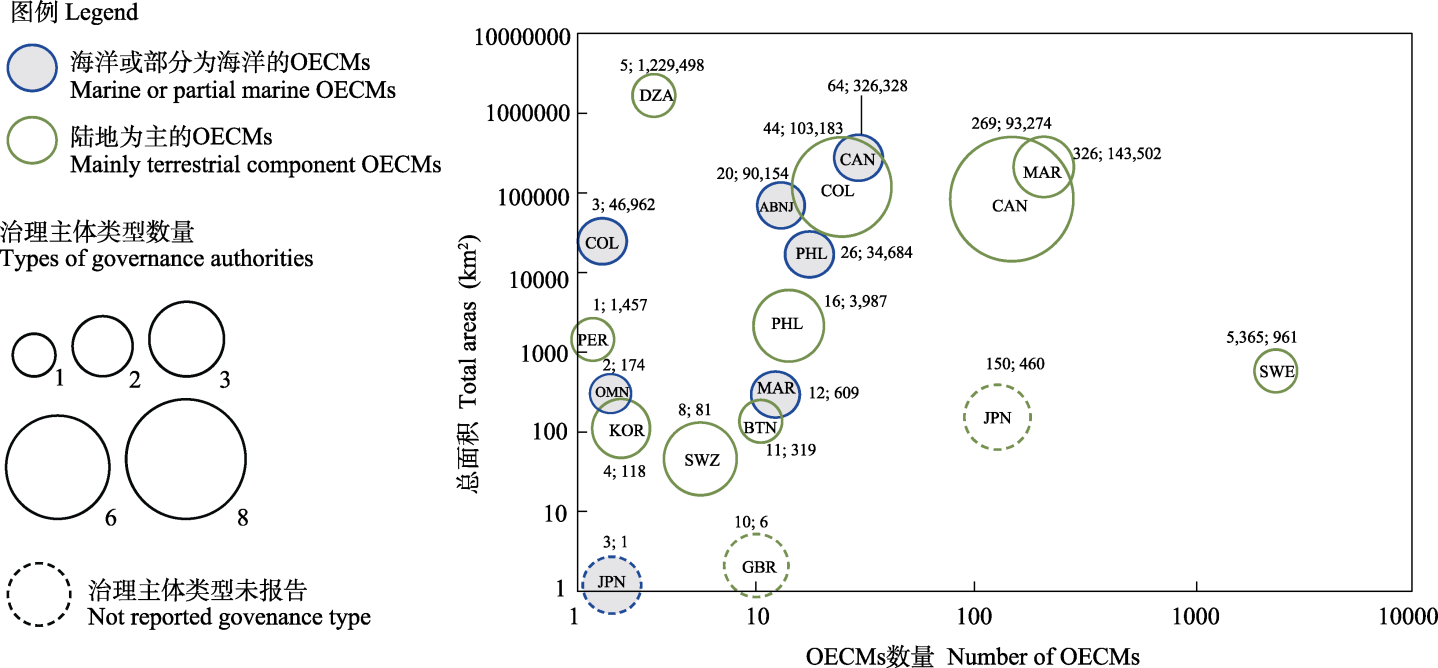
图1 各国其他有效的区域保护措施(OECMs)数量、总面积及治理主体类型数量情况示意。ABNJ: 公海区; BTN: 不丹; CAN: 加拿大; COL: 哥伦比亚; DZA: 阿尔及利亚; GBR: 英国(根西岛); JPN: 日本; KOR: 韩国; MAR: 摩洛哥; OMN: 阿曼; PER: 秘鲁; PHL: 菲律宾; SWE: 瑞典; SWZ: 斯威士兰。
Fig. 1 Illustration of the other effective area-based conservation measures (OECMs) number, total area, and types of governing authority across countries. ABNJ, Areas beyond National Jurisdiction; BTN, Bhutan; CAN, Canada; COL, Colombia; DZA, Algeria; GBR, United Kingdom (Guernsey); JPN, Japan; KOR, Republic of Korea; MAR, Morocco; OMN, Oman; PER, Peru; PHL, Philippines; SWE, Sweden; SWZ, Eswatini.
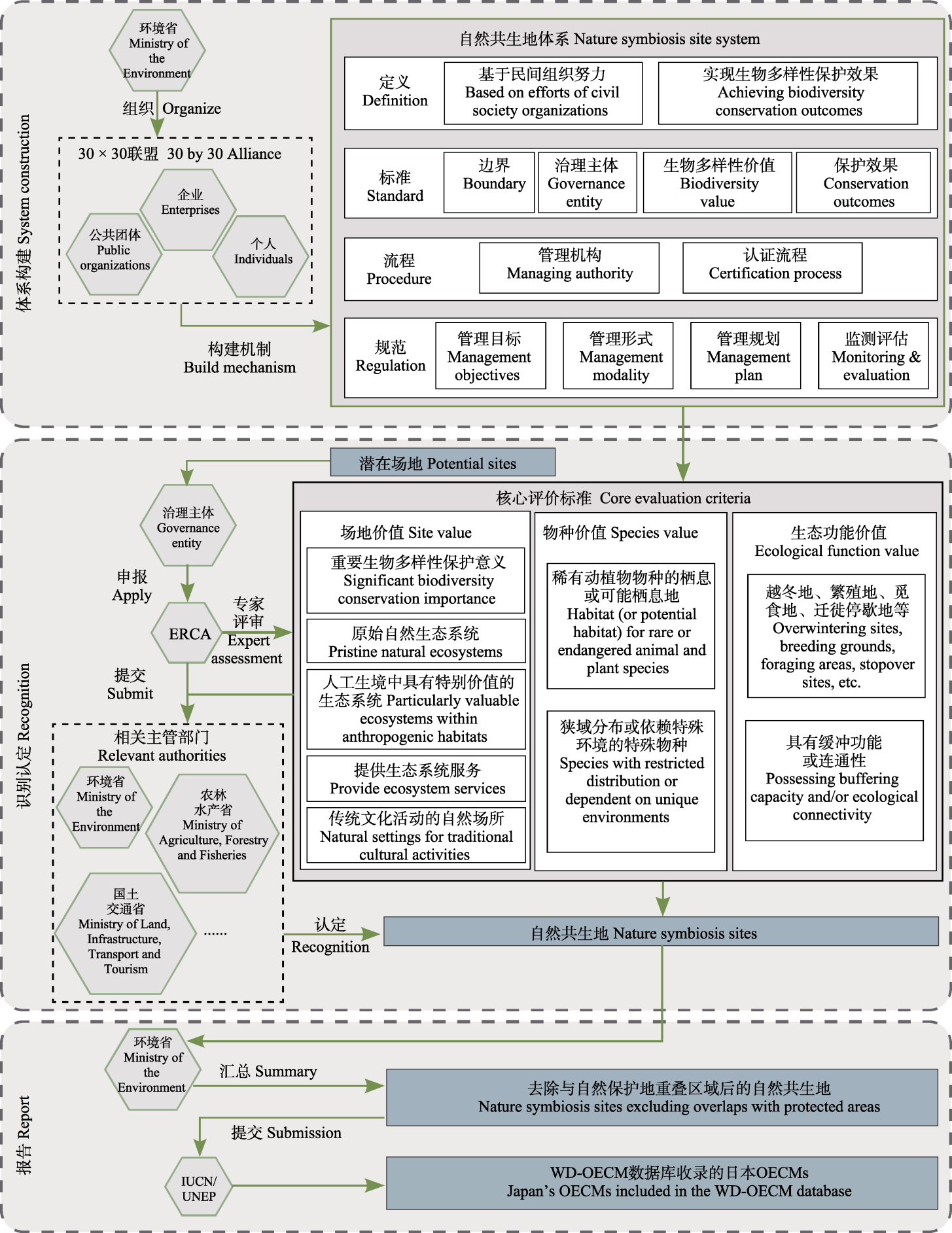
图2 日本自然共生地申报、认定、报告流程。ERCA: 独立行政法人环境修复与保护机构。
Fig. 2 Process for nomination, designation, and reporting of the nature symbiosis sites in Japan. ERCA, Environmental Restoration and Conservation Agency.
| 主导地类 Dominant landcover | 保护关注点高频词 Frequent terms of conservation concerns | 管理特色 Management features | 规划设计要点 Design considerations | 代表案例 Representative project |
|---|---|---|---|---|
| 农田 Cropland | 连通性; 物种繁殖和越冬; 两栖和爬行动物; 珍稀物种; 传统农事风俗文化 Connectivity; species reproduction and overwintering; amphibians and reptiles; rare species; traditional agricultural practices and cultural customs | 合作管理为主; 多为新纳入保护体系; 不同季节不同措施 Primary reliance on collaborative management; most areas are newly designated within the conservation network; implementing season-specific measures | 分区规划; 关注物种连通性; 景观和视线廊道 Zoning; prioritizing species connectivity; landscape and visual corridors | 北海道大学札幌校区 Hokkaido University-Sapporo Campus①(① 旅行者廊道 Voyageurs corridor②(② |
| 农田与自然植被镶嵌 Cropland and vegetation mosaic | 连通性; 物种繁殖和越冬; 两栖和爬行动物; 区域生态功能支持 Connectivity; species reproduction and overwintering; support for regional ecological functions | 机构管理为主; 不同季节不同措施 Management predominantly by institutions; implementing season-specific measures | 分区规划; 光照环境; 观察通道 Zoning; light environment; observation corridor | 阿斯制药坂越工场 Earth Corporation Sakoshi Factory (Earth Forest in Sakoshi)③(③ |
| 林地 Woodland | 珍稀动植物; 生态修复; 外来物种防控; 水源涵养 Rare flora and fauna; ecological restoration; invasive species management; water conservation | 政府和企业管理为主; 常态化养护; 采伐管理; 各季节不同管理重点; 低干扰作业; 多方合作 Government and corporate co-led management; routine maintenance; regulated harvesting; seasonally-adapted management priorities; low-impact operations; multi-stakeholder collaboration | 分区规划; 保留自然区域; 动态监测系统; 提供环境教育和宣传场地 Zoning; preservation of natural areas; adaptive monitoring systems; provision of sites for public awareness and education | 北海道大学雨龙研究林 Hokkaido University-Uryu experimental forest④(④ 格罗斯岛和爱尔兰国家纪念遗址 Grosse Île and the Irish Memorial National Historic Site⑤(⑤ |
| 草地 Grassland | 农林复合系统; 野生动物栖息地; 低强度可持续生产; 生态廊道 Agroforestry ecosystem; wildlife habitat; low-intensity sustainable production; ecological corridor | 参与性管理计划; 能力建设与环境教育 Participatory management plan; capacity building and environmental education | 生态廊道建设; 人类使用与生态修复的协调 Ecological corridor construction; coordinating human use with ecological restoration | 菲勒蒙-利米廊道 Philemon Wright Corridor⑥(⑥ |
| 城市用地 Urban land | 连通性; 踏脚石; 自然教育; 体验 Connectivity; stepping stones; nature education; experience | 合作管理为主; 季节动态养护; 公众参与 Collaborative management; seasonally adaptive maintenance; public participation | 分区规划; 游憩设施与物种关系; 人工生境 Zoning; relationship between recreational facilities and species; artificial habitats | 兵库尼崎之森中央绿地 Amagasaki Forest Central Green Space⑦(⑦ |
| 裸地 Bare land | 濒危动植物; 珍稀动物栖息地; 生态系统 Endangered flora and fauna; habitat for rare animals; ecosystem | 管控狩猎; 旅游活动管理; 发动多方合作 Regulated hunting; visitor activity management; mobilizing multi-stakeholder collaboration | 监测系统; 分区明确对自然和文化遗产保护要求 Monitoring systems; zoning with explicit conversation requirements for natural and cultural heritage | 塔西利恩阿耶文化公园 Tassili n'Ajjer Cultural Park⑧(⑧ |
| 湿地水体 Wetland & Water | 文化景观; 水生生物; 水文功能 Cultural landscape; aquatic organisms; hydrological functions | 政府管理为主; 结合运营进行保护 Government-led management; conservation through operations | 暂无 Not reported for now | 里多运河国家历史遗址 Rideau Canal National Historic Site⑨(⑨ |
表2 不同地表类型其他有效的区域保护措施(OECMs)管理措施要点
Table 2 Key management measures for other effective area-based conservation measures (OECMs) across different landcover types
| 主导地类 Dominant landcover | 保护关注点高频词 Frequent terms of conservation concerns | 管理特色 Management features | 规划设计要点 Design considerations | 代表案例 Representative project |
|---|---|---|---|---|
| 农田 Cropland | 连通性; 物种繁殖和越冬; 两栖和爬行动物; 珍稀物种; 传统农事风俗文化 Connectivity; species reproduction and overwintering; amphibians and reptiles; rare species; traditional agricultural practices and cultural customs | 合作管理为主; 多为新纳入保护体系; 不同季节不同措施 Primary reliance on collaborative management; most areas are newly designated within the conservation network; implementing season-specific measures | 分区规划; 关注物种连通性; 景观和视线廊道 Zoning; prioritizing species connectivity; landscape and visual corridors | 北海道大学札幌校区 Hokkaido University-Sapporo Campus①(① 旅行者廊道 Voyageurs corridor②(② |
| 农田与自然植被镶嵌 Cropland and vegetation mosaic | 连通性; 物种繁殖和越冬; 两栖和爬行动物; 区域生态功能支持 Connectivity; species reproduction and overwintering; support for regional ecological functions | 机构管理为主; 不同季节不同措施 Management predominantly by institutions; implementing season-specific measures | 分区规划; 光照环境; 观察通道 Zoning; light environment; observation corridor | 阿斯制药坂越工场 Earth Corporation Sakoshi Factory (Earth Forest in Sakoshi)③(③ |
| 林地 Woodland | 珍稀动植物; 生态修复; 外来物种防控; 水源涵养 Rare flora and fauna; ecological restoration; invasive species management; water conservation | 政府和企业管理为主; 常态化养护; 采伐管理; 各季节不同管理重点; 低干扰作业; 多方合作 Government and corporate co-led management; routine maintenance; regulated harvesting; seasonally-adapted management priorities; low-impact operations; multi-stakeholder collaboration | 分区规划; 保留自然区域; 动态监测系统; 提供环境教育和宣传场地 Zoning; preservation of natural areas; adaptive monitoring systems; provision of sites for public awareness and education | 北海道大学雨龙研究林 Hokkaido University-Uryu experimental forest④(④ 格罗斯岛和爱尔兰国家纪念遗址 Grosse Île and the Irish Memorial National Historic Site⑤(⑤ |
| 草地 Grassland | 农林复合系统; 野生动物栖息地; 低强度可持续生产; 生态廊道 Agroforestry ecosystem; wildlife habitat; low-intensity sustainable production; ecological corridor | 参与性管理计划; 能力建设与环境教育 Participatory management plan; capacity building and environmental education | 生态廊道建设; 人类使用与生态修复的协调 Ecological corridor construction; coordinating human use with ecological restoration | 菲勒蒙-利米廊道 Philemon Wright Corridor⑥(⑥ |
| 城市用地 Urban land | 连通性; 踏脚石; 自然教育; 体验 Connectivity; stepping stones; nature education; experience | 合作管理为主; 季节动态养护; 公众参与 Collaborative management; seasonally adaptive maintenance; public participation | 分区规划; 游憩设施与物种关系; 人工生境 Zoning; relationship between recreational facilities and species; artificial habitats | 兵库尼崎之森中央绿地 Amagasaki Forest Central Green Space⑦(⑦ |
| 裸地 Bare land | 濒危动植物; 珍稀动物栖息地; 生态系统 Endangered flora and fauna; habitat for rare animals; ecosystem | 管控狩猎; 旅游活动管理; 发动多方合作 Regulated hunting; visitor activity management; mobilizing multi-stakeholder collaboration | 监测系统; 分区明确对自然和文化遗产保护要求 Monitoring systems; zoning with explicit conversation requirements for natural and cultural heritage | 塔西利恩阿耶文化公园 Tassili n'Ajjer Cultural Park⑧(⑧ |
| 湿地水体 Wetland & Water | 文化景观; 水生生物; 水文功能 Cultural landscape; aquatic organisms; hydrological functions | 政府管理为主; 结合运营进行保护 Government-led management; conservation through operations | 暂无 Not reported for now | 里多运河国家历史遗址 Rideau Canal National Historic Site⑨(⑨ |
| 场地类型 Site type | 主要活动 Primary activities | 管理要点 Key management aspects | 监测要点 Key monitoring aspects | 代表案例 Representative project | |||||||||
|---|---|---|---|---|---|---|---|---|---|---|---|---|---|
| 访客 Visitor | |||||||||||||
| 绿地与广场用地: 廊道 Green space and square land: corridors | 生态修复工程; 休闲活动; 生物多样性维护 Ecological restoration project; recreational activities; biodiversity conservation | 提升生态连通性; 划定分区并管控人类活动强度; 多方参与协同治理 Enhancing ecological connectivity; zoning and regulating human activity intensity; multi-stakeholder collaborative governance | 栖息地状况监测; 动植物监测; 专业机构主导监测 Habitat condition monitoring; biodiversity monitoring; agency-led monitoring | 菲勒蒙-利米廊道Philemon Wright Corridor①(① | |||||||||
| 绿地与广场用地: 郊野公园 Green space and square land: country park | 生物多样性维护; 自然体验 Biodiversity conservation; nature-based experience | 多维度资源保护; 体验导向的游客管理; 强化公众参与和宣传教育 Multi-dimensional resource conservation; experience-oriented visitor management; strengthening public engagement and awareness campaigns | 定期开展监测 Regular monitoring | 安达基市立自然公园 Parque Municipal Natural Andakier②(② | |||||||||
| 绿地与广场用地: 城市公园 Green space and square land: urban park | 日常游憩; 自然教育; 公众参与活动; 生态系统服务 Daily recreation; environmental education; public participation activities; ecosystem services | 访客行为管理; 外来物种管控; 日常随时巡护; 根据生物需求调整养护工作时间和区域; 生态修复 Visitor behavior management; invasive species control; routine and responsive patrolling; adjusting maintenance schedules and areas based on biological needs; ecological restoration | 保护对象定期监测; 公众参与调查 Regular monitoring of conservation targets; citizen science surveys | 爱知县春日井市高森山公园 Aichi Prefecture Kasugai City Takamoriyama Park③(③ | |||||||||
| 水域: 自然水域 Aquatic areas: natural waters | 观光游览; 生态保护Sightseeing; ecological conservation | 多方协助管理; 恢复保护特有植被Multi-party assisted management; restoring and conserving endemic vegetation | 重点物种监测; 多方参与式监测 Key species monitoring; multi-stakeholder participatory monitoring | 伊瓜滩 Playón del Iguá④(④ | |||||||||
| 文物古迹用地 Heritage site | 观光游览; 文化教育Sightseeing; cultural education | 维护遗址纪念的完整性; 多方协助管理; 游线规划引导 Preserving the commemorative integrity of the heritage site; management with multi-party assistance; visitor route planning | 重点物种监测; 生态系统调查; 定期监测文化和自然遗产资源; 考虑历史资源的优先次序 Key species monitoring; ecosystem surveys; regular monitoring of cultural and natural heritage resources; priority setting for historical resources | 伦诺克斯堡国家历史遗址 Fort Lennox National Historic Site⑤(⑤ | |||||||||
| 工作人员 Manage-ment personnel | |||||||||||||
| 特别管理区 Special management area | 特有物种保护; 资源管理经营 Endemic species conservation; resource management and stewardship | 以生物多样性保护为首要目标; 关键栖息地管理; 多方协助管理; 生境评估 Prioritizing biodiversity conservation as the primary objective; critical habitat management; management with multi-party assistance; habitat assessment | 定期普查评估; 对比研究; 专业人员开展全面监测 Regular census and assessment; comparative studies; comprehensive monitoring by professionals | 塔基图穆保护区Takitumu Conservation Area⑥(⑥ | |||||||||
| 商务用地 Commercial land | 工作; 参观活动; 企业合作活动 Management operations; guided tours; corporate partnership programs | 员工参与维护与管理; 根据生物需求调整养护工作时间、区域及养护强度 Staff involvement in maintenance and management; adjusting timing, zones, and intensity based on species’ requirements | 重点物种监测; 员工参与定期巡护调查; 公众参与调查 Key species monitoring; staff-led regular patrol-based surveys; citizen science surveys | 格林怀斯株式会社总公司 GREEN WISE Co., Ltd. Head Office⑦(⑦ | |||||||||
| 工业用地 Industrial land | 工作; 参观活动; 企业合作活动 Management operations; guided tours; corporate partnership programs | 员工参与维护与管理; 根据生物需求调整养护工作时间和区域; 分区管理Staff involvement in maintenance and management; adjusting timing, zones based on species’ requirements; zoning management | 重点物种监测; 员工参与调查; 公众参与调查 Key species monitoring; staff-involved surveys; public participation in surveys | 花王株式会社和歌山工厂 Kao Corporation Wakayama Plant⑧(⑧ | |||||||||
| 科研教育用地: 学校用地 Land for scientific research and education: school sites 科研教育用地: 科研用地 Land for scientific research and education: research facilities | 教学活动; 日常游憩; 公众教育 Educational programs; daily recreation; public education | 活动需申请; 分区管理; 根据生物需求调整养护工作 Activity permit system; zoning management; maintenance adjusted to biological needs | 活动前后调查; 定期巡护; 定期监测; 学生为监测主体 Pre- and post-activity surveys; regular patrols; periodic monitoring; student-led monitoring | 北海道大学札幌校区 Hokkaido University-Sapporo Campus | |||||||||
| 科学研究; 生态修复Scientific research; ecological restoration | 分区管理; 根据生物需求调整养护工作 Zoning management; maintenance adjusted to biological needs | 定期巡护; 定期监测; 活动前后调查 Regular patrols; periodic monitoring; pre- and post-activity surveys | 清濑市大林组技术研究所 Kiyose City Big Woods in Obayashi Technology Research Institute①(① | ||||||||||
| 居民 Residents | |||||||||||||
| 居住用地Residential land | 居住; 日常休憩Residence; daily leisure | 常驻管理; 按内容划分实施时间; 多以公众参与活动形式实施维护工作On-site management; task-specific scheduling; maintenance often conducted as public participation activities | 聚焦重点物种; 抽样检测; 与专业机构或专家合作 Focusing on key species; sampling and testing; collaboration with professional institutions or experts | “Branch神户学园都市”用地东侧斜坡Branch Kobe Gakuentoshi②(② | |||||||||
| 水域: 水库 Aquatic areas: reservoirs | 生态保护; 水源涵养; 外来物种清除 Ecological conservation; water retention; invasive species removal | 保障水质优质; 开展相应物种保护活动 Ensuring high water quality; implementing targeted species conservation activities | 委托专业机构检测; 水质监测; 跟踪观察定期维护Commissioning professional institutions for testing; water quality monitoring; tracking and observing regular maintenance | 青下水库 Sendai City Waterworks③(③ | |||||||||
| 水域: 渔业用地Aquatic areas: fisheries | 鱼类养殖和畜牧业; 生态保护 Aquaculture and animal husbandry; ecological conservation | 多方协助管理; 恢复保护原有物种Management with multi-party assistance; restoring and conserving native species | 记录生物物种; 注重气候变化带来的影响 Biodiversity inventories; accounting for climate change impacts | 拉雷塞达自然保护区 Reserva Natural la Reseda④(④ | |||||||||
| 农林用地: 农业用地 Agricultural and forestry land: cropland | 种植生产; 自然体验Crop production; nature-based experience | 日常巡视; 特定区域生物危害防治措施; 与生态友好农业及农业文化融合Routine patrols; pest management measures in specific zones; integration with eco-friendly agriculture and agricultural heritage | 持续监视; 招募志愿者参与监测活动 Continuous surveillance; recruiting volunteers for monitoring activities | 鸟取县八头船冈环境保全区域 Yazu-funaoka, Tottori Prefecture, Environmental Conservation Area⑤(⑤ | |||||||||
| 农林用地: 农用林 Agricultural and forestry land: woodland for agricultural use | 农业生产为主, 种植经济树种Agriculture-dominated production with economic tree species | 定期巡视; 特定区域采取兽害防治措施; 根据生物需求调整养护工作时间和区域 Regular patrols; wildlife damage prevention measures in specific areas; maintenance timing and zones adjusted to biological needs | 重点物种类群及栖息环境定期监测; 多方合作监测 Regular monitoring of priority species groups and their habitats; collaborative monitoring with multiple parties | 森田守中心Moritamori Field Guardian Base⑥(⑥ | |||||||||
| 农林用地: 林业用地 Agricultural and forestry land: woodland | 林业生产活动; 自然体验 Forestry production activities; nature-based experience | 分区规划; 适应性管理; 日常巡视; 协同治理; 基于树木生长周期的管理; 根据生物需求调整养护工作时间和区域 Zoning planning; adaptive management; routine patrols; collaborative governance; management based on tree growth cycles; maintenance timing and zones adjusted to biological needs | 以植物和动物为主要监测对象; 多方协作; 专业人员开展全面监测; 监测反馈适应性管理 Focusing monitoring on flora and fauna; multi-stakeholder collaboration; comprehensive monitoring by professionals; adaptive management informed by monitoring feedback | 可口可乐装永井水源之森 Coca-cola Bottlers Japan Water Source Forest⑦(⑦ | |||||||||
| 混合主体 Mixed user groups | |||||||||||||
| 多功能综合用地 Mixed-use land | 生态维护; 自然教育; 观光休闲; 流域环境管理; 饮用水供应Ecosystem stewardship; nature education; sightseeing and leisure tourism; watershed environmental management; potable water supply | 分区管理; 提供自然体验场所及活动; 协同治理; 资源可持续利用; 教育宣传 Zoning planning; provision of natural experience sites and activities; co-management; sustainable resource use; education and outreach | 委托专业人员检测; 设立多个自动监测站 Testing commissioned to professionals; deployment of multiple automated monitoring stations | 湘南平塚缓坡田畔山林 Shonan Hiratsuka Yurugi Satochi-Satoyama①(① | |||||||||
表3 不同使用主体及场地类型其他有效的区域保护措施(OECMs)的管理措施要点
Table 3 Management measures for other effective area-based conservation measures (OECMs) by different governing entities and site types
| 场地类型 Site type | 主要活动 Primary activities | 管理要点 Key management aspects | 监测要点 Key monitoring aspects | 代表案例 Representative project | |||||||||
|---|---|---|---|---|---|---|---|---|---|---|---|---|---|
| 访客 Visitor | |||||||||||||
| 绿地与广场用地: 廊道 Green space and square land: corridors | 生态修复工程; 休闲活动; 生物多样性维护 Ecological restoration project; recreational activities; biodiversity conservation | 提升生态连通性; 划定分区并管控人类活动强度; 多方参与协同治理 Enhancing ecological connectivity; zoning and regulating human activity intensity; multi-stakeholder collaborative governance | 栖息地状况监测; 动植物监测; 专业机构主导监测 Habitat condition monitoring; biodiversity monitoring; agency-led monitoring | 菲勒蒙-利米廊道Philemon Wright Corridor①(① | |||||||||
| 绿地与广场用地: 郊野公园 Green space and square land: country park | 生物多样性维护; 自然体验 Biodiversity conservation; nature-based experience | 多维度资源保护; 体验导向的游客管理; 强化公众参与和宣传教育 Multi-dimensional resource conservation; experience-oriented visitor management; strengthening public engagement and awareness campaigns | 定期开展监测 Regular monitoring | 安达基市立自然公园 Parque Municipal Natural Andakier②(② | |||||||||
| 绿地与广场用地: 城市公园 Green space and square land: urban park | 日常游憩; 自然教育; 公众参与活动; 生态系统服务 Daily recreation; environmental education; public participation activities; ecosystem services | 访客行为管理; 外来物种管控; 日常随时巡护; 根据生物需求调整养护工作时间和区域; 生态修复 Visitor behavior management; invasive species control; routine and responsive patrolling; adjusting maintenance schedules and areas based on biological needs; ecological restoration | 保护对象定期监测; 公众参与调查 Regular monitoring of conservation targets; citizen science surveys | 爱知县春日井市高森山公园 Aichi Prefecture Kasugai City Takamoriyama Park③(③ | |||||||||
| 水域: 自然水域 Aquatic areas: natural waters | 观光游览; 生态保护Sightseeing; ecological conservation | 多方协助管理; 恢复保护特有植被Multi-party assisted management; restoring and conserving endemic vegetation | 重点物种监测; 多方参与式监测 Key species monitoring; multi-stakeholder participatory monitoring | 伊瓜滩 Playón del Iguá④(④ | |||||||||
| 文物古迹用地 Heritage site | 观光游览; 文化教育Sightseeing; cultural education | 维护遗址纪念的完整性; 多方协助管理; 游线规划引导 Preserving the commemorative integrity of the heritage site; management with multi-party assistance; visitor route planning | 重点物种监测; 生态系统调查; 定期监测文化和自然遗产资源; 考虑历史资源的优先次序 Key species monitoring; ecosystem surveys; regular monitoring of cultural and natural heritage resources; priority setting for historical resources | 伦诺克斯堡国家历史遗址 Fort Lennox National Historic Site⑤(⑤ | |||||||||
| 工作人员 Manage-ment personnel | |||||||||||||
| 特别管理区 Special management area | 特有物种保护; 资源管理经营 Endemic species conservation; resource management and stewardship | 以生物多样性保护为首要目标; 关键栖息地管理; 多方协助管理; 生境评估 Prioritizing biodiversity conservation as the primary objective; critical habitat management; management with multi-party assistance; habitat assessment | 定期普查评估; 对比研究; 专业人员开展全面监测 Regular census and assessment; comparative studies; comprehensive monitoring by professionals | 塔基图穆保护区Takitumu Conservation Area⑥(⑥ | |||||||||
| 商务用地 Commercial land | 工作; 参观活动; 企业合作活动 Management operations; guided tours; corporate partnership programs | 员工参与维护与管理; 根据生物需求调整养护工作时间、区域及养护强度 Staff involvement in maintenance and management; adjusting timing, zones, and intensity based on species’ requirements | 重点物种监测; 员工参与定期巡护调查; 公众参与调查 Key species monitoring; staff-led regular patrol-based surveys; citizen science surveys | 格林怀斯株式会社总公司 GREEN WISE Co., Ltd. Head Office⑦(⑦ | |||||||||
| 工业用地 Industrial land | 工作; 参观活动; 企业合作活动 Management operations; guided tours; corporate partnership programs | 员工参与维护与管理; 根据生物需求调整养护工作时间和区域; 分区管理Staff involvement in maintenance and management; adjusting timing, zones based on species’ requirements; zoning management | 重点物种监测; 员工参与调查; 公众参与调查 Key species monitoring; staff-involved surveys; public participation in surveys | 花王株式会社和歌山工厂 Kao Corporation Wakayama Plant⑧(⑧ | |||||||||
| 科研教育用地: 学校用地 Land for scientific research and education: school sites 科研教育用地: 科研用地 Land for scientific research and education: research facilities | 教学活动; 日常游憩; 公众教育 Educational programs; daily recreation; public education | 活动需申请; 分区管理; 根据生物需求调整养护工作 Activity permit system; zoning management; maintenance adjusted to biological needs | 活动前后调查; 定期巡护; 定期监测; 学生为监测主体 Pre- and post-activity surveys; regular patrols; periodic monitoring; student-led monitoring | 北海道大学札幌校区 Hokkaido University-Sapporo Campus | |||||||||
| 科学研究; 生态修复Scientific research; ecological restoration | 分区管理; 根据生物需求调整养护工作 Zoning management; maintenance adjusted to biological needs | 定期巡护; 定期监测; 活动前后调查 Regular patrols; periodic monitoring; pre- and post-activity surveys | 清濑市大林组技术研究所 Kiyose City Big Woods in Obayashi Technology Research Institute①(① | ||||||||||
| 居民 Residents | |||||||||||||
| 居住用地Residential land | 居住; 日常休憩Residence; daily leisure | 常驻管理; 按内容划分实施时间; 多以公众参与活动形式实施维护工作On-site management; task-specific scheduling; maintenance often conducted as public participation activities | 聚焦重点物种; 抽样检测; 与专业机构或专家合作 Focusing on key species; sampling and testing; collaboration with professional institutions or experts | “Branch神户学园都市”用地东侧斜坡Branch Kobe Gakuentoshi②(② | |||||||||
| 水域: 水库 Aquatic areas: reservoirs | 生态保护; 水源涵养; 外来物种清除 Ecological conservation; water retention; invasive species removal | 保障水质优质; 开展相应物种保护活动 Ensuring high water quality; implementing targeted species conservation activities | 委托专业机构检测; 水质监测; 跟踪观察定期维护Commissioning professional institutions for testing; water quality monitoring; tracking and observing regular maintenance | 青下水库 Sendai City Waterworks③(③ | |||||||||
| 水域: 渔业用地Aquatic areas: fisheries | 鱼类养殖和畜牧业; 生态保护 Aquaculture and animal husbandry; ecological conservation | 多方协助管理; 恢复保护原有物种Management with multi-party assistance; restoring and conserving native species | 记录生物物种; 注重气候变化带来的影响 Biodiversity inventories; accounting for climate change impacts | 拉雷塞达自然保护区 Reserva Natural la Reseda④(④ | |||||||||
| 农林用地: 农业用地 Agricultural and forestry land: cropland | 种植生产; 自然体验Crop production; nature-based experience | 日常巡视; 特定区域生物危害防治措施; 与生态友好农业及农业文化融合Routine patrols; pest management measures in specific zones; integration with eco-friendly agriculture and agricultural heritage | 持续监视; 招募志愿者参与监测活动 Continuous surveillance; recruiting volunteers for monitoring activities | 鸟取县八头船冈环境保全区域 Yazu-funaoka, Tottori Prefecture, Environmental Conservation Area⑤(⑤ | |||||||||
| 农林用地: 农用林 Agricultural and forestry land: woodland for agricultural use | 农业生产为主, 种植经济树种Agriculture-dominated production with economic tree species | 定期巡视; 特定区域采取兽害防治措施; 根据生物需求调整养护工作时间和区域 Regular patrols; wildlife damage prevention measures in specific areas; maintenance timing and zones adjusted to biological needs | 重点物种类群及栖息环境定期监测; 多方合作监测 Regular monitoring of priority species groups and their habitats; collaborative monitoring with multiple parties | 森田守中心Moritamori Field Guardian Base⑥(⑥ | |||||||||
| 农林用地: 林业用地 Agricultural and forestry land: woodland | 林业生产活动; 自然体验 Forestry production activities; nature-based experience | 分区规划; 适应性管理; 日常巡视; 协同治理; 基于树木生长周期的管理; 根据生物需求调整养护工作时间和区域 Zoning planning; adaptive management; routine patrols; collaborative governance; management based on tree growth cycles; maintenance timing and zones adjusted to biological needs | 以植物和动物为主要监测对象; 多方协作; 专业人员开展全面监测; 监测反馈适应性管理 Focusing monitoring on flora and fauna; multi-stakeholder collaboration; comprehensive monitoring by professionals; adaptive management informed by monitoring feedback | 可口可乐装永井水源之森 Coca-cola Bottlers Japan Water Source Forest⑦(⑦ | |||||||||
| 混合主体 Mixed user groups | |||||||||||||
| 多功能综合用地 Mixed-use land | 生态维护; 自然教育; 观光休闲; 流域环境管理; 饮用水供应Ecosystem stewardship; nature education; sightseeing and leisure tourism; watershed environmental management; potable water supply | 分区管理; 提供自然体验场所及活动; 协同治理; 资源可持续利用; 教育宣传 Zoning planning; provision of natural experience sites and activities; co-management; sustainable resource use; education and outreach | 委托专业人员检测; 设立多个自动监测站 Testing commissioned to professionals; deployment of multiple automated monitoring stations | 湘南平塚缓坡田畔山林 Shonan Hiratsuka Yurugi Satochi-Satoyama①(① | |||||||||
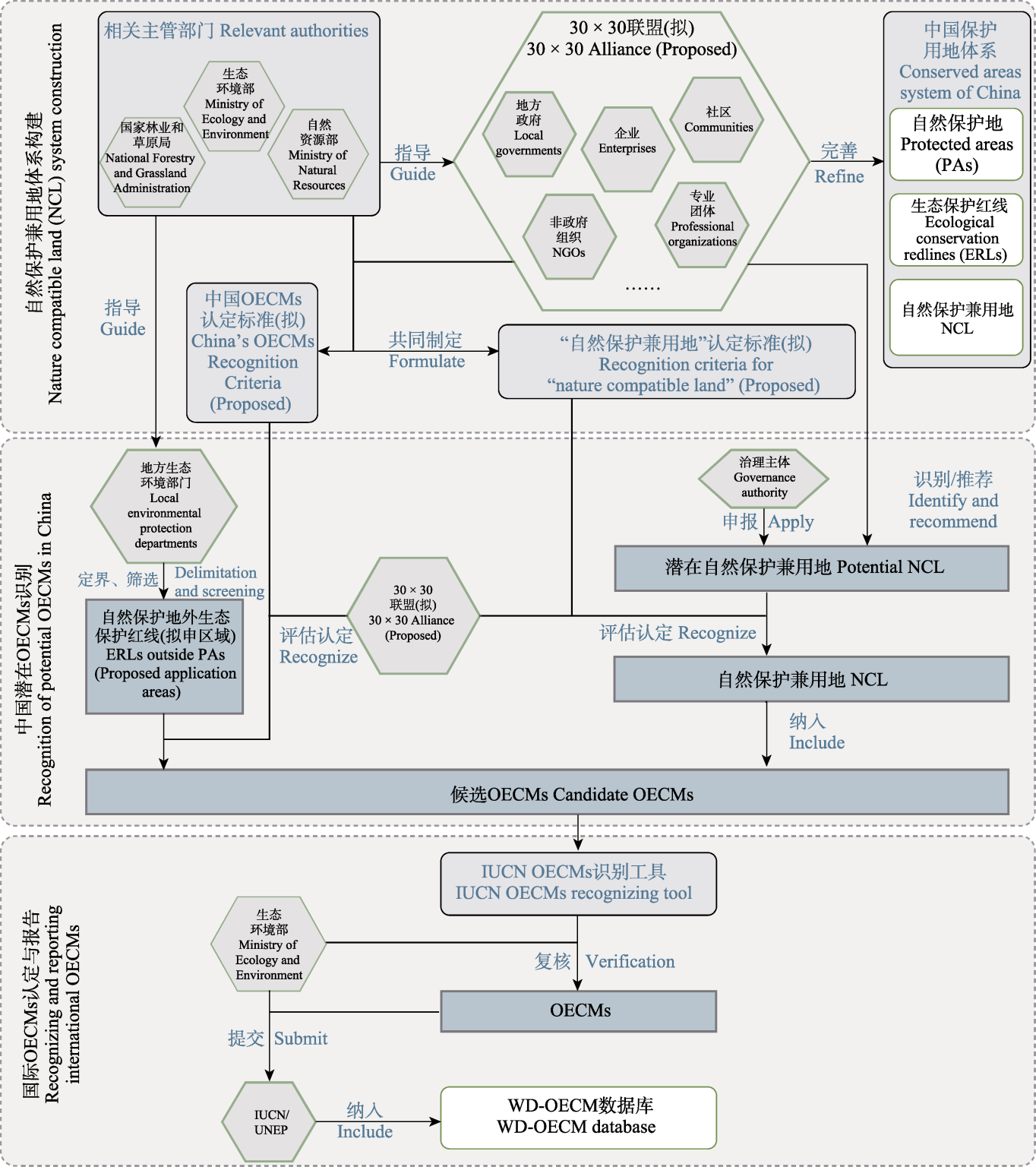
图3 中国自上而下-自下而上结合的其他有效的区域保护措施(OECMs)识别认定体系示意
Fig. 3 Schematic representation of China’s integrated top-down and bottom-up approach to identifying and recognizing other effective area-based conservation measures (OECMs). NGOs, Non-Governmental Organizations.
| [1] |
Artelle KA, Zurba M, Bhattacharyya J, Chan DE, Brown K, Housty J, Moola F (2019) Supporting resurgent indigenous-led governance: A nascent mechanism for just and effective conservation. Biological Conservation, 240, 108284.
DOI URL |
| [2] |
Beazley L, Kenchington E, Korabik M, Fenton D, King M (2021) Other effective area-based conservation measures promotes recovery in a cold-water coral reef. Global Ecology and Conservation, 26, e01485.
DOI URL |
| [3] | CBD (Convention on Biological Diversity) (2022) COP15 Decision. https://www.cbd.int/doc/c/c2db/972a/fb32e0a277bf1ccfff742be5/cop-15-05-add1-en.pdf/. (accessed on 2024- 12-20) |
| [4] | Cook CN (2024a) Diverse approaches to protecting biodiversity: The different conservation measures discussed as possible other effective area-based conservation measures. Conservation Letters, 17, e13027. |
| [5] | Cook CN (2024b) Progress developing the concept of other effective area-based conservation measures. Conservation Biology, 38, e14106. |
| [6] |
Donald PF, Buchanan GM, Balmford A, Bingham H, Couturier AR, de la Rosa Jr GE, Gacheru P, Herzog SK, Jathar G, Kingston N, Marnewick D, Maurer G, Reaney L, Shmygaleva T, Sklyarenko S, Stevens CMD, Butchart SHM (2019) The prevalence, characteristics and effectiveness of Aichi Target 11’s “other effective area-based conservation measures” (OECMs) in key biodiversity areas. Conservation Letters, 12, e12659.
DOI URL |
| [7] |
Gooden JL (2019) Cultivating identity through private land conservation. People and Nature, 1, 362-375.
DOI URL |
| [8] | Gray PA, Cheriton D, Gaetz N, Lehman P, Sherwood J, Beechey TJ, Lemieux CJ (2018) Comparing screening tools for assessment of potential “other effective area-based conservation measures” in Ontario, Canada. Parks, 24(SI), 31-48. |
| [9] |
Guo X, He SY, Min QW (2025) Ideas and ways for agricultural sectors to implement the Convention on Biological Diversity: Insights from the management of Important Agricultural Heritage Systems. Biodiversity Science, 33, 24527. (in Chinese with English abstract)
DOI |
|
[郭旋, 何思源, 闵庆文 (2025) 农业部门履行《生物多样性公约》的思路与途径——来自重要农业文化遗产管理的启示. 生物多样性, 33, 24527.]
DOI |
|
| [10] |
Heo HY, Park SJ (2023) A study on the identifying OECMs in Korea for achieving the Kunming-Montreal Global Biodiversity Framework. Korean Journal of Environment and Ecology, 37, 302-314.
DOI URL |
| [11] | Hou SY (2023) Identification and Management of the Priority Areas for Conservation-compatible Areas for Birds in China. PhD dissertation, Tsinghua University, Beijing. (in Chinese with English abstract) |
| [侯姝彧 (2023) 中国鸟类保护兼用地优先区域识别与管理研究. 博士学位论文, 清华大学, 北京.] | |
| [12] | Hou SY, Yang R, Zhao ZC, Cao Y, Tseng TH, Wang FY, Wang H, Wang P, Wang X, Yu L (2024) A cost-effective approach to identify conservation priority for 30 × 30 biodiversity target on the premise of food security. Science of the Total Environment, 941, 172870. |
| [13] | IUCN (2019) Recognising and Reporting Other Effective Area-based Conservation Measures. IUCN, Gland, Switzerland. |
| [14] | Jia YF, Sun LL, Guo J, Ren SC, Yang HY, Huang G, Wen L, Saintilan N, Chen Q, Wang YY, Lei GC (2025) Identifying non-breeding habitat conservation gaps of the critically threatened spoon-billed sandpiper (Calidris pygmaea) using species distribution model. Global Ecology and Conservation, 61, e03640. |
| [15] | Jin T, Bu JY, Ma JZ (2022) Other-effective area-based measures of global experiences and implications for Post-2020 Biodiversity Conservation in China. Journal of West China Forestry Science, 51(1), 1-8. (in Chinese with English abstract) |
| [靳彤, 卜君玉, 马建忠 (2022) 其他有效的区域保护措施的国际经验及对中国2020年后生物多样性保护的启示. 西部林业科学, 51(1), 1-8.] | |
| [16] | Jin T, Peng YY, Zeng LS, Chu ZT, Ge L, Zhang XQ (2023) Promoting the mainstreaming of biodiversity conservation. Natural Protected Areas, 3(3), 35-44. (in Chinese) |
| [靳彤, 彭昀月, 曾丽诗, 楚哲婷, 葛乐, 张小全 (2023) 基于自然的解决方案: 推动生物多样性保护主流化. 自然保护地, 3(3), 35-44.] | |
| [17] |
Jonas HD, Bingham HC, Bennett NJ, Woodley S, Zlatanova R, Howland E, Belle E, Upton J, Gottlieb B, Kamath V, Lessmann J, Delli G, Dubois G, Ahmadia G, Claudet J, Cook C, Deza J, Grorud-Colvert K, Gurney G, Lemieux CJ, Ruiz L (2024a) Global status and emerging contribution of other effective area-based conservation measures (OECMs) towards the ‘3030’ Biodiversity Target 3. Frontiers in Conservation Science, 5, 1447434.
DOI URL |
| [18] | Jonas HD, Wood P, Woodley S (2024b) Guidance on Other Effective Area-based Conservation Measures (OECMs). IUCN WCPA Good Practice Series, No. 36. Gland, Switzerland. |
| [19] |
Lemieux CJ, Gray PA, Devillers R, Wright PA, Dearden P, Halpenny EA, Groulx M, Beechey TJ, Beazley K (2019) How the race to achieve Aichi Target 11 could jeopardize the effective conservation of biodiversity in Canada and beyond. Marine Policy, 99, 312-323.
DOI URL |
| [20] |
Liu SQ, Hua FY, Xia F, Yan LL, Yu F, Ye H, Peng P, Zhang DY, Guan XY, Fu JP, Liang X, Hou XR, Li XY, Zhao XR (2024) Stopover habitat quality of urban green space for migratory landbirds and the impact of urban wilding measures. Biodiversity Science, 32, 24046. (in Chinese with English abstract)
DOI |
|
[刘双祺, 华方圆, 夏舫, 闫亮亮, 于方, 叶红, 彭澎, 张东元, 关雪燕, 付建平, 梁烜, 侯笑如, 李晓阳, 赵欣如 (2024) 城市绿地作为迁徙陆鸟中途停歇地的栖息地质量及其受留野措施的影响. 生物多样性, 32, 24046.]
DOI |
|
| [21] | Liu YY, Lü JY, Hou YL (2026) From conflict to symbiosis: The Chinese case of harmony between man and nature in crested ibis habitat. Natural Protected Areas, doi: 10.12335/2096-8981.2024091401. (in Chinese with English abstract) |
| [刘弋洋, 吕佳谕, 侯一蕾 (2026) 从冲突到共生: 朱鹮栖息地人与自然和谐共生的中国案例. 自然保护地, doi: 10.12335/2096-8981.2024091401.] | |
| [22] | Lü Z (2022) Meeting China’s “3030 goal” on biodiversity conservation. Frontiers, (4), 24-34. (in Chinese with English abstract) |
| [吕植 (2022) 中国生物多样性保护与“3030目标”. 人民论坛·学术前沿, (4), 24-34.] | |
| [23] |
MacKey B, Dellasala DA, Kormos C, Lindenmayer D, Kumpel N, Zimmerman B, Hugh S, Young V, Foley S, Arsenis K, Watson JEM (2015) Policy options for the world’s primary forests in multilateral environmental agreements. Conservation Letters, 8, 139-147.
DOI URL |
| [24] |
Mascorda Cabre L, Hosegood P, Attrill MJ, Bridger D, Sheehan EV (2021) Offshore longline mussel farms: A review of oceanographic and ecological interactions to inform future research needs, policy and management. Reviews in Aquaculture, 13, 1864-1887.
DOI |
| [25] |
No’kmaq M, Marshall A, Beazley KF, Hum J, Joudry S, Papadopoulos A, Pictou S, Rabesca J, Young L, Zurba M (2021) “Awakening the sleeping giant”: Re-indigenization principles for transforming biodiversity conservation in Canada and beyond. FACETS, 6, 839-869.
DOI URL |
| [26] | Renwick AR, Robinson CJ, Garnett ST, Leiper I, Possingham HP, Carwardine J (2017) Mapping indigenous land management for threatened species conservation: An Australian case-study. PLoS ONE, 12, e0173876. |
| [27] |
Schram C, Ladell K, Mitchell J, Chute C (2019) From one to ten: Canada’s approach to achieving marine conservation targets. Aquatic Conservation: Marine and Freshwater Ecosystems, 29(S2), 170-180.
DOI URL |
| [28] |
Sinthumule NI (2025) Sacred natural sites as other effective area-based conservation measures (OECMS) for biodiversity conservation in South Africa: Key opportunities and challenges for policy and practice. Journal for Nature Conservation, 86, 126935.
DOI URL |
| [29] | Tang XP, Tian H, Jiang YF, Zhang BL (2024) Systematic optimization of in-situ biodiversity conservation patterns. Research of Environmental Sciences, 37, 2093-2099. (in Chinese with English abstract) |
| [唐小平, 田禾, 蒋亚芳, 张博琳 (2024) 系统优化生物多样性就地保护格局. 环境科学研究, 37, 2093-2099.] | |
| [30] | Tian Y, Li JS (2024) Analysis of the connotation and implementation path for the 30 by 30 target in the Kunming-Montreal Global Biodiversity Framework. Biodiversity Science, 32, 24086. (in Chinese with English abstract) |
|
[田瑜, 李俊生 (2024) 《昆明-蒙特利尔全球生物多样性框架》“3030”目标的内涵及实现路径分析. 生物多样性, 32, 24086.]
DOI |
|
| [31] | Tseng TH, Wang FY, Sun MC, Cao Y, Hou SY, Zhou YX, Zhao ZC, Yang R (2025) Protected areas unevenly contribute to terrestrial vertebrate habitat conservation in China. Communications Earth & Environment, 6, 313. |
| [32] | UNEP-WCMC, IUCN (2024) Protected Planet Report 2024. UNEP-WCMC, Cambridge, United Kingdom & IUCN, Gland, Switzerland. |
| [33] |
Wang W, Li JS (2021) In-situ conservation of biodiversity in China: Advances and prospects. Biodiversity Science, 29, 133-149. (in Chinese with English abstract)
DOI URL |
| [王伟, 李俊生 (2021) 中国生物多样性就地保护成效与展望. 生物多样性, 29, 133-149.] | |
| [34] |
Wang XQ, Deng Y (2025) Key issues and advancement strategies for China’s OECMs in alignment with the Kunming-Montreal Global Biodiversity Framework. Biodiversity Science, 33, 24569. (in Chinese with English abstract)
DOI |
|
[王晓倩, 邓毅 (2025) 与《昆明-蒙特利尔全球生物多样性框架》衔接的中国OECMs关键问题与推进策略. 生物多样性, 33, 24569.]
DOI |
|
| [35] | Wang YL, Hong CB, Xue YH, Ren TY (2024) An exploration of the pivotal issues for the localization of other effective area-based conservation measures (OECMs) in China. Chinese Landscape Architecture, 40(10), 6-11. (in Chinese with English abstract) |
| [王应临, 洪传博, 薛镒涵, 任天祎 (2024) 试析其他基于区域的有效保护措施(OECMs)中国化的关键议题. 中国园林, 40(10), 6-11.] | |
| [36] | Yang R, Cao Y (2018) Discussion on the long-term target of protected area coverage in China. Chinese Landscape Architecture, 34(7), 5-12. (in Chinese with English abstract) |
| [杨锐, 曹越 (2018) 论中国自然保护地的远景规模. 中国园林, 34(7), 5-12.] | |
| [37] |
Yang R, Hou SY, Zhang Y, Zhao ZC (2024) The necessity and feasibility of establishing conservation compatible land in China. Biodiversity Science, 32, 23454. (in Chinese with English abstract)
DOI URL |
|
[杨锐, 侯姝彧, 张引, 赵智聪 (2024) 论建立中国自然保护兼用地的必要性和可行性. 生物多样性, 32, 23454.]
DOI |
|
| [38] | Zhang LR, Luo M, Zhu ZX, Sun YQ, Jin SC, Yang CY, Meng R, Zhang LJ (2023) Implementation path of biodiversity mainstreaming in China under the guidance of Kunming-Montreal Global Biodiversity Framework. Guihaia, 43, 1356-1365. (in Chinese with English abstract) |
| [张丽荣, 罗明, 朱振肖, 孙雨芹, 金世超, 杨崇曜, 孟锐, 张丽佳 (2023) 《昆明-蒙特利尔全球生物多样性框架》指引下中国生物多样性主流化实施路径探析. 广西植物, 43, 1356-1365.] | |
| [39] | Zhang XY, Jin H (2025) Construction of general wetland legal protection mechanism based on OECMs. Wetland Science & Management, 21(2), 78-82. (in Chinese with English abstract) |
| [张欣颖, 晋海 (2025) 基于OECMs的一般湿地法律保护机制构建. 湿地科学与管理, 21(2), 78-82.] | |
| [40] | Zhang Y, Zhang L, Sun YY, Li DQ, Wang W, Jin T, Xu JY (2024) A Stocktaking Report on Other Effective Area-Based Conservation Measures in China. IUCN, Gland, Switzerland. |
| [41] | Zhang Y, Zhang L, Sun YY, Jin T, Wang W, Fang Z, Guo YF, Li DQ, Liu J, Luo M, Lü Z, Wang XF, Yang B (2025) Identifying Other Effective Area-Based Conservation Measures (OECMs): Recommendations for an Assessment Tool in the Chinese Context. IUCN China Representative Office, Beijing. (in Chinese) |
| [张琰, 张璐, 孙艺芸, 靳彤, 王伟, 房志, 郭寅峰, 李迪强, 柳军, 罗明, 吕植, 汪晓帆, 杨彪 (2025) 识别其他有效的区域保护措施: 基于中国情境的评估工具建议. IUCN中国代表处, 北京.] https://portals.iucn.org/library/sites/library/files/documents/2025-028-Zh.pdf. (accessed on 2025-10-26) | |
| [42] |
Zhao WY, Wang W (2026) Promise and precautions in mainstreaming China’s OECMs. Trends in Ecology & Evolution, 41, 10-12.
DOI URL |
| [43] |
Zhao WY, Wang W, Ma BR (2025) Advances and prospects in research on other effective area-based conservation measures (OECMs). Biodiversity Science, 33, 24525. (in Chinese with English abstract)
DOI |
|
[赵维洋, 王伟, 马冰然 (2025) 其他有效的区域保护措施(OECMs)研究进展与展望. 生物多样性, 33, 24525.]
DOI |
|
| [44] |
Zhou ZH, Jin XH, Luo Y, Li DQ, Yue JB, Liu F, He T, Li X, Dong H, Luo P (2025) Analyses and suggestions on mechanisms of forestry and grassland administrations in China to achieve targets of Kunming-Montreal Global Biodiversity Framework. Biodiversity Science, 33, 24487. (in Chinese with English abstract)
DOI |
| [周志华, 金效华, 罗颖, 李迪强, 岳建兵, 刘芳, 何拓, 李希, 董晖, 罗鹏 (2025) 中国林草部门落实《昆明-蒙特利尔全球生物多样性框架》的机制、成效分析及建议. 生物多样性, 33, 24487.] | |
| [45] | Zhu Y, Li LX, Li SL, Xiong GL, He RX (2025) Canada’s other effective area-based conservation measures (OECMs): Practices and implications. World Forestry Research, 38(3), 100-105. (in Chinese with English abstract) |
| [朱玉, 李岚曦, 黎淑翎, 熊国玲, 何荣晓 (2025) 加拿大其他有效的区域保护措施(OECMs)实践与启示. 世界林业研究, 38(3), 100-105.] |
| [1] | 李保平, 张展豪, 魏雅丹. 人工智能背景下中国践行《生物多样性公约》获取与惠益分享制度的挑战与创新路径[J]. 生物多样性, 2026, 34(6): 26073-. |
| [2] | 蔡莉, 葛丽萍, 彭丹晓, 胡海花, 陈之端, 牛艳婷. 未来气候变化情景下东亚-北美间断分布属植物潜在分布区的比较[J]. 生物多样性, 2026, 34(6): 25478-. |
| [3] | 张洁, 路昊明, 陈佳杰, 陈江源, 毛宇帆, 胡骏熙, 张保卫. 中国软骨鱼类拉-英-汉-日物种名录及各海域多样性比较[J]. 生物多样性, 2026, 34(6): 25522-. |
| [4] | 魏能, 周亚东, 张彩飞, 王生位, 胡光万, Geoffrey Mwachala, 王青锋. 《肯尼亚植物志》编研概况和阶段性成果[J]. 生物多样性, 2026, 34(5): 25423-. |
| [5] | 梁竣策, 李开枝, 谭烨辉. 南海翼足类物种多样性与分布[J]. 生物多样性, 2026, 34(5): 25487-. |
| [6] | 周丽洁, 郝珉辉, 何怀江, 程艳霞, 张春雨, 赵秀海. 小兴安岭森林β多样性格局、组分及其影响因素[J]. 生物多样性, 2026, 34(4): 25443-. |
| [7] | 彭昀月, 彭奎, 刘昕然, 孙天怡, 张小全. 生物多样性信用的企业参与途径、市场发展障碍与建议[J]. 生物多样性, 2026, 34(4): 26031-. |
| [8] | 李伯尧, 盛天成, 幸小云. 生物多样性风险对企业财务绩效的影响: 来自中国上市公司的证据[J]. 生物多样性, 2026, 34(4): 25330-. |
| [9] | 刘昊, 张玉霄, 刘冰, 李飞飞, 马洪峥, 覃海宁, 李德铢, 陈文俐. 中国禾本科植物多样性及其物种名录[J]. 生物多样性, 2026, 34(4): 25438-. |
| [10] | 孔孜亦, 王德港, 王建涛, 裴志永, 孙晶, 张长春, 张军国. 基于SCD-HRNet模型的野生动物姿态估计及其在生物多样性监测中的应用: 以内蒙古赛罕乌拉地区为例[J]. 生物多样性, 2026, 34(4): 25287-. |
| [11] | 朱浩友, 周友兵, 罗怡, 周昭敏. 南充市城区繁殖鸟类群落20年前后的变化[J]. 生物多样性, 2026, 34(3): 24560-. |
| [12] | 程晓帆, 李青媛, 李媛辉, 张明祥. 外来入侵物种治理政策体系的困境与出路[J]. 生物多样性, 2026, 34(2): 25332-. |
| [13] | 陈璐露, 汤皓婷, 冷红, 袁青, 杨昕悦. 城市街区建成环境对生物多样性的影响[J]. 生物多样性, 2026, 34(2): 25286-. |
| [14] | 高雯琪, 向景荣, 赵耀, 范灵霜, 谷圆, 邵韦涵, 李高俊, 赵光军, 陈明斌, 蔡杏伟, 陈凯. 海南热带雨林国家公园黎母山和尖峰岭溪流鱼类群落特征及其对土地利用的响应[J]. 生物多样性, 2026, 34(2): 25374-. |
| [15] | 卢晓强, 芮丹, 张江峰, 尹冰鑫, 王雨露, 岑雨婷, 崔怡晨, 杨万霞. 氮输入驱动的关键生态过程对生物多样性的影响及其管理启示[J]. 生物多样性, 2026, 34(2): 25368-. |
| 阅读次数 | ||||||
|
全文 |
|
|||||
|
摘要 |
|
|||||
备案号:京ICP备16067583号-7
Copyright © 2026 版权所有 《生物多样性》编辑部
地址: 北京香山南辛村20号, 邮编:100093
电话: 010-62836137, 62836665 E-mail: biodiversity@ibcas.ac.cn
