

生物多样性 ›› 2026, Vol. 34 ›› Issue (3): 25453. DOI: 10.17520/biods.2025453 cstr: 32101.14.biods.2025453
尚晓彤1( ), 黄程2,*()(
 ), 杨立1(), 牟希东3(), 李添明1(), 刘阳1,*()()
收稿日期:2025-11-11
接受日期:2026-01-22
出版日期:2026-03-20
发布日期:2026-04-09
通讯作者:
*E-mail: 基金资助:
Xiaotong Shang1(), Cheng Huang2,*()(), Li Yang1(), Xidong Mu3(), Tien Ming Lee1(), Yang Liu1,*()()
Received:2025-11-11
Accepted:2026-01-22
Online:2026-03-20
Published:2026-04-09
Contact:
*E-mail: Supported by:摘要: 水产养殖发展与水鸟保护之间的冲突在全球范围内普遍存在。一方面, 水产养殖用地扩张侵占了水鸟栖息地, 尤其是在沿海地区; 另一方面, 水鸟取食水产品可能增加水产品疾病跨塘传播的风险, 进而引发养殖户对水鸟采取非选择性致死控制, 形成恶性循环, 威胁水鸟的生存及其生态系统功能。因此, 指导养殖户采取合理的非致死性控制措施对水产养殖产业的可持续发展具有现实意义。然而, 目前仍缺乏系统性研究来评估水产养殖区防鸟措施的成效。本研究梳理了全球1950-2024年间经过实验验证的防鸟措施及其行为刺激, 并整合评估了这些措施的有效性。结果表明, 当前防鸟措施的整体有效比例为66.7%, 其中复合型措施(80.9%)与物理阻碍型措施(76.7%)的有效性较高, 而单一的视觉干扰措施有效性相对较低(46.9%)。防鸟措施的有效性受多种因素影响, 不存在能够完全消除损失的解决方案。目前, 该领域研究在地域覆盖和水产品种类上存在严重偏倚, 超过80%的案例集中在北美和欧洲(亚洲仅占2.8%), 研究案例高度集中于鱼类养殖(73.1%), 对甲壳类等其他种类的养殖关注不足。中国作为全球最大的水产养殖国, 仅有1项案例关注甲壳类养殖场景的研究。基于全球经验与中国本土现状, 本研究呼吁中国应尽快在冲突区域(如沿海水产养殖塘)开展减损措施成效评估实验, 加强水鸟在养殖区域内的生态与行为研究, 并结合新技术设计更多防鸟措施, 在保障水产养殖发展的同时, 履行中国在全球候鸟保护网络中的关键责任。
尚晓彤, 黄程, 杨立, 牟希东, 李添明, 刘阳 (2026) 全球尺度水产养殖系统减少鸟类致损措施成效评估. 生物多样性, 34, 25453. DOI: 10.17520/biods.2025453.
Xiaotong Shang, Cheng Huang, Li Yang, Xidong Mu, Tien Ming Lee, Yang Liu (2026) Evaluation of the effectiveness of bird-induced loss reduction measures in global aquaculture systems. Biodiversity Science, 34, 25453. DOI: 10.17520/biods.2025453.
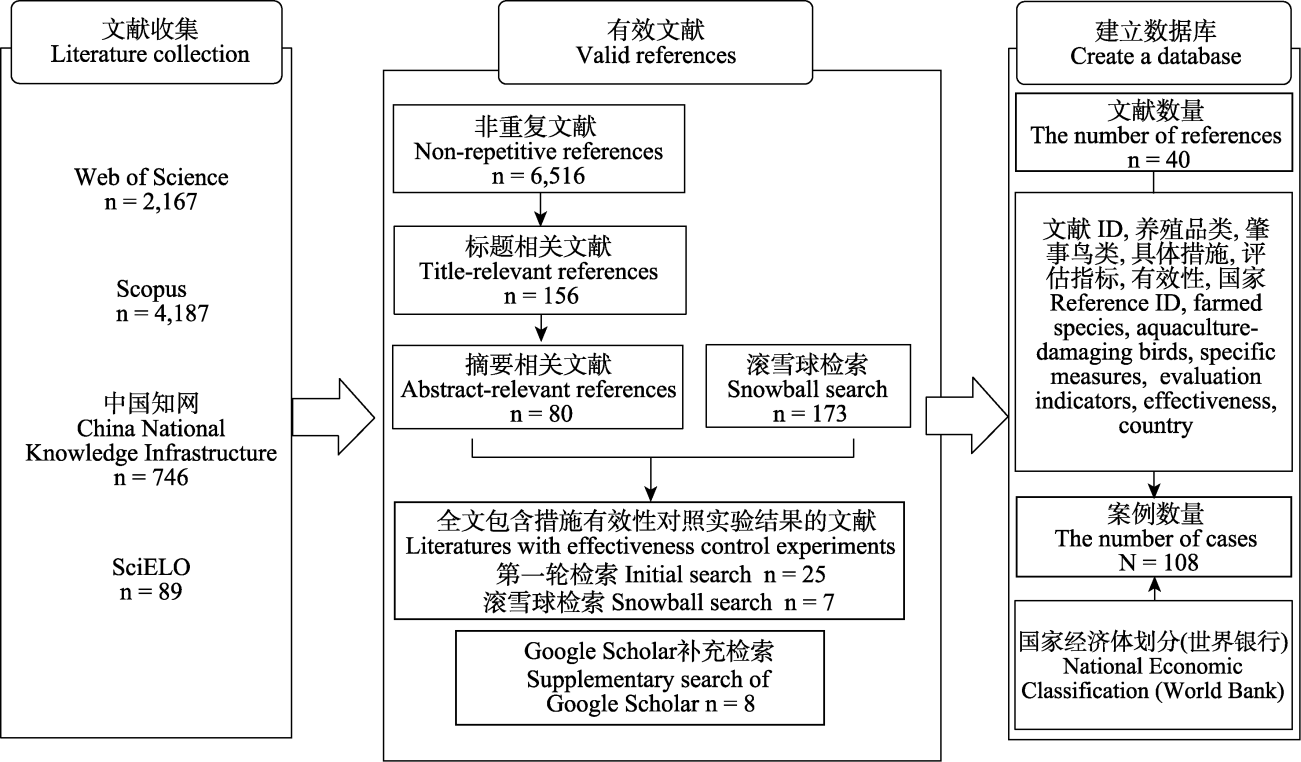
图1 本研究文献收集采用的系统评价和荟萃分析优先报告文献筛选(PRISMA)流程图。n: 文献数量, N: 案例数量。图内仅展示检索结果数量大于0的数据库。
Fig. 1 The preferred reporting items for systematic reviews and meta-analyses (PRISMA) flowchart illustrating the literature collection process for this study. n, The number of literature, N, The number of cases. Only databases with at least one retrieval result are shown in the figure.
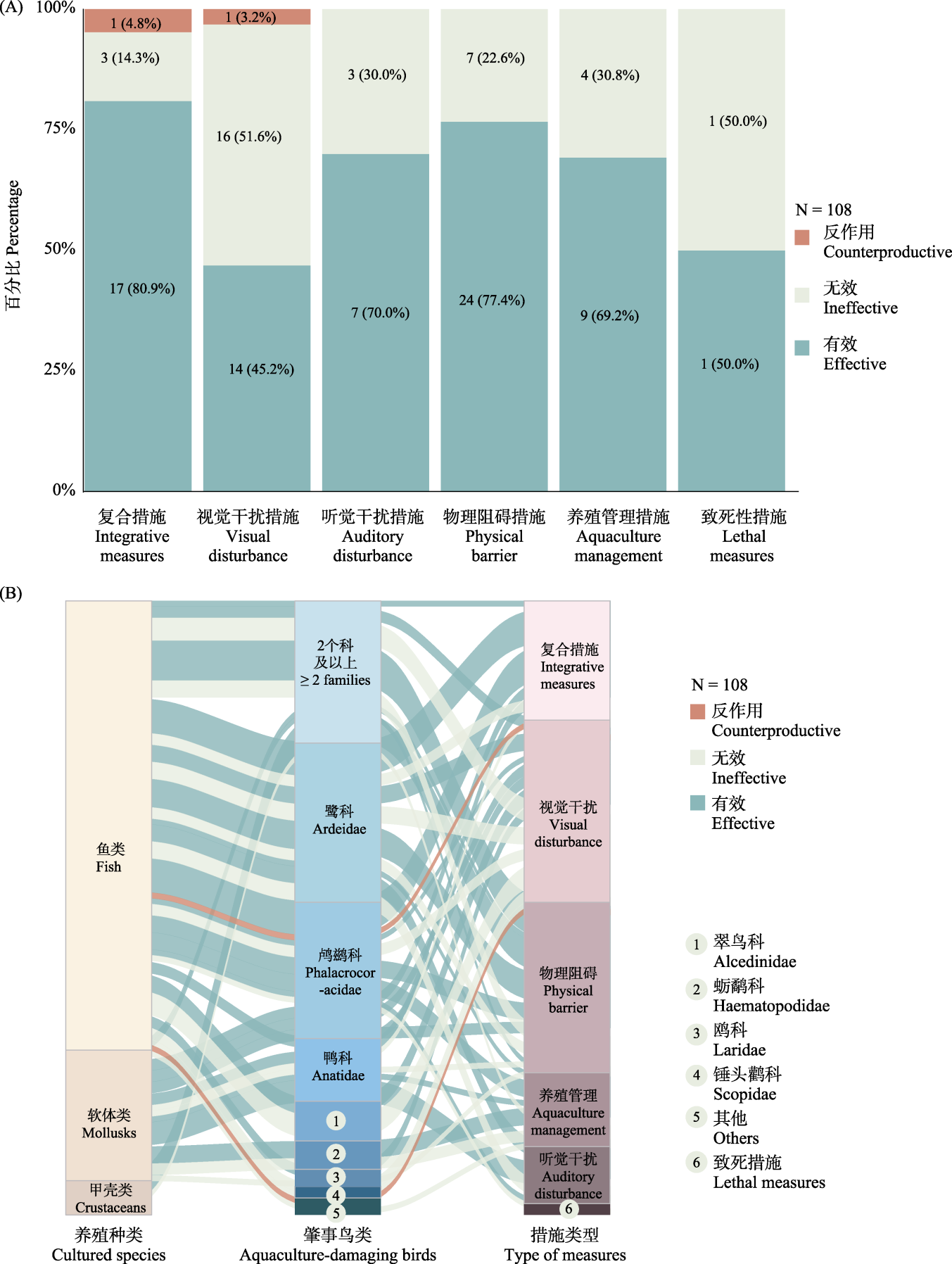
图2 全球养殖塘防鸟措施有效性(A)及其与水产动物和肇事鸟类的关系(B)。N: 案例数量。其他包括鹰科、拟黄鹂科、椋鸟科和潜鸟科的各一个案例。
Fig. 2 Effectiveness of bird control measures in global aquaculture ponds (A) and their association with aquaculture species and bird species causing damage to aquaculture (B). N, Number of cases. Others include one case each from Accipitridae, Icteridae, Sturnidae, and Gaviidae.
| 措施类型 Measure types | 措施(数量) Measures (Count) | 有效比例 Effective proportion | 国家 Country | 案例 Case | 参考文献 References | |||||
|---|---|---|---|---|---|---|---|---|---|---|
| 视觉干扰措施 Visual disturbance | 增加水体浑浊度 Increase the turbidity of water bodies (21) | 38% | 肯尼亚 Kenya 加纳 Ghana 美国 USA 法国 France | 农家肥和商业磷酸肥在整个鱼类生长期间分次施用, 增加水体浑浊度 Use farmyard manure and commercial phosphorus fertilizers in multiple applications throughout the fish growth period to increase water turbidity | Otieno & Shidavi | |||||
| 激光 Laser (5) | 60% | 美国 USA | 使用激光在日落前后照射鸟群 Use lasers to shine on bird flocks before and after sunset | Glahn et al., | ||||||
| 闪光灯 Flash light | 66.7% | 美国 USA | 使用灯塔和光束在日落后旋转闪光 Use lighthouses and beams that rotate and flash after sunset | Woolley & Hopper, | ||||||
| 猛禽风筝 Raptor-like kite (1) | 100% | 美国 USA | 用风筝模拟捕食者(如猛禽)的形象, 吓退鸟类 Use raptor-like kites to simulate the image of predators (such as raptors) to scare away birds | Cunningham et al., | ||||||
| 反光带 Reflective tape (1) | 0% | 美国 USA | 红色反光聚酯薄膜带系在埋入池塘周边的金属桩上, 风动时反射阳光产生闪烁 Red reflective polyester film strips are tied to metal posts buried around the pond; they reflect sunlight and create flashes when moved by the wind | Baird et al., | ||||||
| 物理阻碍措施 Physical barrier | 罩网 Cover net (15) | 73.3% | 美国 USA 肯尼亚 Kenya 澳大利亚 Australia 丹麦 Denmark 德国 Germany | 在养殖塘上安装罩网(尼龙、钢丝、塑料等材质)阻碍鸟类取食 Install overhead nets (made of nylon, steel wire, plastic, etc.) on aquaculture ponds to obstruct birds from preying | Avery et al., | |||||
| 防鸟绳 Bird-scaring lines (5) | 80% | 美国 USA 澳大利亚 Australia 中国 China | 单丝线悬挂于池面上方0.5 m作为障碍干扰鸟类进入养殖塘捕食 Hang monofilament lines 0.5 m above the pond surface as an obstacle to interfere with birds entering the aquaculture pond | Farrell & Leonard, | ||||||
| 降落阻碍物 Landing deterrents (4) | 100% | 美国 USA 加拿大 Canada | 尖刺条塑料制成的扎带铺设在浮筒表面阻碍鸟类站立 Lay plastic tie strips with sharp points on the surface of floating rafts to prevent birds from standing | Cunningham et al., | ||||||
| 网笼 Net cages (2) | 100% | 喀麦隆 Cameroon | 封闭式网箱排除包括鸟类在内的所有捕食者Enclosed net cages exclude all predators, including birds | Yong-Sulem et al., | ||||||
| 电围栏 Electric fencing (2) | 100% | 美国 USA | 鸟类身体同时接触塘边的电围栏和水体/地面时, 形成闭合电路, 受到高压低电流脉冲电击, 不致命但极具威慑力 When birds’ bodies simultaneously contact both the electric fence around the pond and the water/ground, a closed circuit is formed, and they receive high-voltage, low-current pulse shocks, which are non-lethal but highly deterrent | Mott & Flynt, | ||||||
| 塑料膜覆盖 Plastic film covering (1) | 0% | 美国 USA | 托盘的顶部覆盖一块1 mm厚的黑色塑料, 以防止海鸥(银鸥、大鸥)的捕食 Cover the top of trays with a 1 mm thick black plastic sheet to prevent seagulls (e.g., silver gulls, large gulls) from preying | Beal et al., | ||||||
| 可降解网套包裹 Biodegradable mesh sleeves (1) | 0% | 加拿大 Canada | 双层网套, 外层是一层可生物降解的保护性套筒, 网眼尺寸小于内层, 旨在限制贻贝移动至网套外部 Double-layered netting: the outer layer is a biodegradable protective sleeve, with smaller mesh than the inner layer, designed to limit mussel migration outside the netting | Dionne et al., | ||||||
| 普通围栏 Standard fencing (1) | 100% | 喀麦隆 Cameroon | 当地尼龙袋剪裁缝合制成, 高度1.0 m, 埋入堤岸10 cm, 木桩固定 Local nylon bags are cut and sewn to make a fence height of 1.0 m, buried 10 cm into the embankment, and fixed with wooden stakes | Yong-Sulem et al., | ||||||
| 养殖管理措施 Aquaculture management | 养殖布局调整 Farm layout adjustment (5) | 60% | 英国 UK | 根据贻贝生长阶段, 分阶段调整其养殖的潮位, 以减少被水鸟捕食 Adjust the tidal level of mussel farming in stages based on the growth stage of mussels to reduce predation by waterfowl | Caldow et al., | |||||
| 水下庇护所 Underwater shelters (4) | 75% | 英国 UK 比利时 Belgium 澳大利亚 Australia | 立方体框架结合内部树枝, 提供复杂躲避空间, 顶部遮荫和水下安装对应, 减少水面反光, 减少鸬鹚捕食效率 A cubic frame combined with internal branches provides complex shelter space, with shading on top and underwater installation to reduce surface reflections and decrease cormorant predation efficiency | Russell et al., | ||||||
| 工人巡逻 Worker patrols (2) | 100% | 英国 UK 比利时 Belgium | 工人出现可使鸭群减少95% The presence of workers can reduce duckflocks by 95% | Ross, | ||||||
| 设施沉水 Submerging structures (1) | 100% | 加拿大 Canada | 浮子移至养殖设备上方, 通过松绳使设备下沉6 cm, 减少鸟类停留 Move the floaters above the aquaculture equipment, and lower the equipment by 6 cm through slackening the rope to reduce bird perching | Comeau et al., | ||||||
| 训练鱼躲避鸟 Training fish to avoid birds (1) | 0% | 加拿大 Canada | 塑料潜鸟模型模拟潜鸟游动, 对靠近的鱼产生电击, 鱼学会侧向躲避模型后释放到养殖区 Use a plastic diving bird model to simulate diving bird movement, delivering electric shocks to nearby fish. The fish learn to avoid the model sideways and are later released into the aquaculture area | Fraser, | ||||||
| 听觉干扰措施 Auditory disturbance | 水下声音威慑 Underwater acoustic deterrents (4) | 100% | 英国 UK | 播放船只引擎声, 模拟真实威胁, 使鸭群误以为有船靠近 Play engine sounds of boats to simulate a real threat, making duck flocks believe a boat is approaching | Ross et al., | |||||
| 高分贝气枪 High-decibel gas cannon (1) | 0% | 以色列 Israel | 在鱼塘区域持续整夜循环播放高分贝气枪声Continuously play the sound of a high-decibel gas cannon throughout the night in the pond area | Spanier, | ||||||
| 鸟类遇险警戒叫声 Bird distress (5) | 60% | 美国 USA 以色列 Israel | 在鱼塘区域循环播放幼鸟和成鸟的惊叫组合 Cycle the sounds of distress calls from both chicks and adult birds in the pond area | Spanier, | ||||||
| 复合措施 Integrative measures | 视觉与听觉组合 Visual and auditory combination (17) | 76.4% | 美国 USA 英国 UK 比利时 Belgium 埃及 Egypt | 在鸟类夜间栖息地使用烟花类爆音装置驱赶夜栖鸟类Use firecracker-like noise devices in the birds’ night roosting areas to drive away roosting birds | Woolley & Hopper, | |||||
| 视觉与物理组合 Visual and physical combination (3) | 100% | 美国 USA | 机械臂转动产生视觉和运动干扰, 使鸟类不敢靠近Mechanical arms rotate to create visual and motion disturbances, preventing birds from approaching | Cunningham et al., | ||||||
| 视觉、听觉与管理组合 Visual, auditory and management combination (3) | 100% | 美国 USA | 人偶突然充气、摇晃模拟人类活动并发出警戒声, 配合巡逻驱赶 Inflate and shake a mannequin suddenly to simulate human activity and emit warning sounds, in coordination with patrols to drive birds away | Stickley & King, | ||||||
| 致死性措施 Lethal measures | 射击 Shooting (2) | 50% | 美国 USA | 射击驱散鸟类 Shooting to disperse birds | Taylor & Strickland, | |||||
表1 水产养殖系统防鸟措施类型、种类、有效比例、分布及典型案例
Table 1 Types, categories, effectiveness ratios, distribution, and typical cases of bird control measures in aquaculture systems
| 措施类型 Measure types | 措施(数量) Measures (Count) | 有效比例 Effective proportion | 国家 Country | 案例 Case | 参考文献 References | |||||
|---|---|---|---|---|---|---|---|---|---|---|
| 视觉干扰措施 Visual disturbance | 增加水体浑浊度 Increase the turbidity of water bodies (21) | 38% | 肯尼亚 Kenya 加纳 Ghana 美国 USA 法国 France | 农家肥和商业磷酸肥在整个鱼类生长期间分次施用, 增加水体浑浊度 Use farmyard manure and commercial phosphorus fertilizers in multiple applications throughout the fish growth period to increase water turbidity | Otieno & Shidavi | |||||
| 激光 Laser (5) | 60% | 美国 USA | 使用激光在日落前后照射鸟群 Use lasers to shine on bird flocks before and after sunset | Glahn et al., | ||||||
| 闪光灯 Flash light | 66.7% | 美国 USA | 使用灯塔和光束在日落后旋转闪光 Use lighthouses and beams that rotate and flash after sunset | Woolley & Hopper, | ||||||
| 猛禽风筝 Raptor-like kite (1) | 100% | 美国 USA | 用风筝模拟捕食者(如猛禽)的形象, 吓退鸟类 Use raptor-like kites to simulate the image of predators (such as raptors) to scare away birds | Cunningham et al., | ||||||
| 反光带 Reflective tape (1) | 0% | 美国 USA | 红色反光聚酯薄膜带系在埋入池塘周边的金属桩上, 风动时反射阳光产生闪烁 Red reflective polyester film strips are tied to metal posts buried around the pond; they reflect sunlight and create flashes when moved by the wind | Baird et al., | ||||||
| 物理阻碍措施 Physical barrier | 罩网 Cover net (15) | 73.3% | 美国 USA 肯尼亚 Kenya 澳大利亚 Australia 丹麦 Denmark 德国 Germany | 在养殖塘上安装罩网(尼龙、钢丝、塑料等材质)阻碍鸟类取食 Install overhead nets (made of nylon, steel wire, plastic, etc.) on aquaculture ponds to obstruct birds from preying | Avery et al., | |||||
| 防鸟绳 Bird-scaring lines (5) | 80% | 美国 USA 澳大利亚 Australia 中国 China | 单丝线悬挂于池面上方0.5 m作为障碍干扰鸟类进入养殖塘捕食 Hang monofilament lines 0.5 m above the pond surface as an obstacle to interfere with birds entering the aquaculture pond | Farrell & Leonard, | ||||||
| 降落阻碍物 Landing deterrents (4) | 100% | 美国 USA 加拿大 Canada | 尖刺条塑料制成的扎带铺设在浮筒表面阻碍鸟类站立 Lay plastic tie strips with sharp points on the surface of floating rafts to prevent birds from standing | Cunningham et al., | ||||||
| 网笼 Net cages (2) | 100% | 喀麦隆 Cameroon | 封闭式网箱排除包括鸟类在内的所有捕食者Enclosed net cages exclude all predators, including birds | Yong-Sulem et al., | ||||||
| 电围栏 Electric fencing (2) | 100% | 美国 USA | 鸟类身体同时接触塘边的电围栏和水体/地面时, 形成闭合电路, 受到高压低电流脉冲电击, 不致命但极具威慑力 When birds’ bodies simultaneously contact both the electric fence around the pond and the water/ground, a closed circuit is formed, and they receive high-voltage, low-current pulse shocks, which are non-lethal but highly deterrent | Mott & Flynt, | ||||||
| 塑料膜覆盖 Plastic film covering (1) | 0% | 美国 USA | 托盘的顶部覆盖一块1 mm厚的黑色塑料, 以防止海鸥(银鸥、大鸥)的捕食 Cover the top of trays with a 1 mm thick black plastic sheet to prevent seagulls (e.g., silver gulls, large gulls) from preying | Beal et al., | ||||||
| 可降解网套包裹 Biodegradable mesh sleeves (1) | 0% | 加拿大 Canada | 双层网套, 外层是一层可生物降解的保护性套筒, 网眼尺寸小于内层, 旨在限制贻贝移动至网套外部 Double-layered netting: the outer layer is a biodegradable protective sleeve, with smaller mesh than the inner layer, designed to limit mussel migration outside the netting | Dionne et al., | ||||||
| 普通围栏 Standard fencing (1) | 100% | 喀麦隆 Cameroon | 当地尼龙袋剪裁缝合制成, 高度1.0 m, 埋入堤岸10 cm, 木桩固定 Local nylon bags are cut and sewn to make a fence height of 1.0 m, buried 10 cm into the embankment, and fixed with wooden stakes | Yong-Sulem et al., | ||||||
| 养殖管理措施 Aquaculture management | 养殖布局调整 Farm layout adjustment (5) | 60% | 英国 UK | 根据贻贝生长阶段, 分阶段调整其养殖的潮位, 以减少被水鸟捕食 Adjust the tidal level of mussel farming in stages based on the growth stage of mussels to reduce predation by waterfowl | Caldow et al., | |||||
| 水下庇护所 Underwater shelters (4) | 75% | 英国 UK 比利时 Belgium 澳大利亚 Australia | 立方体框架结合内部树枝, 提供复杂躲避空间, 顶部遮荫和水下安装对应, 减少水面反光, 减少鸬鹚捕食效率 A cubic frame combined with internal branches provides complex shelter space, with shading on top and underwater installation to reduce surface reflections and decrease cormorant predation efficiency | Russell et al., | ||||||
| 工人巡逻 Worker patrols (2) | 100% | 英国 UK 比利时 Belgium | 工人出现可使鸭群减少95% The presence of workers can reduce duckflocks by 95% | Ross, | ||||||
| 设施沉水 Submerging structures (1) | 100% | 加拿大 Canada | 浮子移至养殖设备上方, 通过松绳使设备下沉6 cm, 减少鸟类停留 Move the floaters above the aquaculture equipment, and lower the equipment by 6 cm through slackening the rope to reduce bird perching | Comeau et al., | ||||||
| 训练鱼躲避鸟 Training fish to avoid birds (1) | 0% | 加拿大 Canada | 塑料潜鸟模型模拟潜鸟游动, 对靠近的鱼产生电击, 鱼学会侧向躲避模型后释放到养殖区 Use a plastic diving bird model to simulate diving bird movement, delivering electric shocks to nearby fish. The fish learn to avoid the model sideways and are later released into the aquaculture area | Fraser, | ||||||
| 听觉干扰措施 Auditory disturbance | 水下声音威慑 Underwater acoustic deterrents (4) | 100% | 英国 UK | 播放船只引擎声, 模拟真实威胁, 使鸭群误以为有船靠近 Play engine sounds of boats to simulate a real threat, making duck flocks believe a boat is approaching | Ross et al., | |||||
| 高分贝气枪 High-decibel gas cannon (1) | 0% | 以色列 Israel | 在鱼塘区域持续整夜循环播放高分贝气枪声Continuously play the sound of a high-decibel gas cannon throughout the night in the pond area | Spanier, | ||||||
| 鸟类遇险警戒叫声 Bird distress (5) | 60% | 美国 USA 以色列 Israel | 在鱼塘区域循环播放幼鸟和成鸟的惊叫组合 Cycle the sounds of distress calls from both chicks and adult birds in the pond area | Spanier, | ||||||
| 复合措施 Integrative measures | 视觉与听觉组合 Visual and auditory combination (17) | 76.4% | 美国 USA 英国 UK 比利时 Belgium 埃及 Egypt | 在鸟类夜间栖息地使用烟花类爆音装置驱赶夜栖鸟类Use firecracker-like noise devices in the birds’ night roosting areas to drive away roosting birds | Woolley & Hopper, | |||||
| 视觉与物理组合 Visual and physical combination (3) | 100% | 美国 USA | 机械臂转动产生视觉和运动干扰, 使鸟类不敢靠近Mechanical arms rotate to create visual and motion disturbances, preventing birds from approaching | Cunningham et al., | ||||||
| 视觉、听觉与管理组合 Visual, auditory and management combination (3) | 100% | 美国 USA | 人偶突然充气、摇晃模拟人类活动并发出警戒声, 配合巡逻驱赶 Inflate and shake a mannequin suddenly to simulate human activity and emit warning sounds, in coordination with patrols to drive birds away | Stickley & King, | ||||||
| 致死性措施 Lethal measures | 射击 Shooting (2) | 50% | 美国 USA | 射击驱散鸟类 Shooting to disperse birds | Taylor & Strickland, | |||||
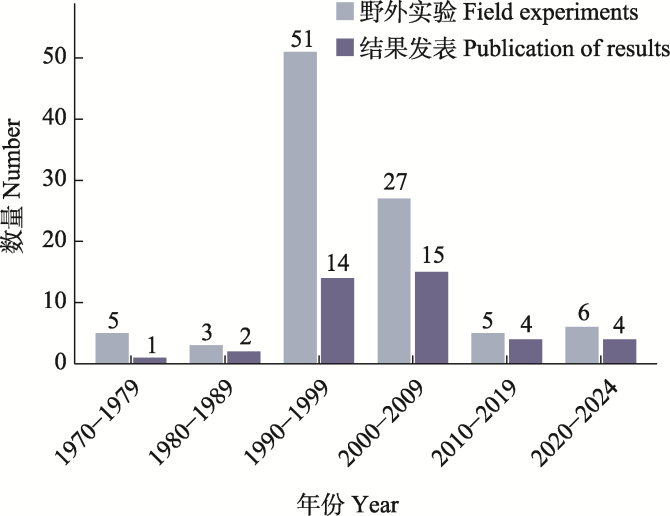
图3 水产养殖系统防鸟措施有效性评估研究的实验开展与文献发表热度变化
Fig. 3 Development of experimental methodologies and the publication patterns of literature assessing the efficacy of bird control strategies in aquaculture systems
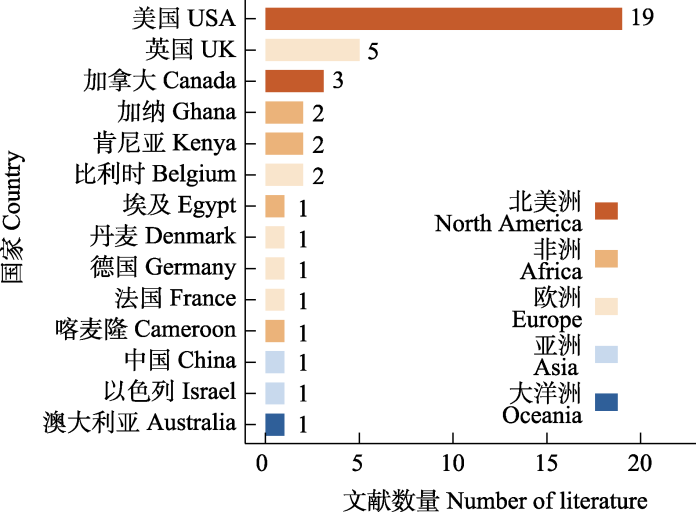
图4 研究文献的全球分布格局
Fig. 4 Global research pattern of research literature
| [1] |
Andelt WF, Hopper SN (1996) Effectiveness of alarm-distress calls for frightening herons from a fish rearing facility. The Progressive Fish-Culturist, 58, 258-262.
DOI URL |
| [2] |
Angkaew R, Round PD, Ngoprasert D, Powell LA, Limparungpatthanakij W, Gale GA (2022) Collateral damage from agricultural netting to open-country bird populations in Thailand. Conservation Science and Practice, 4, e12810.
DOI URL |
| [3] |
Avery ML, Eiselman DS, Young MK, Humphrey JS, Decker DG (1999) Wading bird predation at tropical aquaculture facilities in central Florida. North American Journal of Aquaculture, 61, 64-69.
DOI URL |
| [4] | Baird ML, Smith TIJ, Jenkins WE (1993) Evaluation of control techniques for avian predators of pond-reared fishes. In:Proceedings of the Annual Conference of the Southeastern Association of Fish and Wildlife Agencies, pp. 580-587. SEAFWA, Maggie Valley, North Carolina, USA. |
| [5] |
Beal BF, Protopopescu G, Yeatts K, Porada J (2009) Experimental trials on the nursery culture, overwintering, and field grow-out of hatchery-reared northern quahogs (hard clams), Mercenaria mercenaria (L.), in eastern Maine. Journal of Shellfish Research, 28, 763-776.
DOI URL |
| [6] | Blackwell BF, Bernhardt GE, Dolbeer RA (2002) Lasers as nonlethal avian repellents. The Journal of Wildlife Management, 66, 250. |
| [7] |
Blagodatski A, Trutneva K, Glazova O, Mityaeva O, Shevkova L, Kegeles E, Onyanov N, Fede K, Maznina A, Khavina E, Yeo SJ, Park H, Volchkov P (2021) Avian influenza in wild birds and poultry: Dissemination pathways, monitoring methods, and virus ecology. Pathogens, 10, 630.
DOI URL |
| [8] |
Bomford M, Sinclair R (2002) Australian research on bird pests: Impact, management and future directions. Emu Austral Ornithology, 102, 29-45.
DOI URL |
| [9] | Bureau of Fisheries and Fishery Administration, Ministry of Agriculture and Rural Affairs of the People’s Republic of China, National Fisheries Technology Extension Center, China Society of Fisheries (2024) China Fishery Statistical Yearbook. China Agriculture Press, Beijing. (in Chinese) |
| [中华人民共和国农业农村部渔业渔政管理局, 全国水产技术推广总站, 中国水产学会(2024) 2024中国渔业统计年鉴. 中国农业出版社, 北京.] | |
| [10] |
Burr PC, Avery JL, Street GM, Strickland BK, Dorr BS (2020) Historic and contemporary use of catfish aquaculture by piscivorous birds in the Mississippi Delta. The Condor, 122, duaa036.
DOI URL |
| [11] | Bushman BJ, Wang MC (2009) Vote-counting procedures in meta-analysis. In: The Handbook of Research Synthesis and Meta-analysis (eds Cooper H, Hedges LV, Valentine JC), pp. 207-220. Russell Sage Foundation, New York. |
| [12] |
Caldow RWG, Beadman HA, McGrorty S, Stillman RA, Goss-Custard JD, le V dit Durell SEA, West AD, Kaiser MJ, Mould K, Wilson A (2004) A behavior-based modeling approach to reducing shorebird-shellfish conflicts. Ecological Applications, 14, 1411-1427.
DOI URL |
| [13] |
Can ÖE (2021) How to design better human wildlife conflict management plans? Forestist, 71, 118-126.
DOI URL |
| [14] |
Céspedes V, Sánchez MI, Green AJ (2017) Predator-prey interactions between native brine shrimp Artemia parthenogenetica and the alien boatman Trichocorixa verticalis: Influence of salinity, predator sex, and size, abundance and parasitic status of prey. PeerJ, 5, e3554.
DOI URL |
| [15] | Chen JL (2024) Conflict and its reconciliation between wild animal protection. Journal of National Prosecutors College, 32(6), 60-75. (in Chinese with English abstract) |
| [陈金林 (2024) 野生动物刑法保护与民生的冲突及其协调. 国家检察官学院学报, 32(6), 60-75.] | |
| [16] |
Cheng CY, Liu JJ, Ma ZJ (2022) Effects of aquaculture on the maintenance of waterbird populations. Conservation Biology, 36, e13913.
DOI URL |
| [17] |
Comeau LA, St-Onge P, Pernet F, Lanteigne L (2009) Deterring coastal birds from roosting on oyster culture gear in eastern New Brunswick, Canada. Aquacultural Engineering, 40, 87-94.
DOI URL |
| [18] |
Cunningham FL, Burr P, Glover J, Tappa J, Redd M, Wang GM (2024) The effectiveness of commercially available double-crested cormorant (Nannopterum auritus) deterrent methods in reducing loafing time on floating oyster cages. Diversity, 16, 5.
DOI URL |
| [19] |
Cunningham FL, Hanson-Dorr KC, Ford L, Middleton DR, Crain A, Durst L, Ware C, Griffin MJ, Mischke CC, Wan XF, Hanson LA (2020) Environmental factor(s) and animal vector(s) associated with atypical Aeromonas hydrophila abundance and dissemination among channel catfish ponds. Journal of the World Aquaculture Society, 51, 750-762.
DOI |
| [20] | Dai WZ, Cao AQ, Kang HT, Tang SB, Jiang AW (2022) Distribution of waterbirds in shrimp aquaculture pond areas in Beilun Estuary from November 2018 to March 2019 and analysis of its influencing factors. Wetland Science, 20, 591-597. (in Chinese with English abstract) |
| [代文章, 曹爱清, 亢红涛, 唐上波, 蒋爱伍 (2022) 2018年11月至2019年3月北仑河口虾养殖塘区水鸟分布及其影响因素分析. 湿地科学, 20, 591-597.] | |
| [21] |
Dionne M, Lauzon-Guay JS, Hamilton DJ, Barbeau MA (2006) Protective socking material for cultivated mussels: A potential non-disruptive deterrent to reduce losses to diving ducks. Aquaculture International, 14, 595-613.
DOI URL |
| [22] |
Duan HL, Yu XB, Xia SX, Zhang GS (2021) Waterbird habitat loss: Fringes of the Yellow and Bohai seas along the East Asian-Australasian Flyway. Land Degradation & Development, 32, 4174-4182.
DOI URL |
| [23] |
Engle CR, Christie TW, Dorr BS, Kumar G, Davis B, Roy LA, Kelly AM (2021) Principal economic effects of cormorant predation on catfish farms. Journal of the World Aquaculture Society, 52, 41-56.
DOI URL |
| [24] | FAO (Food and Agriculture Organization of the United Nations) (2024) The State of World Fisheries and Aquaculture 2024—Blue Transformation in action. FAO, Rome. (in Chinese) |
| [联合国粮食及农业组织 (2024) 2024年世界渔业和水产养殖状况: 蓝色转型在行动. 联合国粮食及农业组织, 罗马.] | |
| [25] | Farrell P, Leonard B (2001) Observations on the survival of the yabby, Cherax destructor, in ponds where access by piscivorous birds is inhibited. Journal of Applied Aquaculture, 11, 75-80. |
| [26] |
Faulkner KT, Hulme PE, Wilson JRU (2024) Harder, better, faster, stronger? Dispersal in the Anthropocene. Trends in Ecology & Evolution, 39, 1130-1140.
DOI URL |
| [27] |
Floris I, Pusceddu M, Satta A (2020) Birds and honey bees: A brief overview on this antagonistic relationship and its potential impact on beekeeping. Redia, 103, 65-67.
DOI URL |
| [28] |
Frank EG, Schlenker W (2016) Balancing economic and ecological goals. Science, 353, 651-652.
DOI PMID |
| [29] |
Fraser JM (1974) An attempt to train hatchery-reared brook trout to avoid predation by the common loon. Transactions of the American Fisheries Society, 103, 815-818.
DOI URL |
| [30] | Geffen O, Yitzhaky Y, Glassner H, Katzir G, Halachmi I (2019) Developing an automatic system aiming to detect and deter migrating birds from aquaculture ponds. Precision Livestock Farming, 19, 899-902. |
| [31] | Glahn JF (2000) Comparison of pyrotechnics versus shooting for dispersing double-crested cormorants from their night roosts. Proceedings of the Vertebrate Pest Conference, 19, 44-48. |
| [32] |
Goras G, Tananaki C, Liolios V, Kanelis D, Tofaris C, Giannouris E, Argena N, Gounari S, Rodopoulou M, Thrasyvoulou A (2023) The conflict between avian predators and domestic honey bees: A case study of European bee-eater (Merops apiaster L.) preying on the honey bee (Apis mellifera L.) in Cyprus. Journal of Apicultural Research, 62, 1115-1122.
DOI URL |
| [33] | Han DM, Hu Y (2025) Vision and directions for China’s agricultural green development during the 15th Five-Year Plan period. Journal of Agro-Forestry Economics and Management, 24, 849-858. (in Chinese with English abstract) |
| [韩冬梅, 胡钰 (2025) “十五五”时期中国农业绿色发展愿景及行动方向. 农林经济管理学报, 24, 849-858.] | |
| [34] | Hanson L (2019) Fish eating birds can spread bacterial diseases between catfish ponds. In:Proceedings of the 18th Wildlife Damage Management Conference (eds Armstrong JB, Gallagher GR), pp. 47-48. The Eighteenth Wildlife Damage Management Conference. Mount Berry, Berry College, GA. |
| [35] |
Hegde S, Kumar G, Engle C, van Senten J (2023) Cost of regulations on US catfish farms. Journal of the World Aquaculture Society, 54, 32-53.
DOI URL |
| [36] |
Huang C, Chen YQ, Li LL, Campos-Arceiz A, Wang Y, Onditi KO, Li ZQ, Feng LM, Liu Y, Lee TM (2025) Human-wildlife coexistence needs more evidence-based interventions to reduce the losses of crops, livestock and fishery catches. Journal of Applied Ecology, 62, 527-544.
DOI URL |
| [37] |
Huang C, Rice J, Richter A, Zhou KW, Wang Y, Wei CT, Pagani-Núñez E, Maleko PN, Zhang X, Lee TM, Liu Y (2024) Effects of fishery bycatch-mitigation measures on vulnerable marine fauna and target catch. Nature Sustainability, 7, 1535-1545.
DOI |
| [38] |
Huang C, Zhou KW, Huang YJ, Fan PF, Liu Y, Lee TM (2023) Insights into the coexistence of birds and humans in cropland through meta-analyses of bird exclosure studies, crop loss mitigation experiments, and social surveys. PLoS Biology, 21, e3002166.
DOI URL |
| [39] |
Jiang YF, Li J, Zhang Z, Li Y (2024) Dynamics of coastal land-based aquaculture pond in China and Southeast Asia from 1990 to 2020. International Journal of Applied Earth Observation and Geoinformation, 127, 103654.
DOI URL |
| [40] |
Kumar G, Hegde S, Wise D, Mischke C, Dorr B (2021) Economic losses of catfish to avian predation: A case report. North American Journal of Aquaculture, 83, 127-137.
DOI URL |
| [41] | Lee CE, Seo BS, Kim JB, Kim SH, Roh MC, Byun JM, Lee KH (2011) Method for controlling bird in airport using mobile robot. 8812156, Electronics and Telecommunications Research Institute. 2011-03-03. |
| [42] |
Lemmens P, De Meester L, Declerck SAJ (2016) Can underwater refuges protect fish populations against cormorant predation? Evidence from a large-scale multiple pond experiment. Fisheries Management and Ecology, 23, 89-98.
DOI URL |
| [43] |
Lewis SL, Maslin MA (2015) Defining the Anthropocene. Nature, 519, 171-180.
DOI |
| [44] | Li GF, Li Q, Chen TX (2009) Protective measures of bird damage in tidal flat aquaculture. Jiangsu Agricultural Sciences, 37(3), 282-283. (in Chinese) |
| [李国峰, 李茜, 陈天兄 (2009) 滩涂水产养殖中鸟害的防护措施. 江苏农业科学, 37(3), 282-283.] | |
| [45] |
Liang D, Mu T, Yang ZY, Giam X, Wang YD, Li J, Cai SX, Zhang XL, Wang YX, Liu Y, Wilcove DS (2024) Assessing shorebird mortalities due to razor clam aquaculture at key migratory stopover sites in southeastern China. Conservation Biology, 38, e14185.
DOI URL |
| [46] |
Mott DE, Flynt RD (1995) Evaluation of an electric fence system for excluding wading birds at catfish ponds. The Progressive Fish-Culturist, 57, 88-90.
DOI URL |
| [47] |
Mott DF, Boyd FL (1995) A review of techniques for preventing cormorant depredations at aquaculture facilities in the southeastern United States. Colonial Waterbirds, 18, 176-180.
DOI URL |
| [48] |
Otieno NE, Shidavi E (2022) Effectiveness of physical barriers and enhanced fertilization in controlling predation on tilapia and catfish aquaculture systems by four piscivorous water bird families. Frontiers in Sustainable Food Systems, 6, 1018064.
DOI URL |
| [49] |
Otieno NE, Shidavi E (2024) Piscivorous bird assemblages at functional rather than species level better predict predation risk on open culture fish ponds within enhanced fertilization treatment regime. Hydrobiologia, 851, 3963-3976.
DOI |
| [50] | Ross BP (2000) Manipulation of the Feeding Behaviour of Diving Ducks on Mussel Farms. PhD dissertation, University of Glasgow, Glasgow. |
| [51] |
Ross BP, Lien J, Furness RW (2001) Use of underwater playback to reduce the impact of eiders on mussel farms. ICES Journal of Marine Science, 58, 517-524.
DOI URL |
| [52] | Rummel SM (2010) Evaluation of the Post-Stocking Loss of Three Species of Hatchery-Reared Salmonids in Pennsylvania PhD dissertation. The Pennsylvania State University, State College. |
| [53] | Russell IC, Parrott D, Ives MJ, Davison PI, Fox S, Clifton-Dey D (2022) Reducing fish losses to great cormorants using artificial fish refuges: Refining refuge deployment strategies. Ardea, 109, 639-658. |
| [54] |
Russell IC, Parrott D, Ives MJ, Goldsmith D, Fox S, Clifton-Dey D, Prickett A, Drew T (2008) Reducing fish losses to cormorants using artificial fish refuges: An experimental study. Fisheries Management and Ecology, 15, 189-198.
DOI URL |
| [55] |
Shave ME, Shwiff SA, Elser JL, Lindell CA (2018) Falcons using orchard nest boxes reduce fruit-eating bird abundances and provide economic benefits for a fruit-growing region. Journal of Applied Ecology, 55, 2451-2460.
DOI URL |
| [56] |
Spanier E (1980) The use of distress calls to repel night herons (Nycticorax nycticorax) from fish ponds. The Journal of Applied Ecology, 17, 287.
DOI URL |
| [57] | Stickley AR, King JO (1993) Long term trial of an inflatable effigy scare device for repelling cormorants from catfish ponds. In: Proceeding of the Sixth Eastern Wildlife Damage Control Conference (ed. King GMM), pp.89-92. Clemson University, Asheville. |
| [58] | Taylor J, Strickland B (2008) Effects of roost shooting on double-crested cormorant use of catfish ponds preliminary results. Proceedings of the Vertebrate Pest Conference, 23, 98-102. |
| [59] |
Varennes É, Hanssen SA, Bonardelli J, Guillemette M (2013) Sea duck predation in mussel farms: The best nets for excluding common eiders safely and efficiently. Aquaculture Environment Interactions, 4, 31-39.
DOI URL |
| [60] |
Wang FX, Li J, Zhu H (2025) Research progress in ecological security of tropical marine ranching. Chinese Journal of Applied Ecology, 36, 3202-3210. (in Chinese with English abstract)
DOI |
|
[王凤霞, 李建, 朱辉 (2025) 热带海洋牧场生态安全研究进展. 应用生态学报, 36, 3202-3210.]
DOI |
|
| [61] |
Wang M, Mao DH, Xiao XM, Song KS, Jia MM, Ren CY, Wang ZM (2023) Interannual changes of coastal aquaculture ponds in China at 10-m spatial resolution during 2016-2021. Remote Sensing of Environment, 284, 113347.
DOI URL |
| [62] | Wang X (2018) Preliminary study on the influence of bird damage in aquaculture pond and ecological bird prevention technology. Fishery Guide to be Rich, (12), 55-56. (in Chinese) |
| [王雪 (2018) 水产养殖池塘鸟害的影响及生态防鸟技术的初步研究. 渔业致富指南, (12), 55-56.] | |
| [63] | Wang YC, Liu CJ, Chen CY, Zhou P, Sun GL, Pan YH, Wang WP (2023) Image identification-based airport bird-expelling intelligent auxiliary control system for driving birds. CN116630897A, Weihai Sanwei Engineering Surveying and Mapping Co., Ltd. 2023-08-22. (in Chinese) |
| [王钰存, 刘昌军, 陈春雨, 周鹏, 孙光磊, 潘永红, 王伟鹏 (2023) 基于图像识别的机场驱鸟智能辅助控制系统. CN116630897A, 威海市三维工程测绘有限公司. 2023-08-22.] | |
| [64] | Woolley T, Hopper SN (1997) Effectiveness of barriers, pyrotechnics, flashing lights, and Scarey Man? For deterring heron predation on fish. Wildlife Society Bulletin, 25, 686-694. |
| [65] | Wu XG, Li JY, Yuan X, Wu H, Cheng YX (2014) A preliminary study on major bird species of bird trouble and ecological technique for bird prevention in rice-crab co-culture pond of Chongming Island. Journal of Shanghai Ocean University, 23, 690-696. (in Chinese with English abstract) |
| [吴旭干, 李嘉尧, 袁晓, 吴昊, 成永旭 (2014) 崇明岛稻蟹种养池塘的主要鸟害及生态防鸟技术的初步研究. 上海海洋大学学报, 23, 690-696.] | |
| [66] |
Wywialowski AP (1999) Wildlife-caused losses for producers of channel catfish Ictalurus punctatus in 1996. Journal of the World Aquaculture Society, 30, 461-472.
DOI URL |
| [67] |
Yong-Sulem S, Brummett RE, Tabi TE, Tchoumboué J (2007) Towards the maximum profitability of smallholder catfish nurseries: Predator defense and feeding-adapted stocking of Clarias gariepinus. Aquaculture, 271, 371-376.
DOI URL |
| [68] | Zhang P, Gui FK, Feng DJ, Zhang GY (2024) Remote sensing extraction of aquaculture ponds in China’s coastal zone based on random forest. Journal of Physics, 2863, 012018. |
| [69] | Zhao X, Zhao C, Liu H, Zhang Y, He G, Yang J, An J, Xu Y. (2021) Intelligent detection fan-blade type acousto-optic bird repelling device. CN215012977U, China. 2021-12-24. (in Chinese) |
| [赵鑫, 赵常, 刘海, 张亚, 何光, 杨洁, 安敬, 徐勇 (2021) 智能探测扇叶式声光驱鸟装置. CN215012977U, 中国. 2021-12-24.] | |
| [70] |
Zou FS, Yang QF, Dahmer T, Cai JX, Zhang W (2006) Habitat use of waterbirds in coastal wetland on Leizhou Peninsula, China. Waterbirds, 29, 459-464.
DOI URL |
| [1] | 林雅莉, 林舒云, 廖凌云, 张玮仪, 陈大樑, 兰思仁, 尹伟伦. 《昆蒙框架》背景下自然保护地管理有效性评估演化趋势与启示[J]. 生物多样性, 2025, 33(12): 25260-. |
| [2] | 许再富. 对国家植物园体系建设“统筹原则”的一些见解[J]. 生物多样性, 2023, 31(1): 22470-. |
| [3] | 秦乐, 朱彦鹏, 任月恒, 李博炎, 付梦娣, 李俊生. 青藏高原国家级自然保护区管理能力差异及其对保护成效的影响[J]. 生物多样性, 2022, 30(11): 22419-. |
| [4] | 冯斌, 李迪强, 张于光, 薛亚东. 基于爱知生物多样性目标11的我国自然保护地管理有效性评估进展与分析[J]. 生物多样性, 2021, 29(2): 150-159. |
| [5] | 冯斌, 李迪强, 张于光, 薛亚东. 自然保护区减缓和适应气候变化的管理有效性评估: 以广西12个典型自然保护区为例[J]. 生物多样性, 2020, 28(8): 1026-1035. |
| [6] | 郦珊, 陈家宽, 王小明. 淡水鱼类入侵种的分布、入侵途径、机制与后果[J]. 生物多样性, 2016, 24(6): 672-685. |
| [7] | 米湘成, 郭静, 郝占庆, 谢宗强, 郭柯, 马克平. 中国森林生物多样性监测: 科学基础与执行计划[J]. 生物多样性, 2016, 24(11): 1203-1219. |
| [8] | 余小林, 周友兵, 徐文婷, 谢宗强. 保护地旅游公路的野生动物通道设计原则与技术参数[J]. 生物多样性, 2015, 23(6): 824-829. |
| [9] | 权佳, 欧阳志云, 徐卫华, 苗鸿. 自然保护区管理有效性评价方法的比较与应用[J]. 生物多样性, 2010, 18(1): 90-99. |
| [10] | 唐文乔, 胡雪莲, 杨金权. 从线粒体控制区全序列变异看短颌鲚和湖鲚的物种有效性[J]. 生物多样性, 2007, 15(3): 224-231. |
| 阅读次数 | ||||||
|
全文 |
|
|||||
|
摘要 |
|
|||||
备案号:京ICP备16067583号-7
Copyright © 2026 版权所有 《生物多样性》编辑部
地址: 北京香山南辛村20号, 邮编:100093
电话: 010-62836137, 62836665 E-mail: biodiversity@ibcas.ac.cn
