

Biodiv Sci ›› 2026, Vol. 34 ›› Issue (6): 25522. DOI: 10.17520/biods.2025522 cstr: 32101.14.biods.2025522
• Bioinventories • Previous Articles Next Articles
Jie Zhang1,*,#( )(
)( ), Haoming Lu1,2,#(), Jiajie Chen3(), Jiangyuan Chen4(), Yufan Mao5(), Junxi Hu1,6(), Baowei Zhang2,*()()
Received:2025-12-31
Accepted:2026-02-14
Online:2026-06-20
Published:2026-07-30
Contact:
*Co-authors for correspondence. E-mail: zhangjie@ioz.ac.cn; zhangbw@ahu.edu.cn
About author:#Co-first authors
Supported by:Jie Zhang, Haoming Lu, Jiajie Chen, Jiangyuan Chen, Yufan Mao, Junxi Hu, Baowei Zhang. Latin-English-Chinese-Japanese checklist of Chinese chondrichthyans and a comparison of diversity among marine regions[J]. Biodiv Sci, 2026, 34(6): 25522.
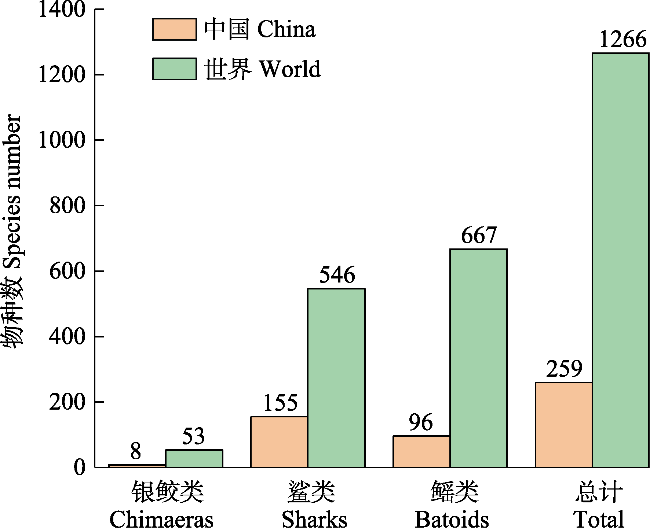
Fig. 1 Comparison of species number of different chondrichthyan taxa between China and the World
| 目 Order | 科 Family | 属 Genus | 种 Species |
|---|---|---|---|
| 银鲛目 Chimaeriformes | 2 | 4 | 8 (15.09%*) |
| 银鲛类小计 Chimaeras subtotal | 2 | 4 | 8 (15.09%) |
| 六鳃鲨目 Hexanchiformes | 2 | 4 | 5 (71.43%) |
| 虎鲨目 Heterodontiformes | 1 | 1 | 2 (20.00%) |
| 鼠鲨目 Lamniformes | 8 | 10 | 14 (93.33%) |
| 须鲨目 Orectolobiformes | 6 | 6 | 12 (26.66%) |
| 真鲨目 Carcharhiniformes | 11 | 33 | 74 (25.00%) |
| 棘鲨目 Echinorhiniformes | 1 | 1 | 1 (50.00%) |
| 角鲨目 Squaliformes | 6 | 15 | 42 (30.66%) |
| 锯鲨目 Pristiophoriformes | 1 | 1 | 1 (10.00%) |
| 扁鲨目 Squatiniformes | 1 | 1 | 4 (16.67%) |
| 鲨类小计 Sharks subtotal | 37 | 72 | 155 (28.39%) |
| 犁头鳐目 Rhinopristiformes | 4 | 6 | 13 (19.12%) |
| 电鳐目 Torpediniformes | 4 | 5 | 12 (19.05%) |
| 鳐形目 Rajiformes | 3 | 7 | 26 (8.61%) |
| 鲼形目 Myliobatiformes | 9 | 20 | 45 (10.26%) |
| 鳐类小计 Batoids subtotal | 20 | 38 | 96 (14.39%) |
| 总计 Total | 59 | 114 | 259 (20.46%) |
Table 1 Species composition of chondrichthyans in China (* represents the proportion of species in this taxa in China to the total number of species in the world)
| 目 Order | 科 Family | 属 Genus | 种 Species |
|---|---|---|---|
| 银鲛目 Chimaeriformes | 2 | 4 | 8 (15.09%*) |
| 银鲛类小计 Chimaeras subtotal | 2 | 4 | 8 (15.09%) |
| 六鳃鲨目 Hexanchiformes | 2 | 4 | 5 (71.43%) |
| 虎鲨目 Heterodontiformes | 1 | 1 | 2 (20.00%) |
| 鼠鲨目 Lamniformes | 8 | 10 | 14 (93.33%) |
| 须鲨目 Orectolobiformes | 6 | 6 | 12 (26.66%) |
| 真鲨目 Carcharhiniformes | 11 | 33 | 74 (25.00%) |
| 棘鲨目 Echinorhiniformes | 1 | 1 | 1 (50.00%) |
| 角鲨目 Squaliformes | 6 | 15 | 42 (30.66%) |
| 锯鲨目 Pristiophoriformes | 1 | 1 | 1 (10.00%) |
| 扁鲨目 Squatiniformes | 1 | 1 | 4 (16.67%) |
| 鲨类小计 Sharks subtotal | 37 | 72 | 155 (28.39%) |
| 犁头鳐目 Rhinopristiformes | 4 | 6 | 13 (19.12%) |
| 电鳐目 Torpediniformes | 4 | 5 | 12 (19.05%) |
| 鳐形目 Rajiformes | 3 | 7 | 26 (8.61%) |
| 鲼形目 Myliobatiformes | 9 | 20 | 45 (10.26%) |
| 鳐类小计 Batoids subtotal | 20 | 38 | 96 (14.39%) |
| 总计 Total | 59 | 114 | 259 (20.46%) |
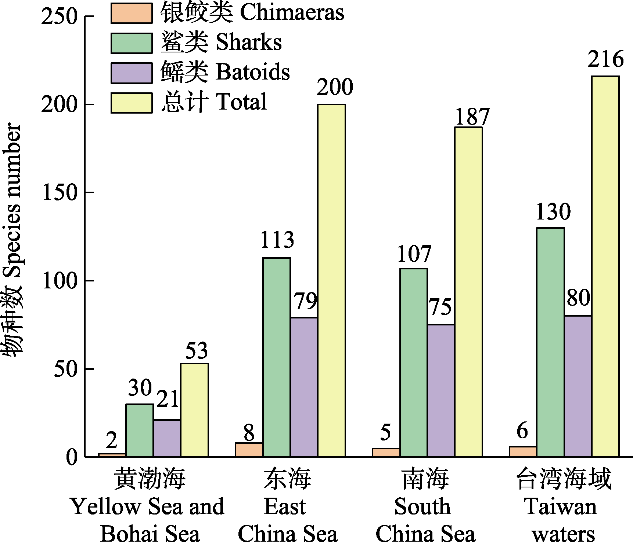
Fig. 2 Species composition of chimaeras, sharks, and batoids in different marine regions of China
| 海域 Marine regions | 目 Order | 科 Family | 属 Genus | 种 Species | G指数 G index | F指数 F index | G-F指数 G-F index |
|---|---|---|---|---|---|---|---|
| 黄渤海 Yellow Sea and Bohai Sea | 13 | 24 | 37 | 53 | 3.4475 | 6.4494 | 0.4655 |
| 东海 East China Sea | 13 | 52 | 94 | 200 | 4.2691 | 17.2662 | 0.7527 |
| 南海 South China Sea | 14 | 52 | 94 | 187 | 4.2466 | 16.2866 | 0.7393 |
| 台湾海域 Taiwan waters | 14 | 59 | 106 | 216 | 4.3640 | 17.5633 | 0.7580 |
Table 2 Comparison of three diversity indices and species composition of chondrichthyan taxa in marine regions of China
| 海域 Marine regions | 目 Order | 科 Family | 属 Genus | 种 Species | G指数 G index | F指数 F index | G-F指数 G-F index |
|---|---|---|---|---|---|---|---|
| 黄渤海 Yellow Sea and Bohai Sea | 13 | 24 | 37 | 53 | 3.4475 | 6.4494 | 0.4655 |
| 东海 East China Sea | 13 | 52 | 94 | 200 | 4.2691 | 17.2662 | 0.7527 |
| 南海 South China Sea | 14 | 52 | 94 | 187 | 4.2466 | 16.2866 | 0.7393 |
| 台湾海域 Taiwan waters | 14 | 59 | 106 | 216 | 4.3640 | 17.5633 | 0.7580 |
| 目 Order | 目级 Order level | 科级 Family level | 属级 Genus level | 种级 Species level |
|---|---|---|---|---|
| 银鲛目 Chimaeriformes | - | - | - | 3 |
| 六鳃鲨目 Hexanchiformes | - | - | - | 2 |
| 虎鲨目 Heterodontiformes | - | - | - | - |
| 鼠鲨目 Lamniformes | - | 3 | 5 | 7 |
| 须鲨目 Orectolobiformes | - | - | - | 4 |
| 真鲨目 Carcharhiniformes | - | 4 | 6 | 27 |
| 棘鲨目 Echinorhiniformes | 1 | - | - | - |
| 角鲨目 Squaliformes | - | 4 | 5 | 33 |
| 锯鲨目 Pristiophoriformes | - | - | - | - |
| 扁鲨目 Squatiniformes | - | - | - | - |
| 犁头鳐目 Rhinopristiformes | 1 | 2 | 2 | 11 |
| 电鳐目 Torpediniformes | - | 2 | 2 | 11 |
| 鳐形目 Rajiformes | - | 1 | 6 | 27 |
| 鲼形目 Myliobatiformes | - | 1 | 13 | 46 |
| 总计 Total | 2 | 17 | 39 | 171 |
Table 3 Changes in each taxonomic level of chondrichthyans in China
| 目 Order | 目级 Order level | 科级 Family level | 属级 Genus level | 种级 Species level |
|---|---|---|---|---|
| 银鲛目 Chimaeriformes | - | - | - | 3 |
| 六鳃鲨目 Hexanchiformes | - | - | - | 2 |
| 虎鲨目 Heterodontiformes | - | - | - | - |
| 鼠鲨目 Lamniformes | - | 3 | 5 | 7 |
| 须鲨目 Orectolobiformes | - | - | - | 4 |
| 真鲨目 Carcharhiniformes | - | 4 | 6 | 27 |
| 棘鲨目 Echinorhiniformes | 1 | - | - | - |
| 角鲨目 Squaliformes | - | 4 | 5 | 33 |
| 锯鲨目 Pristiophoriformes | - | - | - | - |
| 扁鲨目 Squatiniformes | - | - | - | - |
| 犁头鳐目 Rhinopristiformes | 1 | 2 | 2 | 11 |
| 电鳐目 Torpediniformes | - | 2 | 2 | 11 |
| 鳐形目 Rajiformes | - | 1 | 6 | 27 |
| 鲼形目 Myliobatiformes | - | 1 | 13 | 46 |
| 总计 Total | 2 | 17 | 39 | 171 |
| 目 Order | 科 Family | 物种 Species | 年份 Year |
|---|---|---|---|
| (一)真鲨目 Carcharhiniformes | (1)单鳍猫鲨科 Pentanchidae | 1. 仲谷氏光尾鲨 Apristurus nakayai | 2013 |
| (2)猫鲨科 Scyliorhinidae | 2. 沙捞越绒毛鲨 Cephaloscyllium sarawakense | 2005 | |
| (3)皱唇鲨科 Triakidae | 3. 杂纹半皱唇鲨 Hemitriakis complicofasciata | 2004 | |
| (二)须鲨目 Orectolobiformes | (4)须鲨科 Orectolobidae | 4. 细线须鲨 Orectolobus leptolineatus | 2010 |
| (三)角鲨目 Squaliformes | (5)角鲨科 Squalidae | 5. 台湾角鲨 Squalus formosus | 2011 |
| (6)刺鲨科 Centrophoridae | 6. 长鳍刺鲨 Centrophorus longipinnis | 2017 | |
| (7)乌鲨科 Etmopteridae | 7. 庄氏乌鲨 Etmopterus joungi | 2011 | |
| 8. 李氏乌鲨 Etmopterus lii | 2024 | ||
| (8)睡鲨科 Somniosidae | 9. 陈氏睡鲨 Somniosus cheni | 2020 | |
| (四)犁头鳐目 Rhinopristiformes | (9)圆犁头鳐科 Rhinidae | 10. 无斑尖犁头鳐 Rhynchobatus immaculatus | 2013 |
| 11. 眉斑尖犁头鳐 Rhynchobatus palpebratus | 2008 | ||
| 12. 斯氏尖犁头鳐 Rhynchobatus springeri | 2010 | ||
| (五)电鳐目 Torpediniformes | (10)团扇鳐科 Platyrhinidae | 13. 汤氏团扇鳐 Platyrhina tangi | 2011 |
| (11)双鳍电鳐科 Narcinidae | 14. 杨氏深海电鳐 Benthobatis yangi | 2003 | |
| (12)电鳐科 Torpedinidae | 15. 台湾四鳍电鳐 Tetronarce formosa | 2006 | |
| (六)鳐形目 Rajiformes | (13)鳐科 Rajidae | 16. 汉霖长吻鳐 Dipturus wuhanlingi | 2008 |
| 17. 孟氏瓮鳐 Okamejei mengae | 2007 | ||
| 18. 卡氏瓮鳐 Okamejei cairae | 2010 | ||
| 19. 点瓮鳐 Okamejei picta | 2023 | ||
| (七)鲼形目 Myliobatiformes | (14)魟科 Dasyatidae | 20. 豹纹窄尾魟 Himantura leoparda | 2008 |
| 21. 东方新魟 Neotrygon orientalis | 2016 | ||
| (15)鹞鲼科 Aetobatidae | 22. 日本鹞鲼 Aetobatus narutobiei | 2013 |
Table 4 New chondrichthyan species named and described in Chinese marine regions after 2001
| 目 Order | 科 Family | 物种 Species | 年份 Year |
|---|---|---|---|
| (一)真鲨目 Carcharhiniformes | (1)单鳍猫鲨科 Pentanchidae | 1. 仲谷氏光尾鲨 Apristurus nakayai | 2013 |
| (2)猫鲨科 Scyliorhinidae | 2. 沙捞越绒毛鲨 Cephaloscyllium sarawakense | 2005 | |
| (3)皱唇鲨科 Triakidae | 3. 杂纹半皱唇鲨 Hemitriakis complicofasciata | 2004 | |
| (二)须鲨目 Orectolobiformes | (4)须鲨科 Orectolobidae | 4. 细线须鲨 Orectolobus leptolineatus | 2010 |
| (三)角鲨目 Squaliformes | (5)角鲨科 Squalidae | 5. 台湾角鲨 Squalus formosus | 2011 |
| (6)刺鲨科 Centrophoridae | 6. 长鳍刺鲨 Centrophorus longipinnis | 2017 | |
| (7)乌鲨科 Etmopteridae | 7. 庄氏乌鲨 Etmopterus joungi | 2011 | |
| 8. 李氏乌鲨 Etmopterus lii | 2024 | ||
| (8)睡鲨科 Somniosidae | 9. 陈氏睡鲨 Somniosus cheni | 2020 | |
| (四)犁头鳐目 Rhinopristiformes | (9)圆犁头鳐科 Rhinidae | 10. 无斑尖犁头鳐 Rhynchobatus immaculatus | 2013 |
| 11. 眉斑尖犁头鳐 Rhynchobatus palpebratus | 2008 | ||
| 12. 斯氏尖犁头鳐 Rhynchobatus springeri | 2010 | ||
| (五)电鳐目 Torpediniformes | (10)团扇鳐科 Platyrhinidae | 13. 汤氏团扇鳐 Platyrhina tangi | 2011 |
| (11)双鳍电鳐科 Narcinidae | 14. 杨氏深海电鳐 Benthobatis yangi | 2003 | |
| (12)电鳐科 Torpedinidae | 15. 台湾四鳍电鳐 Tetronarce formosa | 2006 | |
| (六)鳐形目 Rajiformes | (13)鳐科 Rajidae | 16. 汉霖长吻鳐 Dipturus wuhanlingi | 2008 |
| 17. 孟氏瓮鳐 Okamejei mengae | 2007 | ||
| 18. 卡氏瓮鳐 Okamejei cairae | 2010 | ||
| 19. 点瓮鳐 Okamejei picta | 2023 | ||
| (七)鲼形目 Myliobatiformes | (14)魟科 Dasyatidae | 20. 豹纹窄尾魟 Himantura leoparda | 2008 |
| 21. 东方新魟 Neotrygon orientalis | 2016 | ||
| (15)鹞鲼科 Aetobatidae | 22. 日本鹞鲼 Aetobatus narutobiei | 2013 |
| 科 Family | 物种 Species |
|---|---|
| (一)银鲛目 Chimaeriformes | |
| (1)银鲛科 Chimaeridae | 1. 曾氏兔银鲛 Hydrolagus tsengi |
| (二)须鲨目 Orectolobiformes | |
| (2)斑鳍鲨科 Parascyllidae | 2. 台湾橙黄鲨 Cirrhoscyllium formosanum |
| (三)真鲨目 Carcharhiniformes | |
| (3)单鳍猫鲨科 Pentanchidae | 3. 中间光尾鲨 Apristurus internatus |
| 4. 微鳍光尾鲨 Apristurus micropterygeus | |
| 5. 中华光尾鲨 Apristurus sinensis | |
| 6. 驼背光尾鲨 Apristurus gibbosus | |
| 7. 无斑深海沟鲨 Bythaelurus immaculatus | |
| (4)猫鲨科 Scyliorhinidae | 8. 台湾绒毛鲨 Cephaloscyllium formosanum |
| (四)角鲨目 Squaliformes | |
| (5)乌鲨科 Etmopteridae | 9. 李氏乌鲨 Etmopterus lii |
| 10. 南海乌鲨 Etmopterus decacuspidatus | |
| 11. 庄氏乌鲨 Etmopterus joungi | |
| (6)睡鲨科 Somniosidae | 12. 陈氏睡鲨 Somniosus cheni |
| (7)刺鲨科 Centrophoridae | 13. 等齿刺鲨 Centrophorus isodon |
| (五)犁头鳐目 Rhinopristiformes | |
| (8)圆犁头鳐科 Rhinidae | 14. 无斑尖犁头鳐 Rhynchobatus immaculatus |
| (9)蓝吻犁头鳐科 Glaucostegidae | 15. 小眼蓝吻犁头鳐 Glaucostegus microphthalmus |
| (六)电鳐目 Torpediniformes | |
| (10)双鳍电鳐科 Narcinidae | 16. 杨氏深海电鳐 Benthobatis yangi |
| (七)鳐形目 Rajiformes | |
| (11)鳐科 Rajidae | 17. 广东长吻鳐 Dipturus kwangtungensis |
| 18. 汉霖长吻鳐 Dipturus wuhanlini | |
| 19. 孟氏瓮鳐 Okamejei mengae | |
| 20. 点瓮鳐 Okamejei picta | |
| (12)无刺鳐科 Anacanthobatidae | 21. 狭体海湾无鳍鳐 Sinobatis stenosoma |
| (八)鲼形目 Myliobatiformes | |
| (13)魟科 Dasyatidae | 22. 中国半魟 Hemitrygon sinensis |
Table 5 Chondrichthyan species endemic to China
| 科 Family | 物种 Species |
|---|---|
| (一)银鲛目 Chimaeriformes | |
| (1)银鲛科 Chimaeridae | 1. 曾氏兔银鲛 Hydrolagus tsengi |
| (二)须鲨目 Orectolobiformes | |
| (2)斑鳍鲨科 Parascyllidae | 2. 台湾橙黄鲨 Cirrhoscyllium formosanum |
| (三)真鲨目 Carcharhiniformes | |
| (3)单鳍猫鲨科 Pentanchidae | 3. 中间光尾鲨 Apristurus internatus |
| 4. 微鳍光尾鲨 Apristurus micropterygeus | |
| 5. 中华光尾鲨 Apristurus sinensis | |
| 6. 驼背光尾鲨 Apristurus gibbosus | |
| 7. 无斑深海沟鲨 Bythaelurus immaculatus | |
| (4)猫鲨科 Scyliorhinidae | 8. 台湾绒毛鲨 Cephaloscyllium formosanum |
| (四)角鲨目 Squaliformes | |
| (5)乌鲨科 Etmopteridae | 9. 李氏乌鲨 Etmopterus lii |
| 10. 南海乌鲨 Etmopterus decacuspidatus | |
| 11. 庄氏乌鲨 Etmopterus joungi | |
| (6)睡鲨科 Somniosidae | 12. 陈氏睡鲨 Somniosus cheni |
| (7)刺鲨科 Centrophoridae | 13. 等齿刺鲨 Centrophorus isodon |
| (五)犁头鳐目 Rhinopristiformes | |
| (8)圆犁头鳐科 Rhinidae | 14. 无斑尖犁头鳐 Rhynchobatus immaculatus |
| (9)蓝吻犁头鳐科 Glaucostegidae | 15. 小眼蓝吻犁头鳐 Glaucostegus microphthalmus |
| (六)电鳐目 Torpediniformes | |
| (10)双鳍电鳐科 Narcinidae | 16. 杨氏深海电鳐 Benthobatis yangi |
| (七)鳐形目 Rajiformes | |
| (11)鳐科 Rajidae | 17. 广东长吻鳐 Dipturus kwangtungensis |
| 18. 汉霖长吻鳐 Dipturus wuhanlini | |
| 19. 孟氏瓮鳐 Okamejei mengae | |
| 20. 点瓮鳐 Okamejei picta | |
| (12)无刺鳐科 Anacanthobatidae | 21. 狭体海湾无鳍鳐 Sinobatis stenosoma |
| (八)鲼形目 Myliobatiformes | |
| (13)魟科 Dasyatidae | 22. 中国半魟 Hemitrygon sinensis |
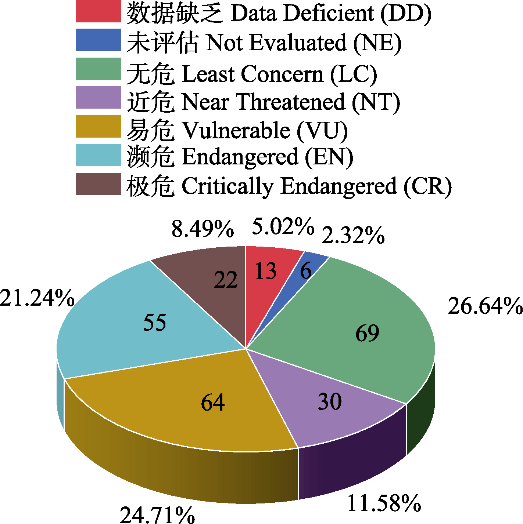
Fig. 3 Status of chondrichthyans in China based on IUCN Red List (2021)
| [1] | Arai T, Azri A (2019) Diversity, occurrence and conservation of sharks in the southern South China Sea. PLoS ONE, 14, e0213864. |
| [2] | Baum JK, Worm B (2009) Cascading top-down effects of changing oceanic predator abundances. Journal of Animal Ecology, 78, 699-714. |
| [3] | Borsa P, Arlyza IS, Hoareau TB, Shen KN (2018) Diagnostic description and geographic distribution of four new cryptic species of the blue-spotted maskray species complex (Myliobatoidei: Dasyatidae; Neotrygon spp.) based on DNA sequences. Journal of Oceanology and Limnology, 36, 827-841. |
| [4] | Carrier JC, Musick JA, Heithaus MR (2012) Biology of Sharks and Their Relatives, 2nd edn. CRC Press, New York. |
| [5] | Chen GB, Liang PW, Guan SY, Yu J, Li N (2016) Illustrated Guidebook on Marine Fishes of the South China Sea. Science Press, Beijing. (in Chinese) |
| [陈国宝, 梁沛文, 关少映, 于杰, 李娜 (2016) 南海海洋鱼类原色图谱. 科学出版社, 北京.] | |
| [6] | Chen JF, Wu XJ, Lin H, Cui GF (2023) A comparative analysis of the List of State Key Protected Wild Animals and other wildlife protection lists. Biodiversity Science, 31, 22639. (in Chinese with English abstract) |
| [陈金锋, 吴欣静, 林海, 崔国发 (2023) 《国家重点保护野生动物名录》和其他保护名录对比分析. 生物多样性, 31, 22639.] | |
| [7] | Chen JJ, Chen JY, Guo XL, Zeng S, Yang DY, Zhong JS, Zhao SL, Fang WH, Chen J, Liu P (2025) First records of Bathytoshia brevicaudata (Hutton, 1875) (Myliobatiformes, Dasyatidae) from China with mitogenomic evidence. Zoosystematics and Evolution, 101, 2191-2205. |
| [8] | Cheng QT, Zhou CW (1997) Fishes of Shandong Province. Shandong Science and Technology Press, Jinan. (in Chinese) |
| [成庆泰, 周才武 (1997) 山东鱼类志. 山东科学技术出版社, 济南.] | |
| [9] | Clerkin PJ, Arostegui MC, Chiang WC, Lin SJ, Miller CD, Braun CD (2024) First telemetry insights into the movements and vertical habitat use of megamouth shark (Megachasma pelagios) in the Northwest Pacific. Deep Sea Research Part I: Oceanographic Research Papers, 212, 104385. |
| [10] | Compagno LJV (1984) Sharks of the World: An Annotated and Illustrated Catalogue of Shark Species Known to Date. Part 2. Carcharhiniformes. Food & Agriculture Organisation, Rome. |
| [11] | Compagno LJV (2001) An Annotated and Illustrated Catalogue of Shark Species Known to Date, Vol. 2. Food & Agriculture Organisation, Rome. |
| [12] | Compagno LJV, Last PR (2008) A new species of wedgefish, Rhynchobatus palpebratus sp. nov. (Rhynchobatoidei:Rhynchobatidae), from the Indo-West Pacific. In: Descriptions of New Australian Chondrichthyans (eds Last PR, White WT, Pogonoski JJ), pp. 227-240. CSIRO Marine and Atmospheric Research, Hobart. |
| [13] | Compagno LJV, Last PR (2010) A new species of wedgefish, Rhynchobatus springeri (Rhynchobatoidei, Rhynchiobatidae), from the western Pacific. In: Descriptions of New Sharks and Rays from Borneo (eds Last PR, White WT, Pogonoski JJ), pp. 77-88. CSIRO Marine and Atmospheric Research, Hobart. |
| [14] | Cortés E (1999) Standardized diet compositions and trophic levels of sharks. ICES Journal of Marine Science, 56, 707-717. |
| [15] | da Silva Rodrigues-Filho LF, da Costa Nogueira P, Sodré D, da Silva Leal JR, Nunes JLS, Rincon G, Lessa RPT, Sampaio I, Vallinoto M, Ready JS, Sales JBL (2023) Evolutionary history and taxonomic reclassification of the Critically Endangered daggernose shark, a species endemic to the western Atlantic. Journal of Zoological Systematics and Evolutionary Research, 2023, 4798805. |
| [16] | Daly-Engel TS, Baremore IE, Grubbs RD, Gulak SJB, Graham RT, Enzenauer MP (2019) Resurrection of the sixgill shark Hexanchus vitulus Springer & Waller, 1969 (Hexanchiformes, Hexanchidae), with comments on its distribution in the Northwest Atlantic Ocean. Marine Biodiversity, 49, 759-768. |
| [17] | de Carvalho MR, Compagno LJV, Ebert DA (2003) Benthobatis yangi, a new species of blind electric ray from Taiwan (Chondrichthyes: Torpediniformes: Narcinidae). Bulletin of Marine Science, 72, 923-939. |
| [18] | Didier DA, Nakaya K (1999) Redescription of Rhinochimaera pacifica (Mitsukuri) and first record of R. africana Compagno, Stehmann & Ebert from Japan (Chimaeriformes: Rhinochimaeridae). Ichthyological Research, 46, 139-152. |
| [19] | Ding ZW, Chen YT, Yu W, Zhang JJ, Huang YB, Li DK, Peng ZJ, Lai H, Wei SC, Huang MP (2025) Application of baited remote underwater video technology in assessing nearshore reef fish diversity. Biodiversity Science, 33, 24572. (in Chinese with English abstract) |
| [丁仲文, 陈奕廷, 余文, 张晶晶, 黄亿彬, 李丁科, 彭昭杰, 赖瀚, 魏世超, 黄明攀 (2025) 诱饵式远程水下视频技术在近岸礁栖鱼类多样性监测中的应用. 生物多样性, 33, 24572.] | |
| [20] | Dulvy NK, Pacoureau N, Rigby CL, Pollom RA, Jabado RW, Ebert DA, Finucci B, Pollock CM, Cheok J, Derrick DH, Herman KB, Sherman CS, VanderWright WJ, Lawson JM, Walls RHL, Carlson JK, Charvet P, Bineesh KK, Fernando D, Ralph GM, Matsushiba JH, Hilton-Taylor C, Fordham SV, Simpfendorfer CA (2021) Overfishing drives over one-third of all sharks and rays toward a global extinction crisis. Current Biology, 31, 4773-4787.e8. |
| [21] | Dyldin YV (2015) Annotated checklist of the sharks, batoids and chimaeras (Chondrichthyes: Elasmobranchii, Holocephali) from waters of Russia and adjacent areas. Publications of the Seto Marine Biological Laboratory, 43, 40-91. |
| [22] | Editorial group of Deep Sea Fishes of the East China Sea, East China Sea Fisheries Research Institute (1988) Deep Sea Fishes of the East China Sea. Academia Press, Shanghai. (in Chinese) |
| [东海水产研究所《东海深海鱼类》编写组 (1988) 东海深海鱼类. 学林出版社, 上海.] | |
| [23] | Ebert DA, Dando M, Fowler S (2021) Sharks of the World:A Complete Guide. Princeton University Press, New Jersey. |
| [24] | Ebert DA, Dando M, Fowler S ( translated by Zhang J, Lu HM, Chen JY, Mao YF) (2025) Sharks of the World: A Complete Guide. China Youth Publishing Group, Beijing. (in Chinese) |
| [张洁, 路昊明, 陈江源, 毛宇帆 (译) (2025) 鲨鱼大图鉴: 世界现生536种鲨鱼完全解读. 中国青年出版社, 北京.] | |
| [25] | Ebert DA, White WT, Goldman KJ, Compagno LJV, Daly-Engel TS, Ward RD (2010) Resurrection and redescription of Squalus suckleyi (Girard, 1854) from the North Pacific, with comments on the Squalus acanthias subgroup (Squaliformes: Squalidae). Zootaxa, 2612, 22-40. |
| [26] | Ebert DA, White WT, Ho HC, Last PR, Nakaya K, Séret B, Straube N, Naylor GJP, de Carvalho MR (2013) An annotated checklist of the chondrichthyans of Taiwan. Zootaxa, 3752, 279-386. |
| [27] | FAO (2019) Report of the Sixth FAO Expert Advisory Panel for the Assessment of Proposals to Amend Appendices I and II of CITES Concerning Commercially Exploited Aquatic Species, Rome. https://openknowledge.fao.org/items/c98cf547-d0aa-4677-b67c-1c5fda4eaef1. (accessed on 2026-02-03) |
| [28] | Faria VV, McDavitt MT, Charvet P, Wiley TR, Simpfendorfer CA, Naylor GJP (2013) Species delineation and global population structure of Critically Endangered sawfishes (Pristidae). Zoological Journal of the Linnean Society, 167, 136-164. |
| [29] | Finucci B, Cheok J, Ebert DA, Herman K, Kyne PM, Dulvy NK (2021) Ghosts of the deep—Biodiversity, fisheries, and extinction risk of ghost sharks. Fish and Fisheries, 22, 391-412. |
| [30] | Finucci B, White WT, Kemper JM, Naylor GJP (2018) Redescription of Chimaera ogilbyi (Chimaeriformes; Chimaeridae) from the Indo-Australian region. Zootaxa, 4375, 191-210. |
| [31] | Fricke R, Eschmeyer WN, Van der Laan R (2023) Eschmeyer’s Catalog of Fishes. https://researcharchive.calacademy.org/research/ichthyology/catalog/fishcatmain.asp. (accessed on 2025-12-17) |
| [32] | Furumitsu K, Yamaguchi A (2021) Records of the purple eagle ray Myliobatis hamlyni from Japan and comparisons with the Japanese eagle ray Myliobatis tobijei. Japanese Journal of Ichthyology, 68, 117-128. (in Japanese) |
| [古満啓介, 山口敦子 (2021) トビエイ科トビエイ属Myliobatis hamlyni スミレトビエイ(新称) の日本における分布記録とトビエイとの形態比較に基づく新たな識別法. 魚類学雑誌, 68, 117-128.] | |
| [33] | Garrick JAF, Paul LJ (1971) Heptranchias dakini Whitley, 1931, a synonym of H. perlo (Bonnaterre, 1788), the sharpsnouted sevengill or perlon shark, with notes on sexual dimorphism in this species. Zoological Publications from Victoria University of Wellington, 53, 1-14. |
| [34] | Giovos I, Aga-Spyridopoulou RN, Serena F, Soldo A, Barash A, Doumpas N, Gkafas GA, Katsada D, Katselis G, Kleitou P, Minasidis V, Papastamatiou YP, Touloupaki E, Moutopoulos DK (2022) An updated Greek national checklist of Chondrichthyans. Fishes, 7, 199. |
| [35] | Haas DL, Ebert DA (2006) Torpedo formosa sp. nov., a new species of electric ray (Chondrichthyes: Torpediniformes: Torpedinidae) from Taiwan. Zootaxa, 1320, 1-14. |
| [36] | Heemstra E, Heemstra P, Ebert DA, Holleman W, Randall JE (2022) Coastal Fishes of the Western Indian Ocean. South African Institute for Aquatic Biodiversity, Makhanda. |
| [37] | Ho HC, Nakaya K (2016) New record of the Japanese roughshark, Oxynotus japonicus Yano et Murofushi, 1985 (Elasmobranchii: Squaliformes: Oxynotidae) in Taiwan. Acta Ichthyologica et Piscatoria, 46, 357-360. |
| [38] | Hsu HH, Joung SJ, Ebert DA, Lin CY (2013) Records of new and rare elasmobranchs from Taiwan. Zootaxa, 3752, 249-255. |
| [39] | Hsu HH, Lin CY, Joung SJ (2020) Somniosus (Rhinoscymnus) cheni sp. nov., a new species of sleeper shark (Squaliformes: Somniosidae) from eastern Taiwan, with aspects of embryo biology. Zoological Studies, 59, e48. |
| [40] | Huang ZR, Chen ZZ, Zeng XG (2009) Species composition and resources density of Chondrichthyes in the continental shelf of northern South China Sea. Journal of Oceannography in Taiwan Strait, 28, 38-44. (in Chinese with English abstract) |
| [黄梓荣, 陈作志, 曾晓光 (2009) 南海北部海区软骨鱼类种类组成和资源密度分布. 台湾海峡, 28, 38-44.] | |
| [41] | Iglésias SP (2012) Apristurus nakayai sp. nov., a new species of deepwater catshark (Chondrichthyes: Pentanchidae) from New Caledonia. Cybium, 36, 511-519. |
| [42] | Iglésias SP, Kemper JM, Naylor GJP (2022) Chimaera compacta, a new species from southern Indian Ocean, and an estimate of phylogenetic relationships within the genus Chimaera (Chondrichthyes: Chimaeridae). Ichthyological Research, 69, 31-45. |
| [43] | Iino T, Maekawa T, Motomura H (2021) First record of Rhynchobatus australiae (Whitley, 1939) (Rhinidae) from Amami-oshima island, Amami Islands, Kagoshima, Japan, with a review of distributional records in Japanese waters and assessment of diagnostic characters of the species. Ichthy, Natural History of Fishes of Japan, 9, 6-10. (in Japanese) |
| [飯野友香, 前川隆則, 本村浩之 (2021) 奄美大島からの初記録を含むトンガリサカタザメ (シノノメサカタザメ科) の国内における分布状況, および本種の標徴に関する再評価. Ichthy, Natural History of Fishes of Japan, 9, 6-10.] | |
| [44] | Ishihara H, Misawa R, Sugiyama H, Kashiwagi T (2019) Updating the scientific names of Japanese batoids. Report of Japanese Society for Elasmobranch Studies, 55, 55-63. (in Japanese with English abstract) |
| [石原元, 三澤遼, 杉山秀樹, 柏木努 (2019) 日本産エイ類の和名·学名対応関係の更新. 板鰓類研究会報, 55, 55-63.] | |
| [45] | IUCN SSC Shark Specialist Group (2024) Important Shark and Ray Areas Regional Expert Workshop Report: Asia. IUCN, Dubai. |
| [46] | Iwatsuki Y, Miyamoto K, Nakaya K, Zhang J (2011) A review of the genus Platyrhina (Chondrichthys: Platyrhinidae) from the northwestern Pacific, with descriptions of two new species. Zootaxa, 2738, 26-40. |
| [47] | Jeong CH, Nakabo T (2008) Dipturus wuhanlingi, a new species of skates (Elasmobranchii: Rajidae) from China. Ichthyological Research, 55, 183-190. |
| [48] | Jeong CH, Nakabo T, Wu HL (2007) A new species of skate (Chondrichthyes: Rajidae), Okamejei mengae from the South China Sea. Korean Journal of Ichthyology, 19, 57-65. |
| [49] | Jiang XH, Xie YJ, Huang LM, Li J, Zhang YZ (2010) The distribution of species composition and quantity of cartilaginous fishes in Minjiang estuary and its neighboring waters and Xiamen coastal waters. Journal of Jimei University (Natural Science), 15(6), 7-12. (in Chinese with English abstract) |
| [蒋新花, 谢仰杰, 黄良敏, 李军, 张雅芝 (2010) 闽江口及附近海域和厦门沿岸海域软骨鱼类种类组成和数量的时空分布. 集美大学学报(自然科学版), 15(6), 7-12.] | |
| [50] | Jiang ZG (2011) Non-detrimental findings should be enhanced for the management of international trade in endangered species of wild fauna and flora. Biodiversity Science, 19, 495-496. (in Chinese) |
| [蒋志刚 (2011) 濒危野生动植物种国际贸易管理亟待加强贸易物种的非致危性判断. 生物多样性, 19, 495-496.] | |
| [51] | Jiang ZG, Ji LQ (1999) Avian-mammalian species diversity in nine representative sites in China. Chinese Biodiversity, 7, 220-225. (in Chinese with English abstract) |
| [蒋志刚, 纪力强 (1999) 鸟兽物种多样性测度的G-F指数方法. 生物多样性, 7, 220-225.] | |
| [52] | Knuckey JD, Ebert DA, Burgess GH (2011) Etmopterus joungi n. sp., a new species of lanternshark (Squaliformes: Etmopteridae) from Taiwan. Aqua, International Journal of Ichthyology, 17(2), 61-72. |
| [53] | Kottelat M (2013) The fishes of the inland waters of Southeast Asia: A catalogue and core bibliography of the fishes known to occur in freshwaters, mangroves and estuaries. Raffles Bulletin of Zoology Supplement, 27, 1-663. |
| [54] | Laboratory of Marine Geology, Institution of Oceanology, Chinese Academy of Sciences (1985) Geology of the Bohai Sea. Science Press, Beijing. (in Chinese) |
| [中国科学院海洋研究所海洋地质研究室 (1985) 渤海地质. 科学出版社, 北京.] | |
| [55] | Last PR, Fahmi, Ishihara H (2010a) Okamejei cairae sp. nov. (Rajoidei:Rajidae), a new skate from the South China Sea. In: Descriptions of New Sharks and Rays from Borneo (eds Last PR, White WT, Pogonoski JJ), pp. 89-100. CSIRO Marine and Atmospheric Research, Hobart. |
| [56] | Last PR, Ho HC, Chen RR (2013) A new species of wedgefish, Rhynchobatus immaculatus (Chondrichthyes, Rhynchobatidae), from Taiwan. Zootaxa, 3752, 185-198. |
| [57] | Last PR, Naylor GJP, Manjaji-Matsumoto BM (2016a) A revised classification of the family Dasyatidae (Chondrichthyes: Myliobatiformes) based on new morphological and molecular insights. Zootaxa, 4139, 345-368. |
| [58] | Last PR, Pogonoski JJ, White WT (2010b) A new wobbegong shark, Orectolobus leptolineatus sp. nov. (Orectolobiformes:Orectolobidae), from the western Central Pacific. In: Descriptions of New Sharks and Rays from Borneo (eds Last PR, White WT, Pogonoski JJ), pp. 1-6. CSIRO Marine and Atmospheric Research, Hobart. |
| [59] | Last PR, White WT, de Carvalho MR, Séret B, Stehmann MFW, Naylor GJP (2016b) Rays of the World. CSIRO Publishing, Clayton South. |
| [60] | Last PR, White WT, Séret B (2016c) Taxonomic status of maskrays of the Neotrygon kuhlii species complex (Myliobatoidei: Dasyatidae) with the description of three new species from the Indo-West Pacific. Zootaxa, 4083, 533-561. |
| [61] | Lee PF, Shao KT (2009) Two new records of Lamniform shark from the waters adjacent to Taiwan. Journal of fisheries Society of Taiwan, 36, 303-311 |
| [62] | Lim KC, White WT, Then AYH, Naylor GJP, Arunrugstichai S, Loh KH (2022) Integrated taxonomy revealed genetic differences in morphologically similar and non-sympatric Scoliodon macrorhynchos and S. laticaudus. Animals, 12, 681. |
| [63] | Liu CX, Qin KJ (1987) Fauna Liaoningica·Pisces. Liaoning Science and Technology Press, Shenyang. (in Chinese) |
| [刘蝉馨, 秦克静 (1987) 辽宁动物志·鱼类. 辽宁科学技术出版社, 沈阳.] | |
| [64] | Liu JY (2013) Status of marine biodiversity of the China seas. PLoS ONE, 8, e50719. |
| [65] | Liu M, Chen X, Yang SY (2013) Marine Fishes of Southern Fujian, China. China Ocean Press, Beijing. (in Chinese) |
| [刘敏, 陈骁, 杨圣云 (2013) 中国福建南部海洋鱼类图鉴. 海洋出版社, 北京.] | |
| [66] | Lucifora LO, García VB, Menni RC, Worm B (2012) Spatial patterns in the diversity of sharks, rays, and chimaeras (Chondrichthyes) in the Southwest Atlantic. Biodiversity and Conservation, 21, 407-419. |
| [67] | Ma YY, Dai XJ, Wu F (2023) Preliminary analysis of the status of global shark fisheries and trade in their products. China Fishery Economics, 41(3), 101-110. (in Chinese with English abstract) |
| [马晔阳, 戴小杰, 吴峰 (2023) 全球鲨鱼捕捞现状及其制品贸易初步分析. 中国渔业经济, 41(3), 101-110.] | |
| [68] | Manjaji-Matsumoto BM, Last PR (2008) Himantura leoparda sp. nov., a new whipray (Myliobatoidei:Dasyatidae) from the Indo-Pacific. In: Descriptions of New Australian Chondrichthyans (eds Last PR, White WT, Pogonoski JJ), pp. 293-301. CSIRO Marine and Atmospheric Research, Hobart. |
| [69] | Mariani S, Fernandez C, Baillie C, Magalon H, Jaquemet S (2021) Shark and ray diversity, abundance and temporal variation around an Indian Ocean Island, inferred by eDNA metabarcoding. Conservation Science and Practice, 3, e407. |
| [70] | Merson ZS, Jahn EE, Barnes MA, Spurgeon EA, Rex PT, Elstner JT, Samara Chacon YN, Anderson JM, Jones WD, Lowe CG (2025) eDNA metabarcoding detection of nearshore juvenile white sharks (Carcharodon carcharias) and prey fish communities. Journal of Experimental Marine Biology and Ecology, 583, 152084. |
| [71] | Motomura H (2020) List of Japan’s All Fish Species. Current Standard Japanese and Scientific Names of All Fish Species Recorded from Japanese Waters. The Kagoshima University Museum, Kagoshima. (in Japanese) |
| [本村浩之 (2020) 日本産魚類全種目録. これまでに記録された日本産魚類全種の現在の標準和名と学名. 鹿児島大学総合研究博物館, 鹿児島.] | |
| [72] | Myers RA, Baum JK, Shepherd TD, Powers SP, Peterson CH (2007) Cascading effects of the loss of apex predatory sharks from a coastal ocean. Science, 315, 1846-1850. |
| [73] | Nakabo T (2013) Fishes of Japan with Pictorial Keys to the Species, 3rd edn. Tokai University Press, Hadano-shi. (in Japanese) |
| [中坊徹次 (2013) 日本產魚類検索: 全種の同定(第三版). 東海大學出版社, 秦野.] | |
| [74] | Nakaya K (2016) Sharks—Champion of the Sea, Revised Edition. Bukkumansha, Tokyo. (in Japanese) |
| [仲谷一宏 (2016b) サメ-海の王者たち-改訂版. ブックマン社, 東京都.] | |
| [75] | Nakaya K, Inoue S, Ho HC (2013) A review of the genus Cephaloscyllium (Chondrichthyes: Carcharhiniformes: Scyliorhinidae) from Taiwanese waters. Zootaxa, 3752, 101-129. |
| [76] | Nakaya K, Kawauchi J (2013) A review of the genus Apristurus (Chondrichthyes: Carcharhiniformes: Scyliorhinidae) from Taiwanese waters. Zootaxa, 3752, 130-171. |
| [77] | Nakayama N, Matsunuma M, Endo H (2020) A preliminary review and in situ observations of the spookfish genus Harriotta (Holocephali: Rhinochimaeridae). Ichthyological Research, 67, 82-91. |
| [78] | Nelson JS, Grande TC, Wilson MVH (2016) Fishes of the World, 5th edn. John Wiley & Sons, Inc., New York. |
| [79] | Ng SL, Ho HC, Joung SJ, Liu KM (2023a) Okamejei picta sp. nov., a new rajid skate from the South China Sea (Rajiformes: Rajidae). Zootaxa, 5278, 103-118. |
| [80] | Ng SL, Ho HC, Liu KM, Joung SJ (2022a) Redescription of the longnose houndshark Iago garricki (Carcharhiniformes: Triakidae), based on specimens recently collected from the South China Sea. Zootaxa, 5189, 67-77. |
| [81] | Ng SL, Liu HW, Mediodia DP, Lin YT, Lee CH, Lin CF, Huang SP, Wu SM, Tung CR, Ho HC, Lin CH (2024a) An updated checklist of fishes of Dongsha Island, Taiwan, northern South China Sea. ZooKeys, 1220, 175. |
| [82] | Ng SL, Liu KM, Joung SJ (2023b) Occurrence of the milk-eye catshark Apristurus nakayai (Carcharhiniformes: Pentanchidae) from the South China Sea. Zootaxa, 5244, 51-60. |
| [83] | Ng SL, Liu KM, Joung SJ (2024b) Description of a new lanternshark species from the South China Sea, with additional description of Etmopterus sheikoi from Taiwanese waters (Squaliformes: Etmopteridae). Raffles Bulletin of Zoology, 72, 26. |
| [84] | Ng SL, Straube N, Liu KM, Joung SJ (2025a) Confusions across the hemispheres: Taxonomic re-evaluation of two lanternshark species, Etmopterus lucifer and E. molleri (Squaliformes: Etmopteridae). Vertebrate Zoology, 75, 59-86. |
| [85] | Ng SL, White WT, Joung SJ, Chen WJ (2025b) Groundwork for conservation: An updated checklist of Chondrichthyes of Taiwan. Biological Journal of the Linnean Society, 145, blaf051. |
| [86] | Ng SL, Yu CJ, Su SH, Joung SJ (2022b) A new record of the rare bigeye sand tiger shark Odontaspis noronhai Maul, 1955 (Lamniformes: Odontaspididae) from the northwestern Pacific, with notes on dentition. Zootaxa, 5094, 92-102. |
| [87] | Ni Y, Wu HL (2006) Fishes of Jiangsu Province. China Agriculture Press, Beijing. (in Chinese) |
| [倪勇, 伍汉霖(2006) 江苏鱼类志. 中国农业出版社, 北京.] | |
| [88] | Notarbartolo di Sciara G, Adnet S, Bennett M, Broadhurst MK, Fernando D, Jabado RW, Laglbauer BJL, Stevens G (2020) Taxonomic status, biological notes, and conservation of the longhorned pygmy devil ray Mobula eregoodoo (Cantor, 1849). Aquatic Conservation: Marine and Freshwater Ecosystems, 30, 104-122. |
| [89] | Nunis T, Grant MI, Chin A (2024) Sharks and rays of the Samoan Archipelago: A review of their biological diversity, social and cultural values, and conservation status. Pacific Conservation Biology, 30, PC23039. |
| [90] | Pacoureau N, Rigby CL, Kyne PM, Sherley RB, Winker H, Carlson JK, Fordham SV, Barreto R, Fernando D, Francis MP, Jabado RW, Herman KB, Liu KM, Marshall AD, Pollom RA, Romanov EV, Simpfendorfer CA, Yin JS, Kindsvater HK, Dulvy NK (2021) Half a century of global decline in oceanic sharks and rays. Nature, 589, 567-571. |
| [91] | Prokofiev AM (2019) On the status of Paragaleus longicaudatus (Hemigaleidae). Journal of Ichthyology, 59, 113-114. |
| [92] | Qi JW, Shi FL, Zhang BW, Chen X, Xing J, Furumitsu K, Corush JB, Yamaguchi A, Zhang J (2022) Insights into genetic variation and demographic history of sharpnose rays: Examinations of three species of Telatrygon (Elasmobranchii, Dasyatidae) from the Indo-West Pacific. Integrative Zoology, 17, 1063-1077. |
| [93] | Qin YS (1987) Geology of the East China Sea. Science Press, Beijing. (in Chinese) |
| [秦蕴珊 (1987) 东海地质. 科学出版社, 北京.] | |
| [94] | Qin YS (1989) Geology of the Yellow Sea. China Ocean Press, Beijing. (in Chinese) |
| [秦蕴珊 (1989) 黄海地质. 海洋出版社, 北京.] | |
| [95] | Rigby CL, Bin Ali A, Bineesh KK, Chen X, Derrick D, Dharmadi, Ebert DA, Fahmi, Fernando D, Gautama DA, Haque AB, Herman K, Ho H, Hsu H, Maung A, Vo VQ, Sianipar A, Tanay D, Utzurrum JAT, Yuneni RR, Zhang J (2020a) Squatina tergocellatoides. The IUCN Red List of Threatened Species 2020: e. T161525A134193835. https://dx. doi.org/10.2305/IUCN.UK.2020-3.RLTS.T161525A134193835.en.(accessed on 2026-02-03) |
| [96] | Rigby CL, Bin Ali A, Bineesh KK, Chen X, Derrick D, Dharmadi, Ebert DA, Fahmi, Fernando D, Gautama DA, Haque AB, Ho H, Hsu H, Krajangdara T, Maung A, Vo VQ, Sianipar A, Tanay D, Utzurrum JAT, Yuneni RR, Zhang J (2020b) Mustelus manazo. The IUCN Red List of Threatened Species 2020: e. T161633A124518703. https://dx. doi.org/10.2305/IUCN.UK.2020-3.RLTS.T161633A124518703.en. (accessed on 2026-02-03) |
| [97] | Rigby CL, Bin Ali A, Bineesh KK, Chen X, Derrick D, Dharmadi, Ebert DA, Fahmi, Fernando D, Gautama DA, Haque AB, Ho H, Hsu H, Maung A, Vo VQ, Sianipar A, Tanay D, Utzurrum JAT, Yuneni RR, Zhang J (2020c) Orectolobus japonicus. The IUCN Red List of Threatened Species 2020: e. T161563A124507360. https://dx.doi.org/10.2305/IUCN.UK.2020-3.RLTS.T161563A124507360.en. (accessed on 2026-02-03) |
| [98] | Rigby CL, Chen X, Ebert DA, Herman K, Ho H, Hsu H, Zhang J (2020d) Squalus japonicus. The IUCN Red List of Threatened Species 2020: e. T161433A124484752. https://dx. doi.org/10.2305/IUCN.UK.2020-3.RLTS.T161433A124484752.en. (accessed on 2026-02-03) |
| [99] | Rigby CL, Chen X, Ebert DA, Herman K, Ho H, Hsu H, Zhang J (2020e) Squatina formosa. The IUCN Red List of Threatened Species 2020: e. T161456A134193368. https://dx.doi.org/10.2305/IUCN.UK.2020-3.RLTS.T161456A134193368.en. (accessed on 2026-02-03) |
| [100] | Seigel JA (1978) Revision of the dalatiid shark genus Squaliolus: Anatomy, systematics, ecology. Copeia, 1978, 602-614. |
| [101] | Setiati N, Peniati E, Partaya P (2018) Diversity and conservation knowledge of chondrichthyans in northern coastal areas of Central Java. Biosaintifika: Journal of Biology & Biology Education, 10, 472-477. |
| [102] | Shen SC (1993) Fishes of Taiwan. Department of Zoology, Taiwan University, Taipei. (in Chinese) |
| [沈世杰 (1993) 台湾鱼类志. 台湾大学动物学系, 台北.] | |
| [103] | Shirai S, Tachikawa H (1993) Taxonomic resolution of the Etmopterus pusillus species group (Elasmobranchii, Etmopteridae), with description of E. bigelowi n. sp. Copeia, 1993, 483-495. |
| [104] | Soares KDA, Mathubara K (2022) Combined phylogeny and new classification of catsharks (Chondrichthyes: Elasmobranchii: Carcharhiniformes). Zoological Journal of the Linnean Society, 195, 761-814. |
| [105] | Stein RW, Mull CG, Kuhn TS, Aschliman NC, Davidson LNK, Joy JB, Smith GJ, Dulvy NK, Mooers AO (2018) Global priorities for conserving the evolutionary history of sharks, rays and chimaeras. Nature Ecology & Evolution, 2, 288-298. |
| [106] | Stevens JD, Bonfil R, Dulvy NK, Walker PA (2000) The effects of fishing on sharks, rays, and chimaeras (chondrichthyans), and the implications for marine ecosystems. ICES Journal of Marine Science, 57, 476-494. |
| [107] | Straube N, Li CH, Claes JM, Corrigan S, Naylor GJP (2015) Molecular phylogeny of Squaliformes and first occurrence of bioluminescence in sharks. BMC Evolutionary Biology, 15, 162. |
| [108] | Straube N, White WT, Ho HC, Rochel E, Corrigan S, Li CH, Naylor GJP (2013) A DNA sequence-based identification checklist for Taiwanese chondrichthyans. Zootaxa, 3752, 256-278. |
| [109] | Takahashi M, Nakaya K (2004) Hemitriakis complicofasciata, a new whitefin topeshark (Carcharhiniformes: Triakidae) from Japan. Ichthyological Research, 51, 248-255. |
| [110] | Taniuchi T, Garrick JAF (1986) A new species of Scymnodalatias from the southern oceans, and comments on other squaliform sharks. Japanese Journal of Ichthyology, 33, 119-134. |
| [111] | Tian H, Zhong JS, Chen JY, Jiang YN, Zhang J, Xie W, Gao ZY, Wang YC, Liu HZ, Wang SJ, Zhang F, Yang J, Yin KD (2024) Southwestward expansion of the Pacific sleeper shark’s (Somniosus pacificus) known distribution into the South China Sea. Animals, 14, 2162. |
| [112] | Tian SK, Wang YF, Chen XY, Shi YL (2022) Illustrated Guide on Fishes of Yunnan Province. Yunnan Science and Technology Press, Kunming. (in Chinese) |
| [田树魁, 王云峰, 陈小勇, 石永伦 (2022) 云南鱼类图集. 云南科技出版社, 昆明.] | |
| [113] | VanCompernolle M, Morris J, Calich HJ, Rodríguez JP, Marley SA, Pearce JR, Abrahms B, Abrantes K, Afonso AS, Aguilar A (2025) Vulnerability of marine megafauna to global at-sea anthropogenic threats. Conservation Biology, 40, e70147. |
| [114] | Vélez-Zuazo X, Agnarsson I (2011) Shark tales: A molecular species-level phylogeny of sharks (Selachimorpha, Chondrichthyes). Molecular Phylogenetics and Evolution, 58, 207-217. |
| [115] | Viana STFL, de Carvalho MR (2020) Squalus shiraii sp. nov. (Squaliformes, Squalidae), a new species of dogfish shark from Japan with regional nominal species revisited. Zoosystematics and Evolution, 96, 275-311. |
| [116] | Vincent ACJ, Sadovy de Mitcheson YJ, Fowler SL, Lieberman S (2014) The role of CITES in the conservation of marine fishes subject to international trade. Fish and Fisheries, 15, 563-592. |
| [117] | Wang HG, Fan ZY, Fang YF (2007) New record species of shark from seacoast of China mainland. Acta Zootaxonomica Sinica, 32, 490-491. (in Chinese with English abstract) |
| [王火根, 范忠勇, 方一峰 (2007) 中国大陆沿海鲨鱼新纪录种. 动物分类学报, 32, 490-491.] | |
| [118] | Wang SA, Wang ZM, Li GL, Cao YP (2001) The Fauna of Hebei, China Pisces. Hebei Science and Technology Publishing House, Shijiazhuang. (in Chinese) |
| [王所安, 王志敏, 李国良, 曹玉萍 (2001) 河北动物志·鱼类. 河北科学技术出版社, 石家庄.] | |
| [119] | Wang Y, Liu RY, Su JL (2013) Oceanography of China. Science Press, Beijing. (in Chinese) |
| [王颖, 刘瑞玉, 苏纪兰 (2013) 中国海洋地理. 科学出版社, 北京.] | |
| [120] | Weigmann S (2016) Annotated checklist of the living sharks, batoids and chimaeras (Chondrichthyes) of the world, with a focus on biogeographical diversity. Journal of Fish Biology, 88, 837-1037. |
| [121] | Weigmann S, Didier D, Finucci B, Nakaya K, Naylor GJP, Séret B, Straube N, Vaz DFB (2024) Biodiversity, taxonomy, and systematics of extant chondrichthyan fishes. In: The Global Status of Sharks, Rays, and Chimaeras (eds Jabado RW, Morata AZA, Bennett RH, Finucci B, Ellis JR, Fowler SL, Grant MI, Barbosa AP, Sinclair SL), pp. 7-23. IUCN, Gland. |
| [122] | Wheeler CR, Gervais CR, Johnson MS, Vance S, Rosa R, Mandelman JW, Rummer JL (2020) Anthropogenic stressors influence reproduction and development in elasmobranch fishes. Reviews in Fish Biology and Fisheries, 30, 373-386. |
| [123] | White WT, Corrigan S, Yang L, Henderson AC, Bazinet AL, Swofford DL, Naylor GJP (2018) Phylogeny of the manta and devilrays (Chondrichthyes: Mobulidae), with an updated taxonomic arrangement for the family. Zoological Journal of the Linnean Society, 182, 50-75. |
| [124] | White WT, Ebert DA, Naylor GJP (2017) Revision of the genus Centrophorus (Squaliformes: Centrophoridae): Part 2—Description of two new species of Centrophorus and clarification of the status of Centrophorus lusitanicus Barbosa du Bocage & de Brito Capello, 1864. Zootaxa, 4344, 86-114. |
| [125] | White WT, Ebert DA, Naylor GJP, Ho HC, Clerkin P, Veríssimo AN, Cotton CF (2013a) Revision of the genus Centrophorus (Squaliformes: Centrophoridae): Part 1—Redescription of Centrophorus granulosus (Bloch & Schneider), a senior synonym of C. acus Garman and C. niaukang Teng. Zootaxa, 3752, 35-72. |
| [126] | White WT, Furumitsu K, Yamaguchi A (2013b) A new species of eagle ray Aetobatus narutobiei from the Northwest Pacific: An example of the critical role taxonomy plays in fisheries and ecological sciences. PLoS ONE, 8, e83785. |
| [127] | White WT, Harris M (2013) Redescription of Paragaleus tengi (Chen, 1963) (Carcharhiniformes: Hemigaleidae) and first record of Paragaleus randalli Compagno, Krupp & Carpenter, 1996 from the western North Pacific. Zootaxa, 3752, 172-184. |
| [128] | White WT, Iglésias SP (2011) Squalus formosus, a new species of spurdog shark (Squaliformes: Squalidae), from the western North Pacific Ocean. Journal of Fish Biology, 79, 954-968. |
| [129] | White WT, Last PR (2013) Notes on shark and ray types at the South China Sea Fisheries Research Institute (SCSFRI) in Guangzhou, China. Zootaxa, 3752, 228-248. |
| [130] | White WT, Last PR, Lim APK (2010a) Rediscovery of the rare and endangered Borneo shark Carcharhinus borneensis (Bleeker, 1858) (Carcharhiniformes:Carcharhinidae). In: Descriptions of New Sharks and Rays from Borneo (eds Last PR, White WT, Pogonoski JJ), pp. 17-28. CSIRO Marine and Atmospheric Research, Hobart. |
| [131] | White WT, Last PR, Naylor GJP, Jensen K, Caira JN (2010b) Clarification of Aetobatus ocellatus (Kuhl, 1823) as a valid species, and a comparison with Aetobatus narinari (Euphrasen, 1790) (Rajiformes:Myliobatidae). In: Descriptions of New Sharks and Rays from Borneo (eds Last PR, White WT, Pogonoski JJ), p. 141. CSIRO Marine and Atmospheric Research, Hobart. |
| [132] | White WT, Stewart AL, O’Neill HL, Naylor GJP (2024) Dichichthyidae, a new family of deepwater sharks (Carcharhiniformes) from the Indo-West Pacific, with description of a new species. Fishes, 9, 121. |
| [133] | White WT, Vaz DFB, Ho HC, Ebert DA, de Carvalho MR, Corrigan S, Rochel E, de Carvalho M, Tanaka S, Naylor GJP (2015) Redescription of Scymnodon ichiharai Yano and Tanaka 1984 (Squaliformes: Somniosidae) from the western North Pacific, with comments on the definition of somniosid genera. Ichthyological Research, 62, 213-229. |
| [134] | Wu HL, Shao KT, Lai CF, Zhuang DH, Lin PL (2017) Latin-Chinese Dictionary of Fish Names by Classification System. China Ocean University Press, Qingdao. (in Chinese and in Latin) |
| [伍汉霖, 邵广昭, 赖春福, 庄棣华, 林沛立 (2017) 拉汉世界鱼类系统名典. 中国海洋大学出版社, 青岛.] | |
| [135] | Wu HL, Zhong JS (2021) Key to Marine and Estruarial Fishes of China. China Agriculture Press, Beijing. (in Chinese) |
| [伍汉霖, 钟俊生 (2021) 中国海洋及河口鱼类系统检索. 农业出版社, 北京.] | |
| [136] | Xu DY (1977) Geology of Chinese Coastal Waters. China Ocean Press, Beijing. (in Chinese) |
| [许东禹 (1977) 中国近海地质. 海洋出版社, 北京.] | |
| [137] | Yan HF, Kyne PM, Jabado RW, Leeney RH, Davidson LNK, Derrick DH, Finucci B, Freckleton RP, Fordham SV, Dulvy NK (2021) Overfishing and habitat loss drive range contraction of iconic marine fishes to near extinction. Science Advances, 7, eabb6026. |
| [138] | Yano KA, Ahmed AC, Gambang AH, Idris AR, Solahuddin AR, Aznan Z (2005) Sharks and Rays of Malaysia and Brunei Darussalam. SEAFDEC/MFRDMD, Kuala Terengganu. |
| [139] | Zeng Y, Wu ZZ, Zhang CG, Meng ZB, Jiang ZG, Zhang J (2016) DNA barcoding of mobulid ray gill rakers for implementing CITES on elasmobranch in China. Scientific Reports, 6, 37567. |
| [140] | Zhang CL, Cheng QT, Zheng BS, Li SZ, Zheng WL, Wang WB (1955) Investigation Report on Fishes of the Bohai Sea and the Yellow Sea. Science Press, Beijing. (in Chinese) |
| [张春霖, 成庆泰, 郑葆珊, 李思忠, 郑文莲, 王文滨 (1955) 黄渤海鱼类调查报告. 科学出版社, 北京.] | |
| [141] | Zhang J, Chen JJ, Lu HM (2024) China. In: The Global Status of Sharks, Rays, and Chimaeras (eds Jabado RW, Morata AZA, Bennett RH, Finucci B, Ellis JR, Fowler SL, Grant MI, Barbosa AP, Sinclair SL), pp. 1629-1645. IUCN, Gland. |
| [142] | Zhang J, Yamaguchi A, Zhou Q, Zhang C (2010) Rare occurrences of Dasyatis bennettii (Chondrichthyes: Dasyatidae) in freshwaters of Southern China. Journal of Applied Ichthyology, 26, 939-941. |
| [143] | Zhang J, Yang BJ, Yamaguchi A, Furumitsu K, Zhang BW (2015) Mitochondrial genome of longheaded eagle ray Aetobatus flagellum (Chondrichthyes: Myliobatidae). Mitochondrial DNA, 26, 763-764. |
| [144] | Zhang QR, Yang SY (2005) Species, geography distribution and resource of Chondrichthyan fishes of China. Journal of Xiamen University (Natural Science), 44(Suppl.), 207-211. (in Chinese with English abstract) |
| [张清榕, 杨圣云 (2005) 中国软骨鱼类种类、地理分布及资源. 厦门大学学报(自然科学版), 44(增刊), 207-211.] | |
| [145] | Zhu YD (1960) Chondrichthyan Fishes of China. Science Press, Beijing. (in Chinese) |
| [朱元鼎 (1960) 中国软骨鱼类志. 科学出版社, 北京.] | |
| [146] | Zhu YD, Cheng QT, Zhang CL (1963) Fishes of the East China Sea. Science Press, Beijing. (in Chinese) |
| [朱元鼎, 成庆泰, 张春霖 (1963) 东海鱼类志. 科学出版社, 北京.] | |
| [147] | Zhu YD, Meng QW (2001) Fauna Sinica·Cyclostomata·Chondrichthyes. Science Press, Beijing. (in Chinese) |
| [朱元鼎, 孟庆闻 (2001) 中国动物志·圆口纲·软骨鱼纲. 科学出版社, 北京.] |
| [1] | Han Li, Xingcheng He, Shangmingyu Zhang, Yiwei Cao, Jiayu Zhang, Kexin Peng, Yongjie Wu. Avian checklist of the Hengduan Mountains [J]. Biodiv Sci, 2026, 34(7): 25375-. |
| [2] | Zhongjun Gong, Weizheng Li, Yongsheng Yao, Xuqi Zuo, Yuqing Wu, Jin Miao. Distribution characteristics of arthropod eDNA in the solid, liquid, and gas phases of farmland soil [J]. Biodiv Sci, 2026, 34(7): 26146-. |
| [3] | Zheng Huan. Research on the design logic and tool construction of the biodiversity net gain system under China’s territorial spatial planning framework [J]. Biodiv Sci, 2026, 34(7): 25440-. |
| [4] | Yu Tian, Yijia Geng, Junsheng Li, Ming Li. Scale discrepancies between global goals and implementation of the Kunming-Montreal Global Biodiversity Framework and pathways to resolution [J]. Biodiv Sci, 2026, 34(6): 26086-. |
| [5] | Fangyuan Hua, Shuangqi Liu, Yangjing Peng, Shanxing Gong, Xiaoli Shen, Kun Jin. A framework for synergistically addressing the risk sources of biodiversity loss and climate change in protected areas and Ecological Conservation Redlines [J]. Biodiv Sci, 2026, 34(6): 25492-. |
| [6] | Li Cai, Liping Ge, Danxiao Peng, Haihua Hu, Zhiduan Chen, Yanting Niu. Comparison of potential distribution of East Asian-North American disjunct distribution genera in response to future climate change [J]. Biodiv Sci, 2026, 34(6): 25478-. |
| [7] | Hailong Zhang, Haiyan Nie, Mengmeng Liu, Meicai Wei, Zejian Li. Diversity patterns and influencing factors of sawfly communities in Mt. Wuyanling, Zhejiang Province, China [J]. Biodiv Sci, 2026, 34(6): 25459-. |
| [8] | Neng Wei, Yadong Zhou, Caifeng Zhang, Shengwei Wang, Guangwan Hu, Geoffrey Mwachala, Qingfeng Wang. Compilation overview and the phase-specific outcomes of Flora of Kenya [J]. Biodiv Sci, 2026, 34(5): 25423-. |
| [9] | Lijie Zhou, Minhui Huang, Huaijiang He, Yanxia Cheng, Chunyu Zhang, Xiuhai Zhao. Disentangling the patterns, components, and influencing factors of forest β diversity in the Xiaoxing’an Mountains, Northeast China [J]. Biodiv Sci, 2026, 34(4): 25443-. |
| [10] | Yunyue Peng, Kui Peng, Xinran Liu, Tianyi Sun, Xiaoquan Zhang. Corporate engagement pathways, market development barriers and recommendations for biodiversity credits [J]. Biodiv Sci, 2026, 34(4): 26031-. |
| [11] | Boyao Li, Tiancheng Sheng, Xiaoyun Xing. Impact of biodiversity risk on corporate financial performance: Evidence from listed companies in China [J]. Biodiv Sci, 2026, 34(4): 25330-. |
| [12] | Hao Liu, Yuxiao Zhang, Bing Liu, Feifei Li, Hongzheng Ma, Haining Qin, Dezhu Li, Wenli Chen. Diversity and checklist of grasses (Poaceae) in China [J]. Biodiv Sci, 2026, 34(4): 25438-. |
| [13] | Ziyi Kong, Degang Wang, Jiantao Wang, Zhiyong Pei, Jing Sun, Changchun Zhang, Junguo Zhang. Wildlife pose estimation based on the SCD-HRNet model and its application in biodiversity monitoring: A case study of the Saihanwula Region, Inner Mongolia [J]. Biodiv Sci, 2026, 34(4): 25287-. |
| [14] | Dexi Zhang, Qian Zhou, Xuezhu Pei, Hongyong Zhang, Yingtai Pei, Shan Sun, Mingxin Liu, Lixun Zhang, Changming Zhao. Dataset of arthropod specimen images and DNA barcodes in forest ecosystem of the Xinglong Mountains of Gansu Province [J]. Biodiv Sci, 2026, 34(4): 25409-. |
| [15] | Haoyou Zhu, Youbing Zhou, Yi Luo, Zhaomin Zhou. Changes in breeding bird community in an urban area of Nanchong over two decades [J]. Biodiv Sci, 2026, 34(3): 24560-. |
| Viewed | ||||||
|
Full text |
|
|||||
|
Abstract |
|
|||||
Copyright © 2026 Biodiversity Science
Editorial Office of Biodiversity Science, 20 Nanxincun, Xiangshan, Beijing 100093, China
Tel: 010-62836137, 62836665 E-mail: biodiversity@ibcas.ac.cn

