

Biodiv Sci ›› 2026, Vol. 34 ›› Issue (6): 25459. DOI: 10.17520/biods.2025459 cstr: 32101.14.biods.2025459
• Original Papers: Animal Diversity • Previous Articles Next Articles
Hailong Zhang1, Haiyan Nie1, Mengmeng Liu2( ), Meicai Wei3(), Zejian Li4,*()(
 )
)
Received:2025-11-15
Accepted:2026-02-24
Online:2026-06-20
Published:2026-07-30
Contact:
*E-mail: lizejian2006@163.com
Supported by:Hailong Zhang, Haiyan Nie, Mengmeng Liu, Meicai Wei, Zejian Li. Diversity patterns and influencing factors of sawfly communities in Mt. Wuyanling, Zhejiang Province, China[J]. Biodiv Sci, 2026, 34(6): 25459.
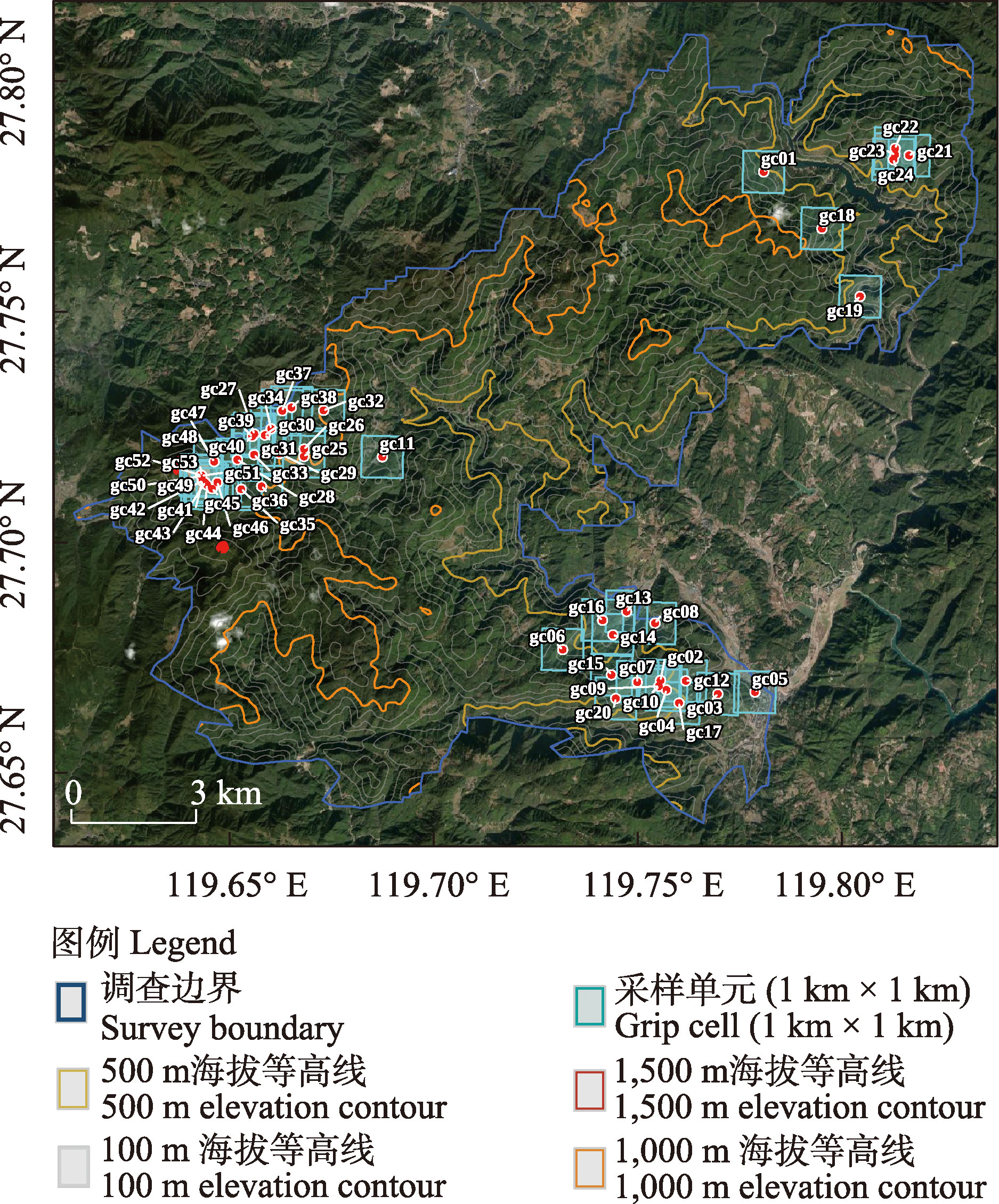
Fig. 1 Location of sawfly survey grid cell (gc) of Wuyanling National Nature Reserve in Zhejiang
| 科 Family | 个体数量 Number of individuals | 属 Genus | 种 Species | |||
|---|---|---|---|---|---|---|
| 数量 Number | 占比 Proportion (%) | 数量 Number | 占比 Proportion (%) | 数量 Number | 占比 Proportion (%) | |
| 叶蜂科 Tenthredinidae | 783 | 78.61 | 48 | 78.69 | 96 | 80.00 |
| 棒蜂科 Xyelidae | 103 | 10.36 | 1 | 1.64 | 1 | 0.83 |
| 锤角叶蜂科 Cimbicidae | 44 | 4.42 | 2 | 3.28 | 5 | 4.17 |
| 三节叶蜂科 Argidae | 30 | 3.01 | 3 | 4.92 | 11 | 9.17 |
| 树蜂科 Siricidae | 28 | 2.81 | 1 | 1.64 | 1 | 0.83 |
| 松叶蜂科 Diprionidae | 3 | 0.30 | 3 | 4.92 | 3 | 2.50 |
| 茎蜂科 Cephidae | 2 | 0.20 | 1 | 1.64 | 1 | 0.83 |
| 残青叶蜂科 Athaliidae | 2 | 0.20 | 1 | 1.64 | 1 | 0.83 |
| 项蜂科 Xiphydriidae | 1 | 0.10 | 1 | 1.64 | 1 | 0.83 |
| 合计 Total | 996 | 100.00 | 61 | 100.00 | 120 | 100.00 |
Table 1 Number of individuals and taxonomic abundance of different families of sawfly insects
| 科 Family | 个体数量 Number of individuals | 属 Genus | 种 Species | |||
|---|---|---|---|---|---|---|
| 数量 Number | 占比 Proportion (%) | 数量 Number | 占比 Proportion (%) | 数量 Number | 占比 Proportion (%) | |
| 叶蜂科 Tenthredinidae | 783 | 78.61 | 48 | 78.69 | 96 | 80.00 |
| 棒蜂科 Xyelidae | 103 | 10.36 | 1 | 1.64 | 1 | 0.83 |
| 锤角叶蜂科 Cimbicidae | 44 | 4.42 | 2 | 3.28 | 5 | 4.17 |
| 三节叶蜂科 Argidae | 30 | 3.01 | 3 | 4.92 | 11 | 9.17 |
| 树蜂科 Siricidae | 28 | 2.81 | 1 | 1.64 | 1 | 0.83 |
| 松叶蜂科 Diprionidae | 3 | 0.30 | 3 | 4.92 | 3 | 2.50 |
| 茎蜂科 Cephidae | 2 | 0.20 | 1 | 1.64 | 1 | 0.83 |
| 残青叶蜂科 Athaliidae | 2 | 0.20 | 1 | 1.64 | 1 | 0.83 |
| 项蜂科 Xiphydriidae | 1 | 0.10 | 1 | 1.64 | 1 | 0.83 |
| 合计 Total | 996 | 100.00 | 61 | 100.00 | 120 | 100.00 |
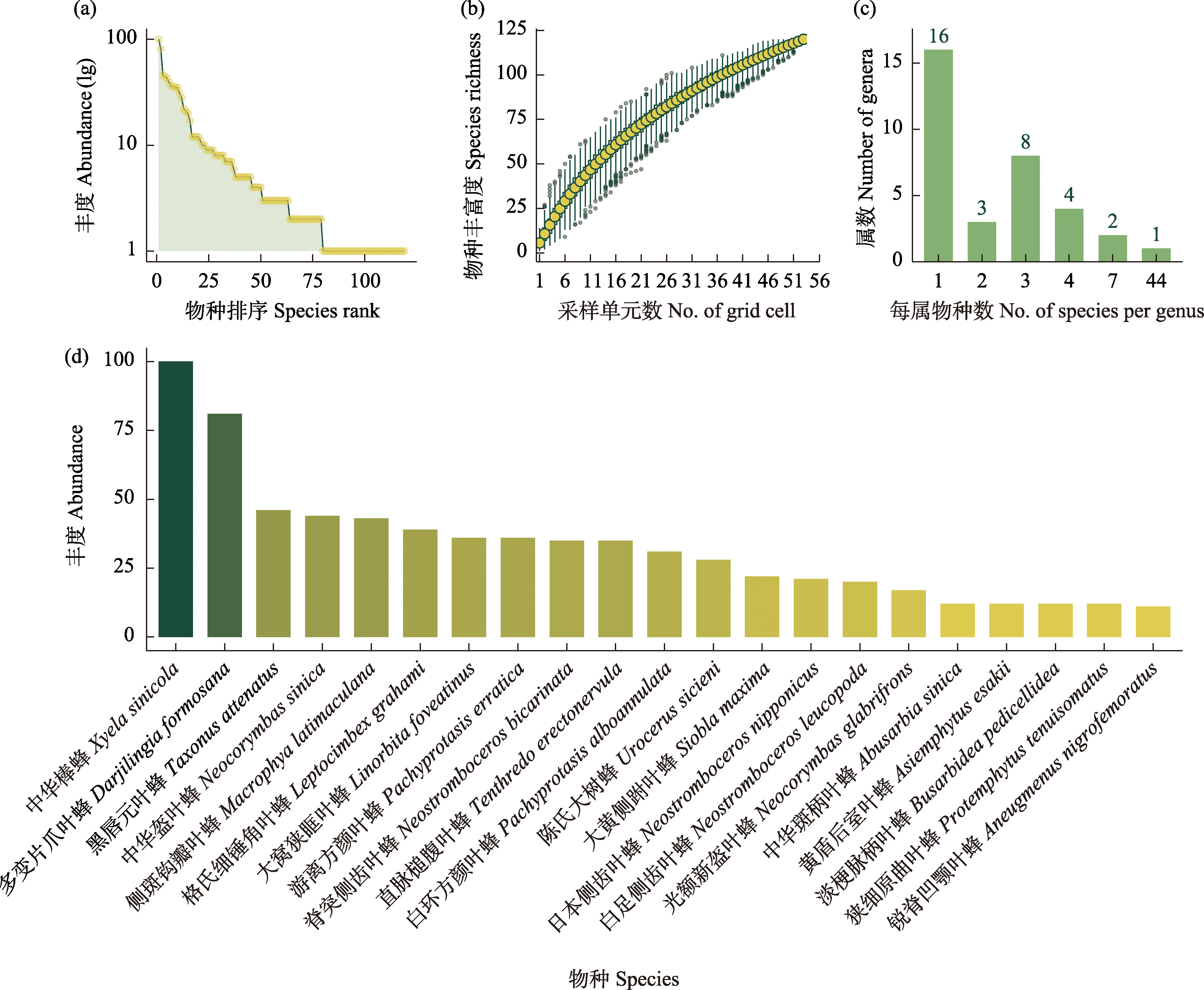
Fig. 2 General characteristics of the sawfly community. (a) Abundance rank curve; (b) Species accumulation curve; (c) Relationship between genus and species numbers; (d) Individual counts of major sawfly species (individuals > 10).
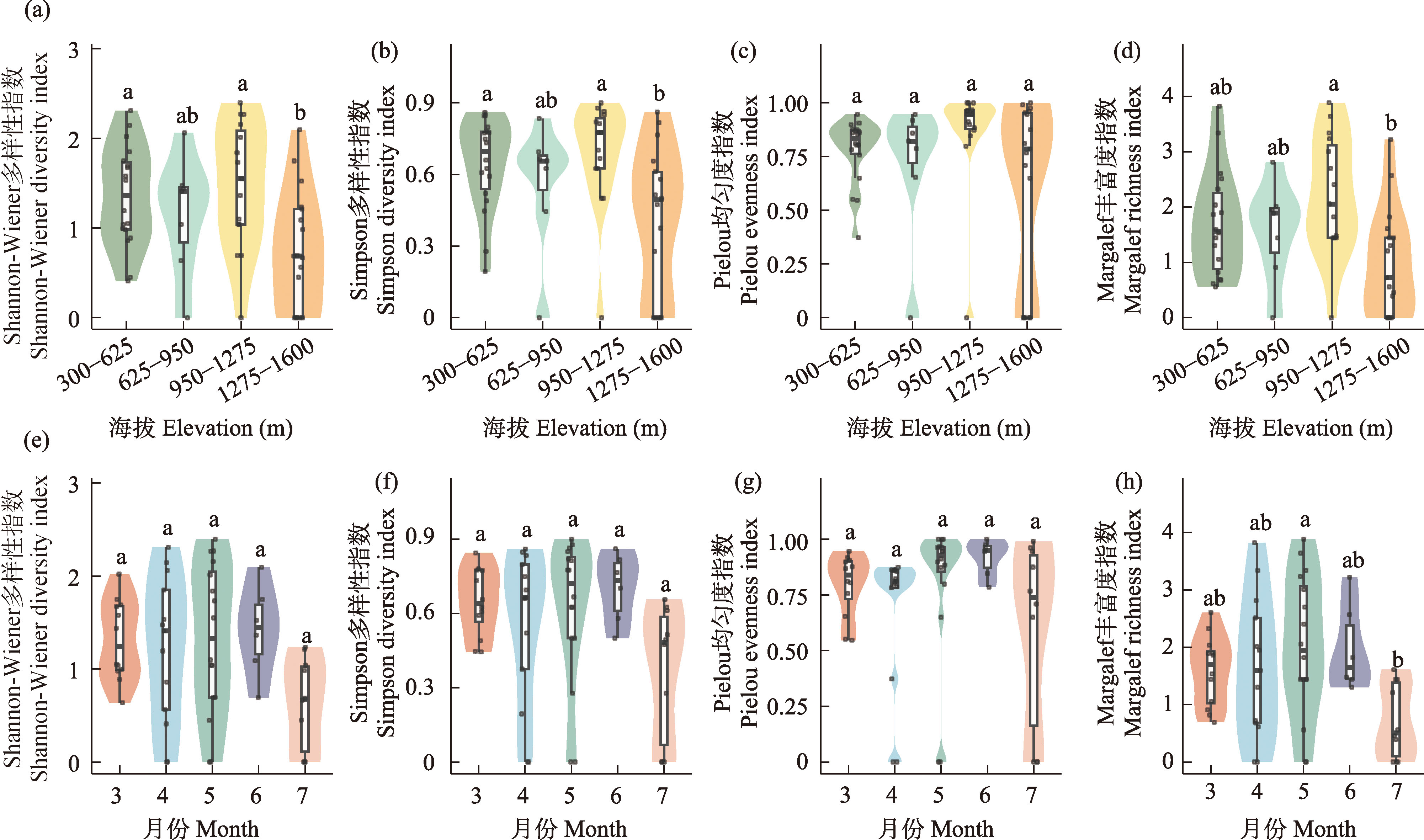
Fig. 3 Spatiotemporal dynamics of α diversity indices. (a-d) Boxplots of diversity indices across different elevation gradients; (e-h) Boxplots of diversity indices across different months. Different lowercase letters indicate significant differences among groups (P < 0.05, Tukey’s HSD test).
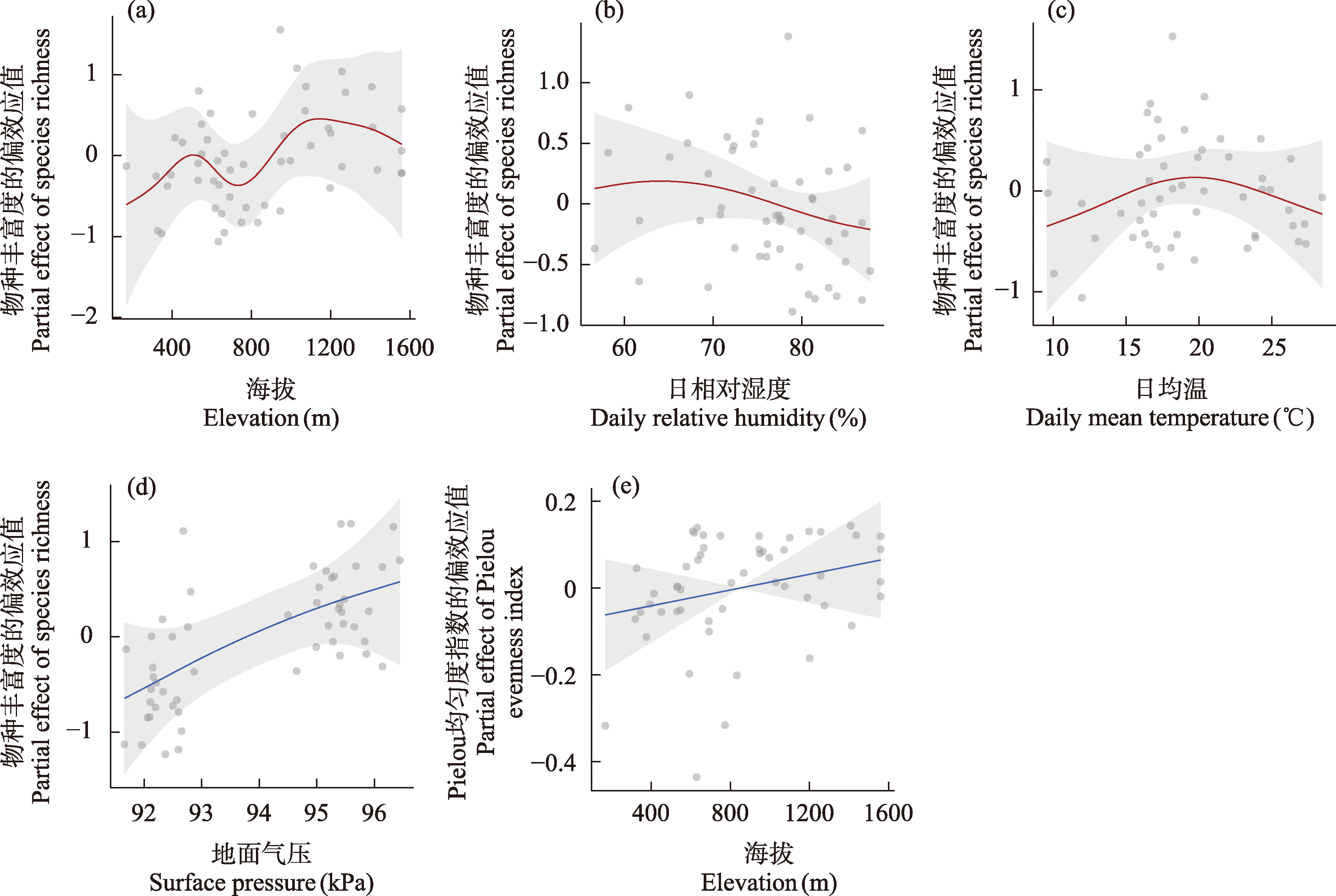
Fig. 4 Generalized additive model analysis illustrating the influences of environmental variables on α diversity indices of sawfly communities. Solid lines represent fitted smooth curves, grey shaded areas indicate 95% confidence intervals, and points represent partial residuals; EDF = 1 suggests an approximately linear relationship, EDF > 1 indicates a nonlinear relationship, and EDF = 0 implies that the variable effect has been shrunk by the model to near zero with negligible explanatory power.
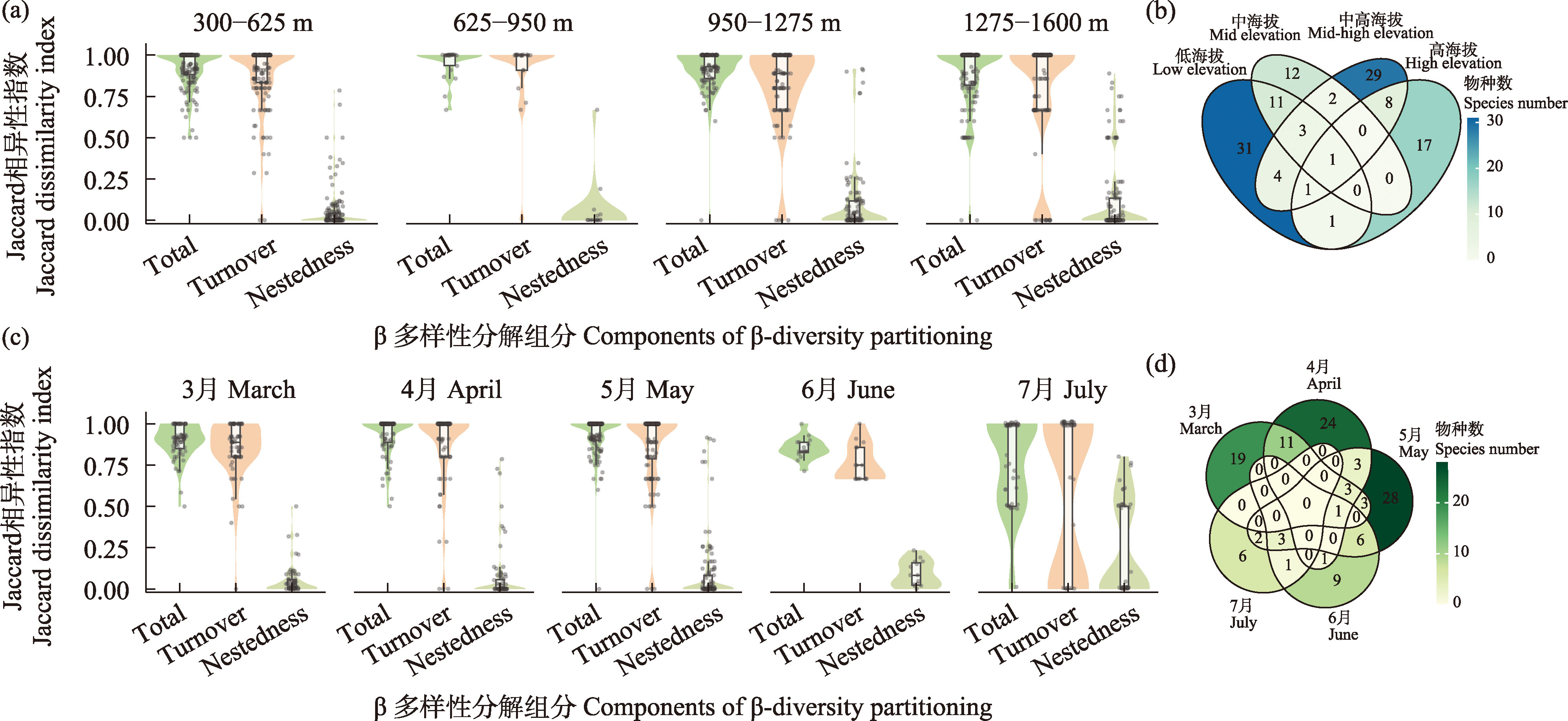
Fig. 5 Spatiotemporal dynamics of β diversity indices. (a) Jaccard dissimilarity and its turnover and nestedness components across elevation gradients; (b) Venn diagram of species composition among elevation gradients; (c) Jaccard dissimilarity and its turnover and nestedness components across months; (d) Venn diagram of species composition among months. Total, Overall β diversity; Turnover, Turnover component; Nestedness, Nestedness component.
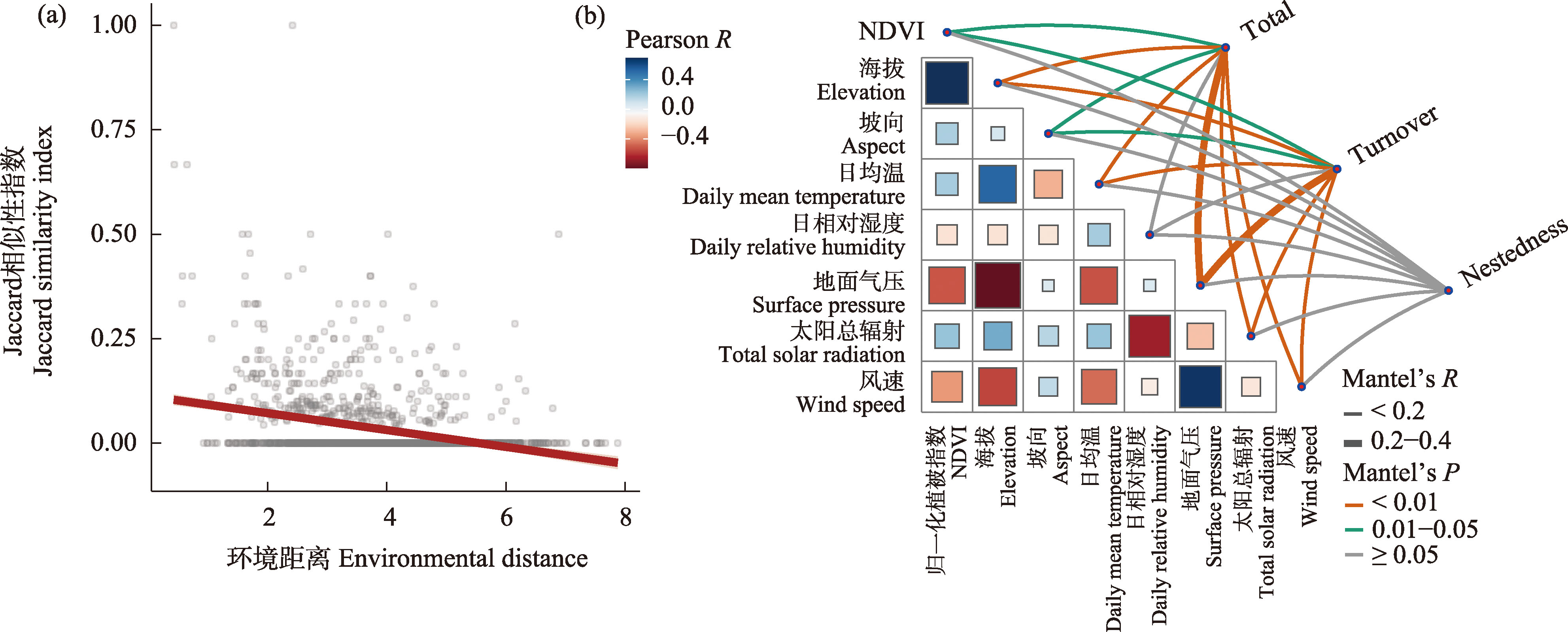
Fig. 6 Distance-decay patterns of sawfly community β diversity and the environmental driving effects. (a) Decay regulation of sawfly community similarity with increasing environmental distance; (b) Mantel correlations of overall β diversity and its components with environmental factors (line colors represent significance levels of Mantel tests, line widths represent the magnitudes of Mantel’s r values, and heatmap colors represent Pearson correlation coefficients among environmental factors).
| [1] | Adams BJ, Li EJ, Bahlai CA, Meineke EK, McGlynn TP, Brown BV (2020) Local- and landscape-scale variables shape insect diversity in an urban biodiversity hot spot. Ecological Applications, 30, e02089. |
| [2] | Ayres MP, Lombardero MJ (2000) Assessing the consequences of global change for forest disturbance from herbivores and pathogens. Science of the Total Environment, 262, 263-286. |
| [3] | Bai PH, Liu BS, Feng YR, Yin HG, Zhang SF, Xu JY, Liu JQ (2016) Morphology and biology of Pristiphora conjugata. Forest Research, 29, 793-796. (in Chinese with English abstract) |
| [白鹏华, 刘宝生, 冯友仁, 尹鸿刚, 张素芬, 许静杨, 刘家褀 (2016) 杨黑点叶蜂形态特征和生物学特性. 林业科学研究, 29, 793-796.] | |
| [4] | Baselga A (2010) Partitioning the turnover and nestedness components of beta diversity. Global Ecology and Biogeography, 19, 134-143. |
| [5] | Beck J, McCain CM, Axmacher JC, Ashton LA, Bärtschi F, Brehm G, Choi SW, Cizek O, Colwell RK, Fiedler K, Francois CL, Highland S, Holloway JD, Intachat J, Kadlec T, Kitching RL, Maunsell SC, Merckx T, Nakamura A, Odell E, Sang WG, Toko PS, Zamecnik J, Zou Y, Novotny V (2017) Elevational species richness gradients in a hyperdiverse insect taxon: A global meta-study on geometrid moths. Global Ecology and Biogeography, 26, 412-424. |
| [6] | Blank SM, Shinohara A, Altenhofer E (2013) The Eurasian species of Xyela (Hymenoptera, Xyelidae): Taxonomy, host plants and distribution. Zootaxa, 3629, 1-106. |
| [7] | Cai RH (1988) The horizontal and vertical distribution of main forests in Zhejiang Province. Journal of Hangzhou University (Nature Science), 15, 344-350. (in Chinese with English abstract) |
| [蔡壬侯 (1988) 浙江省森林植被的水平分布与垂直分布. 杭州大学学报(自然科学版), 15, 344-350.] | |
| [8] | Chatelain P, Le Cesne M, Elias M, Guilbert E, Soulier-Perkins A (2020) Elevational filtering and the evolution of planthoppers (Hemiptera, Fulgoromorpha) in Papua New Guinea. Biotropica, 52, 313-322. |
| [9] | Dallas TA, Holian LA, Ten Caten C (2024) Geographic and temporal distance-decay relationships across taxa. Oikos, 2024, e10269. |
| [10] | Damien M, Tougeron K (2019) Prey-predator phenological mismatch under climate change. Current Opinion in Insect Science, 35, 60-68. |
| [11] | Davis JS, Glover AN, Everson KM, Coyle DR, Linnen CR (2023) Identification, biology, and management of conifer sawflies (Hymenoptera: Diprioninae) in eastern North America. Journal of Integrated Pest Management, 14, 13. |
| [12] | de la Iglesia Martinez A, Labib SM (2023) Demystifying normalized difference vegetation index (NDVI) for greenness exposure assessments and policy interventions in urban greening. Environmental Research, 220, 115155. |
| [13] | Dickman M (1968) Some indices of diversity. Ecology, 49, 1191-1193. |
| [14] | Ding ZF, Hu HJ, Cadotte MW, Liang JC, Hu YM, Si XF (2021) Elevational patterns of bird functional and phylogenetic structure in the central Himalaya. Ecography, 44, 1403-1417. |
| [15] | Dolson SJ, Kharouba HM (2024) 30 years of terrestrial insect richness patterns across elevation: What have we learned? A global meta-analysis. Journal of Animal Ecology, 93, 1819-1829. |
| [16] | Farooq MO, Razaq M, Shah FM (2022) Plant diversity promotes species richness and community stability of arthropods in organic farming. Arthropod-Plant Interactions, 16, 593-606. |
| [17] | Fernández-Tizón M, Emmenegger T, Perner J, Hahn S (2020) Arthropod biomass increase in spring correlates with NDVI in grassland habitat. Science of Nature, 107, 42. |
| [18] | Forrest JR (2016) Complex responses of insect phenology to climate change. Current Opinion in Insect Science, 17, 49-54. |
| [19] | Gehlhausen SM, Schwartz MW, Augspurger CK (2000) Vegetation and microclimatic edge effects in two mixed- mesophytic forest fragments. Plant Ecology, 147, 21-35. |
| [20] | Haddad NM, Crutsinger GM, Gross K, Haarstad J, Tilman D (2011) Plant diversity and the stability of foodwebs. Ecology Letters, 14, 42-46. |
| [21] | Haslett JR (1997) Insect communities and the spatial complexity of mountain habitats. Global Ecology and Biogeography Letters, 6, 49-56. |
| [22] | Heino J, Tolonen KT (2017) Ecological drivers of multiple facets of beta diversity in a lentic macroinvertebrate metacommunity. Limnology and Oceanography, 62, 2431-2444. |
| [23] | Hodkinson ID (2005) Terrestrial insects along elevation gradients: Species and community responses to altitude. Biological Reviews, 80, 489-513. |
| [24] | Huang HY (2021) linkET: Everything is Linkable. R package Version 0.0.3. https://github.com/Hy4m/linkET. (accessed on 2026-01-15) |
| [25] | Isaka Y, Sato T (2015) Species richness of sawfly-host plant associations at higher taxonomic levels. Entomological Research, 45, 294-304. |
| [26] | Jiang YP, Liu X, Pan XD, Lei ZP, Wu JS (2023) Community structure characteristics and species diversity of Cyclobalanopsis pachyloma in Wuyanling National Nature Reserve of Zhejiang. Fujian Agricultural Science and Technology, 54(12), 1-6. (in Chinese with English abstract) |
| [江彦苹, 刘西, 潘向东, 雷祖培, 吴家森 (2023) 浙江乌岩岭国家级自然保护区毛果青冈群落结构特征及物种多样性. 福建农业科技, 54(12), 1-6.] | |
| [27] | Jiao XD, Niu HL, Zhang XY, Ren XH, Lin ZJ, Tian XC, Zuo L (2025) Evaluation on the field efficacy of five pesticides on larvae of Fenusella taianensis. Journal of Shandong Forestry Science and Technology, 55(4), 83-86. (in Chinese with English abstract) |
| [焦旭东, 牛辉陵, 张秀芸, 任学花, 蔺志军, 田习财, 左罗 (2025) 5种药剂对台安丝潜叶蜂幼虫的田间防效评价. 山东林业科技, 55(4), 83-86.] | |
| [28] | Jouault C, Aase A, Nel A (2021) Past ecosystems drive the evolution of the early diverged Symphyta (Hymenoptera: Xyelidae) since the earliest Eocene. Fossil Record, 24, 379-393. |
| [29] | Keylock CJ (2005) Simpson diversity and the Shannon-Wiener index as special cases of a generalized entropy. Oikos, 109, 203-207. |
| [30] | Kim JH (2019) Multicollinearity and misleading statistical results. Korean Journal of Anesthesiology, 72, 558-569. |
| [31] | Körner C (2007) The use of ‘altitude’ in ecological research. Trends in Ecology & Evolution, 22, 569-574. |
| [32] | Lai Y, Liu YH, Liu XY (2021) Elevational diversity patterns of green lacewings (Neuroptera: Chrysopidae) uncovered with DNA barcoding in a biodiversity hotspot of Southwest China. Frontiers in Ecology and Evolution, 9, 778686. |
| [33] | Li DJ (2018) hillR: Taxonomic, functional, and phylogenetic diversity and similarity through Hill numbers. Journal of Open Source Software, 3, 1041. |
| [34] | Li ZJ, Wei MC, Liu MM, Chen ML (2018) Macrophya Dahlbom in China. China Agricultural Science and Technology Press, Beijing. (in Chinese) |
| [李泽建, 魏美才, 刘萌萌, 陈明利 (2018) 中国钩瓣叶蜂属志. 中国农业科学技术出版社, 北京.] | |
| [35] | Liu X, Xiong YY, Lei ZP, Qin SD, Ying YX, He K, Si HK, Liu BQ, Gao HD (2025) Habitat conflicts and daily activity rhythms of Cabot’s tragopan, Elliot’s pheasant, and silver pheasant in Zhejiang Wuyanling Nature Reserve. Chinese Journal of Zoology, 60, 683-693. (in Chinese with English abstract) |
| [刘西, 熊艳云, 雷祖培, 覃世迪, 应易炫, 何珂, 斯煌凯, 刘宝权, 高洪娣 (2025) 浙江乌岩岭保护区黄腹角雉、白颈长尾雉和白鹇日活动节律和栖息地冲突. 动物学杂志, 60, 683-693.] | |
| [36] | Malm T, Nyman T (2015) Phylogeny of the symphytan grade of Hymenoptera: New pieces into the old jigsaw (fly) puzzle. Cladistics, 31, 1-17. |
| [37] | Margalef R (1958) Information theory in ecology. General Systems, 3, 36-71. |
| [38] | Morris EK, Caruso T, Buscot F, Fischer M, Hancock C, Maier TS, Meiners T, Müller C, Obermaier E, Prati D, Socher SA, Sonnemann I, Wäschke N, Wubet T, Wurst S, Rillig MC (2014) Choosing and using diversity indices: Insights for ecological applications from the German Biodiversity Exploratories. Ecology and Evolution, 4, 3514-3524. |
| [39] | Morris RJ, Sinclair FH, Burwell CJ (2015) Food web structure changes with elevation but not rainforest stratum. Ecography, 38, 792-802. |
| [40] | Nyman T, Farrell BD, Zinovjev AG, Vikberg V (2006) Larval habits, host-plant associations, and speciation in nematine sawflies (Hymenoptera: Tenthredinidae). Evolution. 60, 1622-1637. |
| [41] | Nyman T, Onstein RE, Silvestro D, Wutke S, Taeger A, Wahlberg N, Blank SM, Malm T (2019) The early wasp plucks the flower: Disparate extant diversity of sawfly superfamilies (Hymenoptera: ‘Symphyta’) may reflect asynchronous switching to angiosperm hosts. Biological Journal of the Linnean Society, 128, 1-19. |
| [42] | Oksanen J, Simpson G, Blanchet F, Kindt R, Legendre P, Minchin P, O’Hara R, Solymos P, Stevens M, Szoecs E, Wagner H, Bedward M, Bolker B, Borcard D, Carvalho G, De Caceres M, Durand S, Evangelista H, Hannigan G, Hill M, Lahti L, Martino C, Ouellette M, Ribeiro Cunha E, Smith T, Stier A, Ter Braak C, Weedon J (2026) vegan: Community Ecology Package. R package Version 2.7.5. https://cran.r-project.org/web/packages/vegan/index.html. (accessed on 2026-01-10) |
| [43] | Perillo LN, de Siqueira Neves F, Antonini Y, Martins RP (2017) Compositional changes in bee and wasp communities along neotropical mountain altitudinal gradient. PLoS ONE, 12, e0182054. |
| [44] | Pielou EC (1966) The measurement of diversity in different types of biological collections. Journal of Theoretical Biology, 13, 131-144. |
| [45] | Podani J, Schmera D (2011) A new conceptual and methodological framework for exploring and explaining pattern in presence-absence data. Oikos, 120, 1625-1638. |
| [46] | Qiao F, Che LW, Xin Y, Wu XH, Sun YM, Cui J (2022) Biological characteristics of Priophorus fulvostigmatus (Hymenoptera: Tenthredinidae) on strawberry. Plant Protection, 48, 183-187. (in Chinese with English abstract) |
| [乔方, 车丽雯, 辛月, 吴欣航, 孙艳梅, 崔娟 (2022) 草莓食叶害虫褐痣拟栉叶蜂生物学特性初步观察. 植物保护, 48, 183-187.] | |
| [47] | Ran J (2025) Techniques for the prevention and control of insect pests on Ulmus pumila in the Guandi Mountain forest region. Forestry of Shanxi, (5), 54-55. (in Chinese) |
| [冉娟 (2025) 关帝山林区白榆虫害防治技术. 山西林业, (5), 54-55.] | |
| [48] | Schwartzberg EG, Jamieson MA, Raffa KF, Reich PB, Montgomery RA, Lindroth RL (2014) Simulated climate warming alters phenological synchrony between an outbreak insect herbivore and host trees. Oecologia, 175, 1041-1049. |
| [49] | Si XF, Zhao YH, Chen CW, Ren P, Zeng D, Wu LB, Ding P (2017) Beta-diversity partitioning: Methods, applications and perspectives. Biodiversity Science, 25, 464-480. (in Chinese with English abstract) |
| [斯幸峰, 赵郁豪, 陈传武, 任鹏, 曾頔, 吴玲兵, 丁平 (2017) Beta多样性分解: 方法、应用与展望. 生物多样性, 25, 464-480.] | |
| [50] | Soininen J, McDonald R, Hillebrand H (2007) The distance decay of similarity in ecological communities. Ecography, 30, 3-12. |
| [51] | van Asch M, Visser ME (2007) Phenology of forest caterpillars and their host trees: The importance of synchrony. Annual Review of Entomology, 52, 37-55. |
| [52] | Wang YP (2009) Insects and Forest Health Assessment in Wuyanling, Zhejiang Province. Science Press, Beijing. (in Chinese) |
| [王义平 (2009) 浙江乌岩岭昆虫及其森林健康评价. 科学出版社, 北京.] | |
| [53] | Wei MC (2024) Zhejiang Insect Fauna, Vol. 14: “Hymenoptera Symphyta”. Science Press, Beijing. (in Chinese) |
| [魏美才 (2024) 浙江昆虫志(第十四卷): 膜翅目“广腰亚目”. 科学出版社, 北京.] | |
| [54] | Wood SN (2011) Fast stable restricted maximum likelihood and marginal likelihood estimation of semiparametric generalized linear models. Journal of the Royal Statistical Society B: Statistical Methodology, 73, 3-36. |
| [55] | Wu GM, Fan JX, Li YH, Xu R, Zeng TX, Xu J (2020) Behavioral ecology of Cephlica chuxiongica (Hymenoptera: Pamphiliidae). Journal of Northwest Forestry University, 35(4), 115-119. (in Chinese with English abstract) |
| [吴国梅, 樊佳星, 李永和, 徐荣, 曾廷潇, 徐进 (2020) 楚雄腮扁叶蜂行为生态学研究. 西北林学院学报, 35(4), 115-119.] | |
| [56] | Xiao LF, Chen L, Labandeira CC, Azevedo-Schmidt L, Wang YJ, Ren D (2025) The modern pattern of insect herbivory predates the advent of angiosperms by 60 My. Proceedings of the National Academy of Sciences, USA, 122, e2412036122. |
| [57] | Xu CF, Luo D, Yin LX, Liu XP (2017) Influence of temperature on the development and reproduction of the camphor sawfly, Mesoneura rufonota (Hymenoptera: Tenthredinidae). Acta Entomologica Sinica, 60, 1216-1225. (in Chinese with English abstract) |
| [徐川峰, 骆丹, 殷立新, 刘兴平 (2017) 温度对樟叶蜂生长发育和繁殖的影响. 昆虫学报, 60, 1216-1225.] | |
| [58] | Xu H, Turlings TCJ (2018) Plant volatiles as mate-finding cues for insects. Trends in Plant Science, 23, 100-111. |
| [59] | Xu YY, Wang YD, Li LQ, Lu N, Zhu YB, Huang ZL, McLoughlin S (2024) Plant-insect interactions across the Triassic-Jurassic boundary in the Sichuan Basin, South China. Frontiers in Ecology and Evolution, 11, 1338865. |
| [60] | Zhao J (2025) Analysis of major pest and disease species and their damage to Picea crassifolia in the Qilian Mountains. Contemporary Horticulture, 48(22), 81-83. (in Chinese) |
| [赵娟 (2025) 祁连山青海云杉主要病虫害种类及其为害分析. 现代园艺, 48(22), 81-83.] | |
| [61] | Zhong YH, Wei MJ, Li ZJ (2023) Pachyprotasis Hartig in China. China Agricultural Science and Technology Press, Beijing. (in Chinese) |
| [钟义海, 魏美才, 李泽建 (2023) 中国方颜叶蜂属志. 中国农业科学技术出版社, 北京.] |
| [1] | Yubo Wang, Chonggao Wu, Tong Zhu, Yunlong Cui, Baohua Zhang, Guiping Diao. An inventory of macrofungal species diversity in Northeast Asia [J]. Biodiv Sci, 2026, 34(8): 26230-. |
| [2] | Han Li, Xingcheng He, Shangmingyu Zhang, Yiwei Cao, Jiayu Zhang, Kexin Peng, Yongjie Wu. Avian checklist of the Hengduan Mountains [J]. Biodiv Sci, 2026, 34(7): 25375-. |
| [3] | Jie Zhang, Haoming Lu, Jiajie Chen, Jiangyuan Chen, Yufan Mao, Junxi Hu, Baowei Zhang. Latin-English-Chinese-Japanese checklist of Chinese chondrichthyans and a comparison of diversity among marine regions [J]. Biodiv Sci, 2026, 34(6): 25522-. |
| [4] | Dexi Zhang, Qian Zhou, Xuezhu Pei, Hongyong Zhang, Yingtai Pei, Shan Sun, Mingxin Liu, Lixun Zhang, Changming Zhao. Dataset of arthropod specimen images and DNA barcodes in forest ecosystem of the Xinglong Mountains of Gansu Province [J]. Biodiv Sci, 2026, 34(4): 25409-. |
| [5] | Xuri Zhang, Biao Luo, Tong Zhao, Dan Huang, Weiming Ai. Fish diversity of Zhejiang Province: Inventory, distribution and conservation [J]. Biodiv Sci, 2026, 34(2): 25225-. |
| [6] | Yizhe Wang, Yuchen Feng, Xiaolei Huang. The diversity of aphids and their host plants in Fujian Province, China [J]. Biodiv Sci, 2025, 33(6): 25159-. |
| [7] | Xiao Chen, Xiaohui Ma, Jiacheng Chen, Ding Yao, Xinyi Yu, Wenfei Song, Zhongguan Jiang, Shiping Su. Updated species checklist of freshwater fishes from major tributaries of Yangtze River in Chizhou of Anhui Province, China [J]. Biodiv Sci, 2025, 33(12): 25182-. |
| [8] | Jianan Han, Yang Su, Fei Li, Junyan Liu, Yilin Zhao, Lin Li, Jiancheng Zhao, Hongzhu Liang, Min Li. Bryophytes diversity of Hebei Province, China [J]. Biodiv Sci, 2024, 32(9): 24096-. |
| [9] | Huimei Chen, Wenjun Li, Juan Qiu, Zhancang Ma, Bo Li, Zongzong Yang, Zhibin Wen, Yan Meng, Qiumei Cao, Dong Qiu, Danhui Liu, Guangzhao Jin. A checklist of wild vascular plants in Xinjiang, China [J]. Biodiv Sci, 2023, 31(9): 23124-. |
| [10] | Jingxuan Chen, Jiajun Zhou, Baoquan Liu. Records and population status of sea turtles in the Zhejiang sea area of China [J]. Biodiv Sci, 2023, 31(6): 23082-. |
| [11] | Ling Ji, Yifei Xie, Zhongyang Li, Tingchen Xu, Bo Yang, Bo Li. A checklist of wild vascular plants in Jiangxi Province, China [J]. Biodiv Sci, 2022, 30(6): 22057-. |
| [12] | Zixiao Dai, Guoke Chen, Naili Zhang, Keping Ma. A dataset on the diversity of forest vascular epiphytes in China [J]. Biodiv Sci, 2022, 30(11): 22332-. |
| [13] | Liuyong Ding, Hao Li, Juan Tao, Jinlong Zhang, Minrui Huang, Ke Yang, Jun Wang, Chengzhi Ding, Daming He. SP2000: An open-sourced R package for querying the Catalogue of Life [J]. Biodiv Sci, 2021, 29(1): 118-122. |
| [14] | Rijin Jiang,Linlin Zhang,Kaida Xu,Pengfei Li,Yi Xiao,Ziwei Fan. Characteristics and diversity of nekton functional groups in the coastal waters of south-central Zhejiang Province [J]. Biodiv Sci, 2019, 27(12): 1330-1338. |
| [15] | Wuchang Zhang, Meiping Feng, Ying Yu, Cuixia Zhang, Jun Sun, Tian Xiao. Species checklist of contemporary tintinnids (Ciliophora, Spirotrichea, Choreotrichia, Tintinnida) in the world [J]. Biodiv Sci, 2011, 19(6): 655-660. |
| Viewed | ||||||
|
Full text |
|
|||||
|
Abstract |
|
|||||
Copyright © 2026 Biodiversity Science
Editorial Office of Biodiversity Science, 20 Nanxincun, Xiangshan, Beijing 100093, China
Tel: 010-62836137, 62836665 E-mail: biodiversity@ibcas.ac.cn
