

Biodiv Sci ›› 2026, Vol. 34 ›› Issue (4): 26031. DOI: 10.17520/biods.2026031 cstr: 32101.14.biods.2026031
• Conservation and Governance • Previous Articles Next Articles
Yunyue Peng1( ), Kui Peng1,*(
 ), Xinran Liu2, Tianyi Sun3, Xiaoquan Zhang1
Received:2026-01-27
Accepted:2026-03-13
Online:2026-04-20
Published:2026-05-28
Contact:
*E-mail: kui.peng@tnc.org
Yunyue Peng, Kui Peng, Xinran Liu, Tianyi Sun, Xiaoquan Zhang. Corporate engagement pathways, market development barriers and recommendations for biodiversity credits[J]. Biodiv Sci, 2026, 34(4): 26031.
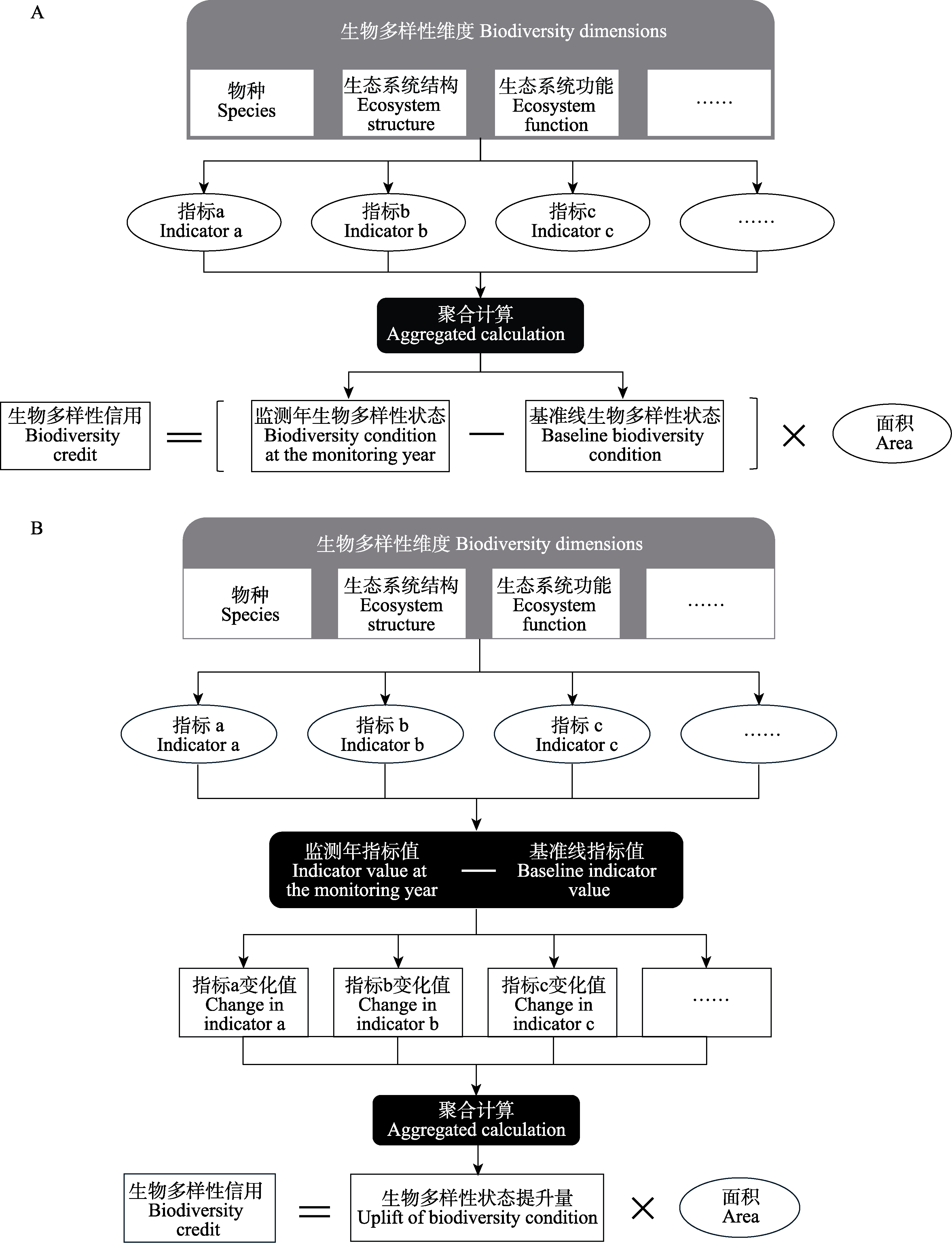
Fig. 1 Two common frameworks for biodiversity credit accounting methodologies. A, Aggregate first, then calculate the change; B, Calculate the change value, then aggregate.
| 信用机制(项目) Credit scheme (project) | 信用单价 Price per credit (USD) | 数据来源 Data source |
|---|---|---|
| Ekos | 7.08 | OPIS, |
| 华莱士信托 Wallacea Trust | 5-10 | OPIS, |
| Seatrees | 15 | Bloomlabs, |
| 生态系统再生协会 Ecosystem Regeneration Associates, ERA | 27 | OPIS, |
| Savimbo | 30 | Bloomlabs, |
| Terrasos | 34.28 | OPIS, |
| Wilderland | 35.10 | Bloomlabs, |
| 气候行动公司(莫华) Climate Action Company (Mohua) | 118 | Bloomlabs, |
| 气候行动公司(东怀奥) Climate Action Company (Eastern Whio) | 118 | Bloomlabs, |
| Niue Ocean Wide | 147.50 | Bloomlabs, |
| Earthly (伊福德庄园造林) Earthly (Iford Estate Woodland Creation) | 297 | OPIS, |
| Earthly (廷斯伯里生境修复与土地还湿) Earthly (Timsbury Habitat Restoration and Land Rewetting) | 357.75 | OPIS, |
| 气候行动公司(南湖保护区) Climate Action Company (Southern Lakes Sanctuary) | 413 | Bloomlabs, |
| 英国环境、食品与乡村事务部 Department for Environment, Food and Rural Affairs, DEFRA | 56,700-877,500 | DEFRA, |
| 国际植物园保护联盟 Botanic Gardens Conservation International, BGCI | 500,000 | Bloomlabs, |
Table 1 Prices of individual credits under different biodiversity credit schemes
| 信用机制(项目) Credit scheme (project) | 信用单价 Price per credit (USD) | 数据来源 Data source |
|---|---|---|
| Ekos | 7.08 | OPIS, |
| 华莱士信托 Wallacea Trust | 5-10 | OPIS, |
| Seatrees | 15 | Bloomlabs, |
| 生态系统再生协会 Ecosystem Regeneration Associates, ERA | 27 | OPIS, |
| Savimbo | 30 | Bloomlabs, |
| Terrasos | 34.28 | OPIS, |
| Wilderland | 35.10 | Bloomlabs, |
| 气候行动公司(莫华) Climate Action Company (Mohua) | 118 | Bloomlabs, |
| 气候行动公司(东怀奥) Climate Action Company (Eastern Whio) | 118 | Bloomlabs, |
| Niue Ocean Wide | 147.50 | Bloomlabs, |
| Earthly (伊福德庄园造林) Earthly (Iford Estate Woodland Creation) | 297 | OPIS, |
| Earthly (廷斯伯里生境修复与土地还湿) Earthly (Timsbury Habitat Restoration and Land Rewetting) | 357.75 | OPIS, |
| 气候行动公司(南湖保护区) Climate Action Company (Southern Lakes Sanctuary) | 413 | Bloomlabs, |
| 英国环境、食品与乡村事务部 Department for Environment, Food and Rural Affairs, DEFRA | 56,700-877,500 | DEFRA, |
| 国际植物园保护联盟 Botanic Gardens Conservation International, BGCI | 500,000 | Bloomlabs, |
| 障碍 Barriers | 建议 Recommendations |
|---|---|
| 缺乏禁止将生物多样性信用用于抵消的保障; 碳市场连锁反应导致“漂绿”恐惧 Lack of safeguards to prohibit the use of biodiversity credits for offsetting; Carbon market spillover effects triggering “greenwashing” concerns | 借鉴碳信用市场建设经验, 探索建立生物多样性信用市场。具体建议: (1)在发展初期汲取自愿碳市场经验教训; (2)探索将生物多样性与碳信用相结合。Drawing on the experience of carbon market to explore and establish biodiversity credit markets. Detailed recommendations: (1) Learn from the voluntary carbon market in early development phases; (2) Explore the integration of biodiversity and carbon credits. |
| 技术与数据瓶颈导致核算体系不完善Technical and data bottlenecks lead to an imperfect accounting system | 链接核算方法、需求和生物多样性保护目标。具体建议: (1)链接核算方法、指标与买方需求; (2)衔接指标与生物多样性保护目标、信息披露框架; (3)将资金收益用于保护与恢复行动。Linking the accounting methods, demand, and biodiversity conservation goals. Detailed recommendations: (1) Link accounting methods, indicators, and buyers’ demand; (2) Align indicators with biodiversity conservation goals and disclosure frameworks; (3) Direct financial returns to conservation and restoration actions. |
| 市场基础设施与监管规则不完善Incomplete market infrastructure and regulatory rules | 制定监管规则, 完善市场基础设施。监管规则层面的具体建议: (1)建立跨部门的监管协调机制; (2)建立当地社区与居民的权益保障机制; (3)明确问责制; (4)设立严格保障措施确保不被用于抵消。市场基础设施层面的具体建议: (1)出台生物多样性信息披露的政策文件或立法; (2)建立由政府主导或监管的市场及信用交易平台; (3)建立自愿性市场及针对特定行业的强制性市场; (4)结合生态补偿政策与生态产品价值实现体系; (5)鼓励发展生物多样性混合融资渠道。Formulating regulatory rules and improving market infrastructure. Detailed recommendations at the regulatory level: (1) Establish cross-sectoral regulatory coordination mechanisms; (2) Set up mechanisms to safeguard the rights and interests of local communities and residents; (3) Clarify accountability systems; (4) Set strict safeguards to ensure credits are not used for offsetting. Detailed recommendations at the market infrastructure level: (1) Issue policy documents or legislation on biodiversity disclosure; (2) Establish government-led or regulated markets and credit trading platforms; (3) Develop voluntary markets and mandatory markets for specific sectors; (4) Integrate with ecological compensation policies and the ecological product value realization system; (5) Encourage the development of blended finance channels for biodiversity. |
| 使用场景不明, 信用声明缺乏共识Unclear use cases and lack of consensus on credit claims | 建立信用声明共识。具体建议: (1)将信用作为“贡献”进行披露; (2)声明应基于“提供支持”而非“实现成果”; (3)建立政府与企业协作声明机制。Establishing consensus on credit claims. Detailed recommendations: (1) Disclose credits as a “contribution”; (2) Claims should be based on “providing support” rather than “achieving outcomes”; (3) Establish government-business collaborative claim mechanisms. |
Table 2 Development barriers and corresponding recommendations on biodiversity credit markets
| 障碍 Barriers | 建议 Recommendations |
|---|---|
| 缺乏禁止将生物多样性信用用于抵消的保障; 碳市场连锁反应导致“漂绿”恐惧 Lack of safeguards to prohibit the use of biodiversity credits for offsetting; Carbon market spillover effects triggering “greenwashing” concerns | 借鉴碳信用市场建设经验, 探索建立生物多样性信用市场。具体建议: (1)在发展初期汲取自愿碳市场经验教训; (2)探索将生物多样性与碳信用相结合。Drawing on the experience of carbon market to explore and establish biodiversity credit markets. Detailed recommendations: (1) Learn from the voluntary carbon market in early development phases; (2) Explore the integration of biodiversity and carbon credits. |
| 技术与数据瓶颈导致核算体系不完善Technical and data bottlenecks lead to an imperfect accounting system | 链接核算方法、需求和生物多样性保护目标。具体建议: (1)链接核算方法、指标与买方需求; (2)衔接指标与生物多样性保护目标、信息披露框架; (3)将资金收益用于保护与恢复行动。Linking the accounting methods, demand, and biodiversity conservation goals. Detailed recommendations: (1) Link accounting methods, indicators, and buyers’ demand; (2) Align indicators with biodiversity conservation goals and disclosure frameworks; (3) Direct financial returns to conservation and restoration actions. |
| 市场基础设施与监管规则不完善Incomplete market infrastructure and regulatory rules | 制定监管规则, 完善市场基础设施。监管规则层面的具体建议: (1)建立跨部门的监管协调机制; (2)建立当地社区与居民的权益保障机制; (3)明确问责制; (4)设立严格保障措施确保不被用于抵消。市场基础设施层面的具体建议: (1)出台生物多样性信息披露的政策文件或立法; (2)建立由政府主导或监管的市场及信用交易平台; (3)建立自愿性市场及针对特定行业的强制性市场; (4)结合生态补偿政策与生态产品价值实现体系; (5)鼓励发展生物多样性混合融资渠道。Formulating regulatory rules and improving market infrastructure. Detailed recommendations at the regulatory level: (1) Establish cross-sectoral regulatory coordination mechanisms; (2) Set up mechanisms to safeguard the rights and interests of local communities and residents; (3) Clarify accountability systems; (4) Set strict safeguards to ensure credits are not used for offsetting. Detailed recommendations at the market infrastructure level: (1) Issue policy documents or legislation on biodiversity disclosure; (2) Establish government-led or regulated markets and credit trading platforms; (3) Develop voluntary markets and mandatory markets for specific sectors; (4) Integrate with ecological compensation policies and the ecological product value realization system; (5) Encourage the development of blended finance channels for biodiversity. |
| 使用场景不明, 信用声明缺乏共识Unclear use cases and lack of consensus on credit claims | 建立信用声明共识。具体建议: (1)将信用作为“贡献”进行披露; (2)声明应基于“提供支持”而非“实现成果”; (3)建立政府与企业协作声明机制。Establishing consensus on credit claims. Detailed recommendations: (1) Disclose credits as a “contribution”; (2) Claims should be based on “providing support” rather than “achieving outcomes”; (3) Establish government-business collaborative claim mechanisms. |
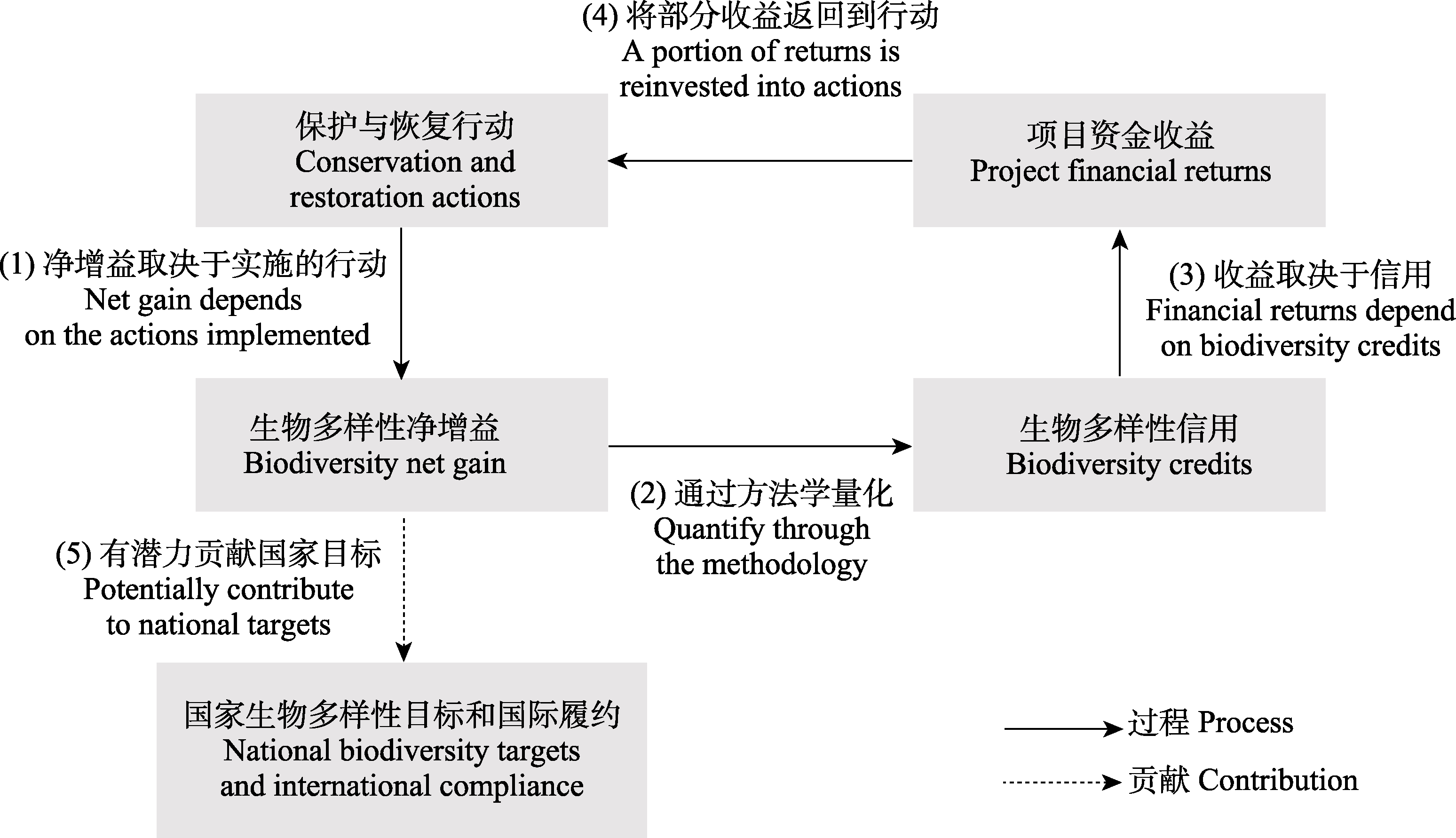
Fig. 2 The logical framework of a biodiversity credit project from actions to financial returns
| [1] |
Antonelli A, Rueda X, Calcagno R, Nantongo Kalunda P (2024) How biodiversity credits could help to conserve and restore nature. Nature, 634, 1045-1049.
DOI |
| [2] | Barisa K, Drake MM, Shah T, Susarla R, Rodewald N (2024) Credit Where Credit’s Due: Identifying the Core Principles for a High Integrity Biodiversity Credit Market. https://www.bluemarinefoundation.com/wp-content/uploads/2025/06/Credit-where-credits-due1.pdf. (accessed on 2025-12-10) |
| [3] | BCA (Biodiversity Credit Alliance) (2023) Demand-side Sources and Motivation for Biodiversity Credits. https://www.biodiversitycreditalliance.org/wp-content/uploads/2024/05/BCAIssuePaper_DemandOverview06122023-final.pdf. (accessed on 2025-12-10) |
| [4] | BCA (Biodiversity Credit Alliance) (2024) Definition of A Biodiversity Credit. https://www.biodiversitycreditalliance.org/wp-content/uploads/2024/05/Definition-of-a-Biodiversity-Credit-Rev-220524.pdf. (accessed on 2025-12-10) |
| [5] | Bloomlabs (2025) Market Intelligence for Biodiversity Credits. https://app.bloomlabs.earth/. (accessed on 2026-02-23) |
| [6] | Cole M, Eis J (2024) Biodiversity Credits: Lessons for Leaders. https://www.mckinsey.com/capabilities/sustainability/our-insights/sustainability-blog/biodiversity-credits-lessons-for-leaders. (accessed on 2025-10-22) |
| [7] | DEFRA (Department for Environment, Food & Rural Affairs)(2023) Statutory Biodiversity Credit Prices. https://www.gov.uk/guidance/statutory-biodiversity-credit-prices. (accessed on 2025-12-10) |
| [8] | EFRAG (European Financial Reporting Advisory Group) (2022) ESRS E4: Biodiversity and Ecosystems. https://www.efrag.org/sites/default/files/sites/webpublishing/SiteAssets/11%20Draft%20ESRS%20E4%20Biodiversity%20and%20ecosystems%20November%202022.pdf. (accessed on 2026-03-04) |
| [9] | ERA (Ecosystem Regeneration Associates)(2025) Umbrella Species Stewardship: Biodiversity Crediting Protocol (Version 2.2). https://cdn.prod.website-files.com/65ae9262fbf418e225c9e4f0/68e7ef162522f00e6830ebc9_ERA_Biodiversity%20Crediting%20Protocol%20Umbrella%20Species%20Stewardship___clean__Aug2025.pdf. (accessed on 2026-02-23) |
| [10] | ESMA (European Securities and Markets Authority) (2025) EU Carbon Markets 2025. https://www.esma.europa.eu/sites/default/files/2025-10/ESMA50-481369926-30552_Carbon_Markets_Report_2025.pdf. (accessed on 2026-01-26) |
| [11] | Fiore A, Grabbe H (2025) Nature Markets: How Can Credits and Shares Provide Durable, Additional Finance? https://www.bruegel.org/policy-brief/nature-markets-how-can-credits-and-shares-provide-durable-additional-finance. (accessed on 2025-12-10) |
| [12] | Gradeckas S (2024) Deep Dive: Biodiversity Credit Demand. https://newsletter.bloomlabs.earth/p/deep-dive-biodiversity-credit-demand. (accessed on 2025-12-10) |
| [13] | Gray C, Khatri A (2022) How Biodiversity Credits Can Deliver Benefits for Business, Nature and Local Communities. https://www.weforum.org/agenda/2022/12/biodiversity-credits-nature-cop15. (accessed on 2025-12-10) |
| [14] |
Hu H, Lazar E, Pan J, Wang S (2024) Environmental performance and credit ratings: A transatlantic study. International Review of Financial Analysis, 96, 103635.
DOI URL |
| [15] | IAPB (International Advisory Panel on Biodiversity Credits) (2024a) Design Criteria for High Integrity Measurement of Biodiversity Credits. https://drive.google.com/file/d/1s61LfEs9tGaN3FspDpJLz0DyxhUQQ7cV/view. (accessed on 2025-12-10) |
| [16] | IAPB (International Advisory Panel on Biodiversity Credits) (2024b) Recommendations for High Integrity Demand for Biodiversity Credits. https://drive.google.com/file/d/1uKUdgXHMga1MtBQ4o3y8uIzJTfwnfmBF/view. (accessed on 2025-12-10) |
| [17] | IAPB (International Advisory Panel on Biodiversity Credits) (2024c) Framework for High Integrity Biodiversity Credit Markets. https://www.iapbiocredits.org/framework. (accessed on 2026-02-23) |
| [18] | IAPB (International Advisory Panel on Biodiversity Credits) (2025a) IAPB Community of Practice, One Year On: Learning from Practical Implementation. https://drive.google.com/file/d/1KSwLZhGTGSwgMK5qbJVvcfMed9cUAnei/view. (accessed on 2025-12-10) |
| [19] | IAPB (International Advisory Panel on Biodiversity Credits) (2025b) Learnings from Government-Led Approaches to Nature Credit Markets. https://drive.google.com/file/d/1M-uwu9xctD6RNEo6Cqai32jbQWFIz9Ad/view. (accessed on 2025-12-10) |
| [20] | Knape J (2023) Effects of choice of baseline on the uncertainty of population and biodiversity indices. Environmental and Ecological Statistics, 30, 1-16. |
| [21] |
Krause MS, Matzdorf B, Droste N (2020) Survey data on voluntary nature conservation commitments of German businesses and their perceptions towards conservation credits. Data in Brief, 33, 106625.
DOI URL |
| [22] |
Lu XQ, Dong SS, Ma Y, Xu X, Qiu F, Zang MY, Wan YQ, Li LX, Yu CG, Liu Y (2025) Current status, challenges, and prospects of frontier technologies in biodiversity conservation applications. Biodiversity Science, 33, 24440.(in Chinese with English abstract)
DOI |
|
[卢晓强, 董姗姗, 马月, 徐徐, 邱凤, 臧明月, 万雅琼, 李孪鑫, 于赐刚, 刘燕 (2025) 前沿技术在生物多样性研究中的应用现状、挑战与展望. 生物多样性, 33, 24440.]
DOI |
|
| [23] |
Oliver RY, Meyer C, Ranipeta A, Winner K, Jetz W (2021) Global and national trends, gaps, and opportunities in documenting and monitoring species distributions. PLoS Biology, 19, e3001336.
DOI URL |
| [24] | OPIS (Oil Price Information Service) (2025) Biodiversity Market Report. https://www.opis.com/product/pricing/spot/biodiversity-market-report/. (accessed on 2025-12-10) |
| [25] |
Peng YY, Jin T, Zhang XQ (2024) Biodiversity credits: Concepts, principles, transactions and challenges. Biodiversity Science, 32, 23300.(in Chinese with English abstract)
DOI |
|
[彭昀月, 靳彤, 张小全 (2024) 生物多样性信用的概念、原则、交易和挑战. 生物多样性, 32, 23300.]
DOI |
|
| [26] | Pollination (2023) State of Voluntary Biodiversity Credit Markets: A global Review of Biodiversity Credit Schemes. https://pollinationgroup.com/wp-content/uploads/2023/10/Global-Review-of-Biodiversity-Credit-Schemes-Pollination-October-2023.pdf. (accessed on 2025-12-10) |
| [27] | Pollination (2024) State of Voluntary Biodiversity Credit Markets: Current supply & Demand Dynamics. https://pollinationgroup.com/wp-content/uploads/2024/09/BiodiversityCreditMarkets_2024-FINAL.pdf. (accessed on 2025-12-10) |
| [28] | Pollination, Taskforce on Nature Markets(2023) Biodiversity Credit Markets: The Role of Law, Regulation and Policy. https://assets-global.website-files.com/623a362e6b1a3e2eb749839c/6452340b9bcbb3ef3f82e6b6_BiodiversityCreditMarkets.pdf. (accessed on 2025-12-10) |
| [29] | Porras I, Steele P (2020) Making the Market Work for Nature: How Biocredits can Protect Biodiversity and Reduce Poverty. https://www.iied.org/sites/default/files/pdfs/migrate/16664IIED.pdf. (accessed on 2025-12-10) |
| [30] |
Romm J, Lezak S, Alshamsi A (2025) Are carbon offsets fixable? Annual Review of Environment and Resources, 50, 649-680.
DOI URL |
| [31] |
Senanayake M, Harymawan I, Dorfleitner G, Lee S, Rhee JH, Ok YS (2024) Toward more nature-positive outcomes: A review of corporate disclosure and decision making on biodiversity. Sustainability, 16, 8110.
DOI URL |
| [32] | Swanson E, Heal G, Zhu L, Niu R, Townshend T, Song JS. (2025) Financing Nature: The Unabated Biodiversity Finance Crisis. https://www.paulsoninstitute.org/wp-content/uploads/2025/09/Financing-Nature_Interim-Update_2025.pdf. (accessed on 2025-12-10) |
| [33] |
Tedersoo L, Sepping J, Morgunov AS, Kiik M, Esop K, Rosenvald R, Hardwick K, Breman E, Purdon R, Groom B, Venmans F, Kiers ET, Antonelli A (2024) Towards a co-crediting system for carbon and biodiversity. Plants, People, Planet, 6, 18-28.
DOI URL |
| [34] | UEBT (Union for Ethical BioTrade) (2024) The Evolution of Biodiversity in the Minds of Consumers Since 2009: 2024 Summary. https://static1.squarespace.com/static/577e0feae4fcb502316dc547/t/67bf1aafb8b1c467400f2b38/1740577461089/UEBT+Biodiversity+Barometer+2024+Report+Summary.pdf. (accessed on 2026-02-23) |
| [35] | Vaquié M, Gradeckas S (2025) Voluntary biodiversity market projects. https://newsletter.bloomlabs.earth/p/voluntary-biodiversity-market-projects. (accessed on 2026-02-23) |
| [36] | Vardon MJ, Lindenmayer DB (2023) Biodiversity market doublespeak. Science, 382, 491. |
| [37] | Wauchope HS, Zu Ermgassen SOSE, Jones JPG, Carter H, Schulte To Bühne H, Milner-Gulland EJ (2024) What is a unit of nature? Measurement challenges in the emerging biodiversity credit market. Proceedings of the Royal Society B: Biological Sciences, 291, 20242353. |
| [38] | WEF (World Economic Forum) (2020) Nature Risk Rising: Why the Crisis Engulfing Nature Matters for Business and the Economy. https://www.weforum.org/publications/nature-risk-rising-why-the-crisis-engulfing-nature-matters-for-business-and-the-economy. (accessed on 2025-10-22) |
| [39] | WEF (World Economic Forum) (2023a) Biodiversity Credits: Demand Analysis and Market Outlook. https://www3.weforum.org/docs/WEF_2023_Biodiversity_Credits_Demand_Analysis_and_Market_Outlook.pdf. (accessed on 2025-12-10) |
| [40] | WEF (World Economic Forum) (2023b) Biodiversity Credits: A Guide to Support Early Use with High Integrity. https://www3.weforum.org/docs/WEF_Biodiversity_Credits_A_Guide_to_Support_Early_Use_with_High_Integrity_2023.pdf. (accessed on 2025-12-10) |
| [41] | WEF (World Economic Forum) (2024) Biodiversity Credits: Demystifying Metrics for Nature Markets. https://www3.weforum.org/docs/WEF_Biodiversity_Credits_2024.pdf. (accessed on 2025-12-10) |
| [42] |
Wunder S, Fraccaroli C, Bull JW, Dutta T, Eyres A, Evans MC, Thorsen BJ, Jones JPG, Maron M, Muys B, Pacheco A, Olesen AS, Swinfield T, Tegegne YT, White TB, Zhang H zu Ermgassen SOSE (2025) Biodiversity credits: An overview of the current state, future opportunities, and potential pitfalls. Business Strategy and the Environment, 34, 8470-8499.
DOI URL |
| [43] |
Xu J, Wang JZ, Li JS (2022) Progress, pathways and suggestions on business engagement in biodiversity mainstreaming. Biodiversity Science, 30, 22078.(in Chinese with English abstract)
DOI |
| [徐靖, 王金洲, 李俊生 (2022) 商业界参与生物多样性主流化的进展、路径与建议. 生物多样性, 30, 22078.] |
| [1] | Zheng Huan. Research on the design logic and tool construction of the biodiversity net gain system under China’s territorial spatial planning framework [J]. Biodiv Sci, 2026, 34(7): 25440-. |
| [2] | Qianlu Wang, Yuxi Wang, Ye Wang, Yang Zhao, Xin Wang. Comparative analysis of biodiversity credits mechanisms in China and abroad and implications for China [J]. Biodiv Sci, 2026, 34(1): 25299-. |
| [3] | Yunyue Peng, Tong Jin, Xiaoquan Zhang. Biodiversity credits: Concepts, principles, transactions and challenges [J]. Biodiv Sci, 2024, 32(2): 23300-. |
| Viewed | ||||||
|
Full text |
|
|||||
|
Abstract |
|
|||||
Copyright © 2026 Biodiversity Science
Editorial Office of Biodiversity Science, 20 Nanxincun, Xiangshan, Beijing 100093, China
Tel: 010-62836137, 62836665 E-mail: biodiversity@ibcas.ac.cn

