

生物多样性 ›› 2026, Vol. 34 ›› Issue (4): 25464. DOI: 10.17520/biods.2025464 cstr: 32101.14.biods.2025464
王露红1,2,#, 李波3,#, 杨攀艳4, 黄嘉琴1,2, 谢予婷1,2, 杜鑫5, 文毅5, 王彬1,6,*( )(
)( )
)
收稿日期:2025-11-20
接受日期:2026-01-22
出版日期:2026-04-20
发布日期:2026-05-28
通讯作者:
*E-mail: wangbin513@cwnu.edu.cn
作者简介:#共同第一作者
基金资助:
Luhong Wang1,2,#, Bo Li3,#, Panyan Yang4, Jiaqin Huang1,2, Yuting Xie1,2, Xin Du5, Yi Wen5, Bin Wang1,6,*()()
Received:2025-11-20
Accepted:2026-01-22
Online:2026-04-20
Published:2026-05-28
Contact:
*E-mail: wangbin513@cwnu.edu.cn
About author:#Co-first authors
Supported by:摘要:
不同维度的生物多样性通常具有不同的时空格局和塑造机制, 从多个维度研究鸟类多样性格局对于全面了解群落的维持和调控机制具有重要意义。四川省自然环境复杂, 野生鸟种数位居全国第二, 具有极高的鸟类多样性, 但不同维度的鸟类多样性空间格局及其关键影响因子尚不明晰。本研究基于2023-2024年四川省分层抽样的288个野外样地调查数据, 分别计算了繁殖鸟类群落的分类、功能与系统发育多样性, 采用广义线性模型分析了气候、生境和人类活动等因子对各维度多样性的影响。结果表明: 分类多样性主要受生境和气候影响, 与样地中的森林、水体及耕地占比显著正相关, 与年降水量显著负相关; 功能多样性受气候和生境共同影响, 与降水变异系数、土地利用类型多样性和耕地占比显著正相关, 与年均温显著负相关; 系统发育多样性同时受气候、生境和人类活动影响, 与年均温显著正相关, 与森林占比和人类足迹指数显著负相关。本研究发现, 繁殖鸟类群落的分类、功能和系统发育多样性由不同的生态因子主导, 相同因子对不同维度的影响兼具一致和相反的效应。整合分类、功能和系统发育多样性的多维视角有助于更全面地理解群落结构特征及其维持机制, 进而为区域鸟类多样性保护提供科学依据。
王露红, 李波, 杨攀艳, 黄嘉琴, 谢予婷, 杜鑫, 文毅, 王彬 (2026) 四川省繁殖鸟类群落的多维度多样性及其影响因子. 生物多样性, 34, 25464. DOI: 10.17520/biods.2025464.
Luhong Wang, Bo Li, Panyan Yang, Jiaqin Huang, Yuting Xie, Xin Du, Yi Wen, Bin Wang (2026) Effects of ecological factors on the multidimensional diversity of breeding birds communities in Sichuan Province. Biodiversity Science, 34, 25464. DOI: 10.17520/biods.2025464.
| 目名 Order | 科数 No. of families | 种数 No. of species | 占比 Percentage |
|---|---|---|---|
| 雀形目 Passeriformes | 32 | 251 | 65.9% |
| 鹰形目 Accipitriformes | 1 | 18 | 4.7% |
| 鸻形目 Charadriiformes | 6 | 16 | 4.2% |
| 鸡形目 Galliformes | 1 | 14 | 3.7% |
| 雁形目 Anseriformes | 1 | 13 | 3.4% |
| 鹈形目 Pelecaniformes | 1 | 11 | 2.9% |
| 啄木鸟目 Piciformes | 2 | 9 | 2.4% |
| 佛法僧目 Coraciiformes | 3 | 8 | 2.1% |
| 鸽形目 Columbiformes | 1 | 8 | 2.1% |
| 鹤形目 Gruiformes | 2 | 7 | 1.8% |
| 鹃形目 Cuculiformes | 1 | 7 | 1.8% |
| 雨燕目 Apodiformes | 1 | 4 | 1.0% |
| 䴙䴘目 Podicipediformes | 1 | 3 | 0.8% |
| 隼形目 Falconiformes | 1 | 3 | 0.8% |
| 鸮形目 Strigiformes | 1 | 3 | 0.8% |
| 鹳形目 Ciconiiformes | 1 | 2 | 0.5% |
| 鲣鸟目 Suliformes | 1 | 1 | 0.3% |
| 犀鸟目 Bucerotiformes | 1 | 1 | 0.3% |
| 夜鹰目 Caprimulgiformes | 1 | 1 | 0.3% |
| 鹦鹉目 Psittaciformes | 1 | 1 | 0.3% |
| 总计 Total | 60 | 381 | 100.0% |
表1 四川省繁殖鸟类各目物种数
Table 1 Number of species by order of breeding birds in Sichuan Province
| 目名 Order | 科数 No. of families | 种数 No. of species | 占比 Percentage |
|---|---|---|---|
| 雀形目 Passeriformes | 32 | 251 | 65.9% |
| 鹰形目 Accipitriformes | 1 | 18 | 4.7% |
| 鸻形目 Charadriiformes | 6 | 16 | 4.2% |
| 鸡形目 Galliformes | 1 | 14 | 3.7% |
| 雁形目 Anseriformes | 1 | 13 | 3.4% |
| 鹈形目 Pelecaniformes | 1 | 11 | 2.9% |
| 啄木鸟目 Piciformes | 2 | 9 | 2.4% |
| 佛法僧目 Coraciiformes | 3 | 8 | 2.1% |
| 鸽形目 Columbiformes | 1 | 8 | 2.1% |
| 鹤形目 Gruiformes | 2 | 7 | 1.8% |
| 鹃形目 Cuculiformes | 1 | 7 | 1.8% |
| 雨燕目 Apodiformes | 1 | 4 | 1.0% |
| 䴙䴘目 Podicipediformes | 1 | 3 | 0.8% |
| 隼形目 Falconiformes | 1 | 3 | 0.8% |
| 鸮形目 Strigiformes | 1 | 3 | 0.8% |
| 鹳形目 Ciconiiformes | 1 | 2 | 0.5% |
| 鲣鸟目 Suliformes | 1 | 1 | 0.3% |
| 犀鸟目 Bucerotiformes | 1 | 1 | 0.3% |
| 夜鹰目 Caprimulgiformes | 1 | 1 | 0.3% |
| 鹦鹉目 Psittaciformes | 1 | 1 | 0.3% |
| 总计 Total | 60 | 381 | 100.0% |
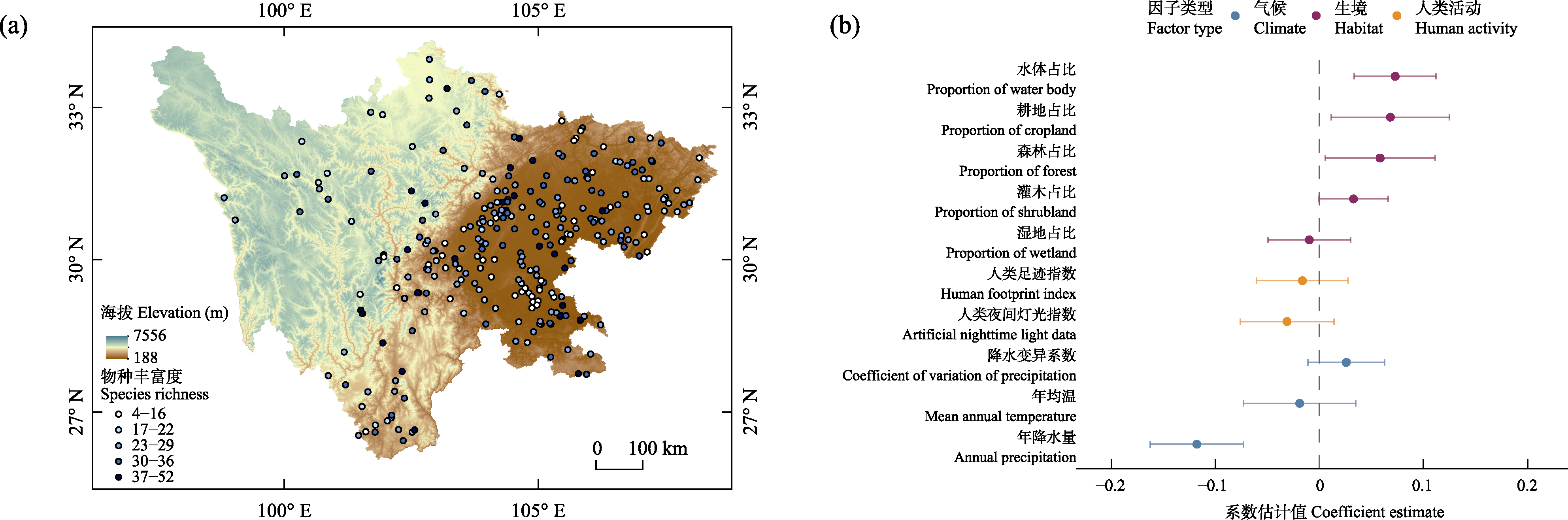
图1 四川省繁殖鸟类群落分类多样性(物种丰富度)的空间分布格局(a)和不同生态因子对分类多样性影响的广义线性回归模型结果(b), 其中展示了模型平均后的标准化系数估计值及其95%置信区间。
Fig. 1 Spatial distribution patterns of taxonomic diversity (species richness) of breeding bird communities in Sichuan Province (a) and the effects of different ecological factors on taxonomic diversity estimated by generalized linear regression models (b), showing the model-averaged standardized coefficient estimates and their 95% confidence intervals.
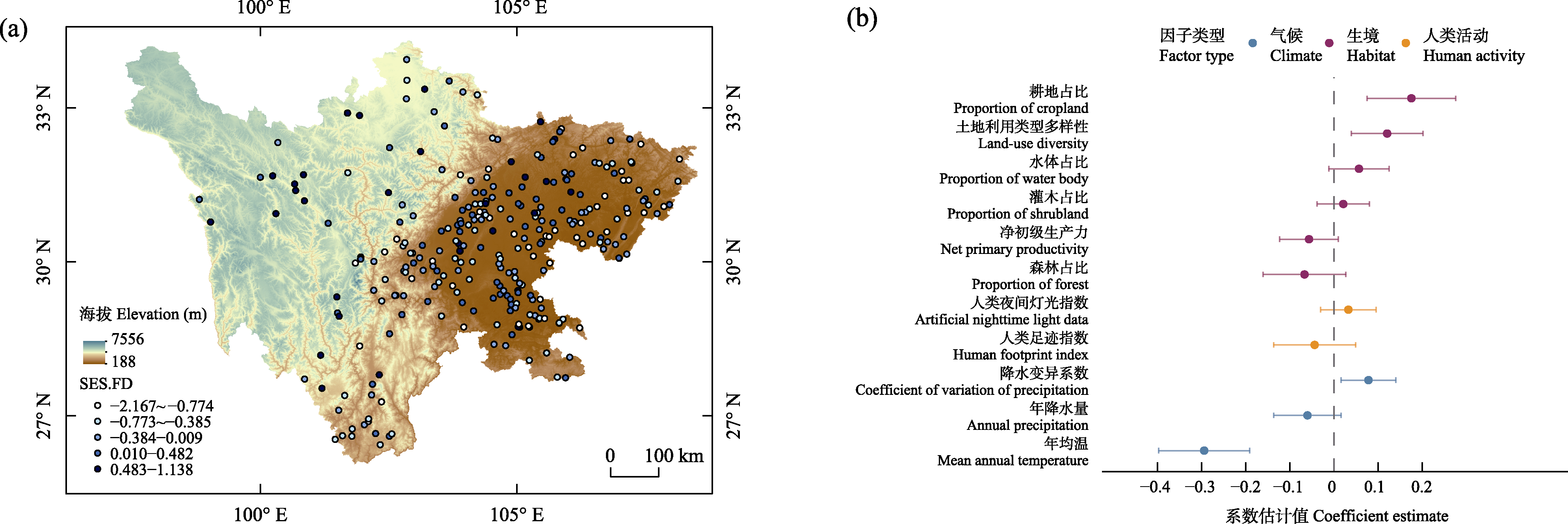
图2 四川省繁殖鸟类群落功能多样性(功能多样性标准化效应量, SES.FD)的空间分布格局(a)和不同生态因子对功能多样性影响的广义线性回归模型结果(b), 其中展示了模型平均后的标准化系数估计值及其95%置信区间。
Fig. 2 Spatial distribution patterns of functional diversity (standardized effect size of functional diversity, SES.FD) of breeding bird communities in Sichuan Province (a) and the effects of different ecological factors on functional diversity estimated by generalized linear regression models (b), showing the model-averaged standardized coefficient estimates and their 95% confidence intervals.
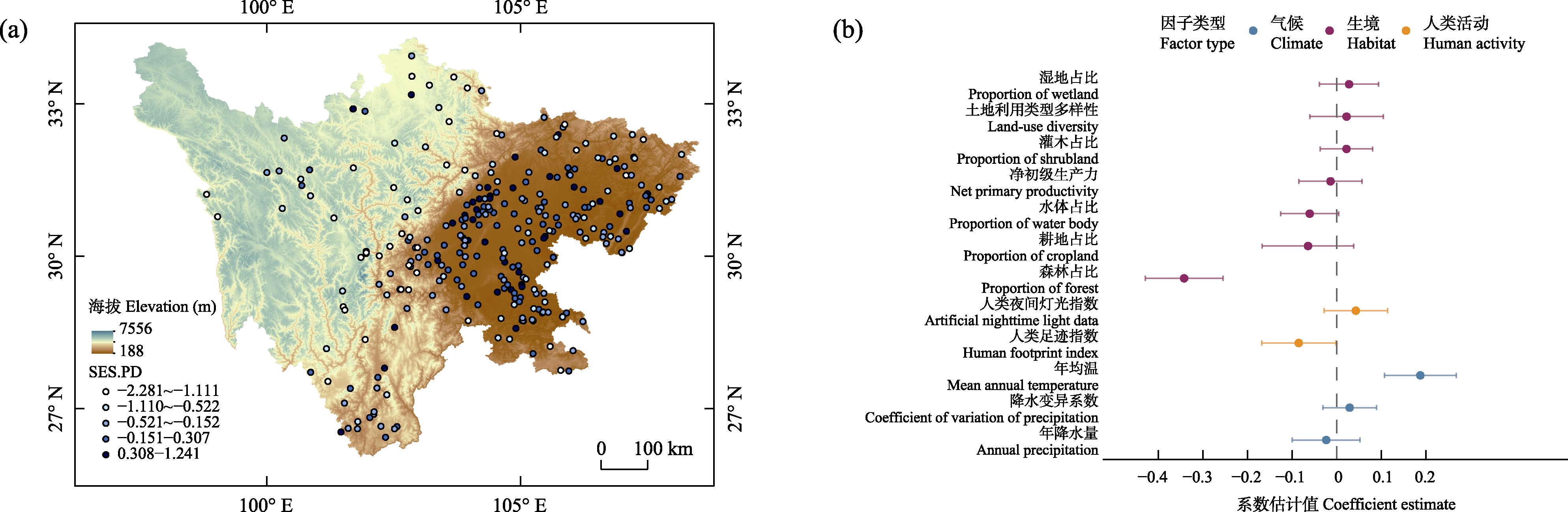
图3 四川省繁殖鸟类群落系统发育多样性(系统发育多样性标准化效应量, SES.PD)的空间分布格局(a)和不同生态因子对系统发育多样性影响的广义线性回归模型结果(b), 其中展示了模型平均后的标准化系数估计值及其95%置信区间。
Fig. 3 Spatial distribution patterns of phylogenetic diversity (standardized effect size of phylogenetic diversity, SES.PD) of breeding bird communities in Sichuan Province (a) and the effects of different ecological factors on phylogenetic diversity estimated by generalized linear regression models (b), showing the model-averaged standardized coefficient estimates and their 95% confidence intervals.
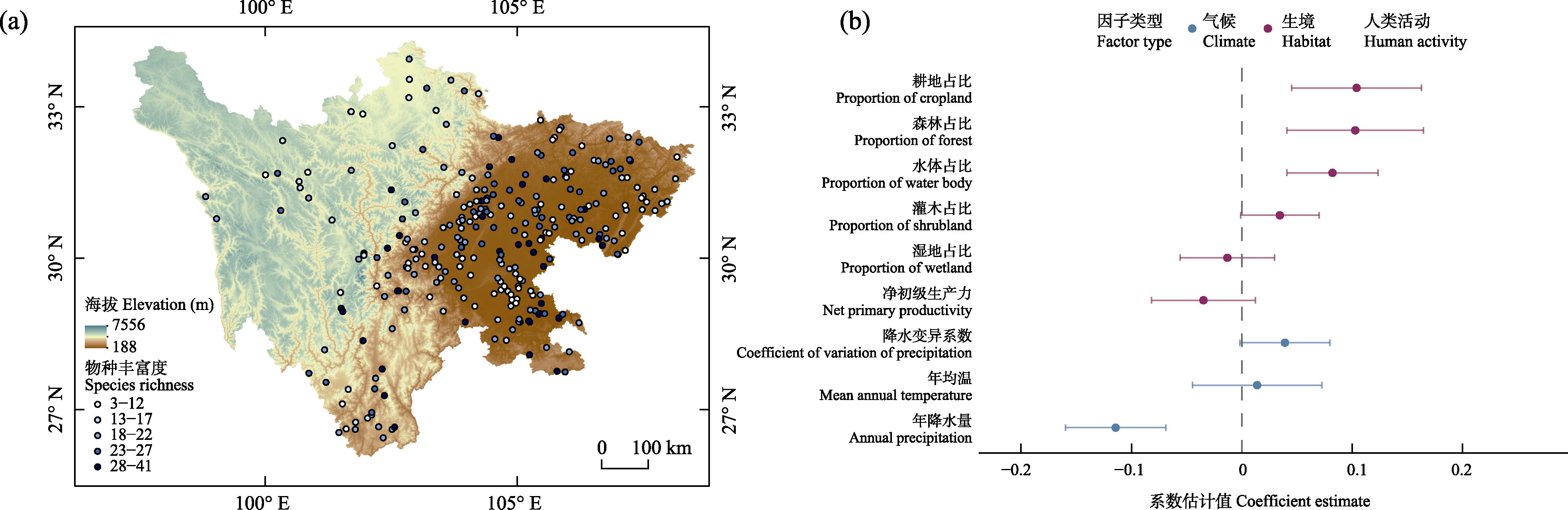
图4 四川省繁殖鸟类中非迁徙繁殖鸟类群落分类多样性(物种丰富度)的空间分布格局(a)和不同生态因子对分类多样性影响的广义线性回归模型结果(b), 其中展示了模型平均后的标准化系数估计值及其95%置信区间。
Fig. 4 Spatial distribution patterns of taxonomic diversity (species richness) of breeding non-migratory bird communities in Sichuan Province (a) and the effects of different ecological factors on taxonomic diversity estimated by generalized linear regression models (b), showing the model-averaged standardized coefficient estimates and their 95% confidence intervals.
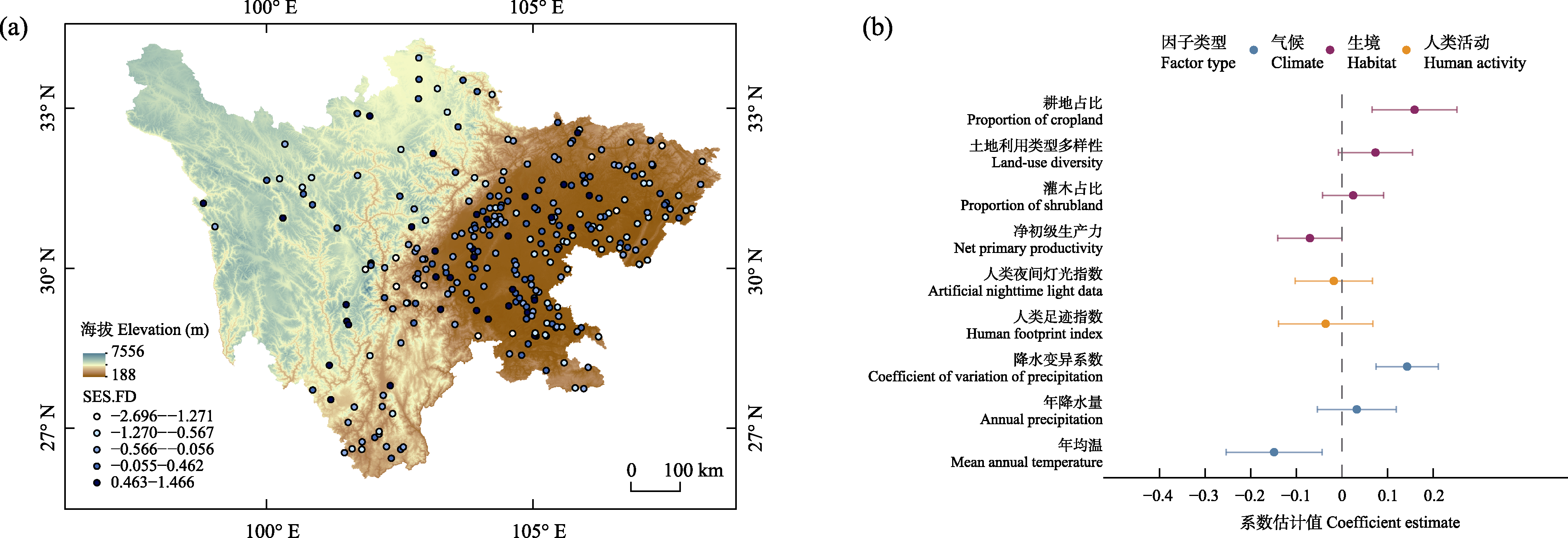
图5 四川省繁殖鸟类中非迁徙繁殖鸟类群落功能多样性(功能多样性标准化效应量, SES.FD)的空间分布格局(a)和不同生态因子对功能多样性影响的广义线性回归模型结果(b), 其中展示了模型平均后的标准化系数估计值及其95%置信区间。
Fig. 5 Spatial distribution patterns of functional diversity (standardized effect size of functional diversity, SES.FD) of breeding non-migratory bird communities in Sichuan Province (a) and the effects of different ecological factors on functional diversity estimated by generalized linear regression models (b), showing the model-averaged standardized coefficient estimates and their 95% confidence intervals.
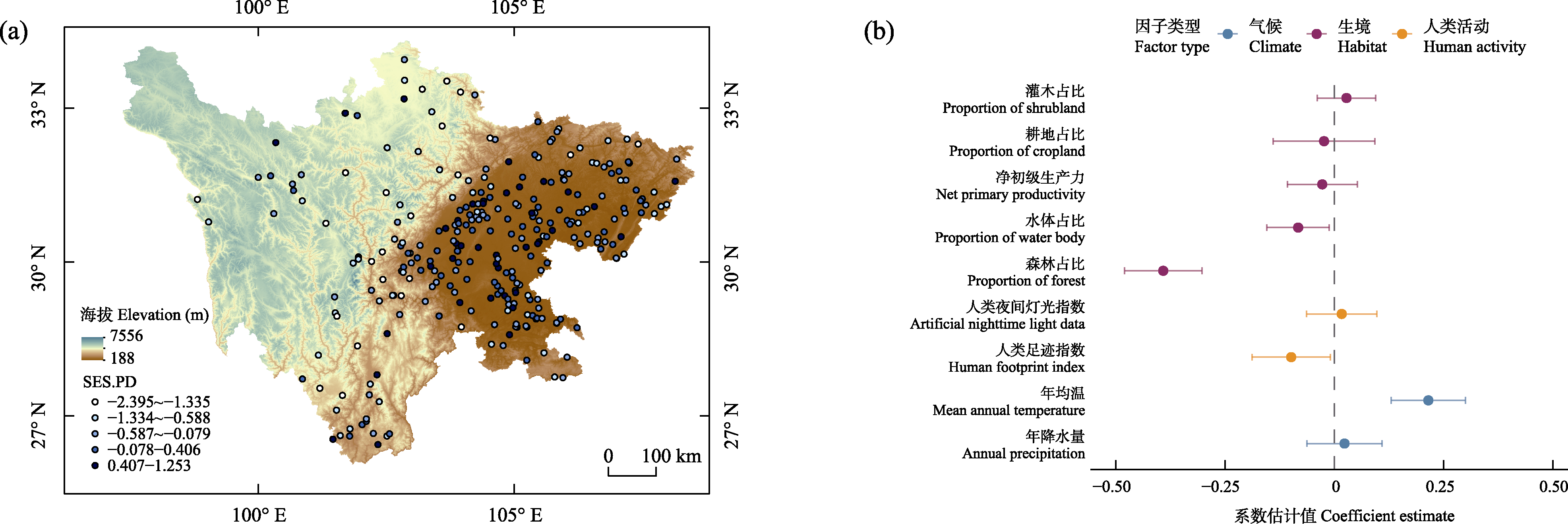
图6 四川省繁殖鸟类中非迁徙繁殖鸟类群落系统发育多样性(系统发育多样性标准化效应量, SES.PD)的空间分布格局(a)和不同生态因子对系统发育多样性影响的广义线性回归模型结果(b), 其中展示了模型平均后的标准化系数估计值及其95%置信区间。
Fig. 6 Spatial distribution patterns of phylogenetic diversity (standardized effect size of phylogenetic diversity, SES.PD) of breeding non-migratory bird communities in Sichuan Province (a) and the effects of different ecological factors on phylogenetic diversity estimated by generalized linear regression models (b), showing the model-averaged standardized coefficient estimates and their 95% confidence intervals.
| [1] |
Alexandrino ER, Buechley ER, Piratelli AJ, de Andrade Moral R, Şekercioğlu ÇH, Silva WR, do Couto HTZ (2016) Bird sensitivity to disturbance as an indicator of forest patch conditions: An issue in environmental assessments. Ecological Indicators, 66, 369-381.
DOI URL |
| [2] |
Asefa A, Davies AB, Mckechnie AE, Kinahan AA, van Rensburg BJ (2017) Effects of anthropogenic disturbance on bird diversity in Ethiopian montane forests. The Condor, 119, 416-430.
DOI URL |
| [3] | Bantihun G, Tadele S, Ameha A (2020) Avian diversity in Dilifekar Block, Arsi Mountains National Park, Ethiopia. Advances in Bioscience and Bioengineering, 8, 6-11. |
| [4] | Barnagaud JY, Kissling WD, Tsirogiannis C, Fisikopoulos V, Villéger S, Sekercioglu CH, Svenning JC (2017) Biogeographical, environmental and anthropogenic determinants of global patterns in bird taxonomic and trait turnover. Global Ecology and Biogeography, 26, 1190-1200. |
| [5] |
Barrios P, Martinez-Nuñez C (2024) Bird phylogenetic diversity increases with temperature worldwide. Diversity and Distributions, 30, e13930.
DOI URL |
| [6] | Bartoń K (2025) MuMIn: Multi-Model Inference. R package version 1.48.11. (accessed on 2025-12-18) |
| [7] |
Bełcik M, Lenda M, Amano T, Skórka P (2020) Different response of the taxonomic, phylogenetic and functional diversity of birds to forest fragmentation. Scientific Reports, 10, 20320.
DOI PMID |
| [8] |
Bennett JM, Sunday J, Calosi P, Villalobos F, Martínez B, Molina-Venegas R, Araújo MB, Algar AC, Clusella-Trullas S, Hawkins BA, Keith SA, Kühn I, Rahbek C, Rodríguez L, Singer A, Morales-Castilla I, Olalla-Tárraga MÁ (2021) The evolution of critical thermal limits of life on Earth. Nature Communications, 12, 1198.
DOI PMID |
| [9] | Brum FT, Graham CH, Costa GC, Hedges SB, Penone C, Radeloff VC, Rondinini C, Loyola R, Davidson AD (2017) Global priorities for conservation across multiple dimensions of mammalian diversity. Proceedings of the National Academy of Sciences, USA, 114, 7641-7646. |
| [10] | Burnham KP, Anderson DR (2002) Model Selection and Multimodel Inference: A Practical Information-Theoretic Approac. Springer, New York. |
| [11] |
Cadotte MW, Carboni M, Si XF, Tatsumi S (2019) Do traits and phylogeny support congruent community diversity patterns and assembly inferences? Journal of Ecology, 107, 2065-2077.
DOI |
| [12] |
Carbonell JA, Stoks R (2020) Thermal evolution of life history and heat tolerance during range expansions toward warmer and cooler regions. Ecology, 101, e03134.
DOI URL |
| [13] | Cardoso P, Mammola S, Rigal F, Carvalho J (2024) BAT: Biodiversity Assessment Tools. R package Version 2.11.0. https://CRAN.R-project.org/package=BAT. (accessed on 2025-12-17) |
| [14] |
Chowfin SM, Leslie AJ (2021) Using birds as biodindicators of forest restoration progress: A preliminary study. Trees, Forests and People, 3, 100048.
DOI URL |
| [15] |
Cosset CCP, Edwards DP (2017) The effects of restoring logged tropical forests on avian phylogenetic and functional diversity. Ecological Applications, 27, 1932-1945.
DOI PMID |
| [16] |
Devictor V, Mouillot D, Meynard C, Jiguet F, Thuiller W, Mouquet N (2010) Spatial mismatch and congruence between taxonomic, phylogenetic and functional diversity: The need for integrative conservation strategies in a changing world. Ecology Letters, 13, 1030-1040.
DOI PMID |
| [17] |
Dormann CF, Elith J, Bacher S, Buchmann C, Carl G, Carré G, Márquez JRG, Gruber B, Lafourcade B, Leitão PJ, Münkemüller T, Mcclean C, Osborne P, Reineking B, Schröder B, Skidmore AK, Zurell D, Lautenbach S (2013) Collinearity: A review of methods to deal with it and a simulation study evaluating their performance. Ecography, 36, 27-46.
DOI URL |
| [18] |
Doxa A, Bas Y, Paracchini ML, Pointereau P, Terres JM, Jiguet F (2010) Low-intensity agriculture increases farmland bird abundances in France. Journal of Applied Ecology, 47, 1348-1356.
DOI URL |
| [19] |
Drummond AJ, Rambaut A (2007) BEAST: Bayesian evolutionary analysis by sampling trees. BMC Evolutionary Biology, 7, 214.
PMID |
| [20] |
Erwin DH (2009) Climate as a driver of evolutionary change. Current Biology, 19, R575-R583.
DOI URL |
| [21] |
Faith DP (1992) Conservation evaluation and phylogenetic diversity. Biological Conservation, 61, 1-10.
DOI URL |
| [22] | Ficetola GF, Mazel F, Thuiller W (2017) Global determinants of zoogeographical boundaries. Nature Ecology & Evolution, 1, 0089. |
| [23] | Gaston KJ, Spicer JI. (2004) Biodiversity: An Introduction, 2nd edn. Wiley-Blackwell, Hoboke. |
| [24] |
Gong Z, Liu YC, Feng HZ, Zhu TS (2024) Fish diversity evaluation and community assembly process analysis in the Yarlung Tsang-po River based on multi-faceted indices. Journal of Lake Sciences, 36, 213-222.(in Chinese with English abstract)
DOI URL |
| [巩政, 刘艳超, 冯慧喆, 朱天顺 (2024) 基于多维度指数的雅鲁藏布江鱼类多样性评价及群落构建过程分析. 湖泊科学, 36, 213-222.] | |
| [25] |
Gotelli NJ, Entsminger GL (2003) Swap algorithms in null model analysis. Ecology, 84, 532-535.
DOI URL |
| [26] |
Hiley JR, Bradbury RB, Thomas CD (2016) Impacts of habitat change and protected areas on alpha and beta diversity of Mexican birds. Diversity and Distributions, 22, 1245-1254.
DOI URL |
| [27] |
Howard C, Stephens PA, Pearce-Higgins JW, Gregory RD, Willis SG (2015) The drivers of avian abundance: Patterns in the relative importance of climate and land use. Global Ecology and Biogeography, 24, 1249-1260.
DOI URL |
| [28] |
Hua FY, Wang XY, Zheng XL, Fisher B, Wang L, Zhu JG, Tang Y, Yu DW, Wilcove DS (2016) Opportunities for biodiversity gains under the world’s largest reforestation programme. Nature Communications, 7, 12717.
DOI |
| [29] |
Hughes EC, Edwards DP, Sayer CA, Martin PA, Thomas GH (2020) The effects of tropical secondary forest regeneration on avian phylogenetic diversity. Journal of Applied Ecology, 57, 1351-1362.
DOI |
| [30] | Hunter ML Jr (1999) Maintaining Biodiversity in Forest Ecosystems. Cambridge University Press, Cambridge. |
| [31] |
Ibáñez-Álamo JD, Rubio E, Benedetti Y, Morelli F (2017) Global loss of avian evolutionary uniqueness in urban areas. Global Change Biology, 23, 2990-2998.
DOI PMID |
| [32] |
Jetz W, Thomas GH, Joy JB, Hartmann K, Mooers AO (2012) The global diversity of birds in space and time. Nature, 491, 444-448.
DOI |
| [33] |
Katuwal HB, Bhattarai BP, Regmi S, Nepali A, Sabin KC, Gautam R, Rokka P, Pradhan N, Koirala S, Mandal DN, Sharma HP, Quan RC (2025) Anthropogenic pressures drive the multidimensional homogenisation of bird diversity in a South Asian landscape. Journal of Environmental Management, 394, 127628.
DOI URL |
| [34] |
Kembel SW, Cowan PD, Helmus MR, Cornwell WK, Morlon H, Ackerly DD, Blomberg SP, Webb CO (2010) Picante: R tools for integrating phylogenies and ecology. Bioinformatics, 26, 1463-1464.
DOI PMID |
| [35] |
Kim JY, Yoon J, Choi YS, Eo SH (2022) The influencing factors for distribution patterns of resident and migrant bird species richness along elevational gradients. PeerJ, 10, e13258.
DOI URL |
| [36] |
Kozak KH, Wiens JJ (2010) Accelerated rates of climatic-niche evolution underlie rapid species diversification. Ecology Letters, 13, 1378-1389.
DOI PMID |
| [37] |
Li JX, Mammides C, Zhou LP, Sun JJ, Tan XC, Jiang AW (2022) Bird diversity in different habitats under agriculturalization in Guangxi, China. Biodiversity Science, 30, 21515.(in Chinese with English abstract)
DOI |
|
[李家兴, Christos Mammides, 周丽萍, 孙家杰, 谭筱彩, 蒋爱伍 (2022) 广西山地农业化背景下鸟类多样性比较. 生物多样性, 30, 21515.]
DOI |
|
| [38] | Liang CX (2020) Analysis on the Characteristics and Formation Mechanisms of Breeding Bird Diversity in Inner Mongolia. PhD dissertation, Inner Mongolia University, Hohhot. (in Chinese with English abstract) |
| [梁晨霞 (2020) 内蒙古繁殖鸟类多样性特征及其形成机制分析. 博士学位论文, 内蒙古大学, 呼和浩特.] | |
| [39] | Liang CX, Feng G, Si XF, Mao LF, Yang GS, Svenning JC, Yang J (2018) Bird species richness is associated with phylogenetic relatedness, plant species richness, and altitudinal range in Inner Mongolia. Ecology and Evolution, 8, 53-58. |
| [40] |
Liao J, Liao T, He XC, Zhang TX, Li DR, Luo XH, Wu YJ, Ran JH (2020) The effects of agricultural landscape composition and heterogeneity on bird diversity and community structure in the Chengdu Plain China. Global Ecology and Conservation, 24, e01191.
DOI URL |
| [41] |
Lin HX, Wang XY, Zhong MJ, Tang K, Du YB, Xu HG, Yi JF, Liu W, Hu JH (2024) Elevational patterns and assembly processes of multifaceted bird diversity in a subtropical mountain system. Journal of Biogeography, 51, 1276-1289.
DOI URL |
| [42] |
Liu Y, Zhu Y, Wu S, Wang Y, Xie J, Zhang K, Xu Y (2024) Determinants of taxonomic, functional, and phylogenetic beta diversity in breeding birds within urban remnant woodlots: Implications for conservation. Ecology and Evolution, 14, e11426.
DOI URL |
| [43] |
Lu XH, Jia YF, Wang YC (2024) The effect of landscape composition, complexity, and heterogeneity on bird richness: A systematic review and meta-analysis on a global scale. Landscape Ecology, 39, 132.
DOI |
| [44] |
MacArthur RH (1958) Population ecology of some warblers of northeastern coniferous forests. Ecology, 39, 599-619.
DOI URL |
| [45] |
Matthews TJ, Triantis KA, Wayman JP, Martin TE, Hume JP, Cardoso P, Faurby S, Mendenhall CD, Dufour P, Rigal F, Cooke R, Whittaker RJ, Pigot AL, Thébaud C, Jørgensen MW, Benavides E, Soares FC, Ulrich W, Kubota Y, Sadler JP, Tobias JA, Sayol F (2024) The global loss of avian functional and phylogenetic diversity from anthropogenic extinctions. Science, 386, 55-60.
DOI PMID |
| [46] |
McCain CM (2009) Global analysis of bird elevational diversity. Global Ecology and Biogeography, 18, 346-360.
DOI URL |
| [47] | Mittermeier R, Gil P, Hoffmann M, Pilgrim J, Brooks T, Mittermeier C, Lamoreux J, Fonseca G (2004) Hotspots Revisited: Earth’s Biologically Richest and Most Endangered Terrestrial Ecoregions. Cemex, Mexico. |
| [48] | Monnet AC, Jiguet F, Meynard CN, Mouillot D, Mouquet N, Thuiller W, Devictor V (2014) Asynchrony of taxonomic, functional and phylogenetic diversity in birds. Global Ecology and Biogeography, 23, 780-788. |
| [49] |
Montaño-Centellas F, Baiser B, McGrew A, Trotta L, Li DJ (2022) Global patterns and drivers of raptor phylogenetic and functional diversity. Global Ecology and Biogeography, 32, 281-294.
DOI URL |
| [50] |
Mu HW, Li XC, Wen YN, Huang JX, Du PJ, Su W, Miao SX, Geng M (2023) A global record of annual terrestrial human footprint dataset from 2000 to 2018. Scientific Data, 9, 176.
DOI |
| [51] |
O’Brien EM (1998) Water-energy dynamics, climate, and prediction of woody plant species richness: An interim general model. Journal of Biogeography, 25, 379-398.
DOI URL |
| [52] | Pan XY, Liang D, Zeng W, Hu YM, Liang JC, Wang XW, Robinson SK, Luo X, Liu Y (2019) Climate, human disturbance and geometric constraints drive the elevational richness pattern of birds in a biodiversity hotspot in Southwest China. Global Ecology and Conservation, 18, e00630. |
| [53] | Pellissier V, Barnagaud JY, Kissling WD, Şekercioğlu Ç, Svenning JC (2018) Niche packing and expansion account for species richness-productivity relationships in global bird assemblages. Global Ecology and Biogeography, 27, 604-615. |
| [54] |
Petchey OL, Gaston KJ (2002) Functional diversity (FD), species richness and community composition. Ecology Letters, 5, 402-411.
DOI URL |
| [55] |
Pfister C, Harrington BA, Lavine M (1992) The impact of human disturbance on shorebirds at a migration staging area. Biological Conservation, 60, 115-126.
DOI URL |
| [56] |
Pio DV, Broennimann O, Barraclough TG, Reeves G, Rebelo AG, Thuiller W, Guisan A, Salamin N (2011) Spatial predictions of phylogenetic diversity in conservation decision making. Conservation Biology, 25, 1229-1239.
DOI PMID |
| [57] |
Pollock LJ, O’Connor LMJ, Mokany K, Rosauer DF, Talluto L, Thuiller W (2020) Protecting biodiversity (in all its complexity): New models and methods. Trends in Ecology & Evolution, 35, 1119-1128.
DOI URL |
| [58] | R Core Team (2025) R: A Language and Environment for Statistical Computing. https://www.R-project.org. (accessed on 2025-12-17) |
| [59] |
Şekercioğlu ÇH, Primack RB, Wormworth J (2012) The effects of climate change on tropical birds. Biological Conservation, 148, 1-18.
DOI URL |
| [60] |
Sreekar R, Si XF, Sam K, Liu JJ, Dayananda S, Goodale U, Kotagama S, Goodale E (2021) Land use and elevation interact to shape bird functional and phylogenetic diversity and structure: Implications for designing optimal agriculture landscapes. Journal of Applied Ecology, 58, 1738-1748.
DOI URL |
| [61] |
Stein A, Gerstner K, Kreft H (2014) Environmental heterogeneity as a universal driver of species richness across taxa, biomes and spatial scales. Ecology Letters, 17, 866-880.
DOI PMID |
| [62] |
Stewart PS, Voskamp A, Santini L, Biber MF, Devenish AJM, Hof C, Willis SG, Tobias JA (2022) Global impacts of climate change on avian functional diversity. Ecology Letters, 25, 673-685.
DOI PMID |
| [63] | Tian YH, Zheng JW, Zhang ZB, Zhang T, Li SJ, Yan DM, Xu B (2025) Extended VIIRS-Like Artificial Nighttime Night Dataset of China (1986-2024). National Tibetan Plateau Data Center. https://cstr.cn/18406.11.HumanNat.tpdc.302930. (accessed on 2025-09-25) |
| [64] |
Tobias JA (2022) A bird in the hand: Global-scale morphological trait datasets open new frontiers of ecology, evolution and ecosystem science. Ecology Letters, 25, 573-580.
DOI PMID |
| [65] | Tobias JA, Sheard C, Pigot AL, Devenish AJM, Yang JY, Sayol F, Neate-Clegg MHC, Alioravainen N, Weeks TL, Barber RA, Walkden PA, MacGregor HEA, Jones SEI, Vincent C, Phillips AG, Marples NM, Montaño-Centellas FA, Leandro-Silva V, Claramunt S, Darski B, Freeman BG, Bregman TP, Cooney CR, Hughes EC, Capp EJR, Varley ZK, Friedman NR, Korntheuer H, Corrales-Vargas A, Trisos CH, Weeks BC, Hanz DM, Töpfer T, Bravo GA, Remeš V, Nowak L, Carneiro LS, Moncada RAJ, Matysioková B, Baldassarre DT, Martínez-Salinas A, Wolfe JD, Chapman PM, Daly BG, Sorensen MC, Neu A, Ford MA, Mayhew RJ, Fabio Silveira L, Kelly DJ, Annorbah NND, Pollock HS, Grabowska-Zhang AM, McEntee JP, Carlos T. Gonzalez J, Meneses CG, Muñoz MC, Powell LL, Jamie GA, Matthews TJ, Johnson O, Brito GRR, Zyskowski K, Crates R, Harvey MG, Jurado Zevallos M, Hosner PA, Bradfer-Lawrence T, Maley JM, Stiles FG, Lima HS, Provost KL, Chibesa M, Mashao M, Howard JT, Mlamba E, Chua MAH, Li BC, Gómez MI, García NC, Päckert M, Fuchs J, Ali JR, Derryberry EP, Carlson ML, Urriza RC, Brzeski KE, Prawiradilaga DM, Rayner MJ, Miller ET, Bowie RCK, Lafontaine RM, Scofield RP, Lou YQ, Somarathna L, Lepage D, Illif M, Neuschulz EL, Templin M, Dehling DM, Cooper JC, Pauwels OSG, Analuddin K, Fjeldså J, Seddon N, Sweet PR, DeClerck FAJ, Naka LN, Brawn JD, Aleixo A, Böhning-Gaese K, Rahbek C, Fritz SA, Thomas GH, Schleuning M (2022) AVONET: Morphological, ecological and geographical data for all birds. Ecology Letters, 25, 581-597. |
| [66] | Tu HM, Fan MW, Ko JC (2020) Different habitat types affect bird richness and evenness. Scientific Reports, 10, 1221. |
| [67] |
Villéger S, Mason NWH, Mouillot D (2008) New multidimensional functional diversity indices for a multifaceted framework in functional ecology. Ecology, 89, 2290-2301.
DOI PMID |
| [68] |
Voskamp A, Baker DJ, Stephens PA, Valdes PJ, Willis SG (2017) Global patterns in the divergence between phylogenetic diversity and species richness in terrestrial birds. Journal of Biogeography, 44, 709-721.
DOI URL |
| [69] | Wang C, Hu Y, Li MM, Ran JH, Tang RH (2022) Spatial distribution pattern of birds in the list of wild animals under state priority conservation in Sichuan Province. Sichuan Journal of Zoology, 41, 601-610.(in Chinese with English abstract) |
| [王灿, 胡烨, 李明明, 冉江洪, 唐荣华 (2022) 四川省国家重点保护野生鸟类的空间分布格局. 四川动物, 41, 601-610.] | |
| [70] |
Ye YC, Lin WP, Song J, Wei QM, Zheng YF (2025) Spatial mismatches and multi-dimensional conservation priorities for urban birds in China. Journal of Environmental Management, 379, 124905.
DOI URL |
| [71] |
Zhai ZR, Liu SY, Li ZM, Ma RJ, Ge XY, Feng HD, Shi Y, Gu C (2024) The spatiotemporal distribution patterns and impact factors of bird species richness: A case study of urban built-up areas in Beijing, China. Ecological Indicators, 169, 112847.
DOI URL |
| [72] |
Zhang X, Zhao TT, Xu H, Liu WD, Wang JQ, Chen XD, Liu LY (2024) GLC_FCS30D: The first global 30 m land-cover dynamics monitoring product with a fine classification system for the period from 1985 to 2022 generated using dense-time-series Landsat imagery and the continuous change-detection method. Earth System Science Data, 16, 1353-1381.
DOI URL |
| [73] | Zhou Y (2024) Comprehensive benefit evaluation of the project of returning farmland to forest and grassland in Sichuan Province. Rural Scientific Experiment, (22), 48-50.(in Chinese) |
| [周勇 (2024) 四川省退耕还林还草工程的综合效益评价. 农村科学实验, (22), 48-50.] | |
| [74] | Zhou YT, Xu JH, Hu DF, Zhao Y, Li QH, Sun JX, Chen W, Chang Q, Li P, Hu CC (2023) Functional and phylogenetic bird diversity and bird strike avoidance at Nanjing Lukou International Airport. Journal of Nanjing Normal University (Natural Science Edition), 46(3), 69-78.(in Chinese with English abstract) |
| [周雨桐, 徐嘉晖, 胡东方, 赵阳, 李权衡, 孙健翔, 陈婉, 常青, 李鹏, 胡超超 (2023) 南京禄口国际机场鸟类群落功能和谱系多样性及鸟击防范研究. 南京师大学报(自然科学版), 46(3), 69-78.] |
| [1] | 卢晓强, 芮丹, 张江峰, 尹冰鑫, 王雨露, 岑雨婷, 崔怡晨, 杨万霞. 氮输入驱动的关键生态过程对生物多样性的影响及其管理启示[J]. 生物多样性, 2026, 34(2): 25368-. |
| [2] | 刘振元, 周婷婷, 王伟民, 韩博平, 谢志才. 城市化对深圳地区河流大型底栖无脊椎动物群落物种多样性和功能多样性的影响机制[J]. 生物多样性, 2025, 33(9): 25135-. |
| [3] | 于琦胧, 郝珉辉, 何怀江, 张春雨, 赵秀海. 长白山森林不同演替阶段生物多样性与生产力的关系: 基于物种、性状和系统发育的视角[J]. 生物多样性, 2025, 33(8): 25060-. |
| [4] | 刘志祥, 谢华, 张慧, 黄晓磊. 表皮碳氢化合物在社会性昆虫中的功能多样性及其调控[J]. 生物多样性, 2025, 33(2): 24302-. |
| [5] | 王腾, 李纯厚, 王广华, 赵金发, 石娟, 谢宏宇, 刘永, 刘玉. 西沙群岛七连屿珊瑚礁鱼类的物种组成与演替[J]. 生物多样性, 2024, 32(6): 23481-. |
| [6] | 曹可欣, 王敬雯, 郑国, 武鹏峰, 李英滨, 崔淑艳. 降水格局改变及氮沉降对北方典型草原土壤线虫多样性的影响[J]. 生物多样性, 2024, 32(3): 23491-. |
| [7] | 王兴煜, 孟京辉, 任思远, 祝燕. 北京东灵山暖温带落叶阔叶林群落生物多样性与地上生物量的关系[J]. 生物多样性, 2024, 32(12): 24230-. |
| [8] | 何林君, 杨文静, 石宇豪, 阿说克者莫, 范钰, 王国严, 李景吉, 石松林, 易桂花, 彭培好. 火烧干扰下植物群落系统发育和功能多样性对紫茎泽兰入侵的影响[J]. 生物多样性, 2024, 32(11): 24269-. |
| [9] | 王丽媛, 胡慧建, 姜杰, 胡一鸣. 南岭哺乳类和鸟类物种丰富度空间分布格局及其影响因子[J]. 生物多样性, 2024, 32(1): 23026-. |
| [10] | 曹亚苏, 范敏, 彭羽, 辛嘉讯, 彭楠一. 景观格局动态对浑善达克沙地植物物种多样性和功能多样性的影响[J]. 生物多样性, 2023, 31(8): 23048-. |
| [11] | 李发扬, 李滢钰, 蒋文妮, 刘曙光, 霍超, 孙巧奇, 邹红菲. 火后恢复时间影响大兴安岭寒温带森林内部与边缘鸟类多样性[J]. 生物多样性, 2023, 31(7): 22665-. |
| [12] | 刘伟, 王濡格, 范天巧, 娜依曼·阿不都力江, 宋新航, 肖书平, 郭宁, 帅凌鹰. 福建省明溪县黑冠鹃隼生境适宜性[J]. 生物多样性, 2023, 31(7): 22660-. |
| [13] | 陈晓澄, 张鹏展, 康斌, 刘林山, 赵亮. 基于中国科学院西北高原生物研究所馆藏标本分析青藏高原雀形目鸟类物种和功能多样性[J]. 生物多样性, 2023, 31(5): 22638-. |
| [14] | 张伟, 翟东东, 熊飞, 刘红艳, 陈元元, 王莹, 廖传松, 段辛斌, 田辉伍, 邓华堂, 陈大庆. 三峡库区鱼类群落结构和功能多样性[J]. 生物多样性, 2023, 31(2): 22136-. |
| [15] | 马瑞霞, 郭屹立, 李冬兴, 王斌, 向悟生, 黄甫昭, 陆芳, 文淑均, 李健星, 陆树华, 李先琨. 桂西南喀斯特季节性雨林幼树更新的空间分布格局及机制[J]. 生物多样性, 2023, 31(2): 22251-. |
| 阅读次数 | ||||||
|
全文 |
|
|||||
|
摘要 |
|
|||||
备案号:京ICP备16067583号-7
Copyright © 2026 版权所有 《生物多样性》编辑部
地址: 北京香山南辛村20号, 邮编:100093
电话: 010-62836137, 62836665 E-mail: biodiversity@ibcas.ac.cn
