

生物多样性 ›› 2026, Vol. 34 ›› Issue (8): 26142. DOI: 10.17520/biods.2026142 cstr: 32101.14.biods.2026142
叶俊伟1( ), 戴梦婧2, 田祥宇2, 施文婷2, 鲍蕾2, 葛剑平2, 王红芳2,*()(
 )
收稿日期:2026-04-20
接受日期:2026-06-09
出版日期:2026-08-20
发布日期:2026-10-21
通讯作者:
*. E-mail: wanghf@bnu.edu.cn
基金资助:
Junwei Ye1(), Mengjing Dai2, Xiangyu Tian2, Wenting Shi2, Lei Bao2, Jianping Ge2, Hongfang Wang2,*()()
Received:2026-04-20
Accepted:2026-06-09
Online:2026-08-20
Published:2026-10-21
Contact:
*. E-mail: wanghf@bnu.edu.cn
Supported by:摘要:
东亚是第三纪孑遗植物的重要避难所, 分子地理学研究已揭示其南北亚区间的分化历史, 然而性状演化的格局及其成因仍缺乏系统研究。本研究以三桠乌药(Lindera obtusiloba)为对象, 结合野外调查和同质园实验, 探究其表型和生理性状的地理分异格局与成因。通过主成分分析(PCA)探究东亚北部、西南部和东南部种群叶性状的分布模式, 通过单因素方差分析(ANOVA)比较种子重量及幼苗物候、生长速率和光合能力的差异, 通过冗余分析(RDA)和多元线性回归分析(MLR)检验环境因子与性状间的相关性。结果显示: 三桠乌药叶大小和叶形存在一定变异, 野外调查和同质园中分别是西南部和东南部与其他区域间的分化最明显, 温度、光照和土壤与野外叶性状显著相关(r > 0.5), 而在同质园中无显著相关性。在种子中, 北部和南部种群间颜色、重量和成熟时间的差异最大, 东南部和西南部种群间次之, 环境因子与种子重量间无显著相关性。在同质园中, 萌芽和展叶物候在不同区域间差异显著, 在其他物候中, 北部与东南部间的差异也较明显。西南部幼苗存活率最低, 东南部幼苗生长速率最高且变异最大。3个区域幼苗的光饱和点无显著差异; 北部的光补偿点最低, 东南部的最大净光合速率最高。因此, 三桠乌药性状存在明显的地理格局, 叶性状主要由环境因子控制, 种子和生理性状主要由遗传因素影响。该研究分析了性状变异的格局及其与环境和遗传因素的相关性, 为第三纪孑遗植物的演化历史研究提供了有价值的依据。
叶俊伟, 戴梦婧, 田祥宇, 施文婷, 鲍蕾, 葛剑平, 王红芳 (2026) 东亚第三纪孑遗植物三桠乌药表型和生理性状的演化格局与成因. 生物多样性, 34, 26142. DOI: 10.17520/biods.2026142.
Junwei Ye, Mengjing Dai, Xiangyu Tian, Wenting Shi, Lei Bao, Jianping Ge, Hongfang Wang (2026) Evolutionary patterns and causes of phenotypic and physiological traits of the Tertiary relict plant Lindera obtusiloba in East Asia. Biodiversity Science, 34, 26142. DOI: 10.17520/biods.2026142.
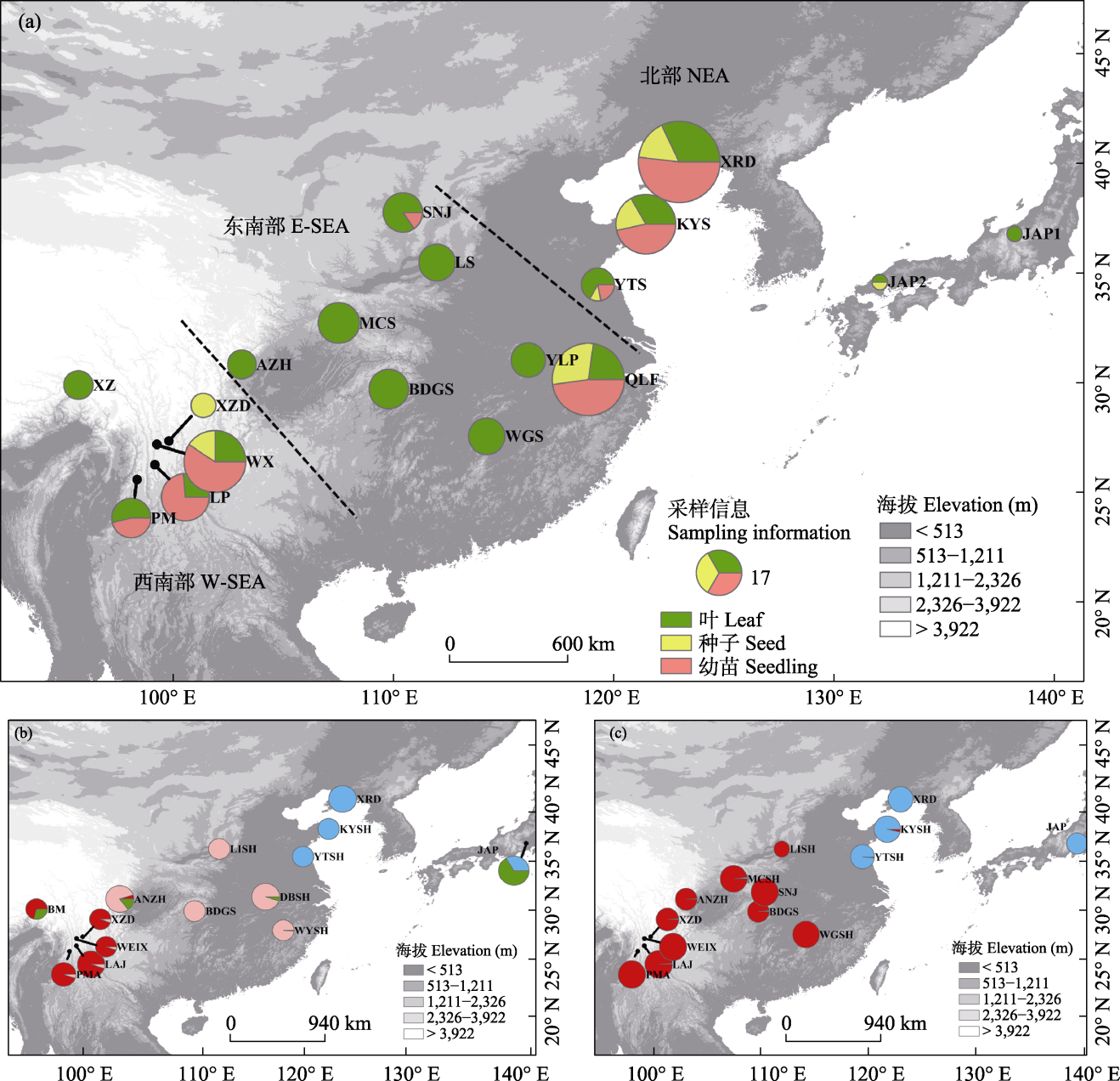
图1 三桠乌药的采样信息与遗传结构。(a)野外调查中叶片和种子采集点, 以及同质园实验中幼苗的采样信息(附录1)。北部、东南部和西南部区域由虚线分隔; (b)基于低拷贝核基因数据的遗传分组(K = 4, 引自Ye et al., 2026); (c)基于核微卫星数据的遗传分组(K = 2, 引自Ye et al., 2017)。图中圆圈大小与样本量成正比。(b)和(c)小图中种群名沿用原始文献中的种群名。
Fig. 1 Sampling locations and genetic structure of Lindera obtusiloba. (a) Sampling sites of leaves and seeds from field surveys and seedlings used in the common garden experiment. For details see Appendix 1. The regions of North East Asia (NEA), Eastern South East Asia (E-SEA) and Western South East Asia (W-SEA) are separated by dashed lines; (b) Genetic structure based on low copy nuclear genes (K = 4, cited from Ye et al., 2026); (c) Genetic structure based on nuclear microsatellites (K = 2, cited from Ye et al., 2017). Circle size is proportional to sample sizes. In panels (b) and (c), population names follow those used in the original literature.
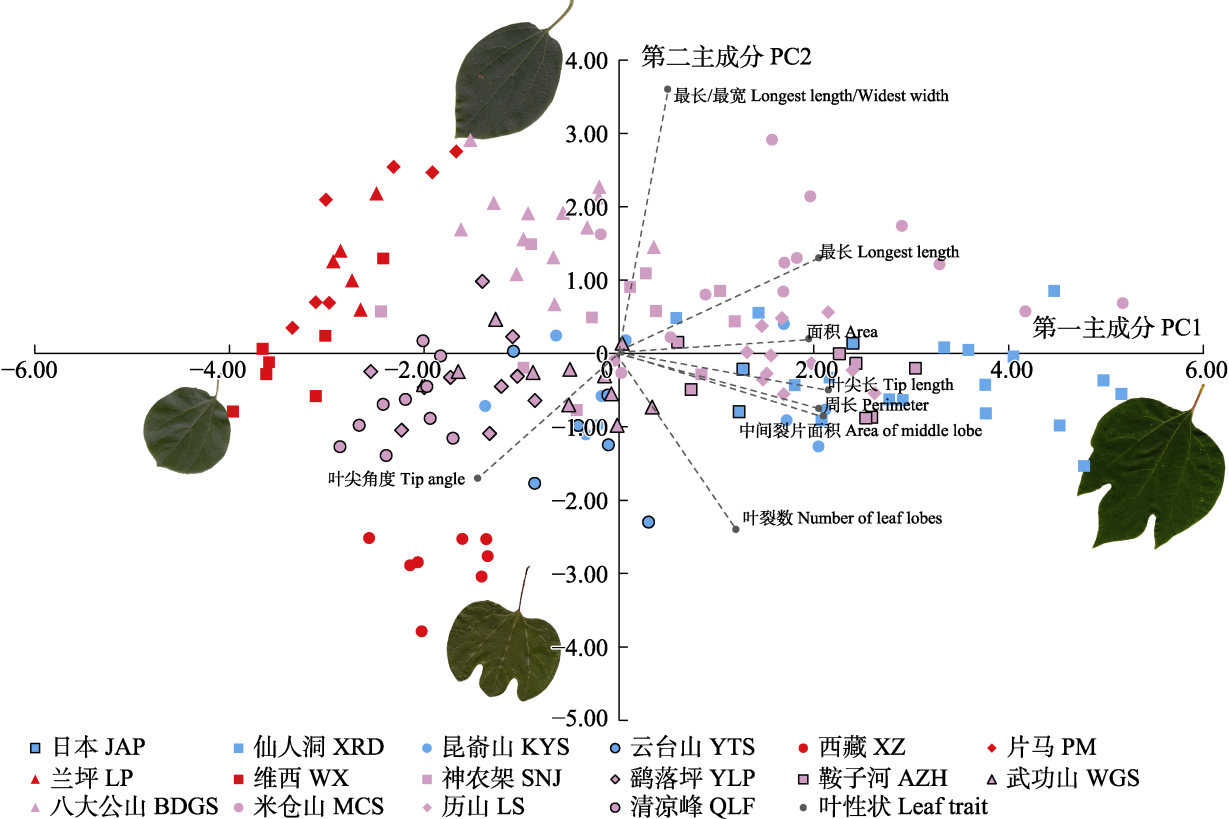
图2 野外调查中三桠乌药不同区域种群(详见图1和附录1)的叶性状主成分分析。北部(NEA)、东南部(E-SEA)和西南部(W-SEA)区域种群分别以蓝色、粉色和红色表示, 不同种群以不同形状表示。不同叶性状的位置与其在第一主成分(PC1)和第二主成分(PC2)上的标准化因子载荷相关。日本种群由JAP1和JAP2合并。
Fig. 2 Principal component analysis (PCA) of leaf traits in Lindera obtusiloba populations across various regions in field surveys (For details see Fig. 1 and Appendix 1). Populations of North East Asia (NEA), Eastern South East Asia (E-SEA) and Western South East Asia (W-SEA) regions are represented by blue, pink and red respectively, and different populations are indicated by distinct shapes. The positions of leaf trait vectors correspond to their standardized loadings of principal component 1 (PC1) and principal component 2 (PC2). Note, JAP population was combined by JAP1 and JAP2 populations.
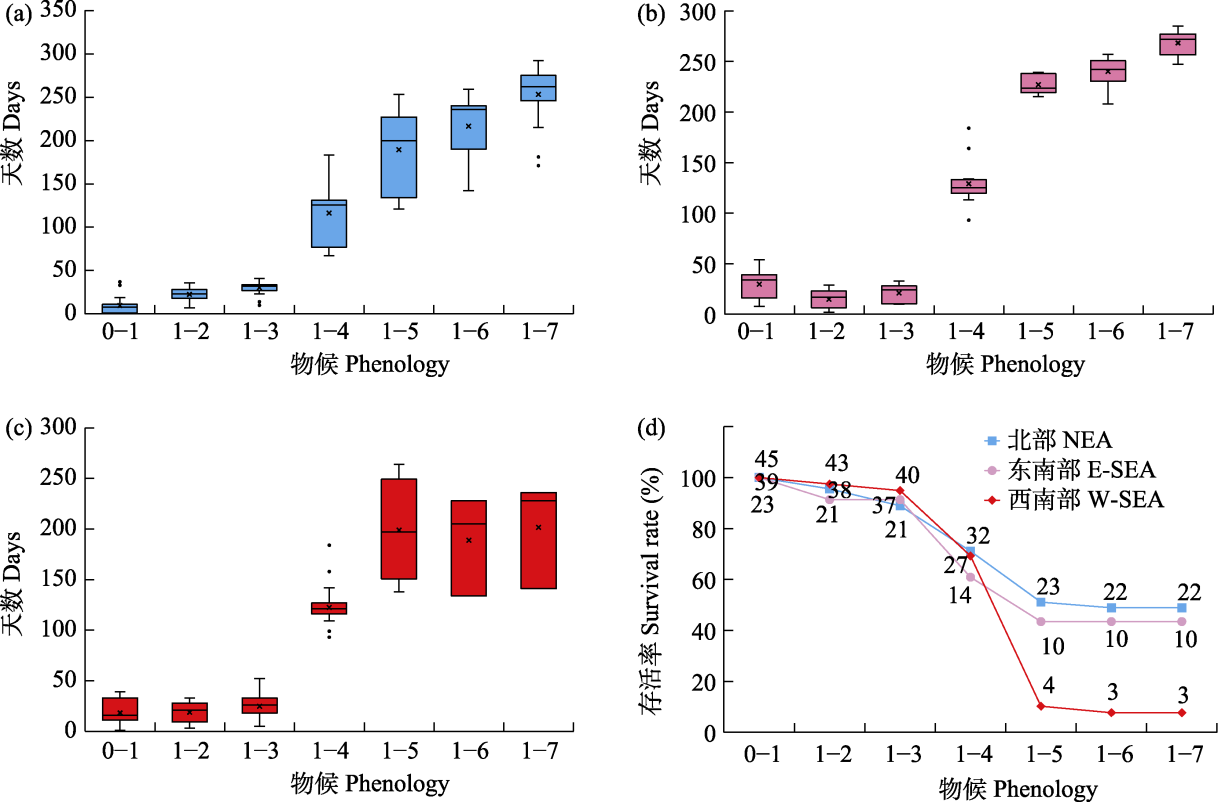
图3 三桠乌药北部(a)、东南部(b)和西南部(c)区域幼苗在不同物候时期的持续天数及存活率(d)。物候阶段划分: 0‒1为萌芽物候, 1‒2为显叶物候, 1‒3为展叶物候, 1‒4为开放芽物候, 1‒5为成熟芽物候, 1‒6为黄叶物候, 1‒7为脱叶物候。在箱线图中(a‒c), ×为平均值, 箱内横线表示中位数。
Fig. 3 Phenological stage durations (days; a‒c) and seedling survival rates (d) of Lindera obtusiloba in the North East Asia (NEA, a), Eastern South East Asia (E-SEA, b) and Western South East Asia (W-SEA, c) regions. Phenological stages: 0‒1, bud phenology; 1‒2, leaf emergence phenology; 1‒3, unfolding phenology; 1‒4, open bud phenology; 1‒5, mature bud phenology; 1‒6, yellow leaf phenology; 1‒7, leaf fall phenology. In the box plots (a‒c), × represents the mean value, and the internal horizontal line represents the median value.
| 区域 Region | 样本量 Sample size | 平均值 ± 标准误 Mean ± SE |
|---|---|---|
| 北部 North East Asia (NEA) | 30 | 1.10 ± 1.41a |
| 东南部 Eastern South East Asia (E-SEA) | 11 | 3.30 ± 1.92b |
| 西南部 Western South East Asia (W-SEA) | 27 | 1.44 ± 2.33a |
表1 不同区域三桠乌药相对生长速率差异
Table 1 Differences in relative growth rates of Lindera obtusiloba in different regions
| 区域 Region | 样本量 Sample size | 平均值 ± 标准误 Mean ± SE |
|---|---|---|
| 北部 North East Asia (NEA) | 30 | 1.10 ± 1.41a |
| 东南部 Eastern South East Asia (E-SEA) | 11 | 3.30 ± 1.92b |
| 西南部 Western South East Asia (W-SEA) | 27 | 1.44 ± 2.33a |
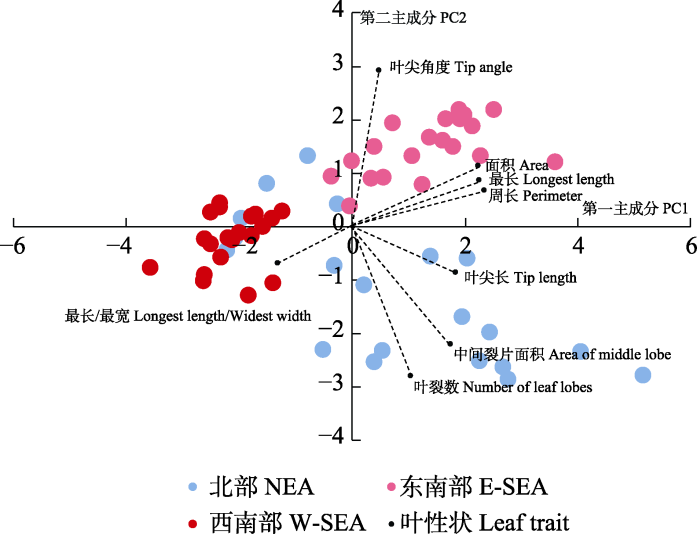
图4 同质园实验中三桠乌药不同区域种群的叶性状主成分分析。北部、东南部和西南部区域的种群分别以蓝色、粉色和红色表示。不同叶性状的位置与其在第一主成分(PC1)和第二主成分(PC2)的标准化因子载荷相关。
Fig. 4 Principal component analysis (PCA) of leaf traits of Lindera obtusiloba from different regions in the common garden experiment. The North East Asia (NEA), Eastern South East Asia (E-SEA) and Western South East Asia (W-SEA) regions are represented by blue, pink and red, respectively. The positions of different leaf traits are correlated with their standardized loadings on principal component 1 (PC1) and principal component 2 (PC2).
| 区域 Region | 光饱和点 Light saturation point (μmol·m‒2·s‒1) | 光补偿点 Light compensation point (μmol·m‒2·s‒1) | 最大净光合速率 Maximum net photosynthetic rate (μmol CO2·m‒2·s‒1) | R2 |
|---|---|---|---|---|
| 北部 North East Asia (NEA) | 208.38 ± 24.48a | 6.10 ± 1.14a | 5.32 ± 0.90a | 0.860‒0.994 |
| 东南部 Eastern South East Asia (E-SEA) | 238.52 ± 24.60a | 15.18 ± 5.08ab | 7.69 ± 0.42b | 0.973‒0.998 |
| 西南部 Western South East Asia (W-SEA) | 262.14 ± 13.04a | 17.80 ± 1.41b | 4.69 ± 0.31a | 0.968‒0.995 |
表2 不同区域三桠乌药个体的光响应曲线参数(平均值 ± 标准误)
Table 2 Parameters (mean ± SE) of light response curves for individuals of Lindera obtusiloba in different regions
| 区域 Region | 光饱和点 Light saturation point (μmol·m‒2·s‒1) | 光补偿点 Light compensation point (μmol·m‒2·s‒1) | 最大净光合速率 Maximum net photosynthetic rate (μmol CO2·m‒2·s‒1) | R2 |
|---|---|---|---|---|
| 北部 North East Asia (NEA) | 208.38 ± 24.48a | 6.10 ± 1.14a | 5.32 ± 0.90a | 0.860‒0.994 |
| 东南部 Eastern South East Asia (E-SEA) | 238.52 ± 24.60a | 15.18 ± 5.08ab | 7.69 ± 0.42b | 0.973‒0.998 |
| 西南部 Western South East Asia (W-SEA) | 262.14 ± 13.04a | 17.80 ± 1.41b | 4.69 ± 0.31a | 0.968‒0.995 |
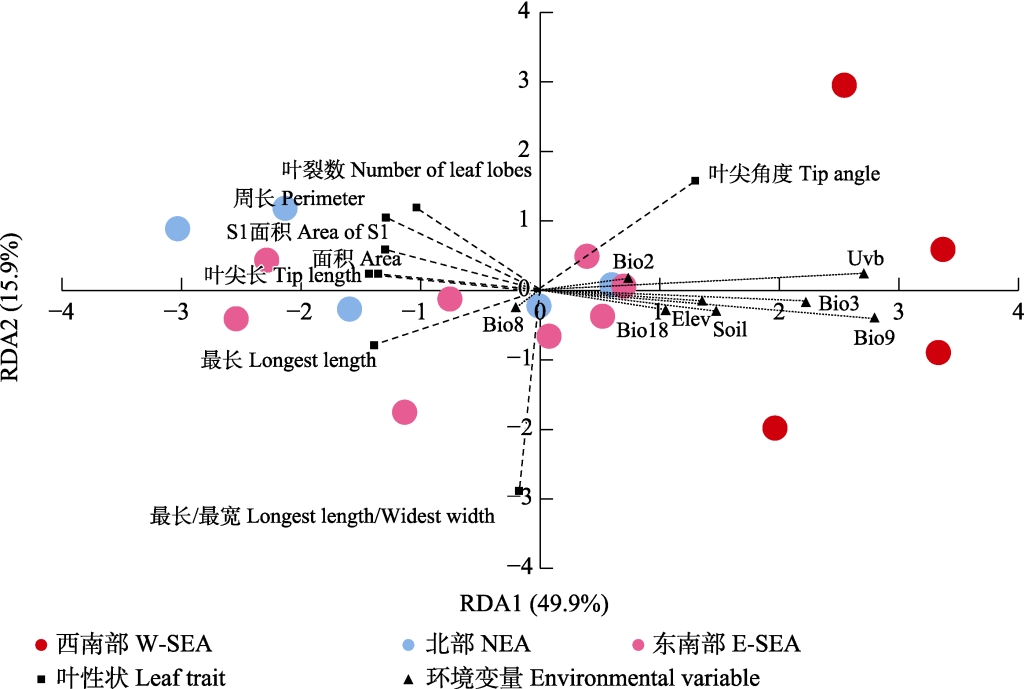
图5 三桠乌药北部(NEA)、东南部(E-SEA)和西南部(W-SEA)区域野生种群叶性状(详见附录2)与环境变量的冗余分析。Bio2: 日温度平均范围; Bio3: 等温性; Bio8: 最湿季平均温度; Bio9: 最干季平均温度; Bio18: 最暖季降水; Soil: 土壤有效持水量; Elev: 海拔; Uvb: 年平均紫外线辐射。
Fig. 5 Redundancy analysis (RDA) of leaf traits (For details see Appendix 2) and environmental variables in wild populations of North East Asia (NEA), Eastern South East Asia (E-SEA) and Western South East Asia (W-SEA) regions in Lindera obtusiloba. Bio2, Mean diurnal range; Bio3, Isothermality; Bio8, Mean Temperature of wettest quarter; Bio9, Mean temperature of driest quarter; Bio18, Precipitation of warmest quarter; Soil, Available water capacity for rootable depth; Elev, Elevation; Uvb, Annual mean ultraviolet-b radiation.
| 环境变量 Environmental variables | 面积 Leaf area | 周长 Leaf perimeter | 叶尖角度 Tip angle | 最长 Longest length | 最长/最宽 Longest length/ Widest width | 中间裂片面积 Area of middle lobe | 叶尖长 Tip length | 叶裂数 No. of leaf lobes |
|---|---|---|---|---|---|---|---|---|
| 海拔 Elev | 0.04 | ‒0.29 | 0.60 | ‒0.08 | 0.01 | ‒0.52 | ‒0.38 | ‒0.36 |
| 土壤有效持水量 Soil | ‒0.59 | ‒0.31 | 0.03 | ‒0.47 | 0.09 | ‒0.27 | ‒0.43 | ‒0.19 |
| 年平均紫外线辐射 Uvb | ‒0.49 | ‒0.48 | 0.88 | ‒0.61 | ‒0.16 | ‒0.64 | ‒0.72 | ‒0.61 |
| 日温度平均范围 Bio2 | ‒0.02 | 0.08 | 0.40 | ‒0.13 | ‒0.01 | ‒0.16 | ‒0.22 | ‒0.25 |
| 等温性 Bio3 | ‒0.31 | ‒0.40 | 0.74 | ‒0.41 | 0.10 | ‒0.56 | ‒0.60 | ‒0.65 |
| 最湿季平均温度 Bio8 | ‒0.30 | 0.08 | ‒0.29 | ‒0.18 | 0.05 | 0.27 | 0.03 | 0.02 |
| 最干季平均温度 Bio9 | ‒0.73 | ‒0.78 | 0.51 | ‒0.68 | 0.08 | ‒0.64 | ‒0.67 | ‒0.59 |
| 最暖季降水量 Bio18 | ‒0.37 | ‒0.40 | 0.03 | ‒0.29 | 0.08 | ‒0.19 | ‒0.25 | ‒0.07 |
表3 三桠乌药叶性状与环境变量间的相关性。粗体表示相关系数绝对值大于0.5。
Table 3 Correlations between leaf traits of Lindera obtusiloba and environmental variables. Correlation coefficients (r) with absolute values greater than 0.5 are shown in bold. The meanings of the environmental variables are shown in Fig. 5.
| 环境变量 Environmental variables | 面积 Leaf area | 周长 Leaf perimeter | 叶尖角度 Tip angle | 最长 Longest length | 最长/最宽 Longest length/ Widest width | 中间裂片面积 Area of middle lobe | 叶尖长 Tip length | 叶裂数 No. of leaf lobes |
|---|---|---|---|---|---|---|---|---|
| 海拔 Elev | 0.04 | ‒0.29 | 0.60 | ‒0.08 | 0.01 | ‒0.52 | ‒0.38 | ‒0.36 |
| 土壤有效持水量 Soil | ‒0.59 | ‒0.31 | 0.03 | ‒0.47 | 0.09 | ‒0.27 | ‒0.43 | ‒0.19 |
| 年平均紫外线辐射 Uvb | ‒0.49 | ‒0.48 | 0.88 | ‒0.61 | ‒0.16 | ‒0.64 | ‒0.72 | ‒0.61 |
| 日温度平均范围 Bio2 | ‒0.02 | 0.08 | 0.40 | ‒0.13 | ‒0.01 | ‒0.16 | ‒0.22 | ‒0.25 |
| 等温性 Bio3 | ‒0.31 | ‒0.40 | 0.74 | ‒0.41 | 0.10 | ‒0.56 | ‒0.60 | ‒0.65 |
| 最湿季平均温度 Bio8 | ‒0.30 | 0.08 | ‒0.29 | ‒0.18 | 0.05 | 0.27 | 0.03 | 0.02 |
| 最干季平均温度 Bio9 | ‒0.73 | ‒0.78 | 0.51 | ‒0.68 | 0.08 | ‒0.64 | ‒0.67 | ‒0.59 |
| 最暖季降水量 Bio18 | ‒0.37 | ‒0.40 | 0.03 | ‒0.29 | 0.08 | ‒0.19 | ‒0.25 | ‒0.07 |
| [1] | Bai WN, Wang WT, Zhang DY (2016) Phylogeographic breaks within Asian butternuts indicate the existence of a phytogeographic divide in East Asia. New Phytologist, 209, 1757-1772. |
| [2] | Cao YN, Comes HP, Sakaguchi S, Chen LY, Qiu YX (2016) Evolution of East Asia’s Arcto-Tertiary relict Euptelea (Eupteleaceae) shaped by Late Neogene vicariance and Quaternary climate change. BMC Evolutionary Biology, 16, 66. |
| [3] | Cao YN, Zhu SS, Chen J, Comes HP, Wang IJ, Chen LY, Sakaguchi S, Qiu YX (2020) Genomic insights into historical population dynamics, local adaptation, and climate change vulnerability of the East Asian Tertiary relict Euptelea (Eupteleaceae). Evolutionary Applications, 13, 2038-2055. |
| [4] | Dang DY (2001) A new ornamental plant: Lindera obtusiloba Bl. Journal of Beijing Forestry University, 23(S2), 134-134. (in Chinese with English abstract) |
| [党东雨 (2001) 三桠乌药的特性与其开发利用. 北京林业大学学报, 23(S2), 134-134.] | |
| [5] | Du Y, He HJ, Zhang ZF, Yang YJ, Li LY, Yang XY (2014) Correlation of seed mass with elevation. Plant Diversity and Resources, 36, 109-115. (in Chinese with English abstract) |
| [杜燕, 何华杰, 张志峰, 杨娅娟, 李涟漪, 杨湘云 (2014) 种子重量与海拔的相关性分析. 植物分类与资源学报, 36, 109-115.] | |
| [6] | Dupont YL, Kato M (1999) Phenology and flower-visiting entomofauna of six species of Lindera (Lauraceae) in Japan. Nordic Journal of Botany, 19, 707-718. |
| [7] | Farquhar GD, von Caemmerer S, Berry JA (1980) A biochemical model of photosynthetic CO2 assimilation in leaves of C3 species. Planta, 149, 78-90. |
| [8] | Gong H, Wang LK, Liu YJ, Xu YF, Yu ZY, Wu KL, Cao QL, Jia XC (2025) Comparative study on leaf anatomy and photosynthetic characteristics of 3 tropical tea-oil Camellia. Journal of Southwest Forestry University (Natural Science), 45(11), 45-51. (in Chinese with English abstract) |
| [龚涵, 王林凯, 刘艳菊, 徐玉芬, 于钊妍, 吴坤林, 曹秋林, 贾效成 (2025) 热带地区3种油茶叶片解剖及光合生理特性比较. 西南林业大学学报(自然科学), 45(11), 45-51.] | |
| [9] | Guo XD, Wang HF, Bao L, Wang TM, Bai WN, Ye JW, Ge JP (2014) Evolutionary history of a widespread tree species Acer mono in East Asia. Ecology and Evolution, 4, 4332-4345. |
| [10] | Guo ZT, Sun B, Zhang ZS, Peng SZ, Xiao GQ, Ge JY, Hao QZ, Qiao YS, Liang MY, Liu JF, Yin QZ, Wei JJ (2008) A major reorganization of Asian climate by the early Miocene. Climate of the Past, 4, 153-174. |
| [11] | Hu HH, Ye JF, Liu B, Mao LF, Smith SA, Barrett RL, Soltis PS, Soltis DE, Chen ZD, Lu LM (2022) Temporal and spatial comparisons of angiosperm diversity between eastern Asia and North America. National Science Review, 9, nwab199. |
| [12] | Kong Y, Du Z, Zhao YQ (2024) Research progress on phenotypic plasticity. Chinese Science Bulletin, 69, 1881-1892. (in Chinese with English abstract) |
| [孔源, 杜茁, 赵毅强 (2024) 表型可塑性的研究进展. 科学通报, 69, 1881-1892.] | |
| [13] | Li XW, Li J (1993) A preliminary floristic study on the seed plants from the region of Hengduan Mountains. Acta Botanica Yunnanica, 15, 217-231. (in Chinese with English abstract) |
| [李锡文, 李捷 (1993) 横断山脉地区种子植物区系的初步研究. 云南植物研究, 15, 217-231.] | |
| [14] | Manchester SR, Chen ZD, Lu AM, Uemura K (2009) Eastern Asian endemic seed plant genera and their paleogeographic history throughout the Northern Hemisphere. Journal of Systematics and Evolution, 47, 1-42. |
| [15] | Meng H, Wei X, Franklin SB, Wu H, Jiang M (2017) Geographical variation and the role of climate in leaf traits of a relict tree species across its distribution in China. Plant Biology, 19, 552-561. |
| [16] | Milne RI, Abbott RJ (2002) The origin and evolution of Tertiary relict floras. Advances in Botanical Research, 38, 281-314. |
| [17] | Moles AT, Westoby M (2000) Do small leaves expand faster than large leaves, and do shorter expansion times reduce herbivore damage? Oikos, 90, 517-524. |
| [18] | Qi XS, Chen C, Comes HP, Sakaguchi S, Liu YH, Tanaka N, Sakio H, Qiu YX (2012) Molecular data and ecological niche modelling reveal a highly dynamic evolutionary history of the East Asian Tertiary relict Cercidiphyllum (Cercidiphyllaceae). New Phytologist, 196, 617-630. |
| [19] | Qiu YX, Lu QX, Zhang YH, Cao YN (2017) Phylogeography of East Asia’s Tertiary relict plants: Current progress and future prospects. Biodiversity Science, 25, 136-146. (in Chinese with English abstract) |
| [邱英雄, 鹿启祥, 张永华, 曹亚男 (2017) 东亚第三纪孑遗植物的亲缘地理学: 现状与趋势. 生物多样性, 25, 136-146.] | |
| [20] | Sakaguchi S, Qiu YX, Liu YH, Qi XS, Kim SH, Han JY, Takeuchi Y, Worth JRP, Yamasaki M, Sakurai S, Isagi Y (2012) Climate oscillation during the Quaternary associated with landscape heterogeneity promoted allopatric lineage divergence of a temperate tree Kalopanax septemlobus (Araliaceae) in East Asia. Molecular Ecology, 21, 3823-3838. |
| [21] | Schwinning S, Lortie CJ, Esque TC, DeFalco LA (2022) What common-garden experiments tell us about climate responses in plants. Journal of Ecology, 110, 986-996. |
| [22] | Shao WW, Fan GZ, He ZZ, Song ZP (2023) Phenotypic plasticity and local adaptation of Oryza rufipogon revealed by common garden trials. Biodiversity Science, 31, 22311. (in Chinese with English abstract) |
| [邵雯雯, 范国祯, 何知舟, 宋志平 (2023) 多地同质园实验揭示普通野生稻的表型可塑性与本地适应性. 生物多样性, 31, 22311.] | |
| [23] | She CQ, Yang WX, Fang SZ, Shang XL (2009) Phenotypic diversity of natural Cyclocarya paliurus populations seed traits. Chinese Journal of Applied Ecology, 20, 2351-2356. (in Chinese with English abstract) |
| [佘诚棋, 杨万霞, 方升佐, 尚旭岚 (2009) 青钱柳天然群体种子性状表型多样性. 应用生态学报, 20, 2351-2356.] | |
| [24] | Smith CG III, Hamel PB, Devall MS, Schiff NM (2004) Hermit thrush is the first observed dispersal agent for pondberry (Lindera melissifolia). Castanea, 69, 1-8. |
| [25] | Song SS, Wu H, Lü LY, Xiao ZQ, Yang T, Shi HW, Wei XZ (2024) Geographic patterns of leaf functional traits and environmental drivers of national key protected wild plant Davidia involucrata Baillon. Plant Science Journal, 42, 160-169. (in Chinese with English abstract) |
| [宋帅帅, 吴浩, 吕林玉, 肖之强, 杨腾, 史红文, 魏新增 (2024) 国家重点保护植物珙桐叶片功能性状地理格局及其驱动因素. 植物科学学报, 42, 160-169.] | |
| [26] | Sun M, Tian K, Zhang Y, Wang H, Guan DX, Yue HT (2017) Research on leaf functional traits and their environmental adaptation. Plant Science Journal, 35, 940-949. (in Chinese with English abstract) |
| [孙梅, 田昆, 张贇, 王行, 管东旭, 岳海涛 (2017) 植物叶片功能性状及其环境适应研究. 植物科学学报, 35, 940-949.] | |
| [27] | Tian XY, Guo J, Song Y, Yu QF, Liu C, Fu ZX, Shi YH, Shao YZ, Yuan ZL (2024) Intraspecific differentiation of Lindera obtusiloba as revealed by comparative plastomic and evolutionary analyses. Ecology and Evolution, 14, e11119. |
| [28] | Tsui HP (1987) A study on the system of Lindera. Acta Phytotaxonomica Sinica, 25, 161-171. (in Chinese with English abstract) |
| [崔鸿宾 (1987) 山胡椒属系统的研究. 植物分类学报, 25, 161-171.] | |
| [29] | Wan MW, Liu XZ (1979) Methods of Phenological Observation in China. Science Press, Beijing. (in Chinese) |
| [宛敏渭, 刘秀珍 (1979) 中国物候观测方法. 科学出版社, 北京.] | |
| [30] | Ward FK (1921) The Mekong-Salween divide as a geographical barrier. The Geographical Journal, 58, 49-56. |
| [31] | Wu ZY, Wu SG (1996) A proposal for a new floristic kingdom (realm)-The E. Asiatic Kingdom, its delimitation and characteristics. In:Proceedings of the First International Symposium on Floristic Characteristics and Diversity of East Asian Plants (eds Zhang AL, Wu SG), pp. 3-42. Higher Education Press, Beijing. |
| [32] | Ye JW, Bai WN, Bao L, Wang TM, Wang HF, Ge JP (2017) Sharp genetic discontinuity in the aridity-sensitive Lindera obtusiloba (Lauraceae): Solid evidence supporting the Tertiary floral subdivision in East Asia. Journal of Biogeography, 44, 2082-2095. |
| [33] | Ye JW, Tian B, Li DZ (2022) Monsoon intensification in East Asia triggered the evolution of its flora. Frontiers in Plant Science, 13, 1046538. |
| [34] | Ye JW, Yang R, Bao L, Dai MJ, Wang HF, Ge JP (2026) Complex evolution of East Asian Tertiary relict species revealed by the phylogeography of Lindera obtusiloba. BMC Plant Biology, 26, 74. |
| [35] | Yu SL, Chen HW, Li H (2007) Review of advances in ecology of seed mass. Journal of Plant Ecology (Chinese Version), 31, 989-997. (in Chinese with English abstract) |
| [于顺利, 陈宏伟, 李晖 (2007) 种子重量的生态学研究进展. 植物生态学报, 31, 989-997.] | |
| [36] | Zhao HX, Zhang YJ, Xu MZ, Wei TZ, Mao J, Luo Y, Jia X, Zha TS (2022) Effects of leaf nitrogen allocation on seasonal variation in maximum net photosynthetic rate in Artemisia ordosica. Acta Ecologica Sinica, 42, 7156-7166. (in Chinese with English abstract) |
| [赵洪贤, 张洋军, 徐铭泽, 卫腾宙, 毛军, 雒宇, 贾昕, 查天山 (2022) 油蒿叶片氮分配对其最大净光合速率季节变异的影响. 生态学报, 42, 7156-7166.] | |
| [37] | Zhao Y, Bi QX, Ju J, Yu D, Fan SQ, Chen MY, Cui YF, Fu GH, Wang LB (2019) Geographic variation of seed and seedling growing traits in Xanthoceras sorbifolium. Forest Research, 32, 160-168. (in Chinese with English abstract) |
| [赵阳, 毕泉鑫, 句娇, 于丹, 范思琪, 陈梦圆, 崔艺凡, 傅光辉, 王利兵 (2019) 文冠果种子及苗期生长性状地理种源变异. 林业科学研究, 32, 160-168.] | |
| [38] | Zhao YJ, Lu YZ, Liu LJ, Yang HP, Wu FS, Zhai L (2018) Seed phenotypic diversity of Lindera obtusiloba natural populations. Shandong Agricultural Sciences, 50(2), 19-23. (in Chinese with English abstract) |
| [赵永军, 鲁仪增, 刘立江, 杨海平, 吴府胜, 翟利 (2018) 三桠乌药天然群体种子表型多样性研究. 山东农业科学, 50(2), 19-23.] | |
| [39] | Zhu XB, Liu YM, Sun SC (2005) Leaf expansion of the dominant woody species of three deciduous oak forests in Nanjing, East China. Acta Phytoecologica Sinica, 29, 128-136. (in Chinese with English abstract) |
| [朱旭斌, 刘娅梅, 孙书存 (2005) 南京地区落叶栎林主要木本植物的展叶动态研究. 植物生态学报, 29, 128-136.] |
| [1] | 易木荣, 卢萍, 彭勇, 汤勇, 许久恒, 尹浩萍, 张路杨, 翁晓东, 底明晓, 雷隽, 卢宸祺, 曹如君, 戴年华, 占德洋, 童媚, 楼智明, 丁永刚, 柴静, 车静. 北潦河金家水支流江西大鲵野外种群现状及栖息地评估[J]. 生物多样性, 2025, 33(4): 24145-. |
| [2] | 常雯青, 张黎慧, 王伊玲, 钟欣烊, 徐永福. 湖南省野生种子植物名录与地理分布数据集[J]. 生物多样性, 2025, 33(10): 25202-. |
| [3] | 曲文杰, 王磊, 康文岩, 杨新国, 屈建军, 张雪. 腾格里沙漠东南缘不同年限固沙植被区种子雨和土壤种子库动态与植被更新潜力[J]. 生物多样性, 2025, 33(1): 24254-. |
| [4] | 丁扬, 冯英群, 张金羽, 王博. 动物对濒危特有种大别山五针松种子的捕食和散布[J]. 生物多样性, 2024, 32(3): 23401-. |
| [5] | 王明慧, 陈昭铨, 李帅锋, 黄小波, 郎学东, 胡子涵, 尚瑞广, 刘万德. 云南普洱季风常绿阔叶林不同种子扩散方式的优势种空间点格局分析[J]. 生物多样性, 2023, 31(9): 23147-. |
| [6] | 丁炳扬, 金孝锋, 张永华, 李根有, 陈征海, 张方钢. 浙江野生种子植物的分布格局与区系分区[J]. 生物多样性, 2023, 31(4): 22515-. |
| [7] | 程继铭, 何慧敏, 牛红玉, 张洪茂. 鼠类种内个性差异对种子传播影响的研究进展[J]. 生物多样性, 2023, 31(4): 22446-. |
| [8] | 吴政浩, 丁志锋, 周智鑫, 梁健超, 王卓婷, 章亚宁, 胡一鸣, 胡慧建. 中国陆生脊椎动物野外调查的发展现状与文献分析[J]. 生物多样性, 2023, 31(3): 22363-. |
| [9] | 金孝锋, 鲁益飞, 丁炳扬, 李根有, 陈征海, 张方钢. 浙江种子植物物种编目[J]. 生物多样性, 2022, 30(6): 21408-. |
| [10] | 邵晨, 李耀琪, 罗奥, 王志恒, 席祯翔, 刘建全, 徐晓婷. 不同生活型被子植物功能性状与基因组大小的关系[J]. 生物多样性, 2021, 29(5): 575-585. |
| [11] | 施雨含, 任宗昕, 赵延会, 王红. 气候变化对植物-传粉昆虫的分布区和物候及其互作关系的影响[J]. 生物多样性, 2021, 29(4): 495-506. |
| [12] | 都业勤, 张迪, 王赛, 王磊, 闫兴富, 唐占辉. 湿地植物大花百合种群的性系统特征[J]. 生物多样性, 2021, 29(10): 1321-1335. |
| [13] | 赵万义, 刘忠成, 叶华谷, 王蕾, 陈功锡, 刘克明, 詹选怀, 廖文波. 罗霄山脉种子植物区系及其南北分化特征[J]. 生物多样性, 2020, 28(7): 842-853. |
| [14] | 李慢如, 张玲. 桑寄生植物繁殖物候研究概述[J]. 生物多样性, 2020, 28(7): 833-841. |
| [15] | 杨锡福, 张洪茂, 张知彬. 植物大年结实及其与动物贮食行为之间的关系[J]. 生物多样性, 2020, 28(7): 821-832. |
| 阅读次数 | ||||||
|
全文 |
|
|||||
|
摘要 |
|
|||||
备案号:京ICP备16067583号-7
Copyright © 2026 版权所有 《生物多样性》编辑部
地址: 北京香山南辛村20号, 邮编:100093
电话: 010-62836137, 62836665 E-mail: biodiversity@ibcas.ac.cn
