

生物多样性 ›› 2026, Vol. 34 ›› Issue (1): 25210. DOI: 10.17520/biods.2025210 cstr: 32101.14.biods.2025210
石亚飞1,*( )(
)( ), 牛富荣2, 黄晓敏3, 洪星1, 龚相文4, 王艳莉2, 林栋1, 柳小妮1
收稿日期:2025-06-06
接受日期:2025-09-05
出版日期:2026-01-20
发布日期:2026-01-21
通讯作者:
石亚飞
基金资助:
Yafei Shi1,*()(), Furong Niu2, Xiaomin Huang3, Xing Hong1, Xiangwen Gong4, Yanli Wang2, Dong Lin1, Xiaoni Liu1
Received:2025-06-06
Accepted:2025-09-05
Online:2026-01-20
Published:2026-01-21
Contact:
Yafei Shi
Supported by:摘要:
近年来, 机器学习在生态学领域的应用日益广泛, 尤其在复杂的非线性数据建模方面展现出强大优势。然而, 机器学习的“黑箱属性”使其难以提供清晰的结果解释, 这限制了其应用范围。为解决机器学习的不透明问题, 可解释机器学习(interpretable machine learning, IML)应运而生, 它致力于提高模型透明度并增强结果的可解释性。本文系统梳理了可解释机器学习中的白盒模型与黑盒模型、全局解释与局部解释、内在可解释与事后解释模型等基本概念, 并基于案例数据分别应用于线性回归、决策树与随机森林等模型, 展示了包括回归系数、置换特征重要性、部分依赖图、累积局部效应图、Shapley加性解释(SHAP)以及局部模型无关解释(LIME)等多种主流可解释机器学习的实现方法与生态学解释能力。研究表明, 尽管白盒模型的解释也属于可解释机器学习的范畴, 但当前其主要是一系列针对黑盒模型的事后解释方法的集成。其次, 不同方法在解释层级、适用模型及可视化表达方面各具优势。可解释机器学习能在一定程度上填补了复杂模型预测性能与生态学解释需求之间的鸿沟, 但需要基于数据情况和研究问题进行选择性应用。本文可为生态学研究人员提供可操作的分析框架, 并强调可解释机器学习应当作为当前主流统计建模的重要补充, 将在未来生态学研究中具有广阔的应用前景。
石亚飞, 牛富荣, 黄晓敏, 洪星, 龚相文, 王艳莉, 林栋, 柳小妮 (2026) 可解释机器学习及其生态学应用. 生物多样性, 34, 25210. DOI: 10.17520/biods.2025210.
Yafei Shi, Furong Niu, Xiaomin Huang, Xing Hong, Xiangwen Gong, Yanli Wang, Dong Lin, Xiaoni Liu (2026) Interpretable machine learning and its applications in ecology. Biodiversity Science, 34, 25210. DOI: 10.17520/biods.2025210.
| 解释需求 Interpretation domain | 核心目标 Core objective | 解释类型 Interpretation type |
|---|---|---|
| 自变量贡献(重要)度 Predictor importance assessment | 哪些自变量更重要? Which predictors contribute most significantly to the model’s output? | 全局解释 Global interpretability |
| 自变量与因变量的关系 Predictor-response relationships | 某个自变量如何影响因变量? How does a given predictor influence the response variable across the dataset? | 全局解释 Global interpretability |
| 单个案例解释 Case-level interpretation | 为何对某一案例有如此的预测结果? What explains the prediction outcome for a specific observation or case? | 局部解释 Local interpretability |
| 生态学意义提炼 Ecological synthesis and insight | 模型结果揭示了什么生态学机制或意义? What ecological mechanisms or implications are inferred from the model outputs? | 抽象提炼、概念集成 Abstract conceptualization and theoretical framing |
表1 生态学解释的主要内容
Table 1 Main contents of ecological interpretation
| 解释需求 Interpretation domain | 核心目标 Core objective | 解释类型 Interpretation type |
|---|---|---|
| 自变量贡献(重要)度 Predictor importance assessment | 哪些自变量更重要? Which predictors contribute most significantly to the model’s output? | 全局解释 Global interpretability |
| 自变量与因变量的关系 Predictor-response relationships | 某个自变量如何影响因变量? How does a given predictor influence the response variable across the dataset? | 全局解释 Global interpretability |
| 单个案例解释 Case-level interpretation | 为何对某一案例有如此的预测结果? What explains the prediction outcome for a specific observation or case? | 局部解释 Local interpretability |
| 生态学意义提炼 Ecological synthesis and insight | 模型结果揭示了什么生态学机制或意义? What ecological mechanisms or implications are inferred from the model outputs? | 抽象提炼、概念集成 Abstract conceptualization and theoretical framing |
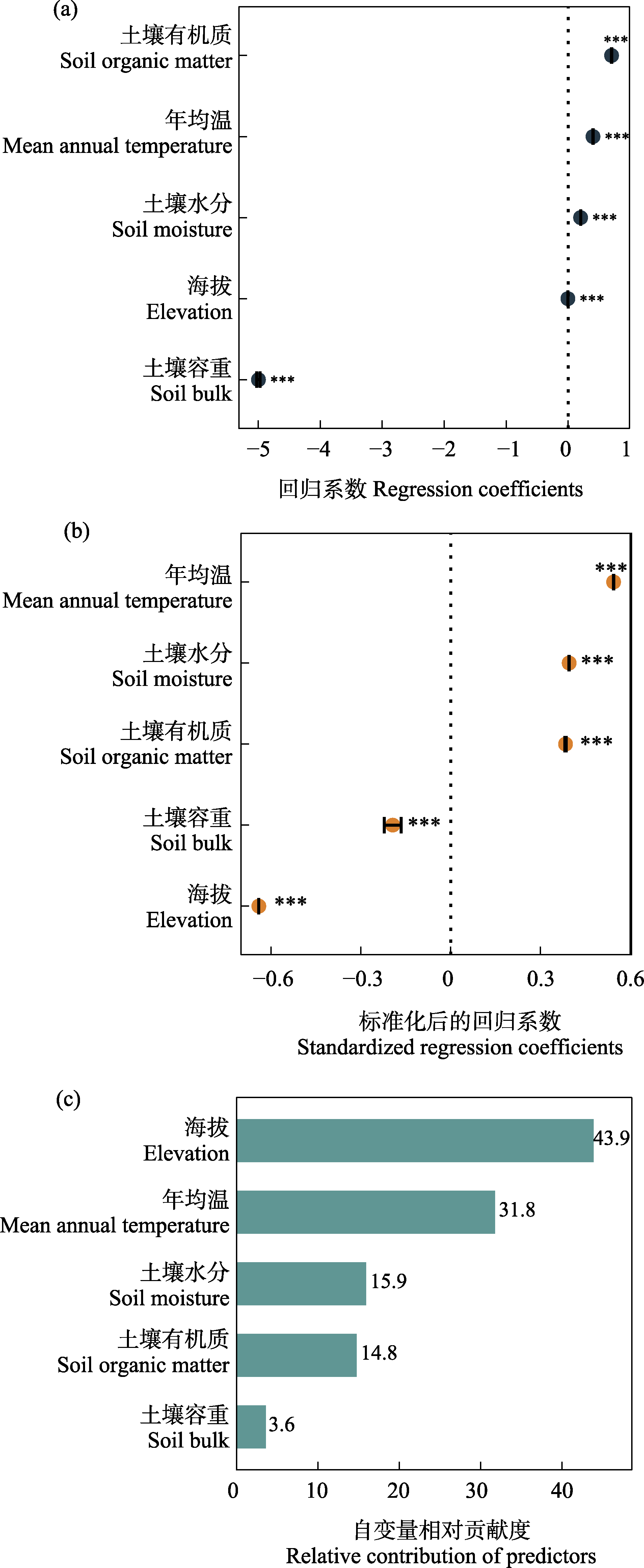
图1 线性回归模型的结果解释。(a)线性回归系数; (b)标准化后的线性回归系数; (c)基于变差分解和层次分割的自变量贡献度排序。*** P < 0.001。
Fig. 1 Interpretation of linear regression model results. (a) Linear regression coefficients; (b) Standardized linear regression coefficients; (c) Variable importance ranking based on variation partitioning and hierarchical partitioning. *** P < 0.001.
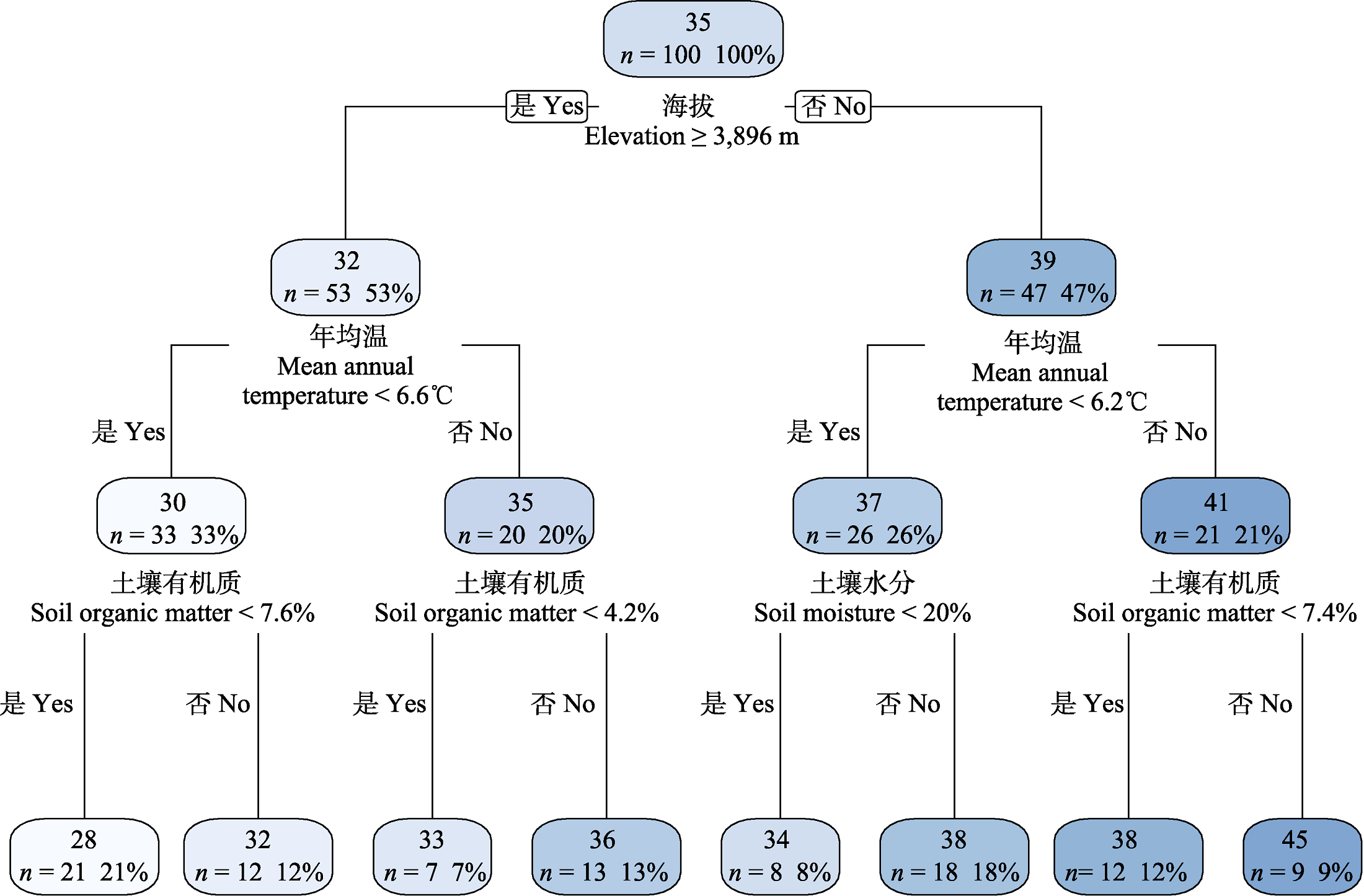
图2 回归树的分析结果。n为样本个数, 百分值为属于此类的样本数量占比。
Fig. 2 Regression tree results. n is the number of samples, and percentage value represents the proportion of samples belonging to this category.
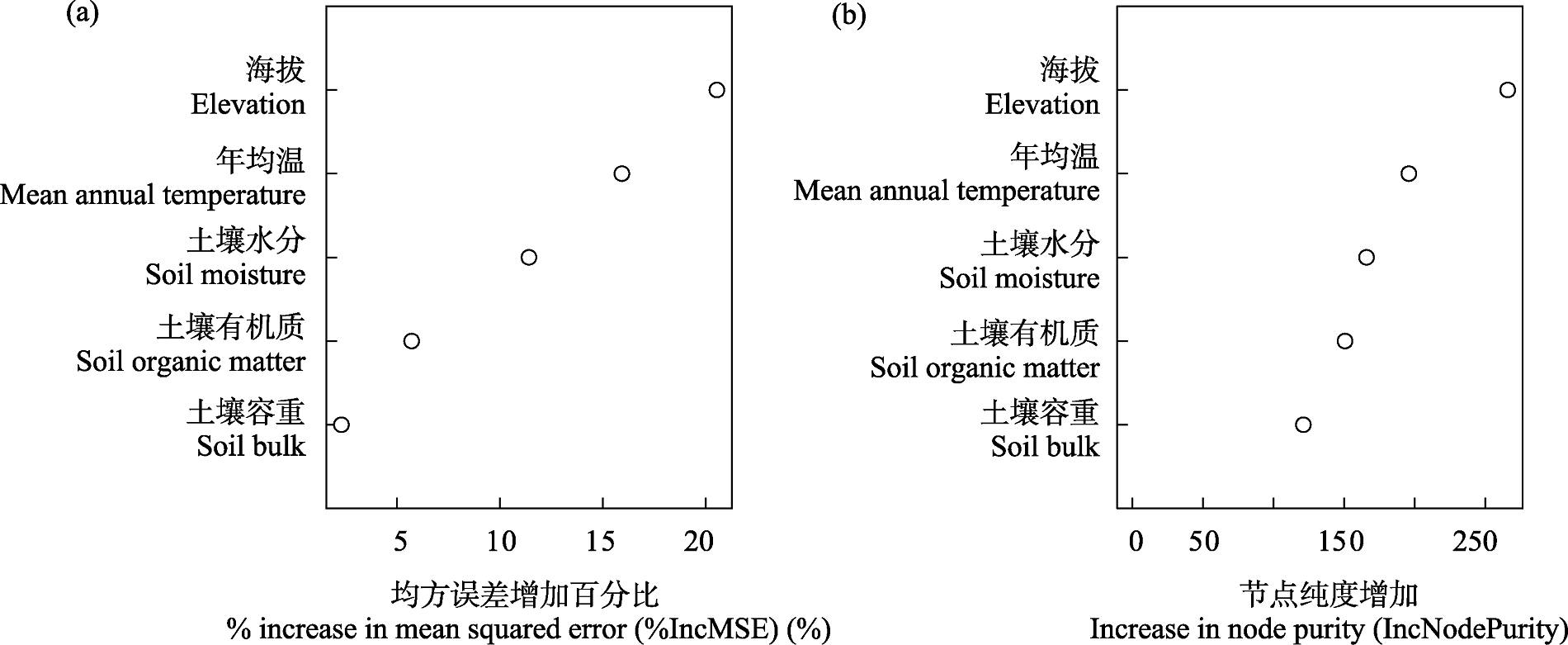
图3 随机森林模型基于置换特征(a)和节点纯度(b)的自变量重要性排序
Fig. 3 Ranking of variable importance based on permutation importance (a) and node impurity (b) in the random forest model
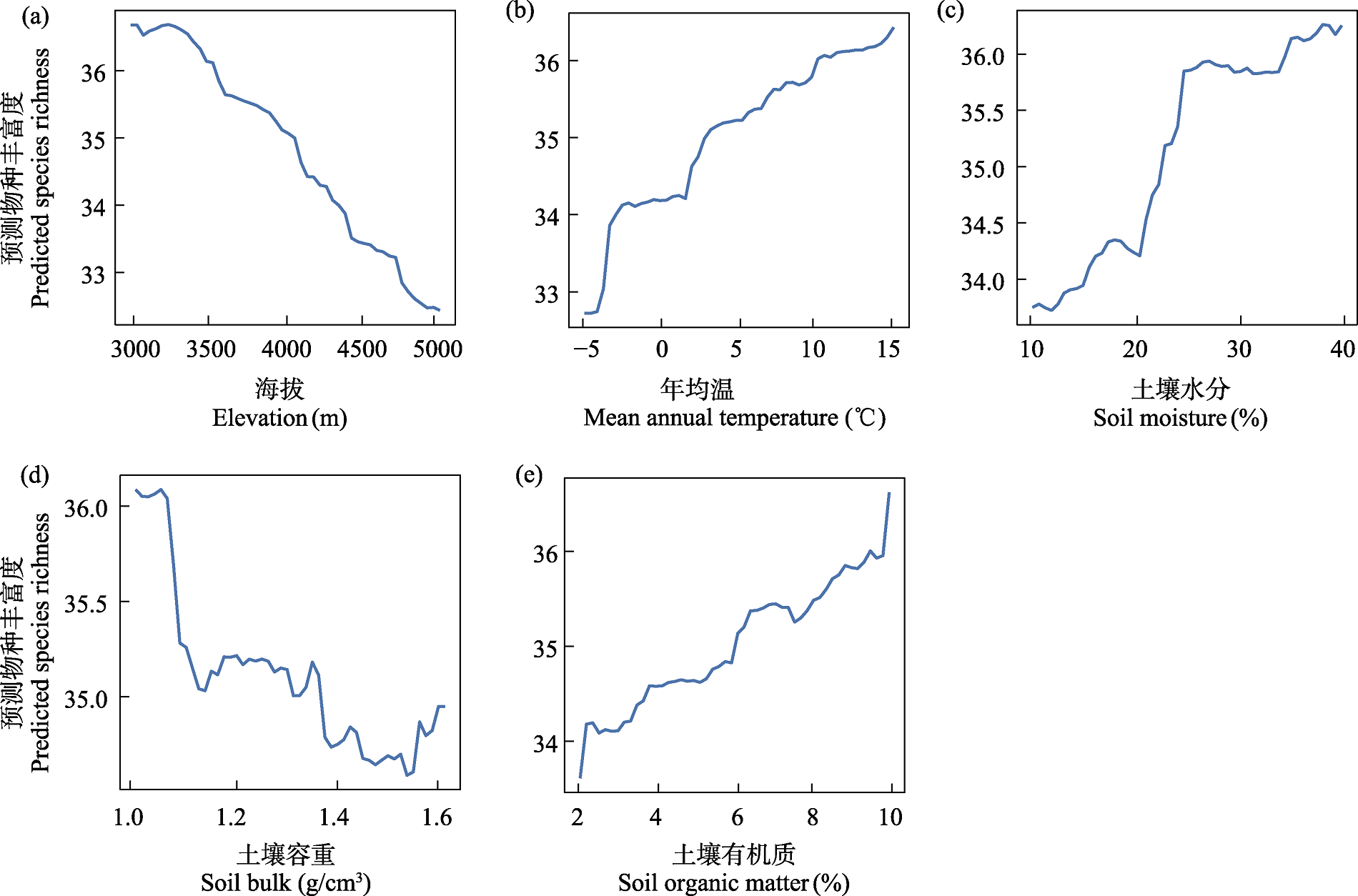
图4 针对随机森林模型的部分依赖图
Fig. 4 Partial dependence plots for the random forest model
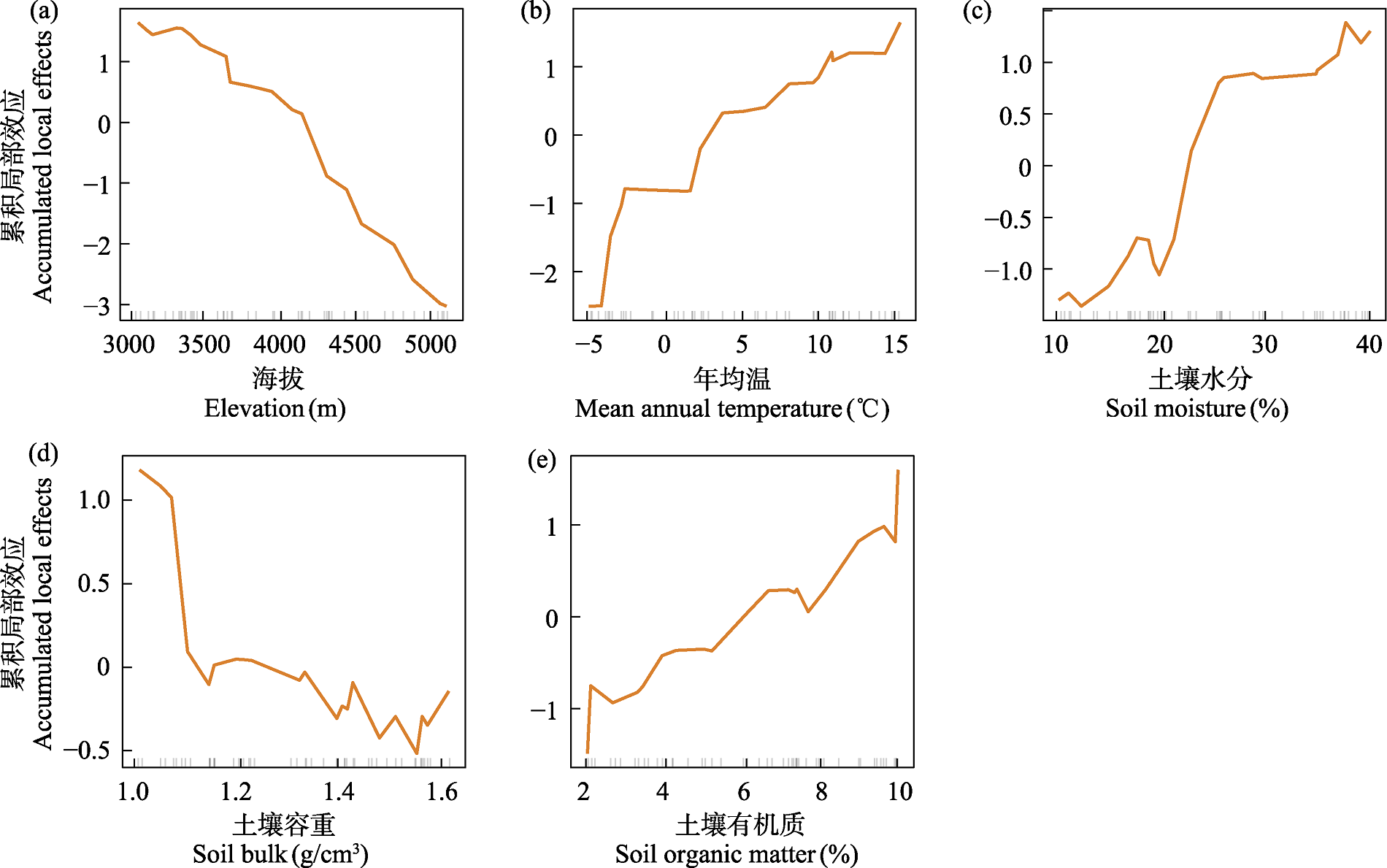
图5 针对随机森林模型的累积局部效应图。横轴中的小竖线表示该变量在数据中的分布情况。
Fig. 5 Accumulated local effects plot (ALE) based on the random forest model. The small vertical ticks on the x-axis indicate the distribution of the variable in the dataset.
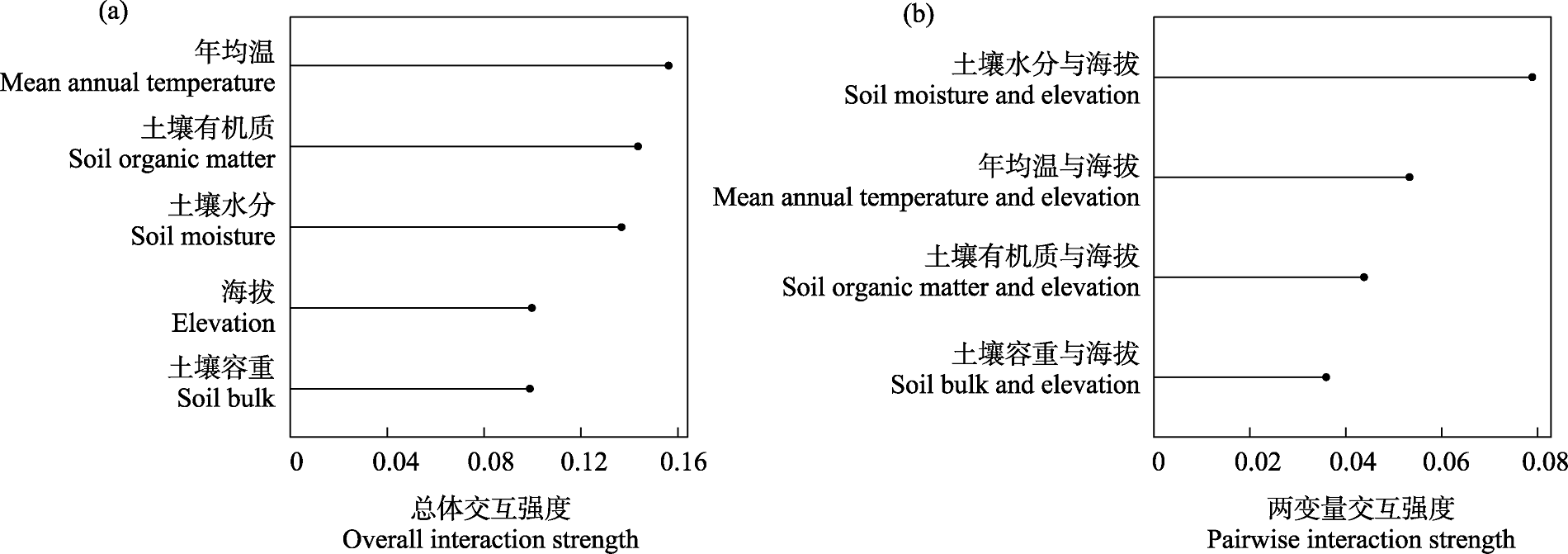
图6 基于H-statistic的特征交互。(a)单个变量与其他变量的总体交互强度; (b)变量间的两两交互强度。
Fig. 6 Feature interactions based on H-statistic. (a) The overall interaction strength between a single variable and all other variables; (b) The pairwise interaction strength between variables.
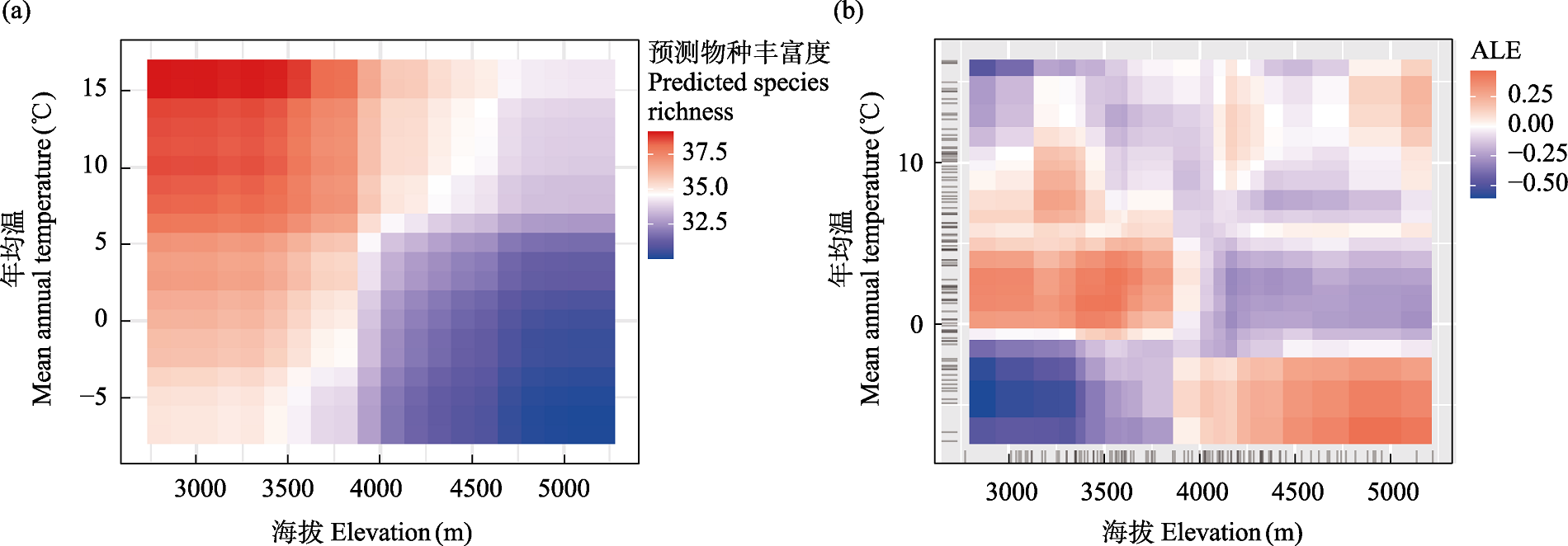
图7 海拔与年均温的二维交互图。(a)部分依赖图; (b)累积局部效应图(ALE)。
Fig. 7 Two-dimensional interaction plots of elevation and mean annual temperature. (a) Partial dependence plot; (b) Accumulated local effects plot (ALE).
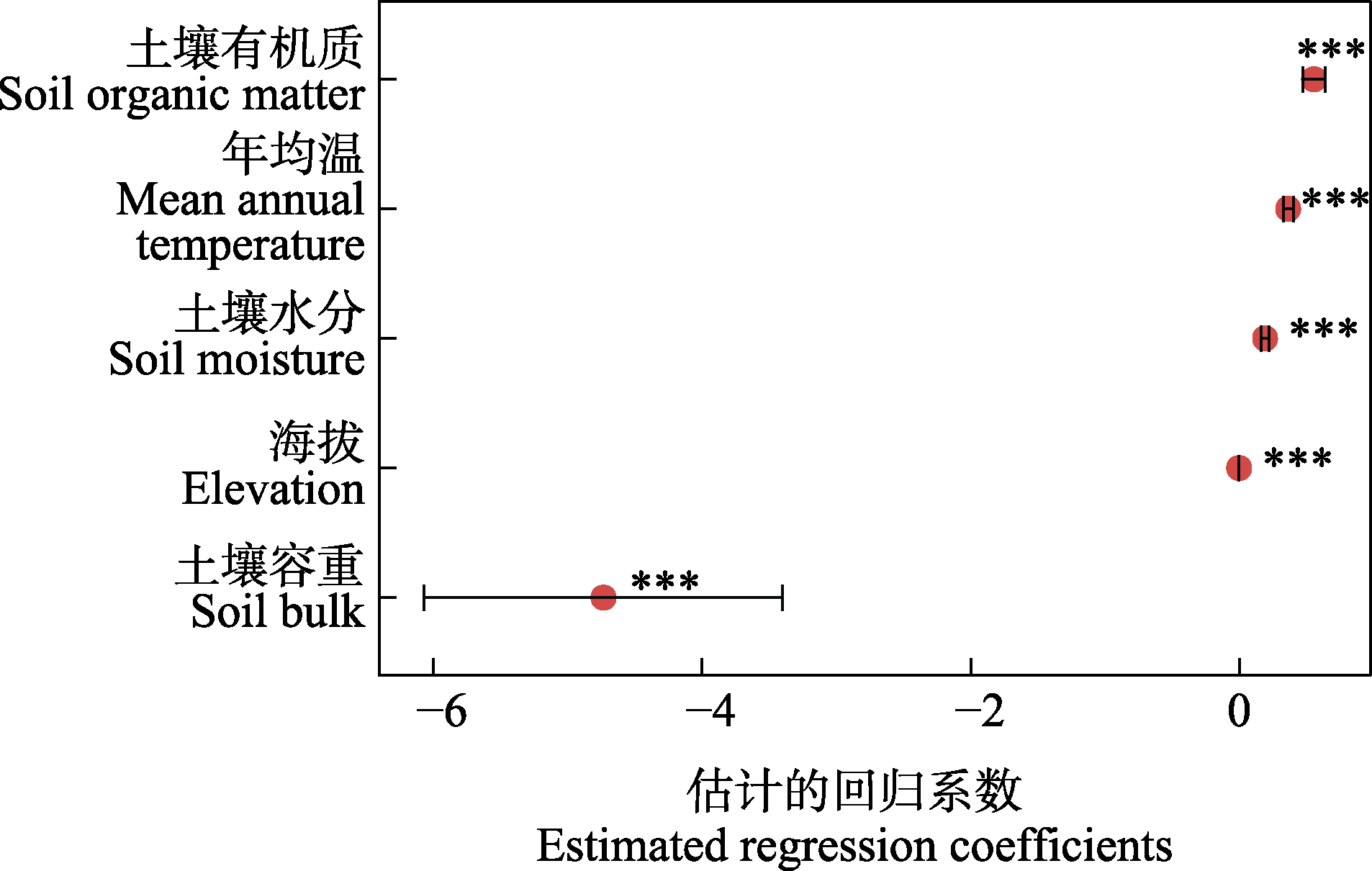
图8 基于线性回归的全局代理模型结果。*** P < 0.001。
Fig. 8 Results of global surrogate modeling using linear regression. *** P < 0.001.
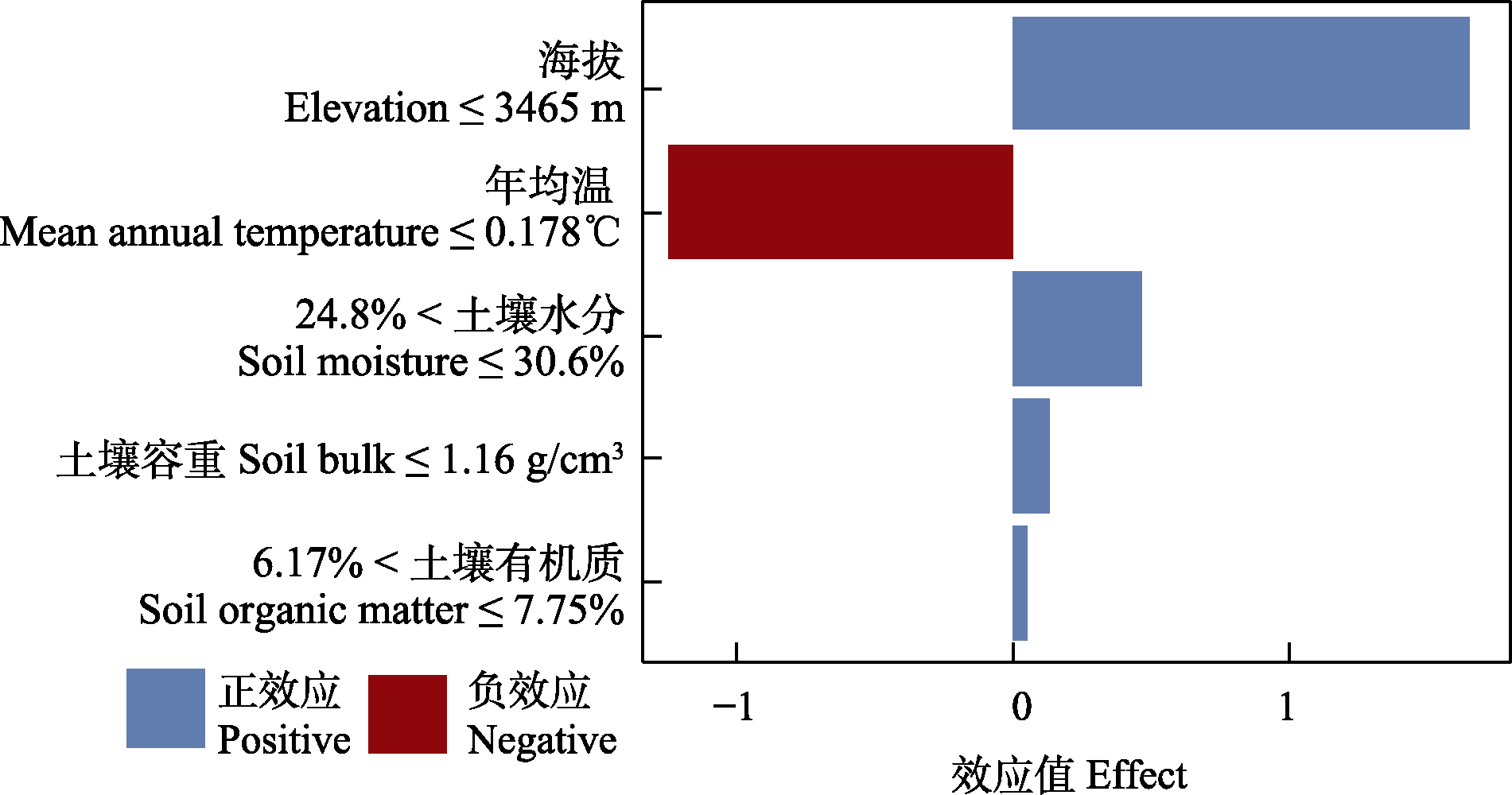
图9 对第30个数据点预测值的局部模型无关解释
Fig. 9 Local interpretable model-agnostic explanations for the prediction of the 30th sample
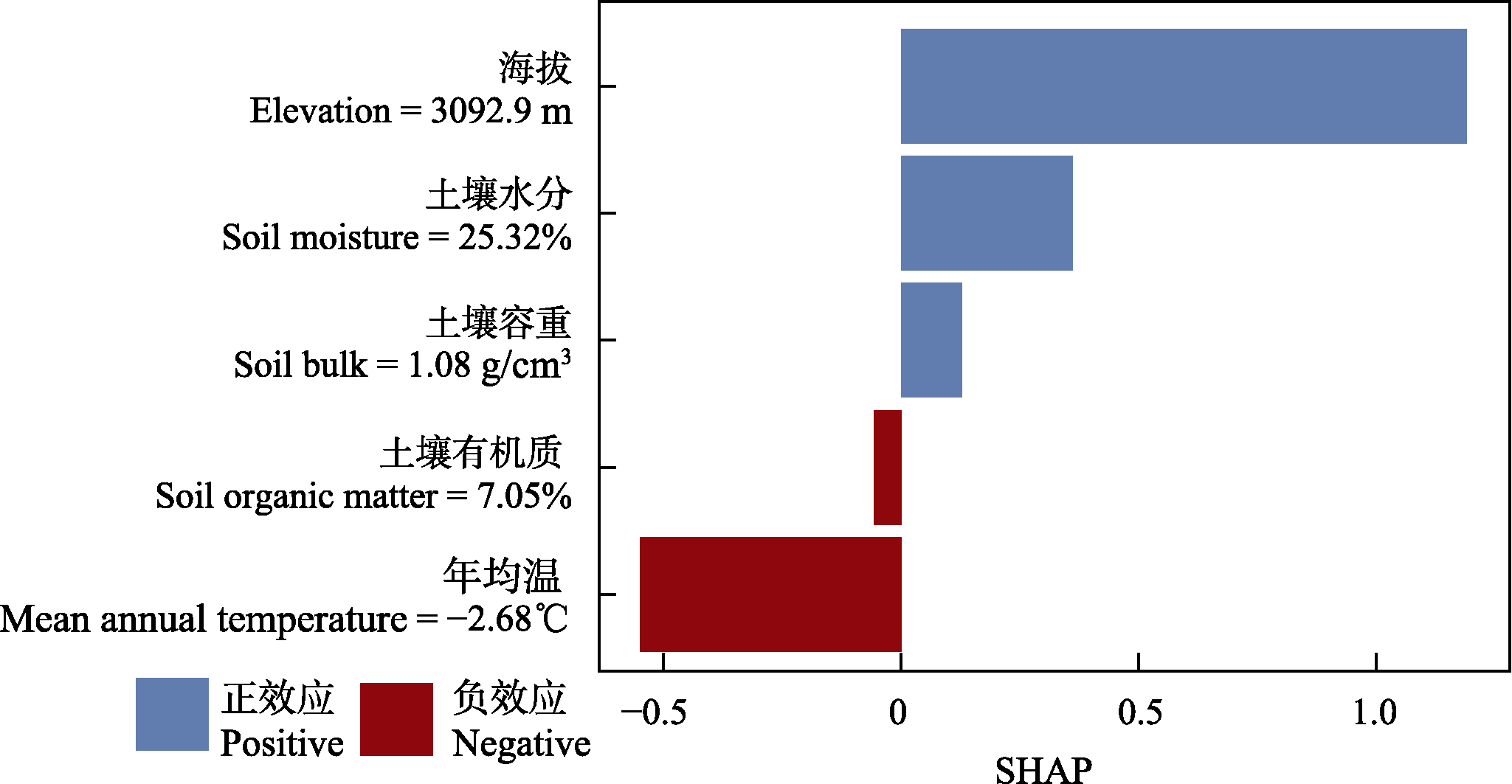
图10 对第30个数据点预测值的Shapley加性解释(SHAP)
Fig. 10 Shapley additive explanations (SHAP) for the prediction of the 30th sample
| 方法 Methods | 适合模型 Applicable models | 是否模型无关 Whether it is model-agnostic | 解释层级 Interpretation level | 优点 Advantages | 局限性/注意事项 Limitations/notes |
|---|---|---|---|---|---|
| 回归系数 Regression coefficients | 线性模型(白盒) Linear models (white-box) | 否 No | 全局 Global | 直观、易于理解 Intuitive and easy to interpret | 依赖模型假设; 适用于线性关系 Dependent on model assumptions; suitable only for linear relationships |
| 决策树 Decision tree | 决策树类模型(白盒) Decision tree models (white-box) | 否 No | 全局 Global | 可视化清晰, 展示变量优先级 Clearly visualizes structure; reveals variable hierarchy | 易过拟合, 稳定性差 Overfitting-prone and unstable |
| 置换特征重要性 Permutation importance | 黑盒模型 Black-box models | 是 Yes | 全局 Global | 简单直观, 适用于多数模型 Simple and widely applicable; supports many models | 易受变量相关性影响, 结果不稳定 Sensitive to variable correlation; results may be unstable |
| Gini重要性 Gini importance | 随机森林等树模型 Tree-based models such as random forest | 否 No | 全局 Global | 计算快速、内置于模型 Fast computation; embedded in model | 偏向取值范围大的变量, 不适用于所有模型 Biased toward variables with large ranges; lacks generalizability |
| 部分依赖图 Partial dependence plots (PDP) | 黑盒/白盒模型 Black-/white-box models | 是 Yes | 全局 Global | 图形表达直观, 适合展示非线性关系 Visual and intuitive; useful for nonlinear patterns | 假设变量独立, 存在不现实组合风险 Assumes feature independence; may generate unrealistic combinations |
| 累积局部效应图 Accumulated local effects (ALE) | 黑盒/白盒模型 Black-/white-box models | 是 Yes | 全局 Global | 不依赖变量独立性假设, 解释更稳定 Free from variable independence assumptions, yielding more robust interpretations | Y轴是特征变化的局部平均效应值, 不易直观理解 Y-axis shows local average effect, which lacks intuitive clarity |
| H-statistic交互分析 H-statistic interaction analysis | 黑盒/白盒模型 Black-/white-box models | 是 Yes | 全局 Global | 可量化变量交互强度, 补充单变量解释的不足 Quantifies feature interaction strength; supplements univariate interpretations | 解释难度略高, 计算复杂度大 Interpretation complexity increases; relatively high computational cost |
| 全局代理模型 Global surrogate models | 黑盒模型 Black-box models | 是 Yes | 全局 Global | 简化复杂模型, 借助可解释模型进行间接解释 Approximates complex models with simpler ones for interpretation | 逼近可能不完全, 解释不一 定准确 Approximation may be incomplete; explanation only partially faithful |
| 局部模型无关解释 Local interpretable model-agnostic explanations | 黑盒模型 Black-box models | 是 Yes | 局部 Local | 适合个体预测的解释 Suitable for explaining individual predictions | 局部解释不稳定, 依赖邻域构建 Unstable local explanations; neighborhood-dependent |
| Shapley加性解释 Shapley additive explanations | 黑盒/白盒模型 Black-/white-box models | 是 Yes | 全局/局部 Global/Local | 理论稳健、解释公平性强 Theoretically sound; ensures fair feature attribution | 计算复杂度大 High computational cost |
表2 部分可解释机器学习方法的对比总结
Table 2 Comparative summary of selected interpretable machine learning methods
| 方法 Methods | 适合模型 Applicable models | 是否模型无关 Whether it is model-agnostic | 解释层级 Interpretation level | 优点 Advantages | 局限性/注意事项 Limitations/notes |
|---|---|---|---|---|---|
| 回归系数 Regression coefficients | 线性模型(白盒) Linear models (white-box) | 否 No | 全局 Global | 直观、易于理解 Intuitive and easy to interpret | 依赖模型假设; 适用于线性关系 Dependent on model assumptions; suitable only for linear relationships |
| 决策树 Decision tree | 决策树类模型(白盒) Decision tree models (white-box) | 否 No | 全局 Global | 可视化清晰, 展示变量优先级 Clearly visualizes structure; reveals variable hierarchy | 易过拟合, 稳定性差 Overfitting-prone and unstable |
| 置换特征重要性 Permutation importance | 黑盒模型 Black-box models | 是 Yes | 全局 Global | 简单直观, 适用于多数模型 Simple and widely applicable; supports many models | 易受变量相关性影响, 结果不稳定 Sensitive to variable correlation; results may be unstable |
| Gini重要性 Gini importance | 随机森林等树模型 Tree-based models such as random forest | 否 No | 全局 Global | 计算快速、内置于模型 Fast computation; embedded in model | 偏向取值范围大的变量, 不适用于所有模型 Biased toward variables with large ranges; lacks generalizability |
| 部分依赖图 Partial dependence plots (PDP) | 黑盒/白盒模型 Black-/white-box models | 是 Yes | 全局 Global | 图形表达直观, 适合展示非线性关系 Visual and intuitive; useful for nonlinear patterns | 假设变量独立, 存在不现实组合风险 Assumes feature independence; may generate unrealistic combinations |
| 累积局部效应图 Accumulated local effects (ALE) | 黑盒/白盒模型 Black-/white-box models | 是 Yes | 全局 Global | 不依赖变量独立性假设, 解释更稳定 Free from variable independence assumptions, yielding more robust interpretations | Y轴是特征变化的局部平均效应值, 不易直观理解 Y-axis shows local average effect, which lacks intuitive clarity |
| H-statistic交互分析 H-statistic interaction analysis | 黑盒/白盒模型 Black-/white-box models | 是 Yes | 全局 Global | 可量化变量交互强度, 补充单变量解释的不足 Quantifies feature interaction strength; supplements univariate interpretations | 解释难度略高, 计算复杂度大 Interpretation complexity increases; relatively high computational cost |
| 全局代理模型 Global surrogate models | 黑盒模型 Black-box models | 是 Yes | 全局 Global | 简化复杂模型, 借助可解释模型进行间接解释 Approximates complex models with simpler ones for interpretation | 逼近可能不完全, 解释不一 定准确 Approximation may be incomplete; explanation only partially faithful |
| 局部模型无关解释 Local interpretable model-agnostic explanations | 黑盒模型 Black-box models | 是 Yes | 局部 Local | 适合个体预测的解释 Suitable for explaining individual predictions | 局部解释不稳定, 依赖邻域构建 Unstable local explanations; neighborhood-dependent |
| Shapley加性解释 Shapley additive explanations | 黑盒/白盒模型 Black-/white-box models | 是 Yes | 全局/局部 Global/Local | 理论稳健、解释公平性强 Theoretically sound; ensures fair feature attribution | 计算复杂度大 High computational cost |
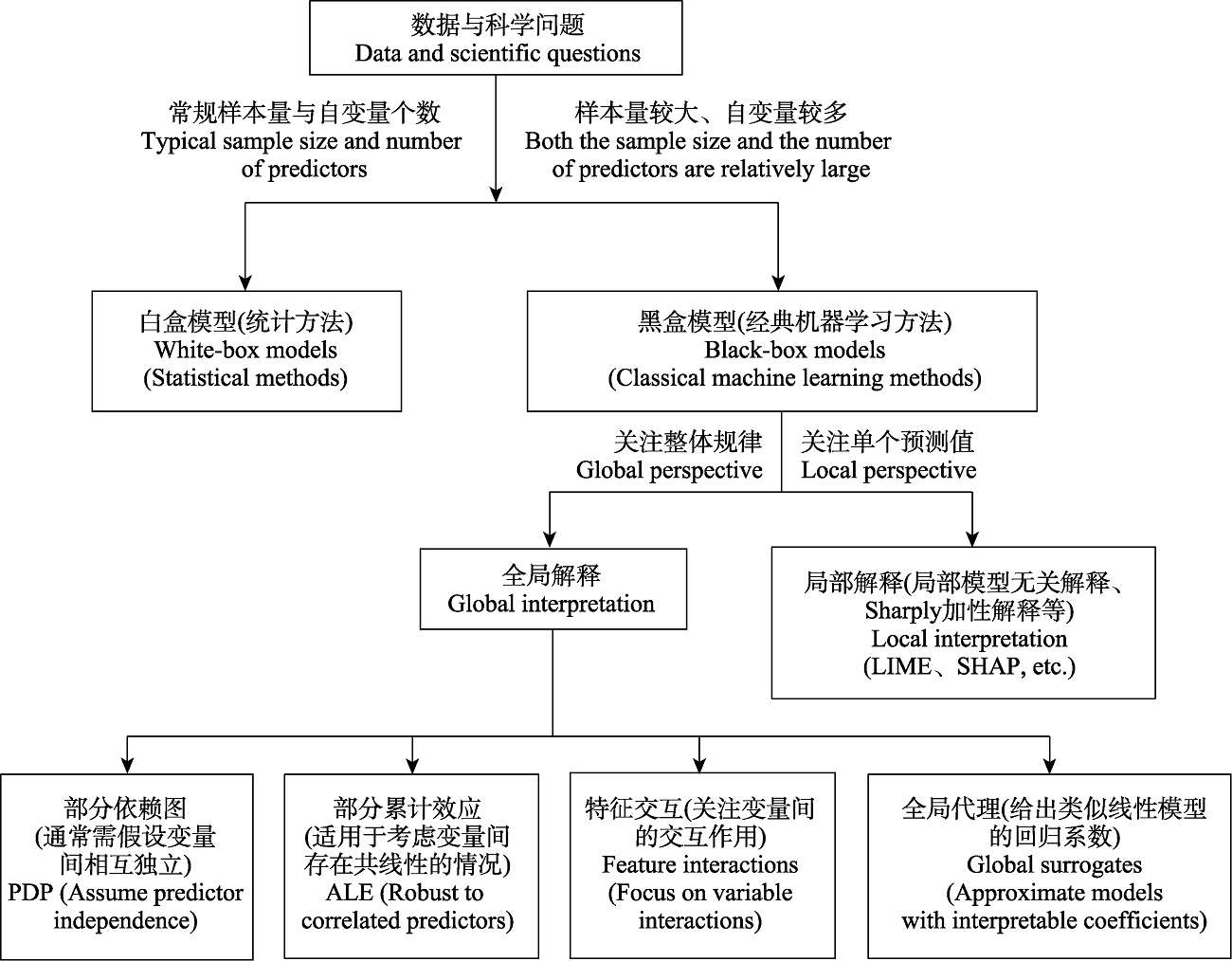
图11 可解释机器学习方法的选择建议
Fig. 11 Recommendations for selecting interpretable machine learning methods. LIME, Local interpretable model-agnostic explanations; SHAP, Shapley additive explanations; PDP, Partial dependence plots; ALE, Accumulated local effects.
| [1] | Apley DW, Zhu JY (2020) Visualizing the effects of predictor variables in black box supervised learning models. Journal of the Royal Statistical Society B: Statistical Methodology, 82, 1059-1086. |
| [2] | Beery S, Cole E, Parker J, Perona P, Winner K (2021) Species distribution modeling for machine learning practitioners: A review. ACM SIGCAS Conference on Computing and Sustainable Societies (COMPASS’21), New York, USA. |
| [3] |
Breiman L (2001) Statistical modeling: The two cultures. Statistical Science, 16, 199-231.
DOI URL |
| [4] | Christoph M (2022) Interpretable Machine Learning: A Guide for Making Black Box Models Explainable, 2nd edn. Independently published. |
| [5] |
Davison CW, Assmann JJ, Normand S, Rahbek C, Morueta-Holme N (2023) Vegetation structure from LiDAR explains the local richness of birds across Denmark. Journal of Animal Ecology, 92, 1332-1344.
DOI PMID |
| [6] |
De’ath G, Fabricius KE (2000) Classification and regression trees: A powerful yet simple technique for ecological data analysis. Ecology, 81, 3178-3192.
DOI URL |
| [7] |
Ding Y, Zang RG (2021) Determinants of aboveground biomass in forests across three climatic zones in China. Forest Ecology Management, 482, 118805.
DOI URL |
| [8] | Friedman JH (2001) Greedy function approximation: A gradient boosting machine. Annals of Statistics, 29, 1189-1232. |
| [9] | Friedman JH, Popescu BE (2008) Predictive learning via rule ensembles. Annals of Applied Statistics, 2, 916-954. |
| [10] |
Gobeyn S, Mouton AM, Cord AF, Kaim A, Volk M, Goethals P (2019) Evolutionary algorithms for species distribution modelling: A review in the context of machine learning. Ecological Modelling, 392, 179-195.
DOI |
| [11] |
Guo QH, Jin SC, Li M, Yang QL, Xu KX, Ju YZ, Zhang J, Xuan J, Liu J, Su YJ, Xu Q, Liu Y (2020) Application of deep learning in ecological resource research: Theories, methods, and challenges. Science China Earth Sciences, 63, 1457-1474.
DOI |
| [12] | Jiang SJ, Sweet L, Blougouras G, Brenning A, Li WT, Reichstein M, Denzler J, SG W, Yu G, Huang FN (2024) How interpretable machine learning can benefit process understanding in the geosciences. Earth’s Future, 12, e2024EF004540. |
| [13] |
Lai JS, Tang J, Li TY, Zhang AY, Mao LF (2024) Evaluating the relative importance of predictors in generalized additive models using the gam.hp R package. Plant Diversity, 46, 542-546.
DOI URL |
| [14] |
Lai JS, Zou Y, Zhang JL, Peres-Neto PR (2022a) Generalizing hierarchical and variation partitioning in multiple regression and canonical analyses using the rdacca.hp R package. Methods in Ecology Evolution, 13, 782-788.
DOI URL |
| [15] |
Lai JS, Zou Y, Zhang S, Zhang XG, Mao LF (2022b) glmm.hp: An R package for computing individual effect of predictors in generalized linear mixed models. Journal of Plant Ecology, 15, 1302-1307.
DOI URL |
| [16] |
Li HJ, Wang B, Niu X, Liang YL, Li JY (2023) Application of machine learning technology in ecology. Chinese Journal of Ecology, 42, 2767-2775. (in Chinese with English abstract)
DOI |
| [李慧杰, 王兵, 牛香, 梁咏亮, 李静尧 (2023) 机器学习技术在生态学中的应用进展. 生态学杂志, 42, 2767-2775.] | |
| [17] |
Liu ZL, Peng CH, Work T, Candau J, DesRochers A, Kneeshaw D (2018) Application of machine-learning methods in forest ecology: Recent progress and future challenges. Environmental Reviews, 26, 339-350.
DOI URL |
| [18] |
Lu SZ, Qiao XG, Zhao LQ, Wang Z, Gao CG, Wang J, Guo K (2020) Basic characteristics of Stipa sareptana var. krylovii communities in China. Chinese Journal of Plant Ecology, 44, 1087-1094. (in Chinese with English Abstract)
DOI URL |
| [陆帅志, 乔鲜果, 赵利清, 王孜, 高趁光, 王静, 郭柯 (2020) 中国西北针茅草原的基本群落特征. 植物生态学报, 44, 1087-1094.] | |
| [19] | Lucas T (2020) A translucent box: Interpretable machine learning in ecology. Ecological Monographs, 90, e01422. |
| [20] |
Lundberg SM, Erion G, Chen H, DeGrave A, Prutkin JM, Nair B, Katz R, Himmelfarb J, Bansal N, Lee SI (2020) From local explanations to global understanding with explainable AI for trees. Nature Machine Intelligence, 2, 56-67.
DOI PMID |
| [21] | Lundberg SM, Lee SI (2017) A unified approach to interpreting model predictions. Conference on Neural Information Processing Systems (NIPS 2017), Long Beach, USA |
| [22] | Mac Aodha O, Gibb R, Barlow KE, Browning E, Firman M, Freeman R, Harder B, Kinsey L, Mead GR, Newson SE (2018) Bat detective—Deep learning tools for bat acoustic signal detection. PLoS Computational Biology, 14, e1005995. |
| [23] | Norberg A, Abrego N, Blanchet FG, Adler FR, Anderson BJ, Anttila J, Araújo MB, Dallas T, Dunson D, Elith J, Foster SD, Fox R, Franklin J, Godsoe W, Guisan A, O’Hara B, Hill NA, Holt RD, Hui FKC, Husby M, Kålås JA, Lehikoinen A, Luoto M, Mod HK, Newell G, Renner I, Roslin T, Soininen J, Thuiller W, Vanhatalo J, Warton D, White M, Zimmermann NE, Gravel D, Ovaskainen O (2019) A comprehensive evaluation of predictive performance of 33 species distribution models at species and community levels. Ecological Monographs, 89, e01370. |
| [24] |
Pichler M, Hartig F (2023) Machine learning and deep learning—A review for ecologists. Methods in Ecology and Evolution, 14, 994-1016.
DOI URL |
| [25] |
Pollock L J, O’Connor LMJ, Mokany K, Rosauer DF, Talluto L, Thuiller W (2020) Protecting biodiversity (in all its complexity): New models and methods. Trends in Ecology & Evolution, 35, 1119-1128.
DOI URL |
| [26] |
Reichstein M, Camps-Valls G, Stevens B, Jung M, Denzler J, Carvalhais N, Prabhat F (2019) Deep learning and process understanding for data-driven Earth system science. Nature, 566, 195-204.
DOI |
| [27] | Ribeiro MT, Singh S, Guestrin C (2016) “Why should I trust you?” Explaining the predictions of any classifier. Proceedings of the 22nd ACM SIGKDD International Conference on Knowledge Discovery and Data Mining, San Francisco, USA. |
| [28] | Rudin C, Chen CF, Chen Z, Huang HY, Semenova L, Zhong C (2022) Interpretable machine learning: Fundamental principles and 10 grand challenges. Statistic Surveys, 16, 1-85. |
| [29] |
Shamir L, Yerby C, Simpson R, von Benda-Beckmann AM, Tyack P, Samarra F, Miller P, Wallin J (2014) Classification of large acoustic datasets using machine learning and crowdsourcing: Application to whale calls. The Journal of the Acoustical Society of America, 135, 953-962.
DOI URL |
| [30] |
Teng QY, Liu Z, Song YQ, Han K, Lu Y (2022) A survey on the interpretability of deep learning in medical diagnosis. Multimedia Systems, 28, 2335-2355.
DOI |
| [31] | Thampi A (2022) Interpretable AI:Building Explainable Machine Learning Systems. Manning Publications, New York. |
| [32] |
Tuia D, Kellenberger B, Beery S, Costelloe BR, Zuffi S, Risse B, Mathis A, Mathis MW, van Langevelde F, Burghardt T, Kays R, Klinck H, Wikelski M, Couzin ID, van Horn G, Crofoot MC, Stewart CV, Berger WT (2022) Perspectives in machine learning for wildlife conservation. Nature Communications, 13, 792.
DOI PMID |
| [33] |
Wäldchen J, Mäder P (2018) Machine learning for image based species identification. Methods in Ecology and Evolution, 9, 2216-2225.
DOI URL |
| [34] |
Welchowski T, Maloney KO, Mitchell R, Schmid M (2022) Techniques to improve ecological interpretability of black-box machine learning models: Case study on biological health of streams in the United States with gradient boosted trees. Journal of Agricultural, Biological Environmental Statistics, 27, 175-197.
DOI |
| [35] |
Xue YF, Wang TJ, Skidmore AK (2017) Automatic counting of large mammals from very high resolution panchromatic satellite imagery. Remote Sensing, 9, 878.
DOI URL |
| [36] |
Yu QY, Ji WJ, Prihodko L, Ross CW, Anchang JY, Hanan NP (2021) Study becomes insight: Ecological learning from machine learning. Methods in Ecology and Evolution, 12, 2117-2128.
DOI PMID |
| [37] |
Yu SJ, Wang J, Zhang CY, Zhao XH (2022) Impact and mechanism of maintaining biomass stability in a temperate coniferous and broadleaved mixed forest. Chinese Journal of Plant Ecology, 46, 632-641. (in Chinese with English abstract)
DOI URL |
|
[于水今, 王娟, 张春雨, 赵秀海 (2022) 温带针阔混交林生物量稳定性影响机制. 植物生态学报, 46, 632-641.]
DOI |
|
| [38] |
Zhao YF, Zhu WW, Wei PP, Fang P, Zhang XW, Yan NN, Liu WJ, Zhao H, Wu QR (2022) Classification of Zambian grasslands using random forest feature importance selection during the optimal phenological period. Ecological Indicators, 135, 108529.
DOI URL |
| [39] | Zheng LL, Xu JY, Wang XL, Liu BG (2020) Study on relationships between vegetation community distribution and topsoil factors based on random forests in shoaly wetlands of Poyang Lake. Soils, 52, 378-385. (in Chinese with English Abstract) |
| [郑利林, 徐金英, 王晓龙, 刘宝贵 (2020) 基于随机森林方法研究鄱阳湖典型洲滩植被群落分布与表层土壤因子耦合关系. 土壤, 52, 378-385.] |
| [1] | 高雯琪, 向景荣, 赵耀, 范灵霜, 谷圆, 邵韦涵, 李高俊, 赵光军, 陈明斌, 蔡杏伟, 陈凯. 海南热带雨林国家公园黎母山和尖峰岭溪流鱼类群落特征及其对土地利用的响应[J]. 生物多样性, 2026, 34(2): 25374-. |
| [2] | 李帅, 刘卫华, 许驭丹, 田晓波, 宋厚娟, 岳晓婷, 武玲玲, 张青, 上官铁梁. 山西省野生维管植物编目和分布数据集[J]. 生物多样性, 2025, 33(7): 24317-. |
| [3] | 林秦文, 张娜, 王强. 中国盐生植物编目和分布数据集[J]. 生物多样性, 2025, 33(7): 25030-. |
| [4] | 杨泉峰, 唐艳杰, 肖海军, 王颖, 张蓉, 欧阳芳, 魏淑花. 宁夏不同草原类型植物多样性-蝗虫-步甲的级联效应及对初级生产力的影响[J]. 生物多样性, 2025, 33(6): 25021-. |
| [5] | 宋威, 程才, 王嘉伟, 吴纪华. 土壤微生物对植物多样性-生态系统功能关系的调控作用[J]. 生物多样性, 2025, 33(4): 24579-. |
| [6] | 张浩斌, 肖路, 刘艳杰. 夜间灯光对外来入侵植物和本地植物群落多样性和生长的影响[J]. 生物多样性, 2025, 33(4): 24553-. |
| [7] | 卢炜煜, 陈旭, 张日谦, 张云海, 李昭. 氮和牛粪输入对典型草原植物种-面积关系的影响[J]. 生物多样性, 2025, 33(12): 25251-. |
| [8] | 沈君瀚, 高海洋, 孙松, 吴飞, 何南, 王鹤, 华彦, 武正军. 鳄蜥的微生境选择特征及保护启示[J]. 生物多样性, 2025, 33(11): 25203-. |
| [9] | 连佳丽, 陈婧, 杨雪琴, 赵莹, 罗叙, 韩翠, 赵雅欣, 李建平. 荒漠草原植物多样性和微生物多样性对降水变化的响应[J]. 生物多样性, 2024, 32(6): 24044-. |
| [10] | 万凤鸣, 万华伟, 张志如, 高吉喜, 孙晨曦, 王永财. 草地植物多样性无人机调查的应用潜力[J]. 生物多样性, 2024, 32(3): 23381-. |
| [11] | 张乃鹏, 梁洪儒, 张焱, 孙超, 陈勇, 王路路, 夏江宝, 高芳磊. 土壤类型和地下水埋深对黄河三角洲典型盐沼植物群落空间分异的影响[J]. 生物多样性, 2024, 32(2): 23370-. |
| [12] | 蒋陈焜, 郁文彬, 饶广远, 黎怀成, Julien B. Bachelier, Hartmut H. Hilger, Theodor C. H. Cole. 植物系统发生海报——以演化视角介绍植物多样性的科教资料项目[J]. 生物多样性, 2024, 32(11): 24210-. |
| [13] | 韩赟, 迟晓峰, 余静雅, 丁旭洁, 陈世龙, 张发起. 青海野生维管植物名录[J]. 生物多样性, 2023, 31(9): 23280-. |
| [14] | 陈又生, 宋柱秋, 卫然, 罗艳, 陈文俐, 杨福生, 高连明, 徐源, 张卓欣, 付鹏程, 向春雷, 王焕冲, 郝加琛, 孟世勇, 吴磊, 李波, 于胜祥, 张树仁, 何理, 郭信强, 王文广, 童毅华, 高乞, 费文群, 曾佑派, 白琳, 金梓超, 钟星杰, 张步云, 杜思怡. 西藏维管植物多样性编目和分布数据集[J]. 生物多样性, 2023, 31(9): 23188-. |
| [15] | 宋柱秋, 叶文, 董仕勇, 金梓超, 钟星杰, 王震, 张步云, 徐晔春, 陈文俐, 李世晋, 姚纲, 徐洲锋, 廖帅, 童毅华, 曾佑派, 曾云保, 陈又生. 广东省高等植物多样性编目和分布数据集[J]. 生物多样性, 2023, 31(9): 23177-. |
| 阅读次数 | ||||||
|
全文 |
|
|||||
|
摘要 |
|
|||||
备案号:京ICP备16067583号-7
Copyright © 2026 版权所有 《生物多样性》编辑部
地址: 北京香山南辛村20号, 邮编:100093
电话: 010-62836137, 62836665 E-mail: biodiversity@ibcas.ac.cn
