

生物多样性 ›› 2025, Vol. 33 ›› Issue (12): 24323. DOI: 10.17520/biods.2024323 cstr: 32101.14.biods.2024323
• 综述 • 下一篇
孔祥飞1,2( ), 丁强1,3(), 王国全4(), 黄国华5(), 田哲豪1,6, 王新谱6(), 佟一杰1(), 宋志顺7(), 张晓宁8,9, 李卫海2(), 韩辉林10(), 李文亮11(), 聂瑞娥12(), 杨海东1,13, 杨星科1,13, 刘梅柯14(), 孙永明15(), 崔亚琴15(), 杨美霞16(), 刘宁1, 路园园1(), 李盼盼1,4(), 白明1,3,*()(
 )
)
收稿日期:2025-08-18
接受日期:2025-10-11
出版日期:2025-12-20
发布日期:2026-01-09
通讯作者:
*E-mail: baim@ioz.ac.cn
基金资助:
Xiangfei Kong1,2(), Qiang Ding1,3(), Guoquan Wang4(), Guohua Huang5(), Zhehao Tian1,6, Xinpu Wang6(), Yijie Tong1(), Zhishun Song7(), Xiaoning Zhang8,9, Weihai Li2(), Huilin Han10(), Wenliang Li11(), Rui’e Nie12(), Haidong Yang1,13, Xingke Yang1,13, Meike Liu14(), Yongming Sun15(), Yaqin Cui15(), Meixia Yang16(), Ning Liu1, Yuanyuan Lu1(), Panpan Li1,4(), Ming Bai1,3,*()()
Received:2025-08-18
Accepted:2025-10-11
Online:2025-12-20
Published:2026-01-09
Supported by:摘要:
昆虫是动物界中物种最为丰富的一类生物, 也是陆地与淡水生态系统中不可或缺的关键组成部分。人类活动的加剧导致全球生物多样性以前所未有的速度丧失, 第六次灭绝危机已经到来。这场危机在很大程度上是昆虫的危机, 昆虫数量的下降速度大约是脊椎动物的两倍。由此, 昆虫多样性监测的重要性日益凸显。为突破传统昆虫多样性监测高度依赖主动采集方式的技术路径, 进入21世纪以来, 加强被动式监测方法的应用已成为昆虫多样性监测领域的重要发展趋势。然而, 单一采样装置往往难以充分反映昆虫群落的真实结构, 采样不充分的问题依然普遍存在。如何在多区域尺度上整合多种被动式监测装置, 并在保证采样效率的同时实现标准化和可比性, 已成为全球昆虫多样性变化趋势评估中的核心科学问题之一。在此背景下, 中国科学院动物研究所白明研究员与英国帝国理工大学-英国自然历史博物馆Alfried Vogler教授联合诸多同行共同提出了“SITE-100”国际大科学计划。本项目计划在全球选定100个大样地, 基于生物多样性采样原则, 通过建设标准化样地, 利用多种被动式采集装备组合来定量收集从地表到半高空的昆虫样本, 从物种、形态、系统发育和遗传等多个多样性维度来探究全球昆虫多样性格局及其衰减机制。自2016年该项目提出以来, 团队已累计在中国建设了16个样地。同时, 联合国际同行在欧洲、非洲、亚洲、北美洲、南美洲、澳洲等地区建立了30余个样地。本文通过对“SITE-100”中国样地目前在昆虫多样性监测方面取得的研究成果、研发的新技术、新方法进行综述, 详细介绍了“SITE-100”样地的标准化工作流程, 以及各个新技术、新方法的特点与优势, 以期助力于中国森林生物多样性监测工作的更好开展, 推动在昆虫多样性时空分布格局评估、昆虫智能监测等方面技术标准体系的形成。
孔祥飞, 丁强, 王国全, 黄国华, 田哲豪, 王新谱, 佟一杰, 宋志顺, 张晓宁, 李卫海, 韩辉林, 李文亮, 聂瑞娥, 杨海东, 杨星科, 刘梅柯, 孙永明, 崔亚琴, 杨美霞, 刘宁, 路园园, 李盼盼, 白明 (2025) “SITE-100”中国样地昆虫多样性监测研究进展. 生物多样性, 33, 24323. DOI: 10.17520/biods.2024323.
Xiangfei Kong, Qiang Ding, Guoquan Wang, Guohua Huang, Zhehao Tian, Xinpu Wang, Yijie Tong, Zhishun Song, Xiaoning Zhang, Weihai Li, Huilin Han, Wenliang Li, Rui’e Nie, Haidong Yang, Xingke Yang, Meike Liu, Yongming Sun, Yaqin Cui, Meixia Yang, Ning Liu, Yuanyuan Lu, Panpan Li, Ming Bai (2025) Research progress of insect diversity in “SITE-100” sampling sites in China. Biodiversity Science, 33, 24323. DOI: 10.17520/biods.2024323.
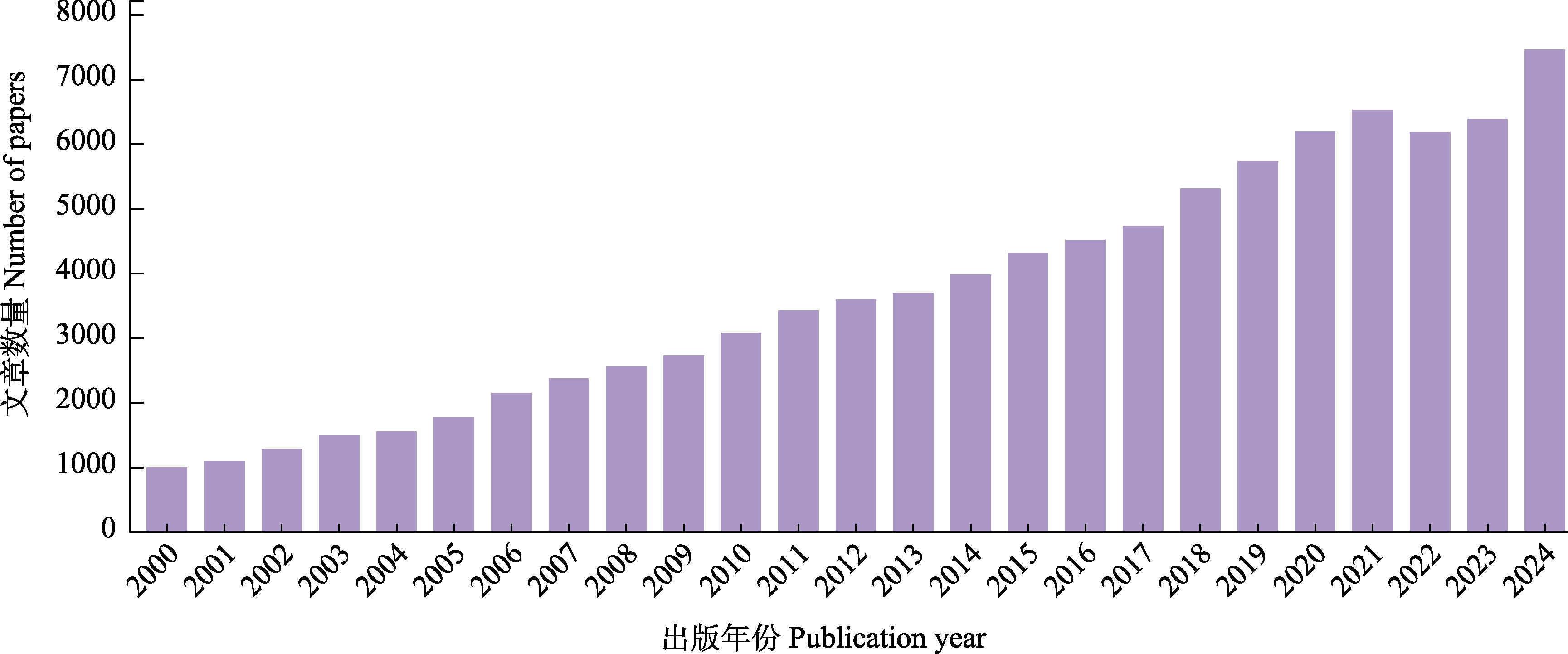
图1 Web of Science中检索到的2000-2024年发表的关于昆虫多样性主题的文献数量
Fig. 1 The number of papers retrieved from the Web of Science on the topic of insect diversity published between 2000 and 2024
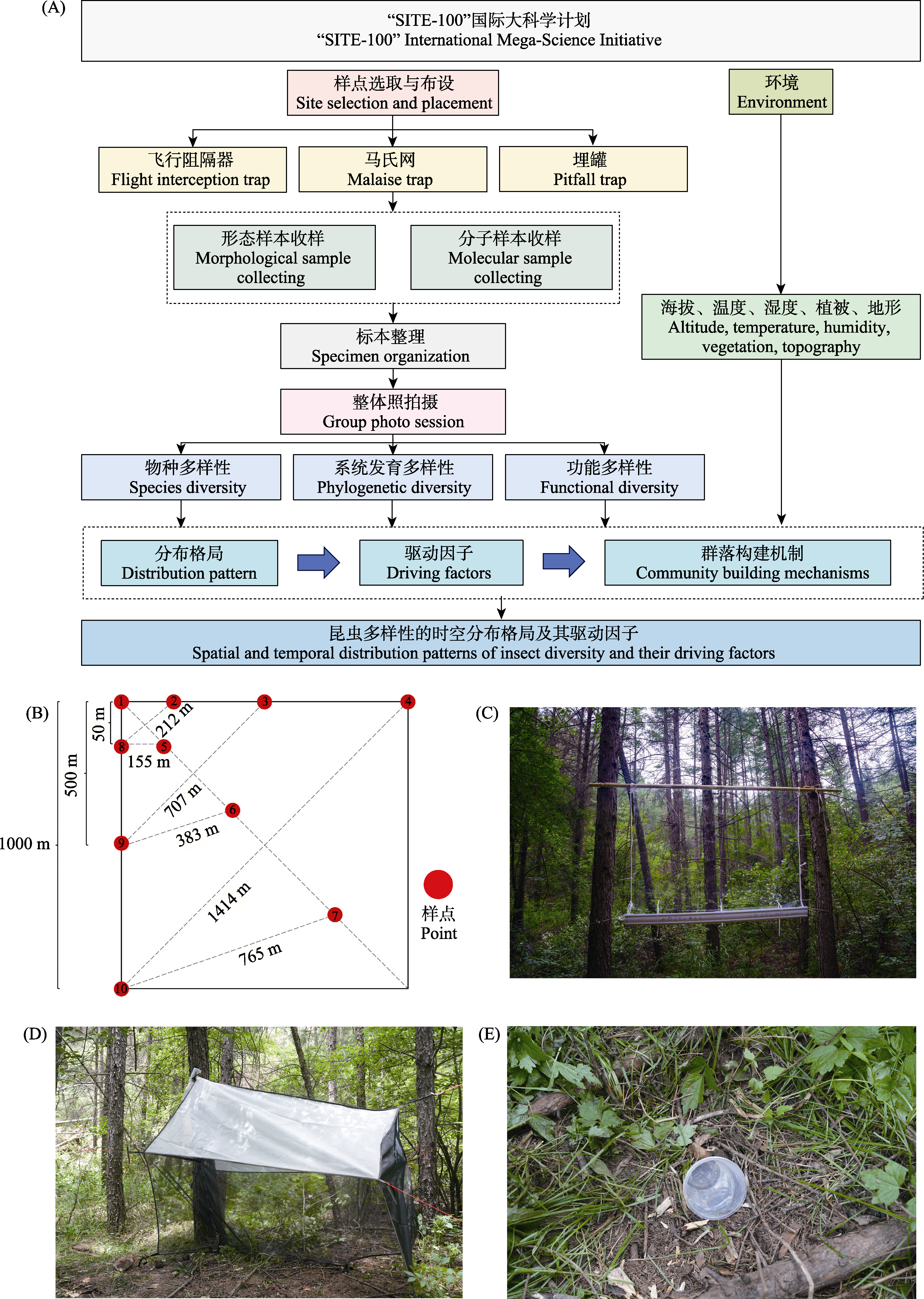
图2 “SITE-100”项目技术路线图与样点建设。(A) “SITE-100”研究技术路线图; (B) 1平方公里样方设置10个样点的理论位置; (C)飞行阻隔器; (D)马氏网; (E)埋罐。
Fig. 2 Technical roadmap and sample point construction of “SITE-100”. (A) The frame work of “SITE-100”; (B) The theoretical position of 10 sample points is set in one square kilometer quadrat; (C) Flight interception trap; (D) Malaise trap; (E) Pitfall trap.
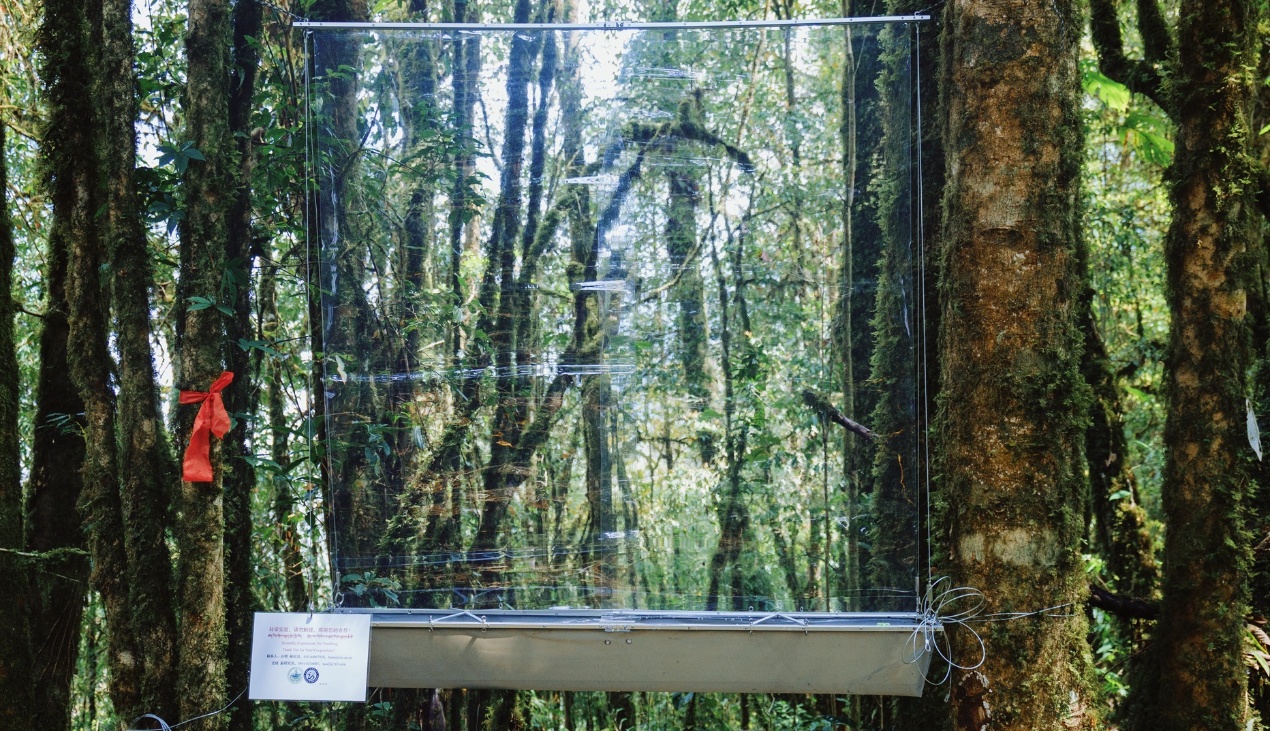
图3 产品化的飞行阻隔器
Fig. 3 Commercialized version of the flight interception trap
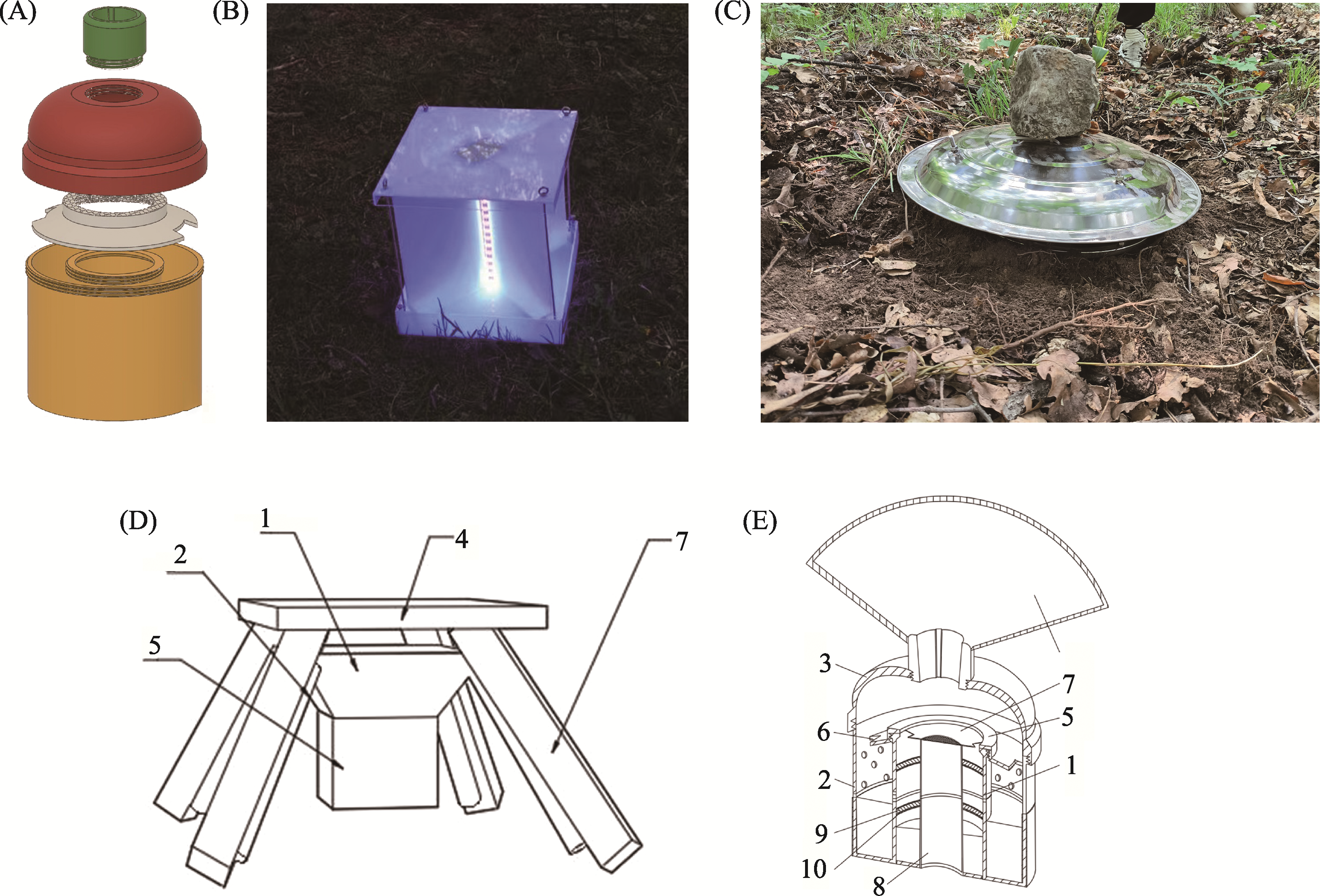
图4 “SITE-100”中国团队设计的各种新型装置。(A)避水集虫器(图片来源: Lee et al, 2023); (B)新型近光式昆虫灯诱器; (C)新型浅土层陷阱; (D)地表昆虫采集装置(图片来源: 赵奎等, 2023); (E)一种漏斗型昆虫诱捕器(图片来源: 张爱军等, 2023)。
Fig. 4 Various new devices designed by “SITE-100” China team. (A) Water exclusion trap (Photo credits: Lee et al, 2023); (B) Portable funnel light trap; (C) Shallow soil trap; (D) Surface insect collection device (Photo credits: Zhao et al, 2023); (E) A funnel-shaped insect trap (Photo credits: Zhang et al, 2023).
| [1] | Baillie JEM, Hilton-Taylor C, Stuart SN (2004) 2004 IUCN Red List of Threatened Species. A Global Species Assessment. IUCN, Gland, Switzerland and Cambridge, UK. |
| [2] | Chen YD, Yang HD, Leung MH, Cheung KH, Lee YM, He X, Huang ZZ, Bai M (2022) Evaluation of efficiency of flight interception trap (FIT) in collecting rare beetles and application potential of FIT in biodiversity research: A case study in Hong Kong. Journal of Environmental Entomology, 44, 1113-1123. (in Chinese with English abstract) |
| [陈炎栋, 杨海东, 梁敏轩, 张嘉康, 李英铭, 贺旭, 黄正中, 白明 (2022) 飞行阻隔器获取罕见甲虫标本的效能及在生物多样性调查中应用潜力的评价——以香港采集为例. 环境昆虫学报, 44, 1113-1123.] | |
| [3] | Chen YK, Bai M, Wang JF, Wang XP, Wang T, Han YJ, Lu JB, Han MY, Shen H (2021) Insect trapping device. 202121722523.9, China. 2021-07-27. (in Chinese) |
| [陈云康, 白明, 王继飞, 王新谱, 王涛, 韩永金, 路金博, 韩勐扬, 申昊 (2021) 昆虫诱集装置. 202121722523.9, 中国. 2021-07-27.] | |
| [4] | Cooke R, Outhwaite CL, Bladon AJ, Millard J, Rodger JG, Dong ZK, Dyer EE, Edney S, Murphy JF, Dicks LV, Hui C, Jones JI, Newbold T, Purvis A, Roy HE, Woodcock BA, Isaac NJB (2025) Integrating multiple evidence streams to understand insect biodiversity change. Science, 388, eadq2110. |
| [5] |
Dornelas M, Daskalova GN (2020) Nuanced changes in insect abundance. Science, 368, 368-369.
DOI PMID |
| [6] |
Druckenmiller H (2022) Accounting for ecosystem service values in climate policy. Nature Climate Change, 12, 596-598.
DOI |
| [7] | French CM, Bertola LD, Carnaval AC, Economo EP, Kass JM, Lohman DJ, Marske KA, Meier R, Overcast I, Rominger AJ, Staniczenko PPA, Hickerson MJ (2023) Global determinants of insect mitochondrial genetic diversity. Nature Communications, 14, 5276. |
| [8] | Geiger MF, Moriniere J, Hausmann A, Haszprunar G, Wägele W, Hebert PDN, Rulik B (2016) Testing the Global Malaise Trap Program—How well does the current barcode reference library identify flying insects in Germany? Biodiversity Data Journal, (4), e10671. |
| [9] | Habel JC, Segerer A, Ulrich W, Torchyk O, Weisser WW, Schmitt T (2016) Butterfly community shifts over two centuries. Conservation Biology, 30, 754-762. |
| [10] | Hallmann CA, Sorg M, Jongejans E, Siepel H, Hofland N, Schwan H, Stenmans W, Müller A, Sumser H, Hörren T, Goulson D, de Kroon H (2017) More than 75 percent decline over 27 years in total flying insect biomass in protected areas. PLoS ONE, 12, e0185809. |
| [11] |
Halsch CA, Elphick CS, Bahlai CA, Forister ML, Wagner DL, Ware JL, Grames EM (2025) Meta-synthesis reveals interconnections among apparent drivers of insect biodiversity loss. BioScience, 75, 448-456.
DOI URL |
| [12] | Han YJ, Liang YL, Tong YJ, Ding Q, Tian ZH, Li LL, Li XJ, Shen H, Zhu YC, Liu N, Wang XP, Bai M (2024) Dataset of beetle specimen images based on three passive acquisition methods in Mt. Helanshan, Ningxia. Biodiversity Science, 32, 24054. (in Chinese with English abstract) |
|
[韩永金, 梁咏亮, 佟一杰, 丁强, 田哲豪, 李露露, 李晓娟, 申昊, 朱亚超, 刘宁, 王新谱, 白明 (2024) 基于三种被动式采集方法采集的宁夏贺兰山甲虫标本照片数据集. 生物多样性, 32, 24054.]
DOI |
|
| [13] | Hudson LN, Blagoderov V, Heaton A, Holtzhausen P, Livermore L, Price BW, van der Walt S, Smith VS (2015) Inselect: Automating the digitization of natural history collections. PLoS ONE, 10, e0143402. |
| [14] |
Humphreys RK, Ruxton GD (2018) A review of thanatosis (death feigning) as an anti-predator behaviour. Behavioral Ecology and Sociobiology, 72, 22.
DOI PMID |
| [15] |
Keil P, Storch D, Jetz W (2015) On the decline of biodiversity due to area loss. Nature Communications, 6, 8837.
DOI PMID |
| [16] | Lagos-Kutz D, Voegtlin DJ, Onstad D, Hogg D, Ragsdale D, Tilmon K, Hodgson E, Difonzo C, Groves R, Krupke C, Laforest J, Seiter NJ, Duerr E, Bradford B, Hartman GL (2020) The soybean aphid suction trap network: Sampling the aerobiological “soup”. American Entomologist, 66, 48-55. |
| [17] |
Lee S, Orr MC, Seung J, Yang Y, Tian ZH, Lee M, Tak JH, Lee S, Bai M (2024) Designing and evaluating a portable UV-LED vane trap to expedite arthropod biodiversity discovery. Insects, 15, 21.
DOI URL |
| [18] |
Lee S, Seung J, Yang Y, Orr M, Lee M, Tak J, Vogler AP, Bai M, Lee S (2023) The Water-Exclusion Trap (WET): A 3D printable window trap collector that prevents DNA degradation. Methods in Ecology and Evolution, 14, 2774-2779.
DOI URL |
| [19] |
Li J, Wang WC, Li LL, Ding Q, Bai M (2024) Hexagon-based adaptive hierarchies for efficient point-in-spherical-polygon tests on GPUs. International Journal of Geographical Information Science, 38, 322-353.
DOI URL |
| [20] |
Li PP, Tong YJ, Cao HY, Rong GS, Qin SQ, Yang XK, Wang GQ, Bai M (2021) A photographic dataset of the beetle specimens from a SITE100 standardized sampling area in Huaping Guangxi. Biodiversity Science, 29, 1165-1169. (in Chinese with English abstract)
DOI URL |
|
[李盼盼, 佟一杰, 曹浩宇, 容国森, 覃诗晴, 杨星科, 王国全, 白明 (2021) 广西花坪SITE100样地甲虫标本照片数据集. 生物多样性, 29, 1165-1169.]
DOI |
|
| [21] |
Montgomery GA, Belitz MW, Guralnick RP, Tingley MW (2021) Standards and best practices for monitoring and benchmarking insects. Frontiers in Ecology and Evolution, 8, 579193.
DOI URL |
| [22] |
Nie RE, Li LL, Feijó A, Yang MX, Bai M, Creedy TJ, Jin X, Hao JS, Ruan YY, Liu HX, Garner BH, Bocak L, Yang XK, Vogler AP (2024) Phylogenetic origin of an insect fauna at the boundary of the Palaearctic and Oriental realms: Evidence from ‘site-based’ mitogenomics. Journal of Biogeography, 51, 1329-1339.
DOI URL |
| [23] | Nie RE, Yang MX, Xue HJ, Yang YR, Tong YJ, Qiu TF, Bai M, Yang XK (2017) The application and effectiveness of a flight interception trap for insect collecting. Chinese Journal of Applied Entomology, 54, 530-535. (in Chinese with English abstract) |
| [聂瑞娥, 杨美霞, 薛怀君, 杨御儒, 佟一杰, 邱腾飞, 白明, 杨星科 (2017) 飞行阻隔器在昆虫采集中的应用探究. 应用昆虫学报, 54, 530-535.] | |
| [24] |
Ollerton J, Winfree R, Tarrant S (2011) How many flowering plants are pollinated by animals? Oikos, 120, 321-326.
DOI URL |
| [25] | Schultheiss P, Nooten SS, Wang RX, Wong MKL, Brassard F, Guénard B (2022) The abundance, biomass, and distribution of ants on Earth. Proceedings of the National Academy of Sciences, USA, 119, e2201550119. |
| [26] |
Stork NE (2018) How many species of insects and other terrestrial arthropods are there on earth? Annual Review of Entomology, 63, 31-45.
DOI PMID |
| [27] |
Teng B, Yang HD, Tong YJ, Leung MH, Cheung KH, Lee YM, Guenard B, Bai M (2021) A comparative study on the collection effectiveness of beetles by three passive acquisition methods in Shing Mun (Hong Kong). Biodiversity Science, 29, 1386-1395. (in Chinese with English abstract)
DOI |
|
[滕备, 杨海东, 佟一杰, 梁敏轩, 张嘉康, 李英铭, Benoit Guénard, 白明 (2021) 三种被动式采集方法对甲虫收集效果的比较研究: 以香港城门样地为例. 生物多样性, 29, 1386-1395.]
DOI |
|
| [28] | Thomas JA, Telfer MG, Roy DB, Preston CD, Greenwood JJD, Asher J, Fox R, Clarke RT, Lawton JH (2004) Comparative losses of British butterflies, birds, and plants and the global extinction crisis. Science, 303, 1879-1881. |
| [29] |
Vanbergen AJ, the Insect Pollinators Initiative (2013) Threats to an ecosystem service: Pressures on pollinators. Frontiers in Ecology and the Environment, 11, 251-259.
DOI URL |
| [30] |
Wagner DL (2020) Insect declines in the Anthropocene. Annual Review of Entomology, 65, 457-480.
DOI PMID |
| [31] | Wagner DL, Fox R, Salcido DM, Dyer LA (2021) A window to the world of global insect declines: Moth biodiversity trends are complex and heterogeneous, Proceedings of the National Academy of Sciences, USA,118, e2002549117. |
| [32] | Wang YQ, Zhou QS, Bai M, Chen J, Zhu CD, Liu XY (2025) Chinese top 10 new insect species of 2024. Biodiversity Science, 33, 25107. (in Chinese) |
|
[王彦卿, 周青松, 白明, 陈军, 朱朝东, 刘星月 (2025) 2024年度中国十大昆虫新物种. 生物多样性, 33, 25107.]
DOI |
|
| [33] |
Wilson EO (1987) The little things that run the world (the importance and conservation of invertebrates). Conservation Biology, 1, 344-346.
DOI URL |
| [34] | Yang ZW, Ding SX, Zhang AJ, Hua BZ (2009) New insect collection method—Flight interception trap. Shaanxi Journal of Agricultural Sciences, 55(4), 84-85. (in Chinese) |
| [杨宗武, 丁升选, 张爱娟, 花保祯 (2009) 昆虫采集新方法——飞行拦截网. 陕西农业科学, 55(4), 84-85.] | |
| [35] | Zhang AJ, Bai M, Wang XP, Tian ZH, Lee SY, Zhao K (2023) A funnel-shaped insect trap. 202323102086.2, China. 2023-11-16. (in Chinese) |
| [张爱军, 白明, 王新谱, 田哲豪, 李升铉, 赵奎 (2023) 一种漏斗型昆虫诱捕器. 202323102086.2, 中国. 2023-11-16.] | |
| [36] | Zhao K, Song ZS, Xu SY, Yin F, Zhang AJ, Zhong TM, Bai M, Wang XP (2023) Surface insect collection device. 202322241603.8, China. 2023-08-21. (in Chinese) |
| [赵奎, 宋志顺, 徐思远, 殷凡, 张爱军, 钟天民, 白明, 王新谱 (2023) 地表昆虫采集装置. 202322241603.8, 中国. 2023-08-21.] | |
| [37] |
Zhao SZ, Tong YJ, Teng B, Chen X, Yang XK, Li J, Bai M (2022) A species diversity dataset of beetles by three passive acquisition methods in Tei Tong Tsai (Hong Kong). Scientific Data, 9, 210.
DOI PMID |
| [38] |
Zhao ZY, Lu YY, Tong YJ, Chen X, Bai M (2023) PENet: A phenotype encoding network for automatic extraction and representation of morphological discriminative features. Methods in Ecology and Evolution, 14, 3035-3046.
DOI URL |
| [1] | 梁竣策, 李开枝, 谭烨辉. 南海翼足类物种多样性与分布[J]. 生物多样性, 2026, 34(5): 25487-. |
| [2] | 周丽洁, 郝珉辉, 何怀江, 程艳霞, 张春雨, 赵秀海. 小兴安岭森林β多样性格局、组分及其影响因素[J]. 生物多样性, 2026, 34(4): 25443-. |
| [3] | 彭昀月, 彭奎, 刘昕然, 孙天怡, 张小全. 生物多样性信用的企业参与途径、市场发展障碍与建议[J]. 生物多样性, 2026, 34(4): 26031-. |
| [4] | 李伯尧, 盛天成, 幸小云. 生物多样性风险对企业财务绩效的影响: 来自中国上市公司的证据[J]. 生物多样性, 2026, 34(4): 25330-. |
| [5] | 刘昊, 张玉霄, 刘冰, 李飞飞, 马洪峥, 覃海宁, 李德铢, 陈文俐. 中国禾本科植物多样性及其物种名录[J]. 生物多样性, 2026, 34(4): 25438-. |
| [6] | 孔孜亦, 王德港, 王建涛, 裴志永, 孙晶, 张长春, 张军国. 基于SCD-HRNet模型的野生动物姿态估计及其在生物多样性监测中的应用: 以内蒙古赛罕乌拉地区为例[J]. 生物多样性, 2026, 34(4): 25287-. |
| [7] | 朱浩友, 周友兵, 罗怡, 周昭敏. 南充市城区繁殖鸟类群落20年前后的变化[J]. 生物多样性, 2026, 34(3): 24560-. |
| [8] | 侯姝彧, 刘盈盈, 杨锐. 《昆蒙框架》背景下国际OECMs体系构建实践进展及中国化思路[J]. 生物多样性, 2026, 34(3): 25264-. |
| [9] | 程晓帆, 李青媛, 李媛辉, 张明祥. 外来入侵物种治理政策体系的困境与出路[J]. 生物多样性, 2026, 34(2): 25332-. |
| [10] | 陈璐露, 汤皓婷, 冷红, 袁青, 杨昕悦. 城市街区建成环境对生物多样性的影响[J]. 生物多样性, 2026, 34(2): 25286-. |
| [11] | 高雯琪, 向景荣, 赵耀, 范灵霜, 谷圆, 邵韦涵, 李高俊, 赵光军, 陈明斌, 蔡杏伟, 陈凯. 海南热带雨林国家公园黎母山和尖峰岭溪流鱼类群落特征及其对土地利用的响应[J]. 生物多样性, 2026, 34(2): 25374-. |
| [12] | 卢晓强, 芮丹, 张江峰, 尹冰鑫, 王雨露, 岑雨婷, 崔怡晨, 杨万霞. 氮输入驱动的关键生态过程对生物多样性的影响及其管理启示[J]. 生物多样性, 2026, 34(2): 25368-. |
| [13] | 谭廷鸿, 高帆, 杨雨, 肖群英, 吴春芳, 邱娜, 赵宁宁, 周敏, 康公平, 卢志宏, 高健强, 杨红, 杨传东, 邓春英. 中国西南喀斯特地区大型真菌物种编目[J]. 生物多样性, 2026, 34(2): 25281-. |
| [14] | 章旭日, 罗标, 赵彤, 黄丹, 艾为明. 浙江鱼类多样性: 编目、分布与保护[J]. 生物多样性, 2026, 34(2): 25225-. |
| [15] | 刘海鸥, 郝志明, 杜乐山, 刘文慧, 李子圆, 刘蕾. 全球生物多样性框架基金运行进展、挑战与启示[J]. 生物多样性, 2026, 34(2): 25463-. |
| 阅读次数 | ||||||
|
全文 |
|
|||||
|
摘要 |
|
|||||
备案号:京ICP备16067583号-7
Copyright © 2026 版权所有 《生物多样性》编辑部
地址: 北京香山南辛村20号, 邮编:100093
电话: 010-62836137, 62836665 E-mail: biodiversity@ibcas.ac.cn
