

生物多样性 ›› 2026, Vol. 34 ›› Issue (1): 25386. DOI: 10.17520/biods.2025386 cstr: 32101.14.biods.2025386
吴春莹1,#( ), Viorel D. Popescu2,#(), 季吟秋1,*()(
 )
)
收稿日期:2025-10-01
接受日期:2026-01-20
出版日期:2026-01-20
发布日期:2026-02-03
通讯作者:
季吟秋
作者简介:第一联系人:#共同第一作者
基金资助:
Chunying Wu1,#(), Viorel D. Popescu2,#(), Yinqiu Ji1,*()()
Received:2025-10-01
Accepted:2026-01-20
Online:2026-01-20
Published:2026-02-03
Contact:
Yinqiu Ji
About author:First author contact:#Co-first authors
Supported by:摘要:
面对全球第六次生物大灭绝的严峻形势, 准确评估物种分布和种群动态已成为生物多样性监测中的紧迫任务。传统生物多样性监测方法常因生物学固有的不完全检测问题而导致估计偏差, 为生物多样性保护带来挑战。本文深入阐释层级占有率模型(hierarchical occupancy models, HOM)如何通过分离生态过程(占有率ψ)与观测过程(检测率P)的双层统计框架, 实现对不完全检测的无偏校正。重点论述该模型在整合多源异构数据、捕捉种群动态(定殖率γ与灭绝率ε)和同时分析多物种关联性方面的独特应用优势。其产出的真实占有率、动态参数及相关衍生指标, 是支持系统保护规划(systematic conservation planning, SCP)的高效、可理解且可审计的决策工具。本文同时剖析了模型应用中的关键挑战及应对策略, 以期为生态学研究者提供方法论参考, 并为管理者与决策者将模型输出转化为保护行动提供分析路径与依据。
吴春莹, Viorel D. Popescu, 季吟秋 (2026) 生物多样性评估挑战的层级占有率模型解决路径. 生物多样性, 34, 25386. DOI: 10.17520/biods.2025386.
Chunying Wu, Viorel D. Popescu, Yinqiu Ji (2026) Hierarchical occupancy models as solutions to challenges in biodiversity assessment. Biodiversity Science, 34, 25386. DOI: 10.17520/biods.2025386.
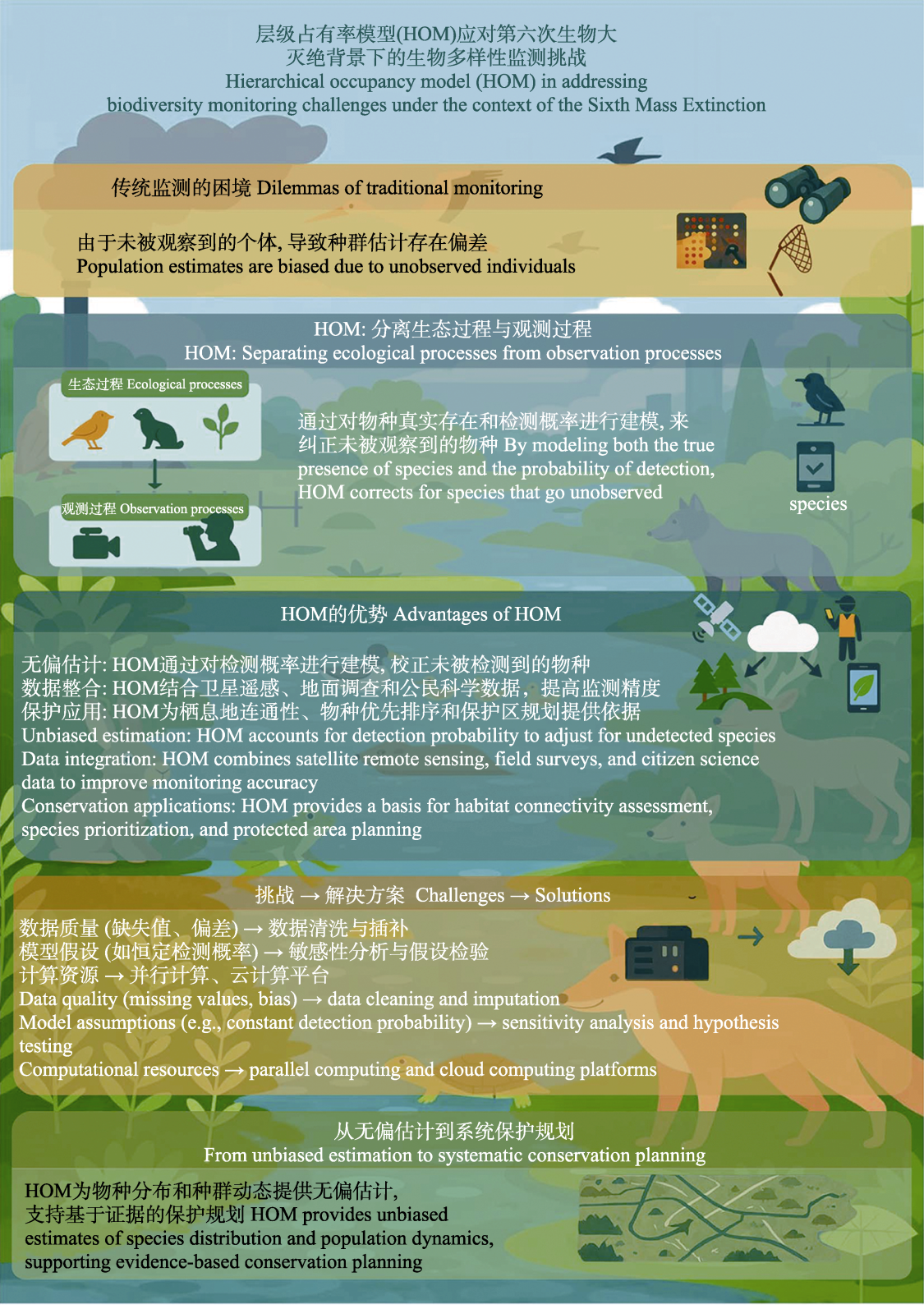
图1 层级占有率模型应对第六次生物大灭绝背景下的生物多样性监测挑战
Fig. 1 Hierarchical occupancy model (HOM) addressing biodiversity monitoring challenges in the context of the Sixth Mass Extinction
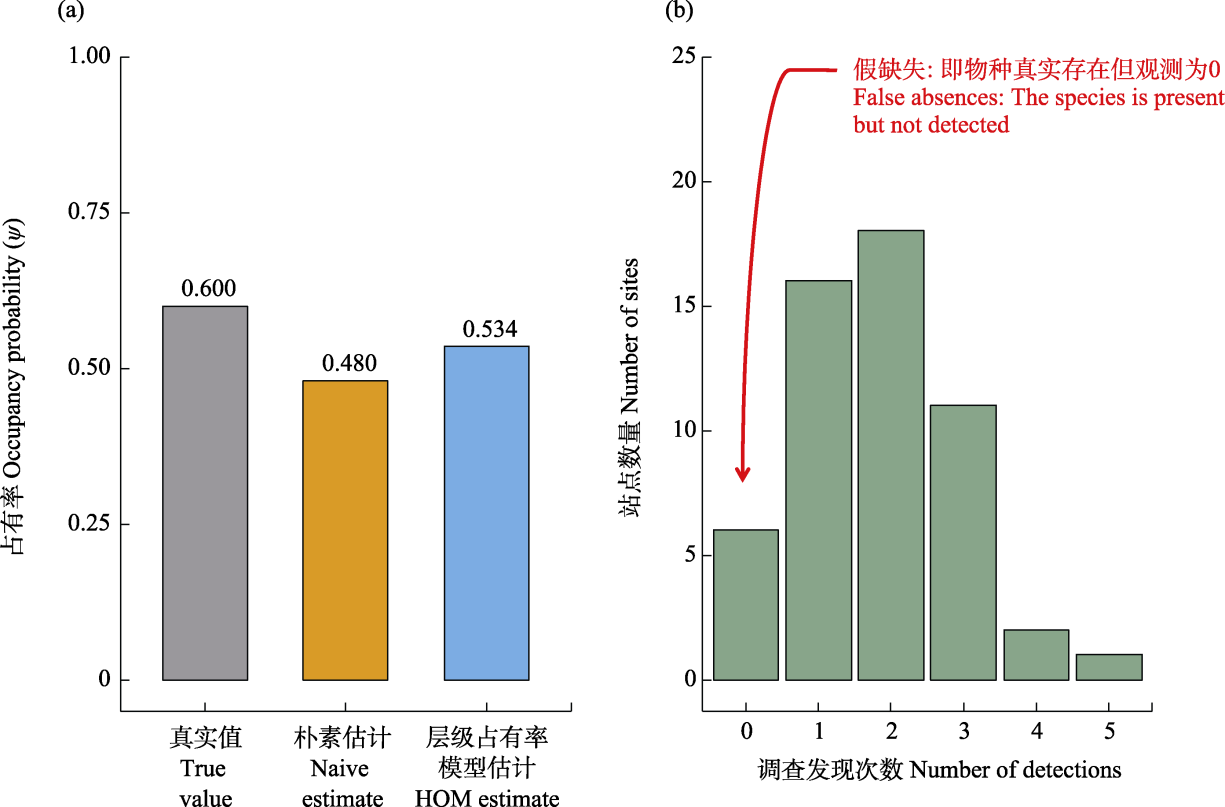
图2 层级占有率模型(HOM)对不完全检测的校正效果模拟。(a)不同方法对占有概率(ψ)的估计对比(样本量n = 100)。朴素估计(naive estimate)由于忽略了不完全检测而系统性低估了占有率, 而模型估计(HOM)更接近真实值(true value)。(b)物种真实存在站点(sites with true presence)的检测频率分布。红色箭头指向的“0次发现”柱状图代表假缺失(false absences)现象, 即物种在该站点真实存在, 但由于检测概率P < 1导致调查结果为0, 这是占有率估计偏差的核心来源。
Fig. 2 Simulation of hierarchical occupancy model (HOM) performance in correcting for imperfect detection. (a) Comparison of occupancy probability (ψ) estimates among different methods (sample size n = 100). The naive estimate systematically underestimates occupancy by ignoring imperfect detection, whereas the HOM estimate is closer to the true value. (b) Distribution of detection frequency at sites where the species is truly present. The bar at “0 detections” indicated by the red arrow represents “false absences”, where the species exists at the site but remains undetected due to a detection probability P < 1. This phenomenon is the primary source of bias in occupancy estimation.
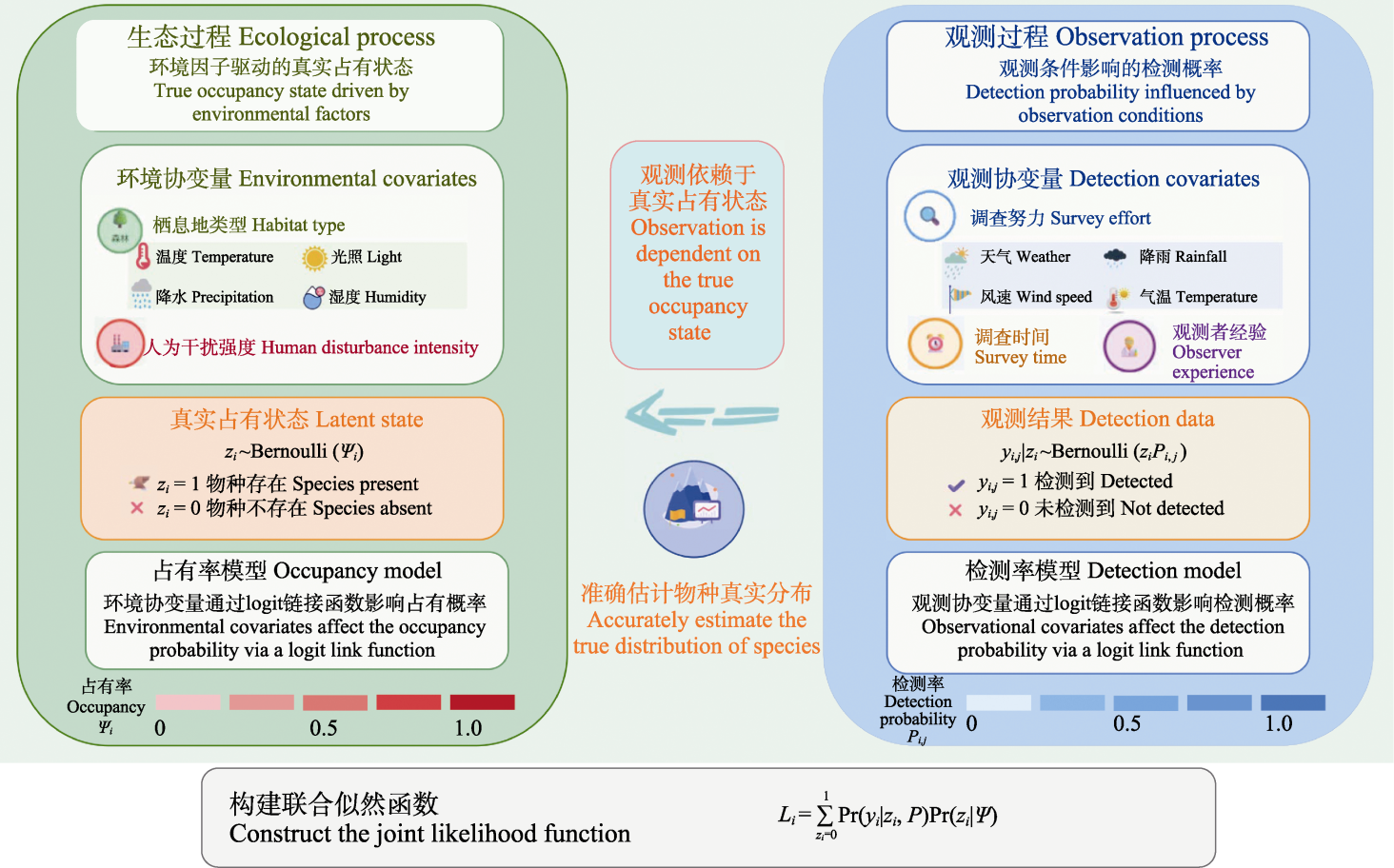
图3 层级占有率模型的双层统计框架。该示意图展示了层级占有率模型的双层统计逻辑, 其核心在于通过对生态过程与观测过程的解耦, 有效校正物种调查中的不完全检测问题。左侧生态过程描述由环境因子驱动的真实占有状态(即潜变量zi); 在此层级中, 样点的占有概率ψ受栖息地类型(如森林覆盖率、植被结构)、非生物因子及人为干扰等环境协变量的影响, 并采用logit链接函数进行建模。右侧观测过程则描述实际调查中的检测概率P, 该概率受调查努力(如调查时长、采样强度、重复次数)、天气条件及观测者经验等观测协变量的影响, 同样通过logit链接函数建立联系。由于观测结果y严格依赖于真实占有状态z (即仅在物种真实存在的条件下, 检测概率才具有生物学意义), 模型通过对zi进行边缘化处理并构建联合似然函数。这一机制通过数学手段消除了假缺失(false absences)导致的估计偏差, 从而实现对物种真实分布的无偏估计。
Fig. 3 Dual-level statistical framework of the hierarchical occupancy model. This figure illustrates the dual-level statistical framework of the hierarchical occupancy model, which centers on correcting for imperfect detection in species surveys by decoupling the ecological and observation processes. The ecological process on the left describes the true occupancy state (latent variable zi) driven by environmental factors; the occupancy probability ψ is influenced by environmental covariates—such as habitat type (e.g., forest cover, vegetation structure), abiotic factors, and human disturbance—and is modeled via a logit link function. The observation process on the right describes the detection probability P during field surveys, which is affected by observational covariates including survey effort (duration, intensity, and number of replicates), weather conditions, and observer experience, also linked through a logit function. Given that the observation y is strictly dependent on the true occupancy state z (meaning a species can only be detected if it is truly present), the model integrates these processes by marginalizing over the latent variable zi to construct a joint likelihood function. This approach mathematically accounts for false absences, thereby achieving an unbiased estimation of the true species distribution.
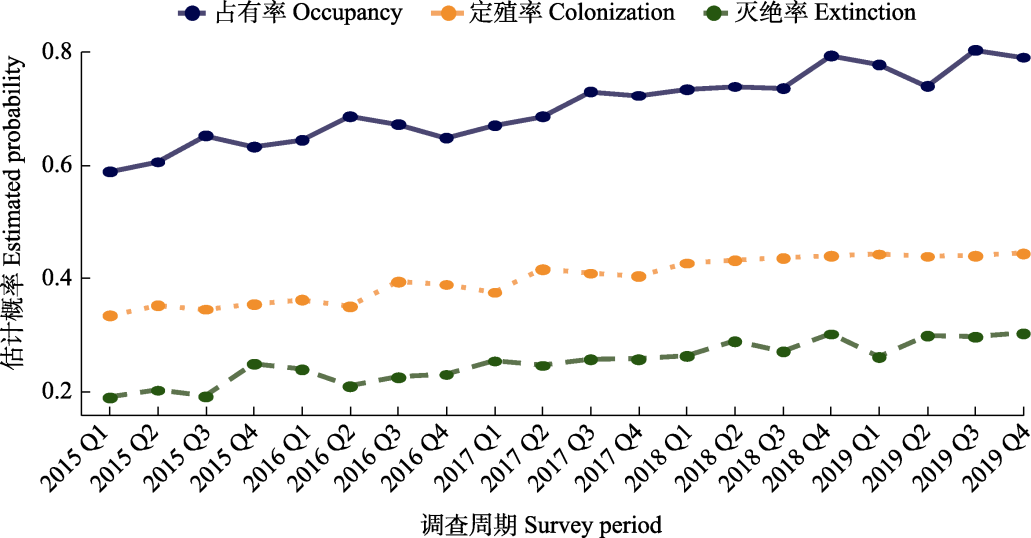
图4 物种多季节占有率动态与迁移趋势示意图。图中展示了基于模拟数据的某物种在2015-2019年间的季度动态(Q1-Q4分别代表第一至第四季度): 占有率ψ (蓝色实线)整体维持在0.6-0.8, 表明其在研究区域内持续保持较高存在率; 定殖概率γ (橙色点线)稳定在0.3-0.4, 略有上升, 反映其扩展能力较强; 灭绝概率ε (绿色虚线)维持在0.1-0.2, 提示可能存在栖息地干扰或环境压力。该图基于模拟数据绘制, 用于示意多季节层级占有率模型在揭示物种动态方面的应用。R代码见附录2。
Fig. 4 Schematic diagram of multi-season occupancy dynamics and state transition trends. This diagram illustrates the quarterly dynamics (where Q1-Q4 represent the first to fourth quarters of each year, respectively) of a species based on simulated data between 2015 and 2019: The occupancy rate (ψ, blue solid line) is generally maintained between 0.6-0.8, indicating a high persistent probability of presence in the study area. The colonization probability (γ, orange dotted line) is stable at 0.3-0.4 with a slight upward trend, reflecting a relatively strong capacity for range expansion. The extinction probability (ε, green dashed line) is maintained at 0.1-0.2, suggesting potential habitat disturbance or environmental pressure. This figure is created using simulated data and serves to illustrate the application of the multi-season hierarchical occupancy model (MSOM) in revealing species dynamics. Please see Appendix 2 for the R code.
| 类别 Category | 核心假设 Core assumption | 描述 Description |
|---|---|---|
| 生态过程 Ecological process | 闭合假设 Closure assumption | 在调查期间, 站点占有状态无变化(单季节模型); 动态模型放松此假设(MacKenzie et al., |
| 生态过程 Ecological process | 独立站点 Site independence | 站点间占有率条件独立, 或通过随机效应建模空间相关 Occupancy is conditionally independent among sites, or spatial correlation is accounted for through random effects |
| 观测过程 Observation process | 无假阳性 No false positives | 检测到即真实存在; eDNA等场景需扩展模型处理假阳性(Guillera-Arroita et al., |
| 观测过程 Observation process | 检测独立 Independent detections | 重复调查间检测事件独立 Detection events are independent across replicate surveys |
| 参数估计 Parameter estimation | 局部识别 Local identifiability | 重复调查足够多以分离ψ和P (通常j ≥ 3) A sufficient number of replicate surveys are required to distinguish ψ from P (typically j ≥ 3) |
表1 层级占有率模型的核心假设
Table 1 Core assumptions of hierarchical occupancy models
| 类别 Category | 核心假设 Core assumption | 描述 Description |
|---|---|---|
| 生态过程 Ecological process | 闭合假设 Closure assumption | 在调查期间, 站点占有状态无变化(单季节模型); 动态模型放松此假设(MacKenzie et al., |
| 生态过程 Ecological process | 独立站点 Site independence | 站点间占有率条件独立, 或通过随机效应建模空间相关 Occupancy is conditionally independent among sites, or spatial correlation is accounted for through random effects |
| 观测过程 Observation process | 无假阳性 No false positives | 检测到即真实存在; eDNA等场景需扩展模型处理假阳性(Guillera-Arroita et al., |
| 观测过程 Observation process | 检测独立 Independent detections | 重复调查间检测事件独立 Detection events are independent across replicate surveys |
| 参数估计 Parameter estimation | 局部识别 Local identifiability | 重复调查足够多以分离ψ和P (通常j ≥ 3) A sufficient number of replicate surveys are required to distinguish ψ from P (typically j ≥ 3) |
| 类别 Category | 核心内容 Core item | 描述 Description |
|---|---|---|
| 模型选择 Model selection | AICc/WAIC/LOO-CV | 用于比较模型拟合与复杂度; AICc适用于小样本(Burnham & Anderson, |
| 模型选择 Model selection | 后验预测检查 Posterior predictive check (PPC) | 贝叶斯框架下评估模型拟合(Gelman et al., |
| 模型验证 Model selection | 交叉验证 Cross-validation (CV) | 使用k折交叉验证评估预测性能 Evaluating predictive performance using k-fold cross-validation (k-fold CV) |
| 残差诊断 Residual diagnostics | DHARMa残差 DHARMa residuals | 模拟残差检查拟合优度, 适用于层级模型(Hartig, |
表2 层级占有率模型的选择与验证框架
Table 2 Framework for model selection and validation in hierarchical occupancy models
| 类别 Category | 核心内容 Core item | 描述 Description |
|---|---|---|
| 模型选择 Model selection | AICc/WAIC/LOO-CV | 用于比较模型拟合与复杂度; AICc适用于小样本(Burnham & Anderson, |
| 模型选择 Model selection | 后验预测检查 Posterior predictive check (PPC) | 贝叶斯框架下评估模型拟合(Gelman et al., |
| 模型验证 Model selection | 交叉验证 Cross-validation (CV) | 使用k折交叉验证评估预测性能 Evaluating predictive performance using k-fold cross-validation (k-fold CV) |
| 残差诊断 Residual diagnostics | DHARMa残差 DHARMa residuals | 模拟残差检查拟合优度, 适用于层级模型(Hartig, |
| [1] | Beger M, Grantham HS, Pressey RL, Wilson KA, Peterson EL, Dorfman D, Mumby PJ, Possingham HP (2010) Conservation planning in a changing world: Multispecies approaches to prioritizing the global protection of biodiversity. BioScience, 60, 52-62. |
| [2] |
Belmont J, Martino S, Illian J, Rue H (2024) Spatio-temporal occupancy models with INLA. Methods in Ecology and Evolution, 15, 2087-2100.
DOI URL |
| [3] |
Brambilla M, Caprio E, Assandri G, Scridel D, Bassi E, Bionda R, Celada C, Falco R, Bogliani G, Pedrini P, Rolando A, Chamberlain D (2017) A spatially explicit definition of conservation priorities according to population resistance and resilience, species importance and level of threat in a changing climate. Diversity and Distributions, 23, 727-738.
DOI URL |
| [4] | Burnham KP, Anderson DR (2002) Model Selection and Multimodel Inference: A Practical Information-Theoretic Approach, 2nd edn. Springer, New York. |
| [5] | Ceballos G, Ehrlich PR, Barnosky AD, García A, Pringle RM, Palmer TM (2015) Accelerated modern human-induced species losses: Entering the sixth mass extinction. Science Advances, 1, e1400253. |
| [6] | Chen IC, Hill JK, Ohlemüller R, Roy DB, Thomas CD (2011) Rapid range shifts of species associated with high levels of climate warming. Science, 333, 1024-1026. |
| [7] |
Crist TO, Veech JA (2006) Additive partitioning of rarefaction curves and species-area relationships: Unifying α-, β- and γ-diversity with sample size and habitat area. Ecology Letters, 9, 923-932.
DOI URL |
| [8] |
Devarajan K, Morelli TL, Tenan S (2020) Multi-species occupancy models: Review, roadmap, and recommendations. Ecography, 43, 1612-1624.
DOI URL |
| [9] | Dorazio RM, Gotelli NJ, Ellison AM (2011) Modern methods of estimating biodiversity from presence-absence surveys. In: BiodiversityLoss in a Changing Planet (ed. Grillo O), pp.71-102. InTech, Rijeka. |
| [10] |
Dorazio RM, Royle JA, Söderström B, Glimskär A (2006) Estimating species richness and accumulation by modeling species occurrence and detectability. Ecology, 87, 842-854.
PMID |
| [11] |
Doser JW, Leuenberger W, Sillett TS, Hallworth MT, Zipkin EF (2022) Integrated community occupancy models: A framework to assess occurrence and biodiversity dynamics using multiple data sources. Methods in Ecology and Evolution, 13, 919-932.
DOI URL |
| [12] |
Ficetola GF, Pansu J, Bonin A, Coissac E, Giguet-Covex C, De Barba M, Gielly L, Lopes CM, Boyer F, Pompanon F, Rayé G, Taberlet P (2015) Replication levels, false presences and the estimation of the presence/absence from eDNA metabarcoding data. Molecular Ecology Resources, 15, 543-556.
DOI URL |
| [13] |
Ficetola GF, Taberlet P (2023) Towards exhaustive community ecology via DNA metabarcoding. Molecular Ecology, 32, 6320-6329.
DOI PMID |
| [14] | Gelman A, Hill J (2007) Data Analysis Using Regression and Multilevel/Hierarchical Models. Cambridge University Press, Cambridge. |
| [15] | Gelman A, Hwang J, Vehtari A (2014) Understanding predictive information criteria for Bayesian models. Statistics and Computing, 24, 997-1016. |
| [16] |
Gronau QF, Sarafoglou A, Matzke D, Ly A, Boehm U, Marsman M, Leslie DS, Forster JJ, Wagenmakers EJ, Steingroever H (2017) A tutorial on bridge sampling. Journal of Mathematical Psychology, 81, 80-97.
DOI PMID |
| [17] |
Guillera-Arroita G, Lahoz-Monfort JJ, van Rooyen AR, Weeks AR, Tingley R (2017) Dealing with false-positive and false-negative errors about species occurrence at multiple levels. Methods in Ecology and Evolution, 8, 1081-1091.
DOI URL |
| [18] | Hamer AJ, Schloegel LM, Rossauer B, Anyomi K, Stockwell MP, Mahony MJ, Clulow S, Banks SC (2021) Multi-species occupancy models reveal community assembly and wetland restoration in amphibians. Journal of Applied Ecology, 58, 607-616. |
| [19] |
Hansen LM, Pfeifer M (2019) Machine learning in remote sensing: A comprehensive review. ISPRS Journal of Photogrammetry and Remote Sensing, 152, 166-177.
DOI URL |
| [20] | Hartig F (2024) DHARMa: Residual Diagnostics for Hierarchical (Multi-level/Mixed) Regression Models. R Package Version 0.4.7. https://CRAN.R-project.org/package=DHARMa. (accessed on 2025-09-02) |
| [21] | Hepler SA, Erhardt RJ (2021) A spatiotemporal model for multivariate occupancy data. Environmetrics, 32, e2657. |
| [22] | Hepler SA, Yang BQ (2024) Occupancy models with autocorrelated detection heterogeneity. Environmental and Ecological Statistics, 31, 777-800. |
| [23] | IPBES (2019) Global Assessment Report on Biodiversity and Ecosystem Services. IPBES Secretariat, Bonn, Germany. |
| [24] |
Ji YQ, Baker CCM, Popescu VD, Wang JX, Wu CY, Wang ZY, Li YH, Wang L, Hua CL, Yang ZX, Yang CY, Xu CCY, Diana A, Wen QZ, Pierce NE, Yu DW (2022) Measuring protected-area effectiveness using vertebrate distributions from leech iDNA. Nature Communications, 13, 1555.
DOI PMID |
| [25] | Ji YQ, Diana A, Li XY, Matechou E, Griffin JE, Liu SW, Luo MJ, Wu CY, Bai R, Yao CY, Yin TT, Dong F, Wu F, Wang K, Yu ZB, Chen XY, Jiang XL, Che J, Yu DW, Popescu VD (2025) High quality, granular, timely, trustworthy and efficient vertebrate species distribution data across a 30,000 km2 protected area complex. Ecology Letters, 28, e70302. |
| [26] | Kelleher S, Guillera-Arroita G, Elith J, Briscoe NJ (2025) Twenty years of dynamic occupancy models: A review of applications and look to the future. Ecography, 48, e07757. |
| [27] | Kéry M, Royle JA (2015) Applied Hierarchical Modeling in Ecology: Analysis of Distribution, Abundance and Species Richness in R and BUGS (Vol. 1): Prelude and Static Models. Academic Press, New York. |
| [28] | Kéry M, Royle JA (2020) Applied Hierarchical Modeling in Ecology: Analysis of Distribution, Abundance and Species Richness in R and BUGS (Vol. 2): Dynamic and Advanced Models. Academic Press, New York. |
| [29] |
Kéry M, Royle JA, Plattner M, Dorazio RM (2009) Species richness and occupancy estimation in communities subject to temporary emigration. Ecology, 90, 1279-1290.
PMID |
| [30] |
Kleiven EF, Barraquand F, Gimenez O, Henden JA, Ims RA, Soininen EM, Yoccoz NG (2023) A dynamic occupancy model for interacting species with two spatial scales. Journal of Agricultural, Biological and Environmental Statistics, 28, 466-482.
DOI |
| [31] |
Lipsey MK, Naugle DE, Nowak J, Lukacs PM (2017) Extending utility of hierarchical models to multi-scale habitat selection. Diversity and Distributions, 23, 783-793.
DOI URL |
| [32] |
MacKenzie DI, Nichols JD, Hines JE, Knutson MG, Franklin AB (2003) Estimating site occupancy, colonization, and local extinction when a species is detected imperfectly. Ecology, 84, 2200-2207.
DOI URL |
| [33] | MacKenzie DI, Nichols JD, Lachman GB, Droege S, Royle JA, Langtimm CA (2002) Estimating site occupancy rates when detection probabilities are less than one. Ecology, 83, 2248-2255. |
| [34] | MacKenzie DI, Nichols JD, Royle JA, Pollock KH, Bailey LL, Hines JE (2017) Occupancy Estimation and Modeling: Inferring Patterns and Dynamics of Species Occurrence, 2nd edn. Academic Press, London. |
| [35] |
MacKenzie DI, Nichols JD, Seamans ME, Gutiérrez RJ (2009) Modeling species occurrence dynamics with multiple states and imperfect detection. Ecology, 90, 823-835.
PMID |
| [36] |
MacKenzie DI, Royle JA (2005) Designing occupancy studies: General advice and allocating survey effort. Journal of Applied Ecology, 42, 1105-1114.
DOI URL |
| [37] |
Margules CR, Pressey RL (2000) Systematic conservation planning. Nature, 405, 243-253.
DOI |
| [38] |
Miller DA, Nichols JD, McClintock BT, Grant EHC, Bailey LL, Weir LA (2011) Improving occupancy estimation when two types of observational error occur: Non-detection and species misidentification. Ecology, 92, 1422-1428.
PMID |
| [39] | Moilanen E, Wilson KA, Possingham HP (2009) Spatial Conservation Prioritization. Oxford University Press, Oxford. |
| [40] |
Moll RJ, Kilshaw K, Montgomery RA, Abade L, Campbell RD, Harrington LA, Millspaugh JJ, Birks JDS, MacDonald DW (2016) Clarifying habitat niche width using broad-scale, hierarchical occupancy models: A case study with a recovering mesocarnivore. Journal of Zoology, 300, 177-185.
DOI URL |
| [41] |
Nichols JD, Williams BK (2006) Monitoring for conservation. Trends in Ecology & Evolution, 21, 668-673.
DOI URL |
| [42] | Popescu VD, de Valpine P, Butsie DC (2016) Biological realism of wildlife population estimates in data-poor systems. Ecological Applications, 26, 1429-1444. |
| [43] |
Rahman H, Moore JF, Connor T, Amin R, Evans MJ, Steinmetz R, Royle JA, Belant JL (2021) Assessing mammalian diversity in northeastern Bangladesh using multi-species occupancy models. Biodiversity and Conservation, 30, 15-34.
DOI |
| [44] |
Rota CT, Ferreira MAR, Kays RW, Forrester TD, Kalies EL, McShea WJ, Parsons AW, Millspaugh JJ (2016) A multispecies occupancy model for two or more interacting species. Methods in Ecology and Evolution, 7, 1164-1173.
DOI URL |
| [45] | Royle JA, Dorazio RM (2008) Hierarchical Modeling and Inference in Ecology:The Analysis of Data from Populations, Metapopulations and Communities. Academic Press, San Diego. |
| [46] |
Rue H, Martino S, Chopin N (2009) Approximate Bayesian inference for latent Gaussian models by using integrated nested Laplace approximations. Journal of the Royal Statistical Society Series B: Statistical Methodology, 71, 319-392.
DOI URL |
| [47] |
Saadi I, Farooq B, Mustafa A, Teller J, Cools M (2018) An efficient hierarchical model for multi-source information fusion. Expert Systems with Applications, 110, 352-362.
DOI URL |
| [48] | Smith AM, Goldberg CS (2020) Occupancy in dynamic systems: Multi-scale and false-positive environmental DNA monitoring. Ecology, 101, e02945. |
| [49] | Sollmann R, Eaton MJ, Link WA, Mulondo P, Ayebare S, Prinsloo S, Plumptre AJ, Johnson DS (2021) A Bayesian Dirichlet process community occupancy model to estimate community structure and species similarity. Ecological Applications, 31, e02249. |
| [50] | Thuiller W, Guéguen M, Renaud J, Karger DN, Zimmermann NE (2019) Climate change and species distribution: From theory to practice. Global Change Biology, 25, 1126-1141. |
| [51] |
Tittensor DP, Walpole M, Hill SLL, Boyce DG, Britten GL, Burgess ND, Butchart SHM, Leadley PW, Regan EC, Alkemade R, Baumung R, Bellard C, Bouwman L, Bowles-Newark NJ, Chenery AM, Cheung WWL, Christensen V, Cooper HD, Crowther AR, Dixon MJR, Galli A, Gaveau V, Gregory RD, Gutierrez NL, Hirsch TL, Höft R, Januchowski-Hartley SR, Karmann M, Krug CB, Leverington FJ, Loh J, Lojenga RK, Malsch K, Marques A, Morgan DHW, Mumby PJ, Newbold T, Noonan-Mooney K, Pagad SN, Parks BC, Pereira HM, Robertson T, Rondinini C, Santini L, Scharlemann JPW, Schindler S, Sumaila UR, Teh LSL, van Kolck J, Visconti P, Ye YM (2014) A mid-term analysis of progress toward international biodiversity targets. Science, 346, 241-244.
DOI PMID |
| [52] |
Tobler MW, Zúñiga Hartley A, Carrillo-Percastegui SE, Powell GVN (2015) Spatiotemporal hierarchical modelling of species richness and occupancy using camera trap data. Journal of Applied Ecology, 52, 413-421.
DOI URL |
| [53] | Vehtari A, Gelman A, Gabry J (2017) Practical Bayesian model evaluation using leave-one-out cross-validation and WAIC. Statistics and Computing, 27, 1413-1432. |
| [54] | Wilson KA, Underwood EC, Morrison SA, Klausmeyer KR, Murdoch WW, Reyers B, Wardell-Johnson G, Marquet PA, Albert AS, Simons AJ (2007) Prioritizing global conservation efforts. Nature, 446, 109-112. |
| [55] |
Zheng J (2023) Impact of transportation infrastructure on amphibians. Theoretical and Natural Science, 6, 426-430.
DOI URL |
| [56] |
Zipkin EF, DeWan A, Andrew Royle J (2009) Impacts of forest fragmentation on species richness: A hierarchical approach to community modelling. Journal of Applied Ecology, 46, 815-822.
DOI URL |
| [1] | 冯杰, 李彦知, 王书理, 李岚曦, 丁鹏飞, 吕冰薇, 孟吉, 史湘莹, 李雪阳. 西南山地有蹄类栖息地利用率多年变化及环境影响: 以关坝村红外相机监测为例[J]. 生物多样性, 2026, 34(5): 25261-. |
| [2] | 田书荣, 魏营, 肖芬, 周芸芸, 解宜兴, 王丞, 宋芬, 梁志强, 桂小杰. 湖南张家界大鲵国家级自然保护区中国大鲵种群动态及保护策略[J]. 生物多样性, 2025, 33(7): 24581-. |
| [3] | 周冯祥, 鲁夕霞, 雍李明, 曾千慧, 杨亮亮, 李平, 张语克, 王先艳. 鲸类动物声学监测研究进展[J]. 生物多样性, 2025, 33(7): 24556-. |
| [4] | 农荞伊, 曹军, 程文达, 彭艳琼. 不同方法对蜜蜂总科昆虫资源与多样性监测效果的比较[J]. 生物多样性, 2025, 33(4): 25057-. |
| [5] | 罗金怡, 张纪, 毕艳玲, 陈哲, 武瑞东. 集成多层次保护对象的潜在保护地识别: 以大理白族自治州为例[J]. 生物多样性, 2025, 33(11): 25080-. |
| [6] | 李珍珍, 杜梦甜, 朱原辛, 王大伟, 李治霖, 王天明. 基于红外相机的不可个体识别动物种群密度估算方法[J]. 生物多样性, 2023, 31(3): 22422-. |
| [7] | 孙翊斐, 王士政, 冯佳伟, 王天明. 东北虎豹国家公园森林声景的昼夜和季节变化[J]. 生物多样性, 2023, 31(1): 22523-. |
| [8] | 初漠嫣, 梁书洁, 李沛芸, 贾丁, 阿卜杜赛麦提·买尔迪亚力, 李雪阳, 姜楠, 赵翔, 李发祥, 肖凌云, 吕植. 三江源国家级自然保护区内云塔村雪豹种群动态[J]. 生物多样性, 2022, 30(9): 22157-. |
| [9] | 张健, 孔宏智, 黄晓磊, 傅声雷, 郭良栋, 郭庆华, 雷富民, 吕植, 周玉荣, 马克平. 中国生物多样性研究的30个核心问题[J]. 生物多样性, 2022, 30(10): 22609-. |
| [10] | 陈星, 官天培, 蒋文乐, 李丹丹, 杨孔, 李晟. 中国牛科动物分布与种群现状: 基于文献计量数据[J]. 生物多样性, 2021, 29(5): 668-679. |
| [11] | 杨国平, 吴涛, 耿云芬, 李小双, 郝佳波, 袁春明. 生境片断化对濒危植物景东翅子树种群结构与动态的影响[J]. 生物多样性, 2021, 29(4): 449-455. |
| [12] | 王天明, 冯利民, 杨海涛, 鲍蕾, 王红芳, 葛剑平. 东北虎豹生物多样性红外相机监测平台概述[J]. 生物多样性, 2020, 28(9): 1059-1066. |
| [13] | 刘炎林, 宋大昭, 刘蓓蓓, 夏凡, 陈月龙, 王一晴, 黄巧雯. 中国猫科动物红外相机监测平台介绍: 民间环保机构的数据整合[J]. 生物多样性, 2020, 28(9): 1067-1074. |
| [14] | 李晟, William J. McShea, 王大军, 申小莉, 卜红亮, 官天培, 王放, 古晓东, 张晓峰, 廖灏泓. 西南山地红外相机监测网络建设进展[J]. 生物多样性, 2020, 28(9): 1049-1058. |
| [15] | 徐志峰, 钟问, 张东康, 胡红英. 新疆吉木萨尔县蝴蝶群落多样性[J]. 生物多样性, 2020, 28(8): 993-1002. |
| 阅读次数 | ||||||
|
全文 |
|
|||||
|
摘要 |
|
|||||
备案号:京ICP备16067583号-7
Copyright © 2026 版权所有 《生物多样性》编辑部
地址: 北京香山南辛村20号, 邮编:100093
电话: 010-62836137, 62836665 E-mail: biodiversity@ibcas.ac.cn
