

生物多样性 ›› 2026, Vol. 34 ›› Issue (7): 26054. DOI: 10.17520/biods.2026054 cstr: 32101.14.biods.2026054
彭昀月1( ), 靳彤2(), 刁澄怡3(), 申小莉3,*()(
 )
)
收稿日期:2026-02-23
接受日期:2026-07-08
出版日期:2026-07-20
发布日期:2026-09-21
通讯作者:
申小莉
基金资助:
Yunyue Peng1(), Tong Jin2(), Chengyi Diao3(), Xiaoli Shen3,*()()
Received:2026-02-23
Accepted:2026-07-08
Online:2026-07-20
Published:2026-09-21
Contact:
Xiaoli Shen
Supported by:摘要:
全球气候变化对人类社会及其赖以生存的自然环境影响深远。本文系统梳理了欧盟、美国与澳大利亚为适应气候变化, 特别是在生物多样性保护领域所采取的政策、措施和行动。1990年, 适应概念在气候变化领域正式提出; 进入21世纪初, 澳大利亚发布了首个《生物多样性和气候变化国家行动计划(2004-2007年)》(National Biodiversity and Climate Change Action Plan 2004-2007)。基于适应气候变化的生物多样性保护政策文本的关键词分析发现, 欧盟重视基于生态系统的方法和提升生态系统连通性; 美国关注入侵物种调查和控制、生态系统在气候适应中的作用, 并制定了淡水生态系统的适应措施; 澳大利亚强调制定政策和管理计划以及研究的重要性。从落地应用的措施与行动来说, 包括基于生态系统的适应(EbA)在内的基于自然的解决方案(NbS)是国际社会普遍关注的适应措施, 并被广泛纳入国家适应战略与行动计划。其他直接针对生物多样性的保护措施包括: 改善生态系统状况, 如生态系统保护和恢复; 保护和管理大尺度景观, 特别是扩大保护地网络和建设生态廊道; 针对特定物种或生态系统的措施, 如防控外来种入侵、减少其他威胁、辅助物种定居和扩散等; 以及通过监测、规划和政策支撑预警和适应性管理。最后, 本文总结了部分适应气候变化的生物多样性保护案例。通过梳理发达地区和国家的进展, 本研究以期为完善我国适应气候变化的生物多样性保护政策与行动提供参考。
彭昀月, 靳彤, 刁澄怡, 申小莉 (2026) 适应气候变化的生物多样性保护政策措施和行动进展: 基于欧盟、美国与澳大利亚的分析. 生物多样性, 34, 26054. DOI: 10.17520/biods.2026054.
Yunyue Peng, Tong Jin, Chengyi Diao, Xiaoli Shen (2026) Progress in biodiversity conservation policies, measures, and actions for climate change adaptation: An analysis based on the European Union, the United States, and Australia. Biodiversity Science, 34, 26054. DOI: 10.17520/biods.2026054.
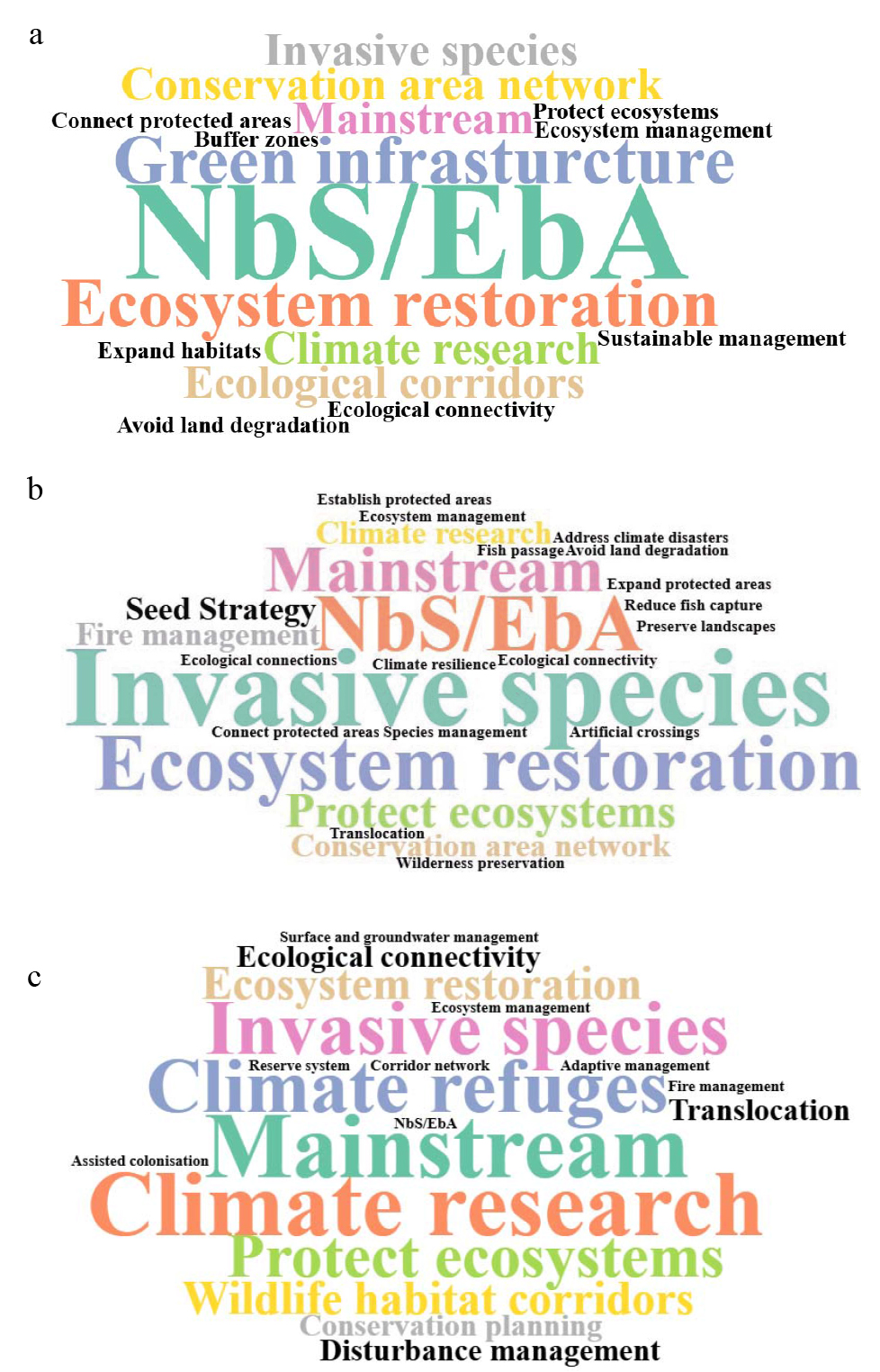
图1 欧盟(a)、美国(b)及澳大利亚(c)生物多样性适应气候变化政策的关键词频
Fig. 1 Keyword frequency of climate change adaptation-related biodiversity policies in the European Union (a), the United States (b), and Australia (c)
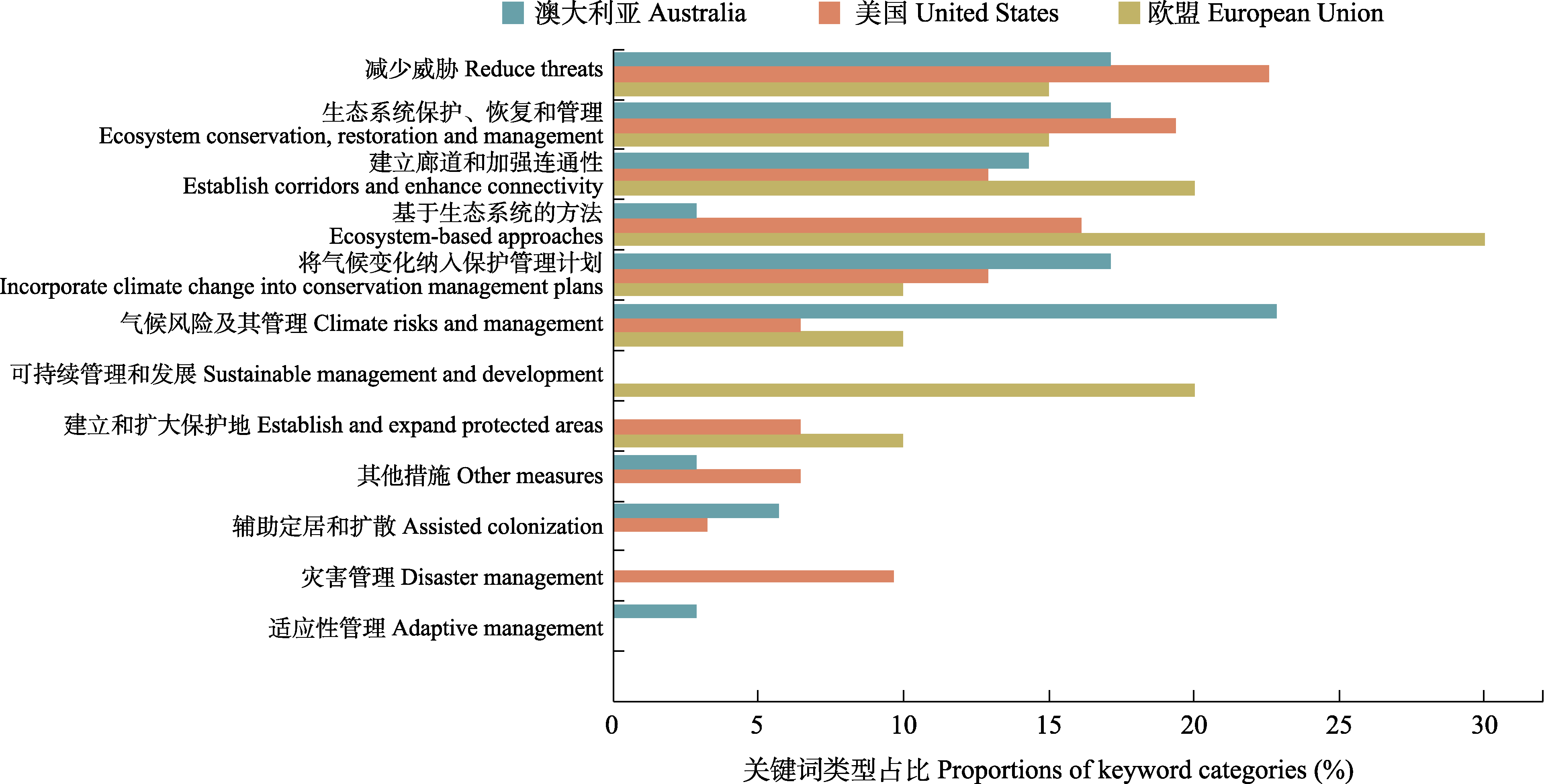
图2 欧盟、美国及澳大利亚生物多样性适应气候变化政策关键词类型统计
Fig. 2 The occurrence of keyword categories in climate change adaptation-related biodiversity policies of the European Union, the United States, and Australia
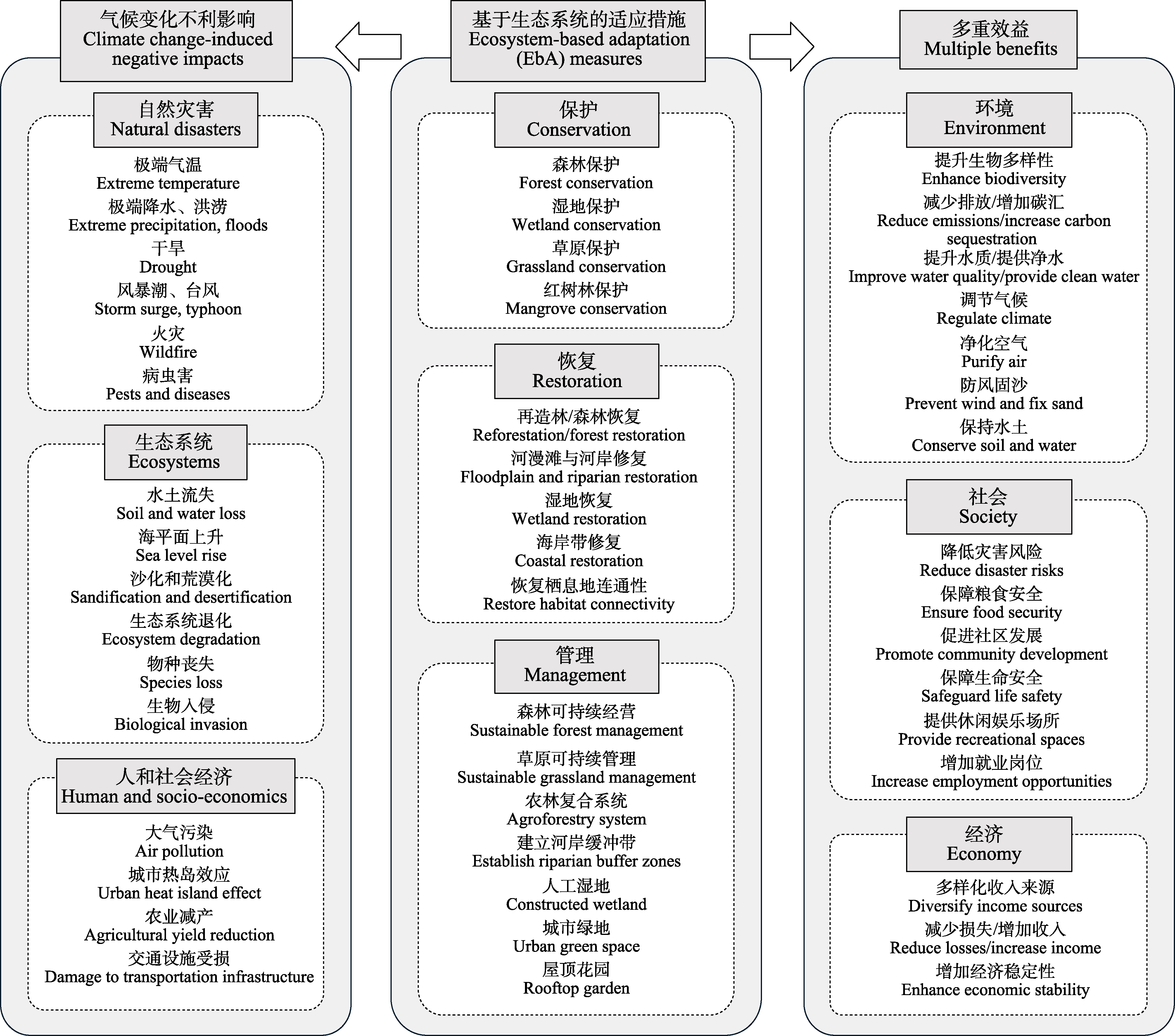
图3 基于生态系统的适应(EbA)措施应对气候变化的不利影响及其多重效益示例
Fig. 3 Examples of ecosystem-based adaptation (EbA) measures for addressing the adverse impacts of climate change and their multiple co-benefits
| [1] | Agaton CB, Guila PMC (2023) Ecosystem services valuation of constructed wetland as a nature-based solution to wastewater treatment. Earth, 4, 78-92. |
| [2] | Arkema KK, Guannel G, Verutes G, Wood SA, Guerry A, Ruckelshaus M, Kareiva P, Lacayo M, Silver JM (2013) Coastal habitats shield people and property from sea-level rise and storms. Nature Climate Change, 3, 913-918. |
| [3] | Australian Government (2012) National Wildlife Corridors Plan: A Framework for Landscape-scale Conservation. https://ger.org.au/wp-content/uploads/2020/05/Commonwealth-of-Australia-2012-National-Wildlife-Corridors-Plan.pdf. (accessed on 2026-02-10) |
| [4] | Australian Government (2021a) Australia’s Strategy for Nature2019-2030. https://www.cbd.int/doc/world/au/au-nbsap-v3-en.pdf. (accessed on 2026-02-10) |
| [5] | Australian Government (2021b) National Climate Change Adaptation Framework. https://www4.unfccc.int/sites/NAPC/Country%20Documents/Parties/national_climate_change_adaption_framework.pdf. (accessed on 2026-02-10) |
| [6] | Australian Government (2021c) National Climate Resilience and Adaptation Strategy 2021-2025. https://www.agriculture.gov.au/sites/default/files/documents/national-climate-resilience-and-adaptation-strategy.pdf. (accessed on 2026-02-10) |
| [7] | Australian Government (2021d) Threatened Species Strategy 2021-2031. https://www.dcceew.gov.au/sites/default/files/documents/threatened-species-strategy-2021-2031.pdf. (accessed on2026-02-10) |
| [8] | Australian Government (2022) Threatened Species Action Plan 2022-2032. https://www.dcceew.gov.au/sites/default/files/documents/threatened-species-action-plan-2022-2032.pdf.(accessed on 2026-02-10) |
| [9] | Australian Government (2025a) Australia’s Strategy for Nature 2024-2030. https://www.dcceew.gov.au/sites/default/files/documents/australias-strategy-for-nature-2024-2030.pdf.(accessed on 2026-02-05) |
| [10] | Australian Government (2025b) National Adaptation Plan. https://www.dcceew.gov.au/sites/default/files/documents/national-adaptation-plan.pdf. (accessed on 2026-02-05) |
| [11] | Bevacqua E, Schleussner CF, Zscheischler J (2025) A year above 1.5℃ signals that Earth is most probably within the 20-year period that will reach the Paris Agreement limit. Nature Climate Change, 15, 262-265. |
| [12] | Booth TH (2012) Biodiversity and climate change adaptation in Australia: Strategy and research developments. Advances in Climate Change Research, 3, 12-21. |
| [13] | Bourne A, Holness S, Holden P, Scorgie S, Donatti CI, Midgley G (2016) A socio-ecological approach for identifying and contextualising spatial ecosystem-based adaptation priorities at the sub-national level. PLoS ONE, 11, e0155235. |
| [14] | Brodie EG, Knapp EE, Brooks WR, Drury SA, Ritchie MW (2024) Forest thinning and prescribed burning treatments reduce wildfire severity and buffer the impacts of severe fire weather. Fire Ecology, 20, 17. |
| [15] | Cannon AJ (2025) Twelve months at 1.5℃ signals earlier than expected breach of Paris Agreement threshold. Nature Climate Change, 15, 266-269. |
| [16] | Cortinovis C, Olsson P, Boke-Olén N, Hedlund K (2022) Scaling up nature-based solutions for climate-change adaptation: Potential and benefits in three European cities. Urban Forestry & Urban Greening, 67, 127450. |
| [17] | Craig RK (2022) Climate adaptation law and policy in the United States. Frontiers in Marine Science, 9, 1059734. |
| [18] | Czech B, Covington S, Crimmins TM, Ericson JA, Flather C, Gale M, Gerst K, Higgins M, Kaib M, Marino E, Moran T, Morton J, Niemuth N, Peckett H, Savignano D, Saperstein L, Skorupa S, Wagener E, Wilen B, Wolfe B (2014) Planning for Climate Change on the National Wildlife Refuge System. US Fish and Wildlife Service. https://www.fs.usda.gov/rm/pubs_journals/2014/rmrs_2014_czech_b001.pdf. (accessed on 2026-02-10) |
| [19] | DEFRA (Department for Environment, Food & Rural Affairs) (2024) Understanding Climate Adaptation and the Third National Adaptation Programme (NAP3). https://www.gov.uk/government/publications/third-national-adaptation-programme-nap3/understanding-climate-adaptation-and-the-third-national-adaptation-programme-nap3. (accessed on 2026-02-10) |
| [20] | El Chami D, Daccache A, El Moujabber M (2020) How can sustainable agriculture increase climate resilience? A systematic review. Sustainability, 12, 3119. |
| [21] | EU (European Union) (2014) Regulation (EU) No 1143/2014 of the European Parliament and of the Council of 22 October 2014 on the Prevention and Management of the Introduction and Spread of Invasive Alien Species. https://eur-lex.europa.eu/legal-content/EN/TXT/?qid=1483614313362&uri=CELEX:32014R1143. (accessed on 2026-02-10) |
| [22] | EU (European Union) (2017) An Action Plan for Nature, People and the Economy. https://eur-lex.europa.eu/legal-content/EN/TXT/?uri=CELEX%3A52017DC0198. (accessed on 2026-02-10) |
| [23] | EU (European Union) (2021a) Forging a Climate-resilient Europe-The New EU Strategy on Adaptation to Climate Change. https://eur-lex.europa.eu/legal-content/EN/TXT/?uri=COM:2021:82:FIN. (accessed on 2026-02-10) |
| [24] | EU (European Union) (2021b) EU Biodiversity Strategy for 2030. https://environment.ec.europa.eu/strategy/biodiversity-strategy-2030_en. (accessed on 2026-02-10) |
| [25] | EU (European Union) (2021c) Guidelines on Climate Change and Natura 2000. https://op.europa.eu/en/publication-detail/-/publication/59c03f44-f672-4f61-bbf7-5422479cf6bb.(accessed on 2026-02-10) |
| [26] | EU (European Union) (2023a) Green Infrastructure (GI)-Enhancing Europe’s Natural Capital. https://eur-lex.europa.eu/legal-content/EN/TXT/?uri=CELEX:52013DC0249. (accessed on 2026-02-10) |
| [27] | EU (European Union) (2023b) Revision of the EU Pollinators Initiative-A New Deal for Pollinators. https://eur-lex.europa.eu/legal-content/EN/TXT/?uri=COM:2023:35:FIN&qid=1674555285177. (accessed on 2026-02-10) |
| [28] | EU (European Union) (2024) Regulation (EU) 2024/1991 of the European Parliament and of the Council of 24 June 2024 on Nature Restoration and Amending Regulation (EU) 2022/869. https://eur-lex.europa.eu/eli/reg/2024/1991/oj/eng/pdf. (accessed on 2026-02-10) |
| [29] | Future Earth, The Earth League, WCRP (the World Climate Research Programme) 2025) 10 New Insights in Climate Science 2025/2026. https://10insightsclimate.science/wp-content/uploads/2026/01/10NICS-2025-Report_digital_v2.pdf. (accessed on 2026-05-12) |
| [30] | Greenwood O, Mossman HL, Suggitt AJ, Curtis RJ, Maclean IMD (2016) Using in situ management to conserve biodiversity under climate change. Journal of Applied Ecology, 53, 885-894. |
| [31] | Grimm NB, Chapin III FS, Bierwagen B, Gonzalez P, Groffman PM, Luo YQ, Melton F, Nadelhoffer K, Pairis A, Raymond PA, Schimel J, Williamson CE (2013) The impacts of climate change on ecosystem structure and function. Frontiers in Ecology and the Environment, 11, 474-482. |
| [32] | Haase D (2017) Urban wetlands and riparian forests as a nature-based solution for climate change adaptation in cities and their surroundings. In: Nature-Based Solutions to Climate Change Adaptation in Urban Areas (eds Kabisch N, Korn H, Stadler J, Bonn A), pp. 111-121. Springer, Cham. |
| [33] | Harvey CA, Martínez-Rodríguez MR, Cárdenas JM, Avelino J, Rapidel B, Vignola R, Donatti CI, Vilchez-Mendoza S (2017) The use of ecosystem-based adaptation practices by smallholder farmers in Central America. Agriculture, Ecosystems & Environment, 246, 279-290. |
| [34] | Heller NE, Zavaleta ES (2009) Biodiversity management in the face of climate change: A review of 22 years of recommendations. Biological Conservation, 142, 14-32. |
| [35] | IPCC (Intergovernmental Panel on Climate Change) (2023) Climate Change 2023: Synthesis Report. https://www.ipcc.ch/report/ar6/syr/. (accessed on 2026-02-10) |
| [36] | Keenan RJ, Weston CJ, Volkova L (2021) Potential for forest thinning to reduce risk and increase resilience to wildfire in Australian temperate Eucalyptus forests. Current Opinion in Environmental Science & Health, 23, 100280. |
| [37] | Liu Y, Zou YY, Zhu LC, Wu WL, Li P (2014) Major policies and measures on biodiversity adaptation to climate change: International experience and enlightenment. Biodiversity Science, 22, 407-413. (in Chinese with English abstract) |
| [刘影, 邹玥屿, 朱留财, 吴伟玲, 李培 (2014) 生物多样性适应气候变化的国家政策和措施: 国际经验及启示. 生物多样性, 22, 407-413.] | |
| [38] | Mawdsley JR, O’Malley RO, Ojima DS (2009) A review of climate-change adaptation strategies for wildlife management and biodiversity conservation. Conservation Biology, 23, 1080-1089. |
| [39] | Moran C, Boulter S (2018) Biodiversity and Ecosystems Climate Adaptation Plan. National Climate Change Adaptation Research Facility (NCCARF), Brisbane, Australia. https://www.qld.gov.au/__data/assets/pdf_file/0022/87610/b-e-cap.pdf. (accessed on 2026-02-10) |
| [40] | Nalau J, Becken S, MacKey B (2018) Ecosystem-based adaptation: A review of the constraints. Environmental Science & Policy, 89, 357-364. |
| [41] | Ocean Policy Committee (2023) Ocean Climate Action Plan. https://bidenwhitehouse.archives.gov/wp-content/uploads/2023/03/Ocean-Climate-Action-Plan_Final.pdf. (accessed on 2026-02-10) |
| [42] | Ojea E (2015) Challenges for mainstreaming ecosystem-based adaptation into the international climate agenda. Current Opinion in Environmental Sustainability, 14, 41-48. |
| [43] | Opperman JJ, Luster R, McKenney BA, Roberts M, Meadows AW (2010) Ecologically functional floodplains: Connectivity,flow regime, and scale. Journal of the American Water Resources Association, 46, 211-226. |
| [44] | Pautasso M, Döring TF, Garbelotto M, Pellis L, Jeger MJ (2012) Impacts of climate change on plant diseases-Opinions and trends. European Journal of Plant Pathology, 133, 295-313. |
| [45] | Prichard SJ, Hessburg PF, Hagmann RK, Povak NA, Dobrowski SZ, Hurteau MD, Kane VR, Keane RE, Kobziar LN, Kolden CA, North M, Parks SA, Safford HD, Stevens JT, Yocom LL, Churchill DJ, Gray RW, Huffman DW, Lake FK, Khatri-Chhetri P (2021) Adapting western North American forests to climate change and wildfires: 10 common questions. Ecological Applications, 31, e02433. |
| [46] | Salgado K, Martinez ML (2017) Is ecosystem-based coastal defense a realistic alternative? Exploring the evidence. Journal of Coastal Conservation, 21, 837-848. |
| [47] | Schmitz OJ, Lawler JJ, Beier P, Groves C, Knight G, Boyce DA Jr, Bulluck J, Johnston KM, Klein ML, Muller K, Pierce DJ, Singleton WR, Strittholt JR, Theobald DM, Trombulak SC, Trainor A (2015) Conserving biodiversity: Practical guidance about climate change adaptation approaches in support of land-use planning. Natural Areas Journal, 35, 190-203. |
| [48] | Spalding MD, Ruffo S, Lacambra C, Meliane I, Hale LZ, Shepard CC, Beck MW (2014) The role of ecosystems in coastal protection: Adapting to climate change and coastal hazards. Ocean & Coastal Management, 90, 50-57. |
| [49] | Staudinger MD, Carter SL, Cross MS, Dubois NS, Duffy JE, Enquist C, Griffis R, Hellmann JJ, Lawler JJ, O’Leary J, Morrison SA, Sneddon L, Stein BA, Thompson LM, Turner W (2013) Biodiversity in a changing climate: A synthesis of current and projected trends in the US. Frontiers in Ecology and the Environment, 11, 465-473. |
| [50] | Stein BA, Staudt A, Cross MS, Dubois NS, Enquist C, Griffis R, Hansen LJ, Hellmann JJ, Lawler JJ, Nelson EJ, Pairis A (2013) Preparing for and managing change: Climate adaptation for biodiversity and ecosystems. Frontiers in Ecology and the Environment, 11, 502-510. |
| [51] | Stephens SL, McIver JD, Boerner REJ, Fettig CJ, Fontaine JB, Hartsough BR, Kennedy PL, Schwilk DW (2012) The effects of forest fuel-reduction treatments in the United States. BioScience, 62, 549-560. |
| [52] | Sun F, He XJ (2014) Global progress in climate change adaptation policies and its implication for China. China Population Resources and Environment, 24(5), 1-9. (in Chinese with English abstract) |
| [孙傅, 何霄嘉 (2014) 国际气候变化适应政策发展动态及其对中国的启示. 中国人口·资源与环境, 24(5), 1-9.] | |
| [53] | UNEP (United Nations Environment Programme) (2023) Adaptation Gap Report 2023. https://www.unep.org/resources/adaptation-gap-report-2023. (accessed on 2026-02-10) |
| [54] | UNEP (2026) Limiting Overshoot: Navigating Exceedance of 1.5°C and Pathways towards Return. United Nations Environment Programme, Nairobi. |
| [55] | Vignola R, Harvey CA, Bautista-Solis P, Avelino J, Rapidel B, Donatti C, Martinez R (2015) Ecosystem-based adaptation for smallholder farmers: Definitions, opportunities and constraints. Agriculture, Ecosystems & Environment, 211, 126-132. |
| [56] | Wan XR, Cheng CY, Bai DF, Zhang ZB (2023) Ecological impacts of climate change and adaptation strategies. Bulletin of Chinese Academy of Sciences, 38, 518-527. (in Chinese with English abstract) |
| [万辛如, 程超源, 白德凤, 张知彬 (2023) 气候变化的生态影响及适应对策. 中国科学院院刊, 38, 518-527.] | |
| [57] | Wang GQ, Fu C, Xu XB, Zhang LX (2020) Experience and inspiration of ecosystem-based adaptation from the perspective of South-South Cooperation on climate change. Environmental Protection, 48(13), 25-28. (in Chinese) |
| [王国勤, 付超, 徐湘博, 张林秀 (2020) 气候变化南南合作视角下基于生态系统的适应的经验启示. 环境保护, 48(13), 25-28.] | |
| [58] | World Bank (2009) Convenient Solutions to an Inconvenient Truth: Ecosystem-based Approaches to Climate Change. World Bank, Washington, DC. |
| [59] | Wu YF, Sun JX, Xu YJ, Zhang GX, Liu T (2022) Projection of future hydrometeorological extremes and wetland flood mitigation services with different global warming levels: A case study in the Nenjiang River basin. Ecological Indicators, 140, 108987. |
| [60] | Zheng DW, Pan ZH (2022) How to Adapt to Climate Change. China Meteorological Press, Beijing. (in Chinese) |
| [郑大玮, 潘志华 (2022) 怎样适应气候变化. 气象出版社, 北京.] | |
| [61] | Zhou GS, He QJ, Ji YH (2016) Advances in the international action and agricultural measurements of adaptation to climate change. Journal of Applied Meteorological Science, 27, 527-533. (in Chinese with English abstract) |
| [周广胜, 何奇瑾, 汲玉河 (2016) 适应气候变化的国际行动和农业措施研究进展. 应用气象学报, 27, 527-533.] |
| [1] | 胡宇蝶, 张晶晶, 唐军, 史雪威, 杨泉峰, 赵磊. 自然保护地管理成效评估研究进展及展望[J]. 生物多样性, 2026, 34(8): 26167-. |
| [2] | 潘奕好, 马冰然, 杜乐山, 朱彦鹏, 方向文, 刘方正. 夜晚人工灯光对京津冀区域自然保护区的影响特征[J]. 生物多样性, 2026, 34(8): 26245-. |
| [3] | 华方圆, 刘双祺, 彭杨靖, 龚善星, 申小莉, 金崑. 自然保护地和生态保护红线生物多样性与气候变化风险源的协同治理框架[J]. 生物多样性, 2026, 34(6): 25492-. |
| [4] | 冯春婷, 吴晨, 孙熙晴, 王伟. 中国的世界生物圈保护区人与自然关系评估[J]. 生物多样性, 2025, 33(9): 25248-. |
| [5] | 钱嘉宁. 履行就地保护义务的投资仲裁风险及应对[J]. 生物多样性, 2025, 33(7): 24333-. |
| [6] | 康燕, 干靓, 俞霖琳, 何晨静, 张理卿, 吴婧彬. 基于NbS的城市小微栖息地营造与网络构建模式: 以上海市长宁区生境花园为例[J]. 生物多样性, 2025, 33(5): 24528-. |
| [7] | 郭雨桐, 李素萃, 王智, 解焱, 杨雪, 周广金, 尤春赫, 朱萨宁, 高吉喜. 全国自然保护地对国家重点保护野生物种的覆盖度及其分布状况[J]. 生物多样性, 2025, 33(3): 24423-. |
| [8] | 罗金怡, 张纪, 毕艳玲, 陈哲, 武瑞东. 集成多层次保护对象的潜在保护地识别: 以大理白族自治州为例[J]. 生物多样性, 2025, 33(11): 25080-. |
| [9] | 张雨琦, 文君, 张引, 李晟之. 大熊猫国家公园全民公益性评价研究: 基于利益相关者感知视角[J]. 生物多样性, 2024, 32(9): 24240-. |
| [10] | 鄢德奎. 中国生物多样性保护政策的共同要素、不足和优化建议[J]. 生物多样性, 2024, 32(5): 23293-. |
| [11] | 崔国发. 关于自然保护地整合优化工作中几个关键问题的讨论与建议[J]. 生物多样性, 2023, 31(9): 22447-. |
| [12] | 林木青, 张应明, 欧阳芳, 束祖飞, 朱朝东, 肖治术. 广东车八岭国家级自然保护区独栖性胡蜂多样性空间分布特征及其对环境因子的响应[J]. 生物多样性, 2023, 31(2): 22310-. |
| [13] | 王金洲, 徐靖. “基于自然的解决方案”应对生物多样性丧失和气候变化: 进展、挑战和建议[J]. 生物多样性, 2023, 31(2): 22496-. |
| [14] | 张敏, 田春坡, 车先丽, 赵岩岩, 陈什旺, 周霞, 邹发生. 广东省鸟类新记录及其与自然和社会经济因素的关联性[J]. 生物多样性, 2022, 30(5): 21396-. |
| [15] | 张书杰, 庄优波. 管控视角下生态空间与生态保护红线关系研究[J]. 生物多样性, 2022, 30(4): 21441-. |
| 阅读次数 | ||||||
|
全文 |
|
|||||
|
摘要 |
|
|||||
备案号:京ICP备16067583号-7
Copyright © 2026 版权所有 《生物多样性》编辑部
地址: 北京香山南辛村20号, 邮编:100093
电话: 010-62836137, 62836665 E-mail: biodiversity@ibcas.ac.cn
