

生物多样性 ›› 2026, Vol. 34 ›› Issue (5): 26051. DOI: 10.17520/biods.2026051 cstr: 32101.14.biods.2026051
• 研究报告: 动物多样性 • 上一篇
朱芸1( ), 王凯红2, 李洪磊2, 徐向龙1(), 雷宇1(), 陈浩2, 陈卫华2, 蔡新杰2, 丁长青1,*(
 )
)
收稿日期:2026-02-12
接受日期:2026-04-21
出版日期:2026-05-20
发布日期:2026-07-03
通讯作者:
丁长青
基金资助:
Yun Zhu1(), Kaihong Wang2, Honglei Li2, Xianglong Xu1(), Yu Lei1(), Hao Chen2, Weihua Chen2, Xinjie Cai2, Changqing Ding1,*()
Received:2026-02-12
Accepted:2026-04-21
Online:2026-05-20
Published:2026-07-03
Contact:
Changqing Ding
Supported by:摘要:
面对全球生物多样性持续衰退的严峻挑战, 再引入已成为拯救濒危动物、恢复区域生物多样性的关键保护措施。放归前进行野化训练对人工繁育个体的野外存活至关重要, 其中食物丰容训练主要通过增加食物类型、模拟自然觅食环境等方式提高动物对放归地的适应能力。然而, 目前对食物丰容效果的动态过程及其量化评估研究仍为空白。为评估朱鹮(Nipponia nippon)对滨海湿地食物的适应性、探索行为学方法在野化训练成效评价中的应用, 本研究于2023年7-8月在江苏盐城湿地珍禽国家级自然保护区开展了野化训练朱鹮的食性转换实验。采用全事件取样法系统记录朱鹮对滨海食物的取食多样性及觅食行为变化, 以探明其滨海食物适应潜力与行为适应过程。结果表明: (1)朱鹮对滨海食物的取食比例达78.47%, 实验期间滨海食物的取食量逐渐升高、原有主食泥鳅逐渐降低, 表明其具备适应当地野外食物资源的潜力。(2)朱鹮的行为适应过程遵循“观望-试探-取食”的渐进模式。随着实验的进行, 其试探与取食行为频次显著升高, 体现了食物丰容措施驱动朱鹮探索行为和觅食行为多样性提高的动态过程。(3)个体适应能力存在显著差异, 活动能力较强的个体表现出更快的适应速度与更高的取食多样性。本研究基于行为学方法从时间维度上探明了食物丰容训练对行为多样性的促进作用, 证实科学设计的食物丰容实验能够有效引导圈养动物的行为结构向提高自然探索行为与功能性觅食行为多样性的方向发生显著调整。基于实验结果建议在再引入实践中构建“训练-放归-监测”全周期的本地食物丰容管理方案, 即放归前通过针对性食性转换训练拓宽濒危动物的食谱, 同步建立个体行为档案实现个体质量评估并筛选出合格个体实施放归, 监测放归后的高适应性食物并进行放归初期的过渡性食物补充。本研究为优化朱鹮及其他濒危物种的再引入技术方案提供了关键的理论依据与实践支撑。
朱芸, 王凯红, 李洪磊, 徐向龙, 雷宇, 陈浩, 陈卫华, 蔡新杰, 丁长青 (2026) 朱鹮对滨海食物的适应性: 恢复东部沿海朱鹮种群的初步探索. 生物多样性, 34, 26051. DOI: 10.17520/biods.2026051.
Yun Zhu, Kaihong Wang, Honglei Li, Xianglong Xu, Yu Lei, Hao Chen, Weihua Chen, Xinjie Cai, Changqing Ding (2026) Adaptation of Crested Ibis to coastal foods: A pilot study for reestablishing population in the eastern coastal region of China. Biodiversity Science, 34, 26051. DOI: 10.17520/biods.2026051.
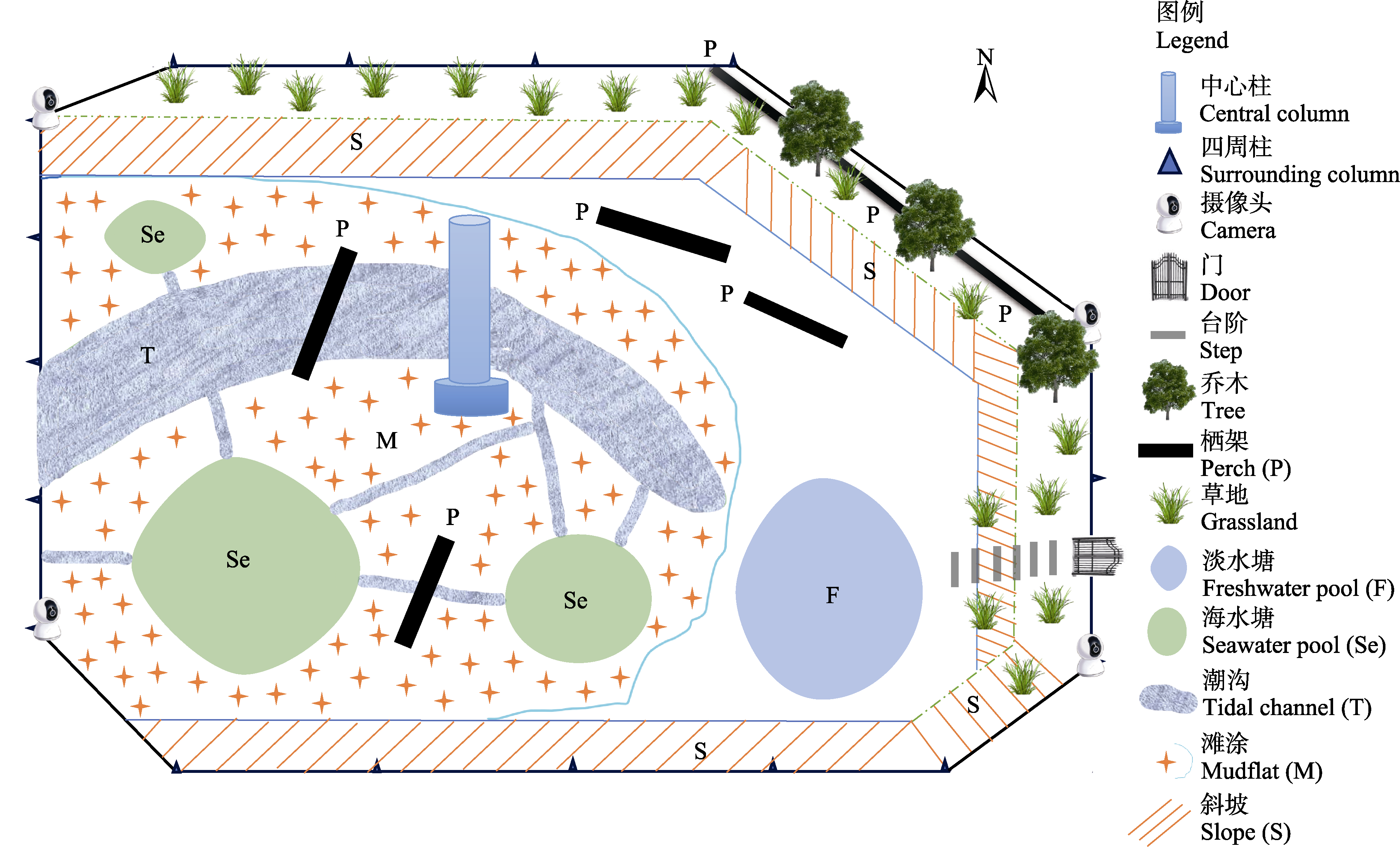
图1 江苏盐城湿地珍禽国家级自然保护区朱鹮野化训练大网笼环境丰容示意图
Fig. 1 Layout of environmental enrichment in the large aviary for Crested Ibis acclimating at Jiangsu Yancheng Wetland & Rare Birds National Nature Reserve
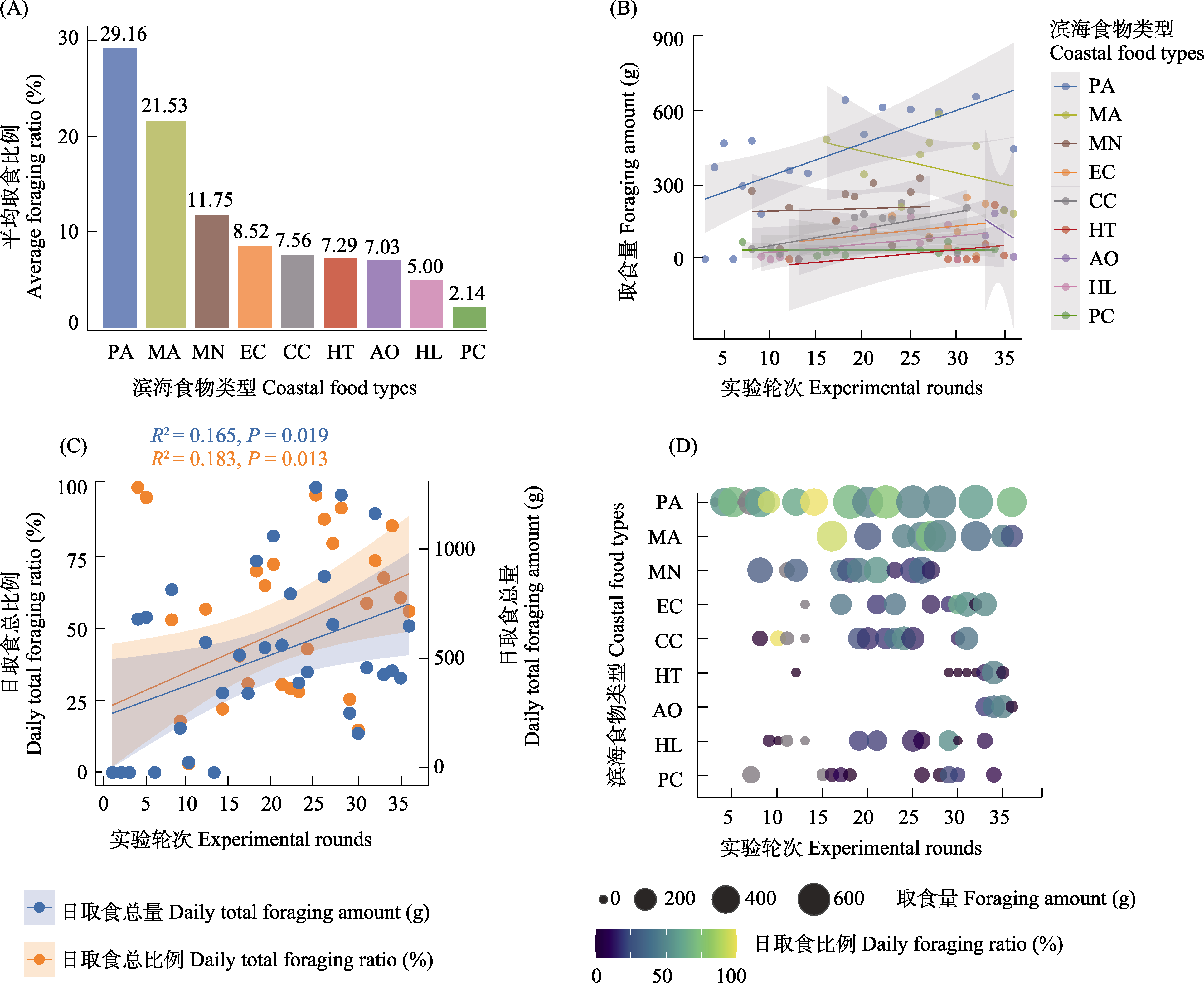
图2 江苏盐城野化训练朱鹮对滨海食物的取食情况。取食比例(A), 取食量变化(B), 日取食总比例和日取食总量变化(C), 日取食比例和取食量变化(D)。PA: 双齿围沙蚕; MA: 泥鳅; MN: 日本沼虾; EC: 脊尾白虾; CC: 黑鲫; HT: 天津厚蟹; AO: 斑尾刺虾虎鱼; HL: 䱗; PC: 弹涂鱼。
Fig. 2 Dietary composition of coastal foods in Crested Ibis during acclimation in Yancheng, Jiangsu. (A) Average foraging ratio; (B) foraging amount; (C) daily total foraging ratio and daily total foraging amount; (D) daily foraging amount and ratio. PA, Perinereis aibuhitensis; MA, Misgurnus anguilicaudatus; MN, Macrobrachium nipponense; EC, Exopalaemon carinicauda; CC, Carassius carassius; HT, Helice tridens; AO, Acanthogobius ommaturus; HL, Hemiculter leucisculus; PC, Periophthalmus cantonensis.
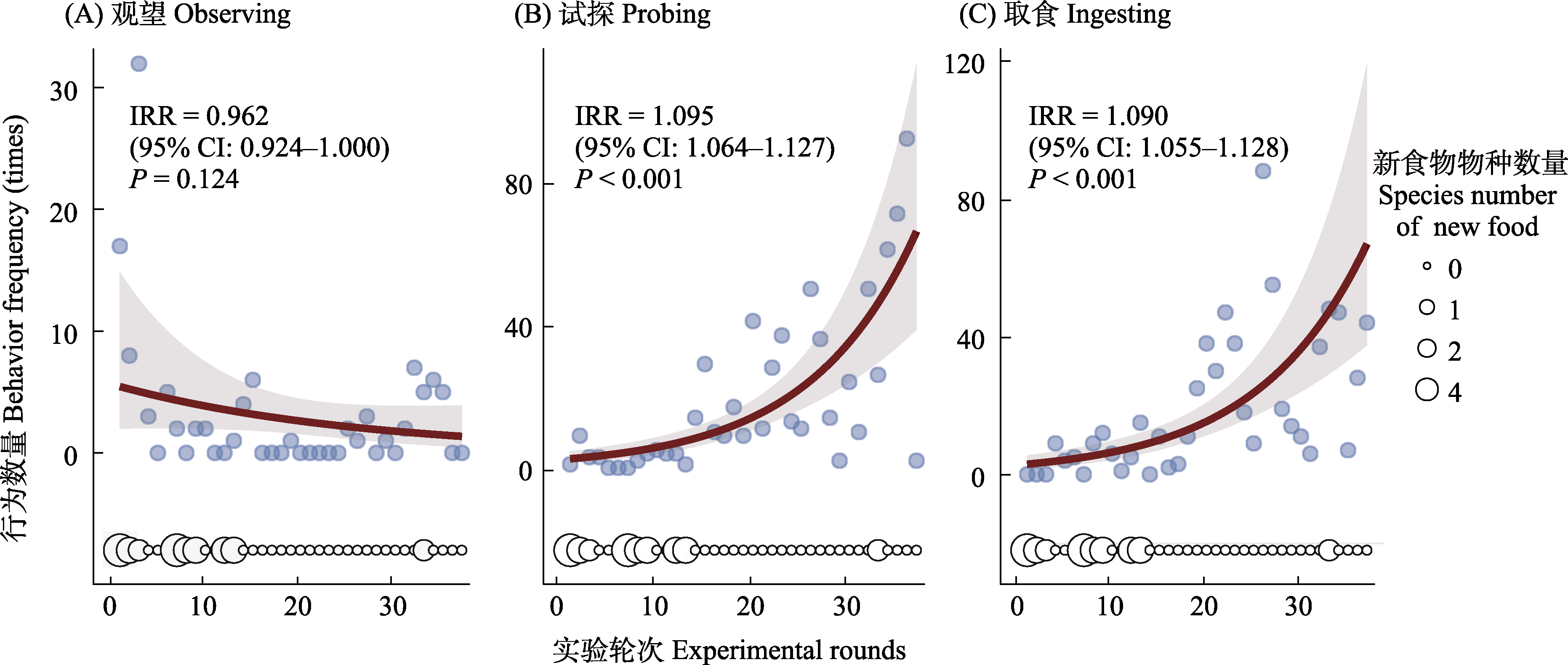
图3 江苏盐城野化训练朱鹮食性转换实验期间的觅食行为变化。IRR为发生率比: 95% CI包含1、P > 0.05则差异无统计学意义; 95% CI不包含1、P < 0.05时,IRR > 1显著升高,IRR < 1显著降低。
Fig. 3 Changes in foraging behaviors during the diet-shifting experiments of Crested Ibis acclimated in Yancheng, Jiangsu. IRR denotes incidence rate ratio: The 95% CI including 1 and P > 0.05 indicates no statistically significant difference. When the 95% CI does not include 1 and P < 0.05, an IRR > 1 indicates a significant increase, whereas an IRR < 1 indicates a significant decrease.
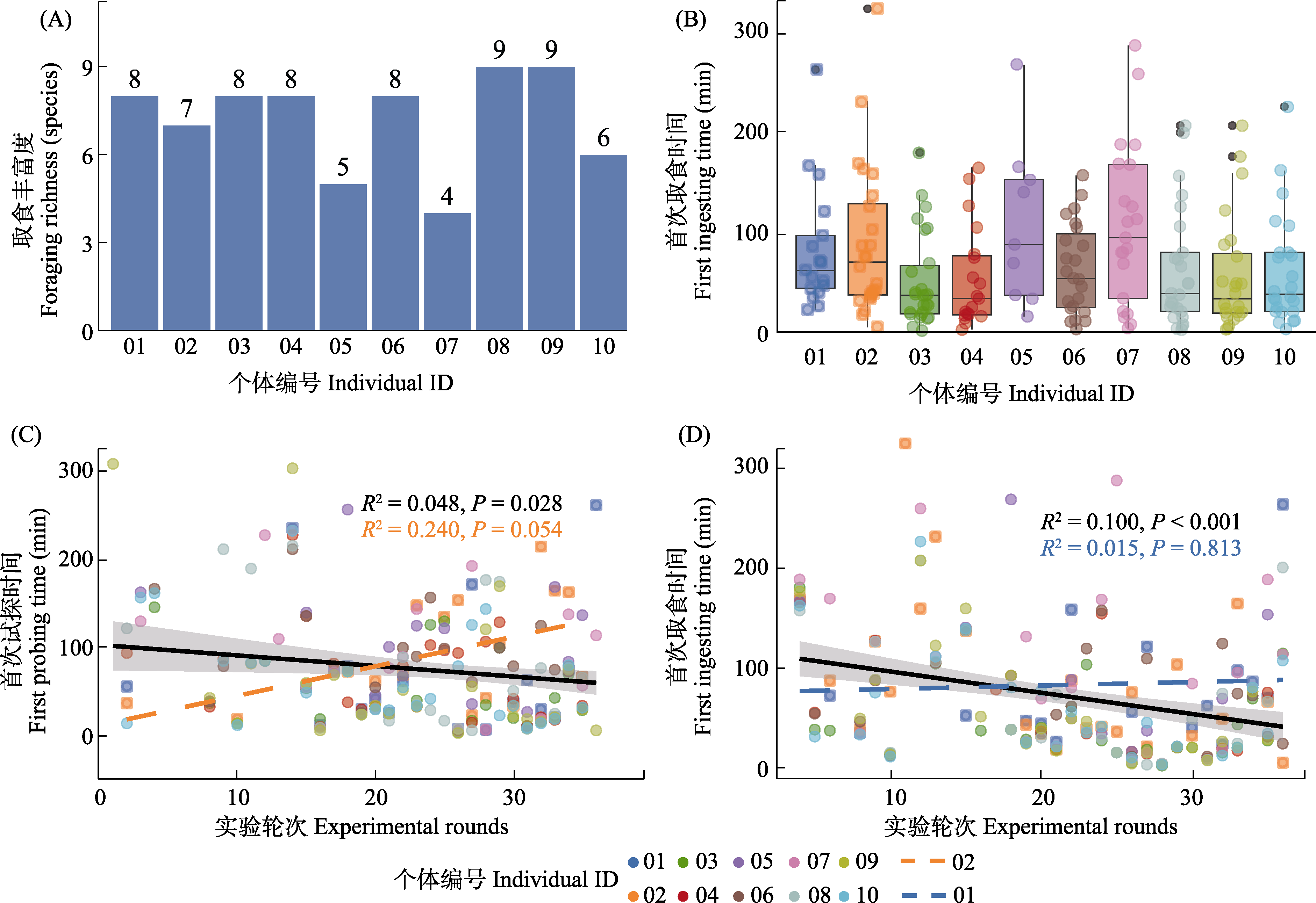
图4 江苏盐城野化训练朱鹮滨海食物取食丰富度和觅食行为的个体差异。滨海食物的取食丰富度(A); 个体首次取食时间(B); 群体首次试探时间(C, 橙色虚线表示02号朱鹮的首次试探时间); 群体首次取食时间(D, 蓝色虚线表示01号朱鹮的首次取食时间)。
Fig. 4 Individual variation in coastal foods foraging richness and behaviors of acclimating Crested Ibis in Yancheng, Jiangsu. (A) Foraging richness on coastal foods; (B) First ingesting time across individuals; (C) First probing time across experimental rounds within groups (the orange dashed line represents individual No. 02); (D) First ingesting time across experimental rounds within groups (the blue dashed line represents individual No. 01).
| [1] |
Altmann J (1974) Observational study of behavior: Sampling methods. Behaviour, 49, 227-267.
DOI PMID |
| [2] | BirdLife International (2018) The IUCN Red List of Threatened Species 2018: e.T22697548A132069229. https://dx.doi.org/10.2305/IUCN.UK.2018-2.RLTS.T22697548A132069229.en. (accessed on 2024-10-01) |
| [3] |
Ceballos G, Ehrlich PR, Barnosky AD, García A, Pringle RM, Palmer TM (2015) Accelerated modern human-induced species losses: Entering the sixth mass extinction. Science Advances, 1, e1400253.
DOI URL |
| [4] |
de Almeida AC, Palme R, Moreira N (2018) How environmental enrichment affects behavioral and glucocorticoid responses in captive blue-and-yellow macaws (Ara ararauna). Applied Animal Behaviour Science, 201, 125-135.
DOI URL |
| [5] | Ding CQ (2004) Research on the Crested Ibis. Shanghai Scientific and Technological Education Publishing House, Shanghai. (in Chinese) |
| [丁长青 (2004) 朱鹮研究. 上海科技教育出版社, 上海.] | |
| [6] | Dingemanse NJ, Both C, van Noordwijk AJ, Rutten AL, Drent PJ (2003) Natal dispersal and personalities in great tits (Parus major). Proceedings of the Royal Society B: Biological Sciences, 270, 741-747. |
| [7] |
Edge C, Thompson D, Hao CY, Houlahan J (2014) The response of amphibian larvae to exposure to a glyphosate-based herbicide (Roundup WeatherMax) and nutrient enrichment in an ecosystem experiment. Ecotoxicology and Environmental Safety, 109, 124-132.
DOI PMID |
| [8] |
Eguizábal GV, Palme R, Villarreal D, Dal Borgo C, Di Rienzo JA, Busso JM (2013) Assessment of adrenocortical activity and behavior of the collared anteater (Tamandua tetradactyla) in response to food-based environmental enrichment. Zoo Biology, 32, 632-640.
DOI PMID |
| [9] |
Gooch S, Ashbrook K, Taylor A, Székely T (2015) Using dietary analysis and habitat selection to inform conservation management of reintroduced Great Bustards Otis tarda in an agricultural landscape. Bird Study, 62, 289-302.
DOI URL |
| [10] |
Hamilton LP, Kelly PA, Williams DF, Kelt DA, Wittmer HU (2010) Factors associated with survival of reintroduced riparian brush rabbits in California. Biological Conservation, 143, 999-1007.
DOI URL |
| [11] | IUCN/SSC (IUCN Species Survival Commission) (2013) Guidelines for Reintroductions and Other Conservation Translocations. Version 1.0. (accessed on 2024-10-01) |
| [12] | Jiang ZG (2004) Principle of Animal Behavior and Methods in Species Conservation. Science Press, Beijing. (in Chinese) |
| [蒋志刚 (2004) 动物行为原理与物种保护方法. 科学出版社, 北京.] | |
| [13] | Joseph M, Wunderle JR (1991) Age-specific foraging proficiency in birds. In: CurrentOrnithology (ed. Dennis MP), pp. 273-324. Plenum Publishing Corporation, New York. |
| [14] |
Kalan AK, Kulik L, Arandjelovic M, Boesch C, Haas F, Dieguez P, Barratt CD, Abwe EE, Agbor A, Angedakin S, …, Tagg N, Tennie C, Vergnes V, Welsh A, Wessling EG, Willie J, Wittig RM, Yuh YG, Zuberbühler K, Kühl HS (2020) Environmental variability supports chimpanzee behavioural diversity. Nature Communications, 11, 4451.
DOI PMID |
| [15] | Khan AS (2023) The influence of food-based enrichment on the behaviour of captive red pandas Ailurus fulgens fulgens. Prithivya, 3, 17-28. |
| [16] |
Lehner PN (1992) Sampling methods in behavior research. Poultry Science, 71, 643-649.
PMID |
| [17] | Li YH, Yu C, Liao J, Jiang YX, Liu TJ, Luo LJ, Yang S, Yang B, Xu X, Deng T, Li DS, Ran JH (2026) Panda profiles: Integrating personality, cognition, and physiology for conservation success. Conservation Physiology, 14, coag019. |
| [18] |
Liu BY, Li L, Lloyd H, Xia CW, Zhang YY, Zheng GM (2016) Comparing post-release survival and habitat use by captive-bred Cabot’s Tragopan (Tragopan caboti) in an experimental test of soft-release reintroduction strategies. Avian Research, 7, 19.
DOI URL |
| [19] | Meng XX, Yang QS, Feng ZJ, Xia L, Feng JC, Zhou YJ, Xu HF (2006) Behavioral diversity of captive alpine musk deer in Xinglongshan Musk Deer Farm. Acta Zoologica Sinica, 52, 1026-1033. (in Chinese with English abstract) |
| [孟秀祥, 杨奇森, 冯祚建, 夏霖, 冯金朝, 周宜君, 徐宏发 (2006) 兴隆山圈养马麝的行为多样性. 动物学报, 52, 1026-1033.] | |
| [20] | Meng XX, Yang QS, Feng ZJ, Xu HF, Feng JC, Zhou YJ (2007) Stereotypic behavior of alpine musk deer in captivity. Journal of Northeast Forestry University, 35, 47-48, 57. (in Chinese with English abstract) |
| [孟秀祥, 杨奇森, 冯祚建, 徐宏发, 冯金朝, 周宜君 (2007) 圈养马麝的刻板行为. 东北林业大学学报, 35, 47-48, 57.] | |
| [21] |
Mertes K, Stabach JA, Songer M, Wacher T, Newby J, Chuven J, Al Dhaheri S, Leimgruber P, Monfort S (2019) Management background and release conditions structure post-release movements in reintroduced ungulates. Frontiers in Ecology and Evolution, 7, 470.
DOI URL |
| [22] | Nelder JA, Wedderburn RWM (1972) Generalized linear models. Journal of the Royal Statistical Society. Series A (General), 135, 370-384. |
| [23] |
Patrick SC, Pinaud D, Weimerskirch H (2017) Boldness predicts an individual’s position along an exploration- exploitation foraging trade-off. The Journal of Animal Ecology, 86, 1257-1268.
DOI URL |
| [24] |
Pedersen IJ, Tahamtani FM, Forkman B, Young JF, Poulsen HD, Riber AB (2020) Effects of environmental enrichment on health and bone characteristics of fast growing broiler chickens. Poultry Science, 99, 1946-1955.
DOI PMID |
| [25] | R Core Team (2024) R: A Language and Environment for Statistical Computing. R foundation for statistical computing, Vienna, Austria. |
| [26] |
Réale D, Gallant BY, Leblanc M, Festa-Bianchet M (2000) Consistency of temperament in bighorn ewes and correlates with behaviour and life history. Animal Behaviour, 60, 589-597.
DOI PMID |
| [27] |
Roberts JL, Luther D (2023) An exploratory analysis of behavior-based and other management techniques to improve avian conservation translocations. Biological Conservation, 279, 109941.
DOI URL |
| [28] |
Seddon PJ, Armstrong DP, Maloney RF (2007) Developing the science of reintroduction biology. Conservation Biology, 21, 303-312.
PMID |
| [29] |
Shapiro SS, Wilk MB (1965) An analysis of variance test for normality (complete samples). Biometrika, 52, 591-611.
DOI URL |
| [30] |
Shepherdson DJ, Carlstead K, Mellen JD, Seidensticker J (1993) The influence of food presentation on the behavior of small cats in confined environments. Zoo Biology, 12, 203-216.
DOI URL |
| [31] | Shi DC, Cao YH (2001) The Crested Ibis of China. China Forestry Publishing House, Beijing. (in Chinese) |
| [史东仇, 曹永汉 (2001) 中国朱鹮. 中国林业出版社, 北京.] | |
| [32] |
Spiezio C, Valsecchi V, Sandri C, Regaiolli B (2018) Investigating individual and social behaviour of the northern bald ibis (Geronticus eremita): Behavioural variety and welfare. PeerJ, 6, e5436.
DOI URL |
| [33] |
Teixeira CP, Azevedo CS, Mendl M, Cipreste CF, Young RJ (2007) Revisiting translocation and reintroduction programmes: The importance of considering stress. Animal Behaviour, 73, 1-13.
DOI URL |
| [34] | Wang GX (2017) Yancheng Coastal Wetland:Comprehensive Scientific Survey Report of Jiangsu Yancheng Wetland & Rare Birds National Nature Reserve. Science Press, Beijing. (in Chinese) |
| [王国祥 (2017) 盐城沿海湿地: 江苏盐城湿地珍禽国家级自然保护区综合科学考察报告. 科学出版社, 北京.] | |
| [35] |
Wemelsfelder F, Haskell M, Mendl MT, Calvert S, Lawrence AB (2000) Diversity of behaviour during novel object tests is reduced in pigs housed in substrate-impoverished conditions. Animal Behaviour, 60, 385-394.
PMID |
| [36] |
Xu AL, Zheng YT, Zhang XM, Xu DD, Wang JX, Sun JP (2025) Effect of food enrichment based on diverse feeding regimes on the immunity of Nibea albiflora by biochemical and RNA-seq analysis of the spleen. Comparative Biochemistry and Physiology Part D: Genomics and Proteomics, 53, 101363.
DOI URL |
| [37] |
Xu XL, Jiang JH, Lei Y, Wang C, Qing BP, Ding CQ (2022) Using stable isotope to compare the habitat use and trophic level between the new and old breeding range of wild Crested Ibis in the early breeding season. Avian Research, 13, 100007.
DOI URL |
| [38] |
Zhu Y, Wang KH, Li HL, Xu XL, Duan WB, Chen H, Qiu GQ, Chen WH, Lu J, Ding CQ (2024) Ethogram and PAE coding system of Crested Ibis in non-breeding season. Biodiversity Science, 32, 24075. (in Chinese with English abstract)
DOI |
| [朱芸, 王凯红, 李洪磊, 徐向龙, 段文斌, 陈浩, 邱国强, 陈卫华, 卢靖, 丁长青 (2024) 朱鹮非繁殖期行为谱及PAE编码系统. 生物多样性, 32, 24075.] |
| [1] | 柯金钊, 曹玉宁, 何南, 吕彬, Mona van Schingen-Khan, Thomas Ziegler, 杜卫国, 华彦, 武正军, 齐银. 濒危物种鳄蜥的研究进展与保护展望[J]. 生物多样性, 2026, 34(6): 25425-. |
| [2] | 黄薇, 刘一凡, 方涛, 赵微, 王荣, 吴婷, 靳瑜, 罗芳丽, 郭允倩, 朱耀军. 刈割后互花米草残体保留与覆膜对滨海湿地土壤细菌群落结构的影响[J]. 生物多样性, 2026, 34(5): 25468-. |
| [3] | 宋远昊, 龚吕, 李贲, 胡阳, 李秀珍. 辽河口不同退塘还湿方式对大型底栖动物的影响[J]. 生物多样性, 2025, 33(2): 24316-. |
| [4] | 朱芸, 王凯红, 李洪磊, 徐向龙, 段文斌, 陈浩, 邱国强, 陈卫华, 卢靖, 丁长青. 朱鹮非繁殖期行为谱及PAE编码系统[J]. 生物多样性, 2024, 32(9): 24075-. |
| [5] | 张乃鹏, 梁洪儒, 张焱, 孙超, 陈勇, 王路路, 夏江宝, 高芳磊. 土壤类型和地下水埋深对黄河三角洲典型盐沼植物群落空间分异的影响[J]. 生物多样性, 2024, 32(2): 23370-. |
| [6] | 黄雨菲, 路春燕, 贾明明, 王自立, 苏越, 苏艳琳. 基于无人机影像与面向对象-深度学习的滨海湿地植物物种分类[J]. 生物多样性, 2023, 31(3): 22411-. |
| [7] | 曲方圆, 李淑芸, 赵林林, 杨松颖, 万铭扬, 蔡吕彤, 张朝晖. 黄海生态区保护空缺分析[J]. 生物多样性, 2021, 29(3): 385-393. |
| [8] | 李弛, 杨道德, 张玉铭, 宋玉成, 李鹏飞, 蒋志刚. 麋鹿夜间卧息地选择的季节变化[J]. 生物多样性, 2016, 24(9): 1031-1038. |
| [9] | 李有志, 崔丽娟, 潘旭, 宁宇, 李伟, 康晓明, 李凯, 孙宝娣, 于菁菁. 辽河口湿地植物多样性及物种功能型空间分布格局[J]. 生物多样性, 2015, 23(4): 471-478. |
| [10] | 王昌海, 崔丽娟, 毛旭锋. 保护区周边农户对绿色农业认知度分析[J]. 生物多样性, 2012, 20(6): 735-744. |
| [11] | 黄雅琴, 李荣冠, 王建军, 郑成兴, 郑凤武, 林俊辉, 江锦祥, 李淑珠. 湄洲湾潮间带底栖生物多样性[J]. 生物多样性, 2010, 18(2): 156-161. |
| [12] | 李春旺, 蒋志刚, 曾岩, 游章强. 不同密度下和不同发情期时段中雄性麋鹿的繁殖计策[J]. 生物多样性, 2005, 13(5): 424-431. |
| [13] | 李欣海, 马志军, 李典谟, 丁长青, 翟天庆, 路宝忠. 应用资源选择函数研究朱鹮的巢址选择[J]. 生物多样性, 2001, 09(4): 352-358. |
| [14] | 李欣海, 李典谟, 丁长青, 曹永汉, 卢西荣, 傅文凯, 马志军, 路宝忠, 翟天庆. 朱鹮(Nipponia nippon)栖息地质量的初步评价[J]. 生物多样性, 1999, 07(3): 161-169. |
| [15] | 李欣海, 李典谟, 路宝忠, 翟天庆. 朱鹮(Nipponia nippon)种群生存力分析[J]. 生物多样性, 1996, 04(2): 69-77. |
| 阅读次数 | ||||||
|
全文 |
|
|||||
|
摘要 |
|
|||||
备案号:京ICP备16067583号-7
Copyright © 2026 版权所有 《生物多样性》编辑部
地址: 北京香山南辛村20号, 邮编:100093
电话: 010-62836137, 62836665 E-mail: biodiversity@ibcas.ac.cn
