

生物多样性 ›› 2026, Vol. 34 ›› Issue (6): 25425. DOI: 10.17520/biods.2025425 cstr: 32101.14.biods.2025425
柯金钊1,2,3, 曹玉宁1,2, 何南4, 吕彬1( ), Mona van Schingen-Khan5, Thomas Ziegler6, 杜卫国7(), 华彦8(), 武正军9,*()(
 ), 齐银1,*()()
4 广东曲江罗坑鳄蜥省级自然保护区管理处,广东韶关512135,中国
5 German Federal Agency for Nature Conservation, Bonn 53179, Germany
6 Cologne Zoo, Cologne 50735, Germany
7 复旦大学生命科学学院,上海200438,中国收稿日期:2025-10-27
接受日期:2026-02-14
出版日期:2026-06-20
发布日期:2026-07-30
通讯作者:
*共同通讯作者 E-mail: wu_zhengjun@aliyun.com; qiyin@cib.ac.cn
基金资助:
Jinzhao Ke1,2,3, Yuning Cao1,2, Nan He4, Bin Lü1(), Mona van Schingen-Khan5, Thomas Ziegler6, Weiguo Du7(), Yan Hua8(), Zhengjun Wu9,*()(), Yin Qi1,*()()
Received:2025-10-27
Accepted:2026-02-14
Online:2026-06-20
Published:2026-07-30
Contact:
*Co-authors for correspondence. E-mail: wu_zhengjun@aliyun.com; qiyin@cib.ac.cn
Supported by:摘要: 由于历史时期的栖息地丧失、国际宠物贸易驱动的人为盗猎以及其他人类活动压力, 鳄蜥(Shinisaurus crocodilurus)野生种群经历了长期衰退和分布范围萎缩, 目前在整个分布区内(中国和越南)均面临极高的灭绝风险。该物种被IUCN濒危物种红色名录评估为濒危(EN), 并在中国被列为国家一级重点保护野生动物, 在越南亦被列入国家重点保护野生动物名录。除了无可替代的保护价值, 鳄蜥因其重要的系统分类学地位、漫长的演化历史、特殊的生活史策略以及对环境变化的高度敏感性, 成为研究蜥蜴类群演化历程和生态适应机制的重要对象。本文系统综述了鳄蜥在分类地位与化石记录、栖息地选择、分布变迁与种群现状、遗传多样性与谱系分化, 以及圈养条件下行为节律与热生理等方面的研究进展。现有研究表明, 分子系统学和基因组学研究已明确鳄蜥在蛇蜥类系统发育中的关键位置, 并揭示了中国不同地理种群及越南亚种之间显著的遗传分化格局。遗传学与基因组学证据进一步显示, 现存种群整体遗传多样性较低, 但长期瓶颈和近交过程中可能发生了一定程度的遗传净化, 即部分有害隐性变异可能被选择性清除。与此同时, 野外调查与生态研究表明, 栖息地丧失与破碎化以及人为干扰已对鳄蜥野生种群造成持续压力; 基于气候情景的模型预测则进一步指出, 未来气候变化可能显著加剧其栖息地适宜性下降与种群长期存续风险。此外, 本文进一步概述了鳄蜥保护研究面临的关键科学问题, 并提出未来研究与管理工作的重点方向, 包括完善种群动态监测、评估气候变化背景下的适应性潜力、规范圈养种群的遗传管理、开发体色等无创指标辅助个体评估以及优化再引入与长期监测策略, 以期为鳄蜥的科学保护与管理决策提供参考。
柯金钊, 曹玉宁, 何南, 吕彬, Mona van Schingen-Khan, Thomas Ziegler, 杜卫国, 华彦, 武正军, 齐银 (2026) 濒危物种鳄蜥的研究进展与保护展望. 生物多样性, 34, 25425. DOI: 10.17520/biods.2025425.
Jinzhao Ke, Yuning Cao, Nan He, Bin Lü, Mona van Schingen-Khan, Thomas Ziegler, Weiguo Du, Yan Hua, Zhengjun Wu, Yin Qi (2026) Research progress and conservation prospects for the endangered crocodile lizard (Shinisaurus crocodilurus). Biodiversity Science, 34, 25425. DOI: 10.17520/biods.2025425.
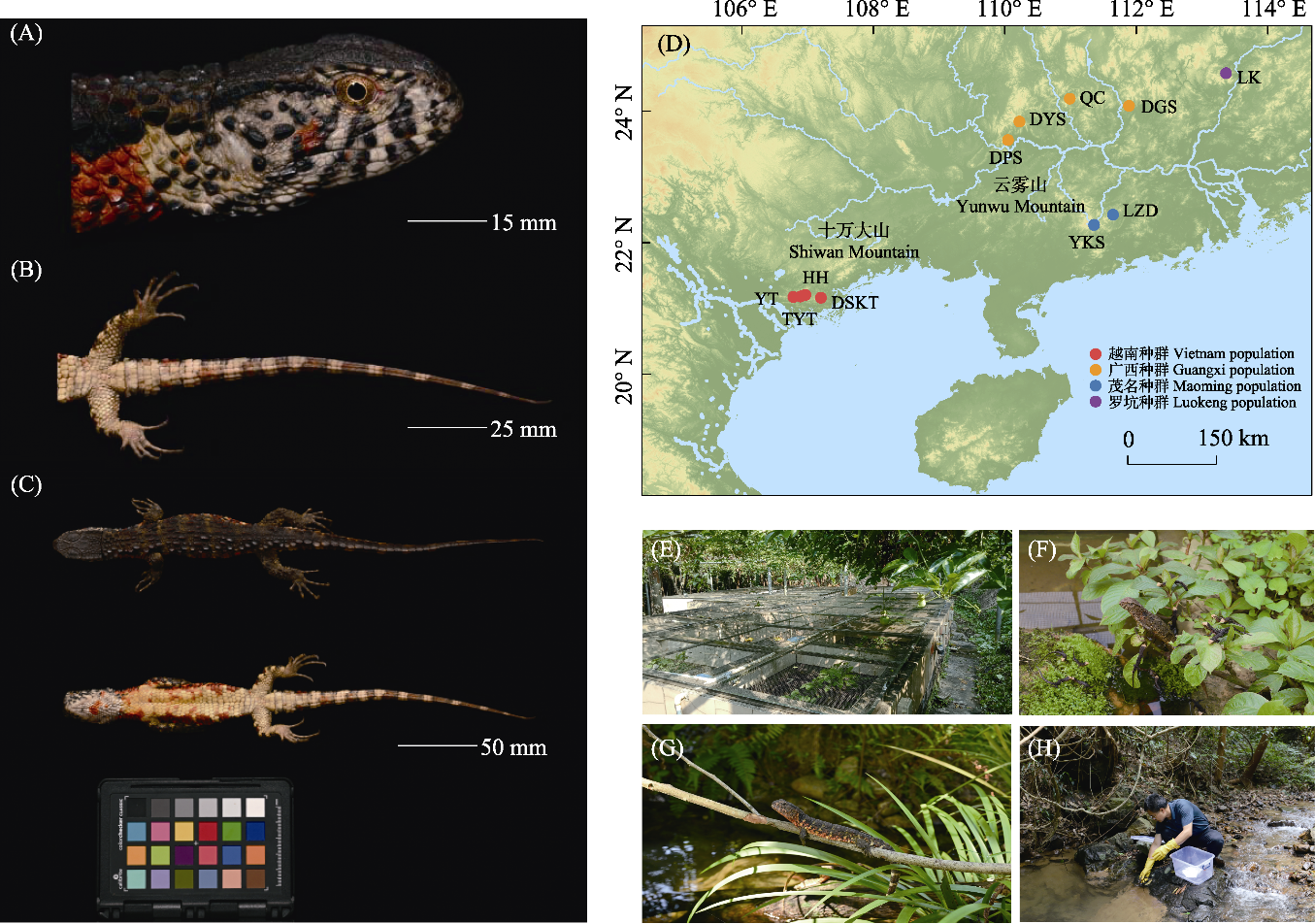
图1 鳄蜥的形态特征、地理分布及相关保护活动。(A-C)一只雄性成体鳄蜥的头部和尾部花纹以及背部和腹部形态照片; (D)目前鳄蜥野外种群的主要地理分布及遗传谱系。图中各缩写表示不同分布地点, 点位颜色表示其所属谱系单元。不同颜色分别对应越南, 以及中国广西、广东罗坑和茂名4个谱系单元; (E)人工饲养池; (F)分娩期雌性个体及新生幼蜥; (G)野化训练环境中的鳄蜥; (H)鳄蜥的野外放归。地理位置含义: 中国包括LK (罗坑鳄蜥国家级自然保护区)、DGS (大桂山鳄蜥国家级自然保护区)、DYS (大瑶山国家级自然保护区)、DPS (大平山自然保护区)、QC (七冲国家级自然保护区)、YKS (云开山国家级自然保护区)和LZD (林洲顶鳄蜥省级自然保护区); 越南包括YT (Yen Tu自然保护区)、TYT (Tay Yen Tu自然保护区)、DSKT (Dong Son-Ky Thuong自然保护区)和HH (Hai Ha区)。图片来源: 罗树毅、曹玉宁、柯金钊。
Fig. 1 Morphology and geographic distribution of Shinisaurus crocodilurus, with conservation-related activities for the species. (A-C) Photographs of the head and tail patterns, and dorsal and ventral morphology of an adult male Chinese crocodile lizard; (D) Main geographic distribution and genetic lineages of extant wild populations of the crocodile lizard. Abbreviations indicate different distribution localities, and colors represent the corresponding lineage units. Different colors correspond to four lineage units, including Vietnam and the Guangxi, Luokeng, and Maoming populations in China; (E) Rearing facilities; (F) A parturient female and neonates; (G) Chinese crocodile lizards in a rewilding training environment; (H) Reintroduction of the Chinese crocodile lizard into the wild. Abbreviations: In China, locations include LK (Luokeng Crocodile Lizard National Nature Reserve), DGS (Dagui Mountain Crocodile Lizard National Nature Reserve), DYS (Dayaoshan National Nature Reserve), DPS (Dapingshan Nature Reserve), QC (Qichong National Nature Reserve), YKS (Yunkaishan National Nature Reserve), and LZD (Linzhouding Crocodile Lizard Provincial Nature Reserve); in Vietnam, locations include YT (Yen Tu Nature Reserve), TYT (Tay Yen Tu Nature Reserve), DSKT (Dong Son-Ky Thuong Nature Reserve), and HH (Hai Ha District). Image sources: Shuyi Luo, Yuning Cao, and Jinzhao Ke.
| 国家 Country | 调查年份 Survey year | 总数 Total individuals | 地区/自然保护区(数量) Locality/Nature Reserve (Number) | 参考文献 Reference |
|---|---|---|---|---|
| 中国 China | 1978 | 5,900-6,000 | HZ (3,000), ZP (1,700), GP & PN (500), JX (700-800) | 龚明昊等, |
| 1984-1986 | 2,400 | HZ (500), ZP (1,700), JX (200) | 龚明昊等, | |
| 1987-1988 | 2,500 | HZ (500), ZP (1,500), JX (500) | 龚明昊等, | |
| 1997-1999 | 730-830 | HZ (30), ZP (300-400), JX (400) | 龚明昊等, | |
| 2001-2002 | 499-664 | HZ (65-86), ZP (291-388), JX (143-190) | 龚明昊等, | |
| 2004 | 950 | HZ (150), ZP (350), GP (150), JX (70), MS (10), LK (220) | Huang et al., | |
| 2009 | 1,360-1,625 | - | 未发表数据 Unpublished data | |
| 2012 | 1,080-1,248 | - | 未发表数据 Unpublished data | |
| 2019 | 1,020-1,178 | - | 未发表数据 Unpublished data | |
| 越南 Vietnam | 2010 | 17 | TYT (17) | van Schingen-Khan et al., |
| 2013 | 98 | TYT (52), YT (20), DSKT (26) | van Schingen-Khan et al., | |
| 2014 | 89 | TYT (51), YT (32), DSKT (6) | van Schingen-Khan et al., | |
| 2015 | 147 | TYT (64), YT (34), DSKT (21), HH (28) | van Schingen-Khan et al., |
表1 历次调查鳄蜥野外个体数量
Table 1 Estimated number of wild individuals of Shinisaurus crocodilurus in previous surveys
| 国家 Country | 调查年份 Survey year | 总数 Total individuals | 地区/自然保护区(数量) Locality/Nature Reserve (Number) | 参考文献 Reference |
|---|---|---|---|---|
| 中国 China | 1978 | 5,900-6,000 | HZ (3,000), ZP (1,700), GP & PN (500), JX (700-800) | 龚明昊等, |
| 1984-1986 | 2,400 | HZ (500), ZP (1,700), JX (200) | 龚明昊等, | |
| 1987-1988 | 2,500 | HZ (500), ZP (1,500), JX (500) | 龚明昊等, | |
| 1997-1999 | 730-830 | HZ (30), ZP (300-400), JX (400) | 龚明昊等, | |
| 2001-2002 | 499-664 | HZ (65-86), ZP (291-388), JX (143-190) | 龚明昊等, | |
| 2004 | 950 | HZ (150), ZP (350), GP (150), JX (70), MS (10), LK (220) | Huang et al., | |
| 2009 | 1,360-1,625 | - | 未发表数据 Unpublished data | |
| 2012 | 1,080-1,248 | - | 未发表数据 Unpublished data | |
| 2019 | 1,020-1,178 | - | 未发表数据 Unpublished data | |
| 越南 Vietnam | 2010 | 17 | TYT (17) | van Schingen-Khan et al., |
| 2013 | 98 | TYT (52), YT (20), DSKT (26) | van Schingen-Khan et al., | |
| 2014 | 89 | TYT (51), YT (32), DSKT (6) | van Schingen-Khan et al., | |
| 2015 | 147 | TYT (64), YT (34), DSKT (21), HH (28) | van Schingen-Khan et al., |
| 分类层级 Taxonomic level | 地区 Region | 机构数 Institutions | 雄性 Male | 雌性 Female | 性别不明 Unknown | 近12个月出生个体数 Births (12 months) | 总计 Total |
|---|---|---|---|---|---|---|---|
| 未定亚种 Unspecified subspecies | 亚洲 Asia | 7 | 8 | 11 | 71 | 3 | 90 |
| 欧洲 Europe | 56 | 70 | 78 | 148 | 35 | 296 | |
| 北美洲 North America | 39 | 41 | 39 | 41 | 8 | 121 | |
| 指名亚种 Shinisaurus crocodilurus crocodilurus | 欧洲 Europe | 11 | 3 | 7 | 13 | - | 23 |
| 越南亚种 Shinisaurus crocodilurus vietnamensis | 欧洲 Europe | 14 | 15 | 12 | 27 | 31 | 54 |
| 总计 Total | 全球 Global | 121 | 137 | 147 | 300 | 77 | 584 |
表2 全球鳄蜥迁地保护种群的规模与分布现状
Table 2 Current status of global ex situ conservation populations of the Chinese crocodile lizard
| 分类层级 Taxonomic level | 地区 Region | 机构数 Institutions | 雄性 Male | 雌性 Female | 性别不明 Unknown | 近12个月出生个体数 Births (12 months) | 总计 Total |
|---|---|---|---|---|---|---|---|
| 未定亚种 Unspecified subspecies | 亚洲 Asia | 7 | 8 | 11 | 71 | 3 | 90 |
| 欧洲 Europe | 56 | 70 | 78 | 148 | 35 | 296 | |
| 北美洲 North America | 39 | 41 | 39 | 41 | 8 | 121 | |
| 指名亚种 Shinisaurus crocodilurus crocodilurus | 欧洲 Europe | 11 | 3 | 7 | 13 | - | 23 |
| 越南亚种 Shinisaurus crocodilurus vietnamensis | 欧洲 Europe | 14 | 15 | 12 | 27 | 31 | 54 |
| 总计 Total | 全球 Global | 121 | 137 | 147 | 300 | 77 | 584 |
| [1] | Ahl E (1930) Beiträge zur Lurch- und Kriechtierfauna Kwangsi’s. Sitzungsberichte der Gesellschaft Naturforschender Freunde zu Berlin, 1930, 310-332. |
| [2] | Alston JD, Clark JD, Gibbs DB, Hast J (2022) Density, harvest rates, and growth of a reintroduced American black bear population. The Journal of Wildlife Management, 86, e22298. |
| [3] | Auliya M, Altherr S, Ariano-Sanchez D, Baard EH, Brown C, Brown RM, Cantu JC, Gentile G, Gildenhuys P, Henningheim E, Hintzmann J, Kanari K, Krvavac M, Lettink M, Lippert J, Luiselli L, Nilson G, Nguyen TQ, Nijman V, Parham JF, Pasachnik SA, Pedrono M, Rauhaus A, Córdova DR, Sanchez ME, Schepp U, van Schingen-Khan M, Schneeweiss N, Segniagbeto GH, Somaweera R, Sy EY, Türkozan O, Vinke S, Vinke T, Vyas R, Williamson S, Ziegler T (2016) Trade in live reptiles, its impact on wild populations, and the role of the European market. Biological Conservation, 204, 103-119. |
| [4] | Bei RB, Chen JP, Liu HY, Huang JL, Yu H, Wu ZJ (2012) Isolation and characterization of 12 microsatellite loci in the Chinese crocodile lizard (Shinisaurus crocodilurus). Conservation Genetics Resources, 4, 743-745. |
| [5] | Berger-Tal O, Blumstein DT, Swaisgood RR (2020) Conservation translocations: A review of common difficulties and promising directions. Animal Conservation, 23, 121-131. |
| [6] | Böhme W (1988) Zur Genitalmorphologie der Sauria: Funktionelle und stammesgeschichtliche Aspekte. Bonner Zoologische Monographien, 27, 1-176. |
| [7] | Chen YL, Ge DY, Ericson PGP, Song G, Wen ZX, Luo X, Yang QS, Lei FM, Qu YH (2023) Alpine burrow-sharing mammals and birds show similar population-level climate change risks. Nature Climate Change, 13, 990-996. |
| [8] | Chen YL, Jiang ZY, Fan P, Ericson PGP, Song G, Luo X, Lei FM, Qu YH (2022) The combination of genomic offset and niche modelling provides insights into climate change-driven vulnerability. Nature Communications, 13, 4821. |
| [9] | Cheng R, He MX, Zhong CY, Luo SY, Wu ZJ (2021) Comparison of swimming ability between wild and captive breeding Shinisaurus crocodilurus. Journal of Guangxi Normal University (Natural Science Edition), 39(1), 79-86. (in Chinese with English abstract) |
| [程瑞, 何明先, 钟春英, 罗树毅, 武正军 (2021) 野生与人工繁育鳄蜥游泳能力比较. 广西师范大学学报(自然科学版), 39(1), 79-86.] | |
| [10] | Conrad JL (2004) Skull, mandible, and hyoid of Shinisaurus crocodilurus Ahl (Squamata, Anguimorpha). Zoological Journal of the Linnean Society, 141, 399-434. |
| [11] | Conrad JL (2006a) An Eocene shinisaurid (Reptilia, Squamata) from Wyoming, U.S.A. Journal of Vertebrate Paleontology, 26, 113-126. |
| [12] | Conrad JL (2006b) Postcranial skeleton of Shinisaurus crocodilurus (Squamata: Anguimorpha). Journal of Morphology, 267, 759-775. |
| [13] | Conrad JL (2008) Phylogeny and systematics of Squamata (Reptilia) based on morphology. Bulletin of the American Museum of Natural History, 310, 1-182. |
| [14] | Conrad JL, Ast JC, Montanari S, Norell MA (2011) A combined evidence phylogenetic analysis of Anguimorpha (Reptilia: Squamata). Cladistics, 27, 230-277. |
| [15] | Conrad JL, Head JJ, Carrano MT (2014) Unusual soft-tissue preservation of a crocodile lizard (Squamata, Shinisauria) from the Green River Formation (Eocene) and shinisaur relationships. The Anatomical Record, 297, 545-559. |
| [16] | Cooper JC, Soberón J (2018) Creating individual accessible area hypotheses improves stacked species distribution model performance. Global Ecology and Biogeography, 27, 156-165. |
| [17] | Costelli J Jr, Hecht MK (1971) The postcranial osteology of the lizard Shinisaurus: The appendicular skeleton. Herpetologica, 27, 87-98. |
| [18] | Donovan VM, Roberts CP, Wonkka CL, Beck JL, Popp JN, Allen CR, Twidwell D (2020) Range-wide monitoring of population trends for Rocky Mountain bighorn sheep. Biological Conservation, 248, 108639. |
| [19] | Edmands S (2007) Between a rock and a hard place: Evaluating the relative risks of inbreeding and outbreeding for conservation and management. Molecular Ecology, 16, 463-475. |
| [20] | Estes R, de Queiroz K, Gauthier J (1988) Phylogenetic relationships within Squamata. In: Phylogenetic Relationships of the Lizard Families (eds Estes R, Pregill GK), pp. 119-281. Stanford University Press, Stanford. |
| [21] | Evans SE, Wang Y (2005) The early cretaceous lizard Dalinghosaurus from China. Acta Palaeontologica Polonica, 50, 725-742. |
| [22] | Fan TH (1931) Preliminary report of reptiles from Yaoshan, Kwangsi, China. Bulletin of the Department of Biology, College of Science, Sun Yat-Sen University, 11, 1-154. |
| [23] | Fernández-Chacón A, Bertolero A, Amengual A, Tavecchia G, Homar V, Oro D (2011) Spatial heterogeneity in the effects of climate change on the population dynamics of a Mediterranean tortoise. Global Change Biology, 17, 3075-3088. |
| [24] | Frankham R (2008) Genetic adaptation to captivity in species conservation programs. Molecular Ecology, 17, 325-333. |
| [25] | Frankham R, Ballou JD, Eldridge MDB, Lacy RC, Ralls K, Dudash MR, Fenster CB (2011) Predicting the probability of outbreeding depression. Conservation Biology, 25, 465-475. |
| [26] | Gajdárová B, Belotti E, Bufka L, Volfová J, Wölfl S, Mináriková T, Hollerbach L, Duľa M, Kleven O, Kutal M, Nowak C, Ozoliņš J, Tám B, Bryja J, Koubek P, Krojerová-Prokešová J (2023) Long-term genetic monitoring of a reintroduced Eurasian lynx population does not indicate an ongoing loss of genetic diversity. Global Ecology and Conservation, 42, e02399. |
| [27] | Gao K, Norell MA (1998) Taxonomic revision of Carusia (Reptilia, Squamata) from the late Cretaceous of the Gobi Desert and phylogenetic relationships of anguimorphan lizards. American Museum Novitates, 3230, 1-51. |
| [28] | Giachello S, Lefosse S, Simoncini A, Bonato L (2025) Species distribution models for the conservation of a micro-endemic animal: The contribution of regional land cover. Biodiversity and Conservation, 34, 1689-1707. |
| [29] | Gong MH, Huang CM, Yu H, Tang SQ, Li YB, Chen Z, Peng HY, Zhang MQ (2006) Survey of the Crocodile Lizard and Its Habitat in Yaoshan. China Forestry Publishing House, Beijing. (in Chinese) |
| [龚明昊, 黄乘明, 于海, 唐绍清, 李友邦, 陈智, 彭红元, 张猛强 (2006) 瑶山鳄蜥及栖息地调查研究. 中国林业出版社, 北京.] | |
| [30] | Haas G (1960) On the trigeminus muscles of the lizards Xenosaurus grandis and Shinisaurus crocodilurus. American Museum Novitates, 2017, 1-54. |
| [31] | Haesen S, Lenoir J, Gril E, De Frenne P, Lembrechts JJ, Kopecký M, Macek M, Man M, Wild J, Van Meerbeek K (2023) Microclimate reveals the true thermal niche of forest plant species. Ecology Letters, 26, 2043-2055. |
| [32] | Hällfors MH, Liao JS, Dzurisin J, Grundel R, Hyvärinen M, Towle K, Wu GC, Hellmann JJ (2016) Addressing potential local adaptation in species distribution models: Implications for conservation under climate change. Ecological Applications, 26, 1154-1169. |
| [33] | He MX, Xu SL, Li SL, Luo SY, Yang CS, Cheng R, Wu ZJ (2020) Correlation between locomotor performance and body measurements of captive breeding Shinisaurus crocodilurus. Journal of Guangxi Normal University (Natural Science Edition), 38(1), 120-126. (in Chinese with English abstract) |
| [何明先, 许淑淋, 李诗林, 罗树毅, 阳春生, 程瑞, 武正军 (2020) 人工饲养鳄蜥运动能力及其与身体测量值的关系. 广西师范大学学报(自然科学版), 38(1), 120-126.] | |
| [34] | He N, Wu ZJ, Cai FJ, Wang ZX, Yu H, Huang CM (2011) Sexual dimorphism of Shinisaurus crocodilurus. Chinese Journal of Ecology, 30, 7-11. (in Chinese with English abstract) |
| [何南, 武正军, 蔡凤金, 王振兴, 于海, 黄乘明 (2011) 鳄蜥的两性异形. 生态学杂志, 30, 7-11.] | |
| [35] | He N, Zhang XL, Chen N, Chen ZN, Wu ZJ (2022a) Genetic structure of the artificial breeding Shinisaurus crocodilurus in Luokeng Nature Reserve based on microsatellite DNA marker. Journal of Guangxi Normal University (Natural Science Edition), 40(4), 180-187. (in Chinese with English abstract) |
| [何南, 张小丽, 陈宁, 陈泽柠, 武正军 (2022a) 基于SSR分析广东罗坑鳄蜥饲养种群的遗传结构. 广西师范大学学报(自然科学版), 40(4), 180-187.] | |
| [36] | He N, Zhang XL, Que QQ, Chen ZN, Wu ZJ (2022b) Physiological thermoregulation of the Chinese crocodile lizard (Shinisaurus crocodilurus) in the Luokeng Nature Reserve, Guangdong. Chinese Journal of Wildlife, 43, 139-144. (in Chinese with English abstract) |
| [何南, 张小丽, 阙青青, 陈泽柠, 武正军 (2022b) 广东罗坑自然保护区鳄蜥生理体温调节能力研究. 野生动物学报, 43, 139-144.] | |
| [37] | He XP, Johansson ML, Heath DD (2016) Role of genomics and transcriptomics in selection of reintroduction source populations. Conservation Biology, 30, 1010-1018. |
| [38] | Hecht MK, Costelli J Jr (1969) The postcranial osteology of the lizard Shinisaurus: The vertebral column. American Museum Novitates, 2378, 1-21. |
| [39] | Hecht VL, Pham CT, Nguyen TT, Nguyen TQ, Bonkowski M, Ziegler T (2013) First report on the herpetofauna of Tay Yen Tu Nature Reserve, northeastern Vietnam. Biodiversity Journal, 4, 507-552. |
| [40] | Hu QX, Jiang YM, Zhao EM (1984) Taxonomic status of Shinisaurus crocodilurus. Acta Herpetologica Sinica, 3, 1-7. (in Chinese) |
| [胡其雄, 江耀明, 赵尔宓 (1984) 鳄蜥 Shinisaurus crocodilurus分类地位的研究. 两栖爬行动物学报, 3, 1-7.] | |
| [41] | Hu YB, Thapa A, Fan HZ, Ma TX, Wu Q, Ma S, Zhang DL, Wang B, Li M, Yan L, Wei FW (2020) Genomic evidence for two phylogenetic species and long-term population bottlenecks in red pandas. Science Advances, 6, eaax5751. |
| [42] | Hu YS, Hu YB, Zhou WL, Wei FW (2024) Conservation genomics and metagenomics of giant and red pandas in the wild. Annual Review of Animal Biosciences, 12, 69-89. |
| [43] | Huang CM, Wu ZJ, Luo SY, He JS, Yang CS, Meng M, Yao L, Zeng ZG (2019) Mating ethogram of a video-aided study of mating and parturition in captive Chinese crocodile lizards (Shinisaurus crocodilurus). Asian Herpetological Research, 10, 253-260. |
| [44] | Huang CM, Yu H, Wu ZJ, Li YB, Wei FW, Gong MH (2008) Population and conservation strategies for the Chinese crocodile lizard (Shinisaurus crocodilurus) in China. Animal Biodiversity and Conservation, 31, 63-70. |
| [45] | Huang HY, Wang H, Li LM, Wu ZJ, Chen JP (2014) Genetic diversity and population demography of the Chinese crocodile lizard (Shinisaurus crocodilurus) in China. PLoS ONE, 9, e91570. |
| [46] | Huang WZ (2009) Present status of Chinese xenosaurs and its protection. Chinese Journal of Wildlife, 30, 287-289. (in Chinese with English abstract) |
| [黄文志 (2009) 鳄蜥的现状及保护策略. 野生动物, 30, 287-289.] | |
| [47] | Jiang HY, Luo SY, Zhou JB, Huang WZ, Li LM, Zhang XJ, He JS, Chen JP (2022) Skin microbiota was altered in crocodile lizards (Shinisaurus crocodilurus) with skin ulcer. Frontiers in Veterinary Science, 9, 817490. |
| [48] | Jiang HY, Ma JE, Li J, Zhang XJ, Li LM, He N, Liu HY, Luo SY, Wu ZJ, Han RC, Chen JP (2017) Diets alter the gut microbiome of crocodile lizards. Frontiers in Microbiology, 8, 2073. |
| [49] | Jiang HY, Zhang XJ, Li LM, Ma JG, He N, Liu HY, Han RC, Li HM, Wu ZJ, Chen JP (2019) Identification of Austwickia chelonae as cause of cutaneous granuloma in endangered crocodile lizards using metataxonomics. PeerJ, 7, e6574. |
| [50] | Jiang J, Wu ZJ, Yu H, Huang CM, Wang ZX (2009) Prey discrimination mechanisms of Chinese crocodile lizard (Shinisaurus crocodilurus). Zoological Research, 30, 553-558. (in Chinese with English abstract) |
| [蒋洁, 武正军, 于海, 黄乘明, 王振兴 (2009) 鳄蜥的食物识别机制. 动物学研究, 30, 553-558.] | |
| [51] | Jiang ZW, Ma L, Mi CR, Tao SA, Guo FY, Du WG (2023) Distinct responses and range shifts of lizard populations across an elevational gradient under climate change. Global Change Biology, 29, 2669-2680. |
| [52] | Jule KR, Leaver LA, Lea SEG (2008) The effects of captive experience on reintroduction survival in carnivores: A review and analysis. Biological Conservation, 141, 355-363. |
| [53] | Kessler EJ, Dreslik MJ (2024) Movement behavior and passive dispersal of a reintroduced population of alligator snapping turtles. The Journal of Wildlife Management, 88, e22511. |
| [54] | Klembara J (2008) A new anguimorph lizard from the Lower Miocene of north-west Bohemia, Czech Republic. Palaeontology, 51, 81-94. |
| [55] | Klinard NV, Matley JK, Halfyard EA, Connerton M, Johnson TB, Fisk AT (2020) Post-stocking movement and survival of hatchery-reared bloater (Coregonus hoyi) reintroduced to Lake Ontario. Freshwater Biology, 65, 1073-1085. |
| [56] | Le QK, Ziegler T (2003) First record of the Chinese crocodile lizard from outside of China: Report on a population of Shinisaurus crocodilurus Ahl, 1930 from North-eastern Vietnam. Hamadryad, 27, 193-199. |
| [57] | Lembrechts JJ, Nijs I, Lenoir J (2019) Incorporating microclimate into species distribution models. Ecography, 42, 1267-1279. |
| [58] | Li QY, Luo SY, Yang CS, Li SR, Guo J, He JS, Chen YH, Huang CM, Wu ZJ, Du WG (2019) Impacts of maternal characteristics and temperature on juvenile survival in the crocodile lizard: Implications for conservation. Zoo Biology, 38, 272-280. |
| [59] | Li SH, Yeh CF, Jang-Liaw NH, Chang SW, Lin YH, Tsai CE, Chiu CC, Chen CW, Ke HR, Wang QY, Lu YW, Zheng KD, Fan PF, Zhang L, Liu Y (2024) Low but highly geographically structured genomic diversity of East Asian Eurasian otters and its conservation implications. Evolutionary Applications, 17, e13630. |
| [60] | Li SM, Cheng R, Zhong CY, Luo SY, He MX, Wu ZJ (2022) Comparison of behavior rhythm and time distribution from wild and captive Shinisaurus crocodilurus in summer. Chinese Journal of Wildlife, 43, 131-138. (in Chinese with English abstract) |
| [李胜明, 程瑞, 钟春英, 罗树毅, 何明先, 武正军 (2022) 野生和人工饲养鳄蜥夏季行为时间分配及节律差异. 野生动物学报, 43, 131-138.] | |
| [61] | Li XH, Tian HD, Wang Y, Li RQ, Song ZM, Zhang FC, Xu M, Li DM (2013) Vulnerability of 208 endemic or endangered species in China to the effects of climate change. Regional Environmental Change, 13, 843-852. |
| [62] | Li ZC, Xiao Z (2002) Discovery of Shinisaurus crocodilurus in Guangdong Province. Chinese Journal of Zoology, 37(5), 76-77. (in Chinese with English abstract) |
| [黎振昌, 肖智 (2002) 广东省曲江县发现鳄蜥. 动物学杂志, 37(5), 76-77.] | |
| [63] | Liang WB, Zhang YX, Su P, Long Q, Huang JQ (2006) Observation on time budget of Shinisaurus crocodilurus in captivity. Sichuan Journal of Zoology, 25, 264-266. (in Chinese) |
| [梁文波, 张玉霞, 苏萍, 龙强, 黄金泉 (2006) 半自然状态下鳄蜥活动时间分配的初步研究. 四川动物, 25, 264-266.] | |
| [64] | Lin ZZ, He MX, Zhong CY, Li YH, Tang SQ, Kang XD, Wu ZJ (2023) Responses of gut microbiota in crocodile lizards (Shinisaurus crocodilurus) to changes in temperature. Frontiers in Microbiology, 14, 1263917. |
| [65] | Liu XH, Zhou F, Pan GP (1989) New distribution of crocodile lizard in Yaoshan, Guangxi. Sichuan Journal of Zoology, 8(3), 32-33. (in Chinese) |
| [刘小华, 周放, 潘国平 (1989) 广西瑶山鳄蜥的新分布. 四川动物, 8(3), 32-33.] | |
| [66] | Liu YT, Tan Y, Tang SQ, Luo SY, He JS, Qin XD, Wu ZJ (2022) Diving behavior and its influencing factors of captive-reared crocodile lizard (Shinisaurus crocodilurus). Chinese Journal of Zoology, 57, 493-502. (in Chinese with English abstract) |
| [刘亚婷, 谭茵, 唐三淇, 罗树毅, 何家松, 秦旭东, 武正军 (2022) 人工饲养鳄蜥的潜水行为及影响因素. 动物学杂志, 57, 493-502.] | |
| [67] | Long Q, Zhang YX, Liang WB, Su CT, Deng ZY (2007a) Diurnal time distribution of Shinisaurus crocodilurus under releasing condition. Journal of Hainan Normal University (Natural Science), 20, 268-271. (in Chinese with English abstract) |
| [龙强, 张玉霞, 梁文波, 苏春田, 邓志勇 (2007a) 放归鳄蜥昼间活动时间分配的初步研究. 海南师范学院学报(自然科学版), 20, 268-271.] | |
| [68] | Long Q, Zhang YX, Liang WB, Su P, Luo BT, Huang JQ (2007b) Monitoring earlier activities of released Chinese crocodile lizard (Shinisaurus crocodilurus). Sichuan Journal of Zoology, 26, 308-311. (in Chinese with English abstract) |
| [龙强, 张玉霞, 梁文波, 苏萍, 罗保庭, 黄金泉 (2007b) 圈养鳄蜥放归初期的活动监测. 四川动物, 26, 308-311.] | |
| [69] | Lü M, Guo YD, Chen YH, Luo WX, Zeng XC, Jiang HY, Chen JP, Jing YX (2023) Identification and drug sensitivity analysis of Citrobacter portucalensis and Morganella morganii isolated from Shinisaurus crocodilurus. Chinese Journal of Wildlife, 44, 383-392. (in Chinese with English abstract) |
| [吕美, 郭怡德, 陈耀还, 罗文贤, 曾晓晨, 江海英, 陈金平, 靖元孝 (2023) 鳄蜥源葡萄牙柠檬酸杆菌和摩氏摩根菌的分离鉴定及药敏分析. 野生动物学报, 44, 383-392.] | |
| [70] | Lu Q, Hu Q, Shi XG, Jin SL, Li S, Yao M (2019) Metabarcoding diet analysis of snow leopards (Panthera uncia) in Wolong National Nature Reserve, Sichuan Province. Biodiversity Science, 27, 960-969. (in Chinese with English abstract) |
| [陆琪, 胡强, 施小刚, 金森龙, 李晟, 姚蒙 (2019) 基于分子宏条形码分析四川卧龙国家级自然保护区雪豹的食性. 生物多样性, 27, 960-969.] | |
| [71] | Luo SY, Li SR, Cen HY (2018) Comparison of morphology and health status between captive breeding and wild Shinisaurus crocodilurus at newborn and sub-adult stage. Chinese Journal of Zoology, 53, 368-374. (in Chinese with English abstract) |
| [罗树毅, 李树然, 岑海瑶 (2018) 人工繁育与野外鳄蜥幼体及亚成体形态和健康状况的比较. 动物学杂志, 53, 368-374.] | |
| [72] | Luo SY, Li YT, Wu ZJ, Cheng R, Chen YH, He JS (2021) Influencing factors of perch height of Shinisaurus crocodilurus in Daguishan Mountain, China. Journal of Guangxi Normal University (Natural Science Edition), 39(5), 182-189. (in Chinese with English abstract) |
| [罗树毅, 黎永泰, 武正军, 程瑞, 陈耀还, 何家松 (2021) 广西大桂山鳄蜥的栖枝高度及其影响因素. 广西师范大学学报(自然科学版), 39(5), 182-189.] | |
| [73] | Luo SY, Yang CS, Wu PP, He JS, Qin JH, Xie HX, Wu ZJ (2019) Estimating Shinisaurus crocodilurus population by removal sampling method. Guangxi Forestry Science, 48, 108-110. (in Chinese with English abstract) |
| [罗树毅, 阳春生, 武盼盼, 何家松, 秦建汉, 谢鸿鑫, 武正军 (2019) 去除取样法估算鳄蜥的种群数量. 广西林业科学, 48, 108-110.] | |
| [74] | Luo SY, Yang YJ, Yang CS, Guo J, Qin XD, Cen HY, Xie HX, Wu ZJ (2022) Field surveys suggest biennial reproduction cycle and competition-triggered dispersal of the endangered Chinese crocodile lizard. Asian Herpetological Research, 13, 190-197. |
| [75] | Macey JR, Schulte JA, Larson A, Tuniyev BS, Orlov N, Papenfuss TJ (1999) Molecular phylogenetics, tRNA evolution, and historical biogeography in anguid lizards and related taxonomic families. Molecular Phylogenetics and Evolution, 12, 250-272. |
| [76] | Maroso F, Padovani G, Muñoz Mora VH, Giannelli F, Trucchi E, Bertorelle G (2023) Fitness consequences and ancestry loss in the Apennine brown bear after a simulated genetic rescue intervention. Conservation Biology, 37, e14133. |
| [77] | Marshall IR, Brauer CJ, Wedderburn SD, Whiterod NS, Hammer MP, Barnes TC, Attard CRM, Möller LM, Beheregaray LB (2022) Longitudinal monitoring of neutral and adaptive genomic diversity in a reintroduction. Conservation Biology, 36, e13889. |
| [78] | McDowell SB, Bogert CM (1954) The systematic position of Lanthanotus and the affinities of the anguinomorphan lizards. Bulletin of the American Museum of Natural History, 105, 1-142. |
| [79] | Mi CR, Ma L, Wang Y, Wu DY, Du WG, Sun BJ (2022) Temperate and tropical lizards are vulnerable to climate warming due to increased water loss and heat stress. Proceedings of the Royal Society B: Biological Sciences, 289, 20221074. |
| [80] | Mo DY, Jiang HY, Huang MW, Wu ZJ, Chen JP (2019) Genetic diversity and SNPs distribution characteristics of tlr 4 gene in different geographic populations of the Chinese crocodile lizard. Chinese Journal of Zoology, 54, 845-859. (in Chinese with English abstract) |
| [莫大颖, 江海英, 黄铭威, 武正军, 陈金平 (2019) 不同地理种群鳄蜥tlr4基因遗传多样性及SNPs分布特点分析. 动物学杂志, 54, 845-859.] | |
| [81] | Murray A, Sutherland R, Kays R (2024) Ecological effects of a declining red wolf population. Animal Conservation, 27, 396-407. |
| [82] | Nadeau CP, Urban MC, Bridle JR (2017) Coarse climate change projections for species living in a fine-scaled world. Global Change Biology, 23, 12-24. |
| [83] | Nguyen TQ, Hamilton P, Ziegler T (2022a) Shinisaurus crocodilurus (amended version of 2014 assessment). The IUCN Red List of Threatened Species 2022: e.T57287221A217811129. https://dx.doi.org/10.2305/IUCN.UK.2022-1.RLTS.T57287221A217811129.en. (accessed on 2025-10-15) |
| [84] | Nguyen TT, Ngo HT, Ha QQ, Nguyen TQ, Le TQ, Nguyen SH, Pham CT, Ziegler T, van Schingen-Khan M, Le MD (2022b) Molecular phylogenetic analyses and ecological niche modeling provide new insights into threats to the endangered crocodile lizard (Shinisaurus crocodilurus). Frontiers of Biogeography, 14, e54779. |
| [85] | Ning JJ, Huang CM, Yu H, Dai DL, Wu ZJ, Zhong YM (2006) Summer habitat characteristics of the Chinese crocodile lizard (Shinisaurus crocodilurus) in the Luokeng Nature Reserve, Guangdong. Zoological Research, 27, 419-426. (in Chinese with English abstract) |
| [宁加佳, 黄乘明, 于海, 戴冬亮, 武正军, 钟移明 (2006) 广东罗坑自然保护区鳄蜥夏季生境特征. 动物学研究, 27, 419-426.] | |
| [86] | Nopcsa FB (1932) Zur systematischen Stellung von Shinisaurus. Zoologischer Anzeiger, 97, 185-187. |
| [87] | Pero EM, Palm EC, Chitwood MC, Hildreth AM, Keller BJ, Sumners JA, Hansen LP, Isabelle JL, Millspaugh JJ (2023) Spatial acclimation of elk during population restoration to the Missouri Ozarks, USA. Animal Conservation, 26, 789-801. |
| [88] | Pomara LY, LeDee OE, Martin KJ, Zuckerberg B (2014) Demographic consequences of climate change and land cover help explain a history of extirpations and range contraction in a declining snake species. Global Change Biology, 20, 2087-2099. |
| [89] | Potter KA, Woods HA, Pincebourde S (2013) Microclimatic challenges in global change biology. Global Change Biology, 19, 2932-2939. |
| [90] | Pyron RA, Burbrink FT, Wiens JJ (2013) A phylogeny and revised classification of Squamata, including 4161 species of lizards and snakes. BMC Evolutionary Biology, 13, 93. |
| [91] | Qiu X, Whiting MJ, Du WG, Wu ZJ, Luo SY, Yue BS, Fu JZ, Qi Y (2022) Colour variation in the crocodile lizard (Shinisaurus crocodilurus) and its relationship to individual quality. Biology, 11, 1314. |
| [92] | Ratajczak Z, Collins SL, Blair JM, Koerner SE, Louthan AM, Smith MD, Taylor JH, Nippert JB (2022) Reintroducing bison results in long-running and resilient increases in grassland diversity. Proceedings of the National Academy of Sciences, USA, 119, e2210433119. |
| [93] | Raynor JL, Grainger CA, Parker DP (2021) Wolves make roadways safer, generating large economic returns to predator conservation. Proceedings of the National Academy of Sciences, USA, 118, e2023251118. |
| [94] | Razgour O, Forester B, Taggart JB, Bekaert M, Juste J, Ibáñez C, Puechmaille SJ, Novella-Fernandez R, Alberdi A, Manel S (2019) Considering adaptive genetic variation in climate change vulnerability assessment reduces species range loss projections. Proceedings of the National Academy of Sciences, USA, 116, 10418-10423. |
| [95] | Reinhardt T, van Schingen-Khan M, Windisch HS, Nguyen TQ, Ziegler T, Fink P (2019) Monitoring a loss: Detection of the semi-aquatic crocodile lizard (Shinisaurus crocodilurus) in inaccessible habitats via environmental DNA. Aquatic Conservation: Marine and Freshwater Ecosystems, 29, 353-360. |
| [96] | Rieppel O (1980) The Phylogeny of Anguinomorph Lizards. Birkhäuser Verlag, Basel. |
| [97] | Rollinson N, Keith DM, Houde ALS, Debes PV, McBride MC, Hutchings JA (2014) Risk assessment of inbreeding and outbreeding depression in a captive-breeding program. Conservation Biology, 28, 529-540. |
| [98] | Roznik EA, Reichling SB (2021) Survival, movements and habitat use of captive-bred and reintroduced dusky gopher frogs. Animal Conservation, 24, 51-63. |
| [99] | Rueda C, Jiménez J, Palacios MJ, Margalida A (2021) Exploratory and territorial behavior in a reintroduced population of lberian lynx. Scientific Reports, 11, 14148. |
| [100] | Ruegg K, Bay RA, Anderson EC, Saracco JF, Harrigan RJ, Whitfield M, Paxton EH, Smith TB (2018) Ecological genomics predicts climate vulnerability in an endangered southwestern songbird. Ecology Letters, 21, 1085-1096. |
| [101] | Sahlean TC, Gherghel I, Papeş M, Strugariu A, Zamfirescu ŞR (2014) Refining climate change projections for organisms with low dispersal abilities: A case study of the Caspian whip snake. PLoS ONE, 9, e91994. |
| [102] | Sang YP, Long ZQ, Dan XM, Feng JJ, Shi TT, Jia CF, Zhang XX, Lai Q, Yang GL, Zhang HY, Xu XT, Liu HH, Jiang YZ, Ingvarsson PK, Liu JQ, Mao KS, Wang J (2022) Genomic insights into local adaptation and future climate-induced vulnerability of a keystone forest tree in East Asia. Nature Communications, 13, 6541. |
| [103] | Scheffers BR, Edwards DP, Diesmos A, Williams SE, Evans TA (2014) Microhabitats reduce animal’s exposure to climate extremes. Global Change Biology, 20, 495-503. |
| [104] | Shao XN, Lu Q, Xiong MY, Bu HL, Shi XY, Wang DJ, Zhao JD, Li S, Yao M (2021) Prey partitioning and livestock consumption in the world’s richest large carnivore assemblage. Current Biology, 31, 4887-4897. |
| [105] | Shen JH, Gao HY, Sun S, Wu F, He N, Wang H, Hua Y, Wu ZJ (2025) Microhabitat selection characteristics and conservation implications of the Chinese crocodile lizard (Shinisaurus crocodilurus). Biodiversity Science, 33, 25203. (in Chinese with English abstract) |
| [沈君瀚, 高海洋, 孙松, 吴飞, 何南, 王鹤, 华彦, 武正军 (2025) 鳄蜥的微生境选择特征及保护启示. 生物多样性, 33, 25203.] | |
| [106] | Shi NJ, He MX, Lin ZZ, Kang XD, Wu ZJ (2025) Climate warming induces age-specific gut microbiota alterations and functional metagenomic changes in captive crocodile lizards (Shinisaurus crocodilurus). Global Ecology and Conservation, 63, e03905. |
| [107] | Smith KT (2017) First crocodile-tailed lizard (Squamata: Pan-Shinisaurus) from the Paleogene of Europe. Journal of Vertebrate Paleontology, 37, e1313743. |
| [108] | Stephens T, Wilson SC, Cassidy F, Bender D, Gummer D, Smith DHV, Lloyd N, McPherson JM, Moehrenschlager A (2018) Climate change impacts on the conservation outlook of populations on the poleward periphery of species ranges: A case study of Canadian black-tailed prairie dogs (Cynomys ludovicianus). Global Change Biology, 24, 836-847. |
| [109] | Stepkovitch B, Neave G, Jensen MA, Tuft K, Moseby KE (2025) From threatened to threatening: Impacts of a reintroduced predator on reintroduced prey. Animal Conservation, 28, 5-18. |
| [110] | Stickley SF, Fraterrigo JM (2023) Microclimate species distribution models estimate lower levels of climate-related habitat loss for salamanders. Journal for Nature Conservation, 72, 126333. |
| [111] | Su P, Zhang YX, Zhao JY, Huang YQ (2006) Scientific managements of Shinisaurus crocodilurus in captivity. Sichuan Journal of Zoology, 25, 407-410. (in Chinese with English abstract) |
| [苏萍, 张玉霞, 赵继艳, 黄永清 (2006) 半自然条件下鳄蜥的管理. 四川动物, 25, 407-410.] | |
| [112] | Sun X, Liu YC, Tiunov MP, Gimranov DO, Zhuang Y, Han Y, Driscoll CA, Pang YH, Li CM, Pan Y, Velasco MS, Gopalakrishnan S, Yang RZ, Li BG, Jin K, Xu X, Uphyrkina O, Huang YY, Wu XH, Gilbert MTP, O’Brien SJ, Yamaguchi N, Luo SJ (2023) Ancient DNA reveals genetic admixture in China during tiger evolution. Nature Ecology & Evolution, 7, 1914-1929. |
| [113] | Tang GS, Liang XX, Yang MY, Wang TT, Chen JP, Du WG, Li H, Sun BJ (2020) Captivity influences gut microbiota in crocodile lizards (Shinisaurus crocodilurus). Frontiers in Microbiology, 11, 550. |
| [114] | Tang ZJ, Zhang YX (1986) Observation on indoor reproduction and larval growth of crocodile lizard. Chinese Journal of Zoology, 21(4), 10-12. (in Chinese) |
| [唐振杰, 张玉霞 (1986) 鳄蜥室内繁殖及幼体生长的观察. 动物学杂志, 21(4), 10-12.] | |
| [115] | Tapia Aguilera W, Gibbs JP (2023) Rewilding giant tortoises engineers plant communities at local to landscape scales. Conservation Letters, 16, e12968. |
| [116] | Townsend TM, Larson A, Louis E, Macey JR (2004) Molecular phylogenetics of Squamata: The position of snakes, amphisbaenians, and dibamids, and the root of the squamate tree. Systematic Biology, 53, 735-757. |
| [117] | van Schingen-Khan M, Ha QQ, Pham CT, Le TQ, Nguyen TQ, Bonkowski M, Ziegler T (2016a) Discovery of a new crocodile lizard population in Vietnam: Population trends, future prognoses and identification of key habitats for conservation. Revue suisse de Zoologie, 123, 241-251. |
| [118] | van Schingen-Khan M, Ihlow F, Nguyen TQ, Ziegler T, Bonkowski M, Wu ZJ, Rödder D (2014) Potential distribution and effectiveness of the protected area network for the crocodile lizard, Shinisaurus crocodilurus (Reptilia: Squamata: Sauria). Salamandra, 50, 71-76. |
| [119] | van Schingen-Khan M, Le MD, Ngo HT, Pham CT, Ha QQ, Nguyen TQ, Ziegler T (2016b) Is there more than one crocodile lizard? An integrative taxonomic approach reveals Vietnamese and Chinese Shinisaurus crocodilurus represent separate conservation and taxonomic units. Der Zoologische Garten, 85, 240-260. |
| [120] | van Schingen-Khan M, Pham CT, Thi HA, Nguyen TQ, Bernardes M, Bonkowski M, Ziegler T (2015a) First ecological assessment of the endangered crocodile lizard Shinisaurus crocodilurus Ahl, 1930 in Vietnam: Microhabitat characterization and habitat selection. Herpetological Conservation and Biology, 10, 948-958. |
| [121] | van Schingen-Khan M, Schepp U, Pham CT, Nguyen TQ, Ziegler T (2015b) Last chance to see? A review of the threats to and use of the crocodile lizard. TRAFFIC Bulletin, 27, 19-26. |
| [122] | Wang ZX, Wu ZJ, Chen L, Yu S, Yu H, Huang CM, Jiang J (2009) Effects of pregnancy and ages on temperature selection and resting metabolic rates in Chinese crocodile lizard, Shinisaurus crocodilurus. Journal of Guangxi Normal University (Natural Science Edition), 27(2), 80-84. (in Chinese with English abstract) |
| [王振兴, 武正军, 陈亮, 于仕, 于海, 黄乘明, 蒋洁 (2009) 年龄和怀卵对鳄蜥选择体温及静止代谢率的影响. 广西师范大学学报(自然科学版), 27(2), 80-84.] | |
| [123] | Wang ZX, Wu ZJ, Yu H, Huang CM, Zhong YM (2008) Thermoregulatory and thermal dependence of resting metabolic rates in the Chinese crocodile lizard Shinisaurus crocodilurus in the Luokeng Nature Reserve, Guangdong. Acta Zoologica Sinica, 54, 964-971. (in Chinese with English abstract) |
| [王振兴, 武正军, 于海, 黄乘明, 钟移明 (2008) 广东罗坑自然保护区鳄蜥的体温调节及静止代谢率的热依赖性. 动物学报, 54, 964-971.] | |
| [124] | Wen GN, Xie HX, Du WG (2026) Fine-scale genetic structure and genetic diversity in the Chinese crocodile lizard. iScience, 29, 114258. |
| [125] | Wen GN, Xie HX, Luo SY, Yang CS, Tang XW, Hu YB, Du WG (2024) Outbreeding management offers the promise of genetic rescue for an endangered lizard. Current Zoology, 70, 721-727. |
| [126] | Whiteside MA, Sage R, Madden JR (2015) Diet complexity in early life affects survival in released pheasants by altering foraging efficiency, food choice, handling skills and gut morphology. Journal of Animal Ecology, 84, 1480-1489. |
| [127] | Wielgus E, Mandinyenya B, Wieprecht S, Heurich M (2023) Bringing the Black rhino back: Key factors for reintroduction success. Global Ecology and Conservation, 48, e02756. |
| [128] | Wiens JJ, Hutter CR, Mulcahy DG, Noonan BP, Townsend TM, Sites JW Jr, Reeder TW (2012) Resolving the phylogeny of lizards and snakes (Squamata) with extensive sampling of genes and species. Biology Letters, 8, 1043-1046. |
| [129] | Wisz MS, Pottier J, Kissling WD, Pellissier L, Lenoir J, Damgaard CF, Dormann CF, Forchhammer MC, Grytnes JA, Guisan A, Heikkinen RK, Høye TT, Kühn I, Luoto M, Maiorano L, Nilsson MC, Normand S, Öckinger E, Schmidt NM, Termansen M, Timmermann A, Wardle DA, Aastrup P, Svenning JC (2013) The role of biotic interactions in shaping distributions and realised assemblages of species: Implications for species distribution modelling. Biological Reviews, 88, 15-30. |
| [130] | Wood G, Marzinelli EM, Campbell AH, Steinberg PD, Vergés A, Coleman MA (2021) Genomic vulnerability of a dominant seaweed points to future-proofing pathways for Australia’s underwater forests. Global Change Biology, 27, 2200-2212. |
| [131] | Wu CH, Huang ZJ (1986) A comparison of the external characters and the skeletal system between Shinisaurus crocodilurus and Xenosaurus grandis. Sinozoologia, 4, 41-50. (in Chinese with English abstract) |
| [吴翠蘅, 黄祝坚 (1986) 鳄蜥与异蜥外形及骨骼系统比较. 动物学集刊, 4, 41-50.] | |
| [132] | Wu ZJ, Dai DL, Huang CM, Yu H, Ning JJ, Zhong YM (2007) Selection of Shinisaurus crocodilurus on forest type in mountain streams in Luokeng Nature Reserve of Guangdong Province. Chinese Journal of Ecology, 26, 1777-1781. (in Chinese with English abstract) |
| [武正军, 戴冬亮, 黄乘明, 于海, 宁加佳, 钟移明 (2007) 广东省罗坑自然保护区鳄蜥对溪沟林型的选择. 生态学杂志, 26, 1777-1781.] | |
| [133] | Wu ZJ, Dai DL, Ning JJ, Huang CM, Yu H (2012a) Seasonal differences in habitat selection of the crocodile lizard (Shinisaurus crocodilurus) in Luokeng Nature Reserve, Guangdong. Acta Ecologica Sinica, 32, 4691-4699. (in Chinese with English abstract) |
| [武正军, 戴冬亮, 宁加佳, 黄乘明, 于海 (2012a) 广东罗坑自然保护区鳄蜥生境选择的季节性差异. 生态学报, 32, 4691-4699.] | |
| [134] | Wu ZJ, Wang ZX, Liu HY, He N, Yu H, Huang CM (2012b) Thermal dependence of locomotor performance for Shinisaurus crocodilurus in the Luokeng Nature Reserve, Guangdong, China. Journal of Guangxi Normal University (Natural Science Edition), 30, 276-281. (in Chinese with English abstract) |
| [武正军, 王振兴, 刘海洋, 何南, 于海, 黄乘明 (2012b) 广东罗坑自然保护区鳄蜥运动能力的热依赖性. 广西师范大学学报(自然科学版), 30, 276-281.] | |
| [135] | Xie H, Chen L, Huang HY, He N, Liu HY, Wu ZJ (2017) Research on movement pattern and the influencing factors of Shinisaurus crocodilurus in the Luokeng Nature Reserve, Guangdong, China. Journal of Guangxi Normal University (Natural Science Edition), 35(4), 106-113. (in Chinese with English abstract) |
| [谢海, 陈亮, 黄海燕, 何南, 刘海洋, 武正军 (2017) 广东罗坑自然保护区鳄蜥的移动格局及其影响因子. 广西师范大学学报(自然科学版), 35(4), 106-113.] | |
| [136] | Xie HX, Liang XX, Chen ZQ, Li WM, Mi CR, Li M, Wu ZJ, Zhou XM, Du WG (2022) Ancient demographics determine the effectiveness of genetic purging in endangered lizards. Molecular Biology and Evolution, 39, msab359. |
| [137] | Xie MJ, Lv M, Zhao ZW, Li LM, Jiang HY, Yu YP, Zhang XJ, Liu P, Chen JP (2023) Plastisphere characterization in habitat of the highly endangered Shinisaurus crocodilurus: Bacterial composition, assembly, function and the comparison with surrounding environment. Science of the Total Environment, 900, 165807. |
| [138] | Xie MJ, Lv M, Zhao ZW, Li LM, Jiang HY, Yu YP, Zhang XJ, Liu P, Chen JP (2024) New insights of bacterial and eukaryotic phenotypes on the plastics collected from the typical natural habitat of the endangered crocodile lizard. Ecotoxicology and Environmental Safety, 280, 116541. |
| [139] | Xiong Y, Wu Q, Qin XD, Yang CS, Luo SY, He JS, Cheng QZ, Wu ZJ (2022) Identification of Pseudomonas aeruginosa from the skin ulcer disease of crocodile lizards (Shinisaurus crocodilurus) and probiotics as the control measure. Frontiers in Veterinary Science, 9, 850684. |
| [140] | Yang CS, Luo SY, Li YH, He JS, Wu ZJ (2017) Comparison of line transect versus mark-recapture methods for estimating population size of Shinisaurus crocodilurus. Chinese Journal of Wildlife, 38, 291-294. (in Chinese with English abstract) |
| [阳春生, 罗树毅, 李钰慧, 何家松, 武正军 (2017) 样线法和标志重捕法在鳄蜥种群数量调查中的应用比较. 野生动物学报, 38, 291-294.] | |
| [141] | Yang HL, Leng XQ, Du H, Luo J, Wu JP, Wei QW (2020) Adjusting the prerelease gut microbial community by diet training to improve the postrelease fitness of captive-bred Acipenser dabryanus. Frontiers in Microbiology, 11, 488. |
| [142] | Yang L, Wei FW, Zhan XJ, Fan HZ, Zhao PP, Huang GP, Chang J, Lei YH, Hu YB (2022) Evolutionary conservation genomics reveals recent speciation and local adaptation in threatened takins. Molecular Biology and Evolution, 39, msac111. |
| [143] | Yang YJ, Zeng ZG, Wang K, Luo SY, Yang CS, He JS, Wu ZJ, Nie HY (2019) Predation on lizards and snakes by crocodile lizards. Chinese Journal of Zoology, 54, 293-297. (in Chinese with English abstract) |
| [杨羽婕, 曾治高, 王坤, 罗树毅, 阳春生, 何家松, 武正军, 聂海燕 (2019) 鳄蜥捕食蜥蜴和蛇的现象. 动物学杂志, 54, 293-297.] | |
| [144] | Yang YJ, Zeng ZG, Xing KF, Li SR, Yang CS, Du WG (2020) Behavioural thermoregulation by the endangered crocodile lizard (Shinisaurus crocodilurus) in captivity. Journal of Thermal Biology, 93, 102731. |
| [145] | Yu H, Huang CM, Chen Z, Su LN, Cao HM, Gong MH (2005) Study on current population and habitats of Shinisaurus crocodilurus in Guiping City, Guangxi. Sichuan Journal of Zoology, 24, 395-400. (in Chinese with English abstract) |
| [于海, 黄乘明, 陈智, 苏立宁, 曹华猛, 龚明昊 (2005) 广西桂平市鳄蜥种群及栖息地现状的分析研究. 四川动物, 24, 395-400.] | |
| [146] | Yu H, Huang CM, Wu ZJ, Ning JJ, Dai DL (2006) Observation on habit of Chinese crocodile lizard. Sichuan Journal of Zoology, 25, 364-366. (in Chinese with English abstract) |
| [于海, 黄乘明, 武正军, 宁加佳, 戴冬亮 (2006) 鳄蜥生活习性的观察. 四川动物, 25, 364-366.] | |
| [147] | Yu S, Wu ZJ, Wang ZX, Chen L, Huang CM, Yu H (2009) Courtship and mating behavior of Shinisaurus crocodilurus bred in Luokeng Nature Reserve, Guangdong. Chinese Journal of Zoology, 44(5), 38-44. (in Chinese with English abstract) |
| [于仕, 武正军, 王振兴, 陈亮, 黄乘明, 于海 (2009) 广东罗坑自然保护区饲养鳄蜥的求偶和交配行为. 动物学杂志, 44(5), 38-44.] | |
| [148] | Zemanova MA (2020) Towards more compassionate wildlife research through the 3Rs principles: Moving from invasive to non-invasive methods. Wildlife Biology, 2020, 1-17. |
| [149] | Zeng YR, Xiong Y, Yang CS, He N, He JS, Luo WX, Chen YH, Zeng XC, Wu ZJ (2022) Investigation of parasitic infection in crocodile lizards (Shinisaurus crocodilurus) using high-throughput sequencing. Animals, 12, 2726. |
| [150] | Zhan ZJ, Zhang C, Chen MH, Wang JD, Fu AH, Fan YW, Luan XF (2023) DNA metabarcoding-based winter diet analysis of Eurasian otter (Lutra lutra) in the northern Greater Khingan Mountains. Biodiversity Science, 31, 22586. (in Chinese with English abstract) |
| [湛振杰, 张超, 陈敏豪, 王嘉栋, 富爱华, 范雨薇, 栾晓峰 (2023) 基于DNA宏条形码技术的大兴安岭北部欧亚水獭冬季食性分析. 生物多样性, 31, 22586.] | |
| [151] | Zhang TW, Cheng R, Wu ZJ, He MX, Zhong CY (2022) Comparison of selected body temperatures and running ability between captive-bred and wild Shinisaurus crocodilurus. Journal of Guangxi Normal University (Natural Science Edition), 40(6), 215-221. (in Chinese with English abstract) |
| [张桐玮, 程瑞, 武正军, 何明先, 钟春英 (2022) 人工繁育与野外鳄蜥选择体温和运动能力的比较. 广西师范大学学报(自然科学版), 40(6), 215-221.] | |
| [152] | Zhang XL, Alvarez F, Whiting MJ, Qin XD, Chen ZN, Wu ZJ (2022a) Climate change and dispersal ability jointly affects the future distribution of crocodile lizards. Animals, 12, 2731. |
| [153] | Zhang XL, Qin XD, Alvarez F, Chen ZN, Wu ZJ (2022b) Potential impact of land-use change on habitat quality in the distribution range of crocodile lizards in China. Ecology and Evolution, 12, e9390. |
| [154] | Zhang YX (1981) Ecological observation of crocodile lizard in Yaoshan, Guangxi. Chinese Journal of Zoology, 16(4), 12-14. (in Chinese) |
| [张玉霞 (1981) 广西瑶山鳄蜥的生态观察. 动物学杂志, 16(4), 12-14.] | |
| [155] | Zhang YX (1986) An endangered rare animal—Crocodile lizard. Chinese Journal of Zoology, 21(5), 38-39. (in Chinese) |
| [张玉霞 (1986) 一种濒危的珍稀动物——鳄蜥. 动物学杂志, 21(5), 38-39.] | |
| [156] | Zhang YX (1988) The crocodile lizard in Yaoshan. Chinese Journal of Wildlife, (3), 12-13. (in Chinese) |
| [张玉霞 (1988) 瑶山鳄蜥. 野生动物, (3), 12-13.] | |
| [157] | Zhang YX (1991) The Chinese Crocodile Lizard. China Forestry Publishing House, Beijing. (in Chinese) |
| [张玉霞 (1991) 中国鳄蜥. 中国林业出版社, 北京.] | |
| [158] | Zhang YX, Tang ZJ (1984) Discussion on geographical distribution and morphological variation of crocodile lizard. Journal of Guangxi Normal University (Natural Science Edition), 2, 39-41. (in Chinese) |
| [张玉霞, 唐振杰 (1984) 鳄蜥的地理分布及其形态变异的探讨. 广西师范大学学报(自然科学版), 2, 39-41.] | |
| [159] | Zhao CL, Feng JY, Sun ZJ, Zhu W, Chang J, Fan WB, Jiang JP, Yue BS, Zhao T (2023) Intraspecific variation in microhabitat selection in reintroduced Chinese giant salamanders. Current Zoology, 69, 121-127. |
| [160] | Ziegler T, Böhme W (1997) Genitalstrukturen und Paarungsbiologie bei squamaten Reptilien, speziell den Platynota, mit Bemerkungen zur Systematik. Mertensiella, 8, 1-207. |
| [161] | Ziegler T, Le KQ, Nguyen VT, Hendrix R, Böhme W (2008) A comparative study of crocodile lizards (Shinisaurus crocodilurus Ahl, 1930) from Vietnam and China. The Raffles Bulletin of Zoology, 56, 181-187. |
| [162] | Ziegler T, Rauhaus A, Mutschmann F, Dang PH, Pham CT, Nguyen TQ (2016) Building up of keeping facilities and breeding projects for frogs, newts and lizards at the Me Linh Station for biodiversity in northern Vietnam, including improvement of housing conditions for confiscated reptiles and primates. Der Zoologische Garten, 85, 91-120. |
| [163] | Ziegler T, van Schingen-Khan M, Rauhaus A, Dang PH, Pham DTK, Pham CT, Nguyen TQ (2019) New insights into the habitat use and husbandry of crocodile lizards (Reptilia: Shinisauridae) including the conception of new facilities for Vietnamese crocodile lizards Shinisaurus crocodilurus vietnamensis in Vietnam and Germany. International Zoo Yearbook, 53, 250-269. |
| [1] | 朱芸, 王凯红, 李洪磊, 徐向龙, 雷宇, 陈浩, 陈卫华, 蔡新杰, 丁长青. 朱鹮对滨海食物的适应性: 恢复东部沿海朱鹮种群的初步探索[J]. 生物多样性, 2026, 34(5): 26051-. |
| [2] | 沈君瀚, 高海洋, 孙松, 吴飞, 何南, 王鹤, 华彦, 武正军. 鳄蜥的微生境选择特征及保护启示[J]. 生物多样性, 2025, 33(11): 25203-. |
| [3] | 朱芸, 王凯红, 李洪磊, 徐向龙, 段文斌, 陈浩, 邱国强, 陈卫华, 卢靖, 丁长青. 朱鹮非繁殖期行为谱及PAE编码系统[J]. 生物多样性, 2024, 32(9): 24075-. |
| [4] | 景昭阳, 程可光, 舒恒, 马永鹏, 刘平丽. 全基因组重测序方法在濒危植物保护中的应用[J]. 生物多样性, 2023, 31(5): 22679-. |
| [5] | 李媛媛, 刘超男, 王嵘, 罗水兴, 农寿千, 王静雯, 陈小勇. 分子标记在濒危物种保护中的应用[J]. 生物多样性, 2020, 28(3): 367-375. |
| 阅读次数 | ||||||
|
全文 |
|
|||||
|
摘要 |
|
|||||
备案号:京ICP备16067583号-7
Copyright © 2026 版权所有 《生物多样性》编辑部
地址: 北京香山南辛村20号, 邮编:100093
电话: 010-62836137, 62836665 E-mail: biodiversity@ibcas.ac.cn
