

生物多样性 ›› 2026, Vol. 34 ›› Issue (5): 26028. DOI: 10.17520/biods.2026028 cstr: 32101.14.biods.2026028
郭蓉1,2, 吴旭东3,4, 张雨2, 康瑞红2, 王一凡2, 王占军3,4, 蒋齐3,4, 俞鸿千3,4, 马琨1,2,4,*( )
)
收稿日期:2026-01-22
接受日期:2026-03-30
出版日期:2026-05-20
发布日期:2026-07-01
通讯作者:
马琨
基金资助:
Rong Guo1,2, Xudong Wu3,4, Yu Zhang2, Ruihong Kang2, Yifan Wang2, Zhanjun Wang3,4, Qi Jiang3,4, Hongqian Yu3,4, Kun Ma1,2,4,*()
Received:2026-01-22
Accepted:2026-03-30
Online:2026-05-20
Published:2026-07-01
Contact:
Kun Ma
Supported by:摘要:
丛枝菌根(arbuscular mycorrhizal, AM)真菌是陆地生态系统中关键的植物共生体, 研究降水变化背景下AM真菌群落特征及其与植物和土壤因子之间的关系, 对维持荒漠草原生态系统稳定性具有重要的理论意义。本研究于2019-2021年在宁夏盐池县开展降水控制试验, 采用单因素完全随机设计, 设置D50 (自然降水-50%)、D25 (自然降水-25%)、CK (自然降水)、I25 (自然降水+25%)和I50 (自然降水+50%) 5种降水处理, 基于Illumina高通量测序技术, 并结合Mantel分析、随机森林分析和偏最小二乘路径模型(PLS-PM)分析, 探讨降水格局变化对荒漠草原土壤AM真菌群落多样性、丰富度和组成的影响及其驱动机制。研究结果表明, 荒漠草原植物盖度、生物量、Shannon多样性指数对降水变化较为敏感。与CK相比, D50处理下AM真菌Shannon多样性指数、Sobs指数、ACE指数和Chao1指数分别显著降低31.64%、53.32%、62.41%和58.77%; AM真菌优势属相对丰度在不同降水梯度下无显著差异。非度量多维尺度(NMDS)分析表明, 降水梯度显著影响AM真菌群落组成。随机森林分析显示, 植物群落多样性和盖度是决定AM真菌多样性的首要因素; AM真菌丰富度主要受pH调控; AM真菌群落组成主要受降水与硝态氮影响。PLS-PM进一步表明, 降水可以通过改变土壤水分对AM真菌群落组成产生间接效应, 通过调节植物群落对AM真菌多样性产生间接正效应, 并通过改变土壤pH对AM真菌丰富度产生间接正效应。综上, 荒漠草原降水变化通过影响植物与土壤因子的耦合关系, 进而驱动AM真菌群落结构与组成发生变化。研究揭示了菌根共生系统对降水变化的敏感响应特征, 为理解荒漠草原生态系统在气候变化背景下的调控机制提供了新的科学依据。
郭蓉, 吴旭东, 张雨, 康瑞红, 王一凡, 王占军, 蒋齐, 俞鸿千, 马琨 (2026) 荒漠草原土壤丛枝菌根真菌群落对降水变化的响应. 生物多样性, 34, 26028. DOI: 10.17520/biods.2026028.
Rong Guo, Xudong Wu, Yu Zhang, Ruihong Kang, Yifan Wang, Zhanjun Wang, Qi Jiang, Hongqian Yu, Kun Ma (2026) Response of soil arbuscular mycorrhizal fungal communities to precipitation changes in the desert steppe. Biodiversity Science, 34, 26028. DOI: 10.17520/biods.2026028.
| 物种 Species | 科 Family | 降水梯度 Precipitation gradient | ||||
|---|---|---|---|---|---|---|
| D50 | D25 | CK | I25 | I50 | ||
| 134.34 mm | 201.50 mm | 268.67 mm | 335.84 mm | 403.01 mm | ||
| 阿尔泰狗娃花 Heteropappus altaicus | 菊科 Asteraceae | 0.01 ± 0.03a | 0.04 ± 0.04a | 0.03 ± 0.03a | 0.01 ± 0.02a | - |
| 草木樨状黄芪 Astragalus melilotoides | 豆科 Fabaceae | - | 0.12 ± 0.09a | 0.06 ± 0.05b | 0.07 ± 0.05b | 0.08 ± 0.07b |
| 糙隐子草 Cleistogenes squarrosa | 禾本科 Gramineae | 0.02 ± 0.02a | 0.01 ± 0.02a | 0.02 ± 0.03a | 0.02 ± 0.03a | 0.02 ± 0.02a |
| 叉枝鸦葱 Scorzonera divaricata | 菊科 Asteraceae | 0.01 ± 0.01a | 0.01 ± 0.02a | 0.01 ± 0.02a | 0.03 ± 0.04a | - |
| 达乌里胡枝子 Lespedeza davurica | 豆科 Fabaceae | 0.33 ± 0.11a | 0.25 ± 0.13ab | 0.26 ± 0.04ab | 0.14 ± 0.05b | 0.13 ± 0.04b |
| 老瓜头 Vincetoxicum mongolicum | 夹竹桃科 Apocynaceae | - | 0.02 ± 0.05a | 0.02 ± 0.03a | - | 0.03 ± 0.05a |
| 猫头刺 Oxytropis aciphylla | 豆科 Fabaceae | 0.02 ± 0.05a | - | - | - | - |
| 蒙古冰草 Agropyron mongolicum | 禾本科 Gramineae | - | 0.04 ± 0.08d | 0.14 ± 0.03c | 0.23 ± 0.05b | 0.33 ± 0.05a |
| 砂珍棘豆 Oxytropis racemosa | 豆科 Fabaceae | - | 0.01 ± 0.02b | 0.03 ± 0.02ab | 0.05 ± 0.03a | 0.06 ± 0.03a |
| 远志 Polygala tenuifolia | 远志科 Polygalaceae | 0.08 ± 0.06a | 0.09 ± 0.03a | 0.08 ± 0.04a | 0.08 ± 0.02a | 0.05 ± 0.01a |
| 针茅 Stipa capillata | 禾本科 Gramineae | 0.15 ± 0.04a | 0.15 ± 0.05a | 0.05 ± 0.02c | 0.12 ± 0.04ab | 0.09 ± 0.04bc |
| 猪毛蒿 Artemisia scoparia | 菊科 Asteraceae | 0.32 ± 0.17a | 0.24 ± 0.04a | 0.30 ± 0.05a | 0.25 ± 0.03a | 0.21 ± 0.05a |
| 赖草 Leymus secalinus | 禾本科 Gramineae | - | 0.02 ± 0.03a | - | - | 0.02 ± 0.04a |
| 乳浆大戟 Euphorbia esula | 大戟科 Euphorbiaceae | 0.01 ± 0.02 | - | - | - | - |
| 猪毛菜 Salsola collina | 苋科 Amaranthaceae | 0.01 ± 0.03 | - | - | - | - |
| 虫实 Corispermum hyssopifolium | 苋科 Amaranthaceae | 0.03 ± 0.04 | - | - | - | - |
| 沙打旺 Astragalus laxmannii | 豆科 Fabaceae | - | - | 0.02 ± 0.04 | - | - |
表1 连续3年降水处理对荒漠草原植物群落物种重要值的影响
Table 1 Effects of three consecutive years of precipitation manipulation on importance values in the desert steppe plant species
| 物种 Species | 科 Family | 降水梯度 Precipitation gradient | ||||
|---|---|---|---|---|---|---|
| D50 | D25 | CK | I25 | I50 | ||
| 134.34 mm | 201.50 mm | 268.67 mm | 335.84 mm | 403.01 mm | ||
| 阿尔泰狗娃花 Heteropappus altaicus | 菊科 Asteraceae | 0.01 ± 0.03a | 0.04 ± 0.04a | 0.03 ± 0.03a | 0.01 ± 0.02a | - |
| 草木樨状黄芪 Astragalus melilotoides | 豆科 Fabaceae | - | 0.12 ± 0.09a | 0.06 ± 0.05b | 0.07 ± 0.05b | 0.08 ± 0.07b |
| 糙隐子草 Cleistogenes squarrosa | 禾本科 Gramineae | 0.02 ± 0.02a | 0.01 ± 0.02a | 0.02 ± 0.03a | 0.02 ± 0.03a | 0.02 ± 0.02a |
| 叉枝鸦葱 Scorzonera divaricata | 菊科 Asteraceae | 0.01 ± 0.01a | 0.01 ± 0.02a | 0.01 ± 0.02a | 0.03 ± 0.04a | - |
| 达乌里胡枝子 Lespedeza davurica | 豆科 Fabaceae | 0.33 ± 0.11a | 0.25 ± 0.13ab | 0.26 ± 0.04ab | 0.14 ± 0.05b | 0.13 ± 0.04b |
| 老瓜头 Vincetoxicum mongolicum | 夹竹桃科 Apocynaceae | - | 0.02 ± 0.05a | 0.02 ± 0.03a | - | 0.03 ± 0.05a |
| 猫头刺 Oxytropis aciphylla | 豆科 Fabaceae | 0.02 ± 0.05a | - | - | - | - |
| 蒙古冰草 Agropyron mongolicum | 禾本科 Gramineae | - | 0.04 ± 0.08d | 0.14 ± 0.03c | 0.23 ± 0.05b | 0.33 ± 0.05a |
| 砂珍棘豆 Oxytropis racemosa | 豆科 Fabaceae | - | 0.01 ± 0.02b | 0.03 ± 0.02ab | 0.05 ± 0.03a | 0.06 ± 0.03a |
| 远志 Polygala tenuifolia | 远志科 Polygalaceae | 0.08 ± 0.06a | 0.09 ± 0.03a | 0.08 ± 0.04a | 0.08 ± 0.02a | 0.05 ± 0.01a |
| 针茅 Stipa capillata | 禾本科 Gramineae | 0.15 ± 0.04a | 0.15 ± 0.05a | 0.05 ± 0.02c | 0.12 ± 0.04ab | 0.09 ± 0.04bc |
| 猪毛蒿 Artemisia scoparia | 菊科 Asteraceae | 0.32 ± 0.17a | 0.24 ± 0.04a | 0.30 ± 0.05a | 0.25 ± 0.03a | 0.21 ± 0.05a |
| 赖草 Leymus secalinus | 禾本科 Gramineae | - | 0.02 ± 0.03a | - | - | 0.02 ± 0.04a |
| 乳浆大戟 Euphorbia esula | 大戟科 Euphorbiaceae | 0.01 ± 0.02 | - | - | - | - |
| 猪毛菜 Salsola collina | 苋科 Amaranthaceae | 0.01 ± 0.03 | - | - | - | - |
| 虫实 Corispermum hyssopifolium | 苋科 Amaranthaceae | 0.03 ± 0.04 | - | - | - | - |
| 沙打旺 Astragalus laxmannii | 豆科 Fabaceae | - | - | 0.02 ± 0.04 | - | - |
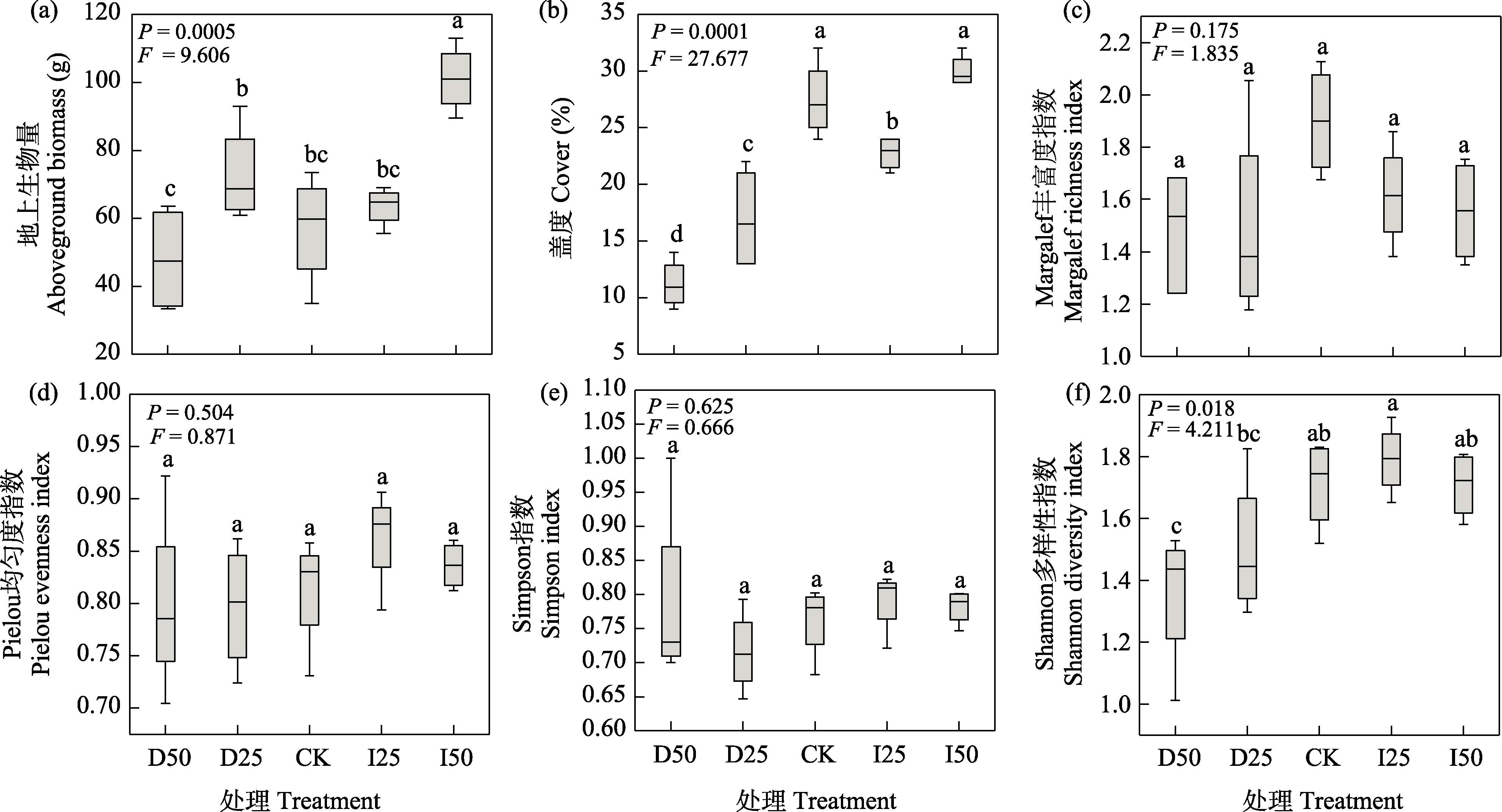
图1 不同降水处理对荒漠草原植物群落特征的影响。图中P为显著性水平, F为单因素方差分析的检验统计量, 不同小写字母表示处理间差异显著(P < 0.05)。D50: 自然降水-50%; D25: 自然降水-25%; CK: 自然降水; I25: 自然降水+25%; I50: 自然降水+50%。
Fig. 1 Effects of precipitation manipulation on plant community characteristics in the desert steppe. P represents the significance level, and F represents the test statistic of one-way ANOVA. Different lowercase letters indicate significant differences between treatments in the figure (P < 0.05). D50, Natural precipitation -50%; D25, Natural precipitation -25%; CK, Natural precipitation; I25, Natural precipitation +25%; I50, Natural precipitation +50%.
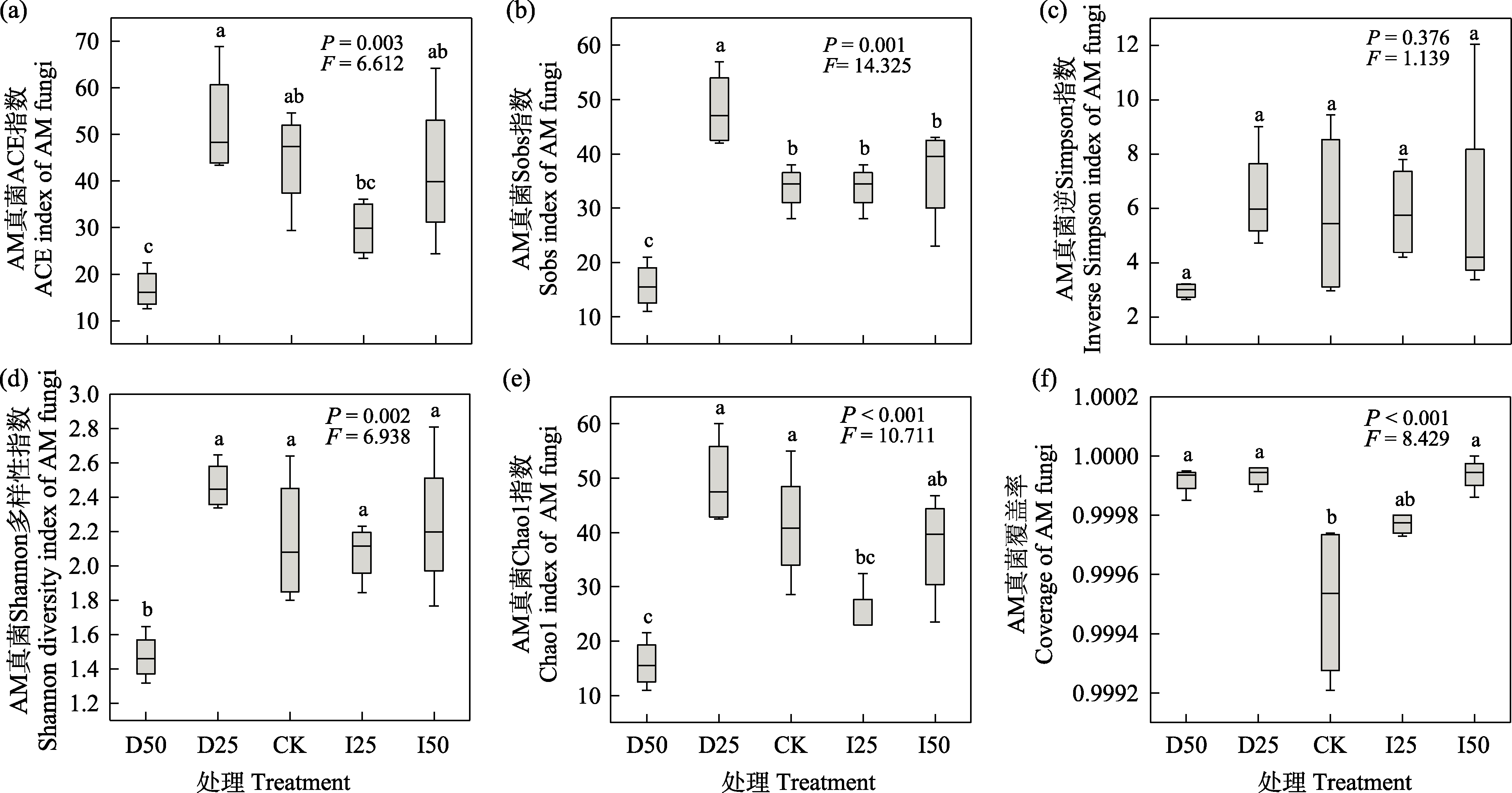
图2 不同降水处理下丛枝菌根(AM)真菌α多样性指数。图中P为显著性水平, F为单因素方差分析的检验统计量, 不同小写字母表示处理间差异显著(P < 0.05)。D50: 自然降水-50%; D25: 自然降水-25%; CK: 自然降水; I25: 自然降水+25%; I50: 自然降水+50%。
Fig. 2 α diversity indices of arbuscular mycorrhizal (AM) fungi under different precipitation treatments. P represents the significance level, and F represents the test statistic of one-way ANOVA. Different lowercase letters indicate significant differences between treatments in the figure (P < 0.05). D50, Natural precipitation -50%; D25, Natural precipitation -25%; CK, Natural precipitation; I25, Natural precipitation +25%; I50, Natural precipitation +50%.
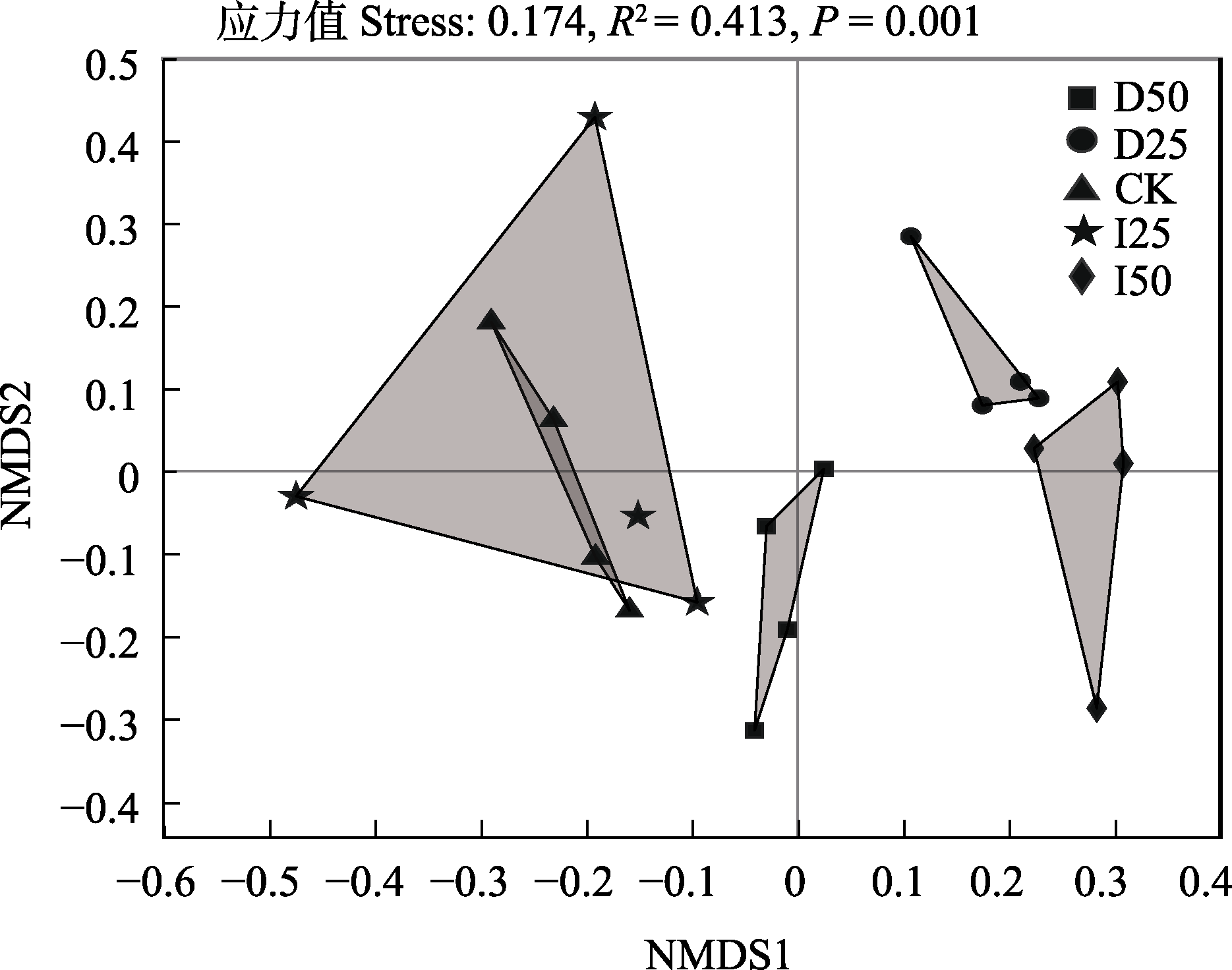
图3 不同降水处理下丛枝菌根(AM)真菌群落组成的非度量多维尺度(NMDS)分析。D50: 自然降水-50%; D25: 自然降水-25%; CK: 自然降水; I25: 自然降水+25%; I50: 自然降水+50%。
Fig. 3 Non-metric multidimensional scaling (NMDS) analysis of soil arbuscular mycorrhizal (AM) fungal community composition under different precipitation treatments. D50, Natural precipitation -50%; D25, Natural precipitation -25%; CK, Natural precipitation; I25, Natural precipitation +25%; I50, Natural precipitation +50%.
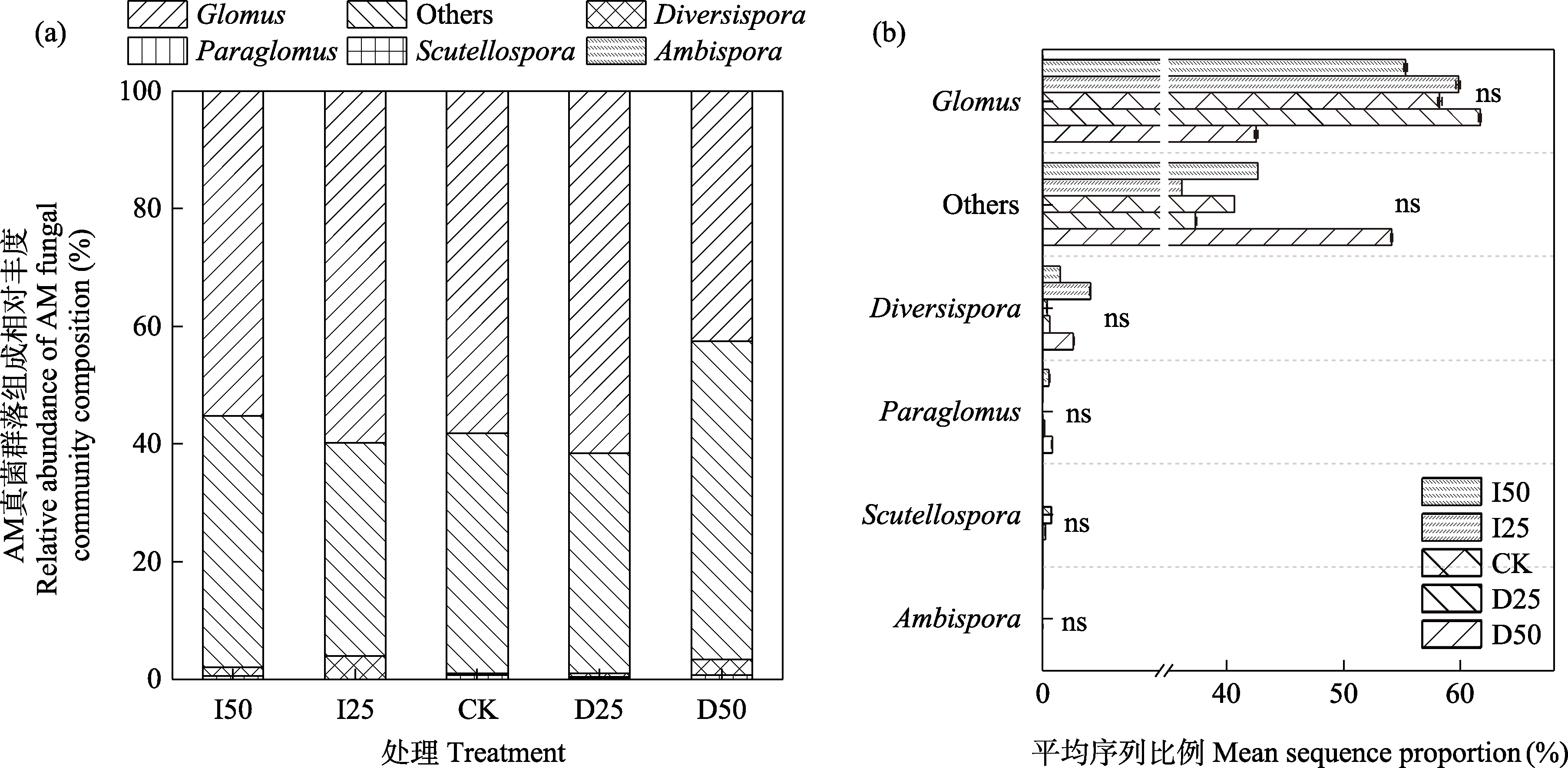
图4 不同降水处理下属水平丛枝菌根(AM)真菌的群落组成(a)及差异显著性检验(b)。Glomus: 球囊霉属; Diversispora: 多孢囊霉属; Paraglomus: 近球囊霉属; Scutellospora: 盾孢囊霉属; Ambispora: 双型囊霉属; 其他: Others。D50: 自然降水-50%; D25: 自然降水-25%; CK: 自然降水; I25: 自然降水+25%; I50: 自然降水+50%。ns表示各处理间无显著性差异。
Fig. 4 Genus-level community composition (a) and significance tests of differences (b) of arbuscular mycorrhizal (AM) fungi under different precipitation treatments. D50, Natural precipitation -50%; D25, Natural precipitation -25%; CK, Natural precipitation; I25, Natural precipitation +25%; I50, Natural precipitation +50%. ns indicates no significant differences among treatments.
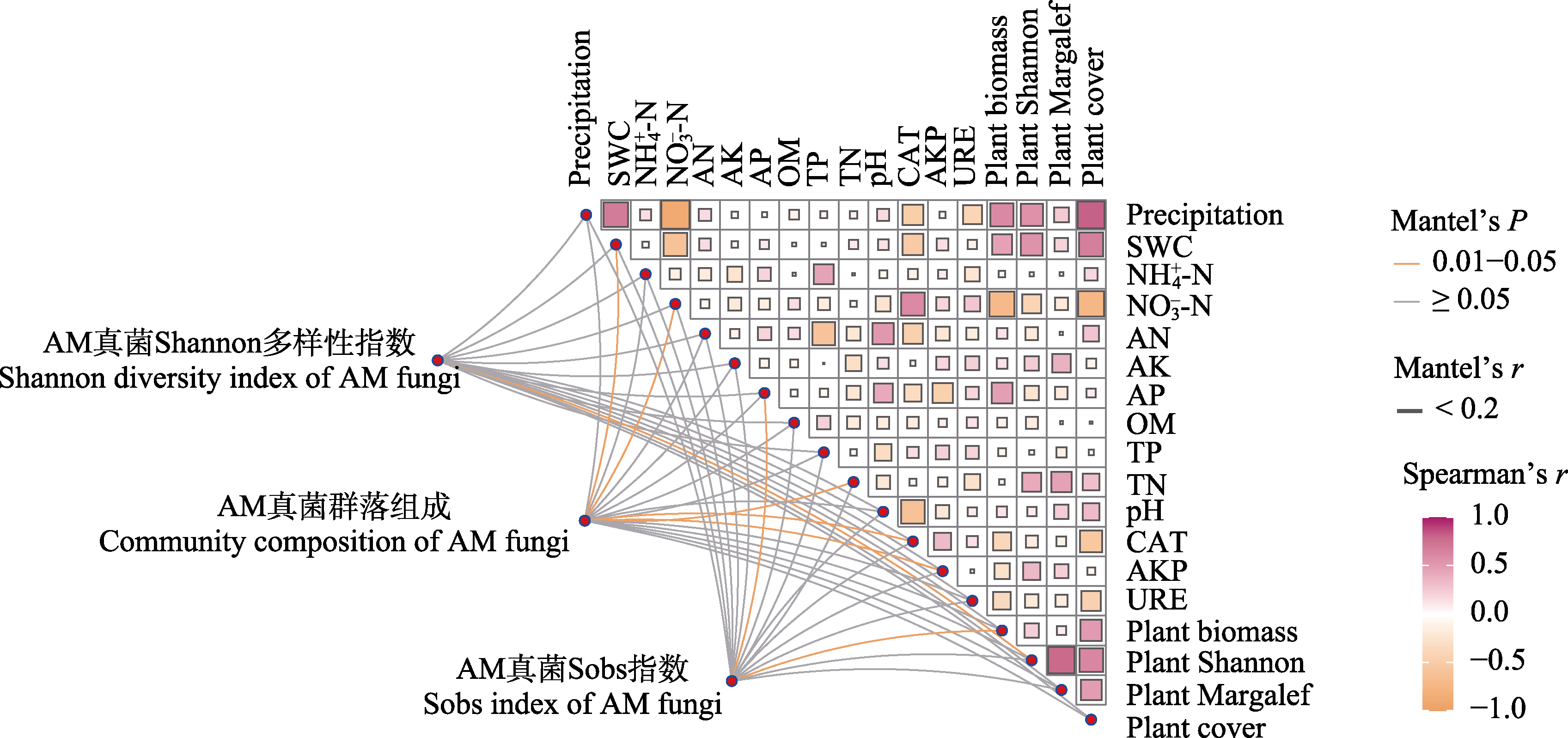
图5 丛枝菌根(AM)真菌群落多样性与环境因子的相关关系。Precipitation: 降水; SWC: 土壤水分含量; NH4+-N: 铵态氮; NO3--N: 硝态氮; AN: 土壤有效氮; AK: 土壤速效钾; AP: 土壤速效磷; OM: 土壤有机质; TP: 土壤全磷; TN: 土壤全氮; pH: 土壤pH; CAT: 过氧化氢酶; AKP: 碱性磷酸酶; URE: 脲酶; Plant biomass: 植物地上生物量; Plant Shannon: 植物Shannon多样性指数; Plant Margalef: 植物Margalef指数; Plant cover: 植物盖度。Mantel’s P: Mantel检验的差异显著性; Mantel’s r: Mantel检验的相关性系数; Spearman’s r: Spearman相关性系数。
Fig. 5 Correlations between arbuscular mycorrhizal (AM) fungal community diversity and environmental factors. SWC, Soil water content; NH4+-N, Ammoniacal nitrogen; NO3--N, Nitrate nitrogen; AN, Available nitrogen; AK, Available potassium; AP, Available phosphorus; OM, Organic matter; TP, Total phosphorus; TN, Total nitrogen; pH, Soil pH; CAT, Catalase; AKP, Alkaline phosphatase; URE, Urease; Plant biomass, Plant aboveground biomass; Plant Shannon, Plant Shannon index; Plant Margalef, Plant Margalef index. Mantel’s P, Mantel test statistical significance; Mantel’s r, Mantel test correlation coefficient; Spearman’s r, Spearman correlation coefficient.
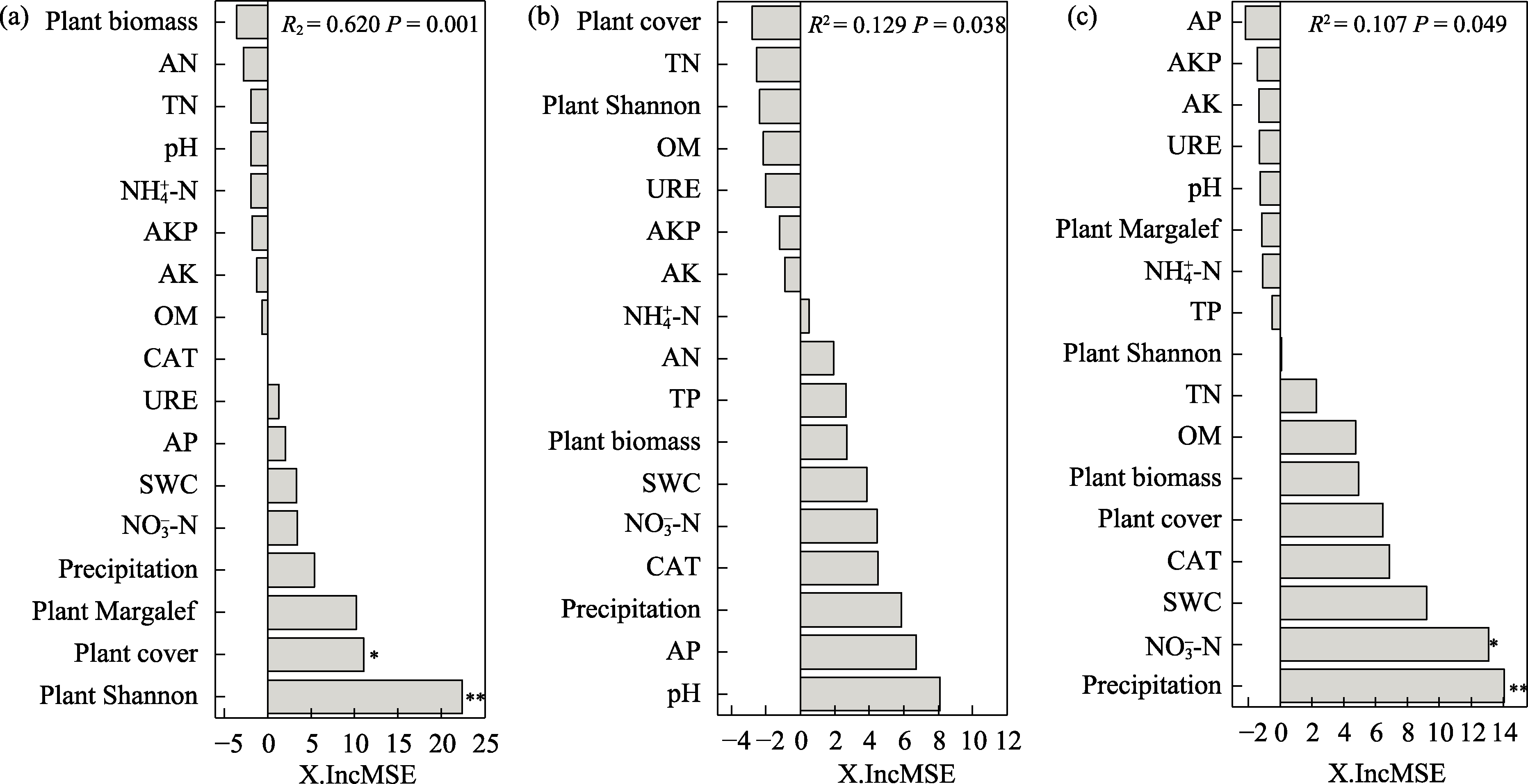
图6 驱动丛枝菌根(AM)真菌群落变化的随机森林分析。(a) Shannon多样性指数; (b) Sobs指数; (c)群落组成。Precipitation: 降水; SWC: 土壤水分含量; NH4+-N: 铵态氮; NO3--N: 硝态氮; AN: 土壤有效氮; AK: 土壤速效钾; AP: 土壤速效磷; OM: 土壤有机质; TP: 土壤全磷; TN: 土壤全氮; pH: 土壤pH; CAT: 过氧化氢酶; AKP: 碱性磷酸酶; URE: 脲酶; Plant biomass: 植物地上生物量; Plant Shannon: 植物Shannon多样性指数; Plant Margalef: 植物Margalef指数; Plant cover: 植物盖度。X.IncMSE: 均方误差增量。* P < 0.05; ** P < 0.01。
Fig. 6 Random forest analysis of the drivers of arbuscular mycorrhizal (AM) fungal community change. (a)Shannon diversity index; (b) Sobs index; (c) Community composition. SWC, Soil water content; NH4+-N, Ammoniacal nitrogen; NO3--N, Nitrate nitrogen; AN, Available nitrogen; AK, Available potassium; AP, Available phosphorus; OM, Organic matter; TP, Total phosphorus; TN, Total nitrogen; pH, Soil pH; CAT, Catalase; AKP, Alkaline phosphatase; URE, Urease; Plant biomass, Plant aboveground biomass; Plant Shannon, Plant Shannon diversity index; Plant Margalef, Plant Margalef index. X.IncMSE, Percentage increase in mean squared error. * P < 0.05; ** P < 0.01.
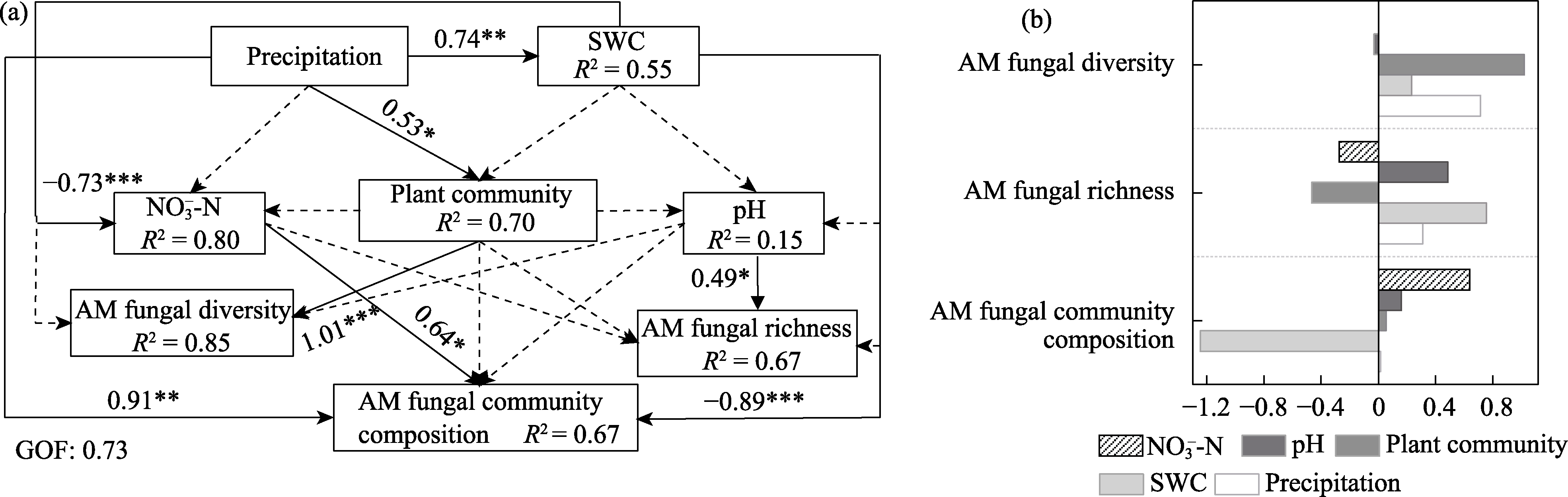
图7 荒漠草原土壤丛枝菌根(AM)真菌群落和土壤环境因子、植物群落的偏最小二乘模型。(a)路径关系; (b)总效应。Precipitation: 降水; SWC: 土壤水分; NO3--N: 土壤硝态氮; Plant community: 植物群落; AM fungal diversity: AM真菌多样性; AM fungal richness: AM真菌丰富度; AM fungal community composition: AM真菌群落组成。实线表示具有显著效应, 虚线表示没有显著效应。* P < 0.05, ** P < 0.01, *** P < 0.001。
Fig. 7 Partial least squares path model (PLS-PM) for the relationships among soil arbuscular mycorrhizal (AM) fungal community, soil environmental factors and the plant community in the desert steppe. (a) Path relationship; (b) Total effects. Precipitation; SWC, Soil water content; NO3--N, Nitrate nitrogen. Solid lines indicate significant effects, dashed lines indicate non-significant effects. * P < 0.05, ** P < 0.01, *** P < 0.001.
| [1] | Abrol IP, Yadav JSP, Massoud FI (1988) Salt-affected Soils and Their Management: FAO Soils Bulletin 39. Food and Agriculture Organization of the United Nations, Rome. |
| [2] |
Bomfim F F, Lansac-Tôha FM, Bonecker CC, Lansac-Tôha FA (2021) Determinants of zooplankton functional dissimilarity during years of El Niño and La Niña in floodplain shallow lakes. Aquatic Sciences, 83, 41.
DOI |
| [3] | Bowles TM, Jackson LE, Cavagnaro TR (2018) Mycorrhizal fungi enhance plant nutrient acquisition and modulate nitrogen loss with variable water regimes. Global Change Biology, 24, e171-e182. |
| [4] | Cai XB, Qian C, Peng YL, Feng G, Gai JP (2005) Effects of environmental factors on AM fungi around steppe plant roots in Tibet Plateau. Chinese Journal of Applied Ecology, 16, 859-864. (in Chinese with English abstract) |
| [蔡晓布, 钱成, 彭岳林, 冯固, 盖京平 (2005) 环境因子对西藏高原草地植物丛枝菌根真菌的影响. 应用生态学报, 16, 859-864.] | |
| [5] |
Canarini A, Schmidt H, Fuchslueger L, Martin V, Herbold CW, Zezula D, Gündler P, Hasibeder R, Jecmenica M, Bahn M, Richter A (2021) Ecological memory of recurrent drought modifies soil processes via changes in soil microbial community. Nature Communications, 12, 5308.
DOI PMID |
| [6] |
Cappelli SL, Domeignoz-Horta LA, Loaiza V, Laine AL (2022) Plant biodiversity promotes sustainable agriculture directly and via belowground effects. Trends in Plant Science, 27, 674-687.
DOI PMID |
| [7] | Chen SF, Zhou YQ, Chen YR, Gu J (2018) Fastp: An ultra-fast all-in-one FASTQ preprocessor. Bioinformatics, 34, i884-i890. |
| [8] |
Chen YL, Xu ZW, Xu TL, Veresoglou SD, Yang GW, Chen BD (2017) Nitrogen deposition and precipitation induced phylogenetic clustering of arbuscular mycorrhizal fungal communities. Soil Biology and Biochemistry, 115, 233-242.
DOI URL |
| [9] |
Chen YL, Yao ZM, Sun Y, Wang EZ, Tian CJ, Sun Y, Liu J, Sun CY, Tian L (2022) Current studies of the effects of drought stress on root exudates and rhizosphere microbiomes of crop plant species. International Journal of Molecular Sciences, 23, 2374.
DOI URL |
| [10] |
Cregger MA, McDowell NG, Pangle RE, Pockman WT, Classen AT (2014) The impact of precipitation change on nitrogen cycling in a semi-arid ecosystem. Functional Ecology, 28, 1534-1544.
DOI URL |
| [11] | Deng Q, Liu D, Shi XR, Yuan ZY (2021) Effects of manipulative precipitation on plant species diversity in the understory of planted Robinia pseudoacacia forest on the Loess Plateau, China. Research of Soil and Water Conservation, 28(1), 1-10. (in Chinese with English abstract) |
| [邓强, 刘迪, 时新荣, 袁志友 (2021) 黄土高原刺槐人工林林下植物多样性对模拟降水变化的响应. 水土保持研究, 28(1), 1-10.] | |
| [12] |
Deveautour C, Donn S, Power SA, Bennett AE, Powell JR (2018) Experimentally altered rainfall regimes and host root traits affect grassland arbuscular mycorrhizal fungal communities. Molecular Ecology, 27, 2152-2163.
DOI PMID |
| [13] |
Evans SE, Burke IC (2013) Carbon and nitrogen decoupling under an 11-year drought in the shortgrass steppe. Ecosystems, 16, 20-33.
DOI URL |
| [14] |
Fu W, Chen BD, Rillig MC, Jansa J, Ma W, Xu C, Luo WT, Wu HH, Hao ZP, Wu H, Zhao AH, Yu Q, Han XG (2022) Community response of arbuscular mycorrhizal fungi to extreme drought in a cold-temperate grassland. New Phytologist, 234, 2003-2017.
DOI URL |
| [15] |
Furze JR, Martin AR, Nasielski J, Thevathasan NV, Gordon AM, Isaac ME (2017) Resistance and resilience of root fungal communities to water limitation in a temperate agroecosystem. Ecology and Evolution, 7, 3443-3454.
DOI PMID |
| [16] |
Gao C, Kim YC, Zheng Y, Yang W, Chen L, Ji NN, Wan SQ, Guo LD (2016) Increased precipitation, rather than warming, exerts a strong influence on arbuscular mycorrhizal fungal community in a semiarid steppe ecosystem. Botany, 94, 459-469.
DOI URL |
| [17] | Gao ZY, Yuan M, Yao HY, Ge CR (2021) Research progress on effects of extreme drought on soil microbial communities and their functions. Jiangsu Agricultural Sciences, 49(13), 35-45. (in Chinese with English abstract) |
| [高志远, 袁鸣, 姚槐应, 葛超荣 (2021) 极端干旱对土壤微生物群落和功能的影响研究进展. 江苏农业科学, 49(13), 35-45.] | |
| [18] |
Giovannetti M, Sbrana C, Avio L, Strani P (2004) Patterns of below-ground plant interconnections established by means of arbuscular mycorrhizal networks. New Phytologist, 164, 175-181.
DOI PMID |
| [19] |
Groffman PM, Baron JS, Blett T, Gold AJ, Goodman I, Gunderson LH, Levinson BM, Palmer MA, Paerl HW, Peterson GD, Poff NL, Rejeski DW, Reynolds JF, Turner MG, Weathers KC, Wiens J (2006) Ecological thresholds: The key to successful environmental management or an important concept with no practical application? Ecosystems, 9, 1-13.
DOI URL |
| [20] | Guan SY (1986) Soil Enzyme and Its Research Methods. Agriculture Press, Beijing. (in Chinese) |
| [关松荫 (1986) 土壤酶及其研究法. 农业出版社, 北京.] | |
| [21] | Guo HJ, He XL, Li YP (2012) Spatial distribution of arbuscular mycorrhiza and glomalin in the rhizosphere of Caragana korshinskii Kom. in the Otindag sandy land, China. African Journal of Microbiology Research, 6, 5745-5753. |
| [22] |
Guo R, Wu XD, Wang ZJ, Jiang Q, Yu HQ, He J, Liu WJ, Ma K (2023) Responses of soil bacterial and fungal communities to altered precipitation in a desert steppe. Chinese Journal of Applied Ecology, 34, 1500-1508. (in Chinese with English abstract)
DOI |
|
[郭蓉, 吴旭东, 王占军, 蒋齐, 俞鸿千, 贺婧, 刘文娟, 马琨 (2023) 荒漠草原土壤细菌和真菌群落对降水变化的响应. 应用生态学报, 34, 1500-1508.]
DOI |
|
| [23] |
He TQ, Wang BB, Cao XX, Zhang KC, Wang XD, Wang H, Bai TS, Zhao YX, Zhang Y, Wang Y, Qiu YP, Hu SJ (2026) Responses of plants and arbuscular mycorrhizal fungal communities to long-term precipitation increase in a semi-arid grassland. Chinese Journal of Plant Ecology, 50, 674-684. (in Chinese with English abstract)
DOI URL |
|
[何堂庆, 王变变, 曹鑫鑫, 张康成, 汪晓东, 王浩, 白彤硕, 赵叶新, 张艺, 王益, 仇云鹏, 胡水金 (2026) 半干旱草地植物和丛枝菌根真菌群落对长期降水增加的响应. 植物生态学报, 50, 674-684.]
DOI |
|
| [24] |
Hinsinger P, Plassard C, Tang CX, Jaillard B (2003) Origins of root-mediated pH changes in the rhizosphere and their responses to environmental constraints: A review. Plant and Soil, 248, 43-59.
DOI |
| [25] | Hu HY, Li HX, Ni B, Shi B, Xu DM, Xie YZ (2019) Characteristic of typical vegetation community and water use efficiency of dominant plants in desert steppe of Ningxia. Journal of Zhejiang University (Agriculture and Life Sciences), 45, 460-471. (in Chinese with English abstract) |
| [胡海英, 李惠霞, 倪彪, 师斌, 许冬梅, 谢应忠 (2019) 宁夏荒漠草原典型群落的植被特征及其优势植物的水分利用效率. 浙江大学学报(农业与生命科学版), 45, 460-471.] | |
| [26] |
Hu HY, Zhu L, Li HX, Xu DM, Xie YZ (2021) Seasonal changes in the water-use strategies of three herbaceous species in a native desert steppe of Ningxia, China. Journal of Arid Land, 13, 109-122.
DOI |
| [27] |
Hu R, Wang XP, Xu JS, Zhang YF, Pan YX, Su X (2020) The mechanism of soil nitrogen transformation under different biocrusts to warming and reduced precipitation: From microbial functional genes to enzyme activity. Science of the Total Environment, 722, 137849.
DOI URL |
| [28] | Huang XM, Zhang Y, Li JP (2022) Responses of vegetation characteristics of Mu Us desert steppe to changes in precipitation. Acta Agrestia Sinica, 30, 178-187. (in Chinese with English abstract) |
|
[黄绪梅, 张翼, 李建平 (2022) 毛乌素荒漠草原植被特征对降水变化的响应. 草地学报, 30, 178-187.]
DOI |
|
| [29] |
Hutchings MJ, Wijesinghe DK (2008) Performance of a clonal species in patchy environments: Effects of environmental context on yield at local and whole-plant scales. Evolutionary Ecology, 22, 313-324.
DOI URL |
| [30] | IPCC (Intergovernmental Panel on Climate Change) (2023) The Physical Science Basis:Working Group I Contribution to the 6th Assessment Report of the Intergovernmental Panel on Climate Change. Cambridge University Press, Cambridge. |
| [31] |
Jiang YL, Lei YB, Yang Y, Korpelainen H, Niinemets Ü, Li CY (2018) Divergent assemblage patterns and driving forces for bacterial and fungal communities along a glacier forefield chronosequence. Soil Biology and Biochemistry, 118, 207-216.
DOI URL |
| [32] |
Jones DL, Hodge A, Kuzyakov Y (2004) Plant and mycorrhizal regulation of rhizodeposition. New Phytologist, 163, 459-480.
DOI PMID |
| [33] | Ju H, Shen GZ, Xu WT, Zhao CM, Su L, Wang Y, Xie ZQ, Zhang QL (2016) The emission of CH4, CO2, and N2O in the typical forest soils of Shennongjia under the precipitation reduction. Acta Ecologica Sinica, 36, 6397-6408. (in Chinese with English abstract) |
| [菊花, 申国珍, 徐文婷, 赵常明, 苏磊, 王杨, 谢宗强, 张秋良 (2016) 神农架主要森林土壤CH4、CO2和N2O排放对降水减少的响应. 生态学报, 36, 6397-6408.] | |
| [34] |
Lauber CL, Hamady M, Knight R, Fierer N (2009) Pyrosequencing-based assessment of soil pH as a predictor of soil bacterial community structure at the continental scale. Applied and Environmental Microbiology, 75, 5111-5120.
DOI PMID |
| [35] |
Li XL, Qi ZQ, Yu XL, Xu M, Liu ZH, Du GF, Yang Y (2021) Soil pH drives the phylogenetic clustering of the arbuscular mycorrhizal fungal community across subtropical and tropical pepper fields of China. Applied Soil Ecology, 165, 103978.
DOI URL |
| [36] |
Li XL, Zhu TY, Peng F, Chen Q, Lin S, Christie P, Zhang JL (2015) Inner Mongolian steppe arbuscular mycorrhizal fungal communities respond more strongly to water availability than to nitrogen fertilization. Environmental Microbiology, 17, 3051-3068.
DOI PMID |
| [37] |
Lian JL, Chen J, Yang XQ, Zhao Y, Luo X, Han C, Zhao YX, Li JP (2024) Responses of desert steppe plant diversity and microbial diversity to precipitation change. Biodiversity Science, 32, 24044. (in Chinese with English abstract)
DOI |
|
[连佳丽, 陈婧, 杨雪琴, 赵莹, 罗叙, 韩翠, 赵雅欣, 李建平 (2024) 荒漠草原植物多样性和微生物多样性对降水变化的响应. 生物多样性, 32, 24044.]
DOI |
|
| [38] |
Magoč T, Salzberg SL (2011) FLASH: Fast length adjustment of short reads to improve genome assemblies. Bioinformatics, 27, 2957-2963.
DOI PMID |
| [39] |
Ochoa-Hueso R, Collins SL, Delgado-Baquerizo M, Hamonts K, Pockman WT, Sinsabaugh RL, Smith MD, Knapp AK, Power SA (2018) Drought consistently alters the composition of soil fungal and bacterial communities in grasslands from two continents. Global Change Biology, 24, 2818-2827.
DOI PMID |
| [40] |
Poorter H, Niklas KJ, Reich PB, Oleksyn J, Poot P, Mommer L (2012) Biomass allocation to leaves, stems and roots: Meta-analyses of interspecific variation and environmental control. New Phytologist, 193, 30-50.
DOI PMID |
| [41] |
Preece C, Peñuelas J (2016) Rhizodeposition under drought and consequences for soil communities and ecosystem resilience. Plant and Soil, 409, 1-17.
DOI URL |
| [42] |
Qin SQ, Yang GJ, Zhang Y, Song MX, Sun L, Cui YZ, Dong JB, Wang N, Liu X, Zheng PM, Wang RQ (2022) Mowing did not alleviate the negative effect of nitrogen addition on the arbuscular mycorrhizal fungal community in a temperate meadow grassland. Frontiers in Plant Science, 13, 917645.
DOI URL |
| [43] |
Scheffer M, Carpenter S, Foley JA, Folke C, Walker B (2001) Catastrophic shifts in ecosystems. Nature, 413, 591-596.
DOI |
| [44] | Schloss PD, Westcott SL, Ryabin T, Hall JR, Hartmann M, Hollister EB, Lesniewski RA, Oakley BB, Parks DH, Robinson CJ, Sahl JW, Stres B, Thallinger GG, Van Horn DJ, Weber CF (2009) Introducing mothur: Open-source, platform-independent, community-supported software for describing and comparing microbial communities. Applied and Environmental Microbiology, 75, 7537-7541. |
| [45] |
Sendek A, Karakoç C, Wagg C, Domínguez-Begines J, do Couto GM, van der Heijden MGA, Ahmad Naz A, Lochner A, Chatzinotas A, Klotz S, Gómez-Aparicio L, Eisenhauer N (2019) Drought modulates interactions between arbuscular mycorrhizal fungal diversity and barley genotype diversity. Scientific Reports, 9, 9650.
DOI |
| [46] |
Stevens BM, Propster JR, Öpik M, Wilson GWT, Alloway SL, Mayemba E, Johnson NC (2020) Arbuscular mycorrhizal fungi in roots and soil respond differently to biotic and abiotic factors in the Serengeti. Mycorrhiza, 30, 79-95.
DOI PMID |
| [47] |
Sun YQ, Zhang X, Wu ZX, Hu YJ, Wu SL, Chen BD (2016) The molecular diversity of arbuscular mycorrhizal fungi in the arsenic mining impacted sites in Hunan Province of China. Journal of Environmental Sciences, 39, 110-118.
DOI PMID |
| [48] |
Taniguchi T, Akaji Y, Yamato M, Kusakabe R, Goomaral A, Undarmaa J, Yamanaka N (2022) Dominance of arbuscular mycorrhizal fungi is key for Mongolian steppe management under livestock grazing, as indicated by ecosystem multifunctionality. Ecological Indicators, 136, 108686.
DOI URL |
| [49] | Tu NR, Hong M, Ye H, Zhang YZ, He SL, Zhang YL, Zhao Y, Hu JY (2023) Effects of precipitation change and nitrogen deposition on soil arbuscular mycorrhizal fungi (AMF) community structure in desert steppe. Soils, 55, 1251-1260. (in Chinese with English abstract) |
| [图纳热, 红梅, 叶贺, 张耀宗, 贺世龙, 张雅玲, 赵宇, 呼吉亚 (2023) 降水变化和氮沉降对荒漠草原土壤丛枝菌根真菌群落结构的影响. 土壤, 55, 1251-1260.] | |
| [50] |
Wang CL, Yue TX, Fan ZM, Zhao N, Sun XF (2012) High-precision surface modeling downscaling model for China climate. Journal of Geo-Information Science, 14, 599-610. (in Chinese with English abstract)
DOI URL |
|
[王晨亮, 岳天祥, 范泽孟, 赵娜, 孙晓芳 (2012) 高精度曲面建模的中国气候降尺度模型. 地球信息科学学报, 14, 599-610.]
DOI |
|
| [51] |
Wang GH, Sheng LC, Zhao D, Sheng JD, Wang XR, Liao H (2016) Allocation of nitrogen and carbon is regulated by nodulation and mycorrhizal networks in soybean/maize intercropping system. Frontiers in Plant Science, 7, 1901.
DOI PMID |
| [52] |
Wang JL, Zhang JW, Wang CJ, Ren GL, Yang YR, Wang DL (2021) Precipitation exerts a strong influence on arbuscular mycorrhizal fungi community and network complexity in a semiarid steppe ecosystem. European Journal of Soil Biology, 102, 103268.
DOI URL |
| [53] |
Wei XT, Shi YN, Qin FW, Zhou HK, Shao XQ (2021) Effects of experimental warming, precipitation increase and their interaction on AM fungal community in an Alpine grassland of the Qinghai-Tibetan Plateau. European Journal of Soil Biology, 102, 103272.
DOI URL |
| [54] |
Wu SL, You F, Wu ZX, Bond P, Hall M, Huang LB (2020) Correction to: Molecular diversity of arbuscular mycorrhizal fungal communities across the gradient of alkaline Fe ore tailings, revegetated waste rock to natural soil sites. Environmental Science and Pollution Research, 27, 11980.
DOI |
| [55] | Wu XD, Ji B, He JL, Ren XB, Yu HQ, Wang ZJ (2021a) The effects of precipitation gradient control on the leaf functional traits and soil nutrients of the dominant plants in a desert steppe. Acta Ecologica Sinica, 41, 2719-2727. (in Chinese with English abstract) |
| [吴旭东, 季波, 何建龙, 任小玢, 俞鸿千, 王占军 (2021a) 控制降水梯度对荒漠草原优势植物叶功能性状及土壤养分的影响. 生态学报, 41, 2719-2727.] | |
| [56] | Wu XD, Jiang Q, Ren XB, Yu HQ, Wang ZJ, He JL, Ji B, Du JM (2021b) Effects of precipitation on carbon, nitrogen and microbial characteristics of biological soil crusts in a desert steppe of Northern China. Acta Prataculturae Sinica, 30(7), 34-43. (in Chinese with English abstract) |
| [吴旭东, 蒋齐, 任小玢, 俞鸿千, 王占军, 何建龙, 季波, 杜建民 (2021b) 降水水平对荒漠草原生物土壤结皮碳、氮和微生物的影响. 草业学报, 30(7), 34-43.] | |
| [57] |
Xu XH, Chen C, Zhang Z, Sun ZH, Chen YH, Jiang JD, Shen ZG (2017) The influence of environmental factors on communities of arbuscular mycorrhizal fungi associated with Chenopodium ambrosioides revealed by MiSeq sequencing investigation. Scientific Reports, 7, 45134.
DOI |
| [58] |
Xu YC, Chen YZ, Dang P, Jiang XJ, Zheng W, Lei JJ, Yan WD (2023) Decay of fallen wood and elevation affects soil fungal community assembly and indirectly controls community diversity. Applied Soil Ecology, 182, 104683.
DOI URL |
| [59] |
Yang XC, Zhu K, Loik ME, Sun W (2021) Differential responses of soil bacteria and fungi to altered precipitation in a meadow steppe. Geoderma, 384, 114812.
DOI URL |
| [60] |
Zhang J, Wang F, Che RX, Wang P, Liu HK, Ji BM, Cui XY (2016) Precipitation shapes communities of arbuscular mycorrhizal fungi in Tibetan Alpine steppe. Scientific Reports, 6, 23488.
DOI PMID |
| [61] |
Zhang J, Wang P, Xue K, Hao YB, Wang YF, Cui XY (2019) Trait complementarity between fine roots of Stipa purpurea and their associated arbuscular mycorrhizal fungi along a precipitation gradient in Tibetan alpine steppe. Journal of Mountain Science, 16, 542-547.
DOI |
| [62] |
Zhang XY, Zhao WQ, Kou YP, Fang K, Liu YJ, He HL, Liu Q (2023) The contrasting responses of abundant and rare microbial community structures and co-occurrence networks to secondary forest succession in the subalpine region. Frontiers in Microbiology, 14, 1177239.
DOI URL |
| [63] | Zhang ZN, Wu GL, Wang D, Deng L, Hao HM, Yang Z, Shangguan ZP (2014) Plant community structure and soil moisture in the semi-arid natural grassland of the Loess Plateau. Acta Prataculturae Sinica, 23(6), 313-319. (in Chinese with English abstract) |
|
[张志南, 武高林, 王冬, 邓蕾, 郝红敏, 杨政, 上官周平 (2014) 黄土高原半干旱区天然草地群落结构与土壤水分关系. 草业学报, 23(6), 313-319.]
DOI |
|
| [64] |
Zhao JH, Wu HQ, Gu HB, Fan YM, Zhao ZW, Wang PF, Li CL (2025) Climate surpasses soil texture in driving soil salinization alleviation in arid Xinjiang. Remote Sensing, 17, 3812.
DOI URL |
| [65] | Zhao Y, Li JP, Wang YT, Zhang Y, Zhao YX, Luo X (2025) Effects of short-term precipitation changes on soil microbial communities in desert grasslands. Acta Ecologica Sinica, 45, 64-79. (in Chinese with English abstract) |
| [赵莹, 李建平, 王誉陶, 张翼, 赵雅欣, 罗叙 (2025) 短期降水变化对荒漠草原土壤微生物群落的影响. 生态学报, 45, 64-79.] | |
| [66] | Zou AL, Yang Y, Wang HL, Wang PY, Liao H (2025) Aerosol decline accelerates the increasing extreme precipitation in China. Geophysical Research Letters, 52, e2024GL113887. |
| [1] | 尹星元, 安慧, 邢彬彬, 苏诗玉, 文志林, 郭建超, 刘小平, 王波. 养分添加和降水变化对荒漠草原地上和地下生物量稳定性的影响[J]. 生物多样性, 2024, 32(7): 24073-. |
| [2] | 连佳丽, 陈婧, 杨雪琴, 赵莹, 罗叙, 韩翠, 赵雅欣, 李建平. 荒漠草原植物多样性和微生物多样性对降水变化的响应[J]. 生物多样性, 2024, 32(6): 24044-. |
| [3] | 钟欣艺, 赵凡, 姚雪, 吴雨茹, 许银, 鱼舜尧, 林静芸, 郝建锋. 三星堆遗址城墙不同维护措施下草本植物物种多样性与土壤抗冲性的关系[J]. 生物多样性, 2023, 31(8): 23169-. |
| [4] | 周欣扬, 王誉陶, 李建平. 黄土高原典型草原植物群落组成对降水变化的响应[J]. 生物多样性, 2023, 31(3): 22118-. |
| [5] | 刘向, 张鹏, 刘建全. 无机肥料是青海塔拉滩光伏电站植被恢复过程中的限制性因子[J]. 生物多样性, 2022, 30(5): 22100-. |
| [6] | 姚海凤, 张赛超, 上官华媛, 李志鹏, 孙新. 城市化对土壤动物群落结构和多样性的影响[J]. 生物多样性, 2022, 30(12): 22547-. |
| [7] | 韩雪, 苏锦权, 姚娜娜, 陈宝明. 外来入侵植物的根系觅养行为研究进展[J]. 生物多样性, 2020, 28(6): 727-733. |
| [8] | 宋乃平, 王兴, 陈林, 薛毅, 陈娟, 随金明, 王磊, 杨新国. 荒漠草原“土岛”生境群落物种共存机制[J]. 生物多样性, 2018, 26(7): 667-677. |
| [9] | 高趁光, 郭柯, 乔鲜果, 陆帅志, 刘长成, 侯东杰, 王孜. 草原模式植物群落监测方法应用样例[J]. 生物多样性, 2018, 26(3): 266-273. |
| [10] | 张晓珂, 梁文举, 李琪. 我国土壤线虫生态学研究进展和展望[J]. 生物多样性, 2018, 26(10): 1060-1073. |
| [11] | 王邵军, 王红, 李霁航. 热带森林不同演替阶段蚂蚁巢穴的分布特征及其影响因素[J]. 生物多样性, 2016, 24(8): 916-921. |
| [12] | 孙军, 薛冰. 全球气候变化下的海洋浮游植物多样性[J]. 生物多样性, 2016, 24(7): 739-747. |
| [13] | 张志明, 沈蕊, 张建利, 徐倩, 罗园, 遇翘楚, 张秋霞, 欧晓昆. 元江流域干热河谷灌草丛土壤种子库与地上植物群落的物种组成比较[J]. 生物多样性, 2016, 24(4): 431-439. |
| [14] | 杨济达, 张志明, 沈泽昊, 欧晓昆, 耿宇鹏, 杨明玉. 云南干热河谷植被与环境研究进展[J]. 生物多样性, 2016, 24(4): 462-474. |
| [15] | 郭柯, 刘长成, 潘庆民. 中国草原/荒漠植物多样性监测网 模式植物群落监测方案[J]. 生物多样性, 2016, 24(11): 1220-1226. |
| 阅读次数 | ||||||
|
全文 |
|
|||||
|
摘要 |
|
|||||
备案号:京ICP备16067583号-7
Copyright © 2026 版权所有 《生物多样性》编辑部
地址: 北京香山南辛村20号, 邮编:100093
电话: 010-62836137, 62836665 E-mail: biodiversity@ibcas.ac.cn
