

生物多样性 ›› 2026, Vol. 34 ›› Issue (2): 25225. DOI: 10.17520/biods.2025225 cstr: 32101.14.biods.2025225
章旭日1( ), 罗标2, 赵彤2, 黄丹1(), 艾为明1,*(
 )
)
收稿日期:2025-06-17
接受日期:2025-12-15
出版日期:2026-02-20
发布日期:2026-03-23
通讯作者:
艾为明
基金资助:
Xuri Zhang1(), Biao Luo2, Tong Zhao2, Dan Huang1(), Weiming Ai1,*()
Received:2025-06-17
Accepted:2025-12-15
Online:2026-02-20
Published:2026-03-23
Contact:
Weiming Ai
Supported by:摘要:
鱼类是水生生态系统的重要组成部分, 也是人类赖以生存的重要生物资源。浙江水系复杂、海域辽阔, 鱼类资源十分丰富, 但目前尚缺乏对全省鱼类多样性的系统总结, 汇编一份完善的名录资料对鱼类资源保护和利用具有重要意义。本文基于文献资料、调查记录及最新分类学成果, 以《浙江省淡水鱼类名录概况与分析》和《浙江海洋鱼类志》为基础整理编制了《浙江鱼类分类与分布名录》, 并对物种分布格局和保护现状进行了探讨。本文修订了原名录中118种鱼类的分类及分布情况, 并在此基础上增补237种。截至2024年12月31日, 浙江省共有鱼类3纲46目257科659属1,148种(含13种外来种), 物种组成以鲈形目(395种)、鲤形目(130种)、鲉形目(72种)、鲽形目(71种)和鲀形目(53种)为主, 共占全省鱼类物种数的62.80%。全省共有土著内陆鱼类201种, 钱塘江(含曹娥江)水系(155种)和瓯江水系(136种)分布最多; 另有土著海洋鱼类934种。八大水系之间土著内陆鱼类的共有种较多, 群落平均相似度指数均大于0.650。鱼类区系聚类分析结果显示, 当相似距离为0.5水平时, 苕溪、运河水系聚为一类, 甬江、椒江(灵江)、瓯江、飞云江、鳌江水系聚为一类, 钱塘江(含曹娥江)水系独为一类。全省共有121种土著鱼类受到国家级保护或处于受胁状态, 其中列入《国家重点保护野生动物名录》的共14种, 列入CITES附录的共32种, 被《IUCN濒危物种红色名录》和《中国生物多样性红色名录》评估为易危(VU)及以上等级的物种分别有104种和16种。针对浙江省鱼类资源现状, 建议加强物种研究、栖息地保护、科教宣传等。
章旭日, 罗标, 赵彤, 黄丹, 艾为明 (2026) 浙江鱼类多样性: 编目、分布与保护. 生物多样性, 34, 25225. DOI: 10.17520/biods.2025225.
Xuri Zhang, Biao Luo, Tong Zhao, Dan Huang, Weiming Ai (2026) Fish diversity of Zhejiang Province: Inventory, distribution and conservation. Biodiversity Science, 34, 25225. DOI: 10.17520/biods.2025225.
| 原名录所属分类 Previous classification | 本文目和科 Current order and family | 变动原因 Cause of change | 参考文献 Reference |
|---|---|---|---|
| 脂鲤目 Characiformes | - | × 因删除物种而删除 | 徐海根等, |
| 鲑形目 Salmoniformes | - | × 因删除物种而删除 | 徐海根等, |
| - | 原鲨科 Proscylliidae | + 因增加物种而新增 | 蔡厚才, |
| - | 大海鲢科 Megalopidae | + 因增加物种而新增 | 陈志俭等, |
| - | 蚓鳗科 Moringuidae | + 因增加物种而新增 | 张洪亮等, |
| - | 遮目鱼科 Chanidae | + 因增加物种而新增 | 蔡厚才, |
| 花鳅科 Cobitidae | 沙鳅科 Botiidae | ♡ 因分类变动拆出 | Tan & Armbruster, |
| 爬鳅科 Balitoridae | 腹吸鳅科 Gastromyzontidae | ♡ 因分类变动拆出 | Tan & Armbruster, |
| - | 条鳅科 Nemacheilidae | + 因增加物种而新增 | 李帆等, |
| 鲤科 Cyprinidae | 鲴科 Xenocyprididae | ♡ 因分类变动拆出 | Tan & Armbruster, |
| 鲤科 Cyprinidae | 鱊科 Acheilognathidae | ♡ 因分类变动拆出 | Tan & Armbruster, |
| 鲤科 Cyprinidae | 鮈科 Gobionidae | ♡ 因分类变动拆出 | Tan & Armbruster, |
| 鲤科 Cyprinidae | 雅罗鱼科 Leuciscidae | ♡ 因分类变动拆出 | Tan & Armbruster, |
| 脂鲤科 Characidae | - | × 因删除物种而删除 | 徐海根等, |
| 长臀鮠科 Cranoglanididae | 鮰科 Ictaluridae | △ 误定 | 伍汉霖等, |
| 鲑科 Salmonidae | - | × 因删除物种而删除 | 徐海根等, |
| - | 巨口光灯鱼科 Phosichthyidae | + 因增加物种而新增 | 蔡厚才, |
| 长尾鳕科 Macrouridae | 底尾鳕科 Bathygadidae | ♡ 因分类变动拆出 | Betancur-R et al., |
| 长尾鳕科 Macrouridae | 拟长尾鳕科 Macrouroididae | ♡ 因分类变动拆出 | 伍汉霖和钟俊生, |
| - | 海蛾鱼科 Pegasidae | + 因增加物种而新增 | 蔡厚才, |
| 鲉科 Scorpaenidae | 真裸皮鲉科 Tetrarogidae | ♡ 因分类变动拆出 | Betancur-R et al., |
| 鲉科 Scorpaenidae | 平鲉科 Sebastidae | ♡ 因分类变动拆出 | Betancur-R et al., |
| - | 须蓑鲉科 Apistidae | + 因增加物种而新增 | 陈伟峰等, |
| 鲉科 Scorpaenidae | 毒鲉科 Synanceiidae | ♡ 因分类变动拆出 | Betancur-R et al., |
| - | 双边鱼科 Ambassidae | + 因增加物种而新增 | 黎海丽, 2023①(① 黎海丽 (2023) 浙江海域四个新纪录鱼种的形态学与DNA条形码研究. 硕士学位论文, 浙江海洋大学, 浙江舟山.) |
| 狼鲈科 Moronidae | 花鲈科 Lateolabracidae | ♡ 因分类变动拆出 | Betancur-R et al., |
| 鮨科 Serranidae | 石斑鱼科 Epinephelidae | ♡ 因分类变动拆出 | 刘敏等, |
| - | 后颌鰧科 Opistognathidae | + 因增加物种而新增 | 许成玉等, |
| - | 梅鲷科 Caesionidae | + 因增加物种而新增 | 吴伟志等, |
| - | 汤鲤科 Kuhliidae | + 因增加物种而新增 | 吴伟志等, |
| - | 海鲫科 Embiotocidae | + 因增加物种而新增 | 叶健亨等, |
| - | 线鳚科 Stichaeidae | + 因增加物种而新增 | 陈健和赵盛龙, |
| - | 鳒科 Psettodidae | + 因增加物种而新增 | 李思忠和王惠民, |
| 牙鲆科 Paralichthyidae | 花鲆科 Tephrinectidae | ♡ 因分类变动拆出 | 伍汉霖和钟俊生, |
| 鲽科 Pleuronectidae | 瓦鲽科 Poecilopsettidae | ♡ 因分类变动拆出 | Betancur-R et al., |
表1 浙江省鱼类目级和科级变动
Table 1 Order and family changes of fishes in Zhejiang Province. + New added families due to species addition; ♡ New families due to taxonomic splitting; △ Misidentification; × Removed orders or families due to species deletion.
| 原名录所属分类 Previous classification | 本文目和科 Current order and family | 变动原因 Cause of change | 参考文献 Reference |
|---|---|---|---|
| 脂鲤目 Characiformes | - | × 因删除物种而删除 | 徐海根等, |
| 鲑形目 Salmoniformes | - | × 因删除物种而删除 | 徐海根等, |
| - | 原鲨科 Proscylliidae | + 因增加物种而新增 | 蔡厚才, |
| - | 大海鲢科 Megalopidae | + 因增加物种而新增 | 陈志俭等, |
| - | 蚓鳗科 Moringuidae | + 因增加物种而新增 | 张洪亮等, |
| - | 遮目鱼科 Chanidae | + 因增加物种而新增 | 蔡厚才, |
| 花鳅科 Cobitidae | 沙鳅科 Botiidae | ♡ 因分类变动拆出 | Tan & Armbruster, |
| 爬鳅科 Balitoridae | 腹吸鳅科 Gastromyzontidae | ♡ 因分类变动拆出 | Tan & Armbruster, |
| - | 条鳅科 Nemacheilidae | + 因增加物种而新增 | 李帆等, |
| 鲤科 Cyprinidae | 鲴科 Xenocyprididae | ♡ 因分类变动拆出 | Tan & Armbruster, |
| 鲤科 Cyprinidae | 鱊科 Acheilognathidae | ♡ 因分类变动拆出 | Tan & Armbruster, |
| 鲤科 Cyprinidae | 鮈科 Gobionidae | ♡ 因分类变动拆出 | Tan & Armbruster, |
| 鲤科 Cyprinidae | 雅罗鱼科 Leuciscidae | ♡ 因分类变动拆出 | Tan & Armbruster, |
| 脂鲤科 Characidae | - | × 因删除物种而删除 | 徐海根等, |
| 长臀鮠科 Cranoglanididae | 鮰科 Ictaluridae | △ 误定 | 伍汉霖等, |
| 鲑科 Salmonidae | - | × 因删除物种而删除 | 徐海根等, |
| - | 巨口光灯鱼科 Phosichthyidae | + 因增加物种而新增 | 蔡厚才, |
| 长尾鳕科 Macrouridae | 底尾鳕科 Bathygadidae | ♡ 因分类变动拆出 | Betancur-R et al., |
| 长尾鳕科 Macrouridae | 拟长尾鳕科 Macrouroididae | ♡ 因分类变动拆出 | 伍汉霖和钟俊生, |
| - | 海蛾鱼科 Pegasidae | + 因增加物种而新增 | 蔡厚才, |
| 鲉科 Scorpaenidae | 真裸皮鲉科 Tetrarogidae | ♡ 因分类变动拆出 | Betancur-R et al., |
| 鲉科 Scorpaenidae | 平鲉科 Sebastidae | ♡ 因分类变动拆出 | Betancur-R et al., |
| - | 须蓑鲉科 Apistidae | + 因增加物种而新增 | 陈伟峰等, |
| 鲉科 Scorpaenidae | 毒鲉科 Synanceiidae | ♡ 因分类变动拆出 | Betancur-R et al., |
| - | 双边鱼科 Ambassidae | + 因增加物种而新增 | 黎海丽, 2023①(① 黎海丽 (2023) 浙江海域四个新纪录鱼种的形态学与DNA条形码研究. 硕士学位论文, 浙江海洋大学, 浙江舟山.) |
| 狼鲈科 Moronidae | 花鲈科 Lateolabracidae | ♡ 因分类变动拆出 | Betancur-R et al., |
| 鮨科 Serranidae | 石斑鱼科 Epinephelidae | ♡ 因分类变动拆出 | 刘敏等, |
| - | 后颌鰧科 Opistognathidae | + 因增加物种而新增 | 许成玉等, |
| - | 梅鲷科 Caesionidae | + 因增加物种而新增 | 吴伟志等, |
| - | 汤鲤科 Kuhliidae | + 因增加物种而新增 | 吴伟志等, |
| - | 海鲫科 Embiotocidae | + 因增加物种而新增 | 叶健亨等, |
| - | 线鳚科 Stichaeidae | + 因增加物种而新增 | 陈健和赵盛龙, |
| - | 鳒科 Psettodidae | + 因增加物种而新增 | 李思忠和王惠民, |
| 牙鲆科 Paralichthyidae | 花鲆科 Tephrinectidae | ♡ 因分类变动拆出 | 伍汉霖和钟俊生, |
| 鲽科 Pleuronectidae | 瓦鲽科 Poecilopsettidae | ♡ 因分类变动拆出 | Betancur-R et al., |
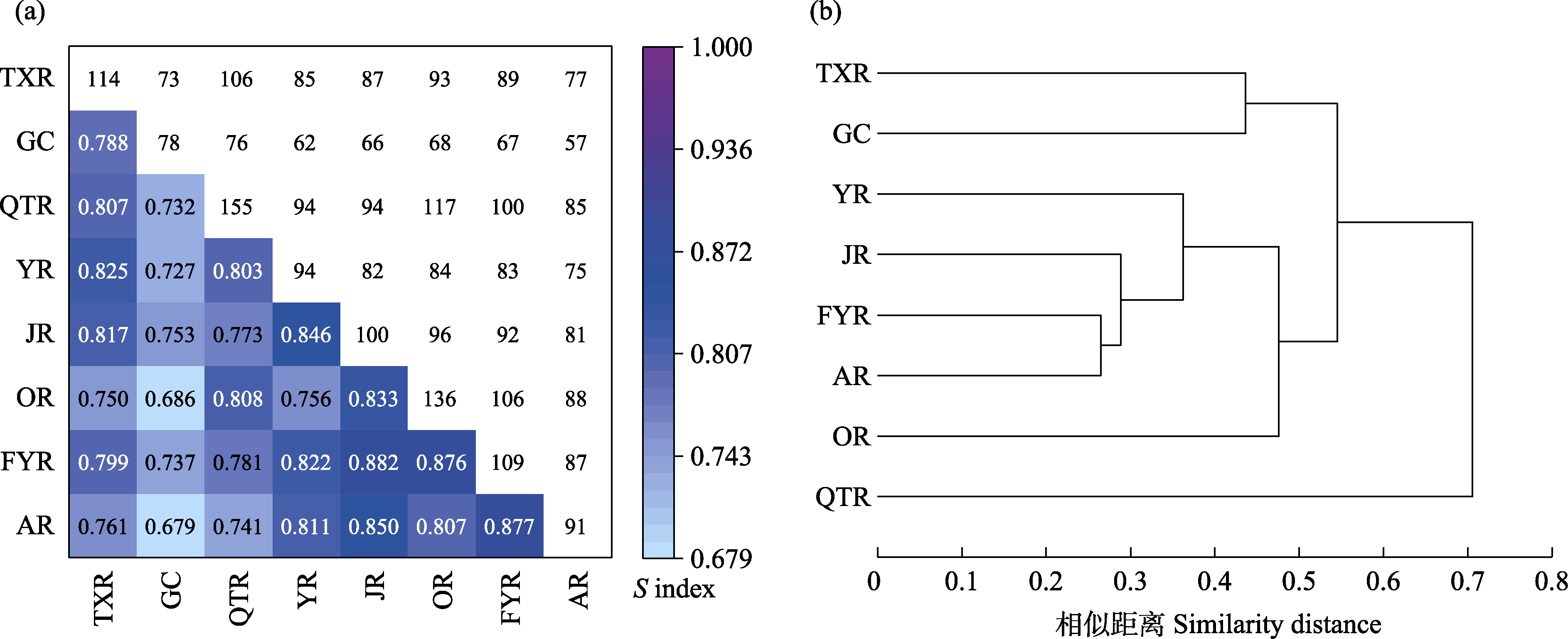
图1 浙江八大水系土著内陆鱼类群落相似性(a)及聚类分析(b)。(a)图中左下方数字为平均相似度指数(S), 右上方数字为共有种数。TXR: 苕溪; GC: 运河; QTR: 钱塘江(含曹娥江); YR: 甬江; JR: 椒江(灵江); OR: 瓯江; FYR: 飞云江; AR: 鳌江。
Fig. 1 Similarity (a) and cluster analysis (b) of native inland fish communities in eight major water systems of Zhejiang Province. In fig. (a), the value at the lower left represents the average similarity index (S), while the value at the upper right represents the number of shared species. TXR, Tiaoxi River; GC, Grand Canal; QTR, Qiantang River (including Cao’e River); YR, Yongjiang River; JR, Jiaojiang River (Lingjiang River); OR, Oujiang River; FYR, Feiyun River; AR, Aojiang River.
| [1] |
Betancur-R R, Wiley EO, Arratia G, Acero A, Bailly N, Miya M, Lecointre G, Ortí G (2017) Phylogenetic classification of bony fishes. BMC Evolutionary Biology, 17, 162.
DOI PMID |
| [2] | Boulenger GA (1901) Descriptions of new freshwater fishes discovered by Mr. F. W. Styan at Ningpo, China. Proceedings of the Zoological Society of London, 1, 268-271. |
| [3] | Cai HC (2021) Overview of Nanji Islands National Marine Nature Reserve. China Ocean Press, Beijing. (in Chinese) |
| [蔡厚才 (2021) 南麂列岛国家级海洋自然保护区简志. 海洋出版社, 北京.] | |
| [4] | Cantor TE (1842) General features of Chusan, with remarks on the flora and fauna of that island. Annals and Magazine of Natural History, 9, 481-493. |
| [5] | Cao WX (2024) Fauna Sinica∙Osteichthyes∙Cypriniformes (I). Science Press, Beijing. (in Chinese) |
| [曹文宣 (2024) 中国动物志∙硬骨鱼纲∙鲤形目(上卷). 科学出版社, 北京.] | |
| [6] | Chang CH, Lin WW, Shao YT, Arai R, Ishinabe T, Ueda T, Matsuda M, Kubota H, Wang FY, Jang-Liaw NH, Kao HW (2009) Molecular phylogeny and genetic differentiation of the Tanakia himantegus complex (Teleostei: Cyprinidae) in China. Zoological Studies, 48, 823-834. |
| [7] | Chen J, Zhao SL (2012) Three new records of marine fishes in Zhejiang Province. Journal of Zhejiang Ocean University (Natural Science), 31, 379-383. (in Chinese with English abstract) |
| [陈健, 赵盛龙 (2012) 浙江海域3种鱼类新记录. 浙江海洋学院学报(自然科学版), 31, 379-383.] | |
| [8] | Chen MK, Tong HY, Yu TJ, Diao ZS (1990) The Fish Resources of Qiantang River. Shanghai Scientific and Technological Literature Press, Shanghai. (in Chinese) |
| [陈马康, 童合一, 俞泰济, 刁铸山 (1990) 钱塘江鱼类资源. 上海科学技术文献出版社, 上海.] | |
| [9] | Chen WF, Peng X, Ye S, Liu P (2023) Illustrated Handbook of Marine Fishes in Southern Zhejiang, China (Vol. I). China Ocean Press, Beijing. (in Chinese) |
| [陈伟峰, 彭欣, 叶深, 刘攀 (2023) 浙江南部海洋鱼类图鉴(卷一). 海洋出版社, 北京.] | |
| [10] | Chen WJ, Fu HY, Zhang YP, Zhang HX, Fu YL (2024) The Fishes of Jiangxi Province. Science Press, Beijing. (in Chinese) |
| [陈文静, 付辉云, 张燕萍, 章海鑫, 傅义龙 (2024) 江西鱼类志. 科学出版社, 北京.] | |
| [11] | Chen YY (1998) Fauna Sinica∙Osteichthyes∙Cypriniformes (II). Science Press, Beijing. (in Chinese) |
| [陈宜瑜 (1998) 中国动物志∙硬骨鱼纲∙鲤形目(中卷). 科学出版社, 北京.] | |
| [12] | Chen ZJ, Ai WM, Zhou ZM, Chen X (2016) Atlas of Fishes in Nanxi River. China Agricultural Science and Technology Press, Beijing. (in Chinese) |
| [陈志俭, 艾为明, 周志明, 陈骁 (2016) 楠溪江鱼类图谱. 中国农业科学技术出版社, 北京.] | |
| [13] | Cheng QT, Zhou CW (1997) The Fishes of Shandong Province. Shandong Science and Technology Press, Ji’nan. (in Chinese) |
| [成庆泰, 周才武 (1997) 山东鱼类志. 山东科学技术出版社, 济南.] | |
| [14] | Chu XL, Zheng BS, Dai DY (1999) Fauna Sinica∙Osteichthyes∙ Siluriformes. Science Press, Beijing. (in Chinese) |
| [褚新洛, 郑葆珊, 戴定远 (1999) 中国动物志∙硬骨鱼纲∙鲇形目. 科学出版社, 北京.] | |
| [15] | Chu YT (1931a) Index piscium sinensium. Biological Bulletin of St. John’s University, 1, 1-290. |
| [16] | Chu YT (1931b) Contributions to the ichthyology of China. The China Journal, 15, 32-40. |
| [17] | Chu YT (1932) Fishes of the West Lake. The West Lake Museum, Hangzhou. (in Chinese and in English) |
| [朱元鼎 (1932) 西湖鱼类志. 浙江省立西湖博物馆印行, 杭州.] | |
| [18] | Chu YT (1935) Description of a new species of Lagocephalus from Chusan, China. The China Journal, 22, 87. |
| [19] | Chu YT (1960) Chondrichthyes of China. Science Press, Beijing. (in Chinese) |
| [朱元鼎 (1960) 中国软骨鱼类志. 科学出版社, 北京.] | |
| [20] | Chu YT (1984) The Fishes of Fujian Province (Part I). Fujian Science and Technology Press, Fuzhou. (in Chinese) |
| [朱元鼎 (1984) 福建鱼类志(上册). 福建科学技术出版社, 福州.] | |
| [21] | Chu YT, Zhang CL, Cheng QT (1963) Fishes of East China Sea. Science Press, Beijing. (in Chinese) |
| [朱元鼎, 张春霖, 成庆泰 (1963) 东海鱼类志. 科学出版社, 北京.] | |
| [22] | East China Sea Fisheries Research Institute of Chinese Academy of Fishery Sciences, Shanghai Fisheries Research Institute(1990) The Fishes of Shanghai Area. Shanghai Scientific & Technical Publishers, Shanghai. (in Chinese) |
| [中国水产科学研究院东海水产研究所, 上海市水产研究所 (1990) 上海鱼类志. 上海科学技术出版社, 上海.] | |
| [23] | Evermann BW, Shaw TH (1927) Fishes from Eastern China, with descriptions of new species. Proceedings of the California Academy of Sciences (Series 4), 16(4), 97-122. |
| [24] | Fang PW (1933) Notes on Gobiobotia tungi, sp. nov. Sinensia, 3, 265-268. |
| [25] | Fang PW (1936) Study on the botoid fishes of China. Sinensia, 7, 1-49. |
| [26] | Fang PW (1938) On Huigobio chenhsienensis, gen. & sp. nov. Bulletin of the Fan Memorial Institute of Biology (Zoological Series), 8, 237-244. |
| [27] | Fang PW, Wang KF (1931) A review of the fishes of the genus Gobiobotia. Contributions from the Biological Laboratory of the Science Society of China (Zoological Series), 7, 289-305. |
| [28] | Froese R, Pauly D (2025) FishBase. https://fishbase.mnhn.fr/search.php. (accessed on 2025-05-28) |
| [29] | Fu NP, Yan Y (2009) The Eight Major Water Systems of Zhejiang Province. Zhejiang University Press, Hangzhou. (in Chinese) |
| [符宁平, 闫彦 (2009) 浙江八大水系. 浙江大学出版社, 杭州.] | |
| [30] | Gao TX, Ji DP, Xiao YS, Xue TQ, Yanagimoto T, Setoguma T (2011) Description and DNA barcoding of a new Sillago species, Sillago sinica (Perciformes: Sillaginidae), from coastal waters of China. Zoological Studies, 50, 254-263. |
| [31] | Gu ZM, Liu JD, Zhou ZM, Zhang AJ (2020) Atlas of Common Fishes in Qiantang River. China Agriculture Press, Beijing. (in Chinese) |
| [顾志敏, 刘金殿, 周志明, 张爱菊 (2020) 钱塘江水系常见鱼类原色图谱. 中国农业出版社, 北京.] | |
| [32] | Günther ACLG (1868) Catalogue of the Fishes in the British Museum (Vol. 7). Trustees of the British Museum, London. |
| [33] |
Guo DM, Cao L, Zhang E (2024) Descriptions of two new species of the botiid genus Leptobotia Bleeker, 1870 (Teleostei: Cypriniformes) from South China. Journal of Fish Biology, 104, 433-449.
DOI URL |
| [34] |
Guo DM, Zhang E (2021) Re-description of the loach species Leptobotia citrauratea (Teleostei, Botiidae), with the description of L. brachycephala from Southern Zhejiang Province, China. ZooKeys, 1017, 89-109.
DOI URL |
| [35] | Herre AWCT (1940) Notes on fishes in the Zoological Museum of Stanford University. VIII. A new genus and two new species of Chinese gobies with remarks on some other species. The Philippine Journal of Science, 73, 293-299. |
| [36] | Herre AWCT, Lin SY (1936) Fishes of the Tsien Tang River system. Bulletin of the Chekiang Provincial Fisheries Experiment Station, 2(7), 1-37. |
| [37] | Ho HC, Bineesh KK, Akhilesh KV (2014) Rediscovery of Lophiodes triradiatus (Lloyd, 1909), a senior synonym of L. infrabrunneus Smith and Radcliffe (Lophiiformes: Lophiidae). Zootaxa, 3786, 587-592. |
| [38] |
Huang SP, Chen IS, Shao KT (2016) A new species of Rhinogobius (Teleostei: Gobiidae) from Zhejiang Province, China. Ichthyological Research, 63, 470-479.
DOI URL |
| [39] | IUCN (2025) The IUCN Red List of Threatened Species (Version 2025-1). https://www.iucnredlist.org. (accessed on 2025-05-28) |
| [40] | Lacépède BGÉ (1803) Histoire Naturelle des Poissons (Tome Cinquième). Chez Plassan, Paris. |
| [41] | Li F, Liu P, Zhou ZC, Zhou X, Li S, Huang JH, Zhang JL, Chen JC (2024) Fresh Water Fishes of China. Straits Publishing House, Fuzhou. (in Chinese) |
| [李帆, 刘攀, 周卓诚, 周行, 郦珊, 黄俊豪, 张继灵, 陈敬琛 (2024) 中国淡水鱼类图鉴. 海峡书局, 福州.] | |
| [42] | Li SZ, Wang HM (1995) Fauna Sinica∙Osteichthyes∙ Tleuronectiformes. Science Press, Beijing. (in Chinese) |
| [李思忠, 王惠民 (1995) 中国动物志∙硬骨鱼纲∙鲽形目. 科学出版社, 北京.] | |
| [43] | Liu J (2016) Fauna Sinica∙Osteichthyes∙Perciformes (IV). Science Press, Beijing. (in Chinese) |
| [刘静 (2016) 中国动物志∙硬骨鱼纲∙鲈形目(四). 科学出版社, 北京.] | |
| [44] | Liu M, Shao KT, Xue QW, Chen X (2024) Marine Fishes of China and Adjacent Waters. Straits Publishing House, Fuzhou. (in Chinese) |
| [刘敏, 邵广昭, 薛绮雯, 陈骁 (2024) 中国海洋鱼类图鉴. 海峡书局, 福州.] | |
| [45] | Mao JR, Xu SS, Jia GS, Zheng ML (1991) Fauna of Zhejiang:Fresh Water Fishes. Zhejiang Science and Technology Publishing House, Hangzhou. (in Chinese) |
| [毛节荣, 徐寿山, 郏国生, 郑米良 (1991) 浙江动物志: 淡水鱼类. 浙江科学技术出版社, 杭州.] | |
| [46] | McClelland J (1844) Description of a collection of fishes made at Chusan and Ningpo in China, by Dr. G. R. Playfair, surgeon of the Phlegethon, war steamer, during the late military operations in that country. Calcutta Journal of Natural History, 4, 390-413. |
| [47] | Nelson JS (2006) Fishes of the World, 4th edn. John Wiley & Sons, Hoboken, New Jersey. |
| [48] | Nelson JS, Grande TC, Wilson MVH (2016) Fishes of the World, 5th edn. John Wiley & Sons, Hoboken, New Jersey. |
| [49] | Ni Y, Wu HL, Zhu CD (2006) Fishes of Jiangsu Province. China Agriculture Press, Beijing. (in Chinese) |
| [倪勇, 伍汉霖, 朱成德 (2006) 江苏鱼类志. 中国农业出版社, 北京.] | |
| [50] | Norman JR (1925) Two new fishes from China. Annals and Magazine of Natural History (Series 9), 16, 270. |
| [51] | Peters WCH (1881) Über die von der chinesischen Regierung zu der internationalen Fischerei-Austellung gesandte Fischsammlung aus Ningpo. Monatsberichte der Königlichen Preussischen Akademie der Wissenschaften zu Berlin, 45, 921-927. |
| [52] | Richardson J (1845) Ichthyology (Part 3) of the Zoology of the Voyage of H. M. S. Sulphur. Smith, Elder & Co., London. |
| [53] | Sauvage HÉ, Dabry de Thiersant CP (1874) Notes sur les poissons des eaux douces de Chine. Annales des Sciences Naturelles, Paris (Zoologie et Paléontologie) (Sér. 6), 1, 1-18. |
| [54] | Shao KT (2025) The Fish Database of Taiwan. (in Chinese) |
| [邵广昭 (2025) 台湾鱼类资料库.] http://fishdb.sinica.edu.tw. (accessed on 2025-05-28) | |
| [55] |
Shao WH, Cheng JL, Zhang E (2024) Tachysurus taeniatus (Günther, 1873), a senior synonym of the congeneric species T. ondon (Shaw, 1934) (Teleostei, Bagridae) from Eastern China. ZooKeys, 1218, 131-144.
DOI URL |
| [56] | Shaw TH (1930) Notes on some fishes from Ka-Shing and Shing-Tsong, Chekiang Province. Bulletin of the Fan Memorial Institute of Biology, 1, 109-124. |
| [57] |
Shen XM, Xu XJ, Huang FY, Du JM (2024) Industry overview and development trend analysis of stream fish in Zhejiang Province. Journal of Zhejiang Agricultural Sciences, 65, 3025-3030. (in Chinese with English abstract)
DOI |
|
[沈小明, 许晓军, 黄福勇, 杜建明 (2024) 浙江溪流性鱼类产业概况与发展趋势分析. 浙江农业科学, 65, 3025-3030.]
DOI |
|
| [58] |
Song XJ, Tang WQ, Zhang Y (2017) Freshwater fish fauna and zoogeographical divisions in the Wuyi-Xianxialing Mountains of Eastern China. Biodiversity Science, 25, 1331-1338. (in Chinese with English abstract)
DOI |
|
[宋小晶, 唐文乔, 张亚 (2017) 华东武夷山-仙霞岭地区淡水鱼类区系特征及其动物地理区划. 生物多样性, 25, 1331-1338.]
DOI |
|
| [59] |
Suzuki T, Shibukawa K, Senou H, Chen IS (2016) Redescription of Rhinogobius similis Gill 1859 (Gobiidae: Gobionellinae), the type species of the genus Rhinogobius Gill 1859, with designation of the neotype. Ichthyological Research, 63, 227-238.
DOI URL |
| [60] |
Tan M, Armbruster JW (2018) Phylogenetic classification of extant genera of fishes of the order Cypriniformes (Teleostei: Ostariophysi). Zootaxa, 4476, 6-39.
DOI PMID |
| [61] | Tang WQ, Song XJ, Zhang Y (2022) Species diversity and zoogeographical analysis of freshwater fishes in central and Southern mountainous area of East China. Acta Hydrobiologica Sinica, 46, 621-629. (in Chinese with English abstract) |
| [唐文乔, 宋小晶, 张亚 (2022) 华东中南部山区淡水鱼类物种多样性及动物地理区划. 水生生物学报, 46, 621-629.] | |
| [62] | van der Laan R, Fricke R, Eschmeyer WN (2025) Eschmeyer’s Catalog of Fishes: Genera, Species, References. https://researcharchive.calacademy.org/research/ichthyology/catalog/fishcatmain.asp. (accessed on 2025-05-24) |
| [63] | Wang KF (1933) Preliminary notes on the fishes of Chekiang (Elasmobranches). Contributions from the Biological Laboratory of the Science Society of China (Zoological Series), 9, 87-117. |
| [64] | Wang KF (1935) Preliminary notes on the fishes of Chekiang (Isospondyli, Apodes & Plectospondyli). Contributions from the Biological Laboratory of the Science Society of China (Zoological Series), 11, 1-65. |
| [65] | Wu HL, Shao KT, Lai CF, Zhuang DH, Lin PL (2017) Latin-Chinese Dictionary of Fish Name by Classification System. China Ocean University Press, Qingdao, Shandong. (in Chinese) |
| [伍汉霖, 邵广昭, 赖春福, 庄棣华, 林沛立 (2017) 拉汉世界鱼类系统名典. 中国海洋大学出版社, 山东青岛.] | |
| [66] | Wu HL, Zhong JS (2008) Fauna Sinica∙Osteichthyes∙ Perciformes (V):Gobioidei. Science Press, Beijing. (in Chinese) |
| [伍汉霖, 钟俊生 (2008) 中国动物志∙硬骨鱼纲∙鲈形目(五): 虾虎鱼亚目. 科学出版社, 北京.] | |
| [67] | Wu HL, Zhong JS (2021) Key to Marine and Estuarial Fishes of China. China Agriculture Press, Beijing. (in Chinese) |
| [伍汉霖, 钟俊生 (2021) 中国海洋及河口鱼类系统检索. 中国农业出版社, 北京.] | |
| [68] | Wu HW (1930) Description de poissons nouveaux de Chine. Bulletin du Muséum National d'Histoire Naturelle (Série 2), 2, 255-259. |
| [69] | Wu HW (1931) Liste des poissons d'eau douce du Tchékiang (Chine). Descriptions de deux espèces nouvelles de la famille des Cyprinidés. Bulletin du Muséum National d'Histoire Naturelle (Série 2), 3, 433-439. |
| [70] | Wu HW (1932) Contribution à l'Étude Morphologique, Biologique et Systématique des Poissons Hétérosomes (Pisces Heterosomata) de la Chine. Thèse de Doctorat, Université de Paris, Paris. |
| [71] | Wu WZ, Tao JX, Xie WY, Jin W, Zhang XW (2019) Zhejiang’s Forestry Ecological Resources:Wetland. Zhejiang Science and Technology Publishing House, Hangzhou. (in Chinese) |
| [吴伟志, 陶吉兴, 谢文远, 金伟, 张小伟 (2019) 浙江林业生态资源: 湿地卷. 浙江科学技术出版社, 杭州.] | |
| [72] | Wu XW (1964) The Cyprinid Fishes of China (Vol. I). Shanghai Scientific & Technical Publishers, Shanghai. (in Chinese) |
| [伍献文 (1964) 中国鲤科鱼类志(上卷). 上海科学技术出版社, 上海.] | |
| [73] | Xie ZG, Zhang E, He SP (2001) Study on species validation for Glyptothorax sinense (Regan) and G. fukiensis (Rendahl) with the method of morphometrics. Journal of Huazhong Agricultural University, 20, 169-172. (in Chinese with English abstract) |
| [谢仲桂, 张鹗, 何舜平 (2001) 应用形态度量学方法对中华纹胸鮡和福建纹胸鮡物种有效性的研究. 华中农业大学学报, 20, 169-172.] | |
| [74] | Xu CY, Deng SM, Xiong GQ, Zhan HX (1980) Two new fishes from East China Sea. Oceanologia et Limnologia Sinica, 11, 179-182. (in Chinese with English abstract) |
| [许成玉, 邓思明, 熊国强, 詹鸿禧 (1980) 东海鱼类两新种. 海洋与湖沼, 11, 179-182.] | |
| [75] | Xu HG, Qiang S, Meng L, Miao JL, Hu BS, Guo JY, Le ZF, Ma FZ, Han ZM, Huang C, Sun HY (2018) China’s Invasive Alien Species (Revised Edition). Science Press, Beijing. (in Chinese) |
| [徐海根, 强胜, 孟玲, 缪锦来, 胡白石, 郭建英, 乐志芳, 马方舟, 韩正敏, 黄成, 孙红英 (2018) 中国外来入侵生物(修订版). 科学出版社, 北京.] | |
| [76] | Xue LJ, Xu HX, Xu WJ (2008) Preliminary study on growth characteristics of escaped red drum Sciaenops ocellatus in Zhejiang sea area. Marine Fisheries Research, 29(2), 17-22. (in Chinese with English abstract) |
| [薛利建, 徐汉祥, 许文军 (2008) 逃逸美国红鱼在浙江海域生长特性的初步研究. 海洋水产研究, 29(2), 17-22.] | |
| [77] | Yang GR, Xie CX (1983) A new species of fishes from mount Shennong. Zoological Research, 4, 71-74. (in Chinese with English abstract) |
| [杨干荣, 谢从新 (1983) 神农架鱼类一新种. 动物学研究, 4, 71-74.] | |
| [78] |
Yang JQ, Wu HL, Chen IS (2008) A new species of Rhinogobius (Teleostei: Gobiidae) from the Feiyunjiang Basin in Zhejiang Province, China. Ichthyological Research, 55, 379-385.
DOI URL |
| [79] | Yao WQ (2010) Systematic Synopsis of Fishes in Anhui Province. Anhui University Press, Hefei. (in Chinese) |
| [姚闻卿 (2010) 安徽鱼类系统检索. 安徽大学出版社, 合肥.] | |
| [80] | Ye JH, Chen X, Chen H, Chen SB, Zhou ZM, Ai WM (2017) Study of diversity of fish in the trunk stream and estuarine coastal of Aojiang River, Zhejiang Province. Journal of Anhui Agricultural Sciences, 45(31), 109-114, 121. (in Chinese with English abstract) |
| [叶健亨, 陈骁, 陈浩, 陈少波, 周志明, 艾为明 (2017) 浙南典型通海流域鳌江干流及河口近海鱼类多样性研究. 安徽农业科学, 45(31), 109-114, 121.] | |
| [81] | Yin W (2015) Studies on Phylogeny and Biogeography of the Opsariichthine Fishes. PhD dissertation, Fudan University, Shanghai. (in Chinese with English abstract) |
| [殷维 (2015) 马口鱼类的系统发育关系与生物地理研究. 博士学位论文, 复旦大学, 上海.] | |
| [82] | Yuan JL, Lian QP, Chu TJ, Zhou JJ (2023) Atlas of Fishes in Zhejiang Province (Vol. I). China Agriculture Press, Beijing. (in Chinese) |
| [原居林, 练青平, 储忝江, 周佳俊 (2023) 浙江省鱼类原色图集(上册). 中国农业出版社, 北京.] | |
| [83] | Yue PQ (2000) Fauna Sinica∙Osteichthyes∙Cypriniformes (III). Science Press, Beijing. (in Chinese) |
| [乐佩琦 (2000) 中国动物志∙硬骨鱼纲∙鲤形目(下卷). 科学出版社, 北京.] | |
| [84] | Zhang CG, Shao KT, Wu HL, Zhao YH (2020) Species Catalogue of China (Vol. 2): Animals∙Vertebrates (V)∙Fishes. Science Press, Beijing. (in Chinese) |
| [张春光, 邵广昭, 伍汉霖, 赵亚辉 (2020) 中国生物物种名录(第二卷): 动物∙脊椎动物(V)∙鱼类 科学出版社, 北京.] | |
| [85] | Zhang CG, Zhao YH, Xing YC, Zhou W, Tang WQ (2016) Species Diversity and Distribution of Inland Fishes in China. Science Press, Beijing. (in Chinese) |
| [张春光, 赵亚辉, 邢迎春, 周伟, 唐文乔 (2016) 中国内陆鱼类物种与分布. 科学出版社, 北京.] | |
| [86] | Zhang E, Cao WX (2021) China’s Red List of Biodiversity∙Vertebrates (Vol. V): Freshwater Fishes. Science Press, Beijing. (in Chinese and in English) |
| [张鹗, 曹文宣 (2021) 中国生物多样性红色名录∙脊椎动物(第五卷): 淡水鱼类. 科学出版社, 北京.] | |
| [87] | Zhang E, Chen YY (1997) Fish fauna in Northeastern Jiangxi Province with a discussion on the zoogeographical division of East China. Acta Hydrobiologica Sinica, 21, 254-261. (in Chinese with English abstract) |
| [张鹗, 陈宜瑜 (1997) 赣东北地区鱼类区系特征及我国东部地区动物地理区划. 水生生物学报, 21, 254-261.] | |
| [88] |
Zhang E, Xie ZG, Xie CX (2004) Morphological variation between Sinibrama macrops and S. wui with notes on their validities. Acta Hydrobiologica Sinica, 28, 511-518. (in Chinese with English abstract)
DOI URL |
| [张鹗, 谢仲桂, 谢从新 (2004) 大眼华鳊和伍氏华鳊的形态差异及其物种有效性. 水生生物学报, 28, 511-518.] | |
| [89] | Zhang HL, Song ZQ, Pan GL, Chen F, Zhou YD (2013) Diversity analysis of fish in the coastal area of Zhejiang during spring. Oceanologia et Limnologia Sinica, 44, 126-134. (in Chinese with English abstract) |
| [张洪亮, 宋之琦, 潘国良, 陈峰, 周永东 (2013) 浙江南部近海春季鱼类多样性分析. 海洋与湖沼, 44, 126-134.] | |
| [90] |
Zhang RR, Yang K, Luo D, Ding SX (2024) A new species of Bostrychus (Gobiiformes: Eleotridae) from the East China Sea. Zoological Research: Diversity and Conservation, 1, 82-85.
DOI URL |
| [91] | Zhang SY (2001) Fauna Sinica∙Osteichthyes: Acipenseriformes, Elopiformes, Clupeiformes, Gonorhynchiformes. Science Press, Beijing. (in Chinese) |
| [张世义 (2001) 中国动物志∙硬骨鱼纲: 鲟形目, 海鲢目, 鲱形目, 鼠鱚目. 科学出版社, 北京.] | |
| [92] | Zhang XR, Fei C, Ai WM (2022) Species checklist of freshwater fishes in Zhejiang Province. Wuyi Science Journal, 38, 48-68. (in Chinese with English abstract) |
| [章旭日, 费超, 艾为明 (2022) 浙江省淡水鱼类名录概况与分析. 武夷科学, 38, 48-68.] | |
| [93] | Zhang Y, Zhou JJ, Yang JQ (2023) A new species of genus Zacco from Southern China (Cypriniformes: Cyprinidae). Journal of Shanghai Ocean University, 32, 544-552. (in Chinese with English abstract) |
| [张琰, 周佳俊, 杨金权 (2023) 中国南部鱲属鱼类一新种(鲤形目, 鲤科). 上海海洋大学学报, 32, 544-552.] | |
| [94] | Zhao SL, Wang RX, Liu XS (2002) Reasons of exhaustion of resources of Pseudosciaena crocea in Zhoushan Fishing Ground and the measures of protection and proliferation. Journal of Zhejiang Ocean University (Natural Science), 21, 160-165. (in Chinese with English abstract) |
| [赵盛龙, 王日昕, 刘绪生 (2002) 舟山渔场大黄鱼资源枯竭原因及保护和增殖对策. 浙江海洋学院学报(自然科学版), 21, 160-165.] | |
| [95] | Zhao SL, Xu HX, Zhong JS, Chen J (2016) Marine Fishes of Zhejiang Province. Zhejiang Science and Technology Publishing House, Hangzhou. (in Chinese) |
| [赵盛龙, 徐汉祥, 钟俊生, 陈健 (2016) 浙江海洋鱼类志. 浙江科学技术出版社, 杭州.] | |
| [96] | Zhao T, Xie YY, Luo B, Chen X, Ai WM, Zhang XR (2024) Diversity of aquatic vertebrate in Hangzhou. Journal of Hangzhou Normal University (Natural Science Edition), 23, 164-180. (in Chinese with English abstract) |
| [赵彤, 谢颖盈, 罗标, 陈星, 艾为明, 章旭日 (2024) 杭州水生脊椎动物多样性. 杭州师范大学学报(自然科学版), 23, 164-180.] | |
| [97] | Zhejiang Provincial Department of Water Resources (2016) Zhejiang Rivers Handbook. China Water & Power Press, Beijing. (in Chinese) |
| [浙江省水利厅 (2016) 浙江省河流手册. 中国水利水电出版社, 北京.] | |
| [98] | Zheng ML, Yan JP (1986) A new species of the genus Gobiobotia. Acta Zoologica Sinica, 32, 58-61. (in Chinese with English abstract) |
| [郑米良, 严纪平 (1986) 鳅鮀属鱼类一新种. 动物学报, 32, 58-61.] | |
| [99] | Zhou CW, Luo H, Li LZ, Li CG, Zhang ZG (2024) Gobiid Fishes in China. Intellectual Property Publishing House, Beijing. (in Chinese) |
| [周朝伟, 罗昊, 李凌禛, 李晨光, 张志刚 (2024) 中国虾虎鱼. 知识产权出版社, 北京.] | |
| [100] |
Zhou JJ, Yuan LY, Shao WH (2024) Tachysurus wuyueensis (Teleostei, Bagridae), a new species of catfish from the Qiantang-Jiang basin, southeast China. Zoosystematics and Evolution, 100, 583-595.
DOI URL |
| [101] | Zhu SQ (1995) The Synopsis of Freshwater Fishes of China. Jiangsu Science and Technology Publishing House, Nanjing. (in Chinese) |
| [朱松泉 (1995) 中国淡水鱼类检索. 江苏科学技术出版社, 南京.] | |
| [102] | Zhu YD, Meng QW (2001) Fauna Sinica∙Cyclostomata, Chondrichthyes. Science Press, Beijing. (in Chinese) |
| [朱元鼎, 孟庆闻 (2001) 中国动物志∙圆口纲, 软骨鱼纲. 科学出版社, 北京.] | |
| [103] | Zhuang P, Wang YH, Li SF, Deng SM, Li CS, Ni Y (2006) Fishes of the Yangtze Estuary. Shanghai Scientific & Technical Publishers, Shanghai. (in Chinese) |
| [庄平, 王幼槐, 李圣法, 邓思明, 李长松, 倪勇 (2006) 长江口鱼类. 上海科学技术出版社, 上海.] |
| [1] | 何天琪, 翟东东, 蔡方陶, 王东, 陈元元, 刘红艳, 熊飞, 刘明典, 段辛斌. 澜沧江下游干流鱼类群落结构特征及外来鱼类入侵风险评估[J]. 生物多样性, 2026, 34(5): 25394-. |
| [2] | 张海龙, 聂海燕, 刘萌萌, 魏美才, 李泽建. 浙江乌岩岭叶蜂多样性分布及影响因素[J]. 生物多样性, 2026, 34(5): 25459-. |
| [3] | 王倩倩, 陈孝国, 朱锐丰, 张明春, 王新, 李世林, 仁增江措, 彭武, 杨彪. 藏东南黑麝及其同域有蹄类物种的生态适应性差异[J]. 生物多样性, 2026, 34(5): 25433-. |
| [4] | 梁竣策, 李开枝, 谭烨辉. 南海翼足类物种多样性与分布[J]. 生物多样性, 2026, 34(5): 25487-. |
| [5] | 周丽洁, 郝珉辉, 何怀江, 程艳霞, 张春雨, 赵秀海. 小兴安岭森林β多样性格局、组分及其影响因素[J]. 生物多样性, 2026, 34(4): 25443-. |
| [6] | 陈小勇. 珍稀濒危植物有效迁地保护: 概念、标准和建议[J]. 生物多样性, 2026, 34(4): 25448-. |
| [7] | 彭昀月, 彭奎, 刘昕然, 孙天怡, 张小全. 生物多样性信用的企业参与途径、市场发展障碍与建议[J]. 生物多样性, 2026, 34(4): 26031-. |
| [8] | 李伯尧, 盛天成, 幸小云. 生物多样性风险对企业财务绩效的影响: 来自中国上市公司的证据[J]. 生物多样性, 2026, 34(4): 25330-. |
| [9] | 张同, 梁力文, 王长剑, 舒服, 王璐, 郭泽光, 卓玛曲珍, 钱芊, 蒋安莉, 敖俊杰, 彭兴文, 伍小刚, 向左甫, 郭克疾, 廖梓延. 基于红外相机的西藏芒康滇金丝猴国家级自然保护区鸟兽多样性及代表性物种的季节性空间利用特征[J]. 生物多样性, 2026, 34(4): 25435-. |
| [10] | 刘昊, 张玉霄, 刘冰, 李飞飞, 马洪峥, 覃海宁, 李德铢, 陈文俐. 中国禾本科植物多样性及其物种名录[J]. 生物多样性, 2026, 34(4): 25438-. |
| [11] | 安明态, 吴旭, 余江洪, 胡国雄, 王琨, 刘锋, 吴天柔, 徐钦, 张豪, 徐建, 杨焱冰, 曹威, 严令斌, 李鹤, 李志, 余德会, 黄郎, 陈志萍, 李晓芳, 邹华凯, 龙敏, 顾伟豪, 马宇航, 邱剪. 贵州省高等植物物种多样性编目及分布数据集[J]. 生物多样性, 2026, 34(4): 25427-. |
| [12] | 孔孜亦, 王德港, 王建涛, 裴志永, 孙晶, 张长春, 张军国. 基于SCD-HRNet模型的野生动物姿态估计及其在生物多样性监测中的应用: 以内蒙古赛罕乌拉地区为例[J]. 生物多样性, 2026, 34(4): 25287-. |
| [13] | 张德喜, 周倩, 裴雪竹, 张红勇, 裴应泰, 孙杉, 刘名信, 张立勋, 赵长明. 甘肃兴隆山森林节肢动物标本照片与DNA条形码数据集[J]. 生物多样性, 2026, 34(4): 25409-. |
| [14] | 鲁夕霞, 周冯祥, 雍李明, 曾千慧, 赵丽媛, 张语克, 王先艳. 1990-2020年围填海对我国中华白海豚栖息地的影响[J]. 生物多样性, 2026, 34(3): 25249-. |
| [15] | 尚晓彤, 黄程, 杨立, 牟希东, 李添明, 刘阳. 全球尺度水产养殖系统减少鸟类致损措施成效评估[J]. 生物多样性, 2026, 34(3): 25453-. |
| 阅读次数 | ||||||
|
全文 |
|
|||||
|
摘要 |
|
|||||
备案号:京ICP备16067583号-7
Copyright © 2026 版权所有 《生物多样性》编辑部
地址: 北京香山南辛村20号, 邮编:100093
电话: 010-62836137, 62836665 E-mail: biodiversity@ibcas.ac.cn
