

生物多样性 ›› 2026, Vol. 34 ›› Issue (4): 25409. DOI: 10.17520/biods.2025409 cstr: 32101.14.biods.2025409
张德喜1,2( ), 周倩1,2, 裴雪竹1,2, 张红勇3, 裴应泰3, 孙杉1,2, 刘名信1,2,*()(
 ), 张立勋1,2(), 赵长明1,2
收稿日期:2025-10-15
接受日期:2026-01-26
出版日期:2026-04-20
发布日期:2026-05-28
通讯作者:
*E-mail: liumingxin@lzu.edu.cn
基金资助:
Dexi Zhang1,2(), Qian Zhou1,2, Xuezhu Pei1,2, Hongyong Zhang3, Yingtai Pei3, Shan Sun1,2, Mingxin Liu1,2,*()(), Lixun Zhang1,2(), Changming Zhao1,2
Received:2025-10-15
Accepted:2026-01-26
Online:2026-04-20
Published:2026-05-28
Contact:
*E-mail: liumingxin@lzu.edu.cn
Supported by:摘要:
节肢动物在森林生态系统中承担着传粉、分解和群落结构调控等关键生态功能, 是维系生态系统稳定性与生产力的重要生物类群。然而, 相较于植物和脊椎动物, 节肢动物多样性数据的系统积累仍然不足, 区域尺度的基础数据尤为匮乏。本研究以兴隆山国家级自然保护区典型森林生态系统为研究对象, 于2023-2024年的7-8月, 在27个样地采用振击法(beating)、马氏网法(Malaise trap)和地面陷阱法(pitfall trap)相结合的采样方法, 共采集节肢动物20,564头。结合DNA条形码与形态学鉴定, 共鉴定出1,060个物种(其中669种鉴定至物种水平, 391种为属级形态种), 包括昆虫纲882种(14目146科551属), 蛛形纲164种(3目21科68属)及其他纲14种(4目5科8属)。本数据集系统整合了兴隆山节肢动物物种名录、标本照片及DNA条形码信息, 可为物种鉴定、功能性状研究、隐存种识别以及区域生物多样性评估与保护研究提供基础数据支撑。
数据库(集)基本信息简介
| 数据库(集)名称 | 甘肃兴隆山森林节肢动物标本照片与DNA条形码数据集 |
| 作者 | 张德喜, 周倩, 裴雪竹, 张红勇, 裴应泰, 孙杉, 刘名信, 张立勋, 赵长明 |
| 通讯作者 | 刘名信(liumingxin@lzu.edu.cn) |
| 时间范围 | 2023-2024年7-8月 |
| 地理区域 | 兴隆山: 103°50′-104°10′ E, 35°38′-35°58′ N; 海拔: 2,300-2,800 m |
| 文件大小 | 53.19 MB |
| 数据格式 | *.xlsx, *.pdf, *.fasta |
| 数据链接 | https://doi.org/10.57760/sciencedb.29873 https://doi.org/10.12283/lzu.mcsos.arthropod.FOREST.001.2025 https://www.biodiversity-science.net/fileup1005-0094/DATA/2025409.zip/ |
| 数据库(集)组成 | 该数据集由5部分组成: (1)包含27个研究样地的森林类型、样地编号、经纬度、海拔及通过不同采样方法所采集的节肢动物目的物种丰富度和个体数量数据(*.xlsx); (2) 1,060种节肢动物名录数据(*.xlsx); (3) 669个物种标本照片(*.pdf); (4) 391个属级形态种标本照片(*.pdf); (5) 931种节肢动物DNA条形码序列信息(1,133条, *.fasta)。 |
张德喜, 周倩, 裴雪竹, 张红勇, 裴应泰, 孙杉, 刘名信, 张立勋, 赵长明 (2026) 甘肃兴隆山森林节肢动物标本照片与DNA条形码数据集. 生物多样性, 34, 25409. DOI: 10.17520/biods.2025409.
Dexi Zhang, Qian Zhou, Xuezhu Pei, Hongyong Zhang, Yingtai Pei, Shan Sun, Mingxin Liu, Lixun Zhang, Changming Zhao (2026) Dataset of arthropod specimen images and DNA barcodes in forest ecosystem of the Xinglong Mountains of Gansu Province. Biodiversity Science, 34, 25409. DOI: 10.17520/biods.2025409.
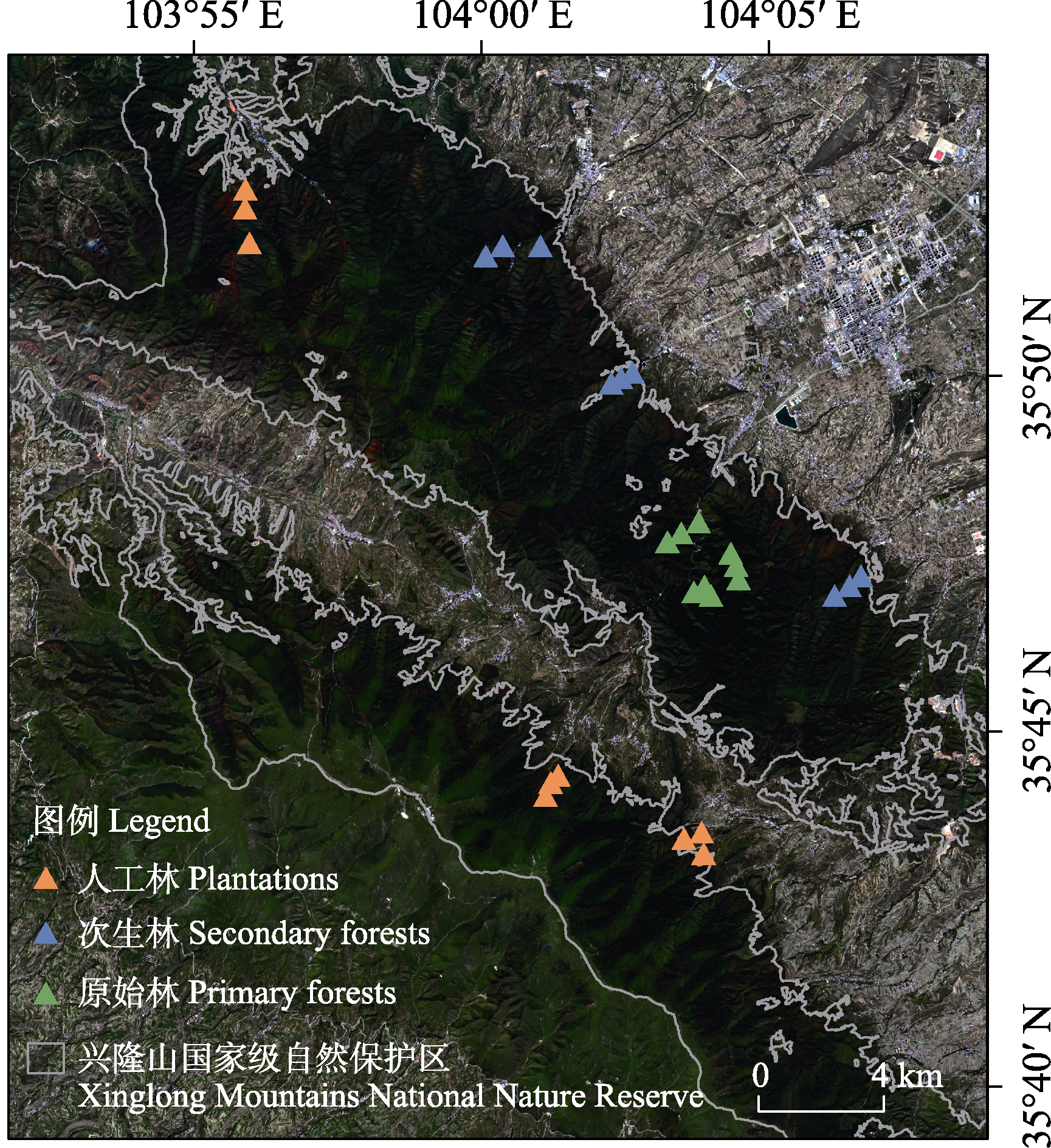
图1 甘肃兴隆山国家级自然保护区节肢动物研究样地分布
Fig. 1 Distribution of arthropod sampling plots in the Gansu Xinglongshan National Nature Reserve
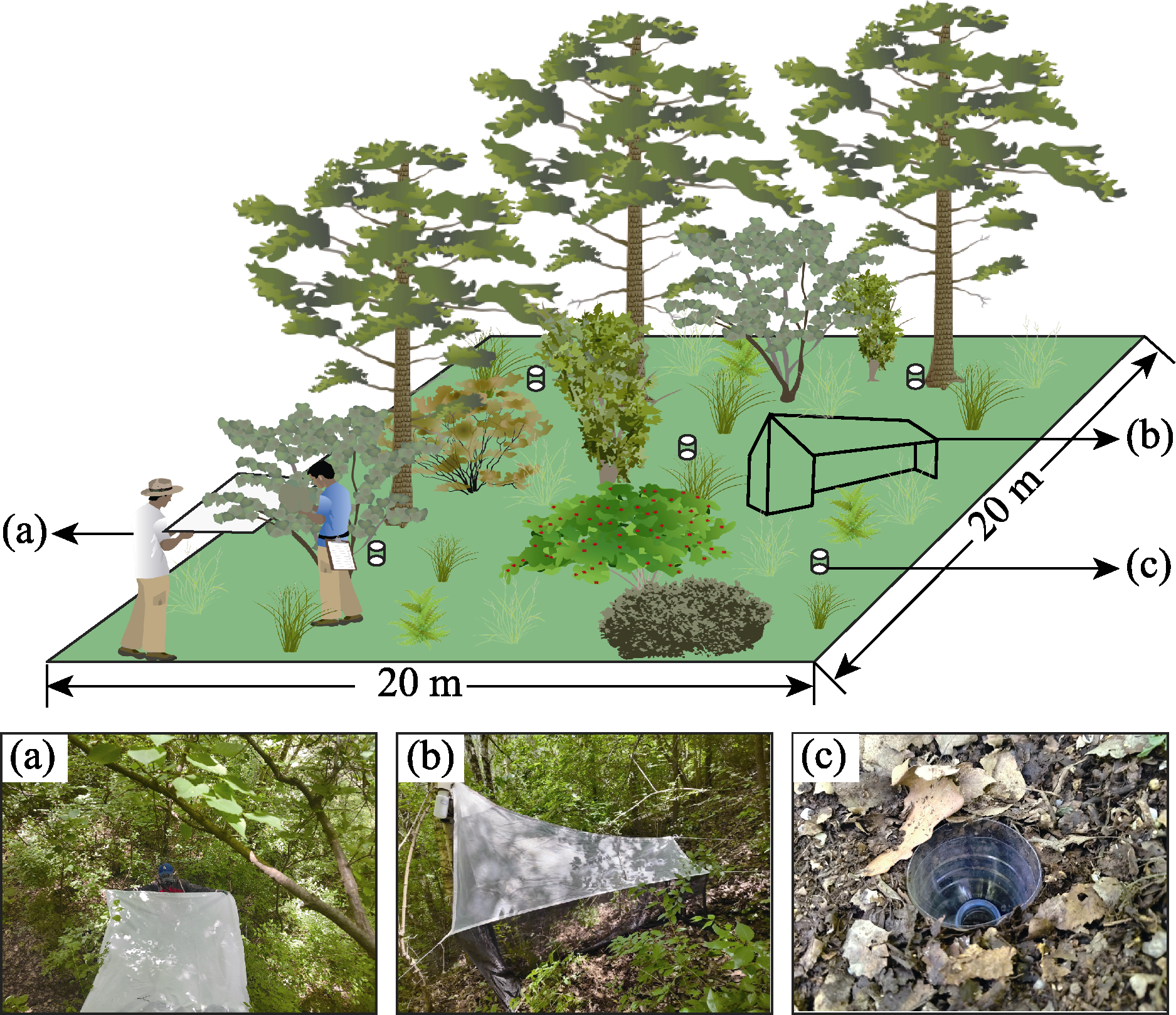
图2 3种节肢动物采集方法。(a)振击法; (b)马氏网法; (c)地面陷阱法。
Fig. 2 The three arthropod sampling methods. (a) Beating; (b) Malaise trap; (c) Pitfall trap.
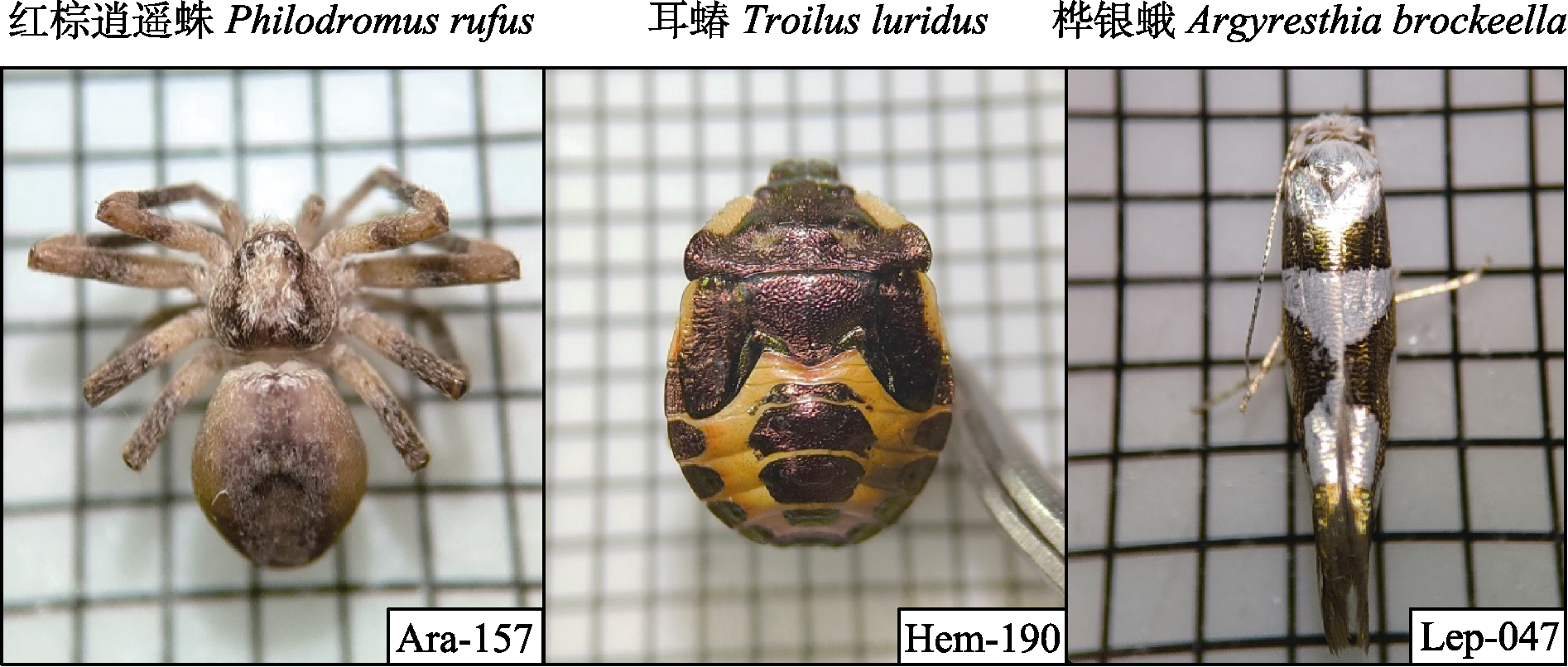
图3 采集的节肢动物标本照片示例
Fig. 3 Exemplar specimen images of collected arthropods
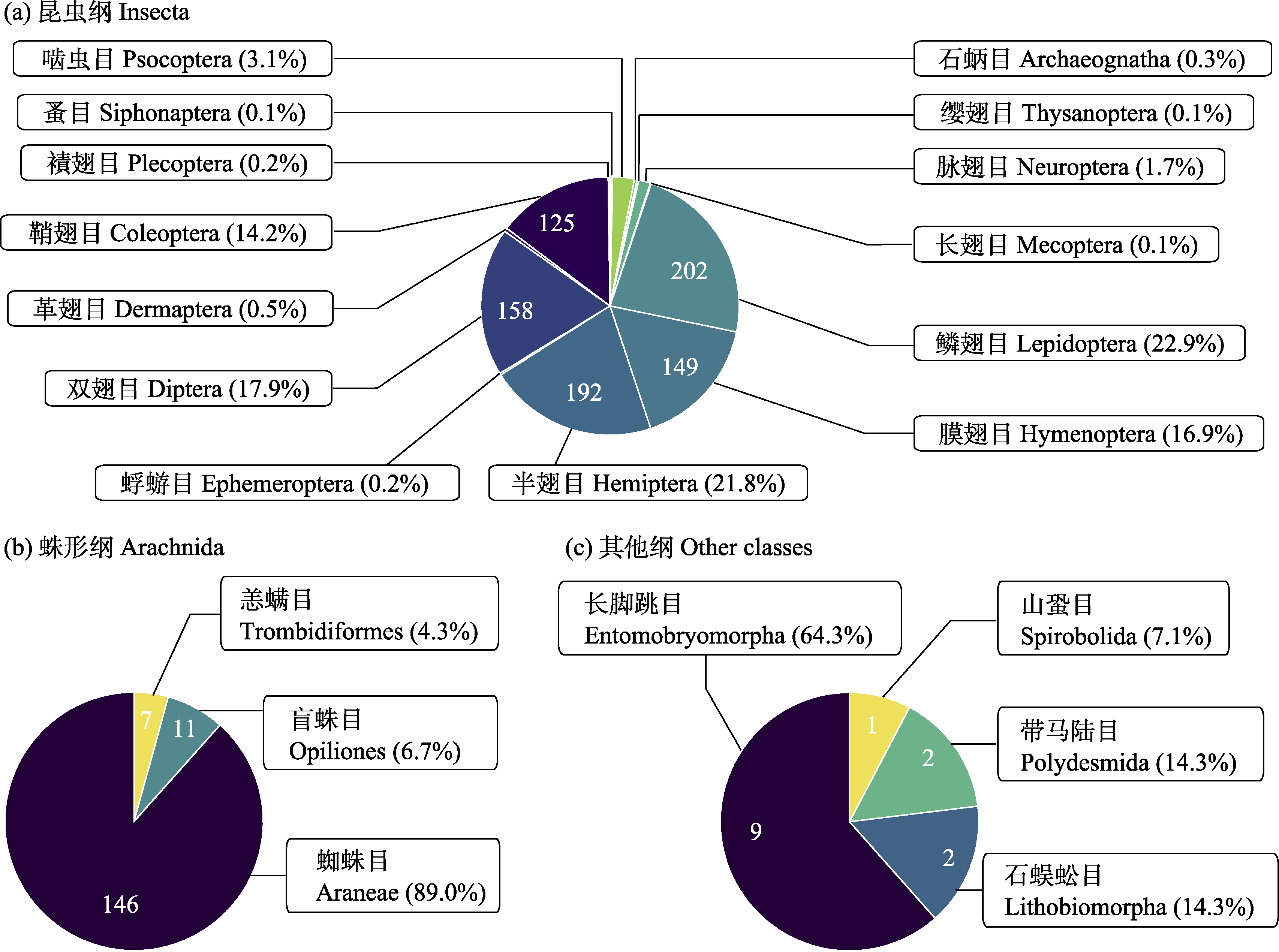
图4 昆虫纲(a)、蛛形纲(b)和其他纲(c)在目水平的物种组成
Fig. 4 Order-level species composition of Insecta (a), Arachnida (b) and other classes (c)
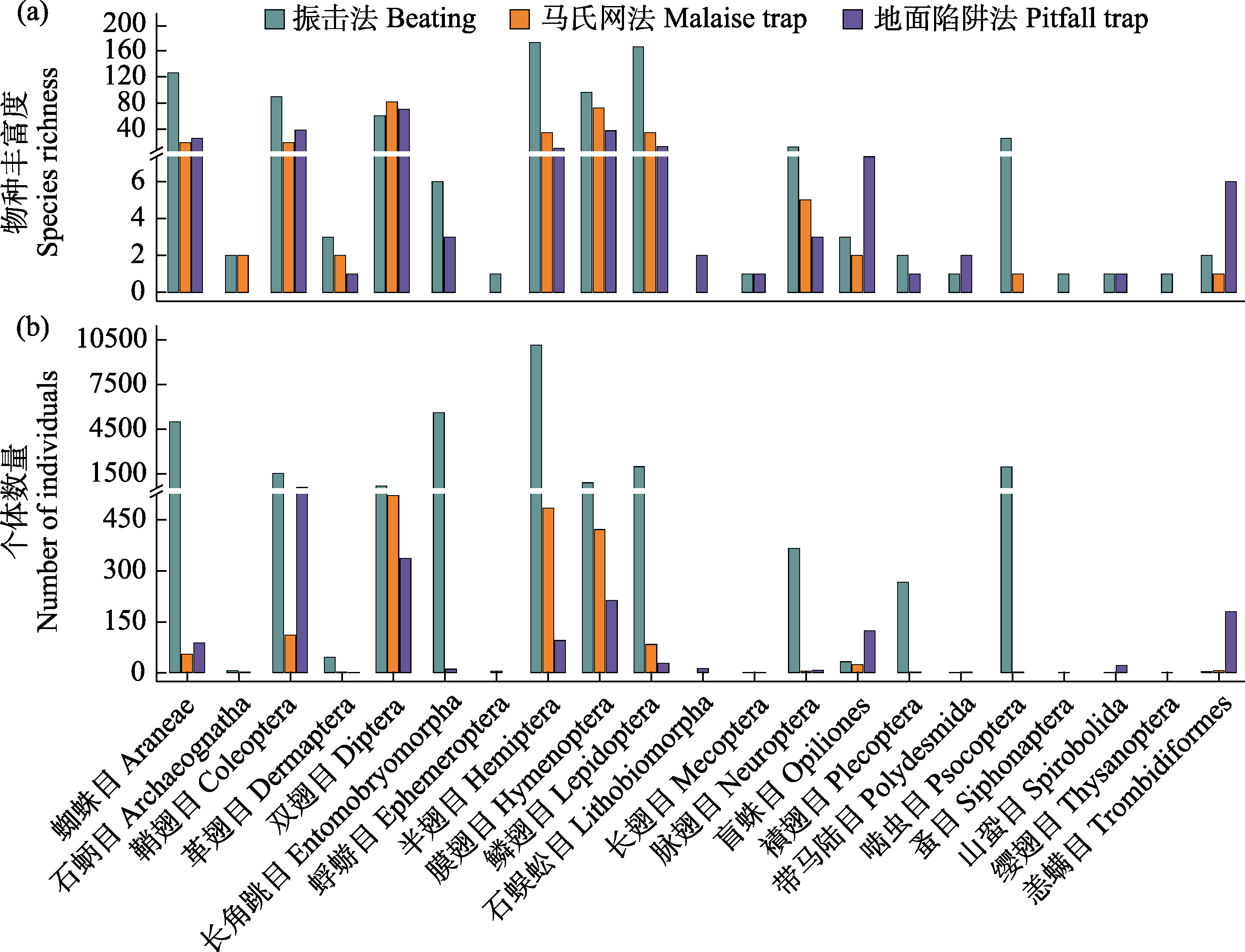
图5 不同采样方法在目水平的物种丰富度(a)和个体数量(b)比较
Fig. 5 Comparison of species richness (a) and number of individuals (b) at the order level collected by different sampling methods
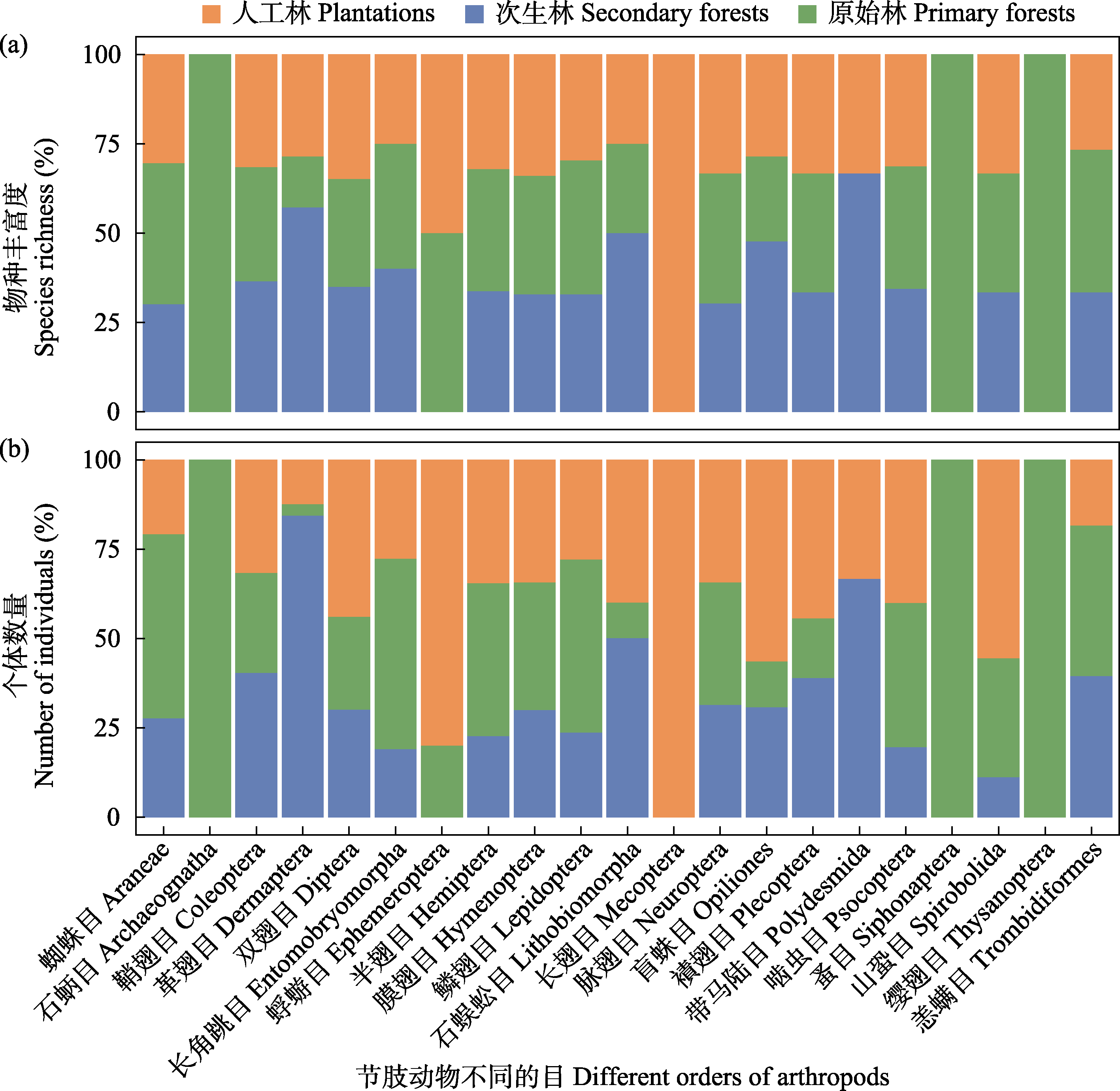
图6 目水平的物种丰富度(a)和个体数量(b)在不同森林类型中的占比
Fig. 6 Relative proportions of species richness (a) and number of individuals (b) at the order level across different forest types
| [1] |
Bastin JF, Finegold Y, Garcia C, Mollicone D, Rezende M, Routh D, Zohner CM, Crowther TW (2019) The global tree restoration potential. Science, 365, 76-79.
DOI URL |
| [2] |
Dai ZX, Chen GK, Zhang NL, Ma KP (2022) A dataset on the diversity of forest vascular epiphytes in China. Biodiversity Science, 30, 22332.(in Chinese with English abstract)
DOI |
|
[戴梓潇, 陈国科, 张乃莉, 马克平 (2022) 中国森林附生维管植物多样性数据集. 生物多样性, 30, 22332.]
DOI |
|
| [3] |
Eggleton P (2020) The state of the world’s insects. Annual Review of Environment and Resources, 45, 61-82.
DOI |
| [4] |
Folmer O, Black M, Hoeh W, Lutz R, Vrijenhoek R (1994) DNA primers for amplification of mitochondrial cytochrome c oxidase subunit I from diverse metazoan invertebrates. Molecular Marine Biology and Biotechnology, 3, 294-299.
PMID |
| [5] |
Han YJ, Liang YL, Tong YJ, Ding Q, Tian ZH, Li LL, Li XJ, Shen H, Zhu YC, Liu N, Wang XP, Bai M (2024) Dataset of beetle specimen images based on three passive acquisition methods in Mt. Helanshan, Ningxia. Biodiversity Science, 32, 24054.(in Chinese with English abstract)
DOI |
|
[韩永金, 梁咏亮, 佟一杰, 丁强, 田哲豪, 李露露, 李晓娟, 申昊, 朱亚超, 刘宁, 王新谱, 白明 (2024) 基于三种被动式采集方法采集的宁夏贺兰山甲虫标本照片数据集. 生物多样性, 32, 24054.]
DOI |
|
| [6] | Hebert PDN, Cywinska A, Ball SL, de Waard JR (2003) Biological identifications through DNA barcodes. Proceedings of the Royal Society B: Biological Sciences, 270, 313-321. |
| [7] |
Hua FY, Bruijnzeel LA, Meli P, Martin PA, Zhang J, Nakagawa S, Miao XR, Wang WY, McEvoy C, Peña-Arancibia JL, Brancalion PHS, Smith P, Edwards DP, Balmford A (2022) The biodiversity and ecosystem service contributions and trade-offs of forest restoration approaches. Science, 376, 839-844.
DOI URL |
| [8] |
Langor DW, Spence JR (2006) Arthropods as ecological indicators of sustainability in Canadian forests. The Forestry Chronicle, 82, 344-350.
DOI URL |
| [9] | Li Y, Schmid B, Schuldt A, Li S, Wang MQ, Fornoff F, Staab M, Guo PF, Anttonen P, Chesters D, Bruelheide H, Zhu CD, Ma KP, Liu XJ (2023) Multitrophic arthropod diversity mediates tree diversity effects on primary productivity. Nature Ecology & Evolution, 7, 832-840. |
| [10] |
Luo XY, Li Q, Huang XL (2023) DNA barcode reference dataset for flower-visiting insects in Daiyun Mountain National Nature Reserve. Biodiversity Science, 31, 23236.(in Chinese with English abstract)
DOI |
|
[罗小燕, 李强, 黄晓磊 (2023) 戴云山国家级自然保护区访花昆虫DNA条形码数据集. 生物多样性, 31, 23236 ]
DOI |
|
| [11] |
Potapov AM, Drescher J, Darras K, Wenzel A, Janotta N, Nazarreta R, Kasmiatun, Laurent V, Mawan A, Utari EH, Pollierer MM, Rembold K, Widyastuti R, Buchori D, Hidayat P, Turner E, Grass I, Westphal C, Tscharntke T, Scheu S (2024) Rainforest transformation reallocates energy from green to brown food webs. Nature, 627, 116-122.
DOI |
| [12] |
Ratnasingham S, Hebert PDN (2007) BOLD: The Barcode of Life Data System (http://www.barcodinglife.org). Molecular Ecology Notes, 7, 355-364.
DOI URL PMID |
| [13] |
Shang SQ, Wu XB, Wang ZL, Peng HN, Zhou HL, Zhang HY, Bai YL (2020) Butterfly community structure and species-abundance distribution in different habitats in the Xinglong Mountains National Nature Reserve. Biodiversity Science, 28, 983-992.(in Chinese with English abstract)
DOI URL |
| [尚素琴, 吴兴波, 王召龙, 彭鹤年, 周惠丽, 张红勇, 白映禄 (2020) 兴隆山国家级自然保护区不同生境的蝴蝶群落结构与种-多度分布. 生物多样性, 28, 983-992.] | |
| [14] |
van Klink R, Bowler DE, Gongalsky KB, Swengel AB, Gentile A, Chase JM (2020) Meta-analysis reveals declines in terrestrial but increases in freshwater insect abundances. Science, 368, 417-420.
DOI PMID |
| [15] |
Wang QJ, Zhang SY, Dong SF, Zhang GC, Yang J, Li R, Wang HQ (2020) Pest24: A large-scale very small object data set of agricultural pests for multi-target detection. Computers and Electronics in Agriculture, 175, 105585.
DOI URL |
| [16] | Wang XT (1996) Investigation and Research on the Resource Background of Xinglongshan National Nature Reserve in Gansu Province. Gansu Nationalities Publishing House, Lanzhou.(in Chinese) |
| [王香亭 (1996) 甘肃兴隆山国家级自然保护区资源本底调查研究. 甘肃民族出版社, 兰州.] | |
| [17] |
Wang XY, Hua FY, Wang L, Wilcove DS, Yu DW (2019) The biodiversity benefit of native forests and mixed-species plantations over monoculture plantations. Diversity and Distributions, 25, 1721-1735.
DOI URL |
| [18] |
Wang YP, Song YF, Zhong YX, Chen CW, Zhao YH, Zeng D, Wu YR, Ding P (2021) A dataset on the life-history and ecological traits of Chinese birds. Biodiversity Science, 29, 1149-1153.(in Chinese with English abstract)
DOI URL |
|
[王彦平, 宋云枫, 钟雨茜, 陈传武, 赵郁豪, 曾頔, 吴亦如, 丁平 (2021) 中国鸟类的生活史和生态学特征数据集. 生物多样性, 29, 1149-1153.]
DOI |
|
| [19] | Wu XP, Zhan C, Lai YK, Cheng MM, Yang JF (2019) IP102:A large-scale benchmark dataset for insect pest recognition. In: Proceedings of the IEEE/CVF Conference on Computer Vision and Pattern Recognition (CVPR), pp. 8779-8788. IEEE, Long Beach, CA. |
| [20] |
Zenker MM, Rougerie R, Teston JA, Laguerre M, Pie MR, Freitas AVL (2016) Fast census of moth diversity in the Neotropics: A comparison of field-assigned morphospecies and DNA barcoding in tiger moths. PLoS ONE, 11, e0148423.
DOI URL |
| [21] |
Zhang DX, Mao RR, Liu MX, Zhou Q, Wang YZ, Si XF, Zhao CM, Zhang LX (2024) Impacts of forest restoration on multifaceted bird diversity and community assembly in the Loess Plateau of China. Forest Ecology and Management, 573, 122350.
DOI URL |
| [1] | 巩中军, 李为争, 姚永生, 左旭琦, 武予清, 苗进. 农田土壤节肢动物eDNA在固-液-气三相中的分布特征[J]. 生物多样性, 2026, 34(7): 26146-. |
| [2] | 李菡, 何兴成, 张尚明玉, 曹一唯, 张家语, 彭可欣, 吴永杰. 横断山区鸟类名录[J]. 生物多样性, 2026, 34(7): 25375-. |
| [3] | 张洁, 路昊明, 陈佳杰, 陈江源, 毛宇帆, 胡骏熙, 张保卫. 中国软骨鱼类拉-英-汉-日物种名录及各海域多样性比较[J]. 生物多样性, 2026, 34(6): 25522-. |
| [4] | 张海龙, 聂海燕, 刘萌萌, 魏美才, 李泽建. 浙江乌岩岭叶蜂多样性分布及影响因素[J]. 生物多样性, 2026, 34(6): 25459-. |
| [5] | 章旭日, 罗标, 赵彤, 黄丹, 艾为明. 浙江鱼类多样性: 编目、分布与保护[J]. 生物多样性, 2026, 34(2): 25225-. |
| [6] | 刘思雨, 李春环, 潘玉梅, 赵秀海, 张春雨, 张乃莉. 温带森林不同演替阶段外生菌根树种优势对幼苗更新的影响[J]. 生物多样性, 2025, 33(9): 25268-. |
| [7] | 彭欣, 刘传, 黄晓磊. 基于GenBank数据库的真核生物遗传数据时空格局分析[J]. 生物多样性, 2025, 33(8): 25184-. |
| [8] | 王轶哲, 冯雨晨, 黄晓磊. 福建省蚜虫及其寄主植物多样性[J]. 生物多样性, 2025, 33(6): 25159-. |
| [9] | 陈啸, 马晓慧, 陈家丞, 姚鼎, 余欣奕, 宋文飞, 蒋忠冠, 苏时萍. 安徽省池州市主要通江支流鱼类物种更新名录[J]. 生物多样性, 2025, 33(12): 25182-. |
| [10] | 卢宸祺, 王剀, 于中斌, 吴云鹤, 郭宪光, 郭鹏, 车静. 中国青藏高原两栖、爬行动物多样性及其分布格局[J]. 生物多样性, 2025, 33(12): 25087-. |
| [11] | 靳川, 张子嘉, 底凯, 张卫荣, 乔栋, 程思源, 胡中民. 海南热带雨林植物光合荧光气体交换和叶功能性状数据集[J]. 生物多样性, 2024, 32(9): 24139-. |
| [12] | 何欣怡, 潘玉梅, 祝燕, 陈佳仪, 张思榕, 张乃莉. 暖温带森林外生菌根树种优势和植物多样性对土壤氮素周转的影响[J]. 生物多样性, 2024, 32(9): 24173-. |
| [13] | 韩佳楠, 苏杨, 李霏, 刘君妍, 赵依林, 李琳, 赵建成, 梁红柱, 李敏. 河北省苔藓植物多样性[J]. 生物多样性, 2024, 32(9): 24096-. |
| [14] | 程建伟, 徐满厚, 窦永静, 王亚东, 王桠楠, 刘新民, 李永宏. 内蒙古典型草原马粪分解过程中节肢动物群落的季节动态变化[J]. 生物多样性, 2024, 32(6): 24018-. |
| [15] | 陈慧妹, 李文军, 邱娟, 马占仓, 李波, 杨宗宗, 闻志彬, 孟岩, 曹秋梅, 邱东, 刘丹辉, 金光照. 新疆野生维管植物名录[J]. 生物多样性, 2023, 31(9): 23124-. |
| 阅读次数 | ||||||
|
全文 |
|
|||||
|
摘要 |
|
|||||
备案号:京ICP备16067583号-7
Copyright © 2026 版权所有 《生物多样性》编辑部
地址: 北京香山南辛村20号, 邮编:100093
电话: 010-62836137, 62836665 E-mail: biodiversity@ibcas.ac.cn
