

Biodiv Sci ›› 2026, Vol. 34 ›› Issue (4): 25438. DOI: 10.17520/biods.2025438 cstr: 32101.14.biods.2025438
• Bioinventory • Previous Articles Next Articles
Hao Liu1,2,3( ), Yuxiao Zhang4(), Bing Liu1,2,3(), Feifei Li5,6(), Hongzheng Ma7(), Haining Qin1,2,3, Dezhu Li8(), Wenli Chen1,2,3,*()(
 )
)
Received:2025-11-03
Accepted:2026-01-17
Online:2026-04-20
Published:2026-05-06
Contact:
*E-mail: chenwl@ibcas.ac.cn
Supported by:Hao Liu, Yuxiao Zhang, Bing Liu, Feifei Li, Hongzheng Ma, Haining Qin, Dezhu Li, Wenli Chen. Diversity and checklist of grasses (Poaceae) in China[J]. Biodiv Sci, 2026, 34(4): 25438.
| 主要支系 Major clades | 亚科 Subfamilies | 族 Tribes | 属 Genera | 物种 Species | |||
|---|---|---|---|---|---|---|---|
| N | A | N | A | N | A | ||
| Basal Clade | 原禾亚科 Pharoideae | 1 (1) | 0 | 1 (3) | 0 | 1 (12) | 0 |
| BOP | 稻亚科 Oryzoideae | 1 (4) | 2 | 5 (19) | 3 | 12 (117) | 5 |
| BOP | 竹亚科 Bambusoideae | 2 (3) | 2 | 46 (136) | 23 | 712 (1,698) | 66 |
| BOP | 早熟禾亚科 Pooideae | 12 (15) | 6 | 74 (219) | 37 | 746 (4,126) | 123 |
| PACMAD | 三芒草亚科 Aristidoideae | 1 (1) | 0 | 2 (3) | 0 | 12 (367) | 0 |
| PACMAD | 黍亚科 Panicoideae | 7 (14) | 4 | 68 (242) | 30 | 351 (3,325) | 93 |
| PACMAD | 芦竹亚科 Arundinoideae | 3 (3) | 1 | 4 (14) | 2 | 7 (36) | 2 |
| PACMAD | 澳禾亚科 Micrairoideae | 2 (3) | 1 | 4 (9) | 1 | 22 (192) | 1 |
| PACMAD | 扁芒草亚科 Danthonioideae | 1 (1) | 1 | 2 (19) | 2 | 4 (292) | 2 |
| PACMAD | 虎尾草亚科 Chloridoideae | 4 (5) | 3 | 26 (121) | 11 | 111 (1,603) | 34 |
| 合计 Total | 34 (54) | 20 | 232 (789) | 109 | 1,978 (11,783) | 326 | |
| 去重统计 Unique count | 10 | 37 | 283 | 2,304 | |||
Table 1 The diversity composition of Poaceae in China
| 主要支系 Major clades | 亚科 Subfamilies | 族 Tribes | 属 Genera | 物种 Species | |||
|---|---|---|---|---|---|---|---|
| N | A | N | A | N | A | ||
| Basal Clade | 原禾亚科 Pharoideae | 1 (1) | 0 | 1 (3) | 0 | 1 (12) | 0 |
| BOP | 稻亚科 Oryzoideae | 1 (4) | 2 | 5 (19) | 3 | 12 (117) | 5 |
| BOP | 竹亚科 Bambusoideae | 2 (3) | 2 | 46 (136) | 23 | 712 (1,698) | 66 |
| BOP | 早熟禾亚科 Pooideae | 12 (15) | 6 | 74 (219) | 37 | 746 (4,126) | 123 |
| PACMAD | 三芒草亚科 Aristidoideae | 1 (1) | 0 | 2 (3) | 0 | 12 (367) | 0 |
| PACMAD | 黍亚科 Panicoideae | 7 (14) | 4 | 68 (242) | 30 | 351 (3,325) | 93 |
| PACMAD | 芦竹亚科 Arundinoideae | 3 (3) | 1 | 4 (14) | 2 | 7 (36) | 2 |
| PACMAD | 澳禾亚科 Micrairoideae | 2 (3) | 1 | 4 (9) | 1 | 22 (192) | 1 |
| PACMAD | 扁芒草亚科 Danthonioideae | 1 (1) | 1 | 2 (19) | 2 | 4 (292) | 2 |
| PACMAD | 虎尾草亚科 Chloridoideae | 4 (5) | 3 | 26 (121) | 11 | 111 (1,603) | 34 |
| 合计 Total | 34 (54) | 20 | 232 (789) | 109 | 1,978 (11,783) | 326 | |
| 去重统计 Unique count | 10 | 37 | 283 | 2,304 | |||
| 族 Tribes | 物种数 No. of species | % | 属 Genera | 物种数 No. of species | % |
|---|---|---|---|---|---|
| 1. 北美箭竹族 Arundinarieae | 511 | 25.8 | 1. 簕竹属 Bambusa | 99 | 5.0 |
| 2. 早熟禾族 Poeae | 367 | 18.6 | 2. 披碱草属 Elymus | 96 | 4.9 |
| 3. 高粱族 Andropogoneae | 201 | 10.2 | 3. 箭竹属 Fargesia | 94 | 4.8 |
| 4. 簕竹族 Bambuseae | 201 | 10.2 | 4. 玉山竹属 Yushania | 91 | 4.6 |
| 5. 小麦族 Triticeae | 185 | 9.4 | 5. 早熟禾属 Poa | 82 | 4.1 |
| 6. 黍族 Paniceae | 109 | 5.5 | 6. 刚竹属 Phyllostachys | 63 | 3.2 |
| 7. 针茅族 Stipeae | 88 | 4.4 | 7. 碱茅属 Puccinellia | 55 | 2.8 |
| 8. 狗牙根族 Cynodonteae | 57 | 2.9 | 8. 羊茅属 Festuca | 55 | 2.8 |
| 9. 雀麦族 Bromeae | 51 | 2.6 | 9. 雀麦属 Bromus | 51 | 2.6 |
| 10. 画眉草族 Eragrostideae | 36 | 1.8 | 10. 方竹属 Chimonobambusa | 48 | 2.4 |
| 合计 Total | 1,806 | 91.4 | 合计 Total | 734 | 37.2 |
Table 2 Top 10 tribes and genera by number of native Poaceae species in China
| 族 Tribes | 物种数 No. of species | % | 属 Genera | 物种数 No. of species | % |
|---|---|---|---|---|---|
| 1. 北美箭竹族 Arundinarieae | 511 | 25.8 | 1. 簕竹属 Bambusa | 99 | 5.0 |
| 2. 早熟禾族 Poeae | 367 | 18.6 | 2. 披碱草属 Elymus | 96 | 4.9 |
| 3. 高粱族 Andropogoneae | 201 | 10.2 | 3. 箭竹属 Fargesia | 94 | 4.8 |
| 4. 簕竹族 Bambuseae | 201 | 10.2 | 4. 玉山竹属 Yushania | 91 | 4.6 |
| 5. 小麦族 Triticeae | 185 | 9.4 | 5. 早熟禾属 Poa | 82 | 4.1 |
| 6. 黍族 Paniceae | 109 | 5.5 | 6. 刚竹属 Phyllostachys | 63 | 3.2 |
| 7. 针茅族 Stipeae | 88 | 4.4 | 7. 碱茅属 Puccinellia | 55 | 2.8 |
| 8. 狗牙根族 Cynodonteae | 57 | 2.9 | 8. 羊茅属 Festuca | 55 | 2.8 |
| 9. 雀麦族 Bromeae | 51 | 2.6 | 9. 雀麦属 Bromus | 51 | 2.6 |
| 10. 画眉草族 Eragrostideae | 36 | 1.8 | 10. 方竹属 Chimonobambusa | 48 | 2.4 |
| 合计 Total | 1,806 | 91.4 | 合计 Total | 734 | 37.2 |
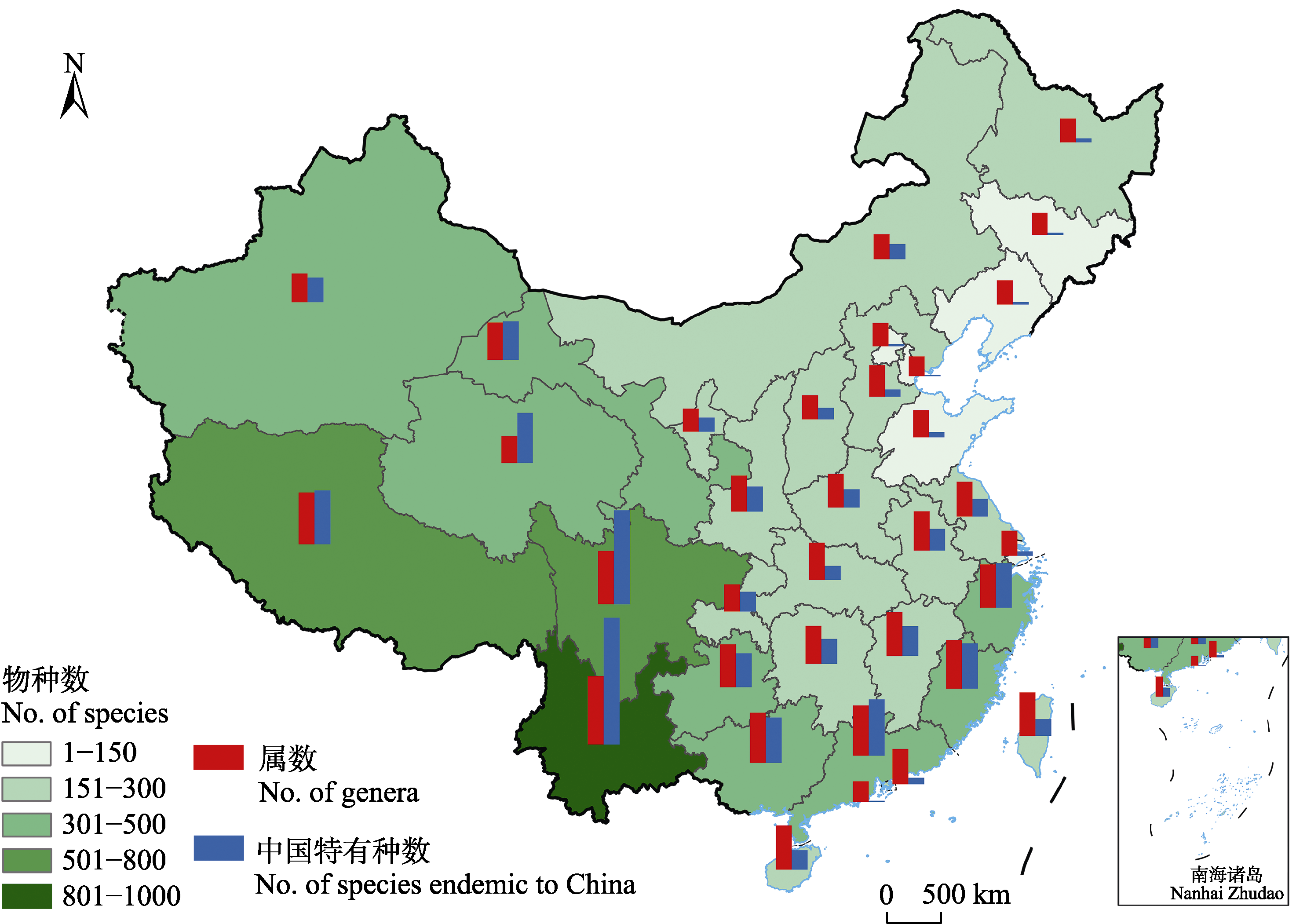
Fig. 1 Diversity patterns of native Poaceae genera and species in China
| 本文 This study | FOC Vol. 22 | 参考文献 References | |||
|---|---|---|---|---|---|
| 新属 New genera | |||||
| 1. 异燕麦属 Helictochloa* | 隶属于山燕麦属 Genus previously included in Helictotrichon | Romero-Zarco, | |||
| 2. 痕花黍属 Hildaea | 隶属于距花黍属 Genus previously included in Ichnanthus | Silva et al., | |||
| 3. 纪如竹属 Hsuehochloa* | 隶属于悬竹属 Genus previously included in Ampelocalamus | Zhang et al., | |||
| 4. 以礼竹属 Kengiochloa* | 隶属于矢竹属 Genus previously included in Pseudosasa | Tong et al., | |||
| 5. 新芨芨草属(新拟) Neotrinia* | 隶属于芨芨草属 Genus previously included in Achnatherum | Nobis et al., | |||
| 6. 雷文竹属 Ravenochloa* | 隶属于箬竹属 Genus previously included in Indocalamus | Zhang et al., | |||
| 7. 三毛草属 Sibirotrisetum* | 隶属于穗三毛草属 Genus previously included in Trisetum | Barberá et al., | |||
| 8. 华赤竹属 Sinosasa* | 隶属于赤竹属 Genus previously included in Sasa | Qin et al., | |||
| 9. 头梨竹属 Stapletonia | 新属 New genus | Dash et al., | |||
| 10. 坚丛草属(新拟) Tenaxia | 隶属于扁芒草属 Genus previously included in Danthonia | Linder et al., | |||
| 11. 棉花竹属 Tongpeia* | 隶属于箭竹属 Genus previously included in Fargesia | Stapleton, | |||
| 12. 斑茅属(新拟) Tripidium | 隶属于甘蔗属 Genus previously included in Saccharum | Valdés & Scholz, | |||
| 13. 绿燕麦属(新拟) Trisetopsis | 隶属于山燕麦属 Genus previously included in Helictotrichon | Wölk & Röser, | |||
| 14. 茨燕麦属(新拟) Tzveleviochloa | 隶属于山燕麦属 Genus previously included in Helictotrichon | Wölk & Röser, | |||
| 15. 高异燕麦属 ×Trisetopsotrichon | 隶属于山燕麦属 Genus previously included in Helictotrichon | Wölk & Röser, | |||
| 恢复属 Resurrected genera | |||||
| 1. 类早熟禾属 Arctopoa* | 隶属于早熟禾属 Genus previously included in Poa | Soreng et al., | |||
| 2. 曲芒发草属 Avenella | 隶属于发草属 Genus previously included in Deschampsia | Soreng et al., | |||
| 3. 巴山木竹属 Bashania* | 隶属于北美箭竹属 Genus previously included in Arundinaria | Vorontsova et al., | |||
| 4. 短穗竹属 Brachystachyum | 隶属于业平竹属 Genus previously included in Semiarundinaria | Zhang et al., | |||
| 5. 小沿沟草属 Catabrosella | 隶属于拟沿沟草属 Genus previously included in Colpodium | Soreng et al., | |||
| 6. 肿节竹属 Clavinodum | 隶属于少穗竹属 Genus previously included in Oligostachyum | Niu et al., | |||
| 7. 假拟沿沟草 Paracolpodium | 隶属于拟沿沟草属 Genus previously included in Colpodium | Soreng et al., | |||
| 8. 茅针属 Patis* | 隶属于芨芨草属 Genus previously included in Achnatherum | Romaschenko et al., | |||
| 9. 冷箭竹属 Sarocalamus | 隶属于北美箭竹属 Genus previously included in Arundinaria | Vorontsova et al., | |||
| 10. 华箬竹属 Sasamorpha | 隶属于箬竹属 Genus previously included in Indocalamus | Vorontsova et al., | |||
| 归并属 Merged genera | |||||
| 1. 凤头黍属 Acroceras (=Setiacis*) | 刺毛头黍属 Setiacis | Soreng et al., | |||
| 2. 蒺藜草属 Cenchrus* (=Pennisetum*) | 狼尾草属 Pennisetum | Chemisquy et al., | |||
| 3. 鼠尾粟属 Sporobolus* (=Crypsis) | 隐花草属 Crypsis | Peterson et al., | |||
| 4. 尾稃草属 Urochloa* (=Brachiaria*) | 臂形草属 Brachiaria | Soreng et al., | |||
| 新记录属 Newly recorded genera | |||||
| 1. 穗燕麦属(新拟) Acrospelion | 新组合 New combination | Barberá et al., | |||
| 2. 多枝竹属 Holttumochloa* | 新物种 New species | Zhou et al., | |||
| 3. 五须芒属 Pentapogon | 新组合 New combination | Peterson et al., | |||
| 4. 雅竹属 Temochloa* | 新物种 New species | Cai et al. | |||
Table 3 Generic-level taxonomic changes in different native genera of Poaceae in China compared with Flora of China (FOC) Vol. 22 (Chen et al., 2006) and China Checklist of Higher Plants in the Catalogue of Life China 2025 Annual Checklist (Liu et al., 2025)
| 本文 This study | FOC Vol. 22 | 参考文献 References | |||
|---|---|---|---|---|---|
| 新属 New genera | |||||
| 1. 异燕麦属 Helictochloa* | 隶属于山燕麦属 Genus previously included in Helictotrichon | Romero-Zarco, | |||
| 2. 痕花黍属 Hildaea | 隶属于距花黍属 Genus previously included in Ichnanthus | Silva et al., | |||
| 3. 纪如竹属 Hsuehochloa* | 隶属于悬竹属 Genus previously included in Ampelocalamus | Zhang et al., | |||
| 4. 以礼竹属 Kengiochloa* | 隶属于矢竹属 Genus previously included in Pseudosasa | Tong et al., | |||
| 5. 新芨芨草属(新拟) Neotrinia* | 隶属于芨芨草属 Genus previously included in Achnatherum | Nobis et al., | |||
| 6. 雷文竹属 Ravenochloa* | 隶属于箬竹属 Genus previously included in Indocalamus | Zhang et al., | |||
| 7. 三毛草属 Sibirotrisetum* | 隶属于穗三毛草属 Genus previously included in Trisetum | Barberá et al., | |||
| 8. 华赤竹属 Sinosasa* | 隶属于赤竹属 Genus previously included in Sasa | Qin et al., | |||
| 9. 头梨竹属 Stapletonia | 新属 New genus | Dash et al., | |||
| 10. 坚丛草属(新拟) Tenaxia | 隶属于扁芒草属 Genus previously included in Danthonia | Linder et al., | |||
| 11. 棉花竹属 Tongpeia* | 隶属于箭竹属 Genus previously included in Fargesia | Stapleton, | |||
| 12. 斑茅属(新拟) Tripidium | 隶属于甘蔗属 Genus previously included in Saccharum | Valdés & Scholz, | |||
| 13. 绿燕麦属(新拟) Trisetopsis | 隶属于山燕麦属 Genus previously included in Helictotrichon | Wölk & Röser, | |||
| 14. 茨燕麦属(新拟) Tzveleviochloa | 隶属于山燕麦属 Genus previously included in Helictotrichon | Wölk & Röser, | |||
| 15. 高异燕麦属 ×Trisetopsotrichon | 隶属于山燕麦属 Genus previously included in Helictotrichon | Wölk & Röser, | |||
| 恢复属 Resurrected genera | |||||
| 1. 类早熟禾属 Arctopoa* | 隶属于早熟禾属 Genus previously included in Poa | Soreng et al., | |||
| 2. 曲芒发草属 Avenella | 隶属于发草属 Genus previously included in Deschampsia | Soreng et al., | |||
| 3. 巴山木竹属 Bashania* | 隶属于北美箭竹属 Genus previously included in Arundinaria | Vorontsova et al., | |||
| 4. 短穗竹属 Brachystachyum | 隶属于业平竹属 Genus previously included in Semiarundinaria | Zhang et al., | |||
| 5. 小沿沟草属 Catabrosella | 隶属于拟沿沟草属 Genus previously included in Colpodium | Soreng et al., | |||
| 6. 肿节竹属 Clavinodum | 隶属于少穗竹属 Genus previously included in Oligostachyum | Niu et al., | |||
| 7. 假拟沿沟草 Paracolpodium | 隶属于拟沿沟草属 Genus previously included in Colpodium | Soreng et al., | |||
| 8. 茅针属 Patis* | 隶属于芨芨草属 Genus previously included in Achnatherum | Romaschenko et al., | |||
| 9. 冷箭竹属 Sarocalamus | 隶属于北美箭竹属 Genus previously included in Arundinaria | Vorontsova et al., | |||
| 10. 华箬竹属 Sasamorpha | 隶属于箬竹属 Genus previously included in Indocalamus | Vorontsova et al., | |||
| 归并属 Merged genera | |||||
| 1. 凤头黍属 Acroceras (=Setiacis*) | 刺毛头黍属 Setiacis | Soreng et al., | |||
| 2. 蒺藜草属 Cenchrus* (=Pennisetum*) | 狼尾草属 Pennisetum | Chemisquy et al., | |||
| 3. 鼠尾粟属 Sporobolus* (=Crypsis) | 隐花草属 Crypsis | Peterson et al., | |||
| 4. 尾稃草属 Urochloa* (=Brachiaria*) | 臂形草属 Brachiaria | Soreng et al., | |||
| 新记录属 Newly recorded genera | |||||
| 1. 穗燕麦属(新拟) Acrospelion | 新组合 New combination | Barberá et al., | |||
| 2. 多枝竹属 Holttumochloa* | 新物种 New species | Zhou et al., | |||
| 3. 五须芒属 Pentapogon | 新组合 New combination | Peterson et al., | |||
| 4. 雅竹属 Temochloa* | 新物种 New species | Cai et al. | |||
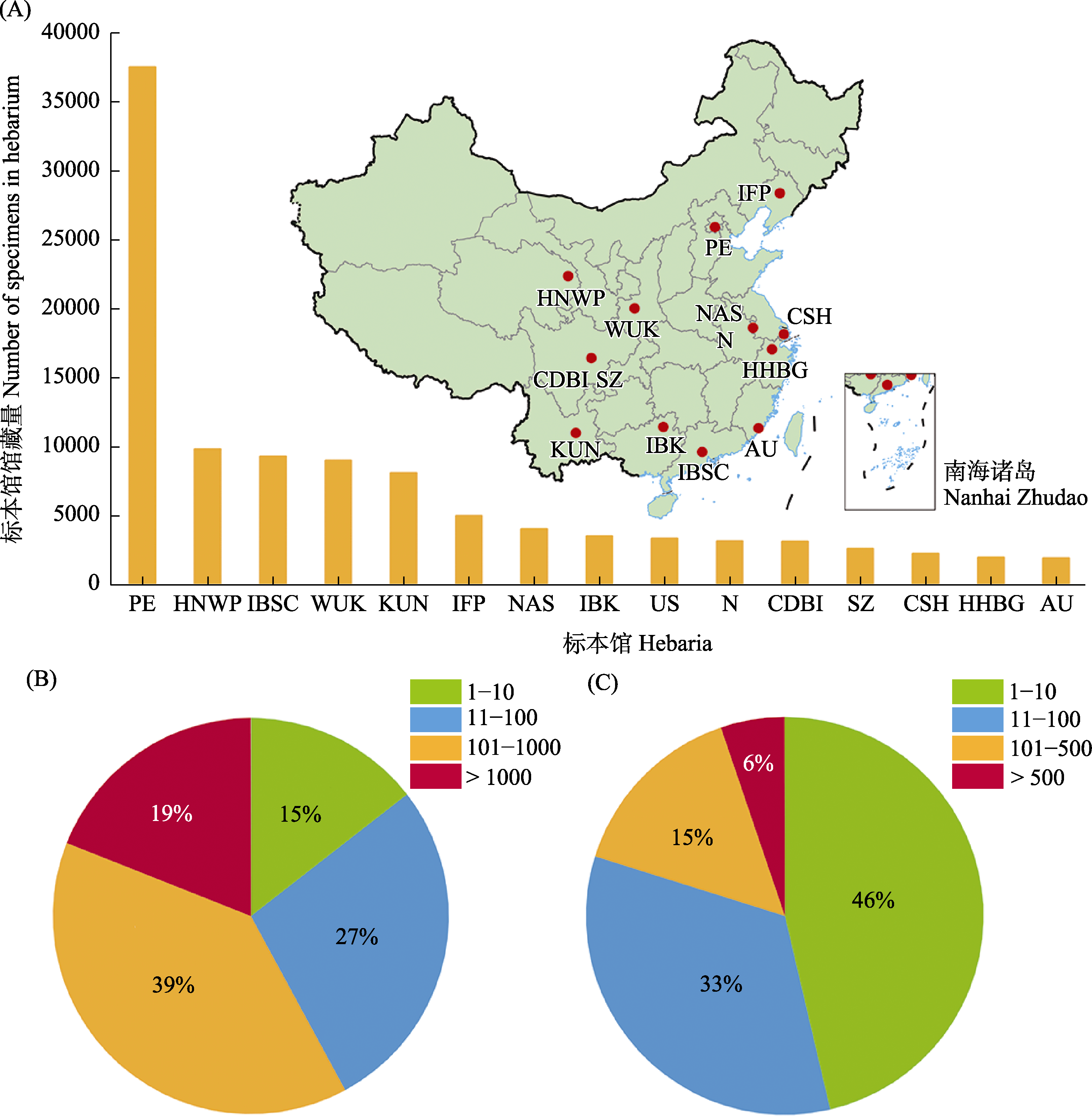
Fig. 2 Statistics of herbarium holdings and specimen collection for Poaceae in China. (A) Holdings of the top 15 herbaria by specimen count (herbarium information is listed in Appendix 4); (B) Collection numbers at the generic level; (C) Collection numbers at the species level.
| [1] |
Barberá P, Soreng RJ, Peterson PM, Romaschenko K, Quintanar A, Aedo C (2020) Molecular phylogenetic analysis resolves Trisetum (Poaceae: Pooideae: Koeleriinae) polyphyletic: Evidence for a new genus, Sibirotrisetum and resurrection of Acrospelion. Journal of Systematics and Evolution, 58, 517-526.
DOI URL |
| [2] |
Barberá P, Soreng RJ, Peterson PM, Garcia-Porta J Romaschenko K, Aedo C, Quintanar A (2025) Phylogenetics and reticulation among koelerioid clades, part I: Contraction of Trisetum, expansion of Acrospelion, Graphephorum, and Tzveleviochloa; Graciliotrisetum gen. nov. and resurrection of Aegialina (Poaceae, Pooideae, Poeae, Aveninae). Journal of Systematics and Evolution, 63, 629-655.
DOI URL |
| [3] |
Bouchenak-Khelladi Y, Verboom GA, Savolainen V, Hodkinson TR (2010) Biogeography of the grasses (Poaceae): A phylogenetic approach to reveal evolutionary history in geographical space and geological time. Botanical Journal of the Linnean Society, 162, 543-557.
DOI URL |
| [4] |
Cai ZY, Zhang YY, Tong YH, Vu TC, Xia NH (2024) Temochloa (Poaceae, Bambusoideae), a newly-recorded bamboo genus for China and Vietnam, with new taxa and a re-interpretation of flowering structures. PhytoKeys, 246, 229-236.
DOI URL |
| [5] |
Chemisquy MA, Giussani LM, Scataglini MA, Kellogg EA, Morrone O (2010) Phylogenetic studies favour the unification of Pennisetum, Cenchrus and Odontelytrum (Poaceae): A combined nuclear, plastid and morphological analysis, and nomenclatural combinations in Cenchrus. Annals of Botany, 106, 107-130.
DOI PMID |
| [6] |
Chen K, Liu YC, Huang Y, Wu XK, Ma HY, Peng H, Li DZ, Ma PF (2025) Reassessing the phylogenetic relationships of Pseudosorghum and Saccharinae (Poaceae) using plastome and nuclear ribosomal sequences. Plant Diversity, 47, 382-393.
DOI |
| [7] | Chen SL, Li DZ, Zhu GH, Wu ZL, Lu SL, Liu L, Wang ZP, Sun BX, Zhu ZD, Xia NH, Jia LZ, Guo ZH, Chen WL, Chen X, Yang GY, Phillips SM, Stapleton C, Soreng RJ, Aiken SG, Tzvelev NN, Peterson PM, Renvoize SA, Olonova MV, Ammann KH (2006) Poaceae. In: Flora of China, Vol. 22 (eds Wu ZY, Raven PH, Hong DY), pp. 1-651. Science Press, Beijing & Missouri Botanical Garden Press, St. Louis. |
| [8] | Chen WL, Liu YC, Li DZ, Zhang YX, Liu QX, Li LL, Zhou W, Wu BC, Chu XF (2018) Poaceae. In: A Dictionary of the Families and Genera of Chinese Vascular Plants (eds Li DZ, Chen ZD, Wang H, Lu AM), pp. 4-602. Science Press, Beijing.(in Chinese) |
| [陈文俐, 刘艳春, 李德铢, 张玉霄, 刘启新, 李灵露, 周伟, 吴宝成, 褚晓芳 (2018) 禾本科. 见: 中国维管植物科属词典(李德铢, 陈之端, 王红, 路安民编著), 4-602页. 科学出版社, 北京.] | |
| [9] | Chen WL, Liu YC, Li DZ, Zhang YX, Liu QX, Li LL, Zhou W, Wu BC, Chu XF (2020) Poaceae. In: The Families and Genera of Chinese Vascular Plants., Vol. 1 (eds Li DZ, Chen ZD, Wang H, Lu AM, Luo Y, Yu WB), pp. 584-726. Science Press, Beijing.(in Chinese) |
| [陈文俐, 刘艳春, 李德铢, 张玉霄, 刘启新, 李灵露, 周伟, 吴宝成, 褚晓芳 (2020) 禾本科. 见: 中国维管植物科属志(上卷) (李德铢, 陈之端, 王红, 路安民, 骆洋, 郁文彬编著), 584-726页. 科学出版社, 北京.] | |
| [10] | Dash SS, Kumari P, Singh P (2009) Notes on flowering in Schizostachyum arunachalensis H. B. Naithani (Poaceae: Bambusoideae). Nelumbo, 51, 241-244. |
| [11] | Delecti Florae Reipublicae Popularis Sinicae Agendae Academiae Sinicae (1959-2004) Flora Reipublicae Popularis Sinicae, Tomus 1-80. Science Press, Beijing.(in Chinese) |
| [中国植物志编辑委员会 (1959-2004) 中国植物志(第1-80卷). 科学出版社, 北京.] | |
| [12] |
Du C, Liu J, Ye W, Liao S (2022) 2021 annual report on new taxa and nomenclatural changes of Chinese plants. Biodiversity Science, 30, 22207.(in Chinese with English abstract)
DOI |
| [杜诚, 刘军, 叶文, 廖帅 (2022) 中国植物新分类群、新名称变化2021年年度报告. 生物多样性, 30, 22207.] | |
| [13] |
Du C, Liu J, Ye W, Liao S (2023) 2022 annual report on new taxa and nomenclatural changes of Chinese plants. Biodiversity Science, 31, 23244.(in Chinese with English abstract)
DOI |
| [杜诚, 刘军, 叶文, 廖帅 (2023) 中国植物新分类群、新名称变化2022年度报告. 生物多样性, 31, 23244.] | |
| [14] |
Du C, Liu J, Ye W, Liao S (2024) 2023 annual report on new taxa and nomenclatural changes for Chinese plants. Biodiversity Science, 32, 24253.(in Chinese with English abstract)
DOI |
| [杜诚, 刘军, 叶文, 廖帅 (2024) 中国植物新分类群、新名称变化2023年度报告. 生物多样性, 32, 24253.] | |
| [15] |
Du C, Liu J, Ye W, Liao S, Ge BJ, Liu B, Ma JS (2021) Annual report of new taxa and new names for Chinese plants in 2020. Biodiversity Science, 29, 1011-1020.(in Chinese with English abstract)
DOI URL |
| [杜诚, 刘军, 叶文, 廖帅, 葛斌杰, 刘冰, 马金双 (2021) 中国植物新分类群、新名称2020年度报告. 生物多样性, 29, 1011-1020.] | |
| [16] |
Edwards EJ, Osborne CP, Strömberg CAE, Smith SA, C4 Grasses Consortium, Bond WJ, Christin PA, Cousins AB, Duvall MR, Fox DL, Freckleton RP, Ghannoum O, Hartwell J, Huang YS, Janis CM, Keeley JE, Kellogg EA, Knapp AK, Leakey ADB, Nelson DM, Saarela JM, Sage RF, Sala OE, Salamin N, Still CJ, Tipple B(2010) The origins of C4 grasslands: Integrating evolutionary and ecosystem science. Science, 328, 587-591.
DOI PMID |
| [17] |
Elliott TL, Spalink D, Larridon I, Zuntini AR, Escudero M, Hackel J, Barrett RL, Martín-Bravo S, Márquez-Corro JI, Granados Mendoza C, Mashau AC, Romero-Soler KJ, Zhigila DA, Gehrke B, Andrino CO, Crayn DM, Vorontsova MS, Forest F, Baker WJ, Wilson KL, Simpson DA, Muasya AM (2024) Global analysis of Poales diversification-parallel evolution in space and time into open and closed habitats. New Phytologist, 242, 727-743.
DOI URL |
| [18] |
Gallaher TJ, Adams DC, Attigala L, Burke SV, Craine JM, Duvall MR, Klahs PC, Sherratt E, Wysocki WP, Clark LG (2019) Leaf shape and size track habitat transitions across forest-grassland boundaries in the grass family (Poaceae). Evolution, 73, 927-946.
DOI PMID |
| [19] |
Gallaher TJ Peterson, PM, Soreng RJ, Zuloaga FO, Li DZ, Clark LG, Tyrrell CD, Welker CAD, Kellogg EA, Teisher JK (2022) Grasses through space and time: An overview of the biogeographical and macroevolutionary history of Poaceae. Journal of Systematics and Evolution, 60, 522-569.
DOI |
| [20] |
GPWG (Grass Phylogeny Working Group) 2001) Phylogeny and subfamilial classification of the grasses (Poaceae). Annals of the Missouri Botanical Garden, 88, 373-457.
DOI URL |
| [21] |
GPWG (Grass Phylogeny Working Group) II (2012) New grass phylogeny resolves deep evolutionary relationships and discovers C4 origins. New Phytologist, 193, 304-312.
DOI URL |
| [22] |
GPWG (Grass Phylogeny Working Group) III (2025) A nuclear phylogenomic tree of grasses (Poaceae) recovers current classification despite gene tree incongruence. New Phytologist, 245, 818-834.
DOI PMID |
| [23] |
Haevermans T, Mantuano D, Zhou MY, Lamxay V, Haevermans A, Blanc P, Li DZ (2020) Discovery of the first succulent bamboo (Poaceae, Bambusoideae) in a new genus from Laos’ karst areas, with a unique adaptation to seasonal drought. PhytoKeys, 156, 125-137.
DOI PMID |
| [24] |
Han YX, Wang R, Hao LF, Yuan HB, Lin KJ (2024) The geographic distribution pattern and factors influencing the spread in China of the invasive alien plant Cenchrus longispinus. Acta Prataculturae Sinica, 33(12), 34-44.(in Chinese with English abstract)
DOI |
|
[韩雨轩, 王瑞, 郝丽芬, 袁海滨, 林克剑 (2024) 外来入侵植物长刺蒺藜草在我国的地理分布格局及其影响因素. 草业学报, 33(12), 34-44.]
DOI |
|
| [25] |
Hao Q, Ma JS (2023) Invasive alien plants in China: An update. Plant Diversity, 45, 117-121.
DOI |
| [26] |
He JY, Yang WJ, You QH, Hu QW, Cong MY, Tian C, Ma KP (2025) Impacts of road networks on the geography of floristic collections in China. Plant Diversity, 47, 403-414.
DOI |
| [27] |
Huang WC, Zhang L, Columbus JT, Hu Y, Zhao YY, Tang L, Guo ZH, Chen WL, McKain M, Bartlett M, Huang CH, Li DZ, Ge S, Ma H (2022) A well-supported nuclear phylogeny of Poaceae and implications for the evolution of C4 photosynthesis. Molecular Plant, 15, 755-777.
DOI URL |
| [28] | Jiang C, Jia JH, Yang Y, Sheng R, Ren LJ, Ji HH, Ye SF (2024) Forty years of Spartina alterniflora in China: Cognitive evolution and governance strategies. Acta Ecologica Sinica, 44, 8944-8956.(in Chinese with English abstract) |
| [江灿, 贾俊鹤, 杨颖, 盛蓉, 任璘婧, 纪焕红, 叶属峰 (2024) 互花米草在中国的40年: 认知演变与治理对策. 生态学报, 44, 8944-8956.] | |
| [29] | Jin XH, Zhou ZH, Yuan LC (2023) Nation Key Protected Wild Plants of China, Vols. 1-3. Hubei Science & Technology Press, Wuhan.(in Chinese) |
| [金效华, 周志华, 袁良琛 (2023) 国家重点保护野生植物(第1-3卷). 湖北科学技术出版社, 武汉.] | |
| [30] |
Ju RT, Gui XT, Measey J, He Q, Xian XQ, Liu JG, Sutherland WJ, Li B, Wu JH (2025) How can China curb biological invasions to meet Kunming-Montreal Target 6? Frontiers in Ecology and the Environment, 23, e2853.
DOI URL |
| [31] |
Kellogg EA, Abbott JR, Bawa KS, Gandhi KN, Kailash BR, Ganeshaiah KN, Babu Shrestha U, Raven PH (2020) Checklist of the grasses of India. PhytoKeys, 163, 1-560.
DOI PMID |
| [32] | Keng YL (1959) Flora Illustrata Plantarum Primarum Sinicarum Gramineae. Science Press, Beijing.(in Chinese) |
| [耿以礼 (1959) 中国主要植物图说: 禾本科. 科学出版社, 北京.] | |
| [33] | Kotukhov JA (1991) The new species of Stipa (Poaceae) from the Southern Altai. Botanichnyi Zhurnal (Moscow & Leningrad), 76, 872-874. (in Russian) |
| [Котухов ЮА (1991) Новые виды рода Stipa (Poaceae) из Южного Алтая. Ботанический журнал, 76, 872-874.] | |
| [34] | Kotukhov JA (1994) The new species of the genus Stipa (Poaceae) from South Altai, Saur and Tarbagata. Botanichnyi Zhurnal (Moscow & Leningrad), 79, 101-106. (in Russian) |
| [Котухов ЮА (1994) Новые виды рода Stipa (Poaceae) из Южного Алтая, Саура и Тарбагатая. Ботанический журнал, 79, 101-106.] | |
| [35] | Li DZ, Hsueh CJ, Xia NH (1995) Gaoligongshania, a new bamboo genus from Yunnan, China. Acta Phytotaxonomica Sinica, 33, 597-601.(in Chinese with English abstract) |
| [李德铢, 薛纪如, 夏念和 (1995) 贡山竹属——我国云南竹亚科一新属. 植物分类学报, 33, 597-601.] | |
| [36] |
Li FF, Hao Q, Cui X, Lin RZ, Luo BS, Ma JS (2025) Global invasive alien plant management lists: Assessing current practices and adapting to new demands. Plant Diversity, 47, 666-680.
DOI URL |
| [37] |
Lin QW, Yu SX, Tang SC, Cui X, Gao XF, Wang HC, Liu QR, Ma JS (2021) Current status of naturalized alien species in China and its relative problem. Chinese Journal of Plant Ecology, 45, 1275-1280.(in Chinese with English abstract)
DOI URL |
|
[林秦文, 于胜祥, 唐赛春, 崔夏, 高信芬, 王焕冲, 刘全儒, 马金双 (2021) 中国外来归化植物的编目现状及有关问题. 植物生态学报, 45, 1275-1280.]
DOI |
|
| [38] |
Lin QW, Xiao C, Ma JS (2022) A dataset on catalogue of alien plants in China. Biodiversity Science, 30, 22127.(in Chinese with English abstract)
DOI |
|
[林秦文, 肖翠, 马金双 (2022) 中国外来植物数据集. 生物多样性, 30, 22127.]
DOI |
|
| [39] |
Linder HP, Baeza M, Barker NP, Galley C, Humphreys AM, Lloyd KM, Orlovich DA, Pirie MD, Simon BK, Walsh N, Verboom GA (2010) A generic classification of the Danthonioideae (Poaceae). Annals of the Missouri Botanical Garden, 97, 306-364.
DOI URL |
| [40] |
Linder HP, Lehmann CER, Archibald S, Osborne CP, Richardson DM (2018) Global grass (Poaceae) success underpinned by traits facilitating colonization, persistence and habitat transformation. Biological Reviews, 93, 1125-1144.
DOI URL |
| [41] | Liu B et al.(2025) China checklist of higher plants. In: Catalogue of Life China: 2025 Annual Checklist (ed. The Biodiversity Committee of Chinese Academy of Sciences), Beijing. |
| [42] | Liu HY, Qin HN, Bao BJ, Chen TX, Han GX, Liu QR (2022) Analysis of digitized specimens of higher plants in China. Guihaia, 42(Suppl. 1), 29-45.(in Chinese with English abstract) |
| [刘慧圆, 覃海宁, 包伯坚, 陈天翔, 韩国霞, 刘全儒 (2022) 中国高等植物数字化标本分析. 广西植物, 42(增刊1), 29-45.] | |
| [43] | Liu L (1980) The characteristics and geographical subdivision of the Gramineae flora in Xizang (Tibet). Acta Phytotaxonomica Sinica, 18, 316-327.(in Chinese with English abstract) |
| [刘亮 (1980) 西藏禾本科植物的区系特点与地理分区. 植物分类学报, 18, 316-327.] | |
| [44] | Liu L (1988) Systematics and evolution of subfam. Panicoideae (Gramineae). Acta Phytotaxonomica Sinica, 26, 11-28.(in Chinese with English abstract) |
| [刘亮 (1988) 论禾本科黍亚科的系统分类与演化. 植物分类学报, 26, 11-28.] | |
| [45] | Liu L, Yi TP, Yang XL, Guo BZ, Wu ZL, Lu SL, Yang YC (1987) Poaceae. In: Flora Xizangica, Tomus 5 (ed. Wu ZY), pp. 17-344. Science Press, Beijing.(in Chinese) |
| [刘亮, 易同培, 杨锡麟, 郭本兆, 吴珍兰, 卢生莲, 杨永昌 (1987) 禾本科. 见: 西藏植物志(第五卷) (吴征镒主编), 17-344页. 科学出版社, 北京.] | |
| [46] |
Lu LM, Mao LF, Yang T, Ye JF, Liu B, Li HL, Sun M, Miller JT, Mathews S, Hu HH, Niu YT, Peng DX, Chen YH, Smith SA, Chen M, Xiang KL, Le CT, Dang VC, Lu AM, Soltis PS, Soltis DE, Li JH, Chen ZD (2018) Evolutionary history of the angiosperm flora of China. Nature, 554, 234-238.
DOI URL |
| [47] | Ma JS (2020) Alien Invasive Flora of China, Vols. 1-5. Shanghai Jiaotong University Press, Shanghai.(in Chinese) |
| [马金双 (2020) 中国外来入侵植物志(第1-5卷). 上海交通大学出版社, 上海.] | |
| [48] |
Niu ZY, Zhang ZX, Cai ZY, Tong YH, Zeng SJ, Graham SW, Xia NH (2025) Phylogenomic and morphological evidence supports the reinstatement of the bamboo genus Clavinodum from Oligostachyum (Poaceae: Bambusoideae). Molecular Phylogenetics and Evolution, 207, 108327.
DOI URL |
| [49] | Nobis M, Gudkova PD, Nowak A (2019) Neotrinia gen. nov. and Pennatherum sect. nov. in Achnatherum (Poaceae: Stipeae) Turczaninowia, 22, 37-41. |
| [50] |
Orton LM, Barberá P, Nissenbaum MP, Peterson PM, Quintanar A, Soreng RJ, Duvall MR (2021) A 313 plastome phylogenomic analysis of Pooideae: Exploring relationships among the largest subfamily of grasses. Molecular Phylogenetics and Evolution, 159, 107110.
DOI URL |
| [51] |
Peterson PM, Romaschenko K, Arrieta YH, Saarela JM (2014) A molecular phylogeny and new subgeneric classification of Sporobolus (Poaceae: Chloridoideae: Sporobolinae). Taxon, 63, 1212-1243.
DOI URL |
| [52] |
Peterson PM, Soreng RJ, Romaschenko K, Barberá P, Quintanar A, Aedo C, Saarela JM (2022) Phylogeny and biogeography of Calamagrostis (Poaceae: Pooideae: Poeae: Agrostidinae), description of a new genus, Condilorachia (Calothecinae), and expansion of Greeneochloa and Pentapogon (Echinopogoninae). Journal of Systematics and Evolution, 60, 570-590.
DOI URL |
| [53] |
Qin F, Han BC, Bussmann RW, Xue TT, Liang YF, Zhang WD, Liu Q, Chen TX, Yu SX (2024) Present status, future trends, and control strategies of invasive alien plants in China affected by human activities and climate change. Ecography, 2024, e06919.
DOI URL |
| [54] |
Qin HN, Yang Y, Dong SY, He Q, Jia Y, Zhao LN, Yu SX, Liu HY, Liu B, Yan YH, Xiang JY, Xia NH, Peng H, Li ZY, Zhang ZX, He XJ, Yin LK, Lin YL, Liu QR, Hou YT, Liu Y, Liu QX, Cao W, Li JQ, Chen SL, Jin XH, Gao TG, Chen WL, Ma HY, Geng YY, Jin XF, Chang CY, Jiang H, Cai L, Zang CX, Wu JY, Ye JF, Lai YJ, Liu B, Lin QW, Xue NX (2017) Threatened species list of China’s higher plants. Biodiversity Science, 25, 696-744. (in Chinese and in English)
DOI URL |
|
[覃海宁, 杨永, 董仕勇, 何强, 贾渝, 赵莉娜, 于胜祥, 刘慧圆, 刘博, 严岳鸿, 向建英, 夏念和, 彭华, 李振宇, 张志翔, 何兴金, 尹林克, 林余霖, 刘全儒, 侯元同, 刘演, 刘启新, 曹伟, 李建强, 陈世龙, 金效华, 高天刚, 陈文俐, 马海英, 耿玉英, 金孝锋, 常朝阳, 蒋宏, 蔡蕾, 臧春鑫, 武建勇, 叶建飞, 赖阳均, 刘冰, 林秦文, 薛纳新 (2017) 中国高等植物受威胁物种名录. 生物多样性, 25, 696-744.]
DOI |
|
| [55] |
Qin QM, Tong YH, Zheng XR, Ni JB, Xia NH (2021) Sinosasa (Poaceae: Bambusoideae), a new genus from China. Taxon, 70, 27-47.
DOI URL |
| [56] |
Romaschenko K, Peterson PM, Soreng RJ, Futorna O, Susanna A (2011) Phylogenetics of Piptatherum s. l. Phylogenetics of Piptatherum s. l. (Poaceae: Stipeae): Evidence for a new genus, Piptatheropsis, and resurrection of Patis. Taxon, 60, 1703-1716.
DOI URL |
| [57] |
Romero-Zarco C (2011) Helictochloa Romero Zarco (Poaceae), a new genus of oat grass. Candollea, 66, 87-103.
DOI URL |
| [58] |
Schubert M, Marcussen T, Meseguer AS, Fjellheim S (2019) The grass subfamily Pooideae: Cretaceous-Palaeocene origin and climate-driven Cenozoic diversification. Global Ecology and Biogeography, 28, 1168-1182.
DOI |
| [59] |
Silva C, Snak C, Schnadelbach AS, van den Berg C, Oliveira RP (2015) Phylogenetic relationships of Echinolaena and Ichnanthus within Panicoideae (Poaceae) reveal two new genera of tropical grasses. Molecular Phylogenetics and Evolution, 93, 212-233.
DOI URL |
| [60] | Soreng RJ, Peterson PM, Romaschenko K, Davidse G, Teisher JK, Clark LG, Barberá P, Gillespie LJ, Zuloaga FO (2017) A worldwide phylogenetic classification of the Poaceae (Gramineae) II: An update and a comparison of two 2015 classifications. Journal of Systematics and Evolution, 55, 259-290. |
| [61] |
Soreng RJ, Peterson PM, Romaschenko K, Davidse G, Zuloaga FO, Judziewicz EJ, Filgueiras TS, Davis JI, Morrone O (2015) A worldwide phylogenetic classification of the Poaceae (Gramineae). Journal of Systematics and Evolution, 53, 117-137.
DOI |
| [62] |
Soreng RJ, Peterson PM, Zuloaga FO, Romaschenko K, Clark LG, Teisher JK, Gillespie LJ, Barberá P, Welker CAD, Kellogg EA, Li DZ, Davidse G (2022) A worldwide phylogenetic classification of the Poaceae (Gramineae) III: An update. Journal of Systematics and Evolution, 60, 476-521.
DOI |
| [63] | Stapleton CMA (2021) We need to talk about Fargesia: New combinations and a new genus in the temperate Sino-Himalayan bamboos (Poaceae: Bambusoideae). Journal of American Bamboo Society, 31, 1-16. |
| [64] |
Strömberg CAE (2011) Evolution of grasses and grassland ecosystems. Annual Review of Earth and Planetary Sciences, 39, 517-544.
DOI URL |
| [65] |
Thakur MP, Gu ZZ, van Kleunen M, Zhou XH (2025) Invasion impacts in terrestrial ecosystems: Global patterns and predictors. Science, 390, 381-385.
DOI URL |
| [66] |
Tkach N, Schneider J, Döring E, Wölk A, Hochbach A, Nissen J, Winterfeld G, Meyer S, Gabriel J, Hoffmann MH, Röser M (2020) Phylogenetic lineages and the role of hybridization as driving force of evolution in grass supertribe Poodae. Taxon, 69, 234-277.
DOI URL |
| [67] | Tong YH, Zheng XR, Zhang YY, Qin QM, Ni JB, Vu TC, Xia NH (2020) Khoonmengia honbaensis, a new genus and species of temperate bamboo (Poaceae, Bambusoideae) from central-southern Vietnam. PhytoKeys, 138, 163-177. |
| [68] |
Tong YH, Niu ZY, Cai ZY, Ni JB, Xia NH (2023) Kengiochloa, a new bamboo genus to accommodate the morphologically unique species, Pseudosasa pubiflora (Poaceae). PhytoKeys, 221, 131-145.
DOI URL |
| [69] |
Tran VT, Nguyen HN, Xia NH (2013) Annamocalamus H. N. Nguyen, N.-H. Xia & V. T. Tran, a new genus of bamboo (Poaceae) from Vietnam. Candollea, 68, 159-165.
DOI URL |
| [70] | Tzvelev NN (1971) On the taxonomy and phylogeny of genus Festuca L. of the USSR flora. I. The system of the genus and the main trends of evolution. Botanichnyi Zhurnal (Moscow & Leningrad), 56, 1252-1262. (in Russian) |
| [Цвелев HH (1971) К систематике и филогении овсяниц (Festuca L.) флоры СССР. I. Система рода и основные направления эволюции. Ботанический журнал, 56, 1252-1262.] | |
| [71] |
Valdés B, Scholz H (2006) The Euro+Med treatment of Gramineae—A generic synopsis and some new names. Willdenowia, 36, 657-669.
DOI URL |
| [72] | Vorontsova MS, Clark LG, Dransfield J, Govaerts R, Baker WJ (2016) World Checklist of Bamboos and Rattans. Science Press, Beijing. |
| [73] | Wölk A, Röser M (2013) The new genus Trisetopsis and new combinations in oat-like grasses (Poaceae). Schlechtendalia, 25, 57-61. |
| [74] |
Wölk A, Röser M (2017) Hybridization and long-distance colonization in oat-like grasses of South and East Asia, including an amended circumscription of Helictotrichon and the description of the new genus Tzveleviochloa (Poaceae) Taxon, 66, 20-43.
DOI URL |
| [75] |
Wu XJ, Chen JF, Cui GF (2023) Proposals for updating the List of National Key Protected Wild Plants—Based on an analysis of existing conservation lists. Biodiversity Science, 31, 22622.(in Chinese with English abstract)
DOI |
| [吴欣静, 陈金锋, 崔国发 (2023) 《国家重点保护野生植物名录》更新建议——基于对现有保护名录的分析. 生物多样性, 31, 22622.] | |
| [76] |
Wu Y, You HL, Li XQ (2018) Dinosaur-associated Poaceae epidermis and phytoliths from the Early Cretaceous of China. National Science Review, 5, 721-727.
DOI URL |
| [77] | Xia NH, Jia LZ, Li DZ, Stapleton C (2006) Bambusa. In: Flora of China, Vol. 22 (eds Wu ZY, Raven PH, Hong DY), pp. 9-38. Science Press, Beijing & Missouri Botanical Garden Press, St. Louis. |
| [78] | Xia NH, Yu H, Li J, Zhao NX, Peng H (2011) Poaceae. In: Flora of Hong Kong, Vol. 4 (eds Hu QM, Wu DL, Xia NH, Ye GL, Li CZ), pp. 120-236. Agriculture, Fisheries and Conservation Department, Hong Kong & South China Botanical Garden, Chinese Academy of Sciences, Guangzhou.(in Chinese) |
| [夏念和, 于慧, 李婧, 赵南先, 彭华 (2011) 禾本科. 见: 香港植物志(第四卷) (胡启明, 吴德邻, 夏念和, 叶国梁, 黎存志著), 120-236页. 香港特别行政区渔农自然护理署香港植物标本室, 香港 & 中国科学院华南植物园, 广州.] | |
| [79] |
Xie D, Chen TX, Du H, Wu H, Ran JH (2025) Gymnosperm collecting in China: Past, present, and future. Journal of Systematics and Evolution, 63, 479-491.
DOI |
| [80] |
Xu ZC, Luo YH, Qin SY, Zhu GF, Li DZ (2021) Current status of herbarium specimens and geographical distribution of bamboos (Gramineae: Bambusoideae) in China. Biodiversity Science, 29, 897-909.(in Chinese with English abstract)
DOI URL |
| [许祖昌, 罗亚皇, 秦声远, 朱光福, 李德铢 (2021) 中国竹类植物馆藏标本现状与地理分布. 生物多样性, 29, 897-909.] | |
| [81] | Yi TP (1983) New taxa of Bambusoideae from Xizang, China. Journal of Bamboo Research, 2(1), 28-46.(in Chinese with English abstract) |
| [易同培 (1983) 西藏竹类新植物. 竹子研究汇刊, 2(1), 28-46.] | |
| [82] | Yi TP, Yang L, Shi JY, Ma LS (2015) New taxa of Dendrocalamopsis (Chia et H. L. Fung) Keng f. and another new forma of Bambusoideae. Journal of Sichuan Forestry Science and Technology, 36(3), 1-3.(in Chinese with English abstract) |
| [易同培, 杨林, 史军义, 马丽莎 (2015) 绿竹属新分类群种和另一竹子新变型. 四川林业科技, 36(3), 1-3.] | |
| [83] | Yu H, Liu Q, Lin RS, Ye HG, Xing FW, Zeng QW 2007) Poaceae. In: Flora of Macao, Vol. III (eds Xing FW, Pan YH, Ye HG), pp. 95-180. Department of Gardens and Green Areas, Civic and Municipal Affairs Bureau of Macao Special Administrative Region, Macao& South China Botanical Garden, Chinese Academy of Sciences, Guangzhou.(in Chinese) |
| [于慧, 刘青, 林汝顺, 叶华谷, 邢福武, 曾庆文 (2007) 禾本科. 见: 澳门植物志(第三卷) (邢福武, 潘永华, 叶华谷著), 95-180页. 澳门特别行政区民政总署园林绿化部, 澳门& 中国科学院华南植物园, 广州.] | |
| [84] |
Zhang YX, Ma PF, Li DZ (2018) A new genus of temperate woody bamboos (Poaceae, Bambusoideae, Arundinarieae) from a limestone montane area of China. PhytoKeys, 109, 67-76.
DOI URL |
| [85] |
Zhang YX, Guo C, Li DZ (2020) A new subtribal classification of Arundinarieae (Poaceae, Bambusoideae) with the description of a new genus. Plant Diversity, 42, 127-134.
DOI URL |
| [86] | Zhong JS, Robbett M, Poire A, Preston JC (2018) Successive evolutionary steps drove Pooideae grasses from tropical to temperate regions. New Phytologist, 217, 925-938. |
| [87] |
Zhou MY, Liu JX, Liang YW, Li DZ (2017) Distribution of Holttumochloa (Poaceae: Bambusoideae) in China with description of a new species revealed by morphological and molecular evidence. Plant Diversity, 39, 135-139.
DOI URL |
| [1] | Han Li, Xingcheng He, Shangmingyu Zhang, Yiwei Cao, Jiayu Zhang, Kexin Peng, Yongjie Wu. Avian checklist of the Hengduan Mountains [J]. Biodiv Sci, 2026, 34(7): 25375-. |
| [2] | Haibo Zhang, Zhongrong Wu, Canshi Hu, Zhongfan Kuang, Yi Li, Mingming Zhang, Xiongwei Yang, Haijun Su, Zhumei Li. Update of the checklist of birds in Guizhou Province [J]. Biodiv Sci, 2026, 34(7): 25381-. |
| [3] | Zhongjun Gong, Weizheng Li, Yongsheng Yao, Xuqi Zuo, Yuqing Wu, Jin Miao. Distribution characteristics of arthropod eDNA in the solid, liquid, and gas phases of farmland soil [J]. Biodiv Sci, 2026, 34(7): 26146-. |
| [4] | Zheng Huan. Research on the design logic and tool construction of the biodiversity net gain system under China’s territorial spatial planning framework [J]. Biodiv Sci, 2026, 34(7): 25440-. |
| [5] | Jie Zhang, Haoming Lu, Jiajie Chen, Jiangyuan Chen, Yufan Mao, Junxi Hu, Baowei Zhang. Latin-English-Chinese-Japanese checklist of Chinese chondrichthyans and a comparison of diversity among marine regions [J]. Biodiv Sci, 2026, 34(6): 25522-. |
| [6] | Yu Tian, Yijia Geng, Junsheng Li, Ming Li. Scale discrepancies between global goals and implementation of the Kunming-Montreal Global Biodiversity Framework and pathways to resolution [J]. Biodiv Sci, 2026, 34(6): 26086-. |
| [7] | Minghui Li, Peng Hou, Chang Xu, Xusheng Liu, Li Liu, Zhiyuan Yao, Chuntian Zhang. A checklist of Tachinidae (Diptera) in the Greater Khingan Mountains, northeastern China [J]. Biodiv Sci, 2026, 34(6): 26159-. |
| [8] | Fangyuan Hua, Shuangqi Liu, Yangjing Peng, Shanxing Gong, Xiaoli Shen, Kun Jin. A framework for synergistically addressing the risk sources of biodiversity loss and climate change in protected areas and Ecological Conservation Redlines [J]. Biodiv Sci, 2026, 34(6): 25492-. |
| [9] | Yusheng Li, Xiaoying Xing. The updated checklist of birds in Heilongjiang Province [J]. Biodiv Sci, 2026, 34(6): 25521-. |
| [10] | Weicai Chen, Guohua Yu, Yunming Mo, Yongjian Bei. Revision of the checklist of amphibian species in Guangxi, China [J]. Biodiv Sci, 2026, 34(6): 26002-. |
| [11] | Li Cai, Liping Ge, Danxiao Peng, Haihua Hu, Zhiduan Chen, Yanting Niu. Comparison of potential distribution of East Asian-North American disjunct distribution genera in response to future climate change [J]. Biodiv Sci, 2026, 34(6): 25478-. |
| [12] | Hailong Zhang, Haiyan Nie, Mengmeng Liu, Meicai Wei, Zejian Li. Diversity patterns and influencing factors of sawfly communities in Mt. Wuyanling, Zhejiang Province, China [J]. Biodiv Sci, 2026, 34(6): 25459-. |
| [13] | Neng Wei, Yadong Zhou, Caifeng Zhang, Shengwei Wang, Guangwan Hu, Geoffrey Mwachala, Qingfeng Wang. Compilation overview and the phase-specific outcomes of Flora of Kenya [J]. Biodiv Sci, 2026, 34(5): 25423-. |
| [14] | Yulu Pu, Shishun Zhou, Ren Li. Ethnobotany of tropical spice plants utilized by ethnic groups in China, Myanmar and Laos [J]. Biodiv Sci, 2026, 34(5): 25041-. |
| [15] | Nan Zhou, Meiling Huang, Xiaocai Tan, Junjie Liu, Ke Wen, Aiwu Jiang. Bird community characteristics and their environmental drivers in urban parks across Chinese prefecture-level cities based on citizen science data [J]. Biodiv Sci, 2026, 34(5): 25347-. |
| Viewed | ||||||
|
Full text |
|
|||||
|
Abstract |
|
|||||
Copyright © 2026 Biodiversity Science
Editorial Office of Biodiversity Science, 20 Nanxincun, Xiangshan, Beijing 100093, China
Tel: 010-62836137, 62836665 E-mail: biodiversity@ibcas.ac.cn

