

Biodiv Sci ›› 2026, Vol. 34 ›› Issue (1): 25269. DOI: 10.17520/biods.2025269 cstr: 32101.14.biods.2025269
• Special Feature: Biodiversity Conservation Financing and Corporate Participation • Previous Articles Next Articles
Fangyi Yang1,*( )(
)( ), Tong Jin2(), Xiaoli Shen3, Li Zhang4(), Biao Yang5
Received:2025-07-13
Accepted:2025-12-26
Online:2026-01-20
Published:2026-01-21
Contact:
Fangyi Yang
Supported by:Fangyi Yang, Tong Jin, Xiaoli Shen, Li Zhang, Biao Yang. The contribution of philanthropic funding to China National Biodiversity Conservation Strategy and Action Plan (2023‒2030)[J]. Biodiv Sci, 2026, 34(1): 25269.
| 基金会名称 Foundations name | 是否参与COP15自主承诺 COP15 funding pledge | 公益支出 Philanthropic funding (¥) | 生物多样性相关公益支出 Biodiversity related spending (¥) | 生物多样性相关支出占比 Percentage of biodiversity-related spending |
|---|---|---|---|---|
| 北京市企业家环保基金会(SEE基金会) Society of Entrepreneurs and Ecology (SEE) Foundation | 是 Yes | 1,083,158,958 | 848,492,351 | 78.3% |
| 中华环境保护基金会 China Environmental Protection Foundation | 是 Yes | 571,896,429 | 246,001,025 | 43.0% |
| 内蒙古老牛慈善基金会 Lao Niu Foundation① | 是 Yes | 302,594,221 | 42,666,304 | 14.1% |
| 中国绿色碳汇基金会 China Green Carbon Foundation | 是 Yes | 296,396,109 | 210,219,279 | 70.9% |
| 桃花源基金会 Paradise Foundation | 是 Yes | 143,980,444 | 123,817,180 | 86.0% |
| 万科基金会 Vanke Foundation | 是 Yes | 410,104,597 | 3,882,500 | 1.0% |
| 深圳市质兰公益基金会 Zhilan Foundation② | 否 No | 18,986,030 | 15,958,900 | 84.1% |
| 云南省绿色环境发展基金会 Yunnan Green Environment Development Foundation | 是 Yes | 76,232,776 | 73,413,084 | 96.3% |
| 中国绿化基金会 China Green Foundation | 否 No | 1,664,525,743 | 1,622,245,059 | 97.5% |
| 深圳市红树林湿地保护基金会 Mangrove Conservation Foundation | 否 No | 165,408,406 | 139,607,488 | 84.4% |
| 深圳市一个地球自然基金会 One Planet Foundation | 否 No | 136,468,600 | 109,896,600 | 80.5% |
| 重复计算值 Double accounting | 22,093,591 | 7,650,000 | ||
| 总计(扣除重复计算) Total (deducting double accounting) | 4,847,658,722 | 3,428,549,770 | 70.7% |
Table1 The biodiversity spending by China’s leading foundations (2020‒2024)
| 基金会名称 Foundations name | 是否参与COP15自主承诺 COP15 funding pledge | 公益支出 Philanthropic funding (¥) | 生物多样性相关公益支出 Biodiversity related spending (¥) | 生物多样性相关支出占比 Percentage of biodiversity-related spending |
|---|---|---|---|---|
| 北京市企业家环保基金会(SEE基金会) Society of Entrepreneurs and Ecology (SEE) Foundation | 是 Yes | 1,083,158,958 | 848,492,351 | 78.3% |
| 中华环境保护基金会 China Environmental Protection Foundation | 是 Yes | 571,896,429 | 246,001,025 | 43.0% |
| 内蒙古老牛慈善基金会 Lao Niu Foundation① | 是 Yes | 302,594,221 | 42,666,304 | 14.1% |
| 中国绿色碳汇基金会 China Green Carbon Foundation | 是 Yes | 296,396,109 | 210,219,279 | 70.9% |
| 桃花源基金会 Paradise Foundation | 是 Yes | 143,980,444 | 123,817,180 | 86.0% |
| 万科基金会 Vanke Foundation | 是 Yes | 410,104,597 | 3,882,500 | 1.0% |
| 深圳市质兰公益基金会 Zhilan Foundation② | 否 No | 18,986,030 | 15,958,900 | 84.1% |
| 云南省绿色环境发展基金会 Yunnan Green Environment Development Foundation | 是 Yes | 76,232,776 | 73,413,084 | 96.3% |
| 中国绿化基金会 China Green Foundation | 否 No | 1,664,525,743 | 1,622,245,059 | 97.5% |
| 深圳市红树林湿地保护基金会 Mangrove Conservation Foundation | 否 No | 165,408,406 | 139,607,488 | 84.4% |
| 深圳市一个地球自然基金会 One Planet Foundation | 否 No | 136,468,600 | 109,896,600 | 80.5% |
| 重复计算值 Double accounting | 22,093,591 | 7,650,000 | ||
| 总计(扣除重复计算) Total (deducting double accounting) | 4,847,658,722 | 3,428,549,770 | 70.7% |
| 投入行动方向 Main actions | 资金量 Total amount of funding (¥) | 占比 Percentage |
|---|---|---|
| 物种保护 Threatened species conservation | 202,218,159 | 5.9% |
| 栖息地及其保护 Habitat and area-based conservation | 373,195,789 | 10.9% |
| 生态修复及造林 Ecological restoration and afforestation | 2,313,187,016 | 67.5% |
| 气候变化及碳汇 Climate change and carbon sink | 85,989,632 | 2.5% |
| 生物多样性主流化 Biodiversity mainstreaming | 325,591,097 | 9.5% |
| 城市生物多样性 Urban biodiversity | 107,231,543 | 3.1% |
| 国际项目 International collaboration | 21,136,534 | 0.6% |
Table 2 The main actions taken by Chinese philanthropic funding for biodiversity conservation over the past five years (2020‒2024)
| 投入行动方向 Main actions | 资金量 Total amount of funding (¥) | 占比 Percentage |
|---|---|---|
| 物种保护 Threatened species conservation | 202,218,159 | 5.9% |
| 栖息地及其保护 Habitat and area-based conservation | 373,195,789 | 10.9% |
| 生态修复及造林 Ecological restoration and afforestation | 2,313,187,016 | 67.5% |
| 气候变化及碳汇 Climate change and carbon sink | 85,989,632 | 2.5% |
| 生物多样性主流化 Biodiversity mainstreaming | 325,591,097 | 9.5% |
| 城市生物多样性 Urban biodiversity | 107,231,543 | 3.1% |
| 国际项目 International collaboration | 21,136,534 | 0.6% |
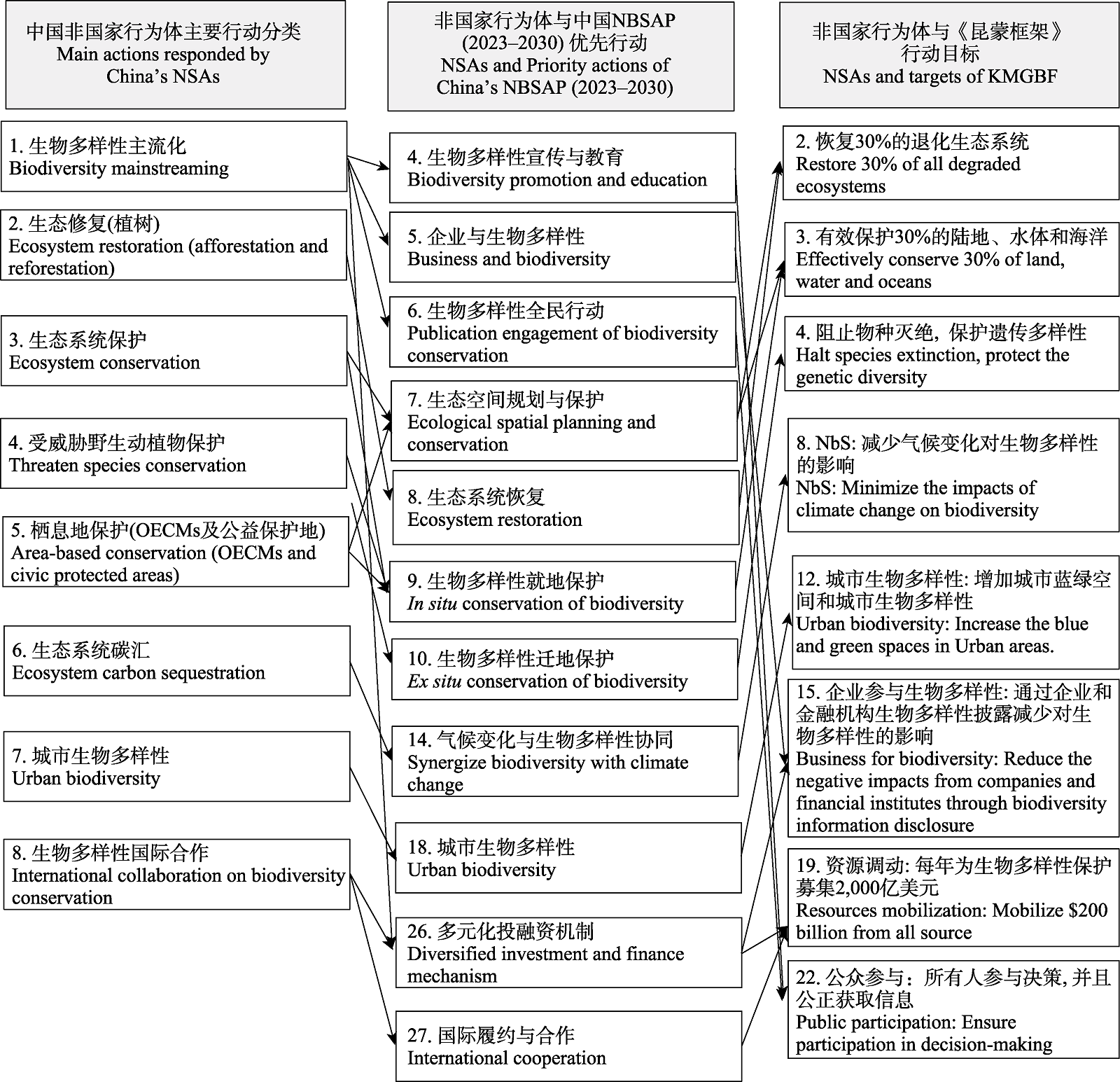
Fig. 1 The correlation between the strategies of non-state actors and the priority actions of China’s NBSAP and the targets of the Kunming-Montreal Global Biodiversity Framework (KMGBF). NSA, Non-state actors; OECMs, Other area-based effective conservation measures; NbS, Nature-based solutions
| 中文名/英文名 Chinese name/English name | 拉丁名 Latin name | IUCN物种红色名录等级 IUCN Red List category | 国家重点保护野生动物名录等级 National Protected Wildlife List class |
|---|---|---|---|
| 雪豹 Snow leopard | Panthera uncia | 易危 Vulnerable (VU) | 一级 First class |
| 亚洲金猫 Asian golden cat | Catopuma temminckii | 近危 Near Threatened (NT) | 二级 Second class |
| 荒漠猫 Chinese mountain cat | Felis bieti | 易危 Vulnerable (VU) | 二级 Second class |
| 华北豹 North China leopard | Panthera pardus japonensis | 濒危 Endangered (EN) | 一级 First class |
| 大熊猫 Giant panda | Ailuropoda melanoleuca | 易危 Vulnerable (VU) | 一级 First class |
| 东北虎 Amur tiger | Panthera tigris altaica | 濒危 Endangered (EN) | 一级 First class |
| 孟加拉虎 Bengal tiger | Panthera tigris tigris | 濒危 Endangered (EN) | 一级 First class |
| 云豹 Cloud leopard | Neofelis nebulosa | 易危 Vulnerable (VU) | 一级 First class |
| 青头潜鸭 Baer’s Pochard | Aythya baeri | 极危 Critically Endangered (CR) | 一级 First class |
| 东黑冠长臂猿 Cao-vit gibbon | Nomascus nasutus | 极危 Critically Endangered (CR) | 一级 First class |
| 亚洲象 Asian elephant | Elephas maximus | 濒危 Endangered (EN) | 一级 First class |
| 安徽麝 Anhui musk deer | Moschus anhuiensis | 濒危 Endangered (EN) | 一级 First class |
| 白唇鹿White-lipped deer | Cervus albirostris | 易危 Vulnerable (VU) | 一级 First class |
| 菲氏叶猴 Phayre’s leaf monkey | Trachypithecus phayrei | 濒危 Endangered (EN) | 一级 First class |
| 喜山长尾叶猴 Nepal gray langur | Semnopithecus schistaceus | 近危 Near Threatened (NT) | 二级 Second class |
| 巫山巴鲵 Wushan salamander | Liua shihi | 易危 Vulnerable (VU) | 二级 Second class |
| 威氏鼷鹿 Williamson’s mouse-deer | Tragulus williamsoni | 易危 Vulnerable (VU) | 二级 Second class |
| 海南长臂猿 Hainan black crested gibbon | Nomascus hainanus | 极危 Critically Endangered (CR) | 一级 First class |
| 黔金丝猴 Grey snub-nosed monkey | Rhinopithecus brelichi | 极危 Critically Endangered (CR) | 一级 First class |
| 朱鹮 Crested ibis | Nipponia nippon | 濒危 Endangered (EN) | 一级 First class |
| 中华穿山甲 Chinese pangolin | Manis pentadactyla | 极危 Critically Endangered (CR) | 一级 First class |
| 丹顶鹤 Red-crowned crane | Grus japonensis | 易危 Vulnerable (VU) | 一级 First class |
| 黑脸琵鹭 Black-faced spoonbill | Platalea minor | 濒危 Endangered (EN) | 一级 First class |
| 东方白鹳 Oriental stork | Ciconia boyciana | 濒危 Endangered (EN) | 一级 First class |
| 中华白海豚 Indo-Pacific humpback dolphin | Sousa chinensis | 易危 Vulnerable (VU) | 一级 First class |
| 蒙新河狸 Sino-Mongolian beaver | Castor fiber birulai | 濒危 Endangered (EN) | 一级 First class |
| 遗鸥 Relict gull | Ichthyaetus relictus | 易危 Vulnerable (VU) | 一级 First class |
| 东北豹 Amur leopard | Panthera pardus orientalis | 极危 Critically Endangered (CR) | 一级 First class |
| 秦岭细鳞鲑 Qinling lenok | Brachymystax tsinlingensis | 濒危 Endangered (EN) | 一级 First class |
| 天行长臂猿 Skywalker hoolock gibbon | Hoolock tianxing | 濒危 Endangered (EN) | 一级 First class |
| 金斑喙凤蝶 Golden birdwing | Teinopalpus aureus | 易危 Vulnerable (VU) | 二级 Second class |
| 马麝 Alpine musk deer | Moschus sifanicus | 濒危 Endangered (EN) | 一级 First class |
| 福建小腺蛙 Little gland frog | Glandirana minima | 极危 Critically Endangered (CR) | 二级 Second class |
| 黄胸鹀 Yellow-breasted bunting | Emberiza aureola | 极危 Critically Endangered (CR) | 一级 First class |
| 中华凤头燕鸥 Chinese crested tern | Thalasseus bernsteini | 极危 Critically Endangered (CR) | 一级 First class |
| 勺嘴鹬 Spoon-billed sandpiper | Calidris pygmaea | 极危 Critically Endangered (CR) | 一级 First class |
Table 3 Threatened species conserved by China’s foundation
| 中文名/英文名 Chinese name/English name | 拉丁名 Latin name | IUCN物种红色名录等级 IUCN Red List category | 国家重点保护野生动物名录等级 National Protected Wildlife List class |
|---|---|---|---|
| 雪豹 Snow leopard | Panthera uncia | 易危 Vulnerable (VU) | 一级 First class |
| 亚洲金猫 Asian golden cat | Catopuma temminckii | 近危 Near Threatened (NT) | 二级 Second class |
| 荒漠猫 Chinese mountain cat | Felis bieti | 易危 Vulnerable (VU) | 二级 Second class |
| 华北豹 North China leopard | Panthera pardus japonensis | 濒危 Endangered (EN) | 一级 First class |
| 大熊猫 Giant panda | Ailuropoda melanoleuca | 易危 Vulnerable (VU) | 一级 First class |
| 东北虎 Amur tiger | Panthera tigris altaica | 濒危 Endangered (EN) | 一级 First class |
| 孟加拉虎 Bengal tiger | Panthera tigris tigris | 濒危 Endangered (EN) | 一级 First class |
| 云豹 Cloud leopard | Neofelis nebulosa | 易危 Vulnerable (VU) | 一级 First class |
| 青头潜鸭 Baer’s Pochard | Aythya baeri | 极危 Critically Endangered (CR) | 一级 First class |
| 东黑冠长臂猿 Cao-vit gibbon | Nomascus nasutus | 极危 Critically Endangered (CR) | 一级 First class |
| 亚洲象 Asian elephant | Elephas maximus | 濒危 Endangered (EN) | 一级 First class |
| 安徽麝 Anhui musk deer | Moschus anhuiensis | 濒危 Endangered (EN) | 一级 First class |
| 白唇鹿White-lipped deer | Cervus albirostris | 易危 Vulnerable (VU) | 一级 First class |
| 菲氏叶猴 Phayre’s leaf monkey | Trachypithecus phayrei | 濒危 Endangered (EN) | 一级 First class |
| 喜山长尾叶猴 Nepal gray langur | Semnopithecus schistaceus | 近危 Near Threatened (NT) | 二级 Second class |
| 巫山巴鲵 Wushan salamander | Liua shihi | 易危 Vulnerable (VU) | 二级 Second class |
| 威氏鼷鹿 Williamson’s mouse-deer | Tragulus williamsoni | 易危 Vulnerable (VU) | 二级 Second class |
| 海南长臂猿 Hainan black crested gibbon | Nomascus hainanus | 极危 Critically Endangered (CR) | 一级 First class |
| 黔金丝猴 Grey snub-nosed monkey | Rhinopithecus brelichi | 极危 Critically Endangered (CR) | 一级 First class |
| 朱鹮 Crested ibis | Nipponia nippon | 濒危 Endangered (EN) | 一级 First class |
| 中华穿山甲 Chinese pangolin | Manis pentadactyla | 极危 Critically Endangered (CR) | 一级 First class |
| 丹顶鹤 Red-crowned crane | Grus japonensis | 易危 Vulnerable (VU) | 一级 First class |
| 黑脸琵鹭 Black-faced spoonbill | Platalea minor | 濒危 Endangered (EN) | 一级 First class |
| 东方白鹳 Oriental stork | Ciconia boyciana | 濒危 Endangered (EN) | 一级 First class |
| 中华白海豚 Indo-Pacific humpback dolphin | Sousa chinensis | 易危 Vulnerable (VU) | 一级 First class |
| 蒙新河狸 Sino-Mongolian beaver | Castor fiber birulai | 濒危 Endangered (EN) | 一级 First class |
| 遗鸥 Relict gull | Ichthyaetus relictus | 易危 Vulnerable (VU) | 一级 First class |
| 东北豹 Amur leopard | Panthera pardus orientalis | 极危 Critically Endangered (CR) | 一级 First class |
| 秦岭细鳞鲑 Qinling lenok | Brachymystax tsinlingensis | 濒危 Endangered (EN) | 一级 First class |
| 天行长臂猿 Skywalker hoolock gibbon | Hoolock tianxing | 濒危 Endangered (EN) | 一级 First class |
| 金斑喙凤蝶 Golden birdwing | Teinopalpus aureus | 易危 Vulnerable (VU) | 二级 Second class |
| 马麝 Alpine musk deer | Moschus sifanicus | 濒危 Endangered (EN) | 一级 First class |
| 福建小腺蛙 Little gland frog | Glandirana minima | 极危 Critically Endangered (CR) | 二级 Second class |
| 黄胸鹀 Yellow-breasted bunting | Emberiza aureola | 极危 Critically Endangered (CR) | 一级 First class |
| 中华凤头燕鸥 Chinese crested tern | Thalasseus bernsteini | 极危 Critically Endangered (CR) | 一级 First class |
| 勺嘴鹬 Spoon-billed sandpiper | Calidris pygmaea | 极危 Critically Endangered (CR) | 一级 First class |
| [1] | California Environmental Associate (2021) A Decade of Ocean Funding: Landscape Trends 2010-2020. https://oursharedseas.com/funding/. (accessed on 2025-09-10) |
| [2] |
Cavalcante AFM, Negacz K, Pattberg P (2025) Biodiversity governance in Latin America: Analyzing the role and relevance of non-state and sub-national cooperative initiatives. Biological Conservation, 305, 111053.
DOI URL |
| [3] | Deutz A, Heal GM, Niu R, Swanson E, Townshend T, Zhu L, Delmar A, Meghji A, Sethi SA, Tobin-de la Puente J (2020) Financing Nature: Closing the Global Biodiversity Financing Gap. The Paulson Institute, the Nature Conservancy, and the Cornell Atkinson Center for Sustainability. https://www.paulsoninstitute.org/wp-content/uploads/2020/10/financing-nature_full-report_final-with-endorsements_101420.pdf/. (accessed on 2026-1-17) |
| [4] |
Gruby RL, Enrici A, Betsill M, Le Cornu E, Basurto X (2021) Opening the black box of conservation philanthropy: A co-produced research agenda on private foundations in marine conservation. Marine Policy, 132, 104645.
DOI URL |
| [5] | Gruby RL, Miller DC, Enrici A, Garrick D (2023) Conservation philanthropy: Growing the field of research and practice. Conservation Science and Practice, 5, e12977. |
| [6] | Institute for Philanthropy of Tsinghua University (2024) China Giving Report. (in Chinese) |
| [清华大学公益慈善研究院 (2024) 中国慈善捐赠报告.] https://www.givingchina.org. (accessed on 2025-11-15) | |
| [7] |
Jiang XY, Xu JY, Sheng XM, Zhu Y (2025) Synergies and differences between the China National Biodiversity Conservation Strategy and Action Plan (2023-2030) and the Kunming-Montreal Global Biodiversity Framework. Biodiversity Science, 33, 24575. (in Chinese with English abstract)
DOI URL |
| [姜雪原, 徐嘉忆, 盛学敏, 朱源 (2025) 中国生物多样性保护战略与行动计划(2023-2030年)》与《昆蒙框架》的协同与差异. 生物多样性, 33, 24575.] | |
| [8] |
Li YX, Li YY, Zhang YXY, Liu WH (2023) The progress and prospect of the financial arrangements under the Convention on Biological Diversity. Biodiversity Science, 31, 23077. (in Chinese with English abstract)
DOI |
|
[李亦欣, 李圆圆, 张杨心怡, 刘文慧 (2023) 《生物多样性公约》资金问题最新进展及展望. 生物多样性, 31, 23077.]
DOI |
|
| [9] |
Liu L, Zang MY, Ma Y, Wan YQ, Hu FL, Lu XQ, Liu Y (2025) Measures, progress and prospects of central-local cooperation in the implementation of the National Biodiversity Strategy and Action Plan. Biodiversity Science, 33, 24532. (in Chinese with English abstract)
DOI |
|
[刘立, 臧明月, 马月, 万雅琼, 胡飞龙, 卢晓强, 刘燕 (2025) 央地协同推动国家生物多样性战略和行动计划执行的措施、进展与展望. 生物多样性, 33, 24532.]
DOI |
|
| [10] | Liu WH, Duan HX, Zhang FC, Liu HO, Li ZY, Zhang WG, Du LS (2025) The analysis of the implementation pathways for achieving biodiversity governance goals through a whole-of- government and whole-of-society approach. Research of Environmental Sciences, 38, 9-17. (in Chinese with English abstract) |
| [刘文慧, 段禾祥, 张风春, 刘海鸥, 李子圆, 张文国, 杜乐山 (2025) 以全政府和全社会方法推动生物多样性治理目标实现路径分析. 环境科学研究, 38, 9-17.] | |
| [11] | OECD (The Organization for Economic Cooperation and Development) (2020) A Comprehensive Overview of Global Biodiversity Finance. https://www.oecd.org/content/dam/oecd/en/publications/reports/2020/04/a-comprehensive-overview-of-global-biodiversity-finance_ad660ace/25f9919e-en.pdf. (accessed on 2025-09-10) |
| [12] | Wei FW, Ping XG, Hu YB, Nie YG, Zeng Y, Huang GP (2021) Main achievements, challenges, and recommendations of biodiversity conservation in China. Bulletin of Chinese Academy of Sciences, 36, 375-383. (in Chinese with English abstract) |
| [魏辅文, 平晓鸽, 胡义波, 聂永刚, 曾岩, 黄广平 (2021) 中国生物多样性保护取得的主要成绩、面临的挑战与对策建议. 中国科学院院刊, 36, 375-383.] | |
| [13] |
Wei W, Shen XL, Liu YN (2021) Toward developing a new funding mechanism to support post-2020 biodiversity conservation. Biodiversity Science, 29, 259-268. (in Chinese with English abstract)
DOI URL |
| [魏伟, 申小莉, 刘忆南 (2021) 2020年后生物多样性保护需要建立新的资金机制. 生物多样性, 29, 259-268.] | |
| [14] | Yang FY, Tao Z, Zhang L (2024) Trends and dynamics of philanthropic funding for biodiversity conservation in China. Conservation Science and Practice, 6, e13059. |
| [15] | Yang J, Yang XD, Liu XY, Zhou J (2025) Perspectives of urban biodiversity studies in China serving Target 12 of the Kunming-Montreal Global Biodiversity Framework. Biodiversity Science, 33, 25104. (in Chinese with English abstract) |
|
[杨军, 杨旭东, 刘心怡, 周景 (2025) 面向《昆蒙框架》目标12的中国城市生物多样性研究展望. 生物多样性, 33, 25104.]
DOI |
| Viewed | ||||||
|
Full text |
|
|||||
|
Abstract |
|
|||||
Copyright © 2026 Biodiversity Science
Editorial Office of Biodiversity Science, 20 Nanxincun, Xiangshan, Beijing 100093, China
Tel: 010-62836137, 62836665 E-mail: biodiversity@ibcas.ac.cn

