

Biodiv Sci ›› 2025, Vol. 33 ›› Issue (11): 25275. DOI: 10.17520/biods.2025275 cstr: 32101.14.biods.2025275
• Original Papers: Plant Diversity • Previous Articles Next Articles
Jihong Huang1( ), Erfan Akberjan2,3, Ruiming Cheng1, Wendong Wang4, Yue Xu1(), Jie Yao1(), Yi Ding1,*()(
 )
)
Received:2025-07-17
Accepted:2025-10-21
Online:2025-11-20
Published:2025-12-26
Contact:
Yi Ding
Supported by:Jihong Huang, Erfan Akberjan, Ruiming Cheng, Wendong Wang, Yue Xu, Jie Yao, Yi Ding. Dynamics of the Picea schrenkiana community in the west Tianshan Mountains of Xinjiang and their influencing factors[J]. Biodiv Sci, 2025, 33(11): 25275.
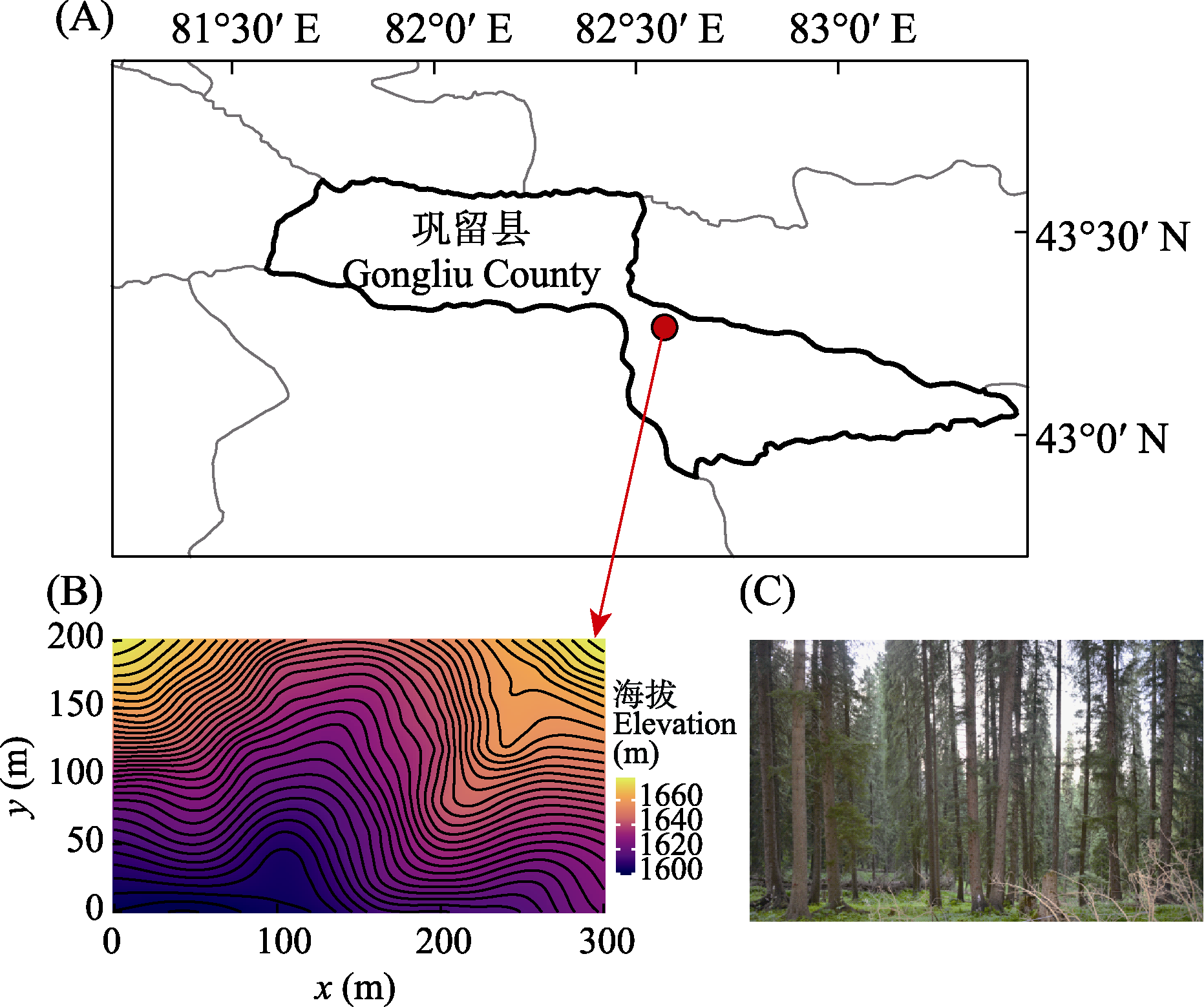
Fig. 1 Location (A), contour map (B), and photographs of a typical Picea schrenkiana forest (C) in the 6-ha forest dynamics plot in the west Tianshan Mountains, Xinjiang
| 变量 Variables | 平均值 ± 标准差 Mean ± SD |
|---|---|
| 地形因子 Topographic factor | |
| 凹凸度 Convexity (Convex) | -0.11 ± 2.21 |
| 坡度 Slope | 21.56° ± 7.79° |
| 坡向 Aspect | 189.77° ± 50.18° |
| 土壤因子 Soil factor | |
| pH | 6.19 ± 0.37 |
| 土壤有机质含量 Soil organic matter content (g/kg) | 173.39 ± 64.08 |
| 有效氮含量 Available nitrogen content (mg/kg) | 191.47 ± 122.10 |
| 全氮含量 Total nitrogen content (g/kg) | 8.67 ± 2.66 |
| 有效磷含量 Available phosphorus content (mg/kg) | 37.56 ± 21.35 |
| 全磷含量 Total phosphorus content (g/kg) | 0.21 ± 0.04 |
Table 1 Basic information of topographic and soil factors of the 6-ha forest dynamics plot in the west Tianshan Mountains, Xinjiang
| 变量 Variables | 平均值 ± 标准差 Mean ± SD |
|---|---|
| 地形因子 Topographic factor | |
| 凹凸度 Convexity (Convex) | -0.11 ± 2.21 |
| 坡度 Slope | 21.56° ± 7.79° |
| 坡向 Aspect | 189.77° ± 50.18° |
| 土壤因子 Soil factor | |
| pH | 6.19 ± 0.37 |
| 土壤有机质含量 Soil organic matter content (g/kg) | 173.39 ± 64.08 |
| 有效氮含量 Available nitrogen content (mg/kg) | 191.47 ± 122.10 |
| 全氮含量 Total nitrogen content (g/kg) | 8.67 ± 2.66 |
| 有效磷含量 Available phosphorus content (mg/kg) | 37.56 ± 21.35 |
| 全磷含量 Total phosphorus content (g/kg) | 0.21 ± 0.04 |
| 物种 Species | 2008 | 2014 | 2019 | 2024 |
|---|---|---|---|---|
| 雪岭云杉 Picea schrenkiana | 1,310 (91.54%) | 1,341 (90.73%) | 1,210 (91.74%) | 1,123 (93.58%) |
| 天山桦 Betula tianschanica | 91 (6.36%) | 92 (6.22%) | 62 (4.70%) | 50 (4.17%) |
| 天山花楸 Sorbus tianschanica | 11 (0.77%) | 11 (0.74 %) | 7 (0.53%) | 3 (0.25%) |
| 新疆忍冬 Lonicera tatarica | 10 (0.70%) | 13 (0.88%) | 17 (1.29%) | 10 (0.83%) |
| 山楂 Crataegus pinnatifida | 3 (0.21%) | 3 (0.20%) | 3 (0.23%) | 3 (0.25%) |
| 黄花柳 Salix caprea | 3 (0.21%) | 3 (0.20%) | 4 (0.30%) | 4 (0.33%) |
| 伊犁小檗 Berberis iliensis | 2 (0.14%) | 14 (0.95%) | 16 (1.21%) | 7 (0.58%) |
| 新疆野苹果 Malus sieversii | 1 (0.07%) | 1 (0.07%) | 0 (0.00%) | 0 (0.00%) |
| 合计 Total | 1,431 (100.00%) | 1,478 (100.00%) | 1,319 (100.00%) | 1,200 (100.00%) |
Table 2 Changes in the number of living trees across different years (2008-2024) in the Picea schrenkiana community in the west Tianshan Mountains, Xinjiang
| 物种 Species | 2008 | 2014 | 2019 | 2024 |
|---|---|---|---|---|
| 雪岭云杉 Picea schrenkiana | 1,310 (91.54%) | 1,341 (90.73%) | 1,210 (91.74%) | 1,123 (93.58%) |
| 天山桦 Betula tianschanica | 91 (6.36%) | 92 (6.22%) | 62 (4.70%) | 50 (4.17%) |
| 天山花楸 Sorbus tianschanica | 11 (0.77%) | 11 (0.74 %) | 7 (0.53%) | 3 (0.25%) |
| 新疆忍冬 Lonicera tatarica | 10 (0.70%) | 13 (0.88%) | 17 (1.29%) | 10 (0.83%) |
| 山楂 Crataegus pinnatifida | 3 (0.21%) | 3 (0.20%) | 3 (0.23%) | 3 (0.25%) |
| 黄花柳 Salix caprea | 3 (0.21%) | 3 (0.20%) | 4 (0.30%) | 4 (0.33%) |
| 伊犁小檗 Berberis iliensis | 2 (0.14%) | 14 (0.95%) | 16 (1.21%) | 7 (0.58%) |
| 新疆野苹果 Malus sieversii | 1 (0.07%) | 1 (0.07%) | 0 (0.00%) | 0 (0.00%) |
| 合计 Total | 1,431 (100.00%) | 1,478 (100.00%) | 1,319 (100.00%) | 1,200 (100.00%) |
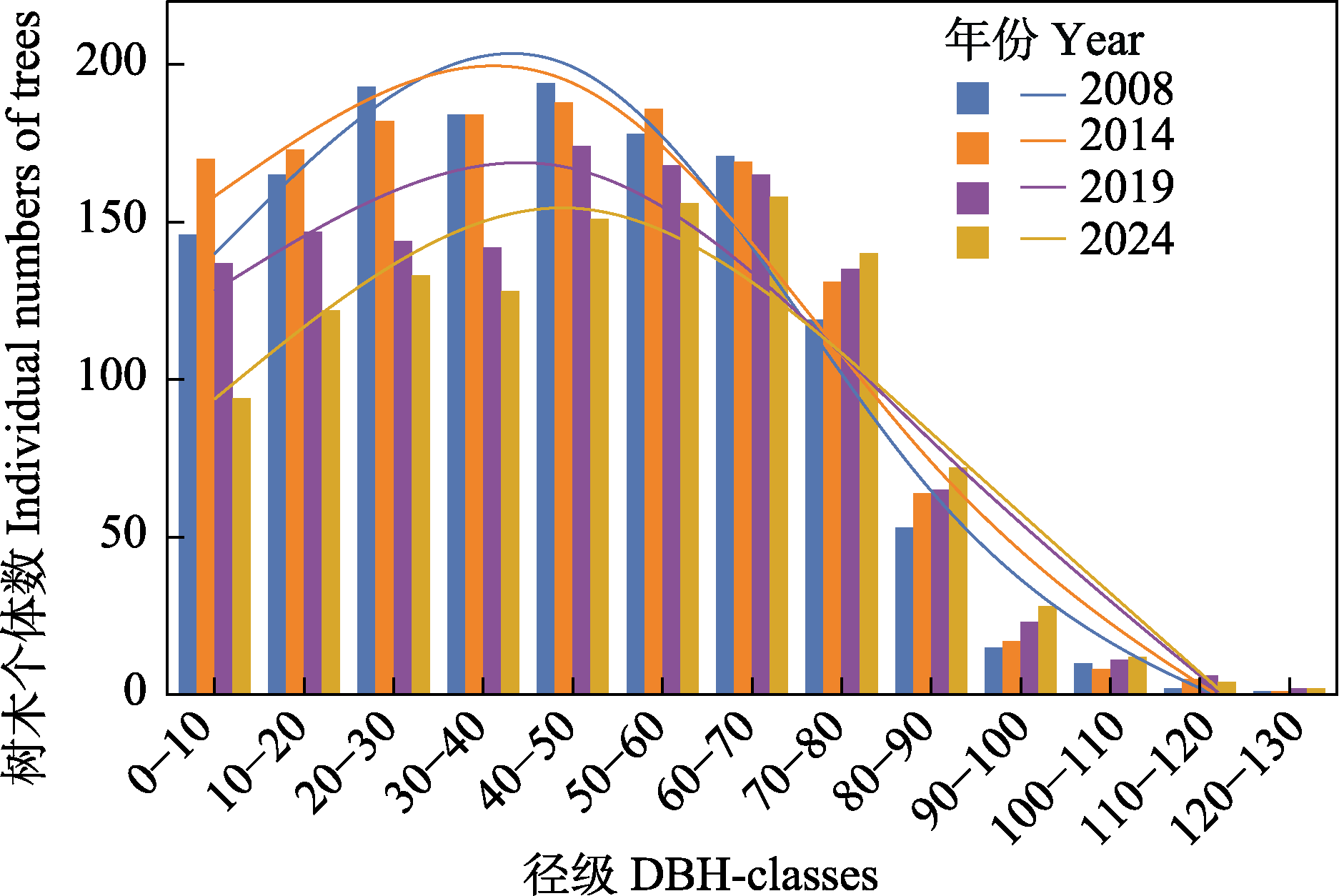
Fig. 2 Interannual variation (2008-2024) in DBH-classes distribution of living stems in the Picea schrenkiana community in the west Tianshan Mountains, Xinjiang. The bar shows the number of individuals corresponding to different DBH-classes across survey years. The line represents the fitted curves of individual numbers varying with DBH-classes in different survey years.
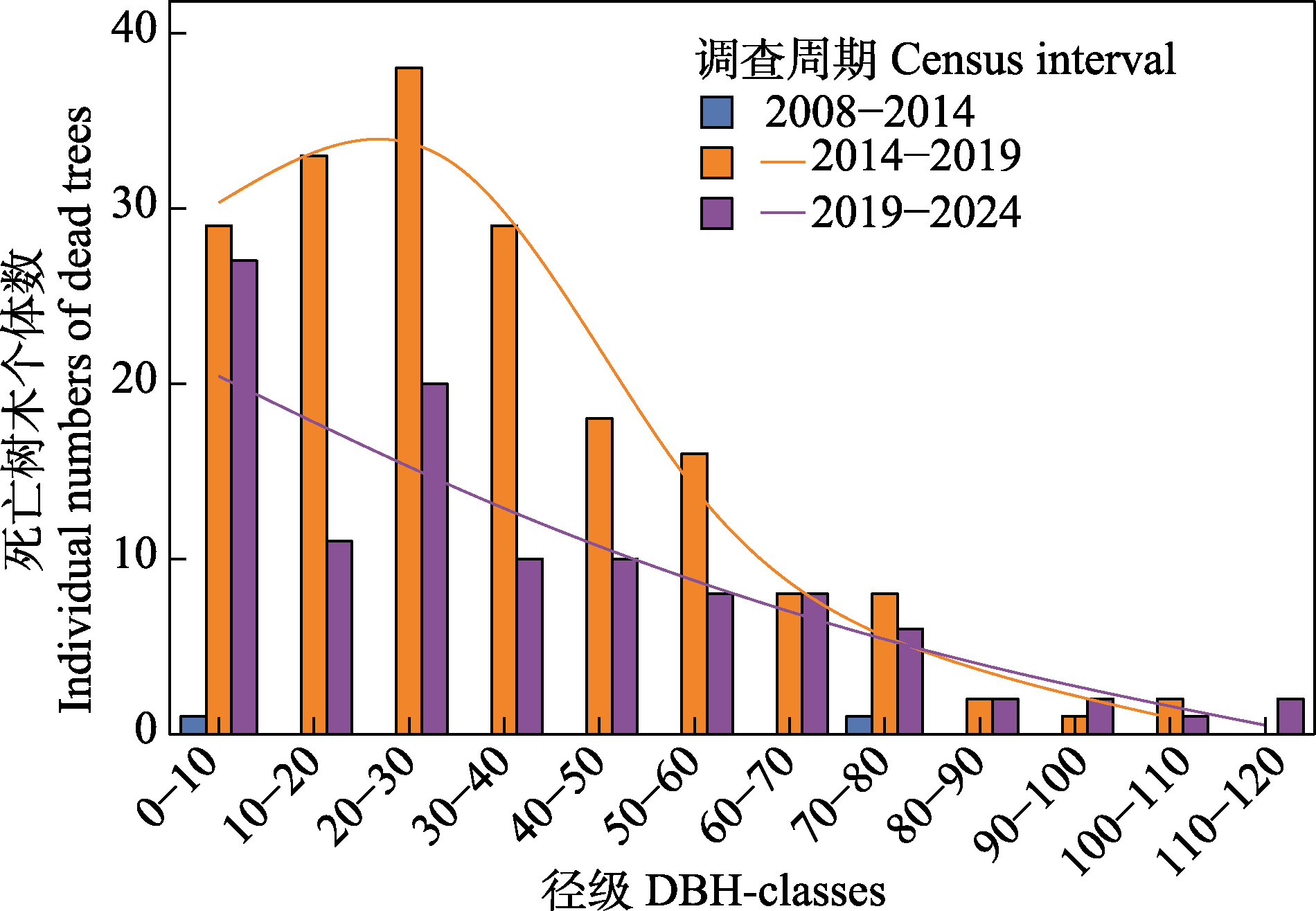
Fig. 3 Interannual (2008-2024) mortality distribution across DBH-classes in the Picea schrenkiana community in the west Tianshan Mountains, Xinjiang. The bar displays the number of dead individuals across different DBH-classes in various time periods. The line graph represents the fitted curve of dead individual numbers varying by DBH-classes over different time periods.
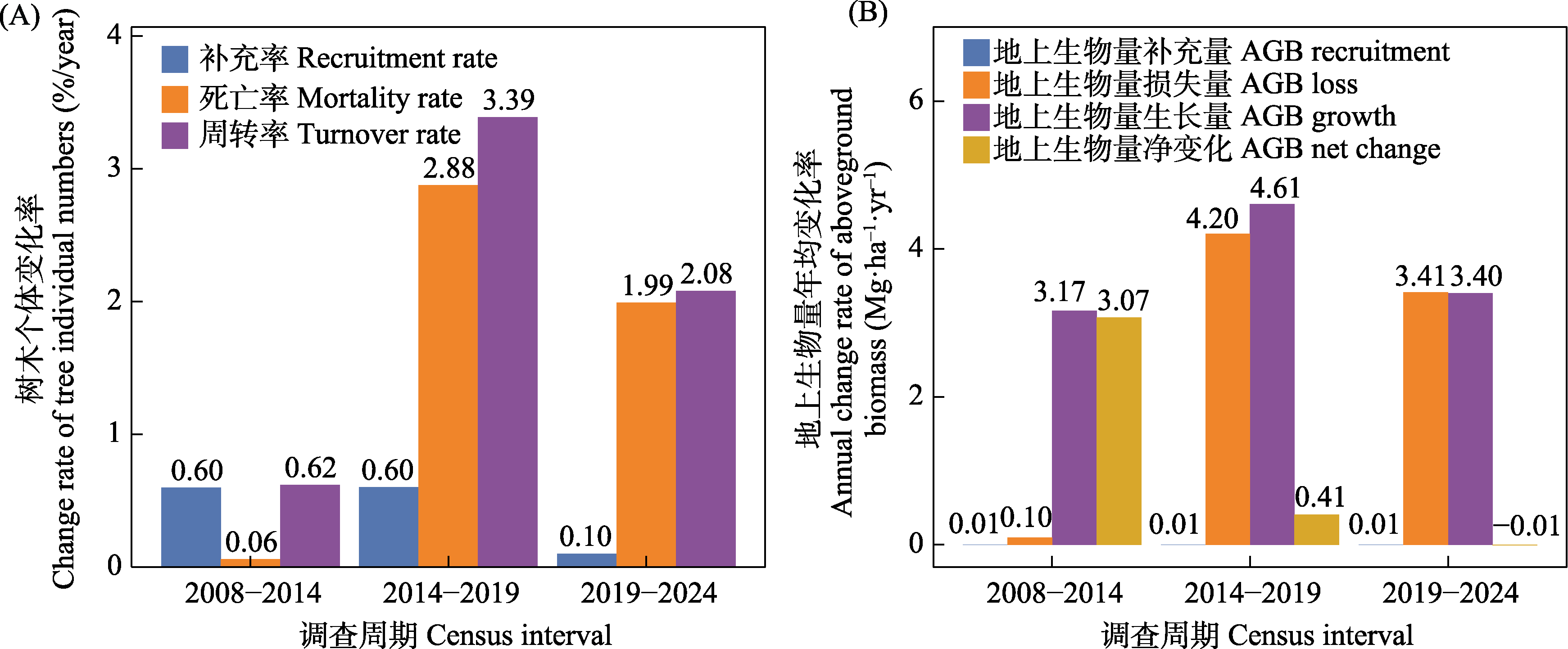
Fig. 4 Interannual (2008-2024) change rates of tree individual number (A) and aboveground biomass (AGB) (B) in the Picea schrenkiana community in the west Tianshan Mountains, Xinjiang
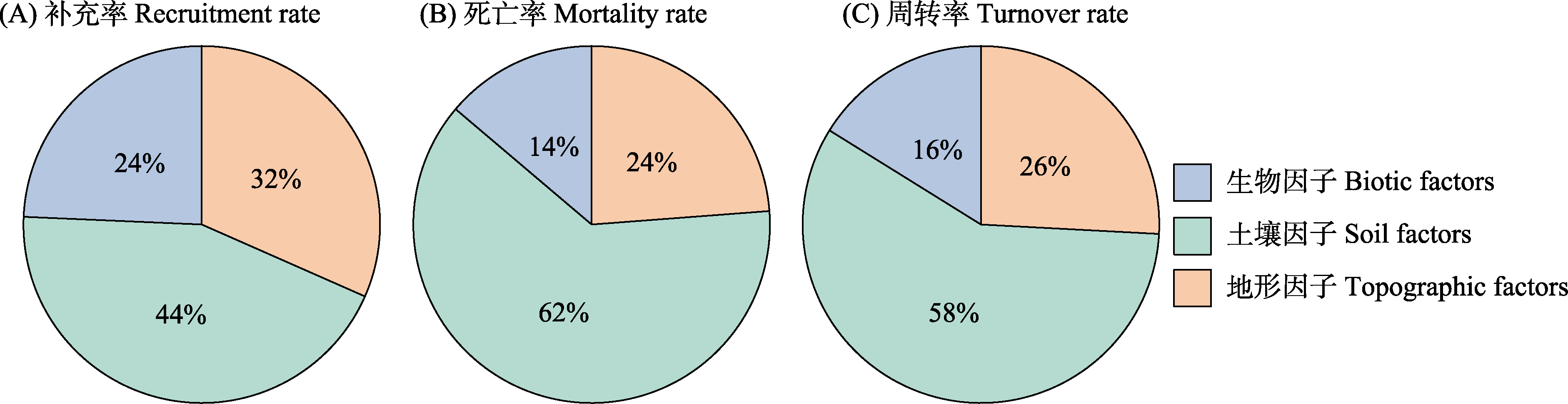
Fig. 5 Proportional contributions of biological, soil, and topographic factors to the recruitment rate (A), mortality rate (B), and turnover rate (C) in the Picea schrenkiana community in the west Tianshan Mountains, Xinjiang
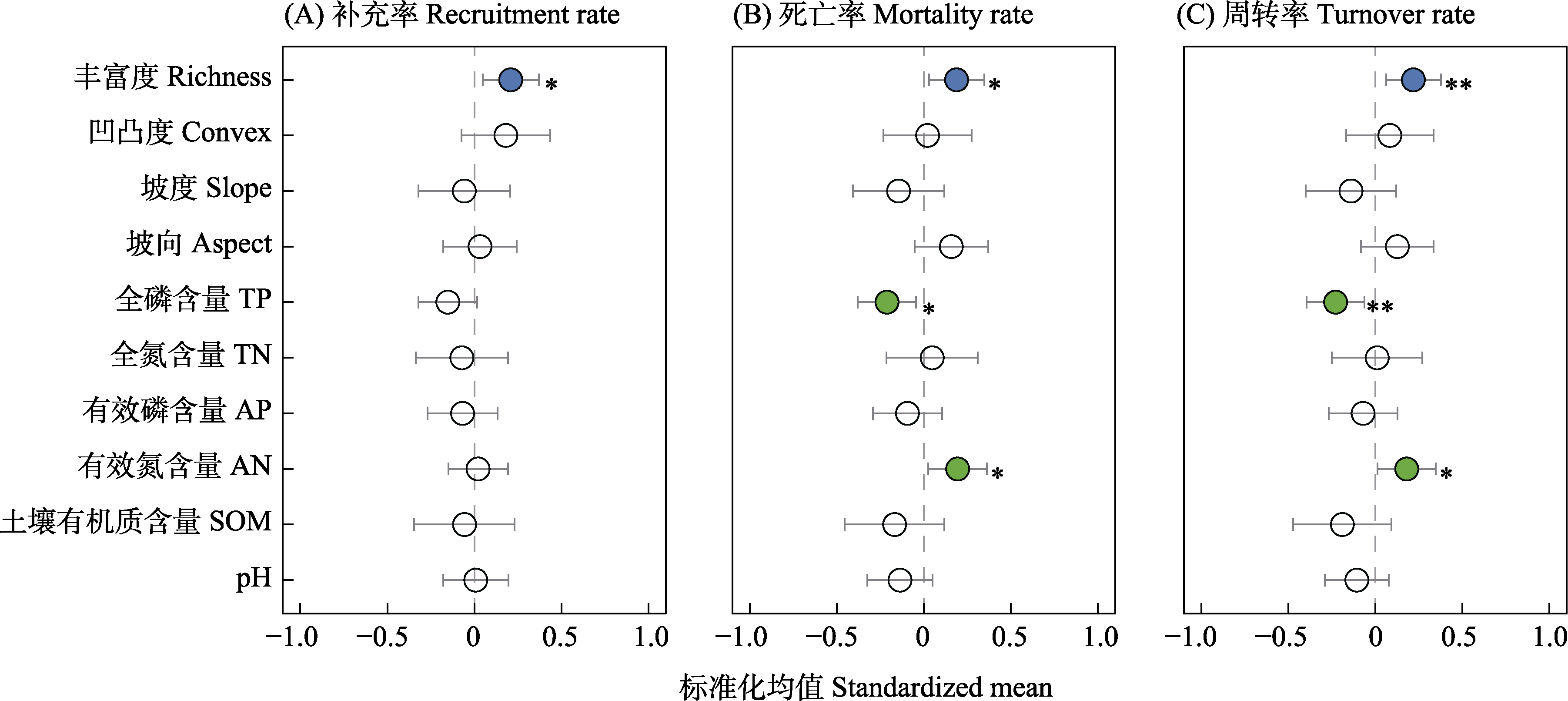
Fig. 6 Factors influencing recruitment rate (A), mortality rate (B), and turnover rate (C) in the Picea schrenkiana community in the west Tianshan Mountains, Xinjiang. Convex, Convexity; SOM, Soil organic matter content; AN, Available nitrogen content; TN, Total nitrogen content; AP, Available phosphorus content; TP, Total phosphorus content. * P < 0.05; ** P < 0.01.
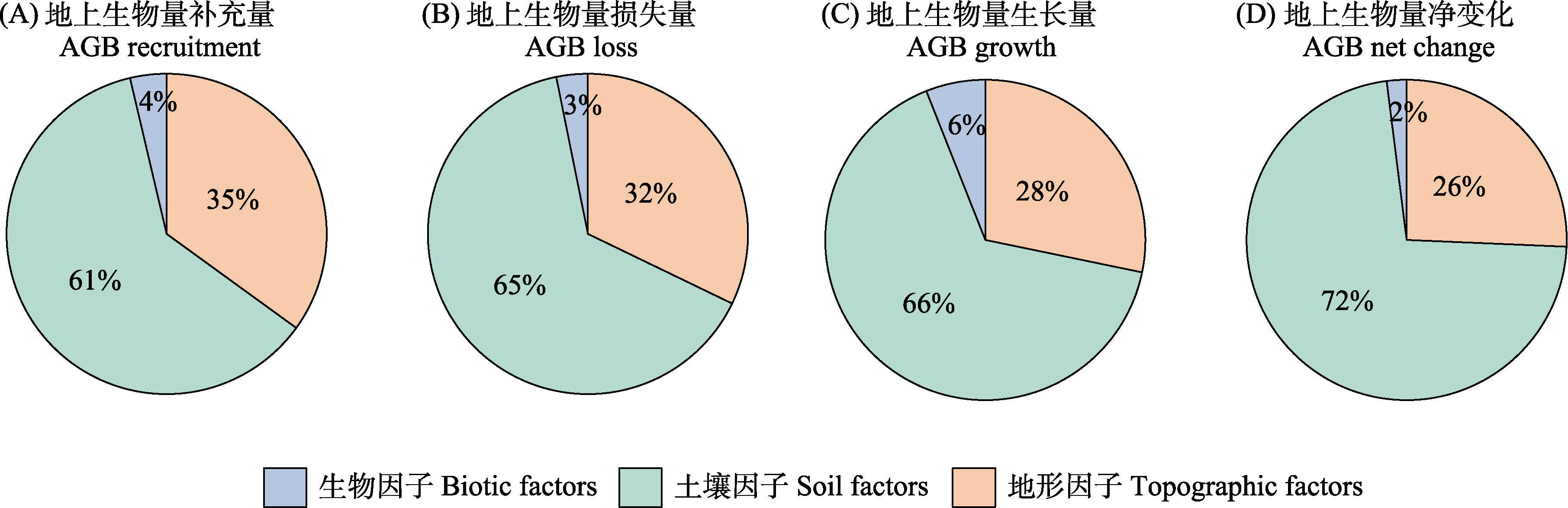
Fig. 7 The proportional contributions of biological, soil, and topographic factors to the aboveground biomass (AGB) recruitment (A), loss (B), growth (C), and net change (D) in the Picea schrenkiana community in the west Tianshan Mountains, Xinjiang
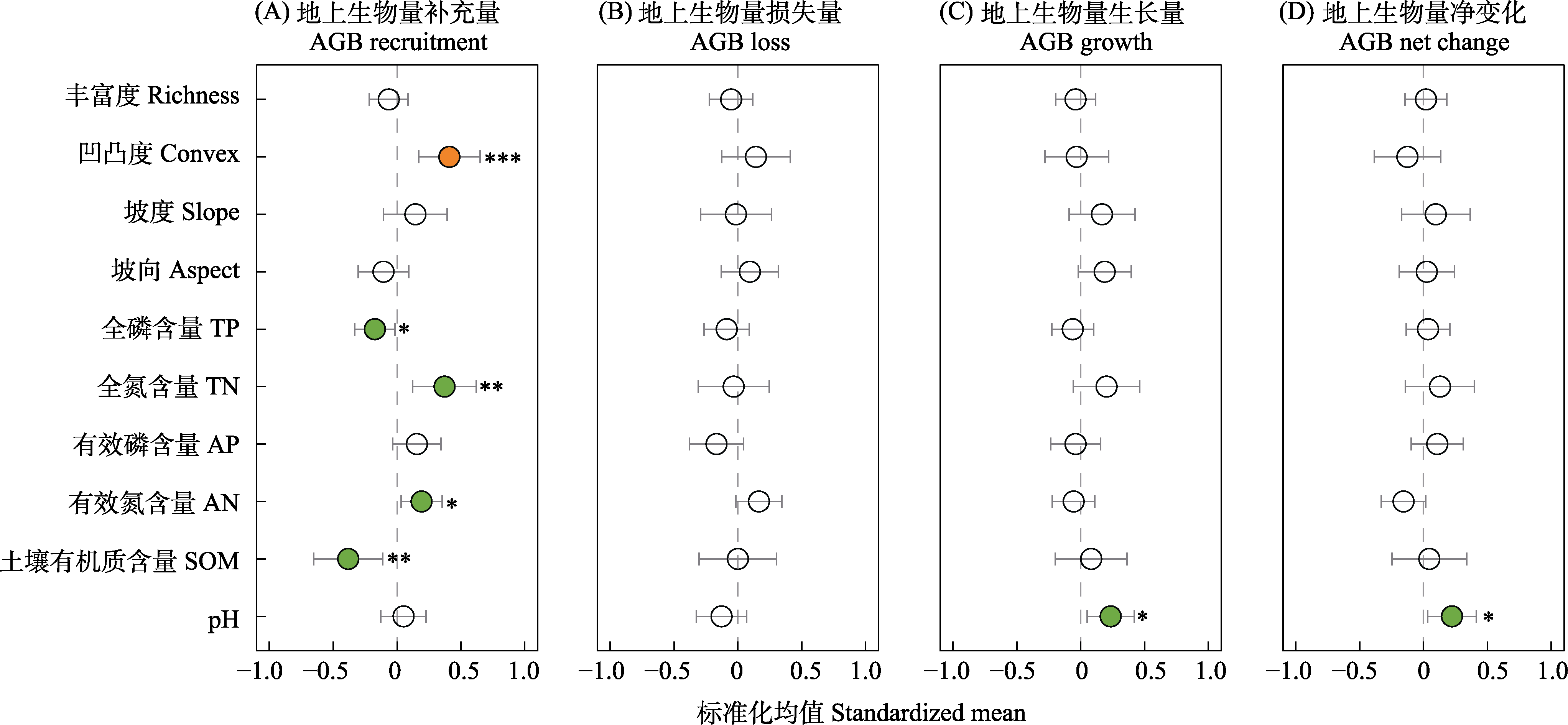
Fig. 8 Factors influencing to the aboveground biomass (AGB) recruitment (A), loss (B), growth (C), and net change (D) in the Picea schrenkiana community in the west Tianshan Mountains, Xinjiang. Convex, Convexity; SOM, Soil organic matter content; AN, Available nitrogen content; TN, Total nitrogen content; AP, Available phosphorus content; TP, Total phosphorus content. * P < 0.05; ** P < 0.01; *** P < 0.001.
| [1] |
Allen CD, Macalady AK, Chenchouni H, Bachelet D, McDowell N, Vennetier M, Kitzberger T, Rigling A, Breshears DD, Hogg EH, Gonzalez P, Fensham R, Zhang Z, Castro J, Demidova N, Lim JM, Allard G, Running SW, Semerci A, Cobb N (2010) A global overview of drought and heat-induced tree mortality reveals emerging climate change risks for forests. Forest Ecology and Management, 259, 660-684.
DOI URL |
| [2] |
Bennett AC, McDowell NG, Allen CD, Anderson-Teixeira KJ (2015) Larger trees suffer most during drought in forests worldwide. Nature Plants, 1, 15139.
DOI PMID |
| [3] |
Callaway RM, Brooker RW, Choler P, Kikvidze Z, Lortie CJ, Michalet R, Paolini L, Pugnaire FI, Newingham B, Aschehoug ET, Armas C, Kikodze D, Cook BJ (2002) Positive interactions among alpine plants increase with stress. Nature, 417, 844-848.
DOI |
| [4] |
Chesson P (2000) Mechanisms of maintenance of species diversity. Annual Review of Ecology and Systematics, 31, 343-366.
DOI URL |
| [5] |
Choat B, Brodribb TJ, Brodersen CR, Duursma RA, López R, Medlyn BE (2018) Triggers of tree mortality under drought. Nature, 558, 531-539.
DOI |
| [6] | Chojnacky DC, Heath LS, Jenkins JC (2014) Updated generalized biomass equations for North American tree species. Forestry, 87, 129-151. |
| [7] |
Clark JS, Bell DM, Hersh MH, Nichols L (2011) Climate change vulnerability of forest biodiversity: Climate and competition tracking of demographic rates. Global Change Biology, 17, 1834-1849.
DOI URL |
| [8] | Condit R (1998) Tropical Forest Census Plots: Methods and Results from Barro Colorado Island, Panama and a Comparison with Other Plots. Springer, Berlin. |
| [9] |
Coomes DA, Allen RB (2009) Testing the metabolic scaling theory of tree growth. Journal of Ecology, 97, 1369-1373.
DOI URL |
| [10] |
Das A, Battles J, Stephenson NL, van Mantgem PJ (2011) The contribution of competition to tree mortality in old-growth coniferous forests. Forest Ecology and Management, 261, 1203-1213.
DOI URL |
| [11] |
Ding Y, Zang RG, Huang JH, Xu Y, Lu XH, Guo ZJ, Ren W (2019) Intraspecific trait variation and neighborhood competition drive community dynamics in an old-growth spruce forest in Northwest China. Science of the Total Environment, 678, 525-532.
DOI |
| [12] |
Eisenhauer N, Mueller K, Ebeling A, Gleixner G, Huang Y, Madaj A, Roscher C, Weigelt A, Bahn M, Bonkowski M, Brose U, Cesarz S, Feilhauer H, Guimaraes-Steinicke C, Heintz-Buschart A, Hines J, Lange M, Meyer ST, Mohanbabu N, Mommer L, Neuhauser S, Oelmann Y, Rahmanian S, Sasaki T, Scheu S, Schielzeth H, Schmid B, Schloter M, Schulz S, Unsicker SB, Vogel C, Weisser WW, Isbell F (2024) The multiple-mechanisms hypothesis of biodiversity-stability relationships. Basic and Applied Ecology, 79, 153-166.
DOI URL |
| [13] |
Elser JJ, Bracken MES, Cleland EE, Gruner DS, Harpole WS, Hillebrand H, Ngai JT, Seabloom EW, Shurin JB, Smith JE (2007) Global analysis of nitrogen and phosphorus limitation of primary producers in freshwater, marine and terrestrial ecosystems. Ecology Letters, 10, 1135-1142.
DOI PMID |
| [14] |
Feng YH, Schmid B, Loreau M, Forrester DI, Fei SL, Zhu JX, Tang ZY, Zhu J, Hong PB, Ji CJ, Shi Y, Su HJ, Xiong XY, Xiao J, Wang SP, Fang JY (2022) Multispecies forest plantations outyield monocultures across a broad range of conditions. Science, 376, 865-868.
DOI PMID |
| [15] |
Fortunel C, Lasky JR, Uriarte M, Valencia R, Wright SJ, Garwood NC, Kraft NJB (2018) Topography and neighborhood crowding can interact to shape species growth and distribution in a diverse Amazonian forest. Ecology, 99, 2272-2283.
DOI PMID |
| [16] |
García Criado M, Myers-Smith IH, Bjorkman AD, Elmendorf SC, Normand S, Aastrup P, Aerts R, Alatalo JM, Baeten L, Björk RG, Björkman MP, Boulanger-Lapointe N, Butler EE, Cooper EJ, Cornelissen JHC, Daskalova GN, Fadrique B, Forbes BC, Henry GHR, Hollister RD, Høye TT, Jacobsen IBD, Jägerbrand AK, Jónsdóttir IS, Kaarlejärvi E, Khitun O, Klanderud K, Kolari THM, Lang SI, Lecomte N, Lenoir J, Macek P, Messier J, Michelsen A, Molau U, Muscarella R, Nielsen ML, Petit Bon M, Post E, Raundrup K, Rinnan R, Rixen C, Ryde I, Serra-Diaz JM, Schaepman-Strub G, Schmidt NM, Schrodt F, Sjögersten S, Steinbauer MJ, Stewart L, Strandberg B, Tolvanen A, Tweedie CE, Vellend M (2025) Plant diversity dynamics over space and time in a warming Arctic. Nature, 642, 653-661.
DOI |
| [17] |
Grubb PJ (1977) The maintenance of species-richness in plant communities: The importance of the regeneration niche. Biological Reviews, 52, 107-145.
DOI URL |
| [18] |
Hammond WM, Williams AP, Abatzoglou JT, Adams HD, Klein T, López R, Sáenz-Romero C, Hartmann H, Breshears DD, Allen CD (2022) Global field observations of tree die-off reveal hotter-drought fingerprint for Earth’s forests. Nature Communications, 13, 1761.
DOI PMID |
| [19] |
Harpole WS, Ngai JT, Cleland EE, Seabloom EW, Borer ET, Bracken MES, Elser JJ, Gruner DS, Hillebrand H, Shurin JB, Smith JE (2011) Nutrient co-limitation of primary producer communities. Ecology Letters, 14, 852-862.
DOI PMID |
| [20] | Hisano M, Chen HYH, Searle EB, Reich PB (2019) Species-rich boreal forests grew more and suffered less mortality than species-poor forests under the environmental change of the past half-century. Ecology Letters, 22, 999-1008. |
| [21] |
Hou EQ, Luo YQ, Kuang YW, Chen CR, Lu XK, Jiang LF, Luo XZ, Wen DZ (2020) Global meta-analysis shows pervasive phosphorus limitation of aboveground plant production in natural terrestrial ecosystems. Nature Communications, 11, 637.
DOI PMID |
| [22] |
Hutchinson GE (1957) Concluding remarks. Cold Spring Harbor Symposia on Quantitative Biology, 22, 415-427.
DOI URL |
| [23] | IUSS Working Group WRB (2015) World reference base for soil resources 2014, update 2015 international soil classification system for naming soils and creating legends for soil maps. In: World Soil Resources Reports, No. 106. (ed. FAO), Rome, Italy. |
| [24] |
Laurance WF, Oliveira AA, Laurance SG, Condit R, Nascimento HEM, Sanchez-Thorin AC, Lovejoy TE, Andrade A, D’Angelo S, Ribeiro JE, Dick CW (2004) Pervasive alteration of tree communities in undisturbed Amazonian forests. Nature, 428, 171-175.
DOI |
| [25] |
Legendre P, Mi XC, Ren HB, Ma KP, Yu MJ, Sun IF, He FL (2009) Partitioning beta diversity in a subtropical broad-leaved forest of China. Ecology, 90, 663-674.
DOI PMID |
| [26] | Lenoir J, Graae BJ, Aarrestad PA, Alsos IG, Armbruster WS, Austrheim G, Bergendorff C, Birks HJB, Bråthen KA, Brunet J, Bruun HH, Dahlberg CJ, Decocq G, Diekmann M, Dynesius M, Ejrnæs R, Grytnes JA, Hylander K, Klanderud K, Luoto M, Milbau A, Moora M, Nygaard B, Odland A, Ravolainen VT, Reinhardt S, Sandvik SM, Schei FH, Speed JDM, Tveraabak LU, Vandvik V, Velle LG, Virtanen R, Zobel M, Svenning JC (2013) Local temperatures inferred from plant communities suggest strong spatial buffering of climate warming across Northern Europe. Global Change Biology, 19, 1470-1481. |
| [27] | Linger E, Long WX (2025) Phosphorus limitation constrains global forest productivity directly and indirectly via forest community structural attributes: Meta-analysis. Global Ecology and Biogeography, 34, e70048. |
| [28] |
Loreau M, Naeem S, Inchausti P, Bengtsson J, Grime JP, Hector A, Hooper DU, Huston MA, Raffaelli D, Schmid B, Tilman D, Wardle DA (2001) Biodiversity and ecosystem functioning: Current knowledge and future challenges. Science, 294, 804-808.
DOI PMID |
| [29] | McDowell NG, Sapes G, Pivovaroff A, Adams HD, Allen CD, Anderegg WRL, Arend M, Breshears DD, Brodribb T, Choat B, Cochard H, De Cáceres M, De Kauwe MG, Grossiord C, Hammond WM, Hartmann H, Hoch G, Kahmen A, Klein T, MacKay DS, Mantova M, Martínez-Vilalta J, Medlyn BE, Mencuccini M, Nardini A, Oliveira RS, Sala AN, Tissue DT, Torres-Ruiz JM, Trowbridge AM, Trugman AT, Wiley E, Xu CG (2022) Mechanisms of woody-plant mortality under rising drought, CO2 and vapour pressure deficit. Nature Reviews Earth & Environment, 3, 294-308. |
| [30] | Pan CD, Wang Q, Ruan X, Li ZH (2009) Biological activity and quantification of potential autotoxins from the leaves of Picea schrenkiana. Chinese Journal of Plant Ecology, 33, 186-196. (in Chinese with English abstract) |
|
[ 潘存德, 王强, 阮晓, 李兆慧 (2009) 天山云杉针叶水提取物自毒效应及自毒物质的分离鉴定. 植物生态学报, 33, 186-196.]
DOI |
|
| [31] |
Phillips OL, Baker TR, Arroyo L, Higuchi N, Killeen TJ, Laurance WF, Lewis SL, Lloyd J, Malhi Y, Monteagudo A, Neill DA, Núñez Vargas P, Silva JNM, Terborgh J, Vásquez Martínez R, Alexiades M, Almeida S, Brown S, Chave J, Comiskey JA, Czimczik CI, Di Fiore A, Erwin T, Kuebler C, Laurance SG, Nascimento HEM, Olivier J, Palacios W, Patiño S, Pitman NCA, Quesada CA, Saldias M, Torres Lezama A, Vinceti B (2004) Pattern and process in Amazon tree turnover, 1976-2001. Philosophical Transactions of the Royal Society B: Biological Sciences, 359, 381-407.
DOI URL |
| [32] | Poorter L, Wright SJ, Paz H, Ackerly DD, Condit R, Ibarra-Manríquez G, Harms KE, Licona JC, Martínez-Ramos M, Mazer SJ, Muller-Landau HC, Peña-Claros M, Webb CO, Wright IJ (2008) Are functional traits good predictors of demographic rates? Evidence from five neotropical forests. Ecology, 89, 1908-1920. |
| [33] | R Core Team (2024) R: A Language and Environment for Statistical Computing. R Foundation for Statistical Computing, Vienna. |
| [34] |
Reich PB, Hobbie SE, Lee TL, Ellsworth DS, West JB, Tilman D, Knops JMH, Naeem S, Trost J (2006) Nitrogen limitation constrains sustainability of ecosystem response to CO2. Nature, 440, 922-925.
DOI |
| [35] |
Sang Y, Tian F, Jin H, Cai Z, Feng L, Dou Y, Eklundh L (2024) Assessing topographic effects on forest responses to drought with multiple seasonal metrics from Sentinel-2. International Journal of Applied Earth Observation and Geoinformation, 128, 103789.
DOI URL |
| [36] |
Scherrer D, Körner C (2011) Topographically controlled thermal-habitat differentiation buffers alpine plant diversity against climate warming. Journal of Biogeography, 38, 406-416.
DOI URL |
| [37] | Schulte-Uebbing L, de Vries W (2018) Global-scale impacts of nitrogen deposition on tree carbon sequestration in tropical, temperate, and boreal forests: A meta-analysis. Global Change Biology, 24, e416-e431. |
| [38] |
Stevens CJ, Lind EM, Hautier Y, Harpole WS, Borer ET, Hobbie S, Seabloom EW, Ladwig L, Bakker JD, Chu CJ, Collins S, Davies KF, Firn J, Hillebrand H, Pierre KJL, MacDougall A, Melbourne B, McCulley RL, Morgan J, Orrock JL, Prober SM, Risch AC, Schuetz M, Wragg PD (2015) Anthropogenic nitrogen deposition predicts local grassland primary production worldwide. Ecology, 96, 1459-1465.
DOI URL |
| [39] |
Thammanu S, Marod D, Han H, Bhusal N, Asanok L, Ketdee P, Gaewsingha N, Lee S, Chung J (2021) The influence of environmental factors on species composition and distribution in a community forest in Northern Thailand. Journal of Forestry Research, 32, 649-662.
DOI |
| [40] |
Tilman D (1997) Distinguishing between the effects of species diversity and species composition. Oikos, 80, 185.
DOI URL |
| [41] |
van der Sande MT, Peña-Claros M, Ascarrunz N, Arets EJMM, Licona JC, Toledo M, Poorter L (2017) Abiotic and biotic drivers of biomass change in a Neotropical forest. Journal of Ecology, 105, 1223-1234.
DOI URL |
| [42] | van Mantgem PJ, Stephenson NL, Byrne JC, Daniels LD, Franklin JF, Fulé PZ, Harmon ME, Larson AJ, Smith JM, Taylor AH, Veblen TT (2009) Widespread increase of tree mortality rates in the western United States. Science, 323, 521-524. |
| [43] |
Vitousek PM, Porder S, Houlton BZ, Chadwick OA (2010) Terrestrial phosphorus limitation: Mechanisms, implications, and nitrogen-phosphorus interactions. Ecological Applications, 20, 5-15.
PMID |
| [44] | Wang GH (2017) Spruce Forest of China. Science Press, Beijing. (in Chinese) |
| [ 王国宏 (2017) 中国云杉林. 科学出版社, 北京.] | |
| [45] |
Wang HJ, Chang SL, Zhang YT, Xie J, He P, Song CC, Sun XJ (2016) Density-dependent effects in Picea schrenkiana forests in Tianshan Mountains. Biodiversity Science, 24, 252-261. (in Chinese with English abstract)
DOI URL |
|
[ 王慧杰, 常顺利, 张毓涛, 谢锦, 何平, 宋成程, 孙雪娇 (2016) 天山雪岭云杉森林群落的密度制约效应. 生物多样性, 24, 252-261.]
DOI |
|
| [46] |
Weintraub SR, Taylor PG, Porder S, Cleveland CC, Asner GP, Townsend AR (2015) Topographic controls on soil nitrogen availability in a lowland tropical forest. Ecology, 96, 1561-1574.
DOI URL |
| [47] | Xiao WF, Alimujiang Y, Qian FW, Xu HX, Cheng KW, Liu WC (2015) Biodiversity and Conservation Management in Xinjiang West Tianshan National Nature Reserve. Forestry Science Press, Beijing. (in Chinese) |
| [ 肖文发, 阿力木江·牙生, 钱法文, 徐洪星, 成克武, 刘文成 (2015) 新疆西天山国家级自然保护区生物多样性与自然保护管理. 林业科学出版社, 北京.] | |
| [48] | Xinjiang Comprehensive Expedition Team, Chinese Academy of Sciences, Institute of Botany, Chinese Academy of Sciences (1978) Xinjiang Vegetation and Its Utilization. Science Press, Beijing. (in Chinese) |
| [ 中国科学院新疆综合考察队, 中国科学院植物研究所 (1978) 新疆植被及其利用. 科学出版社, 北京.] | |
| [49] | Xinjiang Forest Editorial Committee (1989) Xinjiang Forest. Xinjiang People’s Publishing House, Urumqi & China Forestry Publishing House, Beijing. (in Chinese) |
| [ 新疆森林编辑委员会 (1989) 新疆森林. 新疆人民出版社, 乌鲁木齐&中国林业出版社, 北京.] | |
| [50] | Yachi S, Loreau M (1999) Biodiversity and ecosystem productivity in a fluctuating environment: The insurance hypothesis. Proceedings of the National Academy of Sciences, USA, 96, 1463-1468. |
| [51] |
Yang C, Shi Y, Sun WJ, Zhu JL, Ji CJ, Feng YH, Ma SH, Guo ZD, Fang JY (2022) Updated estimation of forest biomass carbon pools in China, 1977-2018. Biogeosciences, 19, 2989-2999.
DOI URL |
| [52] | Zang RG, Jing XH, Liu H, Liu GF, Ding Y, Cheng KW, Zhang J, Wu XC, Zhang XP, Liu P, Zhang ZD, Wang JP (2011) Ecological Characteristics of Forest Vegetation in Northern Xinjiang. China Publishing Group Modern Education Press, Beijing. (in Chinese) |
| [ 臧润国, 井学辉, 刘华, 刘贵峰, 丁易, 成克武, 张军, 吴晓成, 张新平, 刘萍, 张志东, 王计平 (2011) 北疆森林植被生态特征. 中国出版集团现代教育出版社, 北京.] | |
| [53] | Zhang J, Huang S, He FL (2015) Half-century evidence from western Canada shows forest dynamics are primarily driven by competition followed by climate. Proceedings of the National Academy of Sciences, USA, 112, 4009-4014. |
| [1] | Li Huang, Zhifa Liu, Yuening Gong, Buhang Li, Jian Zhang. Plant community composition and structure of sixteen 1-ha forest dynamics monitoring plots of Nanling Mountains in Guangdong Province [J]. Biodiv Sci, 2026, 34(3): 25357-. |
| [2] | Xinbo Hou, Xiuhai Zhao, Huaijiang He, Chunyu Zhang, Juan Wang, Xueying Ren, Xinna Zhang. Responses of rhizosphere and non-rhizosphere microbial communities to the soil carbon and nitrogen in Quercus mongolica pure forest [J]. Biodiv Sci, 2025, 33(7): 25119-. |
| [3] | Zhengdong Pan, Xirong Lin, Hua Xue, Zhiying Hu, Hongyi Guo, Ya Zhang, Enuo Wu, Wenqiao Tang. Fish species diversity background and community structure in the main inland water bodies of Shanghai [J]. Biodiv Sci, 2025, 33(6): 24290-. |
| [4] | Zhang Mingyi, Wang Xiaomei, Zheng Yanxin, Wu Nan, Li Donghao, Fan Enyuan, Li Na, Shan Xiujuan, Yu Tao, Zhao Chunnuan, Li Bo, Xu Shuai, Wu Yuping, Ren Liqun. Resource status and habitat function of typical oyster reef areas in the Yellow River Estuary [J]. Biodiv Sci, 2025, 33(4): 24208-. |
| [5] | Tong Miao, Wang Huan, Zhang Wenshuang, Wang Chao, Song Jianxiao. Distribution characteristics of antibiotic resistance genes in soil bacterial communities exposed to heavy metal pollution [J]. Biodiv Sci, 2025, 33(3): 24101-. |
| [6] | Li Yanpeng, Chen Jie, Lu Chunyang, Xu Han. Community characteristics of a 64-ha secondary forest dynamics plot in a tropical montane rainforest in Jianfengling, Hainan [J]. Biodiv Sci, 2025, 33(2): 24445-. |
| [7] | Wenqi Wang, Yongchuan Yang, Wei Chang, Siwei Hu, Wenbo Mu, Yan Zeng. Community structure, growth characteristics, and potential resource assessment of Nardostachys jatamansi in varied habitats [J]. Biodiv Sci, 2025, 33(11): 25382-. |
| [8] | Zichen Hong, Yuanguang Yang, Xinhao Huang, Zi Wang, Xiao Zheng, Xu Zhou, Yan Zhou, Shipin Chen, Wenjun Lin. Changes and driving mechanism of biomass in evergreen broad-leaved forests in Wuyishan National Park [J]. Biodiv Sci, 2025, 33(11): 25181-. |
| [9] | Shiyu Wei, Tianjiao Song, Jiayi Luo, Yan Zhang, Zixuan Zhao, Jingwen Ru, Hua Yi, Yanbing Lin. Altitudinal distribution patterns of soil bacterial communities in the Huoditang coniferous forests of the Qinling Mountains [J]. Biodiv Sci, 2024, 32(9): 24180-. |
| [10] | Yongqiang Shi, Qingshan Luan, Xiujuan Shan, Chao Wei, Yongsong Zhao, Cece Sun, Xianshi Jin. Annual changes in zooplankton biodiversity in the southern waters of Changdao [J]. Biodiv Sci, 2024, 32(7): 23428-. |
| [11] | Jiaxin Wei, Zhiguo Jiang, Linsen Yang, Huanhuan Xiong, Jiaojiao Jin, Fanglin Luo, Jiehua Li, Hao Wu, Yaozhan Xu, Xiujuan Qiao, Xinzeng Wei, Hui Yao, Huiliang Yu, Jingyuan Yang, Mingxi Jiang. Community composition and structure in a 25 ha mid-subtropical mountain deciduous broad-leaved forest dynamics plot in Shennongjia, Hubei, China [J]. Biodiv Sci, 2024, 32(3): 23338-. |
| [12] | Yanmei Ni, Li Chen, Zhiyuan Dong, Debin Sun, Baoquan Li, Xumin Wang, Linlin Chen. Community structure of macrobenthos and ecological health evaluation in the restoration area of the Yellow River Delta wetland [J]. Biodiv Sci, 2024, 32(3): 23303-. |
| [13] | Xiaolin Liu, Yougui Wu, Minhua Zhang, Xiaorong Chen, Zhicheng Zhu, Dingyun Chen, Shu Dong, Buhang Li, Bingyang Ding, Yu Liu. Community composition and structure of a 25-ha forest dynamics plot of subtropical forest in Baishanzu, Zhejiang Province [J]. Biodiv Sci, 2024, 32(2): 23294-. |
| [14] | Qingqing Du, Siyuan Ren, Nicole Tsz Shun Yuan, Yan Zhu. Factors affecting the productivity of sapling and adult trees in the warm temperate deciduous broad-leaved forest of Donglingshan, Beijing [J]. Biodiv Sci, 2024, 32(12): 24284-. |
| [15] | Xingyu Wang, Jinghui Meng, Siyuan Ren, Yan Zhu. Relationship between biodiversity and aboveground biomass in the warm temperate deciduous broad-leaved forest of Donglingshan, Beijing [J]. Biodiv Sci, 2024, 32(12): 24230-. |
| Viewed | ||||||
|
Full text |
|
|||||
|
Abstract |
|
|||||
Copyright © 2026 Biodiversity Science
Editorial Office of Biodiversity Science, 20 Nanxincun, Xiangshan, Beijing 100093, China
Tel: 010-62836137, 62836665 E-mail: biodiversity@ibcas.ac.cn

