

生物多样性 ›› 2026, Vol. 34 ›› Issue (7): 26008. DOI: 10.17520/biods.2026008 cstr: 32101.14.biods.2026008
桂奇慧1,2, 徐国瑞1,*( )
)
收稿日期:2026-01-09
接受日期:2026-03-30
出版日期:2026-07-20
发布日期:2026-09-21
通讯作者:
徐国瑞
基金资助:
Qihui Gui1,2, Guorui Xu1,*()
Received:2026-01-09
Accepted:2026-03-30
Online:2026-07-20
Published:2026-09-21
Contact:
Guorui Xu
Supported by:摘要:
热带土地利用变化引发的生物多样性丧失与功能退化备受关注, 但地下多营养级(细菌、真菌、原生动物、线虫)土壤微食物网的响应机制、网络拓扑适应策略及跨营养级关联演变仍缺乏系统认知。本研究在西双版纳选取干扰递增的4种典型土地利用类型(原始林、次生林、开阔生境、橡胶(Hevea brasiliensis)林), 基于16S rRNA与18S rRNA高通量测序技术调查4个营养级的群落结构, 并结合共现网络分析(评估复杂性与模块度)和全局Mantel检验开展系统研究。结果表明: (1)微食物网呈现显著的非同步响应, 橡胶林中细菌多样性维持较高水平, 而高营养级原生动物多样性随干扰加剧显著下降, 线虫多样性虽保持稳定, 但群落组成发生明显变化, 杂食性的丝尾属(Oxydirus)线虫在次生林和橡胶林中均未被检出; (2)网络重组策略发生分化, 低营养级(细菌、真菌)随干扰加剧通过提高模块度维持稳定性, 而土壤原生动物网络显著简化(连接数丧失近80%), 橡胶林线虫网络连接高度集中于少数节点并发生致密化; (3)环境驱动机制发生严重解耦, 原始林微食物网构建由土壤物理结构(粒径分布与孔隙度)主导, 而橡胶林随土壤物理状况退化(粘粒流失、总孔隙度下降), 高营养级群落构建与环境因子显著解耦, 主导驱动力由确定性环境筛选转向生态漂变。本研究表明土壤物理微生境退化是触发高营养级网络简化的关键因素, 强调仅凭微生物评估生态健康具有局限性, 为热带人工林生态修复与多营养级生物多样性保护提供了科学依据。
桂奇慧, 徐国瑞 (2026) 热带土地利用变化下土壤微食物网多样性的非同步响应与网络重组. 生物多样性, 34, 26008. DOI: 10.17520/biods.2026008.
Qihui Gui, Guorui Xu (2026) Asynchronous response and network reorganization of soil micro-food web diversity under tropical land use change. Biodiversity Science, 34, 26008. DOI: 10.17520/biods.2026008.
| 土壤性质 Soil property | 原始林 Primary forest (PF) | 次生林 Secondary forest (SF) | 开阔生境 Open habitat (OB) | 橡胶林 Rubber plantation (XJ) |
|---|---|---|---|---|
| pH | 5.27 ± 0.41b | 5.28 ± 0.99b | 6.32 ± 0.97a | 4.62 ± 0.25b |
| 土壤有机碳 Soil organic carbon (g/kg) | 19.69 ± 3.38b | 24.78 ± 2.84a | 9.44 ± 3.80c | 15.85 ± 3.17b |
| 全氮 Total nitrogen (g/kg) | 1.93 ± 0.32ab | 2.38 ± 0.47a | 0.96 ± 0.40c | 1.51 ± 0.33b |
| 全磷 Total phosphorus (g/kg) | 0.49 ± 0.11a | 0.44 ± 0.16a | 0.32 ± 0.13a | 0.47 ± 0.29a |
| 全钾 Total potassium (g/kg) | 11.00 ± 1.65a | 9.04 ± 2.41a | 10.24 ± 2.78a | 11.31 ± 6.10a |
| 土壤容重 Soil bulk density (g/cm3) | 1.29 ± 0.12b | 1.09 ± 0.16c | 1.48 ± 0.13a | 1.32 ± 0.15ab |
| 总孔隙度 Total porosity | 0.42 ± 0.13ab | 0.52 ± 0.10a | 0.33 ± 0.12b | 0.41 ± 0.10ab |
| 粘粒 Clay (< 2 μm, %) | 10.09 ± 2.94a | 6.06 ± 2.27b | 7.32 ± 2.83ab | 6.24 ± 2.33b |
| 粉粒 Silt (2-20 μm, %) | 32.99 ± 14.15a | 16.00 ± 7.51b | 25.25 ± 9.91ab | 19.75 ± 8.75ab |
表1 不同土地利用方式下土壤理化性质(平均值 ± 标准差)
Table 1 Soil physicochemical properties (mean ± SD) under different land use types
| 土壤性质 Soil property | 原始林 Primary forest (PF) | 次生林 Secondary forest (SF) | 开阔生境 Open habitat (OB) | 橡胶林 Rubber plantation (XJ) |
|---|---|---|---|---|
| pH | 5.27 ± 0.41b | 5.28 ± 0.99b | 6.32 ± 0.97a | 4.62 ± 0.25b |
| 土壤有机碳 Soil organic carbon (g/kg) | 19.69 ± 3.38b | 24.78 ± 2.84a | 9.44 ± 3.80c | 15.85 ± 3.17b |
| 全氮 Total nitrogen (g/kg) | 1.93 ± 0.32ab | 2.38 ± 0.47a | 0.96 ± 0.40c | 1.51 ± 0.33b |
| 全磷 Total phosphorus (g/kg) | 0.49 ± 0.11a | 0.44 ± 0.16a | 0.32 ± 0.13a | 0.47 ± 0.29a |
| 全钾 Total potassium (g/kg) | 11.00 ± 1.65a | 9.04 ± 2.41a | 10.24 ± 2.78a | 11.31 ± 6.10a |
| 土壤容重 Soil bulk density (g/cm3) | 1.29 ± 0.12b | 1.09 ± 0.16c | 1.48 ± 0.13a | 1.32 ± 0.15ab |
| 总孔隙度 Total porosity | 0.42 ± 0.13ab | 0.52 ± 0.10a | 0.33 ± 0.12b | 0.41 ± 0.10ab |
| 粘粒 Clay (< 2 μm, %) | 10.09 ± 2.94a | 6.06 ± 2.27b | 7.32 ± 2.83ab | 6.24 ± 2.33b |
| 粉粒 Silt (2-20 μm, %) | 32.99 ± 14.15a | 16.00 ± 7.51b | 25.25 ± 9.91ab | 19.75 ± 8.75ab |
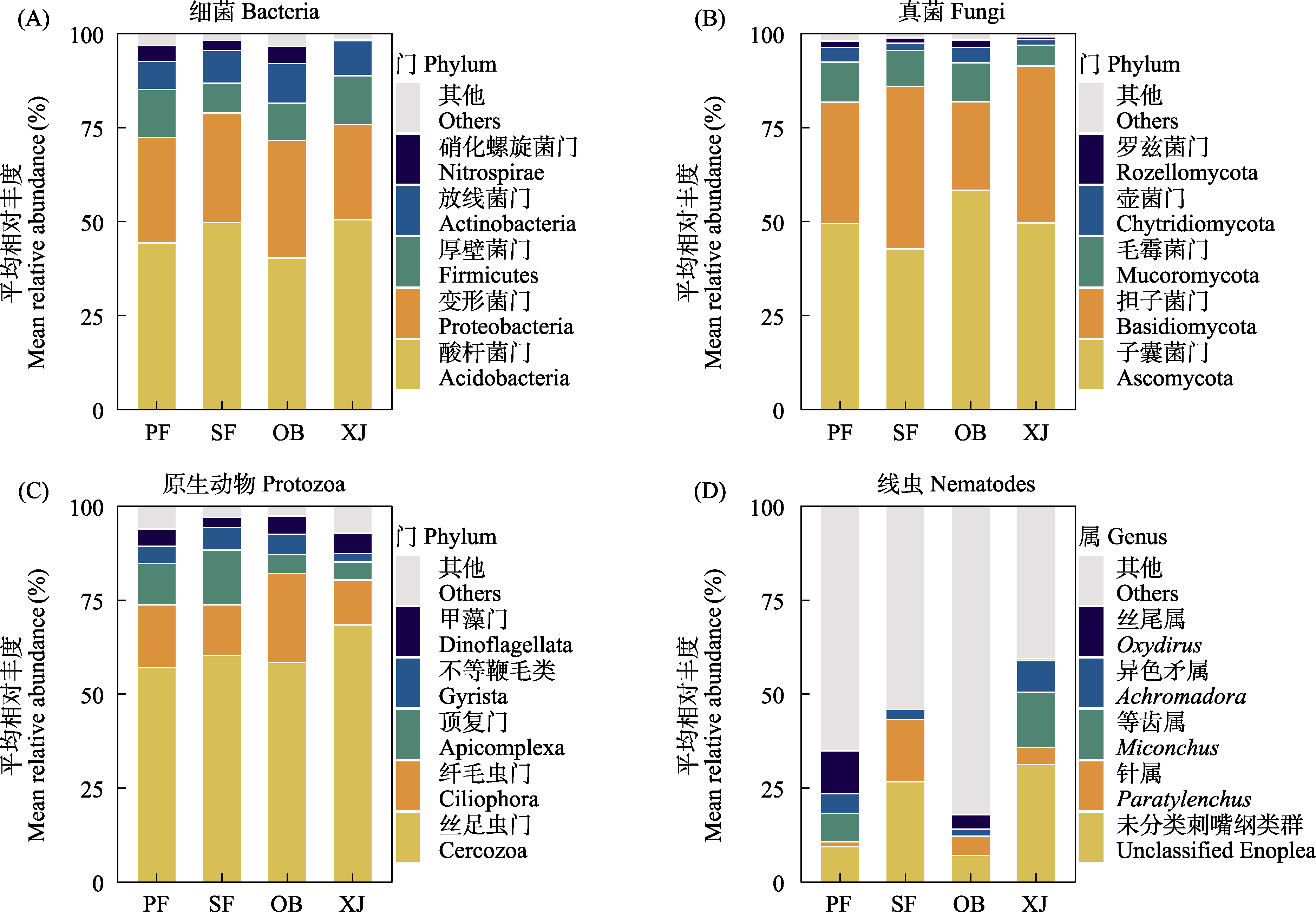
图1 不同土地利用方式下土壤微食物网各营养级生物的分类学组成。PF: 原始林; SF: 次生林; OB: 开阔生境; XJ: 橡胶林。
Fig. 1 Taxonomic composition of organisms at each trophic level of the soil micro-food web under different land use types. PF, Primary forest; SF, Secondary forest; OB, Open habitat; XJ, Rubber plantation.
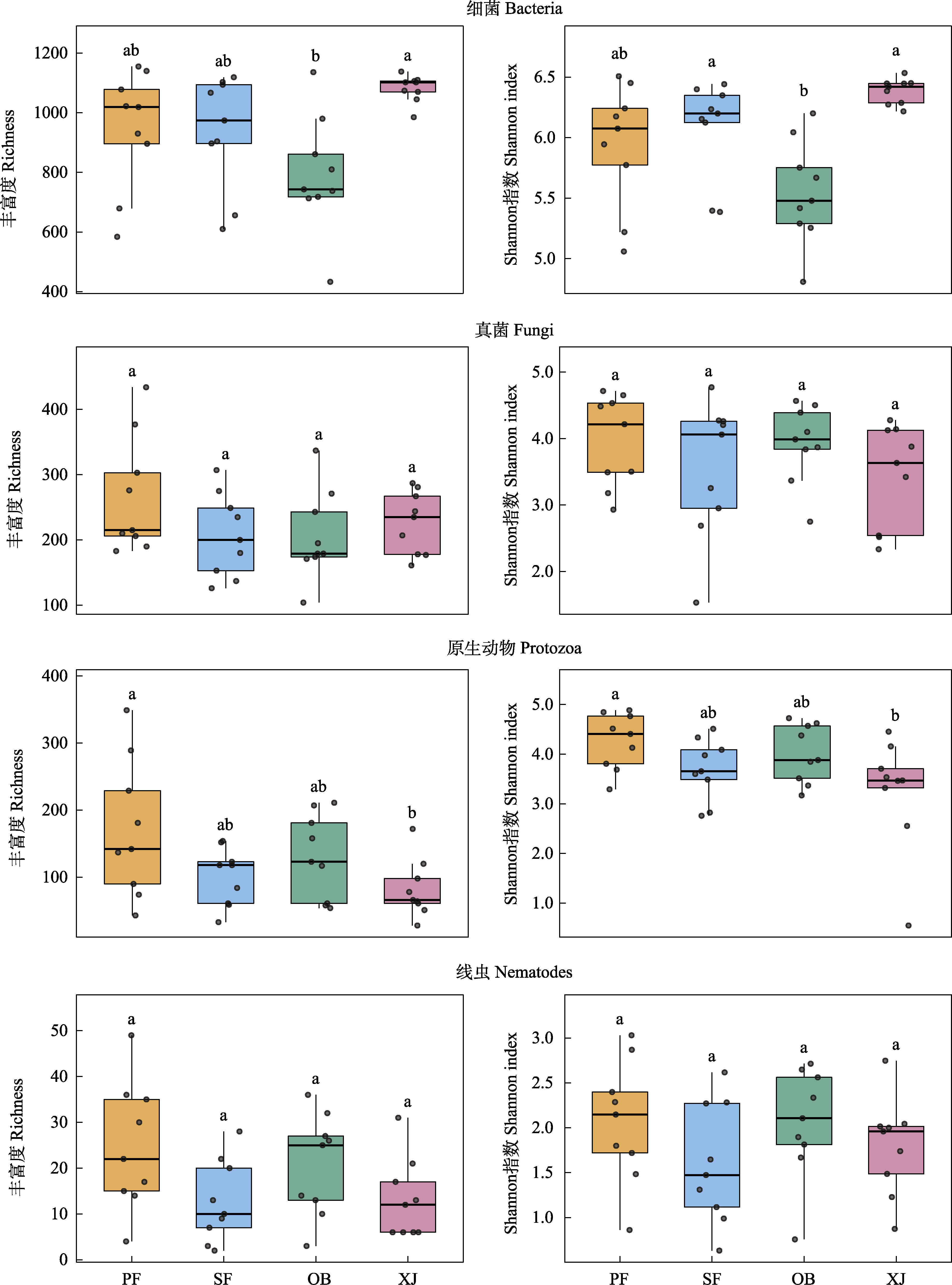
图2 不同土地利用方式下土壤微食物网各营养级生物的α多样性指数。PF: 原始林; SF: 次生林; OB: 开阔生境; XJ: 橡胶林。同一子图中不同小写字母表示不同土地利用方式之间差异显著。
Fig. 2 Alpha diversity indices of organisms at each trophic level in the soil micro-food web under different land use types. PF, Primary forest; SF, Secondary forest; OB, Open habitat; XJ, Rubber plantation. Different lowercase letters within the same panel indicate significant differences among land use types.
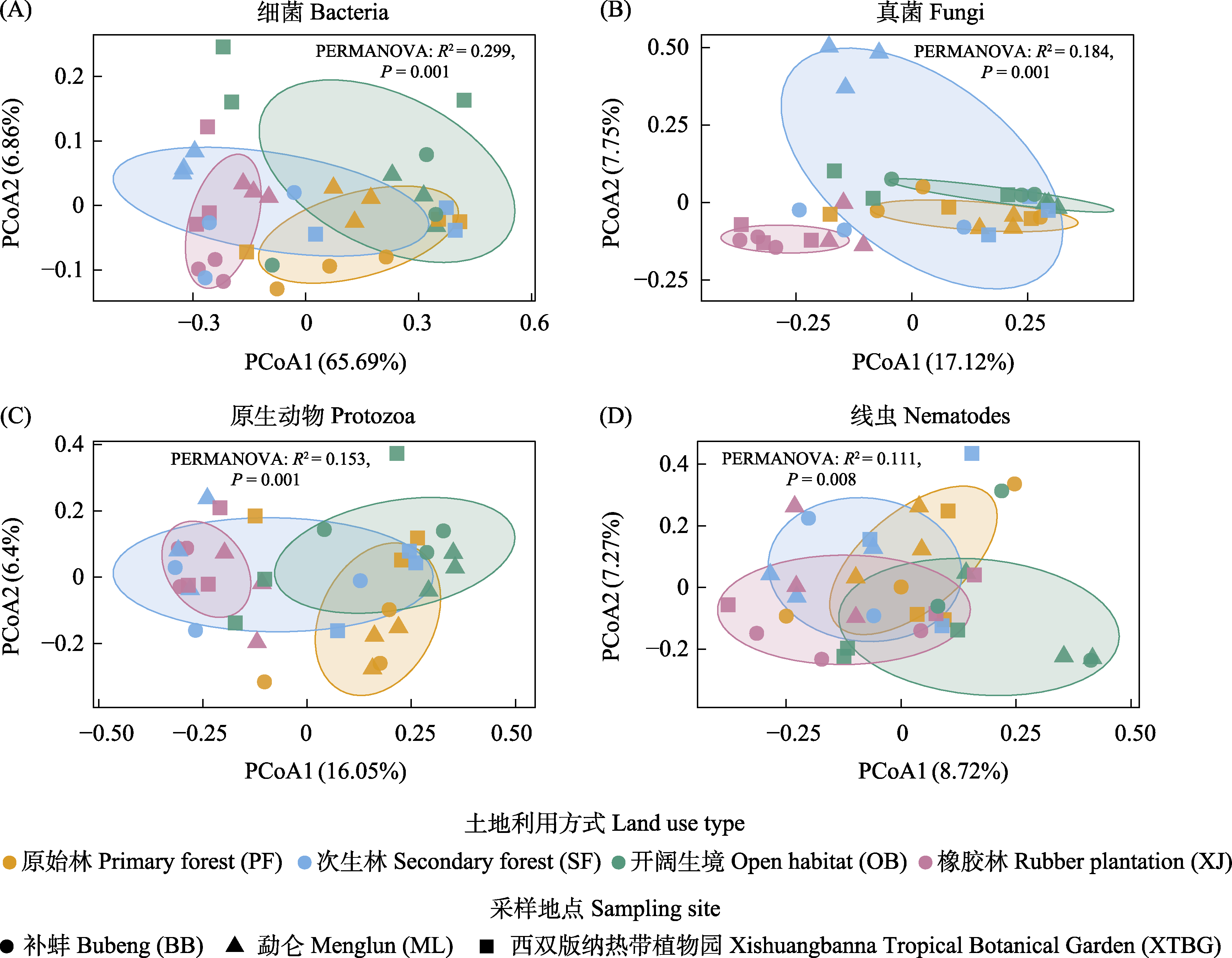
图3 基于扩增子序列变体(ASV)水平的Bray-Curtis距离的主坐标分析比较4种土地利用方式间的细菌、真菌、原生动物和线虫群落的相似性
Fig. 3 Principal coordinate analysis based on the Bray-Curtis distance at the amplicon sequence variant (ASV) level was used to compare the compositions of bacterial, fungal, protozoa and nematode communities among the four land use types
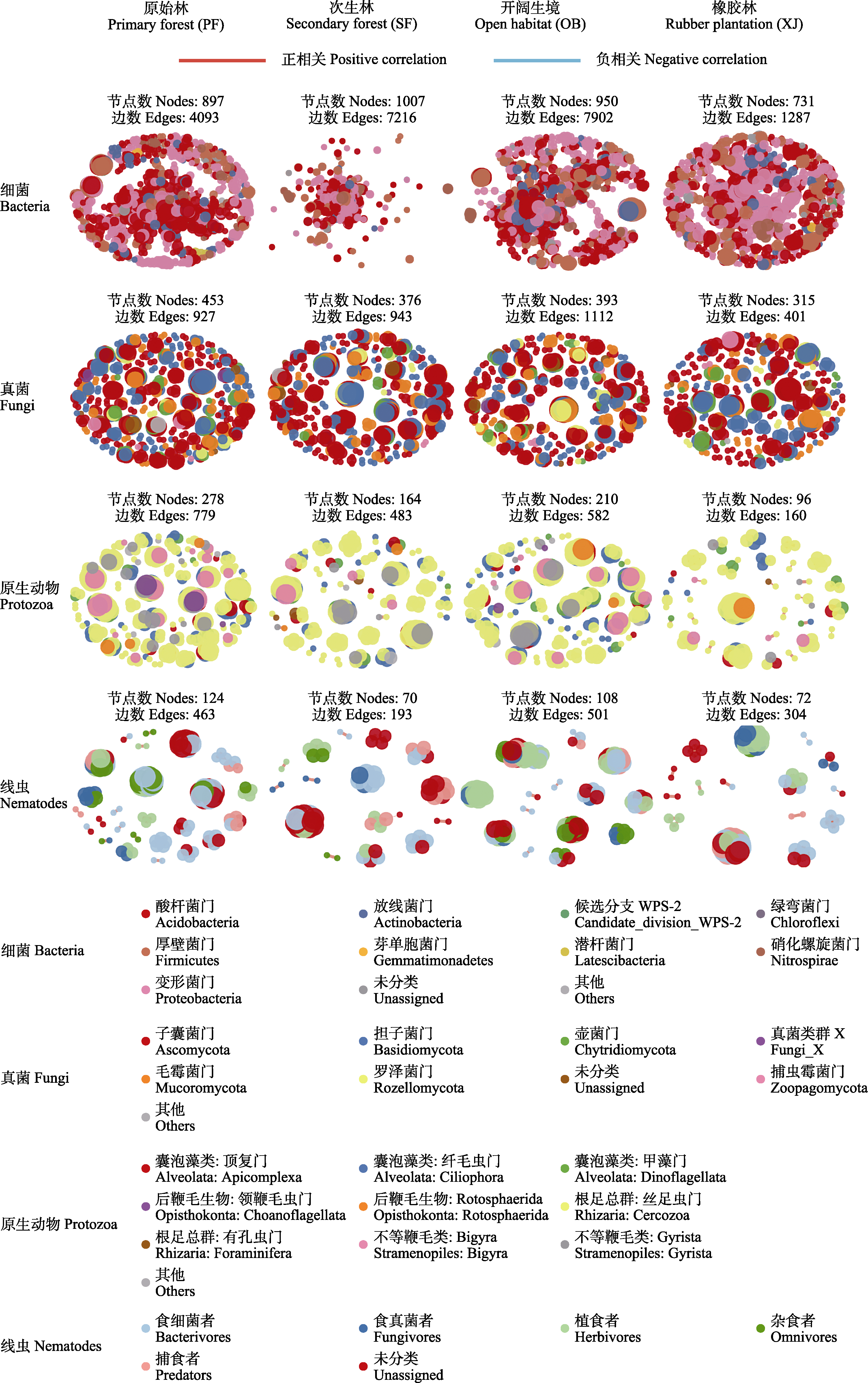
图4 土壤微食物网各生物群落的共现网络模式及拓扑统计。网络图展示了细菌、真菌、原生动物和线虫在不同土地利用方式下的Spearman相关性。每个子图内部节点大小与节点度成正比, 表示该节点与其他节点之间的显著关联数量。
Fig. 4 The co-occurrence network pattern and topological statistics of multi-nutrient-level biological communities in soil. The network diagram shows the Spearman correlation of bacteria, fungi, protozoa, and nematode under different land use types. Within each panel, node size is proportional to node degree, representing the number of significant associations between each node and other nodes.
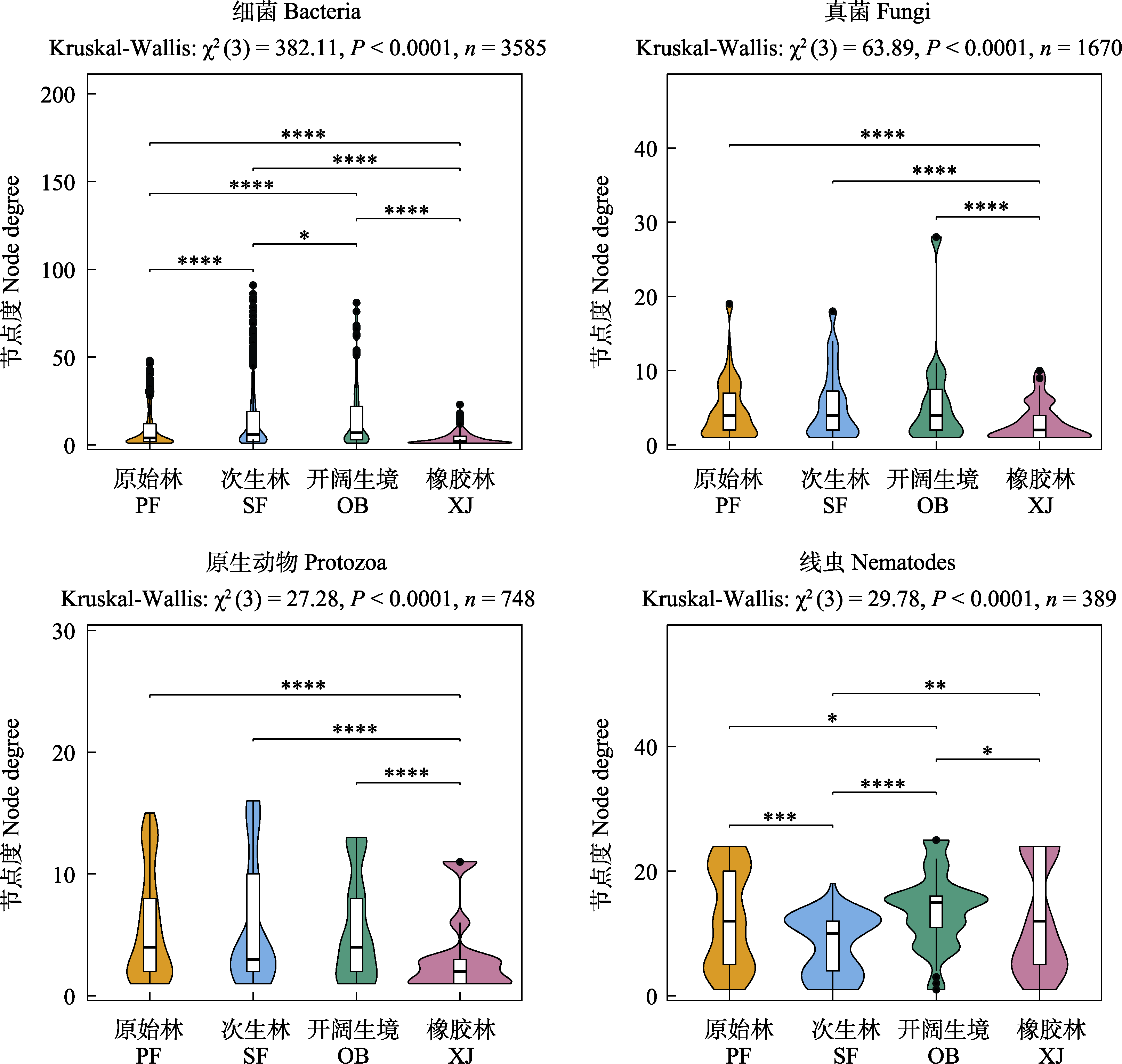
图5 各生物类群在不同土地利用方式下的节点度分布。* P < 0.05; ** P < 0.01; *** P < 0.001; **** P < 0.0001。
Fig. 5 Distribution of node degrees for each organism group across land use types. PF, Primary forest; SF, Secondary forest; OB, Open habitat; XJ, Rubber plantation. * P < 0.05; ** P < 0.01; *** P < 0.001; **** P < 0.0001.
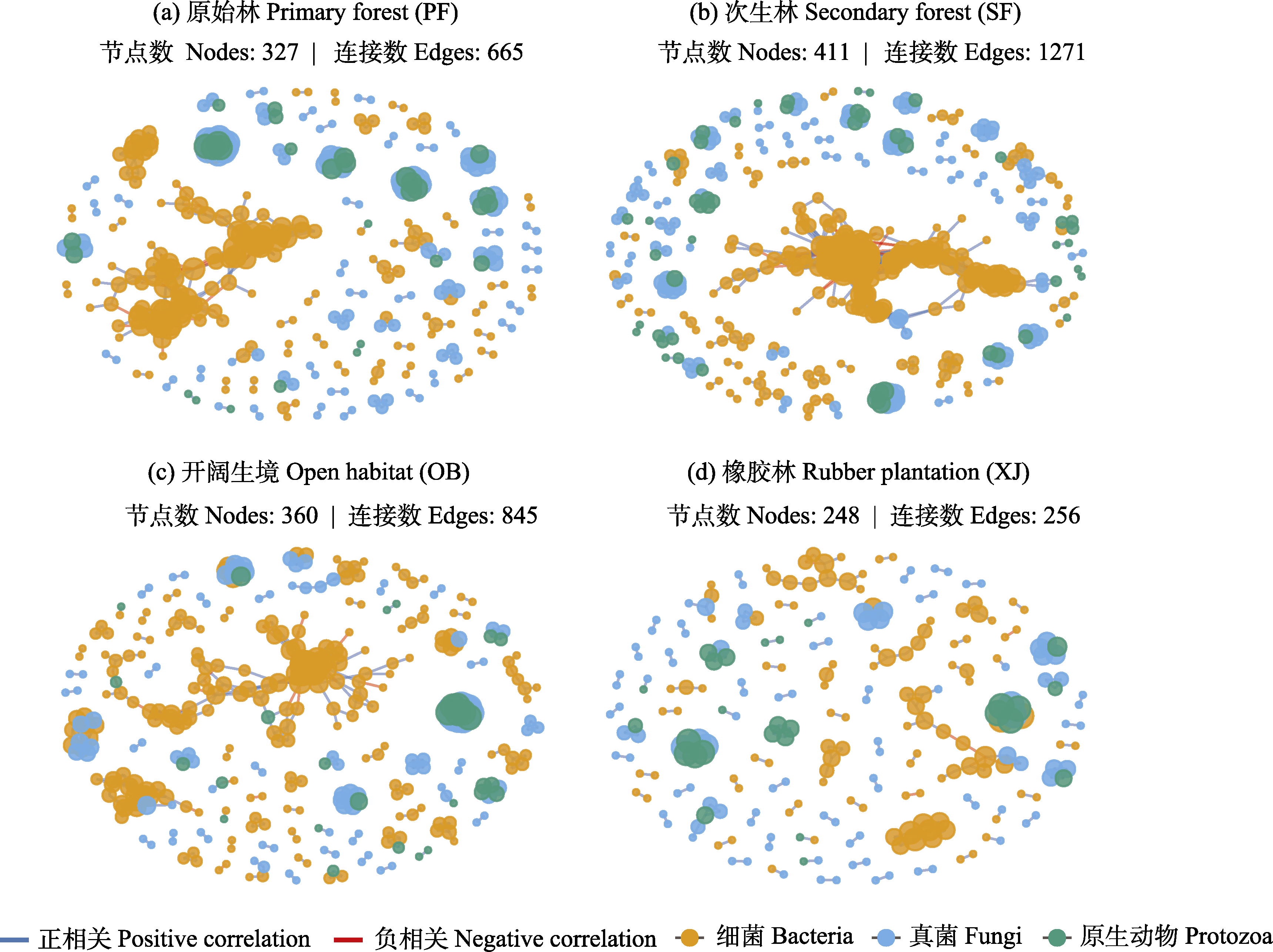
图6 不同土地利用方式下土壤微食物网的共现网络结构。代表线虫的节点已包含在网络构建的计算中, 但由于其丰度和连接度较低, 在此可视化结果中未能显示。
Fig. 6 Co-occurrence network structures of the soil micro-food web across different land use types. Nodes representing nematodes were included in the network calculations, but they are not displayed in this visualization due to their low abundance and connectivity.
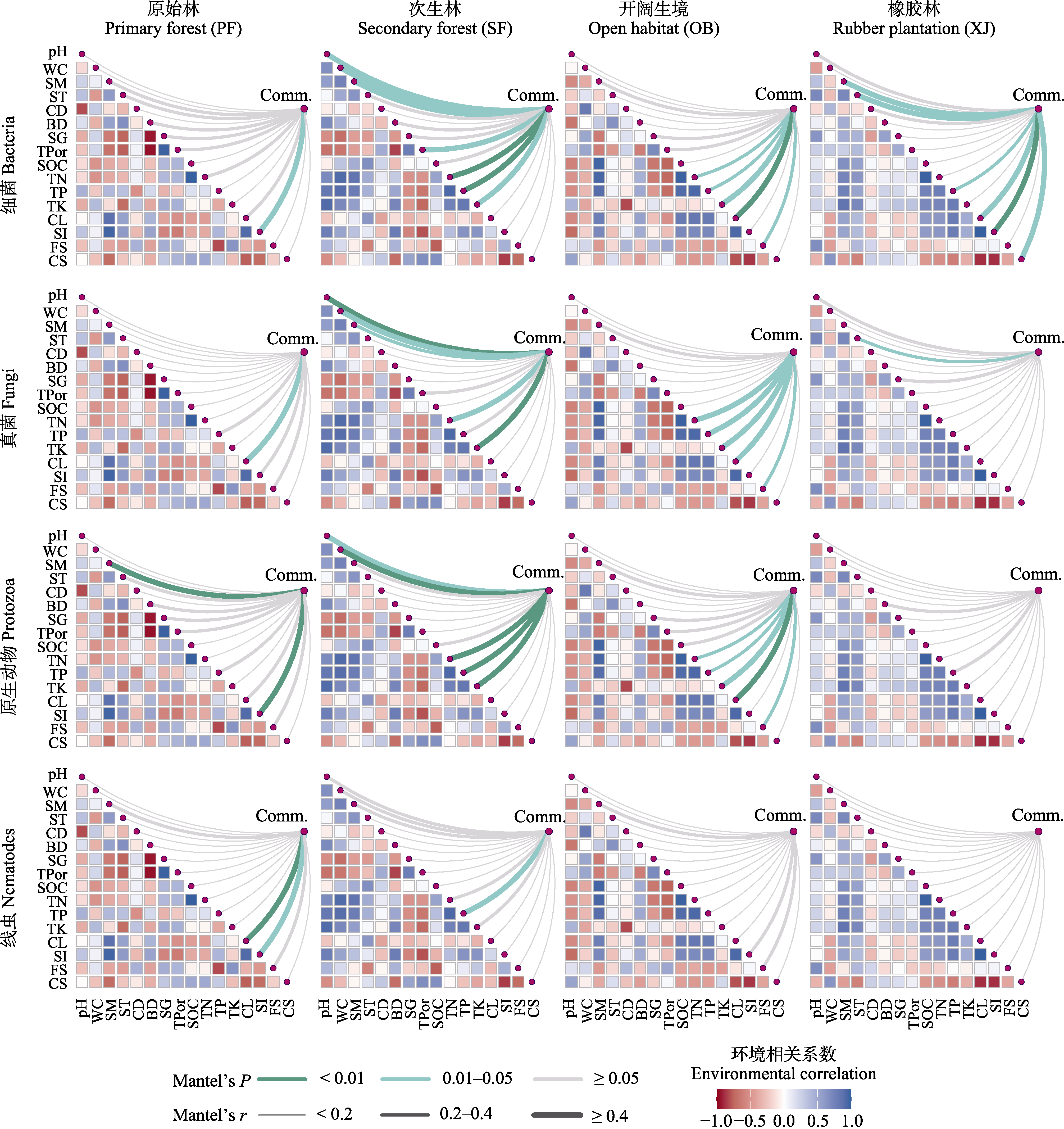
图7 不同土地利用方式下土壤微食物网群落与环境因子的Mantel关系。Comm.: 生物群落; pH: 土壤酸碱度; WC: 土壤含水量; SM: 土壤湿度; ST: 土壤温度; CD: 林冠密度; BD: 土壤容重; SG: 土壤比重; TPor: 总孔隙度; SOC: 土壤有机碳; TN: 全氮; TP: 全磷; TK: 全钾; CL: 粘粒(0-2 μm); SI: 粉粒(2-20 μm); FS: 细砂粒(20-200 μm); CS: 粗砂粒(200-2,000 μm)。
Fig. 7 Mantel relationships between soil micro-food web communities and environmental factors across land use types. Comm., Biological community; pH, Soil pH; WC, Soil water content; SM, Soil moisture; ST, Soil temperature; CD, Canopy density; BD, Soil bulk density; SG, Soil specific gravity; TPor, Total porosity; SOC, Soil organic carbon; TN, Total nitrogen; TP, Total phosphorus; TK, Total potassium; CL, Clay (0-2 μm); SI, Silt (2-20 μm); FS, Fine sand (20-200 μm); CS, Coarse sand (200-2,000 μm).
| [1] | Allison SD, Martiny JBH (2008) Resistance, resilience, and redundancy in microbial communities. Proceedings of the National Academy of Sciences, USA, 105(Suppl. 1), 11512-11519. |
| [2] | Amaral-Zettler LA, McCliment EA, Ducklow HW, Huse SM (2009) A method for studying protistan diversity using massively parallel sequencing of V9 hypervariable regions of small-subunit ribosomal RNA genes. PLoS ONE, 4, e6372. |
| [3] | Bardgett RD, van der Putten WH (2014) Belowground biodiversity and ecosystem functioning. Nature, 515, 505-511. |
| [4] | Barnes AD, Jochum M, Lefcheck JS, Eisenhauer N, Scherber C, O’Connor MI, de Ruiter P, Brose U (2018) Energy flux: The link between multitrophic biodiversity and ecosystem functioning. Trends in Ecology & Evolution, 33, 186-197. |
| [5] | Barnes AD, Jochum M, Mumme S, Haneda NF, Farajallah A, Widarto TH, Brose U (2014) Consequences of tropical land use for multitrophic biodiversity and ecosystem functioning. Nature Communications, 5, 5351. |
| [6] | Bascompte J, Jordano P, Melián CJ, Olesen JM (2003) The nested assembly of plant-animal mutualistic networks. Proceedings of the National Academy of Sciences, USA, 100, 9383-9387. |
| [7] | Bongers T (1990) The maturity index: An ecological measure of environmental disturbance based on nematode species composition. Oecologia, 83, 14-19. |
| [8] | Bronick CJ, Lal R (2005) Soil structure and management: A review. Geoderma, 124, 3-22. |
| [9] | Caporaso JG, Lauber CL, Walters WA, Berg-Lyons D, Huntley J, Fierer N, Owens SM, Betley J, Fraser L, Bauer M, Gormley N, Gilbert JA, Smith G, Knight R (2012) Ultra-high-throughput microbial community analysis on the Illumina HiSeq and MiSeq platforms. The ISME Journal, 6, 1621-1624. |
| [10] | de Vries FT, Griffiths RI, Bailey M, Craig H, Girlanda M, Gweon HS, Hallin S, Kaisermann A, Keith AM, Kretzschmar M, Lemanceau P, Lumini E, Mason KE, Oliver A, Ostle N, Prosser JI, Thion C, Thomson B, Bardgett RD (2018) Soil bacterial networks are less stable under drought than fungal networks. Nature Communications, 9, 3033. |
| [11] | de Vries FT, Thébault E, Liiri M, Birkhofer K, Tsiafouli MA, Bjørnlund L, Bracht Jørgensen H, Brady MV, Christensen S, de Ruiter PC, d’Hertefeldt T, Frouz J, Hedlund K, Hemerik L, Hol WHG, Hotes S, Mortimer SR, Setälä H, Sgardelis SP, Uteseny K, van der Putten WH, Wolters V, Bardgett RD (2013) Soil food web properties explain ecosystem services across European land use systems. Proceedings of the National Academy of Sciences, USA, 110, 14296-14301. |
| [12] | Decaëns T (2010) Macroecological patterns in soil communities. Global Ecology and Biogeography, 19, 287-302. |
| [13] | Díaz S, Settele J, Brondízio ES, Ngo HT, Agard J, Arneth A, Balvanera P, Brauman KA, Butchart SHM, Chan KMA, Garibaldi LA, Ichii K, Liu J, Subramanian SM, Midgley GF, Miloslavich P, Molnár Z, Obura D, Pfaff A, Polasky S, Purvis A, Razzaque J, Reyers B, Roy Chowdhury R, Shin YJ, Visseren-Hamakers I, Willis KJ, Zayas CN (2019) Pervasive human-driven decline of life on Earth points to the need for transformative change. Science, 366, eaax3100. |
| [14] | Elliott ET, Anderson RV, Coleman DC, Cole CV (1980) Habitable pore space and microbial trophic interactions. Oikos, 35, 327-335. |
| [15] | Erktan A, Or D, Scheu S (2020) The physical structure of soil: Determinant and consequence of trophic interactions. Soil Biology and Biochemistry, 148, 107876. |
| [16] | Fadrosh DW, Ma B, Gajer P, Sengamalay N, Ott S, Brotman RM, Ravel J (2014) An improved dual-indexing approach for multiplexed 16S rRNA gene sequencing on the Illumina MiSeq platform. Microbiome, 2, 6. |
| [17] | Ferris H (2010) Form and function: Metabolic footprints of nematodes in the soil food web. European Journal of Soil Biology, 46, 97-104. |
| [18] | Fierer N, Bradford MA, Jackson RB (2007) Toward an ecological classification of soil bacteria. Ecology, 88, 1354-1364. |
| [19] | Fierer N, Lauber CL, Ramirez KS, Zaneveld J, Bradford MA, Knight R (2012) Comparative metagenomic, phylogenetic and physiological analyses of soil microbial communities across nitrogen gradients. The ISME Journal, 6, 1007-1017. |
| [20] | Harrison XA, Donaldson L, Correa-Cano ME, Evans J, Fisher DN, Goodwin CED, Robinson BS, Hodgson DJ, Inger R (2018) A brief introduction to mixed effects modelling and multi-model inference in ecology. PeerJ, 6, e4794. |
| [21] | Hassink J, Bouwman LA, Zwart KB, Brussaard L (1993) Relationships between habitable pore space, soil biota and mineralization rates in grassland soils. Soil Biology and Biochemistry, 25, 47-55. |
| [22] | Jaureguiberry P, Titeux N, Wiemers M, Bowler DE, Coscieme L, Golden AS, Guerra CA, Jacob U, Takahashi Y, Settele J, Díaz S, Molnár Z, Purvis A (2022) The direct drivers of recent global anthropogenic biodiversity loss. Science Advances, 8, eabm9982. |
| [23] | Jousset A, Lara E, Wall LG, Valverde C (2006) Secondary metabolites help biocontrol strain Pseudomonas fluorescens CHA 0 to escape protozoan grazing. Applied and Environmental Microbiology, 72, 7083-7090. |
| [24] | Kitano H (2004) Biological robustness. Nature Reviews Genetics, 5, 826-837. |
| [25] | Li HM, Aide TM, Ma YX, Liu WJ, Cao M (2007) Demand for rubber is causing the loss of high diversity rain forest in SW China. Biodiversity and Conservation, 16, 1731-1745. |
| [26] | Lu RK (2000) Methods of Soil Agrochemical Analysis. China Agricultural Science and Technology Press, Beijing. (in Chinese) |
| [鲁如坤 (2000) 土壤农业化学分析方法. 中国农业科技出版社, 北京.] | |
| [27] | Luu HTT, Esteban GF, Green ID (2025) Soil ciliates’ response to glyphosate exposure: A microcosm experiment. Protist, 178, 126112. |
| [28] | Matz C, Kjelleberg S (2005) Off the hook-How bacteria survive protozoan grazing. Trends in Microbiology, 13, 302-307. |
| [29] | Newbold T, Hudson LN, Hill SLL, Contu S, Lysenko I, Senior RA, Börger L, Bennett DJ, Choimes A, Collen B, Day J, De Palma A, Díaz S, Echeverria-Londoño S, Edgar MJ, Feldman A, Garon M, Harrison MLK, Alhusseini T, Ingram DJ, Itescu Y, Kattge J, Kemp V, Kirkpatrick L, Kleyer M, Correia DLP, Martin CD, Meiri S, Novosolov M, Pan Y, Phillips HRP, Purves DW, Robinson A, Simpson J, Tuck SL, Weiher E, White HJ, Ewers RM, Mace GM, Scharlemann JPW, Purvis A (2015) Global effects of land use on local terrestrial biodiversity. Nature, 520, 45-50. |
| [30] | Newman MEJ (2003) The structure and function of complex networks. SIAM Review, 45, 167-256. |
| [31] | Olesen JM, Bascompte J, Dupont YL, Jordano P (2007) The modularity of pollination networks. Proceedings of the National Academy of Sciences, USA, 104, 19891-19896. |
| [32] | Orrock JL, Watling JI (2010) Local community size mediates ecological drift and competition in metacommunities. Proceedings of the Royal Society B: Biological Sciences, 277, 2185-2191. |
| [33] | Porazinska DL, Giblin-Davis RM, Faller L, Farmerie W, Kanzaki N, Morris K, Powers TO, Tucker AE, Sung W, Thomas WK (2009) Evaluating high-throughput sequencing as a method for metagenomic analysis of nematode diversity. Molecular Ecology Resources, 9, 1439-1450. |
| [34] | Rooney N, McCann K, Gellner G, Moore JC (2006) Structural asymmetry and the stability of diverse food webs. Nature, 442, 265-269. |
| [35] | Rutherford PM, Juma NG (1992) Influence of texture on habitable pore space and bacterial-protozoan populations in soil. Biology and Fertility of Soils, 12, 221-227. |
| [36] | Silk MJ, Harrison XA, Hodgson DJ (2020) Perils and pitfalls of mixed-effects regression models in biology. PeerJ, 8, e9522. |
| [37] | Singh D, Slik JWF, Jeon YS, Tomlinson KW, Yang X, Wang J, Kerfahi D, Porazinska DL, Adams JM (2019) Tropical forest conversion to rubber plantation affects soil micro-& mesofaunal community & diversity. Scientific Reports, 9, 5893. |
| [38] | Soliveres S, van der Plas F, Manning P, Prati D, Gossner MM, Renner SC, Alt F, Arndt H, Baumgartner V, Binkenstein J, Birkhofer K, Blaser S, Blüthgen N, Boch S, Böhm S, Börschig C, Buscot F, Diekötter T, Heinze J, Hölzel N, Jung K, Klaus VH, Kleinebecker T, Klemmer S, Krauss J, Lange M, Morris EK, Müller J, Oelmann Y, Overmann J, Pašalić E, Rillig MC, Schaefer HM, Schloter M, Schmitt B, Schöning I, Schrumpf M, Sikorski J, Socher SA, Solly EF, Sonnemann I, Sorkau E, Steckel J, Steffan-Dewenter I, Stempfhuber B, Tschapka M, Türke M, Venter PC, Weiner CN, Weisser WW, Werner M, Westphal C, Wilcke W, Wolters V, Wubet T, Wurst S, Fischer M, Allan E (2016) Biodiversity at multiple trophic levels is needed for ecosystem multifunctionality. Nature, 536, 456-459. |
| [39] | Swift MJ, Heal OW, Anderson JM (1979) Decomposition in Terrestrial Ecosystems. Blackwell Scientific Publications, Oxford. |
| [40] | Vellend M (2010) Conceptual synthesis in community ecology. The Quarterly Review of Biology, 85, 183-206. |
| [41] | Wang WT, Wang R, Niu CP, Bai Y, Yang XD (2023) Soil multitrophic ecological network structure of agroforestry rubber plantation in Xishuangbanna. Biodiversity Science, 31, 22626. (in Chinese with English abstract) |
| [王文婷, 王蓉, 牛翠平, 白杨, 杨效东 (2023) 西双版纳农林复合橡胶林土壤多营养级生物网络结构. 生物多样性, 31, 22626.] | |
| [42] | Warren-Thomas E, Dolman PM, Edwards DP (2015) Increasing demand for natural rubber necessitates a robust sustainability initiative to mitigate impacts on tropical biodiversity. Conservation Letters, 8, 230-241. |
| [43] | Wright DA, Killham K, Glover LA, Prosser JI (1995) Role of pore size location in determining bacterial activity during predation by protozoa in soil. Applied and Environmental Microbiology, 61, 3537-3543. |
| [44] | Wu WJ, Yuan Y, Zhang J, Zhou LX, Wang J, Ren H, Liu ZF (2022) Dynamics of soil nematode community during the succession of forests in southern subtropical China. Biodiversity Science, 30, 22205. (in Chinese with English abstract) |
| [吴文佳, 袁也, 张静, 周丽霞, 王俊, 任海, 刘占锋 (2022) 南亚热带森林演替过程中土壤线虫群落结构变化. 生物多样性, 30, 22205.] | |
| [45] | Zhang J, Cao M (1995) Tropical forest vegetation of Xishuangbanna, SW China and its secondary changes, with special reference to some problems in local nature conservation. Biological Conservation, 73, 229-238. |
| [46] | Zhao J, Neher DA, Fu SL, Li ZA, Wang KL (2013) Non-target effects of herbicides on soil nematode assemblages. Pest Management Science, 69, 679-684. |
| [47] | Zhou JZ, Deng Y, Luo F, He ZL, Yang YF (2011) Phylogenetic molecular ecological network of soil microbial communities in response to elevated CO2. mBio, 2, e00122-11. |
| [48] | Ziegler AD, Fox JM, Xu J (2009) The rubber juggernaut. Science, 324, 1024-1025. |
| [1] | 张一帆, 张文远, 王迪, 王志恒, 王戎疆. 全球变化情景下的中国蝴蝶受威胁物种名录[J]. 生物多样性, 2025, 33(12): 25400-. |
| [2] | 崔玉进, 李婉莹, 周青青, 赵恒, 吴芳, 员瑗. 北京地区油松与大叶黄杨叶际表生真菌多样性及群落组成[J]. 生物多样性, 2024, 32(7): 23498-. |
| [3] | 姜熠辉, 刘岳, 曾旭, 林喆滢, 王楠, 彭吉豪, 曹玲, 曾聪. 东海六个国家级海洋保护区鱼类多样性和连通性[J]. 生物多样性, 2024, 32(6): 24128-. |
| [4] | 王文婷, 王蓉, 牛翠平, 白杨, 杨效东. 西双版纳农林复合橡胶林土壤多营养级生物网络结构[J]. 生物多样性, 2023, 31(6): 22626-. |
| [5] | 张琼悦, 邓卓迪, 胡学斌, 丁志锋, 肖荣波, 修晨, 吴政浩, 汪光, 韩东晖, 张语克, 梁健超, 胡慧建. 粤港澳大湾区城市化进程对区域内鸟类分布及栖息地连通性的影响[J]. 生物多样性, 2023, 31(3): 22161-. |
| [6] | 丁洪波, 王立彦, 全东丽, 杨斌, 岳麻买, 王平元, 杨勇婧雯, 龚强帮, 周仕顺, 王力, 李剑武, 谭运洪. 中国云南种子植物区系新资料[J]. 生物多样性, 2023, 31(10): 23254-. |
| [7] | 杨润明, 中村彰宏. 巢居蚂蚁更倾向于在人造光源附近定居繁殖[J]. 生物多样性, 2022, 30(8): 22067-. |
| [8] | 周昌艳, 王彬, 邓云, 乌俊杰, 曹敏, 林露湘. 林冠结构是局域尺度木本植物功能性状beta多样性形成的重要驱动力[J]. 生物多样性, 2020, 28(12): 1546-1557. |
| [9] | 杨云卉, 白可喻, Devra Jarvis, 龙春林. 西双版纳黄瓜农家品种及其传统知识[J]. 生物多样性, 2019, 27(7): 743-748. |
| [10] | 孙孝平,李双,余建平,方彦君,张银龙,曹铭昌. 基于土地利用变化情景的生态系统服务价值评估: 以钱江源国家公园体制试点区为例[J]. 生物多样性, 2019, 27(1): 51-63. |
| [11] | 丁晨晨, 胡一鸣, 李春旺, 蒋志刚. 印度野牛在中国的分布及其栖息地适宜性分析[J]. 生物多样性, 2018, 26(9): 951-961. |
| [12] | 刘继亮, 李锋瑞. 干旱区绿洲扩张方式对土壤生物优势类群及功能的影响[J]. 生物多样性, 2018, 26(10): 1116-1126. |
| [13] | 宋亚琼, 刘芝龙, Sophie Willian, 高江云. 西双版纳兰科植物集市贸易特点和保护启示[J]. 生物多样性, 2017, 25(5): 531-539. |
| [14] | 许再富. 生物多样性保护与文化多样性保护是一枚硬币的两面: 以西双版纳傣族生态文化为例[J]. 生物多样性, 2015, 23(1): 126-130. |
| [15] | 方强, 黄双全. 传粉网络的研究进展: 网络的结构和动态[J]. 生物多样性, 2012, 20(3): 300-307. |
| 阅读次数 | ||||||
|
全文 |
|
|||||
|
摘要 |
|
|||||
备案号:京ICP备16067583号-7
Copyright © 2026 版权所有 《生物多样性》编辑部
地址: 北京香山南辛村20号, 邮编:100093
电话: 010-62836137, 62836665 E-mail: biodiversity@ibcas.ac.cn
