

生物多样性 ›› 2026, Vol. 34 ›› Issue (7): 25510. DOI: 10.17520/biods.2025510 cstr: 32101.14.biods.2025510
张谢勇1,2,3,#( ), 刘昊1,2,3,#(), 田雨薇1,#(), 岑鑫1,13,#, 蔡竞4,5,#, 李宇格1,2,3,#, 张云玲7, 赵利清6, 刘艳春8, 寻路路9, 刘磊10, 陈天翔1, 周廉1, 阎平11, 覃海宁1,2,3, 袁良琛12, 刘慧圆1,*(
 ), 马洪峥13,*()(), 陈文俐1,2,3,*()()
收稿日期:2025-12-23
接受日期:2026-03-09
出版日期:2026-07-20
发布日期:2026-09-21
通讯作者:
刘慧圆,马洪峥,陈文俐
作者简介:第一联系人:# 共同第一作者
基金资助:
Xieyong Zhang1,2,3,#(), Hao Liu1,2,3,#(), Yuwei Tian1,#(), Xin Cen1,13,#, Jing Cai4,5,#, Yuge Li1,2,3,#, Yunling Zhang7, Liqing Zhao6, Yanchun Liu8, Lulu Xun9, Lei Liu10, Tianxiang Chen1, Lian Zhou1, Ping Yan11, Haining Qin1,2,3, Liangchen Yuan12, Huiyuan Liu1,*(), Hongzheng Ma13,*()(), Wenli Chen1,2,3,*()()
Received:2025-12-23
Accepted:2026-03-09
Online:2026-07-20
Published:2026-09-21
Contact:
Huiyuan Liu, Hongzheng Ma, Wenli Chen
About author:First author contact:# Co-first author
Supported by:摘要:
禾本科小麦族包含众多作物的野生近缘种与优质牧草资源, 在农业育种、畜牧业发展与生态修复中具有不可替代的战略价值。中国拥有丰富的小麦族野生植物资源, 但《国家重点保护野生植物名录》(2021版)收录的5属12种小麦族植物中, 普遍存在基础数据缺失、物种鉴定困难等问题, 严重制约其保护与利用。本研究基于馆藏标本查阅与系统的野外调查, 综合研究了该类保护植物的地理分布、形态学、细胞学及亚基因组组成等关键特征, 填补了基础数据缺口, 可为物种精准鉴定提供可靠依据。此外, 参照世界自然保护联盟(IUCN)物种红色名录濒危等级和标准重新评估其濒危状况, 发现沙芦草(Agropyron mongolicum)等10个物种受威胁等级上调, 其中内蒙古大麦(Hordeum innermongolicum)上调为极危, 疑似野外灭绝; 华山新麦草(Psathyrostachys huashanica)等级下调; 毛披碱草(Elymus villifer)保持不变; 栖息地退化与破碎化、自然种群过少是主要威胁。基于此, 本文提出分物种差异化就地保护、种质资源系统性收集保藏、建立名录物种动态评估更新机制的整合性保护策略, 以期为该类资源的保护与可持续利用提供科学支撑。
张谢勇, 刘昊, 田雨薇, 岑鑫, 蔡竞, 李宇格, 张云玲, 赵利清, 刘艳春, 寻路路, 刘磊, 陈天翔, 周廉, 阎平, 覃海宁, 袁良琛, 刘慧圆, 马洪峥, 陈文俐 (2026) 小麦族国家重点保护野生植物多样性与濒危等级评估. 生物多样性, 34, 25510. DOI: 10.17520/biods.2025510.
Xieyong Zhang, Hao Liu, Yuwei Tian, Xin Cen, Jing Cai, Yuge Li, Yunling Zhang, Liqing Zhao, Yanchun Liu, Lulu Xun, Lei Liu, Tianxiang Chen, Lian Zhou, Ping Yan, Haining Qin, Liangchen Yuan, Huiyuan Liu, Hongzheng Ma, Wenli Chen (2026) Diversity and threatened categories assessment of national key protected wild plants of the Triticeae (Poaceae). Biodiversity Science, 34, 25510. DOI: 10.17520/biods.2025510.
| 物种 Species | 核型 Karyotype | 染色体相对长度 Relative length of chromosomes | 亚基因组成 Subgenome composition |
|---|---|---|---|
| 沙芦草 Agropyron mongolicum | 1A, 2n = 2x = 14 = 12m + 2sm | 12.28%-16.20% | P (颜济等, |
| 阿拉善披碱草 Elymus alashanicus | 2A, 2n = 4x = 28 = 20m (2sat) + 8sm | 5.07%-8.87% | St |
| 黑紫披碱草 E. atratus | 1A, 2n = 6x = 42 = 38m (6sat) + 4sm (2sat) | 3.56%-6.70% | StHY |
| 短柄披碱草 E. brevipes | 1A, 2n = 4x = 28 = 24m + 4sm | 5.31%-9.21% | StY |
| 内蒙披碱草 E. intramongolicus | 2A, 2n = 4x = 28 = 22m (2sat) + 6sm | 5.12%-8.68% | StH |
| 紫芒披碱草 E. purpuraristatus | 1A, 2n = 6x = 42 = 32m (2sat) + 10sm | 3.48%-6.22% | StHY |
| 新疆披碱草 E. sinkiangensis | 2A, 2n = 4x = 28 = 24m + 4sm | 5.72%-9.41% | StY |
| 无芒披碱草 E. sinosubmuticus | 2A, 2n = 6x = 42 = 28m + 14sm (2sat) | 3.68%-6.11% | StHY |
| 毛披碱草 E. villifer | 1A, 2n = 6x = 42 = 30m + 12sm (6sat) (刘玉红, | - | StHY |
| 内蒙古大麦 Hordeum innermongolicum | - | - | - |
| 青海以礼草 Kengyilia kokonorica | 1B, 2n = 6x = 42 = 30m + 12sm | 3.02%-7.75% | StYP |
| 华山新麦草 Psathyrostachys huashanica | 2A, 2n = 2x = 14 = 10m (4sat) + 4sm (2sat) | 12.30%-19.53% | Ns (Li et al., |
表1 小麦族国家重点保护野生植物的染色体数目、核型与亚基因组组成鉴定实验结果。所有未标注文献的数据均来自本研究。-指未获得研究材料, 也没有文献报道。
Table 1 Results of chromosome number, karyotype and subgenome composition characterization of national key protected wild plants of the Triticeae. Data without cited references were obtained from this study. -indicates that neither experimental materials were acquired nor relevant records have been reported in published literature.
| 物种 Species | 核型 Karyotype | 染色体相对长度 Relative length of chromosomes | 亚基因组成 Subgenome composition |
|---|---|---|---|
| 沙芦草 Agropyron mongolicum | 1A, 2n = 2x = 14 = 12m + 2sm | 12.28%-16.20% | P (颜济等, |
| 阿拉善披碱草 Elymus alashanicus | 2A, 2n = 4x = 28 = 20m (2sat) + 8sm | 5.07%-8.87% | St |
| 黑紫披碱草 E. atratus | 1A, 2n = 6x = 42 = 38m (6sat) + 4sm (2sat) | 3.56%-6.70% | StHY |
| 短柄披碱草 E. brevipes | 1A, 2n = 4x = 28 = 24m + 4sm | 5.31%-9.21% | StY |
| 内蒙披碱草 E. intramongolicus | 2A, 2n = 4x = 28 = 22m (2sat) + 6sm | 5.12%-8.68% | StH |
| 紫芒披碱草 E. purpuraristatus | 1A, 2n = 6x = 42 = 32m (2sat) + 10sm | 3.48%-6.22% | StHY |
| 新疆披碱草 E. sinkiangensis | 2A, 2n = 4x = 28 = 24m + 4sm | 5.72%-9.41% | StY |
| 无芒披碱草 E. sinosubmuticus | 2A, 2n = 6x = 42 = 28m + 14sm (2sat) | 3.68%-6.11% | StHY |
| 毛披碱草 E. villifer | 1A, 2n = 6x = 42 = 30m + 12sm (6sat) (刘玉红, | - | StHY |
| 内蒙古大麦 Hordeum innermongolicum | - | - | - |
| 青海以礼草 Kengyilia kokonorica | 1B, 2n = 6x = 42 = 30m + 12sm | 3.02%-7.75% | StYP |
| 华山新麦草 Psathyrostachys huashanica | 2A, 2n = 2x = 14 = 10m (4sat) + 4sm (2sat) | 12.30%-19.53% | Ns (Li et al., |
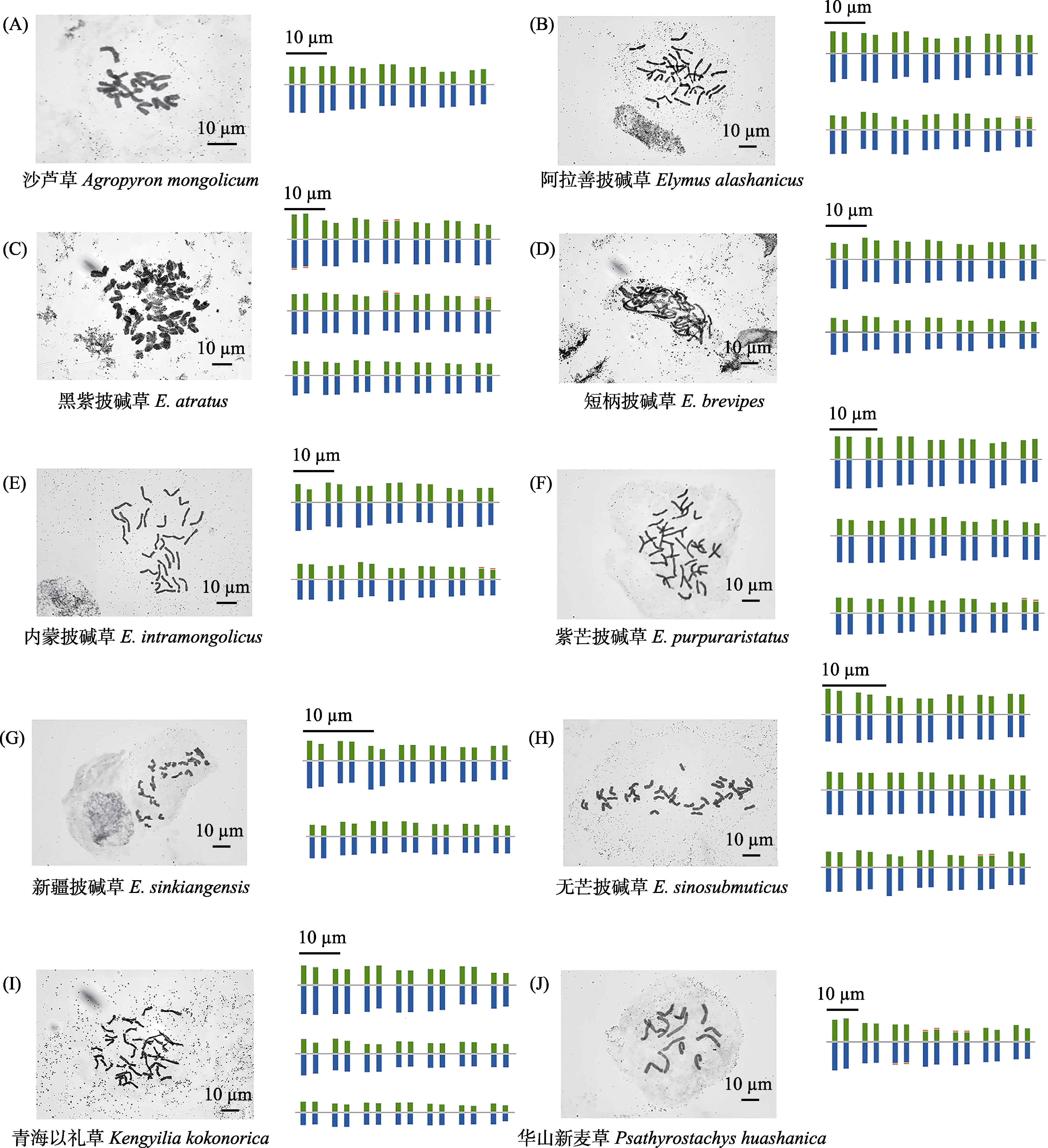
图1 10种小麦族国家重点保护野生植物的染色体核型图。因内蒙古大麦没有获得成熟种子, 毛披碱草种子未能成功萌发, 故未能开展实验。
Fig. 1 Chromosome karyotype plates of 10 national key protected wild plants of the Triticeae. No mature seeds were obtained for Hordeum innermongolicum, whereas seeds of Elymus villifer failed to germinate, precluding further experimental analyses.
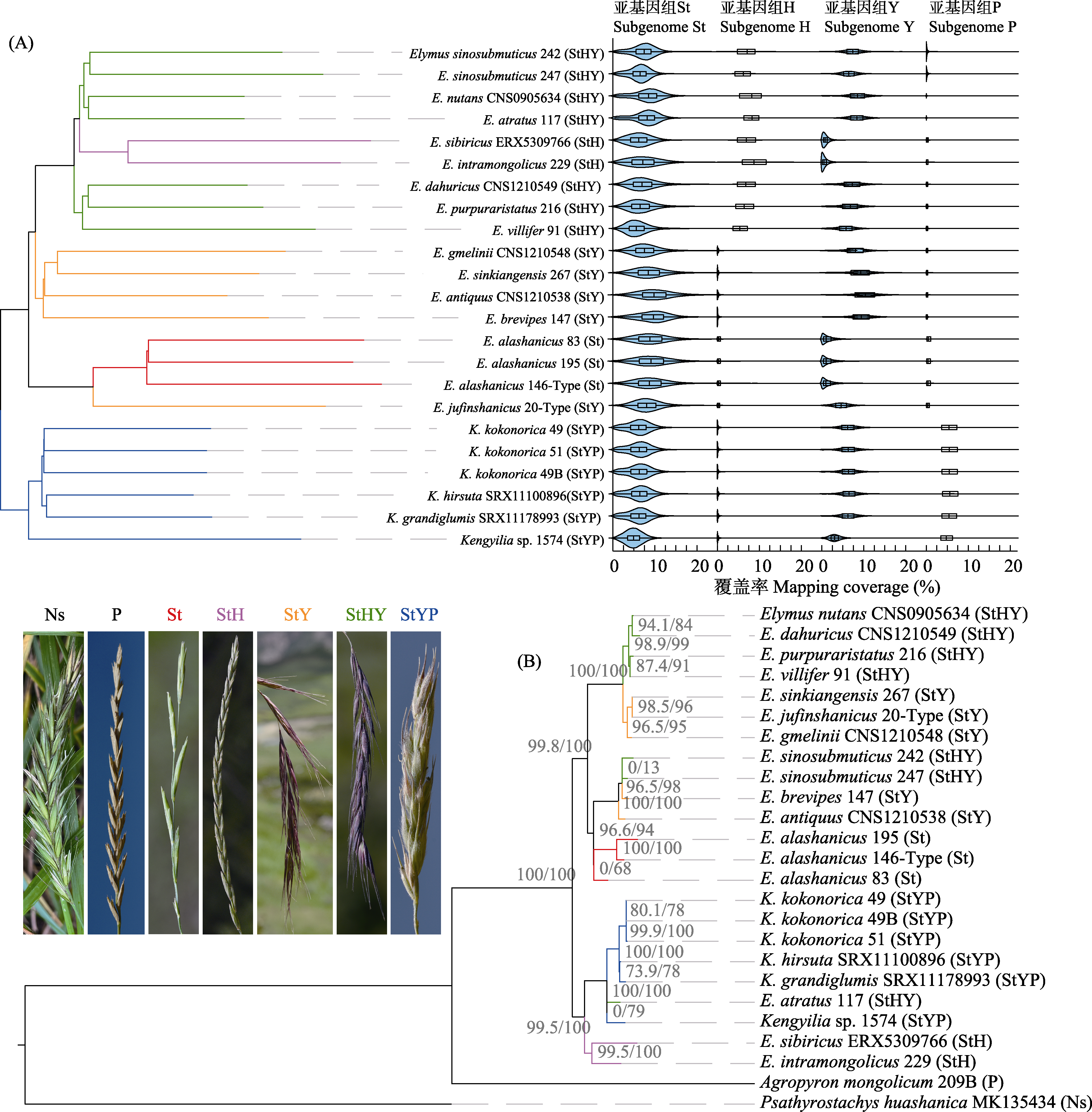
图2 小麦族国家重点保护野生植物分子鉴定。(A)基于全基因组k-mer (k = 21)分析的邻接法系统发育树和基于全基因组比对的亚基因组组成分析, 分别统计St、H、Y、P亚基因组上50 kb无重叠窗口的覆盖度; (B)基于质体基因组的最大似然法系统发育树, 使用IQ-TREE构建, 节点上的数字为分别使用SH-aLRT/UFBoot模式计算的节点支持率。分支的颜色代表不同的亚基因组组成, 同时提供了每种亚基因组组成的花序特征。
Fig. 2 Molecular identification of national key protected wild plants of the Triticeae. (A) Phylogenetic tree inferred from the neighbor-joining analysis based on whole-genome k-mer (k = 21) and subgenome constitution inferred from whole-genome mapping coverage, 50-kb non-overlapping windows was calculated for the St, H, Y and P subgenomes, respectively. (B) Phylogenetic tree inferred from the maximum likelihood analysis based on plastid genomes, numbers at nodes indicate support values obtained by IQ-TREE under SH-aLRT/UFBoot schemes. Branch colors denote different subgenome compositions, and inflorescence characters are provided on the left for each type of subgenome composition.
| 物种 Species | 结实率 Seed setting rate (%) | 千粒重 Thousand kernel weight (g) | 种子大小 Seed size (mm2) |
|---|---|---|---|
| 沙芦草 Agropyron mongolicum | 24 | 1.63 | 5.7 |
| 阿拉善披碱草 Elymus alashanicus | 10 | 2.87 | 9.6 |
| 黑紫披碱草 E. atratus | 60 | 1.87 | 10.5 |
| 短柄披碱草E. brevipes | 77 | 3.59 | 9.8 |
| 内蒙披碱草 E. intramongolicus | 73 | 4.00 | 17.9 |
| 紫芒披碱草 E. purpuraristatus | 86 | 3.53 | 12.3 |
| 新疆披碱草 E. sinkiangensis | 19 | 3.94 | 14.6 |
| 无芒披碱草 E. sinosubmuticus | 67 | 3.44 | 9.7 |
| 毛披碱草 E. villifer | 21 | 1.38 | 11.6 |
| 青海以礼草 Kengyilia kokonorica | 35 | 5.31 | 12.2 |
| 华山新麦草 Psathyrostachys huashanica | 47 | 5.21 | 16.5 |
表2 小麦族国家重点保护野生植物的有性生殖与传播能力。因内蒙古大麦没有采集到成熟种子, 故未能开展实验。
Table 2 Sexual reproduction and dispersal abilities of national key protected wild plants of the Triticeae. Mature seeds of Hordeum innermongolicum were unavailable, and relevant experiments were therefore not performed.
| 物种 Species | 结实率 Seed setting rate (%) | 千粒重 Thousand kernel weight (g) | 种子大小 Seed size (mm2) |
|---|---|---|---|
| 沙芦草 Agropyron mongolicum | 24 | 1.63 | 5.7 |
| 阿拉善披碱草 Elymus alashanicus | 10 | 2.87 | 9.6 |
| 黑紫披碱草 E. atratus | 60 | 1.87 | 10.5 |
| 短柄披碱草E. brevipes | 77 | 3.59 | 9.8 |
| 内蒙披碱草 E. intramongolicus | 73 | 4.00 | 17.9 |
| 紫芒披碱草 E. purpuraristatus | 86 | 3.53 | 12.3 |
| 新疆披碱草 E. sinkiangensis | 19 | 3.94 | 14.6 |
| 无芒披碱草 E. sinosubmuticus | 67 | 3.44 | 9.7 |
| 毛披碱草 E. villifer | 21 | 1.38 | 11.6 |
| 青海以礼草 Kengyilia kokonorica | 35 | 5.31 | 12.2 |
| 华山新麦草 Psathyrostachys huashanica | 47 | 5.21 | 16.5 |
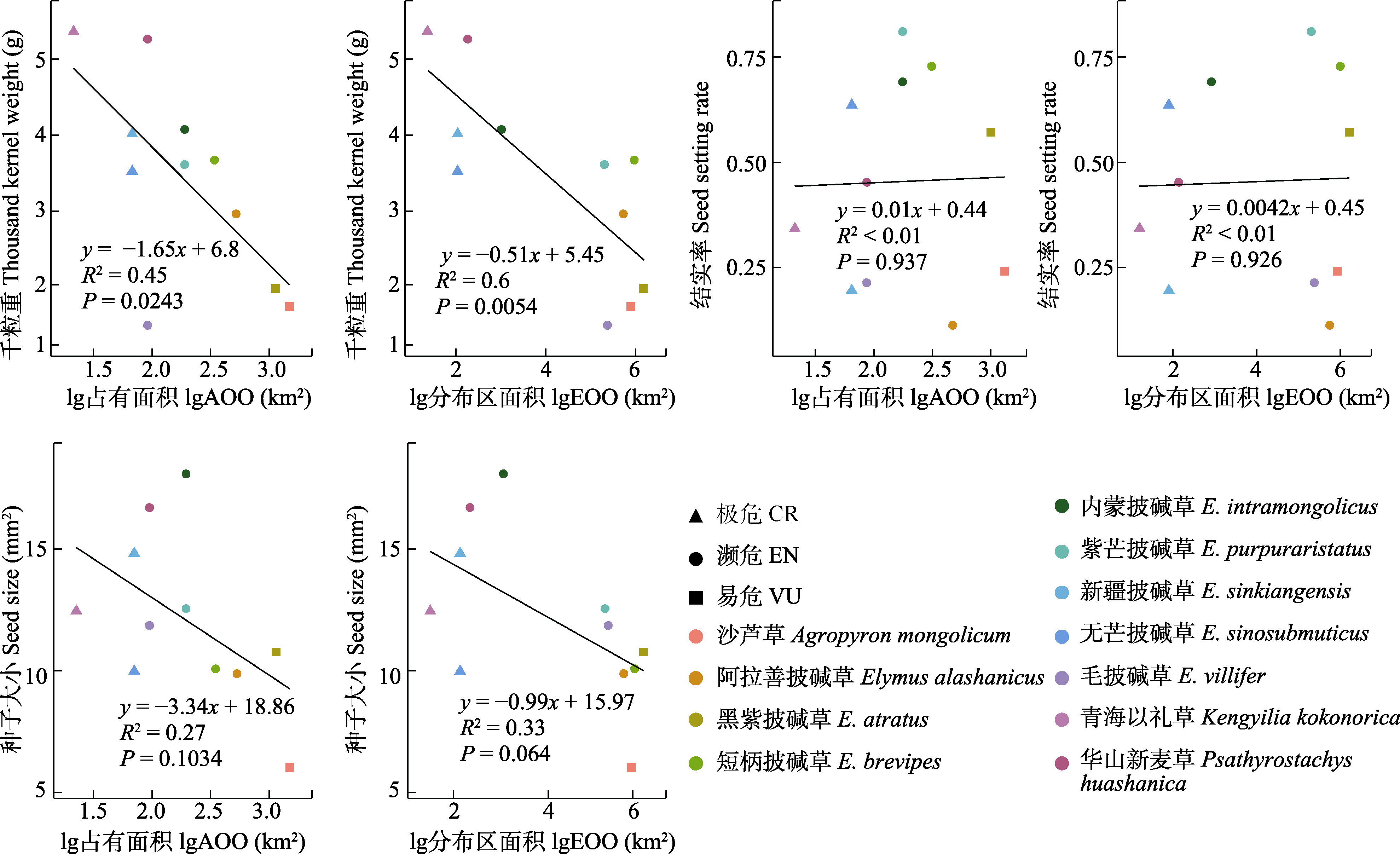
图3 小麦族国家重点保护野生植物结实率、千粒重、种子大小与物种分布区面积(EOO) (km2)及占有面积(AOO) (km2)的相关性分析。因内蒙古大麦没有获得成熟种子, 故未能开展实验。
Fig. 3 Correlation analysis among seed setting rate, thousand kernal weight, seed size, and extent of occurrence (EOO) (km2) as well as area of occupancy (AOO) (km2) for the national key protected wild plants of the Triticeae. Mature seeds of Hordeum innermongolicum were unavailable, and relevant experiments were therefore not performed.
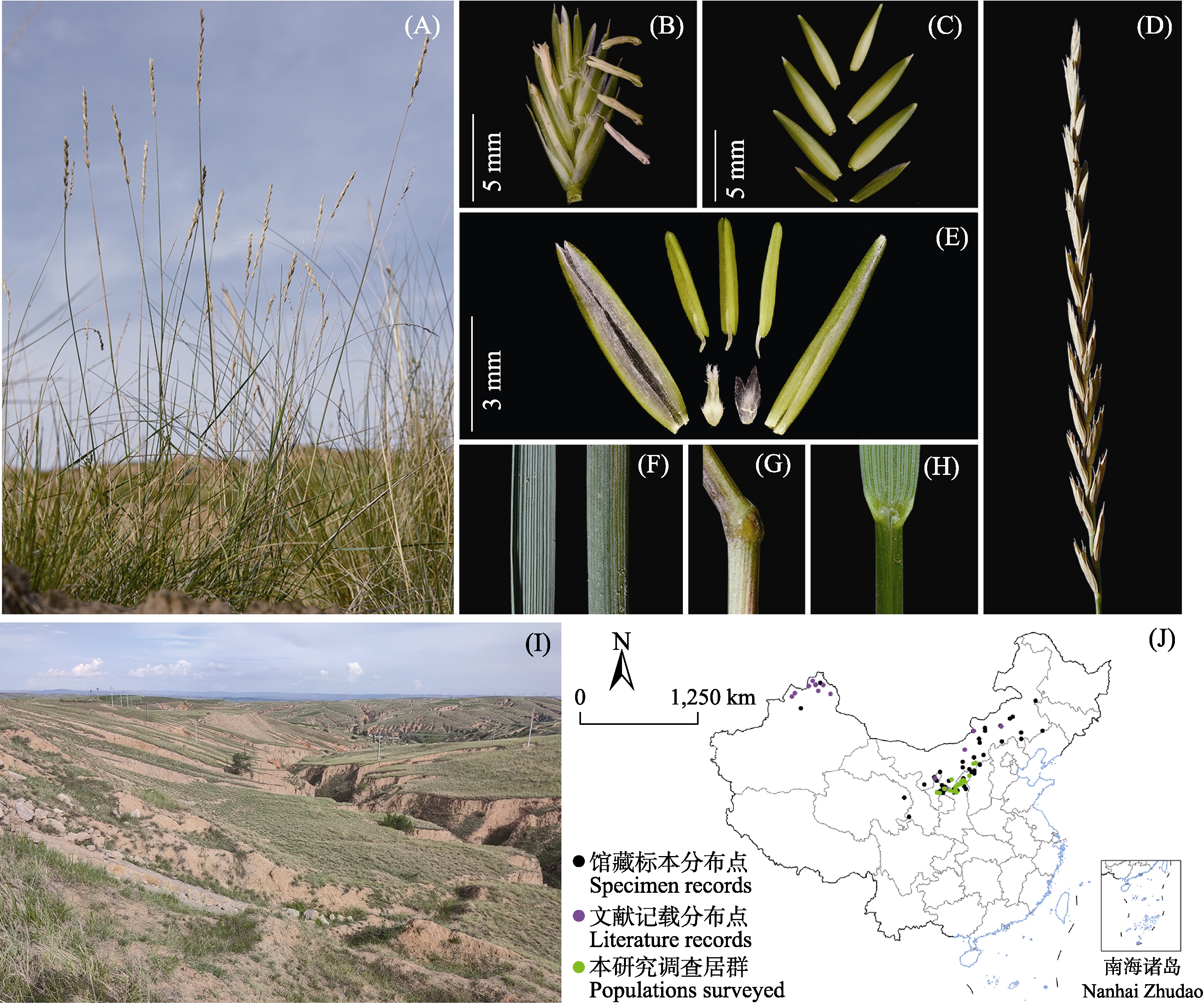
图4 沙芦草的形态特征、生境与地理分布。(A)植株; (B)、(C)小穗; (D)花序; (E)小花; (F)叶片; (G)茎节; (H)叶舌; (I)生境; (J)地理分布。
Fig. 4 Morphological characteristics, habitat, and geographic distribution of Agropyron mongolicum. (A) Plant; (B), (C) Spikelet; (D) Inflorescence; (E) Floret; (F) Leaf blade; (G) Culm node; (H) Ligule; (I) Habitat; (J) Geographic distribution.
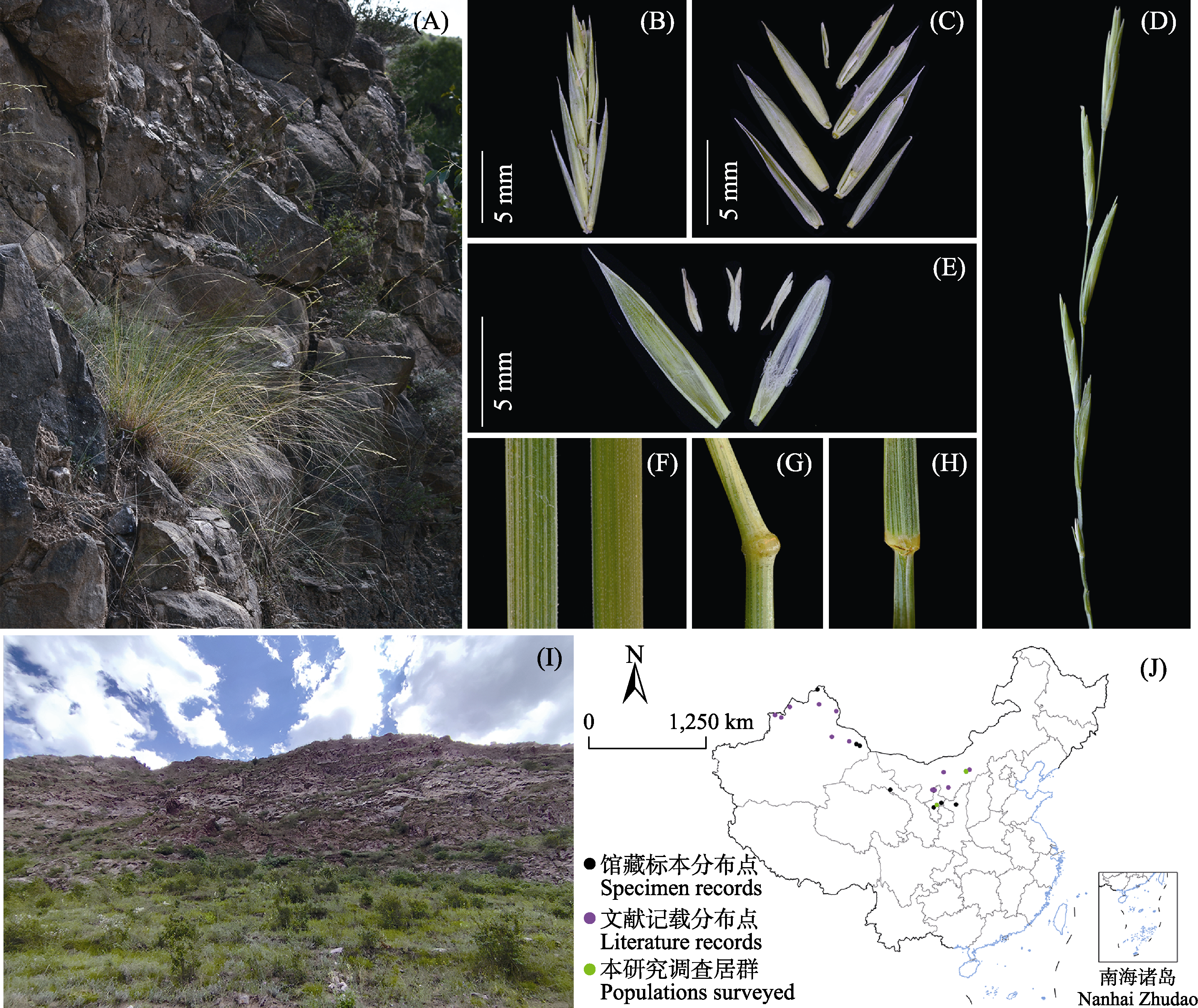
图5 阿拉善披碱草的形态特征、生境与地理分布。(A)植株; (B)、(C)小穗; (D)花序; (E)小花; (F)叶片; (G)茎节; (H)叶舌; (I)生境; (J)地理分布。
Fig. 5 Morphological characteristics, habitat, and geographic distribution of Elymus alashanicus. (A) Plant; (B), (C) Spikelet; (D) Inflorescence; (E) Floret; (F) Leaf blade; (G) Culm node; (H) Ligule; (I) Habitat; (J) Geographic distribution.
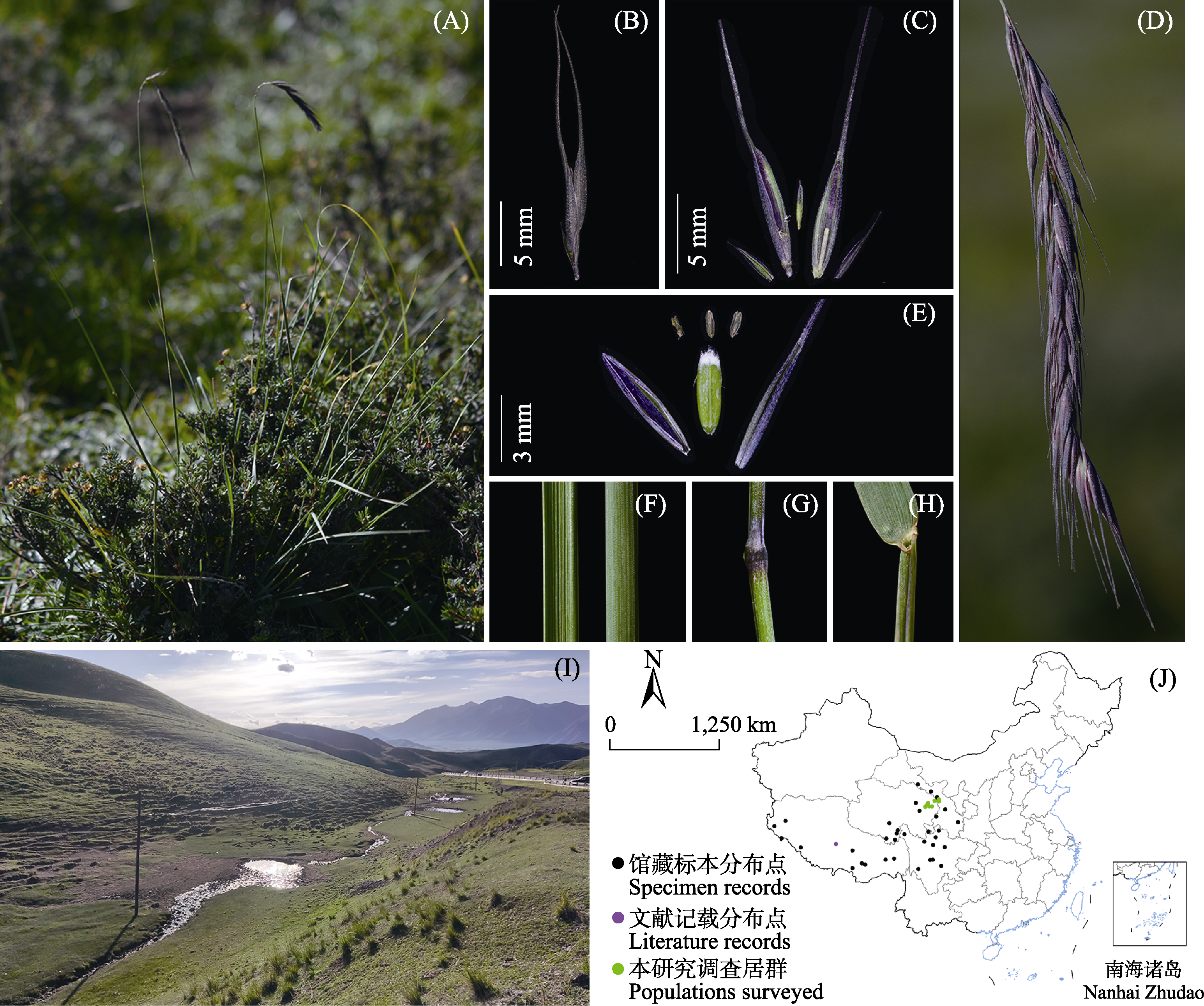
图6 黑紫披碱草的形态特征、生境与地理分布。(A)植株; (B)、(C)小穗; (D)花序; (E)小花; (F)叶片; (G)茎节; (H)叶舌; (I)生境; (J)地理分布。
Fig. 6 Morphological characteristics, habitat, and geographic distribution of Elymus atratus. (A) Plant; (B), (C) Spikelet; (D) Inflorescence; (E) Floret; (F) Leaf blade; (G) Culm node; (H) Ligule; (I) Habitat; (J) Geographic distribution.
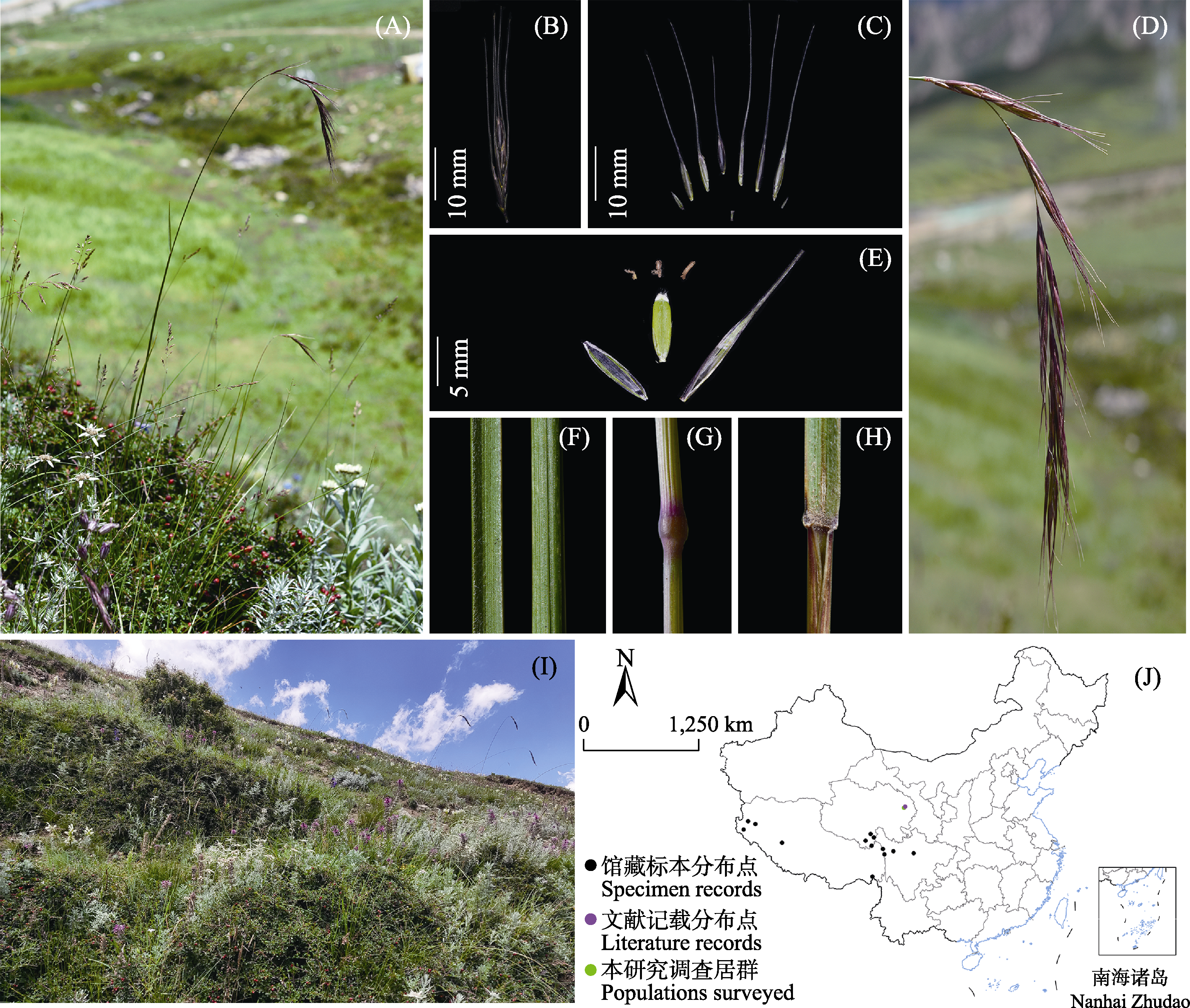
图7 短柄披碱草的形态特征、生境与地理分布。(A)植株; (B)、(C)小穗; (D)花序; (E)小花; (F)叶片; (G)茎节; (H)叶舌; (I)生境; (J)地理分布。
Fig. 7 Morphological characteristics, habitat, and geographic distribution of Elymus brevipes. (A) Plant; (B), (C) Spikelet; (D) Inflorescence; (E) Floret; (F) Leaf blade; (G) Culm node; (H) Ligule; (I) Habitat; (J) Geographic distribution.
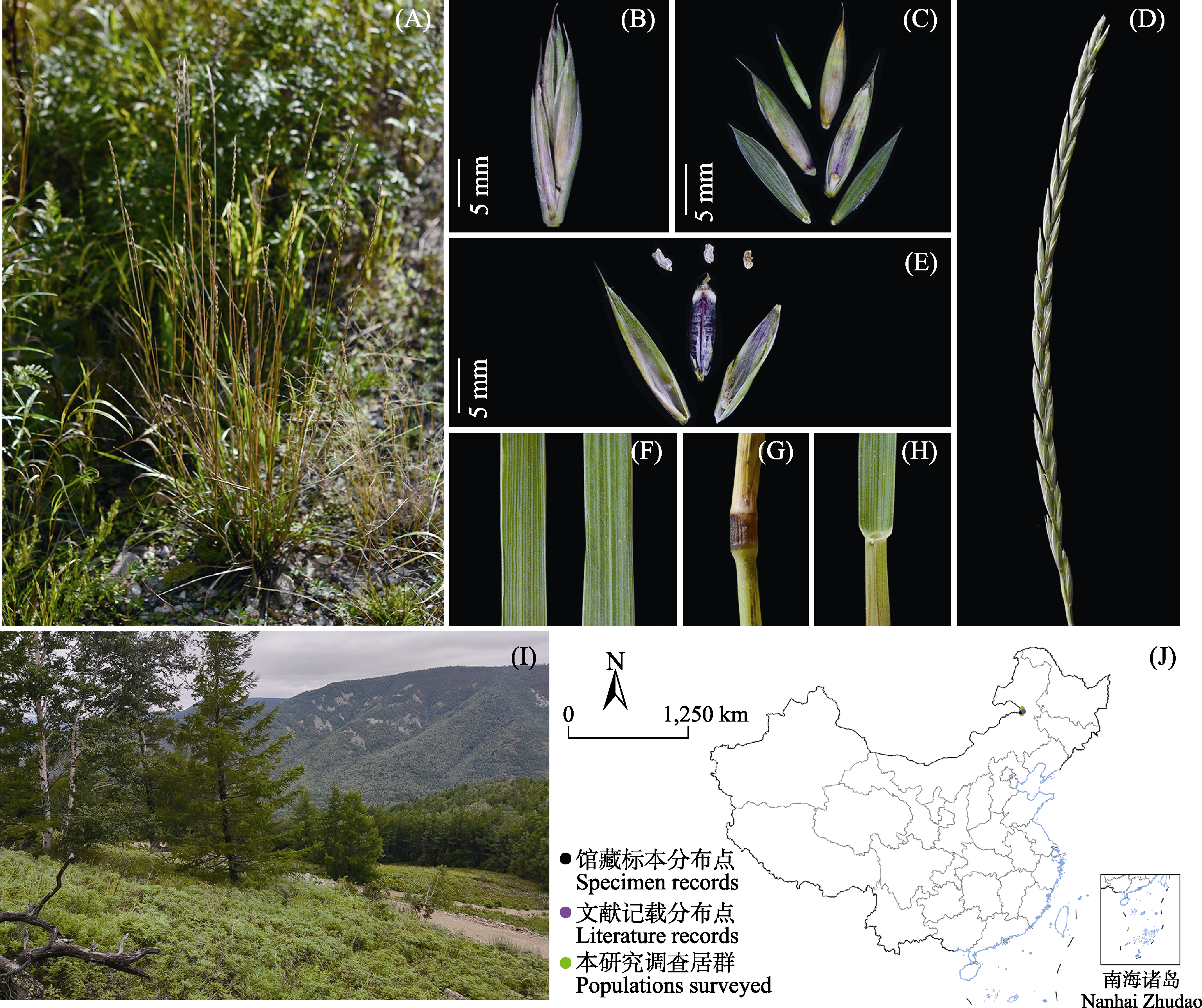
图8 内蒙披碱草的形态特征、生境与地理分布。(A)植株; (B)、(C)小穗; (D)花序; (E)小花; (F)叶片; (G)茎节; (H)叶舌; (I)生境; (J)地理分布。
Fig. 8 Morphological characteristics, habitat, and geographic distribution of Elymus intramongolicus. (A) Plant; (B), (C) Spikelet; (D) Inflorescence; (E) Floret; (F) Leaf blade; (G) Culm node; (H) Ligule; (I) Habitat; (J) Geographic distribution
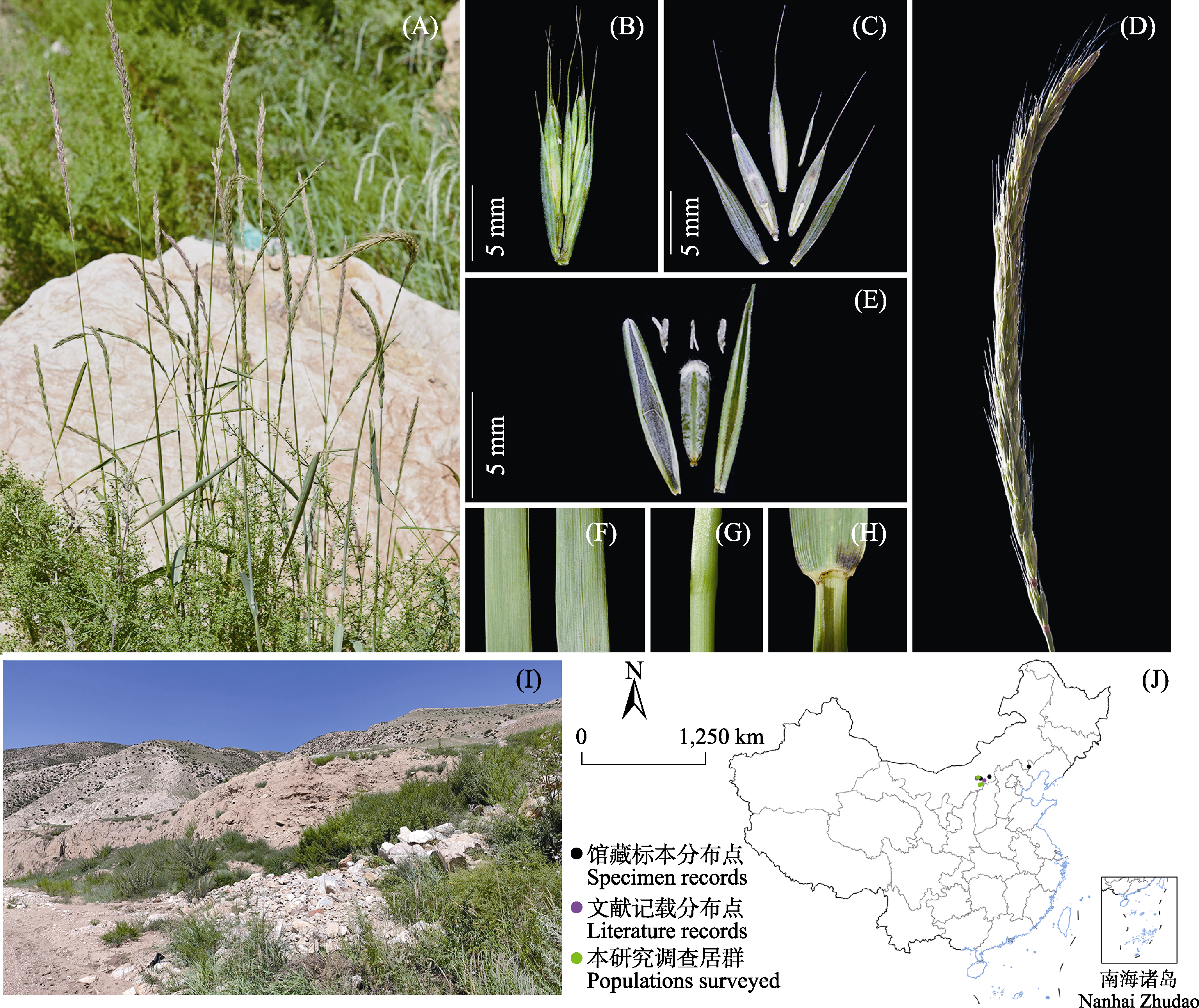
图9 紫芒披碱草的形态特征、生境与地理分布。(A)植株; (B)、(C)小穗; (D)花序; (E)小花; (F)叶片; (G)茎节; (H)叶舌; (I)生境; (J)地理分布。
Fig. 9 Morphological characteristics, habitat, and geographic distribution of Elymus purpuraristatus. (A) Plant; (B), (C) Spikelet; (D) Inflorescence; (E) Floret; (F) Leaf blade; (G) Culm node; (H) Ligule; (I) Habitat; (J) Geographic distribution.
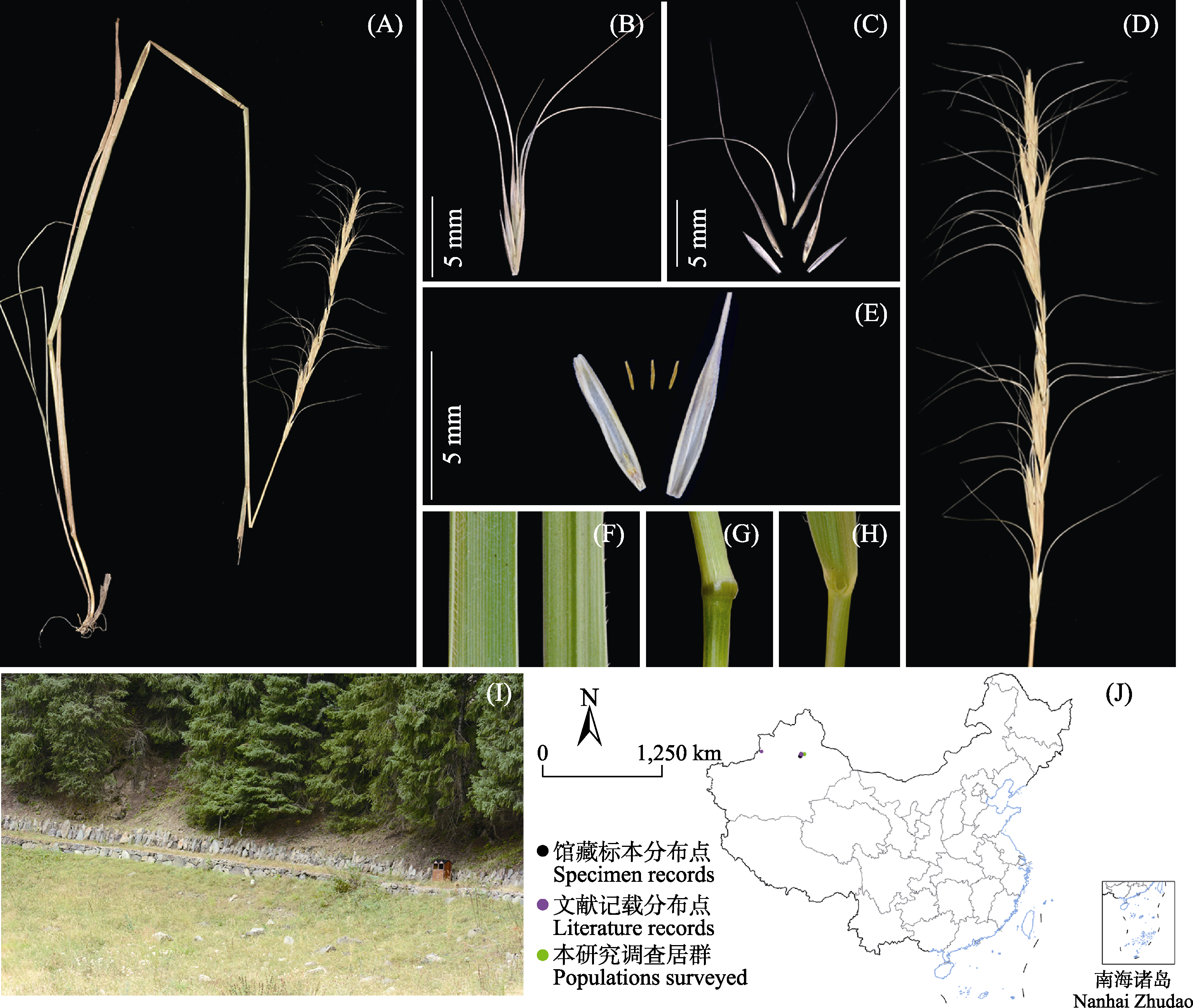
图10 新疆披碱草的形态特征、生境与地理分布。(A)植株; (B)、(C)小穗; (D)花序; (E)小花; (F)叶片; (G)茎节; (H)叶舌; (I)生境; (J)地理分布。
Fig. 10 Morphological characteristics, habitat, and geographic distribution of Elymus sinkiangensis. (A) Plant; (B), (C) Spikelet; (D) Inflorescence; (E) Floret; (F) Leaf blade; (G) Culm node; (H) Ligule; (I) Habitat; (J) Geographic distribution.
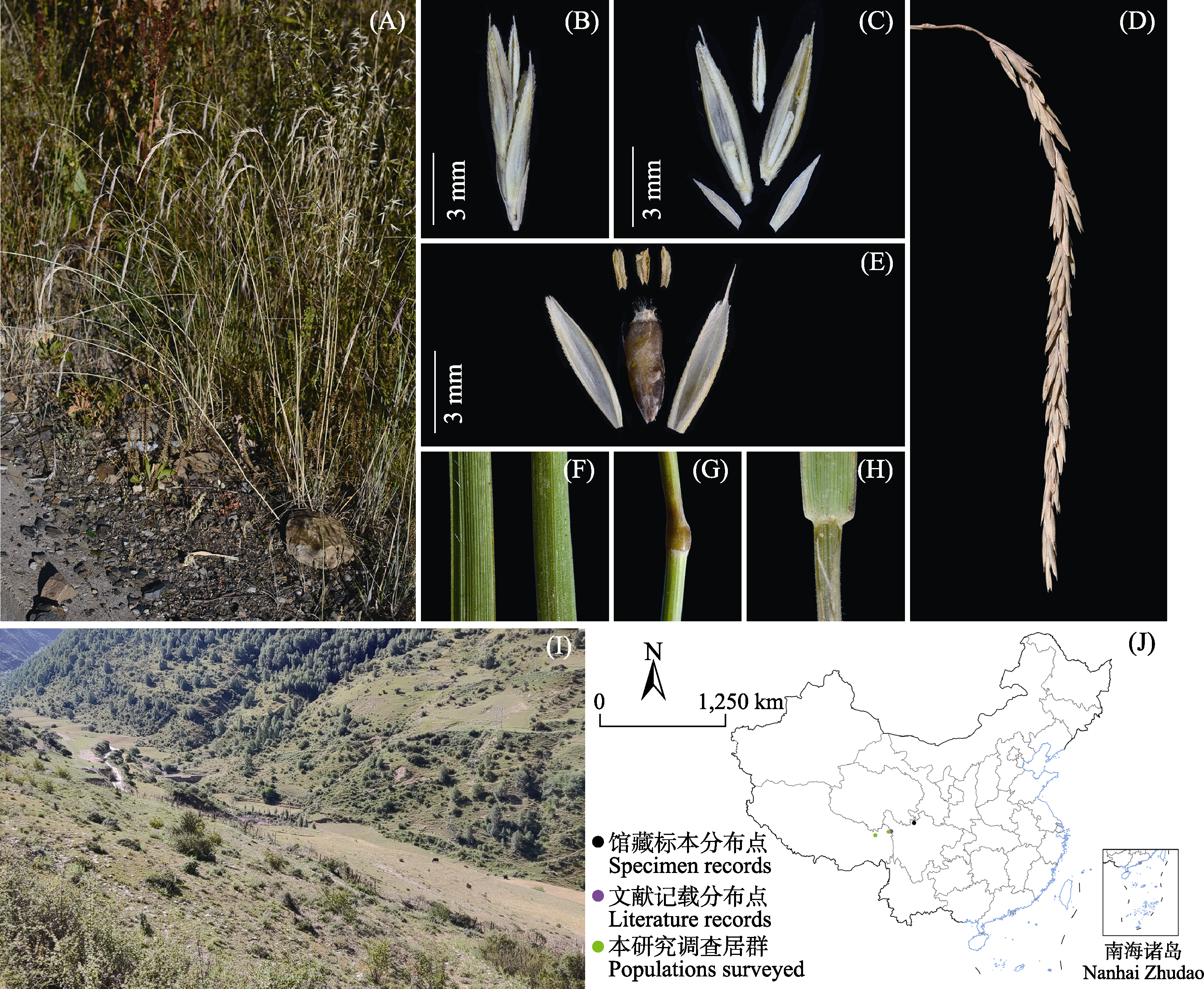
图11 无芒披碱草的形态特征、生境与地理分布。(A)植株; (B)、(C)小穗; (D)花序; (E)小花; (F)叶片; (G)茎节; (H)叶舌; (I)生境; (J)地理分布。
Fig. 11 Morphological characteristics, habitat, and geographic distribution of Elymus sinosubmuticus. (A) Plant; (B), (C) Spikelet; (D) Inflorescence; (E) Floret; (F) Leaf blade; (G) Culm node; (H) Ligule; (I) Habitat; (J) Geographic distribution.
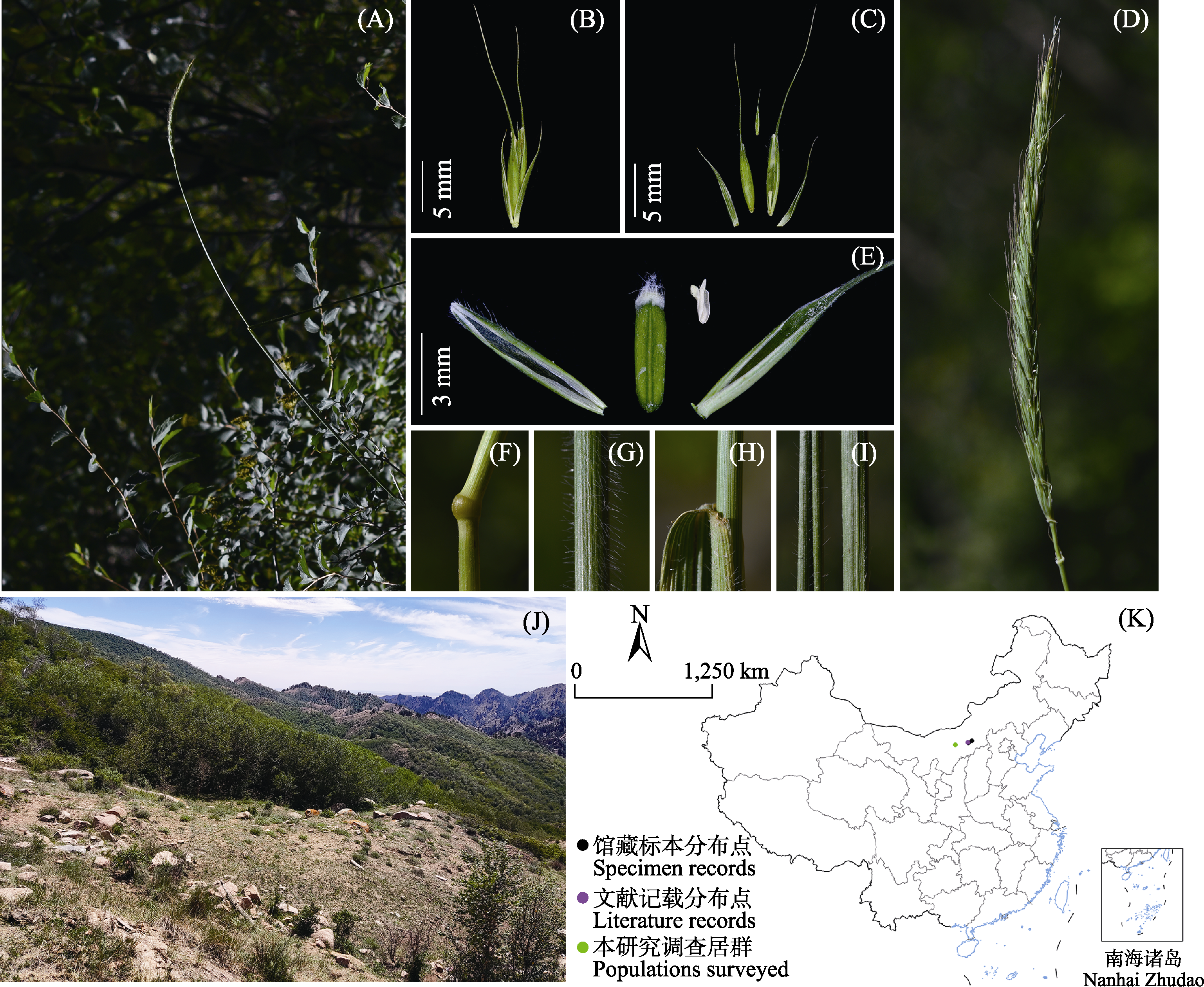
图12 毛披碱草的形态特征、生境与地理分布。(A)植株; (B)、(C)小穗; (D)花序; (E)小花; (F)茎节; (G)叶鞘; (H)叶舌; (I)叶片; (J)生境; (K)地理分布。
Fig. 12 Morphological characteristics, habitat, and geographic distribution of Elymus villifer. (A) Plant; (B), (C) Spikelet; (D) Inflorescence; (E) Floret; (F) Culm node; (G) Leaf sheath; (H) Ligule; (I) Leaf blade; (J) Habitat; (K) Geographic distribution.
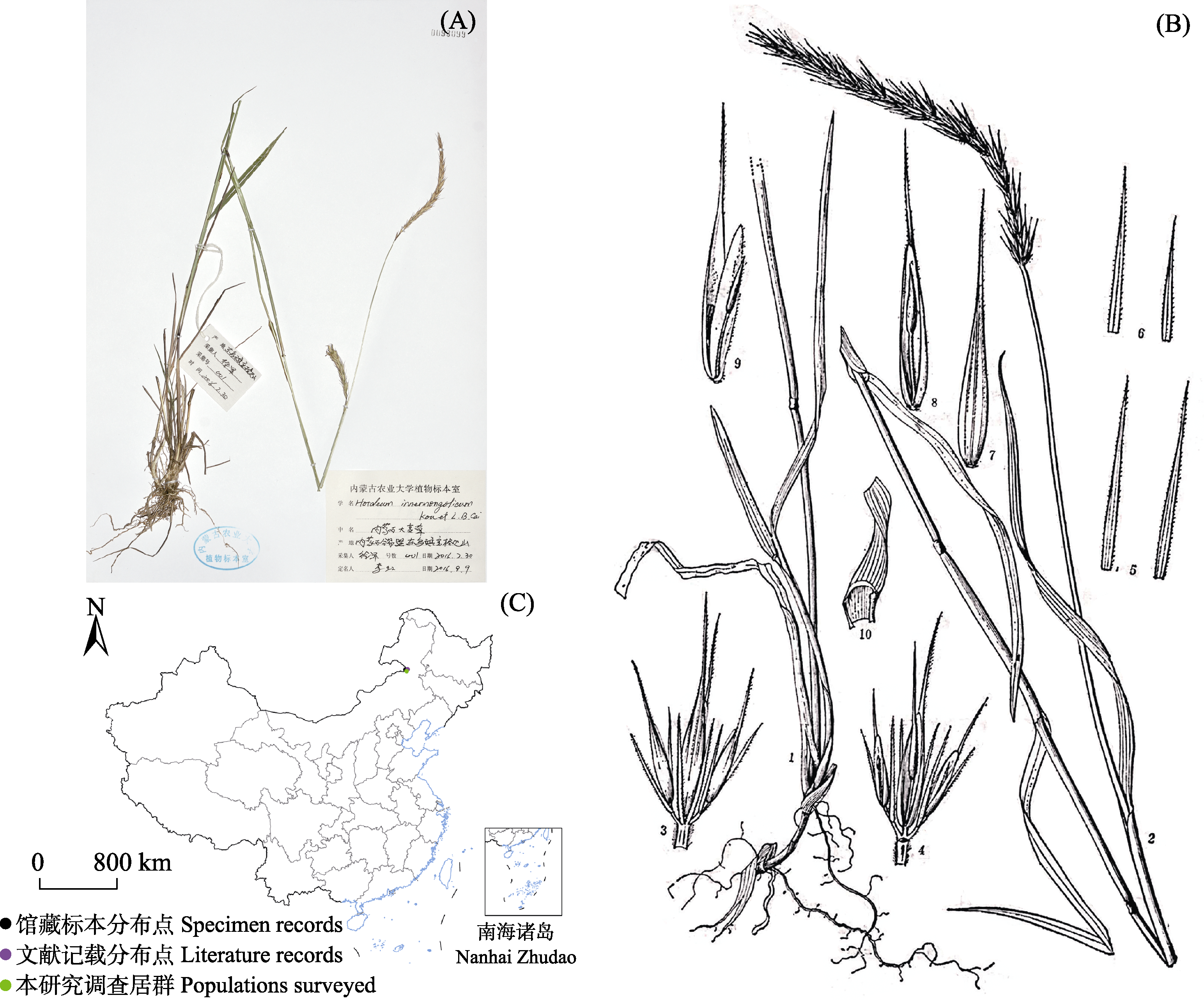
图13 内蒙古大麦的形态特征与地理分布。(A)全株; (B)线描图(引自蔡联炳和郭本兆, 1987); (C)地理分布。
Fig. 13 Morphological characteristics and geographic distribution of Hordeum innermongolicum. (A) Plant; (B) Line drawing, cited from Cai & Guo (1987); (C) Geographic distribution.
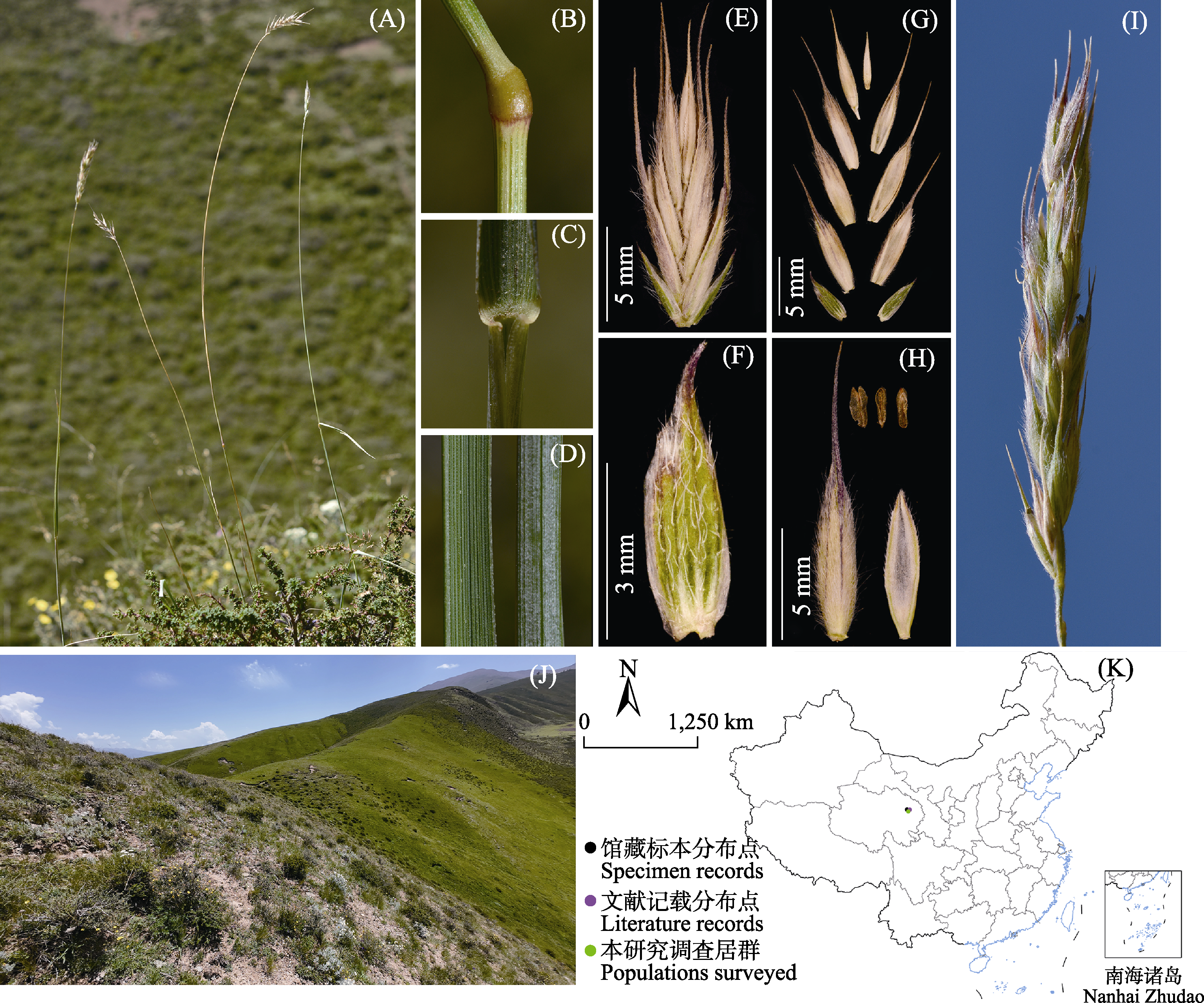
图14 青海以礼草的形态特征、生境与地理分布。(A)植株; (B)茎节; (C)叶舌; (D)叶片; (E)、(G)小穗; (F)颖片; (H)小花; (I)花序; (J)生境; (K)地理分布。
Fig. 14 Morphological characteristics, habitat, and geographic distribution of Kengyilia kokonorica. (A) Plant; (B) Culm node; (C) Ligule; (D) Leaf blade; (E), (G) Spikelets; (F) Glumes; (H) Floret; (I) Inflorescence; (J) Habitat; (K) Geographic distribution.
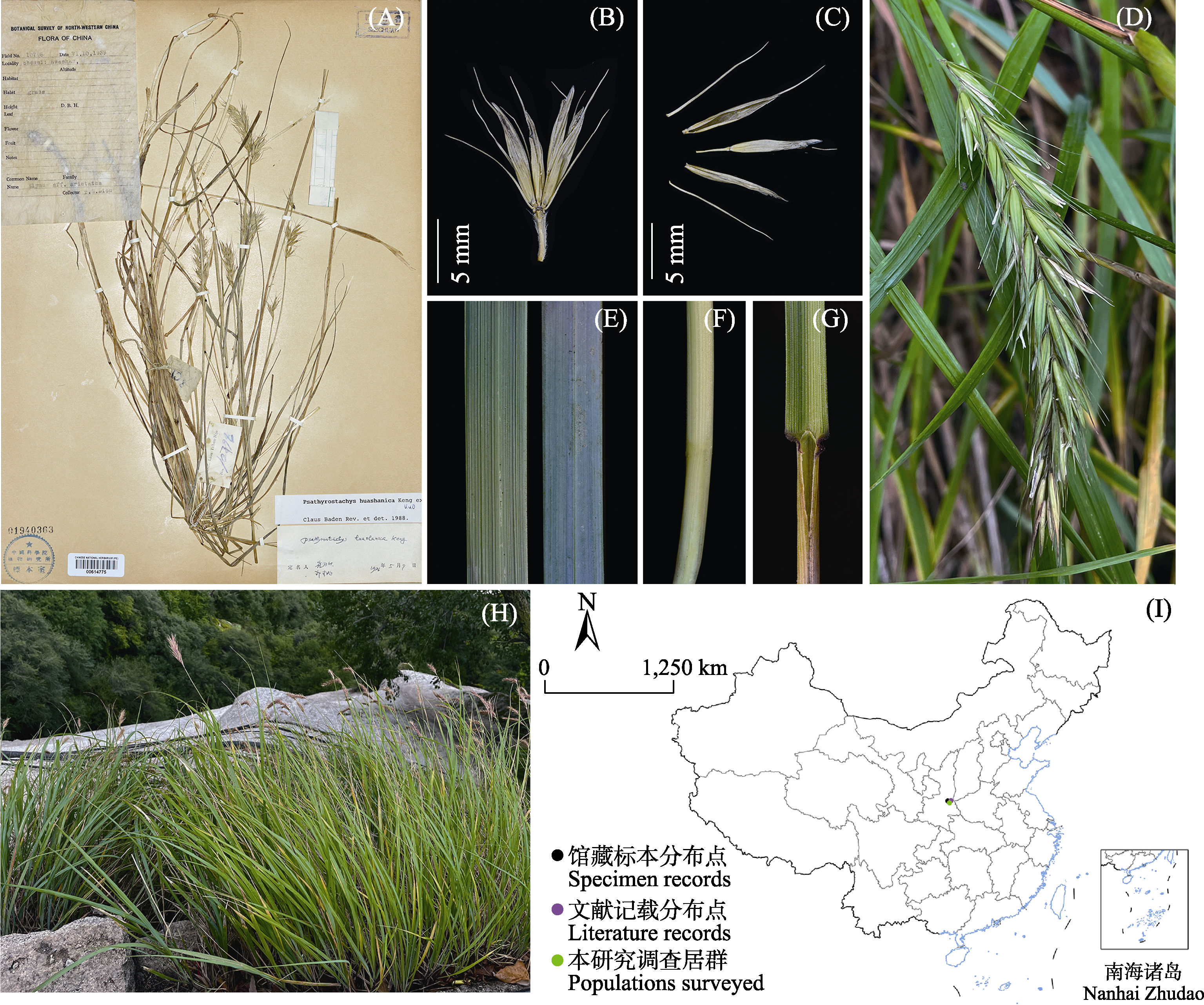
图15 华山新麦草的形态特征、生境与地理分布。(A)植株; (B)、(C)小穗; (D)花序; (E)叶片; (F)茎节; (G)叶舌; (H)生境; (I)地理分布。
Fig. 15 Morphological characteristics, habitat, and geographic distribution of Psathyrostachys huashanica. (A) Plant; (B), (C) Spikelet; (D) Inflorescence; (E) Leaf blade; (F) Culm node; (G) Ligule; (H) Habitat; (I) Geographic distribution.
| [1] | Cai LB, Feng HS (1997) Study on karyotypes of 3 species of Elymus. Acta Botanica Boreali-Occidentalia Sinica, 17, 238-241. (in Chinese with English abstract) |
| [蔡联炳, 冯海生 (1997) 披碱草属3个种的核型研究. 西北植物学报, 17, 238-241.] | |
| [2] | Cai LB, Feng HS (1998) Karyotypes and evolution of five taxa of Roegneria C. Koch. Guihaia, 18, 35-40. (in Chinese with English abstract) |
| [蔡联炳, 冯海生 (1998) 鹅观草属五个类群的核型与进化. 广西植物, 18, 35-40.] | |
| [3] | Capella-Gutiérrez S, Silla-Martínez JM, Gabaldón T (2009) trimAl: A tool for automated alignment trimming in large-scale phylogenetic analyses. Bioinformatics, 25, 1972-1973. |
| [4] | Chen K, Burgess KS, He FL, Yang XY, Gao LM, Li DZ (2022) Seed traits and phylogeny explain plants’ geographic distribution. Biogeosciences, 19, 4801-4810. |
| [5] | Chen SL, Zhu GH (2006) Tribe Triticeae. In:Flora of China (eds Wu ZY, Raven PH, Hong DY), Vol. 22, pp. 386-444. Science Press, Beijing & Missouri Botanical Garden Press, St. Louis. |
| [6] | Chen WL (2018) Poaceae. In: Species Cataligue of China, Vol. 1: Plants (eds Chen WL, Zhang SR), pp. 120-290. Science Press, Beijing. (in Chinese) |
| [陈文俐 (2018) 禾本科. 见: 中国生物物种名录(第一卷): 植物种子植物(II), 被子植物(棕榈科-禾本科) (陈文俐, 张树仁编), 120-290页, 科学出版社, 北京.] | |
| [7] | Chen WL (2023) Poaceae. In: National Key Protected Wild Plants of China, Vol. 3 (eds Jin XH, Zhou ZH, Yuan LC et al.), pp. 20-48. Hubei Science and Technology Press, Wuhan. (in Chinese) |
| [陈文俐 (2023) 禾本科. 禾本科. 见: 国家重点保护野生植物(第三卷) (金效华, 周志华, 袁良琛等主编), 20-48页, 湖北科学技术出版社, 武汉.] | |
| [8] | Ding CB, Zhou YH, Zheng YL, Yang RW, Wei XH (2004) Karyotypes of six species and two subspecies in Pseudoroegneria and three species in Roegneria. Acta Phytotaxonomica Sinica, 42, 162-169. (in Chinese with English abstract) |
| [丁春邦, 周永红, 郑有良, 杨瑞武, 魏秀华 (2004) 拟鹅观草属6种2亚种和鹅观草属3种植物的核型研究. 植物分类学报, 42, 162-169.] | |
| [9] | Dong ZZ (2017) Molecular Phylogeny of the Species with St Genome and Evolution of the St Genome in Tribe Triticeae. PhD dissertation, Sichuan Agricultural University, Ya’an, Sichuan. (in Chinese with English abstract) |
| [董贞贞 (2017) 小麦族含St基因组物种的分子系统及St基因组的分子进化研究. 博士学位论文, 四川农业大学, 四川雅安.] | |
| [10] | Feng Y, Ren SM, Li JJ, Wang CP, Li JC, Zhao JX (2025) Research progress of wheat-Psathyrostachys huashanica chromosome introgression line. Journal of Agricultural Biotechnology, 33, 1611-1625. (in Chinese with English abstract) |
| [冯艳, 任淑敏, 李娇娇, 王春平, 李家创, 赵继新 (2025) 小麦-华山新麦草染色体导入系研究进展. 农业生物技术学报, 33, 1611-1625.] | |
| [11] | Gao W, Liu SJ, Guo HJ, Zhang SW, Chang LF, Yan JL, Li X (2020) Classification and exploitation of the Triticeae plants. Chinese Agricultural Science Bulletin, 36(28), 1-5. (in Chinese with English abstract) |
| [高伟, 刘淑娟, 郭慧娟, 张树伟, 常丽芳, 闫金龙, 李欣 (2020) 小麦族植物分类及开发利用. 中国农学通报, 36(28), 1-5.] | |
| [12] | Gao ZH, Lei YX, Zhou QP (2022) Research progress of molecular systematics of Elymus and its related genera. Chinese Journal of Grassland, 44(2), 107-115. (in Chinese with English abstract) |
| [高子涵, 雷映霞, 周青平 (2022) 广义披碱草属及其近缘属植物的分子系统学研究现状. 中国草地学报, 44(2), 107-115.] | |
| [13] | Guo BZ, Yang XL, Wang CP, Cui NR, Sun YH (1987) Triticeae. In: Flora Reipublicae Popularis Sinicae, Tomus 9, Fascicle 3 (eds Delectis Florae Reipublicae Popularis Sinicae Agendae Academiae Sinicae Edita). Science Press, Beijing. (in Chinese) |
| [郭本兆, 杨锡麟, 王朝品, 崔乃然, 孙永华 (1987) 小麦族. 见: 中国植物志(第9卷第3分册) (中国科学院中国植物志编辑委员会). 科学出版社, 北京.] | |
| [14] | Harper JL, Lovell PH, Moore KG (1970) The shapes and sizes of seeds. Annual Review of Ecology and Systematics, 1, 327-356. |
| [15] | Huang J, Cui ZG, Xie Z, Fu L, Wang Q, Li Y, Wang T, Wang ZD (2019) Research progress on germplasm resource of Psathyrostachys huashanica. Genomics and Applied Biology, 38, 1726-1734. (in Chinese with English abstract) |
| [黄娟, 崔忠刚, 谢洲, 付亮, 王强, 李勇, 王涛, 王志德 (2019) 华山新麦草种质资源研究进展. 基因组学与应用生物学, 38, 1726-1734.] | |
| [16] | IUCN (2001) IUCN Red List Categories and Criteria, Version 3.1. IUCN Species Survival Commission, Gland, Switzerland. |
| [17] | Jin JJ, Yu WB, Yang JB, Song Y, dePamphilis CW, Yi TS, Li DZ (2020) GetOrganelle: A fast and versatile toolkit for accurate de novo assembly of organelle genomes. Genome Biology, 21, 241. |
| [18] | Kalyaanamoorthy S, Minh BQ, Wong TKF, Von Haeseler A, Jermiin LS (2017) ModelFinder: Fast model selection for accurate phylogenetic estimates. Nature Methods, 14, 587-589. |
| [19] | Kang RL, Liu WL, Xu DM, Chang YR, Ma Y (2024) The distribution pattern and intraspecific associations of Agropyron mongolicum populations desert steppe. Acta Ecologica Sinica, 44, 9910-9923. (in Chinese with English abstract) |
| [康如龙, 刘万龙, 许冬梅, 常怡然, 马媛 (2024) 荒漠草原蒙古冰草种群分布格局及种内关联性. 生态学报, 44, 9910-9923.] | |
| [20] | Katoh K, Misawa K, Kuma K, Miyata T (2002) MAFFT: A novel method for rapid multiple sequence alignment based on fast Fourier transform. Nucleic Acids Research, 30, 3059-3066. |
| [21] | Lan BX, Li LH, Wang H (2005) Genetic diversity of Agropyron mongolicum Keng populations. Scientia Agricultura Sinica, 38, 468-473. (in Chinese with English abstract) |
| [兰保祥, 李立会, 王辉 (2005) 蒙古冰草居群遗传多样性研究. 中国农业科学, 38, 468-473.] | |
| [22] | Li H (2013) Aligning sequence reads, clone sequences and assembly contigs with BWA-MEM. arXiv, 1303.3997v2. |
| [23] | Li LH, Yang XM, Li XQ, Dong YT (2000) Study and utilization of wild relatives of wheat in China. Joural of Agricultural Science and Technology, 2(6), 73-76. (in Chinese with English abstract) |
| [李立会, 杨欣明, 李秀全, 董玉探 (2000) 中国小麦野生近缘植物的研究与利用. 中国农业科技导报, 2(6), 73-76.] | |
| [24] | Li MX, Chen RY (1985) A suggestion on the standardization of karyotype analysis in plants. Journal of Wuhan Botanical Research, 3, 297-302. (in Chinese with English abstract) |
| [李懋学, 陈瑞阳 (1985) 关于植物核型分析的标准化问题. 武汉植物学研究, 3, 297-302.] | |
| [25] | Li XQ, Gao YH, Liu Y, Suo PF, Han B (2016) The genetic diversity of 9 populations of dry-desert Agropyron mongolicum collected in northern China. Acta Prataculturae Sinica, 25(3), 77-85. (in Chinese with English abstract) |
| [李晓全, 高有汉, 刘扬, 索培芬, 韩冰 (2016) 我国北方9份旱生-沙生植物蒙古冰草遗传多样性研究. 草业学报, 25(3), 77-85.] | |
| [26] | Li Y, Tan B, Yang J, Zhang H, Zhu W, Xu L, Cheng Y, Wang Y, Zeng J, Sha L, Zhang H, Fan X, Zhou Y, Wu D, Kang H (2025) Integrated review of Psathyrostachy huashanica: From phylogenetic research to wheat breeding application. Molecular Breeding, 45, 42. |
| [27] | Liu DC, Zhang LQ, Hao M, Huang L, Ning SZ, Yuan ZW, Jiang B, Yan ZH, Wu BH, Zheng YL (2020) Genome dominance and the breeding significance in Triticeae. Acta Agronomica Sinica, 46, 1465-1473. (in Chinese with English abstract) |
| [刘登才, 张连全, 郝明, 黄林, 甯顺腙, 袁中伟, 姜博, 颜泽洪, 伍碧华, 郑有良 (2020) 小麦族的基因组显性及其育种学意义. 作物学报, 46, 1465-1473.] | |
| [28] | Liu L, Wang Q, Zhang Z, He X, Yu Y (2023) MATO: An updated tool for capturing and analyzing cytotaxonomic and morphological data. The Innovation Life, 1, 100010. |
| [29] | Liu Q, Huang G, Zhang Z, Lin Z, Deng X, Dong X, Liu Z, Wang Z, Zhang Y, Jing H, Chong K, Cao X (2025) Forage crop research in the modern age. Advanced Science, 12, 2415631. |
| [30] | Liu WX, Li LH, Liu WH, Zhang ZM, Wu ZH, Wang CS (2006) SSR analysis on the sampling strategy of Psathyrostachys huashanic Keng population. Journal of Triticeae Crops, 26(2), 16-20. (in Chinese with English abstract) |
| [刘文献, 李立会, 刘伟华, 张正茂, 吴振海, 王成社 (2006) 华山新麦草居群取样策略的SSR分析. 麦类作物学报, 26(2), 16-20.] | |
| [31] | Liu YH (1985) Studies on the karyotypes of 11 species of Elymus from China. Journal of Wuhan Botanical Research, 3, 325-330. (in Chinese with English abstract) |
| [刘玉红 (1985) 我国11种披碱草的核型研究. 武汉植物学研究, 3, 325-330.] | |
| [32] | Lu BR (1995) Diversity and conservation of the Triticeae genetic resources. Chinese Biodiversity, 3, 63-68. (in Chinese with English abstract) |
| [卢宝荣 (1995) 小麦族遗传资源的多样性及其保护. 生物多样性, 3, 63-68.] | |
| [33] | Nguyen LT, Schmidt HA, Von Haeseler A, Minh BQ (2015) IQ-TREE: A fast and effective stochastic algorithm for estimating maximum-likelihood phylogenies. Molecular Biology and Evolution, 32, 268-274. |
| [34] | Paradis E, Claude J, Strimmer K (2004) APE: Analyses of phylogenetics and evolution in R language. Bioinformatics, 20, 289-290. |
| [35] | Qin HN, Yang Y, Dong SY, He Q, Jia Y, Zhao LN, Yu SX, Liu HY, Liu B, Yan YH, Xiang JY, Xia NH, Peng H, Li ZY, Zhang ZX, He XJ, Yin LK, Lin YL, Liu QR, Hou YT, Liu Y, Liu QX, Cao W, Li JQ, Chen SL, Jin XH, Gao TG, Chen WL, Ma HY, Geng YY, Jin XF, Chang CY, Jiang H, Cai L, Zang CX, Wu JY, Ye JF, Lai YJ, Liu B, Lin QW, Xue NX (2017) Threatened species list of China’s higher plants. Biodiversity Science, 25, 696-744. (in Chinese and in English) |
| [覃海宁, 杨永, 董仕勇, 何强, 贾渝, 赵莉娜, 于胜祥, 刘慧圆, 刘博, 严岳鸿, 向建英, 夏念和, 彭华, 李振宇, 张志翔, 何兴金, 尹林克, 林余霖, 刘全儒, 侯元同, 刘演, 刘启新, 曹伟, 李建强, 陈世龙, 金效华, 高天刚, 陈文俐, 马海英, 耿玉英, 金孝锋, 常朝阳, 蒋宏, 蔡蕾, 臧春鑫, 武建勇, 叶建飞, 赖阳均, 刘冰, 林秦文, 薛纳新 (2017) 中国高等植物受威胁物种名录. 生物多样性, 25, 696-744.] | |
| [36] | Sha LN, Chen N, Chen SY, Zhang Y, Cheng YR, Wu DD, Wang Y, Kang HY, Zhang HQ, Ma X, Zhou YH, Fan X (2025) Rapid diversification of St-genome-sharing species in wheat grasses (Triticeae: Poaceae) accompanied by diversifying selection of chloroplast genes. BMC Plant Biology, 25, 32. |
| [37] | Sha LN, Yan H, Deng C, Yang F, Liu ZH, Li J, Zhang Y, Cheng YR, Wu DD, Wang Y, Kang HY, Zhang HQ, Sun GL, Shen YH, Zhou YH, Yang WY, Fan X (2026) Phylotranscriptomic analyses uncover the evolutionary history and asymmetric diversification patterns of the wheat tribe. Systematic Biology, syag008. doi: https://doi.org/10.1093/sysbio/syag008. |
| [38] | Shen W, Le S, Li Y, Hu F (2016) SeqKit: A cross-platform and ultrafast toolkit for FASTA/Q file manipulation. PLoS ONE, 11, e0163962. |
| [39] | Tan L, Huang QX, Song Y, Wu DD, Cheng YR, Zhang CB, Sha LN, Fan X, Kang HY, Wang Y, Zhang HQ, Zhou YH (2022) Biosystematics studies on Elymus breviaristatus and Elymus sinosubmuticus (Poaceae: Triticeae). BMC Plant Biology, 22, 57. |
| [40] | Tian CY, Wang WQ, Yang B, Huang WG, Liang YL, Yang JL, Li XW (2025) Prediction of potentially suitable areas for Agropyron mongolicum to enhance its distribution. Acta Prataculturae Sinica, 34(2), 27-40. (in Chinese with English abstract) |
| [田丛嫣, 王文强, 杨博, 黄文广, 梁咏亮, 杨君珑, 李小伟 (2025) 沙芦草的分布及潜在适生区预测. 草业学报, 34(2), 27-40.] | |
| [41] | Tian YW, Zhang XY, Yan P, Chen WL (2025) Arundinella mainlingensis (Poaceae), a new species from Xizang, China. PhytoKeys, 257, 65-78. |
| [42] | Wang F, Wang Y, Zeng X, Zhang S, Yu J, Li D, Zhang X (2024) MIKE: An ultrafast, assembly-, and alignment-free approach for phylogenetic tree construction. Bioinformatics, 40, btae154. |
| [43] | Wang JM, Ma JS, Liu WS (2016) Research on enclosed protection effect on Agropyron mongolium Keng of wheat relative. Ningxia Journal of Agriculture and Forestry Science and Technology, 57(10), 1-3. (in Chinese with English abstract) |
| [王君梅, 马静姝, 刘王锁 (2016) 小麦近缘植物沙芦草围封保护效果研究. 宁夏农林科技, 57(10), 1-3.] | |
| [44] | Wang ZJ, Li JH (2021) Molecular karyotype of Agropyron mongolicum Keng. Chinese Journal of Grassland, 43(4), 115-120. (in Chinese with English abstract) |
| [王子君, 李景环 (2021) 蒙古冰草分子核型分析. 中国草地学报, 43(4), 115-120.] | |
| [45] | Wickham H (2016) ggplot2:Elegant Graphics for Data Analysis (Version 3.4.1). Springer-Verlag, New York. |
| [46] | Xiong Y, Yuan S, Xiong Y, Li L, Peng J, Zhang J, Fan X, Jiang C, Sha L, Wang Z, Peng X, Zhang Z, Yu Q, Lei X, Dong Z, Liu Y, Zhao J, Li G, Yang Z, Jia S, Li D, Sun M, Bai S, Liu J, Yang Y, Ma X (2025) Analysis of allohexaploid wheatgrass genome reveals its Y haplome origin in Triticeae and high-altitude adaptation. Nature Communications, 16, 3104. |
| [47] | Yan J, Yang JL (1999) Biosystematics of Triticeae, Vol. 1. China Agriculture Press, Beijing. (in Chinese) |
| [颜济, 杨俊良 (1999) 小麦族生物系统学(第一卷). 中国农业出版社, 北京.] | |
| [48] | Yan J, Yang JL (2004) Biosystematics of Triticeae, Vol. 2. China Agriculture Press, Beijing. (in Chinese) |
| [颜济, 杨俊良 (2004) 小麦族生物系统学(第二卷). 中国农业出版社, 北京.] | |
| [49] | Yan J, Yang JL (2011) Biosystematics of Triticeae, Vol. 4. China Agriculture Press, Beijing. (in Chinese) |
| [颜济, 杨俊良 (2011) 小麦族生物系统学(第四卷). 中国农业出版社, 北京.] | |
| [50] | Yan J, Yang JL (2013) Biosystematics of Triticeae, Vol. 5. China Agriculture Press, Beijing. (in Chinese) |
| [颜济, 杨俊良 (2013) 小麦族生物系统学(第五卷). 中国农业出版社, 北京.] | |
| [51] | Yan J, Yang JL, Baum BR (2006) Biosystematics of Triticeae, Vol. 3. China Agriculture Press, Beijing. (in Chinese) |
| [颜济, 杨俊良, 伯纳德 R. 包姆 (2006) 小麦族生物系统学(第三卷). 中国农业出版社, 北京.] | |
| [52] | Yang C, Baum BR, Johnson DA, Zhang H, Zhou Y (2020) Molecular diversity of the 5S nuclear ribosomal DNA in Campeiostachys with StHY haplome constitution. Journal of Systematics and Evolution, 58, 69-76. |
| [53] | Yang XL, Wang CP (1984) New taxa of Gramineae in China. Bulletin of Botanical Research, 4(4), 83-95. (in Chinese with English abstract) |
| [杨锡麟, 王朝品 (1984) 中国禾本科新分类群. 植物研究, 4(4), 83-95.] | |
| [54] | Yu HY, Shi CM, He WM, Li F, Ouyang B (2024) PanDepth, an ultrafast and efficient genomic tool for coverage calculation. Briefings in Bioinformatics, 25, bbae197. |
| [55] | Yue M, Zhang LJ, Ma K, Zhao GF (2001) Endangering reason and reproductive strategy of Psathyrostachys huashanica population. Acta Ecologica Sinica, 21, 1314-1320. (in Chinese with English abstract) |
| [岳明, 张林静, 马凯, 赵桂仿 (2001) 华山新麦草濒危原因及种群繁殖对策. 生态学报, 21, 1314-1320.] | |
| [56] | Yun JF, Wang JJ (2011) Descriptors and Data Standard for Mongolian Wheatgrass (Agropyron mongolicum Keng) China Agriculture Press, Beijing. (in Chinese) |
| [云锦凤, 王俊杰 (2011) 沙芦草种质资源描述规范和数据标准. 中国农业出版社, 北京.] | |
| [57] | Zhang JY, Li XW, Liu WD, Huang WG, Ma XJ, Yang LB (2023) A study on the Agropyron mongolicum community classification and the relationship between that community characteristics and the environment in Ningxia. Acta Agrestia Sinica, 31, 498-509. (in Chinese with English abstract) |
| [张嘉玉, 李小伟, 刘万弟, 黄文广, 马晓静, 杨利斌 (2023) 宁夏沙芦草群落分类及群落特征与环境关系的研究. 草地学报, 31, 498-509.] | |
| [58] | Zhang TL, Su X, Cai LB (2008) Reduction on Elymus sinosubmuticus based on the external morphology and micromorphological characteristics of leaf blades. Acta Botanica Boreali-Occidentalia Sinica, 28, 1333-1338. (in Chinese with English abstract) |
| [张同林, 苏旭, 蔡联炳 (2008) 根据形态和叶片微形态特征讨论无芒披碱草的归并. 西北植物学报, 28, 1333-1338.] | |
| [59] | Zhou S, Yang W, Han H, Zhou P, Guo B, Zhang J, Han B, Liang X, Lin Y, Deng Y, Liu B, Yang X, Lu Y, Zhang J, Yang P, Yi K, Xu Y, Liu Z, Stein N, He Q, Ling H, Li L (2025) Agropyron cristatum genome provides a new insight for wheat improvement with wild relatives. bioRxiv, doi: https://doi.org/10.1101/2025.06.24.660289. |
| [60] | Zhou YH (1994) Study on karyotypes of 5 species of Kengyilia. Guihaia, 14, 163-169. (in Chinese with English abstract) |
| [周永红 (1994) 仲彬草属5种植物的核型研究. 广西植物, 14, 163-169]. |
| [1] | 王艺璇, 李浩, 孙蔷, 李紫晶, 李明乐, 史亚博, 郑颖, 李星, 莫宇, 范磊, 郭肖, 苗百岭, 韩瀛, 莎娜, 董雷, 张景慧, 李智勇, 王立新, 赵利清, 梁存柱. 绵刺群落地理分布及分类数据集[J]. 生物多样性, 2025, 33(6): 25095-. |
| [2] | 王轶哲, 冯雨晨, 黄晓磊. 福建省蚜虫及其寄主植物多样性[J]. 生物多样性, 2025, 33(6): 25159-. |
| [3] | 黄秀滋, 郭宇明, 戴洪涛, 乔莹, 郭李臻, 陈炳耀. 北部湾海洋哺乳动物组成、地理分布及保护对策[J]. 生物多样性, 2025, 33(12): 25229-. |
| [4] | 常雯青, 张黎慧, 王伊玲, 钟欣烊, 徐永福. 湖南省野生种子植物名录与地理分布数据集[J]. 生物多样性, 2025, 33(10): 25202-. |
| [5] | 许佳, 崔小娟, 张翼飞, 吴昌, 孙远东. 南岭地区鱼类多样性及其地理分布[J]. 生物多样性, 2024, 32(7): 23482-. |
| [6] | 杨胜娴, 杨清, 李晓东, 巢欣, 刘惠秋, 魏蓝若雪, 巴桑. 确定性过程主导高原典型河流浮游植物地理分布格局和群落构建[J]. 生物多样性, 2023, 31(7): 23092-. |
| [7] | 王江, 赵一凡, 屈彦福, 张财文, 张亮, 陈传武, 王彦平. 中国蛇类形态、生活史和生态学特征数据集[J]. 生物多样性, 2023, 31(7): 23126-. |
| [8] | 孟宏虎, 宋以刚. 东南亚生物地理格局: 回溯与思考[J]. 生物多样性, 2023, 31(12): 23261-. |
| [9] | 康敏. 论华莱士的人类学思想及其当代价值[J]. 生物多样性, 2023, 31(12): 23304-. |
| [10] | 梁伟诺, 胡亮. 中国新石器时代以来淡水及河口鱼类考古遗存的地理分布及其生物地理学意义[J]. 生物多样性, 2022, 30(8): 21471-. |
| [11] | 袁桃花, 李美君, 任柳伊, 黄榕鑫, 陈益, 白新祥. 中国野生凤仙花属物种多样性和地理分布数据集[J]. 生物多样性, 2022, 30(5): 22019-. |
| [12] | 钟雨茜, 陈传武, 王彦平. 中国蜥蜴类生活史和生态学特征数据集[J]. 生物多样性, 2022, 30(4): 22071-. |
| [13] | 宋云枫, 陈传武, 王彦平. 中国两栖类生活史和生态学特征数据集[J]. 生物多样性, 2022, 30(3): 22053-. |
| [14] | 丁晨晨, 梁冬妮, 信文培, 李春旺, 蒋志刚. 中国哺乳动物形态、生活史和生态学特征数据集[J]. 生物多样性, 2022, 30(2): 21520-. |
| [15] | 高志伟, 钱天宇, 江建平, 侯德佳, 邓学建, 杨道德. 湖南省两栖、爬行动物物种多样性及其地理分布[J]. 生物多样性, 2022, 30(2): 21290-. |
| 阅读次数 | ||||||
|
全文 |
|
|||||
|
摘要 |
|
|||||
备案号:京ICP备16067583号-7
Copyright © 2026 版权所有 《生物多样性》编辑部
地址: 北京香山南辛村20号, 邮编:100093
电话: 010-62836137, 62836665 E-mail: biodiversity@ibcas.ac.cn
