

生物多样性 ›› 2026, Vol. 34 ›› Issue (7): 26146. DOI: 10.17520/biods.2026146 cstr: 32101.14.biods.2026146
巩中军1,*( )(
 ), 李为争2, 姚永生3, 左旭琦4, 武予清1, 苗进1,*()
收稿日期:2026-04-21
接受日期:2026-06-21
出版日期:2026-07-20
发布日期:2026-09-21
通讯作者:
巩中军,苗进
基金资助:
Zhongjun Gong1,*()(), Weizheng Li2, Yongsheng Yao3, Xuqi Zuo4, Yuqing Wu1, Jin Miao1,*()
Received:2026-04-21
Accepted:2026-06-21
Online:2026-07-20
Published:2026-09-21
Contact:
Zhongjun Gong, Jin Miao
Supported by:摘要:
环境DNA宏条形码技术为土壤节肢动物多样性评估提供了新手段。土壤节肢动物eDNA可存在于土壤固相、液相和气相中, 但不同相态中的eDNA是否对应不同生态位或行为类型的物种类群, 尚不清楚。本研究以8种作物田土壤为对象, 分别采用土壤直接提取法(direct soil extraction, SOL, 代表固相)、空气滤膜法(air filtration, AIR, 代表气相)和土壤水过滤法(water filtration, WAT, 代表液相)提取3种相态的eDNA, 结合高通量测序技术分析节肢动物群落组成, 旨在揭示土壤节肢动物eDNA在固、液、气三相中的分布特征。结果表明, WAT的物种丰富度显著高于SOL和AIR (P < 0.05), 而SOL与AIR间无显著差异; 3种方法的β多样性存在极显著差异。置换多元方差分析(permutational multivariate analysis of variance, PERMANOVA)表明, 3种采样方法下土壤节肢动物群落结构具有极显著差异(R2 = 0.2816, P = 0.001), 采样方法可解释群落组成28.16%的变异。主坐标分析(principal coordinates analysis, PCoA)进一步显示, 3种方法的样本在空间上明显分离, 各自聚集为不同的类群。SOL捕获的操作分类单元(operational taxonomic unit, OTU)数量最为丰富(3,314个), 高于AIR (1,023个)和WAT (871个)。在科水平上, SOL检出的等节跳虫科等土壤底栖类群的相对丰度较高, 但各处理间差异不显著(P > 0.05); WAT中摇蚊科相对丰度最高; AIR对金龟科等类群的检出效率更有优势。天敌类群中, 隐翅虫科和舞虻科在3种方法中均有检出。网络分析显示, SOL与AIR、SOL与WAT的比较呈相似模式, SOL节点周围聚集大量OTU簇; 而AIR与WAT的比较中, 高丰度OTU多为方法特异性。等级发生曲线分析表明, SOL检测到的OTU数量最多(169个), 分布最均匀; WAT居中(113个); AIR最少(83个), 以少数优势OTU为主。本研究明确了eDNA在土壤固相、液相、气相中的分布与节肢动物生态位和行为类型密切相关, 呈现明显的分布异质性。SOL对土壤底栖类群及多种天敌类群的检出效果稳定且覆盖广泛; AIR在双翅目、金龟科等类群的检出上更具优势; WAT则对摇蚊科等湿生类群的富集特征尤为明显。针对农田土壤生物多样性评估, 建议以SOL为基础。若研究重点为双翅目或鞘翅目等特定类群, 可在SOL基础上补充AIR; 若研究涉及摇蚊科等偏好湿生环境的类群, 则需加入WAT。本研究为理解eDNA在土壤生态系统中的空间分布特征及农田土壤动物多样性监测方法筛选与组合优化提供了科学依据。
巩中军, 李为争, 姚永生, 左旭琦, 武予清, 苗进 (2026) 农田土壤节肢动物eDNA在固-液-气三相中的分布特征. 生物多样性, 34, 26146. DOI: 10.17520/biods.2026146.
Zhongjun Gong, Weizheng Li, Yongsheng Yao, Xuqi Zuo, Yuqing Wu, Jin Miao (2026) Distribution characteristics of arthropod eDNA in the solid, liquid, and gas phases of farmland soil. Biodiversity Science, 34, 26146. DOI: 10.17520/biods.2026146.
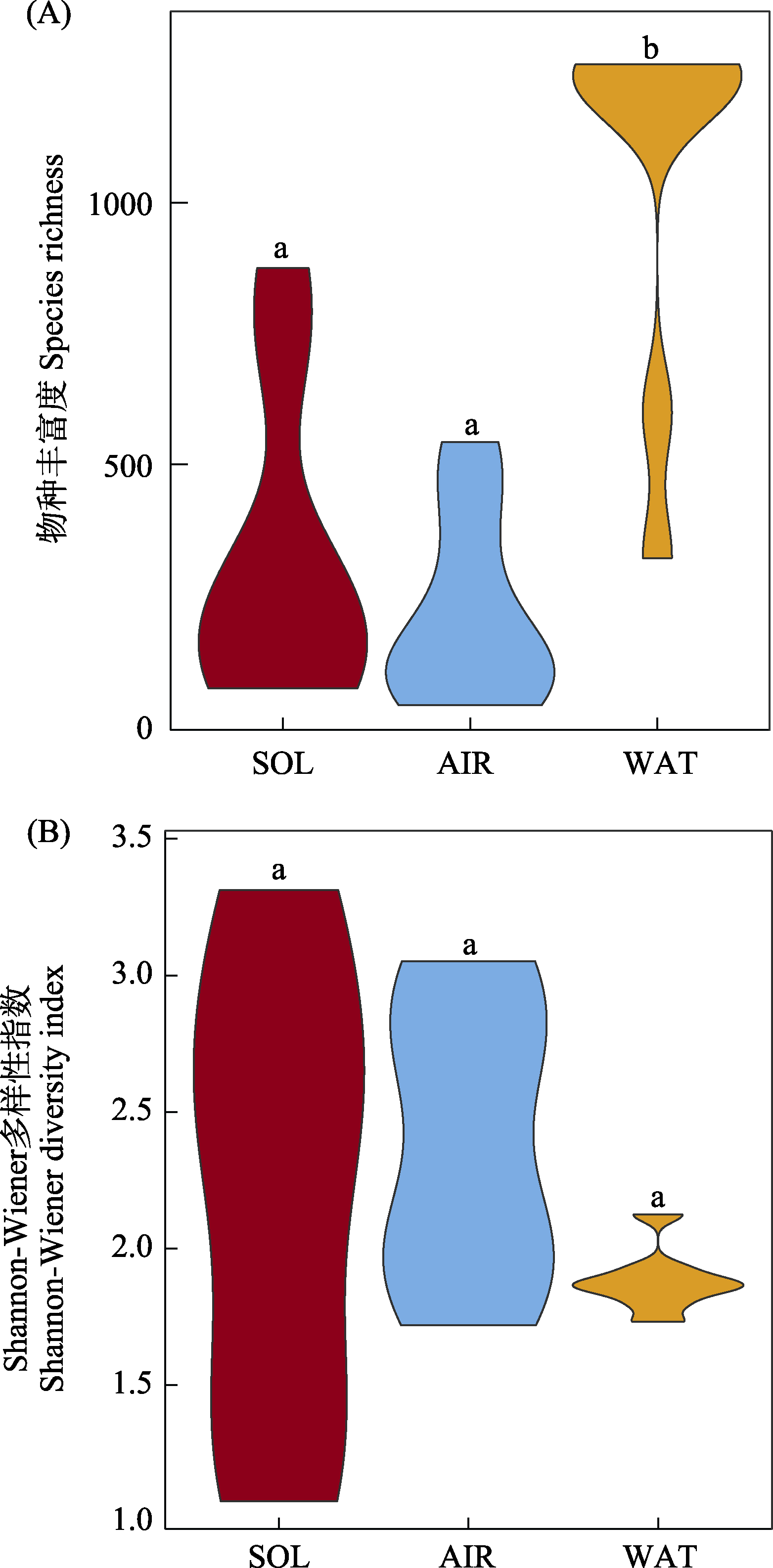
图1 不同方法下土壤节肢动物群落α多样性。SOL: 土壤直接提取法; AIR: 空气滤膜法; WAT: 土壤水过滤法。不同小写字母表示方法间差异显著(P < 0.05)。
Fig. 1 Alpha diversity of soil arthropod communities under different extraction methods. SOL, Direct soil extraction; AIR, Air filtration; WAT, Soil water filtration. Different lowercase letters indicate significant differences among extraction methods (P < 0.05).
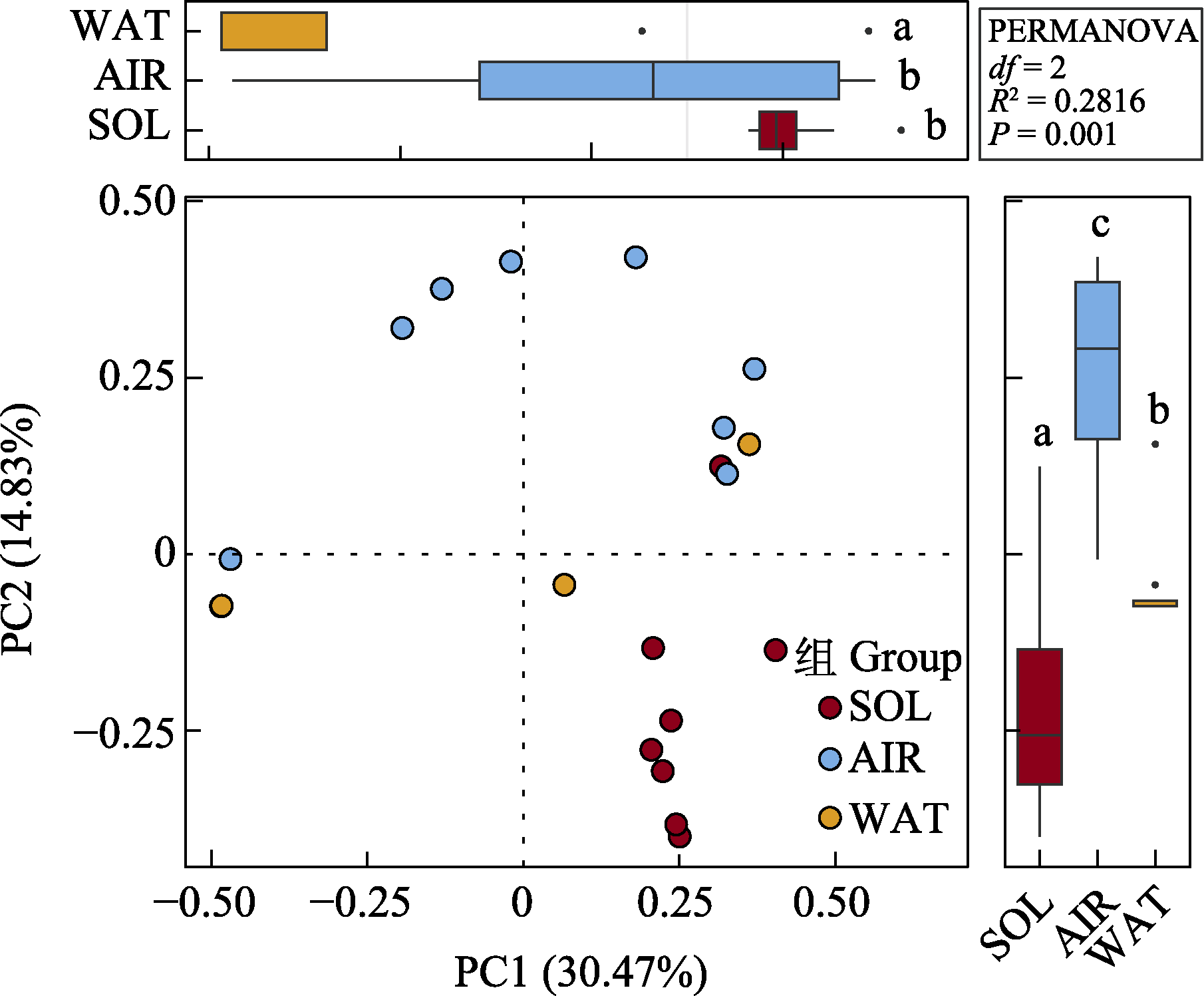
图2 基于3种eDNA提取方法的土壤节肢动物群落结构主坐标分析。每个散点代表1个独立样本, 上方与右侧的箱线图分别展示了各组样本在PC1、PC2轴上的分布差异, 不同小写字母(a/b/c)表示组间差异显著。SOL: 土壤直接提取法; AIR: 空气滤膜法; WAT: 土壤水过滤法。
Fig. 2 Principal coordinates analysis (PCoA) of soil arthropod community structure based on three eDNA extraction methods. Each dot represents an individual sample. The boxplots above and to the right show the distribution of samples along PC1 and PC2, respectively. Different lowercase letters (a/b/c) indicate significant differences among groups. SOL, Direct soil extraction; AIR, Air filtration; WAT, Soil water filtration.
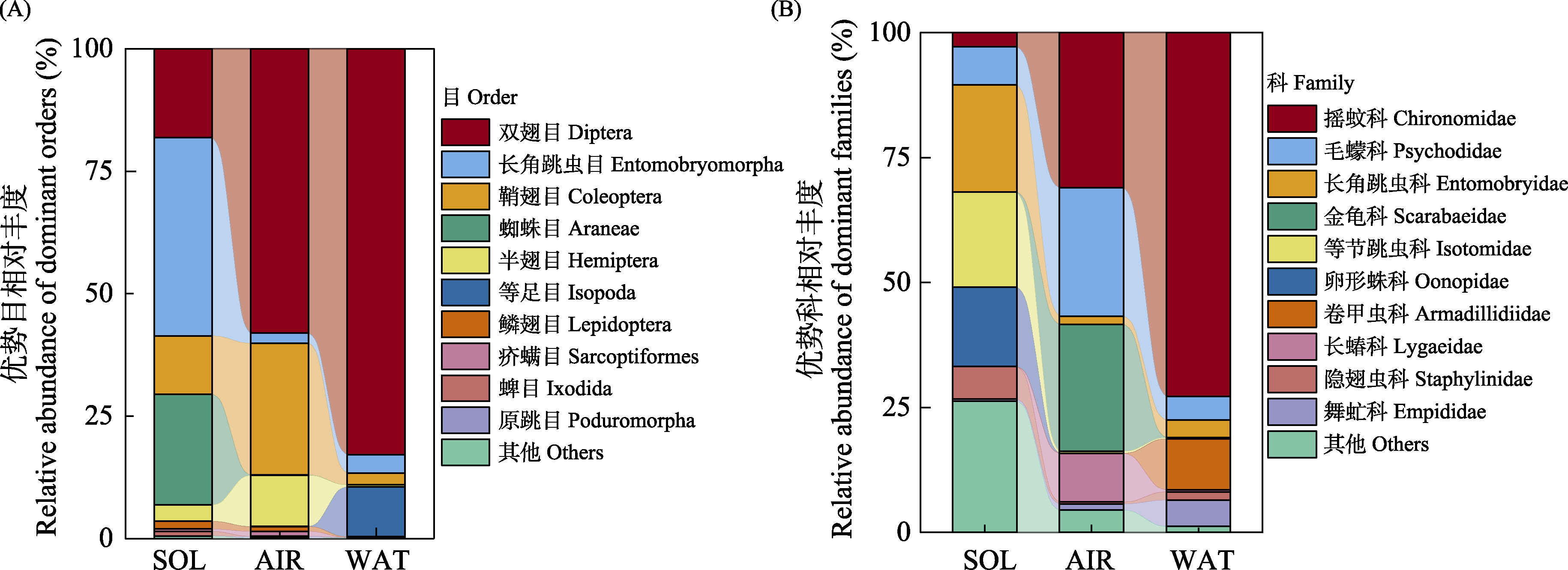
图3 3种eDNA提取方法下土壤节肢动物群落目(A)和科(B)水平优势类群相对丰度。SOL: 土壤直接提取法; AIR: 空气滤膜法; WAT: 土壤水过滤法。
Fig. 3 Relative abundance of dominant soil arthropod taxa at the order (A) and family (B) level under three eDNA extraction methods. SOL, Direct soil extraction; AIR, Air filtration; WAT, Soil water filtration.
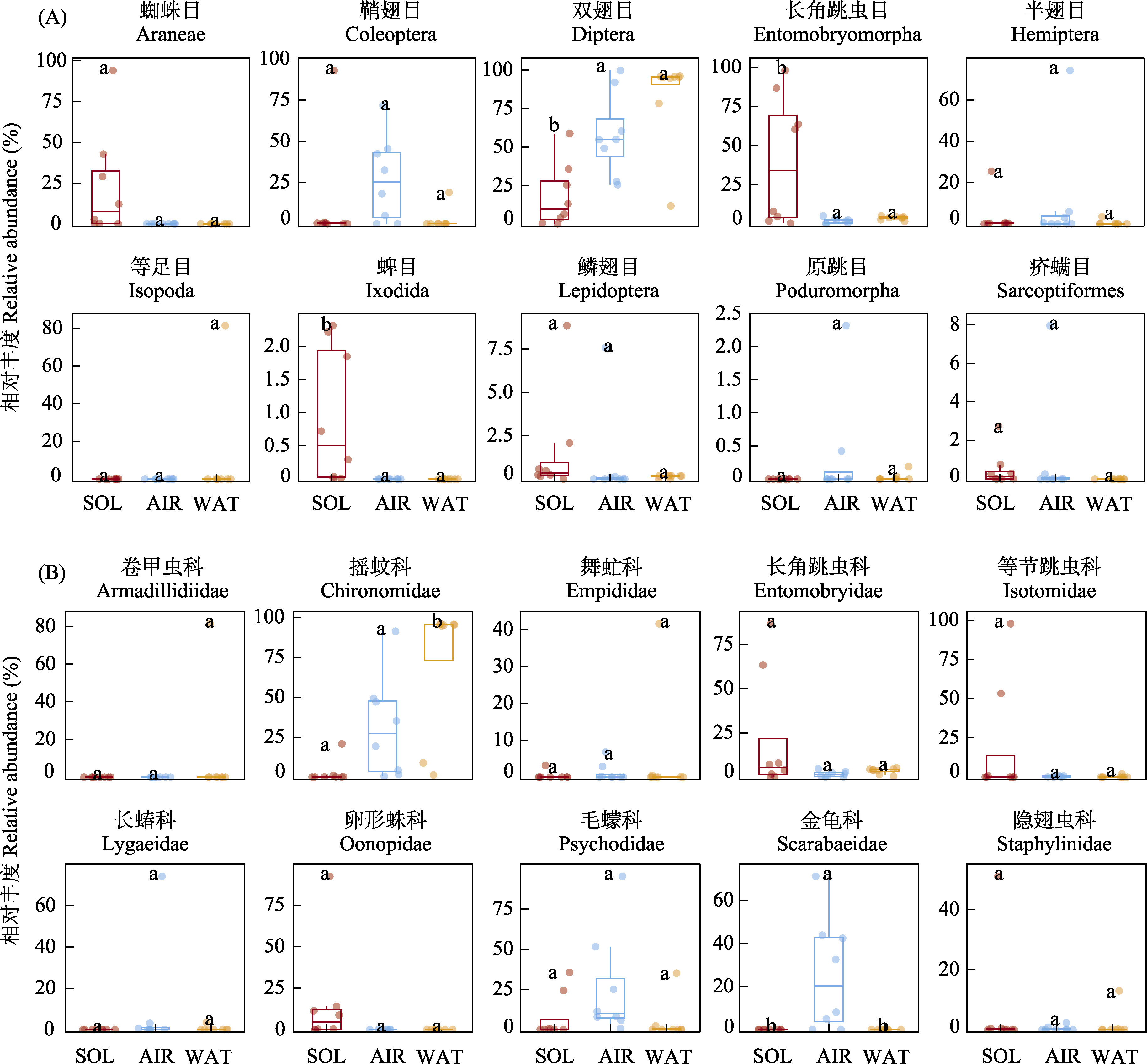
图4 3种土壤eDNA提取方法下目(A)和科(B)水平节肢动物群落类群相对丰度间的差异。不同小写字母表示组间存在显著差异(Tukey’s HSD检验, P < 0.05)。SOL: 土壤直接提取法; AIR: 空气滤膜法; WAT: 土壤水过滤法。
Fig. 4 Intergroup differences in relative abundance of arthropod taxa at order (A) and family (B) level under three soil eDNA extraction methods. Different lowercase letters denote significant differences (Tukey’s HSD test, P < 0.05). SOL, Direct soil extraction; AIR, Air filtration; WAT, Soil water filtration.
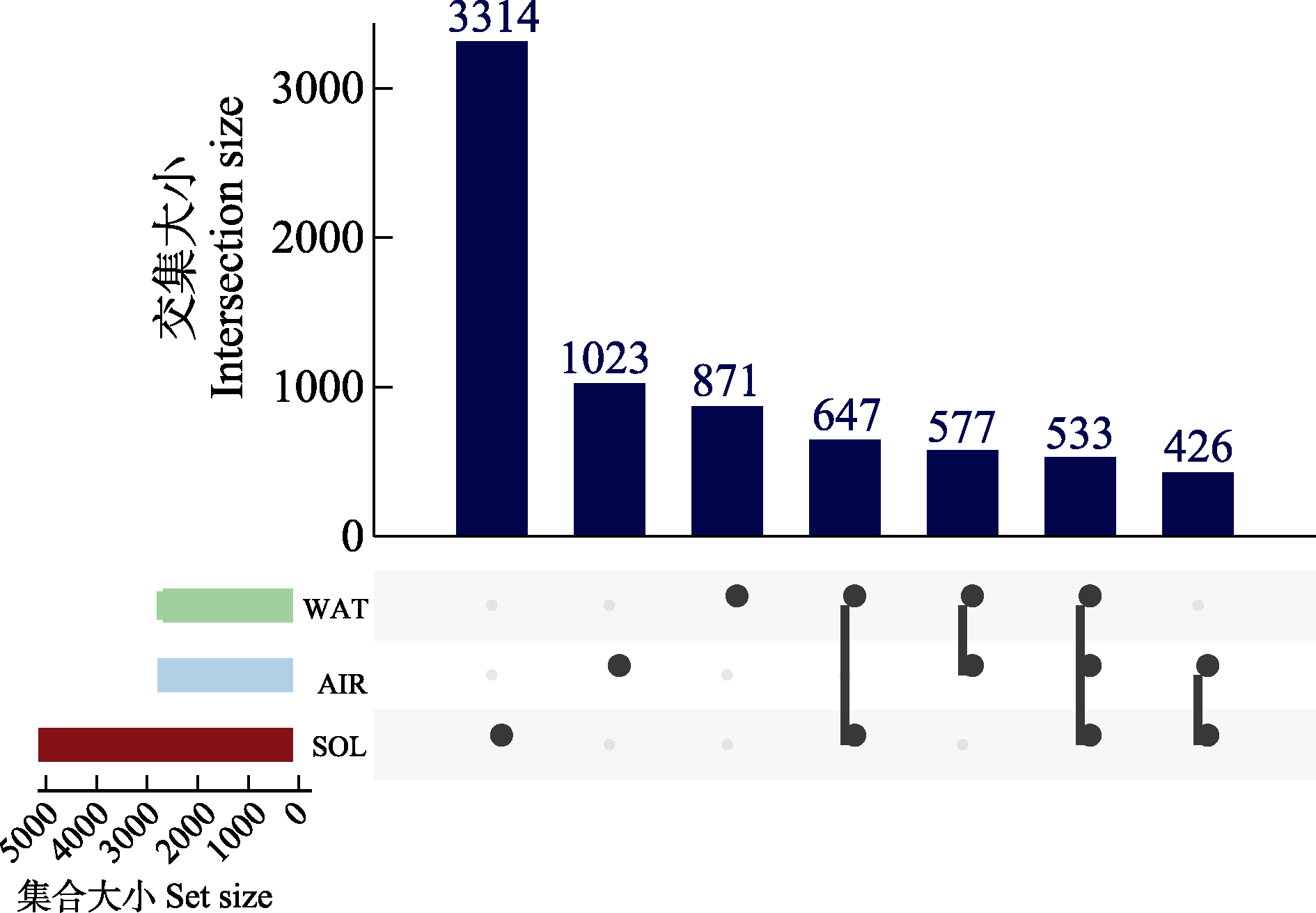
图5 3种土壤eDNA提取方法共有和特有OTU分布UpSet图。左侧柱状图表示各方法检测到的OTU总数; 右侧点阵图展示方法间的交集组合, 点阵图顶部的深蓝色柱状图对应各交集组合的OTU数量, 数字标注了各交集的具体OTU值。SOL: 土壤直接提取法; AIR: 空气滤膜法; WAT: 土壤水过滤法。
Fig. 5 UpSet plot showing shared and unique OTU among three soil eDNA extraction methods. Left bar chart shows the total OTU detected by each method. The bottom dot matrix indicates intersection combinations among methods, with dark blue bars above showing the corresponding intersection sizes; numbers indicate exact OTU counts for each intersection. SOL, Direct soil extraction; AIR, Air filtration; WAT, Soil water filtration.
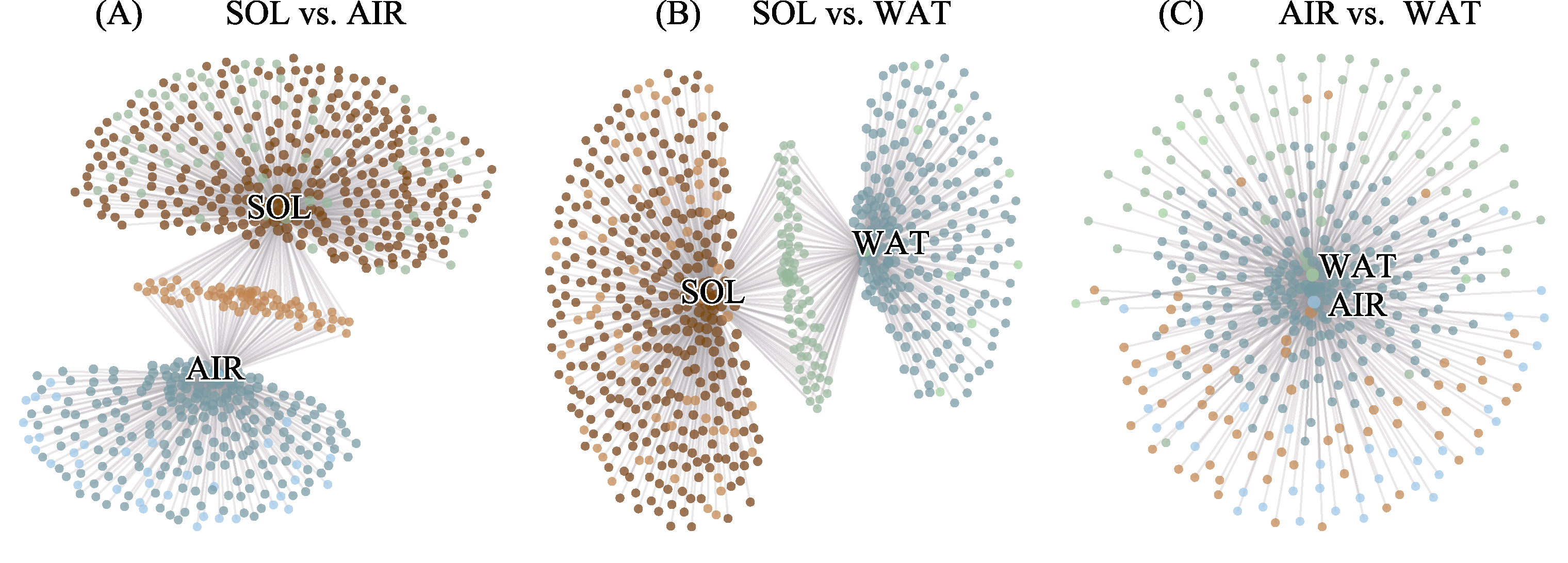
图6 基于网络分析的OTU组成相似性及3种方法间独特性比较。网络中心的彩色圆形节点代表3种eDNA提取方法。SOL: 土壤直接提取法; AIR: 空气滤膜法; WAT: 土壤水过滤法。
Fig. 6 Network analysis comparing shared and unique OTU among three eDNA extraction methods. The colored circular nodes at the network center represent three eDNA extraction methods. SOL, Direct soil extraction; AIR, Air filtration; WAT, Soil water filtration.
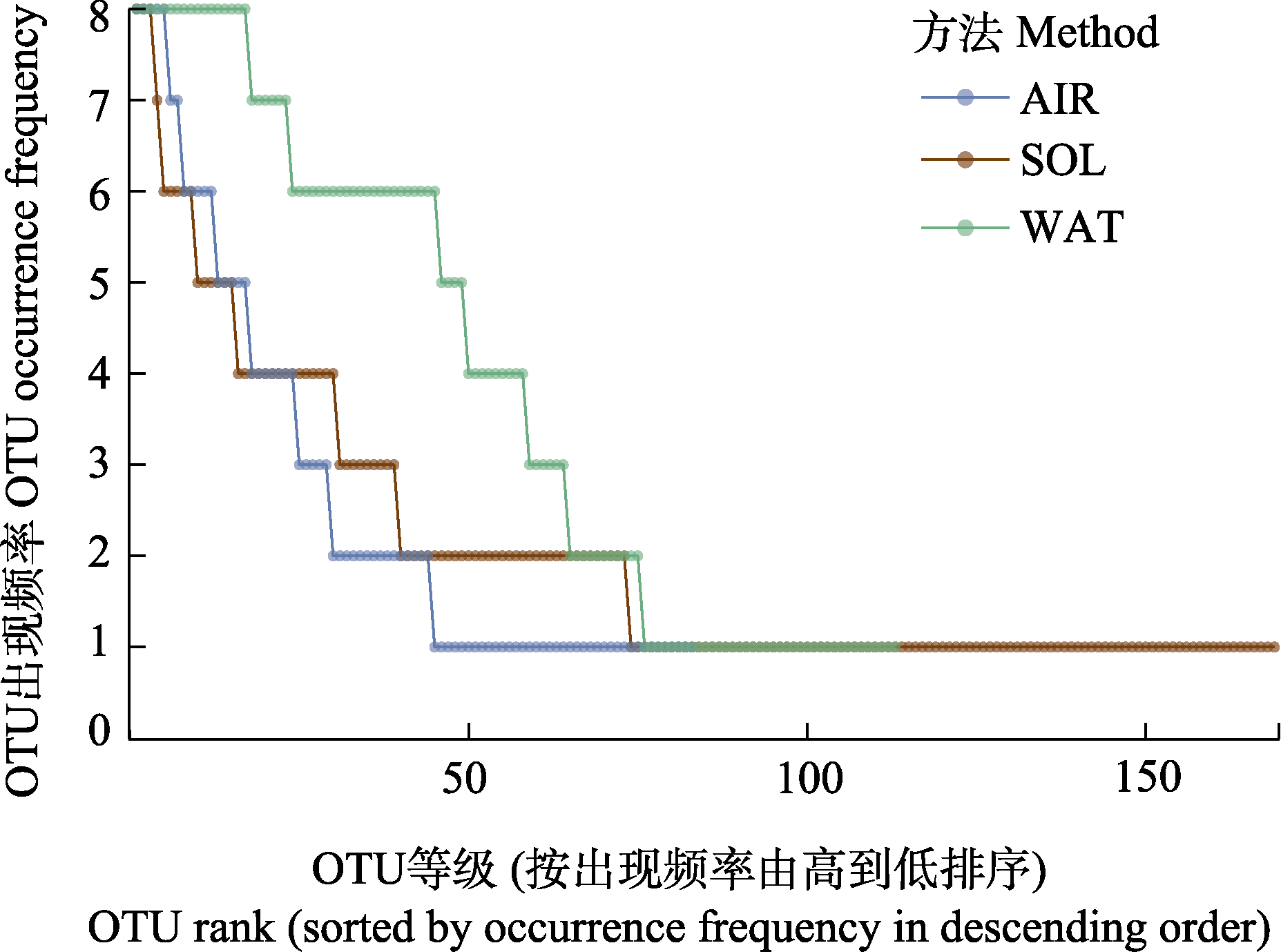
图7 不同土壤eDNA提取方法OTU等级-出现频率曲线。SOL: 土壤直接提取法; AIR: 空气滤膜法; WAT: 土壤水过滤法。
Fig. 7 Rank occurrence frequency curves of OTU detected by different soil eDNA extraction methods. SOL, Direct soil extraction; AIR, Air filtration; WAT, Soil water filtration.
| [1] | Anthony MA, Bender SF, van der Heijden MGA (2023) Enumerating soil biodiversity. Proceedings of the National Academy of Sciences, USA, 120, e2304663120. |
| [2] |
Bardgett RD, van der Putten WH (2014) Belowground biodiversity and ecosystem functioning. Nature, 515, 505-511.
DOI |
| [3] |
Bessey C, Neil Jarman S, Simpson T, Miller H, Stewart T, Kenneth Keesing J, Berry O (2021) Passive eDNA collection enhances aquatic biodiversity analysis. Communications Biology, 4, 236.
DOI PMID |
| [4] |
Bienert F, De Danieli S, Miquel C, Coissac E, Poillot C, Brun JJ, Taberlet P (2012) Tracking earthworm communities from soil DNA. Molecular Ecology, 21, 2017-2030.
DOI PMID |
| [5] |
Blouin M, Hodson ME, Delgado EA, Baker G, Brussaard L, Butt KR, Dai J, Dendooven L, Peres G, Tondoh JE, Cluzeau D, Brun JJ (2013) A review of earthworm impact on soil function and ecosystem services. European Journal of Soil Science, 64, 161-182.
DOI URL |
| [6] |
Cananzi G, Tatini I, Li TS, Montagna M, Serra V, Petroni G (2025) Active or passive? A multi-marker approach to compare active and passive eDNA sampling in riverine environments. Science of the Total Environment, 974, 179247.
DOI URL |
| [7] |
Chen XY, Kong YQ, Zhang S, Zhao JD, Li S, Yao M (2022) Comparative evaluation of common materials as passive samplers of environmental DNA. Environmental Science & Technology, 56, 10798-10807.
DOI URL |
| [8] |
Chen XY, Li S, Zhao JD, Yao M (2024) Passive eDNA sampling facilitates biodiversity monitoring and rare species detection. Environment International, 187, 108706.
DOI URL |
| [9] | Coleman DC, Callaham MA, Crossley DA Jr (2017) Fundamentals of Soil Ecology, 3rd edn. Academic Press, London. |
| [10] |
Deiner K, Bik HM, Mächler E, Seymour M, Lacoursière-Roussel A, Altermatt F, Creer S, Bista I, Lodge DM, de Vere N, Pfrender ME, Bernatchez L (2017) Environmental DNA metabarcoding: Transforming how we survey animal and plant communities. Molecular Ecology, 26, 5872-5895.
DOI PMID |
| [11] |
Dopheide A, Xie D, Buckley TR, Drummond AJ, Newcomb RD (2019) Impacts of DNA extraction and PCR on DNA metabarcoding estimates of soil biodiversity. Methods in Ecology and Evolution, 10, 120-133.
DOI |
| [12] |
Eisenhauer N, Sünnemann M, Pollierer MM, Sun X, Bardgett RD, Bartkowski B, Delgado-Baquerizo M, Dirilgen T, Guerra CA, Mathieu J, Niklaus PA, Romero F, Ristok C, Seeber J, Steinwandter M, Stewart J, van der Heijden M, van der Putten W, Potapov A (2026) Soil biodiversity effects on ecosystems. Nature Reviews Biodiversity, 2, 76-91.
DOI |
| [13] |
George PBL, Keith AM, Creer S, Barrett GL, Lebron I, Emmett BA, Robinson DA, Jones DL (2017) Evaluation of mesofauna communities as soil quality indicators in a national-level monitoring programme. Soil Biology and Biochemistry, 115, 537-546.
DOI URL |
| [14] | Hallmann CA, Sorg M, Jongejans E, Siepel H, Hofland N, Schwan H, Stenmans W, Müller A, Sumser H, Hörren T, Goulson D, de Kroon H (2017) More than 75 percent decline over 27 years in total flying insect biomass in protected areas. PLoS ONE, 12, e0185809. |
| [15] |
Hermans SM, Lear G, Buckley TR, Buckley HL (2022) Environmental DNA sampling detects between-habitat variation in soil arthropod communities, but is a poor indicator of fine-scale spatial and seasonal variation. Ecological Indicators, 140, 109040.
DOI URL |
| [16] |
Jothinarayanan N, Krogstad K, Karlsen F, Tajedin L, Roseng LE (2026) Evaluation of active and passive sampling methods for detecting eDNA of Atlantic salmon (Salmo salar) and its lethal ectoparasite (Gyrodactylus salaris) in the Sande River, Norway. Fishes, 11, 101.
DOI URL |
| [17] |
Kakita M, Furuta Y, Tanaka H (2026) A ground surface rolling method for detecting environmental DNA of terrestrial animals. Environmental DNA, 8, e70248.
DOI URL |
| [18] |
Kirse A, Bourlat SJ, Langen K, Fonseca VG (2021) Unearthing the potential of soil eDNA metabarcoding-Towards best practice advice for invertebrate biodiversity assessment. Frontiers in Ecology and Evolution, 9, 630560.
DOI URL |
| [19] |
Kirtane A, Atkinson JD, Sassoubre L (2020) Design and validation of passive environmental DNA samplers using granular activated carbon and montmorillonite clay. Environmental Science & Technology, 54, 11961-11970.
DOI URL |
| [20] |
Krehenwinkel H, Weber S, Broekmann R, Melcher A, Hans J, Wolf R, Hochkirch A, Kennedy SR, Koschorreck J, Künzel S, Müller C, Retzlaff R, Teubner D, Schanzer S, Klein R, Paulus M, Udelhoven T, Veith M (2022a) Environmental DNA from archived leaves reveals widespread temporal turnover and biotic homogenization in forest arthropod communities. eLife, 11, e78521.
DOI URL |
| [21] |
Krehenwinkel H, Weber S, Künzel S, Kennedy SR (2022b) The bug in a teacup-Monitoring arthropod-plant associations with environmental DNA from dried plant material. Biology Letters, 18, 20220091.
DOI URL |
| [22] |
Lavelle P, Decaëns T, Aubert M, Barot S, Blouin M, Bureau F, Margerie P, Mora P, Rossi JP (2006) Soil invertebrates and ecosystem services. European Journal of Soil Biology, 42, S3-S15.
DOI URL |
| [23] | Li LZ, Huang PP, Xu KD, Zhao F (2022) Effects of DNA and RNA extraction methods for the evaluation of ciliate diversity in marine sediments. Marine Sciences, 46(7), 52-60. (in Chinese with English abstract) |
| [李龙召, 黄平平, 徐奎栋, 赵峰 (2022) DNA/RNA提取及处理方法对评价沉积物中纤毛虫分子多样性的影响. 海洋科学, 46(7), 52-60.] | |
| [24] | Li YA, Zhang WF, Zhao GG, Yang CY, Chen XQ, Yuan SD, Cao M, Cai W, Yang J (2025) Application of airborne eDNA for terrestrial animal diversity monitoring: A case study of 20-ha forest dynamics plot in Xishuangbanna, Yunnan, China. Biodiversity Science, 33, 24318. (in Chinese with English abstract) |
| [李云翱, 张文富, 赵桂刚, 杨春燕, 陈向清, 袁盛东, 曹敏, 蔡望, 杨洁 (2025) 空气环境DNA在陆生脊椎动物多样性监测上的应用: 以西双版纳20 ha森林动态样地为例. 生物多样性, 33, 24318.] | |
| [25] |
Lin RY, Yan ZL, Yao M (2025) Robust passive sampling of airborne environmental DNA to monitor plants and animals. Methods in Ecology and Evolution, 16, 2118-2130.
DOI URL |
| [26] | Liu Y, Liu YG, Gan LY, Chu D (2025) Current status and prospects of standardizing eDNA-based monitoring for agricultural pests. Journal of Plant Protection, 52, 545-556. (in Chinese with English abstract) |
| [刘莹, 刘雅歌, 甘力月, 褚栋 (2025) 农业害虫环境DNA监测技术的标准化研究现状与展望. 植物保护学报, 52, 545-556.] | |
| [27] |
Löbl I, Klausnitzer B, Hartmann M, Krell FT (2023) The silent extinction of species and taxonomists-An appeal to science policymakers and legislators. Diversity, 15, 1053.
DOI URL |
| [28] |
Naglič V, Martinović T, Šibanc N, Grebenc T, Krogh PH, Sapkota R, Winding A, Leskovšek R, Bertoncelj I (2026) Soil microarthropod biodiversity in agricultural landscapes: Revisiting the QBS index through DNA metabarcoding. Applied Soil Ecology, 223, 107118.
DOI URL |
| [29] |
Neher DA (2001) Role of nematodes in soil health and their use as indicators. Journal of Nematology, 33, 161-168.
PMID |
| [30] |
Oliverio AM, Gan HJ, Wickings K, Fierer N (2018) A DNA metabarcoding approach to characterize soil arthropod communities. Soil Biology and Biochemistry, 125, 37-43.
DOI URL |
| [31] |
Penton CR, Gupta VV, Yu JL, Tiedje JM (2016) Size matters: Assessing optimum soil sample size for fungal and bacterial community structure analyses using high throughput sequencing of rRNA gene amplicons. Frontiers in Microbiology, 7, 824.
DOI PMID |
| [32] |
Remmel N, Buchner D, Enss J, Hartung V, Leese F, Welti EAR, Sinclair JS, Haase P (2024) DNA metabarcoding and morphological identification reveal similar richness, taxonomic composition and body size patterns among flying insect communities. Insect Conservation and Diversity, 17, 449-463.
DOI URL |
| [33] |
Rishan ST, Kline RJ, Rahman MS (2025) Environmental DNA (eDNA) collection techniques across diverse ecosystems: A mini-review of promising new tools for eDNA metabarcoding. Environmental Science and Pollution Research, 32, 13566-13577.
DOI |
| [34] |
Ruppert KM, Kline RJ, Rahman MS (2019) Past, present, and future perspectives of environmental DNA (eDNA) metabarcoding: A systematic review in methods, monitoring, and applications of global eDNA. Global Ecology and Conservation, 17, e00547.
DOI URL |
| [35] |
Sandré F, Brochu MP, Langlois VS (2026) Passive environmental DNA sampling: A review of current practices, limitations and future directions for biodiversity monitoring. Methods in Ecology and Evolution, 17, 1535-1555.
DOI URL |
| [36] |
Sapkota R, Buivydaitė Ž, Lilja MA, Ellegaard-Jensen L, Winding A, Krogh PH (2025) Evaluating DNA extraction methods for eDNA metabarcoding of soil invertebrate diversity. European Journal of Soil Biology, 126, 103751.
DOI URL |
| [37] |
Sapkota R, Pan Y, Naglič V, Ellegaard-Jensen L, Krogh PH, Winding A (2026) Environmental RNA and DNA metabarcoding of soil fauna reveal complementary insights into biodiversity and limited effect of nitrification inhibitors. Applied Soil Ecology, 222, 106996.
DOI URL |
| [38] | Seibold S, Gossner MM, Simons NK, Blüthgen N, Müller J, Ambarlı D, Ammer C, Bauhus J, Fischer M, Habel JC, Linsenmair KE, Nauss T, Penone C, Prati D, Schall P, Schulze ED, Vogt J, Wöllauer S, Weisser WW (2019) Arthropod decline in grasslands and forests is associated with landscape-level drivers. Nature, 574, 671-674. |
| [39] |
Taberlet P, Coissac E, Hajibabaei M, Rieseberg LH (2012a) Environmental DNA. Molecular Ecology, 21, 1789-1793.
DOI URL |
| [40] |
Taberlet P, Coissac E, Pompanon F, Brochmann C, Willerslev E (2012b) Towards next-generation biodiversity assessment using DNA metabarcoding. Molecular Ecology, 21, 2045-2050.
DOI URL |
| [41] |
Xing KH, Lu WJ, Huang QQ, Wu JZ, Shang HP, Wang Q, Guo F, Du QP, Yin ZL, Zhang Y, Li FL (2024) Soil eDNA biomonitoring reveals changes in multitrophic biodiversity and ecological health of agroecosystems. Environmental Research, 262, 119931.
DOI URL |
| [42] | Yan ZL, Chen XY, Yao M (2026) A comparative evaluation of bioinformatic pipelines for invertebrate biodiversity profiling via environmental DNA metabarcoding. Biodiversity Science, 34, 25369. (in Chinese with English abstract) |
|
[闫姿伶, 陈晓宇, 姚蒙 (2026) 基于环境DNA宏条形码的无脊椎动物多样性研究: 生物信息学流程比较与评估. 生物多样性, 34, 25369.]
DOI |
|
| [43] |
Yan ZL, Luo Y, Chen XY, Yang LY, Yao M (2024) Angling and trolling for eDNA: A novel and effective approach for passive eDNA capture in natural waters. Environment International, 194, 109175.
DOI URL |
| [1] | 胡莎莎, 李志鹏, 张卫信, 姚海凤, 马磊, 张晓, 刘晓静, 龚鑫, 孙新, 傅声雷. 暖温带森林土壤原生生物功能类群对凋落物与根系资源变化的差异性响应[J]. 生物多样性, 2026, 34(6): 25441-. |
| [2] | 康志成, 高春蕾, 郭嘉宁, 孟范平, 王宗灵. 渤海与北黄海春季有害甲藻包囊: 多样性、分布及环境相关性[J]. 生物多样性, 2026, 34(3): 25426-. |
| [3] | 吴春莹, Viorel D. Popescu, 季吟秋. 生物多样性评估挑战的层级占有率模型解决路径[J]. 生物多样性, 2026, 34(1): 25386-. |
| [4] | 闫姿伶, 陈晓宇, 姚蒙. 基于环境DNA宏条形码的无脊椎动物多样性研究: 生物信息学流程比较与评估[J]. 生物多样性, 2026, 34(1): 25369-. |
| [5] | 李云翱, 张文富, 赵桂刚, 杨春燕, 陈向清, 袁盛东, 曹敏, 蔡望, 杨洁. 空气环境DNA在陆生脊椎动物多样性监测上的应用: 以西双版纳20 ha森林动态样地为例[J]. 生物多样性, 2025, 33(6): 24318-. |
| [6] | 彭文, 邓泽帅, 郑文宝, 龚凌轩, 曾玉枫, 孟昊, 陈军, 杨道德. eDNA技术在两栖动物调查中的应用: 以湖南莽山国家级自然保护区为例[J]. 生物多样性, 2025, 33(6): 24552-. |
| [7] | 农荞伊, 曹军, 程文达, 彭艳琼. 不同方法对蜜蜂总科昆虫资源与多样性监测效果的比较[J]. 生物多样性, 2025, 33(4): 25057-. |
| [8] | 寇毅秀, 翁朝红, 吉芬芬, Kit Yue Kwan, 谢仰杰, 王家樵, 潘杭钊, 赵云廷, 叶坤. 环境DNA技术在濒危水生动物监测中的应用[J]. 生物多样性, 2025, 33(11): 24574-. |
| [9] | 姜熠辉, 刘岳, 曾旭, 林喆滢, 王楠, 彭吉豪, 曹玲, 曾聪. 东海六个国家级海洋保护区鱼类多样性和连通性[J]. 生物多样性, 2024, 32(6): 24128-. |
| [10] | 董志远, 陈琳琳, 张乃鹏, 陈莉, 孙德斌, 倪艳梅, 李宝泉. 基于环境DNA宏条形码技术研究黄河三角洲典型潮沟系统鱼类多样性及其对水文连通性的响应[J]. 生物多样性, 2023, 31(7): 23073-. |
| [11] | 李珍珍, 杜梦甜, 朱原辛, 王大伟, 李治霖, 王天明. 基于红外相机的不可个体识别动物种群密度估算方法[J]. 生物多样性, 2023, 31(3): 22422-. |
| [12] | 孙翊斐, 王士政, 冯佳伟, 王天明. 东北虎豹国家公园森林声景的昼夜和季节变化[J]. 生物多样性, 2023, 31(1): 22523-. |
| [13] | 张健, 孔宏智, 黄晓磊, 傅声雷, 郭良栋, 郭庆华, 雷富民, 吕植, 周玉荣, 马克平. 中国生物多样性研究的30个核心问题[J]. 生物多样性, 2022, 30(10): 22609-. |
| [14] | 高梅香, 刘启龙, 朱家祺, 赵博宇, 杜嘉, 吴东辉. 中国农田土壤动物长期监测样地科学调查监测的实施方法[J]. 生物多样性, 2022, 30(1): 21265-. |
| [15] | 陈星, 官天培, 蒋文乐, 李丹丹, 杨孔, 李晟. 中国牛科动物分布与种群现状: 基于文献计量数据[J]. 生物多样性, 2021, 29(5): 668-679. |
| 阅读次数 | ||||||
|
全文 |
|
|||||
|
摘要 |
|
|||||
备案号:京ICP备16067583号-7
Copyright © 2026 版权所有 《生物多样性》编辑部
地址: 北京香山南辛村20号, 邮编:100093
电话: 010-62836137, 62836665 E-mail: biodiversity@ibcas.ac.cn
